1. Introduction
The hospitality industry is increasingly shaped by rapid advances in artificial intelligence, as intelligent systems become embedded in-service delivery, operational decision-making, and employee support functions [
1]. Unlike previous waves of technological change, AI-driven tools do not merely automate tasks; they actively interact with employees, influence work pacing, reshape task boundaries, and alter expectations regarding adaptability and responsiveness [
2]. Within such dynamic service environments, employees are no longer passive users of technology but active interpreters of its implications for their daily work [
3].
As AI applications proliferate in hospitality organizations, employees’ awareness of these technologies has emerged as a critical yet underexplored dimension [
4]. AI awareness extends beyond basic knowledge or technical familiarity; it reflects employees’ understanding of how AI affects job requirements, performance expectations, and opportunities for skill development [
5]. This awareness can fundamentally shape how employees respond to technologically enriched work environments, particularly in terms of their capacity to adjust behavior, manage work-related demands, and sustain effective performance under continuous change [
6].
Adaptive performance has therefore become a central concern for hospitality organizations operating in AI-enhanced contexts [
2]. Service employees are frequently required to modify routines, learn new systems, and respond flexibly to unexpected situations while maintaining service quality [
7]. However, adaptive performance does not arise automatically from technological exposure [
8]. Rather, it is influenced by the psychological and behavioral mechanisms through which employees process and respond to AI-related changes at work [
9].
From a psychological perspective, the introduction of AI may generate different forms of work-related stress [
10]. While much of the literature emphasizes technostress and its negative consequences, emerging perspectives suggest that certain AI-related demands can be perceived as challenging rather than threatening [
11]. When employees view AI as an opportunity for growth, learning, or efficiency, these demands may stimulate eustress—a positive form of stress that energizes individuals and enhances motivation. Such psychological responses may, in turn, enable employees to adapt more effectively to evolving job requirements [
12].
In parallel, behavioral responses play a crucial role in shaping performance outcomes [
13]. Task crafting, defined as employees’ proactive modification of task boundaries and work processes, represents a key mechanism through which individuals align their roles with new technological realities [
14]. In hospitality settings, where service roles are inherently flexible, employees who actively reshape their tasks in response to AI-driven changes may be better positioned to sustain high levels of adaptive performance [
15].
From a theoretical standpoint, this study is anchored in the Job Demands–Resources (JD-R) framework, which offers a nuanced explanation of how employees respond to evolving work conditions shaped by technological change [
16]. Rather than viewing advanced technologies solely as sources of strain or efficiency gains, the JD-R perspective emphasizes the dynamic balance between work-related demands and the resources available to employees to manage them [
17]. Within AI-enabled hospitality environments, employees’ awareness of artificial intelligence can be conceptualized as a critical cognitive resource that shapes how AI-related demands are interpreted and managed [
18]. When such awareness enables employees to perceive technological change as a challenge rather than a threat, it may activate positive psychological states and encourage proactive adjustments in work behavior [
19]. This theoretical lens is particularly well suited to the hospitality context, where fluctuating service demands and continuous interaction with intelligent systems require employees to actively regulate both their psychological responses and task-related actions in order to sustain adaptive performance [
20].
Although prior research has extensively examined technology adoption and performance outcomes [
2,
8,
9], several critical gaps remain evident in the existing literature. First, studies on artificial intelligence in the workplace have largely focused on organizational-level benefits, system efficiency, or managerial decision-making [
21,
22], often overlooking employees’ subjective awareness of AI and its implications for their roles. As a result, the human-centered processes through which AI influences performance remain insufficiently theorized, particularly in service-intensive industries such as hospitality. Second, empirical research has predominantly emphasized the negative psychological consequences of advanced technologies, especially technostress and job insecurity [
23,
24]. While these perspectives provide valuable insights, they present an incomplete picture by neglecting the possibility that AI-related demands may also function as positive challenges. The role of eustress as a constructive psychological response to AI awareness has received minimal empirical attention, despite its potential relevance in dynamic and innovation-driven work environments. Third, existing studies have tended to examine psychological or behavioral mechanisms in isolation. Research on adaptive performance often considers stress-related factors without integrating proactive behaviors, while studies on task crafting frequently ignore the technological context that triggers such behaviors [
8,
9]. Consequently, there is a lack of integrative models that explain how AI awareness simultaneously shapes psychological states and behavioral adjustments, and how these mechanisms jointly influence adaptive performance. Finally, within the hospitality context, empirical evidence remains particularly limited. Given the sector’s reliance on frontline employees, real-time service interactions, and flexible job roles, findings from manufacturing or knowledge-intensive industries cannot be readily generalized. There is therefore a clear need for context-specific research that captures the unique interplay between AI awareness, positive stress, proactive task modification, and adaptive performance in hospitality organizations.
In response to these gaps, the present study aims to achieve the following objectives:
To examine the direct relationship between employees’ AI awareness and adaptive performance, eustress, and task crafting within hospitality organizations.
To analyze the direct link between eustress and task crafting and adaptive performance.
To examine the mediating role of eustress and task crafting in the relationship between employees’ AI awareness and adaptive performance.
From a theoretical perspective, this study contributes to the literature by extending the Job Demands–Resources framework to AI-enabled hospitality settings, positioning employees’ AI awareness as a pivotal cognitive resource that activates both psychological and behavioral pathways toward adaptive performance. By integrating eustress and task crafting within a single explanatory model, the study moves beyond fragmented accounts of technology-related performance and offers a more holistic understanding of how employees construct adaptive responses to AI-driven work demands. From a practical standpoint, the findings are expected to inform hospitality managers and policymakers about the importance of fostering AI awareness as a strategic human resource investment. Rather than focusing exclusively on technological deployment, organizations may enhance adaptive performance by cultivating employees’ interpretive capacity, encouraging positive challenge appraisals, and enabling proactive task adjustments in AI-rich service environments.
Accordingly,
Section 2 reviews the relevant literature and develops the study hypotheses. This is followed by
Section 3 involves a description of the research methodology and data analysis procedures.
Section 4 presents the empirical results, while
Section 5,
Section 6 and
Section 7 discuss the findings, outline theoretical and practical implications respectively, and conclude with limitations and directions for future research.
2. Literature Review and Hypotheses Development
2.1. Employees’ AI Awareness and Adaptive Performance
In AI-enabled hospitality environments, adaptive performance increasingly depends on employees’ capacity to interpret technological change and translate it into effective work behavior [
25]. Employees who possess a higher level of AI awareness are more likely to understand how intelligent systems reshape task requirements, decision boundaries, and service expectations. This cognitive clarity reduces uncertainty and enables employees to anticipate adjustments rather than merely react to them [
26]. From a Job Demands–Resources perspective, such awareness functions as a critical cognitive resource that supports employees in managing heightened job demands associated with AI integration [
6]. When employees comprehend the logic, capabilities, and limitations of AI applications, they are better positioned to modify routines, learn new processes, and respond flexibly to novel service situations [
27]. In hospitality settings, where service encounters are dynamic and often unpredictable, this interpretive capacity becomes central to sustaining adaptive performance [
28]. Accordingly, employees’ AI awareness is expected to directly enhance their ability to adjust behaviors and maintain performance effectiveness under changing technological conditions [
29]. So, the following hypothesis is suggested:
H1. Employees’ AI awareness increases employees’ adaptive performance.
2.2. Employees’ AI Awareness and Eustress
Exposure to artificial intelligence in the workplace does not inherently produce negative stress responses; rather, the psychological impact of AI largely depends on how employees cognitively frame its presence [
30]. When employees demonstrate a higher level of AI awareness, they are more capable of interpreting AI-related demands as manageable and potentially beneficial challenges. This interpretive process plays a decisive role in shaping stress appraisals, shifting them away from threat perceptions toward a challenge-oriented mindset [
5,
6]. Within the hospitality context, where employees frequently operate under time pressure and service variability, such cognitive reframing can activate eustress—a form of positive psychological arousal that enhances energy, focus, and engagement [
31]. Drawing on the Job Demands–Resources framework, AI awareness serves as a key cognitive resource that buffers uncertainty and enables employees to experience AI-induced demands as stimulating rather than overwhelming [
32]. Consequently, employees who are more aware of AI applications and their implications are more likely to experience eustress in response to AI-enabled work environments [
11]. Hence, the following hypothesis is assumed:
H2. Employees’ AI awareness increases their eustress.
2.3. Employees’ AI Awareness and Task Crafting
Employees’ awareness of artificial intelligence extends beyond psychological effects to shape how work itself is reorganized [
33]. A clear understanding of AI-driven changes in workflows, task interdependencies, and performance criteria increases employees’ willingness to proactively redefine how their tasks are structured and performed [
34]. This proactive orientation enables AI-aware employees to move away from rigid job boundaries and instead modify task sequences, reallocate effort, or incorporate intelligent tools in ways that better suit their capabilities and work preferences [
27]. Within the Job Demands–Resources framework, these adjustments can be viewed as behavioral efforts aimed at improving alignment between changing job demands and the resources available to address them [
16]. The importance of such proactive task restructuring is particularly evident in hospitality contexts, where role flexibility and real-time service adaptation are central to performance outcomes [
25,
35]. Consequently, greater awareness of artificial intelligence is expected to foster task crafting behaviors as employees actively adjust their work in response to AI-related changes [
36]. Based on this reasoning, the following hypothesis is developed:
H3. Employees’ AI Awareness Increases Task Crafting.
2.4. Eustress and Employees’ Adaptive Performance
In service-oriented work environments, adaptive performance cannot be explained solely by employees’ skills or technical expertise; rather, it is strongly influenced by their level of psychological activation when responding to job demands [
37]. Eustress functions as a constructive form of stress that mobilizes energy, sharpens attention, and enhances motivational preparedness, allowing employees to engage more effectively with changing work requirements [
38]. Unlike distress, this positive stress state does not drain personal resources but instead supports flexible thinking and sustained engagement in challenging situations [
39]. Such psychological activation is especially valuable in hospitality settings where service interruptions and rapidly shifting customer expectations are common. Under these conditions, eustress enables faster adjustment, more creative responses to problems, and consistent performance despite operational pressure [
31]. Eustress represents an adaptive psychological mechanism through which job demands are converted into performance-enhancing outcomes, provided that adequate resources are available within the Job Demands–Resources framework [
38]. Consequently, employees experiencing higher levels of eustress are more likely to exhibit adaptive performance in dynamic service environments [
40]. Hence, the following hypothesis is revealed:
H4. Eustress increases employees’ adaptive performance.
2.5. Task Crafting and Employees’ Adaptive Performance
Adaptive performance in fast-changing service environments is closely tied to employees’ capacity to actively reshape their work in response to evolving conditions rather than relying on fixed role prescriptions [
41]. Task crafting provides employees with the means to exercise this agency by reconfiguring task arrangements, redefining priorities, and adjusting execution methods to better accommodate situational demands [
42]. By engaging in such self-directed changes, employees can improve the alignment between job requirements and their individual strengths, minimize inefficiencies within workflows, and selectively incorporate new tools or procedures to support flexible task execution [
43]. This form of proactive work adjustment is particularly consequential in hospitality organizations, where service effectiveness depends on employees’ ability to deliver timely and context-aware responses to guest needs [
2,
44]. In these settings, employees’ willingness to modify their tasks on their own initiative plays a direct role in sustaining performance under fluctuating service conditions. From the Job Demands–Resources perspective, task crafting can be understood as a behavioral pathway through which employees leverage available resources to generate adaptive and effective performance outcomes [
45]. Consequently, higher engagement in task crafting is expected to be associated with enhanced adaptive performance among employees [
46]. Therefore, the following hypothesis is proposed:
H5. Task crafting increases employees’ adaptive performance.
2.6. The Mediating Role of Eustress and Task Crafting
Adaptive performance is not produced automatically by employees’ awareness of artificial intelligence, even when such awareness is present [
47]. What determines whether awareness translates into effective adaptation lies in the way employees internally respond to AI-related demands at work, both emotionally and cognitively [
48]. In this regard, eustress operates as the key condition through which awareness becomes performance-relevant. Greater clarity about AI’s role and implications at work alters how AI-driven demands are perceived, shifting employees’ evaluations toward challenge-oriented interpretations rather than pressure-oriented ones. This shift activates a positive stress state that strengthens effort investment, maintains engagement, and supports behavioral adjustment in response to changing work conditions [
12]. Through this process, awareness influences performance indirectly by shaping employees’ readiness to adapt. Eustress, in this sense, serves as the psychological process that directs cognitive energy toward actions that support performance adaptation [
49]. The importance of this pathway is heightened in hospitality settings characterized by ongoing variability and intensive service demands, where adaptive performance is more strongly associated with positive stress activation than with awareness alone [
12,
50]. Accordingly, the following hypothesis is developed:
H6. Eustress Mediates the Link Between Employees’ AI Awareness and Adaptive Performance.
The effect of employees’ artificial intelligence awareness on adaptive performance is not limited to psychological activation alone but can also be expressed through changes in how work activities are carried out [
9]. One way this influence materializes is through task crafting, which enables employees to convert their cognitive understanding of AI into concrete modifications in task execution [
51,
52]. Awareness of AI-induced changes in workflows and performance expectations allows employees to reconsider task boundaries, experiment with alternative work methods, and realign their roles with emerging technological conditions [
34,
48]. By initiating such adjustments on their own, employees become more capable of responding to situational variability, which in turn supports higher levels of adaptive performance [
53]. Task crafting, therefore, reflects a form of resource regulation through which employees manage the relationship between AI-driven work demands and their personal capabilities [
2]. This behavioral process is especially influential in hospitality settings, where job roles are fluid and service delivery requires continuous real-time adaptation, suggesting that AI awareness contributes to adaptive performance primarily by stimulating proactive task crafting behaviors [
50,
54]. So, the following hypothesis is developed:
H7. Task crafting mediates the link between employees’ AI awareness and adaptive performance.
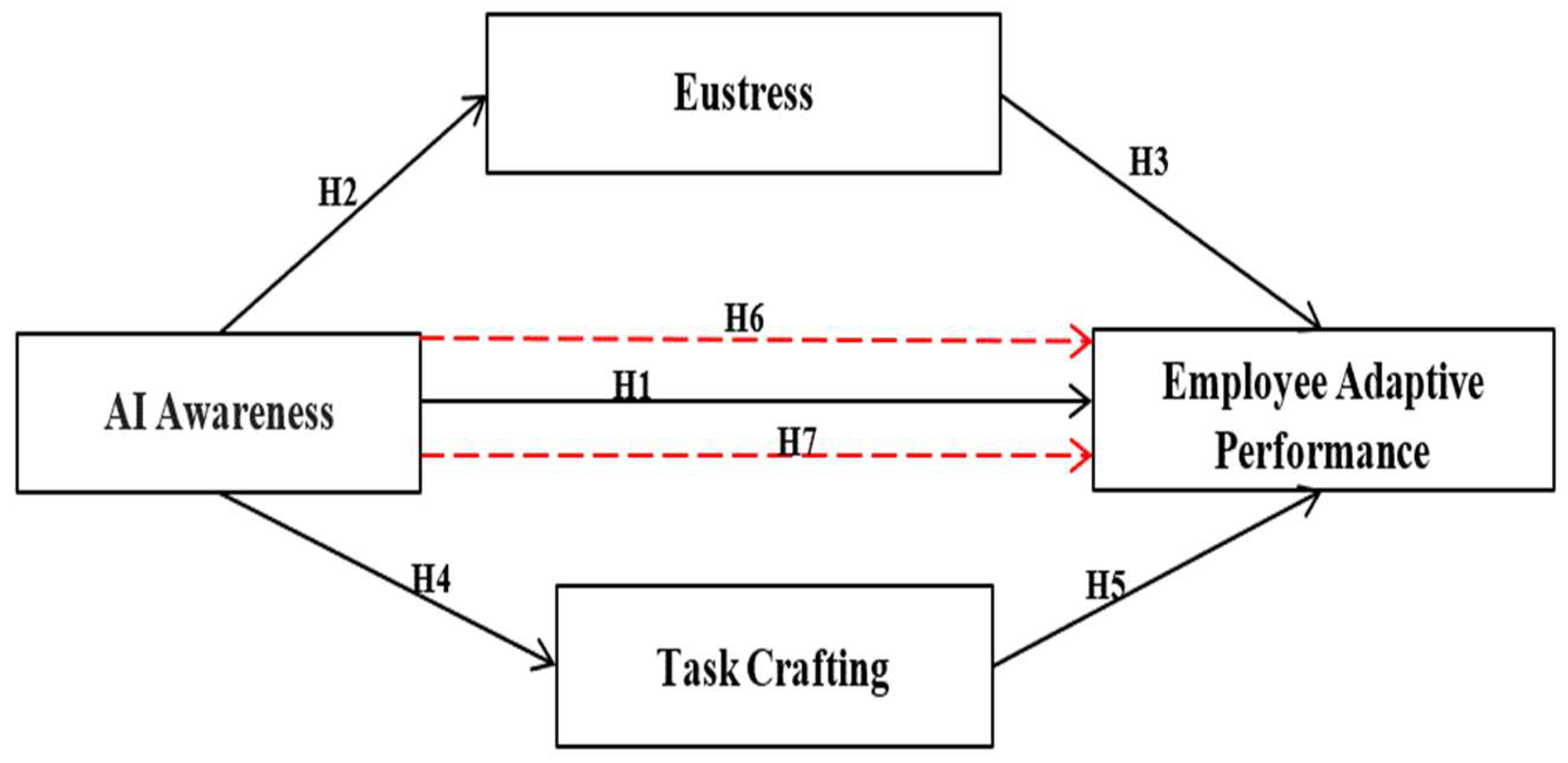
The theoretical framework of the study is illustrated below in
Figure 1.
3. Methodology
3.1. Survey Instrument and Measurement
The research employed a structured survey divided into two main sections. The first section focused on the study’s latent constructs, comprising 29 measurement items [see
Table A1], while the second section gathered demographic information, including gender, age, and educational attainment. All constructs were assessed using previously validated scales adapted from the literature.
Artificial Intelligence Awareness (AIA): Measured with a four-item scale developed by Li et al. [
55].
Employee Adaptive Performance (EAP): Captured using ten items adapted from Hartline and Ferrell [
56].
Employee Eustress (EEU): Assessed through a ten-item scale based on Almazrouei [
57].
Task Crafting (TC): Evaluated using a five-item scale from Slemp and Vella-Brodrick [
58].
The questionnaire was carefully translated using a back-translation process to ensure accuracy and equivalence. Expert reviews by academics and hotel practitioners confirmed its clarity, cultural relevance, and practical suitability. Specifically, the instrument was reviewed by a panel of academic experts specializing in organizational behavior, human resource management, and hospitality studies, as well as hotel practitioners occupying supervisory and managerial roles in five-star hotels. The reviewers assessed the questionnaire in terms of item clarity, contextual appropriateness, and relevance to day-to-day hotel operations. Based on their feedback, minor wording refinements were made to improve clarity and ensure alignment with hospitality-specific terminology. All items were measured on a five-point Likert scale from 1 (“strongly disagree”) to 5 (“strongly agree”).
3.2. Sampling and Data Collection
Given the dispersed nature of five-star hotels across Egypt, a convenience sampling approach was adopted. This non-probability sampling method is commonly used in contexts where probability sampling is impractical due to logistical constraints, resource limitations, or a large, geographically scattered population. Data collection occurred between August and October 2025, targeting full-time employees of five-star hotels.
Five-star hotels were selected as the study context due to their dynamic and service-intensive work environments, which demand high levels of employee adaptability. Employees frequently handle diverse guest needs, integrate new technologies, and adjust workflows, making adaptive performance critical [
59]. Moreover, the increasing adoption of AI technologies for operations, guest services, and analytics underscores the importance of AI awareness for efficient task management [
60]. The challenging yet stimulating service environment also provides opportunities for task crafting and experiencing eustress, making luxury hotels a highly relevant setting to examine how AI awareness influences adaptive outcomes through these mechanisms.
Prior to data collection, verbal approval was obtained from hotel management and human resources departments. Questionnaires were distributed on-site, with participation being voluntary and anonymous. Respondents were assured that data would remain confidential and reported only in aggregated form. Out of 500 distributed questionnaires, 372 valid responses were received, yielding a response rate of 74.4%. According to Hair et al. [
61], a minimum respondent-to-item ratio of 10:1 is recommended; for 29 measurement items, this requires at least 290 respondents. The final sample of 372 participants thus met statistical adequacy for analysis.
To ensure adequate familiarity with the organizational environment, the study included only employees with at least one year of work experience, reflecting the view that individuals typically adapt to workplace culture within a relatively short timeframe [
62].
3.3. Data Analysis
Data were analyzed using Partial Least Squares Structural Equation Modeling [PLS-SEM], a robust multivariate technique suitable for examining complex theoretical models that combine exploratory and confirmatory approaches [
63]. PLS-SEM is particularly advantageous in hospitality research, as it effectively handles non-normal data distributions and delivers reliable results even with small to medium-sized samples [
64].
The study employed WarpPLS version 8.0 to evaluate both the measurement and structural models [
65]. This allowed for a comprehensive assessment of construct reliability, convergent and discriminant validity, and the hypothesized relationships among the variables, ensuring the robustness of the results.
4. Results
4.1. Participants’ Profile
Table 1 presents the demographic characteristics of the 372 hotel employees who participated in the study. The sample was predominantly male, with men accounting for nearly two-thirds of the respondents, while women made up a little over one-third. In terms of age, most participants were between 30 and 45 years old, representing almost half of the sample, followed by employees under 30 years of age. A smaller proportion of respondents fell within the 45 to 60 age group. Regarding educational background, the majority held an undergraduate degree, whereas about one-fifth had a high school education or lower, and fewer than one in ten possessed a postgraduate qualification.
4.2. Measurement Model
Table 2 reports the results of the psychometric evaluation of the study constructs, including indicator loadings, reliability, convergent validity, and collinearity diagnostics. For artificial intelligence awareness, all four indicators showed acceptable factor loadings, supporting the internal consistency of the construct. The composite reliability and Cronbach’s alpha values exceeded recommended thresholds [>0.70], while the average variance extracted [AVE] indicated adequate convergent validity [AVE > 0.50]. The VIF value remained within acceptable limits [<3.3], suggesting no multicollinearity concerns.
Employee adaptive performance demonstrated strong measurement properties, with all ten indicators loading satisfactorily on the construct. The high composite reliability and Cronbach’s alpha values reflect excellent internal consistency, and the AVE confirms that a substantial proportion of variance was captured by the construct. Similarly, task crafting exhibited solid psychometric characteristics, as its indicators displayed acceptable loadings alongside satisfactory reliability and convergent validity measures, with collinearity levels well below critical values. Employee eustress also met established measurement criteria. All indicators loaded adequately, and both reliability coefficients surpassed minimum standards. Although the AVE was relatively modest, it remained above the acceptable threshold, supporting convergent validity. Overall, the results indicate that all constructs in the model demonstrate adequate reliability, validity, and no collinearity issues, confirming the suitability of the measurement model for subsequent structural analysis.
Table 3 presents the correlations among the latent variables along with the square roots of the AVE displayed on the diagonal. For each construct, the square root of the AVE is greater than its correlations with other variables, providing evidence of adequate discriminant validity. This suggests that each construct captures a distinct concept within the model while remaining theoretically related to the others.
Table 4 reports the results of the discriminant validity assessment using the heterotrait–monotrait (HTMT) ratio. All HTMT values among the constructs are well below the recommended threshold of 0.90 and also meet the more conservative criterion of 0.85. These findings confirm that each latent variable is empirically different from the others, providing further support for the discriminant validity of the measurement model.
4.3. Model Fit
Table A2 summarizes the model fit and quality assessment results based on the criteria proposed by Kock [
65]. Overall, the findings indicate that the model demonstrates a satisfactory to strong fit. The average path coefficient, average R-squared, and average adjusted R-squared values were all statistically significant, confirming that the hypothesized relationships and explanatory power of the model meet recommended standards. Measures of multicollinearity, including the average block VIF and average full collinearity VIF, were well below the acceptable thresholds, suggesting that collinearity was not a concern.
The model also showed a strong overall goodness of fit, as reflected by a large Tenenhaus GoF value. In addition, indices addressing potential statistical issues—such as Simpson’s paradox, R-squared contribution, and statistical suppression—achieved ideal values, indicating stable and consistent relationships among variables. The nonlinear bivariate causality direction ratio further confirmed appropriate causal directions within the model. Residual-based measures, including SRMR and SMAR, were within acceptable limits, supporting the adequacy of model estimation. Finally, the standardized chi-squared statistic and threshold difference ratios met the recommended criteria, reinforcing the overall robustness and quality of the proposed model.
4.4. Structural Model and Hypotheses Testing
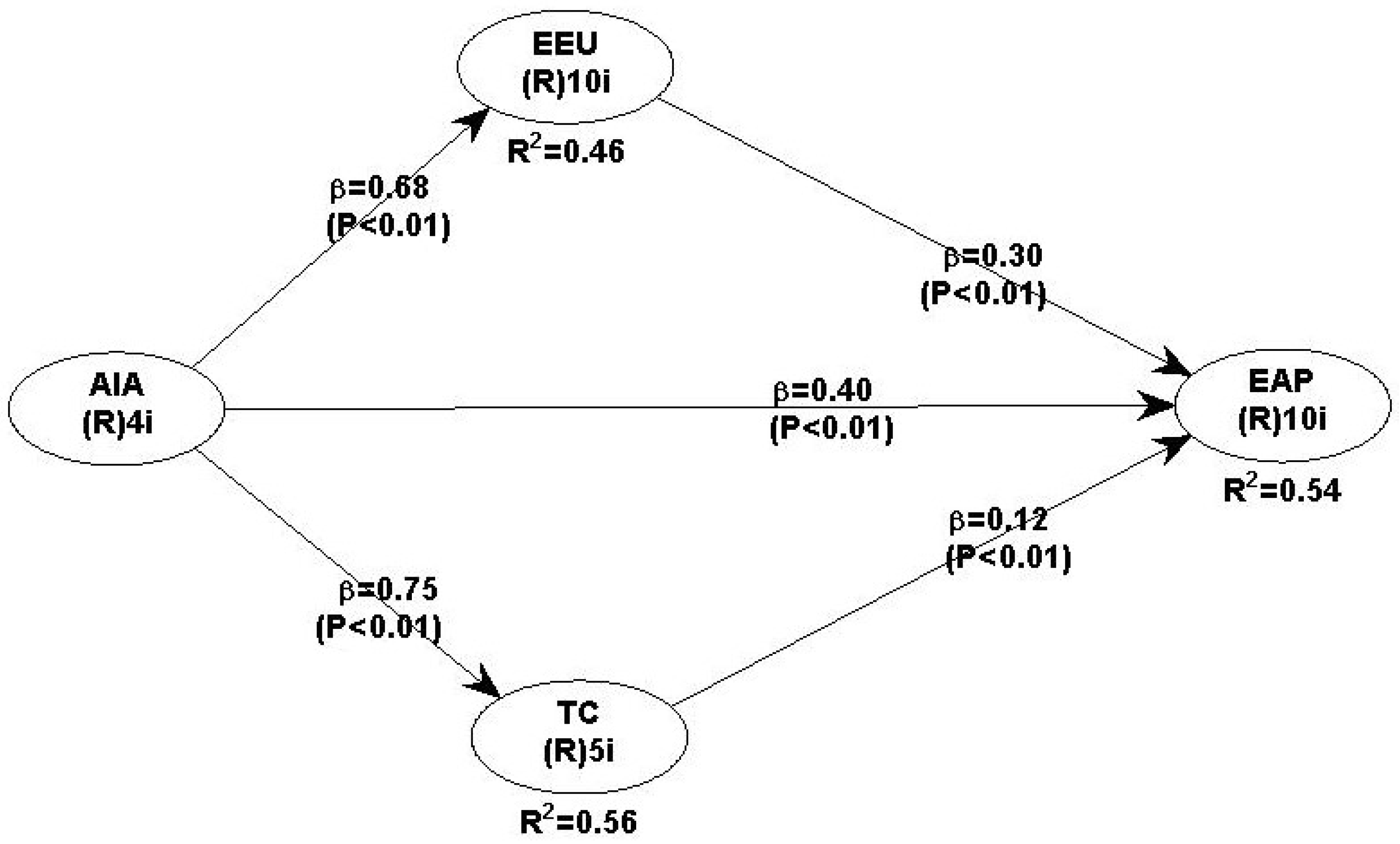
Table 5 and
Figure 2 present the results of the direct effects in the structural model, showing the strength, significance, and practical impact of the hypothesized relationships. All proposed paths are statistically significant at
p < 0.01, indicating strong empirical support for each hypothesis. Artificial intelligence awareness has a positive and meaningful effect on employee adaptive performance, with a path coefficient of β = 0.40 and a moderate effect size of f
2 = 0.276, supporting H1. This suggests that as employees’ awareness of AI increases, their ability to adapt to changing work demands improves considerably. In addition, artificial intelligence awareness exerts a strong influence on employee eustress (β = 0.68, f
2 = 0.460), providing support for H2. This large effect size indicates that AI awareness plays an important role in fostering positive, motivating stress among employees. The strongest direct relationship in the model is observed between artificial intelligence awareness and task crafting (β = 0.75, f
2 = 0.565), supporting H3 and highlighting the substantial role of AI awareness in encouraging employees to proactively modify and optimize their job tasks.
Furthermore, employee eustress has a significant positive effect on employee adaptive performance, with a path coefficient of β = 0.30 and an effect size of f2 = 0.196, supporting H4. This finding indicates that higher levels of positive stress contribute meaningfully to employees’ adaptive capabilities. Task crafting also shows a positive and statistically significant relationship with employee adaptive performance (β = 0.12, f2 = 0.071), supporting H5, although the effect size is relatively small compared to other paths in the model.
The predictive strength of the model is reinforced by the reported R2 values. Artificial intelligence awareness explains 46% of the variance in employee eustress (R2 = 0.46) and 56% of the variance in task crafting (R2 = 0.56). Collectively, artificial intelligence awareness, employee eustress, and task crafting account for 54% of the variance in employee adaptive performance (R2 = 0.54), demonstrating strong explanatory power and confirming the robustness of the structural model.
Table 6 presents the results of the mediation analysis using the bootstrapped confidence interval approach, following Preacher and Hayes [
66]. The findings indicate that both proposed indirect effects are statistically significant, supporting the hypothesized mediation relationships. For H6, employee eustress significantly mediates the relationship between artificial intelligence awareness and employee adaptive performance. The indirect effect is 0.204 with a standard error of 0.036 and a t-value of 5.667, and the 95% bootstrapped confidence interval ranges from 0.133 to 0.275, which does not include zero, confirming a significant partial mediating effect. This suggests that part of the positive impact of AI awareness on adaptive performance operates through increasing employee eustress.
Similarly, for H7, task crafting significantly mediates the relationship between artificial intelligence awareness and employee adaptive performance. The indirect effect is 0.090, with a standard error of 0.036 and a t-value of 2.500, and the 95% confidence interval ranges from 0.019 to 0.161, again excluding zero. This indicates that task crafting partially explains the effect of AI awareness on adaptive performance, highlighting that employees’ proactive adjustment of their tasks is an important mechanism in this relationship. Overall, the mediation analysis confirms that both employee eustress and task crafting serve as significant pathways through which artificial intelligence awareness enhances employee adaptive performance.
5. Discussion
This study deepens understanding of how employees’ awareness of artificial intelligence [AI] contributes to adaptive performance by explicating the motivational and behavioral mechanisms through which AI awareness operates. Grounded in Job Demands–Resources [JD-R] Theory, the findings indicate that AI awareness functions as a critical resource that enables employees to respond effectively to AI-enabled work environments by enhancing adaptive performance both directly and indirectly through eustress and task crafting.
Consistent with JD-R Theory, the positive relationship between employees’ AI awareness and adaptive performance suggests that AI awareness constitutes a valuable job-related and personal resource that supports learning, motivation, and behavioral flexibility, particularly in complex and dynamic work contexts [
67]. Employees who possess a clearer understanding of AI systems, including their capabilities and limitations, are better positioned to interpret AI as a supportive rather than disruptive element of their work. This interpretive clarity allows employees to modify established routines, acquire new skills, and adjust their behaviors in response to emerging task demands. Such findings align with prior research indicating that adaptive performance is facilitated by cognitive readiness and openness to change, particularly when employees comprehend the logic and functionality of advanced technologies [
27]. In hospitality contexts, where service encounters are characterized by high variability and unpredictability, this awareness becomes especially important for sustaining adaptive performance [
28].
The results further demonstrate that AI awareness is positively associated with employees’ experience of eustress, underscoring the importance of cognitive appraisal processes in shaping stress responses. From a JD-R perspective, job demands related to AI—such as learning new systems or interacting with algorithmic decision support—can elicit positive, challenge-oriented stress responses when employees possess sufficient resources to manage these demands [
67]. AI awareness appears to serve as such a resource by enabling employees to appraise AI-related demands as opportunities for growth and skill development rather than as sources of threat. This finding extends prior research on technology-related stress by showing that increased understanding of advanced technologies can transform potentially taxing demands into energizing challenges [
68]. Consequently, employees with higher AI awareness are more likely to experience eustress, which enhances energy, engagement, and willingness to adapt. This interpretation is consistent with emerging evidence suggesting that AI awareness buffers uncertainty and facilitates positive stress activation in AI-enabled work environments [
11,
32].
In addition to its psychological benefits, AI awareness also promotes task crafting, highlighting its role in fostering proactive work behavior. Within the JD-R framework, task crafting represents a self-initiated strategy through which employees adjust job demands and resources to better align with their capabilities and preferences [
69]. Employees with higher levels of AI awareness are more likely to recognize opportunities to integrate AI into their tasks, prompting them to redesign workflows, reallocate effort, and shift attention toward more value-adding activities. This finding is consistent with recent research suggesting that awareness of AI-related changes encourages employees to actively adapt their task structures rather than passively respond to technological implementation [
36]. Moreover, proactive behaviors such as task crafting have been identified as critical for realizing the performance benefits of AI in organizational settings [
70,
71]. By enhancing employees’ capacity to understand and anticipate AI-driven changes, AI awareness empowers individuals to actively shape their work roles in response to evolving technological demands.
The findings further indicate that both eustress and task crafting are positively associated with adaptive performance, reinforcing their central roles in the motivational process proposed by JD-R Theory. Eustress enhances cognitive flexibility, persistence, and focus, which are essential for learning and behavioral adjustment in dynamic environments. Employees who experience eustress are more likely to approach change constructively, experiment with alternative solutions, and sustain effort in the face of challenges, all of which are core components of adaptive performance. Similarly, task crafting supports adaptive performance by enabling employees to continuously realign task demands with available resources and personal strengths [
72]. Through proactive modifications of task content and execution, employees can maintain effectiveness despite ongoing changes in role expectations and work processes. These findings align with prior research indicating that eustress serves as a performance-enhancing psychological mechanism when adequate resources are available [
38] and that greater engagement in task crafting is associated with higher levels of adaptive performance [
42,
46].
Importantly, the mediation analyses reveal that eustress and task crafting jointly explain how AI awareness translates into adaptive performance. These results provide robust support for JD-R Theory by demonstrating that AI awareness influences performance through both affective and behavioral pathways [
67]. By enhancing employees’ ability to positively appraise AI-related demands, AI awareness fosters eustress, which energizes and motivates adaptive responses. Simultaneously, AI awareness encourages proactive task adjustments through task crafting, enabling employees to modify their work in ways that better accommodate AI-driven changes. Together, these mechanisms offer a more comprehensive explanation of how employees adapt to AI-enabled work environments than models that focus on either psychological or behavioral processes in isolation.
The importance of these pathways is particularly salient in hospitality settings, where work is characterized by high variability, customer interaction, and intensive service demands. Prior research suggests that in such contexts, adaptive performance is more strongly linked to positive stress activation and proactive role adjustment than to awareness alone [
12,
50]. Awareness of AI-induced changes in workflows and performance expectations enables employees to reassess task boundaries, experiment with alternative methods, and realign their roles with emerging technological conditions [
34,
48]. By initiating these adjustments proactively, employees enhance their capacity to respond effectively to situational variability, thereby supporting sustained adaptive performance [
53].
6. Theoretical Implications
This study offers several substantive theoretical implications that extend existing understandings of employee performance in AI-enabled work environments, particularly within service-intensive contexts such as hospitality. Most notably, the findings contribute to the Job Demands–Resources [JD-R] theory by refining how cognitive resources are conceptualized in technologically dynamic settings. While prior JD-R research has traditionally emphasized structural or social resources, this study positions employees’ AI awareness as a distinct cognitive resource that shapes how technological demands are interpreted and managed. By doing so, the study advances JD-R theory beyond static job characteristics, highlighting the interpretive role of employee cognition in environments characterized by continuous technological change.
In addition, the study deepens theoretical insight into the stress–performance relationship by empirically distinguishing eustress as a functional psychological mechanism rather than treating stress as a uniformly detrimental outcome of technology use. The findings challenge dominant technostress narratives by demonstrating that AI-related demands can activate positive psychological states when employees possess sufficient cognitive resources. This nuanced perspective contributes to stress theory by reinforcing the importance of appraisal processes and by empirically validating eustress as a meaningful explanatory construct in AI-driven work contexts. Consequently, the study encourages a more differentiated theoretical treatment of stress responses within technology-oriented organizational research.
Beyond psychological mechanisms, the study also advances theory by integrating task crafting as a central behavioral pathway linking AI awareness to adaptive performance. Existing task crafting literature has largely focused on individual agency in relatively stable job environments, often without explicit consideration of advanced technologies as contextual triggers. By situating task crafting within AI-enabled hospitality settings, the study extends the theoretical scope of proactive work behavior, demonstrating how technological awareness catalyzes employees’ intentional reshaping of task boundaries. This contribution underscores the role of employees as active designers of their work roles in response to intelligent systems, rather than passive recipients of technology-driven job redesign.
Importantly, the study’s integrative model contributes to theory by jointly examining psychological and behavioral mechanisms within a single explanatory framework. Prior research has frequently addressed stress-related processes and proactive behaviors in isolation, resulting in fragmented accounts of employee adaptation under technological change. By empirically demonstrating the parallel mediating roles of eustress and task crafting, the study advances a more holistic theoretical explanation of adaptive performance. This dual-pathway approach aligns with and extends JD-R theory by illustrating how cognitive resources simultaneously activate internal psychological states and external behavioral adjustments, both of which are essential for sustained performance in dynamic environments.
Finally, the study enriches the theoretical discourse on adaptive performance by embedding it firmly within the context of AI-enabled service work. Much of the adaptive performance literature has been developed in manufacturing or knowledge-intensive settings, with limited attention to frontline service roles characterized by immediacy, variability, and emotional labor. By focusing on hospitality organizations, the study demonstrates that adaptive performance in service contexts is not merely a function of flexibility or experience, but is deeply influenced by employees’ understanding of and engagement with intelligent technologies. This contextual contribution strengthens the external validity of JD-R-based explanations and opens new theoretical avenues for examining human adaptability in increasingly intelligent service systems.
7. Practical Implications
The findings of this study offer several actionable implications for hospitality organizations seeking to enhance employee adaptive performance in AI-enabled work environments. First, the results highlight the strategic importance of developing employees’ AI awareness as a deliberate managerial intervention rather than assuming it will emerge organically through exposure to technology. Hospitality managers should move beyond basic system training and invest in structured AI awareness initiatives that explain not only how AI tools function, but also why they are introduced, how they alter work processes, and where human judgment remains essential. Such initiatives may include scenario-based workshops, role-specific AI briefings, and continuous learning modules that translate AI capabilities into practical work implications. In practical terms, this means that employees who understand how AI systems influence scheduling, service prioritization, or customer interactions are better equipped to make real-time adjustments during daily operations, such as reallocating effort during peak service hours or responding flexibly to unexpected guest demands. By strengthening employees’ interpretive understanding of AI, organizations can create the cognitive foundation necessary for adaptive performance.
Second, the mediating role of eustress underscores the need for managers to actively shape how AI-related demands are framed within the organization. Rather than presenting AI adoption as a source of control or performance surveillance, leaders should communicate AI-related changes as opportunities for skill development, service innovation, and problem-solving autonomy. Managerial communication, feedback systems, and performance discussions should emphasize challenge and growth narratives, thereby encouraging employees to appraise AI-driven demands positively. encouraging employees to appraise AI-driven demands positively. From a day-to-day management perspective, this finding suggests that moderate, positively framed performance pressure can be leveraged to enhance employee focus, learning, and problem-solving, rather than being treated solely as a risk to employee well-being. This approach suggests that stress management in AI-enabled hospitality settings should not focus exclusively on stress reduction, but also on cultivating conditions under which positive, motivating stress can emerge.
Third, the behavioral pathway identified through task crafting carries important implications for job design and supervisory practices. Analyzing the direct relationship between eustress, task crafting, and adaptive performance provides practical insight into how positively appraised work demands stimulate proactive task adjustments, which in turn enable employees to respond more effectively to changing service conditions. Hospitality organizations should allow sufficient flexibility in task execution to enable employees to adapt their roles in response to AI-driven changes. Managers can support task crafting by encouraging experimentation, legitimizing employee-initiated adjustments to workflows, and incorporating reflective discussions about task redesign into regular team meetings. Practically, this implies that employees who experience manageable challenge are more likely to reorganize tasks, adjust workflows, and experiment with improved service approaches, leading to higher adaptability without the need for constant managerial intervention. Importantly, rigid job descriptions and overly standardized service scripts may undermine the adaptive potential identified in this study, particularly in environments where AI continuously reshapes task interdependencies.
In addition, human resource practices can be directly informed by the study’s findings. Recruitment and selection processes may benefit from assessing candidates’ openness to technology, learning orientation, and capacity for proactive role adjustment. Training programs should be designed to integrate cognitive, psychological, and behavioral dimensions, combining AI literacy with stress appraisal skills and proactive work design techniques. Performance management systems can further reinforce adaptive behavior by recognizing flexibility, initiative, and effective responses to change, rather than rewarding only short-term efficiency metrics.
Finally, at a broader organizational level, the study suggests that successful AI implementation in hospitality organizations depends as much on human resource strategies as on technological sophistication. Investments in AI infrastructure should be accompanied by parallel investments in employee awareness, supportive leadership, and flexible work systems. By aligning technological deployment with human-centered management practices, hospitality organizations can leverage AI not merely as an efficiency-enhancing tool, but as a catalyst for sustained adaptive performance and service excellence.
8. Limitations and Future Research
Despite the contributions of this study, several limitations should be acknowledged, which in turn offer promising directions for future research. Recognizing these limitations is essential not only for contextualizing the findings but also for advancing scholarly inquiry on AI-enabled work environments in hospitality settings. First, the study relies on a single-sector sample drawn from hospitality organizations, which may limit the generalizability of the findings across other service or non-service contexts. While the hospitality sector provides a particularly relevant setting due to its dynamic service demands and intensive human–technology interaction, future research could examine whether the proposed relationships hold in other industries, such as healthcare, retail, or logistics, where AI adoption manifests differently. Comparative or cross-sector studies would allow researchers to assess the boundary conditions of AI awareness as a cognitive resource and to identify context-specific versus universal mechanisms.
Second, the study focuses on eustress and task crafting as mediating mechanisms, which, although theoretically grounded and empirically supported, do not exhaust the range of possible psychological and behavioral pathways linking AI awareness to adaptive performance. Future research could extend the model by incorporating additional mediators, such as learning orientation, psychological empowerment, perceived role clarity, or technology-related self-efficacy. Examining alternative or sequential mediation structures may further illuminate how cognitive resources activated by AI awareness unfold over time into performance outcomes.
Third, adaptive performance is treated as the primary outcome variable in this study, reflecting the growing importance of flexibility and responsiveness in AI-enabled service environments. However, adaptive performance represents only one dimension of employee effectiveness. Future studies could expand the outcome space by considering variables such as innovative work behavior, service creativity, job engagement, customer-oriented performance, or long-term employability. Exploring multiple outcomes simultaneously may reveal differentiated effects of AI awareness on short-term adaptability versus longer-term developmental or innovation-related outcomes.
Fourth, while demographic variables were included as control variables, they were not explicitly theorized as moderators in the current model. Future research could examine how demographic characteristics such as age, tenure, education level, or job position shape the strength of the proposed relationships. For instance, employees at different career stages may interpret AI-related demands differently, resulting in distinct stress appraisals or task crafting behaviors. Investigating such moderating effects would contribute to a more nuanced understanding of heterogeneity in employee responses to AI. In addition, the cross-sectional research design limits the ability to draw strong causal inferences regarding the dynamic processes proposed in the model. Although the theoretical logic suggests directional relationships, longitudinal or time-lagged designs would be better suited to capturing how AI awareness develops over time and how its psychological and behavioral effects evolve as employees gain experience with AI systems. Experimental or intervention-based studies could further strengthen causal claims by examining how targeted AI awareness initiatives influence stress appraisals, task crafting, and adaptive performance.
In addition, while the present study adopts a quantitative approach to examine the relationships among AI awareness, eustress, task crafting, and adaptive performance, it does not capture how employees actually use AI technologies in their day-to-day work practices. Future research could therefore employ qualitative methods, such as in-depth interviews, focus groups, or workplace observations, to explore how employees interact with AI systems, interpret AI-generated insights, and integrate these tools into task execution and problem-solving activities. Such qualitative evidence would provide richer, practice-oriented insights and complement the current findings by illuminating the micro-level processes through which AI awareness translates into adaptive performance.
Another limitation of this study relates to the reliance on self-reported survey measures, which may be subject to perceptual bias or social desirability effects. In particular, constructs such as eustress capture employees’ subjective appraisals of work-related demands rather than objectively verifiable stress levels. However, this focus on perceived experiences is theoretically consistent with the Job Demands–Resources framework, which emphasizes individuals’ cognitive and emotional interpretations of job demands as central mechanisms shaping behavior and performance. Future research could complement self-reported data with multi-source or objective indicators, such as supervisor ratings, physiological stress measures, or behavioral performance metrics, to further strengthen the robustness of the findings.
Finally, future research may benefit from incorporating organizational-level or contextual factors into the model. Leadership styles, organizational AI strategy, ethical AI practices, and perceived organizational support for technology use may condition how AI awareness translates into individual outcomes. Multilevel research designs could explore how individual-level cognitive resources interact with organizational climates to shape adaptation in AI-enabled work systems.
Author Contributions
Conceptualization, A.M.H., H.A.K., B.S.A.-R. and A.N.A.; Methodology, A.M.H., B.S.A.-R. and A.N.A.; Software, A.M.H. and H.A.K.; Validation, A.M.H.; Formal analysis, A.M.H. and H.A.K.; Investigation, A.M.H., H.A.K., B.S.A.-R. and A.N.A.; Resources, A.M.H., H.A.K., B.S.A.-R. and A.N.A.; Data curation, A.M.H., H.A.K. and A.N.A.; Writing—original draft, A.M.H., H.A.K. and B.S.A.-R.; Writing—review & editing, A.M.H., H.A.K. and B.S.A.-R.; Visualization, A.M.H., H.A.K., B.S.A.-R. and A.N.A.; Supervision, A.M.H., B.S.A.-R. and A.N.A.; Project administration, A.M.H. and A.N.A.; Funding acquisition, A.M.H. All authors have read and agreed to the published version of the manuscript.
Funding
This research was funded by the Deanship of Scientific Research, Vice Presidency for Graduate Studies and Scientific Research, King Faisal University, Saudi Arabia, grant number [KFU260021].
Institutional Review Board Statement
The study was conducted according to the guidelines of the Declaration of Helsinki and approved by the Deanship of Scientific Research Ethical Committee, King Faisal University (project number: KFU260021, date of approval: 1 November 2025).
Informed Consent Statement
Informed consent was obtained from all subjects involved in this study.
Data Availability Statement
Data are available upon request from researchers who meet the eligibility criteria. Kindly contact the first author privately through e-mail.
Conflicts of Interest
The authors declare no conflicts of interest.
Appendix A
Table A1.
Measurement scales.
Table A1.
Measurement scales.
Artificial intelligence awareness [AIA]
Li et al. [55] | AIA1 | I am worried that my work will be replaced by artificial intelligence machine |
| AIA2 | I am worried that what I do now in my job may be replaced by machines with AI and robotics |
| AIA3 | I am very pessimistic about the future of the hotel where I work, because employees may be replaced by AI systems |
| AIA4 | I am pessimistic about the future of the hotel industry as a whole, because employees may be replaced by AI systems |
| Employee Adaptive performance [EAP] [56] | EAP.1 | I knows that every customer requires a unique approach |
| EAP.2 | I can easily change to another approach when he or she feels that his or her approach is not working |
| EAP.3 | I like to experiment with different approaches |
| EAP.4 | I do not change his or her approach from one customer to another [–] |
| EAP.5 | I is very sensitive to the needs of his or her customers |
| EAP.6 | I find it difficult to adapt his or her style to certain customers [–] * |
| EAP.7 | I varies his or her approach from situation to situation |
| EAP.8 | I try to understand how one customer differs from another |
| EAP.9 | I feel confident that he or she can effectively change his or her approach when necessary |
| EAP.10 | I treat all customers pretty much the same [–] |
Task crafting (TC)
Slemp and Vella-Brodrick [58] | TC1 | I will introduce new ideas to improve my work |
| TC2 | I will change the scope or type of tasks in my job |
| TC3 | I bring in new tasks that better match my skills or interests |
| TC4 | I choose to take on extra tasks at work |
| TC5 | I prioritize task that matches my skills or interests |
Employee Eustress (EEU)
Almazrouei [57] | EEU1 | I cope effectively with stressful changes that occur in my occupational life. |
| EEU2 | I deal successfully with irritating professional hassles. |
| EEU3 | I feel that stress positively contributes to my ability to handle my occupational problems. |
| EEU4 | In general, I feel motivated by stress. |
| EEU5 | In general, I am able to successfully control the irritations in my occupational life. |
| EEU6 | In general, I fail at any occupational task when under pressure. |
| EEU7 | In general, I am unable to control the way I spend my time on my job. |
| EEU8 | When faced with occupational stress, I find that the pressure makes me more productive. |
| EEU9 | I feel that I perform better on an assignment when under occupational pressure. |
| EEU10 | I feel that stress to do a job has a positive effect on the results of my job. |
Table A2.
Model fit and quality indices Kock [
65].
Table A2.
Model fit and quality indices Kock [
65].
| | Assessment | Criterion | Mark |
|---|
| Average path coefficient (APC) | 0.449, p < 0.001 | p < 0.05 | √ |
| Average R-squared (ARS) | 0.522, p < 0.001 | p < 0.05 | √ |
| Average adjusted R-squared (AARS) | 0.520, p < 0.001 | p < 0.05 | √ |
| Average block VIF (AVIF) | 2.253 | acceptable if ≤5, ideally ≤3.3 | √ |
| Average full collinearity VIF (AFVIF) | 2.219 | acceptable if ≤5, ideally ≤3.3 | √ |
| Tenenhaus GoF (GoF) | 0.546 | small ≥ 0.1, medium ≥ 0.25, large ≥ 0.36 | √ |
| Sympson’s paradox ratio (SPR) | 1.000 | acceptable if ≥0.7, ideally =1 | √ |
| R-squared contribution ratio (RSCR) | 1.000 | acceptable if ≥0.9, ideally =1 | √ |
| Statistical suppression ratio (SSR) | 1.000 | acceptable if ≥0.7 | √ |
| Nonlinear bivariate causality direction ratio (NLBCDR) | 1.000 | acceptable if ≥0.7 | √ |
| Standardized root mean squared residual (SRMR) | 0.102 | acceptable if ≤0.1 | √ |
| Standardized mean absolute residual (SMAR) | 0.089 | acceptable if ≤0.1 | √ |
| Standardized chi-squared with 779 degrees of freedom (SChS) | 15.051, p < 0.001 | p < 0.05 | √ |
| Standardized threshold difference count ratio (STDCR) | 0.916 | acceptable if ≥0.7, ideally =1 | √ |
| Standardized threshold difference sum ratio (STDSR) | 0.771 | acceptable if ≥0.7, ideally =1 | √ |
References
- Ruel, H.; Njoku, E. AI redefining the hospitality industry. J. Tour. Futures 2021, 7, 53–66. [Google Scholar]
- Alhelal, A.; Alshiha, A.; Al-Romeedy, B. Unpacking the pathways from digital leadership to competitive advantage: Mediating insights from digital skills and strategy in tourism and hospitality. Manag. Decis. 2025. ahead of print. [Google Scholar] [CrossRef]
- Schneider, A.; Subramanian, D.; Suquet, J.; Ughetto, P. Situating service work in action: A review and a pragmatist agenda for analysing interactive service work. Int. J. Manag. Rev. 2022, 24, 25–50. [Google Scholar] [CrossRef]
- Liu, S.; Cheng, P. The double-edged sword effect of artificial intelligence awareness among hotel employees. Int. J. Contemp. Hosp. Manag. 2025, 37, 997–1015. [Google Scholar] [CrossRef]
- Elfar, E. Exploring the impact of AI awareness on AI anxiety: The moderating role of perceived organizational support. Manag. Sustain. Arab. Rev. 2025. ahead of print. [Google Scholar] [CrossRef]
- Arboh, F.; Zhu, X.; Atingabili, S.; Yeboah, E.; Drokow, E. From fear to empowerment: The impact of employees AI awareness on workplace well-being–a new insight from the JD–R model. J. Health Organ. Manag. 2025. ahead of print. [Google Scholar] [CrossRef]
- Valeri, M.; Sousa, B. Human Relations Management in Tourism; IGI Global: Hershey, PA, USA, 2024. [Google Scholar]
- Rankin, A.; Lundberg, J.; Woltjer, R. A framework for learning from adaptive performance. In Resilience Engineering in Practice; CRC Press: Boca Raton, FL, USA, 2016; Volume 2, pp. 107–124. [Google Scholar]
- Do, H.; Chu, L.; Shipton, H. How and when AI-driven HRM promotes employee resilience and adaptive performance: A self-determination theory. J. Bus. Res. 2025, 192, 115279. [Google Scholar]
- Giorgi, G.; Ariza-Montes, A.; Mucci, N.; Leal-Rodríguez, A. The dark side and the light side of technology-related stress and stress related to workplace innovations: From artificial intelligence to business transformations. Int. J. Environ. Res. Public Health 2022, 19, 1248. [Google Scholar] [CrossRef]
- Chang, P.; Zhang, W.; Cai, Q.; Guo, H. Does AI-driven technostress promote or hinder employees’ artificial intelligence adoption intention? A moderated mediation model of affective reactions and technical self-efficacy. Psychol. Res. Behav. Manag. 2024, 17, 413–427. [Google Scholar] [CrossRef]
- Ahmed, H.; Fayyad, S.; Al-Romeedy, B.; Abdelghani, A. The role of STARA competencies in driving AI adoption performance in tourism and hospitality: A systematic-quantitative synthesis of dual mediation analysis of self-efficacy and Techno-Eustress. Humanities 2025, 6, 1–24. [Google Scholar]
- Leib, R.; Howard, I.; Millard, M.; Franklin, D. Behavioral motor performance. Compr. Physiol. 2024, 14, 5179–5224. [Google Scholar] [CrossRef]
- Hernaus, T.; Černe, M.; Caniëls, M. The innovative power of actual–desired misfit in task identity: The mediating role of job crafting. Ger. J. Hum. Resour. Manag. 2024, 38, 314–341. [Google Scholar]
- Ali, M.; Khan, T.; Şener, İ. Transforming hospitality: The dynamics of AI integration, customer satisfaction, and organizational readiness in enhancing firm performance. J. Hosp. Tour. Technol. 2025, 16, 911–936. [Google Scholar] [CrossRef]
- Demerouti, E.; Bakker, A. Job demands-resources theory in times of crises: New propositions. Organ. Psychol. Rev. 2023, 13, 209–236. [Google Scholar]
- Keeler, J.; Scuderi, N.; Brock Baskin, M.; Jordan, P.; Meade, L. How job resources can shape perspectives that lead to better performance: A remote worker field study. J. Organ. Eff. People Perform. 2024, 11, 825–846. [Google Scholar]
- Qin, Z.; Wang, G.; Jiang, M. Working with a Digital Human Avatar: Employee–AI Symbiosis Shapes the Double-Edged Sword Effects of Artificial Intelligence (AI) Awareness in the Hospitality Industry. Int. J. Tour. Res. 2025, 27, e70106. [Google Scholar]
- Abdul Hamid, R. The role of employees’ technology readiness, job meaningfulness and proactive personality in adaptive performance. Sustainability 2022, 14, 15696. [Google Scholar] [CrossRef]
- Al-Husain, R.A.; Jasim, T.A.; Mathew, V.; Al-Romeedy, B.S.; Khairy, H.A.; Mahmoud, H.A.; Liu, S.; El-Meligy, M.A.; Alsetoohy, O. Optimizing sustainability performance through digital dynamic capabilities, green knowledge management, and green technology innovation. Sci. Rep. 2025, 15, 24217. [Google Scholar] [CrossRef]
- Song, Y.; Qiu, X.; Liu, J. The impact of artificial intelligence adoption on organizational decision-making: An empirical study based on the technology acceptance model in business management. Systems 2025, 13, 683. [Google Scholar] [CrossRef]
- Mendy, J.; Jain, A.; Thomas, A. Artificial intelligence in the workplace–challenges, opportunities and HRM framework: A critical review and research agenda for change. J. Manag. Psychol. 2025, 40, 517–538. [Google Scholar]
- Sharif, M.; Zhang, L.; Asif, M.; Alshdaifat, S.; Hanaysha, J. Artificial intelligence and employee outcomes: Investigating the role of job insecurity and technostress in the hospitality industry. Acta Psychol. 2025, 253, 104733. [Google Scholar] [CrossRef]
- Harris, K.; Harris, R.; Valle, M.; Carlson, J.; Carlson, D.; Zivnuska, S.; Wiley, B. Technostress and the entitled employee: Impacts on work and family. Inf. Technol. People 2022, 35, 1073–1095. [Google Scholar]
- Xinlin, J.; Wenting, L.; Shah, K.; Na, M.; Shah Alam, S. Transforming hospitality decision-making: The impact of generative AI on cognitive alignment and adaptive intelligence. J. Qual. Assur. Hosp. Tour. 2025, 1–35. [Google Scholar] [CrossRef]
- Rezaei, M.; Pironti, M.; Quaglia, R. AI in knowledge sharing, which ethical challenges are raised in decision-making processes for organisations? Manag. Decis. 2025, 63, 3369–3388. [Google Scholar]
- Daugherty, P.; Wilson, H. Human+ Machine, Updated and Expanded: Reimagining Work in the Age of AI; Harvard Business Press: Brighton, MA, USA, 2024. [Google Scholar]
- Robinson, R.; Jiang, Y.; Yan, H. Tourism Workforce Resilience in Crisis: Paradox Dynamics Across Multi-Level Actors. J. Travel Res. 2025, 00472875251370385, ahead of print. [Google Scholar] [CrossRef]
- He, C.; Teng, R.; Song, J. Linking employees’ challenge-hindrance appraisals toward AI to service performance: The influences of job crafting, job insecurity and AI knowledge. Int. J. Contemp. Hosp. Manag. 2024, 36, 975–994. [Google Scholar]
- Wilkens, U. Artificial intelligence in the workplace–A double-edged sword. Int. J. Inf. Learn. Technol. 2020, 37, 253–265. [Google Scholar]
- Teoh, M.; Wang, Y.; Kwek, A. Coping with emotional labor in high stress hospitality work environments. J. Hosp. Mark. Manag. 2019, 28, 883–904. [Google Scholar] [CrossRef]
- Kong, X.; Yuan, W.; Ma, C. Service robots, artificial intelligence awareness, self-efficacy and work engagement. Manag. Decis. 2025. ahead of print. [Google Scholar] [CrossRef]
- Selenko, E.; Bankins, S.; Shoss, M.; Warburton, J.; Restubog, S. Artificial intelligence and the future of work: A functional-identity perspective. Curr. Dir. Psychol. Sci. 2022, 31, 272–279. [Google Scholar] [CrossRef]
- Murire, O. Artificial intelligence and its role in shaping organizational work practices and culture. Adm. Sci. 2024, 14, 316. [Google Scholar] [CrossRef]
- Bani-Melhem, A.; Aboelmaged, M.; Alkhatib, S. Driving service performance: The interplay of innovation and resilience in food retail supply chain. Bus. Process Manag. J. 2025. ahead of print. [Google Scholar] [CrossRef]
- Nazeer, S.; Ahmad, A. AI anxiety or job crafting? How employees’ AI perceptions reshape innovative work behaviour in Pakistan’s corporate landscape. Int. J. Sociol. Soc. Policy 2025, 45, 1187–1204. [Google Scholar] [CrossRef]
- Li, P.; Lv, Y.; Wang, R.; Chen, T.; Gao, J.; Huang, Z. How do illegitimate tasks affect hospitality employees’ adaptive performance? An explanation from the perspective of cognitive-affective system theory of personality. Int. J. Contemp. Hosp. Manag. 2024, 36, 3032–3051. [Google Scholar]
- Fettahoglu, S.; Yikilmaz, I. Reframing Technostress for Organizational Resilience: The Mediating Role of Techno-Eustress in the Performance of Accounting and Financial Reporting Professionals. Systems 2025, 13, 550. [Google Scholar] [CrossRef]
- Ren, L.; Zhang, X.; Chen, P.; Liu, Q. The impact of empowering leadership on employee improvisation: Roles of challenge-hindrance stress and psychological availability. Psychol. Res. Behav. Manag. 2022, 15, 2783–2801. [Google Scholar] [CrossRef] [PubMed]
- Faiz, S.; Safdar, S.; Mubarak, N. Impact of thriving at work on eustress and distress: Career growth as mediator. Eur. J. Train. Dev. 2022, 46, 178–193. [Google Scholar]
- Park, S.; Park, S. Employee adaptive performance and its antecedents: Review and synthesis. Hum. Resour. Dev. Rev. 2019, 18, 294–324. [Google Scholar] [CrossRef]
- Costantini, A.; Demerouti, E.; Ceschi, A.; Sartori, R. Implementing job crafting behaviors: Exploring the effects of a job crafting intervention based on the theory of planned behavior. J. Appl. Behav. Sci. 2022, 58, 477–512. [Google Scholar]
- Şişu, J.; Tîrnovanu, A.; Mujaya, N.; Ito, S.; Obreja, M. The Role of Digital Solutions in Enhancing Organizational Efficiency. Rev. De Manag. Comp. Int. 2024, 25, 764–774. [Google Scholar]
- Hur, W.; Shin, Y. Service employees’ STARA awareness and proactive service performance. J. Serv. Mark. 2024, 38, 426–442. [Google Scholar] [CrossRef]
- Harju, L.; Kaltiainen, J.; Hakanen, J. The double-edged sword of job crafting: The effects of job crafting on changes in job demands and employee well-being. Hum. Resour. Manag. 2021, 60, 953–968. [Google Scholar]
- Park, Y.; Lim, D.; Kim, W.; Kang, H. Organizational support and adaptive performance: The revolving structural relationships between job crafting, work engagement, and adaptive performance. Sustainability 2020, 12, 4872. [Google Scholar] [CrossRef]
- Farrow, E. Mindset matters: How mindset affects the ability of staff to anticipate and adapt to Artificial Intelligence (AI) future scenarios in organisational settings. AI Soc. 2021, 36, 895–909. [Google Scholar] [CrossRef] [PubMed]
- Oliveira, P.; Carvalho, J.; Faria, S. AI Integration in Organisational Workflows: A Case Study on Job Reconfiguration, Efficiency, and Workforce Adaptation. Information 2025, 16, 764. [Google Scholar] [CrossRef]
- Acquah, A.; Chen, H. The impact of workplace stress management in a business organisation in the service industries–A Case Study on Kingstel Hotel Limited-Takoradi, Ghana. Int. J. Sci. Res. Sci. Eng. Technol. 2021, 8, 240–275. [Google Scholar] [CrossRef]
- Tan, K.; Yeap, P.; Cheong, K.; Loganathan, S. Crafting an organizational strategy for the new era: A qualitative study of artificial intelligence transformation in a homegrown Singaporean hotel chain. Bus. Process Manag. J. 2025, 31, 104–123. [Google Scholar] [CrossRef]
- Tims, M.; Twemlow, M.; Fong, C. A state-of-the-art overview of job-crafting research: Current trends and future research directions. Career Dev. Int. 2022, 27, 54–78. [Google Scholar]
- He, G.; Liu, P.; Zheng, X.; Zheng, L.; Hewlin, P.; Yuan, L. Being proactive in the age of AI: Exploring the effectiveness of leaders’ AI symbolization in stimulating employee job crafting. Manag. Decis. 2023, 61, 2896–2919. [Google Scholar] [CrossRef]
- Vakola, M.; Xanthopoulou, D.; Demerouti, E. Daily job crafting and adaptive performance during organizational change: The moderating role of managers’ influence tactics. J. Appl. Behav. Sci. 2023, 59, 232–261. [Google Scholar]
- Chung, K.; Tan, P. Artificial intelligence and internet of things to improve smart hospitality services. Internet Things 2025, 31, 101544. [Google Scholar] [CrossRef]
- Li, J.J.; Bonn, M.A.; Ye, B.H. Hotel employee’s artificial intelligence and robotics awareness and its impact on turnover intention: The moderating roles of perceived organizational support and competitive psychological climate. Tour. Manag. 2019, 73, 172–181. [Google Scholar] [CrossRef]
- Hartline, M.D.; Ferrell, O.C. The management of customer-contact service employees: An empirical investigation. J. Mark. 1996, 60, 52–70. [Google Scholar] [CrossRef]
- Almazrouei, S.A.S. The Effect of Emotional Intelligence Dimensions on Enhancing Employees’ Eustress at Work. Inf. Manag. Bus. Rev. 2017, 9, 18–27. [Google Scholar]
- Slemp, G.R.; Vella-Brodrick, D.A. The job crafting questionnaire: A new scale to measure the extent to which employees engage in job crafting. Int. J. Wellbeing 2013, 3, 126–146. [Google Scholar]
- Khairy, H.A.; Fayyad, S.; El Sawy, O. AI awareness and work withdrawal in hotel enterprises: Unpacking the roles of psychological contract breach, job crafting, and resilience. Curr. Issues Tour. 2025, 1–21. [Google Scholar] [CrossRef]
- Salama, W.M.; Khairy, H.A.; Mansour, A.A.; Alrefae, W.M.; Afify, S.M.; Shehadat, A.T.A. How AI awareness drives employee intention to leave in hotels: The mediating roles of job burnout and psychological contract breach. Geo J. Tour. Geosites 2025, 60, 1206–1220. [Google Scholar] [CrossRef]
- Hair, J.F.; Black, W.C.; Babin, B.J.; Anderson, R.E.; Tatham, R.L. Multivariate Data Analysis, 7th ed.; Pearson: Hoboken, NJ, USA, 2010. [Google Scholar]
- Morrison, E.W. Newcomer information seeking: Exploring types, modes, sources, and outcomes. Acad. Manag. J. 1993, 36, 557–589. [Google Scholar] [CrossRef]
- Hair, J.F., Jr.; Matthews, L.M.; Matthews, R.L.; Sarstedt, M. PLS-SEM or CB-SEM: Updated guidelines on which method to use. Int. J. Multivar. Data Anal. 2017, 1, 107–123. [Google Scholar] [CrossRef]
- Ali, F.; Rasoolimanesh, S.M.; Sarstedt, M.; Ringle, C.M.; Ryu, K. An assessment of the use of partial least squares structural equation modeling (PLS-SEM) in hospitality research. Int. J. Contemp. Hosp. Manag. 2018, 30, 514–538. [Google Scholar] [CrossRef]
- Kock, N. WarpPLS User Manual, Version 7.0; ScriptWarp Systems: Laredo, TX, USA, 2021. [Google Scholar]
- Preacher, K.J.; Hayes, A.F. Asymptotic and resampling strategies for assessing and comparing indirect effects in multiple mediator models. Behav. Res. Methods 2008, 40, 879–891. [Google Scholar] [CrossRef] [PubMed]
- Bakker, A.B.; Demerouti, E. Job demands–resources theory: Taking stock and looking forward. J. Occup. Health Psychol. 2017, 22, 273. [Google Scholar] [CrossRef]
- Mazzola, J.J.; Disselhorst, R. Should we be “challenging” employees?: A critical review and meta-analysis of the challenge-hindrance model of stress. J. Organ. Behav. 2019, 40, 949–961. [Google Scholar] [CrossRef]
- Tims, M.; Bakker, A.B. Job crafting: Towards a new model of individual job redesign. SA J. Ind. Psychol. 2010, 36, 1–9. [Google Scholar] [CrossRef]
- Parker, S.K.; Grote, G. Automation, algorithms, and beyond: Why work design matters more than ever in a digital world. Appl. Psychol. 2022, 71, 1171–1204. [Google Scholar] [CrossRef]
- Rai, A.; Constantinides, P.; Sarker, S. Editor’s comments: Next-generation digital platforms: Toward human–AI hybrids. MIS Q. 2019, 43, iii–ix. [Google Scholar] [CrossRef]
- Tims, M.; Bakker, A.B.; Derks, D. The impact of job crafting on job demands, job resources, and well-being. J. Occup. Health Psychol. 2013, 18, 230. [Google Scholar] [CrossRef]
| Disclaimer/Publisher’s Note: The statements, opinions and data contained in all publications are solely those of the individual author(s) and contributor(s) and not of MDPI and/or the editor(s). MDPI and/or the editor(s) disclaim responsibility for any injury to people or property resulting from any ideas, methods, instructions or products referred to in the content. |





 ,
,