

You are currently viewing a new version of our website. To view the old version click .

Toxins, Volume 17, Issue 12

December 2025 - 42 articles

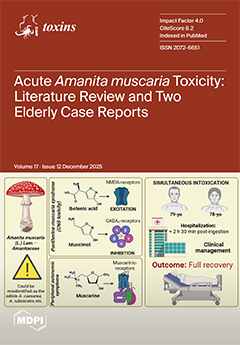
Cover Story: Amanita muscaria (fly agaric) remains an uncommon but clinically significant cause of acute mushroom poisoning, with highly variable toxic effects. This article presents a literature review of this mushroom’s biochemical makeup, toxicodynamics, and clinical manifestations—focusing on the principal toxins ibotenic acid and muscimol—and illustrates these findings through two severe intoxication cases in elderly spouses following home preparation. The cases underscore rapid-onset gastrointestinal symptoms, profound central nervous system depression, and autonomic disturbances, highlighting diagnostic and management challenges. This work emphasizes the need for heightened clinical awareness and improved toxicological preparedness. View this paper
  • Issues are regarded as officially published after their release is announced to the table of contents alert mailing list .
  • You may sign up for email alerts to receive table of contents of newly released issues.
  • PDF is the official format for papers published in both, html and pdf forms. To view the papers in pdf format, click on the "PDF Full-text" link, and use the free Adobe Reader to open them.

Articles (42)

  • Article
  • Open Access
417 Views
22 Pages

Cytotoxic Activity of the Baltic Cyanobacterium Pseudanabaena galeata CCNP1313

  • Marta Cegłowska,
  • Robert Konkel and
  • Hanna Mazur-Marzec

6 December 2025

While tropical regions have traditionally been the focus of studies on natural bioactive products, works published within the last decade demonstrate that cyanobacteria from the Baltic Sea also possess significant biotechnological and pharmaceutical...

  • Article
  • Open Access
466 Views
16 Pages

6 December 2025

Polygalae Radix, a traditional Chinese medicine for insomnia and memory disorders, is highly susceptible to fungal contamination and mycotoxin production (especially by Aspergillus flavus) during storage, compromising its safety and efficacy. Therefo...

  • Article
  • Open Access
724 Views
14 Pages

Beta Toxins Isolated from the Scorpion Centruroides hirsutipalpus (Scorpiones; Buthidae) Affect the Function of Sodium Channels of Mammals

  • Laura L. Valdez-Velazquez,
  • Timoteo Olamendi-Portugal,
  • Rita Restano-Cassulini,
  • Lidia Riaño-Umbarila,
  • Juana María Jiménez-Vargas,
  • Fernando Zamudio,
  • Hermenegildo Salazar-Monge,
  • Baltazar Becerril and
  • Lourival D. Possani

6 December 2025

Scorpion venom toxins are important peptides being studied for their clinical significance. These peptides act by binding to ion channels in the membrane of nerve cells, causing the symptoms associated with scorpion stings (scorpionism). They princip...

  • Review
  • Open Access
460 Views
17 Pages

Snake Venom PLA2 as Anticoagulant Agents: Role of Crotoxin, from Crotalus durissus Rattlesnake, in Hemostasis

  • Lisele Maria Brasileiro-Martins,
  • Greene Dias Marques,
  • Jéssica Burlamaque Maciel,
  • Márcia Neiva,
  • Thaís Pinto Nascimento,
  • David Jose Estrada Reyes,
  • Alessandro Júnio Campelo Feitosa,
  • Sofia Angiole-Cavalcante,
  • Priscila Ferreira de Aquino and
  • Jacqueline de Almeida Gonçalves Sachett
  • + 2 authors

5 December 2025

Snake venoms are rich sources of bioactive molecules that modulate hemostasis and, among these, anticoagulant snake venom phospholipases A2 (sPLA2) are found in a range of snake venoms. Crotoxin (CTX), from the Crotalus durissus rattlesnake, is a het...

  • Correction
  • Open Access
271 Views
2 Pages

Correction: Muñoz-Zavala et al. Aflatoxins in Mexican Maize Systems: From Genetic Resources to Agroecological Resilience and Co-Occurrence with Fumonisins. Toxins 2025, 17, 531

  • Carlos Muñoz-Zavala,
  • Obed Solís-Martínez,
  • Jessica Berenice Valencia-Luna,
  • Kai Sonder,
  • Ana María Hernández-Anguiano and
  • Natalia Palacios-Rojas

4 December 2025

In the original publication [...]

  • Review
  • Open Access
791 Views
26 Pages

Molecular Mechanisms of Venom Diversity

  • Marcela Akemi Ishihara,
  • Adriana Rios Lopes and
  • Milton Yutaka Nishiyama-Jr

3 December 2025

Animal venoms are valuable resources for drug discovery. They offer a wide variety of bioactive molecules with significant biotechnological potential. Venom composition shows extensive diversity not only between and within species, but also across th...

  • Article
  • Open Access
372 Views
17 Pages

2 December 2025

The increasing occurrence of harmful cyanobacterial blooms in freshwater ecosystems poses important risks to aquatic organisms and human health due to the production of bioactive secondary metabolites such as cyanopeptides. While analytical methods f...

  • Review
  • Open Access
1,050 Views
33 Pages

Ion Channel-Targeting Toxins: Structural Mechanisms of Activation, Inhibition, and Therapeutic Potential

  • Narumi Aoki-Shioi,
  • Shuhei Nomura,
  • Yasuyoshi Tanaka and
  • Shinichi Hirose

2 December 2025

Toxins as channel probes, small guanidinium alkaloids, such as tetrodotoxin and saxitoxin, canonical pore occlusion in voltage-gated Na+ channels. Cystine-rich peptides from spiders, scorpions, cone snails, and sea anemones, which act as pore blocker...

  • Review
  • Open Access
739 Views
20 Pages

Toxins and the Kidneys: A Two-Way Street

  • Louis L. Huang,
  • Anthony Longano and
  • Lawrence P. McMahon

1 December 2025

Nephrotoxin-mediated kidney injury is an important clinical problem, as it can lead to acute kidney injury and chronic kidney disease. Both entities are associated with significant morbidity, increased hospitalisation, healthcare utilisation, and car...

  • Article
  • Open Access
418 Views
23 Pages

Assessing Kidney Injury Biomarkers and OTA Exposure in Urine of Lebanese Adolescents Amid Economic Crisis and Evolving Dietary Patterns

  • Rouaa Daou,
  • Maha Hoteit,
  • Jad Chémali,
  • Nikolaos Tzenios,
  • Nassim Fares and
  • André El Khoury

30 November 2025

Although ochratoxin A (OTA) contamination has been previously reported in Lebanon, this study is the first worldwide to assess its potential impact on renal health among adolescents aged 10 to 18 years. In this cross-sectional study, the aim was to e...

of 5

Get Alerted

Add your email address to receive forthcoming issues of this journal.

XFacebookLinkedIn
Toxins - ISSN 2072-6651