Article

Cytotoxic Activity of the Baltic Cyanobacterium Pseudanabaena galeata CCNP1313


by
Marta Cegłowska
1,*,
Robert Konkel
2 and
Hanna Mazur-Marzec
2,*
1
Marine Biochemistry Laboratory, Department of Marine Chemistry, Institute of Oceanology Polish Academy of Sciences, Powstańców Warszawy 55, PL-81712 Sopot, Poland
2
Laboratory of Marine Biotechnology, Department of Marine Biology and Biotechnology, Faculty of Oceanography and Geography, University of Gdańsk, Marszałka Piłsudskiego 46, PL-81378 Gdynia, Poland
*
Authors to whom correspondence should be addressed.
Toxins 2025, 17(12), 586; https://doi.org/10.3390/toxins17120586 (registering DOI)
Submission received: 31 October 2025 / Revised: 28 November 2025 / Accepted: 4 December 2025 / Published: 6 December 2025

Abstract

While tropical regions have traditionally been the focus of studies on natural bioactive products, works published within the last decade demonstrate that cyanobacteria from the Baltic Sea also possess significant biotechnological and pharmaceutical potential. The Baltic Pseudanabaena galeata CCNP1313 previously demonstrated activity against breast cancer cell lines (MCF7 and T47D) and several viruses. In the present study, the cytotoxicity of cellular extract and flash chromatography fractions from the strain were evaluated against a wider panel of cancer cells (A549, C-33A, CaSki, DoTC2, HeLa, PC3, SiHa, and T47D). To gain better insight into the compounds potentially responsible for the observed effects, high-resolution mass spectrometry was combined with bioactivity-based molecular networking. Both the extract and hydrophobic fractions showed strong cytotoxicity, particularly against breast cancer cells and selected cervical cancer cells. While HRMS analyses confirmed the production of previously characterised peptides by CCNP1313 (Pseudanabaena galeata peptides and galeapeptins), neither of them was found to be responsible for the activity. Instead, the molecular networking approach linked the cytotoxicity to specific lipid classes, including diacylglycerols (DAGs) and monogalactosyldiacylglycerols (MGDGs). This study highlights the necessity of integrating traditional methods with advanced bioinformatics for the successful discovery of bioactive natural products, especially when complex samples, such as extract or chromatographically separated fractions, are analysed.
Key Contribution: This study highlights the cytotoxicity of Baltic cyanobacterium Pseudanabaena galeata CCNP1313 against human cancer cell lines. The activities against breast and cervical cancer cell lines were most pronounced, whereas no effects were observed in lung cancer cells. High-resolution mass spectrometry analyses combined with the bioactivity-based molecular networking of chromatographic fractions linked the observed effects with diacylglycerols and monogalactosyldiacylglycerols.

1. Introduction

A comprehensive study by Popin et al. [1] investigated the presence and phylogenetic distribution of biosynthetic gene clusters (BGCs), which are associated with the biosynthesis of natural products, in 185 cyanobacterial strains. The authors found that individual cyanobacterial genomes contain between 1 and 42 BGCs. Their analyses also revealed that 95% of these clusters were located in chromosomes, while the remaining were plasmid-encoded. Furthermore, the number of BGCs was positively correlated with genome size. For example, cyanobacteria from the Synechococcales and Chroococcales orders were characterised by the smallest genomes (average 4.04 Mb) and the lowest number of BGCs [1]. The authors also investigated two Pseudanabaena genomes (5.28 ± 0.54 Mb), identifying three BGCs in the chromosome and one in the plasmid. In comparison, the Baltic Pseudanabaena galeata CCNP1313, which has a larger genome (5.84 Mb), possesses four BGCs located in the chromosome and one in the plasmid [2].
Most studies on Pseudanabaena have focused primarily on taxonomic and morphological characterisation, while information on metabolite production remains underexplored. Only a few studies have investigated the structure and bioactivity of metabolites encoded by Pseudanabaena BGCs. Among the identified compounds there were microcystin [3,4,5,6,7], odorous 2-methylisoborneol (2-MIB) [8,9,10], and various photosynthetic and accessory pigments [11,12,13,14,15]. The highest number of secondary metabolites (sixty-three) was reported from the Baltic Pseudanabaena galeata CCNP1313, among them ‘Pseudanabaena galeata peptides’ (PGs) and ‘galeatapeptins’ (GPs) were characterised [16]. In terms of bioactivity, the phycobiliprotein extract, from P. tenuis, reduced HgCl2-induced oxidative stress and cellular damage in renal cells [17]. Extracts from two P. catenata strains (MWQ8-11A, ATCC29207) were active against herpes simplex virus type 2 (HSV-2) [18]. Furthermore, Pseudanabaena strains from Portugal were cytotoxic against several cancer cell lines [19]. The cellular extract from the Baltic P. galeata CCNP1313 exhibited strong cytotoxic activity against breast cancer cells (MCF-7), and at the same time less significant effects were observed against cervical cancer cells (HeLa) [20]. In a subsequent study, the cytotoxicity and antiviral activity of cellular extracts, chromatographic fractions, and isolated peptides from CCNP1313 against one cancer cell line (breast cancer cells T47D), human coronavirus OC43 (HCoV-OC43), West Nile Virus (WNV), and severe acute respiratory syndrome coronavirus 2 (SARS-CoV-2) were explored [16]. The samples exhibited strong cytotoxicity against T47D cells and significantly inhibited viral replication (LRV −1.7 for WNV, −2.7 for HCoV-OC43, and from −0.3 to −1.8 for SARS-CoV-2) [16].
The World Health Organization (WHO) identifies cancer as a leading cause of mortality worldwide, with lung, breast, colorectal, and prostate cancers among the most frequently diagnosed. Among women, breast and cervical cancers are particularly prevalent and constitute major contributors to cancer-related deaths. Breast cancer alone accounts for nearly one in four cancer diagnoses and one in six cancer deaths among women globally. Cervical cancer also remains a substantial global health burden, with an estimated 660,000 new cases and 350,000 deaths reported in 2022 [21]. On the other hand, among men, lung and prostate cancer are most commonly diagnosed and are leading causes of cancer-related deaths. Prostate cancer, in particular, accounted for approximately 1,466,680 new cases and 396,792 deaths worldwide in 2022 [21]. Most current treatments are associated with adverse effects; therefore, safer and more effective therapies are needed. These considerations, together with the previously reported activity of Pseudanabaena galeata CCNP1313 against breast cancer cells, encouraged us to further investigate the anticancer potential of metabolites produced by the strain. Unlike previous studies that focused primarily on cellular extracts, we aimed to assess the cytotoxicity of chromatographic fractions using a broad panel of cancer cells, including those most commonly diagnosed (lung, breast, prostate, and cervical cancer). Additionally, we sought to identify the metabolites responsible for the observed effects through bioactivity-based molecular networking.

2. Results

The flash chromatography step gradient yielded a total of twenty-six fractions designated as Fx.y, where x represents the MeOH concentration in eluting solvent and y indicates the fraction number eluted with the solvent (for example, F20%.2 stands for second fraction eluted with 20% MeOH).
In the first step of the study, the cytotoxicity of P. galeata CCNP1313 cellular extract (200 µg mL−1) against A549, C33-A, CaSki, DoTC2, HDFa, HeLa, PC3, SiHa, and T47D cells was tested. After 24 h exposure, the sample demonstrated high cytotoxicity against all cancer cells except for the A549 and DoTC2 cells (Table 1). The extract reduced the relative viability of C33-A, CaSki, HeLa, PC3, SiHa, and T47D cells by approximately 90% (Table 1). It had a similar effect on healthy cells, reducing the viability of HDFa by 92% (Table 1).
Then, the activities of twenty-six flash chromatography fractions (200 µg mL−1) were tested against the cancer cell lines identified as sensitive to the cellular extract (C-33A, CaSki, HeLa, PC3, SiHa, and T47D) and HDFa cells. In the assay, T47D, C-33A, and CaSki cells were affected by the highest number of fractions (F70%.3–100%.4, F80%.2–100%.4, and F80%.2–100%.4, respectively; Table 2). These cells also exhibited the strongest cytotoxic responses, with a reduction in the relative cell viability by 89–95% (Table 2). In contrast, fraction F100%.4 was the only fraction active against PC3 cells; however, the observed effects were mild (45% reduction of relative cell viability; Table 2). While most of the fractions from F20%.1 to F70%.1 were inactive, F20%.1 was an exception, as it significantly reduced the viability of HeLa, HDFa, and SiHa cells by 70, 61, and 53%, respectively (Table 2).
When tested over a concentration range (25–200 µg mL−1), the samples reduced the relative cell viability in a dose-dependent manner (Figures S1–S7). To quantify the effects, IC50 values were calculated. The most potent cytotoxicity against cancer cells was observed for fraction F20%.1 against HeLa cells (IC50 = 83 ± 7 µg mL−1; Table S1, Figure S8), fractions F100%2 and F100%.4 against CaSki cells (IC50 = 84 ± 6, and 92 ± 11 µg mL−1, respectively; Table S1, Figure S8), and fractions F90%.2, F100%.3, and F100%.4 against C-33A cells (IC50 = 89 ± 6, 95 ± 13, and 94 ± 5 µg mL−1, respectively; Table S1, Figure S8). Notably, the overall strongest cytotoxicity was observed for F20%.1 against HDFa cells (IC50 = 66 ± 5 µg mL−1; Table S1, Figure S8).
The contents of the flash chromatography fractions were characterised with the application of a high-resolution mass spectrometry (HRMS) system. In the samples, eight previously identified galeapeptins (GP598, GP655, GP15, GP725, GP729, GP818, GP828, and GP999) and one previously identified Pseudanabaena galeata peptide (PG638) were detected (Table 3) [16]. The peptides were present in fractions F60%.1–F100%.4 but were absent in samples from the F20%–F50% range. The highest precursor ion intensities of the peptides were observed in fractions F60%.1–F60%.3 (Table 3). PG638 was detected exclusively in fraction F60%, whereas galeapeptins were more widely distributed, with GP729 present in each of the F60%.1–F100%.4 fractions (Table 3).
To gain better insights into the compounds responsible for the cytotoxicity, statistical analyses based on the method described by Nothias et al. [22] were performed. For each cancer cell line, a score for the top thirty most probable active features, defined as Spearman’s ρ × log10(max intensity), was computed. Heatmaps of these scores revealed that some of the features, identified as being potentially the most cytotoxic, were shared across multiple cell lines (Figures S9–S15, Table 4). Two features (m/z 563.4675 and 763.4997) were associated with activity against all cancer cell lines except HeLa; at the same time the feature at m/z 763.4997 was not selected as being active against HDFa cells (Table 4). Nine of the features were linked to activity against four cancer cells and, with the exception of feature at m/z 589.4825, they were all active against C-33A, CaSki, SiHa, and T47D cells (Table 4). Notably, forty-seven features were designated as being potentially responsible for the activity against only one cancer cell line, primarily HeLa, PC3, or SiHa; at the same time only several of those were also marked as cytotoxic to HDFa cells (Table 4).
Next, the relationship between cytotoxicity and fraction composition was analysed using CaSki cells, as this cell line was one of the three exhibiting the most pronounced responses. The statistical outputs (R) were mapped onto a molecular network generated in GNPS and visualised in Cytoscape 3.10.3 (Figure S16). The Bonferroni multiple testing correction identified thirty-two features as significant (adjusted p values < 0.05; Table 5). Based on the structures they were assigned to one of three lipid classes. The features whose ESI+ MS/MS spectra were dominated by fragments directly derived from acyl chain(s), including characteristic acylium ions [RCO]+ and related alkyl/alkenyl fragments, were classified as fatty acids (FAs). If, in addition to these criteria, they exhibited neutral losses corresponding to individual acyl chains (the loss of RCOOH or the corresponding ketene; Δm consistent with the mass of the relevant FA), yielding monoacylglycerol (MAG) ions, and showed products of glycerol backbone fragmentation and complementary ion pairs following the loss of a single acyl chain, such as [M + H − R1COOH]+ and [M + H − R2COOH]+, they were classified as diacylglycerols (DAGs). Lastly, features were classified as glycolipids, mono-, and digalactosyldiacylglycerols (MGDGs, DGDGs) when they met the DAG criteria and also showed evidence of a sugar headgroup alongside a diacylglycerol core, which was confirmed by a neutral loss of the hexose unit (Δm ≈ 162.0528 Da) from the precursor. DGDG was further distinguished by the sequential loss of two hexose units (2 × 162 Da), accompanied by the presence of co-occurring DAG/MAG-like ions after the cleavage of the glycan moiety and single acyl chain.
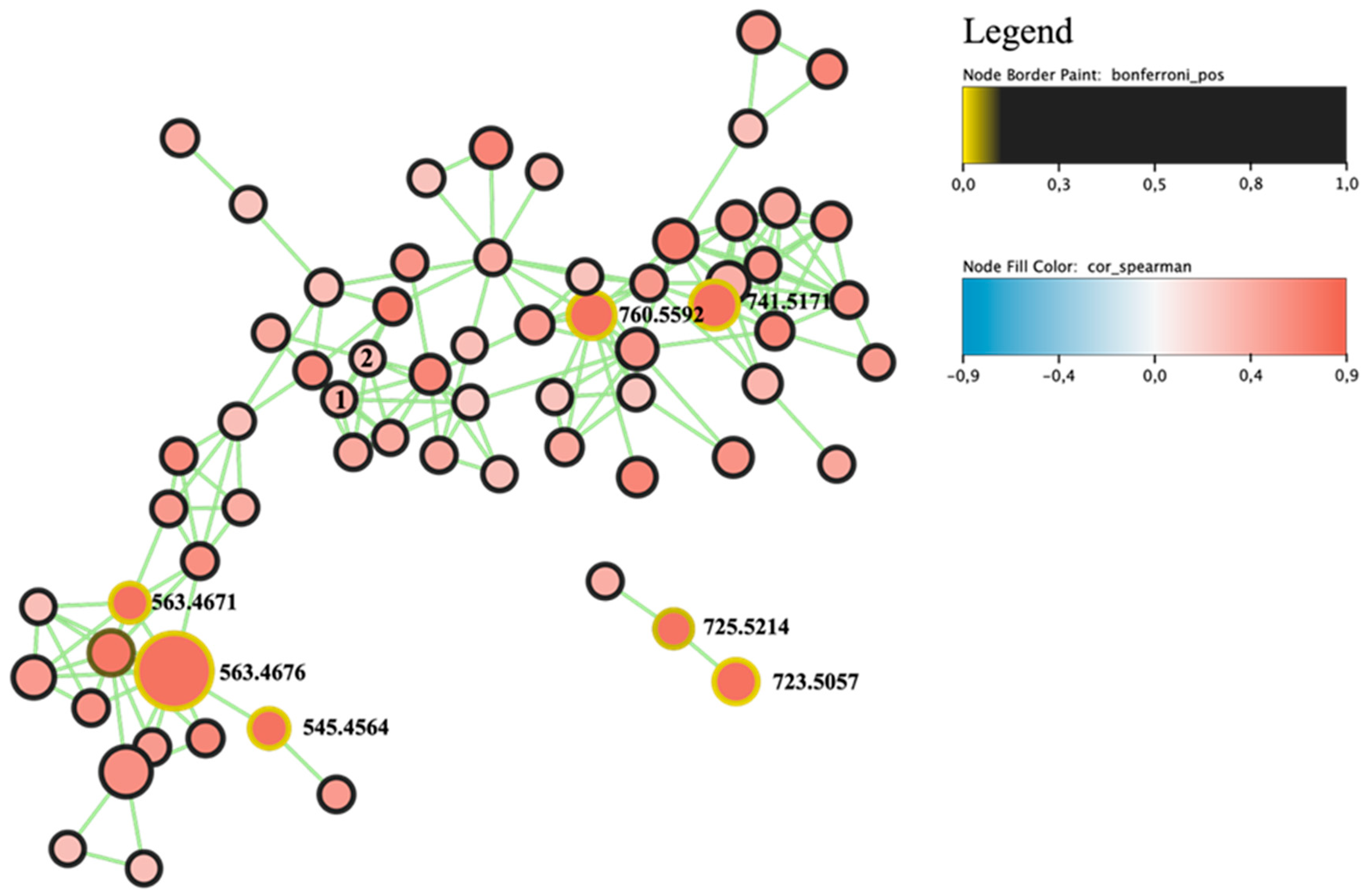
The molecular network workflow revealed two clusters that represent the most likely groups of bioactive compounds (Figure 1). The first, larger cluster comprised sixty-three nodes connected by one hundred sixty-one edges, five of which were prioritised by Bonferroni’s correction. The second, smaller cluster (three nodes, two edges), contained two significant nodes and was highly structurally similarity to the first. The remaining twenty-five significant features were either isolated nodes or part of larger, poorly correlated clusters.
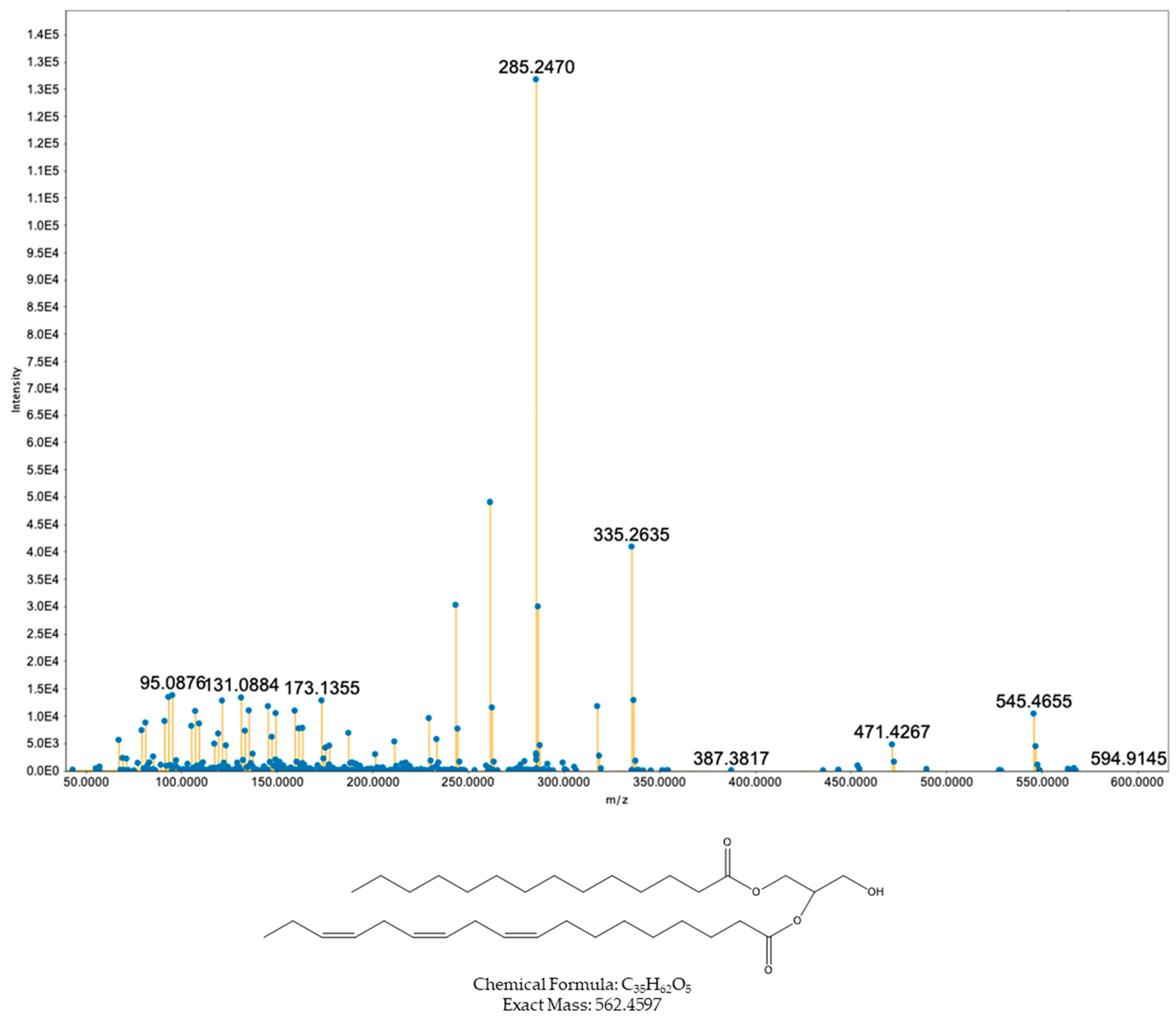
The first three nodes at m/z values 563.4671, 563.4676, and 545.4564 were assigned to the diacylglycerol species DAG (18:3/14:0) (Figure 2). This assignment is supported by the excellent agreement between the measured and calculated exact masses for a DAG bearing 18:3 and 14:0 acyl chains (mass error 0.00007 Da), and also by the diagnostic product ions. Complementary fragments are generated by neutral losses matching the free fatty acids 18:3 and 14:0 (Δm ≈ 278.2246 Da and Δm ≈ 228.2089 Da), yielding ions at ~m/z 285.24 and ~m/z 335.26 that are characteristic of DAG cleavages. In addition, a loss of the glycerol backbone was present (Δm ≈ 92.0473 Da) to give ~m/z 471.42.
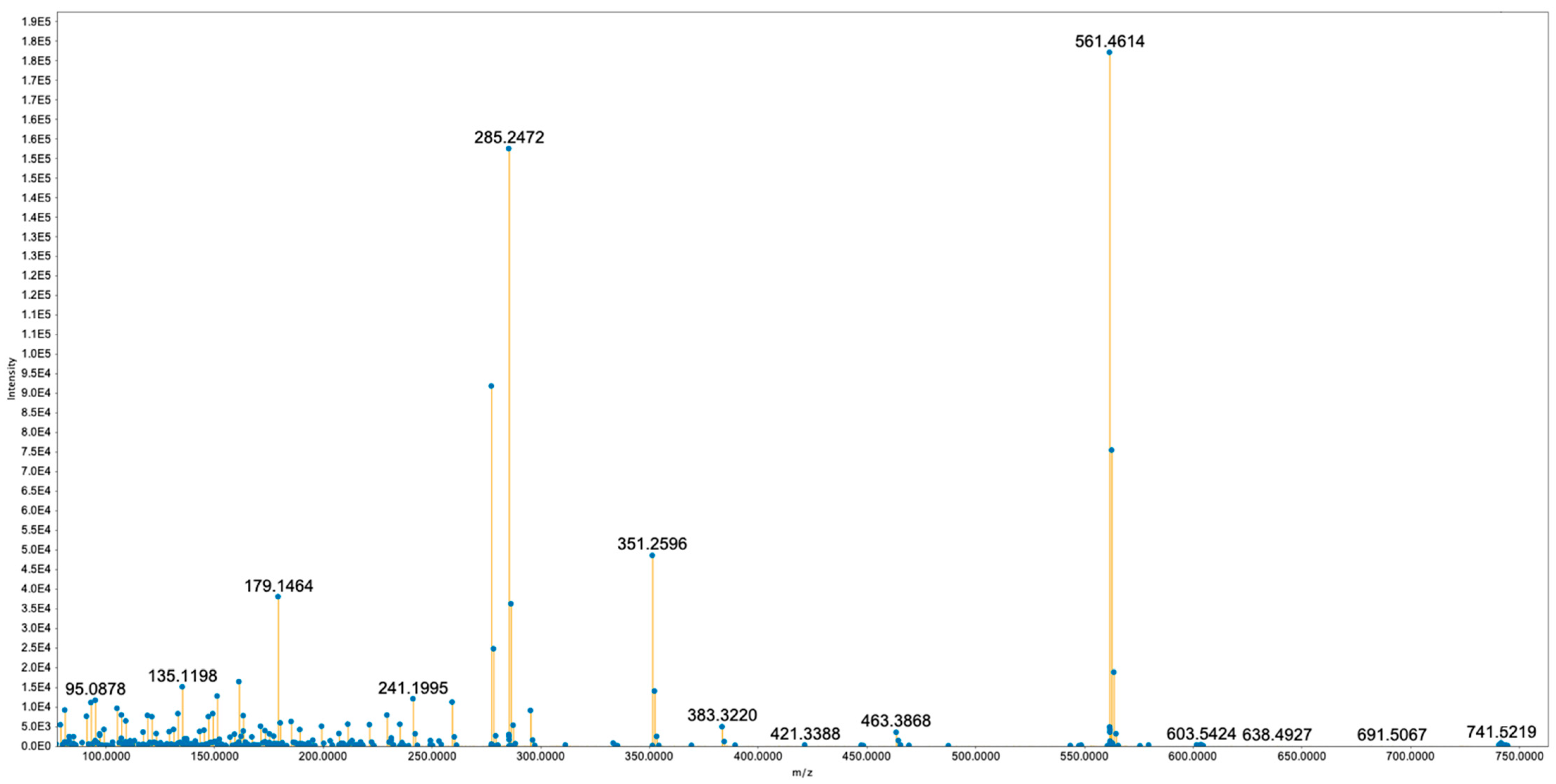
The remaining nodes at m/z values 760.5592 and 741.5171 were assigned to MGDGs (Figure 3). Their spectra display the expected DAG core series after glycosidic cleavage (Δm ≈ 162.0528 Da) together with a very intense ion at m/z ~285.247 consistent with a C18:3-derived fragment. However, the other peaks do not unambiguously support a specific identity for the second acyl chain, which prevents the precise structural annotation of these two features.
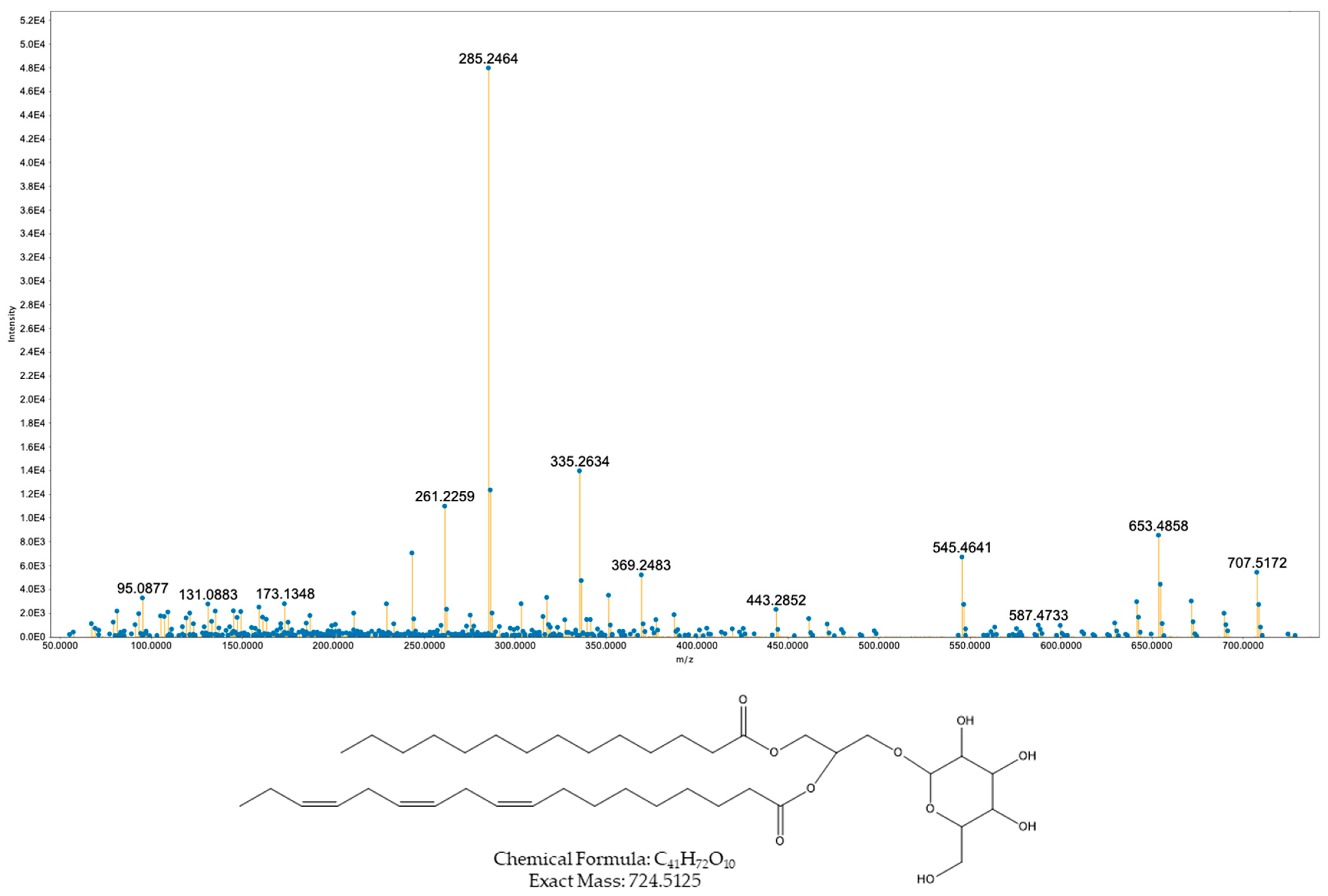
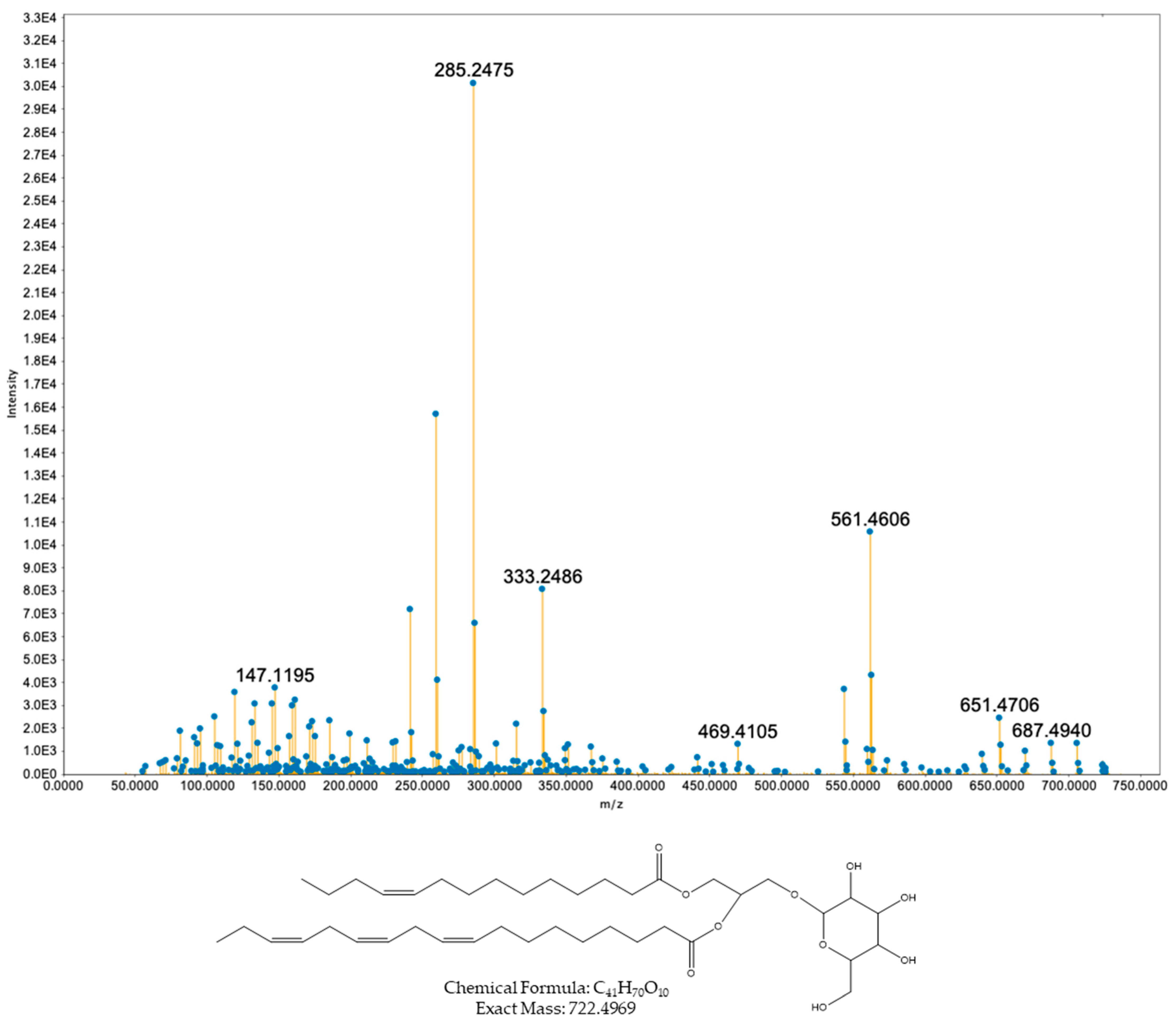
Features in the second cluster at m/z values 725.5214 and 723.5057 were assigned to MGDG (18:3/14:0) and MGDG (18:3/14:1), with mass errors of 0.0011 and 0.0010, respectively (Figure 4 and Figure 5). Both spectra show the expected glycosidic cleavage and the associated DAG core fragment series.

3. Discussion

Works published within the last decade have demonstrated that Baltic Sea cyanobacteria possess significant biotechnological and pharmaceutical potential [16,20,23,24,25,26,27,28,29,30,31,32,33,34]. In the first study on the Baltic strain CCNP1313, ethanol extract was active against MCF-7 (IC50 = 100 µg mL−1), without affecting HDFa cells. Additionally, the cytotoxic effects were determined to result from apoptosis rather than necrosis [20]. In a subsequent study, flash chromatography fractions from the same strain were highly cytotoxic to the T47D breast cancer cells, reducing its viability by more than 90%. Some of the fractions also affected HDFa cells; however, the observed effects were less pronounced (60% reduction) [16]. In the current work, the cytotoxicity of CCNP1313 was tested against a wider panel of cancer cells (A549, C-33A, CaSki, DoTC2, HeLa, PC3, SiHa, and T47D). The obtained results confirmed the activity of CCNP1313 against T47D cells and showed high cytotoxicity of the extract against four out of five cervical cancer cell lines (C-33A, CaSki, HeLa, and SiHa) and PC3 cells. Further studies were conducted with the application of the sensitive cells (C-33A, CaSki, HeLa, PC3, SiHa, and T47D) and chromatographically separated fractions. Consistent with earlier results [16], the selective cytotoxicity of hydrophobic fractions against T47D cells was observed (Table 2). The susceptibility of T47D cells to metabolites produced by Pseudanabaena has also been reported for strains isolated from Portugal [19]. The extracts additionally reduced the viability of another breast cancer cell line (SK-BR-3) [19]. While this does not indicate that the same compounds are responsible for the activity of both the Baltic and Portuguese strains, it cannot be excluded that they belong to the same class of cyanometabolites. Our study, also revealed that cervical cancer cells, primarily C-33A and CaSki, were the most sensitive to CCNP1313 fractions, while the highest selectivity was observed against PC3 cells (Table 2).
The tested fractions inhibited cancer cell growth in a dose-dependent manner (Figures S1–S7), with IC50 values against T47D cells ranging from 107 ± 18 to 200 ± 30 µg mL−1. The direct comparison of these findings with similar studies is challenging, as IC50 values are rarely reported or other cancer cell lines were used. In a few studies reporting IC50 values, the cytotoxicity of cyanobacterial material was evaluated against MCF7 or T47D cells using Spirulina subsalsa [27], Nostoc linckia [35,36], Geitlerinema carotinosum, Chroococcus minutus, Anabaena oryzae [35], and Arthrospira platensis [37]. The resulting IC50 values ranged from 27.99 to 189.45 µg mL−1. Additionally, activity against cervical cancer cells HeLa or SiHa has also been assessed, with the strongest effects (IC50 = 26.80 µg mL−1) induced by Fischerella major [37,38,39,40]. In the present study, the selectivity index for fraction F20%.1 indicates stronger cytotoxicity towards HDFa cells than towards HeLa and SiHa cells. However, it cannot be ruled out that this fraction contains more than one biologically active agent and that each of them acts on a different cell type. Therefore, the calculated IC50 values for these type of samples (i.e., extracts and fractions) do not reflect the true potency of the active components, as at this stage their concentrations are unknown. Only assays performed on the isolated pure metabolites can provide reliable information on the biological activity of natural products.
Our works have consistently demonstrated the cytotoxicity of CCNP1313 against breast and cervical cancer cells. However, identifying the active metabolites remains a significant challenge, likely because they might be synthesised in minute quantities. This was especially evident in the case of dolastatin 10, for which nearly two decades passed between the discovery of the potent cytotoxicity of the biological material and identifying the bioactive molecule [41]. Despite its adverse effects, dolastatin derivatives became the foundation for the successful development of antibody–drug conjugates (ADCs) as approved drugs (Brentuximab vedotin, Polatuzumab vedotin, Enfortumab Vedotin-ejfv, Disitamab Vedotin, Tisotumab vedotin-tftv, Telisotuzumab vedotin, and Belantamab Mafodotin-blmf) effective in the treatment of breast, cervical, ovarian, urothelial, lung, and gastric cancers, as well as lymphoma, soft tissue sarcoma, myeloma, and leukaemia (https://www.marinepharmacology.org/approved (accessed on 1 October 2025).
The success story of dolastatin, combined with the genomic data suggesting that P. galeata has the potential to synthesise bioactive compounds [2], motivates our search for molecules responsible for the observed cytotoxicity. In recent years these kinds of studies have been accelerated through the application of advanced bioinformatics tools. Here, in order to establish the relationship between the chemical composition of CCNP1313 chromatographic fractions and their cytotoxicity, molecular networking was employed. These analyses resulted in the identification of glycoglycerolipids, DAGs (m/z values 563.4671, 563.4676, and 545.4564), and MGDGs (m/z values 760.5592, 741.5171, 725.5214, and 723.5057) as the most plausible sources of bioactivity. Glycoglycerolipids constitute a major class of lipids in photosynthetic organisms such as cyanobacteria (including Pseudanabaena sp. M2) [42,43,44,45,46,47], algae [48,49,50,51], and higher plants [52,53,54]. The compounds play a fundamental role in cyanobacterial cells by forming the core lipid matrix of thylakoid membranes and ensuring the stability and efficient functioning of the photosynthetic apparatus [52]. Environmental abiotic stress factors, such as nutrient deficiency, high light intensity, or the absence of light, affect the lipid profile and their accumulation in microalgal cells [55,56,57,58,59,60]. In our efforts to enhance the biomass production of CCNP1313, we optimised the culture parameters of the strain, including growth media, light intensity, and biomass harvesting protocol. The cells are collected in the mid-exponential phase of growth prior to nutrient depletion to ensure optimal physiological conditions and maximise biomass yield. In numerous studies, the activity of glycoglycerolipids was explored [61]. A glycolipid fraction from spinach (Spinacia oleracea L.) containing MGDG, DGDG, and sulfoquinovosyl diacylglycerol (SQDG) [62], as well as purified MGDG [63], inhibited the proliferation of HeLa, A549, BALL-1 (acute lymphoblastoid leukaemia), HCT116 (colon cancer), HL60 (promyelocytic leukaemia), and NUGC-3 (stomach cancer) cells with IC50 values ranging from 39.20 to 57.20 µg mL–1. MGDG isolated from a single-celled cyanobacterium of the genera Synechocystis induced apoptosis in breast cancer cell lines (BT-474, MDA-MB-231) at IC50 = 27.20 and 150.00 ng mL−1 [47]. Additionally, MGM also demonstrated synergistic effects with gemcitabine, a commonly used anticancer drug, inhibiting the proliferation of human pancreatic cancer cells (BxPC-3, MiaPaCa-2, and PANC-1) [64]. Additionally, it has been demonstrated that certain lipids can interact with proteins to form complexes that induce apoptosis across a broad spectrum of cancer cell types without affecting healthy cells [65,66,67,68,69,70]. When tested independently, the effects of the protein were not as strong as those of the complex [69,71].
Published studies on MGDGs and DGDGs activity strongly support the results of the molecular networking performed in the current work. Molecular networking is an increasingly and successfully employed approach for identifying natural products responsible for biological activity. For example, based on this method the antiviral effects of chromatographic fractions from Euphorbia dendroides L. (Euphorbiaceae) latex (a Mediterranean tree spurge) were attributed to 4β-deoxyphorbol esters. The compounds were subsequently isolated and their activity was confirmed with in vitro methods [72]. Bioinformatics tools not only facilitate the investigation of natural products responsible for the observed bioactivity, but also significantly reduce the time and costs of the studies.

4. Conclusions

In this study, as in many investigations of microalgae, obtaining a sufficient quality of biomass for the identification of bioactive compounds is a major limiting factor. For Pseudanabaena galeata CCNP1313, approximately one year was required to collect enough material for cytotoxicity assessment, whereas even greater amounts are necessary for metabolite isolation and structural identification. Molecular networking substantially reduced the time and effort required to identify the metabolites responsible for the observed biological activity. This approach enabled the identification of lipids as the most probable cytotoxic constituents synthesised by CCNP1313. The definitive confirmation of their role in cytotoxicity will depend on the isolation of these compounds and the validation of their activity through targeted bioassays.

5. Materials and Methods

5.1. Culture Conditions, Extraction, and Fractionation of Pseudanabaena galeata CCNP1313 Metabolites

CCNP1313 (GenBank accession number MN273769) was cultured in BG11 medium [16]. Cells were harvested by centrifugation (4000× g; 15 min; 4 °C) and lyophilised. In the first step of the study, 2 g of freeze-dried material were extracted with 75% methanol (MeOH) in MilliQ water (2 × 50 mL) by vortexing (20 min) The obtained samples were combined and centrifuged (4000× g; 15 min; 4 °C).
To further assess the potential of the strain, in the second step of the study, 20 g of freeze-dried CCNP1313 cells were extracted using 75% MeOH (2 × 250 mL) by vortexing (30 min). After centrifugation, the supernatant was diluted with MilliQ water to a MeOH concentration < 10% and fractionated on a Shimadzu HPLC system (Shimadzu Corporation, Kyoto, Japan) in a 120 g SNAP KP-C18-HS column (Biotage, Uppsala, Sweden). A step gradient of increasing MeOH concentration (20–100%) in MilliQ water was used.
The initial extract and the 40 mL chromatographic fractions were placed in pre-weighed vials, concentrated in a centrifugal vacuum concentrator (MiVac, SP Scientific, Ipswich, UK), and freeze-dried.

5.2. Cell Culture and Cytotoxicity Assessment

The cytotoxicities of the extract and chromatographic fractions were tested against a panel of cancer cell lines, including lung (A549), prostate (PC3), breast (T47D) (ECACC; Merck KGaA, Darmstadt, Germany), and cervical (HeLa; ECACC; C33-A, DoTC2, SiHa, CaSki; ATCC, Manassas, VA, USA). Human dermal fibroblasts (HDFa; Cell Applications; Merck) were used as a control. A549 cells were cultured in F-12K medium, T47D and CaSki cells were cultured in RPMI medium, C-33A, PC3, HeLa, and HDFa cells were cultured in DMEM medium, and SiHa cells were cultured in IMEM medium. All cells were incubated at 37 °C (±1 °C) and 5% CO2 in media supplemented with 10% foetal bovine serum and a penicillin–streptomycin solution (100 U and 100 mg mL−1, respectively). The media and supplements were from Gibco (Thermo Fisher Scientific Inc., Waltham, MA, USA).
For cytotoxicity assessment, the MTT (3-(4,5-dimethylthiazol-2-yl)-2,5-diphenyltetrazolium-bromide) assay was employed. First, samples were tested against all cell lines (200 µg mL−1), and in a further assay only active samples were used (25–200 µg mL−1). Cells were seeded in 96-well plates in their respective media at 4 × 10³ (A549, C33-A, CaSki, DoTC2, HeLa, PC3, SiHa, and T47D) and 10 × 103 (HDFa) per well and incubated overnight (24 h; 37 °C; 5% CO2). The following day, cells were treated with samples and incubated (24 h; 37 °C; 5% CO2). Then the MTT solution (4 mg mL−1; Sigma-Aldrich, St. Louis, MO, USA) was added. After 4 h of incubation, formazan was dissolved with 100% DMSO, and absorbance was measured (Varioskan plate reader; Flash Thermo Fisher Scientific, Vantaa, Finland). In the tests, 1% DMSO served as a solvent control and 3,4-dichloroaniline (Sigma-Aldrich) as a positive control. Cell viability was calculated as the percentage of the mean absorbance of the sample relative to the mean absorbance of the solvent control. Cytotoxicity of the samples was determined in triplicate across three biologically independent experiments. Reduction in relative cell viability greater than 50% was considered significant. Statistical significance was evaluated using one-way ANOVA, with a Student’s t-test and Bonferroni’s correction. The significance level was established at p < 0.05. The IC50 values were calculated using log transformed dose–response curves.

5.3. High-Resolution Mass Spectrometry Analyses

The contents of flash chromatography fractions were analysed using a Waters Synapt XS high-resolution mass spectrometer (HRMS) coupled with an ACQUITY Premier UPLC system (Milford, MA, USA). The analytes were separated in an Acquity Premier BEH C18 column (2.1 mm × 50 mm; 1.75 µm; Waters), using a mixture of 5% acetonitrile in MilliQ water (phase A) and acetonitrile (phase B), both with formic acid (0.1%). The gradient was run at 0.4 mL min−1 from 1% to 30% B over 5 min, and then to 100% B over the subsequent 10 min. To minimise analytical bias, the sample injection order was randomised prior to analyses. Data were acquired with the MassLynx 4.2 SCN1028 software (Waters) using positive electrospray ionisation (ESI+). The ion source operated with a capillary voltage of 3.0 kV and a sampling cone voltage of 4 V. The source and desolvation temperatures were maintained at 40 °C and 490 °C, respectively. Cone and desolvation gas flow rates were 50 L h−1 and 1000 L h−1, with a nebuliser pressure of 5.2 bar. Full-scan mass spectra (m/z 100–2000) were recorded using fast data-dependent acquisition (fastDDA) with a scan time of 0.1 s. MS/MS fragmentation was performed with collision energies of 20–50 V for low-mass and 40–100 V for high-mass precursor ions. The instrument was calibrated using sodium formate, while leucine enkephalin ([M + H]+, m/z 556.2771) was used as a lock mass to ensure mass accuracy.

5.4. Mass Spectrometry Data Processing

High-resolution mass spectrometry data were first converted to the open-source .mzXML format using Waters Data Convert and subsequently imported to MZmine 4.6.1 [73] for processing. During this step, data were first filtered to remove all MS/MS fragment ions within ±17 Da of the precursor m/z, then the MS/MS spectra were filtered to retain only the top 6 fragment ions in the ±50 Da window throughout the spectrum. For the analyses, both the precursor ion mass and the MS/MS fragment ion tolerances were set to 0.02 Da. Then a molecular network was generated, using the Feature-Based Molecular Networking (FBMN) workflow [74] and the GNPS platform (Global Natural Products Social Molecular Networking; https://gnps.ucsd.edu (accessed on 19 September 2025). The edges in the network were filtered to have a cosine score greater than 0.6 and more than 6 matched peaks, and were only retained if each of the nodes appeared in the top 10 most similar nodes of the other. Then, the molecular families were limited to a maximum of 100 nodes by removing the lowest-scoring edges. Finally, the network spectra were searched against GNPS spectral libraries, which were filtered in the same manner as the input data. A match was considered valid only if it had a cosine score greater than 0.7 and at least 6 matched peaks.

5.5. Bioactivity-Based Molecular Networking Analyses

Bioactivity-based molecular networking analyses were performed using a modified workflow from Nothias et al. [72]. Briefly, cell viability data were first converted to inhibition values (100—viability) and then merged with LC–MS feature quantification tables from MZmine to allow direct correlation with metabolite intensities. For each feature, Pearson’s and Spearman’s correlation coefficients between bioactivity and log10-transformed peak intensities were calculated. To account for the relevance of the feature, an intensity-weighted score was also defined as Spearman’s rho × log10(max intensity). Subsequently, multiple testing correction was performed using both the Benjamini–Hochberg FDR and Bonferroni’s procedures. However, this analysis was restricted to features that demonstrated a positive correlation (Text S1).

5.6. Data Visualisation

Heatmaps of the top 30 ranked features were generated with the ComplexHeatmap R package 2.13.1. The heatmaps display metabolite intensities on a log10 scale (white to red) and annotate each fraction with its corresponding cell viability value, allowing for a direct comparison between chemical signal distribution and biological activity profiles. Molecular networks were visualised in Cytoscape 3.10.3 software [75] using a consistent visual style across all figures. Node sizes were assigned to the precursor signal (log10 intensity), the colour of the nodes represents Spearman’s ρ (using a diverging blue–white–red palette for negative–zero–positive association), and the borders of the nodes indicate multiple testing significance (e.g., solid border for Bonferroni-significant features). To identify the source of activity, the nodes on the GNPS map were ranked by CaSki-specific intensity-weighted score and Bonferroni’s significance, which highlighted a single, spectrally coherent subnetwork as the most plausible source of activity.

Supplementary Materials

The following supporting information can be downloaded at: https://www.mdpi.com/article/10.3390/toxins17120586/s1, Text S1: Bioactivity-Based Molecular Networking Analyses; Table S1: Inhibitory effects on cancer (C-33A, CaSki, HeLa, PC3, SiHa, T47D) and healthy (HDFa) cells exposed to flash chromatography fractions from Pseudanabaena galeata CCNP1313. The fractions are designated as Fx.y, where x represents the MeOH concentration in eluting solvent and y indicates the fraction number eluted with the solvent (for example, F20%.2 stands for second fraction eluted with 20% MeOH). Data are presented as mean IC50 values (µg mL−1) with standard deviation, 95% confidence intervals, and selectivity index for fraction F20%.1.; Figure S1: Relative cell viability of C33A cells exposed to flash chromatography fractions from Pseudanabaena galeata CCNP1313 and 3,4-dichloroaniline (3,4-DCA) (data are presented as mean values with standard deviation). The fractions are designated as Fxy, where x represents the MeOH concentration in eluting solvent and y indicates the fraction number eluted with the solvent (for example, F20%2 stands for second fraction eluted with 20% MeOH); Figure S2: Relative cell viability of CaSki cells exposed to flash chromatography fractions from Pseudanabaena galeata CCNP1313 and 3,4-dichloroaniline (3,4-DCA) (data are presented as mean values with standard deviation). The fractions are designated as Fxy, where x represents the MeOH concentration in eluting solvent and y indicates the fraction number eluted with the solvent (for example, F20%2 stands for second fraction eluted with 20% MeOH); Figure S3: Relative cell viability of HDFa cells exposed to flash chromatography fractions from Pseudanabaena galeata CCNP1313 and 3,4-dichloroaniline (3,4-DCA) (data are presented as mean values with standard deviation). The fractions are designated as Fxy, where x represents the MeOH concentration in eluting solvent and y indicates the fraction number eluted with the solvent (for example, F20%2 stands for second fraction eluted with 20% MeOH); Figure S4: Relative cell viability of HeLa cells exposed to flash chromatography fractions from Pseudanabaena galeata CCNP1313 and 3,4-dichloroaniline (3,4-DCA) (data are presented as mean values with standard deviation). The fractions are designated as Fxy, where x represents the MeOH concentration in eluting solvent and y indicates the fraction number eluted with the solvent (for example, F20%2 stands for second fraction eluted with 20% MeOH); Figure S5: Relative cell viability of PC3 cells exposed to flash chromatography fractions from Pseudanabaena galeata CCNP1313 and 3,4-dichloroaniline (3,4-DCA) (data are presented as mean values with standard deviation). The fractions are designated as Fxy, where x represents the MeOH concentration in eluting solvent and y indicates the fraction number eluted with the solvent (for example, F20%2 stands for second fraction eluted with 20% MeOH); Figure S6: Relative cell viability of SiHa cells exposed to flash chromatography fractions from Pseudanabaena galeata CCNP1313 and 3,4-dichloroaniline (3,4-DCA) (data are presented as mean values with standard deviation). The fractions are designated as Fxy, where x represents the MeOH concentration in eluting solvent and y indicates the fraction number eluted with the solvent (for example, F20%2 stands for second fraction eluted with 20% MeOH); Figure S7: Relative cell viability of T47D cells exposed to flash chromatography fractions from Pseudanabaena galeata CCNP1313 and 3,4-dichloroaniline (3,4-DCA) (data are presented as mean values with standard deviation). The fractions are designated as Fxy, where x represents the MeOH concentration in eluting solvent and y indicates the fraction number eluted with the solvent (for example, F20%2 stands for second fraction eluted with 20% MeOH); Figure S8: Dose–response curves for flash chromatography fractions from Pseudanabaena galeata CCNP1313 measured by MTT assay in C33A, CaSki, HDFa, HeLa, PC3, SiHa, and T47D cell lines. The fractions are designated as Fx.y, where x represents the MeOH concentration in eluting solvent and y indicates the fraction number eluted with the solvent (for example, F20%.2 stands for second fraction eluted with 20% MeOH); Figure S9: Heatmap of the top 30 LC–MS features correlated with cytotoxicity of Pseudanabaena galeata CCNP1313 chromatographic fractions against C-33A cells. Columns show features (m/z), rows represent fractions, and colour indicates log10 intensity (white–red). Left annotations display cell viability (%) of each of the fractions. The fractions are designated as xy, where x represents the MeOH concentration in eluting solvent and y indicates the fraction number eluted with the solvent (for example, 20%2 stands for second fraction eluted with 20% MeOH); Figure S10: Heatmap of the top 30 LC–MS features correlated with cytotoxicity of Pseudanabaena galeata CCNP1313 chromatographic fractions against CaSki cells. Columns show features (m/z), rows represent fractions, and colour indicates log10 intensity (white–red). Left annotations display cell viability (%) of each of the fractions. The fractions are designated as xy, where x represents the MeOH concentration in eluting solvent, and y indicates the fraction number eluted with the solvent (for example, 20%2 stands for second fraction eluted with 20% MeOH); Figure S11: Heatmap of the top 30 LC–MS features correlated with cytotoxicity of Pseudanabaena galeata CCNP1313 chromatographic fractions against HDFa cells. Columns show features (m/z), rows represent fractions, and colour indicates log10 intensity (white–red). Left annotations display cell viability (%) of each of the fractions. The fractions are designated as xy, where x represents the MeOH concentration in eluting solvent and y indicates the fraction number eluted with the solvent (for example, 20%2 stands for second fraction eluted with 20% MeOH); Figure S12: Heatmap of the top 30 LC–MS features correlated with cytotoxicity of Pseudanabaena galeata CCNP1313 chromatographic fractions against HeLa cells. Columns show features (m/z), rows represent fractions, and colour indicates log10 intensity (white–red). Left annotations display cell viability (%) of each of the fractions. The fractions are designated as xy, where x represents the MeOH concentration in eluting solvent and y indicates the fraction number eluted with the solvent (for example, 20%.2 stands for second fraction eluted with 20% MeOH); Figure S13: Heatmap of the top 30 LC–MS features correlated with cytotoxicity of Pseudanabaena galeata CCNP1313 chromatographic fractions against PC3 cells. Columns show features (m/z), rows represent fractions, and colour indicates log10 intensity (white–red). Left annotations display cell viability (%) of each of the fractions. The fractions are designated as xy, where x represents the MeOH concentration in eluting solvent and y indicates the fraction number eluted with the solvent (for example, 20%2 stands for second fraction eluted with 20% MeOH); Figure S14: Heatmap of the top 30 LC–MS features correlated with cytotoxicity of Pseudanabaena galeata CCNP1313 chromatographic fractions against SiHa cells. Columns show features (m/z), rows represent fractions, and colour indicates log10 intensity (white–red). Left annotations display cell viability (%) of each of the fractions. The fractions are designated as xy, where x represents the MeOH concentration in eluting solvent and y indicates the fraction number eluted with the solvent (for example, 20%2 stands for second fraction eluted with 20% MeOH); Figure S15: Heatmap of the top 30 LC–MS features correlated with cytotoxicity of Pseudanabaena galeata CCNP1313 chromatographic fractions against T47D cells. Columns show features (m/z), rows represent fractions, and colour indicates log10 intensity (white–red). Left annotations display cell viability (%) of each of the fractions. The fractions are designated as xy, where x represents the MeOH concentration in eluting solvent and y indicates the fraction number eluted with the solvent (for example, 20%2 stands for second fraction eluted with 20% MeOH); Figure S16: Molecular networking generated on the GNPS platform, where node size corresponds to the precursor intensity, node colour represents the Spearman correlation (blue—negative, white—zero, red—strong positive), and the node border indicates significance after Bonferroni’s multiple testing correction (yellow—positive, dark—negative).

Author Contributions

Conceptualization, M.C. and H.M.-M.; methodology, M.C. and R.K.; software, R.K.; formal analysis, M.C. and R.K.; investigation, M.C. and R.K.; resources, M.C. and H.M.-M.; data curation, M.C. and R.K.; writing—original draft preparation, M.C.; writing—review and editing, H.M.-M. and R.K.; visualisation, M.C. and R.K.; supervision, M.C. and H.M.-M.; project administration, M.C. and H.M.-M.; funding acquisition, H.M.-M. and M.C. All authors have read and agreed to the published version of the manuscript.

Funding

This research was funded by the National Science Centre Poland, CYANOCRAB project (2022/45/B/NZ9/02024).

Institutional Review Board Statement

Not applicable.

Informed Consent Statement

Not applicable.

Data Availability Statement

Data obtained during this study is available either in the manuscript or Supplementary Materials. Further inquiries can be directed to the corresponding authors.

Conflicts of Interest

The authors declare no conflicts of interest.

Abbreviations

The following abbreviations are used in this manuscript:
2-MIB2-methylisoborneol
A549Lung cancer cell line
ADCsAntibody–drug conjugates
BALL-1Acute lymphoblastoid leukaemia cell line
BGCsBiosynthetic gene clusters
BxPC-3Pancreatic cancer cell line
C33-ACervical cancer cell line
CaSkiCervical cancer cell line
DAGDiacylglycerol
DGDGDigalactosyldiacylglycerol
DoTC2Cervical cancer cell line
ESIElectrospray ionisation
FAFatty acid
fastDDAFast data-dependent acquisition
FBMNFeature-Based Molecular Networking
GNPSGlobal Natural Products Social Molecular Networking
GPGaleapeptin
HCoV-OC43Human coronavirus OC43
HCT116Colon cancer cell line
HDFaAdult human dermal fibroblasts
HeLaCervical cancer cell line
HL60Promyelocytic leukaemia cell line
HRMSHigh-resolution mass spectrometer
HSV-2Herpes simplex virus type 2
m/zMass to charge ratio
MAGMonoacylglycerol
MCF-7Breast cancer cell line
MeOHMethanol
MGDGMonogalactosyldiacylglycerol
MiaPaCa-2Pancreatic cancer cell line
MTT3-(4,5-dimethylthiazol-2-yl)-2,5-diphenyltetrazolium-bromide
NUGC-3Stomach cancer cell line
PANC-1Pancreatic cancer cell line
PC3Prostate cancer cell line
PGsPseudanabaena galeata peptides
SARS-CoV-2Severe acute respiratory syndrome coronavirus 2
SiHaCervical cancer cell line
SQDGSulfoquinovosyl diacylglycerol
T47DBreast cancer cell line
WNVWest Nile Virus

References

  1. Popin, R.V.; Alvarenga, D.O.; Castelo-Branco, R.; Fewer, D.P.; Sivonen, K. Mining of cyanobacterial genomes indicates natural product biosynthetic gene clusters located in conjugative plasmids. Front. Microbiol. 2021, 12, 684565. [Google Scholar] [CrossRef] [PubMed]
  2. Grabski, M.; Gawor, J.; Cegłowska, M.; Gromadka, R.; Mazur-Marzec, H.; Węgrzyn, G. Genome mining of Pseudanabaena galeata CCNP1313 indicates a new scope in the search for antiproliferative and antiviral agents. Microorganisms 2024, 12, 1628. [Google Scholar] [CrossRef]
  3. Oudra, B.; Loudiki, M.; Sbiyyaa, B.; Martins, R.; Vasconcelos, V.; Namikoshi, N. Isolation, characterization and quantification of microcystins (heptapeptides hepatotoxins) in Microcystis aeruginosa dominated bloom of Lalla Takerkoust lakereservoir (Morocco). Toxicon 2001, 39, 1375–1381. [Google Scholar] [CrossRef] [PubMed]
  4. Oudra, B.; Loudiki, M.; Vasconcelos, V.; Sabour, B.; Sbiyyaa, B.; Oufdou, K.; Mezrioui, N. Detection and quantification of microcystins from cyanobacteria strains isolated from reservoirs and ponds in Morocco. Environ. Toxicol. 2002, 17, 32–39. [Google Scholar] [CrossRef]
  5. Maršálek, B.; Bláha, L.; Babica, P. Analyses of microcystins in the biomass of Pseudanabaena limnetica collected in Znojmo reservoir. Fottea 2003, 3, 195–197. [Google Scholar]
  6. Douma, M.; Loudiki, M.; Oudra, B.; Mouhri, K.; Ouahid, Y.; del Campo, F.F. Taxonomic diversity and toxicological assessment of cyanobacteria in Moroccan inland waters. Rev. Sci. L’eau J. Water Sci. 2009, 22, 435–449. [Google Scholar] [CrossRef]
  7. Gantar, M.; Sekar, R.; Richardson, L.L. Cyanotoxins from black band disease of corals and from other coral reef environments. Microb. Ecol. 2009, 58, 856–864. [Google Scholar] [CrossRef]
  8. Wang, Z.; Xu, Y.; Shao, J.; Wang, J.; Li, R. Genes associated with 2-methylisoborneol biosynthesis in cyanobacteria: Isolation, characterization, and expression in response to light. PLoS ONE 2011, 6, e18665. [Google Scholar] [CrossRef]
  9. Kakimoto, M.; Ishikawa, T.; Miyagi, A.; Saito, K.; Miyazaki, M.; Asaeda, T.; Yamaguchi, M.; Uchimiya, H.; Kawai-Yamada, M. Culture temperature affects gene expression and metabolic pathways in the 2-methylisoborneol-producing cyanobacterium Pseudanabaena galeata. J. Plant Physiol. 2014, 171, 292–300. [Google Scholar] [CrossRef]
  10. Zhang, T.; Zheng, L.; Li, L.; Song, L. 2-Methylisoborneol production characteristics of Pseudanabaena sp. FACHB 1277 isolated from Xionghe Reservoir, China. J Appl Phycol 2016, 28, 3353–3362. [Google Scholar] [CrossRef]
  11. Zimba, P.V.; Dionigi, C.P.; Millie, D.F. Evaluating the relationship between photopigment synthesis and 2-methylisoborneol ac-cumulation in cyanobacteria. J. Phycol. 1999, 35, 1422–1429. [Google Scholar] [CrossRef]
  12. Paliwal, C.; Ghosh, T.; Bhayani, K.; Maurya, R.; Mishra, S. Antioxidant, anti-nephrolithe activities and in vitro digestibility studies of three different cyanobacterial pigment extracts. Mar. Drugs 2015, 13, 5384–5401. [Google Scholar] [CrossRef] [PubMed]
  13. Wojtasiewicz, B.; Stoń-Egiert, J. Bio-optical characterization of selected cyanobacteria strains present in marine and freshwater ecosystems. J. Appl. Phycol. 2016, 28, 2299–2314. [Google Scholar] [CrossRef]
  14. Schlüter, L.; David, G.S.; Jørgensen, N.O.G.; Poddutur, R.; Tucci, A.; Dias, A.S.; da Silva, R.J. Characterization of phytoplankton by pigment analysis and the detection of toxic cyanobacteria in reservoirs with aquaculture production. Aquac. Environ. Interact. 2018, 10, 35–48. [Google Scholar] [CrossRef]
  15. Cegłowska, M.; Toruńska-Sitarz, A.; Stoń-Egiert, J.; Mazur-Marzec, H.; Kosakowska, A. Characteristics of cyanobacterium Pseudanabaena galeata CCNP1313 from the Baltic Sea. Algal Res. 2020, 47, 101861. [Google Scholar] [CrossRef]
  16. Cegłowska, M.; Szubert, K.; Grygier, B.; Lenart, M.; Plewka, J.; Milewska, A.; Lis, K.; Szczepański, A.; Chykunova, Y.; Barreto-Duran, E.; et al. Pseudanabaena galeata CCNP1313—Biological activity and peptides production. Toxins 2022, 14, 330. [Google Scholar] [CrossRef]
  17. Cano-Europa, E.; Ortiz-Butrón, R.; Gallardo-Casas, C.A.; Blas-Valdivia, V.; Pineda-Reynoso, M.; Olvera-Ramírez, R.; Franco-Colin, M. Phycobiliproteins from Pseudanabaena tenuis rich in c-phycoerythrin protect against HgCl2-caused oxidative stress and cellular damage in the kidney. J. Appl. Phycol. 2010, 22, 495–501. [Google Scholar] [CrossRef]
  18. Patterson, G.M.L.; Baker, K.K.; Baldwin, C.L.; Bolis, C.M.; Caplan, F.R.; Larsen, L.K.; Levine, I.A.; Moore, R.E.; Moore, E.; Nelson, C.S.; et al. Antiviral activity of cultured blue-green algae (cyanophyta). J. Phycol. 1993, 29, 125–130. [Google Scholar] [CrossRef]
  19. Costa, M.; Garcia, M.; Costa-Rodrigues, J.; Costa, M.S.; Ribeiro, M.J.; Fernandes, M.H.; Barros, P.; Barreiro, A.; Vasconcelos, V.; Martins, R. Exploring bioactive properties of marine cyanobacteria isolated from the Portuguese coast: High potential as a source of anticancer compounds. Mar. Drugs 2014, 12, 98–114. [Google Scholar] [CrossRef]
  20. Felczykowska, A.; Pawlik, A.; Mazur-Marzec, H.; Toruńska-Sitarz, A.; Narajczyk, M.; Richert, M.; Węgrzyn, G.; Herman-Antosiewicz, A. Selective inhibition of cancer cells’ proliferation by compounds included in extracts from Baltic Sea cyanobacteria. Toxicon 2015, 108, 1–10. [Google Scholar] [CrossRef]
  21. Bray, F.; Laversanne, M.; Sung, H.; Ferlay, J.; Siegel, R.L.; Soerjomataram, I.; Jemal, A. Global cancer statistics 2022: GLOBOCAN estimates of incidence and mortality worldwide for 36 cancers in 185 countries. CA Cancer J. Clin. 2024, 74, 229–263. [Google Scholar] [CrossRef] [PubMed]
  22. Nothias, L.F.; Petras, D.; Schmid, R.; Dührkop, K.; Rainer, J.; Sarvepalli, A.; Protsyuk, I.; Ernst, M.; Tsugawa, H.; Fleischauer, M.; et al. Feature-based molecular networking in the GNPS analysis environment. Nat. Methods 2020, 17, 905–908. [Google Scholar] [CrossRef] [PubMed]
  23. Fewer, D.P.; Jokela, J.; Rouhiainen, L.; Wahlsten, M.; Koskenniemi, K.; Stal, L.J.; Sivonen, K. The non-ribosomal assembly and frequent occurrence of the protease inhibitors spumigins in the bloom-forming cyanobacterium Nodularia spumigena. Mol. Microbiol. 2009, 73, 924–937. [Google Scholar] [CrossRef]
  24. Jokela, J.; Oftedal, L.; Herfindal, L.; Permi, P.; Wahlsten, M.; Døskeland, S.O.; Sivonen, K. Anabaenolysins, novel cytolytic lipopeptides from benthic Anabaena cyanobacteria. PLoS ONE 2012, 7, e41222. [Google Scholar] [CrossRef]
  25. Mazur-Marzec, H.; Błaszczyk, A.; Felczykowska, A.; Hohlfeld, N.; Kobos, J.; Toruńska-Sitarz, A.; Devi, P.; Montalvão, S.; D’souza, L.; Tammela, P.; et al. Baltic cyanobacteria—A source of biologically active compounds. Eur. J. Phycol. 2015, 50, 343–360. [Google Scholar] [CrossRef]
  26. Mazur-Marzec, H.; Fidor, A.; Cegłowska, M.; Wieczerzak, E.; Kropidłowska, M.; Goua, M.; Macaskill, J.; Edwards, C. Cyanopeptolins with trypsin and chymotrypsin inhibitory activity from the cyanobacterium Nostoc edaphicum CCNP1411. Mar. Drugs 2018, 16, 220. [Google Scholar] [CrossRef]
  27. Szubert, K.; Wiglusz, M.; Mazur-Marzec, H. Bioactive metabolites produced by Spirulina subsalsa from the Baltic Sea. Oceanologia 2018, 60, 245–255. [Google Scholar] [CrossRef]
  28. Fewer, D.P.; Jokela, J.; Heinilä, L.; Aesoy, R.; Sivonen, K.; Galica, T.; Hrouzek, P.; Herfindal, L. Chemical diversity and cellular effects of antifungal cyclic lipopeptides from cyanobacteria. Physiol. Plant 2021, 173, 639–650. [Google Scholar] [CrossRef]
  29. Konkel, R.; Cegłowska, M.; Szubert, K.; Wieczerzak, E.; Iliakopoulou, S.; Kaloudis, T.; Mazur-Marzec, H. Structural diversity and biological activity of cyanopeptolins produced by Nostoc edaphicum CCNP1411. Mar. Drugs 2023, 21, 508. [Google Scholar] [CrossRef]
  30. Konkel, R.; Grabski, M.; Cegłowska, M.; Wieczerzak, E.; Węgrzyn, G.; Mazur-Marzec, H. Anabaenopeptins from Nostoc edaphicum CCNP1411. Int. J. Environ. Res. Public Health 2022, 19, 12346. [Google Scholar] [CrossRef] [PubMed]
  31. Konkel, R.; Milewska, A.; Do, N.D.T.; Barreto Duran, E.; Szczepanski, A.; Plewka, J.; Wieczerzak, E.; Iliakopoulou, S.; Kaloudis, T.; Jochmans, D.; et al. Anti-SARS-CoV-2 activity of cyanopeptolins produced by Nostoc edaphicum CCNP1411. Antivir. Res. 2023, 219, 105731. [Google Scholar] [CrossRef] [PubMed]
  32. Overlingė, D.; Cegłowska, M.; Konkel, R.; Mazur-Marzec, H. Aeruginosin 525 (AER525) from cyanobacterium Aphanizomenon Sp. (KUCC C2): A new serine proteases inhibitor. Mar. Drugs 2024, 22, 506. [Google Scholar] [CrossRef]
  33. Overlingė, D.; Toruńska-Sitarz, A.; Cegłowska, M.; Szubert, K.; Mazur-Marzec, H. Phylogenetic and molecular characteristics of two Aphanizomenon strains from the Curonian Lagoon, South-eastern Baltic Sea and their biological activities. Sci. Rep. 2024, 14, 24686. [Google Scholar] [CrossRef] [PubMed]
  34. Mazur-Marzec, H.; Grabowski, Ł.; Węgrzyn, A.; Błaszczyk, A.; Cegłowska, M.; Dąbek, P.; Farooq, M.; Górecka, E.; Jurczak-Kurek, A.; Kaczorowska, A.-K.; et al. Unlocking the biotechnological potential of Baltic microorganisms. Front. Microbiol. 2025, 16, 1682611. [Google Scholar] [CrossRef]
  35. Karan, T.; Aydin, A. Anticancer potential and cytotoxic effect of some freshwater cyanobacteria. Trop. J. Pharm. Res. 2018, 17, 2183–2188. [Google Scholar] [CrossRef]
  36. Ramadan, K.M.A.; El-Beltagi, H.S.; Shanab, S.M.M.; El-Fayoumy, E.A.; Shalaby, E.A.; Bendary, E.S.A. Potential antioxidant and anticancer activities of secondary metabolites of Nostoc linckia cultivated under Zn and Cu stress conditions. Processes 2021, 9, 1972. [Google Scholar] [CrossRef]
  37. Gheda, S.; Abd El-Zaher, E.H.F.; Abou-Zeid, A.M.; Bedair, N.A.; Pereira, L. Potential activity of Arthrospira platensis as antioxidant, cytotoxic and antifungal against some skin diseases: Topical cream application. Mar. Drugs 2023, 21, 160. [Google Scholar] [CrossRef]
  38. Bharat, N.; Irshad, M.; Rizvi, M.M.A.; Fatma, T. Antimicrobial and cytotoxic activities of cyanobacteria. Int. J. Innov. Res. Sci. Eng. Technol. 2013, 2, 4328–4343. [Google Scholar]
  39. Hrouzek, P.; Kapuścik, A.; Vacek, J.; Voráčová, K.; Paichlová, J.; Kosina, P.; Voloshko, L.; Ventura, S.; Kopecký, J. Cytotoxicity evaluation of large cyanobacterial strain set using selected human and murine in vitro cell models. Ecotoxicol. Environ. Saf. 2016, 124, 177–185. [Google Scholar] [CrossRef]
  40. Batsalova, T.; Basheva, D.; Bardarov, K.; Bardarov, V.; Dzhambazov, B.; Teneva, I. Assessment of the cytotoxicity, antioxidant activity and chemical composition of extracts from the cyanobacterium Fischerella major Gomont. Chemosphere 2019, 218, 93–103. [Google Scholar] [CrossRef]
  41. Pettit, G.R.; Kamano, Y.; Herald, C.L.; Tuinman, A.A.; Boettner, F.E.; Kizu, H.; Schmidt, J.M.; Baczynskyj, L.; Tomer, K.B.; Bontems, R.J. The isolation and structure of a remarkable marine animal antineoplastic constituent: Dolastatin 10. J. Am. Chem. Soc. 1987, 109, 6883–6885. [Google Scholar] [CrossRef]
  42. de Loura, I.C.; Dubacq, J.P.; Thomas, J.C. The effects of nitrogen deficiency on pigments and lipids of cyanobacteria. Plant Physiol. 1987, 83, 838–843. [Google Scholar] [CrossRef] [PubMed]
  43. Murakami, N.; Imamura, H.; Sakakibara, J.; Yamada, N. Seven new monogalactosyl diacylglycerols isolated from the axenic cyanobacterium Phormidium tenue. Chem. Pharm. Bull. 1990, 38, 3497–3499. [Google Scholar] [CrossRef]
  44. Kim, Y.; Choi, J.-S.; Hong, J.; Yoo, J.; Kim, M. Identification of acylated glycoglycerolipids from a cyanobacterium, Synechocystis sp., by tandem mass spectrometry. Lipids 1999, 34, 847–853. [Google Scholar] [CrossRef]
  45. Kim, Y.H.; Choi, J.-S.; Yoo, J.S.; Park, Y.-M.; Kim, M.S. Structural identification of glycerolipid molecular species isolated from cyanobacterium Synechocystis sp. PCC 6803 using fast atom bombardment tandem mass spectrometry. Anal Biochem 1999, 267, 260–270. [Google Scholar] [CrossRef]
  46. Marcolongo, G.; de Appolonia, F.; Venzo, A.; Berrie, C.P.; Carofiglio, T.; Ceschi Berrini, C. Diacylglycerolipids isolated from a thermophile cyanobacterium from the Euganean hot springs. Nat. Prod. Res. 2006, 20, 766–774. [Google Scholar] [CrossRef]
  47. Abedin, M.R.; Barua, S. Isolation and purification of glycoglycerolipids to induce apoptosis in breast cancer cells. Sci. Rep. 2021, 11, 1298. [Google Scholar] [CrossRef]
  48. Son, B.-W.; Cho, Y.-J.; Kim, N.-K.; Choi, H.-D. New glyceroglycolipids from the brown alga Sargassum thunbergii. Bull. Korean Chem. Soc. 1992, 13, 584. [Google Scholar]
  49. Mizushina, Y.; Sugiyama, Y.; Yoshida, H.; Hanashima, S.; Yamazaki, T.; Kamisuki, S.; Ohta, K.; Takemura, M.; Yamaguchi, T.; Matsukage, A.; et al. Galactosyldiacylglycerol, a mammalian DNA polymerase alpha-specific inhibitor from a sea alga, Petalonia bingbamiae. Biol. Pharm. Bull. 2001, 24, 982–987. [Google Scholar] [CrossRef]
  50. Kim, Y.; Kim, E.-H.; Lee, C.; Kim, M.-H.; Rho, J.-R. Two new monogalactosyl diacylglycerols from brown alga Sargassum thunbergii. Lipids 2007, 42, 395–399. [Google Scholar] [CrossRef]
  51. Plouguerné, E.; de Souza, L.M.; Sassaki, G.L.; Hellio, C.; Trepos, R.; da Gama, B.A.P.; Pereira, R.C. Barreto-Bergter, E. Glycoglycerolipids from Sargassum vulgare as potential antifouling agents. Front. Mar. Sci. 2020, 7, 116. [Google Scholar] [CrossRef]
  52. Hölzl, G.; Dörmann, P. Structure and function of glycoglycerolipids in plants and bacteria. Prog. Lipid Res. 2007, 46, 225–243. [Google Scholar] [CrossRef]
  53. Nakamura, Y. Galactolipid biosynthesis in flowers. Bot. Stud. 2013, 54, 29. [Google Scholar] [CrossRef]
  54. Gao, Q.M.; Yu, K.; Xia, Y.; Shine, M.B.; Wang, C.; Navarre, D.; Kachroo, A.; Kachroo, P. Mono- and digalactosyldiacylglycerol lipids function nonredundantly to regulate systemic acquired resistance in plants. Cell Rep. 2014, 9, 1681–1691. [Google Scholar] [CrossRef]
  55. Al-Hasan, R.H.; Ali, A.M.; Radwan, S.S. Effects of light and dark incubation on the lipid and fatty acid vomposition of marine cyanobacteria. Microbiology 1989, 135, 865–872. [Google Scholar] [CrossRef]
  56. Roessler, P.G. Environmental control of glycerolipid metabolism in microalgae: Commercial implications and future research directions. J. Phycol. 1990, 26, 393–399. [Google Scholar] [CrossRef]
  57. Sallal, A.K.; Nimer, N.A.; Radwan, S.S. Lipid and fatty acid composition of freshwater cyanobacteria. Microbiology 1990, 136, 2043–2048. [Google Scholar] [CrossRef]
  58. Li, Y.; Horsman, M.; Wang, B.; Wu, N.; Lan, C.Q. Effects of nitrogen sources on cell growth and lipid accumulation of green alga Neochloris oleoabundans. Appl. Microbiol. Biotechnol. 2008, 81, 629–636. [Google Scholar] [CrossRef] [PubMed]
  59. Huerlimann, R.; de Nys, R.; Heimann, K. Growth, lipid content, productivity, and fatty acid composition of tropical microalgae for scale-up production. Biotechnol. Bioeng. 2010, 107, 245–257. [Google Scholar] [CrossRef]
  60. von Alvensleben, N.; Stookey, K.; Magnusson, M.; Heimann, K. Salinity tolerance of Picochlorum atomus and the use of salinity for contamination control by the freshwater cyanobacterium Pseudanabaena limnetica. PLoS ONE 2013, 8, e63569. [Google Scholar] [CrossRef]
  61. Guo, S.S.; Wang, Z.G. Glyceroglycolipids in marine algae: A review of their pharmacological activity. Front. Pharmacol. 2022, 13, 1008797. [Google Scholar] [CrossRef]
  62. Maeda, N.; Kokai, Y.; Ohtani, S.; Sahara, H.; Hada, T.; Ishimaru, C.; Kuriyama, I.; Yonezawa, Y.; Iijima, H.; Yoshida, H.; et al. Anti-tumor effects of the glycolipids fraction from spinach which inhibited DNA polymerase activity. Nutr. Cancer 2007, 57, 216–223. [Google Scholar] [CrossRef] [PubMed]
  63. Maeda, N.; Matsubara, K.; Yoshida, H.; Mizushina, Y. Anti-cancer effect of spinach glycoglycerolipids as angiogenesis inhibitors based on the selective inhibition of DNA polymerase activity. Mini Rev. Med. Chem. 2011, 11, 32–38. [Google Scholar] [CrossRef] [PubMed]
  64. Akasaka, H.; Sasaki, R.; Yoshida, K.; Takayama, I.; Yamaguchi, T.; Yoshida, H.; Mizushina, Y. Monogalactosyl diacylglycerol, a replicative DNA polymerase inhibitor, from spinach enhances the anti-cell proliferation effect of gemcitabine in human pancreatic cancer cells. Biochim. Biophys. Acta 2013, 1830, 2517–2525. [Google Scholar] [CrossRef] [PubMed]
  65. Fischer, W.; Gustafsson, L.; Mossberg, A.K.; Gronli, J.; Mork, S.; Bjerkvig, R.; Svanborg, C. Human alpha-lactalbumin made lethal to tumor cells (HAMLET) kills human glioblastoma cells in brain xenografts by an apoptosis-like mechanism and prolongs survival. Cancer Res. 2004, 64, 2105–2112. [Google Scholar] [CrossRef]
  66. Gustafsson, L.; Leijonhufvud, I.; Aronsson, A.; Mossberg, A.K.; Svanborg, C. Treatment of skin papillomas with topical alpha-lactalbumin-oleic acid. N. Engl. J. Med. 2004, 350, 2663–2672. [Google Scholar] [CrossRef] [PubMed]
  67. Mossberg, A.K.; Wullt, B.; Gustafsson, L.; Månsson, W.; Ljunggren, E.; Svanborg, C. Bladder cancers respond to intravesical instillation of HAMLET (human alpha-lactalbumin made lethal to tumor cells). Int. J. Cancer 2007, 121, 1352–1359. [Google Scholar] [CrossRef] [PubMed]
  68. Mossberg, A.K.; Hou, Y.; Svensson, M.; Holmqvist, B.; Svanborg, C. HAMLET treatment delays bladder cancer development. J. Urol. 2010, 183, 1590–1597. [Google Scholar] [CrossRef]
  69. Tolin, S.; De Franceschi, G.; Spolaore, B.; Frare, E.; Canton, M.; Polverino de Laureto, P.; Fontana, A. The oleic acid complexes of proteolytic fragments of alpha-lactalbumin display apoptotic activity. FEBS J. 2010, 277, 163–173. [Google Scholar] [CrossRef]
  70. Fang, B.; Zhang, M.; Tian, M.; Ren, F.Z. Self-assembled β-lactoglobulin-oleic acid and β-lactoglobulin-linoleic acid complexes with antitumor activities. J. Dairy Sci. 2015, 98, 2898–28907. [Google Scholar] [CrossRef]
  71. Permyakov, S.E.; Knyazeva, E.L.; Khasanova, L.M.; Fadeev, R.S.; Zhadan, A.P.; Roche-Hakansson, H.; Håkansson, A.P.; Akatov, V.S.; Permyakov, E.A. Oleic acid is a key cytotoxic component of HAMLET-like complexes. Biol. Chem. 2012, 393, 85–92. [Google Scholar] [CrossRef] [PubMed]
  72. Nothias, L.F.; Nothias-Esposito, M.; da Silva, R.; Wang, M.; Protsyuk, I.; Zhang, Z.; Sarvepalli, A.; Leyssen, P.; Touboul, D.; Costa, J.; et al. Bioactivity-based molecular networking for the discovery of drug leads in natural product bioassay-guided fractionation. J. Nat. Prod. 2018, 81, 758–767. [Google Scholar] [CrossRef]
  73. Schmid, R.; Heuckeroth, S.; Korf, A.; Smirnov, A.; Myers, O.; Dyrlund, T.S.; Bushuiev, R.; Murray, K.J.; Hoffmann, N.; Lu, M.; et al. Integrative analysis of multimodal mass spectrometry data in MZmine 3. Nat. Biotechnol. 2023, 41, 447–449. [Google Scholar] [CrossRef] [PubMed]
  74. Wang, M.; Carver, J.J.; Phelan, V.V.; Sanchez, L.M.; Garg, N.; Peng, Y.; Nguyen, D.D.; Watrous, J.; Kapono, C.A.; Luzzatto-Knaan, T.; et al. Sharing and community curation of mass spectrometry data with global natural products social molecular networking. Nat. Biotechnol. 2016, 34, 828–837. [Google Scholar] [CrossRef] [PubMed]
  75. Shannon, P.; Markiel, A.; Ozier, O.; Baliga, N.S.; Wang, J.T.; Ramage, D.; Amin, N.; Schwikowski, B.; Ideker, T. Cytoscape: A software environment for integrated models of biomolecular interaction networks. Genome Res. 2003, 13, 2498–2504. [Google Scholar] [CrossRef] [PubMed]
Figure 1. Cluster containing compounds most likely responsible for the cytotoxicity of Pseudanabaena galeata CCNP1313 against the CaSki cell line. Node size corresponds to the precursor ion intensity, node colour represents the Spearman correlation (blue—negative, white—zero, red—strong positive), and the node border indicates significance after Bonferroni’s multiple testing correction (yellow—positive, dark—negative). For the selected features, the precursor m/z values were labelled. Features annotated in GNPS were marked as 1 and 2.
Toxins 17 00586 g001
Figure 2. MS/MS spectrum and proposed structure of compound with precursor ion m/z 563.4676 ([M + H]+) assigned as a diacylglycerol DAG (18:3/14:0; double-bond position not assigned).
Toxins 17 00586 g002
Figure 3. Spectrum of compound with precursor ion m/z 741.5219 ([M + H]+) assigned as the monogalactosyldiacylglycerol MGDG (18:3/14:0).
Toxins 17 00586 g003
Figure 4. MS/MS spectrum and proposed structure of the compound with precursor ion m/z 725.5214 ([M + H]+) assigned as a diacylglycerol, DAG (18:3/14:0; double-bond positions not assigned).
Toxins 17 00586 g004
Figure 5. MS/MS spectrum and proposed structure of the compound with precursor ion m/z 723.5057 ([M + H]+) assigned as a diacylglycerol, DAG (18:3/14:1; double-bond positions not assigned).
Toxins 17 00586 g005
Table 1. Relative cell viability of cancer cells (A549, C-33A, CaSki, DoTC2, HeLa, PC3, SiHa, and T47D) and human dermal fibroblasts (HDFas) exposed to Pseudanabaena galeata CCNP1313 cellular extract applied at 200 µg mL−1 (data presented as mean values with standard deviation). The statistical analyses were performed using a one-way ANOVA with significance against the control indicated by an asterisk for p < 0.05.
Relative Cell Viability [%]
A549C-33ACaSkiDoTC2HDFaHeLaPC3SiHaT47D
121 ± 7 *8 ± 4 *10 ± 3 *80 ± 7 *8 ± 2 *14 ± 5 *13 ± 3 *3 ± 2 *8 ± 3 *
Table 2. Relative cell viability of cancer cells (C-33A, CaSki, HeLa, PC3, SiHa, and T47D) and human dermal fibroblasts (HDFa) exposed to the Pseudanabaena galeata CCNP1313 chromatographic fractions at 200 µg mL−1 (data presented as mean values; active fractions are marked in orange). The fractions are designated as Fx.y, where x represents the MeOH concentration in eluting solvent and y indicates the fraction number eluted with the solvent (for example, F20%.2 stands for second fraction eluted with 20% MeOH). The statistical analyses were performed using a one-way ANOVA with significance against the control indicated by an asterisk for p < 0.05.
SampleRelative Cell Viability [%]
C-33ACaSkiHDFaHeLaPC3SiHaT47D
F20%.172 *66 *39 *30 *63 *7 *59 *
F20%.281 *65 *10259 *83 *9787 *
F30%.160 *9810074 *90 *121 *99
F30%.291 *86 *109 *65 *89 *114 *94 *
F40%.186 *92 *10363 *88 *114 *95 *
F40%.286 *90 *112 *71 *89 *113 *89 *
F50%.178 *90 *87 *61 *83 *120 *93 *
F50%.289 *93 *110 *72 *101121 *98
F50%.389 *98 *111 *71 *100121 *100
F60%.184 *102115 *79 *98111 *94 *
F60%.285 *101111 *71 *94 *116 *81 *
F60%.373 *96113 *80 *99122 *80 *
F70%.170 *92 *109 *86 *95 *115 *60 *
F70%.253 *80 *95 *53 *78 *94 *51 *
F70%.363 *90 *112 *78 *90 *119 *50 *
F80%.153 *81 *107 *85 *92 *117 *44 *
F80%.233 *48 *123 *75 *87 *94 *40 *
F80%.328 *41 *116 *76 *87 *73 *42 *
F80%.428 *37 *106 *76 *80 *53 *42 *
F90%.122 *22 *114 *66 *88 *79 *41 *
F90%.227 *34 *60 *68 *80 *61 *34 *
F90%.318 *16 *108 *70 *79 *38 *27 *
F100%.132 *37 *91 *85 *85 *10034 *
F100%.217 *9 *51 *48 *60 *32 *12 *
F100%.315 *8 *54 *55 *64 *19 *12 *
F100%.47 *5 *56 *29 *45 *19 *11 *
Table 3. Heatmap of galeatapeptins (GPs) and Pseudanabaena galeata peptides (PGs) detected in chromatographic fractions from Pseudanabaena galeata CCNP1313. Colour intensity (light to dark orange) represents the relative abundance of each of the peptides, calculated from the peak area of its precursor ion, and n.d. stands for not detected.
Compoundm/zFraction
F20%–F50%F60%F70%F80%F90%F100%
12312312341231234
GP598599.4133n.d.1.37 × 1045.82 × 1019.54 × 1021.32 × 103n.d.n.d.n.d.n.d.n.d.4.24 × 103n.d.n.d.n.d.n.d.n.d.n.d.n.d.
PG638639.3181n.d.1.43 × 104n.d.4.32 × 103n.d.n.d.n.d.n.d.n.d.n.d.n.d.n.d.n.d.n.d.n.d.n.d.n.d.n.d.
GP655656.8993n.d.1.53 × 104n.d.1.42 × 102n.d.n.d.n.d.n.d.n.d.n.d.1.01 × 103n.d.n.d.n.d.n.d.n.d.n.d.n.d.
GP715716.4362n.d.6.28 × 104n.d.8.06 × 104n.d.n.d.2.48 × 102n.d.2.81 × 1032.48 × 1024.87 × 1031.29 × 103n.d.n.d.n.d.n.d.n.d.n.d.
GP725726.3513n.d.1.37 × 104n.d.ndn.d.n.d.n.d.n.d.n.d.n.d.n.d.n.d.n.d.n.d.n.d.n.d.n.d.n.d.
GP729730.4509n.d.8.44 × 1045.91 × 1021.03 × 1051.10 × 1034.22 × 1033.68 × 1023.10 × 1032.29 × 1033.73 × 1026.42 × 1031.68 × 1032.88 × 1032.56 × 1031.00 × 1031.35 × 1031.31 × 1032.16 × 102
GP818819.5004n.d.n.d.n.d.7.02 × 103n.d.n.d.n.d.n.d.n.d.n.d.n.d.n.d.n.d.n.d.n.d.n.d.n.d.n.d.
GP828829.5208n.d.n.d.n.d.n.d.n.d.5.66 × 102n.d.2.75 × 1032.43 × 103n.d.1.30 × 103n.d.n.d.n.d.n.d.n.d.n.d.n.d.
GP998999.6283n.d.n.d.n.d.6.55 × 103n.d.n.d.3.16 × 1033.41 × 104n.d.2.87 × 1027.01 × 101n.d.n.d.9.63 × 102n.d.n.d.n.d.n.d.
Table 4. Top LC-MS features correlated with cytotoxic activity of Pseudanabaena galeata CCNP1313 against cancer cells (C-33A, CaSki, HeLa, PC3, SiHa, and T47D) and human dermal fibroblasts (HDFa). Features denoted as active only against HDFa cells were excluded. Compounds with identical or highly similar MS spectra were grouped together, with mass difference indicated in the brackets. A “+” indicates features identified as being responsible for the observed cytotoxicity.
m/zActivity Against
C-33ACaSkiHDFaHeLaPC3SiHaT47D
207.1361 +
219.1467 +
221.1517+ +
225.1466 +
225.1569 +
251.1622++ ++
257.1269 +
265.1417 +
277.2144 (±0.0001)+
279.2300++ ++
282.2772++ ++
285.2408 (±0.0004) ++
289.1780++
303.1321 +
309.4792 +
322.1996 +
333.2155 +
335.2178++ ++
335.2565++ +
337.2711 (±0.0004) + ++
340.2575 +
350.1525++ +
353.2172+
353.2287 (±0.0002)++ ++
391.223++ +
394.1432+ + ++
405.1667 +
407.2168 +
425.2275 +
455.1573+ +
531.3165 +
542.3255 +
545.4564++ +
547.4725 (±0.0005) +++
553.2986++ ++
556.3051 +
561.4517++ +
563.4675 (±0.0007)+++ +++
563.4671++ ++
569.2938+ +
573.2365 +
575.2547+
577.2682 +
579.2844++ +
579.4617 +
580.3329 +
589.3192 +
589.4825 (±0.0004) + +++
611.3179 +
633.3594 +
704.5299 + +
707.5107++ +
715.5839 +
718.5453 ++
723.5057++ +
725.3865 +
725.5214++ +
741.5170 +
741.5171++ +
744.5640 +
746.5799 +
747.5040 +
760.5592 + ++
763.4997 (±0.0004)++ +++
765.5152 (±0.0001) ++
770.5802 +
772.5962 +
775.3880 +
779.4948 (±0.0001) + +
788.5908 +
791.5309 (±0.0007)++ ++
801.5524 +
807.5264 +++
817.5467 + ++
819.5604 +
863.6228 + +
863.6238 ++
877.6397 + ++
906.6187 + +
908.6340 + +
909.5584 ++
911.5744 + ++
Table 5. Features significant for the activity of Pseudanabaena galeata CCNP1313 against CaSki cell line after Bonferroni’s multiple testing correction. FA stands for fatty acid, DAG stands for diacylglycerol, MGDGs stands for monogalactosyldiacylglycerols, PQMS stands for poor-quality mass spectrum, which made it impossible to assign the feature to any of the known compound classes.
Featurem/zBonferroniRetention TimeSum Area
FA279.229980.00024.3844.2 × 104
MGDG763.499930.00032.7361.6 × 104
MAG335.217210.00120.5812.0 × 104
MGDG763.499320.00334.2282.9 × 104
PQMS394.143240.00325.0139.3 × 103
FA251.162230.00417.5982.2 × 104
PQMS353.228550.00918.0251.6 × 104
MAG335.21780.01022.0255.1 × 104
DAG589.482080.01333.9614.9 × 103
FA282.277230.01429.7755.0 × 103
DAG553.298570.01519.1882.4 × 104
MGDG723.505680.01632.7441.0 × 104
MGDG791.530290.01633.9792.7 × 103
PQMS391.223030.01733.6814.5 × 103
DAG563.467580.01833.6813.3 × 104
DAG563.467110.01831.3623.3 × 103
MAG335.25650.01833.6812.8 × 103
DAG545.456350.01833.6814.7 × 103
MGDG707.510710.01833.6818.6 × 103
MGDG741.517060.01834.0387.9 × 103
MGDG760.559160.01935.0468.6 × 103
DAG561.451710.01934.0341.3 × 104
FA350.152510.02124.3908.1 × 103
DAG579.28440.02224.1551.3 × 104
DGDG909.558390.02434.5981.4 × 104
MGDG725.521410.02733.7044.8 × 103
DAG563.467530.02934.9518.0 × 103
FA289.177970.03118.7083.5 × 104
DAG579.283960.03620.1039.1 × 103
DGDG911.574390.03935.6571.7 × 104
PQMS455.15730.0415.2706.3 × 103
MGDG807.526420.04833.0905.1 × 103
Disclaimer/Publisher’s Note: The statements, opinions and data contained in all publications are solely those of the individual author(s) and contributor(s) and not of MDPI and/or the editor(s). MDPI and/or the editor(s) disclaim responsibility for any injury to people or property resulting from any ideas, methods, instructions or products referred to in the content.