




Next Issue
Volume 15, December
Previous Issue
Volume 15, August


J. Xenobiot., Volume 15, Issue 5 (October 2025) – 38 articles
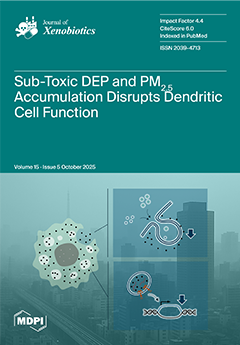
Cover Story (view full-size image): Dendritic cells (DCs) are crucial for antiviral defence through nucleic acid sensing in endosomal compartments. In this study, we show that sub-toxic exposure to diesel exhaust particles and PM2.5 does not induce cytotoxicity; however, these particles accumulate within DCs. The reduced uptake of fluorescent tracer particles indicates diminished endocytic and phagocytic activity under these exposure conditions. Additionally, induction of TLR7-dependent interferon-related genes in response to virus-like stimulation is suppressed. These findings indicate that even non-lethal levels of particulate matter can impair immune function by disrupting cellular uptake mechanisms and innate immune signalling, highlighting an overlooked immunotoxic risk associated with chronic low-dose exposure. View this paper
  • Issues are regarded as officially published after their release is announced to the table of contents alert mailing list.
  • You may sign up for e-mail alerts to receive table of contents of newly released issues.
  • PDF is the official format for papers published in both, html and pdf forms. To view the papers in pdf format, click on the "PDF Full-text" link, and use the free Adobe Reader to open them.
Order results
Result details
Section
Select all
Export citation of selected articles as:
34 pages, 2365 KB  
Review
Scientific and Regulatory Perspectives on Chemical Risk Assessment of Pesticides in the European Union
by Fabio Buonsenso
J. Xenobiot. 2025, 15(5), 173; https://doi.org/10.3390/jox15050173 - 21 Oct 2025
Cited by 2 | Viewed by 1978
Abstract
People are exposed to pesticides daily through food, drinking water, and the environment, both in urban and rural settings. These chemicals, while offering economic and agricultural benefits through pest control and increased productivity, may pose a growing risk to human health and ecosystem [...] Read more.
People are exposed to pesticides daily through food, drinking water, and the environment, both in urban and rural settings. These chemicals, while offering economic and agricultural benefits through pest control and increased productivity, may pose a growing risk to human health and ecosystem biodiversity. While the European regulatory framework offers a robust foundation for risk assessment, significant limitations persist, especially in addressing cumulative exposure, low-dose effects, and chemical mixtures. This review focuses on selected scientific and regulatory challenges by reviewing recent European Food Safety Authority (EFSA) conclusions, Organization for Economic Co-operation and Development (OECD) test guidelines updates, and current European legislative approaches. Particular attention is given to the regulation of endocrine-disrupting and reprotoxic substances, highlighting progress and remaining gaps in implementation. A brief mention will also be made of immuno-toxic substances, for which no specific hazard class has yet been established. Building on official reports and peer-reviewed literature, this review provides a structured evaluation of the scientific and regulatory landscape, including underexplored issues like the transition to animal-free toxicology and integration of biomonitoring with health data. The goal is to propose realistic, evidence-based improvements to current frameworks using integrated, interdisciplinary approaches that connect toxicology, policy, and implementation science. A shift to a holistic, systems-based, and precautionary paradigm is vital to address emerging challenges and ensure strong protection of health and environment, as well as supporting the needs of the agricultural sector. Full article
Show Figures

Graphical abstract

16 pages, 807 KB  
Article
Association Between Antibiotic Exposure and the Risk of Male Infertility: A Case–Control Study
by Friday E. Okonofua, Lorretta Favour C. Ntoimo, Titus A. M. Msagati, Oladiran Ayodeji, Michael Aziken, Akhere Omonkhua, Victor Ohenhen, Celestina Olafusi and Moses O. Alfred
J. Xenobiot. 2025, 15(5), 172; https://doi.org/10.3390/jox15050172 - 21 Oct 2025
Viewed by 1609
Abstract
Irregular use of antibiotics is widespread in Nigeria, which has been reported to be associated with the prevalence of antibiotic resistance. As antibiotics have been reported to be associated with declining male infertility in animal models, we investigated the association between exposure to [...] Read more.
Irregular use of antibiotics is widespread in Nigeria, which has been reported to be associated with the prevalence of antibiotic resistance. As antibiotics have been reported to be associated with declining male infertility in animal models, we investigated the association between exposure to antibiotics and sperm quality. The study was a prospective case–control study involving 136 infertile men and 154 fertile men recruited from five hospitals in southern Nigeria. Semen analysis was carried out, while Liquid Chromatography Mass Spectrometry was used to assay for various antibiotics in urinary samples. Three antibiotics showed an independent association with sperm quality in the regression analysis. Urinary ampicillin was associated with more than a 3 mL decline in sperm count in the cases, with no significant effects shown in the control group. Similarly, a significant association of urinary chloramphenicol with sperm motility and sperm morphology was shown in cases of infertility. In contrast, an independent association of urinary tetracycline with increased sperm motility in men with infertility was found, but no significant association was shown in fertile men. We conclude that urinary antibiotics—ampicillin, tetracycline, and chloramphenicol—may be associated with varying sperm characteristics and sperm quality in Nigerian men. Full article
Show Figures

Figure A1

19 pages, 752 KB  
Article
Four-Year Monitoring Survey of Pesticide Residues in Tomato Samples: Human Health and Environmental Risk Assessment
by Alessandro Atzei, Hamza Bouakline, Francesco Corrias and Alberto Angioni
J. Xenobiot. 2025, 15(5), 171; https://doi.org/10.3390/jox15050171 - 20 Oct 2025
Viewed by 923
Abstract
A four-year survey was conducted to monitor the presence of multiple pesticide residues contaminating tomatoes, with the aim of evaluating the potential health and environmental risks. A multiresidue liquid chromatography–triple mass spectrometry with a multiple reaction monitoring (LC-MS/MS-MRM) method was fully validated and [...] Read more.
A four-year survey was conducted to monitor the presence of multiple pesticide residues contaminating tomatoes, with the aim of evaluating the potential health and environmental risks. A multiresidue liquid chromatography–triple mass spectrometry with a multiple reaction monitoring (LC-MS/MS-MRM) method was fully validated and used to test 252 pesticides in 360 samples analysed. According to SANTE guidelines, the proposed method was considered suitable for the purpose. Dietary risk assessment was conducted using the Hazard Quotient (HQ) approach and the European Food Safety Authority (EFSA) Pesticide Residue Intake Model; meanwhile, the cumulative environmental risk assessment was conducted using the Concentration Addition (CA) and Independent Action (IA) methods. Data obtained revealed multiple contaminations in most fields examined over the years. Twenty-two pesticide residues were identified, comprising 68.2% fungicides, 27.3% insecticides, and the remaining 4.5% acaricides. Higher levels were detected for Boscalid in 2022 in three fields, with an average value of 0.42 mg/kg. Multi-residue contamination occurred each year; the lowest abundance was detected in 2023 (3.9%), and the highest in 2022 (12.3%), with 5 pesticide residues as the maximum number of compounds detected in one sample in 2022. The consumer risk assessment identified no potential health concerns for adults or toddlers, and the combined risk was considered acceptable. The environmental assessment showed maximum cumulative ratio (MCR) values that were always ≥1, indicating a contribution to the toxicity of the mixture, only slightly higher than that of the single compound with the highest toxicity. The results of this study highlight the critical need to include cumulative dietary exposure assessments in pesticide risk evaluations, especially for food products that are susceptible to contamination by multiple residues. Full article
Show Figures

Graphical abstract

16 pages, 1709 KB  
Article
Estrogen Degradation Metabolites: Some Effects on Heart Mitochondria
by Cristina Uribe-Alvarez, Elizabeth Lira-Silva, Lilia Morales-García, Natalia Chiquete-Felix, Francisco Javier Roldán-Gómez, Jesús Vargas-Barrón, José J. García-Trejo, Alejandro Silva-Palacios, Salvador Uribe-Carvajal and Natalia Pavón
J. Xenobiot. 2025, 15(5), 170; https://doi.org/10.3390/jox15050170 - 18 Oct 2025
Viewed by 680
Abstract
Mitochondria play crucial roles in various cellular functions, including ATP production, apoptosis, and calcium homeostasis. Signaling pathways and hormones such as estrogens regulate the mitochondrial network through genetic, epigenetic, and metabolic processes. Estrogens increase the efficiency of mitochondrial oxidative phosphorylation by preventing uncoupling. [...] Read more.
Mitochondria play crucial roles in various cellular functions, including ATP production, apoptosis, and calcium homeostasis. Signaling pathways and hormones such as estrogens regulate the mitochondrial network through genetic, epigenetic, and metabolic processes. Estrogens increase the efficiency of mitochondrial oxidative phosphorylation by preventing uncoupling. Upon reaching menopause, when estrogen levels decrease, impaired mitochondrial function (uncoupled oxidative phosphorylation, lower ATP yields) is observed. Like all hormones in the body, estrogens undergo metabolic processing, resulting in estrogenic degradation metabolites (EDMs). These metabolites can form adducts with genomic and mitochondrial DNA and are of particular interest due to their potential role as carcinogens. Given that estradiol influences mitochondrial function, it is possible that EDMs may have an impact on heart mitochondria. To investigate this, we used isolated heart mitochondria from control and oophorectomized (mimicking menopausal stage) female Wistar rats of the same age. We found that mitochondria exposed to EDMs exhibited reduced coupling of oxidative phosphorylation and diminished ATP production, while increasing reactive oxygen species generation. Furthermore, these effects were significantly stronger in mitochondria from oophorectomized rats than in mitochondria from control (intact) rats. In addition, mitochondrial oxidative phosphorylation complex activities were differentially affected: complex I and ATPase activities decreased, while complex IV remained unaffected. We propose that exposure to EDMs promotes mitochondrial dysfunction in rats and that these effects are exacerbated by oophorectomy, a procedure commonly used to model the effects of menopause in women. Full article
Show Figures

Graphical abstract

20 pages, 2807 KB  
Article
Heavy Metals Affect the Antioxidant Defences in the Soil Ciliate Rigidohymena tetracirrata
by Govindhasamay R. Varatharajan, Antonio Calisi, Santosh Kumar, Daizy Bharti, Arnab Ghosh, Shikha Singh, Amit C. Kharkwal, Martina Coletta, Francesco Dondero and Antonietta La Terza
J. Xenobiot. 2025, 15(5), 169; https://doi.org/10.3390/jox15050169 - 17 Oct 2025
Viewed by 730
Abstract
In this study, we evaluated the cytotoxicity and antioxidant activity of the soil ciliate Rigidohymena tetracirrata (Gellért, 1942) Berger 2011, exposed to single and bimetallic mixtures of heavy metals (HMs) for 24 h. Ecotoxicological tests showed LC20 values of 0.16, 19.86 and [...] Read more.
In this study, we evaluated the cytotoxicity and antioxidant activity of the soil ciliate Rigidohymena tetracirrata (Gellért, 1942) Berger 2011, exposed to single and bimetallic mixtures of heavy metals (HMs) for 24 h. Ecotoxicological tests showed LC20 values of 0.16, 19.86 and 0.68 mg L−1 to Copper (Cu), Zinc (Zn), and Cadmium (Cd), respectively, and LC50 values of 0.25, 44.12 and 1.12 mg L−1, respectively. Furthermore, it was observed that the mixture of Cd and Zn exhibited antagonism in comparison to other mixtures, (Cd + Cu and Cu + Zn). In the total phenolic content (TPC) assay, a higher phenolic content was observed for the LC20 of extracellular Cu (p ≤ 0.01) and the LC20 of intracellular Cd (p ≤ 0.001). The LC50 values for Cd and Zn in both extracellular and intracellular contents demonstrated increased α,α-diphenyl-β-picrylhydrazyl (DPPH) scavenging activity with significant values of p ≤ 0.05, respectively. Regarding hydroxyl scavenging activity (HRSA), the LC50 of extracellular Cd (p ≤ 0.001) and LC50 of intracellular Cu (p ≤ 0.001) exhibited higher antioxidant activity. Therefore, the present study suggests that R. tetracirrata holds considerable potential as bioindicators and could be used as a model organism in ecotoxicological studies of soil polluted by HMs. Full article
Show Figures

Graphical abstract

11 pages, 2275 KB  
Article
Two-Step Air/Water Oxidation Process for the Long-Lasting Photoluminescence and Biological Viability (MTT Assay) of Porous Silicon Particles
by Claudia Castillo Calvente, María F. Gilsanz-Muñoz, Javier Pérez-Piñeiro, Arisbel Cerpa-Naranjo, Rodrigo Blasco, Elvira Bragado-García, María S. Fernández-Alfonso and Darío Gallach-Pérez
J. Xenobiot. 2025, 15(5), 168; https://doi.org/10.3390/jox15050168 - 17 Oct 2025
Viewed by 419
Abstract
Due to their visible photoluminescence (PL) at room temperature, porous silicon particles (PSps) have gained interest for their potential biomedical applications, making them promising biological markers for in vivo or in vitro use. This study explores the PL evolution and stabilization of PSps [...] Read more.
Due to their visible photoluminescence (PL) at room temperature, porous silicon particles (PSps) have gained interest for their potential biomedical applications, making them promising biological markers for in vivo or in vitro use. This study explores the PL evolution and stabilization of PSps following a two-step oxidation process involving air annealing and chemical oxidation in deionized water. PS layers were fabricated by electrochemical etching of p+-Si wafers and then annealed in air at 300 °C and 600 °C for five minutes. The layers were then stored in deionized water and sonicated to produce PSps. Scanning electron microscopy (SEM) and energy-dispersive X-ray spectroscopy (EDX) were used to analyze the morphology and composition of the particles, and spectrofluorimetry was used to monitor the PL over several weeks. Samples annealed at 300 °C exhibited a transition from nearly complete PL quenching to strong yellow–red emission. In contrast, the 600 °C sample showed no PL emission. The cytotoxicity of the PSps was evaluated using an MTT assay on human endothelial cells (EA.Hy926) with PSps and polyethylene glycol (PEG)-coated PSps at concentrations of (3.5–125 µg/mL) in both serum-free and fetal bovine serum (FBS)-containing media over 24, 48, and 72 h. Cell viability was significantly affected by both exposure time and particle concentration; however, this effect was prevented under conditions mimicking the physiological plasma environment. Full article
(This article belongs to the Section Nanotoxicology and Nanopharmacology)
Show Figures

Graphical abstract

16 pages, 553 KB  
Article
DNA Damage and Bisphenol Levels in Chronic Kidney Disease Patients Undergoing Hemodialysis
by Cesar Emilio Ruiz, Lourdes Vela, Martí Nadal, Neus González, Ricard Marcos, Alba Hernández, Susana Pastor and Elisabeth Coll
J. Xenobiot. 2025, 15(5), 167; https://doi.org/10.3390/jox15050167 - 17 Oct 2025
Viewed by 652
Abstract
Bisphenol (BP) compounds are widely present in the environment, primarily due to their use as plastic additives. These substances involve health risks, particularly as endocrine disruptors. While the general population is chronically exposed, patients with end-stage chronic kidney disease undergoing hemodialysis (HD-CKD) represent [...] Read more.
Bisphenol (BP) compounds are widely present in the environment, primarily due to their use as plastic additives. These substances involve health risks, particularly as endocrine disruptors. While the general population is chronically exposed, patients with end-stage chronic kidney disease undergoing hemodialysis (HD-CKD) represent a particularly vulnerable group. This is due to both impaired renal clearance of circulating BPs and potential contamination from plastic-containing dialyzers used in extracorporeal blood circulation. In this longitudinal study, from the 35 HD-CKD patients initially selected, 25 changed their conventional dialyzers to BPA-free dialyzers for 6 months. Blood serum samples were collected, at baseline and after the intervention, to quantify levels of five BP analogues: Bisphenol A (BPA), Bisphenol AF (BPAF), Bisphenol F (BPF), Bisphenol B (BPB), and Bisphenol S (BPS). Genotoxicity was assessed using the comet assay and the micronucleus test on peripheral white blood cells. Among the analyzed BPs, only BPAF showed a statistically significant reduction when using BPA-free dialyzers. In terms of genotoxicity, a significant decrease was observed only in primary DNA damage (mainly DNA strand breaks), with no notable changes in chromosomal damage. This is the first study to detect multiple BP analogues in HD-CKD patients, beyond BPA, and to associate human exposure to BPs with DNA damage biomarkers. The observed reduction in DNA damage in parallel with decreased BPAF levels highlights the importance of monitoring and minimizing BP exposure of this high-risk population. Full article
(This article belongs to the Section Emerging Chemicals)
Show Figures

Graphical abstract

25 pages, 2815 KB  
Article
QSAR Models for Predicting Oral Bioavailability and Volume of Distribution and Their Application in Mapping the TK Space of Endocrine Disruptors
by Guillaume Ollitrault, Marco Marzo, Alessandra Roncaglioni, Emilio Benfenati, Olivier Taboureau and Enrico Mombelli
J. Xenobiot. 2025, 15(5), 166; https://doi.org/10.3390/jox15050166 - 15 Oct 2025
Viewed by 839
Abstract
Toxicokinetic (TK) properties are essential in the framework of chemical risk assessment and drug discovery. Specifically, a TK profile provides information about the fate of chemicals in the human body. In this context, Quantitative Structure–Activity Relationship (QSAR) models are convenient computational tools for [...] Read more.
Toxicokinetic (TK) properties are essential in the framework of chemical risk assessment and drug discovery. Specifically, a TK profile provides information about the fate of chemicals in the human body. In this context, Quantitative Structure–Activity Relationship (QSAR) models are convenient computational tools for predicting TK properties. Here, we developed QSAR models to predict two TK properties: oral bioavailability and volume of distribution at steady state (VDss). We collected and curated two large sets of 1712 and 1591 chemicals for oral bioavailability and VDss, respectively, and compared regression and classification (binary and multiclass) models with the application of several machine learning algorithms. The best predictive performance of the models for regression (R) prediction was characterized by a Q2F3 of 0.34 with the R-CatBoost model for oral bioavailability and a geometric mean fold error (GMFE) of 2.35 with the R-RF model for VDss. The models were then applied to a list of potential endocrine-disrupting chemicals (EDCs), highlighting chemicals with a high probability of posing a risk to human health due to their TK profiles. Based on the results obtained, insights into the structural determinants of TK properties for EDCs are further discussed. Full article
Show Figures

Graphical abstract

15 pages, 301 KB  
Review
Endocrine-Disrupting Chemicals and Male Infertility: Mechanisms, Risks, and Regulatory Challenges
by Sofoklis Stavros, Nikolaos Kathopoulis, Efthalia Moustakli, Anastasios Potiris, Ismini Anagnostaki, Spyridon Topis, Nefeli Arkouli, Konstantinos Louis, Charalampos Theofanakis, Themos Grigoriadis, Nikolaos Thomakos and Athanasios Zikopoulos
J. Xenobiot. 2025, 15(5), 165; https://doi.org/10.3390/jox15050165 - 13 Oct 2025
Viewed by 2615
Abstract
Male reproductive health is increasingly threatened by endocrine-disrupting chemicals (EDCs), which interfere with hormonal homeostasis and reproductive physiology. Rising rates of male infertility have been linked to greater exposure to pollutants such as heavy metals, phthalates, pesticides, and bisphenol A. These compounds act [...] Read more.
Male reproductive health is increasingly threatened by endocrine-disrupting chemicals (EDCs), which interfere with hormonal homeostasis and reproductive physiology. Rising rates of male infertility have been linked to greater exposure to pollutants such as heavy metals, phthalates, pesticides, and bisphenol A. These compounds act through multiple mechanisms, including oxidative stress, apoptosis, receptor-mediated disruption of estrogenic and androgenic signaling, alterations in the hypothalamic–pituitary–gonadal (HPG) axis, and heritable epigenetic changes. Such disruptions impair key outcomes like sperm concentration, motility, morphology, DNA integrity, and steroidogenesis. Evidence from animal studies and human epidemiology consistently demonstrates these harmful effects, with biomarkers of EDC exposure correlating with reduced semen quality, hormonal imbalances, and infertility. Beyond individual health, infertility linked to EDCs carries significant social and economic costs. This review evaluates regulatory frameworks, highlights methodological challenges in risk assessment, and synthesizes mechanistic and clinical evidence. Particular attention is given to unresolved issues such as non-monotonic dose responses, mixture effects, low-dose exposures, and transgenerational impacts. Future priorities include refining biomonitoring, addressing mixture risks, and strengthening international regulation. By integrating mechanistic, clinical, and policy insights, this review underscores the urgent need for strategies to mitigate EDC-related threats to male reproductive health. Full article
Show Figures

Graphical abstract

14 pages, 691 KB  
Article
Determination of Artificial Sweeteners in Commercial Beverages: Do We Know What We Are Consuming?
by Mar Castellanos and Juan M. Sanchez
J. Xenobiot. 2025, 15(5), 164; https://doi.org/10.3390/jox15050164 - 11 Oct 2025
Viewed by 1947
Abstract
Non-nutritive artificial sweeteners (NASs) are xenobiotics widely used in the food industry as sugar substitutes, since they provide few to no calories compared to sucrose. While NASs are considered safe at the acceptable daily intake (ADI) established by regulatory agencies, there is increasing [...] Read more.
Non-nutritive artificial sweeteners (NASs) are xenobiotics widely used in the food industry as sugar substitutes, since they provide few to no calories compared to sucrose. While NASs are considered safe at the acceptable daily intake (ADI) established by regulatory agencies, there is increasing controversy regarding their potential ability to promote metabolic derangements, especially to disrupt the gut microbiome balance. In this study, we analyzed a large cohort of the most commonly consumed beverages in Spain, categorizing them by the type of soda to determine the composition and content of the most frequently used NASs in the food industry. All commercial NAS formulations analyzed contained mixtures of different NASs. The NAS contents were always within regulated limits, although some samples yielded values close to these thresholds. Most soda samples analyzed contained NASs, even though the majority were not labeled as “zero sugars”, “no sugar added”, or “reduced calories”, which may mislead consumers. A preliminary statistical evaluation of the obtained results (cluster analysis) suggests that beverages can be grouped into three distinct clusters based on the total amount of NAS present in the samples. Differences in the total NAS content were significant among the three groups, with one cluster showing two- and four-fold higher levels than the others. Full article
Show Figures

Graphical abstract

14 pages, 1253 KB  
Article
Advanced Characterization of Environmental Pollutant Metabolism in Human Skin
by Rafael Reis, Martine Zanini, Guillaume Lereaux, Ariane Dimitrov and Samia Boudah
J. Xenobiot. 2025, 15(5), 163; https://doi.org/10.3390/jox15050163 - 11 Oct 2025
Viewed by 673
Abstract
Ultrafine particles (UFPs) containing polycyclic aromatic hydrocarbons (PAHs) benzo[a]pyrene (BaP), are linked to pollution-induced health concerns, with skin being highly susceptible to contamination. Understanding the metabolic fate of these environmental pollutants in the skin is crucial. Moreover, traditional in vitro models often lack [...] Read more.
Ultrafine particles (UFPs) containing polycyclic aromatic hydrocarbons (PAHs) benzo[a]pyrene (BaP), are linked to pollution-induced health concerns, with skin being highly susceptible to contamination. Understanding the metabolic fate of these environmental pollutants in the skin is crucial. Moreover, traditional in vitro models often lack metabolic competency, while animal testing raises ethical concerns. This study introduces a novel approach combining stable isotope labeling (SIL) and liquid chromatography–high-resolution mass spectrometry (LC-HRMS) to investigate BaP metabolism. The physiologically relevant 3D reconstructed human epidermis (RHE) model was used. RHE models were exposed to BaP and deuterium-labeled BaP (BaP-d12). These analyses, followed by data analysis incorporating stable isotope filtering, revealed the presence of five distinct BaP phase I metabolites, including mono-hydroxylated, dihydroxylated, and quinone derivatives. This study demonstrates the power of coupling stable isotope labeling with LC-HRMS for the comprehensive characterization of BaP metabolic pathways in human skin. The identification of specific metabolites enhances our understanding of BaP detoxification mechanisms and their potential adverse effects. This analytical approach holds promise for investigating the metabolic fate of various other environmental pollutants. Full article
Show Figures

Graphical abstract

13 pages, 688 KB  
Review
Effects of Endocrine-Disrupting Chemicals in the Brain: The Example of Neurodevelopment Alterations upon Exposure In Utero to Synthetic Sex Hormones
by Charles Sultan, Laura Gaspari and Marie-Odile Soyer-Gobillard
J. Xenobiot. 2025, 15(5), 162; https://doi.org/10.3390/jox15050162 - 10 Oct 2025
Viewed by 1630
Abstract
Endocrine disruptors contaminate indoor and outdoor air, water, and food. Besides modifications of the androgen/estrogen balance, endocrine disruptors can alter thyroid function, metabolic balance, immune defenses, and brain development during fetal life, childhood, and adolescence. Among the consequences of fetal exposure to endocrine [...] Read more.
Endocrine disruptors contaminate indoor and outdoor air, water, and food. Besides modifications of the androgen/estrogen balance, endocrine disruptors can alter thyroid function, metabolic balance, immune defenses, and brain development during fetal life, childhood, and adolescence. Among the consequences of fetal exposure to endocrine disruptors, neurobehavioral disorders, particularly psychiatric disorders (for example, schizophrenia and bipolar disorder), attention deficit disorders, and mood disorders, occupy a special place. Therefore, endocrine disruptors are also neuroendocrine disruptors. This review article first summarizes the direct and transgenerational effects of endocrine disruptors. Then, data from a French national cohort of patients whose mothers were treated with synthetic hormones (estrogens and/or progestogens) during their pregnancy(ies) are used to describe the psychiatric disorders developed by children exposed in utero and the multigenerational and potentially transgenerational impacts. Full article
Show Figures

Graphical abstract

23 pages, 3808 KB  
Article
The Antiproliferative Activity of Tatridin A Against Prostate Cancer Cells Is Lost in Acid Medium by Transformation to Desacetyl-β-Cyclopyrethrosin
by Cecilia Villegas, Rebeca Pérez, Camilo Céspedes-Méndez, Viviana Burgos, Ricardo Baggio, Sebastián Suárez, Bernd Schmidt and Cristian Paz
J. Xenobiot. 2025, 15(5), 161; https://doi.org/10.3390/jox15050161 - 9 Oct 2025
Viewed by 732
Abstract
Background: Prostate cancer (PC) progression is strongly driven by dysregulated signaling pathways, with NF-κB playing a central role. Sesquiterpene lactones have been reported to modulate this pathway. This study evaluated and compared the cytotoxic effects of two structurally distinct sesquiterpene lactones: Tatridin A, [...] Read more.
Background: Prostate cancer (PC) progression is strongly driven by dysregulated signaling pathways, with NF-κB playing a central role. Sesquiterpene lactones have been reported to modulate this pathway. This study evaluated and compared the cytotoxic effects of two structurally distinct sesquiterpene lactones: Tatridin A, a germacranolide, and desacetyl-β-cyclopyrethrosin, a eudesmanolide derivative. Their mechanisms of action were also examined, focusing on oxidative stress induction and NF-κB modulation. Methods: Chemical structures were confirmed by NMR and X-ray crystallography. Cytotoxicity was assessed in DU-145 and 22Rv1 PC cells using real-time cell analysis. Reactive oxygen species (ROS) and mitochondrial membrane potential (ΔΨm) were measured with fluorometric assays. NF-κB activity was determined in THP-1 reporter cells and by Western blot of IκBα phosphorylation. Results: Tatridin A markedly reduced viability, showing lower IC50 values (81.4 ± 2.7 µM in DU-145 and 50.7 ± 1.9 µM in 22Rv1 cells) than desacetyl-β-cyclopyrethrosin (166.9 ± 3.2 µM and 290.3 ± 8.3 µM, respectively). It also inhibited proliferation at markedly lower concentrations, with clonogenic IC50 values of 7.7 µM in DU-145 and 5.24 µM in 22Rv1cells. Both compounds increased ROS, but tatridin A induced earlier and stronger responses and ΔΨm loss. Furthermore, tatridin A more effectively inhibited NF-κB signaling than classical inhibitors. Conclusions: Tatridin A exerts cytotoxic effects through oxidative stress, mitochondrial impairment, and NF-κB inhibition, supporting the therapeutic potential of germacranolides for the treatment of advanced PC. Full article
Show Figures

Graphical abstract

21 pages, 3716 KB  
Article
A Synergistic Approach with Doxycycline and Spirulina Extracts in DNBS-Induced Colitis: Enhancing Remission and Controlling Relapse
by Meriem Aziez, Mohamed Malik Mahdjoub, Tahar Benayad, Ferroudja Abbas, Sarah Hamid, Hamza Moussa, Ibrahima Mamadou Sall, Hichem Tahraoui, Abdeltif Amrane and Noureddine Bribi
J. Xenobiot. 2025, 15(5), 160; https://doi.org/10.3390/jox15050160 - 3 Oct 2025
Viewed by 957
Abstract
Background: Chronic relapsing colitis involves immune dysregulation and oxidative stress, making monotherapies often insufficient. This study investigates a therapeutic strategy combining doxycycline (Dox), an immunomodulatory antibiotic, with Arthrospira platensis extracts to enhance anti-inflammatory and antioxidant effects, improving remission and controlling relapse. Methods: Ethanolic [...] Read more.
Background: Chronic relapsing colitis involves immune dysregulation and oxidative stress, making monotherapies often insufficient. This study investigates a therapeutic strategy combining doxycycline (Dox), an immunomodulatory antibiotic, with Arthrospira platensis extracts to enhance anti-inflammatory and antioxidant effects, improving remission and controlling relapse. Methods: Ethanolic (ES) and aqueous (AS) extracts of A. platensis were chemically characterized by GC-MS after derivatization. Colitis was induced in mice using two intrarectal DNBS administrations spaced 7 days apart, with oral treatments (Dox, ES, AS, or combinations) given daily between doses. Disease progression was evaluated through clinical monitoring, histological scoring, and biochemical analysis, including MPO and CAT activities, as well as NO, MDA, and GSH levels. Results: GC-MS identified 16 bioactive compounds in each extract. ES contained mainly fatty acids and amino acids, whereas AS was rich in polysaccharides and phytol. Combined doxycycline and A. platensis extracts significantly enhanced recovery in reactivated DNBS colitis compared to monotherapies. Each treatment alone reduced disease severity, but their combination showed synergistic effects, significantly reducing disease activity index (p < 0.001), restoring mucosal integrity, and modulating inflammatory and oxidative markers (p < 0.001). Conclusion: Doxycycline potentiates the anti-colitic effects of A. platensis extracts via complementary mechanisms, offering a promising combination for managing relapsing colitis. Full article
Show Figures

Graphical abstract

18 pages, 1141 KB  
Review
The Potential Release of Chemicals from Crumb Rubber Infill Material—A Literature Review
by Federica Ghelli, Samar El Sherbiny, Giulia Squillacioti, Nicoletta Colombi, Valeria Bellisario and Roberto Bono
J. Xenobiot. 2025, 15(5), 159; https://doi.org/10.3390/jox15050159 - 2 Oct 2025
Viewed by 954
Abstract
End-of-life tyre (ELT) management is still a hot topic due to implications for sustainability and human health. This review aims to summarise the findings concerning the chemicals’ bio-accessibility/availability from the granular tyre-derived infill material used in sport surfaces. We included 14 original research [...] Read more.
End-of-life tyre (ELT) management is still a hot topic due to implications for sustainability and human health. This review aims to summarise the findings concerning the chemicals’ bio-accessibility/availability from the granular tyre-derived infill material used in sport surfaces. We included 14 original research articles and 5 reports (grey literature). The results included the analysis concerning volatile organic compounds (VOCs), polycyclic aromatic hydrocarbons (PAHs), phthalates, metal(loid)s and other substances. The release of some dangerous chemicals was demonstrated, even though results must be considered critically. However, the chemicals’ bioaccessibility shows a highly nuanced picture and is not, per se, sufficient to determine the risk for the exposed subjects. The lack of bioavailability and epidemiological studies analysing the exposures in real scenarios resulted in one of the main issues concerning a proper evaluation of the potential risks for human health. Full article
Show Figures

Graphical abstract

26 pages, 5547 KB  
Article
Coffee Waste as a Green Precursor for Iron Nanoparticles: Toward Circular, Efficient and Eco-Friendly Dye Removal from Aqueous Systems
by Cristina Rodríguez-Rasero, Juan Manuel Garrido-Zoido, María del Mar García-Galán, Eduardo Manuel Cuerda-Correa and María Francisca Alexandre-Franco
J. Xenobiot. 2025, 15(5), 158; https://doi.org/10.3390/jox15050158 - 2 Oct 2025
Viewed by 611
Abstract
In this study, the use of spent coffee waste as a green precursor of polyphenolic compounds, which are subsequently employed as reducing agents for the synthesis of zero-valent iron nanoparticles (nZVI) aimed at the efficient removal of dyes from aqueous systems, has been [...] Read more.
In this study, the use of spent coffee waste as a green precursor of polyphenolic compounds, which are subsequently employed as reducing agents for the synthesis of zero-valent iron nanoparticles (nZVI) aimed at the efficient removal of dyes from aqueous systems, has been investigated. The nanoparticles, generated in situ in the presence of controlled amounts of hydrogen peroxide, were applied in the removal of organic dyes—including methylene blue, methyl orange, and orange G—through a heterogeneous Fenton-like catalytic process. The synthesized nZVI were thoroughly characterized by nitrogen adsorption at 77 K, scanning electron microscopy (SEM), transmission electron microscopy (TEM), Fourier-transform infrared spectroscopy (FT-IR), and powder X-ray diffraction (XRD). A statistical design of experiments and response surface methodology were employed to evaluate the effect of polyphenol, Fe(III), and H2O2 concentrations on dye removal efficiency. Results showed that under optimized conditions, a 100% removal efficiency could be achieved. This work highlights the potential of nZVI synthesized from agro-industrial waste through sustainable routes as an effective solution for water remediation, contributing to circular economy strategies and environmental protection. Full article
Show Figures

Graphical abstract

24 pages, 763 KB  
Review
Methylphenidate and Its Impact on Redox Balance and Behavior
by George Jîtcă, Ingrid Evelin Mehelean, Ana Natalia Maier and Carmen-Maria Jîtcă
J. Xenobiot. 2025, 15(5), 157; https://doi.org/10.3390/jox15050157 - 30 Sep 2025
Viewed by 4129
Abstract
Methylphenidate (MPH) and its active enantiomer, dexmethylphenidate, are widely prescribed as first-line therapies for attention deficit hyperactivity disorder (ADHD), yet their increasing non-medical use highlights significant clinical and toxicological challenges. MPH blocks dopamine (DAT) and norepinephrine (NET) transporters, thereby elevating synaptic catecholamine levels. [...] Read more.
Methylphenidate (MPH) and its active enantiomer, dexmethylphenidate, are widely prescribed as first-line therapies for attention deficit hyperactivity disorder (ADHD), yet their increasing non-medical use highlights significant clinical and toxicological challenges. MPH blocks dopamine (DAT) and norepinephrine (NET) transporters, thereby elevating synaptic catecholamine levels. While this underpins therapeutic efficacy, prolonged or abusive exposure has been associated with mitochondrial impairment, disrupted bioenergetics, and excessive reactive oxygen species (ROS) production, which collectively contribute to neuronal stress and long-term neurotoxicity. Growing evidence suggests that the gut–brain axis may critically influence MPH outcomes: diet-induced shifts in microbiome composition appear to regulate oxidative stress, neuroinflammation, and drug metabolism, opening potential avenues for dietary or probiotic interventions. From a forensic perspective, the detection and monitoring of MPH misuse require advanced methodologies, including enantioselective LC–MS/MS and analysis of alternative matrices such as hair or oral fluids, which enable retrospective exposure assessment and improves abuse surveillance. Despite its established therapeutic profile, MPH remains a compound with a narrow balance between clinical benefit and toxicological risk. Future directions should prioritize longitudinal human studies, biomarker identification for abuse monitoring, and the development of mitochondria-targeted therapies to minimize adverse outcomes and enhance safety in long-term treatment. Full article
Show Figures

Graphical abstract

38 pages, 9250 KB  
Article
Phytochemical Profile and Acute Toxicity in CD-1 Mice of the Hydroethanolic Extract and Butanolic Fraction of Piper marginatum Jacq.
by Luis Gonzalo Sequeda-Castañeda, Luis Fernando Ospina-Giraldo, Sandra Janeth Gutiérrez-Prieto and Pilar Ester Luengas-Caicedo
J. Xenobiot. 2025, 15(5), 156; https://doi.org/10.3390/jox15050156 - 28 Sep 2025
Viewed by 1094
Abstract
This study evaluated the acute toxicity of the hydroethanolic extract and the butanolic fraction of Piper marginatum Jacq., following the OECD Guideline 423. Oral and intraperitoneal exposure of CD-1 mice was used in single-dose and repeated-dose schedules. No mortality or significant behavioral alterations [...] Read more.
This study evaluated the acute toxicity of the hydroethanolic extract and the butanolic fraction of Piper marginatum Jacq., following the OECD Guideline 423. Oral and intraperitoneal exposure of CD-1 mice was used in single-dose and repeated-dose schedules. No mortality or significant behavioral alterations were observed. Body weight remained stable during treatment, and histopathological analysis revealed only mild to moderate alterations, mainly in the liver, kidneys, and lungs. These results indicate the absence of acute systemic toxicity under the conditions evaluated. Preliminary phytochemical analysis and metabolomic profile analysis by LC-QTOF/MS revealed a diverse composition of secondary metabolites, including alkaloids, flavonoids, phenylpropanoids, and sphingolipids. Compounds with known biological activity and some with potential toxicity were identified. The findings support the safe use of Piper marginatum extracts in short-term applications and suggest further subchronic toxicity studies and mechanistic evaluation. This research provides fundamental data for preclinical characterization and standardization of extracts of plant origin. Full article
Show Figures

Graphical abstract

32 pages, 1701 KB  
Review
Healthcare Waste Toxicity: From Human Exposure to Toxic Mechanisms and Management Strategies
by Ilie Cirstea, Andrei-Flavius Radu, Ada Radu, Delia Mirela Tit and Gabriela S. Bungau
J. Xenobiot. 2025, 15(5), 155; https://doi.org/10.3390/jox15050155 - 25 Sep 2025
Viewed by 3245
Abstract
Healthcare waste (HCW) represents a growing yet frequently underestimated threat to public health, due to its complex toxicological profile. Exposure to HCW has been associated with a broad spectrum of adverse effects, including infections of bacterial, viral, or fungal origin, as well as [...] Read more.
Healthcare waste (HCW) represents a growing yet frequently underestimated threat to public health, due to its complex toxicological profile. Exposure to HCW has been associated with a broad spectrum of adverse effects, including infections of bacterial, viral, or fungal origin, as well as systemic consequences such as endocrine disruption, metabolic disturbances, and mutagenic, carcinogenic, or teratogenic outcomes. These risks are particularly elevated among healthcare professionals and waste management personnel, who are directly exposed to hazardous materials. This narrative review aims to consolidate current knowledge on the toxic potential of HCW, emphasizing the variability of risks according to waste category and point of origin. A critical reevaluation of the toxicity–health risk–waste management triad is needed to strengthen preventive and protective strategies in both clinical and waste-handling settings, and the review is therefore structured around targeted questions along this axis. Priority should be given to waste prevention, minimization, and segregation at source, as downstream treatment processes may introduce additional hazards. Each category of hazardous HCW exhibits specific mechanisms of toxicity, underlining the importance of targeted and informed management approaches. Future directions should include enhanced training for waste handlers, the development of unified regulatory frameworks, and improved international data collection and reporting systems. Strengthening these components is essential for reducing occupational and environmental health risks and ensuring safer conditions across healthcare systems. Full article
Show Figures

Graphical abstract

30 pages, 3062 KB  
Review
Separation and Detection of Microplastics in Human Exposure Pathways: Challenges, Analytical Techniques, and Emerging Solutions
by Asim Laeeq Khan and Asad A. Zaidi
J. Xenobiot. 2025, 15(5), 154; https://doi.org/10.3390/jox15050154 - 23 Sep 2025
Cited by 1 | Viewed by 2995
Abstract
Microplastics (MPs) are increasingly recognized as widespread environmental contaminants, with confirmed presence in human tissues and biological fluids through ingestion, inhalation, and direct systemic exposure. Their potential impacts on human health have become an important subject of scientific investigation. The detection and quantification [...] Read more.
Microplastics (MPs) are increasingly recognized as widespread environmental contaminants, with confirmed presence in human tissues and biological fluids through ingestion, inhalation, and direct systemic exposure. Their potential impacts on human health have become an important subject of scientific investigation. The detection and quantification of MPs, particularly nanoplastics, in complex biological matrices remain challenging because of their low concentrations, diverse physicochemical properties, and interference from organic and inorganic matter. This review presents a critical assessment of current methods for the separation and detection of MPs from human-relevant samples. It examines pre-treatment, separation, and analytical approaches including physical filtration, density-based separation, chemical and enzymatic digestion, vibrational spectroscopy, thermal analysis, and electron microscopy, highlighting their principles, advantages, and limitations. Key challenges such as low sample throughput, absence of standardized procedures, and the difficulty of nanoplastic detection are identified as major barriers to accurate exposure assessment and risk evaluation. Recent advances, including functionalized adsorbents, improved anti-fouling membranes, integrated microfluidic systems, and artificial intelligence-assisted spectral analysis, are discussed for their potential to provide sensitive, scalable, and standardized analytical workflows. By integrating current challenges with recent innovations, this review aims to guide multidisciplinary research toward the development of reliable and reproducible detection strategies that can support MPs exposure assessment and inform evidence-based health policies. Full article
Show Figures

Figure 1

22 pages, 3111 KB  
Article
Posidonia oceanica Extract Inhibits VEGF-Induced Angiogenic and Oxidative Responses in Human Endothelial Colony-Forming Cells
by Francesca Margheri, Cecilia Anceschi, Elena Frediani, Alessandra Marzoppi, Marzia Vasarri, Donatella Degl’Innocenti, Emanuela Barletta, Anna Laurenzana and Anastasia Chillà
J. Xenobiot. 2025, 15(5), 153; https://doi.org/10.3390/jox15050153 - 17 Sep 2025
Viewed by 774
Abstract
Angiogenesis, the formation of new blood vessels from pre-existing vasculature, is essential for physiological processes such as development and wound healing, but its dysregulation contributes to a range of pathological conditions including cancer, diabetic retinopathy, and chronic inflammation. In recent years, marine-derived compounds [...] Read more.
Angiogenesis, the formation of new blood vessels from pre-existing vasculature, is essential for physiological processes such as development and wound healing, but its dysregulation contributes to a range of pathological conditions including cancer, diabetic retinopathy, and chronic inflammation. In recent years, marine-derived compounds have emerged as promising multitarget agents with anti-angiogenic potential. Posidonia oceanica, a Mediterranean seagrass traditionally used in folk medicine, is increasingly recognized for its pharmacological properties, including antioxidant, anti-inflammatory, and anti-invasive activities. This study investigated the effects of a hydroethanolic extract from P. oceanica leaves (POE) on human Endothelial Colony-Forming Cells (ECFCs), a subpopulation of endothelial progenitor cells with high proliferative and vessel-forming capacity, and a relevant model for studying pathological angiogenesis. ECFCs were treated with POE (4–8 µg/mL), and cell viability, morphology, migration, invasion, tube formation, oxidative stress, and activation markers were evaluated. POE did not alter ECFC morphology or viability, as confirmed by Trypan Blue and MTT assays. However, functional assays revealed that POE significantly impaired ECFC migration, invasion, and in vitro angiogenesis in a dose-dependent manner. Under VEGF (Vascular endothelial growth factor) stimulation, POE reduced intracellular ROS accumulation and downregulated key redox-regulating genes (hTRX1, hTRX2, PRDX2, AKR1C1, AKR1B10). Western blot analysis showed that POE inhibited VEGF-induced phosphorylation of KDR, mTOR and p-ERK, while p-AKT remained elevated, indicating selective disruption of VEGF downstream signaling. Furthermore, POE reduced the expression of pro-inflammatory and pro-coagulant markers (VCAM-1, ICAM-1, TF) and partially reversed TNF-α–induced endothelial activation. These findings suggest that POE exerts anti-angiogenic effects through a multitargeted mechanism, supporting its potential as a natural therapeutic agent for diseases characterized by aberrant angiogenesis. Full article
(This article belongs to the Section Natural Products/Herbal Medicines)
Show Figures

Graphical abstract

17 pages, 808 KB  
Article
Age-Stratified Spatial Radiological Risk Assessment of 226Ra 232Th and 40K in Water Surrounding the Geita Gold Mine in Tanzania
by Jerome M. Mwimanzi, Nils H. Haneklaus, Farida Lolila, Janeth J. Marwa, Mwemezi J. Rwiza and Kelvin M. Mtei
J. Xenobiot. 2025, 15(5), 152; https://doi.org/10.3390/jox15050152 - 16 Sep 2025
Viewed by 765
Abstract
Long-term ingestion of water contaminated with naturally occurring radioactive material (NORM) may pose health risks. Water around the Geita Gold Mine in Tanzania was assessed by high-purity germanium gamma spectrometry to quantify the activity concentrations of 226Ra, 232Th, and 40K, [...] Read more.
Long-term ingestion of water contaminated with naturally occurring radioactive material (NORM) may pose health risks. Water around the Geita Gold Mine in Tanzania was assessed by high-purity germanium gamma spectrometry to quantify the activity concentrations of 226Ra, 232Th, and 40K, and computed age-stratified ingestion doses and risk indices were determined. The average activity concentrations were 57 mBq L−1 for 226Ra and 5026 mBq L−1 for 40K, while the activity concentrations of 232Th were below the detection limit in all samples. The estimated adult fatal cancer risk ranged from 0.9 × 10⁻⁶ to 3.1 × 10⁻⁶ (mean 2.0 × 10⁻⁶). The excess lifetime hereditary effect ranged from 2.0 × 10⁻⁶ to 7.3 × 10⁻⁶ for males (average 4.5 × 10⁻⁶ ± 1.5 × 10⁻⁶) and 2.1 × 10⁻⁶ to 7.7 × 10⁻⁶ for females (average 4.8 × 10⁻⁶ ± 1.6 × 10⁻⁶). One-way ANOVA and Pearson correlations indicated significant spatial variation in activities and indices across sites and age groups. Under current conditions, waters appear to be radiologically safe. However, mine-adjacent hotspots warrant targeted surveillance. The obtained results provide a baseline for sound monitoring approaches at the Geita Gold Mine and other mines showing similar activity profiles. Full article
Show Figures

Graphical abstract

36 pages, 1134 KB  
Review
Innovative Analytical Approaches for Food Pesticide Residue Detection: Towards One Health-Oriented Risk Monitoring
by Alexandra Andreea Botnaru, Ancuta Lupu, Paula Cristina Morariu, Alin Horatiu Nedelcu, Branco Adrian Morariu, Maria Luisa Di Gioia, Vasile Valeriu Lupu, Oana Maria Dragostin, Ioana-Cezara Caba, Emil Anton, Madalina Vieriu and Ionela Daniela Morariu
J. Xenobiot. 2025, 15(5), 151; https://doi.org/10.3390/jox15050151 - 16 Sep 2025
Cited by 1 | Viewed by 2370
Abstract
The increasing use of pesticides in agricultural products raises concerns over food safety. Furthermore, uncontrolled pesticide usage on food products can lead to residual levels that exceed the maximum residue limits (MRLs) and are potentially harmful to human health. Long-term consumption of food [...] Read more.
The increasing use of pesticides in agricultural products raises concerns over food safety. Furthermore, uncontrolled pesticide usage on food products can lead to residual levels that exceed the maximum residue limits (MRLs) and are potentially harmful to human health. Long-term consumption of food contaminated with pesticides can contribute to the buildup of toxic substances in the body, which has negative health effects. Advanced analytical techniques are essential to ensure the accurate and effective monitoring of pesticide residues. To ensure adherence to legal requirements, it is essential to employ rapid and accurate methods for detecting these contaminants. This review outlines current advancements (2020–2025) in the assessment of pesticide residues in diverse food matrices, including sample preparation procedures and detection methods. This review provides a standardized comparative analysis of analytical methods for detecting pesticide residues, emphasizing their advantages and limitations, sensitivity, costs, and applicability to complex food matrices, while evaluating its findings through the One Health approach, linking residue evaluation to cumulative exposure and regulatory standards. This study provides practical guidelines for laboratories and regulators while delineating research requirements for more environmentally friendly, rapid, and sensitive residue analysis in accordance with One Health-oriented risk assessment. Full article
Show Figures

Graphical abstract

21 pages, 1542 KB  
Article
Effects of Different Interventions Aimed at Reducing Dermal and Internal Polycyclic Aromatic Hydrocarbon Exposure Among Firefighters
by Anne Thoustrup Saber, Marie Frederiksen, Simon Pelle Jensen, Vivi Kofoed-Sørensen, Per Axel Clausen, Anja Julie Huusom, Tanja Carøe, Niels Ebbehøj, Maria Helena Guerra Andersen and Ulla Vogel
J. Xenobiot. 2025, 15(5), 150; https://doi.org/10.3390/jox15050150 - 16 Sep 2025
Viewed by 1631
Abstract
Firefighters are inherently exposed to soot and polycyclic aromatic hydrocarbons (PAHs) at work. In this repeated measures study, we assessed if three different interventions reduced PAH exposure. For each sub-study, the firefighters participated in two sampling periods and thereby served as their own [...] Read more.
Firefighters are inherently exposed to soot and polycyclic aromatic hydrocarbons (PAHs) at work. In this repeated measures study, we assessed if three different interventions reduced PAH exposure. For each sub-study, the firefighters participated in two sampling periods and thereby served as their own controls. The first period served as baseline, while the second period was the intervention period where the participants received education on health effects of soot, information on own PAH exposure, and participated in one of three interventions: (1) sauna after fire calls, (2) use of fire suits with improved barrier, and (3) showering after every fire call. We recruited 26 firefighters from three different fire stations. Dermal wipes were assessed for 16 PAHs and spot urine for eight hydroxylated metabolites. Pre-shift PAH burden was significantly reduced compared to our previous biomonitoring study. Post-shift levels of two PAH metabolites (1-hydroxypyrene and 1-hydroxyfluorene) were increased for firefighters after a work shift without fire calls compared to pre-shift. The sauna intervention significantly reduced the levels of all the measured urinary PAH metabolites while the dermal PAH exposure remained unaffected. The fire suit intervention yielded more inconsistent results. While standard shower reduced dermal PAH levels, no additional effects were observed for the shower intervention. Full article
(This article belongs to the Topic Environmental Toxicology and Human Health—2nd Edition)
Show Figures

Graphical abstract

19 pages, 1379 KB  
Article
Multisampling Strategies for Determining Contaminants of Emerging Concern (CECs) in the Marine Environment
by Enrique J. Díaz-Montaña and Sofía Domínguez-Gil
J. Xenobiot. 2025, 15(5), 149; https://doi.org/10.3390/jox15050149 - 15 Sep 2025
Viewed by 756
Abstract
The determination of contaminants of emerging concern (CECs) in the marine environment is performed through many different sampling approaches. Therefore, the main objective of this study was to compare different existing sampling strategies: biofilm mesocosms, considering micro- and macrofouling; passive sampling; and grab [...] Read more.
The determination of contaminants of emerging concern (CECs) in the marine environment is performed through many different sampling approaches. Therefore, the main objective of this study was to compare different existing sampling strategies: biofilm mesocosms, considering micro- and macrofouling; passive sampling; and grab marine water. The sampling of grab water was performed considering spatial and time-line variations. The spatial analysis of CECs showed that three sun agents and caffeine represent the biggest proportion of CECs in the Malaga Mediterranean coastal area, ranging from 0.391 to 0.495 ng/L. The time-line analysis did not show any upward or downward trend in CEC concentration. The mesocosm study comprised a separate evaluation of micro- and macrofouling that showed similar profiles, in which the sun agents presented the highest concentrations. While certain compounds were detected at comparable levels in both fouling types, such as clotrimazole around 0.001 ng/L, others exhibited significant differences in concentration, like caffeine. The passive sampling was also performed, obtaining similar results to those observed in the biofilm mesocosm macrofouling. Finally, all the obtained results from the different samplings were statistically compared, showing that passive sampling presented greater similarities with macrofouling and that there are significant differences between the sampling approach employed. Full article
Show Figures

Graphical abstract

19 pages, 1414 KB  
Systematic Review
A Systematic Review of Estrogens as Emerging Contaminants in Water: A Global Overview Study from the One Health Perspective
by Rhitor Lorca da Silva, Marco Antonio Lima e Silva, Tiago Porfírio Teixeira, Thaís Soares Farnesi de Assunção, Paula Pinheiro Teixeira, Wagner Antonio Tamagno, Thiago Lopes Rocha, Julio Cesar de Souza Inácio Gonçalves and Matheus Marcon
J. Xenobiot. 2025, 15(5), 148; https://doi.org/10.3390/jox15050148 - 13 Sep 2025
Viewed by 2980
Abstract
The widespread presence of estrogens in aquatic environments represents a One Health concern, as it simultaneously threatens environmental integrity, wildlife health, and human well-being. These compounds, widely used in human and veterinary medicine, are excreted in partially or unmetabolized forms and persist in [...] Read more.
The widespread presence of estrogens in aquatic environments represents a One Health concern, as it simultaneously threatens environmental integrity, wildlife health, and human well-being. These compounds, widely used in human and veterinary medicine, are excreted in partially or unmetabolized forms and persist in the environment due to the inefficiency of conventional water treatment systems in removing them. This systematic review provides a global overview of the occurrence of estrogens in water resources. We synthesized data on study characteristics, estrogen compounds detected, their concentrations, types of water bodies, and geographic locations. In total, 39 estrogens, including natural, synthetic, and metabolite forms, were reported at concentrations ranging from 0.002 to 10,380,000.0 ng/L across 40 water body types in 59 countries on all continents. The most frequently detected compounds were estrone, estradiol, and ethinylestradiol. Estrogens were predominantly identified in wastewater treatment plant effluents, rivers, lakes, surface waters, and even drinking water sources. These findings underscore the estrogen contamination and its potential to disrupt endocrine functions across species, posing serious implications for ecosystems. Within the One Health framework, this review highlights the urgent need for integrated strategies to improve water quality monitoring, develop advanced treatment technologies, and update regulatory standards to address the multifaceted risks posed by estrogenic contaminants. Full article
(This article belongs to the Section Emerging Chemicals)
Show Figures

Graphical abstract

26 pages, 2774 KB  
Article
Integrated Assessment of Silver Nanoparticles on Plant Growth and Cytogenotoxicity Using Triticum and Allium Bioassays
by Simona Elena Pisculungeanu, Liliana Cristina Soare, Oana Alexandra Luțu, Alina Păunescu, Georgiana Cîrstea, Aurelian Denis Negrea, Codruța Mihaela Dobrescu and Nicoleta Anca Ionescu (Șuțan)
J. Xenobiot. 2025, 15(5), 147; https://doi.org/10.3390/jox15050147 - 12 Sep 2025
Viewed by 879
Abstract
The production and extensive use of silver nanoparticles (AgNPs) in various fields necessitate thorough testing, not only in terms of their potential applications but also regarding the effects they induce on various organisms. In addition, nanoparticles generated from various anthropogenic activities, which reach [...] Read more.
The production and extensive use of silver nanoparticles (AgNPs) in various fields necessitate thorough testing, not only in terms of their potential applications but also regarding the effects they induce on various organisms. In addition, nanoparticles generated from various anthropogenic activities, which reach or are formed in the atmosphere, have a significant impact on the health of humans and other living organisms. Recent research indicates that the effects produced by these nanoparticles are dependent on their size and applied dose. In this context, the present study aimed to evaluate the physiological, biochemical and cytogenotoxic effects induced by different doses of AgNPs compared to positive and negative controls in Triticum aestivum L. and Allium cepa L. A significant stimulatory effect of the treatment performed with the solution of AgNPs with a size of 20 nm, at the lowest concentration (0.02 µg mL−1), in the two tested species, was obtained. The growth and weight of the seedling were significantly increased, and the mitotic index was also elevated. Additionally, this treatment variant showed the lowest percentage of chromosomal aberrations. No significant differences were observed in cell viability, total polyphenol content, proline levels, or assimilatory pigment concentrations compared to the control. Our findings show that AgNPs may exert stimulatory effects, whether significant or not, on certain physiological and biochemical parameters. However, they also interfere with cell cycle regulation and genomic stability, raising concerns regarding their environmental and biological safety. The Allium test proved to be an effective method for detecting nanoparticle-induced genotoxicity and can be recommended as a preliminary screening assay in nanoparticle safety evaluations. Full article
Show Figures

Graphical abstract

42 pages, 5242 KB  
Review
The Mechanisms of Lead Toxicity in Living Organisms
by Anastasiia Generalova, Slavena Davidova and Galina Satchanska
J. Xenobiot. 2025, 15(5), 146; https://doi.org/10.3390/jox15050146 - 11 Sep 2025
Cited by 3 | Viewed by 5030
Abstract
Lead (Pb) is a non-essential, toxic heavy metal with no known biological function that has caused widespread environmental contamination throughout human history. Pb toxicity represents one of the most persistent environmental health challenges, with no safe exposure threshold identified. The metal demonstrates remarkable [...] Read more.
Lead (Pb) is a non-essential, toxic heavy metal with no known biological function that has caused widespread environmental contamination throughout human history. Pb toxicity represents one of the most persistent environmental health challenges, with no safe exposure threshold identified. The metal demonstrates remarkable persistence in biological systems, with approximately 90% of it stored in bone tissue for decades, mimicking calcium due to its similar ionic properties. Contemporary contamination primarily stems from mining activities, battery manufacturing, electronic waste recycling, and deteriorating infrastructure. Pb enters organisms through multiple pathways and causes severe health impacts across all biological systems, with particularly devastating neurodevelopmental and bone effects in children and cardiovascular and reproductive consequences in adults. On a molecular level, Pb disrupts cellular processes through ion mimicry, replacing essential metals in enzymes and proteins and leading to mitochondrial dysfunction, oxidative stress, DNA damage, and epigenetic modifications. This review examines the sources of Pb pollution and its toxicological impacts on bacteria, fungi, plants, animals, and humans. It explores the molecular mechanisms underlying these effects, including neuroinflammation, genotoxicity, and cell death pathways. The paper considers current approaches for Pb removal from contaminated environments and therapeutic interventions for Pb poisoning. Full article
Show Figures

Graphical abstract

14 pages, 1195 KB  
Article
Effects of Azithromycin on the Functioning of the Food Web in Freshwater Plankton
by Anita Galir, Dubravka Špoljarić Maronić, Filip Stević, Tanja Žuna Pfeiffer, Fran Prašnikar, Nikolina Bek, Eva Penava and Petra Križevac
J. Xenobiot. 2025, 15(5), 145; https://doi.org/10.3390/jox15050145 - 10 Sep 2025
Cited by 1 | Viewed by 862
Abstract
High doses of the antibiotic azithromycin in freshwater environments can impact planktonic organisms at both the individual and community levels, influencing interactions at the base of the food web. This study investigated the effects of azithromycin on the natural rotifer community feeding on [...] Read more.
High doses of the antibiotic azithromycin in freshwater environments can impact planktonic organisms at both the individual and community levels, influencing interactions at the base of the food web. This study investigated the effects of azithromycin on the natural rotifer community feeding on phytoplankton from a eutrophic water body and its potential impacts on rotifer fitness (impaired mastax movement: slow, irregular or reduced frequency), grazing and mortality following acute exposure. The natural plankton community was exposed to three azithromycin concentrations based on the EC50 value (EC50, 1/2 EC50 and 1/3 EC50) and assessed at different exposure times (24, 48 and 72 h) in the microcosm experiments. The results showed that all azithromycin concentrations reduced the fitness of the rotifers, as indicated by impaired mastax movement and/or slow, irregular or reduced movement frequency. Impairment of mastax movement altered rotifer grazing and the abundance of phytoplankton. The rotifers in the control group suppressed abundant phytoplankton growth, suggesting that azithromycin impairs interspecific interactions between plankton species. Rotifer mortality occurred at 48 h after azithromycin exposure in all treated samples. These findings show that the effects of azithromycin can be observed at different trophic levels, affecting both phytoplankton and zooplankton through altered biotic interactions and suppressed grazing. Full article
Show Figures

Graphical abstract

30 pages, 1422 KB  
Article
Adverse Event Signals Associated with Beta-Lactamase Inhibitors: Disproportionality Analysis of USFDA Adverse Event Reporting System
by Kannan Sridharan and Gowri Sivaramakrishnan
J. Xenobiot. 2025, 15(5), 144; https://doi.org/10.3390/jox15050144 - 9 Sep 2025
Viewed by 824
Abstract
Background: Beta-lactamase inhibitors (BLIs) are widely used with beta-lactam antibiotics to combat resistant infections, yet their safety profiles, especially for newer agents, remain underexplored. This study aimed to identify potential adverse event (AE) signals associated with BLIs using the USFDA Adverse Event Reporting [...] Read more.
Background: Beta-lactamase inhibitors (BLIs) are widely used with beta-lactam antibiotics to combat resistant infections, yet their safety profiles, especially for newer agents, remain underexplored. This study aimed to identify potential adverse event (AE) signals associated with BLIs using the USFDA Adverse Event Reporting System (USFDA AERS). Methods: The USFDA AERS was queried for AE reports involving FDA-approved BLIs from March 2004 to March 2024. After removing duplicates, only reports with BLIs listed as primary suspects were included. Disproportionality analysis was conducted using frequentist and Bayesian approaches, with statistical significance assessed by chi-square testing. Results: A total of 12,456 unique reports were analyzed. Common AEs across BLIs included hematologic disorders, hypersensitivity reactions, emergent infections, organ dysfunction, and neurological complications. Signal detection revealed specific associations: septic shock and respiratory failure with avibactam; lymphadenopathy and congenital anomalies with clavulanic acid; antimicrobial resistance and epilepsy with relebactam; disseminated intravascular coagulation and cardiac arrest with sulbactam; and agranulocytosis and conduction abnormalities with tazobactam. For vaborbactam, no distinct AE signals were identified apart from off-label use. Mortality was significantly more frequent with avibactam and relebactam (p < 0.0001). Conclusions: This analysis highlights a spectrum of AE signals with BLIs, including unexpected associations warranting further investigation. While some events may reflect comorbidities or concomitant therapies, these findings underscore the importance of continued pharmacovigilance and targeted clinical studies to clarify causality and ensure the safe use of BLIs in practice. Full article
(This article belongs to the Section Drug Therapeutics)
Show Figures

Graphical abstract

Previous Issue
Next Issue
Back to TopTop
