

Skip to Content

Marine Drugs, Volume 15, Issue 11

2017 November - 34 articles

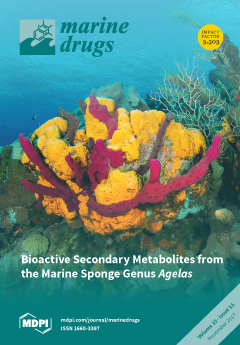
Cover Story: Shown on the cover is Agelas clathrodes, also known as the orange elephant ear sponge. This organism is representative of the 18 other species covered in our review. Agelas sponges have been popular for scientific study because, as can be seen in the cover photo, they stand out in their environment. Agelas species can be found on coral reefs throughout Oceania. Remarkably, there has been sustained study, spanning last 47 years, of their structurally diverse metabolites. We believe that the biosynthetic products isolated from Agelas are truly fascinating and while perusing our review you will be able to scan more than 291 structures, many of which possess hetero atom diversity along with powerful bioactivity properties. (Cover photo by Clay Wiseman, all rights reserved) View this paper
  • Issues are regarded as officially published after their release is announced to the table of contents alert mailing list .
  • You may sign up for email alerts to receive table of contents of newly released issues.
  • PDF is the official format for papers published in both, html and pdf forms. To view the papers in pdf format, click on the "PDF Full-text" link, and use the free Adobe Reader to open them.

Articles (34)

  • Article
  • Open Access
33 Citations
6,073 Views
18 Pages

High-Throughput Identification of Antimicrobial Peptides from Amphibious Mudskippers

  • Yunhai Yi,
  • Xinxin You,
  • Chao Bian,
  • Shixi Chen,
  • Zhao Lv,
  • Limei Qiu and
  • Qiong Shi

22 November 2017

Widespread existence of antimicrobial peptides (AMPs) has been reported in various animals with comprehensive biological activities, which is consistent with the important roles of AMPs as the first line of host defense system. However, no big-data-b...

  • Short Note
  • Open Access
31 Citations
5,503 Views
8 Pages

Aspersymmetide A, a New Centrosymmetric Cyclohexapeptide from the Marine-Derived Fungus Aspergillus versicolor

  • Xue-Mei Hou,
  • Ya-Hui Zhang,
  • Yang Hai,
  • Ji-Yong Zheng,
  • Yu-Cheng Gu,
  • Chang-Yun Wang and
  • Chang-Lun Shao

22 November 2017

A new centrosymmetric cyclohexapeptide, aspersymmetide A (1), together with a known peptide, asperphenamate (2), was isolated from the fungus Aspergillus versicolor isolated from a gorgonian coral Carijoa sp., collected from the South China Sea. The...

  • Article
  • Open Access
17 Citations
6,873 Views
11 Pages

16 November 2017

The cationic antimicrobial peptide epinecidin-1 was identified from Epinephelus coioides and possesses multiple biological functions, including antibacterial, antifungal, anti-tumor, and immunomodulatory effects. In addition, epinecidin-1 suppresses...

  • Article
  • Open Access
192 Citations
14,573 Views
11 Pages

Proximate Composition and Nutritional Value of Three Macroalgae: Ascophyllum nodosum, Fucus vesiculosus and Bifurcaria bifurcata

  • José M. Lorenzo,
  • Rubén Agregán,
  • Paulo E. S. Munekata,
  • Daniel Franco,
  • Javier Carballo,
  • Selin Şahin,
  • Ramón Lacomba and
  • Francisco J. Barba

15 November 2017

Proximate composition (moisture, protein, lipid and ash content) and nutritional value (fatty acid, amino acid and mineral profile) of three macroalgae (Ascophyllum nodosum, Fucus vesiculosus and Bifurcaria bifurcate) were studied. Chemical compositi...

  • Feature Paper
  • Review
  • Open Access
35 Citations
10,747 Views
34 Pages

The Oxepane Motif in Marine Drugs

  • Héctor Barbero,
  • Carlos Díez-Poza and
  • Asunción Barbero

15 November 2017

Oceans have shown to be a remarkable source of natural products. The biological properties of many of these compounds have helped to produce great advances in medicinal chemistry. Within them, marine natural products containing an oxepanyl ring are p...

  • Article
  • Open Access
41 Citations
7,439 Views
16 Pages

Lactones from the Sponge-Derived Fungus Talaromyces rugulosus

  • Lisa Küppers,
  • Weaam Ebrahim,
  • Mona El-Neketi,
  • Ferhat C. Özkaya,
  • Attila Mándi,
  • Tibor Kurtán,
  • Raha S. Orfali,
  • Werner E. G. Müller,
  • Rudolf Hartmann and
  • Peter Proksch
  • + 3 authors

14 November 2017

The marine-derived fungus Talaromyces rugulosus isolated from the Mediterranean sponge Axinella cannabina and cultured on solid rice medium yielded seventeen lactone derivatives including five butenolides (15), seven (3S)-resorcylide derivatives (6–...

  • Article
  • Open Access
46 Citations
6,458 Views
12 Pages

Asperlin Inhibits LPS-Evoked Foam Cell Formation and Prevents Atherosclerosis in ApoE−/− Mice

  • Yue Zhou,
  • Ran Chen,
  • Dong Liu,
  • Chongming Wu,
  • Peng Guo and
  • Wenhan Lin

14 November 2017

Asperlin is a marine-derived natural product with antifungal and anti-inflammatory activities in vitro. In the present study, we isolated asperlin from a marine Aspergillus versicolor LZD4403 fungus and investigated its anti-atherosclerotic effects i...

  • Article
  • Open Access
6 Citations
4,792 Views
12 Pages

12 November 2017

The marine microalgae Isochrysis are a good producer of natural docosahexaenoic acid (DHA). To better understand the patterns of DHA accumulation and distribution, two Isochrysis strains, CL153180 and CCMP462, were evaluated in this study. In a batch...

  • Feature Paper
  • Article
  • Open Access
21 Citations
5,768 Views
10 Pages

New 2-Methoxy Acetylenic Acids and Pyrazole Alkaloids from the Marine Sponge Cinachyrella sp.

  • Amin Mokhlesi,
  • Rudolf Hartmann,
  • Tibor Kurtán,
  • Horst Weber,
  • Wenhan Lin,
  • Chaidir Chaidir,
  • Werner E. G. Müller,
  • Georgios Daletos and
  • Peter Proksch

11 November 2017

Three new 2-methoxy acetylenic acids (1–3) and a known derivative (4), in addition to three new natural pyrazole alkaloids (5–7) were isolated from an Indonesian marine sponge of the genus Cinachyrella. Compounds 5 and 6 have previously been reported...

  • Article
  • Open Access
22 Citations
5,154 Views
9 Pages

Anandins A and B, Two Rare Steroidal Alkaloids from a Marine Streptomyces anandii H41-59

  • Yang-Mei Zhang,
  • Bai-Lian Liu,
  • Xin-Heng Zheng,
  • Xiao-Jun Huang,
  • Hong-Yu Li,
  • Ying Zhang,
  • Ting-Ting Zhang,
  • Da-Yuan Sun,
  • Bi-Run Lin and
  • Guang-Xiong Zhou

10 November 2017

Anandins A (1) and B (2), two rare steroidal alkaloids, were isolated from the fermentative broth of a marine actinobacteria Streptomyces anandii H41-59. The gross structures of the two alkaloids were elucidated by spectroscopic methods including HR-...

  • Article
  • Open Access
18 Citations
6,040 Views
13 Pages

An Insight into Sargassum muticum Cytoprotective Mechanisms against Oxidative Stress on a Human Cell In Vitro Model

  • Susete Pinteus,
  • Marco F. L. Lemos,
  • Joana Silva,
  • Celso Alves,
  • Agnieszka Neugebauer,
  • Rafaela Freitas,
  • Adriana Duarte and
  • Rui Pedrosa

10 November 2017

Sargassum muticum is a brown seaweed with strong potential to be used as a functional food ingredient, mainly due to its antioxidant properties. It is widely used in traditional oriental medicine for the treatment of numerous diseases. Nevertheless,...

  • Review
  • Open Access
97 Citations
11,756 Views
30 Pages

Structural Diversity, Biological Properties and Applications of Natural Products from Cyanobacteria. A Review

  • Sayed Asmat Ali Shah,
  • Najeeb Akhter,
  • Bibi Nazia Auckloo,
  • Ishrat Khan,
  • Yanbin Lu,
  • Kuiwu Wang,
  • Bin Wu and
  • Yue-Wei Guo

10 November 2017

Nowadays, various drugs on the market are becoming more and more resistant to numerous diseases, thus declining their efficacy for treatment purposes in human beings. Antibiotic resistance is one among the top listed threat around the world which eve...

  • Review
  • Open Access
44 Citations
9,935 Views
29 Pages

Bioactive Secondary Metabolites from the Marine Sponge Genus Agelas

  • Huawei Zhang,
  • Menglian Dong,
  • Jianwei Chen,
  • Hong Wang,
  • Karen Tenney and
  • Phillip Crews

8 November 2017

The marine sponge genus Agelas comprises a rich reservoir of species and natural products with diverse chemical structures and biological properties with potential application in new drug development. This review for the first time summarized seconda...

  • Article
  • Open Access
33 Citations
5,602 Views
14 Pages

7 November 2017

In this study, the immunomodulatory activities of Apostichopus japonicus glycosaminoglycan (AHG) on the nature killer (NK) cells, cytotoxic T lymphocytes (CTLs) and cyclophosphamide (CY)-treated mice were investigated. After stimulation with multiple...

  • Review
  • Open Access
68 Citations
8,921 Views
15 Pages

7 November 2017

Classic hypotheses of Alzheimer’s disease (AD) include cholinergic neuron death, acetylcholine (ACh) deficiency, metal ion dynamic equilibrium disorder, and deposition of amyloid and tau. Increased evidence suggests neuroinflammation and oxidative st...

  • Article
  • Open Access
49 Citations
6,108 Views
10 Pages

Cytotoxic and Antibacterial Compounds from the Coral-Derived Fungus Aspergillus tritici SP2-8-1

  • Weiyi Wang,
  • Yanyan Liao,
  • Chao Tang,
  • Xiaomei Huang,
  • Zhuhua Luo,
  • Jianming Chen and
  • Peng Cai

7 November 2017

Three novel compounds, 4-methyl-candidusin A (1), aspetritone A (2) and aspetritone B (3), were obtained from the culture of a coral-derived fungus Aspergillus tritici SP2-8-1, together with fifteen known compounds (418). Their structures, including...

  • Article
  • Open Access
36 Citations
7,137 Views
14 Pages

Evidence for a Saponin Biosynthesis Pathway in the Body Wall of the Commercially Significant Sea Cucumber Holothuria scabra

  • Shahida Akter Mitu,
  • Utpal Bose,
  • Saowaros Suwansa-ard,
  • Luke H. Turner,
  • Min Zhao,
  • Abigail Elizur,
  • Steven M. Ogbourne,
  • Paul Nicholas Shaw and
  • Scott F. Cummins

7 November 2017

The sea cucumber (phylum Echinodermata) body wall is the first line of defense and is well known for its production of secondary metabolites; including vitamins and triterpenoid glycoside saponins that have important ecological functions and potentia...

  • Feature Paper
  • Article
  • Open Access
38 Citations
5,247 Views
11 Pages

7 November 2017

Six kinds of chitinous materials have been used as sole carbon/nitrogen (C/N) sources for producing α-glucosidase inhibitors (aGI) by Paenibacillus sp. TKU042. The aGI productivity was found to be highest in the culture supernatants using demineraliz...

  • Article
  • Open Access
10 Citations
5,460 Views
16 Pages

4 November 2017

AS1041 is a novel synthesized anthraquinone lactone derivative of marine natural compound aspergiolide A (ASP-A) with new structure skeleton and marked cytotoxicity in cancer cells. To study its cytotoxicity in detail, we evaluated its activity on hu...

  • Article
  • Open Access
25 Citations
5,327 Views
17 Pages

Degradation of Polysaccharides from Grateloupia filicina and Their Antiviral Activity to Avian Leucosis Virus Subgroup J

  • Yuhao Sun,
  • Xiaolin Chen,
  • Ziqiang Cheng,
  • Song Liu,
  • Huahua Yu,
  • Xueqin Wang and
  • Pengcheng Li

3 November 2017

In this study, polysaccharides from Grateloupia filicinia (GFP) were extracted and several low molecular weight (Mw) G. filicina polysaccharides (LGFPs) were prepared by the hydrogen peroxide (H2O2) oxidation method. Additionally, the effect of diffe...

  • Article
  • Open Access
12 Citations
5,049 Views
16 Pages

Insight into the Mechanism of Action of Marine Cytotoxic Thiazinoquinones

  • Concetta Imperatore,
  • Paola Cimino,
  • Gerardo Cebrián-Torrejón,
  • Marco Persico,
  • Anna Aiello,
  • Maria Senese,
  • Caterina Fattorusso,
  • Marialuisa Menna and
  • Antonio Doménech-Carbó

2 November 2017

The electrochemical response of four natural cytotoxic thiazinoquinones isolated from the Aplidium species was studied using conventional solution-phase and solid-state techniques, based on the voltammetry of immobilized particles methodology. The in...

  • Article
  • Open Access
15 Citations
5,603 Views
17 Pages

2 November 2017

The chemical study of the bryozoan Schizomavella mamillata has led to the isolation of six new 5-alkylresorcinol derivatives, schizols A–F (16), whose structures were established by spectrocospic means. Schizol A (1) exhibits a (E)-6-phenylnon-5-eny...

  • Article
  • Open Access
27 Citations
5,467 Views
12 Pages

Pseudane-VII Isolated from Pseudoalteromonas sp. M2 Ameliorates LPS-Induced Inflammatory Response In Vitro and In Vivo

  • Mi Eun Kim,
  • Inae Jung,
  • Jong Suk Lee,
  • Ju Yong Na,
  • Woo Jung Kim,
  • Young-Ok Kim,
  • Yong-Duk Park and
  • Jun Sik Lee

1 November 2017

The ocean is a rich resource of flora, fauna, food, and biological products. We found a wild-type bacterial strain, Pseudoalteromonas sp. M2, from marine water and isolated various secondary metabolites. Pseudane-VII is a compound isolated from the P...

  • Article
  • Open Access
56 Citations
6,887 Views
12 Pages

1 November 2017

In this study, a simple aqueous two-phase system (ATPS) was employed for concurrent purification of oyster polysaccharides. The chemical structure and anti-tumor activities of purified oyster polysaccharides (OP-1) were also investigated. Under optim...

  • Article
  • Open Access
41 Citations
6,786 Views
9 Pages

1 November 2017

Polyunsaturated fatty acids, such as eicosapentaenoic acid (EPA; C20:5n-3), are attracting interest as possible new topical antibacterial agents, particularly due to their potency and perceived safety. However, relatively little is known of the under...

  • Article
  • Open Access
24 Citations
8,363 Views
15 Pages

Cucumarioside A2-2 Causes Macrophage Activation in Mouse Spleen

  • Evgeny A. Pislyagin,
  • Igor V. Manzhulo,
  • Tatiana Y. Gorpenchenko,
  • Pavel S. Dmitrenok,
  • Sergey A. Avilov,
  • Alexandra S. Silchenko,
  • Yun-Ming Wang and
  • Dmitry L. Aminin

1 November 2017

The immunomodulatory effect of triterpene glycoside cucumarioside A2-2 (CA2-2), isolated from the Far Eastern sea cucumber Cucumaria japonica, was compared with lipopolysaccharide (LPS) on mouse spleen. It has been shown that the intraperitoneal (i.p...

  • Article
  • Open Access
35 Citations
5,495 Views
13 Pages

Diverse Secondary Metabolites from the Marine-Derived Fungus Dichotomomyces cejpii F31-1

  • Yan-Xiu Chen,
  • Meng-Yang Xu,
  • Hou-Jin Li,
  • Kun-Jiao Zeng,
  • Wen-Zhe Ma,
  • Guo-Bao Tian,
  • Jun Xu,
  • De-Po Yang and
  • Wen-Jian Lan

1 November 2017

By adding l-tryptophan and l-phenylalanine to GPY medium, twenty-eight compounds, including amides, polyketides, a sesquiterpenoid, a diterpenoid, a meroterpenoid, diketopiperazines, β-carbolines, fumiquinazolines, and indole alkaloids, were discover...

  • Article
  • Open Access
45 Citations
4,965 Views
15 Pages

Carrageenans-Sulfated Polysaccharides from Red Seaweeds as Matrices for the Inclusion of Echinochrome

  • Irina M. Yermak,
  • Natalia P. Mischchenko,
  • Viktoria N. Davydova,
  • Valery P. Glazunov,
  • Daria V. Tarbeeva,
  • Anna O. Kravchenko,
  • Evgeniya A. Pimenova and
  • Irina V. Sorokina

1 November 2017

The possibility of using different types of carrageenans (CRG) as matrixes for incorporating of echinochrome A (Ech) was investigated. Ech interacts with carrageenans and is incorporated into the macromolecular structure of the polysaccharide. The in...

  • Feature Paper
  • Article
  • Open Access
29 Citations
6,903 Views
17 Pages

Lipophilic Fraction of Cultivated Bifurcaria bifurcata R. Ross: Detailed Composition and In Vitro Prospection of Current Challenging Bioactive Properties

  • Sónia A. O. Santos,
  • Stephanie S. Trindade,
  • Catia S. D. Oliveira,
  • Paula Parreira,
  • Daniela Rosa,
  • Maria F. Duarte,
  • Isabel Ferreira,
  • Maria T. Cruz,
  • Andreia M. Rego and
  • Armando J. D. Silvestre
  • + 2 authors

1 November 2017

Macroalgae have been seen as an alternative source of molecules with promising bioactivities to use in the prevention and treatment of current lifestyle diseases. In this vein, the lipophilic fraction of short-term (three weeks) cultivated Bifurcaria...

  • Article
  • Open Access
63 Citations
8,603 Views
10 Pages

Antimicrobial and Anti-Proliferative Effects of Skin Mucus Derived from Dasyatis pastinaca (Linnaeus, 1758)

  • Virginia Fuochi,
  • Giovanni Li Volti,
  • Giuseppina Camiolo,
  • Francesco Tiralongo,
  • Cesarina Giallongo,
  • Alfio Distefano,
  • Giulio Petronio Petronio,
  • Ignazio Barbagallo,
  • Maria Viola and
  • Daniele Tibullo
  • + 3 authors

1 November 2017

Resistance to chemotherapy occurs in various diseases (i.e., cancer and infection), and for this reason, both are very difficult to treat. Therefore, novel antimicrobial and chemotherapic drugs are needed for effective antibiotic therapy. The aim of...

  • Article
  • Open Access
26 Citations
5,296 Views
18 Pages

Discovery of Novel Bromophenol Hybrids as Potential Anticancer Agents through the Ros-Mediated Apoptotic Pathway: Design, Synthesis and Biological Evaluation

  • Li-Jun Wang,
  • Chuan-Long Guo,
  • Xiang-Qian Li,
  • Shuai-Yu Wang,
  • Bo Jiang,
  • Yue Zhao,
  • Jiao Luo,
  • Kuo Xu,
  • Hua Liu and
  • Da-Yong Shi
  • + 2 authors

1 November 2017

A series of bromophenol hybrids with N-containing heterocyclic moieties were designed, and their anticancer activities against a panel of five human cancer cell lines (A549, Bel7402, HepG2, HCT116 and Caco2) using MTT assay in vitro were explored. Am...

  • Review
  • Open Access
27 Citations
9,030 Views
28 Pages

Marine Algae as Source of Novel Antileishmanial Drugs: A Review

  • Lauve Rachel Tchokouaha Yamthe,
  • Regina Appiah-Opong,
  • Patrick Valere Tsouh Fokou,
  • Nole Tsabang,
  • Fabrice Fekam Boyom,
  • Alexander Kwadwo Nyarko and
  • Michael David Wilson

29 October 2017

Leishmaniasis is a vector-borne neglected tropical disease caused by protozoan parasites of the Leishmania genus and transmitted by the female Phlebotomus and Lutzomyia sand flies. The currently prescribed therapies still rely on pentavalent antimoni...

  • Article
  • Open Access
32 Citations
4,394 Views
9 Pages

27 October 2017

Four new khayanolide-type limonoids with a 2-carbonyl group, named krishnolides A–D (14), were isolated from the seeds of an Indian mangrove, Xylocarpus moluccensis, collected in the mangrove swamp of Krishna estuary, Andhra Pradesh. The relative an...

  • Article
  • Open Access
70 Citations
7,732 Views
14 Pages

Determination of the Deacetylation Degree of Chitooligosaccharides

  • Yao Jiang,
  • Chuhan Fu,
  • Sihui Wu,
  • Guihua Liu,
  • Jiao Guo and
  • Zhengquan Su

25 October 2017

The methods for determination of chitosan content recommended in the Chinese Pharmacopoeia and the European Pharmacopoeia are not applicable for evaluation of the extent of deacetylation (deacetylation degree, DD) in chitooligosaccharides (COS). This...

XFacebookLinkedIn
Mar. Drugs - ISSN 1660-3397