

You are currently viewing a new version of our website. To view the old version click .

Pharmaceuticals, Volume 14, Issue 5

May 2021 - 106 articles

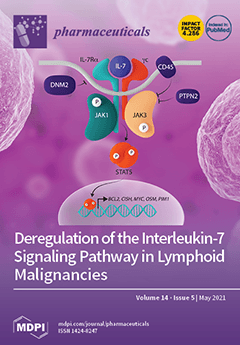
Cover Story: The cytokine interleukin-7 (IL-7) and its receptor are critical for lymphocyte development and homeostasis. The loss of IL-7 signaling causes severe combined immunodeficiency, whereas gain-of-function of the pathway contributes to malignant transformation. It has become increasingly clear that in lymphoid malignancies, especially in T-cell leukemia, many components of the IL-7 signaling pathway carry genetic alterations leading to increased signaling. Moreover, the majority of leukemic cells express the wild type IL-7 receptor and remain dependent on IL-7 signaling for survival, cell cycle progression and proliferation. Here, we review the role of deregulated IL-7-induced JAK-STAT signaling in lymphoid malignancies of T- and B-cell origin. View this paper
  • Issues are regarded as officially published after their release is announced to the table of contents alert mailing list .
  • You may sign up for email alerts to receive table of contents of newly released issues.
  • PDF is the official format for papers published in both, html and pdf forms. To view the papers in pdf format, click on the "PDF Full-text" link, and use the free Adobe Reader to open them.

Articles (106)

  • Review
  • Open Access
54 Citations
11,218 Views
15 Pages

Drug interactions are a well-known cause of adverse drug events, and drug interaction databases can help the clinician to recognize and avoid such interactions and their adverse events. However, not every interaction leads to an adverse drug event. T...

  • Review
  • Open Access
53 Citations
7,312 Views
20 Pages

Immunodepression, whether due to HIV infection or organ transplantation, has increased human vulnerability to fungal infections. These conditions have created an optimal environment for the emergence of opportunistic infections, which is concomitant...

  • Article
  • Open Access
3 Citations
3,465 Views
21 Pages

Conflicting reports about the role of neuropeptide S (NPS) in animal models of psychotic-like behavior and inconsistent results from human genetic studies seeking potential associations with schizophrenia prompted us to reevaluate the effects of NPS...

  • Review
  • Open Access
12 Citations
4,694 Views
15 Pages

The Antiviral Role of Galectins toward Influenza A Virus Infection—An Alternative Strategy for Influenza Therapy

  • Chih-Yen Lin,
  • Zih-Syuan Yang,
  • Wen-Hung Wang,
  • Aspiro Nayim Urbina,
  • Yu-Ting Lin,
  • Jason C. Huang,
  • Fu-Tong Liu and
  • Sheng-Fan Wang

Animal lectins are proteins with carbohydrate recognition activity. Galectins, the β-galactoside binding lectins, are expressed in various cells and have been reported to regulate several immunological and physiological responses. Recently, some gale...

  • Article
  • Open Access
31 Citations
5,108 Views
18 Pages

α-Glucosidase is considered a prime drug target for Diabetes Mellitus and its inhibitors are used to delay carbohydrate digestion for the treatment of diabetes mellitus. With the aim to design α-glucosidase inhibitors with novel chemical scaffolds, t...

  • Feature Paper
  • Review
  • Open Access
14 Citations
5,140 Views
13 Pages

Roles of Neuropeptide S in Anesthesia, Analgesia, and Sleep

  • Tetsuya Kushikata,
  • Kazuyoshi Hirota,
  • Junichi Saito and
  • Daiki Takekawa

Neuropeptide S (NPS) is an endogenous peptide that regulates various physiological functions, such as immune functions, anxiety-like behaviors, learning and memory, the sleep–wake rhythm, ingestion, energy balance, and drug addiction. These processes...

  • Article
  • Open Access
12 Citations
4,261 Views
17 Pages

The avascular structure and lack of regenerative cells make the repair of osteochondral defects in the temporomandibular joint (TMJ) highly challenging in the clinic. To provide a viable treatment option, we developed a methacrylated gelatin (Gel-MA)...

  • Communication
  • Open Access
3 Citations
4,384 Views
10 Pages

Synthesis of Novel Fluorinated Xanthine Derivatives with High Adenosine A2B Receptor Binding Affinity

  • Marcel Lindemann,
  • Sladjana Dukic-Stefanovic,
  • Sonja Hinz,
  • Winnie Deuther-Conrad,
  • Rodrigo Teodoro,
  • Cathleen Juhl,
  • Jörg Steinbach,
  • Peter Brust,
  • Christa E. Müller and
  • Barbara Wenzel

The G protein-coupled adenosine A2B receptor is suggested to be involved in various pathological processes accompanied by increased levels of adenosine as found in inflammation, hypoxia, and cancer. Therefore, the adenosine A2B receptor is currently...

  • Article
  • Open Access
24 Citations
8,395 Views
14 Pages

Hydrotalcite–Niclosamide Nanohybrid as Oral Formulation towards SARS-CoV-2 Viral Infections

  • Goeun Choi,
  • Huiyan Piao,
  • N. Sanoj Rejinold,
  • Seungjin Yu,
  • Ki-yeok Kim,
  • Geun-woo Jin and
  • Jin-Ho Choy

COVID-19 has been affecting millions of individuals worldwide and, thus far, there is no accurate therapeutic strategy. This critical situation necessitates novel formulations for already existing, FDA approved, but poorly absorbable drug candidates,...

  • Article
  • Open Access
6 Citations
4,517 Views
22 Pages

MH-76, a Novel Non-Quinazoline α1-Adrenoceptor Antagonist, but Not Prazosin Reduces Inflammation and Improves Insulin Signaling in Adipose Tissue of Fructose-Fed Rats

  • Monika Kubacka,
  • Szczepan Mogilski,
  • Monika Zadrożna,
  • Barbara Nowak,
  • Małgorzata Szafarz,
  • Bartosz Pomierny,
  • Henryk Marona,
  • Anna Waszkielewicz,
  • Wojciech Jawień and
  • Jacek Sapa
  • + 3 authors

Background: Quinazoline α1-adrenoceptors antagonists have been shown to exert moderately favorable effects on the metabolic profile in hypertensive patients. However, based on AntiHypertensive and Lipid-Lowering Treatment to Prevent Heart Attack Tria...

of 11

Get Alerted

Add your email address to receive forthcoming issues of this journal.

XFacebookLinkedIn
Pharmaceuticals - ISSN 1424-8247