



You are currently viewing a new version of our website. To view the old version click .

Pharmaceuticals, Volume 11, Issue 1

March 2018 - 30 articles

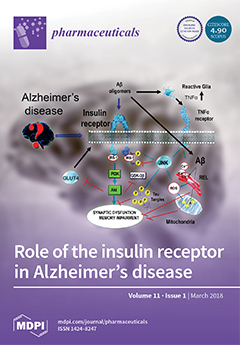
Cover Story: Briefly, amyloid β 1–42 (Aβ) binds to the brain insulin receptor (IR) and dysregulates its signalling cascade in the hippocampus and other brain areas, contributing to the development of insulin resistance. In addition, Aβ indirectly modulates IR activation through the phosphorylation of IR substrates 1 (IRS-1) at its inactivation sites. This response would be the consequence of the increase in reactive glia induced by Aβ and the subsequent release of molecules like tumour necrosis factor alpha (TNFα). Decreased IR signalling leads to reduced activation of protein kinase B (PKB/AKT) which influences other pathways like those controlled by glycogen synthase kinase 3β (GSK3β) and the trafficking of the insulin-sensitive glucose transporter type 4 (GLUT4) to the plasma membrane. In conclusion, all these interrelated mechanisms eventually lead to the well-known memory impairment characteristic of Alzheimer’s disease. View this paper
  • Issues are regarded as officially published after their release is announced to the table of contents alert mailing list .
  • You may sign up for email alerts to receive table of contents of newly released issues.
  • PDF is the official format for papers published in both, html and pdf forms. To view the papers in pdf format, click on the "PDF Full-text" link, and use the free Adobe Reader to open them.

Articles (30)

  • Article
  • Open Access
14 Citations
5,153 Views
13 Pages

Comparison Study of Two Differently Clicked 18F-Folates—Lipophilicity Plays a Key Role

  • Kathrin Kettenbach,
  • Laura M. Reffert,
  • Hanno Schieferstein,
  • Stefanie Pektor,
  • Raphael Eckert,
  • Matthias Miederer,
  • Frank Rösch and
  • Tobias L. Ross

Within the last decade, several folate-based radiopharmaceuticals for Single Photon Emission Computed Tomography (SPECT) and Positron Emission Tomography (PET) have been evaluated; however, there is still a lack of suitable 18F-folates for clinical P...

  • Article
  • Open Access
3 Citations
5,765 Views
26 Pages

Physical interactions between proteins are often difficult to decipher. The aim of this paper is to present an algorithm that is designed to recognize binding patches and supporting structural scaffolds of interacting heterodimer proteins using the G...

  • Article
  • Open Access
81 Citations
10,857 Views
13 Pages

Low Molecular Weight Chitosan-Coated PLGA Nanoparticles for Pulmonary Delivery of Tobramycin for Cystic Fibrosis

  • Nusaiba K. Al-Nemrawi,
  • Nid’’A H. Alshraiedeh,
  • Aref L. Zayed and
  • Bashar M. Altaani

(1) Background: Poly(lactic-co-glycolic acid) (PLGA) nanoparticles (NPs) loaded with Tobramycin were prepared using a solvent-evaporation method. (2) Methods: The NPs were coated with low molecular weight chitosan (LMWC) to enhance the mucoadhesivene...

  • Editorial
  • Open Access
154 Citations
17,960 Views
9 Pages

Glycosaminoglycans and Proteoglycans

  • Vitor H. Pomin and
  • Barbara Mulloy

27 February 2018

In this editorial to MDPI Pharmaceuticals special issue “Glycosaminoglycans and Proteoglycans” we describe in outline the common structural features of glycosaminoglycans and the characteristics of proteoglycans, including the intracellular proteogly...

  • Review
  • Open Access
31 Citations
9,895 Views
12 Pages

Semi-Solid and Solid Dosage Forms for the Delivery of Phage Therapy to Epithelia

  • Teagan L. Brown,
  • Steve Petrovski,
  • Hiu Tat Chan,
  • Michael J. Angove and
  • Joseph Tucci

26 February 2018

The delivery of phages to epithelial surfaces for therapeutic outcomes is a realistic proposal, and indeed one which is being currently tested in clinical trials. This paper reviews some of the known research on formulation of phages into semi-solid...

  • Feature Paper
  • Article
  • Open Access
36 Citations
9,604 Views
19 Pages

Characterization of the Lytic Capability of a LysK-Like Endolysin, Lys-phiSA012, Derived from a Polyvalent Staphylococcus aureus Bacteriophage

  • Jumpei Fujiki,
  • Tomohiro Nakamura,
  • Takaaki Furusawa,
  • Hazuki Ohno,
  • Hiromichi Takahashi,
  • Junya Kitana,
  • Masaru Usui,
  • Hidetoshi Higuchi,
  • Yasunori Tanji and
  • Yutaka Tamura
  • + 1 author

24 February 2018

Antibiotic-resistant bacteria (ARB) have spread widely and rapidly, with their increased occurrence corresponding with the increased use of antibiotics. Infections caused by Staphylococcus aureus have a considerable negative impact on human and lives...

  • Article
  • Open Access
4,693 Views
13 Pages

Improved Syntheses of the mGlu5 Antagonists MMPEP and MTEP Using Sonogashira Cross-Coupling

  • Boshuai Mu,
  • Linjing Mu,
  • Roger Schibli,
  • Simon M. Ametamey and
  • Selena Milicevic Sephton

20 February 2018

The Sonogashira cross-coupling, a key step in the syntheses of the mGlu5 antagonists MMPEP and MTEP, provided an improved three-step method for the preparation of MMPEP in 62% overall yield. Using Spartan molecular modeling kit an explanation for the...

  • Article
  • Open Access
9 Citations
6,285 Views
24 Pages

A π-Halogen Bond of Dibenzofuranones with the Gatekeeper Phe113 in Human Protein Kinase CK2 Leads to Potent Tight Binding Inhibitors

  • Alexander Schnitzler,
  • Andreas Gratz,
  • Andre Bollacke,
  • Michael Weyrich,
  • Uwe Kuckländer,
  • Bernhard Wünsch,
  • Claudia Götz,
  • Karsten Niefind and
  • Joachim Jose

17 February 2018

Human protein kinase CK2 is an emerging target for neoplastic diseases. Potent lead structures for human CK2 inhibitors are derived from dibenzofuranones. Two new derivatives, 7,9-dichloro-1,2-dihydro-8-hydroxy-4-[(4-methoxyphenylamino)-methylene]dib...

  • Article
  • Open Access
29 Citations
5,566 Views
13 Pages

16 February 2018

We examined the benefits of short linear α-helical antimicrobial peptides (AMPs) invented in our laboratory for treating bone infection and preventing microbial biofilm formation on model implants due to causative microorganisms of osteomyelitis. For...

  • Article
  • Open Access
35 Citations
6,384 Views
12 Pages

Pilocarpine-Induced Status Epilepticus Is Associated with P-Glycoprotein Induction in Cardiomyocytes, Electrocardiographic Changes, and Sudden Death

  • Jerónimo Auzmendi,
  • Bruno Buchholz,
  • Jimena Salguero,
  • Carlos Cañellas,
  • Jazmín Kelly,
  • Paula Men,
  • Marcela Zubillaga,
  • Alicia Rossi,
  • Amalia Merelli and
  • Ricardo J. Gelpi
  • + 2 authors

16 February 2018

Sudden unexpected death in epilepsy (SUDEP) is the major cause of death in those patients suffering from refractory epilepsy (RE), with a 24-fold higher risk relative to the normal population. SUDEP risk increases with seizure frequency and/or seizur...

of 3

Get Alerted

Add your email address to receive forthcoming issues of this journal.

XFacebookLinkedIn
Pharmaceuticals - ISSN 1424-8247