Skip to Content

Poultry

Poultry is an international, peer-reviewed, open access journal on poultry health, welfare and productivity, published bimonthly online by MDPI. 

Get Alerted

Add your email address to receive forthcoming issues of this journal.

All Articles (220)

Differential SORCS2 Expression Associated with Aggressive Behavior in Laying Hens

  • Loretta Szabó-Sárvári,
  • Klaudia Szalai and
  • Károly Tempfli
  • + 4 authors

Aggressive behavior is a major welfare and production challenge in cage-free laying hen systems, but the genetic mechanisms behind trait variation are poorly understood. This study investigated the role of a previously identified aggression-associated SORCS2 polymorphism and evaluated the expression of SORCS2, DRD14, and NGF in laying hens. A total of 360 hens from three experimental populations were subjected to behavioral observations. The SORCS2 SNP was genotyped by PCR-RFLP, pituitary gene expression was measured by qPCR, and specific-locus amplified fragment sequencing (SLAF-seq) was performed on pooled DNA samples representing the least (LA) and the most (MA) aggressive hens. The previously reported SORCS2 polymorphism was detected in all populations but showed no significant (p >0.05) association with behavioral traits. Among the analyzed genes, SORCS2 expression differed (p < 0.05) between populations and was consistently higher in the MA compared to the LA hens, whereas DRD14 and NGF expressions were similar (p > 0.05) among populations and aggression-divergent groups. The exploratory gene-level SNP differentiation analysis placed SORCS2 in the top 1.3% of genes between aggression-divergent groups, indicating a higher relative ranking than in population-based comparisons (top 4.5%). Overall, an exploratory association between SORCS2 and aggressive phenotype was detected in the experimental populations, which supports further investigation of this gene in relation to chicken behavior.

Poultry

2 September 2026
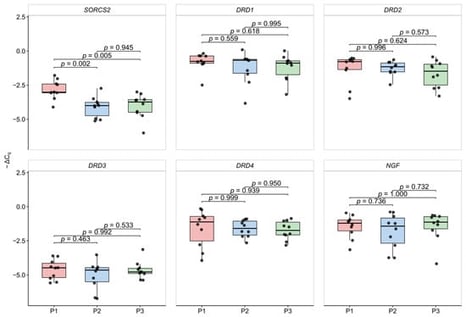
Pituitary gene expression of SORCS2, DRD1, DRD2, DRD3, DRD4, and NGF in three experimental populations (P1–P3).

In Ovo Administration of Vitamin D Sources: A Review

  • Seyed Abolghasem Fatemi,
  • April Waguespack Levy and
  • Edgar David Peebles

In ovo injection has emerged as a targeted strategy for delivering essential nutrients or vaccines during avian embryogenesis, yet the effects of vitamin D (VitD) metabolites delivered prior to hatch remain incompletely understood. This review summarizes the available evidence describing the embryonic and post-hatch responses of broilers when VitD is administered in ovo and highlights the opportunities and limitations for improving their performance in association with each VitD source, including vitamin D3 (VitD3), 25-hydroxyvitamin D3 (25OHD3), 1α-hydroxyvitamin D3 (1α-OHD3), 1,25-dihydroxyvitamin D3 (1,25(OH)2D3), and 24,25-dihydroxyvitamin D3. Greater post-hatch improvements in broiler performance and skeletal development have been observed when in ovo 25OHD3 was combined with dietary 25OHD3 or minerals. The in ovo delivery of 1.2 to 2.4 µg of water-soluble 25OHD3 alone or in combination with Marek’s disease vaccine between 17.5 and 18 days of incubation (doi), has been found to be effective in improving hatchability, post-hatch performance, bone mineralization, meat yield, intestinal histomorphology, and immune function. In contrast, in ovo administration of 1α-OHD3 and 1,25(OH)2D3 at low doses has resulted in inconsistent performance and remains unsuitable for practical in ovo application. The physiological responses to in ovo VitD sources are highly dependent on metabolite form, dose, solubility, vehicle, embryonic age at administration and post-hatch environmental conditions. Nevertheless, 25OHD3 is a promising candidate for integration into commercial in ovo platforms. Furthermore, knowledge gaps remain for defining optimal dose ranges, understanding metabolite interactions, and evaluating long-term impacts across different production systems.

Poultry

7 September 2026

Native Mexican turkeys (Meleagris gallopavo gallopavo) are an important genetic resource in family-based production systems exposed to marked regional and seasonal environmental variation. This study evaluated the associations between environmental gradients, diet composition, and hematological responses in native Mexican turkeys (Meleagris gallopavo gallopavo) raised under traditional family-based production systems. Fifty approximately six-month-old males were evaluated in a 5 × 2 factorial design including five physiographic regions and two seasons (rainy and dry). Crop content composition, estimated dietary nutrient composition, body weight, and hematological profile were analyzed using multivariate analysis of variance, principal component analysis (PCA), and multiple regression. Grains and energy-rich by-products predominated in the diet (58.2–76.2%), whereas the dry season increased dry plant fragments and crude fiber while reducing crude protein from 17.5 to 14.3% (p < 0.001). Body weight was greatest in the Neovolcanic Axis region (5.20 kg) and lowest in the Coast region (4.35 kg) (p < 0.001). Erythrocyte-related variables were higher in temperate, high-altitude regions, whereas leukocyte-related variables predominated in warmer regions (p < 0.05). PCA explained 71.3% of the total variation, identifying nutritional–productive and immunological–adaptive components. Physiographic region was the factor most strongly associated with the diet composition and hematological responses, whereas the dry season intensified nutritional constraints and their effects on physiological adaptation.

Poultry

30 August 2026

A novel fungal phytase (NFP) was evaluated for its effects on growth performance, phosphorus (P) metabolism, tibia development, and nutrient digestibility in broilers. A total of 420 one-day-old Arbor Acres broilers were randomly assigned to seven treatments: a negative control (basal diet without phytase), a positive control (500 U/kg commercial phytase), and five groups supplemented with NFP at 250, 500, 1000, 1500, or 2000 U/kg. Increasing inclusion of dietary NFP linearly improved average daily gain and feed conversion ratio (FCR) during days 22–42 and overall, with NFP outperforming commercial phytase at equivalent doses in FCR reduction. NFP increased the digestibility of crude fiber and P, linearly increased crude protein digestibility, and dose-dependently enhanced ileal digestibility of several amino acids (especially at 1000–2000 U/kg). NFP dose-dependently increased plasma inorganic P while reducing alkaline phosphatase and parathyroid hormone. Tibia weight, midshaft width, bone density, breaking strength, and P content increased linearly with NFP, peaking at 1000–2000 U/kg. NFP also upregulated tibial mRNA expression of the phosphate-regulating gene with homology to endopeptidase on the X chromosome, dentin matrix protein 1, and osteocalcin. In conclusion, NFP optimizes broiler growth, nutrient utilization, and skeletal development via dose-dependent modulation of P metabolism and osteogenic pathways.

Poultry

30 August 2026

Highly Accessed Articles

News & Conferences

Latest Issues

Open for Submission

Journal Sections

XFacebookLinkedIn
Poultry - ISSN 2674-1164