


Abstract
Laying hens exhibit strong motivations for environmental features including secluded nest sites and specific lighting conditions, yet research comparing preferences across commercial layer strains in cage-free systems remains limited. This study examined nest box use under four lighting conditions (monochromatic red LED, monochromatic blue LED, UVA LED, or dark) in four commercial layer strains—three White Leghorn strains (Hy-Line W36, Hy-Line W80, and Lohmann LSL) and one brown layer strain (Hy-Line Brown)—reared under identical cage-free conditions. Sixty birds per strain were housed in a single floor pen per strain (four pens in total), each with an eight-nest, two-tier nest box unit, and the location of eggs laid in nest boxes was recorded at 45 days during early lay. The percentage of eggs laid under each condition was used as an indirect measure of preference. Within each flock, lighting condition affected nest box use (p < 0.001). Overall, more eggs than expected by chance were laid in dark (33.12%) and red-lit (29.51%) nest boxes, and fewer in UV (21.46%) and blue-lit (15.91%) nest boxes. The three White Leghorn flocks used dark nest boxes most, whereas the Hy-Line Brown flock used red-lit boxes most (36.36%), and blue-lit boxes were the least used in all flocks. Use of top- versus bottom-row nest boxes also differed among flocks. Because each strain was represented by a single pen, strain and pen effects are confounded, and differences among strains should be considered preliminary and hypothesis-generating. Replicated studies are needed before strain-specific nest box lighting recommendations can be made.
1. Introduction
The global transition of commercial egg production from conventional battery cages toward cage-free and enriched housing systems has intensified interest in the environmental preferences of laying hens [1]. Battery cage systems, while efficient in terms of production management, prevent hens from performing key motivated behaviors including seeking secluded nest sites for oviposition, dust bathing, and foraging [2,3]. These behavioral needs are rooted in the ecology of the wild Red Junglefowl (Gallus gallus), the progenitor of the domestic chicken, and have been retained through domestication despite millennia of selective breeding for production traits [4]. As the industry expands cage-free housing in response to legislative mandates and consumer expectations, understanding the specific design features that best accommodate hen preferences—including nest box properties and lighting conditions—has become both a practical and regulatory priority [1].
Nest box selection behavior is preceded by a characteristic pre-laying sequence of one to two hours in which hens investigate potential nest sites, exhibiting strong motivation for enclosed, darkened locations with manipulable substrate [5,6]. Preference for darkened nest box interiors is among the most robust findings in nesting behavior research, with hens consistently selecting lower-illumination nest sites across a wide range of lighting conditions [7,8]. This preference is thought to reflect the reduced conspicuousness and disturbance offered by darker nest sites during the vulnerable laying period. The practical importance of this preference is underscored by commercial data showing that insufficiently enclosed or brightly lit nest boxes contribute to floor-laying, a major welfare and production problem in cage-free systems [9]. This practical importance is reinforced by recent work confirming that both genetic and environmental factors continue to shape nest box use in modern cage-free systems: nest preference and floor-egg propensity show a moderate heritable component (h2 = 0.18–0.37; [10]), and targeted lighting interventions can measurably shift the proportion of eggs laid inside versus outside the nest [11,12]. The practical stakes are considerable: a national survey of commercial cage-free flocks found floor-egg levels ranging from 0.01% to 17% of total production, varying with flock size and shed ventilation design [13], and even targeted nest box engineering does not reliably solve the problem—adding ramps to ease physical access to nest boxes shifted, but did not consistently reduce, the proportion of eggs laid on the floor versus in nests [14], underscoring the need to better understand the sensory and lighting cues, rather than access alone, that draw hens into the nest.
Laying hens possess a tetrachromatic visual system sensitive to wavelengths from ultraviolet-A (UV-A, ~300–400 nm) through red (~620–700 nm), providing substantially richer spectral information than the human trichromatic visual system [15]. The spectral composition of light also influences hen behavior and physiology, including fearfulness, pecking behavior, and reproductive function [16,17,18,19,20,21]. Whether these effects extend to nest site choice is less clear, but they suggest that nest box lighting color, in addition to intensity, may influence the attractiveness of nest sites and could be used as a tool to improve nest box use.
Despite this body of research, few studies have systematically compared nest box lighting preference across multiple commercial layer strains under identical cage-free housing conditions. Commercial cage-free operations commonly house multiple genetic strains, and significant variation in behavioral propensities between strains has been documented for fearfulness [22,23], feather pecking susceptibility [24], and social behavior [25], as well as for nest and space-resource use patterns and associated welfare outcomes in aviary and cage systems [26,27]. Recent multi-strain comparisons have also documented strain differences in cage-free production [28], litter use [29], and range use [30] and, most relevant here, in nest box use and floor-egg incidence [31]. Whether strain-level differences extend to the use of nest boxes under different lighting conditions has not been established, leaving a gap in the evidence base for strain-specific housing design recommendations. Addressing this gap is increasingly relevant as retailers and regulatory bodies establish cage-free housing standards that may not account for behavioral variation among commercially available genetic lines. Interest in this question remains active, with strain-comparison studies continuing to emerge under common management conditions [32], yet nest box lighting preference specifically has not been addressed within this comparative framework.
The objective of this study was to compare the use of nest boxes under four lighting conditions (red, blue, UV, and dark) and at two heights (top and bottom row) within flocks of four commercial layer strains—three White Leghorn strains (Hy-Line W36, Hy-Line W80, and Lohmann LSL) and one brown layer strain (Hy-Line Brown)—reared under identical cage-free conditions, and to describe whether these patterns appeared to differ among strains. Because each strain was housed in a single pen, the study was not designed to formally test the strain × lighting interaction, and differences among strains are presented as hypothesis-generating. We hypothesized that (1) hens in all flocks would lay more eggs in darker nest boxes, consistent with the established preference for enclosed, low-illumination nest sites; and (2) the distribution of eggs among lighting conditions would differ among the strain flocks, reflecting documented strain-level behavioral variation.
2. Materials and Methods
2.1. Experimental Design and Animals
Sixty birds from each of four commercial layer strains—three White Leghorn strains (Hy-Line W36, Hy-Line W80, and Lohmann LSL) and one brown layer strain (Hy-Line Brown)—were used in this study (N = 240 total). All birds were obtained from the same commercial hatchery (Hy-Line North America LLC, Bryan, TX, USA) and were not beak-treated. Each strain was reared as a single group of 60 hens in one of four adjacent floor pens (3.05 × 4.57 m) on wood shavings from day of hatch until 35 weeks of age; thus, four pens were used in total, with one pen per strain. All environmental conditions were managed equally according to the guidelines set forth in the Guide for the Care and Use of Agricultural Animals in Research and Teaching [33], and all procedures were approved by the Texas A&M University Institutional Animal Care and Use Committee (IACUC 2017-0259). Nest boxes were provided to all pens from placement. All pens were adjacent to each other and temperature, humidity, lighting and all other environmental conditions were the same.
Because each strain was housed as a single pen, strain was completely confounded with pen, and the 60 hens within a pen cannot be considered independent replicates for the strain effect. Within each pen, lighting conditions and nest box levels were compared across collection days, with the daily distribution of eggs among the eight nest boxes as the unit of observation, so inferences about lighting and nest box level apply to the flocks studied. Differences among strains could not be separated from pen-specific effects, such as pen location or the social characteristics of each group, and were therefore described rather than attributed to genetic strain.
2.2. Nest Box Design and Utilization Analysis
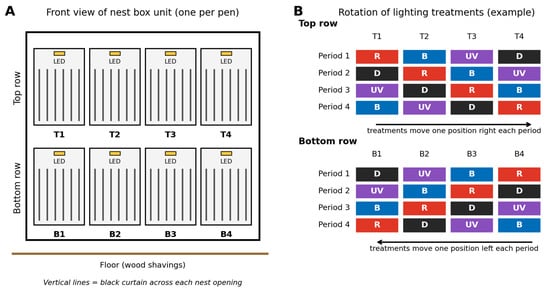
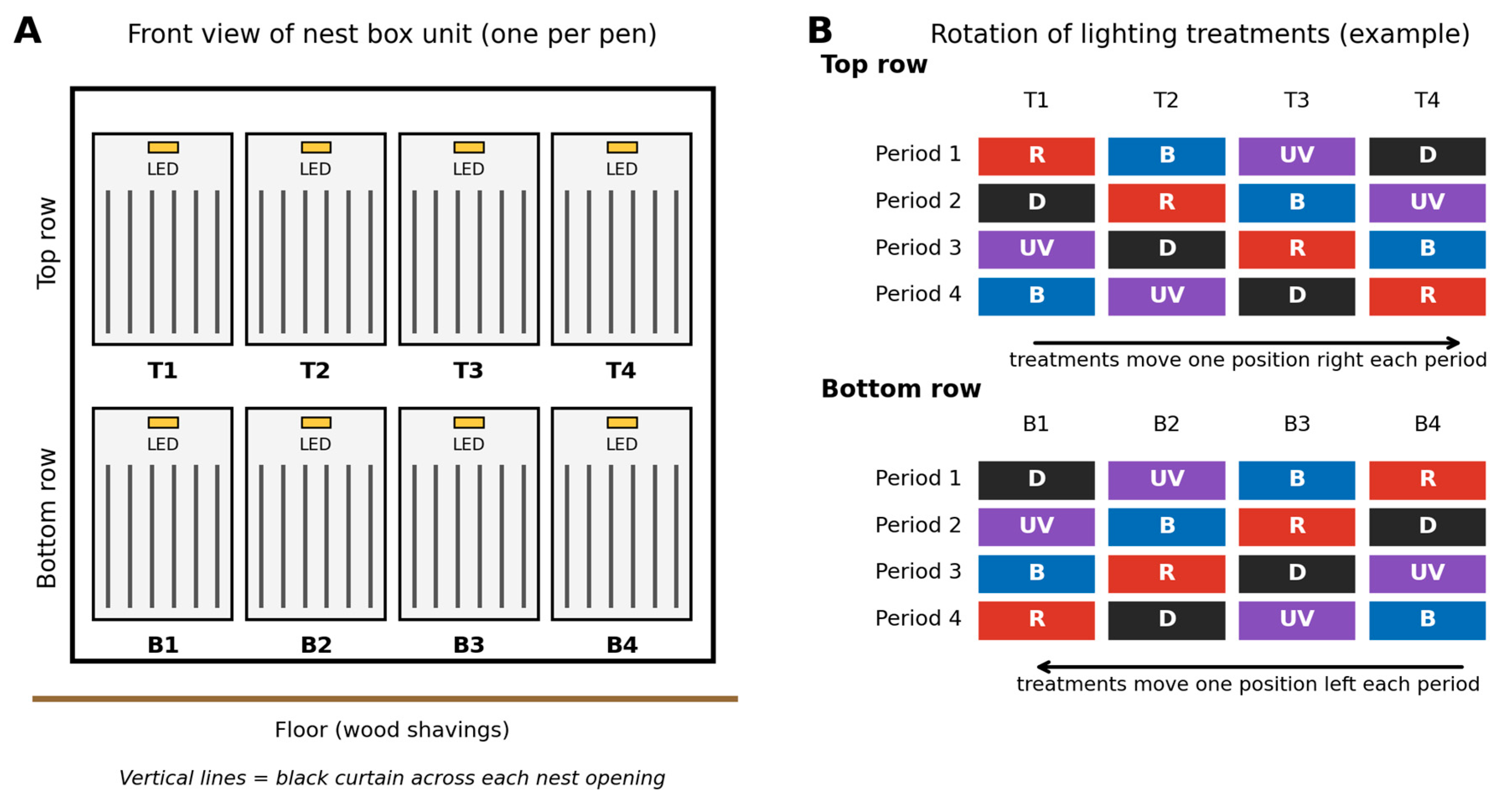
Each pen was equipped with a two-level nest box unit containing eight total nests (KUHL Standard Nesting Boxes, #K8P, Kuhl Corporation, Flemington, NJ, USA), arranged in two rows of four nests (Figure 1). Nest boxes were outfitted with one of four lighting conditions: monochromatic red LED, monochromatic blue LED, UVA LED, or no light (Dark), and each row contained one nest box of each lighting condition. Spectral outputs of the LED treatments are presented in Supplementary Figure S1; peak emissions were approximately 630 nm (red), 450 nm (blue), and 380 nm (UVA). All nest boxes had a black plastic curtain affixed to the front of the opening to isolate the lighting condition within the nest box. Curtain openings overlapped so there was no light leakage. All birds were trained to use the nest boxes by individually placing each hen through the nest box opening on 3 consecutive days prior to lighting treatment initiation. Red and blue light were maintained at 5 clux, a photometric unit weighted to the spectral sensitivity of the domestic fowl [15]. Eggs were collected twice daily, and the nest box in which each egg was laid was recorded; collections occurred 3 h after the pen lights turned on and 3 h before the lights turned off. Eggs laid on the floor were not included in the analysis. Lighting treatments commenced at 22 weeks of age when over 95% of lay was obtained in all pens, and continued until 35 weeks of age. Using a Latin square design, treatments were rotated weekly between nest boxes on each level, with the rotation reversed on bottom versus top row, for a total of three complete rotations during the study (Figure 1). Eggs were recorded by lighting treatment and row rather than by physical nest position, so the effects of position within a row (e.g., left versus right) could not be analyzed separately; the rotation was intended to balance these effects across treatments.
Figure 1.
Nest box arrangement and treatment rotation. (A) Front view of the two-tier nest box unit used in each pen, showing nest positions 1–4 (left to right) in the top (T) and bottom (B) rows, the LED in each nest, and the black curtain across each nest opening. (B) Rotation of lighting treatments among nest positions; treatments moved one position per rotation period, in opposite directions in the two rows, so that each treatment occupied each position. R = red LED; B = blue LED; UV = UVA LED; D = no light (dark). The starting order shown is illustrative. The spectral output of each LED treatment is shown in Supplementary Figure S1.
2.3. Statistical Analysis
Nest box use was analyzed separately for each strain using daily egg counts from 45 collection days. Each day’s data consisted of the number of eggs laid in each of the eight nest boxes, which formed a 2 × 4 arrangement of level (top, bottom) and lighting condition (red, blue, UV, dark). Floor eggs were excluded, and the percentage of eggs in each nest box was calculated from the total number of eggs laid in nest boxes that day. This percentage was used as a measure of nest box use and treated as an indirect indicator of preference; individual hens were not identified, and nest choice was not tested under forced-choice conditions. Data are presented as mean (±SE) daily percentages by strain, lighting condition, and nest box level.
The primary analysis was a generalized linear model with a Poisson error distribution and log link, fitted separately for each pen. Nest box egg counts were modeled as a function of lighting condition, level, and their interaction, with collection day included as a blocking factor. Because day accounts for variation in daily egg totals, this model is equivalent to a multinomial model of how eggs were distributed among nest boxes each day, and it accounts for the repeated daily observations within each pen. Overdispersion was accounted for using a quasi-Poisson approach, with the dispersion parameter estimated from the Pearson χ2 statistic. Effects were tested with F-tests from nested model comparisons; the lighting condition × level interaction was tested against the full model, and main effects were tested against the additive model.
As a nonparametric check, the effect of lighting condition was also tested with Friedman’s test on daily percentages, with collection day as the block, for both levels combined and for each level separately. Kendall’s W was calculated from the Friedman statistic as an index of how consistently lighting conditions were ranked from day to day. Pairwise differences between lighting conditions were assessed with Wilcoxon signed-rank tests on paired daily percentages and are reported with mean differences and 95% confidence intervals (Supplementary Table S2); p-values were adjusted using the Holm method within each strain and level grouping.
Nest box use relative to chance was assessed with one-sample t-tests comparing daily percentages against the value expected if eggs were distributed randomly (lighting condition: 25%; nest box level: 50%), with Holm adjustment across the four lighting conditions within each strain; level results were confirmed with Wilcoxon signed-rank tests. Means, standard deviations, standard errors, 95% confidence intervals, and exact p-values are given in Supplementary Table S1. To determine whether level preference depended on lighting condition, the percentage of each condition’s eggs laid in top-row boxes was compared against 50%, with Holm adjustment across the four conditions. Overall values were calculated from all pen-days combined (n = 180) and are presented for reference.
To examine whether the distribution of eggs differed among the four pens, a quasi-Poisson model including all pens was fitted with pen-by-day blocks and pen × lighting condition, pen × level, and pen × lighting condition × level interactions. Because strain and pen were confounded, these interactions test differences among the four flocks and cannot be attributed to strain alone. To describe changes over time, daily percentages were summarized by week (7-day blocks from the first collection day); trends were assessed with Spearman rank correlations between collection day and daily percentages.
Significance was set at p < 0.05. Analyses were performed in Python 3.12 using statsmodels (v0.15.0) and SciPy (v1.17.1).
3. Results
3.1. Nest Box Use Under Different Lighting Conditions
The mean (±SE) percentage of eggs laid under each nest box lighting condition, by strain and nest box location, is presented in Table 1, and results of the within-flock models are presented in Table 2. Across all pens, 54.55% of eggs were laid in bottom-row nest boxes compared to 45.45% in top-row boxes. When collapsed across location, the overall distribution of eggs across lighting conditions ranked dark (33.12%) > red (29.51%) > UV (21.46%) > blue (15.91%). Lighting condition affected nest box use in all four flocks (p < 0.001; Table 2). W36 and LSL each laid the highest proportion of eggs in dark nest boxes, followed by red, UV, and blue, with all four conditions differing from one another (Holm-adjusted p < 0.05; Supplementary Table S2). W80 followed the same order, but red (25.65%) and UV (25.19%) nest boxes were used equally. Hy-Line Brown showed a different pattern, with the highest proportion of eggs laid under red light (36.36%), followed by dark (31.70%), with UV (16.49%) and blue (15.45%) not differing from each other. Blue light received the lowest proportion of eggs in all flocks. Within flocks, the distribution across top and bottom row varied (Table 2): W36 laid a markedly greater proportion of eggs in bottom-row boxes (64.74%) than top-row boxes (35.26%; p < 0.001), while W80 showed a nearly even split (49.59% bottom vs. 50.41% top; p = 0.67). LSL laid slightly more eggs in top-row boxes (52.44%), which differed from an even split (p = 0.015; Supplementary Table S1) but not in the day-blocked model (p = 0.11), indicating a weak preference. Hy-Line Brown laid more eggs in bottom-row boxes (56.32% bottom vs. 43.68% top; p < 0.001).
Table 1.
Mean (±SE) daily percentage of nest box eggs laid under different lighting conditions and nest box levels by four commercial layer strains (one pen per strain).
Table 2.
Within-flock tests of the effects of nest box lighting condition and level on egg distribution (one pen per strain).
3.2. Lighting Condition and Nest Box Level
The lighting condition × level interaction was not significant for W36 (p = 0.25) or W80 (p = 0.71), indicating that these flocks ranked lighting conditions similarly in both rows (Table 2). In W36, every lighting condition was used more in the bottom row than in the top row (p < 0.001 for each), consistent with the strong overall bottom-row use in that flock, whereas in W80 no lighting condition differed from an even top–bottom split. The interaction was significant for LSL (p = 0.030) and Hy-Line Brown (p < 0.001). In LSL, the use of red-lit boxes was concentrated in the top row, where 59.0% of red-box eggs were laid (p = 0.020), whereas no other lighting condition differed from an even split. In Hy-Line Brown, red-lit boxes were used more than dark boxes in the top row (16.83% vs. 11.89%; p < 0.001), whereas red and dark boxes were used equally in the bottom row (19.53% vs. 19.81%; p = 1.00). This pattern reflected Hy-Line Brown hens laying 63.0% of dark-box eggs in the bottom row (p < 0.001); red-box (54.2%) and blue-box (61.2%) eggs were also laid more often in the bottom row (p < 0.05), whereas UV-box eggs were not (p = 0.72).
3.3. Nest Box Use Relative to Chance
Daily percentages for each lighting condition and nest box level were compared with the values expected by chance (Supplementary Table S1). In all four flocks, more eggs than expected were laid in dark nest boxes (31.49–35.44% vs. 25%; Holm-adjusted p < 0.001) and fewer than expected in blue-lit boxes (14.62–17.66%; p < 0.001). Red-lit boxes were used more than expected by W36 (27.96%; p = 0.018), LSL (28.08%; p = 0.024), and Hy-Line Brown (36.36%; p < 0.001), but not by W80 (25.65%; p = 0.96). UV-lit boxes were used less than expected by W36 (22.28%; p = 0.018), LSL (21.87%; p = 0.010), and Hy-Line Brown (16.49%; p < 0.001), but not by W80 (25.19%; p = 0.96). For nest box level, W36 (64.74% bottom; p < 0.001) and Hy-Line Brown (56.32% bottom; p < 0.001) laid more eggs in the bottom row than expected, LSL laid slightly more in the top row (52.44%; p = 0.015), and W80 did not differ from an even split (50.41% top; p = 0.57). Across all pens combined, dark and red-lit boxes were used more, and blue- and UV-lit boxes less, than expected (p < 0.001), as were bottom-row boxes (54.55%; p < 0.001).
3.4. Differences Among Flocks
When all four pens were analyzed together, the distribution of eggs among lighting conditions differed among flocks (pen × lighting condition: F(9, 1241) = 8.52, p < 0.001), as did the distribution between rows (pen × level: F(3, 1241) = 39.51, p < 0.001) and the combination of the two (pen × lighting condition × level: F(9, 1232) = 2.70, p = 0.004). The largest differences were the higher use of red-lit boxes by Hy-Line Brown (36.36% vs. 25.65–28.08% in the White Leghorn flocks), the lower use of UV-lit boxes by Hy-Line Brown (16.49% vs. 21.87–25.19%), and the strong bottom-row use by W36 (64.74% vs. 47.56–56.32% in the other flocks). Because each strain was represented by a single pen, these differences describe the four flocks studied and cannot be attributed to strain alone.
3.5. Consistency and Changes over Time
The consistency of lighting preference across collection days, measured by Kendall’s W, was highest in Hy-Line Brown (W = 0.67) and LSL (W = 0.49), intermediate in W36 (W = 0.36), and lowest in W80 (W = 0.29; Table 2). The difference between the most- and least-used lighting conditions followed a similar pattern, at approximately 21 percentage points in Hy-Line Brown and LSL, 18 in W36, and 14 in W80. Dark nest boxes were the most used condition in all 7 weeks for LSL and in 6 of 7 weeks for W36, and red-lit boxes were the most used in 6 of 7 weeks for Hy-Line Brown. W80 was the least consistent: dark boxes were most used in 4 weeks, whereas UV- or red-lit boxes were most used in weeks 2 to 4, when weekly use of dark boxes fell to 24.0–28.3%. Blue-lit boxes were the least used condition in every week for W36, W80, and LSL, and either blue- or UV-lit boxes were least used in every week for Hy-Line Brown. Use of top-row nest boxes declined over the trial in W36 (from 42.4% in week 1 to 20.2% in week 7; ρ = −0.78, p < 0.001), Hy-Line Brown (50.2% to 39.2%; ρ = −0.47, p = 0.001), and W80 (53.1% to 47.8%; ρ = −0.41, p = 0.005), but not in LSL (ρ = 0.05, p = 0.77). Use of dark nest boxes increased over time in W36 (ρ = 0.34, p = 0.023) and W80 (ρ = 0.33, p = 0.029), and use of UV-lit boxes increased in Hy-Line Brown (ρ = 0.50, p < 0.001). Restricting the LSL analysis to days 1 to 26 did not change any conclusion: lighting condition (p < 0.001) and the lighting condition × level interaction (p < 0.001) remained significant, the level effect remained non-significant (p = 0.12), and the ranking of lighting conditions was unchanged.
4. Discussion
The present study investigated the use of nest boxes under different lighting conditions in four commercial layer strains reared under identical cage-free conditions. The results confirm and extend prior findings on laying hen environmental preferences while revealing differences among the four strain flocks that may have practical implications for cage-free housing design. Because the percentage of eggs laid in each nest box reflects nest box use, it is an indirect measure of preference, and each strain was represented by a single pen; the findings should be interpreted with both points in mind.
The preference for dark nest boxes, which ranked first or second in every flock, is consistent with the well-established finding that laying hens prefer enclosed, low-illumination nest sites for oviposition [7,8]. This preference likely reflects the adaptive significance of nest site concealment during the vulnerable egg-laying period, a behavior conserved from the ancestral Red Junglefowl [4]. The practical implication is that nest box designs incorporating effective light exclusion should be prioritized in cage-free housing to reduce floor-laying behavior, which is a major welfare and production concern [9]. This recommendation is corroborated by recent applied research showing that supplementing general house lighting in dark, non-nest areas reduces floor-laying by removing alternative dark sites outside the nest, while nest interiors themselves remain dark and enclosed [11], and that nest lighting experienced during rearing can carry over to influence nest space use during lay [12]. Consistent with this, engineering interventions that only ease physical access to the nest, such as ramps, have not reliably reduced floor-laying on their own [14], suggesting that the sensory cues that make a nest box attractive—darkness chief among them—may matter more than accessibility per se.
However, the divergence of the Hy-Line Brown flock is noteworthy, although, with one pen per strain, it cannot be attributed to strain with certainty. While W36, W80, and LSL all conformed to the expected dark > red > UV > blue preference ranking (with red and UV used equally by W80), the Hy-Line Brown flock ranked red light first, with a notably higher proportion of eggs laid under red illumination (36.36%) compared to the other strains. This divergence may be related to documented differences in visual sensitivity or behavioral responses to red light between white and brown feathered strains. Red light has been associated with reduced fearfulness and calmer behavior in poultry [16], and it is possible that Hy-Line Brown hens, which differ from White Leghorn strains in fearfulness profiles [22,23], may experience a greater calming effect from red illumination during the pre-laying period, thereby increasing the attractiveness of red-lit nest sites. An additional, non-mutually exclusive explanation involves the reproductive neuroendocrine effects of long-wavelength light: red light stimulates hypothalamic gonadotropin-releasing hormone release and is associated with reduced circulating melatonin [18,19], so Hy-Line Brown hens may have been differentially responsive to this hormonal pathway during the pre-laying period. Neither fearfulness nor reproductive hormones were measured in the present study, so these explanations remain speculative and require direct testing. The Hy-Line Brown preference for red was also clearest in the top row; in the bottom row, red and dark boxes were used equally, largely because these hens laid most of their dark-box eggs in the bottom row. For this flock, darkness and a low nest position may therefore partly substitute for one another, while red light may make elevated nest boxes comparatively more attractive.
If confirmed in replicated studies, this divergence would be consistent with broader evidence that brown and white commercial layer strains differ systematically in how they use and select housing resources, including nest boxes, under identical management [26,27]. This pattern is echoed by a very recent four-strain cage-free comparison using two of the same strains examined here (Hy-Line W-36 and Hy-Line Brown), which found that brown hens outperformed white strains on most egg production and egg quality measures [28], and by a study reporting that brown and white genotypes differed systematically in nest box use and the proportion of eggs laid on aviary tiers versus in nests [31]. Brown strains have likewise been shown to acclimate more slowly than white strains to changes in litter access, indicating broader brown-versus-white differences in behavioral responsiveness to housing cues [29]. The direction of brown-versus-white differences is not universal, however: at least one survey found no consistent difference in floor-egg rates between brown-egg-laying breeds and, in some populations, white strains showed higher off-nest laying than brown strains while in others the reverse was true [13], so strain-typical responses should be treated as tendencies rather than fixed rules.
Flocks also differed in how strongly and consistently they expressed a lighting preference. The Hy-Line Brown and LSL flocks ranked lighting conditions most consistently from day to day and week to week and showed the largest difference between the most- and least-used conditions, whereas the W80 flock distributed its eggs most evenly, with red- and UV-lit boxes used equally. W80 hens may therefore be less sensitive to nest box lighting, or may weigh other nest box features, such as position, more heavily when selecting a nest site. The temporary decline in dark-box use by W80 during weeks 2 to 4 is consistent with this possibility and may reflect nest position effects after treatments were rotated; however, this could not be tested because eggs were recorded by treatment rather than by physical nest position. If confirmed, these differences would suggest that nest box lighting is a more effective management tool in some strains than in others.
Blue light was consistently the least preferred nest box lighting condition across all strains, with only 15.91% of total eggs laid under blue illumination. This finding is consistent with reports that shorter wavelength light may be perceived as more aversive or disruptive by poultry [15]. The low attractiveness of blue light in nest box environments suggests that cool-spectrum lighting may be best avoided within or immediately adjacent to nest box areas in cage-free facilities, although this should be confirmed in replicated studies. This pattern also parallels recent production data showing that lighting spectra weighted toward shorter wavelengths impair laying performance relative to spectra enriched in longer wavelengths [19].
The overall preference for bottom-row nest boxes (54.55% vs. 45.45%) was driven mainly by the W36 and Hy-Line Brown flocks; W80 showed no level preference and LSL a weak preference for the top row. Where present, a bottom-row preference likely reflects the energetic cost and perceived risk associated with accessing elevated nest sites, as well as the tendency of hens to prefer nest sites that are more easily reached during the pre-laying investigative phase [7]. Notably, flocks differed in the degree of this vertical preference, and some strains may benefit from multi-level nest box arrangements more than others. The steady decline in top-row use over the trial in W36 (from about 43% to 20% of nest box eggs), and to a lesser extent in Hy-Line Brown and W80, also indicates that level preferences were still developing during early lay, so the overall level percentages represent an average of a changing pattern rather than a stable preference. A comparable strain-dependent pattern of vertical resource use has been reported in commercial aviary systems, where white and brown hens differed in their use of upper versus lower tiers, particularly during dark periods [26], suggesting that vertical positioning preferences may generalize beyond nest boxes to other elevated resources. This interpretation is consistent with recent reviews linking elevated structures in cage-free and aviary housing to a heightened risk of keel bone damage from collisions and awkward landings, particularly in multi-tier systems [34], which would reinforce hens’ apparent caution around higher nest box tiers.
If confirmed in studies with replicated pens, these findings would have several practical implications for the design of cage-free housing systems. First, the observed strain-level differences in nest box lighting preferences suggest that a single housing specification may not optimally serve all commercial layer strains. Commercial operations housing multiple strains may benefit from providing a diversity of nest box lighting conditions to accommodate the preferences of different genetic lines. Second, the consistent avoidance of blue-lit nest boxes across all strains suggests that blue light should be avoided in nest box lighting design. Third, the finding that Hy-Line Brown hens diverge from White Leghorn strains in nest box lighting preference suggests that housing recommendations developed primarily from research on White Leghorn strains may not generalize to brown feathered lines. Because nest preference and floor-egg tendencies also have a heritable component [10], genetic selection could complement housing-based interventions in strains prone to off-nest laying. Additionally, because darkness immediately outside the nest box promotes floor-laying whereas darkness inside the nest box is preferred for oviposition, well-designed cage-free lighting programs should combine adequately illuminated general housing areas with light-excluding nest interiors [11,12]. This need for strain-tailored management is reinforced by evidence that commercial strains also differ in the timing of other space-use behaviors, such as litter access and dust bathing, which argues for flexible, strain-informed management protocols more broadly rather than one-size-fits-all housing programs [29].
Several limitations should be considered. First, each strain was housed as a single pen of 60 hens, so strain was completely confounded with pen. Because laying hens are social and show gregarious nesting, the nest choices of hens within a pen are not independent, and differences among flocks may reflect pen location, group social dynamics, or other pen-specific characteristics rather than genetics. The statistical tests therefore describe lighting and level effects within the flocks studied, and differences among strains should be regarded as hypothesis-generating until confirmed in studies with multiple replicate pens per strain. Second, eggs were recorded by lighting treatment and row, not by physical nest position, so position effects within a row (e.g., left versus right or end versus middle nests) could not be tested; although treatments were rotated among positions to balance these effects, residual position effects, including any influence of the starting positions, cannot be excluded. Third, nest box use was/was not recorded before lighting treatments began; without baseline data, it is not possible to determine whether hens had already developed nest or position preferences before treatments were applied. Fourth, the percentage of eggs laid in each nest box is an indirect measure of preference, individual hens were not identified, and floor eggs were not included, so the results describe how eggs were distributed among nest boxes rather than individual choices or overall nest use. Finally, a likely recording error affected bottom-row blue and UV counts for LSL during the final 19 collection days; however, excluding these days did not change the conclusions for that flock.
5. Conclusions
In conclusion, within each of the four flocks studied, nest box use differed among lighting conditions, with dark and red-lit nest boxes used most and blue-lit nest boxes least. The Hy-Line Brown flock used red-lit nest boxes most, and flocks differed in their use of top- and bottom-row nest boxes, suggesting that genetic line may need to be considered when designing cage-free nest boxes. However, because each strain was housed as a single pen, differences among strains could not be separated from pen effects and should be considered preliminary and hypothesis-generating; studies with replicated pens per strain are needed to test strain × lighting interactions before strain-specific recommendations are made. These findings nonetheless provide a useful starting point for optimizing nest box housing specifications in multi-strain commercial cage-free operations. Continued strain-comparison research under standardized management, including very recent multi-strain aviary evaluations [32], underscores that genetic line remains an important and evolving consideration in cage-free housing design.
Supplementary Materials
The following supporting information can be downloaded at: https://www.mdpi.com/article/10.3390/poultry5050068/s1, Figure S1: Spectral output of each LED lighting treatment (red, blue, and UVA). Peak emissions were approximately 630 nm (red), 450 nm (blue), and 380 nm (UVA). The dark treatment had no light source; Table S1: Nest box use relative to chance within each flock (one pen per strain). Values are daily percentages of nest box eggs over 45 collection days, compared with the percentage expected if eggs were distributed randomly (25% per lighting condition; 50% per row) using one-sample t-tests (df = 44); Table S2: Pairwise comparisons of lighting conditions within each flock, for both rows combined and for each row separately. Mean difference is the mean of daily differences in percentage points (first condition minus second).
Author Contributions
Conceptualization, G.S.A.; methodology, G.S.A. and A.A.B.; formal analysis, A.A.B.; investigation, A.A.B.; data curation, A.A.B.; writing—original draft preparation, A.A.B.; writing—review and editing, G.S.A.; supervision, G.S.A.; project administration, G.S.A. All authors have read and agreed to the published version of the manuscript.
Funding
This research received no external funding.
Institutional Review Board Statement
The animal study protocol was approved by the Institutional Animal Care and Use Committee of Texas A&M University (protocol code IACUC 2017-0259, approval date: 1 March 2017).
Informed Consent Statement
Not applicable.
Data Availability Statement
The original contributions presented in this study are included in the article/Supplementary Material. Further inquiries can be directed to the corresponding author.
Conflicts of Interest
The authors declare no conflicts of interest.
References
- Lay, D.C.; Fulton, R.M.; Hester, P.Y.; Karcher, D.M.; Kjaer, J.B.; Mench, J.A.; Mullens, B.A.; Newberry, R.C.; Nicol, C.J.; O’Sullivan, N.P.; et al. Hen welfare in different housing systems. Poult. Sci. 2011, 90, 278–294. [Google Scholar] [CrossRef] [Scilit] [PubMed]
- Nicol, C.J. Effect of cage height and area on the behaviour of hens housed in battery cages. Br. Poult. Sci. 1987, 28, 327–335. [Google Scholar] [CrossRef] [Scilit] [PubMed]
- Appleby, M.C.; Smith, S.F.; Hughes, B.O. Nesting, dust bathing and perching by laying hens in cages: Effects of design on behaviour and welfare. Br. Poult. Sci. 1993, 34, 835–847. [Google Scholar] [CrossRef] [Scilit] [PubMed]
- Jensen, P. Domestication—From behaviour to genes and back again. Appl. Anim. Behav. Sci. 2006, 97, 3–15. [Google Scholar] [CrossRef] [Scilit]
- Follensbee, M.E.; Duncan, I.J.H.; Millman, S.T. Demand for nest boxes in hens. Appl. Anim. Behav. Sci. 1992, 37, 369. [Google Scholar] [CrossRef] [Scilit]
- Freire, R.; Appleby, M.C.; Hughes, B.O. Effects of nest quality and other cues for exploration during pre-laying behaviour. Appl. Anim. Behav. Sci. 1996, 48, 37–46. [Google Scholar] [CrossRef] [Scilit]
- Appleby, M.C.; McRae, H.E.; Peitz, B.E. The effect of light on the choice of nests by domestic hens. Appl. Anim. Ethol. 1984, 11, 249–254. [Google Scholar] [CrossRef] [Scilit]
- Duncan, I.J.H.; Kite, V.G. Nest site selection and nest-building behaviour in domestic fowl. Anim. Behav. 1989, 37, 215–231. [Google Scholar] [CrossRef] [Scilit]
- Sherwin, C.M.; Richards, G.J.; Nicol, C.J. Comparison of the welfare of layer hens in 4 housing systems in the UK. Br. Poult. Sci. 2010, 51, 488–499. [Google Scholar] [CrossRef] [Scilit] [PubMed]
- Bécot, L.; Bédère, N.; Coton, J.; Burlot, T.; Le Roy, P. Nest preference and laying duration traits to select against floor eggs in laying hens. Genet. Sel. Evol. 2023, 55, 8. [Google Scholar] [CrossRef] [Scilit] [PubMed]
- Bist, R.B.; Yang, X.; Subedi, S.; Chai, L. Illuminating Solutions for Reducing Mislaid Eggs of Cage-Free Layers. AgriEngineering 2023, 5, 2170–2183. [Google Scholar] [CrossRef] [Scilit]
- Pillan, G.; Xiccato, G.; Ciarelli, C.; Bordignon, F.; Concollato, A.; Pascual, A.; Birolo, M.; Pirrone, F.; Sirri, F.; Trocino, A.; et al. Factors affecting space use by laying hens in a cage-free aviary system: Effect of nest lighting at pullet housing and of curtain nest color during laying. Poult. Sci. 2023, 102, 102524. [Google Scholar] [CrossRef] [Scilit] [PubMed]
- Putt, R.; Brouwers, H.; Groves, P.J.; Muir, W.I. Floor eggs in Australian cage-free egg production. Animals 2025, 15, 1967. [Google Scholar] [CrossRef] [Scilit] [PubMed]
- Paneru, B.; Yang, X.; Dhungana, A.; Dahal, S.; Ritz, C.W.; Kim, W.; Liu, T.; Chai, L. Monitoring the ramp use of cage-free laying hens with deep learning technologies. Poult. Sci. 2025, 104, 105858. [Google Scholar] [CrossRef] [Scilit] [PubMed]
- Prescott, N.B.; Wathes, C.M. Spectral sensitivity of the domestic fowl (Gallus g. domesticus). Br. Poult. Sci. 1999, 40, 332–339. [Google Scholar] [CrossRef] [Scilit] [PubMed]
- Prayitno, D.S.; Phillips, C.J.C.; Omed, H. The effects of color of lighting on the behavior and production of meat chickens. Poult. Sci. 1997, 76, 452–457. [Google Scholar] [CrossRef] [Scilit] [PubMed]
- Moinard, C.; Sherwin, C.M. Turkeys prefer fluorescent light with supplementary ultraviolet radiation. Appl. Anim. Behav. Sci. 1999, 64, 261–267. [Google Scholar] [CrossRef] [Scilit]
- El-Sabrout, K.; El-Deek, A.A.; Ahmad, S. Lighting, density, and dietary strategies to improve poultry behavior, health, and production. J. Anim. Behav. Biometeorol. 2022, 10, 2212. [Google Scholar] [CrossRef] [Scilit]
- Barros, J.S.G.; Sartor, K.; Pedroso, T.F.; Vasconcelos, H.; Scopacasa, V.A.; Bottura, J.R.; Sena, R.G.; Salvador, M.J.; de Moura, D.J. Impact of light spectrum electromagnetic radiation variations on performance and hormonal profiles in laying hens. Sci. Rep. 2024, 14, 30250. [Google Scholar] [CrossRef] [Scilit] [PubMed]
- Rana, M.S.; Campbell, D.L.M. Application of ultraviolet light for poultry production: A review of impacts on behavior, physiology, and production. Front. Anim. Sci. 2021, 2, 699262. [Google Scholar] [CrossRef] [Scilit]
- Rana, M.S.; Cohen-Barnhouse, A.M.; Lee, C.; Campbell, D.L. Preference testing for UV light spectrum and intensity in laying hens. Poult. Sci. 2021, 100, 101063. [Google Scholar] [CrossRef] [Scilit] [PubMed]
- Jones, R.B. Fear and adaptability in poultry: Insights, implications and imperatives. World’s Poult. Sci. J. 1996, 52, 131–174. [Google Scholar] [CrossRef] [Scilit]
- Brown, A.A.; Sobotik, E.B.; House, G.M.; Nelson, J.R.; Archer, G.S. Differences in fear response strategy and stress susceptibility amongst four different commercial layer strains reared cage free. Front. Physiol. 2022, 13, 943471. [Google Scholar] [CrossRef] [Scilit] [PubMed]
- Kjaer, J.B.; Sorensen, P. Feather pecking behaviour in White Leghorns, a genetic study. Br. Poult. Sci. 1997, 38, 333–341. [Google Scholar] [CrossRef] [Scilit] [PubMed]
- Rodenburg, T.B.; Komen, H.; Ellen, E.D.; Uitdehaag, K.A.; van Arendonk, J.A.M. Selection method and early-life history affect behavioural development, feather pecking and cannibalism in laying hens: A review. Appl. Anim. Behav. Sci. 2008, 110, 217–228. [Google Scholar] [CrossRef] [Scilit]
- Ali, A.; Campbell, D.L.M.; Siegford, J.M. A risk assessment of health, production, and resource occupancy for 4 laying hen strains across the lay cycle in a commercial-style aviary system. Poult. Sci. 2020, 99, 4672–4684. [Google Scholar] [CrossRef] [Scilit] [PubMed]
- Kaba, S.; Bozkurt, Z. The impact of strain and cage type on the welfare of laying hens in different seasons. Tavukçuluk Araşt. Derg. 2023, 20, 68–79. [Google Scholar] [CrossRef] [Scilit]
- Gulabrai, B.P.; Pullin, A.N.; Anderson, K.E.; Kiess, A.S. The influence of genetic strain on production and egg quality amongst four strains of laying hens housed in a cage-free environment. Poult. Sci. 2025, 104, 105073. [Google Scholar] [CrossRef] [Scilit] [PubMed]
- Grebey, T.C.; Swanson, J.C.; Widowski, T.M.; Tempelman, R.J.; Siegford, J.M. Variation in litter occupancy and dust bathing patterns among layer strains following periods of litter restriction. Poult. Sci. 2023, 103, 103322. [Google Scholar] [CrossRef] [Scilit] [PubMed]
- Wurtz, K.E.; Thodberg, K.; Berenjian, A.; Foldager, L.; Tahamtani, F.M.; Riber, A.B. Commercial layer hybrids kept under organic conditions: A comparison of range use, welfare, and egg production in two layer strains. Poult. Sci. 2022, 101, 102005. [Google Scholar] [CrossRef] [Scilit] [PubMed]
- Pravato, M.; Ciarelli, C.; Miolo, A.; Bordignon, F.; Vas, J.; Zardinoni, G.; Giagnoni, L.; Squartini, A.; Stevanato, P.; Trocino, A.; et al. Enrichment with Hermetia illucens live larvae in a cage-free system: Effects on welfare and egg production and quality in laying hens of two genotypes. Poult. Sci. 2026, 105, 106842. [Google Scholar] [CrossRef] [Scilit] [PubMed]
- Cloft, S.E.; Regmi, P.; Robison, C.I.; Jones, D.; Karcher, D.M. Performance, skeletal traits, and welfare indicators of four laying hen strains in aviary housing under common management. Poult. Sci. 2026, 105, 106537. [Google Scholar] [CrossRef] [Scilit] [PubMed]
- FASS. Guide for the Care and Use of Agricultural Animals in Research and Teaching, 3rd ed.; Federation of Animal Science Societies: Champaign, IL, USA, 2010. [Google Scholar]
- Abdallah, N.; Kursun, K.; Baylan, M. Keel bone damage in commercial laying hen hybrids. Vet. Med. Sci. 2025, 11, e70518. [Google Scholar] [CrossRef] [Scilit] [PubMed]

Disclaimer/Publisher’s Note: The statements, opinions and data contained in all publications are solely those of the individual author(s) and contributor(s) and not of MDPI and/or the editor(s). MDPI and/or the editor(s) disclaim responsibility for any injury to people or property resulting from any ideas, methods, instructions or products referred to in the content. |
© 2026 by the authors. Licensee MDPI, Basel, Switzerland. This article is an open access article distributed under the terms and conditions of the Creative Commons Attribution (CC BY) license.