




Journal Menu
► ▼ Journal Menu-
- Pathogens Home
- Aims & Scope
- Editorial Board
- Reviewer Board
- Topical Advisory Panel
- Instructions for Authors
- Special Issues
- Topics
- Sections & Collections
- Article Processing Charge
- Indexing & Archiving
- Editor’s Choice Articles
- Most Cited & Viewed
- Journal Statistics
- Journal History
- Journal Awards
- Conferences
- Editorial Office
Journal Browser
► ▼ Journal BrowserNeed Help?
Announcements
31 March 2023
Meet Us at the 8th European Congress of Virology 2023, 4–7 May 2023, Gdańsk, Poland

Conference: 8th European Congress of Virology 2023
Date: 4–7 May 2023
Location: Gdańsk, Poland
MDPI will be attending the 8th European Congress of Virology 2023 (ECV 2023) as an exhibitor, and we welcome researchers from different backgrounds to visit and share their latest ideas with us.
This conference is organized by the European Society for Virology. ECV 2023 will be a great opportunity for European virologists representing various fields of research to meet, present their results, and discuss all the developments in virology that have taken place during this unusual time. It will also be a great opportunity to meet friends, renew old acquaintances, and establish new collaborations. Although coronavirus studies will undoubtedly be one of the leading subjects at ECV 2023, it is important to have all research areas represented, including basic, clinical, veterinary, and plant virology.
The following MDPI journals will be represented:
If you are planning to attend this conference, please do not hesitate to start an online conversation with us. Our delegates look forward to meeting you in person and answering any questions that you may have. For more information about the conference, please visit the following website: https://www.eusv-congress.eu/.
30 March 2023
Meet Us at the 2023 American Society for Microbiology Annual Meeting (ASM Microbe 2023), 15–19 June 2023, Houston, USA

The 2023 American Society for Microbiology Annual Meeting (ASM Microbe 2023) will be held in Houston, USA, from 15 to 19 June 2023. This annual meeting is the largest gathering of microbiologists in the world, and it is expected that nearly 8,000 professionals from all over the world will attend the meeting. Founded in 1899, the American Society for Microbiology (ASM) is the oldest and largest single life science society in the world, consisting of more than 50,000 scientists and health professionals, of which more than one-third of the members are from countries and regions outside the United States. The mission of the American Society for Microbiology is to promote and advance the science of microbiology.
Topics include:
- Disaster Microbiology;
- Emerging Infections – What is the next pandemic? (Focus on Nipah and Marburg);
- Natural Product Discovery and Synthesis;
- Combating the Climate Crisis with Critters: Microbial Carbon Capture;
- Powering the Future: Applied Microbiology in the Energy Industry;
- Equity and Access in Laboratory Diagnostics;
- Microbiome Management in a Changing World.
The following MDPI journals will be represented:
- Microorganisms;
- Journal of Fungi;
- Viruses;
- Applied Biosciences;
- MPs;
- IJMS;
- Vaccines;
- Fermentation;
- Diversity;
- Metabolites;
- Biomolecules;
- Antibiotics;
- Pathogens;
- Life.
If you are attending this conference, please feel free to start an online conversation with us. Our delegates look forward to meeting you at booth number #2504 in person and answering any questions you may have. For more information about the conference and our virtual booth, please visit the following link: https://asm.org/Events/ASM-Microbe/Home.
29 March 2023
Meet Us at the 112th Annual Meeting of the Japanese Society of Pathology, 13–15 April 2023, Shimonoseki, Japan

Conference: The 112th Annual Meeting of the Japanese Society of Pathology
Date: 13–15 April 2023
Place: Shimonoseki, Japan
MDPI will be attending the 112th Annual Meeting of the Japanese Society of Pathology as an exhibitor. This meeting will be held in Shimonoseki, Japan, from 13 to 15 April 2023. This conference is held every year, and the theme of the 112th edition is “Doors to Overcoming Intractable Diseases: Potential of Pathology and Pathological Diagnostics”. The aim of this meeting is to provide an opportunity for all the members who chose the path of pathology to engage in hot discussions and introduce new perspectives to pathology and diagnostic pathology.
The following MDPI journals will be represented:
If you are attending this conference, please feel free to start a conversation with us. Our delegates look forward to meeting you in person and answering any questions that you may have. For more information about the conference, please visit https://site2.convention.co.jp/112jsp/english/.
23 March 2023
Meet the Editors | Interview with Prof. Dr. Lawrence S. Young—Editor-in-Chief of Pathogens

In this series, we interviewed the Editor-in-Chief of Pathogens (ISSN: 2076-0817), Prof. Dr. Lawrence S. Young, a highly respected publication in the field of infectious diseases. Our goal is to present a behind-the-scenes look at the journal and provide insights into the Editor-in-Chief's perspective on the publishing process.
The following is a short Q&A with Prof. Dr. Lawrence S. Young, who shared his vision for the journal with us, as well as his views of the research area and Open Access publishing.
Can you share with us some information about your academic background and your current research focus?
I began my academic career at the University of Birmingham, UK, and later spent some time in the United States. Currently, I am working as an academic at the University of Warwick, UK, where my research focuses on tumor virology, cancer biology, HPV, immunotherapy, and gene therapy, with a particular emphasis on EBV.
What is your opinion of the papers published in Pathogens?
In my opinion, Pathogens serves the infectious disease community by publishing high-quality papers across a very broad spectrum of topics. We continue to focus on attracting more high-quality papers while maintaining a rigorous peer-review process. I have observed that authors from developing countries often face challenges in securing funding to cover the article processing charge (APC). As far as I know, the journal has already offered discounts to such authors to encourage them to submit high-quality papers to the journal.
What aspects of the journal do you think could be improved?
We need to continue our rigorous approach to peer-review by ensuring that we receive at least three review reports for each paper and by extending the number of reviewers when there are conflicting reports. We need to exploit advances in technology to ensure the probity of all submissions. It is important that we continue to publish review papers that appeal to non-specialists and broaden their horizons. Such papers will add value to the journal.
What are your expectations for Pathogens?
I am pleased to see that Pathogens has a large authorship and receives a significant number of submissions, as well as having a good impact factor. The review process is both timely and of high quality, and the journal does not have multiple review cycles, which is a problem with some other publications. However, I believe the journal could benefit from increased profile-raising and attracting more high-quality papers, particularly reviews from well-respected scientists. Maintaining and increasing Pathogens’ reputation and credibility are my top priorities. With internet technologies becoming increasingly popular, scholars will quickly identify journals and prioritize reliability and reputation over impact factor. Pathogens’ broad and multidisciplinary approach to infectious disease will continue to appeal to a wide variety of researchers and is useful in allowing researchers to learn from different fields.
What are your thoughts on Open Access publication?
Open Access publication is a growing trend that is supported by the UK government and many universities. It is crucial for academics who cannot afford journal subscriptions to have access to the latest research and to build on it.
We wish Prof. Dr. Lawrence S. Young every success in his current position as Editor-in-Chief, and we look forward to his contributions to the journal.
13 March 2023
MDPI’s Newly Launched Journals in December 2022
As a leading open access publisher, MDPI provides scholars with a high-quality and rich academic exchange platform by continuously expanding into new and exciting research areas.
In December 2022, MDPI launched five new journals, covering multiple subjects such as life sciences, biology, medicine and pharmacology, social sciences and humanities. These new journals are being edited by established scholars across the world.
|
Journal |
Founding Editor-in-Chief |
Journal Topics (Selected) |
|
|
Prof. Dr. Fabio Gresta, University of Messina, Italy| Editorial | view inaugural issue |
grass/forage/turf production; grassland management; pasture monitoring; grazing and livestock; grass agro-ecosystems| view journal scope | submit an article |
|
|
Prof. Dr. Christos G. Athanassiou, University of Thessaly, Greece| Editorial | view inaugural issue |
pesticides; fungicides; herbicides; fertilizers; soil conditioners| view journal scope | submit an article |
|
|
Prof. Dr. Stephen H. Safe, Texas A&M University, USA| Editorial | view inaugural issue |
receptor structure; receptor function; receptor signaling; receptor expression and regulation; receptor interactions with drugs| view journal scope | submit an article |
|
|
Dr. Jean Jacques Vanden Eynde, University of Mons-UMONS, Belgium| Editorial | view inaugural issue |
drug discovery; medicinal chemistry; preclinical and clinical research; marketed drugs; intellectual property and regulatory affairs| view journal scope | submit an article |
|
|
Prof. Dr. Heather Kanuka, University of Alberta, Canada| Editorial | view inaugural issue |
higher education; tertiary education; policy and practice in higher education; educational leadership in higher education; educational administration and management in higher education| view journal scope | submit an article |





If you are interested in creating more open access journals with us to publish cutting-edge research, please send your journal proposal application to newjournal-committee@mdpi.com.
7 March 2023
Displaying Co-Authors’ Email Addresses on the Webpage of Published Papers
MDPI is pleased to announce that we now display the co-authors’ email addresses in addition to the corresponding author’s email address on the webpage of published papers, protected by Captcha. For more information about this change, please visit the journal’s instructions for authors page.
We believe this change will facilitate academic discussions and advance our cause of open science and research. The corresponding authors are responsible for communicating with their co-authors and indicating in our system (https://susy.mdpi.com/) if co-authors would prefer for their email addresses not to be displayed.
21 February 2023
Interview with Dr. Stephanea Sotcheff—Winner of the Pathogens 2022 Best Paper Award
We recently had the pleasure of speaking with Dr. Stephanea Sotcheff, author of the recently published paper “Understanding Flavivirus Capsid Protein Functions: The Tip of the Iceberg” and winner of the Pathogens 2022 Best Paper Award. In conversation, we discussed the functions of the caps of protein of flaviviruses and how capsid might be used. Dr. Sotcheff is a scholar who carried out her Ph.D. work at the University of Texas Medical Branch, working on flaviviruses and vaccines. She is currently a technical specialist at Thermo Fisher Scientific.
We hope you enjoy the interview.
16 February 2023
Increasing Visibility for Preprints.org – Clarivate adds the Preprint Citation Index to the Web of Science

On 9 February 2023, Clarivate, a global leader in providing trusted insights and analytics, added the Preprint Citation Index to the Web of Science platform, streamlining the research process by allowing researchers to locate and link to preprints alongside other trusted content in the database.
The Preprint Citation Index will act as a bridge to connect cutting-edge preprints with peer-reviewed journal articles published within the Web of Science Core Collection. Alerts can be easily set to monitor new research across several repositories and authors will also be able to include preprints on their Web of Science Research Profile to more accurately display their various research outputs.
As of its launch, the Preprint Citation Index will provide nearly two million preprints from various repositories, including MDPI’s own Preprints.org.
MDPI's Preprints Platform – Preprints.org
To advance Open Science and the fast dissemination of research, MDPI offers researchers a free multidisciplinary preprint platform. Preprints.org accepts submissions from all research areas and offers authors high visibility, permanent archiving, article-level Metrics and immediately citable content by assigning a Digital Object Identifier (DOI) to all preprints.
During submission to any MDPI journal, authors have the option to share their research as a preprint. After an initial screening, the manuscript is available online in 48 hours or less. Once online, preprints can be downloaded, shared, commented on, and cited, providing authors maximum visibility.
We invite you to join the ranks of the over 100k researchers using Preprints.org and share your research.
For more information, please visit Preprints.org.
22 December 2022
Special Issue Mentor Program
We are pleased to announce the launch of a new initiative—the MDPI Special Issue Mentor Program.
This program will enable early career researchers (who must hold a Ph.D. in a related field) to experience editing a Special Issue in MDPI journals, under the mentorship of our experienced Editorial Board Members or other experienced scientists. The mentor program will provide an excellent opportunity for early career scientists to gain editorial experience, and to cultivate their ability to edit scientific research.
The mentee’s responsibilities include:
- Proposing a Special Issue title and assisting the mentor in preparing a summary (around 200–400 words) and 3–10 keywords describing the background, importance, and goal of the Issue;
- Writing a brief promotion plan for the Special Issue;
- Preparing a list of scholars who may be interested in the Issue and personally e-mailing invitations on behalf of Guest Editors;
- Writing an editorial for the online Special Issue together with the mentor.
The mentor’s responsibilities include:
- Conducting a final check before the Special Issue is published online;
- Performing editorial control of the Special Issue and quality control of the publications, both of which must be carried out in a timely manner;
- Providing suggestions to younger scholars if they have any doubts or concerns regarding submissions;
- Organizing video calls with young scholars and the Editorial Office regularly to discuss problems and improvement suggestions for the Special Issue;
- Making and submitting decisions regarding submissions with the assistance of mentees.
Certificates and awards:
After the Special Issue closes, the Editorial Office will provide official certificates for all the mentors and early career researchers.
If you are interested in this opportunity, please send your Special Issue proposal to the Editorial Office of a journal you choose, and we will discuss the process (i.e., mentor collaboration, Special Issue topic feasibility analysis, etc.) in further detail. The full list of MDPI journals is as follows: https://www.mdpi.com/about/journals.
In addition to the new Special Issue Mentor Program, we will continue to welcome all Special Issue proposals focusing on hot research topics.
14 December 2022
"Thanks a Million!" – One Million Articles Published in MDPI Journals
MDPI has just become the first open access (OA) publisher to reach the milestone of one million articles published. That is one million articles freely available to all, to circulate and build upon! We are proud to share this special moment with the global scientific community.
This landmark has been reached thanks to the immeasurable support of more than 600,000 expert reviewers, 66,000 editorial board members and 6700 hard-working colleagues across MDPI’s global offices.
Within more than 25 years of publishing, our journals received 2.1 million manuscripts and generated 4.6 million peer review reports to get to one million papers published.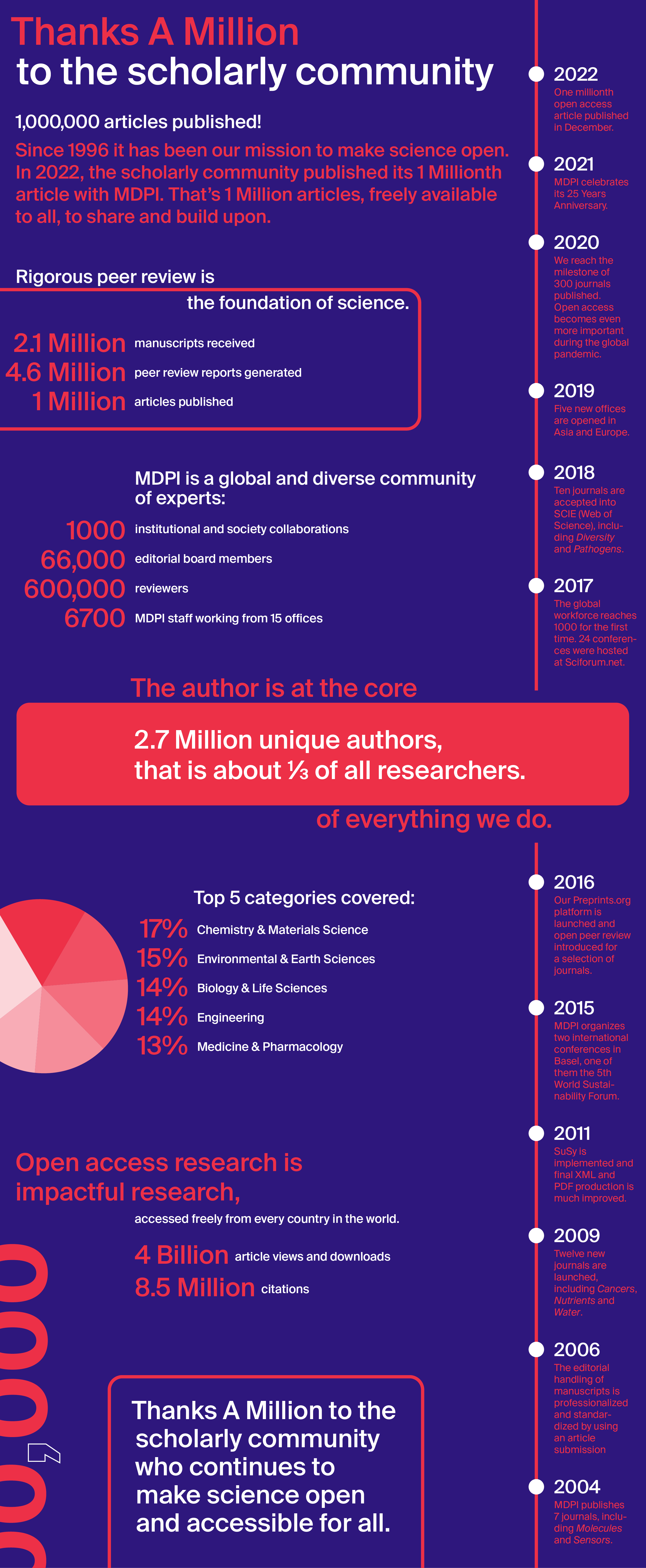
Reaching the milestone of one million articles published reinforces our mission to remove any existing barriers and to make scientific research accessible to all. Since its inception, MDPI’s goal has been to create reliable processes to make science open. This is a path towards facilitating the dissemination of novel insights in scientific communities.
Regular feedback from authors and reviewers shows that our service is greatly appreciated and needed. At the same time, the feedback helps us identify areas for further improvement.
As it stands, a significant share of published research findings remain closed access. More than half of the content published with the most well-known legacy publishers stays behind a paywall, and that is not including articles published in hybrid OA journals, or made available months or years after publication.
A new policy announced by the US administration in August 2022 requires that, as of January 2026, all US federally funded research be made freely and immediately available after publication. While the new policy does not mandate articles be published under an open access license, it is aligned with the open access movement in removing all barriers to research. Similarly, some of the most advanced research institutions in the world intend to have all funded research articles published in open access by 2025.
MDPI is proud to be the leading agent of the transition to open access.
"Thanks a Million" to all the contributors!
