
Skip to Content
  • 2.3
    Impact Factor
  • 5.4
    CiteScore
  • 18 days
    Submission to First Decision
  • 3 days
    Acceptance to Publication

Mathematics

Mathematics is a peer-reviewed, open access journal which provides an advanced forum for studies related to mathematics, and is published semimonthly online by MDPI. The Committee on Mathematical Logic of the Chinese Mathematical Society (CML-CMS) and the International Society for the Study of Information (IS4SI) are affiliated with Mathematics and their members receive a discount on article processing charges.

Get Alerted

Add your email address to receive forthcoming issues of this journal.

All Articles (29,607)

  • Article
  • Open Access

Mathematical Modeling, Analysis of Solutions and Bayesian Estimation of Exosome Biogenesis

  • Rafael Martínez-Fonseca,
  • Ramón Reyes-Carreto and
  • Cruz Vargas-De-León
  • + 2 authors

Exosomes are extracellular vesicles with important biomedical applications. Despite their relevance, the intracellular mechanisms governing exosome biogenesis remain only partially understood. In this work, we develop a system of ordinary differential equations to describe the main stages of exosome biogenesis, with two functional responses for the degradation of multivesicular bodies: mass action and Holling type II. The model is analyzed rigorously, establishing the non-negativity of the solutions and, for the subsystem of endocytosis, early endosomes, multivesicular bodies, lysosomes, and cargo, their boundedness and, in each case, a unique positive equilibrium that is locally and globally asymptotically stable. To bridge theory with experimental observations, we introduce an alternative model that has equilibria if and only if the formation rates of early endosomes and cargo are equal; these equilibria are Lyapunov stable. Bayesian estimation is performed using 15 observations from a three-dimensional culture of mesenchymal stem cells, and posterior distributions are obtained via the No-U-Turn sampler (NUTS), a Hamiltonian Monte Carlo method. The posterior medians are 0.92 day−1 for the formation rate of early endosomes and cargo (95% HDI: 0.83–1.0), 0.05 day−1 for the degradation of multivesicular bodies (0.0–0.13), and 14.3 exosomes per multivesicular body (13.2–15.0). Numerical simulations illustrate the analytical results.

Mathematics

19 November 2026

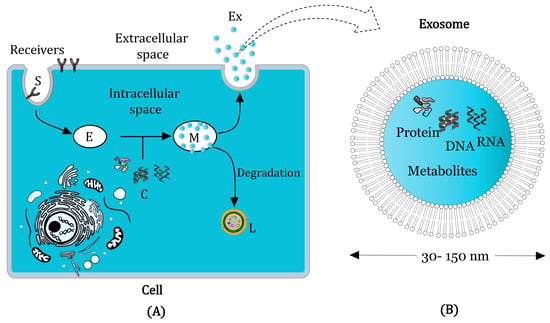
Diagram of the exosome biogenesis model. (A) Cell with the stages of the model. (B) Structure of an exosome and part of its content. Here, S denotes endocytosis, E early endosomes, C biomolecular cargo, M multivesicular bodies, L lysosomes, and 
  
    E
    x
  
 exosomes. The exosomal lumen includes experimentally detected molecular cargo, such as short- and medium-chain fatty acids and other small compounds.
  • Article
  • Open Access

Multimodal skin-lesion classifiers combine dermoscopic images with clinical metadata, but reported gains may depend on how related images, lesions, patients, and dataset releases are separated between model development and testing. This study evaluates how these boundaries affect classification performance and the measured benefit of metadata fusion. HAM10000, PAD-UFES-20, and International Skin Imaging Collaboration (ISIC) releases are assessed using image-level, lesion-level, patient-level, content-based, and cross-release protocols. Image-only, metadata-only, late-fusion, metadata-gated, and cross-attention models are compared under matched settings with repeated seeds and confidence intervals. In HAM10000, with a fine-tuned ConvNeXt-Small encoder, random image-level splitting increased the macro-averaged F1 score (macro-F1) by 9.48 percentage points relative to lesion-disjoint evaluation, whereas cross-attention changed macro-F1 by only −0.34, −0.86, and +1.11 points across the tested protocols. On PAD-UFES-20, 32.22–40.46% of test patients under lesion-disjoint evaluation were also represented in training through different lesions, and cross-attention macro-F1 was 0.8085 under lesion-disjoint and 0.7124 under patient-disjoint evaluation. Retaining shared HAM10000 identities, and thereby their acquisition source, in the ISIC 2019 model-development pool was associated with an 18.2-point macro-F1 difference. For the datasets and models tested, evaluation boundaries produced larger macro-F1 changes than the fusion methods, highlighting the need to align the separation unit with the intended generalization target.

Mathematics

19 November 2026

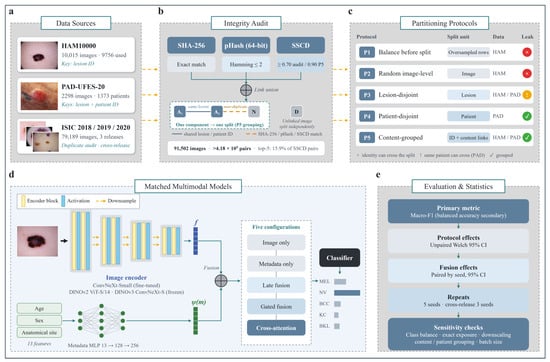
Overview of the study design: (a) source skin-lesion datasets; (b) integrity auditing using SHA-256, perceptual hashing (pHash), and SSCD; (c) evaluation protocols P1–P5 and their separation constraints; (d) image-only and multimodal classification configurations; and (e) performance evaluation and statistical analysis. Dashed orange arrows between panels indicate the workflow, while solid arrows represent data or feature flow. In panel (b), solid blue links denote shared biological identities, whereas dashed orange links indicate detected content similarity. In panel (d), orange arrows indicate encoder downsampling.
  • Article
  • Open Access

Ultrasound-driven coated microbubbles are a promising vehicle for targeted drug delivery, yet how peristaltic wall motion, non-Newtonian blood rheology, and shell-resolved bubble dynamics jointly govern delivery remains poorly understood. Resolving this coupling, we identify two operating principles for microbubble-mediated delivery: drug release is gated by shell rupture rather than graded by acoustic amplitude, and near-wall targeting is governed by matching the drive frequency to the shell resonance. At the clinically standard operating point (PA = 120 kPa, f = 2 MHz, mechanical index MI = 0.085) 88% of the payload is released within one acoustic cycle, while the minimum rupture threshold reported here lies below MI = 0.06; for SonoVue-like shells the threshold itself is minimized along the frequency–size locus fopt R0 ≈ 3.9 MHz.μm. We establish these results with a multiscale framework coupling a Carreau–Yasuda peristaltic carrier flow, obtained from a long-wave lubrication reduction, with the Lagrangian dynamics of a coated microbubble governed by the Marmottant–Keller–Miksis equation and a phenomenological rupture-gated release model, integrated with an adaptive stiff solver at acoustic resolution. The rupture threshold, at which the periodic radial orbit first reaches the rupture radius, is mapped in the drive-frequency–pressure plane. Near-wall migration is driven not by the hydrodynamic pressure, which modulates the oscillation by only one part in 105, but by the secondary-Bjerknes attraction: in the continuity-consistent peristaltic carrier field it induces a radial migration of 28% of the vessel radius over three peristaltic periods at the shell resonance of a 1 MHz drive, f shell/f ≈ 1.13, more than an order of magnitude above that of smaller off-resonant bubbles and insensitive to the near-wall regularization. Shear-thinning suppresses the peristaltic pressure variation as S=0.21Cuw−0.48, thirteen-fold at baseline, while reducing the net throughput by only about 10%. These results establish frequency–size matching as the primary lever for rupture-gated release and near-wall migration, with the peristaltic amplitude ratio as a geometric modulator of the wall-directed attraction.

Mathematics

19 November 2026

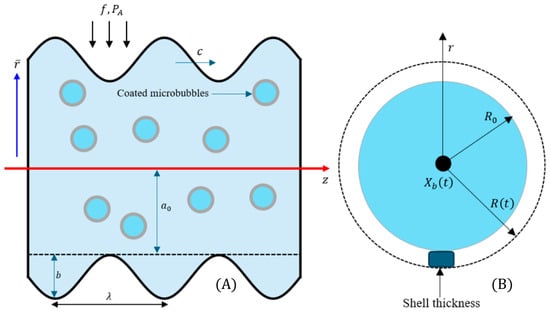
Schematic of the coupled peristaltic–acoustic problem. (A) A drug-loaded coated microbubble suspended in Carreau–Yasuda blood within an axisymmetric vessel whose wall follows 


        R
      
      
        w
      
    
    (
    z
    ,
    t
    )
    =
    
      
        a
      
      
        0
      
    
    +
    b
    sin
    
      (


              2
              π
            
            
              λ


        (
        z
        −
        ct
        )
      
      )
    
  
, Equation (1), with mean half-width a0, wave amplitude b, wavelength λ, and phase speed c; the amplitude ratio is ϕ = b/a0. Coordinates z and r are axial and radial. (B) Cross-section of a single bubble of equilibrium radius R0 and centroid Xb(t) = (rb(t), zb(t)), enclosed by a viscoelastic shell of finite thickness; the double-headed arrow denotes the radial oscillation R(t).
  • Article
  • Open Access

Traffic-flow forecasting estimates future traffic volumes across a road network from historical sensor observations. A central challenge in historical retrieval is balancing node-specific trajectory matching with the coordination of historical sources across related nodes. We propose CoRAF, a retrieval-augmented forecasting framework that adapts the degree of source sharing to the current traffic state. Node-specific source distributions match individual trajectories, while partition-shared distributions additionally consider the compatibility of local temporal relationships. A state-conditioned gate uses traffic dynamics, relation quality, and matching quality to couple the two forms of historical input-window residual evidence and their observation coverage, which are then encoded and integrated with the current traffic representation. Experiments on PEMS03, PEMS04, PEMS07, and PEMS08 with a one-hour forecasting horizon show that CoRAF achieves the lowest reported mean absolute error (MAE) and mean absolute percentage error (MAPE) among the compared methods, reducing MAE by 0.45%–6.29% relative to the best published baseline results on the respective datasets. Ablation and traffic-state analyses support the complementary value of individual and shared historical evidence, with larger gains over static coupling under high volatility.

Mathematics

19 November 2026

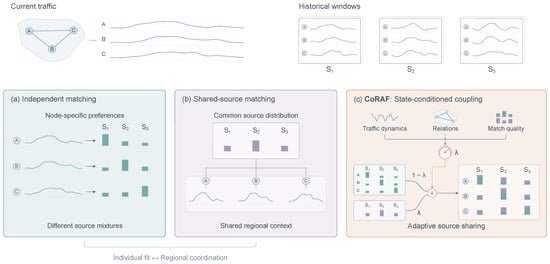
Motivation for state-conditioned source coupling in traffic forecasting. The upper panels show current traffic at three connected nodes (A–C) and three historical source windows (
  
    S
    1
  
–
  
    S
    3
  
), each synchronized across nodes. (a) Independent matching assigns a node-specific distribution over historical sources. (b) Shared-source matching assigns a common distribution to nodes within a partition, coordinating their historical context. (c) CoRAF uses traffic dynamics, relation quality, and matching quality to determine the coupling coefficient 
  λ
. Teal and purple bar segments represent the independent and shared-source contributions, weighted by 
  
    1
    −
    λ
  
 and 
  λ
, respectively. Curves and source weights are schematic.

Featured Articles of Last Quarter

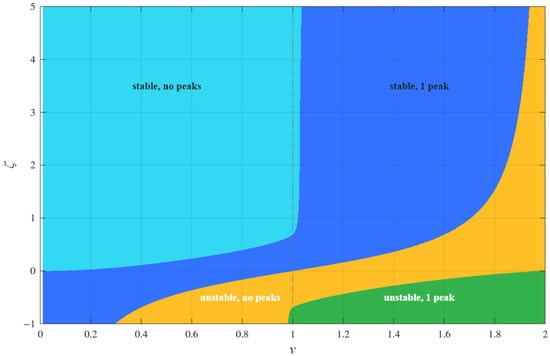
Stability and resonance of (2).
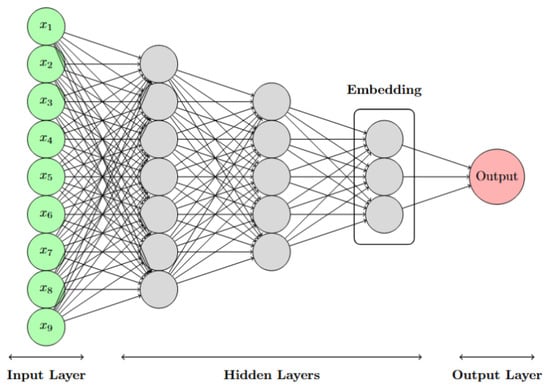
ANN with 3rd hidden layer being the embedding layer.
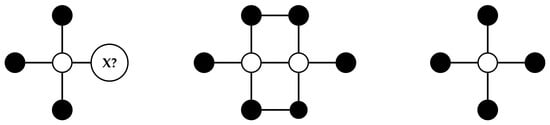
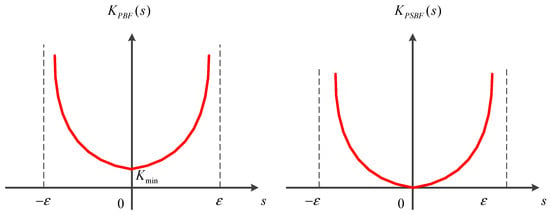
Barrier functions: 


        K
      
      
        P
        B
        F


        s


 and 


        K
      
      
        P
        S
        B
        F


        s


.

Highly Accessed Articles

News & Conferences

Latest Issues

Open for Submission

Journal Sections

XFacebookLinkedIn
Mathematics - ISSN 2227-7390