


Abstract
The paper presents a Barrier Function Adaptive Event-Triggered (ET) Sliding Mode Controller (SMC) for a class of nonlinear systems with matched disturbances. The proposed approach integrates barrier-function-based gain adaptation into the event-triggered sliding mode framework while preserving the original triggering mechanism. Two adaptive barrier functions, namely the Positive Barrier Function and the Positive Semi-Barrier Function, are employed to continuously adjust the switching gain according to the evolution of the sliding variable. Stability of the closed-loop system is established using Lyapunov and input-to-state stability analysis, and a positive lower bound on the inter-event time is derived to exclude Zeno behavior. Theoretical results demonstrate that adaptive gain scheduling enlarges the guaranteed inter-event time compared with conventional ET-SMC. The proposed controller is experimentally validated on an air-levitation system and compared with conventional time-triggered SMC and fixed-gain ET-SMC. Experimental results confirm preserved robustness and disturbance rejection while significantly reducing controller updates and increasing the inter-event time, demonstrating the effectiveness of the proposed adaptive event-triggered strategy.
Keywords:
event triggering; adaptive sliding mode; barrier function; triggering condition; Zeno-phenomena; chattering suppression MSC:
93D05
1. Introduction
Sampling plays a fundamental role in feedback control systems, particularly in conjunction with complex dynamical systems characterized by nonlinear behavior, uncertainties, and multiple interacting components. Traditionally, uniform time-triggered sampling (TT) has been the dominant paradigm, where measurements and control updates are executed at fixed time intervals. This approach simplifies feedback system analysis and implementation and is well supported by classical control [1]. However, in the context of recent advances in nonlinear control have extended robust control techniques to a wide range of applications, including fixed-time synchronization of delayed dynamical neural networks [2] for secure communication and fault-tolerant control of quadrotor unmanned aerial vehicles [3] operating under nonlinear dynamics and unknown external disturbances. These studies demonstrate the increasing importance of designing controllers that simultaneously guarantee robustness, fast convergence, and reliable operation in practical applications. Complementary to these developments, uniform sampling can be inefficient, as it allocates computational and communication resources independently of the system’s current state and state trajectory. As a consequence, unnecessary updates may occur when the system operates near equilibrium or slow dynamics; on the other hand, rapid dynamics require finer attention. These limitations have motivated the development of alternative sampling strategies, among which event-triggered sampling has emerged as a promising framework [4]. By initiating sampling actions only when state-dependent conditions are satisfied, event-triggered (ET) control seeks to adapt the sampling process to the system’s behavior, thereby improving resource efficiency while maintaining stability and performance guarantees. The first comparison and effectiveness of ET were demonstrated in an industrial application with a classic PID controller [5].
Over the last decade, numerous theoretical and practical solutions have been proposed. Early work demonstrated the advantages of event-based sampling—often termed Lebesgue sampling—in contrast to conventional Riemann (periodic) sampling [6]. For first-order stochastic systems, it was shown that sampling signals only when they cross predefined thresholds leads to improved performance, such as reduced average sampling rates while maintaining or enhancing control quality. Building on this insight, a paradigm shift occurred with the proposal that real-time schedulers could function as their own feedback mechanisms. This approach redefines scheduling for stabilizing control tasks on embedded processors: control inputs are updated only when necessary, based on the current plant state, thereby guaranteeing asymptotic stability of the closed-loop system [7]. The method ensures a positive lower bound on inter-execution times, preventing the Zeno phenomenon (infinite events in finite time), and accommodates non-control software tasks by respecting their deadlines. Theoretical foundations rely on input-to-state stability (ISS) concepts and Lyapunov analysis, enabling emulation of continuous-time controllers in a sampled-data setting with relaxed periodic requirements [8]. Subsequent advancements extended these ideas to broader classes of systems. Comprehensive introductions synthesized the field, comparing event-triggered strategies—where events depend on real-time state monitoring—with self-triggered approaches, where the next execution time is predicted in advance without continuous sensing [9,10]. These frameworks highlight benefits in resource-constrained environments, such as wireless networked and embedded control systems, by minimizing computation, communication, and energy use while preserving stability guarantees. Further natural extensions addressed distributed scenarios, particularly multi-agent systems, where decentralized event-based protocols enable consensus or coordination with reduced information exchange [11]. An essential characteristic of ET is the introduction of a non-zero Inter-event Time (IT), which can occur in the case of zero-dynamic systems, and is defined as the required time interval between two consecutive updates. The existence of non-zero IT is crucial for the digital implementation of the designed controller with the ET paradigm.
The presented work introduces an ET Adaptive Sliding Mode Controller (ASMC) [12]. The SMC technique introduces a predefined sliding variable that determines the system’s dynamics and the convergence rate of the system states. To ensure robustness against parameter uncertainty and external disturbances, the nonlinear switch function is employed. The switching function gain is defined with an upper positive bound of the uncertainty and disturbance. In most cases, the upper bound is unknown, and the SMC gain is overestimated [13]. Overestimating gain causes chattering, which deteriorates the performance of SMC on real-time systems. A similar issue arises from the digital implementation of the SMCs. Discrete evaluation of SMC results in a confined sliding variable around the manifold [14]. The convergence bound is proportional to the sampling time. The trade-offs between accuracy, chattering, and sampling time are determined through trial-and-error experiments on the system. To suppress chattering, various approaches have been proposed. First, mention the use of higher-order SMC, where the basic idea is to place a switching function behind a low-pass filter or an integrator [15,16,17,18,19] For higher-order plants, the chattering phenomenon cannot be suppressed entirely; it has been proved with Describing Function and Harmonic Balance analysis [20]. Auspicious results are achieved with ASMC, where the controller gains are adapted regarding the sliding variable. The first approach employs a so-called K-dynamic adjustment, where the gain’s dynamic is determined by the absolute value of the sliding variable [20]. The modification to the adaptation algorithm is presented in [21,22]. It ensures that the SMC gain is not overestimated in the presence of unknown uncertainty and disturbance. The novel method involves SMC gain adaptation over the barrier function (BF) approach [23]. The BF approach introduces a boundary where the sliding variable is defined; at the edges of the barrier function, it goes to infinity, meaning that the SMC gain is adapted to the sliding variable and to unknown uncertainties and disturbances [23,24,25]. All the proposed adaptation ideas use classic TT implementation. Regarding the work [22] and [25], the paper proposes a novel ET approach with a BF adaptation algorithm for lower-order SMC. The main idea is to achieve the efficiency of SMC in ET as analyzed in [26]. Regarding the results in [26,27], the ET-SMC maintains the overall properties of classic SMC while significantly reducing controller updates and improving efficiency, surpassing the characteristics of traditional SMC. The main disadvantage compared to classic SMC is the practical sliding mode. Practical sliding mode is established when the sliding variable enters the prescribed bound and remains thereafter. The width of the region is proportional to both the triggering condition and the dynamics of the sliding variable. Within the prescribed bounds, the sliding variable is unstable, meaning it diverges from the manifold and alternates between the prescribed bounds [28]. To alleviate the phenomenon, the ET-BF gain adaptation is proposed. The BF is activated during the triggering event in the vicinity of the sliding manifold, actively influencing the dynamics of the sliding variable, thereby reducing the number of controller updates. Such an approach significantly improves ET-BF’s performance and accuracy while retaining the classic SMC property. Efficiency and ET-BF property are confirmed with the stability condition analysis based on the input–state stability (ISS) approach [29]. The analysis also addresses Zeno phenomena [30], highlighting the need for a positive lower bound on the controller’s execution time to ensure real-world feasibility. The relationship obtained between ET-FB parameters, state limits, and triggering rules provides clear guidance for selecting controller parameters to achieve the target closed-loop performance. Furthermore, the ET-FB approach is compared to the TT-SMC and ET-SMC. The results are confirmed with a real-time experiment.
The paper is structured as follows: Section 2 presents the preliminaries of the stability analysis for the general ET approach. Section 3 introduces the ET-SMC approach based on ISS paradigms. Section 4 introduces two BF adaptation functions and the ET-BF stability conditions for the selected triggering policy and it analyzes the lower nonnegativity boundary of the inter-event time with BF. Section 5 presents the results of the ET-BF in comparison with the standard TT-SMC and ET-SMC. Section 6 is the conclusion of the work and further guidance and ideas for further research.
2. Problem Formulation
Consider a class of nonlinear single-input single-output (SISO) systems represented by
where and denote the system states, is the control input, and represents an external matched disturbance. The matrices and are constant matrices of appropriate dimensions with .
The disturbance is assumed to be bounded according to
and enters the system through the same channel as the control input, thereby satisfying the standard matching condition required in sliding mode control.
Throughout this work, the nonlinear dynamics are assumed to satisfy the following properties.
Assumption 1.
The nonlinear function possesses a unique equilibrium point at the origin such that
Moreover, it admits the decomposition
where is the Jacobian matrix evaluated at the equilibrium point, while contains higher-order nonlinear terms, satisfying
Assumption 2.
The nonlinear functions and are locally Lipschitz continuous in a compact domain . Consequently, there exist positive constants and such that
and
for all admissible states in the domain . Furthermore, it is assumed that the closed-loop nonlinear system admits an input-to-state stable (ISS) Lyapunov function . Therefore, there exist class- functions , , , and a class- function satisfying
and
for all admissible states and bounded inputs . This assumption guarantees that the nominal closed-loop system is input-to-state stable and provides the basis for the event-triggered stability analysis developed in the following sections [29].
Event-Triggered Control Framework
Unlike conventional sampled-data control, where the controller is executed periodically with a fixed sampling interval, event-triggered control updates the control signal only when a prescribed triggering condition is violated. Consequently, unnecessary controller executions are avoided, reducing computational effort while maintaining closed-loop stability. Assume that a stabilizing state-feedback law,
has been designed for the continuous-time system. Under digital implementation using a zero-order hold, the control signal remains constant between two consecutive triggering instants and , namely,
The corresponding measurement error introduced by the sample-and-hold implementation is defined as
which satisfies Suppose the closed-loop system admits an ISS Lyapunov function , where the derivative satisfies
indicating that the sampling error behaves as an external perturbation [31,32] To preserve system stability, the error must remain sufficiently small, where the requirement is expressed through the triggering inequality,
Assuming that both and are locally Lipschitz continuous, the triggering rule can be rewritten as
where denotes an appropriate Lipschitz constant. Under this condition, the Lyapunov derivative satisfies
which guarantees asymptotic convergence of the closed-loop system while requiring controller updates only when the triggering condition is violated.
3. Event-Triggered Sliding Mode Control
The chapter will briefly present the preliminaries of the sliding mode control (SMC) design for the class of systems given in (1). The sliding variable is defined as , where and . The sliding manifold is defined by
Differentiating the sliding variable with respect to time gives
Substituting the nonlinear system dynamics (1) yields
where To force the system trajectories toward the sliding manifold despite bounded matched disturbances, the continuous-time sliding mode controller is defined as
where holds
Under continuous implementation, this control law guarantees finite-time convergence of the sliding variable to the sliding manifold. In practical digital systems, however, the controller cannot be updated continuously. Let denote the sequence of triggering instants. Between two consecutive events, the control input is held constant using a zero-order hold, which yields
for all , where is referred to as the inter-event time. It should be noted that is evaluated only at the triggering instant and then held constant by the zero-order hold until the next triggering event. Consequently, the controller does not exhibit continuous high-frequency switching, and the event-triggered implementation inherently mitigates the chattering typically associated with continuous-time sliding mode control. Unlike continuous-time sliding mode control, digital implementation cannot maintain the sliding variable exactly at because the control input is updated only at discrete event instants, [32,33,34]. Consequently, the system trajectories temporarily deviate from the sliding manifold between successive control updates. Instead of an ideal sliding motion, the event-triggered implementation guarantees that the trajectories remain confined within a bounded neighborhood of the sliding manifold. In conventional discrete-time sliding mode control, this quasi-sliding mode band depends on the sampling interval and the disturbance. By contrast, the event-triggered strategy adopted here defines the allowable steady-state region through the triggering condition, while the controller is updated only when the system state leaves the prescribed neighborhood.
The triggering law is designed to drive the system trajectories into the vicinity of the sliding manifold in finite time and maintain them within this region thereafter. Therefore, the resulting behavior is referred to as practical sliding mode, in which the sliding variable remains bounded around zero rather than converging exactly to zero. Exact sliding motion is achievable only under continuous control action, whereas event-triggered implementation ensures bounded sliding behavior determined by the selected design parameters.
The stability condition is examined with Laypunov function [33], where the difference along the sliding variable (11) gives
Substituting the event-triggered control law (15), with the sampling error defined as (6), and holds for all time , we obtain
where the triggering condition is defined as
and hold . The system is stable only if the controller gain is selected as
Therefore, the sliding variable decreases toward the sliding manifold. Since exact sliding cannot be maintained under discrete implementation with triggering condition (17), where holds and , the trajectory is confined to
and respect to , a practical sliding band is defined as
Thus, the event-triggered controller guarantees finite-time convergence to a neighborhood of the sliding surface, where the band size is determined by and .
Inside this practical sliding region, the reduced-order dynamics with respect to and (1) is
The stability analysis with a Lyapunov function candidate and is Hurwitz, which implies
Regarding conditions, and , then holds
Using Conditions (3) and (22) and the Cauchy–Schwarz inequality gives
Using Condition (3) with defined parameter , there exists where holds for . The domain is defined as , where then holds
From Condition (24), it can be clearly seen that the is ensured only if and , which confirms ISS with respect to the sliding variable . The condition states that there exists a bound around the manifold of where the The bound is defined from Condition (20) and is defined as
To avoid the Zeno phenomenon [34] regarding the preselected triggering rule (17), it is necessary to prove that the inter-event time fulfills the condition; . The next triggering time is defined by
This rule updates the control only when the sampling error reaches the prescribed threshold. Regarding the system presented in (1) and triggering error (6), we can define the differential equation with respect to the error variable , such as
Using the system can be further rewritten, such as,
The differential equation is solved with the initial condition .
The corresponding inter-event time derived from (28) and Condition (19) is lower-bounded by
where . Since all parameters in the denominator are finite and positive, and , the argument of the logarithm is greater than one. Therefore strictly holds. This means that a finite positive time interval always separates two consecutive triggering instants. Hence, the triggering mechanism avoids event accumulation and excludes Zeno behavior. The inter-event time is directly related to the triggering threshold . A larger allows a larger measurement error before the next control update is generated, which increases . Conversely, a smaller gives tighter control accuracy but produces more frequent triggering events. Thus, provides a trade-off between control performance and computational load.
4. Adaptive Event-Triggered Sliding Mode Control
The event-triggered strategy presented in the previous section employs a fixed triggering threshold defined by the design parameter . Although this approach guarantees practical sliding mode and excludes Zeno behavior [29], a constant threshold represents a compromise between control performance and computational efficiency. A small value of improves tracking accuracy but leads to frequent controller updates, whereas a larger value reduces the update rate at the expense of a wider practical sliding region. To overcome the limitations of a fixed switching gain, an adaptive barrier function is introduced to continuously adjust the sliding-mode control gain as the sliding variable evolves [21] During the reaching phase, the barrier function increases the switching gain when the system state is far from the sliding manifold, ensuring fast convergence and preserving robustness against matched disturbances. As the trajectories approach the practical sliding region, the barrier function gradually reduces the control gain while maintaining the sliding condition. Unlike conventional adaptive sliding mode approaches, the proposed barrier function continuously modifies the controller gain without altering the event-triggering mechanism. Consequently, the control action becomes less aggressive in the vicinity of the sliding manifold, reducing unnecessary switching activity and slowing the growth of the sampling error between consecutive triggering instants. This behavior naturally increases the inter-event time, resulting in fewer controller updates while maintaining the robustness and stability properties of the closed-loop system.
4.1. Barrier Function Adaptive Sliding Mode Control
Before the definition of the barrier functions-based event-triggered sliding mode control, we assume that the sliding variable is confined to a region and holds .
Definition 1.
Let denote the prescribed width of the practical sliding region, and let be the sliding variable. A barrier function is a continuous positive function defined on the interval that satisfies
- ;
- ;
- is monotonically increasing with respect to ;
- as .
In this work, the following two barrier functions are considered:
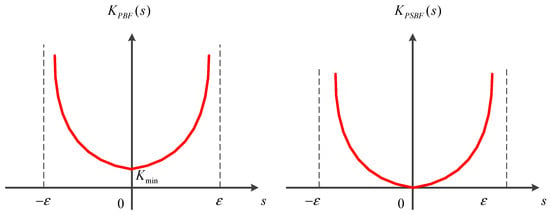
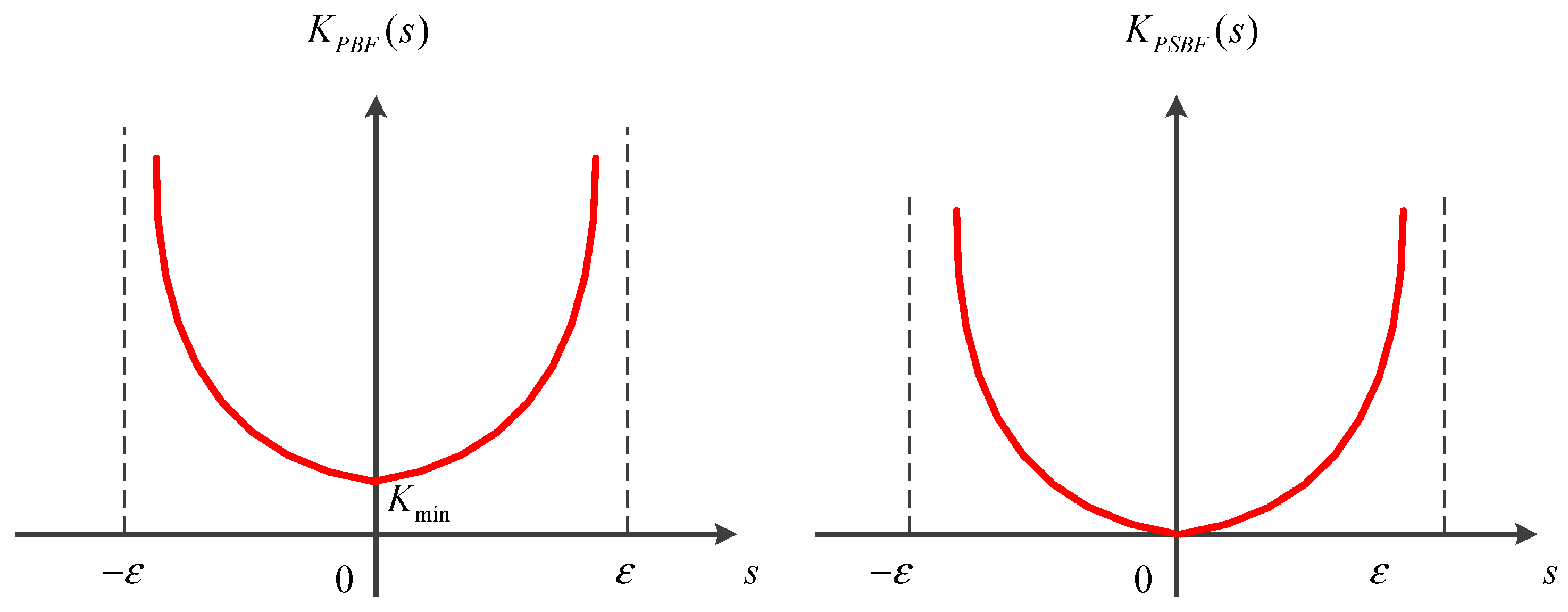
- Positive definite PBF,where denotes the minimum controller gain.
- Positive semi-definite PSBF,
Both barrier functions satisfy the required barrier properties. They remain finite inside the practical sliding region and increase rapidly as the sliding variable approaches the boundary . Consequently, they are well-suited for adapting the switching gain of the proposed event-triggered sliding mode controller. The barrier functions are illustrated in Figure 1.
Figure 1.
Barrier functions: and .
The adaptive barrier gain replaces the constant switching gain introduced in the previous section , where the controller is
This controller updates only at the triggering instants , while the barrier function continuously determines the required switching gain according to the current value of the sliding variable. As the system approaches the sliding manifold, the barrier gain decreases, reducing the control effort and slowing the growth of the sampling error. Conversely, when the trajectories approach the boundary of the practical sliding region, the barrier gain increases rapidly, providing sufficient robustness to maintain the sliding condition.
4.2. Stability of Barrier Function Adaptive Sliding Mode Control
Theorem 1.
Consider a system with a matched disturbance given in (1) and (2) with the sliding variable . Let the event-triggered control law be given in (32), for all [ , where is a barrier function satisfying Definition 1. Let the sampling error be . Assume that the triggering condition,
is satisfied for all [, , where . If the adaptive barrier gain satisfies
then the sliding variable is driven toward the practical sliding region in finite time. Moreover, the closed-loop trajectory remains bounded inside region (20). The next triggering instant is generated by
Therefore, the triggering rule guarantees practical sliding mode and avoids unnecessary controller updates.
Proof.
Consider the Lyapunov candidate . Differentiating along the system trajectories gives
Using the sliding dynamics,
we obtain,
Since the control input is implemented in an event-triggered manner, the control signal is computed at and held constant over the interval . Therefore,
Substituting this control law into yields,
Taking upper bounds gives,
Regarding Definition 1 and triggering error (6) and triggering Condition (33), we can write,
As long as the trajectory does not cross the sliding manifold inside the interval , the sign of the sliding variable is preserved .
If , then the function is strictly decreasing. This proves that the sliding variable decreases toward the sliding manifold whenever the trajectory is outside the practical sliding region. In the case , the condition is no longer valid because the discontinuous control term is evaluated using the previous triggering instant. Consequently, a monotonic decrease in the Lyapunov function cannot be guaranteed during this interval. The sliding variable may temporarily increase until triggering Condition (33) is satisfied, whereupon a new control input is computed. Therefore, the trajectory remains confined within the practical sliding region defined by (36), which establishes the existence of the practical sliding mode. Next, the maximum deviation of the sliding variable between two consecutive triggering instants is evaluated such as,
Substituting the triggering rule (33), we get
The largest deviation occurs when the trajectory crosses the sliding manifold, namely when . Hence,
Therefore, the sliding trajectory remains inside the practical sliding region,
This shows that the event-triggered controller with adaptive barrier gain enforces practical sliding motion. At each event instant, . Hence, the triggering condition is immediately satisfied after each update. The next event occurs only when the error reaches the prescribed threshold. Since the threshold is strictly positive, the controller is not updated continuously. □
It is worth noting that the barrier functions and are lower-bounded by the region defined in (36), as specified by the event-triggering threshold . When the sliding variable remains close to the origin, the barrier function reduces the adaptive gain toward the minimum level necessary to reject disturbances and maintain the sliding motion. As the sliding variable approaches the triggering boundary due to increased disturbances or model uncertainties, the barrier function rapidly increases the adaptive gain. This adaptive behavior prevents the system trajectory from violating the prescribed triggering region while avoiding excessive control effort when high gains are unnecessary. Consequently, the adaptive gain is continuously adjusted to satisfy the desired triggering condition and preserve the stability of the closed-loop system.
4.3. Positive Lower Bound on the Inter-Event Time of Barrier Function Adaptive Sliding Mode Control
Theorem 2.
Consider system (1) controlled by the event-triggered barrier sliding mode controller (32), for all [ . Let the triggering rule be (34). Then the inter-event time is lower bounded by
where
and,
Proof.
The inter-event time is the time required for the sampling error to grow from zero to the triggering threshold . At every triggering instant , the state is sampled and therefore . The system dynamic with (32) can be written as
and shorten
Since , we have
Using the Lipschitz property of , and the relation yields
The solution of (40) gives
The inter-event time with respect to the triggering Condition (33) is equal to
The inter-event time is strictly lower-bounded by a positive constant, thereby excluding the existence of Zeno behavior. □
Remark 1.
Let and denote the inter-event times corresponding to the conventional fixed-gain controller and the proposed barrier-function-based controller, respectively. Since the adaptive barrier function reduces the switching gain in the vicinity of the sliding manifold, the growth rate of the sampling error is correspondingly reduced. Consequently, the triggering condition is reached more slowly, leading to longer intervals between successive control updates. Therefore, the proposed adaptive controller satisfies
where denotes the infimum of the inter-event times. The equality holds only when
whenever
for all inside the practical sliding region. Consequently, the proposed barrier-function adaptation enlarges the minimum guaranteed inter-event time and reduces the total number of controller updates while preserving the stability properties established in Theorem 2.
Remark 2.
The stability analysis presented in Theorem 1 is applicable to both the PBF and PSBF, since both satisfy the properties stated in Definition 1. In particular, both functions are continuous and positive over the interval , are symmetric with respect to the origin, and become unbounded as the sliding variable approaches the boundary of the practical sliding region, i.e., . Consequently, both barrier functions guarantee that the adaptive switching gain remains finite within the admissible region while increasing sufficiently to preserve the sliding condition near the boundary. In the case of and , the adaptive gain strategy proposed in [14] can be employed. Specifically, the adaptive gain increases linearly until the sliding variable reaches the boundary , after which the proposed barrier-function-based adaptation is activated. Although both barrier functions satisfy the same theoretical requirements, they exhibit different adaptation characteristics. The PBF provides a positive minimum switching gain at the sliding manifold, ensuring continuous robustness against bounded matched disturbances even when s is close to zero. In contrast, the PSBF approaches zero as the sliding variable converges to the sliding manifold, resulting in a more conservative control action with reduced switching activity. Therefore, the PBF generally offers stronger disturbance rejection, whereas the PSBF is expected to further reduce the control effort and increase the inter-event time. The proposed stability results remain valid for either barrier function. Consequently, the selection between PBF and PSBF can be based on the desired trade-off between robustness, control effort, and the frequency of controller updates. The proposed stability results remain valid for either barrier function. Consequently, the selection between PBF and PSBF can be based on the desired trade-off between robustness, control effort, and the frequency of controller updates.
5. Results
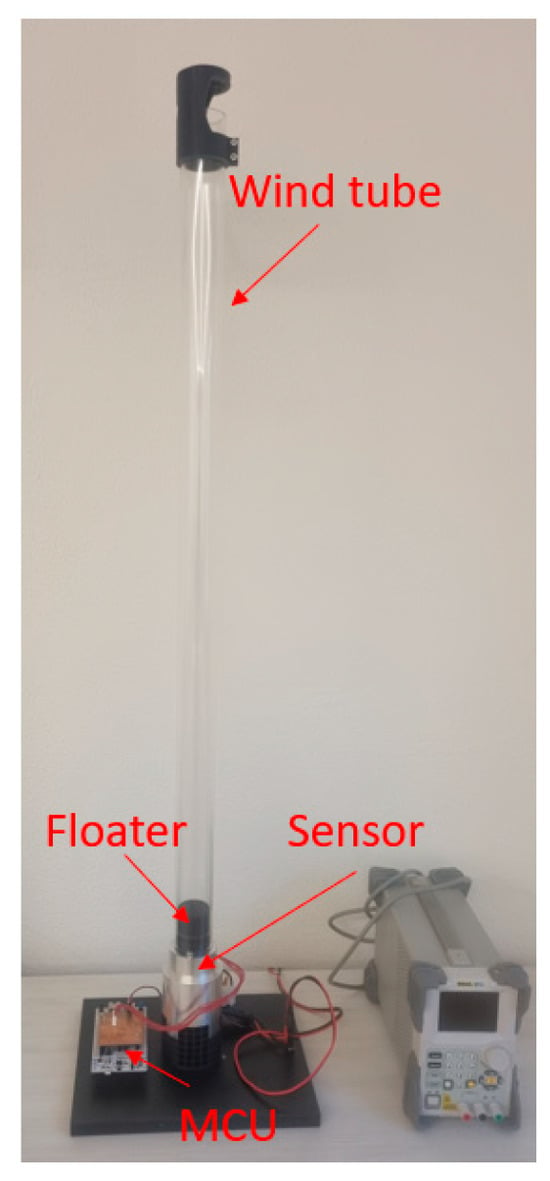
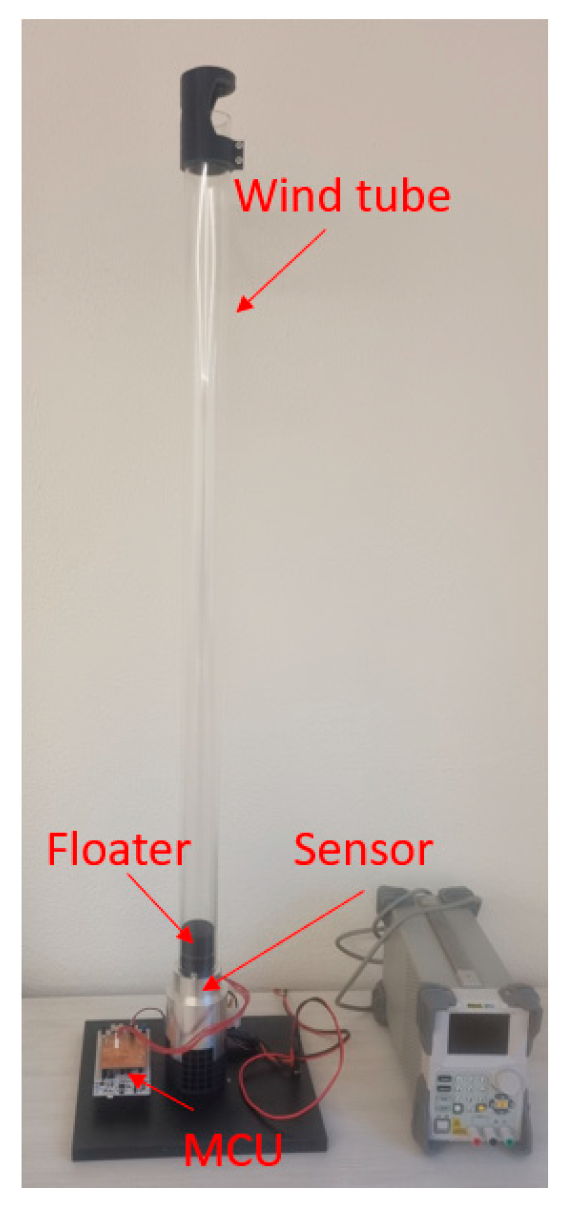
To evaluate the proposed adaptive barrier-function-based event-triggered sliding mode controller, an air-levitation system is considered as a benchmark nonlinear plant, as shown in Figure 2. The system consists of a floating body placed inside a vertical airflow generated by a fan. The controller’s objective is to control the floating body’s vertical position by adjusting the fan force. The air-levitation presents an unstable system. In the absence of a control input, the lifting force is insufficient to balance gravity and uncertainty, causing the floating body to fall. Therefore, continuous control of the fan force is required to maintain the desired equilibrium position. The mathematical model describes the vertical motion of the floating body concerning the lifting force produced by the fan,
where , , , , and are object height (), object velocity (), fan air velocity (), mass (kg) of the floating object, object area (), air density, gravity constant, air resistance (), and bounded disturbance, respectively. System parameters are given in Table 1.
Figure 2.
Air-levitation system.
Table 1.
System parameters.
The experimental system is presented in Figure 2.
The system is running on the STM32H7 MCU, with a sampling time of . The sampling time is selected for state measurements, and as a positive lower bound for event-triggered PBF and PSBF implementation feasibility. The real-time computation has been made for four types of SMC implementation. The paper presents classic time-triggered, event-triggered, and both PBF and PSBF SMC implementations. The proposed controller is implemented on an STM32H7 microcontroller with a sampling period of . The sampling period is used both for state measurements and as the positive lower bound on the inter-event time, ensuring the practical feasibility of the event-triggered PBF and PSBF implementations. The real-time performance is evaluated for four sliding mode control schemes: conventional time-triggered TT-SMC, event-triggered ET-SMC, event-triggered ET-PBF-based SMC, and event-triggered ET-PSBF-based SMC with the following indices,
where are triggering instants and holds . All presented results were obtained from independent real-time experiments, aligned over a common time interval for comparison, and acquired during the microcontroller (MCU) debugging mode. The controller parameters (11), (13), (15), and (32) are present in Table 2.
Table 2.
Controller parameters, .
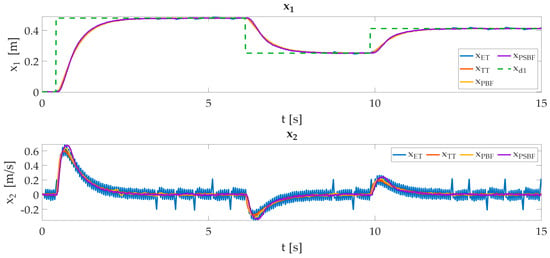
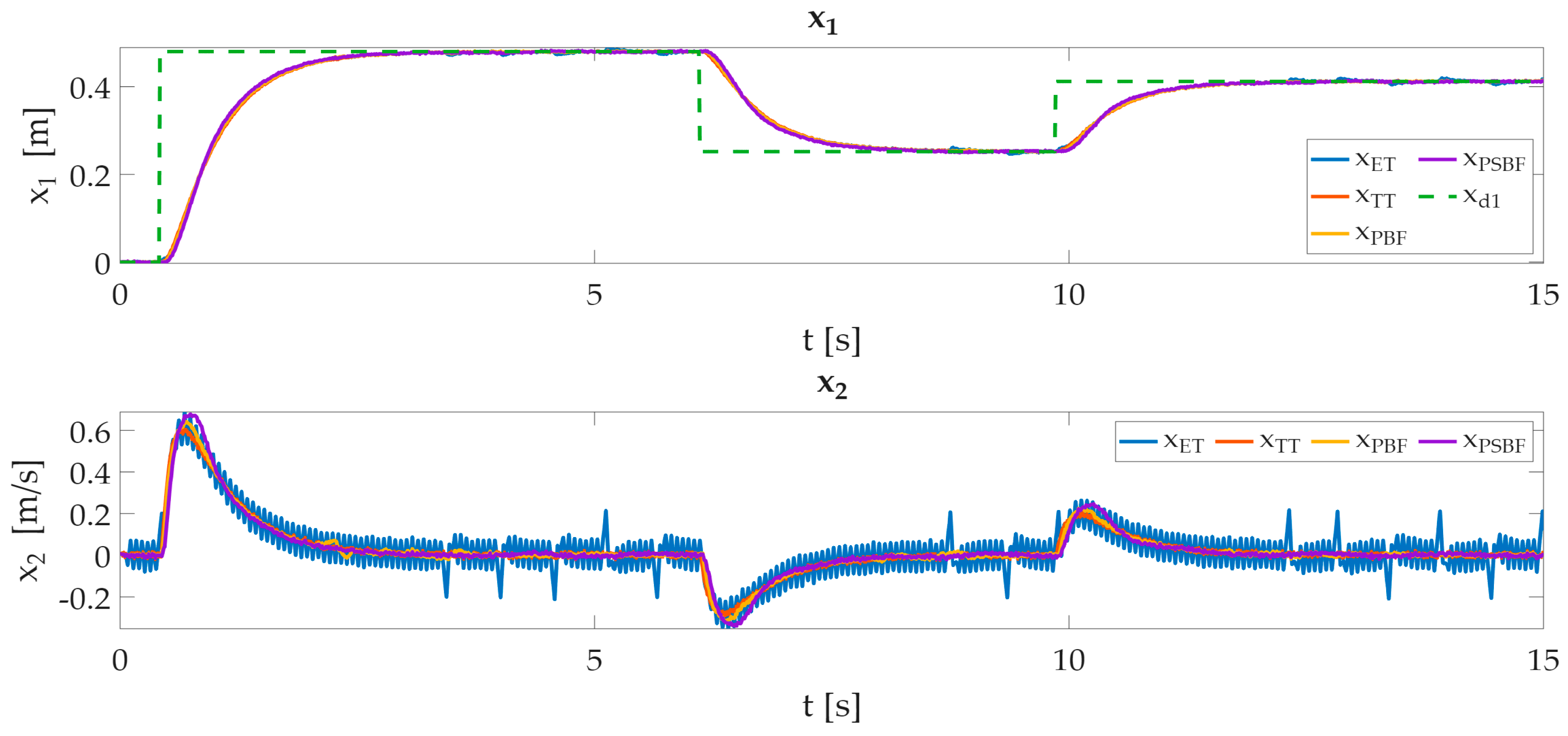
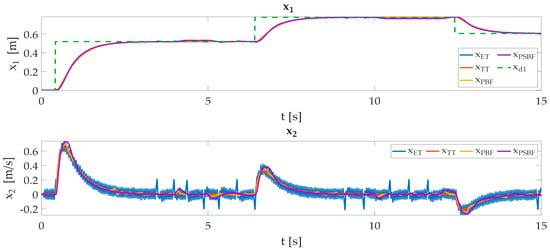
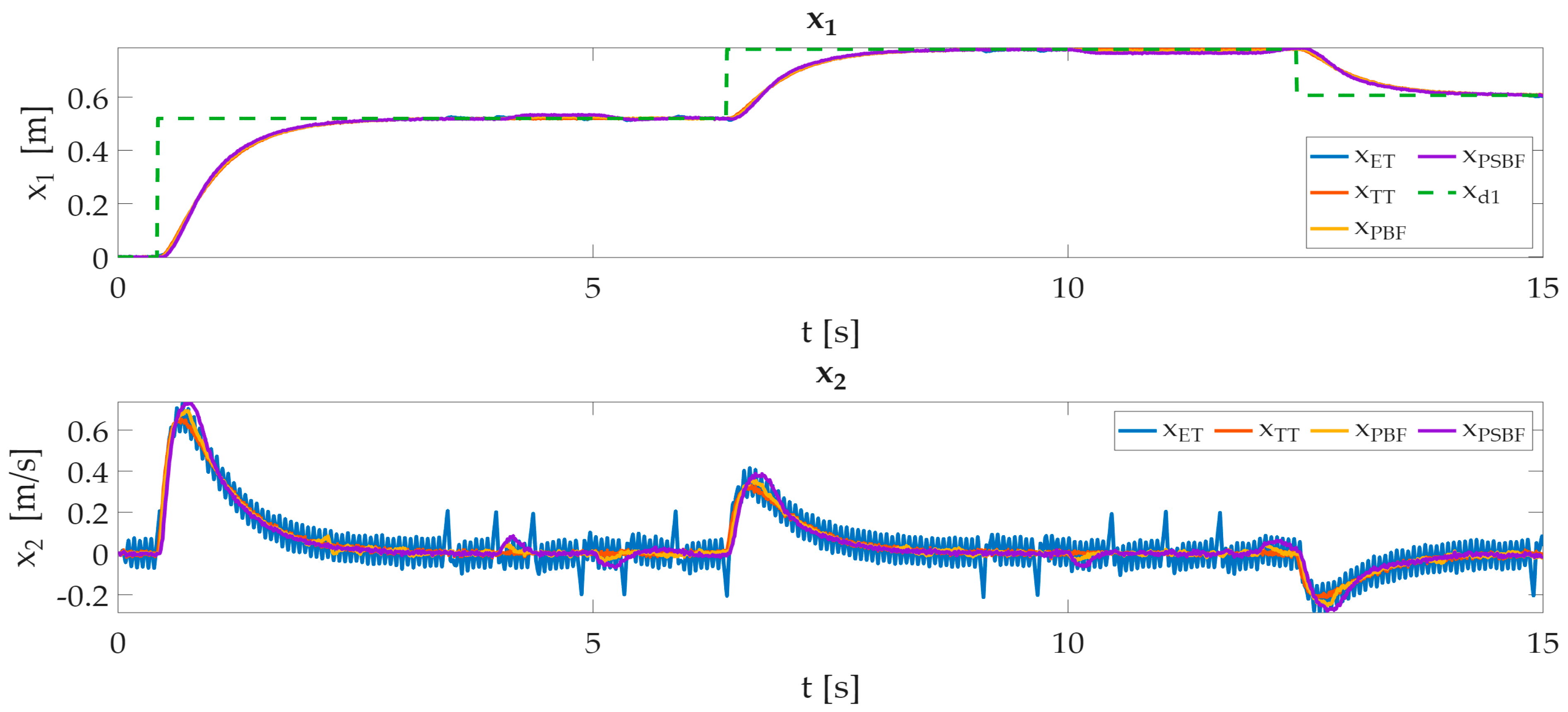
The barrier function parameter is selected such that the sliding variable remains within the barrier region (), thereby eliminating the need for an additional warm-up procedure. For the tracking cabaility the error variable is introduced . Figure 3 compares the experimental responses of all controllers. The figure presents the state variables and .
Figure 3.
The comparison of TT-SMC, ET-SMC, ET-PBF, ET-PSBF control, with state variables , and .
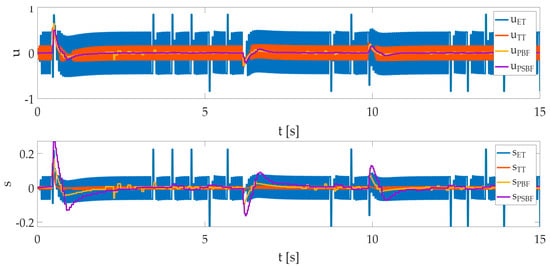
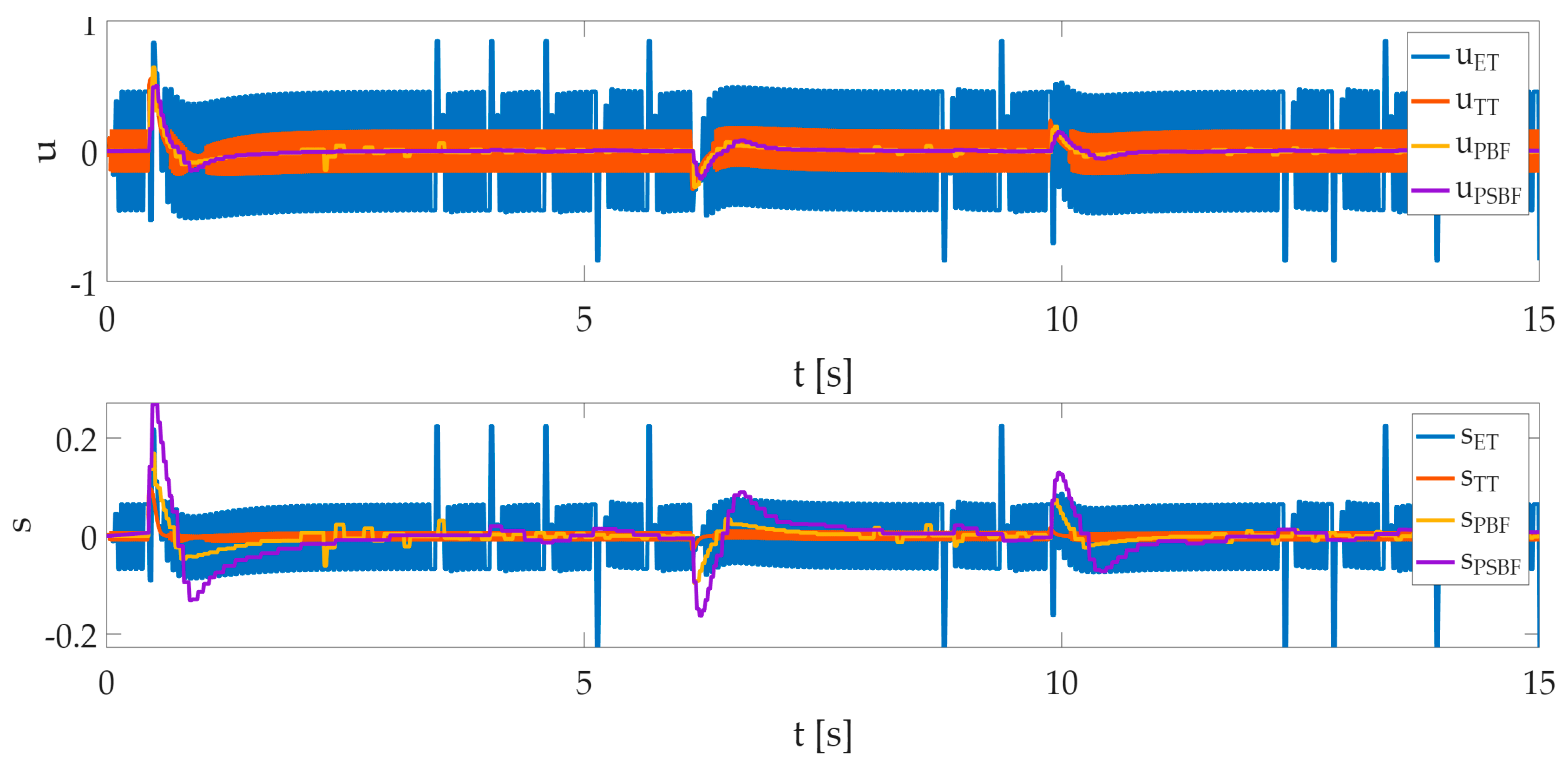
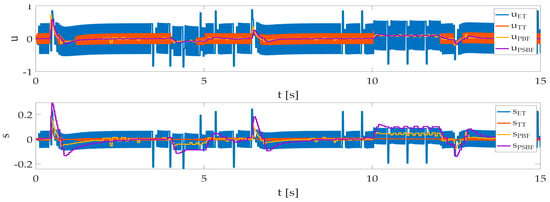
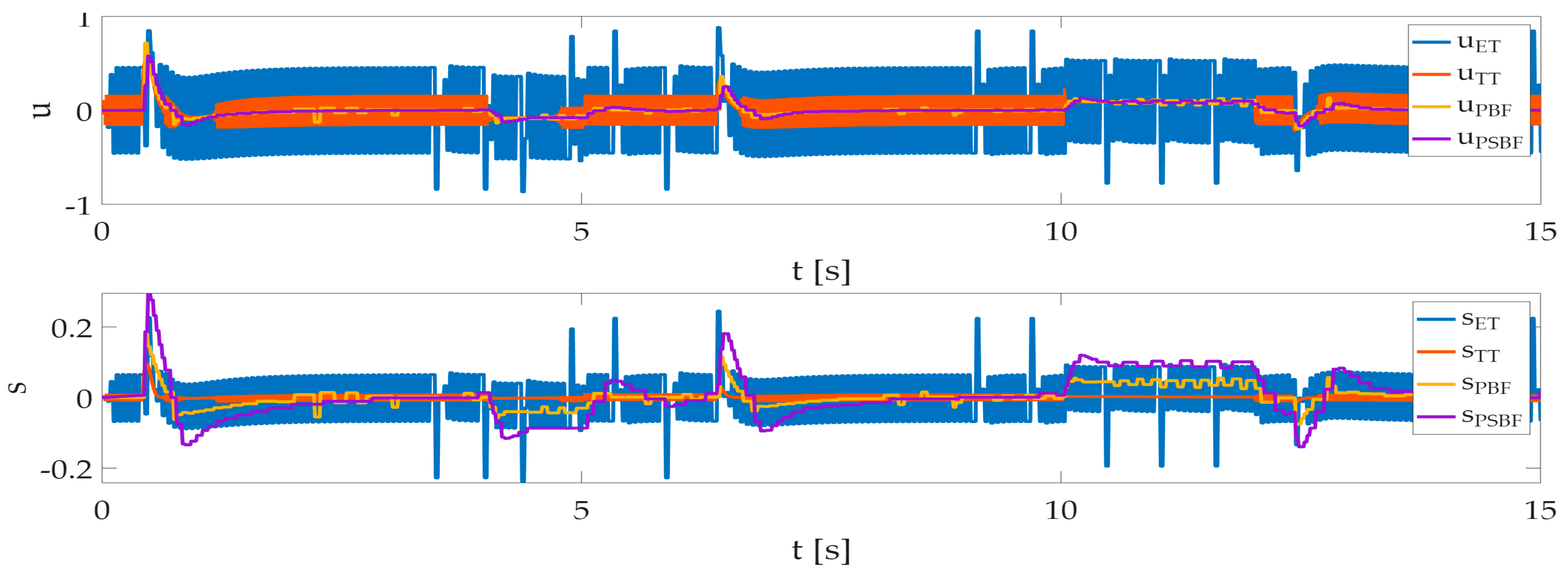
Figure 4 presents the controller’s outputs and sliding variables .
Figure 4.
The comparison of controller outputs and sliding variables .
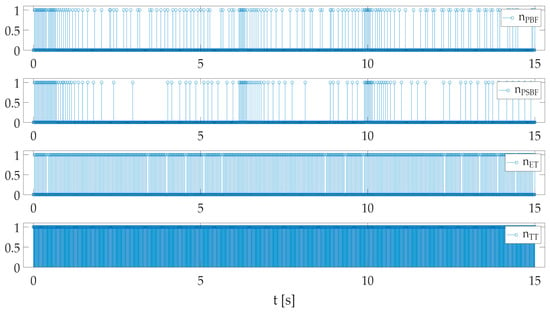
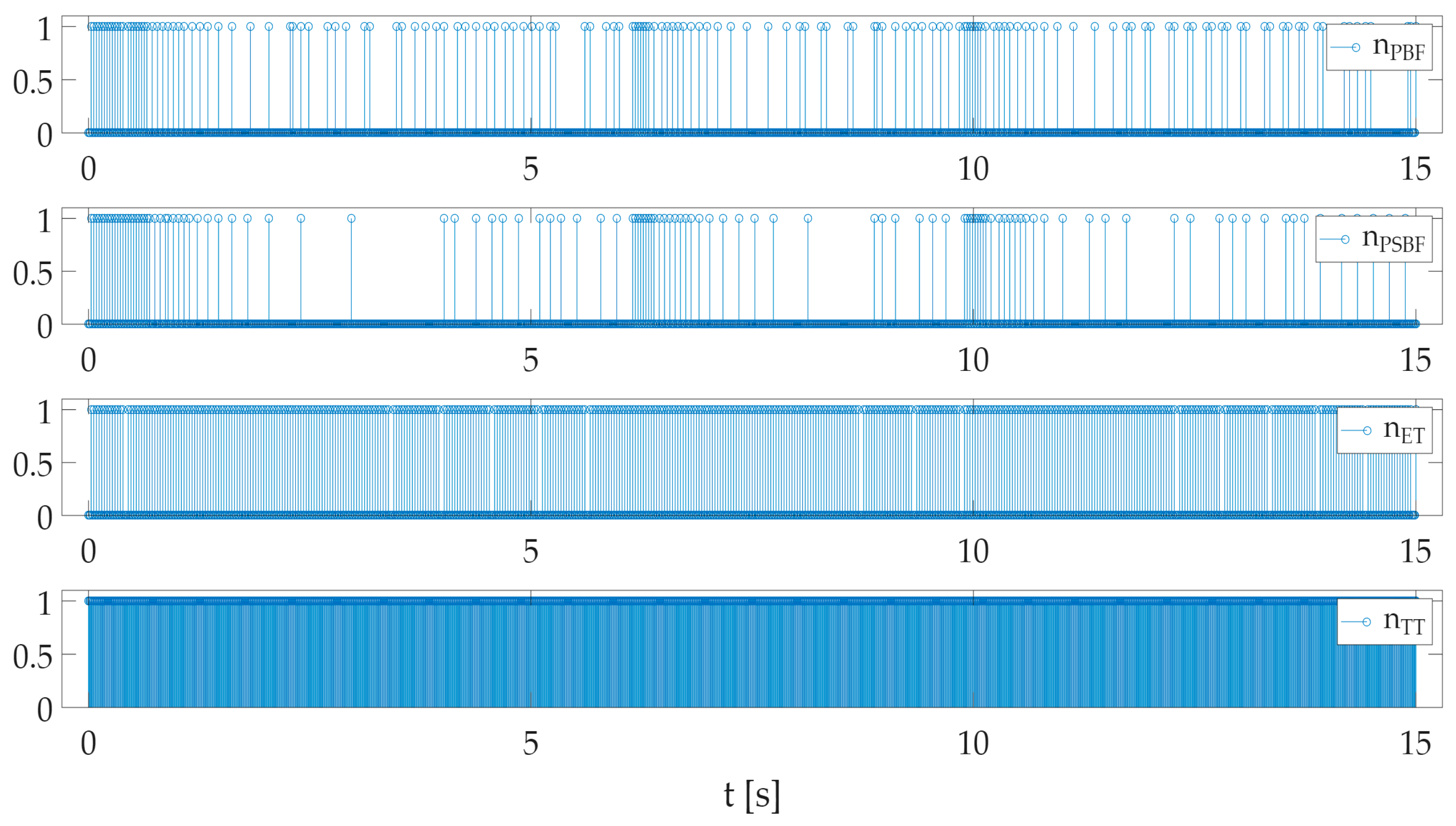
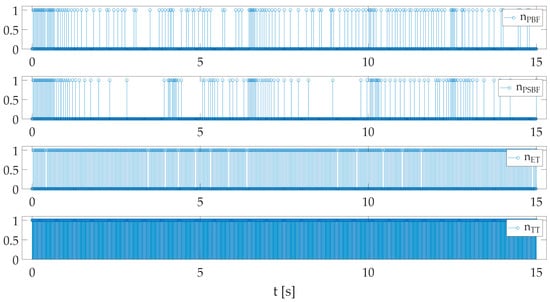
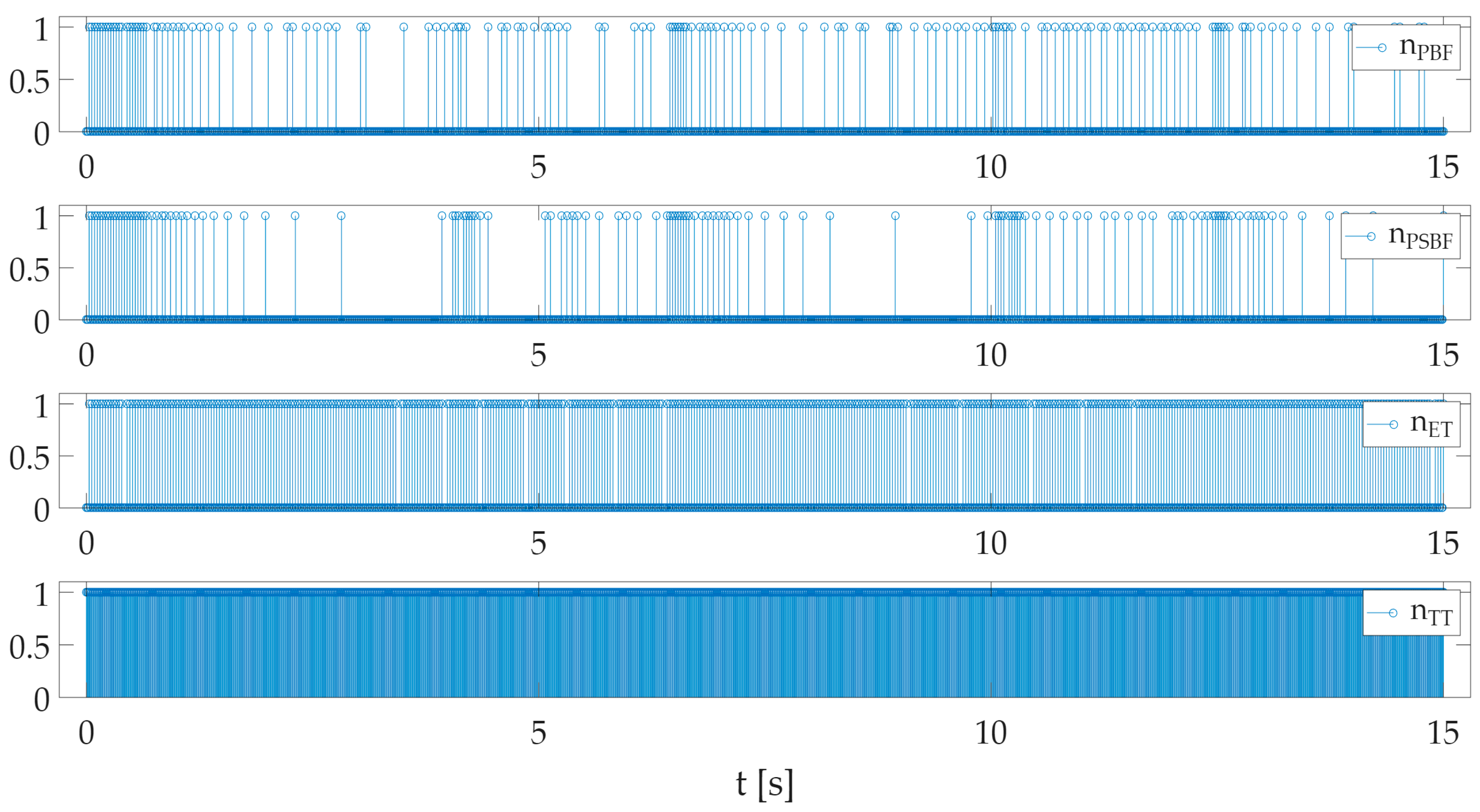
Figure 5 presents triggering events for all four implementations.
Figure 5.
Triggering events of the ET-PBF, ET-PSBF, ET-SMC, and TT-SMC controllers, respectively.
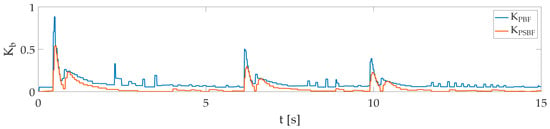
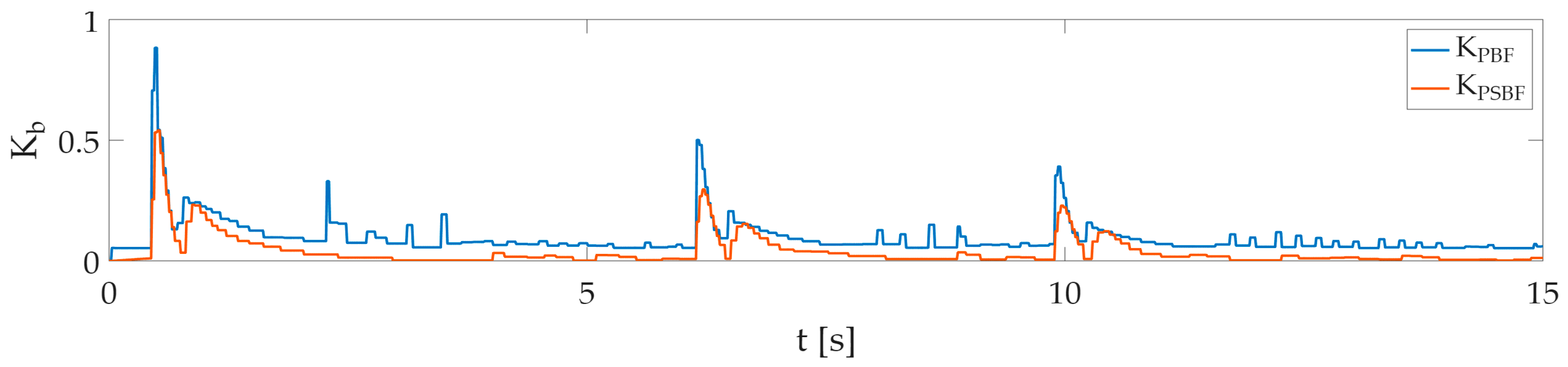
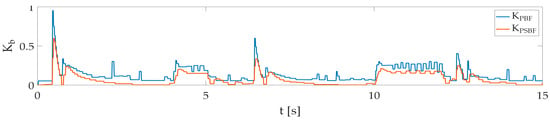
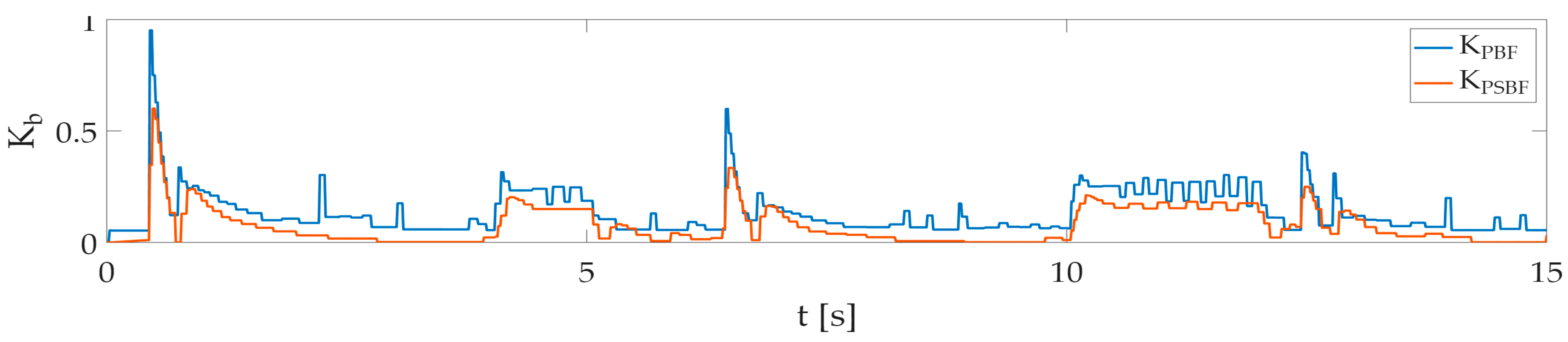
Figure 6 presents the barrier-gain adaptation for the ET-PBF and ET-PSBF controllers.
Figure 6.
ET-PBF and ET-PSBF gain adaptation.
The performance indices of the controllers are summarized in Table 3. The table shows the system data over the 15 s experimental interval, along with the maximum, minimum, and mean inter-event times, and the number of triggering events measured for each controller.
Table 3.
Time performance indices of tested controllers.
The quantitative performance measures defined in (47) are presented in Table 4.
Table 4.
Quantitative performance indices of tested controllers.
To evaluate the disturbance-rejection capability of the proposed controller, an additional set of real-time experiments was conducted under identical operating conditions. For a fair comparison, the same disturbance was applied to each controller at the same instant. The disturbance was generated by the embedded software and injected directly into the control loop, ensuring identical disturbance characteristics for all tested control strategies. The resulting responses demonstrate each controller’s ability to reject external disturbances, recover to the desired equilibrium position, and maintain the practical sliding mode. Figure 7 shows the injected disturbance used in the real-time experiments.
Figure 7.
Input disturbance.
Figure 8.
Disturbance rejection performance of the TT-SMC, ET-SMC, ET-PBF, and ET-PSBF controllers.
Figure 9.
Comparison of the controller outputs u and sliding variables s for the TT-SMC, ET-SMC, ET-PBF, and ET-PSBF controllers under the applied input disturbance.
Triggering events are presented in Figure 10.
Figure 10.
Comparison of the triggering events for the TT-SMC, ET-SMC, ET-PBF, and ET-PSBF controllers under the applied input disturbance.
Figure 11 presents the controller’s gain adaptation with BF.
Figure 11.
Barrier function gain adaptation of ET-PBF and ET-PSBF controllers under the applied input disturbance.
The performance indices of the controllers under applied disturbance are summarized in Table 5.
Table 5.
Time performance indices of tested controllers, under applied disturbance.
The quantitative performance measures defined in (47) are presented in Table 6.
Table 6.
Quantitative performance indices of tested controllers; .
The experimental results demonstrate that the proposed Barrier Function Adaptive Event-Triggered Sliding Mode Controller successfully combines the robustness of conventional sliding mode control with the computational efficiency of event-triggered implementation. Compared with both the conventional TT-SMC and the standard ET-SMC, the proposed adaptive strategy significantly reduces the number of controller executions (see Table 3, Table 4, Table 5 and Table 6), while maintaining comparable tracking accuracy and disturbance-rejection performance. The tracking responses shown in Figure 3 and Figure 4 indicate that all four controllers achieve stable convergence to the desired reference position without steady-state error. The TT-SMC exhibits the fastest switching activity due to periodic controller updates at every sampling instant, resulting in the highest computational load. In contrast, the ET-SMC updates the control input only when the triggering condition is violated, reducing the number of controller executions by approximately 68% compared with TT-SMC. The introduction of the adaptive barrier function further improves the behavior of the event-triggered controller. Unlike the conventional ET-SMC, where a constant switching gain must be selected based on the worst-case disturbance, the proposed ET-PBF and ET-PSBF controllers continuously adapt the switching gain to the instantaneous value of the sliding variable (see Figure 6 and Figure 11).
The disturbance rejection experiments confirm that the adaptive barrier-function strategy preserves the robustness properties of sliding mode control. As shown in Figure 8, Figure 9, Figure 10 and Figure 11, all controllers successfully reject the injected disturbance and return the levitated object to the desired equilibrium position without instability. However, the adaptive controllers achieve this objective with considerably fewer control updates than the conventional ET-SMC. The barrier gain increases immediately after the disturbance is applied, ensuring rapid recovery of the sliding condition, and subsequently decreases as the system returns to equilibrium. Consequently, the controller automatically adjusts its aggressiveness based on the current operating conditions, without requiring manual gain tuning. A comparison between the two barrier functions also reveals different adaptation characteristics. The PBF maintains a positive minimum switching gain even when the sliding variable approaches zero, providing stronger robustness and slightly faster disturbance compensation. In contrast, the PSBF reduces the switching gain to nearly zero in the vicinity of the sliding manifold, resulting in the lowest control activity and the longest inter-event times. Although the ET-PSBF implementation exhibits a slightly slower transient response than ET-PBF, it achieves the greatest reduction in controller updates, which can be preferable for embedded systems with limited computational resources.
6. Conclusions
This paper discussed a Barrier Function Adaptive Event-Triggered Sliding Mode Controller for a class of nonlinear systems. The proposed approach combines the robustness of sliding mode control with the computational efficiency of event-triggered implementation by introducing an adaptive switching gain based on barrier functions. Unlike conventional event-triggered sliding mode control, which employs a fixed switching gain selected according to the worst-case operating conditions, the proposed method continuously adapts the switching gain as a function of the sliding variable while preserving the original event-triggering mechanism. Consequently, the controller automatically adjusts its robustness according to the current system dynamics without modifying the triggering rule or requiring additional design parameters. A derived stability framework applicable to both the PBF and the PSBF was established using Lyapunov stability analysis. It was shown that the proposed adaptive controller guarantees convergence of the sliding variable to a practical sliding region while preserving the robustness properties of conventional sliding mode control. Furthermore, a positive lower bound on the inter-event time was derived, proving the absence of Zeno behavior. The theoretical analysis also demonstrated that adaptive reduction in the switching gain within the practical sliding region enlarges the guaranteed minimum inter-event time compared with the conventional fixed-gain event-triggered controller. The stated proposition was validated on an air-levitation system. The experimental results confirmed that all four controllers achieved stable tracking and satisfactory disturbance rejection. However, the adaptive barrier-function approach substantially reduced the number of controller updates while maintaining comparable transient and steady-state performance. In particular, the barrier-function adaptation significantly increased the mean and maximum inter-event times, thereby reducing the computational burden of the embedded controller. These results demonstrate that the proposed gain adaptation successfully relaxes the conservatism associated with fixed switching gains by applying high control effort only when required and reducing the switching activity as the system approaches the practical sliding region.
Future research will focus on several promising directions. First, alternative classes of adaptive barrier functions will be investigated to further improve the balance between robustness and triggering frequency while reducing unnecessary controller activity. Second, probabilistic and learning-based approaches will be explored to estimate the likelihood of future triggering events based on the evolution of the sliding variable and the system dynamics. Such predictive triggering strategies could enable the controller to anticipate future updates, further increasing the inter-event time and improving computational efficiency. In addition, integrating the proposed barrier-function adaptation with disturbance observers, adaptive estimation techniques, and model predictive event-triggered strategies represents an attractive direction for enhancing control performance under uncertain operating conditions.
Author Contributions
Conceptualization, A.S. and D.G.; methodology, D.G. and A.S.; simulation software, A.S.; validation, D.G.; formal analysis, A.S. and D.G.; investigation, D.G.; writing—original draft preparation, A.S.; writing—review and editing, A.S. and D.G.; visualization, D.G. and A.S.; supervision, D.G.; funding acquisition, D.G. All authors have read and agreed to the published version of the manuscript.
Funding
This research was funded by the Slovenian Research Agency (ARRS), grant number P2-0065.
Data Availability Statement
The original contributions presented in this study are included in the article. Further inquiries can be directed to the corresponding author.
Conflicts of Interest
The authors declare no conflicts of interest.
References
- Phillips, C.L.; Nagle, H.T.; Chakrabortty, A. Digital Control System Analysis and Design; Pearson: London, UK, 2015. [Google Scholar]
- Li, M.; Zhan, G. Fault-Tolerant Control for Quadrotor Unmanned Aerial Vehicle with Nonlinearities and Unknown External Disturbances. Mathematics 2026, 14, 2161. [Google Scholar] [CrossRef] [Scilit]
- Tan, F.; Zhou, L.; Zong, G.; Wang, Z.; Zhuang, G.; Shangguan, X. Fixed Time Control for Interlayer Synchronism Under DDMNNs and Application in Secure Communication. IEEE Trans. Autom. Sci. Eng. 2025, 22, 10827–10834. [Google Scholar] [CrossRef] [Scilit]
- Årzén, K.-E. A simple event-based PID controller. In Proceedings of the 14th IFAC World Congress, Beijing, China, 5–9 July 1999. [Google Scholar]
- Åström, K.J.; Bernhardsson, B. Comparison of periodic and event-based sampling for first-order stochastic systems. IFAC Proc. Vol. 1999, 32, 5006–5011. [Google Scholar] [CrossRef] [Scilit]
- Astrom, K.J.; Bernhardsson, B.M. Comparison of Riemann and Lebesgue sampling for first order stochastic systems. In Proceedings of the 41st IEEE Conference on Decision and Control, Las Vegas, NV, USA, 10–13 December 2002; IEEE: New York, NY, USA, 2022; Volume 2, pp. 2011–2016. [Google Scholar]
- Tabuada, P. Event-Triggered Real-Time Scheduling of Stabilizing Control Tasks. IEEE Trans. Autom. Control 2007, 52, 1680–1685. [Google Scholar] [CrossRef] [Scilit]
- Sandee, J.H.; Heemels, W.P.M.H.; van den Bosch, P.P.J. Event-driven control as an opportunity in the multidisciplinary development of embedded controllers. In Proceedings of the 2005, American Control Conference, Portland, OR, USA, 8–10 June 2005; IEEE: New York, NY, USA, 2005; Volume 3, pp. 1776–1781. [Google Scholar]
- Heemels, W.P.M.H.; Johansson, K.H.; Tabuada, P. An introduction to event-triggered and self-triggered control. In Proceedings of the 2012 IEEE 51st IEEE Conference on Decision and Control (CDC), Maui, HI, USA, 10–13 December 2012; pp. 3270–3285. [Google Scholar]
- Antunes, D.; Heemels, W.P.M.H. Rollout event-triggered control: Beyond periodic control performance. IEEE Trans. Autom. Control 2014, 59, 3296–3311. [Google Scholar] [CrossRef] [Scilit]
- Dimarogonas, D.V.; Frazzoli, E.; Johansson, K.H. Distributed Event-Triggered Control for Multi-Agent Systems. IEEE Trans. Autom. Control 2012, 57, 1291–1297. [Google Scholar] [CrossRef] [Scilit]
- Shtessel, Y.; Edwards, C.; Fridman, L.; Levant, A. Sliding Mode Control and Observation; Birkhäuser: New York, NY, USA, 2014. [Google Scholar]
- Boiko, I.; Fridman, L. Analysis of chattering in continuous sliding-mode controllers. IEEE Trans. Autom. Control 2005, 50, 1442–1446. [Google Scholar] [CrossRef] [Scilit]
- Pérez-Ventura, U.; Fridman, L. When is it reasonable to implement the discontinuous sliding-mode controllers instead of the continuous ones? Frequency domain criteria. Int. J. Robust Nonlinear Control 2018, 29, 810–828. [Google Scholar] [CrossRef] [Scilit]
- Utkin, V.I.; Poznyak, A.S. Adaptive sliding mode control with application to super-twist algorithm: Equivalent control method. Automatica 2013, 49, 39–47. [Google Scholar] [CrossRef] [Scilit]
- Plestan, F.; Shtessel, Y.; Brégeault, V.; Poznyak, A. New methodologies for adaptive sliding mode control. Int. J. Control 2010, 83, 1907–1919. [Google Scholar] [CrossRef] [Scilit]
- Bartolini, G.; Ferrara, A.; Pisano, A.; Usai, E. Adaptive reduction of the control effort in chattering-free sliding-mode control of uncertain nonlinear systems. Appl. Math. Comput. Sci. 1998, 8, 51–71. [Google Scholar] [CrossRef] [Scilit]
- Shtessel, Y.; Plestan, F.; Edwards, C.; Levant, A. Adaptive sliding mode and higher order sliding-mode control techniques with applications: A survey. In Sliding-Mode Control and Variable-Structure Systems; Springer: Cham, Switzerland, 2023; pp. 267–305. [Google Scholar]
- Moreno, J.A.; Osorio, M. A Lyapunov approach to second-order sliding mode controllers and observers. In Proceedings of the 47th IEEE Conference on Decision and Control, Cancun, Mexico, 9–11 December 2008; pp. 2856–2861. [Google Scholar]
- Pérez-Ventura, U.; Fridman, L. Design of super-twisting control gains: A describing function based methodology. Automatic 2019, 99, 175–180. [Google Scholar] [CrossRef] [Scilit]
- Shtessel, Y.; Taleb, M.; Plestan, F. A novel adaptive gain supertwisting sliding mode controller: Methodology and application. Automatica 2012, 48, 759–769. [Google Scholar] [CrossRef] [Scilit]
- Obeid, H.; Fridman, L.M.; Laghrouche, S.; Harmouche, M. Barrier Function-Based Adaptive Sliding Mode Control. Automatica 2018, 93, 540–544. [Google Scholar] [CrossRef] [Scilit]
- Rodrigues, V.H.P.; Hsu, L.; Oliveira, T.R.; Fridman, L. Unit vector control with prescribed performance via monitoring and barrier functions. In Sliding-Mode Control and Variable-Structure Systems; Springer: Cham, Switzerland, 2023; pp. 307–334. [Google Scholar]
- Barghandan, M.; Pirmohamadi, A.A.; Mobayen, S.; Fekih, A. Optimal adaptive barrier-function super-twisting nonlinear global sliding mode scheme for trajectory tracking of parallel robots. Heliyon 2023, 9, e13378. [Google Scholar] [CrossRef] [Scilit] [PubMed]
- Vié, A.T.; Fridman, L.; Galeazzi, R.; Papageorgiou, D. Multi-layer barrier function-based adaptive super-twisting controller. In Proceedings of the IEEE 64th Conference on Decision and Control, Rio de Janeiro, Brazil, 10–12 December 2025. [Google Scholar]
- Behera, A.K.; Bandyopadhyay, B.; Yu, X. Periodic event-triggered sliding mode. Automatica 2018, 96, 1916–1931. [Google Scholar] [CrossRef] [Scilit]
- Behera, A.K.; Bandyopadhyay, B.; Cucuzzella, M.; Ferrara, A.; Yu, X. A survey on event-triggered sliding mode control. IEEE J. Emerg. Sel. Top. Ind. Electron. 2021, 2, 206–217. [Google Scholar] [CrossRef] [Scilit]
- Behera, A.K.; Bandyopadhyay, B. Event-triggered sliding mode control for a class of nonlinear systems. Int. J. Control 2016, 89, 1916–1931. [Google Scholar] [CrossRef] [Scilit]
- Jiang, B.; Wei, J.; Liu, Y.; Gui, W. Periodic Event-Triggered Impulsive Control of Linear Uncertain Systems. IEEE Trans. Autom. Sci. Eng. 2024, 22, 6876–6883. [Google Scholar] [CrossRef] [Scilit]
- Khashooei, B.A.; Antunes, D.J.; Heemels, W.P.M.H. Output-based event-triggered control with performance guarantees. IEEE Trans. Autom. Control 2017, 62, 3646–3652. [Google Scholar] [CrossRef] [Scilit]
- Behera, A.K. Event-triggered sliding mode control via digital redesign. Automatica 2025, 177, 112349. [Google Scholar] [CrossRef] [Scilit]
- Hu, W.; Hou, Y.; Chen, Z.; Yang, C.; Gui, W. Event-triggered consensus of multiagent systems with prescribed performance. IEEE Trans. Autom. Control 2024, 69, 5462–5469. [Google Scholar] [CrossRef] [Scilit]
- Chen, Y.; Li, X.; Li, X. Design of event-based sliding mode controller for high-order systems via a reduced-order method. Trans. Inst. Meas. Control 2025, 47, 477–486. [Google Scholar] [CrossRef] [Scilit]
- Sarjaš, A.; Gleich, D. Toward Embedded System Resources Relaxation Based on the Event-Triggered Feedback Control Approach. Mathematics 2022, 10, 550. [Google Scholar] [CrossRef] [Scilit]



Disclaimer/Publisher’s Note: The statements, opinions and data contained in all publications are solely those of the individual author(s) and contributor(s) and not of MDPI and/or the editor(s). MDPI and/or the editor(s) disclaim responsibility for any injury to people or property resulting from any ideas, methods, instructions or products referred to in the content. |
© 2026 by the authors. Licensee MDPI, Basel, Switzerland. This article is an open access article distributed under the terms and conditions of the Creative Commons Attribution (CC BY) license.