
Skip to Content
  • 9.8
    CiteScore
  • 24 days
    Submission to First Decision
  • 4 days
    Acceptance to Publication

International Journal of Environmental Research and Public Health

International Journal of Environmental Research and Public Health (IJERPH) is a transdisciplinary, peer-reviewed, open access journal that covers global health, healthcare sciences, behavioral and mental health, infectious diseases, chronic diseases and disease prevention, exercise and health related quality of life, environmental health and environmental sciences, and is published monthly online by MDPI. The International Society Doctors for the Environment (ISDE), Italian Society of Environmental Medicine (SIMA) and Environmental Health Association of Québec (ASEQ‑EHAQ) are affiliated with IJERPH and their members receive discounts on the article processing charges.

Get Alerted

Add your email address to receive forthcoming issues of this journal.

All Articles (66,794)

  • Article
  • Open Access

Background: Temporomandibular disorders (TMD) represent a significant source of musculoskeletal pain in the head and orofacial region. Myofascial TMD is characterised by pain, the presence of myofascial trigger points, and functional limitations. Methods: Forty patients (30 women and 10 men; mean age 32.4 ± 8.6 years) were enrolled in this pilot randomised controlled trial. The experimental group (n = 20) received a standard rehabilitation programme supplemented by a single dry needling session targeting the masseter and temporalis muscles, whereas the control group (n = 20) underwent standard rehabilitation alone. Pressure-evoked pain intensity (VAS) was assessed using a 0–10 visual analogue scale following the application of standardised algometric pressure to clinically identified myofascial trigger points. Quality of life was assessed using the WHOQOL-BREF questionnaire. Both outcomes were evaluated at baseline (T0), after the first treatment session (T1), and at the end of the rehabilitation programme (T2). The trial was registered in the ISRCTN registry (ISRCTN17648638). Results: After the first treatment session, both groups demonstrated a one-point reduction in pressure-evoked pain intensity (VAS). Quality-of-life scores increased by 10 points in the experimental group and by 8 points in the control group. At the end of the rehabilitation programme (T2), median pressure-evoked pain intensity (VAS) decreased to 2 (IQR 1) in the experimental group and to 3 (IQR 2) in the control group. WHOQOL-BREF scores increased by 36 points in the experimental group (50 [IQR 10] to 86 [IQR 7]) and by 30 points in the control group (54 [IQR 12] to 84 [IQR 8]). The Mann–Whitney U test revealed a statistically significant between-group difference in the early change in pressure-evoked pain intensity (VAS) from T0 to T1 (p = 0.023) and in WHOQOL-BREF score changes from T0 to T1 (p = 0.007) and from T0 to T2 (p = 0.035). However, the between-group difference in the overall change in pressure-evoked pain intensity (VAS) from T0 to T2 was not statistically significant (p = 0.585). Conclusions: The addition of a single dry needling session to standard rehabilitation was associated with a potentially more favourable early response in pressure-evoked pain intensity (VAS) and greater improvements in quality-of-life scores. However, no statistically significant between-group difference was observed in the overall change in pressure-evoked pain intensity (VAS) at the end of treatment. Given the pilot design and small sample size, these findings should be considered preliminary and interpreted with caution.

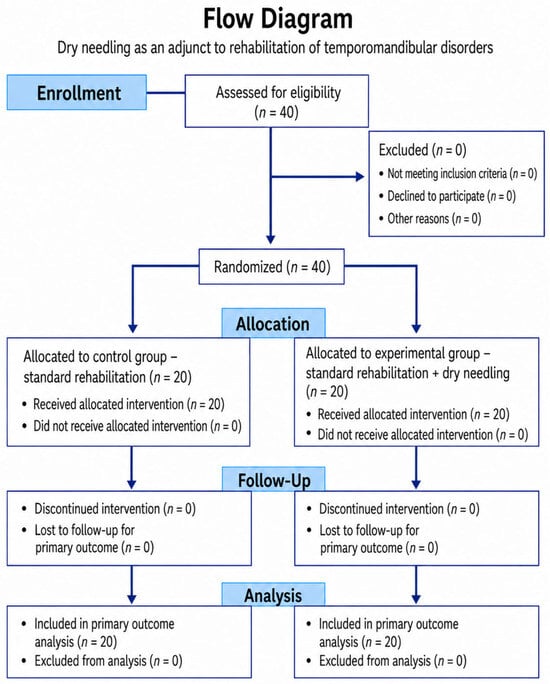
Study flow diagram. The diagram illustrates participant enrolment, randomisation, allocation to the control and experimental groups, follow-up, and inclusion in the final analysis.
  • Article
  • Open Access

Preterm birth is a pressing public health issue, with short- and long-term implications for newborns, their families, and society. Although studies are increasingly examining the structural determinants of this birth outcome, few have considered the role of regional equity—residents’ access to resources, opportunity, and power within a region. This study merges U.S. birth certificate data (2023) with a metropolitan-level Racial Equity Index generated by the National Equity Atlas project to investigate the overall and race-specific associations between racial equity, including its constituent measures of prosperity and inclusion, and preterm birth. Multivariable logistic regression models were fit for the overall sample (N = 2,359,347) and stratified by race. Regional prosperity reduced the odds of preterm birth, but the effect of racial inclusion depended on whether it was measured as past or current performance. Combining past inclusion with current prosperity resulted in 4% lower odds of preterm birth. The results provide some support for proponents who emphasize the importance of historic legacies of exclusion, but they also suggest that attention should extend to regional growth and prosperity since those set the basis for the resources to distribute more equitably. Addressing preterm birth will require sustained commitment to both closing racial gaps and ensuring shared prosperity.

  • Article
  • Open Access

Background: Research demonstrates a strong relationship between healthcare professionals’ vaccine attitudes and behaviors and the vaccination behaviors of patients, family, and friends. Positive vaccine attitudes among healthcare professionals are associated with vaccine uptake among patients and non-patients. Relatedly, vaccine hesitancy among healthcare professionals is associated with decreases in vaccine uptake. Understanding and addressing vaccine hesitancy among healthcare professionals, such as nurses, is a critical public health issue. Purpose: This study examines social and political differences between COVID-19 fully vaccinated (FV) and not fully vaccinated (NFV) nursing students. Methods: An online survey was distributed to investigate the social (i.e., age, gender, race/ethnicity, and religious affiliation) and political (political affiliation) differences in COVID-19 vaccination among RN-to-BSN nursing students. Among the NFV, readiness for COVID-19 vaccination and reasons for vaccine hesitancy were also assessed. The final analytic sample included 192 respondents. Descriptive and bivariate analyses were conducted to identify whether socio-demographic and political differences existed between COVID-19 FV and NFV nursing students. Results: Political affiliation (p = 0.005) was the only statistically significant difference identified. Among the NFV, the majority (70.8%) were in the precontemplation stage, with no intention of becoming vaccinated in the foreseeable future. The top reason reported for vaccine hesitancy was concern about side effects (58.3%). Implications: Political affiliation is an important factor in understanding vaccine hesitancy. Strategies to build trust, engage in empathetic discussions about vaccine hesitancy, and enhance media literacy skills are crucial steps in addressing vaccine hesitancy and the influence of politics on public health issues.

  • Article
  • Open Access

Hookah (waterpipe) tobacco smoking remains common among young adults and is often perceived as less harmful than cigarettes, in part due to the misconception that water “filters” toxins. We examined the perceived short-term health effects of hookah versus cigarette smoking in a cross-sectional survey of 121 young adults (mean age 26 ± 5 years; 45% women) in Southern California, including 75 exclusive hookah smokers, 10 dual hookah and cigarette smokers, and 36 non-smokers. Participants rated perceived effects on general, cardiovascular, and respiratory health on a scale from −10 (extremely harmful) to +10 (extremely healthy). Multivariable linear regression adjusted for sex, ethnicity, and education assessed group differences. Compared with exclusive hookah smokers, non-smokers rated hookah as significantly more harmful to general (β = −2.49, p < 0.05), cardiovascular (β = −3.49, p < 0.01), and respiratory health (β = −2.52, p < 0.05). A pronounced perception difference was observed for cardiovascular health, where exclusive hookah smokers rated hookah’s cardiovascular impact near neutral (adjusted mean −1.70), whereas non-users rated it as substantially harmful (−4.91). Perceptions of cigarette harm were negative across groups. Hookah smokers reported relatively low perceived harm from hookah smoking, including cardiovascular harm, highlighting cardiovascular risk perceptions as a potential target for public health communication.

Highly Accessed Articles

News & Conferences

Latest Issues

Open for Submission

Journal Sections

XFacebookLinkedIn
Int. J. Environ. Res. Public Health - ISSN 1660-4601