


Highlights
Public health relevance—How does this work relate to a public health issue?
- Hookah tobacco smoking remains a relevant youth and young adult public health issue because use is sustained by social patterns, product appeal, and persistent reduced-harm beliefs.
- Misperceptions that hookah is safer than cigarettes may undermine prevention and cessation, especially when intermittent or social use is mistakenly viewed as low-risk.
Public health significance—Why is this work of significance to public health?
- This study shows that harm minimization is not uniform across health domains, with particularly low perceived harm among hookah smokers.
- Current hookah users rated hookah’s cardiovascular impact near neutrality, despite widespread recognition that cigarettes are harmful.
Public health implications—What are the key implications or messages for practitioners, policy makers and/or researchers in public health?
- Risk communication should directly address cardiovascular toxicity and correct the myth that water filtration meaningfully reduces hookah smoke exposure.
- Hookah should be treated as a distinct combustible tobacco exposure in warning labels, clinical screening, and tobacco control policies.
Abstract
Hookah (waterpipe) tobacco smoking remains common among young adults and is often perceived as less harmful than cigarettes, in part due to the misconception that water “filters” toxins. We examined the perceived short-term health effects of hookah versus cigarette smoking in a cross-sectional survey of 121 young adults (mean age 26 ± 5 years; 45% women) in Southern California, including 75 exclusive hookah smokers, 10 dual hookah and cigarette smokers, and 36 non-smokers. Participants rated perceived effects on general, cardiovascular, and respiratory health on a scale from −10 (extremely harmful) to +10 (extremely healthy). Multivariable linear regression adjusted for sex, ethnicity, and education assessed group differences. Compared with exclusive hookah smokers, non-smokers rated hookah as significantly more harmful to general (β = −2.49, p < 0.05), cardiovascular (β = −3.49, p < 0.01), and respiratory health (β = −2.52, p < 0.05). A pronounced perception difference was observed for cardiovascular health, where exclusive hookah smokers rated hookah’s cardiovascular impact near neutral (adjusted mean −1.70), whereas non-users rated it as substantially harmful (−4.91). Perceptions of cigarette harm were negative across groups. Hookah smokers reported relatively low perceived harm from hookah smoking, including cardiovascular harm, highlighting cardiovascular risk perceptions as a potential target for public health communication.
1. Introduction
Hookah (waterpipe) tobacco smoking is a combustible, ancient form of tobacco use that remains common among adolescents and young adults and is sustained by flavors, social use patterns, and widespread beliefs of reduced harm [1]. In the United States (U.S.), recent national surveillance continues to document hookah use among youth and young adults [2,3]. In 2025, 0.7% of middle and high school students reported current (past 30 days) hookah use [4]. Among adults, nationally representative longitudinal data from 2013 to 2021 showed that those aged 18–24 years had the highest prevalence of both ever and current hookah use compared with other adult age groups across all survey waves, while overall ever use among adults increased from 16.39% to 20.92% [5]. Hookah products are sold in fruit/candy/alcohol-like flavors and strategically marketed to normalize use and position hookah as a “safer” alternative to cigarettes, often leveraging the sensory appeal of flavors and the social ritual of use to reduce perceived risk and reinforce sustained use [6]. These perceptions are consequential because lower perceived harm is a consistent predictor of tobacco initiation and progression, and youth who perceive hookah as neither harmful nor addictive are substantially more likely to initiate use [7].
These favorable perceptions are discordant with the toxicant profile and cardiopulmonary effects of hookah smoking, particularly for charcoal-heated waterpipes. Hookah smoke delivers nicotine and multiple toxic constituents, including carbon monoxide, fine particulate matter, polycyclic aromatic hydrocarbons, and heavy metals, and evidence associates hookah smoking with cardiovascular and respiratory harm [8,9,10,11]. Flavors can further facilitate deeper inhalation and sustained sessions by masking harshness and increasing product appeal, potentially increasing exposure to smoke toxicants [12,13]. Yet a persistent misconception, prominently echoed in public discourse and marketing, is that water “filters” toxins, leading many users to view hookah as benign [6,14]. Importantly, the type of harm perceived may be uneven, as respiratory harms may be more readily recognized than cardiovascular harms, which can undermine prevention and cessation messaging in a product with well-established cardiovascular toxicity [8,11].
Although reduced-harm perceptions of hookah smoking are well documented, prior research has focused primarily on overall harmfulness, addictiveness, and social acceptability rather than specific health domains. This distinction matters because smoking-related risk perceptions are multidimensional, and misperceptions may differ according to the disease outcome being considered. Whether young adults differentially appraise the short-term cardiovascular versus respiratory effects of hookah smoking relative to cigarettes remains insufficiently characterized. Accordingly, we examined the perceived short-term health effects of hookah and cigarette smoking on general health, cardiovascular health, and respiratory health among exclusive hookah smokers, dual users, and non-current tobacco users. We hypothesized that hookah users would rate hookah smoking as less harmful than non-users and that hookah would be rated as less harmful than cigarettes across groups.
2. Materials and Methods
2.1. Study Design and Participants
We conducted a cross-sectional survey between 2021 and 2024 to assess young adults’ (aged 21–39 years) perceptions of the health impacts of hookah smoking versus cigarette smoking. Participants were recruited in Southern California through online postings (Facebook, Reddit, Craigslist) and flyers at local colleges and universities. The sample consisted of eligible participants recruited during the study period using convenience sampling. Participants were screened for tobacco use history and categorized into three groups: (1) exclusive hookah smokers (regular hookah smoking and no cigarette smoking), (2) dual users (both hookah and cigarette smoking), and (3) non-smokers (never use of any tobacco products). Inclusion criteria included hookah smokers and dual users who had a history of regular hookah smoking, defined as smoking hookah at least once weekly for the past 12 months. All participants provided informed written consent, and the study protocol was approved by the University of California, Los Angeles institutional review board.
2.2. Survey Measures
Participants completed a questionnaire that included demographic characteristics (age, sex, race/ethnicity, and education level) and tobacco use history and frequency of use. While participants recorded age at smoking initiation for each tobacco product, for analysis, smoking initiation age was dichotomized as <18 vs. ≥18 years (minor vs. adult initiation). The primary outcomes were perceived short-term health effects of hookah smoking and of cigarette smoking. Participants were asked to rate, on a continuous scale from −10 to +10, how they believe smoking hookah affects: (1) general overall health, (2) cardiovascular health, and (3) respiratory health. A score of −10 was labeled “extremely harmful,” 0 was “no effect or neutral,” and +10 “extremely healthy.” The same participants also rated the perceived impact of cigarette smoking on each of those three health domains using the same −10 to +10 scales. The term “short-term” was used in the questionnaire to distinguish these perceived effects from longer-term health consequences. These perception items were study-specific and were not derived from a previously validated instrument.
2.3. Statistical Analysis
We summarized participant characteristics and tobacco use behavior by group using descriptive statistics (means ± SD for continuous variables; counts and percentages for categorical variables). To examine differences across groups in risk perceptions, we used multiple linear regression models with perception scores as the dependent variables. In the primary analysis, we included all three groups (hookah-only, dual, and non-smokers), with exclusive hookah smokers as the reference group. Each model included indicator variables for “dual user” and “non-smoker” (reference: hookah smoker). We ran separate models for each of the three health domains (general, cardiovascular, respiratory) and for each product perception (hookah and cigarette). All models were adjusted for sex (female vs. male), race/ethnicity (non-Hispanic White vs. all other racial/ethnic groups), and education (college education beyond high school vs. high school or less). Given the prior literature suggesting possible sex differences in risk perception of hookah and cigarette smoking, we included sex-by-group interaction terms in the models to explore sex-specific effects [14,15]. Male was the reference category for sex; therefore, in models containing sex-by-group interactions, the main-effect group coefficients represent group differences among males, while the interaction terms represent the additional differences for females relative to males. Because several individual race/ethnicity categories had small cell counts, race/ethnicity was dichotomized as non-Hispanic White versus all other racial/ethnic groups for the regression analyses.
In an exploratory secondary analysis focusing on smokers only, we restricted the sample to the hookah-only and dual user groups (excluding non-smokers) to directly compare perceptions between these two smoker groups. In these models, dual user was the key independent variable (reference: hookah-only smoker), we adjusted for sex, race/ethnicity, and education, and we added smoking initiation age (<18 vs. ≥18) and its interaction with group to assess whether starting to smoke as a minor versus as an adult influenced perceptions differently in dual vs. single-product users. Given the small number of dual users, these analyses were considered exploratory.
For all regression models, we examined overall model significance with an omnibus F-test and report adjusted R2 to indicate the proportion of variance explained. Regression assumptions were examined, and sensitivity analyses using bootstrapped confidence intervals and robust standard errors were conducted where departures from normality or homoscedasticity were observed. Sensitivity analyses yielded substantively similar results to the primary OLS models. Regression coefficients (B) with standard errors (SE) are reported for key predictors. A two-tailed p-value < 0.05 was considered statistically significant. No formal adjustment for multiple comparisons was applied; p values are therefore nominal. A general linear model for repeated measures was used to examine differences between hookah and cigarette perceptions within each health domain, adjusting for sex, ethnicity, and education. Analyses were conducted using SPSS (V28.0).
3. Results
3.1. Participant Characteristics
The analytic sample (N = 121; 26 ± 5 years) included 75 exclusive hookah smokers, 10 dual (hookah and cigarette) smokers, and 36 non-smokers. Overall, 45% of participants were female, with diverse racial/ethnic composition and about two-thirds reporting at least some college education beyond high school (Table 1). Exclusive hookah smokers reported an average of 2.7 ± 2.3 smoking sessions per week, with each session lasting about 104 ± 48 min, whereas dual users smoked hookah slightly more often (3.3 ± 2.1 sessions/week on average) but for shorter durations (79 ± 56 min per session). Among dual users, self-reported cigarette consumption averaged 8.4 ± 12.6 cigarettes per week. Those who smoke reported initiating smoking during late adolescence or early adulthood.
Table 1.
Demographic and Smoking Characteristics of Study Participants.
3.2. Perceived Health Effects of Hookah vs. Cigarettes
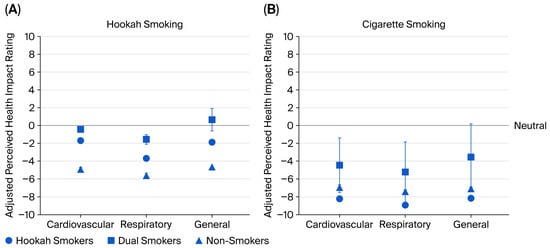
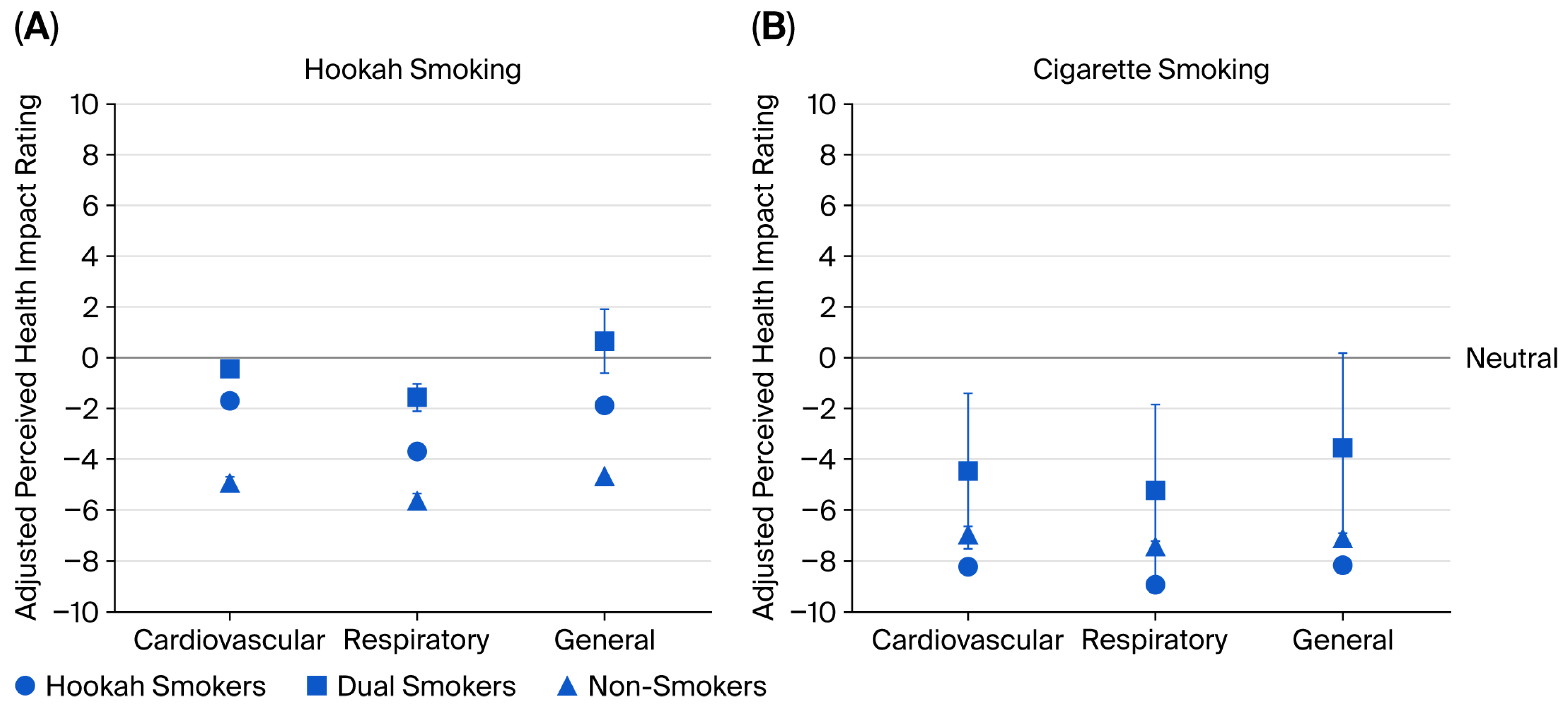
Figure 1 presents adjusted perception ratings by tobacco-use group across cardiovascular, respiratory, and general health domains. Exclusive hookah smokers rated hookah smoking relatively close to neutral, particularly for cardiovascular health (adjusted predicted mean, −1.70 on the −10 to +10 scale), whereas non-smokers rated its cardiovascular impact as substantially more harmful (−4.91). Repeated-measures results showed that cigarette smoking was perceived as significantly more harmful than hookah smoking for each of the three health domains (general: F(1,110) = 25.91, p < 0.001; cardiovascular: F(1,110) = 30.07, p < 0.001; respiratory: F(1,109) = 29.49, p < 0.001).
Figure 1.
Adjusted perceived health impact of hookah and cigarette smoking across health domains and tobacco-use groups. Panel (A) presents perceived health effects of hookah smoking, and Panel (B) presents perceived health effects of cigarette smoking. Symbols represent predicted means from multivariable linear regression models adjusted for sex, race/ethnicity, and education; error bars represent 95% confidence intervals. Ratings ranged from −10 (extremely harmful) to +10 (extremely healthy), with 0 indicating a neutral perceived effect. More negative values indicate greater perceived harm.
In multivariable models adjusted for sex, race/ethnicity, and education (Appendix A, Table A1), non-smokers provided significantly lower, or more harmful, ratings than exclusive hookah smokers for cardiovascular health (B = −3.49, SE = 1.09, p = 0.002), respiratory health (B = −2.52, SE = 1.01, p = 0.014), and general health (B = −2.49, SE = 1.07, p = 0.021). Dual users did not differ significantly from exclusive hookah smokers in their perceptions of hookah across these domains. Their adjusted ratings were also relatively close to neutral for cardiovascular (−0.44) and general health (0.67).
Cigarette smoking was perceived as harmful across all three tobacco-use groups, with adjusted cardiovascular ratings of −8.20 among exclusive hookah smokers, −4.44 among dual users, and −6.94 among non-smokers. Although the group-level estimates were consistently negative, significant sex-by-tobacco-use-group interactions were observed among dual users for cigarette perceptions of general health (B = 11.12, SE = 2.59, p < 0.001), cardiovascular health (B = 8.48, SE = 2.62, p = 0.002), and respiratory health (B = 10.07, SE = 2.29, p < 0.001). Female dual users reported substantially more favorable cigarette ratings than male dual users; however, because only three dual users were female, these interaction findings should be considered exploratory.
In exploratory analyses restricted to tobacco users, dual users provided significantly higher ratings for hookah’s respiratory-health impact than exclusive hookah smokers (B = 3.73, SE = 1.80, p < 0.05), indicating less perceived respiratory harm after adjustment for demographic characteristics and age of smoking initiation. A smoking-initiation-age-by-group interaction was also observed for cardiovascular perceptions of cigarette smoking (B = 5.37, SE = 2.38, p < 0.05). The positive interaction was consistent with more favorable cigarette cardiovascular ratings among dual users who initiated smoking at age ≥18 relative to the corresponding initiation-age pattern among exclusive hookah smokers (Appendix A, Table A2). Given the small dual-user sample, these estimates should be interpreted cautiously.
4. Discussion
Our findings are consistent with a large body of literature showing that hookah smoking is commonly perceived as less harmful than cigarette smoking among youth and young adults [7,16]. Prior studies have documented reduced perceptions of harm, addictiveness, and social risk surrounding hookah use, and longitudinal evidence indicates that lower perceived harm predicts subsequent initiation and earlier progression to use [17,18,19]. The present study extends this literature by showing that harm minimization was not uniform across health domains. The clearest divergence concerned cardiovascular health, where current hookah users rated hookah’s cardiovascular impact near neutrality, whereas cigarette harm was recognized across groups.
This domain-specific misperception is clinically meaningful. Hookah tobacco smoking exposes users to substantial carbon monoxide, nicotine, smoke volume, and other vascular toxicants, and acute use increases heart rate and blood pressure while impairing vascular function and increases cardiovascular disease risk [8,9,11,20]. Moreover, cardiovascular risk from combustible tobacco exposure is non-linear, such that even low or intermittent smoking carries a substantial proportion of the excess coronary heart disease and stroke risk associated with heavier smoking [21,22,23]. Viewed in this context, the perception that hookah smoking is largely innocuous to cardiovascular health is especially concerning, because it may reinforce the belief that social or intermittent hookah use is comparatively safe.
Exploratory secondary analyses suggested complexity in risk appraisal among dual users, including potential heterogeneity by sex and smoking initiation patterns. Given the small dual-user subgroup, these findings should be interpreted cautiously and considered hypothesis-generating. They are consistent with emerging evidence that multi-product users may adopt distinct cognitive frameworks for evaluating tobacco harm, but these patterns warrant further investigation in larger, population-based samples. Prior work suggests that dual use can be associated with altered risk appraisal and compensatory beliefs, though sex-specific patterns remain underexplored and warrant further investigation with a larger sample size [16].
These findings have implications for public health communication and regulation. Existing hookah communication research suggests that young adults respond favorably to simple, factual health-harm messages, with health-harm content demonstrating greater message receptivity than addiction-risk content [24]. At the same time, compliance with U.S. Food and Drug Administration nicotine warning requirements on hookah tobacco packaging remains low [25]. Risk communication informed by the present findings should therefore explicitly address cardiovascular toxicity, in addition to the focus on respiratory harms, and should directly counter the persistent misconception that water filtration meaningfully reduces toxicant exposure. These findings may inform broader tobacco-control efforts addressing hookah products among young adults, particularly where reduced-harm perceptions may contribute to continued use.
This study has several limitations. First, tobacco use and perceptions were self-reported and not biochemically verified. Participants were recruited from Southern California and were predominantly young adults, which may limit generalizability. The modest sample size, particularly for dual users, reduces the precision of subgroup and interaction estimates. Accordingly, analyses involving dual users should be considered exploratory and interpreted cautiously, and these findings require replication in larger, more balanced samples. The study-specific perception items have not undergone formal psychometric validation, which may limit direct comparability with studies using validated risk-perception measures. The dichotomization of race/ethnicity may obscure heterogeneity across racial and ethnic groups. Finally, the cross-sectional design precludes causal inference regarding the temporal relationship between tobacco use and risk perceptions.
Future research should extend these findings in larger, more diverse samples with greater representation of dual users and incorporate psychometrically validated measures of tobacco-related risk perceptions. Longitudinal and experimental studies are also needed to determine whether cardiovascular-specific risk communication can modify hookah-related harm perceptions and whether such changes translate into subsequent tobacco-use behavior.
5. Conclusions
Young adult hookah smokers perceived the short-term health effects of hookah smoking as substantially less harmful than non-smokers did across cardiovascular, respiratory, and general health domains, with particularly low perceived cardiovascular harm. These perceptions contrast with established evidence of the cardiovascular and respiratory toxicity of hookah smoke. The findings may inform risk-communication and tobacco-control efforts aimed at improving young adults’ understanding of hookah-related health risks.
Author Contributions
Conceptualization, C.-W.C. and M.R.-H.; methodology, C.-W.C. and M.R.-H.; validation, C.-W.C., M.-L.B. and M.R.-H.; formal analysis, M.-L.B.; investigation, C.-W.C.; resources, M.R.-H.; data curation, C.-W.C. and M.R.-H.; writing—original draft preparation, C.-W.C.; writing—review and editing, C.-W.C., C.A.P. and M.R.-H.; visualization, C.-W.C. and C.A.P.; supervision, M.R.-H.; project administration, M.R.-H.; funding acquisition, M.R.-H. All authors have read and agreed to the published version of the manuscript.
Funding
This research received no external funding.
Institutional Review Board Statement
The study was conducted in accordance with the Declaration of Helsinki, and approved by the Institutional Review Board of the University of California, Los Angeles (protocol codes 17-001870, initial approval 16 March 2018 and 18-001559, initial approval 6 November 2018, with approval maintained throughout the study period).
Informed Consent Statement
Informed consent was obtained from all subjects involved in the study.
Data Availability Statement
The data presented in this study may be available on request from the corresponding author due to participant confidentiality.
Conflicts of Interest
The authors declare no conflicts of interest.
Appendix A
Table A1.
Relationship of smoking status with perceptions of health impact of hookah and cigarettes, controlling for selected demographics B (SE) [95% CI].
Table A2.
Exploratory smoker-only regression models of perceptions of health impact of hookah and cigarettes, B (SE) [95% CI].
References
- Cooper, M.; Pacek, L.R.; Guy, M.C.; Barrington-Trimis, J.L.; Simon, P.; Stanton, C.; Kong, G. Hookah Use Among US Youth: A Systematic Review of the Literature from 2009 to 2017. Nicotine Tob. Res. 2019, 21, 1590–1599. [Google Scholar] [CrossRef] [Scilit] [PubMed]
- Jamal, A.; Park-Lee, E.; Birdsey, J.; West, A.; Cornelius, M.; Cooper, M.R.; Cowan, H.; Wang, J.; Sawdey, M.D.; Cullen, K.A.; et al. Tobacco Product Use Among Middle and High School Students—National Youth Tobacco Survey, United States, 2024. Morb. Mortal. Wkly. Rep. 2024, 73, 917–924. [Google Scholar] [CrossRef] [Scilit] [PubMed]
- Pérez, A.; Kuk, A.E.; Bluestein, M.A.; Chen, B.; Sterling, K.L.; Harrell, M.B. Age of initiation of hookah use among young adults: Findings from the Population Assessment of Tobacco and Health (PATH) study, 2013–2017. PLoS ONE 2021, 16, e0258422. [Google Scholar] [CrossRef] [Scilit] [PubMed]
- Park-Lee, E.; Dutra, L.M.; Cowan, H.; Levine, B.; Sawdey, M.D.; Cooper, M.; Merson, B.; Valverde, R.; Bradfield, B.; Lennon, J.; et al. Tobacco product use among middle and high school students in the United States: National Youth Tobacco Survey, 2025. Nicotine Tob. Res. 2026, 28, 1912–1920. [Google Scholar] [CrossRef] [Scilit] [PubMed]
- Kalan, M.E.; Li, W.; Osibogun, O.; Jebai, R.; Gautam, P.; Erinoso, O.; Alemohammad, S.Y.; Khosravaniardakani, S.; Dargahi Abbasabad, G.; Behaleh, R.; et al. Trends and Disparities in Waterpipe Tobacco Smoking Among US Adolescents and Adults: PATH Study 2013–2021. Tob. Use Insights 2024, 17, 1179173x241275352. [Google Scholar] [CrossRef] [Scilit] [PubMed]
- Feliciano, J.R.; Li, D.; Xie, Z. Public Perceptions of Flavored Waterpipe Smoking on Twitter. Int. J. Environ. Res. Public Health 2023, 20, 5264. [Google Scholar] [CrossRef] [Scilit] [PubMed]
- Kuk, A.E.; Bluestein, M.A.; Chen, B.; Harrell, M.; Spells, C.E.; Atem, F.; Pérez, A. The Effect of Perceptions of Hookah Harmfulness and Addictiveness on the Age of Initiation of Hookah Use among Population Assessment of Tobacco and Health (PATH) Youth. Int. J. Environ. Res. Public Health 2022, 19, 5034. [Google Scholar] [CrossRef] [Scilit] [PubMed]
- Rezk-Hanna, M.; Benowitz, N.L. Cardiovascular Effects of Hookah Smoking: Potential Implications for Cardiovascular Risk. Nicotine Tob. Res. 2019, 21, 1151–1161. [Google Scholar] [CrossRef] [Scilit] [PubMed]
- Rezk-Hanna, M.; Mosenifar, Z.; Benowitz, N.L.; Rader, F.; Rashid, M.; Davoren, K.; Moy, N.B.; Doering, L.; Robbins, W.; Sarna, L.; et al. High Carbon Monoxide Levels from Charcoal Combustion Mask Acute Endothelial Dysfunction Induced by Hookah (Waterpipe) Smoking in Young Adults. Circulation 2019, 139, 2215–2224. [Google Scholar] [CrossRef] [Scilit] [PubMed]
- Montazeri, Z.; Nyiraneza, C.; El-Katerji, H.; Little, J. Waterpipe smoking and cancer: Systematic review and meta-analysis. Tob. Control 2016, 26, 92–97. [Google Scholar] [CrossRef] [Scilit] [PubMed]
- Bhatnagar, A.; Maziak, W.; Eissenberg, T.; Ward, K.D.; Thurston, G.; King, B.A.; Sutfin, E.L.; Cobb, C.O.; Griffiths, M.; Goldstein, L.B.; et al. Water Pipe (Hookah) Smoking and Cardiovascular Disease Risk: A Scientific Statement from the American Heart Association. Circulation 2019, 139, e917–e936. [Google Scholar] [CrossRef] [Scilit] [PubMed]
- Kassem, N.O.F.; Strongin, R.M.; Stroup, A.M.; Brinkman, M.C.; El-Hellani, A.; Erythropel, H.C.; Etemadi, A.; Goniewicz, M.L.; Hansen, E.G.; Kassem, N.O.; et al. Toxicity of waterpipe tobacco smoking: The role of flavors, sweeteners, humectants, and charcoal. Toxicol. Sci. 2024, 201, 159–173. [Google Scholar] [CrossRef] [Scilit] [PubMed]
- Wagener, T.L.; Leavens, E.L.S.; Mehta, T.; Hale, J.; Shihadeh, A.; Eissenberg, T.; Halquist, M.; Brinkman, M.C.; Johnson, A.L.; Floyd, E.L.; et al. Impact of flavors and humectants on waterpipe tobacco smoking topography, subjective effects, toxicant exposure and intentions for continued use. Tob. Control 2020, 30, 366–372. [Google Scholar] [CrossRef] [Scilit] [PubMed]
- Aljarrah, K.; Ababneh, Z.Q.; Al-Delaimy, W.K. Perceptions of hookah smoking harmfulness: Predictors and characteristics among current hookah users. Tob. Induc. Dis. 2009, 5, 16. [Google Scholar] [CrossRef] [Scilit] [PubMed]
- Agaku, I.T.; Sulentic, R.; Dragicevic, A.; Njie, G.; Jones, C.K.; Odani, S.; Tsafa, T.; Gwar, J.; Vardavas, C.I.; Ayo-Yusuf, O. Gender differences in use of cigarette and non-cigarette tobacco products among adolescents aged 13-15 years in 20 African countries. Tob. Induc. Dis. 2024, 22, 20. [Google Scholar] [CrossRef] [Scilit] [PubMed]
- Soneji, S.; Knutzen, K.E.; Gravely, S.; Elton-Marshall, T.; Sargent, J.; Lambert, E.; Hilmi, N.; Sharma, E.; Jackson, K.J.; Wang, B.; et al. Transitions in frequency of hookah smoking among youth and adults: Findings from waves 1 and 2 of the Population Assessment of Tobacco and Health (PATH) study, 2013–15. Addiction 2021, 116, 936–948. [Google Scholar] [CrossRef] [Scilit] [PubMed]
- Fitzpatrick, M.; Johnson, A.C.; Tercyak, K.P.; Hawkins, K.B.; Villanti, A.C.; Mays, D. Adolescent Beliefs About Hookah and Hookah Tobacco Use and Implications for Preventing Use. Prev. Chronic Dis. 2019, 16, E05. [Google Scholar] [CrossRef] [Scilit] [PubMed]
- Parker, M.A.; Villanti, A.C.; Quisenberry, A.J.; Stanton, C.A.; Doogan, N.J.; Redner, R.; Gaalema, D.E.; Kurti, A.N.; Nighbor, T.; Roberts, M.E.; et al. Tobacco Product Harm Perceptions and New Use. Pediatrics 2018, 142, e20181505. [Google Scholar] [CrossRef] [Scilit] [PubMed]
- Patterson, S.L.; Duguid, I.; Clark, S.A.; Noar, S.M.; Lazard, A.J.; Thrasher, J.F.; Goldstein, A.O.; Kowitt, S.D. Perceived risks, reasons for use, and barriers to cessation among youth who use multiple tobacco products. PLoS ONE 2025, 20, e0335019. [Google Scholar] [CrossRef] [Scilit] [PubMed]
- Rezk-Hanna, M.; Doering, L.; Robbins, W.; Sarna, L.; Elashoff, R.M.; Victor, R.G. Acute Effect of Hookah Smoking on Arterial Stiffness and Wave Reflections in Adults Aged 18 to 34 Years of Age. Am. J. Cardiol. 2018, 122, 905–909. [Google Scholar] [CrossRef] [Scilit] [PubMed]
- Schane, R.E.; Ling, P.M.; Glantz, S.A. Health effects of light and intermittent smoking: A review. Circulation 2010, 121, 1518–1522. [Google Scholar] [CrossRef] [Scilit] [PubMed]
- Pope, C.A., 3rd; Burnett, R.T.; Krewski, D.; Jerrett, M.; Shi, Y.; Calle, E.E.; Thun, M.J. Cardiovascular mortality and exposure to airborne fine particulate matter and cigarette smoke: Shape of the exposure-response relationship. Circulation 2009, 120, 941–948. [Google Scholar] [CrossRef] [Scilit] [PubMed]
- Hackshaw, A.; Morris, J.K.; Boniface, S.; Tang, J.L.; Milenković, D. Low cigarette consumption and risk of coronary heart disease and stroke: Meta-analysis of 141 cohort studies in 55 study reports. BMJ 2018, 360, j5855, Correction in BMJ 2018, 361, k1611. https://doi.org/10.1136/bmj.k1611. Correction in BMJ 2018, 363, k5035. https://doi.org/10.1136/bmj.k5035. [Google Scholar] [CrossRef] [Scilit] [PubMed]
- Phan, L.; Villanti, A.C.; Leshner, G.; Wagener, T.L.; Stevens, E.M.; Johnson, A.C.; Mays, D. Development and Pretesting of Hookah Tobacco Public Education Messages for Young Adults. Int. J. Environ. Res. Public Health 2020, 17, 8752. [Google Scholar] [CrossRef] [Scilit] [PubMed]
- Ross, J.C.; Zizzi, A.R.; Suerken, C.K.; Kimes, C.; Soule, E.; Sutfin, E.L. Compliance with US Federal Regulations on Waterpipe Tobacco Warnings on Packaging. JAMA Netw. Open 2024, 7, e2354467. [Google Scholar] [CrossRef] [Scilit] [PubMed]

Disclaimer/Publisher’s Note: The statements, opinions and data contained in all publications are solely those of the individual author(s) and contributor(s) and not of MDPI and/or the editor(s). MDPI and/or the editor(s) disclaim responsibility for any injury to people or property resulting from any ideas, methods, instructions or products referred to in the content. |
© 2026 by the authors. Licensee MDPI, Basel, Switzerland. This article is an open access article distributed under the terms and conditions of the Creative Commons Attribution (CC BY) license.