
- Article

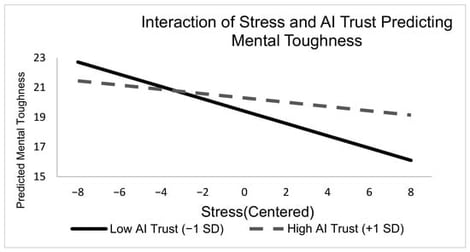
Background: Stress represents a significant public health concern and is associated with diminished psychological resilience among students and young adults. Mental toughness, the capacity to function effectively under pressure, may be influenced by attitudes toward emerging technologies. Methods: This cross-sectional study investigated whether trust in artificial intelligence (AI) moderates the relationship between perceived stress and mental toughness. Students attending a Historically Black College or University (HBCU) participated (n = 109); 84.4% were aged 18–25 years. Perceived stress was assessed using an adapted six-item DASS stress index, while mental toughness and AI trust were measured using adapted multi-item scales. Hierarchical regression analyses examined the moderating role of AI trust. Results: Higher perceived stress was associated with lower mental toughness. Although AI trust did not directly predict mental toughness after accounting for the interaction, a significant interaction emerged: students with greater AI trust showed a weaker negative association between stress and mental toughness. Conclusions: Higher AI trust was associated with attenuation of the negative relationship between perceived stress and mental toughness among students. These findings may inform future research on trustworthy AI, student well-being, and evidence-based public health strategies for students in high-stress environments.
Trends Public Health
10 September 2026