
Skip to Content
You are currently on the new version of our website. Access the old version .

Health Economics and Policy

Health Economics and Policy is an international, peer-reviewed, open access journal on health economics published quarterly online by MDPI.

Get Alerted

Add your email address to receive forthcoming issues of this journal.

All Articles (11)

  • Article
  • Open Access

The Bronx bears close to one-third of all violent crimes in New York City, and 90% of the victims are male young adults between the ages of 24 and 65 years of age from a racial and ethnic minority. The voices of marginal urban young adults living in communities with a high incidence of violent crime are often misunderstood and therefore excluded from research and community practice opportunities. The focus of this manuscript is to showcase the opportunity for economic evaluation to involve hard-to-reach community members in research and community-orientated violence prevention in the Bronx. This pilot study introduced the willingness-to-pay—WTP—approach among two samples of young adults to prioritize their violence prevention ideas. The WTP approach relies on surveys to elicit the subjective value that individuals place on public goods that are not traded in the marketplace. The first sample was comprised by 298 college students. This sample completed an online quantitative survey, and the second sample was divided into two qualitative focus groups with a total of 32 young adults enrolled in a community crime prevention program. This study asked participants their willingness to pay to prevent different types of violent crimes in the Bronx. The results indicate young adults perceive sexual assault as a higher priority compared to other violent crime offenses, including homicide. The results suggest that programs and interventions that illustrate the economic loss to society related to crime, such as losses in productivity, costs to health care, and ultimately the societal costs of premature mortality, may engage young adults in a meaningful conversation about crime prevention. The participants rated the Contingent Valuation (CV) methodology as innovative and were keen to discuss economic concepts and the value of life.

Health Econ. Policy

2 October 2026

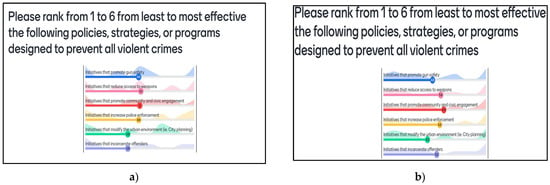
(a,b) Graph produced by the Mentimeter platform.
  • Article
  • Open Access

Background: Chronic conditions are associated with poorer health-related quality of life (HRQoL) and are more common in socioeconomically disadvantaged groups. We examined income-related inequality in health-related quality of life and quantified the contribution of chronic conditions to inequality in HRQoL among Australian adults. Methods: We analysed pooled cross-sectional survey data from 4953 Australian adults recruited through a non-probability online panel. We measured HRQoL using EQ-5D-5L utility scores calculated with the Australian value set. We measured income-related inequality using the Erreygers-corrected concentration index. Multivariable ordinary least squares regression estimated adjusted associations with utility, and decomposition analysis estimated the statistical contributions of chronic-condition burden and sociodemographic characteristics. Results: Higher EQ-5D-5L utility was modestly concentrated among participants in higher-income categories (Erreygers-corrected concentration index [ECI] = 0.0328; bootstrap SE = 0.0038; 95% bootstrap percentile CI 0.0251–0.0401; p < 0.001). Compared with participants reporting no chronic condition, those with multimorbidity had an adjusted utility score that was 0.151 points lower. Multimorbidity made the largest contribution to the observed inequality (27.63%), followed by not working (26.34%) and annual income above A$65,000 (19.27%). Conclusions: EQ-5D-5L utility was modestly concentrated among participants in higher-income categories. Multimorbidity and not working were the largest measured contributors. These cross-sectional findings describe statistical associations and do not establish cause and effect.

Health Econ. Policy

4 November 2026

  • Article
  • Open Access

Acute cardiovascular care is among the most resource-intensive domains of contemporary healthcare. Major investments are concentrated in the index hospital episode, including emergency diagnostics, reperfusion or revascularization, intensive monitoring, specialist pharmacotherapy and multidisciplinary stabilization. Yet a substantial share of this value may be lost after discharge, when patients enter fragmented outpatient pathways characterized by delayed follow-up, medication discrepancies, unclear accountability and inconsistent implementation of secondary prevention. This paper uses the discharge cliff as an organizing metaphor for that phenomenon. We argue that the discharge cliff is not only a clinical problem but also a health-economic and sustainability problem. When responsibility becomes discontinuous after discharge, high-cost acute gains are exposed to avoidable erosion. The result is recurrent emergency use, repeat diagnostic cascades, duplicated medicines work, potentially preventable rehospitalization and additional material consumption. These consequences are relevant after acute myocardial infarction, decompensated heart failure, cardiogenic shock survivorship and stroke with cardiovascular complications, where the post-discharge period is both vulnerable and management intensive. Drawing on cardiovascular guidelines, outcomes research, policy documents and sustainability literature, we organize the synthesis around three recurring governance mechanisms: discontinuity of accountability, misaligned reimbursement incentives and weak post-acute feedback loops. We then propose a framework of post-acute cardiovascular stewardship. Core levers include structured discharge-to-follow-up pathways, pharmacist-supported medicines optimization, early specialist review, digital monitoring for high-risk patients, accountable transition metrics, and bundled or episode-based payment models. Clinical continuity and economic stewardship form the operational core of the framework; environmental resource use is included as an emerging, cross-cutting dimension whose pathway-level quantification remains less mature. The vulnerability of the post-discharge period is well established. The contribution here is not a new clinical phenomenon but a reframing of that established failure as a problem of value preservation and governance, and its operationalization into accountable ownership, episode-level measurement and reimbursement design. The sustainable future of high-intensity cardiovascular care depends not only on saving lives in hospital, but also on preserving the value generated there once the patient returns to community care.

Health Econ. Policy

1 October 2026

  • Article
  • Open Access

Traditional benefit–cost analysis (BCA) summarizes the average net social benefit of a policy but often obscures how benefits and costs are distributed across groups. This is a major limitation in health policy settings, where decision-makers must assess both efficiency and equity. This article develops an integrated equity-weighted causal benefit–cost analysis (IEW-BCA) framework for equity-conscious policy evaluation. The framework links subgroup-specific causal effect estimates, explicit valuation functions, and equity weights within a single evaluation pipeline suitable for applied policy appraisal. It makes three contributions: first, it provides an implementable structure for combining causal heterogeneity with welfare-consistent valuation; second, it introduces a compound equity vector and associated weighting functions that extend income-based schemes and can be interpreted, under standard conditions, as a first-order approximation to a broad class of social welfare functions; and third, it develops equity-oriented summary tools, including a causal equity gradient and related dominance criteria, to improve transparency about distributional impacts. A stylized example illustrates implementation, and the discussion outlines implications for uncertainty, sensitivity analysis, and potential application in health economics, public health policy, and regulatory evaluation.

Health Econ. Policy

4 September 2026

Highly Accessed Articles

News & Conferences

Latest Issues

Open for Submission

Journal Sections

XFacebookLinkedIn
Health Econ. Policy - ISSN 3042-898X