


Highlights
Public health relevance—How does this work relate to a public health issue?
- Exposure to body odors is common and may trigger immune and psychosomatic responses.
Public health significance—Why is this work of significance to public health?
- An advanced air cleaner efficiently removed two important body odor chemical classes.
Public health implications—What are the key implications or messages for practitioners, policy makers and/or researchers in public health?
- Air cleaners have dual benefits relating to building energy consumption and health.
Abstract
People spend most of their time indoors, and objectionable body odors can modify perceived indoor air quality, particularly in densely occupied spaces. Discomfort and psychosomatic effects may be experienced by exposed individuals. Such exposures can be mitigated by ventilation and supplementary air cleaning. However, there is a limited understanding of the effectiveness of air cleaning for specific body odor chemical classes, which may be important depending on occupants and settings. To advance knowledge in this area, a pilot study examining the removal efficiencies of representative underarm and foot odor chemicals by an advanced multi-modal air cleaner was conducted. Chemical analysis utilized photoionization detection (PID) and porous polymer sorption followed by gas chromatography–mass spectrometry (GC-MS). The pilot study demonstrated efficient removal of selected highly odorous aldehydes and carboxylic acids in single-pass laboratory experiments. Removal efficiencies were 97–99% for the three aldehydes tested, based on PID. Corresponding efficiencies for four carboxylic acids ranged from 72% (GC -MS, sub ppb) to 99% (PID, low ppb). Multi-modal air cleaners offer advantages over single-mode air cleaners by potentially mitigating a wider range of odors, reducing the need for large quantities of outside air and thereby improving energy efficiency. Data from this study provides evidence to inform engineers and designers of building ventilation systems where a reduced outside air requirement is desired to reduce carbon footprints and limit global warming.
1. Introduction
Objectionable body odors can impact perceived indoor air quality for building occupants. Discomfort, dissatisfaction and psychosomatic effects may arise for exposed individuals [1]. Such experiences are common in various workplaces including offices [2]. Body odors are chemically diverse but can be broadly described as volatile or semi-volatile organic compounds (VOCs and SVOCs) [3]. Some are more characteristic of body regions than others, e.g., propanoic acid and foot odor [4]. Body odors tend to have very low odor thresholds for most people, although there is variability amongst individuals [5].
Options for mitigation include natural or mechanical ventilation and supplementary air cleaning. Mechanical heating, ventilation and air conditioning (HVAC) systems are ubiquitous in modern buildings but make a substantial contribution to global carbon emissions in order to maintain thermal comfort indoors [6]. Global warming has a range of public health consequences. Accordingly, greater emphasis has been placed on reducing the amount of outside air that needs to be conditioned and also treated during outdoor air pollution episodes, for example, from wildfires.
There is allowance in mechanical ventilation standards for reduced outdoor air provided that airborne particles and odors can be controlled with suitable air cleaning technology. This is reflected, for example, in Australian Standard 1668.2-2024 Appendix D, which uses the term “effective outdoor air”. However, such air cleaning technology needs to be independently tested, and the method needs to be transparent and publicly available [7]. Portable indoor air cleaners can be used in individual rooms, but their performance with regard to VOC removal is limited and may be compound-specific [8,9].
A detailed review of (largely single-mode) fan-driven air cleaning technologies indicated that sorption could be effective for some VOCs [10]. Novel multi-modal air cleaning (MMAC) technologies employing mechanical filtration, sorption and so on may be more suitable, but so far there appear to be few air cleaner studies with a focus on body odors. Rather, the studies have addressed VOCs more generally.
To advance knowledge in this area, a pilot study of a multi-modal air cleaning technology for the removal of selected body odor chemicals was conducted.
2. Materials and Methods
2.1. Multi-Modal Air Cleaner and Test Chemical Odorants
The PlasmaShield® multi-modal air cleaner technology has been previously described [11,12] and was used for the laboratory experiments at approximately 20 °C. The HVAC-integrated unit is commercially available and utilizes electron beam irradiation, a mechanical filter and an endstage multi-layer combination catalyst (CuO/MnO2)/activated charcoal filter. The PlasmaShield MD250 MMAC (PlasmaShield Ltd., Adelaide, Australia) used here had 3 layers and a volumetric flow rate of 300 m3/h. A selection of body odorant chemicals emitted from underarms, feet and exhalation [3,4] were used as models of body odor. They were selected on the basis of common occurrence, perceived odor intensity and specificity to body region. For example, Natsch and coworkers [13] suggested that trans-3-methyl-2-hexenoic acid (3MHA), and 3 hydroxy-3-methylhexanoic acid (HMHA) could be considered as index chemicals for underarm odor. These chemicals and two other carboxylic acids (namely propionic acid (propanoic acid) and isovaleric acid (3-methylbutanoic acid)) were studied. In addition, aldehydes (acetaldehyde, nonanal and decanal), commonly found in studies of human emissions, were included [14]. All chemicals were of >95% purity. Decanal > 98%; nonanal > 95%; 3-methylbutanoic acid > 99%; diethylhexyl sebacate (DEHS) > 97%; HMHA > 95% and 3MHA > 95% were sourced from Sigma Aldrich (Merck Life Science Pty Ltd., Melbourne, Australia). Propanoic acid 99.5% and acetaldehyde > 99% were sourced from Chem Supply, Adelaide, Australia.
2.2. Test Apparatus
2.2.1. Direct Flow Arrangement for Relatively Volatile Odorants
A simple duct flow was approach applied for propanoic acid, 3-methylbutanoic acid, acetaldehyde, nonanal and decanal. These chemicals can be considered as VOCs with low-to-moderate boiling points (21–207 °C). A TSI 3073 aerosol generator (TSI Instruments, Shoreview, MN, USA) was used to introduce vapors into a duct feeding into the air cleaner. Depending on the volatility of the chemical, a stainless-steel split arrangement was used to regulate air flow into the duct. Air sampling points were positioned immediately before and after the cleaner. The single-pass arrangement was informed by test standard ASHRAE 145.2-2025 [15].
2.2.2. Chamber Arrangement for Low Volatility Odorants
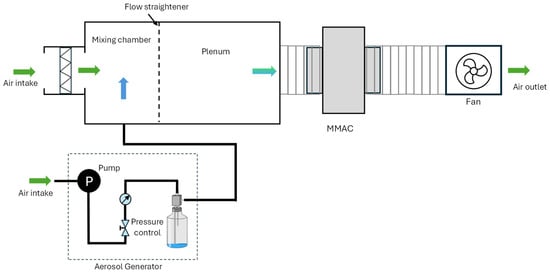
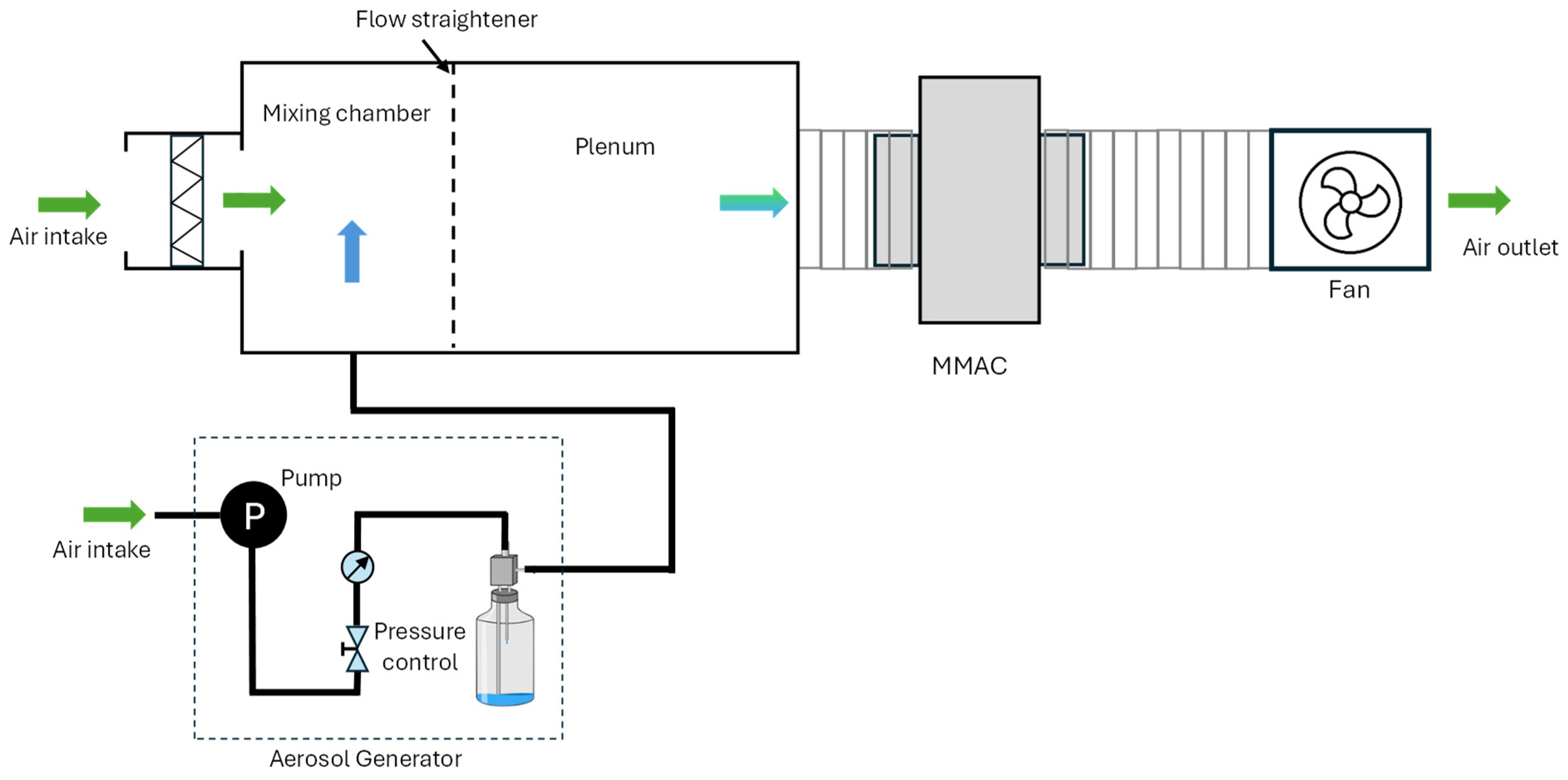
A separate test apparatus for the semi-volatile compounds, namely 3MHA (boiling point approximately 225–237 °C) and HMHA (bpt about 265 °C), was used and has been previously described and used for semi-volatile cresols in wildfire smoke [16]. It is illustrated as a schematic diagram in Figure 1. Briefly, a single-pass system, sufficiently small to be enclosed in a laboratory fume cupboard, was used. The components of the apparatus included a 90 L polypropylene chamber, the TSI 3073 aerosol generator, a distribution tube, filtered make-up air, and sampling points immediately at the air cleaner inlet and outlet. Measuring the concentration differential directly at the inlet and outlet effectively excludes potential losses from upstream tubing and chamber walls from the MMAC’s calculated removal efficiency.
Figure 1.
Test chamber arrangement for low-volatility odorants (not to scale).
For these chamber experiments, 3MHA and HMHA were diluted in diethylhexyl sebacate (DEHS) to allow for smooth aerosolization at room temperature [16]. Propanoic acid and 3-methylbutanoic acid were included in the mix for comparative purposes (see below). These two acids were aerosolized simultaneously with 3MHA/HMHA in the same DEHS solution and chamber run. The analyte concentrations in DEHS were in the range 0.1–1% w/w. DEHS as the dominant chemical was not monitored quantitatively, but monitored at 1 μm size with a TSI DustTrak 8520 (TSI Instruments, Shoreview, MN, USA) photometer to verify stability of the challenge atmosphere over time.
2.3. Chemical Analysis Using Photoionization Detection and GC-MS
2.3.1. Photoionization Detection and Analysis
Real-time monitoring of pure acetaldehyde, nonanal, decanal, propanoic acid and 3-methylbutanoic acid in the direct-flow apparatus was possible and undertaken with an Ion Science (Royston, UK) Tiger XT photoionization detector (PID) with a 10.6 eV lamp. Response factors were available from the manufacturer. Two calibrated, cross-checked and synchronized PIDs were used, one for the inlet and one for the outlet, allowing for continuous and simultaneous datalogging. One-minute data logging intervals were used, with typical durations of at least one hour.
For the PID assays, the challenge concentrations in independent experiments were as follows: propanoic acid 400 ppb; 3-methylbutanoic acid 100 ppb; acetaldehyde 100 ppb; nonanal 120 ppb; and decanal 100 ppb. The PID detection limit was approximately 1 ppb, and the limit of quantification was 3 ppb.
2.3.2. GC-MS Detection and Analysis
For the chamber experiments, test agent concentrations were determined by air sampling with tenax sorbent tubes (Gerstel, Mülheim an der Ruhr, Germany) at 200 mL/min and subsequent gas chromatography–mass spectrometry (GC-MS) analysis. Calibrated SKC low-flow pocket TOUCH pumps were used. Sampling time was typically one hour. For the chamber experiments, there were two probes each for inlet and outlet, and the duplicate data were averaged before calculation of removal efficiency. All samples were processed at the same time under the same instrumental conditions. Removal efficiencies and concentrations were based on relative areas for each analyte (inlet versus outlet).
Concentrations for the GC-MS assays were 0.1 ppb for 3MHA and HMHA and 0.3 ppb for propanoic acid and 3-methylbutanoic acid. The GC-MS detection limit was approximately 1 ppt, with a limit of quantification of approximately 3 ppt.
The GC-MS analyses of body odorants were performed using an Agilent 7890A gas chromatograph equipped with a thermal desorption unit (TDU), a cold injection system, an MPS autosampler and an Agilent 5975c mass spectrometer (Agilent Technologies, Inc., Santa Clara, CA, USA). The chromatographic separation of compounds was conducted using a DB-624 Ultra Inert 30 m × 0.25 mm J&W column with a 1.4 μm film thickness. Tenax sample tubes were inserted into the TDU at 30 °C (with 0.5 min delay and held for 3 min), and the temperature was raised at a rate of 50 °C/min to 280 °C and held for 3 min. The cold injection system started at −20 °C and equilibrated for 1 min, and then the temperature was raised at a rate of 12 °C/min to 240 °C and held for 3 min. The carrier gas was helium, and the septum purge flow rate was 3 mL/min. Injection was performed using solvent vent mode with an inlet pressure of 9.78 psi under a total flow of 64.2 mL/min. The oven temperature program started at 40 °C and held for 10 min, increased to 100 °C at 15 °C/min and held for 10 min, increased to 150 °C at 20 °C/min, then increased to 220 °C at 20 °C/min and then held at this temperature for 10 min. The splitter, at a split ratio of 42:1, was opened after 30 s. The transfer line was held at 240 °C. To enhance the sensitivity, mass spectra were recorded in the selective ion monitoring (SIM) mode. The ions monitored in SIM mode were m/z 45.1 and 74.1 for propanoic acid, m/z 60.1 and 87.1 for 3-methylbutanoic acid, m/z 41.1, 100.1, 113.1 and 128.1 for 3MHA, m/z 43.1, 85.1 and 103.1 for HMHA. Identification and relative quantitation were conducted using pure reference compounds of the target analytes as described in Section 2.1 above. The raw data from Agilent’s ChemStation software (v E.02.02.1431) were converted into MassHunter data files and processed using the MassHunter Workstation software for quantitative analysis for GC-MS (v 10.1).
3. Results
Table 1 demonstrates that the test chemicals were efficiently removed by the multi-modal air cleaner in single-pass experimentation at parts per billion (ppb) and sub-parts per billion challenge concentrations. In total there were 15 sorbent tubes for GC-MS analysis (duplicate inlet and outlet samples), including 3 laboratory blanks (unexposed sorbent tubes). There were five independent experiments incorporating real-time PID analysis. GC-MS- and PID-related range finding and other preliminary experiments were separately undertaken. For example, two sorbent tubes were run in series to assess analyte breakthrough. No analytes could be detected in blanks, and there was no evidence of breakthrough.
Table 1.
Percentage removal efficiencies for the test chemicals a.
The key metric is the ratio of input to output levels, expressed as percentage removal efficiency. Table 1 also reports standard deviations. Variability was observed in the GC-MS data. The PID data were relatively tightly bounded in each single run.
As mentioned above, PID experiments were at ppb levels whereas GC-MS experiments were at sub-ppb levels. Given this wide range of challenge concentrations (>100 fold), broad consistency for propanoic acid (99 vs. 75%) and 3-methylbutanoic acid (95 vs. 89%) with the two methods is suggested. Qualitatively, no discernible smell at the outlet was noted by the researchers.
The clean air delivery rates relating to the test chemicals can be approximated from the MMAC volumetric flow rate (300 m3/h) multiplied by the individual chemical removal efficiencies. Thus, the CADRs are >290 m3/h for the aldehydes and 216–297 m3/h for the carboxylic acids tested. Note that this approximation is not directly comparable to chamber-decay-derived CADR values.
4. Discussion
4.1. General Comments
Air cleaners should reduce indoor body odor to acceptable levels and maintain this performance for extended periods. Acceptability can be judged by the perception of visitors to the occupied spaces, dissatisfaction amongst occupants, or by chemical measurement. With regard to chemical measurement, there are known limitations to single-mode air cleaners, e.g., removal efficiency depends on the odorous chemical [8,9,10]. A high removal efficiency, expressed as the clean air delivery rate, can be effective in reducing the number of air changes or outdoor ventilation required for odor mitigation.
Akamatsu and coworkers investigated three body odor chemicals in common with the pilot experimental study, namely acetaldehyde, nonanal and decanal [17]. Humans in a chamber were the source of body odor chemicals. Removal rates judged by GC-MS assays were >12–>49%, >47–>80% and >49–81% respectively. Their MMAC system utilized an antibacterial enzyme filter for particulate removal and special activated carbon. Limited single-pass efficiency data for the special activated carbon using a “total VOCs” metric were reportedly better (95%), but no data were available in the open literature [17]. The corresponding values in Table 1 for the MMAC were 99, 99 and 97%, indicating somewhat better performance, perhaps because of the action of the electron beam irradiation and combined catalyst/activated charcoal filter.
Precise data on specific body odorant concentrations under real-world conditions are not available. However, some data are available from Akamatsu et al. [17]. In that study, two volunteers generated body odor in a chamber. At 23 °C acetaldehyde, nonanal and decanal concentrations were reported to be 1.1, 0.9 and 1.0 μg/m3 respectively. These correspond to 0.6, 0.15 and 0.15 ppb. At 28 °C, the concentrations were about twice as high.
In a recent chamber study by Qu and coworkers, nonanal and decanal concentrations were much higher [18]. The chamber was poorly ventilated (0.005 h−1), and there were eight volunteers. Concentrations of the order of 20 μg/m3 (3 ppb) were found when the participants were sedentary. Even higher concentrations were noted when the participants were physically active [18]. Interestingly, their machine learning approach revealed that three of the five major compounds influencing odor intensity were nonanal, decanal and acetaldehyde, supporting the selection of these aldehydes in this pilot study.
Challenge concentrations in the present pilot study were 0.1 ppb for 3MHA and HMHA, and 0.3 ppb for propanoic acid and 3-methylbutanoic acid. These carboxylic acid concentrations are relevant in real-world settings. However, the challenge concentrations for the aldehydes were higher (100 ppb). A high removal efficiency at these concentrations would suggest high efficiency at lower concentrations based on a chemisorption mechanism. Although it is possible that DEHS competes for active sites, this does not seem to be significant in this or other research where DEHS was used as a diluent, and high removal efficiencies were reported [16].
The use of MMACs potentially allows for reduced outdoor air by substituting it with “effective outdoor air”. This is important for energy efficiency and in dealing with ambient air pollution episodes potentially affecting vulnerable building occupants. It also has implications for reducing infectious disease spread by airborne viruses [12]. In the case of the Australian Standard on building mechanical ventilation, engineers and designers must demonstrate compliance with Appendix D, where a minimum outdoor supply air rate can be 2.5 L/s per person, compared with the usual 10 L/s per person if both particle and odor filtration are provided [7]. Specifically, Appendix D5.2 is a test method for odor control. It addresses body odors as well as odor-masking chemicals and other malodorous gaseous indoor air contaminants. Performance indicators for air cleaners include reproducible removal efficiency for a specified contaminant and comparable operating characteristics with the intended indoor environment such as air flow rate, temperature and humidity. New or secondary air contaminants arising from the air cleaner should remain below acceptable limits.
The pilot study data here on odors and related studies on particle and VOC mitigation offer practical evidence to inform HVAC design and operation [9,12,16,19]. A recent research report in the grey literature provides data on energy efficiency and ventilation aspects on a long-term basis for a healthcare facility [20]. The study, comparing a mechanical filter using 100% outside air with a PlasmaShield MMAC with 33% outside air, demonstrated an energy improvement of approximately 34% and IAQ resilience during an extended wildfire episode [20].
4.2. Strengths and Weaknesses
The research reported here has a number of strengths. A recent narrative literature review summarized evidence on body odor control, which points to the need for further studies investigating the performance of novel air cleaning technologies [21]. The pilot study follows on from the review and enables comparison with recent work on odorous aldehydes [17]. Further, it reports data on carboxylic acids that are known chemicals emitted from the body and diagnostic of certain body regions, notably underarms and feet. Removal efficiencies of SVOCs such as 3MHA and HMHA have not been previously reported, likely owing to complexity and cost of experimentation.
The research also has limitations. The pilot study was exploratory and included only a subset of compounds representing different categories of body odor [3,17,22]. Testing with PID was of single chemicals rather than the complex mixtures found in real-world situations. Chemicals in such mixtures may interact, e.g., competitive adsorption on sorbent/catalyst sites. There was no formal sensory panel associated with the testing, although any discernible smell was noted by the researchers at the outlet. Thus, the reported data refer only to chemical removal rather than odor removal as judged by a sensory panel. Partially oxidized and small-molecule organic by-products were not evident by GC-MS, although the end-stage activated charcoal is likely to be effective [12,16]. Quantitative background decay tests for the MMAC unit were not conducted. Internal deposition was assumed to be negligible owing to the compact metal housing and prior evidence [16]. Only one challenge concentration was used for each assay, although it was <0.5 ppm in each case to reflect the low concentrations typically found indoors. There were few sample replicates limiting statistical analysis, and PID data relate to single runs. It was a short-term single-pass laboratory experiment, which limits generalizability to other settings. However, throughout the continuous monitoring periods, the PID-derived removal efficiencies remained highly stable as reflected by the tight standard deviations, with no observable initial saturation or degradation in performance. In addition, this MMAC system has been assessed in a real-world healthcare setting, where a range of VOCs were present and demonstrably reduced over extended periods [12]. Compound-specific testing over longer periods is planned to confirm performance.
5. Conclusions
The use of multi-modal air cleaners for indoor odor control appears promising, particularly as they may also have benefits in terms of HVAC energy efficiency and infection risk reduction and in dealing with outdoor air pollution episodes. Although there is a wide range of body odor chemicals, this pilot study assessed the removal performance of one MMAC with respect to two important chemical classes, namely carboxylic acids and aldehydes, which have also been associated with body regions. The short-term single-pass experiments demonstrated efficient removal, but well-designed longer-term studies with a wider range of body odorants should be undertaken, ideally targeted for real-world settings. Such settings may relate to sensitive subpopulations or densely occupied spaces. Whilst subjective indoor air quality assessment is the traditional way of dealing with chemical complexity at low atmospheric concentrations, further exploration of advanced air cleaning technologies tied to specific odorous chemicals and/or classes is warranted.
Author Contributions
Conceptualization, D.P. and C.R.; methodology, D.P., M.P., W.J. and L.N.; formal analysis, D.P. and L.N.; investigation, D.P., M.P., W.J. and N.L.; writing—original draft preparation, D.P. and L.N.; writing—review and editing, D.P., L.N., C.R., M.P., N.L. and W.J. All authors have read and agreed to the published version of the manuscript.
Funding
This study was funded by Adelaide University and PlasmaShield Ltd. The views and ideas expressed within the paper are strictly those of the authors and do not necessarily reflect the official view or position of Adelaide University or the Australian Wine Research Institute.
Institutional Review Board Statement
Not applicable.
Informed Consent Statement
Not applicable.
Data Availability Statement
Data is contained within the article or can be provided upon reasonable request.
Acknowledgments
The authors would like to acknowledge PlasmaShield Ltd. for the supply of the multi-modal MD250 air cleaner used for experiments. Independent testing of the commercially available unit is welcomed.
Conflicts of Interest
The authors declare no conflicts of interest. PlasmaShield Ltd. provided partial funding and equipment to conduct the research but were not involved in study design; in the collection, analysis, and interpretation of data; in the writing of the report; or in the decision to submit the paper for publication.
References
- Dalton, P.; Claeson, A.-S.; Horenziak, S. The impact of indoor malodor: Historical perspective, modern challenges, negative effects, and approaches for mitigation. Atmosphere 2020, 11, 126. [Google Scholar] [CrossRef] [Scilit]
- Parkinson, T.; Schiavon, S.; Kim, J.; Betti, G. Common sources of occupant dissatisfaction with workspace environments in 600 office buildings. Build. Cities 2023, 4, 17–35. [Google Scholar] [CrossRef] [Scilit]
- Jha, S.K. Characterization of human body odor and identification of aldehydes using chemical sensor. Rev. Anal. Chem. 2017, 36, 20160028. [Google Scholar] [CrossRef] [Scilit]
- Khanna, K. Microbial Origins of Body Odor; American Society for Microbiology: Washington, DC, USA, 2021; Available online: https://asm.org/articles/2021/december/microbial-origins-of-body-odor (accessed on 21 September 2026).
- Kendal-Reed, M.; Walker, J.C.; Morgan, W.T.; LaMacchio, M.; Lutz, R.W. Human responses to propionic acid. I. Quantification of within- and between-participant variation in perception by normosmics and anosmics. Chem. Senses 1998, 23, 71–82. [Google Scholar] [CrossRef] [Scilit] [PubMed]
- Asim, N.; Badiei, M.; Mohammad, M.; Razali, H.; Rajabi, A.; Chin Haw, L.; Jameelah Ghazali, M. Sustainability of heating, ventilation and air-conditioning (HVAC) systems in buildings—An overview. Int. J. Environ. Res. Public Health 2022, 19, 1016. [Google Scholar] [CrossRef] [Scilit] [PubMed]
- Australian Standard 1668.2-2024; The Use of Ventilation and Airconditioning in Buildings. Part 2 Mechanical Ventilation in Buildings. Standards Australia: Sydney, Australia, 2024. Available online: https://www.standards.org.au/blog/spotlight-on-as-1668-2024 (accessed on 21 September 2026).
- Shaughnessy, R.J.; Levetin, E.; Blocker, J.; Sublette, K.L. Effectiveness of portable indoor air cleaners: Sensory testing results. Indoor Air 1994, 4, 179–188. [Google Scholar] [CrossRef] [Scilit]
- Xiang, Y.; Amada, K.; Mishra, A.K.; Tanabe, S.; Fang, L.; Wargocki, P. Assessing the performance of portable gas-phase air cleaners and implications for their use in buildings. Energy Build. 2025, 346, 116152. [Google Scholar] [CrossRef] [Scilit]
- Zhang, Y.; Mo, J.; Li, Y.; Sundell, J.; Wargocki, P.; Zhang, J.; Little, J.C.; Corsi, R.; Deng, Q.; Leung, M.H.; et al. Can commonly-used fan-driven air cleaning technologies improve indoor air quality? A literature review. Atmos. Environ. 2011, 45, 4329–4343. [Google Scholar] [CrossRef] [Scilit] [PubMed]
- Whiley, H.; Keerthirathne, T.P.; Kuhn, E.J.; Nisar, M.A.; Sibley, A.; Speck, P.; Ross, K.E. Efficacy of the PlasmaShield®, a non-thermal plasma-based air purification device, in removing airborne microorganisms. Electrochem 2022, 3, 276–284. [Google Scholar] [CrossRef] [Scilit]
- Pisaniello, D.; Nitschke, M. Relative health risk reduction from an advanced multi-modal air purification system: Evaluation in a post-surgical healthcare setting. Int. J. Environ. Res. Public Health 2024, 21, 1089. [Google Scholar] [CrossRef] [Scilit] [PubMed]
- Natsch, A.; Derrer, S.; Flachsmann, F.; Schmid, J. A broad diversity of volatile carboxylic acids, released by a bacterial aminoacylase from axilla secretions, as candidate molecules for the determination of human-body odor type. Chem. Biodivers. 2006, 3, 1–20. [Google Scholar] [CrossRef] [Scilit] [PubMed]
- Irga, P.J.; Mullen, G.; Fleck, R.; Matheson, S.; Wilkinson, S.J.; Torpy, F.R. Volatile organic compounds emitted by humans indoors—A review on the measurement, test conditions, and analysis techniques 2024. Build. Environ. 2024, 255, 111442. [Google Scholar] [CrossRef] [Scilit]
- ANSI/ASHRAE Standard 145.2-2025; Laboratory Test Method for Assessing the Performance of Gas-Phase Air-Cleaning Systems: Air-Cleaning Devices. ASHRAE: Peachtree Corners, GA, USA, 2025. Available online: https://webstore.ansi.org/standards/ashrae/ansiashrae1452025?srsltid=AfmBOor3XFQtpqIfsutp5haDPo3Cju4OcgP6jTvjfVZpk67jG_ZZGHhD (accessed on 21 September 2026).
- Pisaniello, D.; Parker, M.; Neupane, V.; Gaskin, S.; Ramkissoon, C. Mitigation of individual odorous bushfire smoke semi-volatile organic compounds using multi-modal air purifiers. Ecolibrium 2025, 23, 50–53. [Google Scholar] [CrossRef]
- Akamatsu, N.; Sugano, S.; Amada, K.; Tomita, N.; Iwaizumi, H.; Takeda, Y.; Wargocki, P.; Olesen, B.W.; Tanabe, S. Effects of a gas-phase air cleaner in removing human bioeffluents and improving perceived air quality. Build. Environ. 2024, 257, 111540. [Google Scholar] [CrossRef] [Scilit]
- Qu, M.; Xu, X.; Wang, X.; Zhao, R.; Dong, X.; Cui, J.; Zhao, Z.; Ma, Y.; Pei, J. Volatile organic compound emissions from human body at different metabolic levels—Influence on olfactory perception. Build. Environ. 2026, 298, 114611. [Google Scholar] [CrossRef] [Scilit]
- Tang, X.; Misztal, P.K.; Nazaroff, W.W.; Goldstein, A.H. Volatile organic compound emissions from humans indoors. Environ. Sci. Technol. 2016, 50, 12686–12694. [Google Scholar] [CrossRef] [Scilit] [PubMed]
- Lau, T.; Pisaniello, D.; Kong, H.; Xing, K.; Hooper, M.; Vossoughi, S.; Gill, B. Sustainable Solutions for Pandemic and Bushfire Resilience in Healthcare Facilities: Progress Report I, Prepared for RACE for 2030. 2026. Available online: https://www.racefor2030.com.au/content/uploads/0920-Sustainable-Soultions-Progress_Report-compressed.pdf (accessed on 21 September 2026).
- Pisaniello, D.; Nguyen, L.; Ramkissoon, C.; Jiang, W.; Parker, M.; Lloyd, N.; Cai, L. Public health and indoor body odor control: Part 1—A narrative literature review of ventilation and air cleaning approaches. Int. J. Environ. Res. Public Health, 2026; accepted.
- Iitani, K.; Mori, H.; Ichikawa, K.; Toma, K.; Arakawa, T.; Iwasaki, Y.; Mitsubayashi, K. Gas-phase biosensors (bio-sniffers) for measurement of 2-Nonenal, the causative volatile molecule of human aging-related body odor. Sensors 2023, 23, 5857. [Google Scholar] [CrossRef] [Scilit] [PubMed]

Disclaimer/Publisher’s Note: The statements, opinions and data contained in all publications are solely those of the individual author(s) and contributor(s) and not of MDPI and/or the editor(s). MDPI and/or the editor(s) disclaim responsibility for any injury to people or property resulting from any ideas, methods, instructions or products referred to in the content. |
© 2026 by the authors. Licensee MDPI, Basel, Switzerland. This article is an open access article distributed under the terms and conditions of the Creative Commons Attribution (CC BY) license.