Skip to Content
  • 3.6
    Impact Factor
  • 6.1
    CiteScore
  • 23 days
    Submission to First Decision
  • 3 days
    Acceptance to Publication

Current Oncology

Current Oncology is an international, peer-reviewed, open access journal that since 1994 represents a multidisciplinary medium for clinical oncologists to report and review progress in the management of this disease, and published monthly online by MDPI (from Volume 28, Issue 1 - 2021). The Canadian Association of Medical Oncologists (CAMO), Canadian Association of Psychosocial Oncology (CAPO), Canadian Association of General Practitioners in Oncology (CAGPO), Cell Therapy Transplant Canada (CTTC) and others are affiliated with Current Oncology and their members receive discounts on the article processing charges.

Get Alerted

Add your email address to receive forthcoming issues of this journal.

All Articles (5,746)

  • Article
  • Open Access

Background: Rheumatic immune-related adverse events (R-irAEs) after immune checkpoint inhibitor (ICI) therapy in lung cancer can be difficult to distinguish from cancer-related or degenerative musculoskeletal symptoms. Methods: In this single-center retrospective cohort, we analyzed 768 ICI-treated patients and a nested questionnaire cohort to characterize rheumatologist-confirmed R-irAEs, baseline associated factors, and patient-reported outcomes. Missing baseline C-reactive protein (CRP) was handled using multiple imputation. Results: New musculoskeletal symptoms occurred in 177 patients (23.0%), and 66 patients (8.6%) had confirmed R-irAEs. The leading phenotypes were inflammatory arthritis (n = 22), inflammatory arthralgia (n = 15), and polymyalgia rheumatica-like syndrome (n = 13). In multivariable analysis, female sex (adjusted odds ratio [OR] 2.21, 95% confidence interval [CI] 1.31–3.74), baseline CRP > 10 mg/L (OR 2.08, 95% CI 1.14–3.81), and pre-existing autoimmune disease (OR 5.24, 95% CI 2.37–11.57) were associated with confirmed R-irAEs. Among 437 questionnaire responders, confirmed R-irAEs were associated with worse pain, morning stiffness, disability, fatigue, and health status than non-confirmed musculoskeletal symptoms (all Holm-adjusted p < 0.001). Conclusions: Confirmed R-irAEs affected a measurable minority of ICI-treated patients with lung cancer and were associated with worse post-treatment patient-reported outcomes. Because baseline patient-reported outcomes were unavailable, these findings should not be interpreted as R-irAE-attributable change.

Curr. Oncol.

7 October 2026
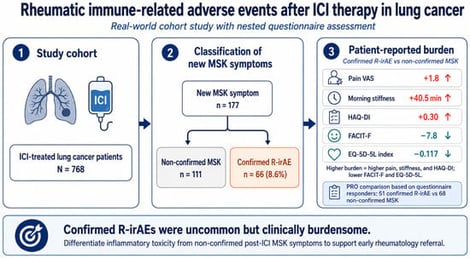
Study cohort and nested questionnaire flow. The flow diagram shows the assembly of the parent lung cancer immune checkpoint inhibitor (ICI) cohort and the nested questionnaire cohort. Among 768 lung cancer patients treated with ICIs, 177 developed new musculoskeletal (MSK) symptoms after ICI initiation and were classified as non-confirmed MSK symptoms or rheumatologist-confirmed rheumatic immune-related adverse events (R-irAEs). Questionnaire responders are shown separately within each of the three post-ICI musculoskeletal-status groups. ICI, immune checkpoint inhibitor; MSK, musculoskeletal; R-irAE, rheumatic immune-related adverse event.
  • Article
  • Open Access

Background: There exists an unmet clinical need to define definitive management strategies for patients with locally advanced non-melanoma skin cancers (NMSC), particularly if not amenable to surgical resection. Methods: We retrospectively reviewed a case series of locally advanced unresectable NMSC treated with induction systemic treatment followed by response-adapted consolidative radiation. Results: We identified 15 patients who met study criteria, including seven with basal cell carcinoma (BCC), six with cutaneous squamous cell carcinoma (CSCC), and two with Merkel cell carcinoma (MCC). Clinical complete response (CR) by physical examination was observed in all 15 patients. No locoregional or distant recurrences were observed in any histologic subtype after completion of radiation (median follow-up from completion of radiation: 18.1 months BCC, 22.5 months CSCC, 22.7 months MCC). The median duration of observed response (DOOR), measured from first clinical response was 26.9 months (26.2 BCC, 29.4 CSCC, 27.1 MCC). Radiation treatment volumes were response-adapted with median gross tumor volume reduction of 55.3% (15.3%–100%). Median treatment-free response was 20.5 months. No unexpected systemic therapy related toxicities were identified. Conclusions: In this single-institution retrospective case series, induction systemic therapy followed by response-adapted consolidative radiation was feasible and associated with durable disease control in selected patients with locally advanced unresectable NMSC.

Curr. Oncol.

6 October 2026

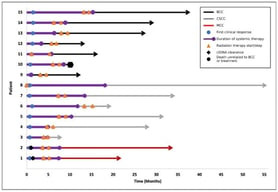
Duration of observed clinical response for 15 patients from start of systemic therapy (Swimmer’s plot). Histologic subtypes are depicted by color: BCC (black), CSCC (gray), and MCC (red). First clinical response is marked by blue dots; duration of systemic therapy is marked in purple; radiation therapy start and stop dates are marked by orange triangles; ctDNA clearance time is marked for Patients 1 and 2 with MCC by black diamonds; and death of Patient 10 from causes unrelated to BCC or treatment is marked by the black hexagon. Note Patient 12 initially started definitive radiation but stopped due to intolerance; systemic therapy was started with excellent cytoreduction and then response-adapted consolidative radiation was delivered. Patient 8 started definitive radiation for CSCC, but then shortly after developed in-transit dermal metastases requiring concurrent systemic immunotherapy and radiation. Abbreviations: BCC = basal cell carcinoma; CSCC = cutaneous squamous cell carcinoma; MCC = Merkel cell carcinoma.
  • Article
  • Open Access

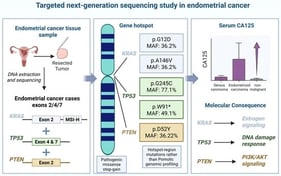
Endometrial cancer (EC) is a heterogeneous malignancy characterized by diverse molecular and clinicopathological features. This study investigated somatic mutations in three hotspot-region genes commonly implicated in EC pathogenesis (KRAS, TP53, PTEN) and their associations with clinical characteristics and biomarkers, rather than comprehensive genomic profiling. Targeted next-generation sequencing (NGS) was used to analyze hotspot regions of KRAS (exons 2 and 4), TP53 (exons 4 and 7), and PTEN (exon 2), while mutation parameters, including mutant allele frequency (MAF), allelic depth, and variant frequency, were assessed alongside clinicopathological data. Pathogenic KRAS missense mutations (p.G12D and p.A146V), TP53 missense (p.G245C) and stop-gain (p.W91*) variants, and a pathogenic PTEN mutation (p.D52Y) were identified, with MAF values ranging from 36.2% to 77.1%. One patient also exhibited microsatellite instability-high (MSI-H) status. Serum CA125 concentrations were significantly higher in serous carcinoma than in endometrioid carcinoma and non-malignant cases, suggesting potential prognostic rather than diagnostic value. This suggests an association between CA125 levels and histological subtype rather than diagnostic or prognostic value, as this study did not evaluate survival, recurrence, or longitudinal outcomes. The detected mutations highlight disruptions in estrogen signaling, DNA damage response, and PI3K/AKT pathway regulation, illustrating the diversity of alterations detectable within these three hotspot regions in EC. These findings provide insight into the mutational status of KRAS, TP53, and PTEN hotspot regions in endometrial cancer and support the potential use of identified genetic alterations as biomarkers for precision medicine and targeted therapeutic strategies, while indicating that CA125’s clinical utility in EC, whether diagnostic or prognostic, remains to be established through outcome-based studies. This also reinforces CA125’s limited diagnostic but possible prognostic role in EC management.

Curr. Oncol.

6 October 2026

Sankey Diagram Showing the Distribution of Participants by Age Group, Weight Status, and Marital Status. Flow width and node labels indicate participant counts (N = 70). Diagram generated using SankeyMATIC.
  • Article
  • Open Access

Objective: This study mainly focused on evaluating the efficacy and safety of drug-eluting beads bronchial arterial chemoembolization (DEB-BACE) in treating advanced refractory non-small cell lung cancer (NSCLC) patients, with an exploratory investigation of whether combining DEB-BACE with anlotinib could bring additional benefits and identification of key prognostic factors. Methods: A retrospective analysis was conducted on 104 eligible patients, including 64 who received DEB-BACE monotherapy and 40 who received DEB-BACE combined with anlotinib. Kaplan–Meier method, log-rank test, and Cox proportional hazard model were used for survival and prognostic analyses. Primary endpoints were progression-free survival (PFS) and overall survival (OS); secondary endpoints included objective response rate (ORR), disease control rate (DCR), and adverse events (AEs). Results: The entire cohort had a median PFS of 13.9 months and median OS of 17.0 months, suggesting a potential survival benefit of DEB-BACE in advanced NSCLC. As an exploratory analysis, the combination group showed numerical advantages in PFS (13.9 vs. 10.6 months), OS (20.3 vs. 14.0 months), and ORR, without significant differences (all p > 0.05). ECOG 2 was an independent poor prognostic factor for PFS (HR = 2.602, p = 0.020) and tended to affect OS (HR = 2.259, p = 0.050). No grade 4 AEs or treatment-related deaths occurred; the 5.8% grade 3 AEs were all manageable. Conclusions: DEB-BACE may be effective and safe as a treatment option for advanced NSCLC patients, although prospective controlled studies are needed to confirm these findings. The combination of DEB-BACE with anlotinib, as an exploratory strategy, shows numerical benefits but no significant superiority.

Curr. Oncol.

5 October 2026

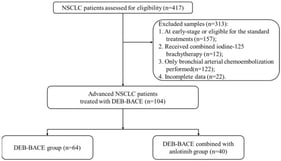
Flowchart of the patient selection. NSCLC, non-small cell lung cancer; DEB-BACE, drug-eluting beads bronchial arterial chemoembolization.

Highly Accessed Articles

News & Conferences

Latest Issues

Open for Submission

Journal Sections

Evolution of Treatments of Prostate Cancer
Reprint

Evolution of Treatments of Prostate Cancer

From Biology to Current Advanced Technologies
Editors: Fernando Munoz
Recent Advances in Anticancer Strategies
Reprint

Recent Advances in Anticancer Strategies

Editors: Hassan Bousbaa, Zhiwei Hu
XFacebookLinkedIn
Curr. Oncol. - ISSN 1718-7729