
Skip to Content
You are currently on the new version of our website. Access the old version .
  • 3.2
    Impact Factor
  • 5.5
    CiteScore
  • 16 days
    Submission to First Decision
  • 3 days
    Acceptance to Publication

Animals

Animals is an international, peer-reviewed, open access journal devoted entirely to animals, including zoology and veterinary sciences, and is published semimonthly online by MDPI. The World Association of Zoos and Aquariums (WAZA), European College of Animal Welfare and Behavioural Medicine (ECAWBM), and Federation of European Laboratory Animal Science Associations (FELASA) are affiliated with Animals and their members receive a discount on the article processing charges.

Get Alerted

Add your email address to receive forthcoming issues of this journal.

All Articles (26,398)

  • Article
  • Open Access

This study aimed to identify genomic regions and candidate genes associated with seven growth and morphometric traits in Hamdani sheep using genome-wide association analysis. A total of 470 sheep were evaluated for body weight, body length, chest depth, heart girth, tail circumference, tail length, and withers height. Genome-wide association analyses were performed using the FarmCPU model implemented in GAPIT4, based on 54,000 single-nucleotide polymorphisms (SNPs). Fourteen significant SNPs were selected for reporting across the seven traits, including four for body weight, three each for heart girth and withers height, and one each for body length, chest depth, tail circumference, and tail length. Candidate gene annotation within ±100 kb of the selected SNPs identified ten protein-coding genes: ADAMTS17, MEF2A, CTNND2, DNTTIP1, UBE2C, TNNC2, RHOA, TGFA, IGSF3, and CNTN6. Gene Ontology analysis highlighted biological processes related to skeletal muscle development, actomyosin organization, and cellular differentiation. KEGG pathway analysis identified signaling pathways including Wnt, Ras, calcium, and cGMP–PKG signaling. These findings identify candidate genomic regions associated with growth and body conformation traits in Hamdani sheep and provide a foundation for further genetic and functional investigations.

Animals

14 November 2026

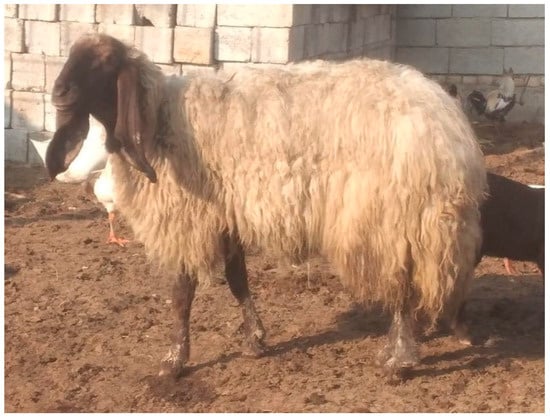
Hamdani sheep breed.
  • Article
  • Open Access

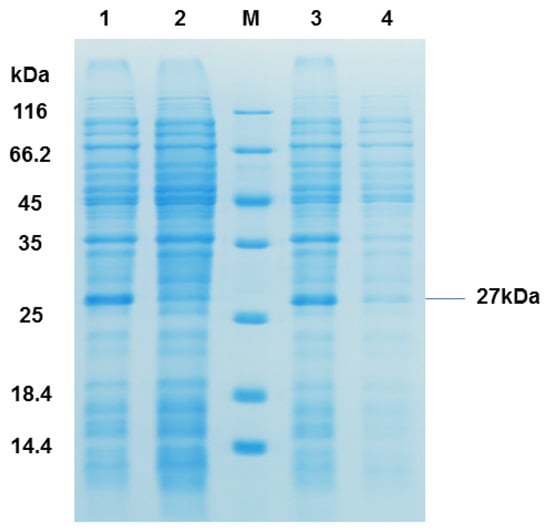
Porcine circovirus type 4 (PCV4), first reported in 2019, lacks a stable in vitro culture system, limiting the application of traditional virus neutralization assays. Serological methods are therefore critical for PCV4 surveillance. The capsid (Cap) protein is the primary target for serological diagnosis, but its N-terminal nuclear localization signal (NLS) hinders prokaryotic expression. In this study, the NLS-truncated Cap gene was cloned into pET-22b(+) and expressed in Escherichia coliBL21(DE3). The recombinant NLS-truncated protein (~27 kDa) was purified by nickel-affinity chromatography and specifically recognized by PCV4-positive serum in Western blot. Mice immunized with the protein produced polyclonal antibodies with titers reaching 1:32,000. Using the purified recombinant NLS-truncated protein as coating antigen, an indirect ELISA was established and optimized. The assay showed no cross-reactivity with sera against pseudorabies virus (PRV), porcine reproductive and respiratory syndrome virus (PRRSV), porcine epidemic diarrhea virus (PEDV), porcine circovirus type 1(PCV1), porcine circovirus type 2 (PCV2), or porcine circovirus type 3 (PCV3); the detection limit was 1:3200; and both intra- and inter-assay coefficients of variation were <10%. Large-scale surveillance of 1058 sera from four production stages revealed overall seroprevalences of 95.37% for PCV2, 38.85% for PCV3, and 3.50% for PCV4, with PCV2 + PCV3 co-seropositivity as the dominant mixed-exposure pattern (33.6%). These results demonstrate that the NLS-truncated PCV4 Cap protein retains full antigenicity and that the established indirect ELISA is a specific, sensitive, and reproducible tool for PCV4 serosurveillance and epidemiological investigation.

Animals

14 November 2026

SDS-PAGE analysis of the recombinant N-terminal nuclear localization signal (NLS)-truncated Cap protein expressed in E.coli. M: protein molecular weight standard; lane 1, total protein after isopropyl β-D-1-thiogalactopyranoside (IPTG) induction; lane 2, total protein without IPTG induction; lane 3, sediments of E.coli lysed cell; lane 4, supernatant of E.coli lysed cell. The full uncropped gel is available in Supplementary Material S1.
  • Article
  • Open Access

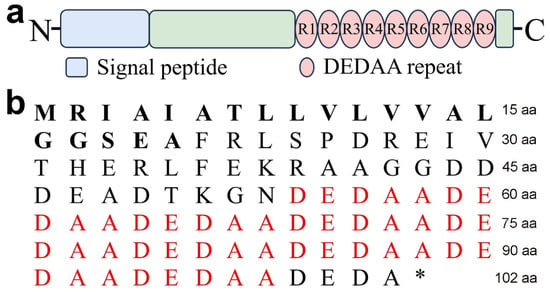
In crustaceans, spermatogenesis is regulated by endocrine and local factors, though many key regulators remain unknown. We identified a previously uncharacterized transcript enriched in male reproductive tissues of the Chinese mitten crab Eriocheir sinensis, encoding a predicted peptide precursor designated MRSS. MRSS encodes a 102-amino acid protein featuring an N-terminal signal peptide and nine C-terminal tandem DEDAA pentapeptide repeats. MRSS is abundantly expressed in the androgenic gland (AG) and accessory sex gland (AsG), with higher expression during the synthesis and secretory stages of AG development. RNAi-mediated knockdown of MRSS altered testicular histology, leading to abnormal vacuolization and abnormal chromatin morphology in spermatocytes. In the AG, MRSS knockdown reduced the expression of IAG and iDMY, while in the testis it downregulated the germ cell maintenance and cell cycle-related genes vasa, PCNA, and cyclin B. MRSS deficiency was also associated with increased apoptosis-related markers, as indicated by an increased Bax/Bcl2 ratio, more prominent TUNEL-positive signals in spermatocytes, and elevated caspase-3-like and caspase-9-like activities. Conversely, in vitro incubation of testes with recombinant MRSS (rMRSS) increased germ cell maintenance and cell cycle-related markers, and reduced apoptosis-related markers, including the Bax/Bcl2 ratio and caspase-3/9-like activities. Our results support a role for MRSS in maintaining testicular homeostasis, potentially in association with IAG expression. This study provides the first evidence of a male reproductive tissue-enriched transcript encoding a predicted peptide precursor involved in testicular structure homeostasis in decapod crustaceans.

Animals

14 November 2026

Characterization of the predicted MRSS precursor. (a) Structure features of MRSS. All elements are shown to scale. (b) Deduced amino acid sequence of the MRSS. The termination codon is indicated by an asterisk (*). The signal peptide is indicated in bold. The tandem repeats of the pentapeptide DEDAA are highlighted in red.
  • Article
  • Open Access

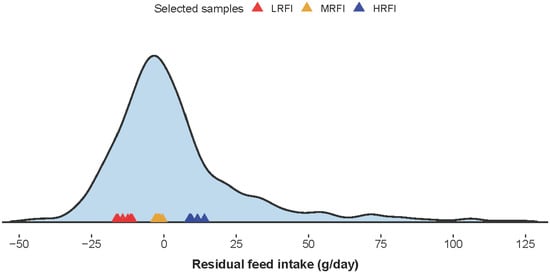
Residual feed intake (RFI) measures feed efficiency after accounting for growth and body size. We examined its association with whole-blood gene expression in slow-growing ducks. Of 800 males phenotyped from 21 to 42 d of age, 527 had valid RFI estimates. Eighteen birds with comparable initial body weights were selected for RNA sequencing from low-RFI (LRFI), medium-RFI (MRFI), and high-RFI (HRFI) ranges, with six per group. Screening at |log2 fold change| ≥ 1 and nominal p < 0.05 identified 707 nonredundant differentially expressed genes (DEGs). The LRFI–MRFI, LRFI–HRFI, and HRFI–MRFI comparisons retained 36, 205, and 6 genes, respectively, after Benjamini–Hochberg correction. Enrichment analysis implicated immune, transport, signaling, and metabolic processes. Weighted gene co-expression network analysis (WGCNA) of the nominal DEG set identified seven modules, five with exploratory associations with intake-related traits. Protein-interaction clustering retained 209 genes, of which 63 correlated strongly with RFI. Elastic Net analysis and repeated subsampling retained 25 genes with high selection stability within the cohort, from which nine named genes were prioritized. These blood transcriptional signals are discovery-stage candidates. These candidates require independent biological and predictive validation.

Animals

14 November 2026

Distribution of residual feed intake (RFI) among the 527 ducks with valid RFI records. Triangles mark the 18 ducks selected for whole-blood RNA sequencing: LRFI (red), MRFI (orange), and HRFI (blue), with six ducks per group.

Highly Accessed Articles

News & Conferences

Latest Issues

Open for Submission

Journal Sections

XFacebookLinkedIn
Animals - ISSN 2076-2615