
Skip to Content
  • 1.9
    Impact Factor
  • 25 days
    Submission to First Decision
  • 3 days
    Acceptance to Publication

NeuroSci

NeuroSci is an international, peer-reviewed, open access journal on neurology and neuroscience published bimonthly online by MDPI. The Panhellenic Federation of Alzheimer's Disease and Related Disorders (PFADRD) is affiliated with NeuroSci, and its members receive discounts on the article processing charges.

Get Alerted

Add your email address to receive forthcoming issues of this journal.

All Articles (425)

  • Review
  • Open Access

Haemorrhagic stroke causes a disproportionate share of stroke deaths and disability, and its incidence rises steeply with age. Vagus nerve stimulation (VNS) targets modifiable secondary injury processes, including neuroinflammation, cerebral oedema, autonomic dysfunction and vasospasm, but its therapeutic role is uncertain. Animal studies and clinical randomised trials of VNS in intracerebral haemorrhage (ICH) or subarachnoid haemorrhage (SAH) were identified from Ovid MEDLINE (to 1 June 2026); appraised using SYRCLE, PEDro, and RoB 2; and synthesised narratively by level of evidence and pathology. Favourable functional outcome (modified Rankin Scale, 0–2) in SAH trials was pooled by random-effects meta-analysis. Nine reports were included: four preclinical (179 animals; three ICH models, one SAH model) and five clinical (four independent cohorts; 105 participants with haemorrhagic stroke: 97 SAH, 8 ICH). Animal studies reported reduced inflammatory signalling, haematoma volume and aneurysm rupture, as well as improved survival and motor recovery, with weaker effects after severe injury. In SAH trials, non-invasive VNS was feasible and well tolerated, with signals of reduced tumour necrosis factor-α and interleukin-6, less radiographic vasospasm and delayed cerebral ischaemia, and increased parasympathetic activity. The pooled functional outcome did not differ significantly (three trials: odds ratio [OR] 1.87, 95% confidence interval [CI] 0.65–5.37). Clinical ICH data were limited to 24 h safety in eight participants. VNS is biologically active and feasible but unproven; adequately powered, severity-stratified multicentre trials with standardised protocols and age-appropriate outcomes are needed.

NeuroSci

19 November 2026

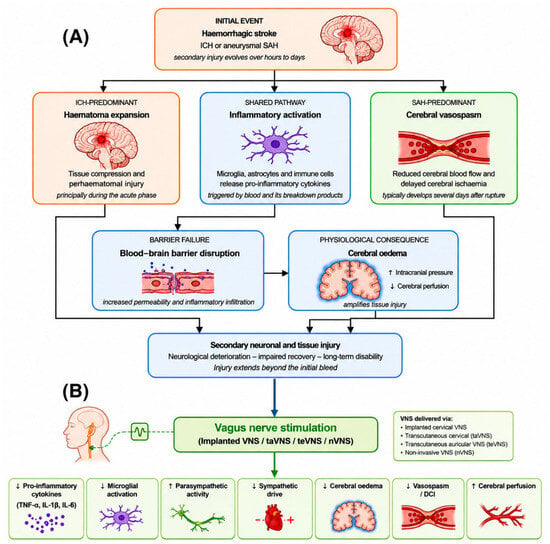
(A) Principal secondary brain injury processes following intracerebral haemorrhage and aneurysmal subarachnoid haemorrhage. (B) Proposed mechanisms through which vagus nerve stimulation may attenuate secondary brain injury and the relationship between biological target engagement and functional recovery.
  • Article
  • Open Access

Alzheimer’s disease (AD) is the leading cause of dementia, with increasing prevalence among women. Age, sex, and the apolipoprotein E4 (APOE4) allele are major risk factors for late-onset AD. APOE4 is associated with accelerated cognitive decline and structural brain changes, while age-related sex hormone loss may exacerbate cognitive impairment in females. Although 17β-estradiol (17βE2) supports neuroplasticity, its peripheral effects limit therapeutic applications. Alternatively, 17α-estradiol (17αE2) has demonstrated neuroprotective potential in AD mouse models. This study investigated the cognitive effects of 17αE2 in 7–9-month-old male and ovariectomized female APOE3, APOE4, and 5xAD mice using the Barnes maze. Mice completed four training days followed by a 72 h probe trial assessing long-term spatial memory. Male and female 5xAD mice exhibited impaired spatial learning, with treatment and training day effects. Male APOE4 mice showed genotype and treatment × training day interactions, while females demonstrated treatment and training day effects. Both sexes of APOE4 mice exhibited increased primary errors during the probe trial without significant treatment effects. 17αE2-treated APOE4 mice showed reduced primary latency, suggesting potential treatment benefits, whereas female APOE4 mice exhibited increased latency. These findings highlight APOE4-associated spatial memory deficits and warrant further investigation of 17αE2 as a potential therapeutic intervention for AD-related cognitive impairment.

NeuroSci

13 November 2026

  • Article
  • Open Access

Chronic hyperammonemia (HA) secondary to liver dysfunction is associated with cognitive impairment, oxidative stress, and neuroinflammation, particularly in hippocampal regions involved in learning and memory. This exploratory study evaluated the effects of sodium phenylbutyrate (PBA) on behavior and on biochemical and molecular changes in a rat model of CCl4-induced HA. Male Wistar rats were randomly distributed into five groups: CTRL (control), COV (corn oil vehicle) + SSI (isotonic saline solution), HA + SSI, COV + PBA, and HA + PBA. At the end of the administration periods, locomotor activity and recognition memory were evaluated with the Open-Field Test (OFT) and Novel-Object Recognition Test (NORt). HA induced significant increases in plasma and hippocampal ammonia and glutamine levels, accompanied by hepatic dysfunction. These alterations were associated with elevated lipid peroxidation, nitrite levels, disruption of antioxidant defenses, and increased proinflammatory cytokines in the hippocampus. In addition, HA + SSI animals showed reduced BDNF (Brain-Derived Neurotrophic Factor) and NT-3 (Neurotrophin-3) levels and impaired behavioral performance. PBA administration reduced ammonia accumulation, improved redox balance (pro- and antioxidant levels), attenuated the hippocampal proinflammatory cytokine profile, and restored neurotrophin levels. These effects were accompanied by improvement in locomotor and cognitive performance. In conclusion, our results indicate that PBA attenuates systemic and hippocampal alterations induced by chronic HA.

NeuroSci

12 November 2026

  • Article
  • Open Access

Background: Caregiver awareness and positive attitudes are essential for the early recognition and effective management of Parkinson’s disease. This study aimed to examine the factors associated with caregivers’ knowledge and attitudes toward the disease. Methods: A descriptive cross-sectional study was conducted among caregivers of patients with Parkinson’s disease across three clinical settings in Alexandria, Egypt. A stratified probability sampling technique was used to recruit 383 formal and informal caregivers between 1/2025 and 6/2025. Data were analyzed using SPSS version 23.0. Results: Most of the respondents were females (72.1%), and about half were between 18–30 years (50.9%). Generally, the participants had generally low knowledge and positive attitudes toward PD. The mean knowledge score was 4.52 ± 1.37 out of 10 and the mean attitude score was 27.62 ± 3.49 out of the maximum score of 35. Several key characteristics were significantly associated with knowledge levels. Marital status was significantly associated with knowledge scores. Unmarried participants had higher knowledge scores (mean rank = 221.75). Knowledge score was also associated with educational level, monthly income, household type and primary source of information (p < 0.05 for all); after false discovery rate correction, marital status, household type and source of information remained significant. Sleep duration was the only factor associated with attitude scores, with participants reporting more than six hours of sleep per day exhibiting more positive attitudes (mean rank = 201.88 vs. 178.52, p = 0.039); this association did not remain significant after correction for multiple comparisons. In multiple linear regression, monthly income and marital status were associated with knowledge scores, whereas education level and sleep duration were associated with attitude scores; however, the models explained only 6.4% and 5.1% of the variance, respectively. Conclusions: Caregivers of individuals with PD in Alexandria, Egypt, demonstrated positive attitudes but generally low knowledge of Parkinson’s disease. The caregiver characteristics examined explained little of the variation in knowledge and attitudes, so the associations identified should be regarded as exploratory. Existing knowledge gaps and misconceptions highlight the need for targeted educational interventions.

NeuroSci

10 November 2026

Highly Accessed Articles

News & Conferences

Latest Issues

Open for Submission

Journal Sections

XFacebookLinkedIn
NeuroSci - ISSN 2673-4087