
Skip to Content
  • 5.3
    Impact Factor
  • 11.4
    CiteScore
  • 24 days
    Submission to First Decision
  • 5 days
    Acceptance to Publication

Big Data and Cognitive Computing

Big Data and Cognitive Computing is an international, peer-reviewed, open access journal on big data and cognitive computing published monthly online by MDPI.

Get Alerted

Add your email address to receive forthcoming issues of this journal.

All Articles (1,493)

  • Article
  • Open Access

This study investigates the classification of inherited Real/Fake labels in Kazakh- and Russian-language news-text corpora using TF-IDF, mBERT and XLM-R. The original benchmark contains 38,010 Kazakh and 37,180 Russian records after title–body deduplication. In-domain Macro-F1 scores were generally above 0.995, while directional transfer and robustness checks exposed marked sensitivity to lexical provenance cues. In the original KZ → RU character TF-IDF experiment, Macro-F1 was 0.810; masking Reuters-related strings in a matched fixed-split protocol increased it to 0.946. Reuters markers occurred in 99.2% of raw Kazakh records labeled Real, indicating strong source–label association. In a separate 280-item external cross-corpus evaluation, matched-language character TF-IDF performance declined substantially. These findings establish strong within-corpus label classification but substantially weaker transfer to a differently sourced dataset. Missing original publisher identifiers, possible translated or paraphrased overlap, and source-confounded labels limit causal interpretation; further publisher-disjoint evaluation with verified provenance is needed.

Big Data Cogn. Comput.

24 November 2026

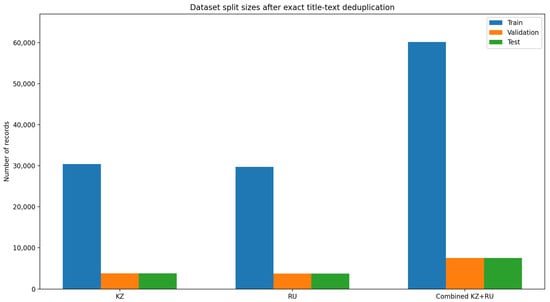
Train, validation, and test sizes after title–text deduplication.
  • Review
  • Open Access

Cold-Start and Skill-Aware Job Recommender Systems: A Scoping Review of Data, Models, and Evaluation Evidence

  • Kamaluddeen Ibrahim Yarima,
  • Abdullahi Abubakar Imam and
  • Usman Ali
  • + 2 authors

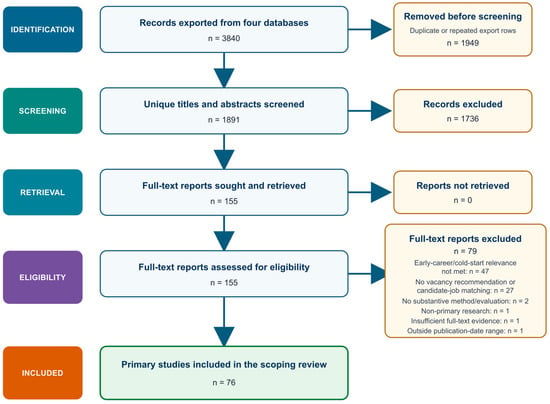
Job recommender systems support applicant–vacancy matching, but their reliability is uncertain when users or jobs are new or information is sparse. This scoping review maps cold-start and skill-aware job recommendation, emphasizing early-career populations. Following PRISMA-ScR, we searched Scopus, Web of Science, IEEE Xplore, and EBSCO for studies published from 2010 to 2026. We screened 1891 unique records, assessed 155 full texts, and included 76 primary studies. Among 58 studies that specified a cold-start scenario, 20 conducted a strict isolated test, 14 provided partial or near-condition evidence, and 24 did not isolate the claimed condition. Out of 48 studies framed around early-career users, 32 evaluated an identifiable early-career cohort and 16 provided intended use, simulated, prototype, or broader population evidence. Among 32 skill-explicit studies, structured forms appeared in 24, lexical and semantic forms in 14 each, and proxies in 12. None of the five field comparisons with reported real-world outcomes directly evaluated an early-career cohort. The evidence therefore supports task- and dataset-specific performance claims more strongly than claims of employment benefit for first-time or early-career job seekers. We propose a six-stage evaluation framework connecting population definition, cold-start construction, information assessment, controlled offline comparison, human assessment, and prospective outcomes.

Big Data Cogn. Comput.

23 November 2026

PRISMA-ScR flow diagram of record identification, screening, eligibility assessment, and inclusion. Adapted from the PRISMA 2020 flow diagram [14].
  • Study Protocol
  • Open Access

Rewriting a story from another character’s position is an established exercise in literary education and in narrative interventions on perspective-taking, and it has become a machine task, yet the capabilities that its use as a stimulus presupposes have not been measured. Existing evaluations test a model’s own social inference on short vignettes, the faithfulness of summaries, or the quality of creative output, and none addresses whether a regeneration preserves a source’s events while varying an agent’s beliefs, goals, frame, or access. This protocol, the second of two companion papers, specifies two studies. Study 1 crosses 35 public-domain excerpts from five literary traditions with five manipulation types and with central and peripheral target agents, benchmarks two generative systems against a human-written arm, and measures preservation of the events accessible to the narrating agent, intrusion, access violations, internal coherence, textual warrant, and manipulation fidelity. Study 2 calibrates three measures of the divergence between paired perspectives, two rated and one elicited, against values computed exactly in formally specified environments, with template and generative verbalizations. We preregister directional hypotheses, thresholds, decision rules, precision targets, and conditions under which a null result would indict the instrument rather than the generator.

Big Data Cogn. Comput.

19 November 2026

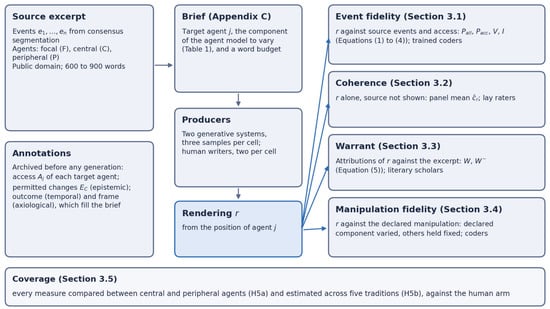
The assessment of a regeneration. A source excerpt and its annotations, archived before generation, fix the events, the agents, and what each agent can know; a brief names the target agent and the component of the agent model to vary, and two generative systems and a human comparison arm produce renderings under it. Each rendering is then read against a different object for each construct, and every measure is compared across central and peripheral agents and across provenance traditions.
  • Article
  • Open Access

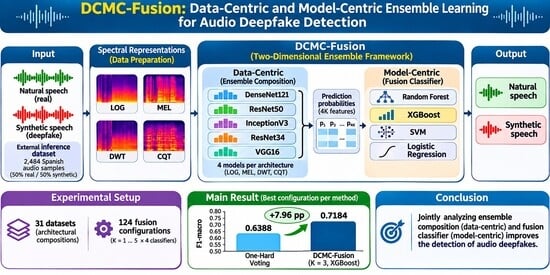
Audio deepfake detectors often exhibit substantial performance degradation when evaluated on speech generated by synthesis technologies not represented during training. In this study, 20 individual detectors, derived from five deep learning architectures (DenseNet121, ResNet50, InceptionV3, ResNet34, and VGG16) and four spectral representations (LOG, Mel, DWT, and CQT), achieved F1-scores above 0.95 during internal validation but exhibited F1-macro values as low as 0.3460 on external audio, highlighting the challenges of generalization. To address this problem, we propose Data-Centric and Model-Centric Fusion (DCMC-Fusion), an ensemble learning framework that jointly investigates the composition and size of the ensemble and the classifier used to combine model predictions. The outputs of the 20 individual models are combined into 31 datasets with different architectural compositions and ensemble sizes. Four supervised fusion classifiers (Logistic Regression, Support Vector Machine, Random Forest, and XGBoost) are evaluated, resulting in 124 configurations. Experiments involving 2484 Spanish-language audio samples, equally distributed between natural and synthetic speech, show that DCMC-Fusion achieves a maximum F1-macro of 0.7184 using three architectures and XGBoost. This represents an improvement of 4.33 percentage points over the best individual detector (0.6751). Furthermore, DCMC-Fusion consistently outperforms One-Hard Voting, Soft Voting, and Weighted Averaging across all ensemble sizes. These findings demonstrate the benefits of jointly investigating ensemble composition and fusion mechanisms for audio deepfake detection under challenging external evaluation conditions.

Big Data Cogn. Comput.

18 November 2026

Comparison of audio deepfake detection and fusion strategies: (a) Bohara et al. (2025) [7], independent classifiers using Mel spectrograms; (b) Ali et al. (2024) [8], fixed soft-voting fusion of multiple models; (c) Combei et al. (2024) [6], learned fusion of WavLM-based models; (d) SMRF (2026) [13], fixed fusion of multiple spectral representations; (e) DCMC-Fusion (ours), data-centric and model-centric fusion. Colors distinguish representations, models, and fusion components, while arrows indicate data flow.

Highly Accessed Articles

News & Conferences

Latest Issues

Open for Submission

Journal Sections

XFacebookLinkedIn
Big Data Cogn. Comput. - ISSN 2504-2289