
Skip to Content

Journal of Superintelligence

Journal of Superintelligence is an international, peer-reviewed, open access journal on the complete ecosystem of artificial general intelligence (AGI) and superintelligence published quarterly online by MDPI.

Get Alerted

Add your email address to receive forthcoming issues of this journal.

All Articles (6)

  • Article
  • Open Access

To illustrate the importance and complexity of considering “task–technology fit”, as well as users’ roles and purposes, when studying AI adoption within any occupation, we present findings from a 2023-25 mixed-method study about professional musicians’ uses and perceptions of AI in music-making. The initial interviews conducted with a diverse group of 42 U.S. musicians suggested that individual levels of interest in and adoption of AI in their music-making depended on the specific task considered, whether the task was perceived as “core” versus “supportive” to one’s professional role, and the intention of using AI to “assist” versus “replace” one’s work. Responses to a subsequent 2025 survey, designed to further explore these insights, as well as to collect additional information about musicians’ AI adoption, confirmed the value of eliciting respondents’ interest, uses, and feelings about using AI for specific tasks rather than in general terms. Exploring the impact of the respondents’ professional roles and purpose proved to be more challenging. Nevertheless, role-based differences were documented, several statistically significant. The study has methodological implications for studies of AI adoptions across fields.

J. Superintelligence

3 September 2026
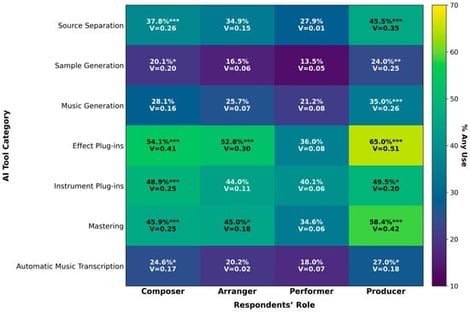
Heatmap reporting the use of specific types of music-related AI tools by role. Note: Analytic Ns ranged from 222 to 224 across AI tool categories because of item-level missing responses. Respondents who did not answer the professional-role question were excluded from role comparisons. V = Cramér’s V. Asterisks indicate significance based on Benjamini–Hochberg false discovery rate (FDR)-adjusted p-values: * p < 0.05, ** p < 0.01, and *** p < 0.001.
  • Article
  • Open Access

This paper examines the relationship between emotions, meta-emotions, and intelligence. It argues for greater care in the development and deployment of artificial intelligence (AI), especially artificial superintelligence (ASI). The impacts on human beings of both conscious and non-conscious forms of ASI are examined. The potential harm to ASI is considered, but the focus is on harm to humans. An under-discussed alignment consideration for AI is the potential emotional and serious mental health consequences of its misuse. For example, the role AI may play in AI psychosis or other mental health challenges needs greater examination. A case for caution is made in the development of ASI as we are still figuring out the kinds of psychological effects existing AI systems can have on humans, effects that could be (if we are not careful) more harmful in superintelligent systems.

J. Superintelligence

23 September 2026

  • Review
  • Open Access

Artificial Intelligence Applications in Biomass Pyrolysis: A Systematic Literature Review

  • Vilmar Steffen,
  • Maiquiel Schmidt de Oliveira and
  • Maressa Fontana Mezoni

The integration of artificial intelligence (AI) techniques into biomass pyrolysis research has attracted increasing attention in recent years; however, the existing literature remains fragmented across diverse methodological approaches and application domains. This study presents a systematic literature review of AI applications in biomass pyrolysis, combining bibliometric and qualitative analyses to map the current state of the art, identify prevailing research trends, and highlight existing knowledge gaps. Following a structured search conducted in the Scopus database, 33 peer-reviewed journal articles published in English between 2003 and 2026 were selected according to predefined eligibility criteria. The final portfolio was prioritized using an adapted version of the Normalized Index for Ranking Papers (NIRP 2.0), while the review procedure followed, whenever applicable, the recommendations of PRISMA, PRISMA for Abstracts, and PRISMA-S guidelines. The ranking methodology incorporated four scientometric indicators: Field-Weighted Citation Impact, average citations per year, SNIP, and CiteScore. The bibliometric analysis revealed a significant intensification of research activity during the last five years, with China, India, and Pakistan emerging as the most productive countries in the field. Machine learning techniques, particularly ensemble learning methods such as Extreme Gradient Boosting, Random Forest, and Gradient Boosting Decision Trees, were identified as the dominant approaches, especially in applications related to product yield prediction (biochar, bio-oil, and gas), kinetic and thermodynamic modeling, co-pyrolysis optimization, and process parameter estimation. Recent studies have also demonstrated growing interest in explainable artificial intelligence methods aimed at improving model interpretability and supporting physical understanding of pyrolysis systems. Despite the promising predictive and optimization capabilities demonstrated by AI-based models, important challenges remain, including limited dataset sizes, data heterogeneity, inconsistent terminology, reduced model generalizability, and the absence of physically informed constraints in many machine learning frameworks. The findings of this review indicate that future advances in the field will strongly depend on the development of standardized and publicly accessible databases, harmonized reporting protocols, and the integration of physics-informed artificial intelligence approaches capable of providing reliable, interpretable, and transferable predictions for biomass pyrolysis processes.

  • Article
  • Open Access

To address the challenges of combinatorial explosion and expensive evaluations in truck–drone (truck–UAV) collaborative delivery under complex geographical constraints, this paper proposes a Surrogate-assisted Rezone-Enhanced Multi-objective Adaptive Evolutionary Algorithm (SRE-MAEA). As a knowledge-driven decomposition-based surrogate-assisted framework, the proposed algorithm aims to synergistically optimize a four-dimensional conflicting objective space consisting of economic cost, social satisfaction, environmental emissions, and battery resilience. To overcome the curse of dimensionality in high-dimensional and strongly constrained environments, SRE-MAEA constructs an adaptive Rezone Search architecture. By dynamically deconstructing the decision space, it transforms global search pressure into refined knowledge mining within high-potential local regions. The core mechanism incorporates an intelligent sampling strategy based on the Multi-Armed Bandit (MAB). By utilizing real-time evolutionary feedback to dynamically prioritize the Pareto contribution of each rezone, the MAB achieves pruning-level scheduling of expensive evaluation resources. Simulation results on 15 benchmark instances with clustered, random, and mixed spatial distributions demonstrate that SRE-MAEA exhibits superior convergence boundaries and distribution uniformity in terms of IGD and HV metrics, significantly outperforming state-of-the-art regression-based strategies. Furthermore, computational efficiency analysis confirms that by precisely identifying invalid search paths via the MAB mechanism, SRE-MAEA maintains a high-precision Pareto front while reducing the average CPU time by approximately 35.2–48.5%. This effectively resolves the computational bottleneck caused by complex battery resilience integral models. This research provides an efficient algorithmic paradigm for resilient logistics scheduling in extreme environments and holds significant academic value and engineering application prospects.

Highly Accessed Articles

News & Conferences

Latest Issues

Open for Submission

Journal Sections

XFacebookLinkedIn
J. Superintelligence - ISSN 3043-0097