


Abstract
This study investigates the classification of inherited Real/Fake labels in Kazakh- and Russian-language news-text corpora using TF-IDF, mBERT and XLM-R. The original benchmark contains 38,010 Kazakh and 37,180 Russian records after title–body deduplication. In-domain Macro-F1 scores were generally above 0.995, while directional transfer and robustness checks exposed marked sensitivity to lexical provenance cues. In the original KZ → RU character TF-IDF experiment, Macro-F1 was 0.810; masking Reuters-related strings in a matched fixed-split protocol increased it to 0.946. Reuters markers occurred in 99.2% of raw Kazakh records labeled Real, indicating strong source–label association. In a separate 280-item external cross-corpus evaluation, matched-language character TF-IDF performance declined substantially. These findings establish strong within-corpus label classification but substantially weaker transfer to a differently sourced dataset. Missing original publisher identifiers, possible translated or paraphrased overlap, and source-confounded labels limit causal interpretation; further publisher-disjoint evaluation with verified provenance is needed.
1. Introduction
Misleading online information spreads quickly across news websites and social platforms, making automated fake news classification a relevant task for natural language processing, media monitoring, and computational journalism. Most existing work has concentrated on languages with abundant resources, while bilingual environments and languages with fewer NLP resources have received less systematic attention. Kazakh is a particularly important case because it operates alongside Russian in Kazakhstan’s public information space, where the same news agenda can circulate in both languages.
In such an environment, a useful detector should not be assessed only on texts from the same language distribution used during training. It should also be tested under transfer conditions, where labeled data are available in one language but the model is applied to another. Bidirectional Kazakh–Russian evaluation is therefore needed to understand whether a model learns language-independent indicators of misinformation or mainly captures language-specific lexical patterns.
The preliminary experiments produced extremely high Transformer scores. A subsequent audit, however, revealed two methodological risks: repeated records and the inclusion of the subject field. Since topic or subject categories can be strongly tied to the Real/Fake label, using this field may allow a model to exploit dataset artifacts rather than textual evidence. For this reason, the final study removes subject, date, URL, and source information from the input and performs exact title–text deduplication before any train–test split is created.
The purpose of the paper is to determine how well classical TF-IDF models and multilingual Transformers perform after these controls are applied. The comparison includes five evaluation settings: Kazakh-only, Russian-only, combined Kazakh–Russian, transfer from Kazakh to Russian, and transfer from Russian to Kazakh.
The study contributes (i) a transparent title–body, metadata-restricted evaluation of inherited Kazakh–Russian news dataset labels; (ii) original five-scenario TF-IDF, mBERT and XLM-R benchmarks; (iii) separately audited validation-selected TF-IDF, chronological and Reuters-marker sensitivity analyses; (iv) class-specific and paired error diagnostics; and (v) exact-group and LaBSE candidate-overlap audits. We distinguish original and supplementary protocols because their cleaning and partition manifests differ, and do not claim independent truth verification, publisher-held-out generalization, or fully verified semantic deduplication.
2. Related Work
2.1. Classical Machine Learning for Fake News Detection
Earlier approaches to fake news detection often used lexical, stylistic, and shallow statistical features. The LIAR dataset proposed by Wang [1] became one of the standard benchmarks for truthfulness classification of short political statements. Pérez-Rosas et al. [2] also showed that deceptive and legitimate news articles may differ in wording and style, although such cues can be affected by the domain and the data collection procedure.
Russian-language fake news detection has also been studied with classical and neural models. Kuzmin et al. [3], for example, evaluated bag-of-n-grams, rhetorical structure information, and RuBERT-based representations. Their results are relevant here because they indicate that lexical baselines can be very strong and that unusually high scores may reflect the internal structure of a particular corpus.
2.2. Transformer-Based and Language-Specific Models
BERT introduced bidirectional Transformer pre-training with masked language modeling and made it possible to fine-tune a single encoder for many classification tasks. Its multilingual version, mBERT, is widely used when labeled data are limited and cross-lingual transfer is required [4].
XLM-R was pretrained on large multilingual web corpora and is an established approach to multilingual transfer [5]. The present evaluation compares multilingual encoders on Kazakh and Russian corpus labels; it does not directly measure the relative contribution of the two languages’ pretraining volume, so language-specific pretraining explanations are treated as hypotheses.
Russian-oriented Transformer models, including RuBERT, may be advantageous in monolingual Russian settings. In the present cleaned experiment, however, the focus is on multilingual transfer models that can be applied in both directions; therefore, RuBERT is reserved for an extended follow-up comparison [6].
Kazakh-oriented encoder literature also warrants explicit consideration. Baitenova et al. [7] evaluated a KazRoBERTa-based component alongside mBERT for Kazakh morphological analysis and text correction. Their results illustrate the relevance of language-adapted encoders, but arise from a different task and dataset; they are not evidence of superior fake-news classification on our corpus. Neither KazRoBERTa nor KazBERT was evaluated in our five-scenario benchmark, and a matched Kazakh-specific baseline remains a limitation.
2.3. Multilingual and Cross-Lingual Misinformation Detection
Cross-lingual misinformation detection studies whether a classifier trained with labels in one language can be used in another language where labels are unavailable or limited. Ozcelik et al. [8] demonstrated that transfer quality depends on more than the model architecture: topic similarity, domain match, and the linguistic relation between the source and target data also matter. Recent studies also extend cross-lingual misinformation detection with adapter-based and multi-agent verification frameworks [9,10].
The reasons for successful transfer are not always straightforward. Deshpande et al. [11] highlighted vocabulary overlap, syntactic similarity, and the amount of pre-training exposure as factors behind multilingual transfer. Singh et al. [12] cautioned that mBERT should not be treated as a universal interlingual representation, because tokenization and representation quality differ across languages.
2.4. Large Language Models for Multilingual and Cross-Lingual Misinformation Detection
Multilingual fact-checking and retrieval-augmented approaches extend beyond supervised text classification, frequently involving external evidence and generative models [13,14,15,16,17,18]. However, those systems use different evidence sources and evaluation objectives; no LLM or RAG model is implemented in this study. Accordingly, the present work concentrates on reproducible TF-IDF and multilingual-encoder classification with targeted source-cue and overlap audits.
Language-specific systems such as RuBERT and Kazakh-oriented pretrained encoders constitute relevant follow-up baselines, but they were not included in the archived five-scenario experiment. Consequently, we do not extrapolate from the present models to language-specific pretraining advantages.
2.5. Dataset Quality, Leakage, and Bias
Evaluation quality in fake news detection is strongly shaped by the dataset itself. Murayama [19] noted that fake news corpora differ in their topics, label definitions, and source composition. As a result, high in-domain accuracy should not automatically be interpreted as evidence that a system will generalize to new outlets, future events, or different misinformation styles. Recent work on dataset bias further emphasizes that models can exploit corpus artifacts under coarse-grained labels [20].
Leakage is another major concern. Elangovan et al. [21] showed that lexical overlap between training and test data may exaggerate performance in NLP evaluations. Kambhatla et al. [22] argued that nearest-neighbor analysis can help reveal hidden train-evaluation overlap. The present work controls exact duplicate overlap and removes explicit subject-field leakage, but treats semantic overlap and source-level bias as open robustness issues.
2.6. Research Gap and Positioning of the Present Study
The literature covers conventional text classifiers, multilingual encoders, cross-lingual transfer, and leakage-sensitive evaluation [13,14,15,16,17,18]. For Kazakh–Russian corpus classification, however, bidirectional transfer with explicit exact-key overlap checks and source-marker sensitivity audits remains underexplored. Our original TF-IDF/mBERT/XLM-R results are therefore complemented by separately identified robustness tests; their partitions are not assumed to be identical across protocols. Table 1 summarizes the relationship between this study and selected prior work.
Table 1.
Relationship between this study and selected prior work.
3. Dataset and Methodology
3.1. Research Design and Task Definition
The study formulates the problem as supervised binary classification of Kazakh and Russian news records. Each text is assigned one of two labels, Real (0) or Fake (1). Metadata are retained for audit and description only; they are not included in the feature space used by the classifiers.
The evaluation is organized into five settings. KZ only, RU only, and Combined KZ + RU measure performance when the training and test distributions belong to the same monolingual or bilingual setup. KZ-to-RU and RU-to-KZ measure cross-lingual transfer. In the transfer experiments, the source language provides the training and validation data, and the target language is used only through its held-out test subset.
3.2. Dataset Composition and Preprocessing
The source CSV files contain title, text, subject, date and label fields. In the cleaned protocol, the model input is created by concatenating only the title and article body. The subject field is removed because it can carry topic-category cues associated with the class label. Date, URL and source information are also excluded from the input. Deduplication is performed before partitioning by constructing a normalized identifier from the title and text.
3.2.1. Dataset Sources and Label Construction
The study reuses two preassembled Kazakh- and Russian-language CSV collections rather than a newly assembled article-level fact-checking corpus. The available fields are title, text, subject, date, and binary label; an independently verified dataset release identifier, original source-domain/URL fields, source-wise counts, provenance documentation, and translation history are not available for these exact files. The original audit included 42,247 KZ and 37,298 RU records; the original no-subject protocol yielded 38,010 and 37,180 after its exact title–body cleaning. The alternative LaBSE audit, using a separate cleaning implementation, retained 38,006 KZ and 37,179 RU records. Recorded years include 2015–2017 and unknown dates, but the original publication chronology and translation provenance cannot be independently established. Labels Real (0) and Fake (1) are inherited corpus labels, not a new independent claim-by-claim fact-check. For illustration of label semantics only, the RU target-test sample contains a Real-labeled item about a U.S. political figure calling for removal of a Confederate statue and a Fake-labeled item about a pastor canceling a wedding. These assignments are corpus labels, not independently verified truth values. Source-level or original-collection attribution and counts cannot be responsibly reconstructed from the available fields; thus source-held-out testing is not claimed. Table 2 presents the cleaned corpus sizes and class distributions.
Table 2.
Corpus size and class distribution after exact duplicate removal.
3.2.2. Observed Provenance Markers and Duplicate Attrition
In the raw archived collections, the lexical marker “Reuters” occurred in 21,042/21,211 Real and 158/21,036 Fake KZ records (99.203% and 0.751%), and in 21,257/21,303 Real and 156/15,995 Fake RU records (99.784% and 0.975%). Classifying records solely by marker presence would yield 99.226% accuracy on raw KZ and 99.458% on raw RU. This is an association between an observed string and inherited labels, not verified identification of the original publisher or proof of a model mechanism. The data do not allow us to identify the fact-checking sites, newspapers, source-wise record counts, original collection names/versions, or whether texts were translated; these attributes must not be inferred from style alone.
The original within-language title–body deduplication reduced KZ by 4237 records (42,247 → 38,010) and RU by 118 (37,298 → 37,180). This asymmetry is a measured property of the available extracts; aggregation, templates, republishing, and translation effects cannot be distinguished without item-level provenance. In the original protocol, exact duplicate keys were controlled within each language before partitioning. A later independent pooled audit detected 2420 links based on identical bodies and one identical title–body link across the two language-labeled collections; it constructed 72,764 exact-content groups from 75,185 cleaned records. These do not represent verified translations or independent publisher domains.
The model inputs contain title and body text, excluding the explicit subject, date, URL, and source metadata fields. This exclusion does not remove source names appearing within article text. Exact-key deduplication checks did not identify contradictory labels for identical normalized title–body keys. Separate audit implementations retained slightly different corpus totals (38,006/37,179 in the LaBSE audit versus 38,010/37,180 in the fixed-split pipeline), and these outputs should not be conflated without preprocessing reconciliation.
3.3. Train, Validation, and Test Splits
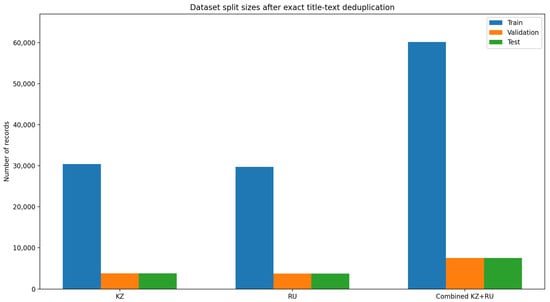
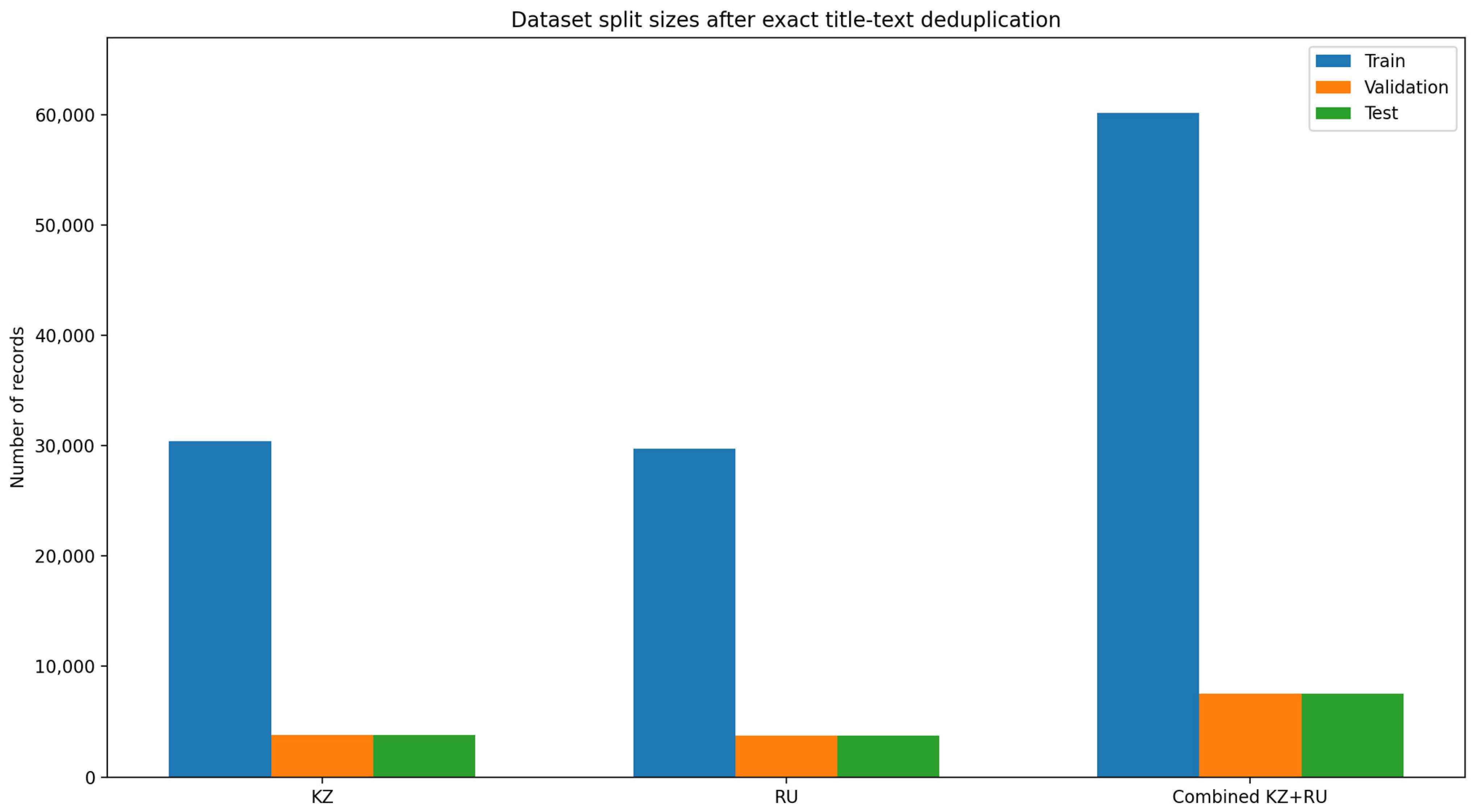
After removing exact duplicates, every dataset was partitioned into training, validation, and test subsets with label-stratified sampling and an approximate 80/10/10 distribution. The normalized duplicate keys were then checked across all split pairs. No key appeared in more than one partition: train–validation, train–test, and validation–test overlap were all zero. Table 3 reports the train, validation, and test partition sizes and confirms zero exact-key overlap; Figure 1 visualizes the corresponding sample sizes.
Table 3.
Partition sizes and exact duplicate-overlap verification.
Figure 1.
Train, validation, and test sizes after title–text deduplication.
3.4. Evaluation Scenarios
Table 4 summarizes the five evaluation scenarios and the training, validation, and test data used in each.
Table 4.
Summary of Evaluation Scenarios.
3.5. Model Configurations: TF-IDF Baselines and Transformer Fine-Tuning
The original experiment compared four TF-IDF baselines (word/character representations × Logistic Regression/Linear SVM) with mBERT and XLM-R on headline-plus-body inputs. Table 5 summarizes the model configurations and training settings. The original Table 6 reports the top TF-IDF configuration in the archived test summary; this original comparison should therefore not be interpreted as unbiased validation-selected model ranking. A separate fixed-split replication subsequently selected configurations exclusively by source-language validation Macro-F1 (KZ validation for KZ → RU; RU validation for RU → KZ), then evaluated the selected configuration once on held-out target-language test data. Each TF-IDF vectorizer, vocabulary, and IDF weighting were fitted on its training fold alone in a scikit-learn Pipeline; test data were transformed without refitting. Word TF-IDF used (1,2)-grams, min_df = 2, max_df = 0.95 and max_features = 200,000; character char_wb used (3,5)-grams and max_features = 300,000. LinearSVC used C = 1.0, class_weight=‘balanced’, random_state = 42. Logistic Regression used C = 2.0, class_weight=‘balanced’, solver=‘liblinear’ and max_iter = 3000. In the original Transformer runs, the available mBERT training configuration selected a validation checkpoint by Macro-F1, whereas the archived XLM-R configuration evaluated the final epoch without validation checkpoint selection. Both used max_length = 128, batch size 4, learning rate 2 × 10⁻⁵, weight decay 0.01, three epochs, and FP16. Thus, the two Transformer checkpoint-selection rules were not strictly equivalent.
Table 5.
Model settings used in the final TF-IDF and Transformer comparison.
Table 6.
Original single-run model results. P/R/F1 refer to Fake (1); FP and FN follow the standard confusion matrix convention with Real (0) negative. The unverified Combined XLM-R summary is marked N/R; supplementary fixed-split results are not substituted here.
3.6. Model and System Architecture
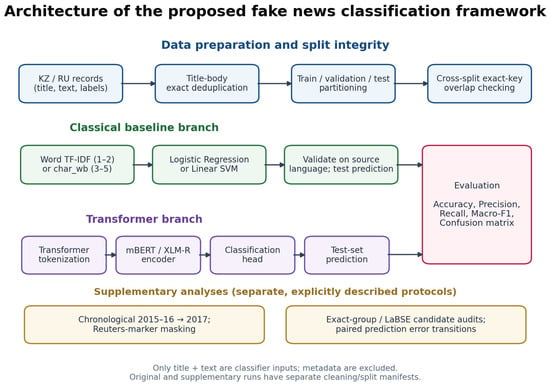
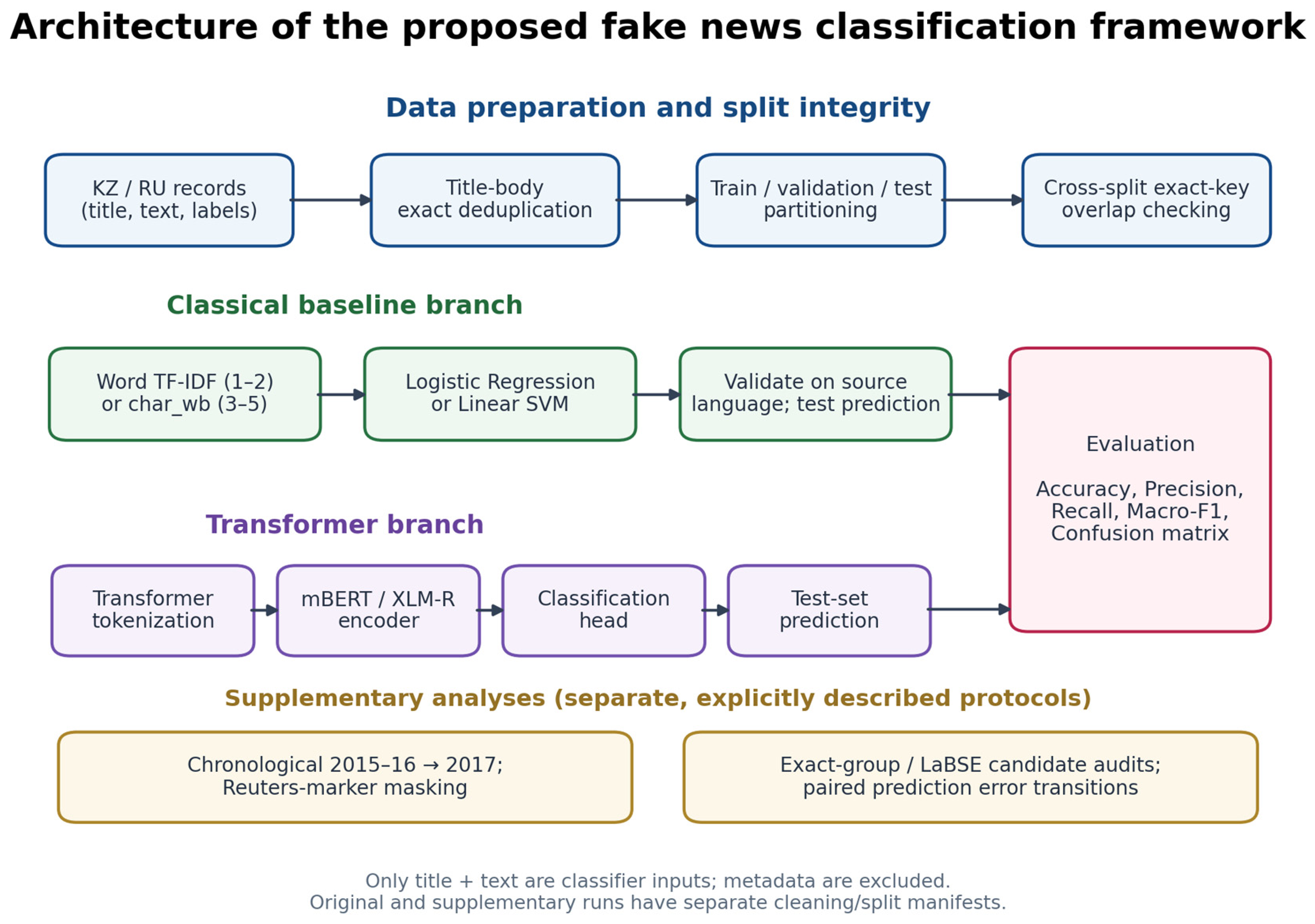
Figure 2 follows the implemented order of data preparation: input validation and exact title–body deduplication, partitioning into train/validation/test sets, and only then cross-split duplicate-key checking. The classical branch includes both word and character TF-IDF representations and distinguishes validation-only model selection from test evaluation. Transformer results and additional chronological/source-marker/semantic candidate analyses arise from distinct experiment protocols; the diagram does not imply identical split manifests across all runs.
Figure 2.
Corrected architecture and evaluation workflow. Original and supplementary experiments use separate, explicitly reported protocols. Blue boxes show data preparation, green boxes the classical branch, purple boxes the Transformer branch, yellow boxes supplementary analyses, and the pink box evaluation; arrows indicate the flow of data and predictions.
3.7. Evaluation Metrics
Performance is reported with accuracy, precision, recall and F1 for the Fake class, together with Macro-F1, Weighted-F1, support, and confusion matrices. Macro-F1 is treated as the primary comparison measure because it averages class-wise F1 values and is therefore less dominated by the majority class than accuracy.
- Precision: TP/(TP + FP);
- Recall: TP/(TP + FN);
- F1: 2 × (Precision × Recall)/(Precision + Recall);
- Macro-F1: (F1_real + F1_fake)/2.
4. Results and Discussion
4.1. Overall Results Across TF-IDF, mBERT and XLM-R
The original metadata-restricted title–body experiments produced high monolingual and bilingual benchmark scores for all model families, but substantial differences emerged in cross-lingual transfer. The strongest classical baseline was character-level TF-IDF with Linear SVM in the reported original comparison. Because the additional fixed-split TF-IDF validation, temporal, and masking analyses used separately audited preprocessing or partitions, results from these protocols should not be interpreted as a fully controlled head-to-head model ranking.
4.2. In-Domain and Combined Bilingual Results with Classical Baselines
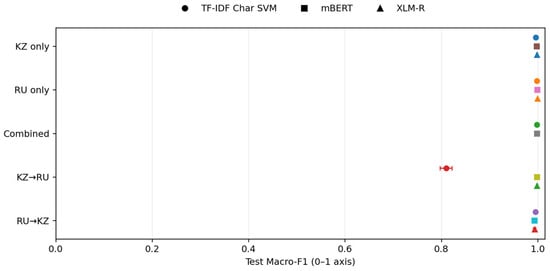
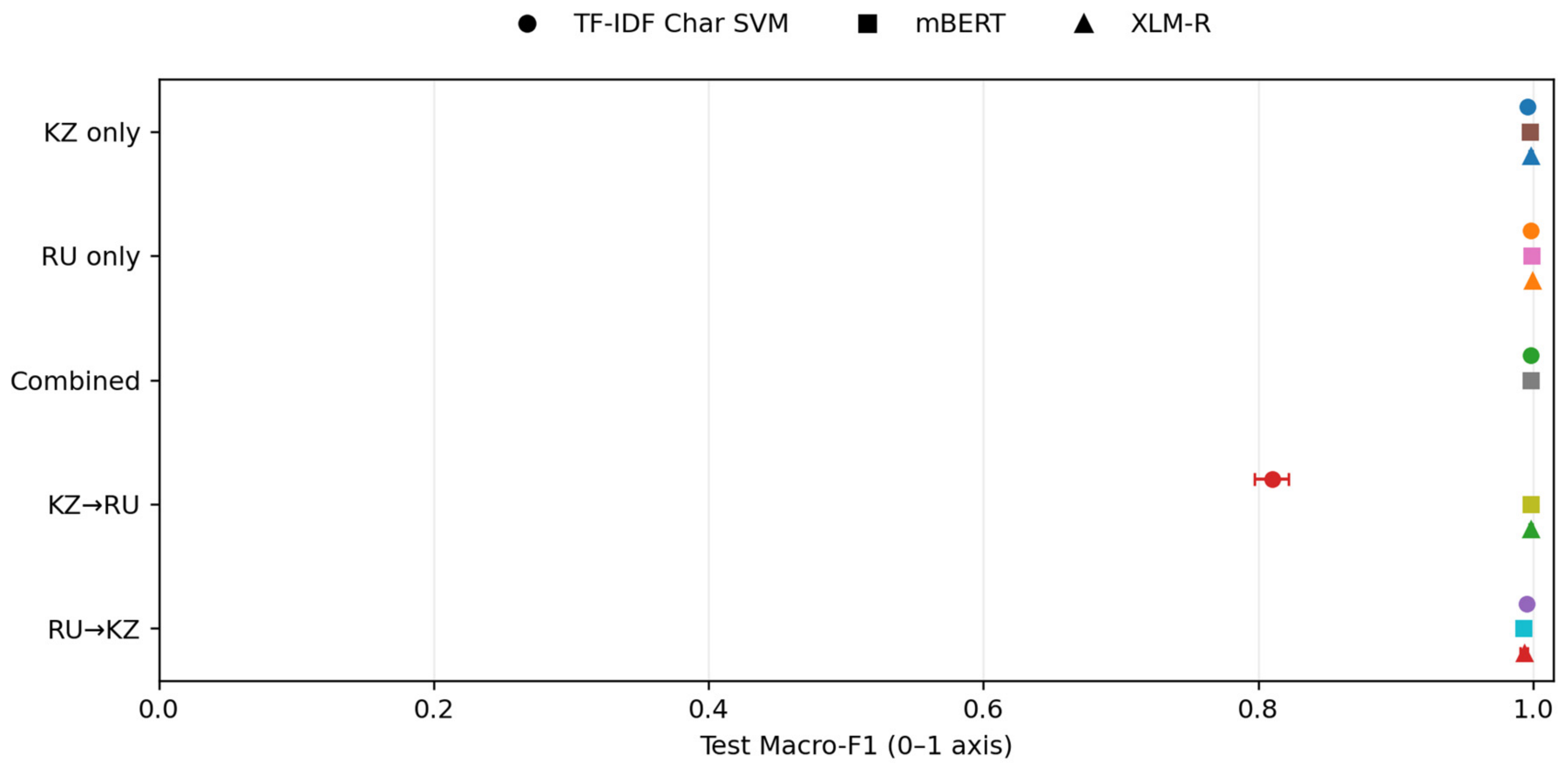
Small differences between mBERT and XLM-R in this single-seed comparison should be interpreted descriptively rather than as evidence of statistically established superiority. Figure 3 provides 95% row-level percentile bootstrap intervals (4000 resamples) conditional on the fixed model predictions; it does not assess run-to-run training variance. XLM-R exhibited the largest observed score on the KZ and RU test partitions in the archived run, but the magnitude of these differences was small.
Figure 3.
Test Macro-F1 with 95% percentile bootstrap confidence intervals (4000 row-level resamples) for the original metadata-restricted title–body evaluation scenarios. The horizontal axis spans 0–1. These intervals quantify held-out test-sample uncertainty conditional on fitted models; they do not represent multi-seed training variability. The XLM-R Combined result is omitted pending reconciliation with the original model summary. Colors distinguish the evaluation scenarios, while marker shapes identify the model families (circle: TF-IDF character-SVM; square: mBERT; triangle: XLM-R).
The combined Kazakh–Russian benchmark yielded high within-corpus performance across model families: character TF-IDF with Linear SVM achieved Macro-F1 = 0.9985 and mBERT approximately 0.9982. This close performance of a surface-feature baseline on the same distribution motivates the provenance-sensitivity analyses below. The XLM-R combined-scenario score could not be independently confirmed from archived summaries and is not presented in Table 6.
In-domain performance is consistently strong on the cleaned benchmark. Section 4.6.3 examines how the same TF-IDF families behave when the test distribution changes.
4.3. Cross-Lingual Transfer Results
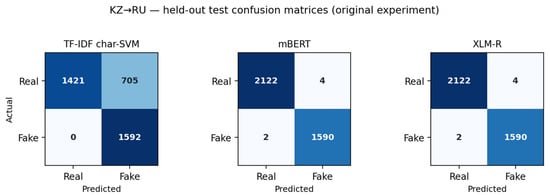
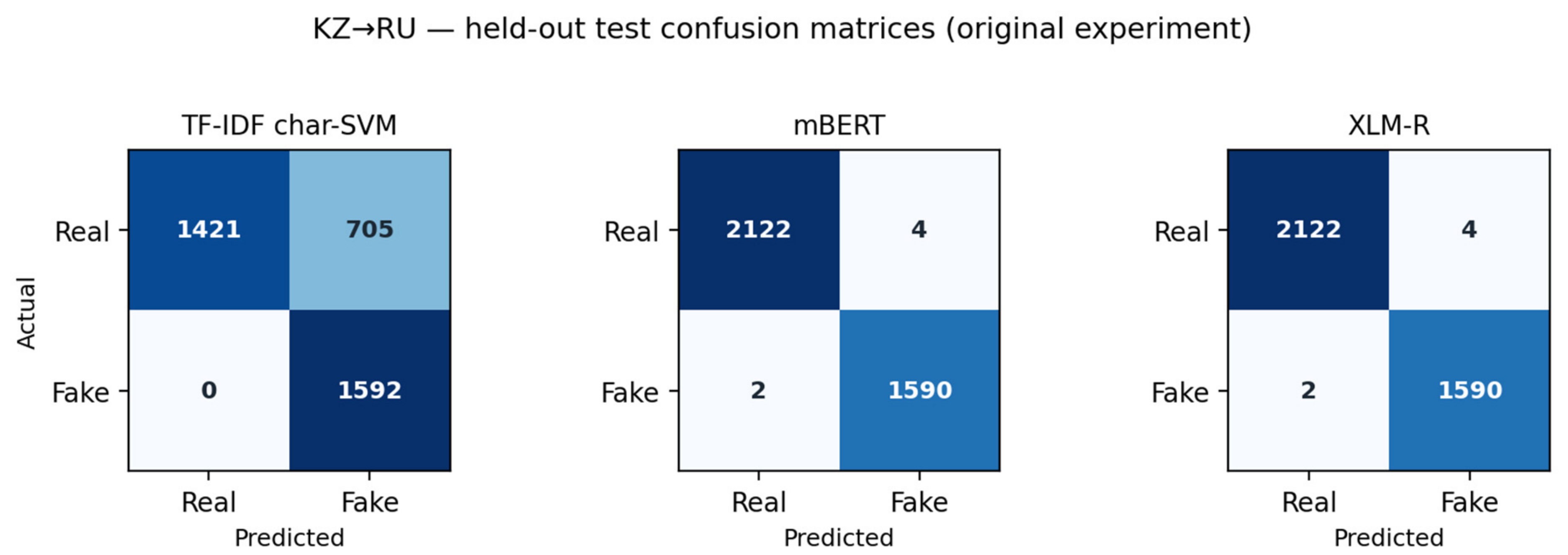
The KZ → RU setting showed the largest gap across original model families: the character TF-IDF baseline obtained Macro-F1 = 0.809980 with 705 false positives, whereas both original Transformer summaries recorded 0.998352 (six errors each). In the reverse RU → KZ direction, TF-IDF obtained 0.995201, mBERT 0.992801, and XLM-R 0.993336. These descriptive single-run results motivated follow-up source-marker and exact-overlap analyses; they are not controlled causal comparisons of architecture or language-transfer capacity.
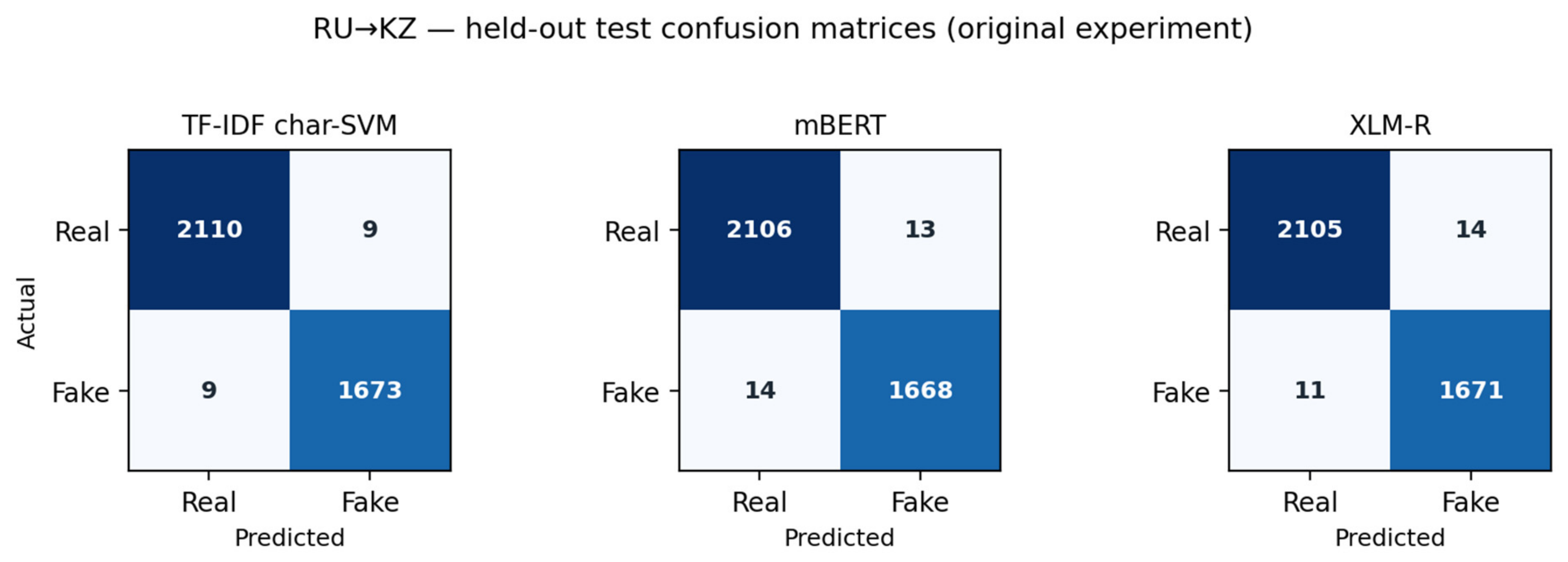
Instance-level audit: the mBERT and XLM-R KZ → RU predictions were aligned on all 3718 test records. Their confusion matrices are identical (TN 2122; FP 4; FN 2; TP 1590), but their predicted labels differ on eight records; of ten records misclassified by at least one model, two are shared errors and four errors are unique to each model. This demonstrates that the prediction columns were not identical, although independent run provenance and possible semantic leakage require additional checks. Figure 4 and Figure 5 present the confusion matrices for KZ → RU and RU → KZ transfer, respectively.
Figure 4.
KZ → RU test confusion matrices for TF-IDF character-SVM, mBERT, and XLM-R. Both Transformers have the same aggregate matrix, but differ on eight instance-level predictions. Darker blue indicates a higher observation count; the counts are also printed in each cell.
Figure 5.
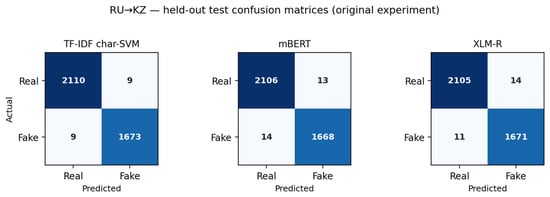
RU → KZ test confusion matrices for TF-IDF character-SVM, mBERT, and XLM-R. Darker blue indicates a higher observation count; the counts are also printed in each cell.
Paired correctness diagnostic for these 3718 aligned test articles: Both models correct = 3708; both models incorrect = 2; mBERT correct/XLM-R incorrect = 4; mBERT incorrect/XLM-R correct = 4. An exact two-sided McNemar test on the eight discordant correctness outcomes gives p = 1.00. This does not support superiority of either Transformer on this test set, nor does it rule out shared source biases or semantic overlap. The paired check is limited to the archived KZ → RU instance-level predictions.
Interpretation of Table 7: Recovery ratios describe relative scores under the archived test protocol. The KZ → RU ratio near 0.9997 is compatible with exact-content overlap and unverified semantic or translated relationships, and cannot establish language-independent misinformation detection. Source-disjoint and human-verified semantic-group tests remain necessary.
Table 7.
Cross-lingual recovery measured against target-language in-domain Macro-F1.
4.4. Error Profile
The original char-TF-IDF + Linear SVM KZ → RU evaluation contained 705 errors, all false positives (Real → Fake). In the paired fixed-split Reuters-marker ablation, 682 of those errors were corrected, but 173 new errors appeared (including 163 false negatives). This indicates sensitivity to source-related lexical patterns, although the retrained decision boundary can also change predictions of articles without an explicit marker. On RU → KZ, 189 new errors appeared after masking versus seven corrections. The five archived examples below describe corpus label and prediction changes, not externally verified news veracity; source-level mechanisms beyond the indicated marker are interpretive hypotheses.
A descriptive audit of the KZ → RU TF-IDF test records found a Reuters-related marker in 49/705 Real → Fake errors (6.95%), but in 1100/1421 correctly classified Real records (77.41%). Median body length was 1662 characters for Real → Fake errors versus 2670 for correctly classified Real records. These are associations within saved predictions, not SVM coefficient explanations or causal proof. Together with the marker-ablation experiment, they support sensitivity to provenance-associated lexical information; unmeasured article source, topic, editorial template, and vocabulary overlap remain competing explanations.
Five illustrative examples from saved Reuters-masking prediction exports (dataset labels; original model → masked model).
E1|KZ → RU|Real (0)|‘Лидер Демократической партии США Пелоси призывает к удалению статуи конфедерации’|Fake → Real (FP corrected); Reuters marker in the body (669 characters).
E2|KZ → RU|Real (0)|‘Сенат Нигерии, чтобы исследовать обвинения в жестокости полиции’|Fake → Real (FP corrected); Reuters dateline in the body (1406 characters).
E3|KZ → RU|Real (0)|‘Конгрессмен Коньерс не планирует уйти в отставку: адвокат рассказывает Detroit News’|Real → Fake (new FP); Reuters-related string in the article (437 characters).
E4|KZ → RU|Fake (1)|‘Пастор решает, что прямая пара не может даже поддерживать равенство брака, отменяет их свадьбу’|Fake → Real (new FN); no explicit Reuters marker (2760 characters).
E5|RU → KZ|Fake (1)|‘Жоғарғы Сот әділет орталығы қайтыс болғаннан кейін бірнеше сағаттан кейін, демократтар …’|Fake → Real (new FN); no explicit Reuters marker (696 characters).
4.5. Interpretation and Validity Considerations
The core protocol excludes the category field from inputs and removes within-language exact title–body duplicates before splitting. The original mBERT and XLM-R evaluations share model-input construction, training hyperparameters, and test scenarios.
The supplementary audits investigate potential non-semantic signals: repeated or translated stories, source-specific language, Reuters-style datelines, and period-specific composition. The cross-corpus test additionally evaluates transportability to a different source distribution.
Results in Table 6 describe the original cross-family benchmark. Fixed-split, chronological, source-marker, and external evaluations use documented protocols separately; their results serve as complementary robustness evidence.
4.6. Additional Robustness and External Validation
Table 8 summarizes the supporting evaluations and outstanding validation requirements. A validation-selected TF-IDF protocol, a paired Reuters-marker ablation, and an independent external-corpus assessment are presented below. Chronological results, matched-record error transitions, validation-model alternatives, and exact-group sensitivity experiments are documented in Supplementary Sections S1–S4. The supplementary random/group experiment uses a separately cleaned 75,185-record cohort and independently reconstructed partitions, unlike the 75,190-record fixed-split protocol used for main-text Table 9; identical test counts do not establish identical test membership. Table 9 reports the paired Reuters-marker ablation in the fixed-split protocol.
Table 8.
Status of supporting evaluations and outstanding validation requirements.
Table 9.
Paired Reuters-marker ablation in the frozen fixed-split character TF-IDF + Linear SVM protocol (75,190-record cleaned input). Original and masked results use identical target-test record membership within each direction. The separately re-cleaned random/group experiment (75,185 records; KZ → RU random Macro-F1 = 0.8995) is reported in Supplementary Table S2. Its cohort and train/test partitions differ from the 75,190-record fixed-split experiment here (KZ → RU Macro-F1 = 0.809980); the equal KZ → RU test counts of 3718 do not indicate identical test membership.
4.6.1. Validation-Based TF-IDF Model Selection
A separate fixed-split evaluation compared word- and character-level TF-IDF with Logistic Regression or Linear SVM, selecting the configuration on source-language validation Macro-F1. Character TF-IDF with Linear SVM was selected for all three in-domain settings (Supplementary Table S1). Its original test Macro-F1 scores were 0.995734 (KZ-only), 0.998352 (RU-only), and 0.997836 (pooled); cross-language values were 0.809980 (KZ → RU) and 0.995201 (RU → KZ). The seed−42 split manifests were frozen and checked. These scores belong to this fixed-split protocol and are not treated as a matched architecture-only comparison with earlier Transformer runs.
Full source-language validation comparisons are provided in Supplementary Table S1. Model selection preceded evaluation of the held-out test records.
4.6.2. Reuters-Marker Masking
Reuters-related lexical strings were highly associated with the inherited class labels (Section 3.2.2). In the paired fixed-split cross-language character TF-IDF protocol, marker masking raised KZ → RU Macro-F1 from 0.809980 to 0.945547 while lowering RU → KZ from 0.995201 to 0.946061 (Table 9). The original and masked models used the same target-test record IDs within each direction. Separately, year-based tests on 2015–2016 versus 2017 demonstrated sensitivity to chronology and source markers (Supplementary Section S2), while the paired predictions are analyzed in Supplementary Section S3. These interventions target Reuters-related strings, rather than every potential provenance or refutation cue.
4.6.3. External Cross-Corpus Evaluation (Exploratory)
To address the Academic Editor’s cross-dataset request, the original word and character TF-IDF + Linear SVM pipelines (C = 1.0, balanced class weighting) were re-fitted on the reconstructed original stratified training partitions (seed 42, 80/10/10). Held-out in-domain Macro-F1 scores reproduced archived values: 0.995733 (KZ word), 0.995734 (KZ character), 0.994777 (RU word) and 0.998352 (RU character). External records were not included in fitting, model selection, or hyperparameter tuning.
We then evaluated these four fitted models on the publicly released 280-item external validation set associated with KazFakeCorpus [24]. It contains 123 KZ records (58 Real, 65 Fake) and 157 RU records (76 Real and 81 Fake). Exact body-text comparison with both original corpora found zero identical external texts. Crucially, the external set has body text but no separate headline field, whereas original models were trained with headline-plus-body input; this input-field and domain shift is a limitation. The results in Table 10 report the matched-language cross-corpus conditions; the full directional prediction outputs are archived separately.
Table 10.
External cross-corpus TF-IDF evaluation, using reconstructed frozen in-domain training partitions. External Macro-F1 intervals are 95% percentile confidence intervals from 5000 class-stratified bootstrap resamples. These 280 external records are distinct from both the fixed-split target test in Table 9 and the independently reconstructed random/group test in Supplementary Table S2.
Both character TF-IDF baselines lost substantial performance under distribution shift. KZ character Macro-F1 fell from 0.995734 to 0.482323 (50 Real → Fake errors among 123 external KZ records); RU character Macro-F1 fell from 0.998352 to 0.694661 (42 Real → Fake and two Fake → Real errors among 157 external RU records). The word-level baselines yielded external scores of 0.655044 and 0.784780, respectively (Table 10). The observed gaps quantify transportability on the new sample, although several aspects of the input and source distribution changed simultaneously.
In the external set, all Fake items are attributed to Factcheck.kz or Stopfake.kz, whereas all Real items are attributed to Kazinform.kz, Informburo.kz, or Tengrinews.kz. Some Fake texts also contain explicit refutation vocabulary. In addition, this set lacks a separate headline field, whereas the original models use headline-plus-body text. These characteristics make it impossible to isolate source style, topic, refutation language, or field mismatch as a unique driver of the observed decline. Exact-match screening found no identical body texts, but translated/paraphrased overlap was not independently adjudicated.
4.7. Synthesis of Results
Three findings remain consistent across these analyses. First, the original dataset labels are predicted with high accuracy under within-corpus splits. Second, masking Reuters-related strings changes directional transfer results materially, indicating sensitivity to corpus-specific lexical signals. Third, external evaluation reveals a pronounced drop for both word and character TF-IDF baselines. Together with the supplementary exact-group and temporal audits, these findings motivate source-aware validation as a necessary complement to ordinary random-split benchmarks.
5. Conclusions
This study compared TF-IDF, mBERT and XLM-R classifiers on 75,190 Kazakh- and Russian-labeled news records and systematically assessed the reliability of the resulting benchmark. The main methodological contribution is a traceable evaluation sequence spanning metadata removal, exact deduplication, cross-lingual transfer, lexical-marker ablation and external cross-corpus testing.
The original within-corpus scores were high, but transfer results proved sensitive to source-linked lexical markers. Removing Reuters-related strings altered KZ → RU and RU → KZ character-TF-IDF decisions, while external test performance was materially below archived within-corpus scores. Exact-content grouping and year-based experiments offered additional sensitivity checks. These observations establish a concrete mismatch between benchmark classification and transport to another source distribution.
The current evidence supports dataset-label classification rather than independent evidence-based verification of factual claims. Stronger generalization conclusions require publisher identifiers, trustworthy original URLs and label provenance, human-confirmed translation/paraphrase groups, balanced source–label evaluation, and repeated-seed comparisons.
Limitations and Future Work
Key unresolved limits are concentrated here. Original publisher identifiers and translation provenance were unavailable, preventing reliable publisher-held-out evaluation and source-wise counts. The separately cleaned exact-group test did not establish paraphrase-disjointness because LaBSE candidates were not independently adjudicated. Transformer results were archived as single runs; test-row bootstrap intervals measure conditional test-sample variation rather than training-seed uncertainty, and no matched RuBERT or Kazakh-specific baseline was trained. The independent 280-record external sample confounds publisher and label and omits the original separate headline input. Future work should prioritize traceable source-balanced corpora, manual semantic-link adjudication, external tests with matched fields, systematic character n-gram attribution and multi-seed comparisons.
Supplementary Materials
The following supporting information can be downloaded at: https://www.mdpi.com/article/10.3390/bdcc10120404/s1, Section S1, TF-IDF validation comparisons (Table S1); Section S2, chronological evaluation; Section S3, paired Reuters-marker masking error transitions; and Section S4, exact-content groups and semantic-neighbor screening (Table S2).
Author Contributions
Conceptualization, U.M. and O.M.; methodology, U.M.; software, U.M.; validation, U.M. and N.Z.; formal analysis, U.M. and G.K.; investigation, Z.T.; data curation, U.M. and A.A.; writing—original draft preparation, U.M.; writing—review and editing, O.M., G.K., A.C., Z.T., A.A. and N.Z.; supervision, O.M. and A.C. All authors have read and agreed to the published version of the manuscript.
Funding
This research received no external funding.
Institutional Review Board Statement
Not applicable.
Informed Consent Statement
Not applicable.
Data Availability Statement
The experiments used Kazakh and Russian CSV collections containing title, text, subject, date, and label fields. The predictive models used title and text only. Underlying full-text data are not redistributed because source-level licensing and provenance information is incomplete. Requests for processed split metadata and preprocessing documentation may be directed to the corresponding author; any sharing is subject to applicable data-use permissions and author approval. Code Availability: Code for text preprocessing, TF-IDF baselines, Transformer training, evaluation, and audit generation may be requested from the corresponding author, subject to author approval and any third-party restrictions.
Acknowledgments
The authors acknowledge the support of Khoja Akhmet Yassawi International Kazakh-Turkish University and the Institute of Information and Computational Technologies. Use of Generative AI: Generative AI tools were used during revision for language editing, drafting and restructuring scientific prose, programming assistance, and support in organizing and interpreting experimental outputs. The authors remain responsible for the correctness of all underlying analyses, numerical results, citations, software, claims, and the final submitted text. No generative AI system is an author.
Conflicts of Interest
The authors declare no conflicts of interest.
References
- Wang, W.Y. Liar, liar pants on fire: A new benchmark dataset for fake news detection. Proc. ACL 2017, 2, 422–426. [Google Scholar] [CrossRef] [Scilit]
- Pérez-Rosas, V.; Kleinberg, B.; Lefevre, A.; Mihalcea, R. Automatic detection of fake news. In Proceedings of the 27th International Conference on Computational Linguistics (COLING 2018), Santa Fe, NM, USA, 20–26 August 2018; pp. 3391–3401. Available online: https://aclanthology.org/C18-1287/ (accessed on 15 November 2026).
- Kuzmin, G.; Larionov, D.; Pisarevskaya, D.; Smirnov, I. Fake news detection for the Russian language. In Proceedings of the 3rd International Workshop on Rumours and Deception in Social Media, Barcelona, Spain (Online), 13 December 2020; pp. 45–57. Available online: https://aclanthology.org/2020.rdsm-1.5/ (accessed on 15 November 2026).
- Devlin, J.; Chang, M.-W.; Lee, K.; Toutanova, K. BERT: Pre-training of deep bidirectional Transformers for language understanding. In Proceedings of the 2019 Conference of the North American Chapter of the Association for Computational Linguistics: Human Language Technologies (NAACL-HLT 2019), Minneapolis, MN, USA, 2–7 June 2019; pp. 4171–4186. [Google Scholar] [CrossRef] [Scilit]
- Conneau, A.; Khandelwal, K.; Goyal, N.; Chaudhary, V.; Wenzek, G.; Guzmán, F.; Grave, E.; Ott, M.; Zettlemoyer, L.; Stoyanov, V. Unsupervised Cross-lingual Representation Learning at Scale. In Proceedings of the 58th Annual Meeting of the Association for Computational Linguistics, Online, 5–10 July 2020; pp. 8440–8451. [Google Scholar] [CrossRef] [Scilit]
- Zmitrovich, D.; Abramov, A.; Kalmykov, A.; Kadulin, V.; Tikhonova, M.; Taktasheva, E.; Astafurov, D.; Baushenko, M.; Snegirev, A.; Shavrina, T.; et al. A family of pretrained Transformer language models for Russian. In Proceedings of the 2024 Joint International Conference on Computational Linguistics, Language Resources and Evaluation (LREC-COLING 2024), Torino, Italy, 20–25 May 2024; ELRA and ICCL: Torino, Italy, 2024; pp. 507–524. Available online: https://aclanthology.org/2024.lrec-main.45/ (accessed on 15 November 2026).
- Baitenova, L.; Tussupova, S.; Mambetov, S.; Munaitbas, G.; Mukhamejanova, G. Hybrid artificial intelligence architectures for automatic text correction in the Kazakh language. Front. Artif. Intell. 2025, 8, 1708566. [Google Scholar] [CrossRef] [Scilit] [PubMed]
- Ozcelik, O.; Yenicesu, A.S.; Yildirim, O.; Haliloglu, D.S.; Eroglu, E.E.; Can, F. Cross-Lingual Transfer Learning for Misinformation Detection: Investigating Performance Across Multiple Languages. In Proceedings of the 4th Conference on Language, Data and Knowledge, Vienna, Austria, 12–15 September 2023; pp. 549–558. Available online: https://aclanthology.org/2023.ldk-1.59/ (accessed on 15 November 2026).
- Fan, H.; Hu, X.; Zhao, G. Cross-lingual social misinformation detector based on hierarchical mixture-of-experts adapter. In Proceedings of the 31st International Conference on Computational Linguistics (COLING 2025), Abu Dhabi, United Arab Emirates, 19–24 January 2025; pp. 7253–7265. Available online: https://aclanthology.org/2025.coling-main.484/ (accessed on 15 November 2026).
- Irnawan, B.R.; Suzuki, Y.; Tomuro, N.; Fukumoto, F. Multi-agent cross-lingual veracity assessment for explainable fake news detection. In Proceedings of the 14th International Joint Conference on Natural Language Processing and the 4th Conference of the Asia-Pacific Chapter of the Association for Computational Linguistics (Findings), Mumbai, India, 20–24 December 2025; pp. 2195–2213. [Google Scholar] [CrossRef] [Scilit]
- Deshpande, A.; Talukdar, P.; Narasimhan, K. When is BERT multilingual? Isolating crucial ingredients for cross-lingual transfer. In Proceedings of the 2022 Conference of the North American Chapter of the Association for Computational Linguistics: Human Language Technologies (NAACL-HLT), Seattle, WA, USA, 10–15 July 2022; pp. 3610–3623. [Google Scholar] [CrossRef] [Scilit]
- Singh, J.; McCann, B.; Socher, R.; Xiong, C. BERT is not an interlingua and the bias of tokenization. In Proceedings of the 2nd Workshop on Deep Learning Approaches for Low-Resource NLP, Hong Kong, China, 3 November 2019; pp. 47–55. [Google Scholar] [CrossRef] [Scilit]
- Vykopal, I.; Pikuliak, M.; Ostermann, S.; Anikina, T.; Gregor, M.; Simko, M. Large language models for multilingual previously fact-checked claim detection. In Proceedings of the Findings of the Association for Computational Linguistics: EMNLP 2025, Suzhou, China, 4–9 November 2025; pp. 15741–15765. [Google Scholar] [CrossRef] [Scilit]
- Shcharbakova, H.; Anikina, T.; Skachkova, N.; van Genabith, J. Cross-lingual fact verification: Analyzing LLM performance patterns across languages. In Proceedings of the 15th International Conference on Recent Advances in Natural Language Processing (RANLP 2025), Varna, Bulgaria, 8–10 September 2025; pp. 1137–1147. Available online: https://aclanthology.org/2025.ranlp-1.131/ (accessed on 15 November 2026).
- Shcharbakova, H.; Anikina, T.; Skachkova, N.; van Genabith, J. When scale meets diversity: Evaluating language models on fine-grained multilingual claim verification. In Proceedings of the Eighth Fact Extraction and VERification Workshop (FEVER), Vienna, Austria, 31 July 2025; pp. 69–84. [Google Scholar] [CrossRef] [Scilit]
- Sittar, A.; Smiljanic, M.; Guček, A.; Grobelnik, M. Fake news detection through LLM-driven text augmentation across media and languages. Mach. Learn. Knowl. Extr. 2026, 8, 103. [Google Scholar] [CrossRef] [Scilit]
- Wang, D.; Tsang, S.J.; Zhou, Y. Performance unfairness of large language models in cross-language fact-checking. Inf. Process. Manag. 2026, 63, 104616. [Google Scholar] [CrossRef] [Scilit]
- Harris, S.; Ta, V.T.; Trovati, M.; Nakhla, G.; Latif, F.; Korkontzelos, I. Multimodal misinformation detection across diverse languages using RAG and LLMs. J. Intell. Inf. Syst. 2026, 64, 1719–1746. [Google Scholar] [CrossRef] [Scilit]
- Murayama, T. Dataset of fake news detection and fact verification: A survey. arXiv 2021, arXiv:2111.03299. [Google Scholar]
- Kishi, Y.; Arima, Y.; Iyatomi, H. Fake news detection strategies under dataset bias: Using large-scale coarse-grained labels. In Proceedings of the EACL 2026 Student Research Workshop, Rabat, Morocco, 26 March 2026; pp. 612–621. [Google Scholar] [CrossRef] [Scilit]
- Elangovan, A.; He, J.; Verspoor, K. Memorization vs. generalization: Quantifying data leakage in NLP performance evaluation. In Proceedings of the 16th Conference of the European Chapter of the Association for Computational Linguistics (EACL 2021), Online, 19–23 April 2021; pp. 1325–1335. [Google Scholar] [CrossRef] [Scilit]
- Kambhatla, G.; Nguyen, T.; Choi, E. Quantifying train-evaluation overlap with nearest neighbors. In Proceedings of the Findings of the Association for Computational Linguistics: ACL 2023, Toronto, ON, Canada, 9–14 July 2023; pp. 2905–2920. [Google Scholar] [CrossRef] [Scilit]
- Sambetbayeva, M.; Nekessova, A.; Yerimbetova, A.; Bayangali, A.; Kaldarova, M.; Telman, D.; Smailov, N. A Multi-Level Annotation Model for Fake News Detection: Implementing Kazakh-Russian Corpus via Label Studio. Big Data Cogn. Comput. 2025, 9, 215. [Google Scholar] [CrossRef] [Scilit]
- Lamasheva, Z.; Nekessova, A.; Kantureyeva, M.; Sambetbayeva, M.; Kaldarova, M.; Nazymkhan, A. KazFakeCorpus: A Bilingual Corpus with Multi-Level Semantic Annotation for Fake News Detection. Big Data Cogn. Comput. 2026, 10, 183. [Google Scholar] [CrossRef] [Scilit]

Disclaimer/Publisher’s Note: The statements, opinions and data contained in all publications are solely those of the individual author(s) and contributor(s) and not of MDPI and/or the editor(s). MDPI and/or the editor(s) disclaim responsibility for any injury to people or property resulting from any ideas, methods, instructions or products referred to in the content. |
© 2026 by the authors. Licensee MDPI, Basel, Switzerland. This article is an open access article distributed under the terms and conditions of the Creative Commons Attribution (CC BY) license.