You are currently viewing a new version of our website. To view the old version click .

Condensed Matter, Volume 5, Issue 4

December 2020 - 27 articles

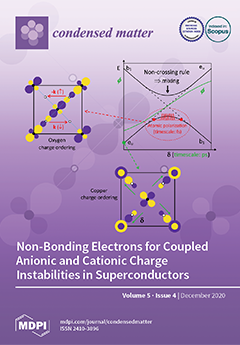
Cover Story: Chemical bonding is well adapted to discuss electronic instabilities and their impact on local aspects of superconductivity mechanisms: Mulliken electronegativity, Pearson hardness for atomic polarizability, van der Waals forces for charge-induced dipole interactions. Anionic or cationic clusters may undergo a partial disproportionation, an important phenomenon in chemistry; physicists would refer to this as a « negative-U » system. Is this static description also valid at the pico- and femto-second timescales of phonons and electronic dipole oscillations, respectively? The non-crossing rule imposes the mixing of electron states at the Fermi level, from which partial charge disproportionation occurs. Thus, as shown in this work, two approaches from chemistry lead to coupled charge fluctuations in titanate, cuprate, and iron selenide superconducting systems. View this paper
  • Issues are regarded as officially published after their release is announced to the table of contents alert mailing list .
  • You may sign up for email alerts to receive table of contents of newly released issues.
  • PDF is the official format for papers published in both, html and pdf forms. To view the papers in pdf format, click on the "PDF Full-text" link, and use the free Adobe Reader to open them.

Articles (27)

  • Feature Paper
  • Article
  • Open Access
5 Citations
4,624 Views
10 Pages

Asymmetric Hysteresis Loops in Co Thin Films

  • Andrea Ehrmann and
  • Tomasz Blachowicz

Asymmetric magnetic hysteresis loops are usually found in exchange bias (EB) systems, typically after field cooling a system below the Néel temperature of an antiferromagnet exchange coupled to a ferromagnet. Alternatively, asymmetric hysteres...

  • Article
  • Open Access
38 Citations
5,824 Views
27 Pages

In a semi-review paper, we show that the local pseudo-Jahn–Teller effect (PJTE) in transition metal B ion center of ABO3 perovskite crystals, notably BaTiO3, is the basis of all their main properties. The vibronic coupling between the ground an...

  • Feature Paper
  • Article
  • Open Access
4 Citations
4,492 Views
12 Pages

First-Principles Calculation of Copper Oxide Superconductors That Supports the Kamimura-Suwa Model

  • Hiroshi Kamimura,
  • Masaaki Araidai,
  • Kunio Ishida,
  • Shunichi Matsuno,
  • Hideaki Sakata,
  • Kenji Shiraishi,
  • Osamu Sugino and
  • Jaw-Shen Tsai

In 1986 Bednorz and Műller discovered high temperature superconductivity in copper oxides by chemically doping holes into La2CuO4 (LCO), the antiferromagnetic insulator. Despite intense experimental and theoretical research during the past 34 years,...

  • Review
  • Open Access
7 Citations
5,449 Views
16 Pages

I present here a short memory of my scientific contacts with K.A. Müller starting from the Interlaken Conference (1988), Erice (1992 and 1993), and Cottbus (1994) on the initial studies on phase separation (PS) and charge inhomogeneity in cuprat...

  • Article
  • Open Access
3 Citations
3,273 Views
29 Pages

Are Superconductivity Mechanisms a Matter for Chemists?

  • Michel Pouchard and
  • Antoine Villesuzanne

From a tight-binding approach to the instability of nonbonding electronic states, along a double-well potential, we consider here how the coupling of these states with a phonon mode can open a superconducting gap at the Fermi level. The alternation o...

  • Feature Paper
  • Article
  • Open Access
11 Citations
4,354 Views
19 Pages

Temperature-Independent Cuprate Pseudogap from Planar Oxygen NMR

  • Jakob Nachtigal,
  • Marija Avramovska,
  • Andreas Erb,
  • Danica Pavićević,
  • Robin Guehne and
  • Jürgen Haase

Planar oxygen nuclear magnetic resonance (NMR) relaxation and shift data from all cuprate superconductors available in the literature are analyzed. They reveal a temperature-independent pseudogap at the Fermi surface, which increases with decreasing...

  • Feature Paper
  • Article
  • Open Access
1 Citations
3,638 Views
23 Pages

Phase Separation and Pairing Fluctuations in Oxide Materials

  • Andreas Bill,
  • Vladimir Hizhnyakov,
  • Reinhard K. Kremer,
  • Götz Seibold,
  • Aleksander Shelkan and
  • Alexei Sherman

The microscopic mechanism of charge instabilities and the formation of inhomogeneous states in systems with strong electron correlations is investigated. We demonstrate that within a strong coupling expansion the single-band Hubbard model shows an in...

  • Article
  • Open Access
2 Citations
2,961 Views
19 Pages

We formulate the statistics of the discrete multicomponent fragmentation event using a methodology borrowed from statistical mechanics. We generate the ensemble of all feasible distributions that can be formed when a single integer multicomponent mas...

  • Article
  • Open Access
6 Citations
4,084 Views
9 Pages

Unconventional Transport Properties of Reduced Tungsten Oxide WO2.9

  • Alexander Shengelaya,
  • Fabio La Mattina and
  • Kazimierz Conder

The temperature and magnetic field dependence of resistivity in WO2.9 was investigated. The variation of resistivity with temperature displayed unusual features, such as a broad maximum around 230 K and a logarithmic increase of resistivity below 16...

  • Creative
  • Open Access
2,957 Views
9 Pages

This contribution presents a personal account of the influence Karl Alex Müller had on the early stages of my career and the scientific questions about which we exchanged our views over the years. While both our research branched into a variety...

of 3

Get Alerted

Add your email address to receive forthcoming issues of this journal.

XFacebookLinkedIn
Condens. Matter - ISSN 2410-3896