

You are currently viewing a new version of our website. To view the old version click .

Journal of Cardiovascular Development and Disease, Volume 9, Issue 5

May 2022 - 44 articles

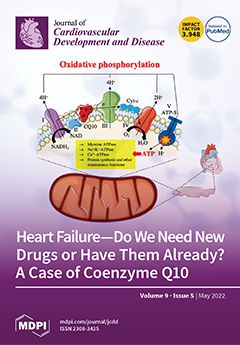
Cover Story: Coenzyme Q10’s main role is participating in the production of energy in the mitochondria, which maintains the proper functioning of all cells. The highest concentration of coenzyme Q10 is found in heart tissue. As the body ages, the concentration of this coenzyme in the heart tissue decreases, which makes it more susceptible to damage by free radicals. In patients with HF, the aggravation of disease symptoms is inversely related to the concentration of coenzyme Q10. Importantly, coenzyme Q10 concentration in patients with HF is an important predictor of the risk of death. Long-term coenzyme Q10 supplementation at a dose of 300 mg/day can significantly improve heart function and prognosis in patients with HF. View this paper
  • Issues are regarded as officially published after their release is announced to the table of contents alert mailing list .
  • You may sign up for email alerts to receive table of contents of newly released issues.
  • PDF is the official format for papers published in both, html and pdf forms. To view the papers in pdf format, click on the "PDF Full-text" link, and use the free Adobe Reader to open them.

Articles (44)

  • Systematic Review
  • Open Access
16 Citations
3,586 Views
18 Pages

A Systematic Review of Adherence to Immunosuppression among Pediatric Heart Transplant Patients

  • Keira Nassetta,
  • Tasmeen Hussain,
  • Katheryn Gambetta,
  • Kevin Le,
  • Linda C. O’Dwyer and
  • Sherif M. Badawy

After pediatric heart transplant, commitment to lifelong immunosuppression is crucial to maintaining graft health. However, a review of the current literature surrounding adherence to immunosuppression in pediatric heart transplant patients is lackin...

  • Article
  • Open Access
6 Citations
3,153 Views
11 Pages

Holter Recordings at Initial Assessment for Long QT Syndrome: Relationship to Genotype Status and Cardiac Events

  • Kathryn E. Waddell-Smith,
  • Alexandra A. Chaptynova,
  • Jian Li,
  • Jackie R. Crawford,
  • Halina Hinds and
  • Jonathan R. Skinner

Background: The relationship of Holter recordings of repolarization length to outcome in long QT syndrome (LQTS) is unknown. Methods: Holter recordings and initial 12 lead ECG QTc were related to outcome in 101 individuals with LQTS and 28 gene-negat...

  • Review
  • Open Access
12 Citations
4,411 Views
9 Pages

Obesity and type 2 diabetes (T2D) are on trend to become a huge burden across all ages. They cause harm to almost every organ, especially the heart. For decades, the incidence of heart failure with impaired diastolic function (or called heart failure...

  • Review
  • Open Access
12 Citations
3,251 Views
33 Pages

Is Obesity a Risk Factor for Carotid Atherosclerotic Disease?—Opportunistic Review

  • Joana Ferreira,
  • Pedro Cunha,
  • Alexandre Carneiro,
  • Isabel Vila,
  • Cristina Cunha,
  • Cristina Silva,
  • Adhemar Longatto-Filho,
  • Amílcar Mesquita,
  • Jorge Cotter and
  • Margarida Correia-Neves
  • + 1 author

Obesity is a risk factor for coronary atherosclerosis. However, the influence of adipose tissue in carotid atherosclerosis is not completely understood. No systematic review/meta-analysis was previously performed to understand if obesity is a risk fa...

  • Review
  • Open Access
6 Citations
13,911 Views
17 Pages

Heart Failure—Do We Need New Drugs or Have Them Already? A Case of Coenzyme Q10

  • Krzysztof J. Filipiak,
  • Stanisław Surma,
  • Monika Romańczyk and
  • Bogusław Okopień

Heart failure (HF) is a global epidemic that contributes to the deterioration of quality of life and its shortening in 1–3% of adult people in the world. Pharmacotherapy of HF should rely on highly effective drugs that improve prognosis and pro...

  • Article
  • Open Access
7 Citations
3,985 Views
11 Pages

Thoracoscopic Implantation of Epicardial Left Ventricular Lead for Cardiac Resynchronization Therapy

  • Hye Ree Kim,
  • Kyunghee Lim,
  • Seung-Jung Park,
  • Jong-Sung Park,
  • Ju Youn Kim,
  • Suryeun Chung,
  • Dong-Seop Jung,
  • Kyoung-Min Park,
  • Young Keun On and
  • June Soo Kim

(1) Background: Limited data exist on the safety and efficacy of epicardial left ventricular (LV) lead placement using video-assisted thoracoscopic surgery (VATS) for cardiac resynchronization therapy (CRT). (2) Methods: Acute and post-discharge outc...

  • Article
  • Open Access
1 Citations
2,801 Views
11 Pages

Impact of S-Wave Amplitude in Right Precordial Leads on Improvement in Mitral Regurgitation following Cardiac Resynchronization Therapy

  • Naoya Kataoka,
  • Teruhiko Imamura,
  • Takahisa Koi,
  • Shuhei Tanaka,
  • Nobuyuki Fukuda,
  • Hiroshi Ueno and
  • Koichiro Kinugawa

Background: The therapeutic strategy for mitral regurgitation (MR) in patients with advanced heart failure and wide QRS complex who are indicated for both intervention to MR and cardiac resynchronization therapy (CRT), remains unclear. Objective: We...

  • Review
  • Open Access
3 Citations
3,530 Views
9 Pages

Practical Approaches to Build and Sustain a Cardio-Oncology Clinic

  • Angeliki Chasouraki,
  • Christos Kourek,
  • Alexandros Sianis,
  • Konstantinos Loritis,
  • Peggy Kostakou,
  • Elias Tsougos,
  • Ioannis Paraskevaidis,
  • Argyrios Ntalianis and
  • Alexandros Briasoulis

The therapeutical advances in recent years in the field of oncology treatment have increased survival rates and improved the quality of life of oncology patients, thus turning cancer into a chronic disease. However, most of the new cancer treatments...

  • Article
  • Open Access
2 Citations
3,386 Views
13 Pages

Association of Circulating IgE and CML Levels with In-Stent Restenosis in Type 2 Diabetic Patients with Stable Coronary Artery Disease

  • Jingmeng Liu,
  • Qiujing Chen,
  • Lin Lu,
  • Qi Jin,
  • Yangyang Bao,
  • Tianyou Ling,
  • Changjian Lin,
  • Fenghua Ding,
  • Xiaoqun Wang and
  • Weifeng Shen
  • + 3 authors

Background: We investigated whether serum levels of immunoglobin (Ig) E and Nε-carboxymethyl-lysine (CML) are related to in-stent restenosis (ISR) in patients with stable coronary artery disease and type 2 diabetes mellitus (T2DM). Methods: S...

  • Article
  • Open Access
9 Citations
5,382 Views
10 Pages

Comparison of Different Laboratory Tests to Identify “Aspirin Resistance” and Risk of Vascular Events among Ischaemic Stroke Patients: A Double-Blind Study

  • Narayanaswamy Venketasubramanian,
  • Sherwin Joy Agustin,
  • Jorge L. Padilla,
  • Maricar P. Yumul,
  • Christina Sum,
  • Sze Haur Lee,
  • Kuperan Ponnudurai and
  • Robert N. Gan

“Aspirin resistance” (AR) is associated with increased risk of vascular events. We aimed to compare different platelet function tests used in identifying AR and assess their implications on clinical outcome. We performed platelet aggregat...

of 5

Get Alerted

Add your email address to receive forthcoming issues of this journal.

XFacebookLinkedIn
J. Cardiovasc. Dev. Dis. - ISSN 2308-3425