Skip Content
You are currently on the new version of our website. Access the old version .
  • 1.8
    Impact Factor
  • 23 days
    Time to First Decision

Pharmacy, Volume 6, Issue 2

2018 June - 30 articles

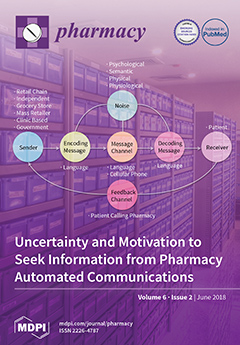
Cover Story: This research examines the communication process in terms of how users interact and engage with pharmacies after receiving automated messages. The purpose of this study is to test the interpersonal communication (IC) process of uncertainty in subjects in receipt of automated telephone calls ATCs from pharmacies. Subjects completed a survey of validated scales for Satisfaction (S); Relevance (R); Quality (Q); Need for Cognitive Closure (NFC). Relationships between S, R, Q, NFC, and subject preference to ATCs were analyzed to determine whether subjects contacting pharmacies display information seeking behavior. Results demonstrated that seeking information occurs if subjects: are dissatisfied with the content of the ATC; perceive that the Q of ATC is high and like receiving the ATC, or have a high NFC and do not like receiving ATCs. Other interactions presented complexities amongst uncertainty and tolerance of NFC within the IC process. View

Articles (30)

  • Conference Report
  • Open Access
3 Citations
4,682 Views
7 Pages

The nation of Singapore highly values its health service as well as the component of healthcare delivery that includes clinical pharmacy and administration. The Ministry of Health (MOH) engaged the services of Dr. Richard Parrish to better understand...

  • Article
  • Open Access
21 Citations
5,785 Views
15 Pages

Women’s Beliefs on Early Adherence to Adjuvant Endocrine Therapy for Breast Cancer: A Theory-Based Qualitative Study to Guide the Development of Community Pharmacist Interventions

  • Brittany Humphries,
  • Stéphanie Collins,
  • Laurence Guillaumie,
  • Julie Lemieux,
  • Anne Dionne,
  • Louise Provencher,
  • Jocelyne Moisan and
  • Sophie Lauzier

Adjuvant endocrine therapy (AET) taken for a minimum of five years reduces the recurrence and mortality risks among women with hormone-sensitive breast cancer. However, adherence to AET is suboptimal. To guide the development of theory-based interven...

  • Article
  • Open Access
13 Citations
6,201 Views
16 Pages

In order to assess the effects of prescription-only (Rx) to over-the-counter (OTC) drug switches and related policies, it is imperative to distinguish self-medication from OTC drug use. The objective of this study was to estimate the OTC drug use in...

  • Review
  • Open Access
4 Citations
5,453 Views
13 Pages

The use of community pharmacies across Europe has potential to alleviate the burden on overstretched healthcare providers. Children and young people (0–18 years) account for a large number of primary care attendances. This narrative literature...

  • Article
  • Open Access
9 Citations
3,975 Views
22 Pages

Background: Understanding the factors that influence the market entry, exit, and stability of community pharmacies (i.e., market dynamics) is important for stakeholders ranging from patients to health policymakers and small business owners to large c...

  • Article
  • Open Access
12 Citations
6,078 Views
11 Pages

To improve the cultural competency of 34 students participating in graduate nutrition counseling classes, the Campinha-Bacote Model of Cultural Competence in the Delivery of Health Care Services was used to design, implement, and evaluate counseling...

  • Article
  • Open Access
10 Citations
6,284 Views
7 Pages

Clinical Pharmacy Education in Japan: Using Simulated Patients in Laboratory-Based Communication-Skills Training before Clinical Practice

  • Rie Kubota,
  • Kiyoshi Shibuya,
  • Yoichi Tanaka,
  • Manahito Aoki,
  • Megumi Shiomi,
  • Wataru Ando,
  • Katsuya Otori and
  • Takako Komiyama

The Japanese pharmaceutical curriculum was extended from four to six years in 2006. Students now receive practical communication-skills training in their fourth year, before progressing to train in hospital and community pharmacies in their fifth yea...

  • Article
  • Open Access
16 Citations
5,094 Views
13 Pages

One-Stop Dispensing: Hospital Costs and Patient Perspectives on Self-Management of Medication

  • Morten Baltzer Houlind,
  • Helle Bach Ølgaard McNulty,
  • Charlotte Treldal,
  • Signe Lindgaard Andersen,
  • Thomas Huneck Haupt,
  • Janne Petersen,
  • Ove Andersen and
  • Lene Juel Kjeldsen

(1) Objective: To assess hospital medication costs and staff time between One-Stop Dispensing (OSD) and the Traditional Medication System (TMS), and to evaluate patient perspectives on OSD. (2) Methods: The study was conducted at Hvidovre Hospital, U...

  • Article
  • Open Access
2 Citations
5,004 Views
13 Pages

Pharmacy personnel often answer telephones to respond to pharmacy customers (subjects) who received messages from automated systems. This research examines the communication process in terms of how users interact and engage with pharmacies after rece...

  • Article
  • Open Access
20 Citations
4,846 Views
9 Pages

Appointment-based medication synchronization (ABMS) programs have been associated with increased adherence and persistence to chronic medications. Adherence to statin therapy, angiotensin-converting enzyme inhibitors (ACEIs), angiotensin receptor blo...

of 3

Get Alerted

Add your email address to receive forthcoming issues of this journal.

XFacebookLinkedIn
Pharmacy - ISSN 2226-4787