



Next Issue
Volume 11, May
Previous Issue
Volume 11, March


Languages, Volume 11, Issue 4 (April 2026) – 19 articles
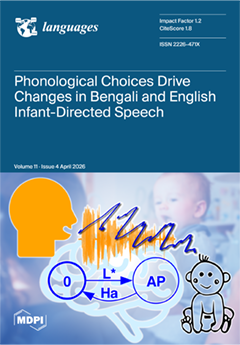
Cover Story (view full-size image): In this study, we demonstrate that intonational phonology is critical for understanding prosodic modifications in infant-directed speech (IDS) relative to adult-directed speech through analyses of simulated infant-directed speech vs. the reading of a story in English and Bengali.  These two languages both have stress and do not use fundamental frequency (F0) to signal changes in word-level meaning, but have two very different intonational grammars. These differences allowed us to disentangle previous hypotheses about the locus of intonational exaggeration in IDS. We show that the phonological choices of speakers to chunk the story into shorter, but larger prosodic constituents drive intonational exaggeration in IDS, since the melody-final position in both languages has the greatest pre-boundary lengthening and F0 range expansion. View this paper
  • Issues are regarded as officially published after their release is announced to the table of contents alert mailing list.
  • You may sign up for e-mail alerts to receive table of contents of newly released issues.
  • PDF is the official format for papers published in both, html and pdf forms. To view the papers in pdf format, click on the "PDF Full-text" link, and use the free Adobe Reader to open them.
Order results
Result details
Select all
Export citation of selected articles as:
21 pages, 411 KB  
Article
Comparative Study of the Northern Greek Dialectal Systems of Thassos and Lesbos
by Nikolaos Vogiatzis
Languages 2026, 11(4), 80; https://doi.org/10.3390/languages11040080 - 16 Apr 2026
Cited by 1 | Viewed by 877
Abstract
The present study undertakes a comparative investigation of the dialects of Thassos and Lesbos, systematically examining both shared and distinctive linguistic features across phonology, morphology, morphosyntax, and the lexicon. Based on primary ethnographic data and contemporary linguistic methodologies, the analysis demonstrates that, although [...] Read more.
The present study undertakes a comparative investigation of the dialects of Thassos and Lesbos, systematically examining both shared and distinctive linguistic features across phonology, morphology, morphosyntax, and the lexicon. Based on primary ethnographic data and contemporary linguistic methodologies, the analysis demonstrates that, although the two varieties belong to the Northeastern Aegean dialectal continuum, they display both substantial similarities and significant divergences shaped by historical and sociolinguistic factors. These differences reflect the geopolitical position of each island: Thassos emerges as a more conservative enclave due to relative isolation, whereas Lesbos functions as a site of linguistic fusion shaped by sustained contact with Asia Minor populations. The study thus underscores the importance of comparative dialectology for understanding the dynamics of insular linguistic systems within the Northeastern Greek-speaking territory. Full article
(This article belongs to the Special Issue The Modern Dialect of Lesbos: Selected Topics)
23 pages, 944 KB  
Article
When Perception Becomes Discourse: The Case of en/por lo que toca a in Spanish
by Miriam Heila Reyes Núñez
Languages 2026, 11(4), 79; https://doi.org/10.3390/languages11040079 - 15 Apr 2026
Viewed by 1145
Abstract
This study examines the diachronic development of Spanish perception verbs into deverbal topic markers (DTMs), focusing on tocar (‘to touch’), e.g., en/por lo que toca a, as representative of sensory perception. While the grammaticalization of visual perception verbs into discourse markers (DMs) [...] Read more.
This study examines the diachronic development of Spanish perception verbs into deverbal topic markers (DTMs), focusing on tocar (‘to touch’), e.g., en/por lo que toca a, as representative of sensory perception. While the grammaticalization of visual perception verbs into discourse markers (DMs) has been extensively documented, sensory verbs remain understudied. Drawing on data from three electronic corpora—CORDIAM, CORDE, and CORPES—this paper traces the semantic and syntactic evolution of these constructions from the 15th to the 21st century. There are three main conclusions: (a) the semantic development of tocar (‘to touch’) is driven by the interaction of metonymy and metaphor, corresponding to a process of metaphtonymy; (b) en/por lo que toca a arises through gradual grammaticalization processes, including semantic bleaching, decategorialization, increase in scope, and a positional shift toward the left periphery; (c) the corpus evidence suggests a gradual diffusion of the construction across textual genres, beginning in legal and administrative texts and later spreading to other registers. Full article
(This article belongs to the Special Issue Recent Developments on the Semantics of Perception Verbs)
Show Figures

Figure 1

42 pages, 3547 KB  
Article
Light Verbs and Syntactic Analyzability in the History of the Galician Language
by Alexandre Rodríguez Guerra
Languages 2026, 11(4), 78; https://doi.org/10.3390/languages11040078 - 15 Apr 2026
Viewed by 1015
Abstract
This contribution studies the behavior of the four main general light verbs (LVs) in the history of Galician (dar, facer and haber/ter). The research is structured around the following three fundamental axes: first, we study the evolution, comparison [...] Read more.
This contribution studies the behavior of the four main general light verbs (LVs) in the history of Galician (dar, facer and haber/ter). The research is structured around the following three fundamental axes: first, we study the evolution, comparison with equivalent full verbs and the morphosyntactic behavior of 26 different LV constructions (with examples that the literature identifies with different degrees of fixation) from medieval to contemporary Galician, all of which form a corpus with 8728 occurrences. Next, we discuss the results of a survey distributed to 162 respondents, which allows an assessment of these LVs from several perspectives, especially syntactic. Finally, we offer an original proposal to measure the degree of syntactic analyzability, based on the quantified review of the various parameters analyzed (of which we also provide a scale, applied synchronically and diachronically) and the results in the specific survey question. We call it Syntactic Analyzability Index (SAI) and, thanks to this index, we obtain an objective scale that projects each example on a gradation that explains the greater or lesser distance or proximity of a construction with LV from freely combined elements or from the most fixed of phrasemes. Full article
Show Figures

Figure 1

14 pages, 291 KB  
Article
On the Effects of Referentiality of Objects in Hindi–Urdu
by Pravaal Yadav and Giulio Ciferri Muramatsu
Languages 2026, 11(4), 77; https://doi.org/10.3390/languages11040077 - 14 Apr 2026
Viewed by 853
Abstract
This paper investigates how referentiality interacts with the syntax of Hindi–Urdu. It argues that three patterns, namely, object reduplication, association with the focus particle , and cross-clausal agreement, are manifestations of a single structural contrast determined by object shift. With our novel [...] Read more.
This paper investigates how referentiality interacts with the syntax of Hindi–Urdu. It argues that three patterns, namely, object reduplication, association with the focus particle , and cross-clausal agreement, are manifestations of a single structural contrast determined by object shift. With our novel observations, we show that only objects that introduce discourse referents undergo displacement to a higher syntactic position, where they can trigger agreement or serve as associates of the focus particle . Reduplicated nominals, which lack referential features, must remain inside the VP and are consequently excluded from these dependencies. The analysis formalizes this correlation through a referential licensing condition that restricts movement to SpecvP to arguments bearing a referential feature [+Ref]. This condition derives the observed interactions between object shift and interpretation of the object. The resulting account integrates phenomena of agreement and focus with the semantics of specificity, offering a unified model of how referential interpretation is encoded in the clause structure of Hindi–Urdu. Full article
(This article belongs to the Special Issue SinFonIJA 17 (Syntax, Phonology and Language Analysis))
26 pages, 968 KB  
Article
Exploring the Connections Between EFL Learners’ Motivation, Engagement and Pragmatic Development in Self-Access Web-Based Instruction
by Sonia López-Serrano, Ariadna Sánchez-Hernández and Alicia Martínez-Flor
Languages 2026, 11(4), 76; https://doi.org/10.3390/languages11040076 - 13 Apr 2026
Cited by 1 | Viewed by 1348
Abstract
The present study investigates the relationship between initial learner motivation, engagement, and pragmatic development within a self-access web-based instructional environment. Focused on the development of awareness and production of English email requests to faculty, the study involved 65 first-year English Studies students at [...] Read more.
The present study investigates the relationship between initial learner motivation, engagement, and pragmatic development within a self-access web-based instructional environment. Focused on the development of awareness and production of English email requests to faculty, the study involved 65 first-year English Studies students at a Spanish public university. Motivation was assessed qualitatively through open-ended responses which were classified as having Pragmatic orientation, Linguistic orientation, or No orientation. Engagement was captured multidimensionally via project-linked indices of behavioural, cognitive, and affective involvement. Findings reveal that initial motivation predicted greater overall engagement, including increased time invested and deeper cognitive processing. A distinct modality gap was identified: while engagement related positively to pragmatic gains, it exerted stronger effects on awareness than production. Most crucially, profile analyses revealed that sustained engagement can override initial motivational deficits. Learners who entered the module with no initial orientation but still engaged at a moderate level significantly outperformed unmotivated, disengaged peers and achieved gains comparable to those of more motivated students. These findings underscore the mediating role of engagement in pragmatic instruction and advocate for specific motivational and engagement assessments over general scales to better account for the effects of these individual differences in L2 pragmatic gains. Full article
Show Figures

Figure 1

22 pages, 842 KB  
Article
The Variety of Adramytti and Its Relationship to Modern Lesbian: Dialect Formation and Classification
by Nikos Liosis and Dionysis Mertyris
Languages 2026, 11(4), 75; https://doi.org/10.3390/languages11040075 - 10 Apr 2026
Viewed by 1004
Abstract
Modern Greek was spoken along the northwestern coast of Asia Minor until the early 20th century, yet neither its precise geographical extent nor its dialectal classification is well established. This paper seeks to clarify both issues by focusing on the variety of Adramytti [...] Read more.
Modern Greek was spoken along the northwestern coast of Asia Minor until the early 20th century, yet neither its precise geographical extent nor its dialectal classification is well established. This paper seeks to clarify both issues by focusing on the variety of Adramytti (Edremit). The available evidence suggests that Adramyttian, despite its close relationship to and partial origin in Modern Lesbian, was essentially a mixed variety that leveled out many characteristic Modern Lesbian features, such as the raising of unstressed mid vowels and certain morphological phenomena. Such differences can be attributed to the diverse character of the speech community that led to contact between speakers of Modern Lesbian origin and speakers of other Greek dialects. In addition to providing a grammatical description of Adramyttian, which demonstrates its mixed profile, the paper offers a tentative classification of this variety in relation to Modern Lesbian and the other insular varieties of northeastern Aegean, as well as in relation to other neighboring varieties of northwestern Asia Minor (Aeolis, Mysia, northern Ionia). Full article
(This article belongs to the Special Issue The Modern Dialect of Lesbos: Selected Topics)
Show Figures

Figure 1

25 pages, 498 KB  
Article
Different Degrees of Analyzability—The Case of the Spanish Verbal Periphrasis [Tardar en + Infinitive]
by Dorien Nieuwenhuijsen
Languages 2026, 11(4), 74; https://doi.org/10.3390/languages11040074 - 9 Apr 2026
Viewed by 557
Abstract
In research on verbal periphrases, analyzability constitutes a central parameter, both for describing the grammaticalization processes to which these constructions are subject and for defining their categorical status. This paper focuses on a specific verbal periphrasis: [tardar en + infinitive]. Its historical [...] Read more.
In research on verbal periphrases, analyzability constitutes a central parameter, both for describing the grammaticalization processes to which these constructions are subject and for defining their categorical status. This paper focuses on a specific verbal periphrasis: [tardar en + infinitive]. Its historical development is examined, along with the recent emergence of a dative of interest in this construction, drawing on quantitative data from various digital corpora. The findings show that over time en became the predominant linking element between the auxiliary and the infinitive and that the order of the components of the periphrasis gradually became fixed. The data also reveal that the new pattern with the dative of interest occurs more frequently in informal written language and colloquial registers, where the object pronoun contributes to clarifying the construction’s potentially opaque meaning. We argue that grammaticalization has reduced the syntactic analyzability of the construction, whereas the incorporation of the dative of interest points to speakers’ perception of tardar as an independent verb, thereby reflecting increased analyzability. This case study illustrates that the analyzability of a construction is not necessarily unidirectional, but may fluctuate over time, shifting in different directions at distinct historical stages. Full article
Show Figures

Figure 1

21 pages, 1402 KB  
Article
Alternations in Third Person Accusative Proclitics and Definite Articles in Some Southern Italian Dialects
by Laura Bafile
Languages 2026, 11(4), 73; https://doi.org/10.3390/languages11040073 - 9 Apr 2026
Viewed by 563
Abstract
Several southern Italian dialects show a systematic alternation in the forms of the third person object clitic between proclisis and enclisis; moreover, in proclisis, the object clitic and the definite article have different forms that alternate between prevocalic and preconsonantal contexts. On the [...] Read more.
Several southern Italian dialects show a systematic alternation in the forms of the third person object clitic between proclisis and enclisis; moreover, in proclisis, the object clitic and the definite article have different forms that alternate between prevocalic and preconsonantal contexts. On the whole, the distribution of forms constitutes a varied and complex picture, which has often been treated in terms of allomorphy. In particular, this article examines the arrangement of proclitic forms in the Neapolitan variety in which the forms are distributed according to three different patterns. The article explores the possibility of analysing the alternations in purely phonological terms, using the representational tools of “floating melody”, “stress space” and “virtual geminate”. The results obtained are encouraging: while some alternations have proven to be allomorphic in nature, a unified phonological explanation has been developed for challenging issues, including the so-called “l-deletion” and the corresponding vowel lengthening. Full article
(This article belongs to the Special Issue Morpho(phono)logy/Syntax Interface)
22 pages, 744 KB  
Article
Tracking Pragmatic Contexts of Pronominal Subjects: Acquisition and Attrition in Brazilian–European Portuguese Late-Sequential Bidialectals
by Ronan Pereira, Catarina Rosa and Mariana Silva
Languages 2026, 11(4), 72; https://doi.org/10.3390/languages11040072 - 3 Apr 2026
Cited by 1 | Viewed by 923
Abstract
This study investigates cross-dialectal influence in native Brazilian Portuguese (BP) immigrants in Portugal regarding the pragmatic distribution of pronominal subjects within a novel framework of second dialect acquisition and first dialect attrition, the Bidialectal Dynamics Model (BDM). Twenty-eight immigrants completed a spontaneous oral [...] Read more.
This study investigates cross-dialectal influence in native Brazilian Portuguese (BP) immigrants in Portugal regarding the pragmatic distribution of pronominal subjects within a novel framework of second dialect acquisition and first dialect attrition, the Bidialectal Dynamics Model (BDM). Twenty-eight immigrants completed a spontaneous oral production task in both BP and European Portuguese (EP). Two control groups (24 BP speakers in Brazil and 24 EP speakers in Portugal) did the same in their respective native varieties only. All groups favored overt subjects for topic shift. For topic maintenance, BP speakers in Brazil preferred overt subjects despite omitting more pronouns in this context than in topic shift, while EP speakers strongly favored null subjects. At the group level, immigrants produced fewer null subjects than EP controls and more than BP controls, suggesting bidirectional cross-dialectal influence. At the individual level, profiles varied: most participants displayed bidirectional cross-dialectal influence, some maintained their native preferences, others used their second dialect across the board, and only a few displayed target-like behavior. Following the BDM, it is argued that this cross-dialectal influence stems from the co-activation of dialects’ overlapping grammars, particularly in the lexicon, and the different profiles observed reflect bidialectals’ diverse and dynamic environments. Full article
Show Figures

Figure 1

20 pages, 705 KB  
Article
The Grammatical Properties of Perception Verbs: A Reflection Based on Some Recurring Oppositions
by Jorge Fernández Jaén
Languages 2026, 11(4), 71; https://doi.org/10.3390/languages11040071 - 3 Apr 2026
Viewed by 1557
Abstract
Verbs of perception show complex linguistic behavior, both grammatically and in semantic terms. Owing to their connection with perceptual processes (sight, hearing, smell…), they always operate in a heterogeneous way, since these types of verbs must code highly diverse events. In light of [...] Read more.
Verbs of perception show complex linguistic behavior, both grammatically and in semantic terms. Owing to their connection with perceptual processes (sight, hearing, smell…), they always operate in a heterogeneous way, since these types of verbs must code highly diverse events. In light of all the above, the specialized literature has tried to systematize the use of these verbs during the last few years, for the purpose of identifying the overall patterns which govern their utilization in natural languages. To that end, numerous authors chose to formulate dichotomous oppositions (for example, active vs passive perception), aiming to describe the syntax of verbs of perception rigorously. The aim of our paper is to critically analyze such dichotomies, which will allow us to ascertain how verbs of perception relate to grammar (type of transitivity, resultative nature of perception, aspectual typology of events, link between perception and space, etc.). This work will additionally provide evidence that, contrary to what has been argued at times, the dichotomies proposed by scholars are quite gradual or prototypical rather than rigid. In short, the aim sought with our study consists of offering an up-to-date review about a topic of great interest—namely, the methodology to analyze verbs of perception—insofar as these verbs stand out for being one of the most frequently used lexical categories in all languages around the world. Full article
(This article belongs to the Special Issue Recent Developments on the Semantics of Perception Verbs)
Show Figures

Figure 1

30 pages, 1431 KB  
Article
Comparable Reading Development in Bulgarian and Italian: Cross-Linguistic Insights from a Finger-Tracking Study
by Claudia Marzi, Marcello Ferro, Andrea Nadalini, Vito Pirrelli, Maria Todorova, Tsvetana Dimitrova, Valentina Stefanova, Hristina Kukova and Svetla Koeva
Languages 2026, 11(4), 70; https://doi.org/10.3390/languages11040070 - 2 Apr 2026
Viewed by 933
Abstract
Transparent orthographies, such as Bulgarian and Italian, feature highly consistent grapheme-phoneme correspondences, enabling rapid acquisition of decoding skills. Despite belonging to different language families and using distinct scripts (i.e., Cyrillic vs. Latin), these languages provide an ideal framework to investigate whether orthographic transparency [...] Read more.
Transparent orthographies, such as Bulgarian and Italian, feature highly consistent grapheme-phoneme correspondences, enabling rapid acquisition of decoding skills. Despite belonging to different language families and using distinct scripts (i.e., Cyrillic vs. Latin), these languages provide an ideal framework to investigate whether orthographic transparency can outweigh script differences in shaping reading development. We conducted a cross-sectional study with primary school children from Grades 2 to 5 in Bulgaria and Italy. Reading performance was recorded using a novel finger-tracking technique, which allows the capture of temporal dynamics of reading in a portable, low-cost, and classroom-friendly format. Measures of reading time and text comprehension accuracy were compared across grades and languages. Developmental trajectories for both speed and comprehension accuracy showed remarkable similarity across Bulgarian and Italian, with both languages exhibiting steady improvement from grade 2 to grade 5. Our cross-linguistic results showed that reading development in primary school children follows both universal and language-specific trajectories. While broad developmental trajectories were similar, cross-linguistic differences emerged in the impact of morphological complexity, pointing to both universal and language-specific mechanisms. Our findings indicate that orthographic transparency may exert a stronger influence on early reading development than script type, even across languages from different families. The study also highlights the potential of finger-tracking for large-scale literacy research. Establishing comparable developmental benchmarks in transparent orthographies may inform cross-linguistic screening tools and early interventions. Full article
Show Figures

Figure 1

23 pages, 5532 KB  
Article
Perception and Production of the Aspiration Contrast in Mandarin Retroflex Affricates [tʂ] and [tʂh] by Adult Spanish Speakers Learning Mandarin Chinese: An Exploratory Study
by Guilherme Galhoz Maria Roque and Quanzhen Zhang
Languages 2026, 11(4), 69; https://doi.org/10.3390/languages11040069 - 2 Apr 2026
Viewed by 1436
Abstract
This exploratory study examines the perception and production of the aspiration contrast in Mandarin voiceless retroflex affricates zh [tʂ] and ch [tʂh] by ten adult Spanish speakers (three Peruvian, seven Chilean) at Nanjing University. Participants completed a perception identification task and [...] Read more.
This exploratory study examines the perception and production of the aspiration contrast in Mandarin voiceless retroflex affricates zh [tʂ] and ch [tʂh] by ten adult Spanish speakers (three Peruvian, seven Chilean) at Nanjing University. Participants completed a perception identification task and a production reading task using the same set of 128 syllables. Voice Onset Time (VOT) measurements from the production task were converted to binary classifications for cross-modality comparison. Perception accuracy was moderately high (zh [tʂ]: 84.43%; ch [tʂh]: 82.39%), whilst production accuracy was substantially lower (zh [tʂ]: 32.61%; ch [tʂh]: 19.15% within native VOT ranges). Participants maintained the aspiration contrast (zh [tʂ] = 58 ms, ch [tʂh] = 125 ms) but consistently underproduced VOT compared to native speakers (zh [tʂ] = 67 ms, ch [tʂh] = 164 ms). Perception patterns align with Category Goodness (CG) assimilation within PAM-L2: both Mandarin sounds map to Spanish [tʃ] but with different goodness-of-fit, enabling moderate discrimination. Production follows SLM-r predictions, with learners developing a Composite L1–L2 Category that maintains the aspiration contrast but fails to establish new phonetic categories. The small sample size (n = 10) precluded robust statistical testing of individual differences. The perception–production asymmetry supports independent modality development in L2 phonetic acquisition. Full article
Show Figures

Figure 1

62 pages, 7579 KB  
Article
Phonological Choices Drive F0 Range Expansion and Lengthening in Bengali and English Infant-Directed Speech
by Kristine M. Yu, Sameer ud Dowla Khan and Megha Sundara
Languages 2026, 11(4), 68; https://doi.org/10.3390/languages11040068 - 1 Apr 2026
Viewed by 1426
Abstract
This study builds on a small body of work, all on Japanese, demonstrating how intonational phonology is critical for understanding prosodic modifications in infant-directed speech (IDS) relative to adult-directed speech. We performed similar analyses on simulated infant-directed speech vs. reading of a story [...] Read more.
This study builds on a small body of work, all on Japanese, demonstrating how intonational phonology is critical for understanding prosodic modifications in infant-directed speech (IDS) relative to adult-directed speech. We performed similar analyses on simulated infant-directed speech vs. reading of a story in English and Bengali: two languages that – unlike Japanese – both have stress and do not use fundamental frequency (F0) to signal changes in word-level meaning, but that have two very different intonational grammars. These differences allowed us to disentangle previous hypotheses about intonational exaggeration in IDS being concentrated in a particular part of the melody. We tested hypotheses that state this locus of exaggeration is either at: the final position in the melody (final in the intonational phrase), the most unpredictable part of the melody, or in pragmatically informative tones. Our results support the first hypothesis. We found that the phonological choices of speakers to chunk the story into shorter, larger prosodic constituents drive intonational exaggeration in IDS. This is because the intonational phrase-final position in both languages is the site of greatest pre-boundary lengthening and F0 range expansion. We also demonstrate: (i) quantification of predictability in intonational melodies using probabilistic finite state automaton representations of intonational grammars and (ii) F0 statistical analyses that are robust and scalable to large, naturalistic IDS corpora. Full article
(This article belongs to the Special Issue Advances in the Acquisition of Prosody)
Show Figures

Figure 1

2 pages, 166 KB  
Editorial
Honoring Past Successes and Embracing New Opportunities in Linguistic Research: Languages Broadens Its Scope
by Anthony Pak-Hin Kong and John Nerbonne
Languages 2026, 11(4), 67; https://doi.org/10.3390/languages11040067 - 1 Apr 2026
Viewed by 679
Abstract
Just as Anthony entered his second year as Co-Editor-in-Chief of Languages, he extended a warm welcome to John Nerbonne as Co-Editor-in-Chief beginning in 2026 [...] Full article
14 pages, 302 KB  
Article
The Decline of French in Education Across Europe, the Middle East, and Africa
by Marko Modiano
Languages 2026, 11(4), 66; https://doi.org/10.3390/languages11040066 - 1 Apr 2026
Viewed by 2767
Abstract
In this study, the role French maintains in education is assessed across Europe, Africa, and the Middle East. Statistics on the numbers of L1 users, those who have French as an additional language, as well as other demographic data, are used to chart [...] Read more.
In this study, the role French maintains in education is assessed across Europe, Africa, and the Middle East. Statistics on the numbers of L1 users, those who have French as an additional language, as well as other demographic data, are used to chart trends in acquisition patterns across these three regions. The decline in the learning of traditional additional languages is juxtaposed with Englishization. What languages are utilized in school as the language of instruction, as well as what foreign languages are promoted in educational systems, has a profound impact on patterns of second-language acquisition. Here, in all three regions, English is gaining ground at the expense of other languages in primary and secondary school, as well as in higher education, and one result of this historic shift in the acquisition of additional languages is that English is now significantly reducing the importance of French in Francophone Africa. Full article
23 pages, 1174 KB  
Article
Majority Language Influence and Heritage Language Maintenance in a Small Transnational Community: Hungarian-Hebrew Families in Israel
by Orsolya Bilgory-Fazakas and Sharon Armon-Lotem
Languages 2026, 11(4), 65; https://doi.org/10.3390/languages11040065 - 1 Apr 2026
Viewed by 1815
Abstract
In a globalised and interconnected world, transnational families must navigate heritage language (HL) practices within dominant majority languages (ML), often with limited institutional support. Focusing on a small and understudied community of Hungarian-speaking transnational families in Israel, this study explores how HL development [...] Read more.
In a globalised and interconnected world, transnational families must navigate heritage language (HL) practices within dominant majority languages (ML), often with limited institutional support. Focusing on a small and understudied community of Hungarian-speaking transnational families in Israel, this study explores how HL development is maintained and negotiated within the framework of family language policy in a dynamic multilingual environment. Fifteen Hungarian-speaking parents from bilingual Hungarian-Hebrew families participated in semi-structured sociolinguistic interviews conducted in Hungarian. A mixed-methods approach was used to analyze the interview data. Quantitative analysis was used to identify the distribution and relative frequency of language use across families. At the same time, qualitative analyses show how parental ideologies and strategies relate to HL development. The findings show that while HL input remains central in parental speech, children frequently respond using both HL and ML, indicating a dynamic bilingual repertoire and a translanguaging orientation. Overall, HL development is negotiated, maintained through cultural and emotional ties, flexible bilingual practices and dynamic family language policies. Full article
Show Figures

Figure 1

16 pages, 337 KB  
Article
From ‘See’ to ‘If’: The Grammaticalization of Visual Perception Verbs in Hlai
by Hui-chi Lee
Languages 2026, 11(4), 64; https://doi.org/10.3390/languages11040064 - 1 Apr 2026
Viewed by 694
Abstract
This study examines the grammaticalization of visual perception verbs in Hlai, a Kra–Dai language spoken on Hainan Island. Based on original fieldwork data, the paper identifies two core verbs of visual perception, zo33 and laai55, which differ systematically in their [...] Read more.
This study examines the grammaticalization of visual perception verbs in Hlai, a Kra–Dai language spoken on Hainan Island. Based on original fieldwork data, the paper identifies two core verbs of visual perception, zo33 and laai55, which differ systematically in their semantic profiles and diachronic developments. While both verbs encode basic visual perception, zo33 exhibits a broader range of activity-oriented meanings (e.g., ‘watch’, ‘read’, ‘visit’, ‘judge’) and has developed a tentative marker function. In contrast, laai55 patterns as an experience-type perception verb and has undergone a distinct grammaticalization pathway, developing into a conditional conjunction meaning ‘if’ and, in combination with negation, an ‘otherwise’ marker. Adopting a typological framework of perception verbs and a model of semantic extension, this study demonstrates that the two verbs diverge not only in aspectual type (activity vs. experience) but also in their susceptibility to functional reanalysis. A comparative analysis with Mandarin and Hainan Min suggests that the tentative use of zo33 is plausibly contact-induced, whereas the conditional development of laai55 lacks a clear parallel in the contact languages and is more likely to represent a language-internal innovation. The findings contribute to the documentation of Hlai and to cross-linguistic discussions of perception verbs, semantic change, and the typology of conditional marking. Full article
(This article belongs to the Special Issue Recent Developments on the Semantics of Perception Verbs)
32 pages, 5457 KB  
Article
Corpus and Experimental Analysis of Passive Structures in Garrusi Kurdish
by Hiwa Asadpour and Masoumeh Zarei
Languages 2026, 11(4), 63; https://doi.org/10.3390/languages11040063 - 31 Mar 2026
Viewed by 1114
Abstract
In this study, we investigate the formation of passive structures in Garrusi Kurdish across two datasets: experimental and narrative free speech. For our data collection, we interviewed 30 native speakers of this language variety, located in Mehraban District in Hamadan Province, Iran. For [...] Read more.
In this study, we investigate the formation of passive structures in Garrusi Kurdish across two datasets: experimental and narrative free speech. For our data collection, we interviewed 30 native speakers of this language variety, located in Mehraban District in Hamadan Province, Iran. For our methodology, we conducted an image-description task and a story-narration task. In the first controlled task, the speakers were asked to describe 20 event-oriented pictures prompted by questions relating to the intended construction. In the free narrative task, the speakers were asked to renarrate the film “The Pear Story.” According to our observations, the choice of voice and the use of passive structures vary depending on the context. Our investigations show that passive is a context-oriented and contact-sensitive feature in Mehraban Garrusi Kurdish. In the controlled descriptive context, where the actor was intentionally ignored, the speakers tended to use passive verbal structures, specifically the prototypical form. However, in the free narrative context, where they were allowed to freely renarrate what they observed, they tended to express active predications in the presence of the animate actor, resorting to anticausative forms with patientive subjects affected by inanimate actors. We also found that the rare emergence of the non-prototypical passive suffix, the non-passivization of certain verbal forms, and the exceptional existence of agent phrases in passive diathesis were products of contact-induced change occurring in interaction with Chaharduli Kurdish, Shahsevan Turkic, and Standard Persian. Full article
Show Figures

Figure 1

27 pages, 10880 KB  
Article
Learner Engagement and Writing Performance in Assessment as Learning L2 Writing
by Lu Wang
Languages 2026, 11(4), 62; https://doi.org/10.3390/languages11040062 - 31 Mar 2026
Viewed by 1252
Abstract
While previous studies on assessment as learning (AaL) in second language (L2) writing have mainly focused on writing teachers’ practices and perceptions of AaL, scant research has examined the relation between students’ engagement and writing performance in an AaL context. To fill the [...] Read more.
While previous studies on assessment as learning (AaL) in second language (L2) writing have mainly focused on writing teachers’ practices and perceptions of AaL, scant research has examined the relation between students’ engagement and writing performance in an AaL context. To fill the void, this study examined how students’ engagement related to their writing performance. Drawing on writing drafts, interviews, verbal reports, observation field notes, and documents, cross-case analyses of two focal students demonstrated that learner engagement in an AaL context was positively associated with improvements in writing performance. The student who demonstrated greater reciprocity in collaborating with teachers and peers in the AaL context, as well as proactivity in taking charge of her learning in L2 writing, showed greater improvements in content, organization, and language of argumentative writing. Full article
Show Figures

Figure 1

Previous Issue
Next Issue
Back to TopTop
