


Abstract
In research on verbal periphrases, analyzability constitutes a central parameter, both for describing the grammaticalization processes to which these constructions are subject and for defining their categorical status. This paper focuses on a specific verbal periphrasis: [tardar en + infinitive]. Its historical development is examined, along with the recent emergence of a dative of interest in this construction, drawing on quantitative data from various digital corpora. The findings show that over time en became the predominant linking element between the auxiliary and the infinitive and that the order of the components of the periphrasis gradually became fixed. The data also reveal that the new pattern with the dative of interest occurs more frequently in informal written language and colloquial registers, where the object pronoun contributes to clarifying the construction’s potentially opaque meaning. We argue that grammaticalization has reduced the syntactic analyzability of the construction, whereas the incorporation of the dative of interest points to speakers’ perception of tardar as an independent verb, thereby reflecting increased analyzability. This case study illustrates that the analyzability of a construction is not necessarily unidirectional, but may fluctuate over time, shifting in different directions at distinct historical stages.
1. Introduction
Spanish has an extensive set of verbal periphrases, which consist of two verb forms functioning as a single unit. Typically, these constructions comprise a conjugated verb, which acts as an auxiliary, and a non-finite verb form, i.e., an infinitive, a gerund or a past participle. If the non-personal verb form is an infinitive, it is often linked to the auxiliary by a preposition. Moreover, and perhaps more importantly, these multi-word constructions convey a unified meaning that emerges from, but is not reducible to, the meanings of the individual verbs. As a result, many periphrases have developed aspectual or modal values, which serve as key parameters for categorizing these constructions (Bravo & García Fernández, 2016; Olbertz, 2023).
Examples (1)–(3) illustrate the use of some common periphrases in Spanish with an infinitive, a gerund, and a past participle, respectively1. In (1) the periphrasis [volver a + infinitive] (literally ‘to go back to’) expresses repetition, [seguir + gerund] (literally ‘to follow’) in (2) refers to a continuous action, whereas [llevar + past participle] (literally ‘to take’) in (3) emphasizes the duration of the action.
| (1) | Unos cuatro años más tarde volvimos a viajar a aquel país, … (esTenTen18; javiermarias.es) |
| about four year-PL more late return-1PL.PST to travel-INF to that-DEM.F.SG country | |
| ‘About four years later, we traveled to that country again, …’ |
| (2) | Una pena que seguía lloviendo y la vista de París era muy escasa. (esTenTen18; lasalle.es) |
| a shame that continue-3SG.IMPF rain-GER and the view of Paris be-3SG.IMPF very scarce-ADJ.F.SG | |
| ‘A shame that it kept raining and the view of Paris was very limited.’ |
| (3) | Sólo tienen a su nombre el teléfono móvil y un viejo Citroën Xsara que lleva recorridos 250.000 kilómetros. (esTenTen18; elcomercio.es) |
| only have-3PL.PRS to their-POSS.3SG name the phone mobile-ADJ.M.SG and an old-ADJ.M.SG Citroën Xsara that carry-3SG traveled-PST-PTCP.M.PL 250,000 km.PL | |
| ‘They only have a mobile phone and an old Citroën Xsara to their name that has traveled 250,000 km.’ |
Over the years, Spanish verbal periphrases have been the object of a considerable body of research (for an overview of the topic, see, for instance, Garachana Camarero, 2017, pp. 35–80; 2020, pp. 11–19; Garachana Camarero & Artigas Álvarez, 2024, pp. 1–23). In synchronic studies, the issues under consideration include the description and delimitation of the grammatical category of verbal periphrases, the different meanings these constructions convey, and dialectical differences, particularly between Spain and Latin-American countries (see, for instance, Bravo & García Fernández, 2016; Fernández de Castro, 1999; García Fernández, 2006, 2012; Gómez Torrego, 1999; Olbertz, 1998, 2023; Yllera, 1999). From a diachronic perspective, scholars have studied the origins of specific periphrases, focusing on the morphological, syntactic and semantic changes these constructions experienced and the subsequent process of grammaticalization (see, for instance, Bybee & Torres Cacoullos, 2009; Cuní Díez, 2023; Garachana Camarero, 2017, 2020; Garachana Camarero & Artigas Álvarez, 2024; Torres Cacoullos, 2015; Yllera, 1980; Zieliński, 2014).
In much of the research on verbal periphrases in Spanish, analyzability plays an important role. Analyzability is defined by Langacker (1987, p. 292; see also p. 448ff) as the “recognition of the contribution that each component makes to the composite conceptualization”. Building on this, Bybee (2010, p. 45) argues that it refers to the capability of language user to identify both the individual words and morphemes of an expression as well as its morphosyntactic structure. In this view, analyzability is a gradient measure that relates to the extent to which the parts of an expression activate their corresponding representations2. Moreover, Torres Cacoullos (2015, p. 266) characterizes the concept as “a morphosyntactic parameter that has to do with the degree to which the internal structure is discernable […], which is not subsumable under a semantic criterion”.
On the one hand, for those scholars who take a synchronic approach, analyzability has been one of the main parameters to define the category of verbal periphrases. Various studies have shown that members of this category differ in the extent to which they are syntactically transparent, allowing, for instance, changes in the order of their components, the substitution of certain components, or the addition of other elements.
On the other hand, studies examining the historical development of verbal periphrases have systematically demonstrated that, once these constructions emerge, they enter a process of grammaticalization, albeit in different degrees and at different paces. Given that grammaticalization typically entails a reduction or even complete loss of analyzability of the construction undergoing the process, it follows logically that analyzability is a key notion in diachronic research on Spanish verbal periphrases.
This paper examines analyzability as a property of grammaticalizing Spanish verbal periphrases. It focuses on the construction [tardar en + infinitive] (literally ‘to be late’) as a case study, tracing its diachronic syntactic development on the basis of quantitative data drawn from various language corpora. In doing so, the study explores syntactic analyzability from both diachronic and synchronic perspectives and provides evidence that it is a gradient parameter that may vary over time even within a single construction.
The structure of the paper is as follows. Section 2 outlines the main semantic and syntactic features of [tardar en + infinitive], followed by an exploration of its historical development through quantitative analysis in Section 3. Next, Section 4 discusses the introduction of a new element in the construction in present-day Spanish, namely an object pronoun functioning as a dative of interest, while Section 5 considers the role of register in this phenomenon. Finally, Section 6 summarizes the main findings and presents the conclusions.
2. Features of [Tardar en + Infinitive]
The periphrasis [tardar en + infinitive] is composed of the verb tardar and an infinitive, with which it is connected through the preposition en. It has an aspectual meaning, expressing that the event denoted by the infinitive is expected to occur while also indicating that its occurrence is delayed (García Fernández, 2006, p. 250; 2012, pp. 75–76; RAE & ASALE, 2010, p. 2183; also, Fernández de Castro, 1999, pp. 230–233)3. Importantly, the periphrasis can take both animate and inanimate subjects, but the perception that the infinitival event takes longer than expected or desired is attributed to the speaker rather than to the subject referent.
Examples (4)–(5) illustrate the use of [tardar en + infinitive]. In (4), according to the speaker, Chiqui was likely to recover from her injuries within a certain time frame, but her recovery was perceived as longer than expected, while in (5) the speaker anticipated the answer to arrive sooner than it did, which created a sense of delay.
| (4) | En fin, Chiqui tardó en recuperarse de las heridas en las piernecitas y las manos, … (esTenTen18; ceutaenelcorazon.es) |
| in end Chiqui take.time-3SG.PST in recover-INF-REFL from the wound-PL in the leg-DIM.PL and the hand-PL | |
| ‘In short, Chiqui took a long time to recover from the wounds on her little legs and hands, …’ |
| (5) | Pensaba que no contabais conmigo porque tardabais en contestar! (esTenTen18; noticiasalminuto.es) |
| think-1SG.IMPF that not count-2PL.IMPF with.me because take.time-2PL.IMPF in answer-INF | |
| ‘I thought you [all] were not counting on me because you [all] took so long to reply!’ |
Apart from the structure exemplified in (4) and (5), the periphrasis may occur with an adverbial phrase (AdvP) specifying the temporal interval preceding the onset of the event. In these cases, there is not necessarily a sense of delay or the implication that the event was expected to take place earlier (García Fernández, 2006, p. 250; 2012, pp. 75–76; RAE & ASALE, 2010, p. 2183). The precise interpretation is normally inferred from the context in which the construction appears but may also depend on extralinguistic factors, particularly world knowledge. In (6), we learn that a 1 MB image takes five minutes to load, but it is not immediately clear whether the speaker regards this duration long or short. However, the subsequent remark, namely that people grow tired of waiting, allows us to infer that the interval exceeds what is considered acceptable. If it takes three hours to go through customs, as is stated in (7), our world knowledge leads us to interpret this interval as long, or at least longer than might reasonably be expected. By contrast, (8) seems to present a purely factual statement about the time required to learn a certain language, without implying any delay.
As the examples (6)–(8) show, the AdvP may appear in different places in the sentence. In (6) it immediately follows the periphrasis (cinco minutos), in (7) it precedes the verb form of tardar (tres horas), while in (8) it is inserted between the auxiliary and the infinitive (entre 1 y 2 años).
| (6) | Acordaros que todavía hay muchas líneas de modem y una imagen de 1 MB, con modem puede tardar en cargar cinco minutos, … (esTenTen18; belver.es) |
| remember-INF-REFL that still there.is many-ADJ.F.PL line-PL of modem and an image of 1 MB with modem can-3SG.PRS take.time-INF in load-INF five minute.PL | |
| ‘Remember [plural] that there are still many modem lines, and a 1 MB image can take five minutes to load with a modem …’ |
| (7) | Ayer tres horas tardaron en pasar la aduana 46 pasajeros y sólo 9 procedentes de Marruecos, … (esTenTen18; tarfaya.es) |
| yesterday three hour-PL take.time-3PL.PST in pass-INF the customs 46 passenger-PL and only 9 coming-ADJ.M.PL from Morocco | |
| ‘Yesterday, it took three hours for 46 passengers to pass through customs, and only 9 of them were coming from Morocco, … ’ |
| (8) | Así se tarda entre 1 y 2 años en aprender un idioma ‘vecino’. (esTenTen18; nadaesgratis.es) |
| thus REFL take.time-3SG.PRS between 1 and 2 year-PL in learn-INF a language neighbor-ADJ.M.SG | |
| ‘Thus, it takes between 1 and 2 years to learn a ‘neighboring’ language.’ |
When [tardar en + infinitive] is combined with a verb of accomplishment, the utterance may carry a double meaning (García Fernández, 2006, p. 252; 2012, p. 76; RAE & ASALE, 2010, pp. 2184–2185). In these cases, the periphrasis may refer to the stage before the start of the action denoted by the infinitive, but it may also highlight the time that is needed for the action to be completed. In both cases, there is a connotation of delay. Accordingly, in (9), the speaker either regrets that it took her so long to start writing the review or that the writing of the review itself took such a long time. In (10), it is not clear if the speaker took her time to start reading the book or that she spent much time finishing the book.
| (9) | Me quedo muy agradecida, y solo siento haber tardado en escribir esta reseña. (esTenTen18; transporterservice.es) |
| REFL stay-1SG.PRS very grateful-ADJ.F.SG and only feel-1SG.PRS have-AUX.INF take.time-PST.PTCP in write-INF this-DEM.F.SG review | |
| ‘I am very grateful, and I am only sorry to have taken so long to begin writing/to write this review.’ |
| (10) | Tardé en leer LA BROMA, libro con el que M. Kundera se hizo archiconocido en Europa. (esTenTen18; solodelibros.es) |
| take.time-1SG.PST in read-INF the joke book with the which M. Kundera REFL make-3SG.PST super-known-ADJ.M.SG in Europe | |
| ‘I took a long time to start reading/read LA BROMA (The Joke), the book with which M. Kundera became well-known in Europe.’ |
The periphrasis is also often used in its negative form, in which the idea of delay is also present but is obviously denied, as example (11) shows.
| (11) | Los cinco jóvenes emprendedores elaboraron una lista de 500 empresas que, en principio, podían estar interesadas en sus servicios, y los clientes no tardaron en aparecer. (esTenTen18; bcn.es) |
| the five young-ADJ.M.PL entrepreneur-PL create-3PL.PST a list of 500 company-PL that in principle can-3PL.IMPF be-INF interest-ADJ.F.PL in their-POSS.3PL service-PL and the client-PL not take.time-3PL.PST in appear-INF | |
| ‘The five young entrepreneurs drew up a list of 500 companies that, in principle, might be interested in their services, and the customers did not take long to appear.’ |
Finally, tardar also appears as a pronominal verb. This usage was common in medieval and classical Spanish and nowadays persists in some regions of Spain and Latin America, especially with the meaning of delay (RAE & ASALE, n.d., s.v. tardar(se)). The pronominal use is illustrated in examples (12)–(13).
| (12) | …, lamentablemente, algunas veces me tardo en terminar cada nuevo capítulo, … (esTenTen18; fanfic.es) |
| unfortunately some-ADJ.F.PL time-PL REFL take.time-1SG.PRS in finish-INF each new-ADJ.M.SG chapter | |
| ‘…, unfortunately, sometimes I take a long time to finish each new chapter, …’ |
| (13) | Nos tardamos solamente 10 minutos en hackearla y eliminarla de la web. (esTenTen18; seccion37.com.mx) |
| REFL take.time-1PL.PRS only 10 min-PL in hack.it-INF-ACC.F.3SG and remove.it-INF-ACC.F.3SG from the web | |
| ‘We only took 10 min to hack it and remove it from the web.’ |
3. Historical Development of the Periphrasis [Tardar en + Infinitive]
3.1. The Verb Tardar
The core of the modern periphrasis [tardar en + infinitive] is formed by the auxiliary tardar. As an independent verb, tardar already appears in the medieval Poema de Mio Cid (example (14)), meaning ‘to spend (much) time’. This usage persists to this day, as illustrated in example (15). Note that in (14) the verb takes a direct object (lo) to refer to the activity in which the time is spent, whereas in (15) the object of the time spending is introduced by the preposition con.
| (14) | Al salir de la missa todos iuntados son, non lo tardó el rrey, la rrazón conpeçó: … (Poema de Mio Cid, l. 2070–2071) |
| to.the leave-INF from the mass all-ADJ.M.PL join-PST.PTCP.M.PL be-3PL.PRS not it.ACC.M.3SG take.time-3SG.PST the king the reason begin-3SG.PST | |
| ‘When leaving the mass, all were gathered together; the king did not delay, he began the speech: …’ |
| (15) | …, hasta el 5 de julio no me verá con los resultados el reumatologo [sic], para que veas lo que tardan con las citas. (esTenTen18; ivi.es) |
| until the 5 of July not me-ACC.1SG. see-3SG.FUT with the result-PL the rheumatologist so that see-2SG.SUBJ.PRS what take.time-3PL.PRS with the appointment-PL | |
| ‘…, until July 5 the rheumatologist will not see me with the results, so you can see how long they take for appointments.’ |
Interestingly, the process of desemanticization or semantic reduction (Heine, 2003, p. 579; Lehmann, 2015, p. 136), which usually is considered an important feature of grammaticalizing verbal periphrases (Bybee & Torres Cacoullos, 2009; Rosemeyer & Garachana Camarero, 2024; Squartini, 1998, pp. 21–22, among others), does not seem to have affected [tardar en + infinitive], since the original meaning of the independent verb (‘to spend (much) time’) remains present, as examples (4)–(5) demonstrate. For reasons of space, we will not pursue this semantic issue in greater detail.
3.2. The Linking Element
Whereas in Modern Spanish, the auxiliary tardar is linked to the infinitive that denotes the event by means of the preposition en, in earlier stages of the language several options were available to connect the verb with an infinitive. Examples (16)–(20), drawn from the Corpus del Diccionario Histórico de la Lengua Española (CDH), show some of the options attested in Old and Early Modern Spanish. In (16)–(18), the verb tardar is linked to the infinitive by the prepositions a, de, and en, respectively. In (19), no linking element appears between tardar and the event denoted by the infinitive. Furthermore, (20) presents a particularly interesting case, with two instances of tardar followed by an infinitive: in the first, the preposition a is used, while in the second en occurs, thus illustrating the variation in linking elements within the same author and even within the same text.
| (16) | El lord no tardó a seguirle prevaliéndose del mismo motivo, … (Pedro Montengón, Eusebio, 1786, CDH) |
| the lord not take.time-3SG.PST to follow.him-INF-ACC.M.3SG avail-GER-REFL of-the same-ADJ.M.SG reason | |
| ‘The lord did not take long to follow him, making use of the same reason, …’ |
| (17) | E si les non touier pro aquesta que dixiemos e les tardaren de nacer las pénnolas, jássenles aquellos logares con una lançuela de sangrar, … (Anónimo, Moamín. Libro de los animales que cazan, 13th c., CDH) |
| and if them.DAT.3PL not have-3SG.SUBJ.FUT benefit this-DEM.F.SG that say-1PL.PST and them.DAT.3PL take.time-3PL.SUBJ.FUT of grow-INF the feather-PL bleed.them-3PL.IMP-DAT.3PL those-DEM.M.PL place-PL with a lancet of bleed-INF | |
| ‘And if the remedy we mentioned did not help them and it took a long time for their feathers to grow, cut them those spots with a bloodletting lancet, …’ |
| (18) | Pues los de a caballo no tardaron en salirles al encuentro, que mataron muchos; … (Bernal Díaz del Castillo, Historia verdadera de la conquista de la Nueva España, 16th c., CDH) |
| so the-ART.M.PL of to horse not take.time-3PL.PST in go.out.them-INF-DAT.3PL to.the encounter that kill-3PL.PST many-ADJ.M.PL | |
| ‘So, the horseman did not take long to go out to meet them, and they killed many; …’ |
| (19) | E visto el muy ayrado Rrey Creos, con grand espanto no tardaron caher a sus pies, demandándole merçed; … (Juan Rodríguez del Padrón, Siervo libre de amor, 15th c., CDH) |
| and see-PST.PTCP.M.SG the very angry-ADJ.M.SG king Creos with great-ADJ.M.SG fear not take.time-3PL.PST fall-INF to his-POSS.3PL foot-PL ask.him-GER-DAT.3SG mercy | |
| ‘And having seen how very angry King Creos was, they did not take long to fall at his feet in great fear, asking mercy from him; …’ |
| (20) | … y tanto tardan a llorar su desdicha, quanto tardan en perficionar su fortuna. (Francisco Garau, El sabio instruido de la Gracia, 1703, CDH) |
| and as.much take.time-3PL.PRS to cry-INF their-POSS.3SG misfortune as.much take.time-3PL.PRS in perfect-INF their-POSS.3SG fortune | |
| ‘… and as much time as they take to mourn their misfortune, they take the same time to perfect their fortune.’ |
We turn now to the question of how the preposition en came to replace other Old Spanish alternatives in linking tardar with the infinitive, resulting in the [tardar en + infinitive] construction. To address this issue on the basis of historical data, the Corpus del Diccionario Histórico de la Lengua Española (CDH), previously mentioned, was used, specifically its ‘CDH nuclear’ section, selecting the sub corpus of ‘Spain’. In a first stage, we extracted all instances of tardar followed by a non-finite verb form with or without linkage4. The linking element might be immediately adjacent to the verb form of tardar or might be separated from it by a complement. We excluded all cases derived from poetry, since in this text genre, the choice of a particular linking option can be motivated by metre or rhythm. A summary of the different linking elements is provided in Table 1.
Table 1.
Linking element between tardar and the infinitive in CDH.
Whereas the preposition en is by far the most frequent (84.6%), de and a also have a noteworthy representation in the corpus (8.7% and 4.8% respectively). Other linking options, including the absence of an element, are comparatively rare.
In order to get a clearer picture of the distribution of the different linking elements over time, we have broken down the data of Table 1 by century, according to the chronology of the texts from which the examples were drawn. The results are displayed in Table 2, followed by its visualization in Figure 1. It should be noted that for many Old and Early Modern texts the CDH indicates two dates, i.e., the date when the original text was supposedly created and the date of the manuscript or edition incorporated in the corpus. For the analysis and presentation of the diachronic data in this paper, the edition date has been taken as the reference point5. This choice has been made since it cannot be ruled out that, over time, texts may have been modified—however slightly—as compared to the original manuscript. In such cases, there is a risk that a relatively early date is assigned to a linguistic form that was actually introduced much later by the scribe or editor responsible for the copy6.
Table 2.
Linking element between tardar and the infinitive per century in CDH.
Figure 1.
Linking element between tardar and the infinitive per century in CDH.
The data demonstrate that from the 16th century onwards the most frequent way to link tardar to its infinitive is by means of the preposition en. Prior to that period, the predominant linking element is de, which disappears after the 17th century, when the last four cases are documented. The largest number of cases of a is found in the 18th century, representing a third part of all the cases for that century. Of the 45 examples, 29 appear in a novel by Pedro Montengón, next to eight examples in another novel of this same author. Thus, the relatively high percentage of [tardar a + infinitive] in the 18th century seems to be largely attributable to one author’s idiosyncratic use of the construction7. Note that in the 20th century, en is the only option found in the data, except for one case of para and one case without any linking element.
Therefore, based on our data, the fact that from the 16th century onwards the preposition en became the sole choice for linking the verb tardar to the infinitive, presumably strengthened the bond between these two elements, leading them to function as a single syntactic unit. At the same time, this development may have decreased the syntactic analyzability of the construction.
3.3. Interpolation of a Complement
As already illustrated in example (8) for Modern Spanish, the periphrasis permits the interpolation of a complement between the auxiliary and the infinitive. The degree to which a verbal periphrasis allows such interpolation can serve as an indicator of its syntactic freedom and, consequently, of how syntactically analyzable the construction is (cf. Torres Cacoullos, 2012, 2015). Thus, when the infinitive and the preposition are not separated by another element, they are likely to be perceived as a single unit, with low syntactic analyzability.
Interpolation is not restricted to [tardar en + infinitive] but is also attested in other periphrases (RAE & ASALE, 2010, pp. 2133–2138; see also Nieuwenhuijsen & Aderdouch Derdouch, 2024, who provide an overview of the literature on this topic), and it is likewise not a recent phenomenon, as evidenced by the examples (21)–(24). In the first two, the verb form of tardar and the preposition en are separated respectively by an adverb of quantity (mucho) and an AdvP marking the time span before the event occurs (dos o tres días). Example (23) shows the interpolation of the subject of the verb tardar (fray Lope), whereas in (24) two different complements are jointly inserted, namely the adverb mucho and the subject Alanio.
| (21) | … & tardaua mucho en soltar los presos quier fuessen en culpa quier sin culpa. (Alfonso X, Estoria de Espanna, 13th c., CDH) |
| and take.time-3SG.IMPF much in release-INF the prisoner-PL whether be-3PL.SUBJ.PST in guilt whether without guilt | |
| ‘… and he took a long time to release the prisoners, whether they were guilty or not.’ |
| (22) | …, se emboscó a tanta distancia que tardaron dos o tres días en hallarla (Benito Jerónimo Feijoo, Cartas eruditas y curiosas, 1742, CDH) |
| REFL ambush-3SG.PST at such-ADJ.F.SG distance that take.time-3PL.PST two or three day-PL in find.her-INF-ACC.F.3SG | |
| ‘…, she hid at such a distance that it took them two or three days to find her.’ |
| (23) | Segun esta cuenta no tardo fray Lope en voluer a España con su nueua religion mas de quatro años. (Fray José Sigüenza, Segunda parte de la Historia de la Orden de San Jerónimo, 1600, CDH) |
| according.to this-DEM.F.SG account not take.time-3SG.PST friar Lope in return-INF to Spain with his-POSS.3SG new-ADJ.F.SG religion more than four year-PL | |
| ‘According to this calculation friar Lope did not take more than four years to return to Spain with his new religion.’ |
| (24) | …; mas no tardó mucho Alanio en castigar a Ismenia, … (Jorge de Montemayor, Los siete libros de la Diana, 1559, CDH) |
| but not take.time-3SG.PST much Alanio in punish-INF to Ismenia | |
| ‘…; but Alanio did not take long to punish Ismenia, …’ |
To provide a historical overview of interpolation with [tardar en + infinitive], we have categorized all instances according to whether the verb tardar and the preposition are separated by a complement or appear next to each other. In Table 3 the corresponding percentages are listed per century.
A comparison of the percentages of −/+interpolation over the centuries does not reveal a clear tendency toward increase or decline. The highest percentage of +interpolation is found in the 16th century (54.5%), while, apart from the 13th century, when absolute numbers are very low, the 19th century witnesses the lowest percentage of +interpolation (37.1%). In the intervening period, percentages fall (37.5% in the 17th century) and rise again (47.8% in the 18th century). Note that, however, the cases in which tardar and the preposition are immediately adjacent to each other always outnumber the cases of interpolation, except for the 16th century, when interpolation slightly predominates9.
The inserted complements belong to a limited set of categories, especially adverbs of quantity (see example (21)), AdvP’s that refer to a temporal interval (see example (22)) and subjects (see example (23)). These findings corroborate the account offered by the RAE and ASALE (2010, pp. 2133–2138), where it is noted that, regarding verbal periphrases, the complements most frequently inserted between the auxiliary verb and the non-finite verb form are subjects, adverbs or AdvP’s, and negative phrases.
When an expression of quantity is present, such as mucho (‘much’), tanto (‘so much’) or bastante (‘enough’), it denotes the temporal interval occurring prior to the realization of the event, which the speaker evaluates subjectively in terms of relative length. As for the subject, it is typically expressed by a lexical noun phrase (e.g., Aníbal y los suyos, aquella naturaleza), though there are also nine instances of personal (yo, ella), indefinite (uno, otras), or demonstrative pronouns (esto, éste), all attested from the 17th century onwards.
Table 4 provides a quantitative overview of the various categories inserted between the verb form of tardar and the preposition en across the centuries. The adverbs of quantity (156 cases) are merged with the AdvP’s of temporal interval (154 cases), since both categories refer to the span of time before the infinitival event takes place. In the interest of clarity, we have grouped all other types of AdvP into a single category, which adds up to seven cases10.
Table 4.
Inserted categories in [tardar en + infinitive] per century in CDH.
The data demonstrate clearly that, overall and in every single century, the complements that are most inserted between the verb and the preposition are adverbs and AdvP’s of temporal interval, followed at a great distance by subjects. Notably, whenever components from two different categories are inserted, one of them always refers to a temporal interval, except for one 18th century case which shows interpolation of a subject and the adverb también (‘also’).
The corpus also attests examples of interpolation of a complement between the preposition and the infinitive. On the one hand, there is interpolation of a full complement, as illustrated in (25), where the adverb sólo appears between the preposition and the infinitive. On the other hand, unstressed personal pronouns are inserted, as the occurrence of la before the infinitive in (26) shows. A contemporary example is presented in (27), where the negative adverb no appears in front of the segment it affects, i.e., the infinitive saber, a position that in present-day Spanish is also common in other verbal periphrases (RAE & ASALE, 2010, pp. 2135–2136)11. Note that in (25), as well as in (27), tardar and the preposition are also separated, in both cases by a time interval AdvP.
| (25) | Tardamos veinte y cinco días en sólo tomar la canal, … (Anónimo, La vida y hechos de Estebanillo González, 1646, CDH) |
| take.time-1PL.PST twenty and five day-PL in only take-INF the channel | |
| ‘We took twenty-five days just to take the canal, …’ |
| (26) | …, e cada vez tardavan en la cargar más de una ora. (Gutierre Díaz de Games, El Victorial, 16th c., CDH) |
| and each-ADJ.F.SG time take.time-3PL.IMPF in it-ACC.F.3SG load-INF more of an hour | |
| ‘…, and each time, they took more than an hour to load it.’ |
| (27) | …, como dos conocidos que no llegaron a intimar y que tardan menos de cinco minutos en no saber qué decirse. (Antonio Muñoz Molina, El invierno en Lisboa, 1987, CDH) |
| like two acquaintance-PL that not arrive-3PL.PST to be.intimate-INF and that take.time-3PL.PRS less of five minute-PL in not know-INF what say-INF-REFL | |
| ‘…, like two acquaintances who did not become close and who take less than five minutes to not know what to say to each other.’ |
Of the 925 examples of which the corpus consists, 21 (2.3%) show interpolation between the preposition and the infinitive. It occurs twice as much when tardar and the preposition are also separated, as is the case in (25) and (27). It is most frequent in the 16th century, dies out in the 17th century with two instances left, only to return in the 20th century with a single appearance in the work of Muñoz Molina (see example (27)). For the historical period, this aligns with Gessner (1893, pp. 52–53), who observed that complements, including pronominal objects, were often placed between the preposition and the infinitive in Old Spanish, a practice that was abandoned during the 16th century (see also Castillo Lluch, 1996, p. 254ff; 2001, on the placement of unstressed pronouns before the infinitive).
Our data, therefore, suggest that, although complements inserted between the verb form of tardar and the preposition en have always been attested, these two components are more frequently found next to each other overall. Considering the low absolute numbers in the earliest period and with the exception of the 16th century, the percentages of no interpolation are consistently higher than those of interpolation (Table 3). When interpolation does occur, it involves a limited set of categories referring either to the temporal interval preceding the onset of the event or to the subject of the construction. In contrast, after the 16th century, the interpolation of a complement between the preposition and the infinitive, which has always been extremely rare, becomes obsolete, resulting in the almost exclusive adjacency of these two components.
3.4. Order of the Components
In present-day Spanish, the order of the three components forming the verbal periphrasis is fixed: the preposition and the infinitive follow the auxiliary tardar. From a historical perspective, the loss of syntagmatic variability in a phrase, manifest in the impossibility of altering the order of its components, constitutes strong evidence that a reanalysis has taken place, leading to the emergence of the verbal periphrasis (Lehmann, 2015, p. 167ff; Garachana Camarero, 2017, p. 66).
Deviations from the Modern Spanish order, in which the preposition and the infinitive immediately precede the verb form of tardar, have always been rare; the CDH records only five of such cases, dating from the late 16th century and the early 17th century (see examples (28)–(29)). Four of them feature the preposition en (as in (28)), while one shows para (see (29)). Notably, four of the five examples come from poetry, including (29), with only (28) drawn from prose.
| (28) | En su poder los tesoros fueron tesoros de sueño, que lo que en dormir tardaban, sólo eso gozaban dellos. (Agustín de Rojas Villadrando, El viaje entretenido, 1603, CDH) |
| In his.POSS.3SG possession the treasure-PL be-3PL.PST treasure-PL of dream that what in sleep-INF take.time-3PL.IMPF only that-DEM.N.SG enjoy-3PL.IMPF of.them-DIS.M.PL | |
| ‘In their possession, the treasures were treasures of dreams, for the time they took to sleep was the only time they enjoyed them.’ |
| (29) | I assí, para escrivirte tardo tanto como para sacar una sentencia suelen tardar, … (Lupercio Leonardo de Argensola, Rimas, c. 1579–1613, CDH) |
| and thus for write.you-INF-DAT.2SG take.time-1SG.PRS as.much as for extract-INF a sentence be.in.the.habit-3PL.PRS take.time-INF | |
| ‘And so, to write to you, I take as much time as they usually take to issue a sentence, …’12 |
Overall, the data indicate that the order of the three components has been fixed since the earliest texts. Inversion of this order is documented only during a short period of time spanning from the late 16th century to the early 17th century and occurs primarily in verse. After this period, the construction becomes firmly established in the fixed sequence of tardar followed by the preposition en and the infinitive.
3.5. Grammaticalization and Syntactic Analyzability
In the historical development of [tardar en + infinitive], as described in the previous sections, several of the parameters of grammaticalization outlined by Lehmann (2015, p. 129ff) can be observed. First, paradigmatic cohesion (or paradigmaticity) of the construction increased, as the number of prepositions that could link tardar with the infinitive was reduced to a single option, namely en. Its syntagmatic cohesion (or bondedness) also increased, since en and the infinitive became progressively more united, admitting only minimal interpolation, namely the negative adverb no, between the two components. Secondly, paradigmatic variability diminished, as language users became increasingly restricted in their choice whether to employ a different preposition or omit the linking element altogether, on the one hand, or to use another type of non-personal verb, on the other hand. Finally, syntagmatic variability likewise decreased, as the position of the components forming the expression became gradually more fixed, losing positional flexibility.
The increase in cohesion parameters, along with the decrease in variability parameters, is a clear sign that [tardar en + infinitive] entered a process of grammaticalization, which culminated, especially after the 16th century, in the development of the verbal periphrasis as found in Modern Spanish.
Consequently, as the construction was grammaticalizing and gradually came to function as a single unit, language users presumably became less aware of its individual components and, in turn, were less able to recognize its syntactic structure, particularly from the 16th century onwards. In this way, the syntactic analyzability of the construction will have diminished as a result of the grammaticalization process.
The next section will show that, in recent times, [tardar en + infinitive] has developed a new pattern, thereby challenging the allegedly low syntactic analyzability of the construction.
4. [Tardar en + Infinitive] with a Pronominal Dative of Interest
In addition to cases where tardar appears with reflexive morphology (see examples (12)–(13)), a new usage with a dative clitic has been attested in recent times. Examples (30)–(31) show this pattern, with and without interpolation of an AdvP of temporal interval.
| (30) | Conozco gente que se ha instalado y le han tardado dos meses en darle una licencia de obra, … (esTenTen18; lavozdelsur.es) |
| know-1SG.PRS people that REFL have-AUX.3SG.PRS settle-PST.PTCP and him-DAT.3SG have-AUX-3PL.PRS take.time-PST.PTCP two month-PL in give.them-INF-DAT.3SG a license of work | |
| ‘I know people who have settled in and it took them two months to get a building permit …’ |
| (31) | …, a ver cuanto te tardan en devolverlo. (esTenTen18; spaniards.es) |
| to see-INF how.much you-DAT.2SG take.time-3PL.PRS in return.it-INF-ACC.M.3SG | |
| ‘…, let us see how long they take to return it.’ |
Examples (30)–(31) contain an unstressed pronominal form, which functions as a dative of interest. These pronouns refer to the person who benefits from or is harmed by the action expressed by the verb (RAE & ASALE, 2010, pp. 2695–2696; also, Gutiérrez Ordóñez, 1999, p. 1906). In the above examples, it is inferred that the referent of le in (30) and of te in (31) is at a disadvantage or is harmed because of the presumed delay.
The construction with a dative of interest should not be confused with the one in which the unstressed personal pronoun, as the object of the infinitive, undergoes clitic climbing and appears before the verb tardar (RAE & ASALE, 2010, p. 2118). This is the case in example (32), where the unstressed pronoun me most likely is the indirect object of the infinitive dar, just like it is in the previous instance of dar (no me han dado). It is worth mentioning, however, that many of the cases like (32) are ambiguous regarding whether the unstressed pronoun preceding tardar is the result of clitic climbing or, instead, represents a dative of interest13.
| (32) | Entregué la documentación para casarme en un municipio de Madrid y no me han dado cita hasta el 1 de Julio y luego me tardan 2 o 3 meses en dar el expediente. (esTenTen18; fororegistrocivil.es) |
| submit-1SG.PST the documentation for marry.me-INF-REFL in a municipality of Madrid and not me-DAT.1SG have-AUX.3PL.PRS give-PST.PTCP appointment until the 1 of July and then me-DAT.1SG take.time-3PL.PRS 2 or 3 month-PL in give-INF the file | |
| ‘I submitted the documentation to get married in a municipality of Madrid and they have not given me an appointment until July 1 and then they take 2 or 3 months to issue the file.’ |
In (30) and (31), a reading in which the unstressed pronoun before tardar, in fact, represents the pronominal object of the infinitive that has climbed to the auxiliary verb, is virtually impossible. In that case, only one of the two pronominal objects of the infinitive would have shifted, whereas there is much evidence that whenever clitic climbing occurs, all pronouns move together to the higher position (RAE & ASALE, 2010, p. 1234). Note that in (30), clitic climbing would lead to a double mention of the pronoun le.
The historical corpus CDH records relatively few cases of [tardar en + infinitive] with a pronominal object which functions as a dative of interest. Some of the cases occur in verse, which makes them less reliable, since the influence of metre or rhythm cannot be ruled out all together; in others, their position appears to be due to clitic climbing. There are only three cases in which the infinitive bears its own pronominal object, which strongly suggests that the unstressed personal pronoun that accompanies the verb form of tardar must be a dative of interest. To illustrate, we provide an early example in (33) and a contemporary example in (34). Note that in the 15th century example, the pronominal object of the infinitive (me) is proclitic, a position that, as was already mentioned in Section 3.3, was fairly common until the 16th century.
| (33) | E nunca fue ombre que se me tanto tardase como vos en me ver. (Anónimo, El baladro del sabio Merlín con sus profecías, 15th c., CDH) |
| and never be-3SG.PST man that REFL me.DAT.1SG so.much take.time-3SG. SUBJ.PST as you-NOM.2SG in me-ACC.1SG see-INF | |
| ‘And there was never a man who took so long to come to see me as you.’ |
| (34) | …; piedra de ojo de venado, me tarda en llevársela a mi nana … (Miguel Ángel Asturias, Hombres de maíz, 1949–1953, CDH) |
| stone of eye of deer me-DAT.1SG take.time-3SG.PRS in take.her.it-INF-DAT.3SG-ACC.F.SG to my-POSS.1SG nanny | |
| ‘…; deer’s eye stone, it takes a long time to take it to my nanny …’ |
Considering the data retrieved from the CDH, we may infer that the construction of [tardar en + infinitive] with a pronominal object in its capacity of dative of interest was practically non-existent prior to Modern Spanish. The emergence of constructions like in (30) and (31), therefore, must be of a relatively recent date.
As far as the dative of interest is concerned, there are no indications that this type of dative is a recent development or that its use has expanded only in recent times. According to the RAE and ASALE (2010, p. 2696), its use can be traced back to the Latin dativus commodi or incommodi. Furthermore, in a paper on the development of the ethical dative in Spanish, Givón (2015, pp. 281–305) provides examples of optional benefactive dative pronouns in the Poema de Mio Cid, thus confirming the long-standing existence of this type of dative in Spanish. Similarly, as far as we know, there are no indications of a recent increase in the dative of interest with other verbal periphrases, which leads us to conclude, for the moment, that the pattern illustrated in (30) and (31) is specific to [tardar en + infinitive].
It is therefore intriguing that, although the CDH includes 20th century texts, only two instances of the new pattern are attested. We shall return to this matter subsequently.
To compile a larger set of examples of this new pattern, we utilized the corpus Spanish Web 2018 (esTenTen18), which comprises internet texts (European Spanish Web, American Spanish Web, whole Spanish Wikipedia) and consists of 16.9 billion words. As a start, we focused on texts from the European Spanish domain .es, which consists of 3,421,720,123 tokens, in order to determine if this would provide us with sufficient examples to conduct a more in-depth analysis14. First, we collected all instances of [object pronoun + tardar en + infinitive], including cases with and without a complement inserted between tardar and the preposition. We then examined whether any instances involved an unstressed personal pronoun that functioned as the reflex of the pronominal verb tardarse. All such cases were excluded. Subsequently, because our focus is on occurrences of tardar with object pronouns referring to the person who benefits from or is harmed by the event and to rule out cases where clitic climbing accounts for the position of the pronominal object, the corpus was further restricted to examples in which the infinitive has its own object pronoun attached enclitically (see examples (30) and (31)). As a result, 64 tokens were collected.
Cases with a dative of interest, to some extent, challenge the relatively fixed structure of the modern verbal periphrasis. Although the data indicate that, from the 16th century onwards, the verb tardar, the preposition en and the infinitive became closely associated, it is possible that in more recent times tardar has come to be interpreted as an independent verb capable of taking an object pronoun to express that someone is affected by the delay.
The reanalysis of tardar is probably facilitated when the connection with the preposition and the infinitive is perceived as weaker, a condition that would entail an increase in the construction’s analyzability. Therefore, we expect a higher percentage of datives of interest in this construction if the verb and preposition do not appear next to each other but are separated by a complement.
We tested this hypothesis by categorizing our cases with a dative of interest based on whether a complement was inserted between the verb tardar and the preposition. To control for the possible effect of a pronominal object on the infinitive and to enable comparison between constructions with and without a dative of interest, we also compiled an additional corpus of [tardar en + infinitive] examples in which no object pronoun precedes tardar, but an enclitic pronoun is attached to the infinitive. These examples were likewise categorized according to the –/+interpolation parameter. The following examples illustrate the different patterns: cases with a dative of interest and –/+interpolation are shown in (35) and (36), and cases without a dative of interest and –/+interpolation in (37) and (38). The results are presented in Table 5.
| (35) | Si algún usuario que tenga el Certificado de minusvalía y nos puede comentar cuánto le han tardado en renovárselo serviría de ayuda también. (esTenTen18; turanking.es) |
| if any-ADJ.M.SG user that have-3SG.SUBJ.PRS the certificate of disability and us-DAT.1PL can-3SG.PRS comment-INF how.much him-DAT.3SG have-AUX.3PL.PRS take.time-PST.PTCP in renew.him.it-INF-DAT.3SG-ACC.M.SG be.of.use-3SG.COND of help also | |
| ‘If any user who has the disability Certificate and can tell us how long it took them to renew it for him, it would also be helpful.’ |
| (36) | Al final he pedido la devolución del dinero que encima me tarda 5 días laborables en ingresarse. (esTenTen18; trustedshops.es) |
| at.the end have-AUX.1SG.PRS request-PST.PTCP the refund of.the money that moreover me-DAT.1SG take.time-3SG.PRS 5 day-PL working-ADJ.M.PL in deposit-INF-REFL | |
| ‘In the end, I have requested the refund of the money which, on top of that, takes 5 working days to be deposited.’ |
| (37) | Pero he tardado en llevarlo a cabo porque no encontraba la forma de contar esta historia, … (esTenTen18; lavozdegalicia.es) |
| but have-AUX.1SG.PRS take.time-PST.PTCP in carry.it-INF-ACC.M.SG to end because not find-1SG.IMPF the way of tell-INF this-DEM.F.SG story | |
| ‘But I have taken a long time to carry it out because I did not find the way to tell this story, …’ |
| (38) | Aunque el microbús viajaba a poca velocidad, apenas tardamos medio minuto en cruzarlo, … (esTenTen18; jccanalda.es) |
| although the minibus travel-3SG.IMPF at little-ADJ.F.SG speed barely take.time-1PL.PST half-ADJ.M.SG minute in cross.it-INF-ACC.M.SG | |
| ‘Although the minibus travelled at low speed, we barely took half a minute to cross it, …’ |
Table 5.
[Dative of interest + tardar en + infinitive + enclitic] and [tardar en + infinitive + enclitic] with −/+interpolation in esTenTen18.
In the construction with a dative of interest, the interpolation of a complement between tardar and the preposition is far more frequent (82.8%) than its no interpolation (17.2%). By contrast, in constructions without a dative of interest, the proportion of cases without and with interpolation is quite similar (47.4% vs. 52.6%)15. These figures are comparable to the corresponding percentages found for the 20th century in the CDH (55.2% vs. 44.8%; see Table 3).
The findings of Table 5 corroborate the conclusion that, as we expected, the presence of a complement between tardar and the preposition favors the use of a dative of interest, since the interpolation diminishes the sense of union between the different components and, therefore, facilitates the reanalysis that has led to the new pattern.
It should be noted that [tardar en + infinitive] is semantically opaque when a temporal interval complement is present. As already noted in Section 2, such a temporal interval does not necessarily imply that the infinitival event is delayed or expected to occur sooner or later; it may simply refer objectively to the time span preceding the event’s onset. This is exemplified in (39). However, when a dative of interest is present, it indicates that someone is affected by the specified temporal interval, which in turn suggests that the event occurs earlier or later than expected (see example (40)).
| (39) | La red social afirma que “normalmente” tardan alrededor de un mes en eliminar una cuenta … (esTenTen18; over-blog.es) |
| the network social-ADJ.SG state-3SG.PRS that normally take.time-3PL.PRS around of a month in delete-INF an account | |
| ‘The social media platform says it “normally” takes about a month to delete an account …’ |
| (40) | Cuando van curando toman un color más pardo, y a mi me tardan alrededor de un mes en desaparecer. (esTenTen18; behcet.es) |
| when go-3PL.PRS heal-GER take-3PL.PRS a color more brown-ADJ.M.SG and to me-DIS.1SG me-DAT.1SG take.time-3PL.PRS around of a month in disappear-INF | |
| ‘When they start healing, they take on a more brownish color, and mine take about a month to disappear.’ |
In this respect, it is noteworthy that of the 53 cases with a dative of interest in which a complement is inserted between tardar and the preposition (see Table 5), 52 refer to a temporal interval. The only other case shows the interpolation of a subject, although the construction with tardar is preceded by the interrogative phrase cuánto tiempo (‘how much time’). Similarly, in 8 of the 11 cases with no interpolation this same interrogative phrase or its shortened form cuánto (‘how much’) is used, while in one case an AdvP of temporal interval immediately follows the construction. In only two cases there is no reference to a time span involved. Therefore, in almost all cases the dative of interest arguably contributes to clarifying how the temporal interval should be understood: not as a factual statement of how long it takes before the infinitival event occurs, but as a subjective clue that this period of time is perceived as too long by the speaker.
The fact that [tardar en + infinitive] is susceptible to clitic climbing (see example (32)) may have paved the way for the occurrence of the dative of interest, as it could easily fit into the syntactic pattern created by the movement of the unstressed personal to the position before the verb form. In fact, as mentioned before, numerous cases we documented are ambiguous, as the unstressed personal pronoun preceding tardar can be interpreted either as the object of the infinitive that has been raised to a higher position or as a dative of interest.
Another factor that may have favored the use of the dative of interest with [tardar en + infinitive] is that, as mentioned before, the verb tardar has a pronominal form, tardarse (see examples (12)–(13)). This form is frequently attested in medieval and classical Spanish and is still found in present-day Spanish in specific areas in Spain and Latin America (RAE & ASALE, n.d., s.v. tardar(se)). The use of a finite form of this verb yields a syntactic pattern in which an unstressed pronoun precedes the verb (e.g., me tardo, example (12)), a pattern that can be readily extended to cases where a dative of interest occurs with tardar (e.g., me tarda, example (36)). Moreover, tardar can occur in impersonal or passive-reflexive constructions, which require the unstressed pronoun se and likewise yield a syntactic pattern in which a finite form of tardar is preceded by an unstressed pronoun (see example (8)).
To evaluate this idea, we examined the frequency of [tardar en + infinitive] in its pronominal appearance and in impersonal and passive-reflexive constructions. For this purpose, we used a random sample of 1000 cases, extracted from the European Spanish domain of the esTenTen18 corpus. We searched for cases with and without interpolation. Once cases not matching the [tardar en + infinitive] construction had been manually excluded, we determined for the remaining 906 cases if they could be categorized as instances of the pronominal verb tardarse or of the impersonal or passive-reflexive construction. 71 of these cases, i.e., 7.8%, responded to this criterion. Despite this rather modest percentage, it does not seem unreasonable to assume that the existence of the pronominal verb tardarse, together with impersonal and passive-reflexive uses of tardar, has supported the emergence of the dative of interest with tardar, since they provided a syntactic scheme in which the verb is preceded by an unstressed personal pronoun, a slot in which the dative of interest could easily be accommodated16. In this regard, it is perhaps significant that the only early unambiguous example that shows a dative of interest, reproduced in (33), precisely occurs with the pronominal version of the verb tardar.
5. Dative of Interest and Register
In the previous section we raised the question of why the dative of interest with [tardar en + infinitive] occurs so rarely in the CDH. A tentative answer might be that this particular use is more common in Latin American Spanish than in European Spanish and therefore is less visible in the CDH, where European Spanish, at least in the nuclear part of the corpus, is slightly dominant. This explanation is corroborated by the RAE and ASALE (2010, p. 2696), according to which the dative of interest generally exhibits greater vitality in Latin American Spanish than in European Spanish. Note that one of the three examples of the dative construction in the CDH is of Guatemalan origin (see example (34)).
However, whereas in the European Spanish domain of the esTenTen18 corpus (3,421,720,123 tokens) we found 62 unambiguous instances of the construction, i.e., cases in which the infinitive bears its own enclitic object pronoun, a search of the Latin American domains together (5,541,447,711 tokens) produces 48 unambiguous cases. Within this group, the Mexican subcorpus (1,409,309,069 tokens) presents the highest number of 20 cases, followed by the Argentinian subcorpus (1,756,243,569 tokens) with 19. From a comparative perspective, while the European Spanish corpus records approximately 18 cases per billion words, the American Spanish corpus documents only half that figure, namely 9 cases per billion words. The Mexican and Argentinian subcorpora yield, respectively, 14 and 11 cases per billion words. Based on the foregoing comparison, we tend to dismiss a diatopic explanation for the low frequency of the dative of interest with [tardar en + infinitive] in the CDH, although additional evidence is needed to substantiate this claim.
The modality of the texts in the CDH provides another possible explanation for the absence of the dative of interest with tardar. The corpus includes both fictional and non-fictional texts, related to a wide range of topics. The data on which Table 3 is based, for instance, originate from texts that cover 19 different topics, among which are ‘Novel’ and ‘(Short) Stories’ as well as ‘History’ and ‘Religion’17. Despite the variety of topics, all these texts share the characteristic of employing the written modality to convey information and, in doing so, presumably reproduce different kinds of written language. Numerous studies have shown that written modes of communication are characterized by specific features, which differ from the features displayed in oral language (for the Spanish language domain, see the work of Oesterreicher, 1997, and Koch & Oesterreicher, 2007, 2012, among others). Although the CDH includes theater plays, which are characterized by direct speech (whether dialogic or monologic), as well as fictional works that may likewise contain direct speech, in both cases the author acts as a mediator between the spoken word and the written text. In this process, the author will presumably apply certain features of written language while omitting some features of oral language.
The esTenTen18 corpus, on the other hand, is exclusively based on internet texts. Research on this kind of texts has pointed out that, unlike traditional paper documents, web documents tend to be far more unpredictable and individualized (Santini, 2006, p. 67). They comprise a relatively heterogeneous category, differing according to whether they are derived from print models, such as online newspapers, or created specifically for the digital medium, like personal homepages and blogs (Kanaris & Stamatatos, 2009, p. 499).
The CDH historical data suggest that the dative of interest construction is a relatively recent development in the case of [tardar en + infinitive]. As with many language changes, it may have emerged first in spoken language. Once it enters written registers, it is likely to appear initially in informal writing and colloquial contexts, given the personal involvement the use of the dative of interest entails. Webpages, which are included in the esTenTen18 corpus but not in the CDH, therefore constitute good candidates for hosting this new pattern.
The informal nature of many of the contexts in which the dative of interest appears can be deduced, among other things, from the type of lexicon that is used, e.g., colloquial words or swearwords, the use of exclamation marks, ellipses, interjections and spelling mistakes. Examples (41)–(42) provide representative instances. In (41), we find the swearword putisima (‘fucking’) and the colloquial verbs largarse (‘to leave’) and molar (‘to be cool’). Moreover, the example contains an ellipsis, and the emoticon xD representing amusement or laughter. The text lacks accent marks, in putísima and servírmela, as well as punctuation; for instance, one would expect a comma or a full stop after the word local. Example (42) shows an ellipsis and exclamation marks, while the word asiático needs an accent mark and a spelling error has occurred in estas vez (esta vez). To express joy or laughter, the onomatopoeic interjection jajaja is used, although according to the RAE (n.d.) it should either be written as three separate words (ja ja ja) or, used as a noun, with an accent mark on the final a (jajajá).
| (41) | La verdad que si una putisima pasada xD pero yo pido una copa…y el camarero me tarda 10 minutos en servirmela porque esta haciendo malabares y me largo a otro local ahora verlo por youtube mola (esTenTen18; pajarracos.es) |
| the truth that yes/if a fucking.ADJ.SPRL.F.SG thing xD but I request-1SG.PRS a drink and the waiter me-DAT.1SG take.time-3SG.PRS 10 minute-PL in serve.me.it-INF-DAT.1SG-ACC.F.SG because be-3SG.PRS do-GER juggling.PL and REFL leave-1SG.PRS to other-ADJ.M.SG place now see.it-INF-ACC.M.SG through youtube be.cool-3SG.PRS | |
| ‘Actually, yeah, it is fucking awesome xD but I order a drink…and the waiter takes 10 min to serve it to me because he’s juggling and I leave for another place, now watching it on YouTube is cool’ |
| (42) | Yo ayer recibí mi maravillosa copia del ROXY & ELSEWHERE de Zappa al maravilloso precio de contrabando asiatico….. 8,26!!!! Jajaja, la verdad me ha tardado estas[sic] vez como 30 días en llegarme (esTenTen18; sinfomusic.es) |
| I yesterday receive-1SG.PST my-POSS.1SG wonderful-ADJ.F.SG copy of.the ROXY & ELSEWHERE of Zappa at.the wonderful-ADJ.M.SG price of smuggling Asian-ADJ.M.SG 8.26 haha the truth me-DAT.1SG have-AUX.3SG.PRS take.time-PST.PTCP these-DEM.F.PL time like 30 day-PL in arrive.me-INF-DAT.1SG | |
| ‘Yesterday, I received my wonderful copy of Zappa’s ROXY & ELSEWHERE at the wonderful Asian smuggling price of….. 8.26!!!! Haha, honestly, this time it took about 30 days to reach me’ |
As noted by Fernández Ramírez (1987, p. 37), the dative of interest or ethical dative is especially expressive and colloquial and is mainly used with a first-person pronoun (see also Alcaraz Varó & Martínez Linares, 1997, p. 158). In this sense, it is noteworthy that of the 62 instances of the dative of interest in the esTenTen18 corpus, 54 refer to a first- or second-person singular or plural, with me being by far the most frequent pronoun, occurring 44 times.
6. Conclusions
In this paper, we have explored the concept of syntactic analyzability, focusing on the construction [tardar en + infinitive], which in Modern Spanish belongs to the extensive category of verbal periphrases. In our case study, we first examined its diachronic development. With respect to the preposition, while before the 16th century the verb tardar could be linked to the infinitive by different prepositions, de being the most frequent, en became predominant from the 16th century onwards. The fixed order of the three components that constitute the periphrasis [tardar en + infinitive] was established at a relatively early stage; cases of inverted order, in which tardar follows the preposition and infinitive, are extremely rare and occur mainly in poetry at the end of the 16th century and the beginning of the 17th century.
Despite the fixed order of the components, the interpolation of a complement between tardar and the preposition is relatively common, although, except in the 16th century, interpolation never becomes the predominant pattern. Moreover, the inserted material belongs to a limited set of categories, particularly adverbs and AdvP’s denoting a temporal interval, and subjects.
By contrast, interpolation of a complement between the preposition and the infinitive has always been infrequent. It was common until the 16th century but disappeared by the 17th century. In Modern Spanish, the only type of interpolation that appears to be permitted is the insertion of the negative adverb no between the preposition and the infinitive, a type of interpolation also common in other verbal periphrases (RAE & ASALE, 2010, pp. 2135–2136). In such cases, the scope of the negation, and consequently the meaning of the construction, is decisive.
As argued, our data therefore suggest that [tardar en + infinitive] came to be grammaticalized in the course of time. In this process, the variability of its components decreased, resulting in a fixed order in which the adjacency of tardar and the infinitive is more frequent than their separation, while the preposition and the infinitive appear exclusively next to each other.
In contemporary Spanish, a new pattern has emerged with tardar taking a pronominal object that is non-reflexive. This pronoun functions as a dative of interest, referring to the person who is affected by the presumed delay of the event. Currently, the new construction appears to be attested more often in European Spanish than in Latin American varieties, and its use is largely confined to colloquial registers, as evidenced by its relatively frequent presence on webpages.
Our analysis shows that the dative of interest appears more often when a complement is inserted between the verb tardar and the preposition. In such contexts, the recognition of the construction as a single unit is weakened, thereby facilitating language users to reinterpret tardar as an independent verb capable of taking a dative of interest.
Since [tardar en + infinitive] permits clitic climbing, a well-established pattern already existed in which an unstressed personal pronoun appeared before verb tardar. The existence of this pattern may have facilitated the emergence of the dative of interest, as it could naturally occupy the slot preceding the verb form of tardar. In many cases it remains unclear whether the unstressed pronoun before tardar is the result of clitic climbing or must be interpreted as a dative of interest. These ambiguous cases of clitic climbing might have functioned as bridging contexts (cf. Heine, 2002) enabling the use of the dative of interest.
Furthermore, the appearance of the dative of interest with [tardar en + infinitive] was possibly favored by the existence of the pronominal verb tardarse, which also occurs with some frequency in this construction and involves an unstressed pronoun preceding the finite verb. Thus, instances of tardarse endorse the syntactic pattern resulting from clitic climbing. This pattern is further reinforced by the use of [tardar en + infinitive] in impersonal and passive-reflexive constructions, in which the unstressed pronoun se precedes the finite verb form.
We have argued that when [tardar en + infinitive] is accompanied by a temporal interval complement, the construction is potentially ambiguous, since it allows for two interpretations: either the speaker refers to the time preceding the onset of the infinitival event in an objective way, or the speaker indicates that this time span is perceived as longer or shorter than expected. However, when the dative of interest is present, it signals that someone is affected by the passage of time before the event occurs, which leads to the second interpretation, namely, that the event is perceived to begin later or sooner than expected. In this way, the use of the dative of interest serves a clear communicative purpose, as it helps prevent potential misinterpretation.
From the perspective of syntactic analyzability, conceived as the degree to which language users are able to identify the individual words and morphemes of a construction and can distinguish its internal structure (Bybee, 2010, p. 45; Torres Cacoullos, 2015, p. 266), the case of [tardar en + infinitive] is interesting, since its diachronic development suggests that this quality may vary across time. At first, given the predominance of the preposition en as the linking element between tardar and the infinitive, together with the frequent adjacency of the three components in a fixed order, language users increasingly may have come to perceive the construction as a single unit, which is a key feature of Spanish verbal periphrases. However, since the construction has always preserved the option of inserting a complement between tardar and the preposition, it is likely the components retained a certain degree of individuality. This, in turn, enabled speakers to interpret the construction not as a unified, indivisible whole, but as one in which tardar functions as an independent verb that, like many others, can take a dative of interest. As our data indicate, the dative of interest is particularly favored when the periphrasis shows interpolation between the infinitive and the preposition, a configuration that reflects a relatively high degree of syntactic analyzability.
The syntactic development of [tardar en + infinitive] therefore argues for a more dynamic view of analyzability. The present case study shows that the analyzability of a construction may change over time, not only moving unidirectionally from greater to lesser analyzability, but also shifting in different directions at different points in history. Future research on the syntactic analyzability of other verbal periphrases should clarify whether this variability is idiosyncratic to [tardar en + infinitive] or applies more broadly within this category. Moreover, since the new pattern and the alleged increase in analyzability of [tardar en + infinitive] occur in colloquial registers, further research could explore the extent to which register influences syntactic analyzability, with colloquial registers potentially promoting this change.
Funding
This research received no external funding.
Institutional Review Board Statement
Not applicable.
Informed Consent Statement
Not applicable.
Data Availability Statement
The original data presented in the study are openly available in [Real Academia Española, Corpus del Diccionario histórico de la lengua Española] at [https://apps.rae.es/CNDHE, accessed on 29 September 2025], [Real Academia Española, Corpus del Español del Siglo XXI] at [https://www.rae.es/corpes/, accessed on 29 September 2025], [Real Academia Española, Corpus de referencia del español actual (annotated version)] at [https://www.rae.es/crea-anotado/, accessed on 29 September 2025], [Kilgarriff, A., et al., Sketch engine. Spanish Web corpus 2018] at [https://www.sketchengine.eu/estenten-spanish-corpus/, accessed on 29 September 2025].
Conflicts of Interest
The author declares no conflict of interest.
Notes
| 1 | The examples are extracted from the Spanish language corpus Spanish Web 2018 (esTenTen18), which is built on a large set of internet texts. After every example, we indicate the corpus name (esTenTen18) and specify the website from which the example is taken. For the present study, we focused on texts from the European Spanish domain. In Section 5 we will discuss the features of the corpus more in detail. | ||||||||||||
| 2 | According to Bybee (2010, pp. 44–45), analyzability must be distinguished from semantic compositionality, which likewise tends to diminish or disappear in the process of grammaticalization. Semantic compositionality refers to the degree to which the meaning of the whole may be predicted from the meaning of the constituting parts (Langacker, 1987, p. 448). For the purpose of this article, we will focus on the concept of syntactic analyzability rather than on semantic compositionality. | ||||||||||||
| 3 | It is pertinent to observe that there is no general consensus regarding the status of [tardar en + infinitive]. Whereas the construction is treated as a periphrasis in Fernández de Castro (1999, pp. 230–233), García Fernández (2006, p. 250; 2012, p. 75), and the RAE and ASALE (2010, p. 2183), it is classified as a semi-auxiliary construction in Olbertz (1998, pp. 116–124). At the same time, Gómez Torrego (1999, pp. 3337, 3386) and Yllera (1999, p. 3336) include it in their survey of verbal periphrases but they stress its weak periphrastic status. Moreover, in the RAE and ASALE (2010, p. 2118) the construction is sometimes referred to as a semi-periphrasis. This is not unique to [tardar en + infinitive], as the RAE and ASALE (2010, pp. 2125–2131) identify several other semi-periphrastic constructions. In this respect, Garachana Camarero (2017, pp. 63–73) argues that the boundaries of the category of verbal periphrases are diffuse, comprising prototypical members at the center as well as less prototypical members at the periphery. For the purpose of the present study, the arguments in favor of or against either classification will not be discussed in detail; instead, the construction will be treated as a periphrasis, acknowledging that it does not fully comply with all the parameters that define the category as a whole. | ||||||||||||
| 4 | Searching for tardar followed by a non-personal verb form also rendered six instances of a gerund. However, the interpretation of these cases is ambiguous, since the gerund either may denote the delayed event or express the reason or cause of the delay. The following example illustrates this use.
Due to their ambiguous interpretation and the limited number of cases, we decided to omit them from our analysis. Moreover, we also documented 16 cases of a nominalized infinitive, illustrated in the example below.
Instances of the nominalized infinitive are mainly attested in the 15th century, with occasional examples in the 13th and 16th century, and a final example in the 17th century. Because of their low frequency and their different status compared to verbal infinitives, we excluded these cases from the corpus we used for the subsequent analyses, focusing instead on the instances in which the verb tardar is followed by a verbal infinitive, which constitutes the basis of the modern verbal periphrasis [tardar en + infinitive]. For the same reason, we also excluded one case in which the verb form of tardar is linked with the infinitive by al, a contraction of the preposition a and the definite article el.
Notably, our corpus contains a similar example from the early 15th century Traducción y glosas de la Biblia de Alba by Rabbi Moisés Arragel, in which the infinitive is linked to tardar by the preposition de (E vio el pueblo como se tardaua Moysen de desçender del monte, …). This example was evidently retained in the corpus. | ||||||||||||
| 5 | In some cases, the CDH gives a rather broad dating, for example ‘end of the 15th century or beginning of the 16th century’. For our analysis, the end of the period has been taken as the date of the text. Accordingly, the given example would fall in the 16th century. | ||||||||||||
| 6 | Rodríguez Molina and Octavio de Toledo y Huerta (2017) address this issue concerning the historical Corpus Diacrónico del Español (CORDE), which, according to the authors, presents serious problems of accuracy in dating. | ||||||||||||
| 7 | Pedro Montengón’s frequent use of the preposition a with tardar may stem from the French cognate tarder à, as his work is described as being influenced by French (Román Gutiérrez, 1989). | ||||||||||||
| 8 | The corpus does not contain 14th century cases of [tardar en + infinitive]. In this century, nine instances of tardar with infinitives are attested: eight with the preposition de and one with pora as the linking element (see Table 2). | ||||||||||||
| 9 | The increase in interpolation from the 15th to the 16th century is not statistically significant. However, the subsequent decrease from the 16th to the 17th century is significant (χ2 = 4.1612, p = 0.041360, significant at the 0.05 level). The statistical data suggest therefore that the slight predominance of interpolation in the 16th century may not represent an actual effect. | ||||||||||||
| 10 | This category contains different types of adverbs and AdvP’s, such as también (‘also’), esta vez (‘this time’) and como vos (‘as you’). | ||||||||||||
| 11 | It is important to emphasize that the position of no is directly related to the scope of the negation and consequently, the meaning of the construction. If its scope concerns the action or event expressed by the infinitive the negation must precede this infinitive; if it concerns the action of tardar it can only appear before this verb form. | ||||||||||||
| 12 | Note that this example contains a second instance of tardar with a preceding preposition and infinitive, this time showing the interpolation of the noun una sentencia, which functions as the direct object of the infinitive sacar. | ||||||||||||
| 13 | Ambiguity occurs with verbs like enviar (me tardaron casi 40 días en enviar el premio—‘it took them almost 40 days to send the prize’) or contestar (le han tardado en contestar—‘it took them a long time to reply’). | ||||||||||||
| 14 | For information on the number of words and tokens in the Spanish Web 2018, see the Corpus info tab on the corpus dashboard. | ||||||||||||
| 15 | The difference is statistically significant (χ2 = 21.8550, p = 0.000003, significant at the 0.05 level). | ||||||||||||
| 16 | By way of comparison, we examined the frequency of [tardar en + infinitive] in impersonal and passive-reflexive constructions in two other Modern Spanish corpora—CREA and CORPES XXI—focusing on European Spanish. These corpora cover the periods 1975–2000 and 2001–2025, respectively. In CREA, 107 instances of [tardar en + infinitive] are recorded, of which only one is a passive-reflexive construction (0.9%). CORPES XXI attests 372 cases, including 13 impersonal or passive-reflexive constructions (3.5%). Thus, although only 7.8% of [tardar en + infinitive] occurs in impersonal or passive-reflexive constructions in the esTenTen18 sample, this proportion is relatively high compared with the other two corpora. | ||||||||||||
| 17 | It should be noted that the RAE’s classification of texts by topic appears to rely on varying criteria. While a topic such as ‘Dance’ refers to the content of the text, ‘Novel’ and ‘Theatre’ clearly denote the text genre. |
References
Primary Sources
Main corpusCDH = Real Academia Española. (2013). Corpus del Diccionario histórico de la lengua Española. Available online: https://apps.rae.es/CNDHE (accessed May-August 2025).esTenTen18 = Kilgarriff, A., Rychlý, P., Smrz, P., & Tugwell, D. (2004). Sketch engine. Spanish Web corpus 2018. Available online: https://www.sketchengine.eu/estenten-spanish-corpus/ (accessed on 1 May 2025).Additional corpusCORPES XXI = Real Academia Española. Corpus del Español del Siglo XXI. Available online: https://www.rae.es/corpes/ (accessed 29 September 2025).CREA = Real Academia Española. Corpus de referencia del español actual (annotated version). Available online: https://www.rae.es/crea-anotado/ (accessed 29 September 2025).Poema de Mio Cid = Michael, I. (Ed.). (1973). Poema de Mio Cid (2nd edition, revised and expanded). Castalia.Secondary Sources
- Alcaraz Varó, E., & Martínez Linares, M. A. (1997). Diccionario de lingüística moderna. Editorial Ariel. [Google Scholar]
- Bravo, A., & García Fernández, L. (2016). Perífrasis verbales. In J. Gutiérrez-Rexach (Ed.), Enciclopedia de lingüística hispánica (pp. 785–796). Routledge. [Google Scholar]
- Bybee, J. (2010). Language, use and cognition. Cambridge University Press. [Google Scholar]
- Bybee, J., & Torres Cacoullos, R. (2009). The role of prefabs in grammmatization. In R. Corrigan, E. A. Moravcsik, H. Ouali, & K. Wheatley (Eds.), Formulaic language: Vol. 1 distribution and historical change (pp. 187–217). John Benjamins. [Google Scholar]
- Castillo Lluch, M. (1996). La posición del pronombre átono en la prosa hispánica medieval [Doctoral dissertation, UAM]. Available online: https://repositorio.uam.es/handle/10486/11753 (accessed on 29 September 2025).
- Castillo Lluch, M. (2001). Cronología lingüística y evoluciones pendulares: El caso de la construcción preposición + infinitivo + pronombre átono. Cahiers de linguistique et de Civilisation Hispaniques Médiévales, 24, 181–198. [Google Scholar] [CrossRef] [Scilit]
- Cuní Díez, D. (2023). Un estudio diacrónico de <estar + gerundio> [Unpublished doctoral dissertation, Universitat de Barcelona]. [Google Scholar]
- Fernández de Castro, F. (1999). Las perífrasis verbales en el español actual. Gredos. [Google Scholar]
- Fernández Ramírez, S. (1987). Gramática española. 3.2 El pronombre (P. José, Ed.; 2nd ed.). Arco/Libros. [Google Scholar]
- Garachana Camarero, M. (Ed.). (2017). La gramática en la diacronía. La evolución de las perífrasis verbales modales en español. Iberoamericana/Vervuert. [Google Scholar]
- Garachana Camarero, M. (Ed.). (2020). La evolución de las perífrasis verbales en español. Una aproximación desde la gramática de construcciones diacrónica y la gramaticalización. Peter Lang. [Google Scholar]
- Garachana Camarero, M., & Artigas Álvarez, E. (Eds.). (2024). Diacronía de las perífrasis verbales: Origen, evolución y vigencia. De Gruyter. [Google Scholar] [CrossRef] [Scilit]
- García Fernández, L. (Ed.). (2006). Diccionario de perífrasis verbales. Gredos. [Google Scholar]
- García Fernández, L. (2012). Las perífrasis verbales. Castalia. [Google Scholar]
- Gessner, E. (1893). Das spanische personalpronomen. Zeitschrift für romanische Philologie, XVII, 1–54. [Google Scholar] [CrossRef] [Scilit]
- Givón, T. (2015). The diachrony of grammar. John Benjamins. [Google Scholar]
- Gómez Torrego, L. (1999). Los verbos auxiliares. Las perífrasis verbales de infinitivo. In I. Bosque, & V. Demonte (Eds.), Gramática descriptiva de la lengua Española (pp. 3323–3389). Espasa Calpe. [Google Scholar]
- Gutiérrez Ordóñez, S. (1999). Los dativos. In I. Bosque, & V. Demonte (Eds.), Gramática descriptiva de la lengua Española (pp. 1855–1930). Espasa Calpe. [Google Scholar]
- Heine, B. (2002). On the role of context in grammaticalization. In I. Wischer, & G. Diewald (Eds.), New reflections on grammaticalization (pp. 83–101). John Benjamins. [Google Scholar]
- Heine, B. (2003). Grammaticalization. In B. D. Joseph, & R. D. Janda (Eds.), The handbook of historical linguistics (pp. 573–601). Blackwell Publishing. [Google Scholar]
- Kanaris, I., & Stamatatos, E. (2009). Learning to recognize webpage genres. Information Processing and Management, 45(5), 499–512. [Google Scholar] [CrossRef] [Scilit]
- Koch, P., & Oesterreicher, W. (2007). Lengua hablada en la Romania: Español, francés, italiano. Gredos. [Google Scholar]
- Koch, P., & Oesterreicher, W. (2012). Language of immediacy–Language of distance: Orality and literacy from the perspective of language theory and linguistic history. In C. Lange, B. Weber, & G. Wolf (Eds.), Communicative spaces. Variation, contact, and change. Papers in honour of Ursula Schaefer (pp. 441–473). Peter Lang. [Google Scholar]
- Langacker, R. W. (1987). Foundations of cognitive grammar, Vol. I: Theoretical prerequisites. Stanford University Press. [Google Scholar]
- Lehmann, C. (2015). Thoughts on grammaticalization (3rd ed.). Language Science Press. [Google Scholar]
- Nieuwenhuijsen, D., & Aderdouch Derdouch, S. (2024). La interpolación en las perífrasis verbales estar + GER e ir a + INF en distintas variedades del español. Revista Internacional de Lingüística Iberoamericana (RiLi), 43, 69–86. [Google Scholar] [CrossRef] [Scilit]
- Oesterreicher, W. (1997). Types of orality in text. In E. J. Bakker, & A. Kahane (Eds.), Written voices, spoken signs: Tradition, performance, and the epic text I (pp. 190–214). Harvard University Press. [Google Scholar]
- Olbertz, H. (1998). Verbal periphrases in a functional grammar of spanish. Mouton de Gruyter. [Google Scholar]
- Olbertz, H. (2023). Perífrasis verbales. In G. Rojo, V. Vázquez Rozas, & R. Torres Cacoullos (Eds.), Sintaxis del español. The routledge handbook of Spanish syntax (pp. 383–398). Routledge. [Google Scholar]
- Real Academia Española. (n.d.). Español al día. Available online: https://www.rae.es/espanol-al-dia/como-se-escribe-la-onomatopeya-de-la-risa-en-espanol (accessed on 20 September 2025).
- Real Academia Española & Asociación de Academias de la Lengua Española. (n.d.). Diccionario panhispánico de dudas (2nd ed.). Available online: https://www.rae.es/dpd (accessed on 25 May 2025).
- Real Academia Española & Asociación de Academias de la Lengua Española. (2010). Nueva gramática de la lengua Española. Espasa Libros. [Google Scholar]
- Rodríguez Molina, J., & Octavio de Toledo y Huerta, Á. (2017). La imprescindible distinción entre texto y testimonio: El CORDE y los criterios de fiabilidad lingüística. Scriptum Digital, 6, 5–68. [Google Scholar] [CrossRef] [Scilit]
- Román Gutiérrez, I. (1989). Un capítulo de historia de la novela española en el siglo XVIII: La novela ilustrada de Pedro Montengón. Philologia Hispalensis, IV(1), 275–303. [Google Scholar] [CrossRef] [Scilit]
- Rosemeyer, M., & Garachana Camarero, M. (2024). Semantic bleaching as an indicator of degrees of periphrasticity: An experimental approach. In K. Pfadenhauer, & E. Wiesinger (Eds.), Romance motion verbs in language change (pp. 179–211). De Gruyter. [Google Scholar]
- Santini, M. (2006). Web pages, text types, and linguistic features: Some issues. International Computer Archive of Modern and Medieval English Journal, 30, 67–86. [Google Scholar] [CrossRef] [Scilit]
- Squartini, M. (1998). Verbal periphrases in romance. Aspect, actionality, and grammaticalization. Mouton de Gruyter. [Google Scholar]
- Torres Cacoullos, R. (2012). Grammaticalization through inherent variability. The development of a progressive in Spanish. Studies in Language, 36(1), 73–122. [Google Scholar] [CrossRef] [Scilit]
- Torres Cacoullos, R. (2015). Gradual loss of analyzability: Diachronic priming effects. In A. Adli, M. García García, & G. Kaufmann (Eds.), Variation in language: System- and usage-based approaches (pp. 265–287). De Gruyter. [Google Scholar] [CrossRef] [Scilit]
- Yllera, A. (1980). Sintaxis histórica del verbo español: Las perífrasis medievales. Departamento de Filología Francesa, Universidad de Zaragoza. [Google Scholar]
- Yllera, A. (1999). Las perífrasis verbales de gerundio y participio. In I. Bosque, & V. Demonte (Eds.), Gramática descriptiva de la lengua Española (pp. 3391–3441). Espasa Calpe. [Google Scholar]
- Zieliński, A. (2014). Las perífrasis de los verbos de movimiento en español medieval y clásico. Wydawnictwo Uniwersytetu Jagiellońskiego. [Google Scholar]
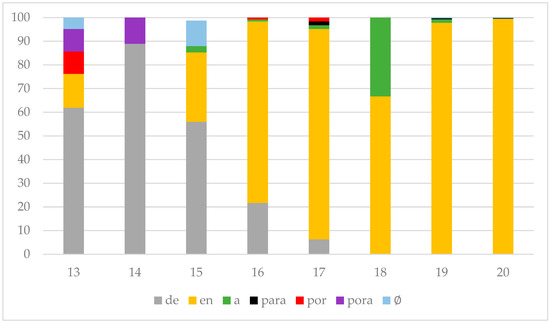

Disclaimer/Publisher’s Note: The statements, opinions and data contained in all publications are solely those of the individual author(s) and contributor(s) and not of MDPI and/or the editor(s). MDPI and/or the editor(s) disclaim responsibility for any injury to people or property resulting from any ideas, methods, instructions or products referred to in the content. |
© 2026 by the author. Licensee MDPI, Basel, Switzerland. This article is an open access article distributed under the terms and conditions of the Creative Commons Attribution (CC BY) license.