
Light Verbs and Syntactic Analyzability in the History of the Galician Language

Abstract
1. Introduction
2. Methodology
2.1. The Corpus
2.2. The Survey
3. Data Analysis
3.1. LV Constructions vs. Simple Verb
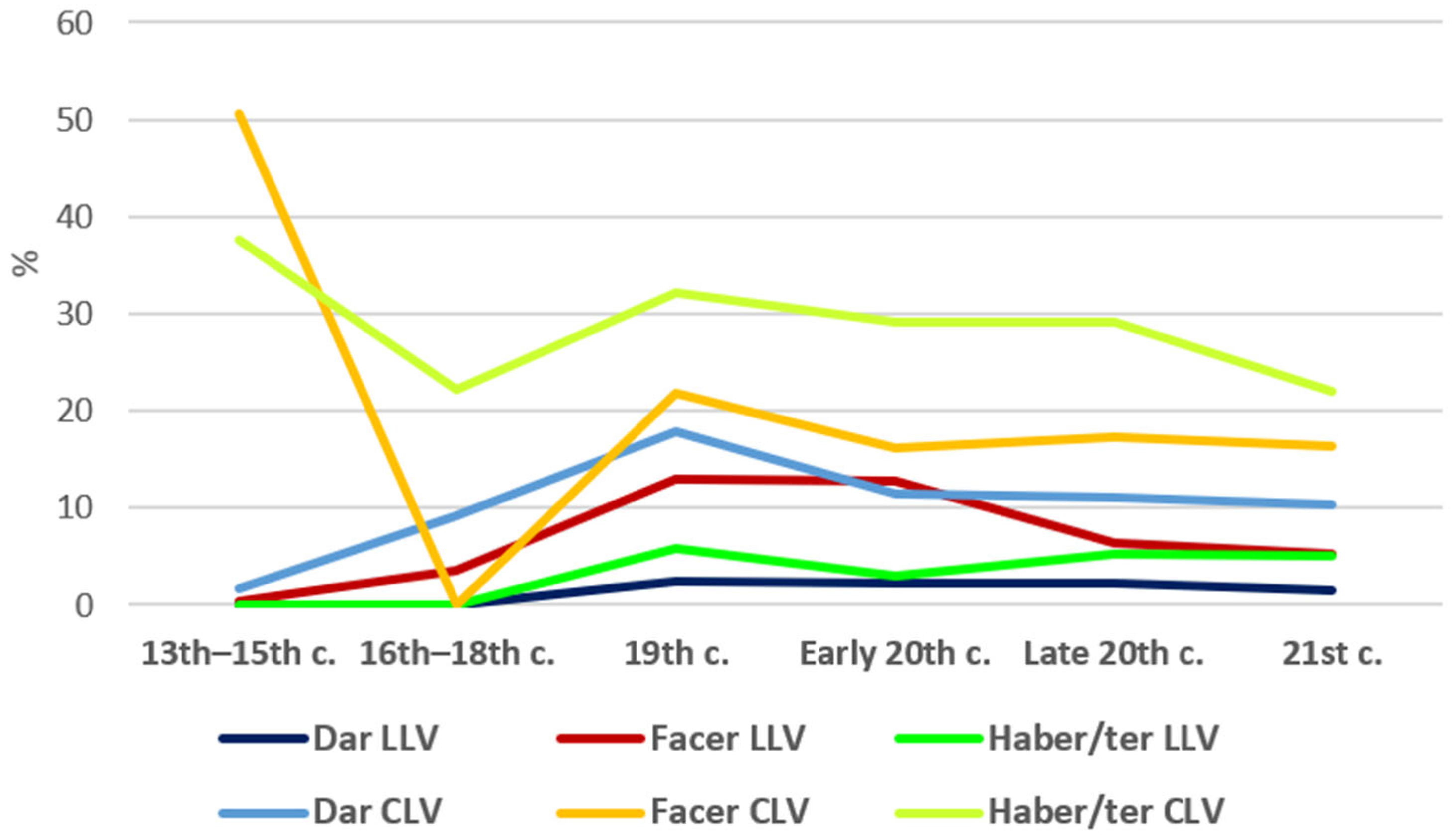
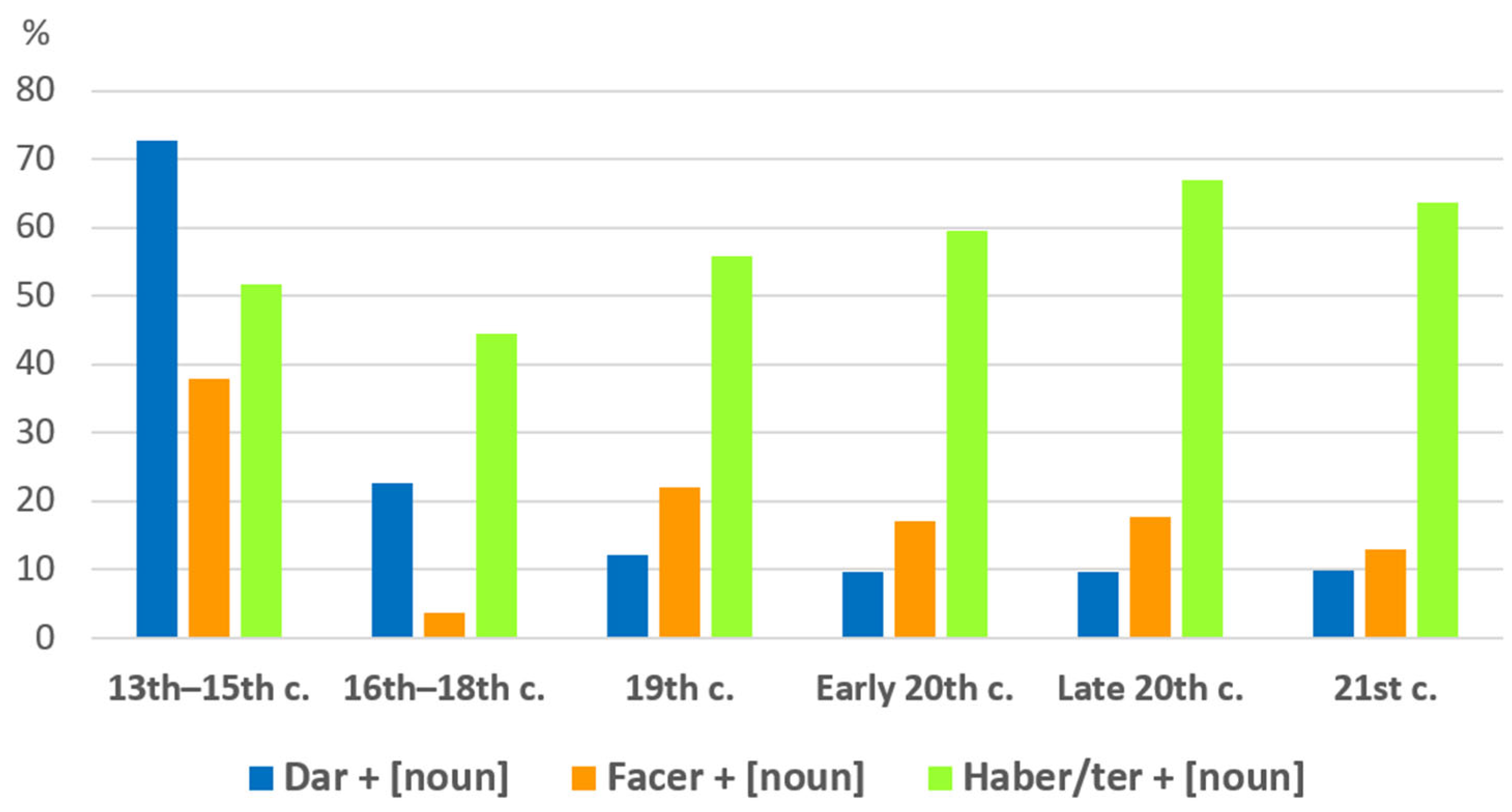
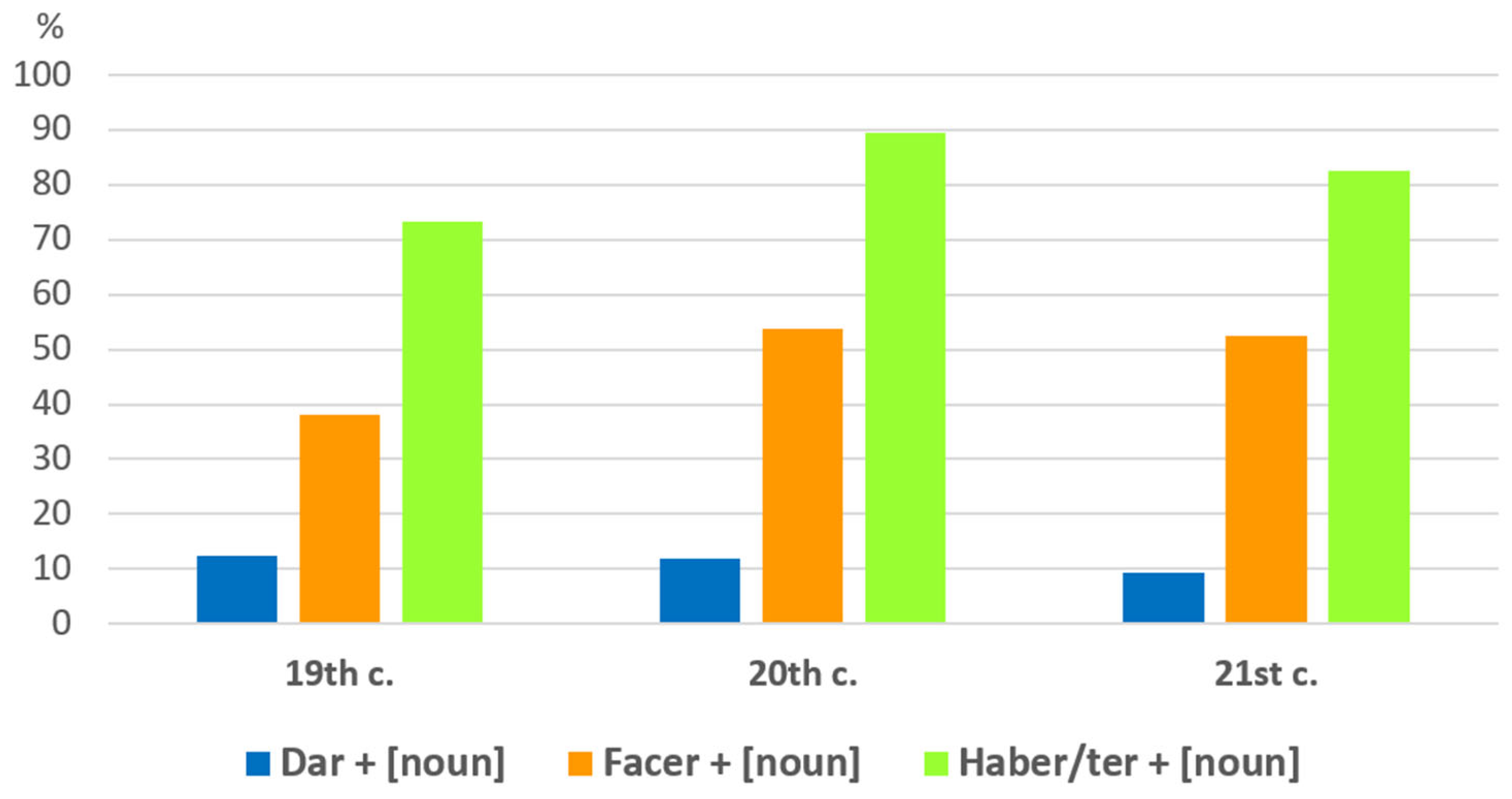
3.1.1. The Corpus Data
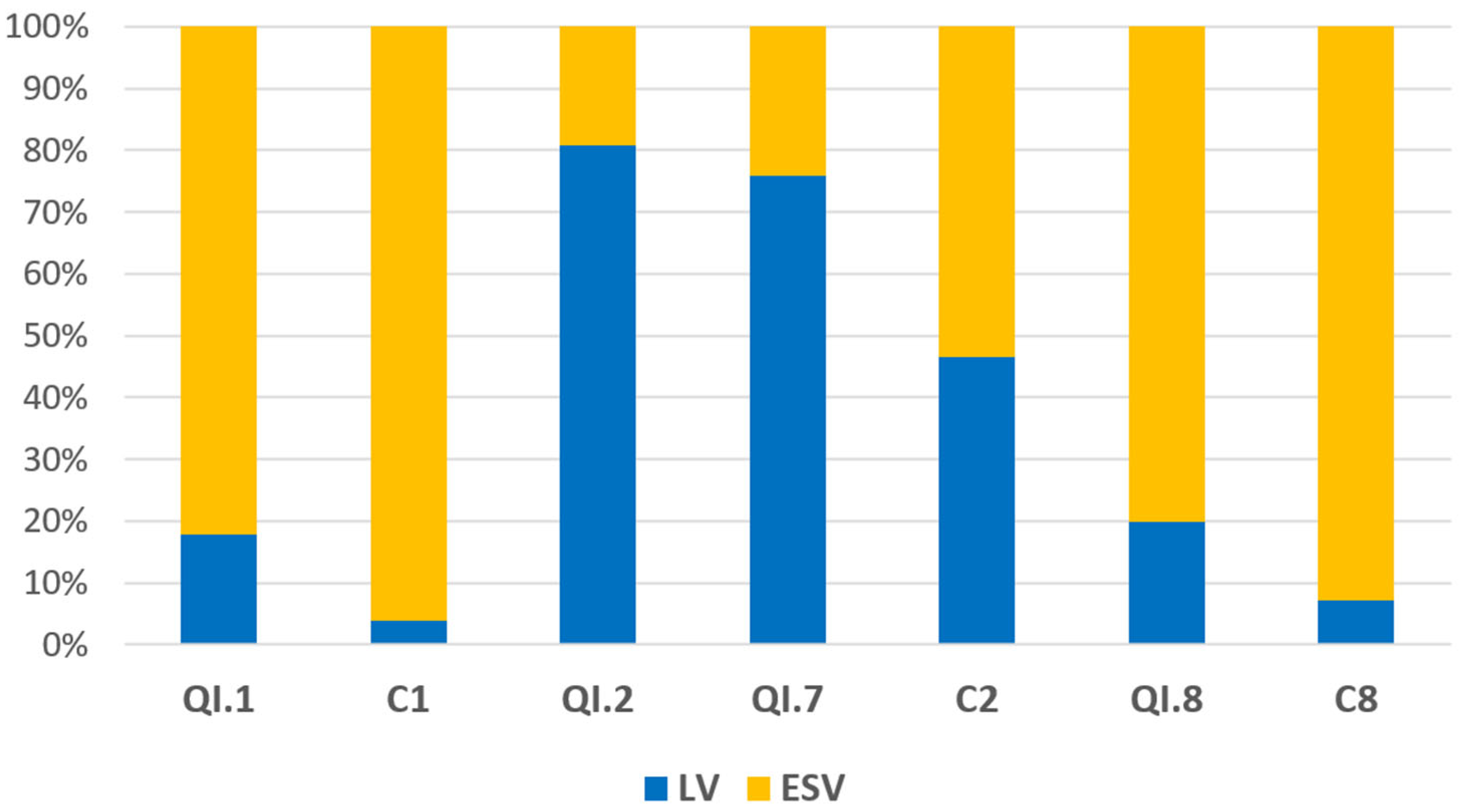
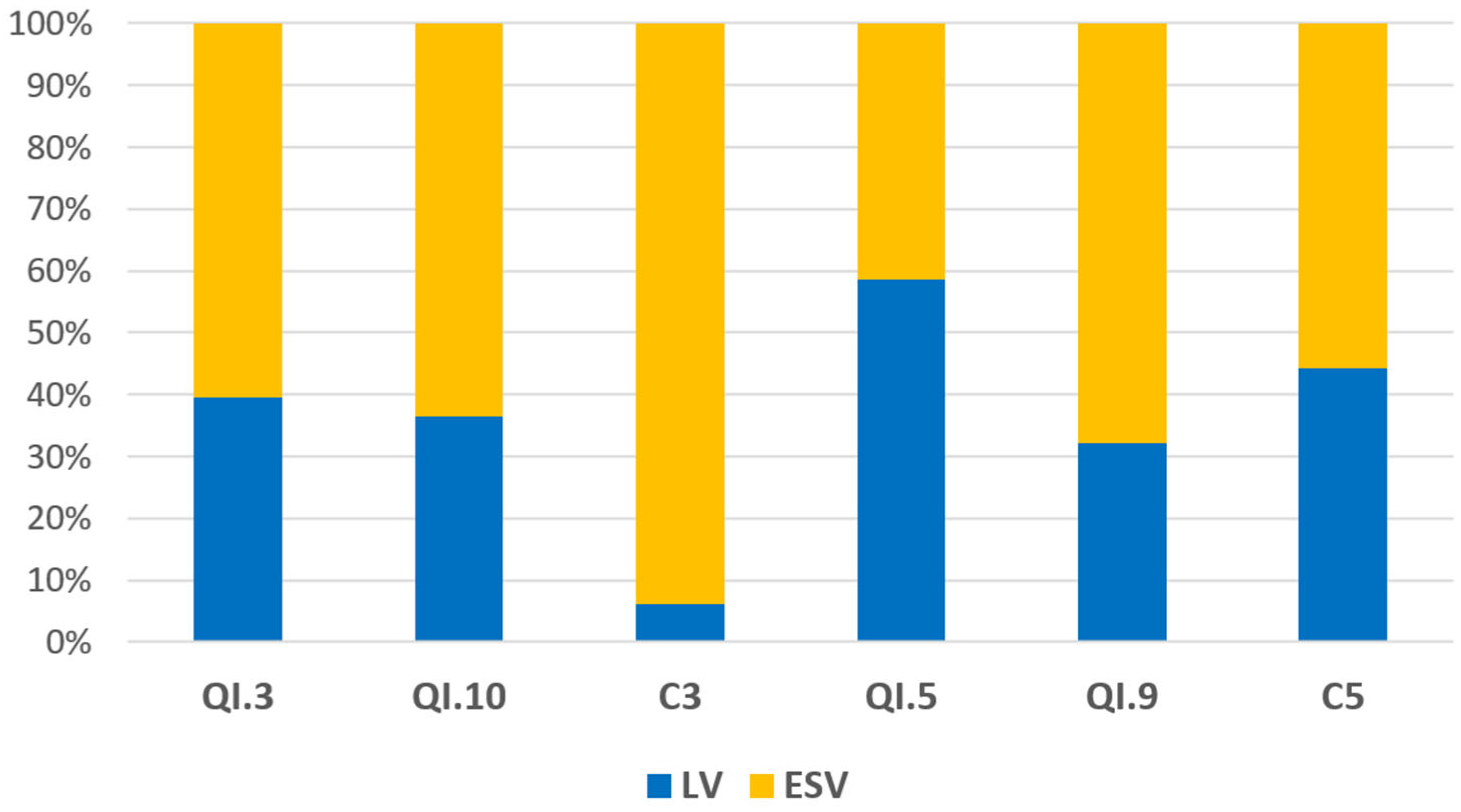
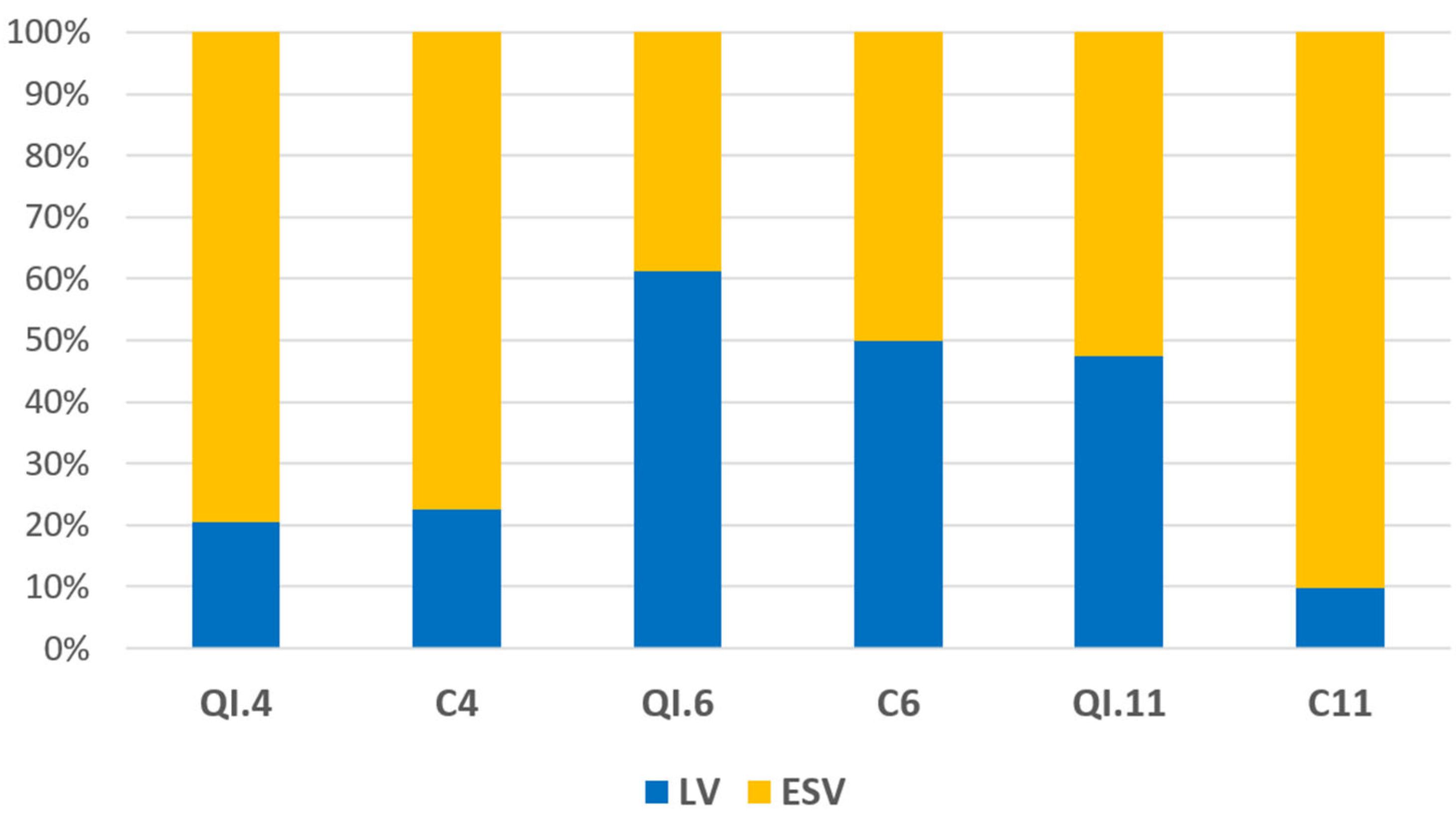
3.1.2. LV or Simple Verb in Survey Answers?
| (1) | A. | Dando berros non solucionas nada. |
| B. | Berrando non solucionas nada. | |
| “Complaining doesn’t solve anything” | ||
| (2) | A. | Comezou a dar patadas co cabreo que colleu. |
| B. | Comezou a patear co cabreo que colleu. | |
| “He started kicking with the anger he felt” | ||
| (3) | A. | Deulle patadas na barriga. |
| B. | Pateoulle a barriga. | |
| “He kicked him in the stomach” | ||
| (4) | A. | Tardaron moito en dar aviso do furacán tropical. |
| B. | Tardaron moito en avisar do furacán tropical. | |
| “They took a long time to warn about the tropical hurricane” |
| (5) | A. | Tiven tose durante toda a noite. |
| B. | Tusín durante toda a noite. | |
| “I coughed all night” | ||
| (6) | A. | Onte pola noite tiveches moita tose. |
| B. | Onte pola noite tusiches moito. | |
| “Last night, you coughed a lot” | ||
| (7) | A. | Díxolle: “Non debes de ter vergonza”. |
| B. | Díxolle: “Non debes de avergonzarte”. | |
| “He told him, ‘You should not be ashamed’” | ||
| (8) | A. | Ó final acabou tendo vergonza do seu pasado. |
| B. | Ó final acabou avergonzándose do seu pasado. | |
| “In the end, he ended up feeling ashamed of his past” |
| (9) | A. | Fixeron burla da súa voz como cantante. |
| B. | Burláronse da súa voz como cantante. | |
| “They mocked his voice as a singer” | ||
| (10) | A. | Facíanos acenos coa man para que fosemos. |
| B. | Acenábanos coa man para que fosemos. | |
| “They waved to us with their hand so we would go” | ||
| (11) | A. | Con tres anos de atraso, por fin, púidenche facer unha visita! |
| B. | Con tres anos de atraso, por fin, púidente visitar! | |
| “With three years of delay, finally, I was able to visit!” |
3.2. LV in Galician: Morphological-Syntactic Flexibility or Rigidity?
- −
- At the level of the noun: possibility of numerical variation and appreciative derivational variation (basically, with the noun in a diminutive form).
- −
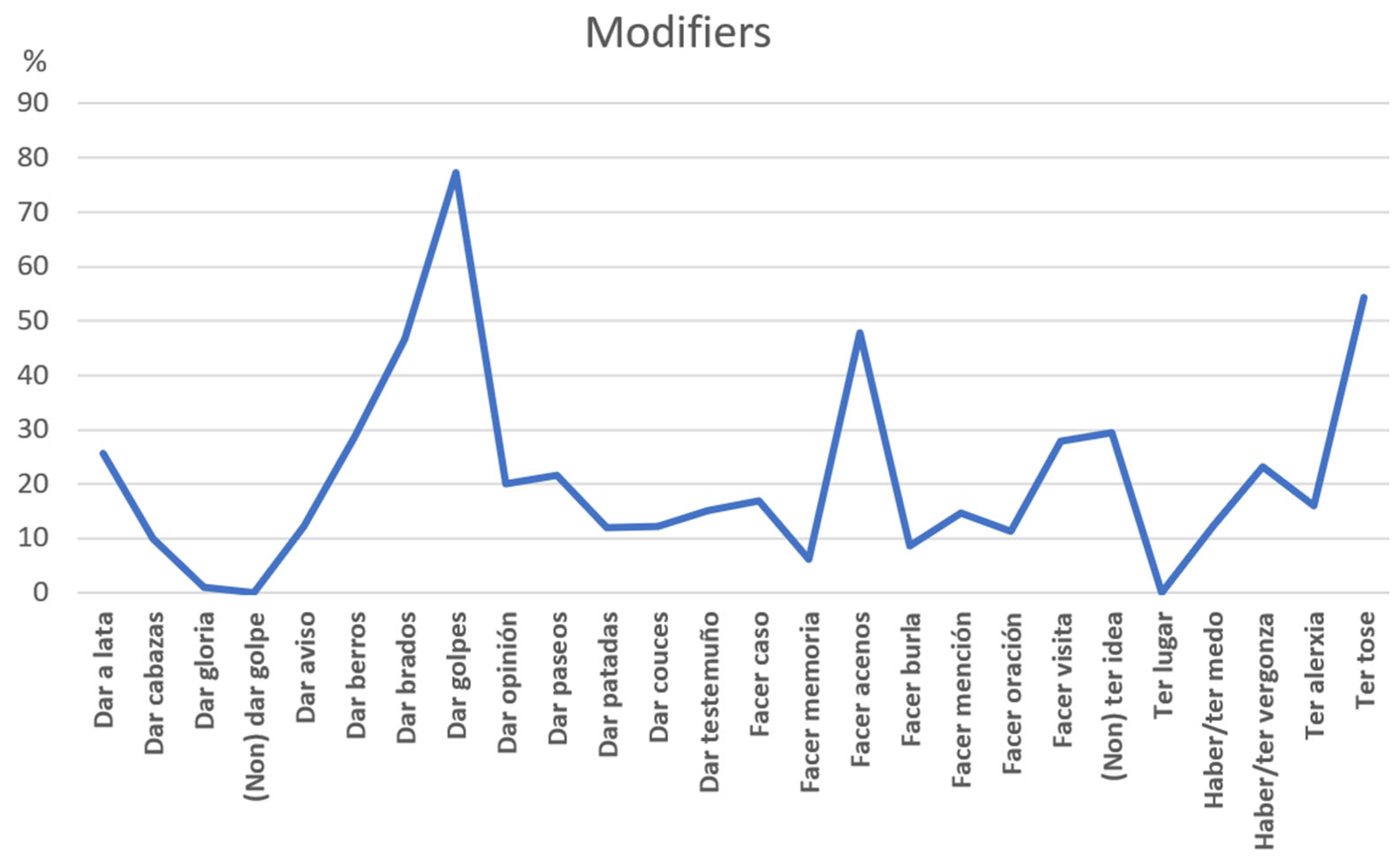
- Inside the nominal unit: presence of determiner and existence of some modifier of the noun (adjectival, prepositional, and indefinite/quantifiers; relatives).
- −
- In the relative position verb/noun: preposing or postposing of the noun to the verb and presence or absence of contiguity between both.
- −
- In the syntactic structure: of the noun, with the presence of a noun complement governed by the noun (second actant of the noun for Alonso Ramos, 2004) and of the verb, with the use of the function of indirect object (lexical and/or clitic).
- −
- Possibility that the noun is a member of a coordination scheme.
- −
- Relativization of the noun.
- −
- In addition, we also analyze the presence of negation.
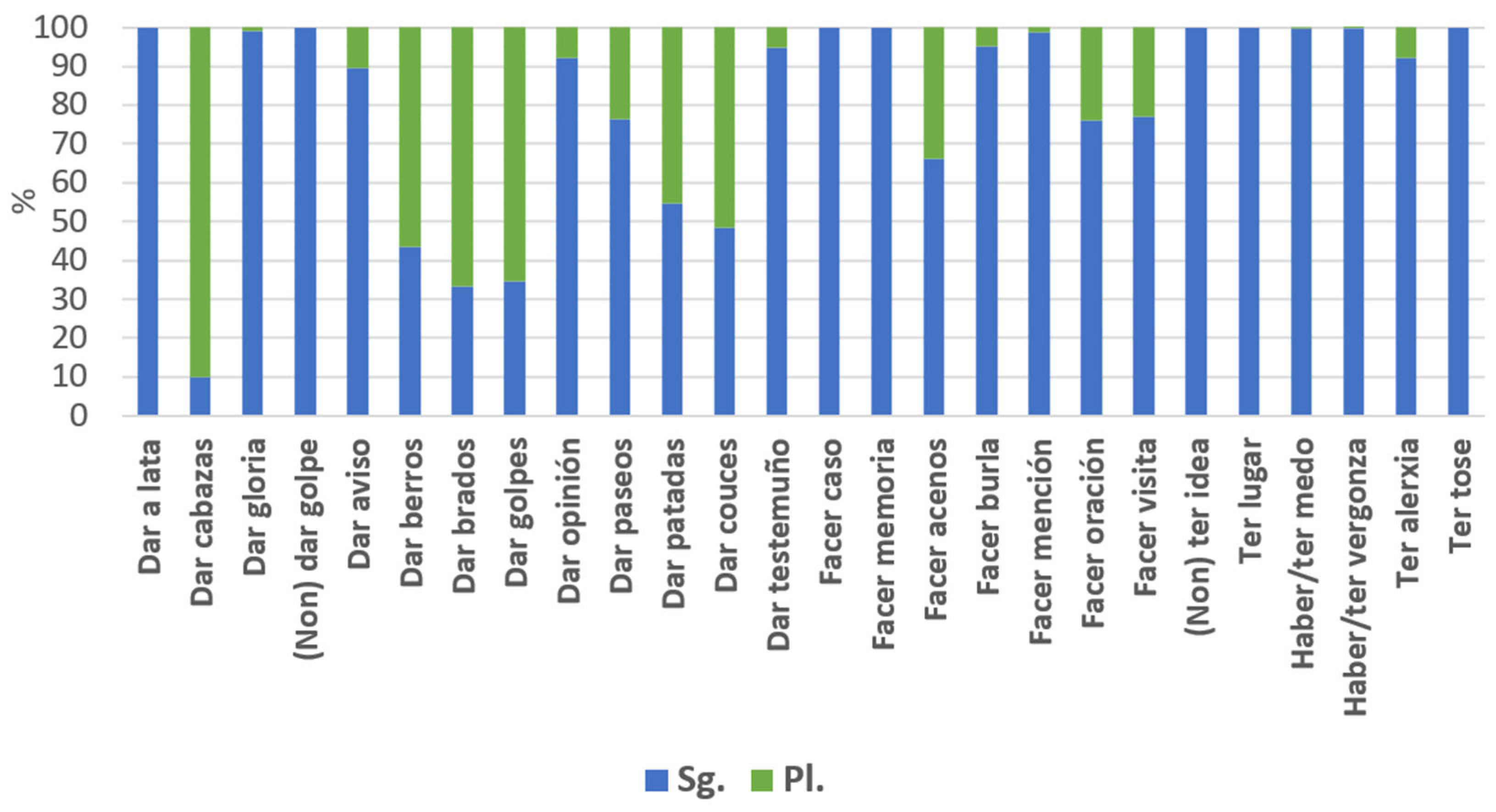
3.2.1. Numerical Variation
| (12) | a. | Nantronte deulle cabazas a un siñorito mui repinicado unha costureira da vila (OTM II,8/1883)10 |
| “The day before yesterday turned down a very refined young man a seamstress from the town” | ||
| b. | — Comigo soio, ¿e darás cabaza aos demais? (Alonso: Contos/1955) | |
| — “Only with me, and you will reject the others?” | ||
| (13) | a. | Fixen aceno de marchar (López López: Caderno/2001) |
| “I made a gesture to leave” | ||
| b. | Fai acenos coa man, chamando (Rodríguez Elías: Sobriño/1930) | |
| “He makes gestures with his hand, signaling” | ||
| (14) | a. | Acaso a tía terá alerxia? (65 2011/González Costa: Filla) |
| “Could it be that the aunt has an allergy?” | ||
| b. | temos alerxias (193 2007/Regueira: L’affiche) | |
| “we have allergies” |
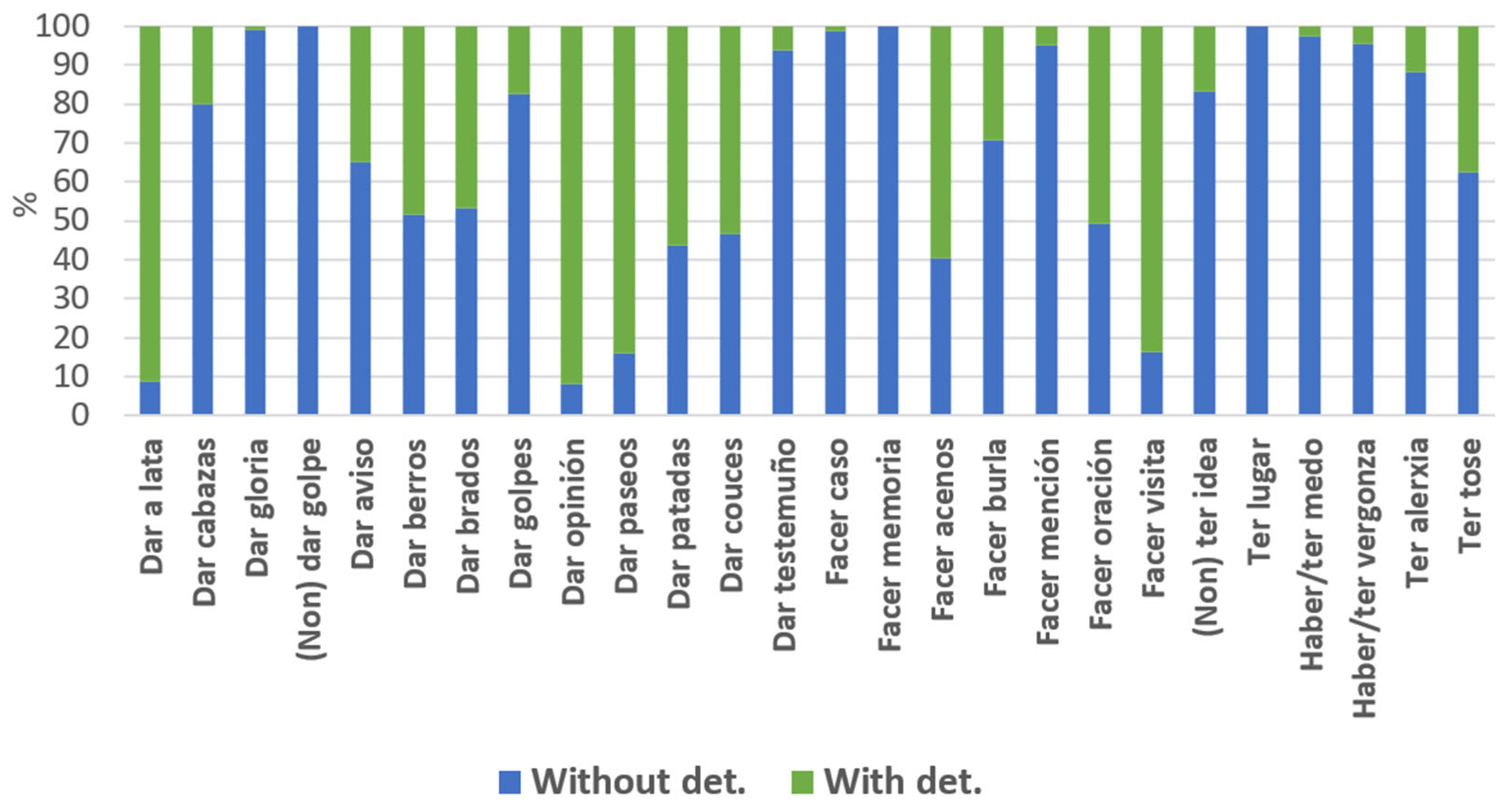
3.2.2. Presence of Determiner
| (15) | a. | Ninguén tiña a menor idea do seu parecido a ti (Veiga: Cinema/2005) |
| “No one had the slightest idea of his resemblance to you” | ||
| b. | cando non teñen idea do que foi o franquismo (Tempos 4/1997) | |
| “when they have no idea of what Francoism was” | ||
| (16) | a. | dando berros de trunfo (Carré Aldao: Rayolas/1898) |
| “shouting triumphantly” | ||
| b. | rapaz que dira o berro trunfal (Fernández González: Piruleiro/1925) | |
| “the boy who gave the triumphant shout” | ||
| (17) | a. | para facer as visitas proxectadas (Martínez Oca: Náufragos/1995) |
| “to carry out the planned visits” | ||
| b. | só facía visitas para mudar a venda unha vez por semana (Paz: Follas/2005) | |
| “he only made visits to change the window once a week” |
3.2.3. Presence of Modifiers
| (18) | a. | e deulle moitas couces (Gallego: Ourense/2001) |
| “and he kicked him several times” | ||
| b. | fixeron pouco caso das súas ordes (Reigosa: Fuxidos/1989) | |
| “they paid little attention to his orders” | ||
| (19) | a. | ouuo grã uergonça (CT 1/328/14th c.) |
| “he was greatly ashamed” | ||
| b. | facendo acenos negativos coa cabeza (Rei Ballesteros: Loaira/1992) | |
| “making negative gestures with his head” | ||
| (20) | Et quiseralle dar outro golpe (TC 1/427/14th c.) | |
| “and he wanted to strike him again” | ||
| (21) | e dárennos avisos que precisamos (Risco: Cultura espiritual/1962) | |
| “and they gave us the warnings we needed” | ||
| (22) | que o vello lle fora facer unha visita de rutina ao médico (Trigo: Extintos/1998) | |
| “the old man had gone to make a routine visit to the doctor” |
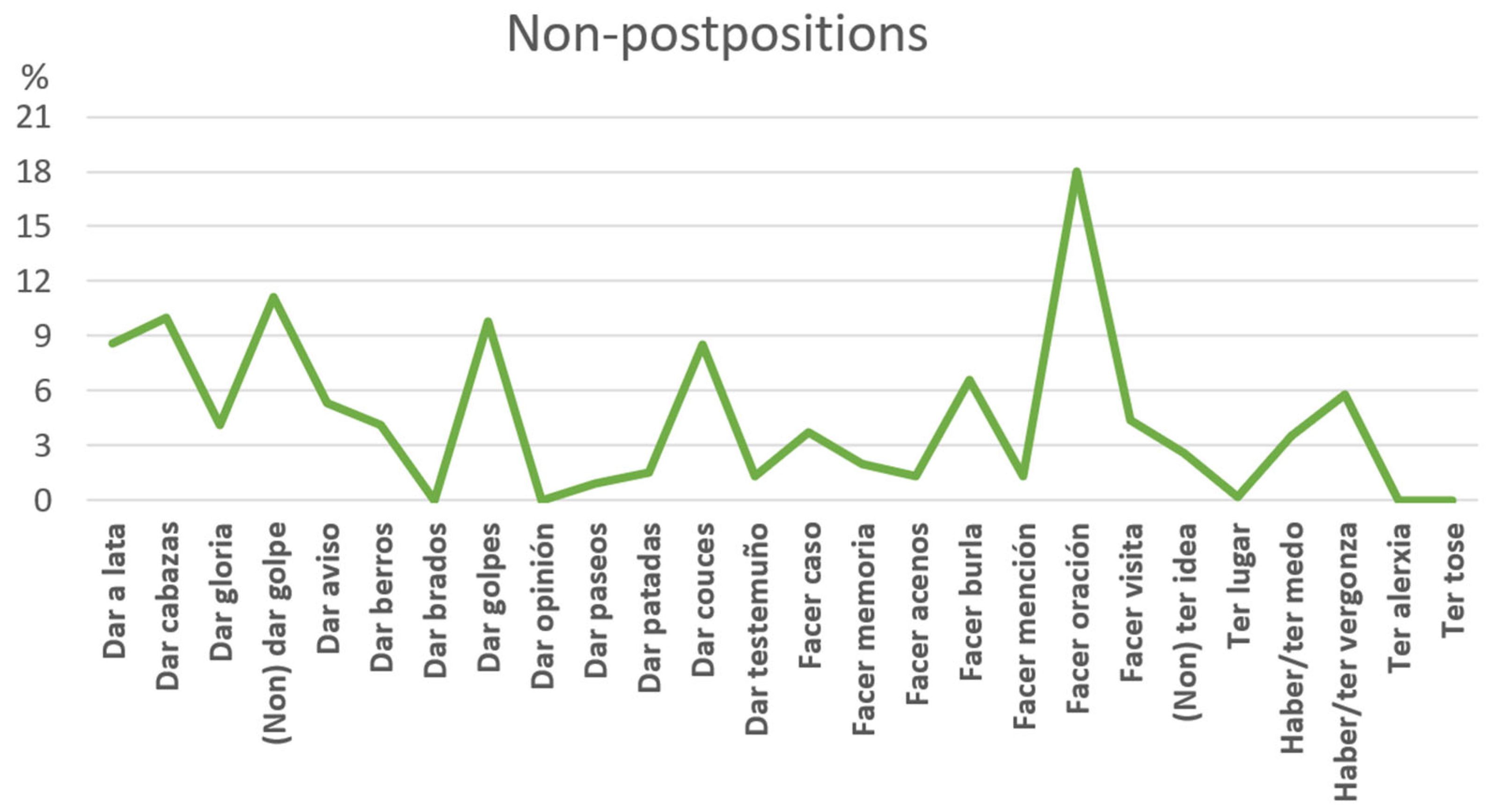
3.2.4. Preposing or Postposing of the Noun to the LV
| (23) | Pois ssa oraçon fezeron (CSM 165/553/13th c.) | |
| “After they had made their prayer” | ||
| (24) | ¡Que lata me vai a dar este tío! (Labarta: Língoa/1897) | |
| “This guy is going to pester me!” | ||
| (25) | e cabazas non lle deu ningunha delas (OTM II, 28/1884) | |
| “and none of them rejected him” | ||
| (26) | a. | Coyrmaão, quẽ uos este golpe deu (TC 1/752/14th c.) |
| “Cousin, the one who gave you this blow” | ||
| b. | Aló pola meia noite unhos fortes golpes dados na porta nosa (Carballal: Tesouro/1919) | |
| “Around midnight, some strong knocks on our door” |
3.2.5. Contiguity Between the Noun and the Verb
| (27) | cortexounas, e cabazas non lle deu ningunha delas (OTM II,28/1884) |
| “he courted them, and none of them refused” | |
| (28) | ¡Non lles teño eu medo (Feixoo: Contenda/1671) |
| “I am not afraid of them” | |
| (29) | As mulleres déronme pancadas e patadas (Miranda: Morning/1998) |
| “The women gave me punches and kicks” |
| (30) | dando cada cal súa opinión sobr’o asunto (Vázquez Taboada: Noites/1888) |
| “each one giving their opinion on the matter” | |
| (31) | ¡Conque faga vosté agora caso de certas faladurías! (Carré Aldao: Forxa/1919) |
| “So, now you’re going to take notice of certain gossip!” |
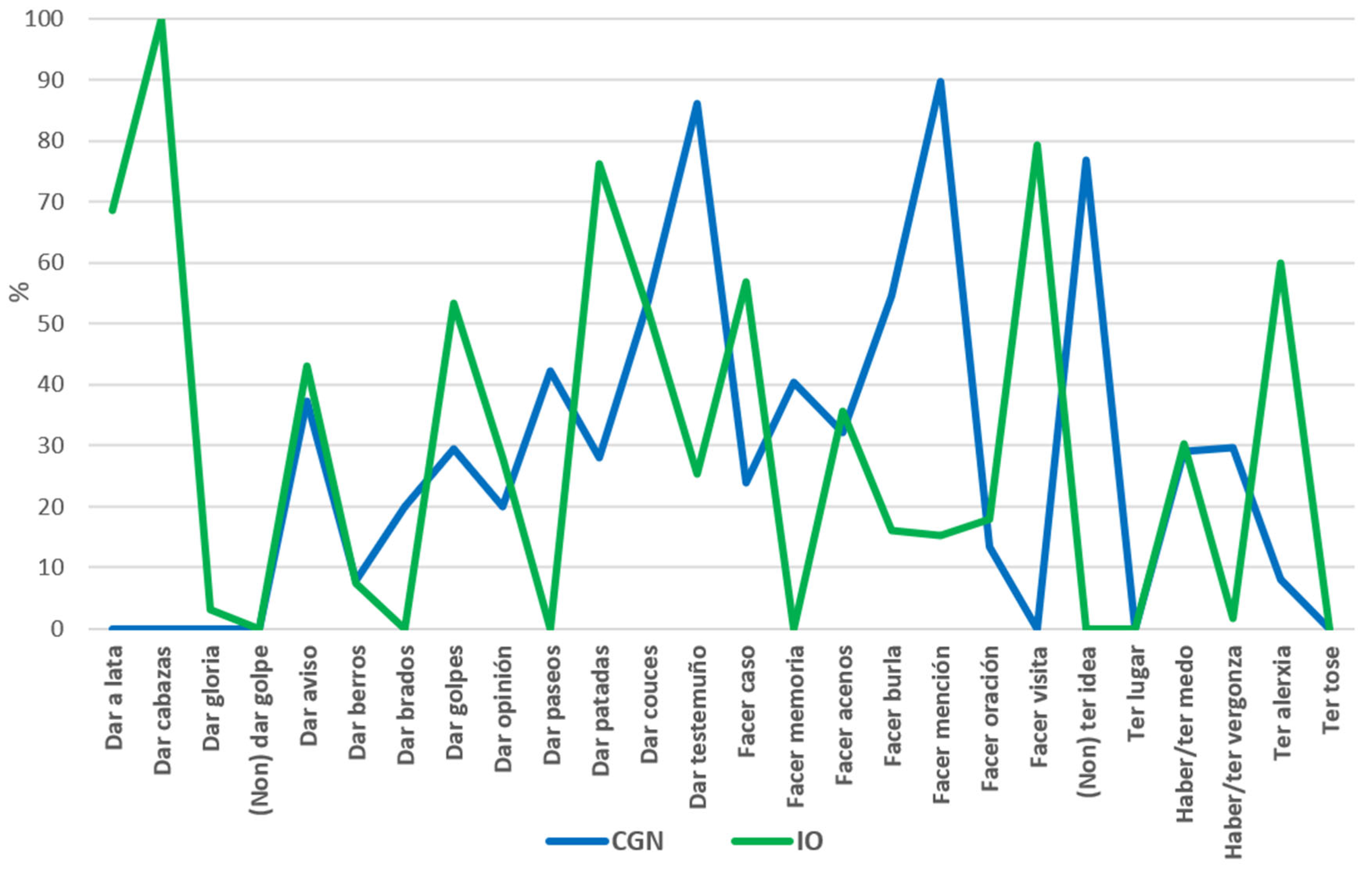
3.2.6. Presence of a Noun Complement Governed by the Nouns (CGN) and the Indirect Object (IO)
| (32) | xa dás testemuña da manda! (Gómez Vilavella: Historias/1992) |
| “you already bear witness to the legacy!” | |
| (33) | Teño idea de qu’había un por eiquí (Rodríguez Elías: Pano/1930) |
| “I have an idea that there was one around here” | |
| (34) | Fíxolle entón un aceno de agardar (Frías: Esperanzas/1997) |
| “He then made a gesture for to wait” | |
| (35) | Non teñas de min vergoña (Risco: Porco/1928) |
| “Don’t be ashamed of me” |
| (36) | Porparadevos, amigos, a faguer unha visita a iste labrego que vive co seu amor a Galicia (Galiciano 93/1886) | |
| “Get ready, friends, to pay a visit to this peasant who lives with his love for Galicia” | ||
| (37) | et quen quer que el cataua avia del medo (MS [I, 1]/133/15th c.) | |
| “and anyone who looked at him was afraid of him” | ||
| (38) | a. | — «Seica tés medo do lobo (Otero Pedrayo: Señores/1928) |
| “Maybe you are afraid of the wolf” | ||
| b. | non lle tes medo ao lobo (Cao: Idilios/1983) | |
| “you are not afraid of the wolf” | ||
| (39) | ou nõ ouuessen medo ao prínçepe que auã (CT 1/303/14th c.) | |
| “or they were not afraid of the prince they had” |
| (40) | o home da eixada (…) déralles aviso (Alonso Ríos: Afranio/1979) |
| “the man with the hoe (…) gave them notice” | |
| (41) | E deulle grandes berros ao conde Nuno Méndiz (Cabana: Morte/1996) |
| “And he shouted loudly at Count Nuno Méndiz” |
3.2.7. Appreciative Derivation, Coordinative Schemes and Relativization
| (42) | golpes que deron na parede (Q.II 14/Appendix A) |
| “knocks they gave on the wall” |
| (43) | a. | Deu un paseíño polo sobrado (Casado: Trancos/1970) |
| “He took a little walk through the attic” | ||
| b. | e ten unha tosiña que coido que lle irían ben os aires da mar (Reimóndez: Médico/1992) | |
| “and he has a little cough that I think would benefit from the sea breeze” | ||
| (44) | a. | Et o ome boo (…) esteue treze dias (…) fazẽdo esmolda et oraçõ (MS [I, 1]/213/15th c.) |
| “And the good man (…) spent thirteen days (…) begging and praying” | ||
| b. | empezou a dar couces e cabezazos contra a porta (Santamarina: Pinocchio/1987) | |
| “he started kicking and banging his head against the door” | ||
| (45) | a. | poidades atender na visita que agora faredes á Biblioteca América (Villares: Idea/1996) |
| “you may attend during the visit you will make now to the América Library” | ||
| b. | queixándose enfurecida da burla que fixera dela (Valladares: Contos/1888) | |
| “complaining angrily about the mockery made of her” |
3.2.8. Negative Polarity
| (46) | a. | Algo máis teño ideia de ll’haber dito que vostede esquence (Dieste: Fiestra (1)/1927) |
| “I have some idea of what I might have told you that you forget” | ||
| b. | Namentras os nosos labregos non teñan idea do que é a instrucción (Lugrís: Ponte/1903) | |
| “While our peasants have no idea of what training is” | ||
| (47) | e dende logo, da España non tén nen a máis pequena ideia (Risco: Mitteleuropa/1934) | |
| “and certainly he doesn’t have the slightest idea about Spain” | ||
| (48) | e o xenro tivo idea de coller unha miga de goberno (Otero Pedrayo: Señores/1928) | |
| “and the son-in-law had an idea of achieving a piece of the government” |
4. Survey Analysis
4.1. The Degree of Fixation of LV Constructions
- −
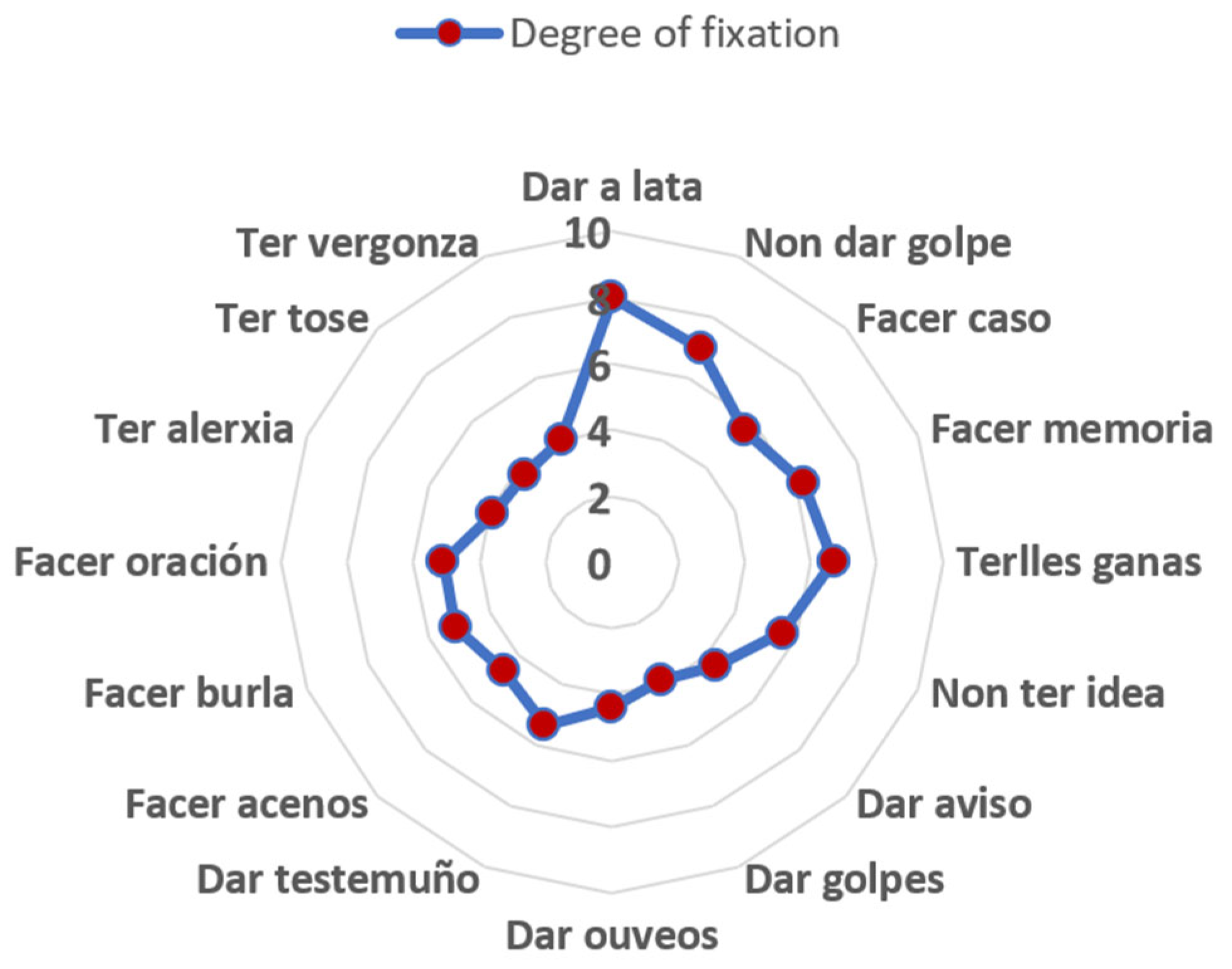
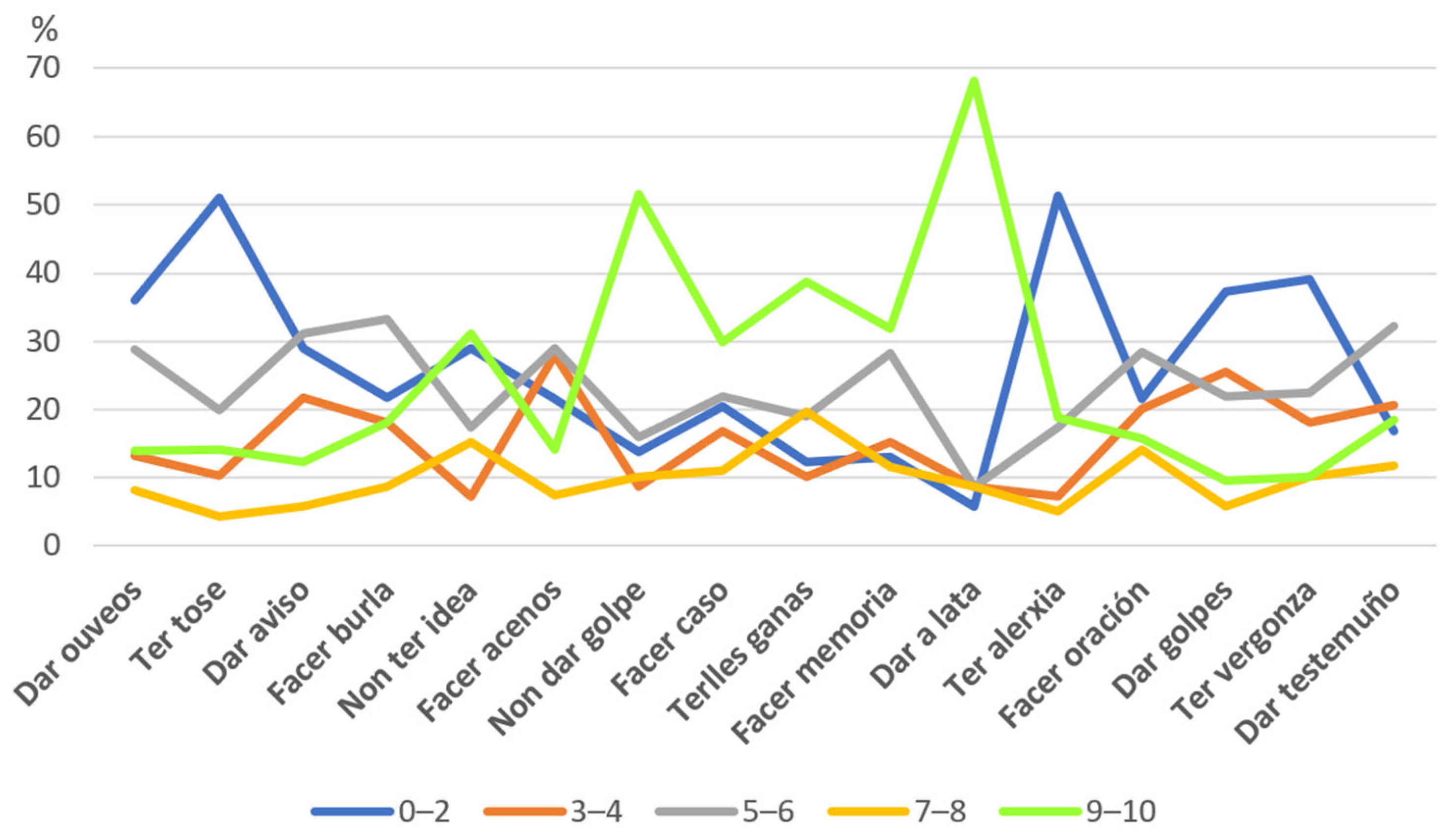
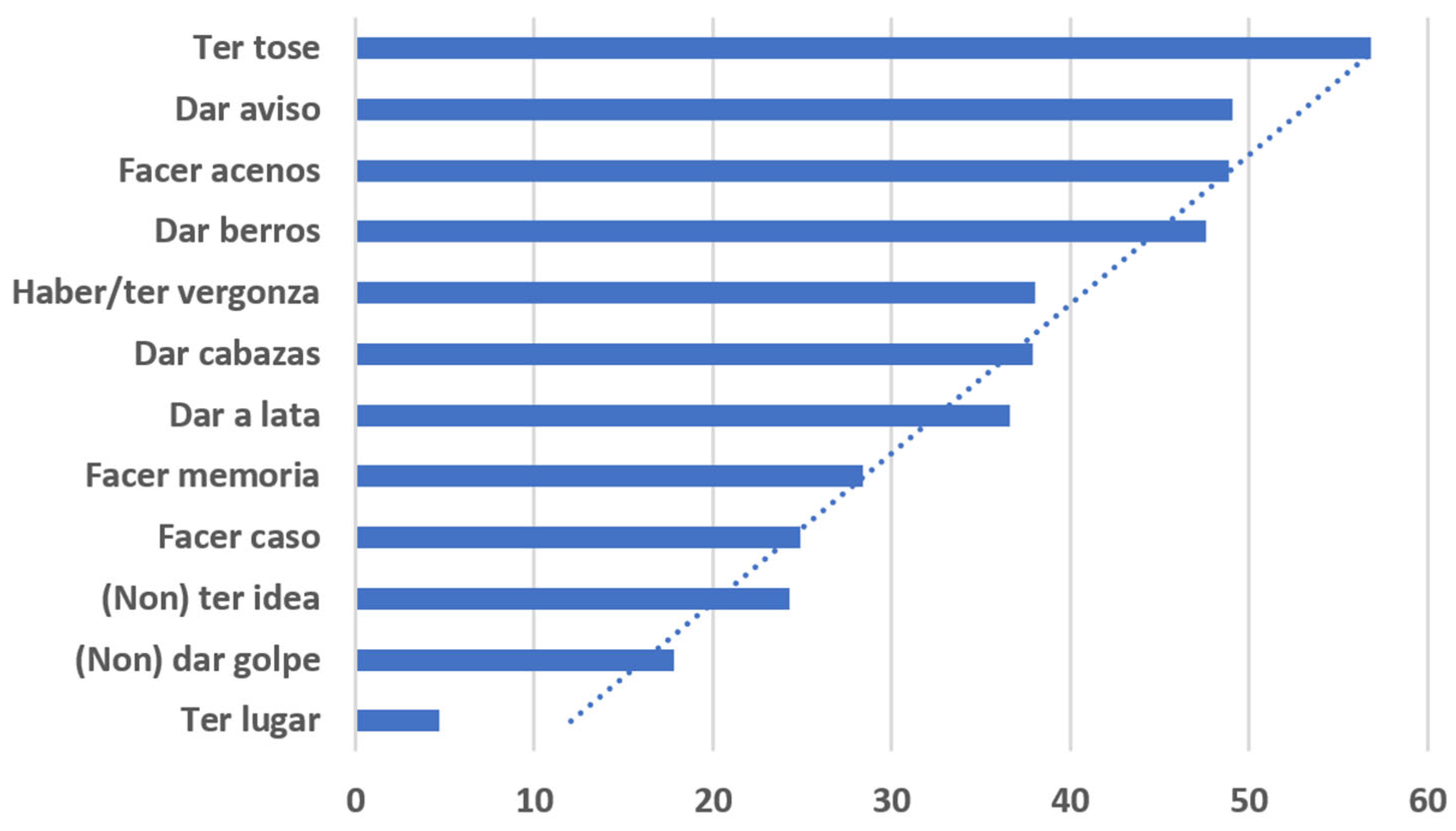
- The constructions with the lowest coefficient of variation are dar a lata (32.6%), terlles ganas (42.6%), non dar golpe (43.9%), facer memoria (45%) and dar testemuño (49.7%). The first of these, an LLV, is by far the one that shows the smallest coefficient of variation; that is, the data are very tightly clustered around the mean, which is the highest mean in the appraisal of fixation among all the proposed constructions. The next three are all LLVs, and the only CLV is dar testemuño, which among them presents the highest figure, very close to 50%.
- −
- In an intermediate band of the coefficient of variation, around 50–60%, we document facer oración (53.2%), facer burla (53.9%), (non) facer caso (55.7%), facer acenos (57%), non ter idea (59.8%) and dar aviso (60.3%). Here, the dispersion of the data relative to their means is somewhat greater than in the previous examples. Among them there are two LLVs ((non) facer caso and non ter idea); note the concentration in this band of four of the five LV constructions with the verb facer.
- −
- Finally, the five LV constructions with the highest coefficient of variation are dar ouveos (66.1%), dar golpes (69.7%), ter vergonza (71.3%), ter tose (82%) and ter alerxia (87.9%). For these items, especially for the latter, the dispersion of the data is quite significant, since for many informants the fixation is maximal (10 respondents directly chose “10” and 16 respondents chose “9”), while for many others the degree of fixation is relatively low or very low (21 answered “0” and 28 chose “1”).
4.2. Assignment of Syntactic Function
- −
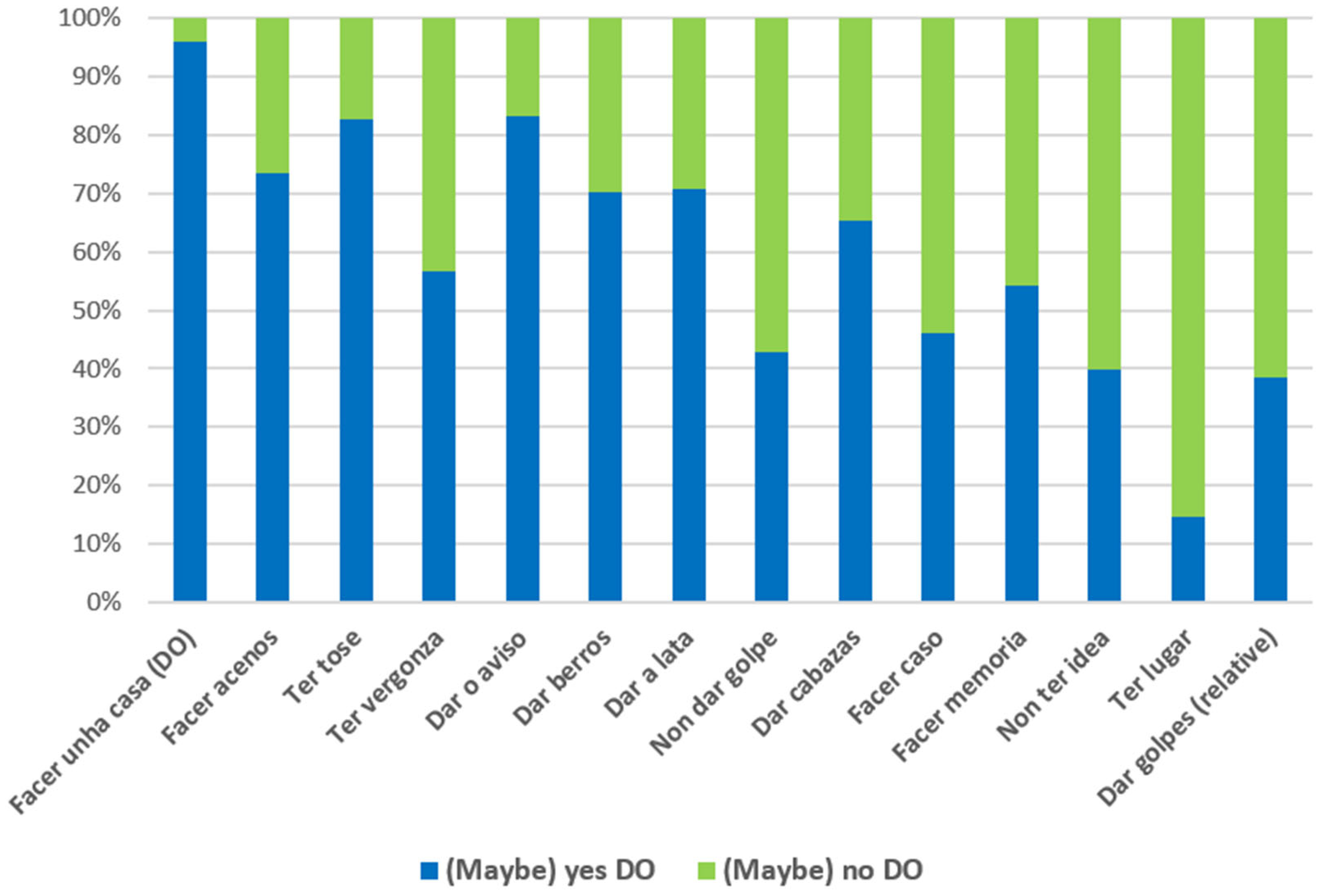
- For the “Yes” responses, the constructions with the highest CRI (between 0.64 and 0.66) are ter vergonza, (non) facer caso, facer memoria and dar o aviso; the rest oscillate between 0.53 and 0.61, and there is only one with an extremely low CRI, 0.29, ter lugar (that is, those who chose to assign the DO function to lugar did so with very little certainty).
- −
- For the “No” responses, there are only two examples with a high percentage of certainty when the noun is not interpreted as a DO: ter lugar (with 0.60), and the example with a relative clause, golpes que deron (with 0.55). There are five examples that fall within a CRI range of 0.42 to 0.48 and the majority, six, have a low CRI between 0.35 and 0.28; the latter corresponds to tiveches unha tose louca, the others are three LLVs (facer memoria, (non) ter idea and dar cabazas) and two CLVs (facer acenos and dar berros).
- −
- Regarding the overall CRI, the highest, at 0.62, corresponds to dar o aviso and the lowest, with less than half that figure, corresponds to (non) ter idea. The second highest is relatively close to the first and corresponds to golpes que deron (0.57), and the penultimate lowest is non dar golpe (0.48). Note that the two highest CRI values are all CLVs with the verb dar and the two lowest are LLVs. The rest of the examples move within a narrow range, between 0.51 and 0.55.
5. A Multiparametric Heterorganic Quantification of Syntactic Analyzability
5.1. Morphosyntactic Fixation Scale (MFS)
- −
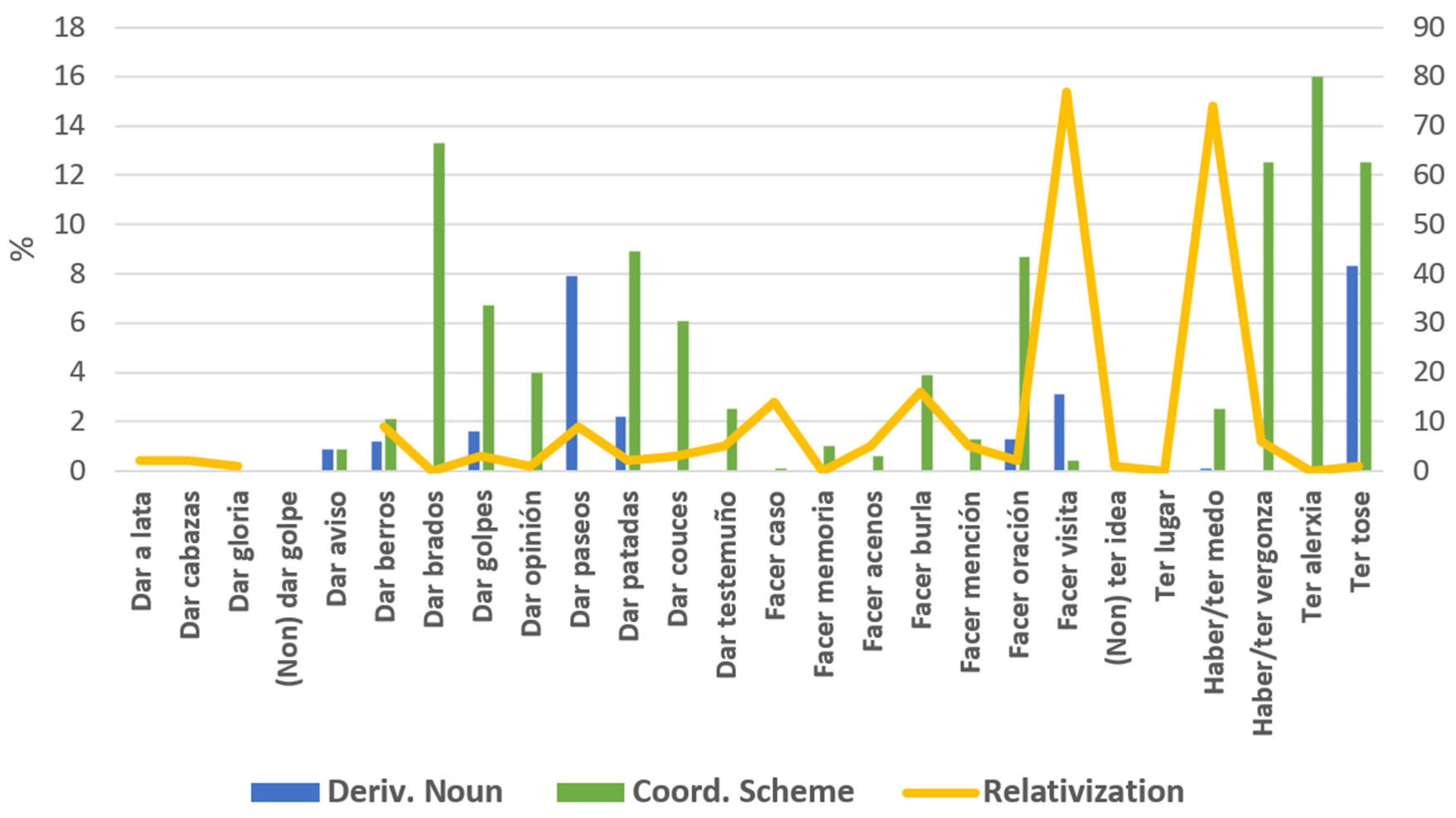
- Numerical variation [0.5]: Variation in the noun number is valued proportionally18 based on the percentage of the least represented number (a 50% variation will imply the maximum score/variation, and a 0% will correspond to the minimum). As the main purpose of this section is to quantify as objectively as possible the (non)variation in the structures studied as a whole, we do not introduce any correction factor, for example, based on the nature of the noun (such as collective nouns, plurale tantum nouns or (un)countable nouns) which, obviously, may limit the possibilities of variation and which will have to be developed in the specific study of each construction).
- −
- Variation in the determiner [0.5]: The same criterion as the previous one applies, but regarding the (non)use of the definite/indefinite article with the noun. According to Álvarez de la Granja’s data from her corpus of Galician phraseological units, the pattern verb + def. art. + noun accounts for 24.71%, and verb + noun for 12.71% (Álvarez de la Granja, 2003, p. 57). For Galician collocations with the verb dar, Martínez Vicente (2023, pp. 160–163) initially observes great flexibility, and the predominant pattern is one in which the collocation admits both the definite article and the indefinite article as well as its absence, in combination with the noun in the singular or plural (38.91%), followed by a pattern similar to the previous one but in which, when there is no article, the noun appears only in the plural (29.33%). For this reason, it seems fundamental to us to quantify (as with the numerical variation) the greater or lesser fixation in the presence or absence of the article, which manifests itself in greater or lesser variation in its (non-)use (since both options may be grammaticalized).
- −
- Existence of nominal modifiers [0.5]: based on the data obtained for Galician, 0.1 is assigned for every 15%, up to the maximum score with 75% or more of examples having some modifier.
- −
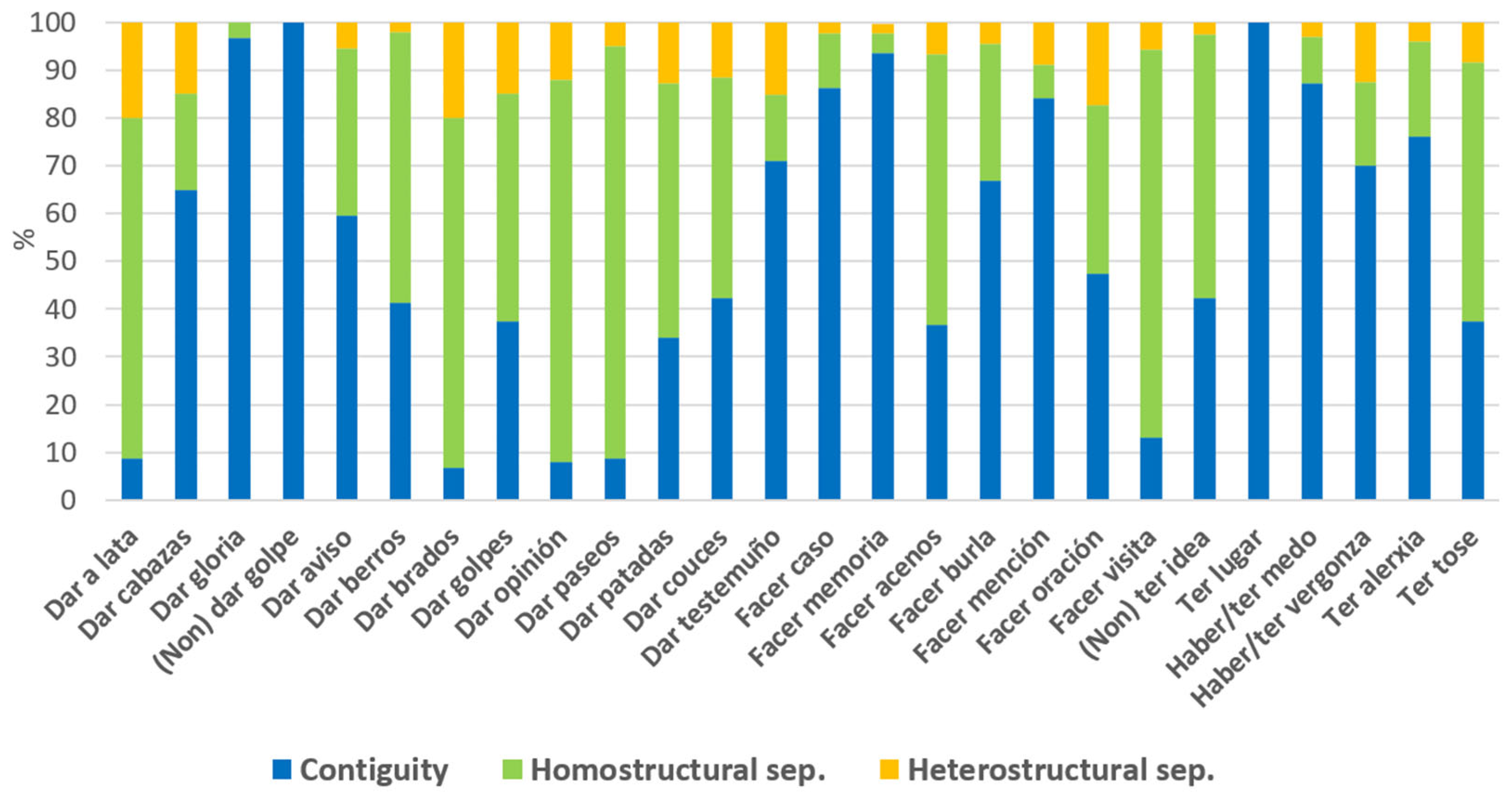
- Preposing and contiguity between noun and verb [0.5]: we assess cases of noun preposing up to a maximum of 0.2 (which is achieved with 20% of preposings), while non-contiguity (always of elements that do not belong to the nominal unit, heterostructural, cf. Section 3.2.5) is quantified up to 0.3 (a score achieved with 30% non-contiguity).
- −
- Complement governed by the noun (CGN) [0.5]: the existence of CGN is valued proportionally, reaching the maximum score with 100% CGN occurrences.
- −
- Appreciative derivation of the noun [0.5]: the maximum score for this concept is achieved with 10% derived nouns, which decreases proportionally (with a minimum of 0.1, as long as at least one example is documented).
- −
- Coordination schemes [0.5]: when the noun is part of a coordination scheme, the same scale is applied as in the previous criterion.
- −
- Finally, we also consider three other parameters not focused on the noun [0.5]: the existence of a simple verb19, indirect object (IO), and relativization examples (with a total score of 0.5 for all three). The presence of a simple verbal correlate equivalent to the LV construction is valued at 0.1; the presence of an IO (lexical, clitic, or doubled) is quantified proportionally up to a maximum of 0.1 with 100% of contexts having IO (and a minimum of 0.01 whenever at least one example is documented); finally, a 15% or more relativization examples20 are valued at 0.3, and the score decreases progressively to a minimum of 0.01.
- −
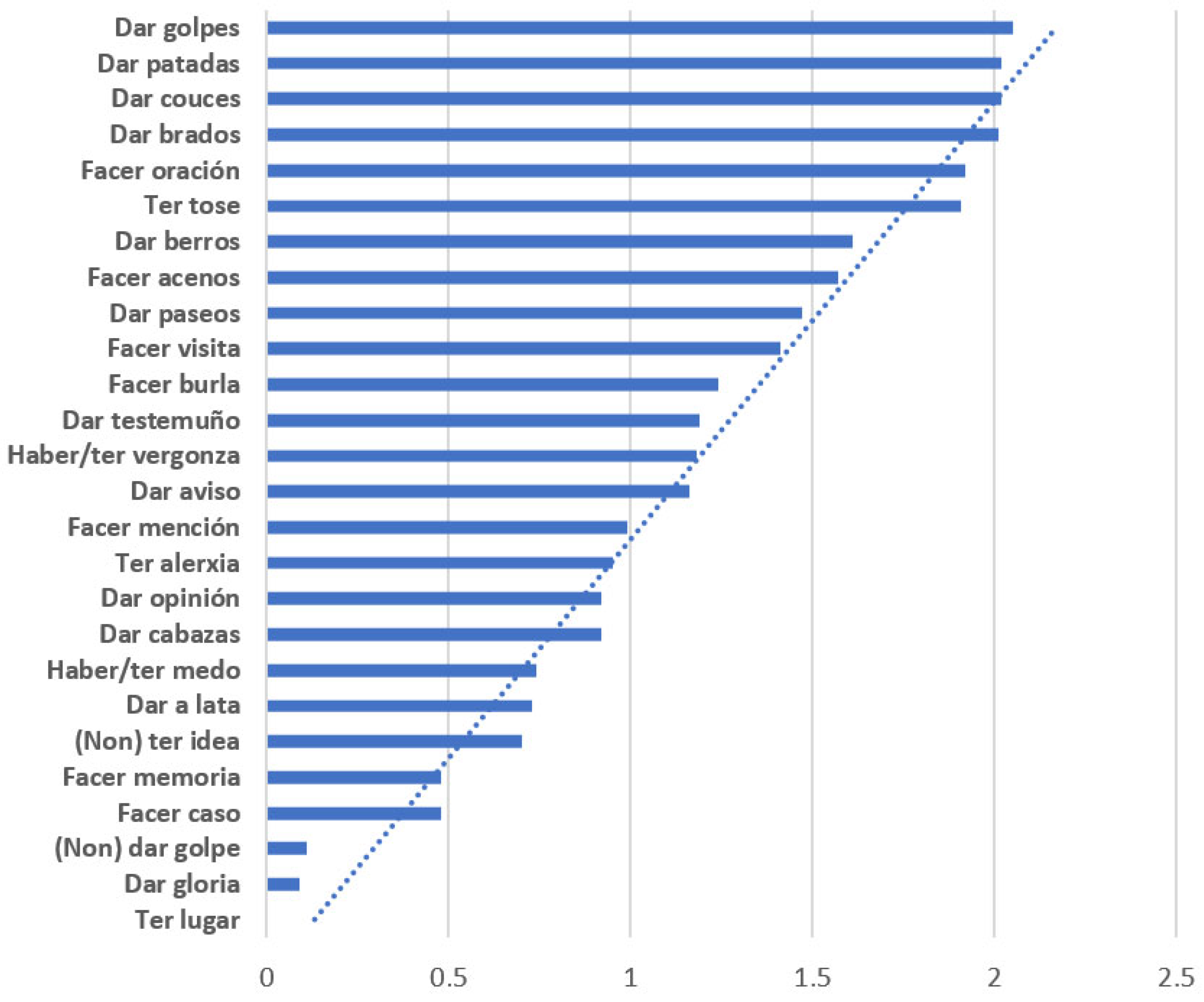
- First, the maximum score reached by these LV examples is 2 (exactly 2.05 for dar golpes), far from the theoretical maximum score of 4 (percentagewise, this represents 51.3% of the maximum value).
- −
- The gradual progression is evident, occurring without significant jumps or gaps, although there is some specificity at certain points on the scale.
- −
- The distinct scores of LLV vs. CLV are confirmed: seven of the eight LLV examples occupy the seven lowest positions on the scale (with the sole exception of dar cabazas, which, with only 20 occurrences, presents considerable variation, including IO and relativizations), while the 18 CLV examples consistently receive higher scores (except for haber/ter medo).
- −
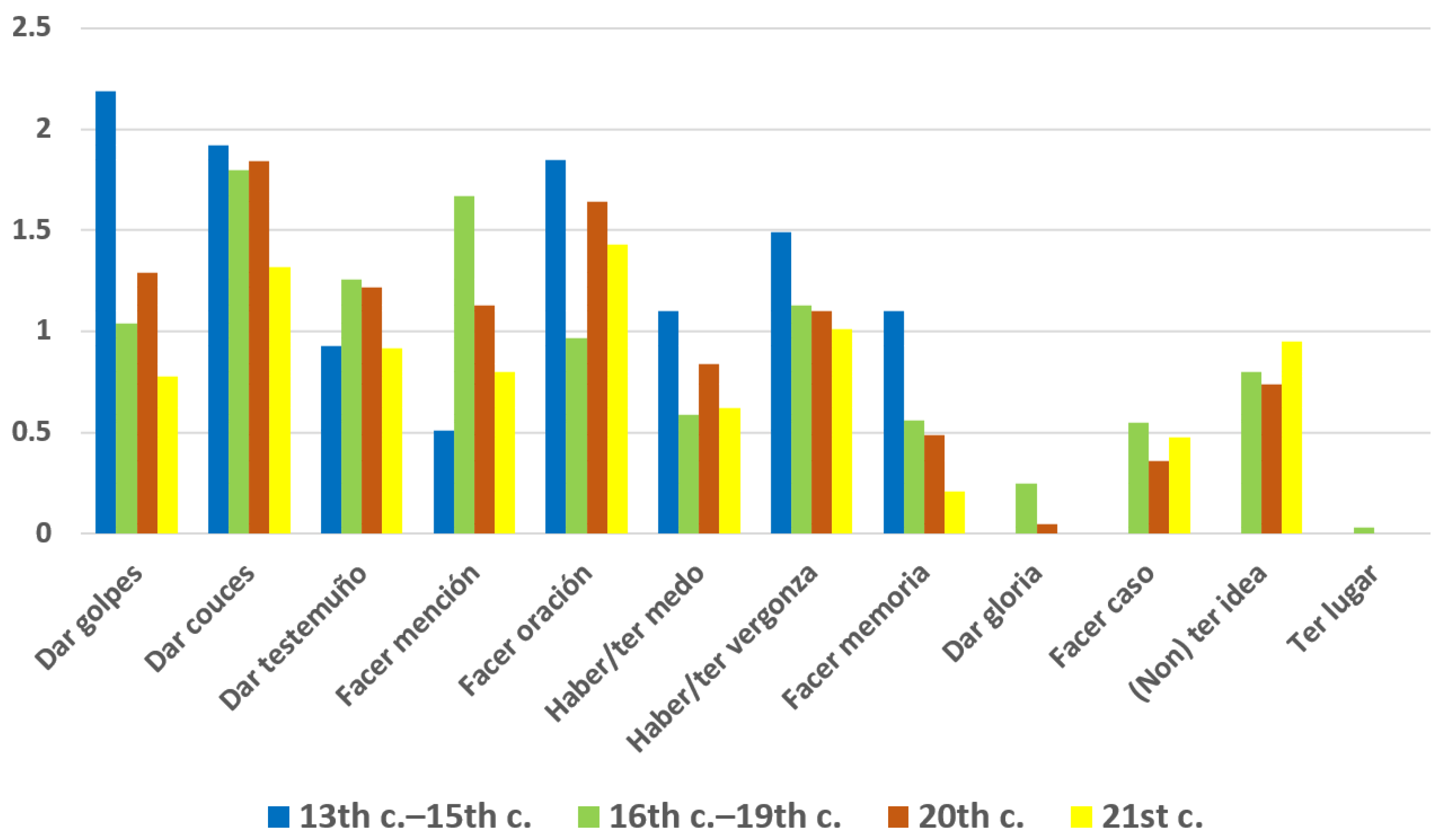
- However, not all units are concentrated around the same point; rather, there are specific behaviors. Of the LLVs, the following three show maximum fixation and, consequently, a very low MFS value: ter lugar (0), dar gloria (0.09) and non dar golpe (0.11). Also with a low score of 0.48 are facer caso and facer memoria, followed by three others in the 0.7 range: two LLVs, (non) ter idea (0.7) and dar a lata (0.73), and one CLV, haber/ter medo (0.74).
- −
- Relatively close to the latter are dar cabazas and dar opinión, with 0.92 each, along with ter alerxia (0.95) and facer mención (0.99), all below the value of 1. Most are CLV examples with lower variation.
- −
- The next group of CLVs is concentrated in the range from 1.16 for dar aviso to 1.24 for facer burla, with haber/ter vergonza (1.18) and dar testemuño (1.19) in between. These are followed by another subset of four CLV examples ranging from 1.41 for facer visita, to 1.47 for dar paseos, to 1.57 for facer acenos, to 1.61 for dar berros.
- −
- After this group, there is a small jump, and we find the last six cases of CLV, which display the highest MFS values and, consequently, a lower degree of fixation: they range from ter tose (1.91) and facer oración (1.92) to four examples that reach a score of two or higher: dar brados (2.01), dar couces and dar patadas with 2.02 each, and finally dar golpes (2.05).
5.2. Usefulness of a Syntactic Analyzability Index (SAI)
- −
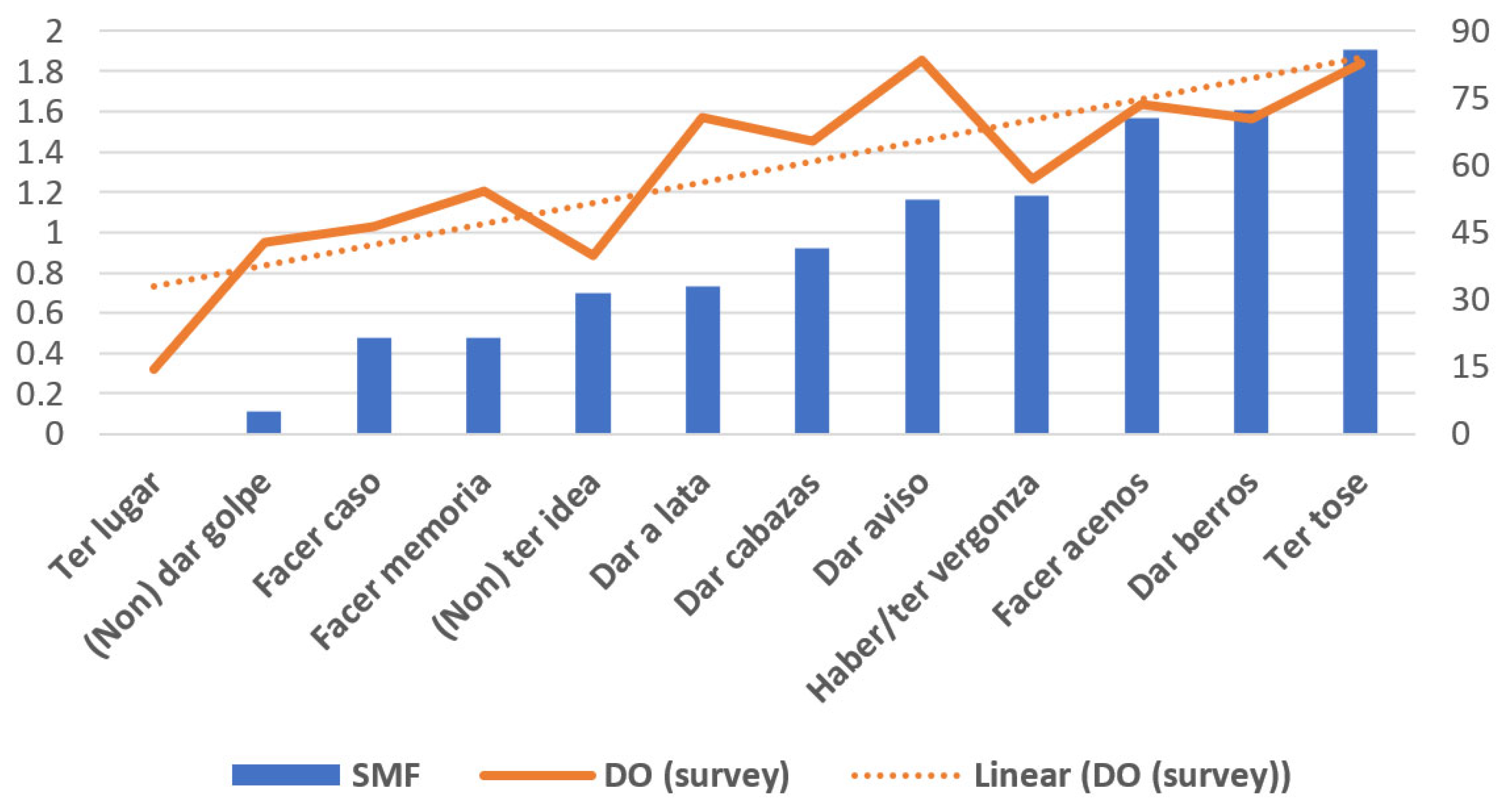
- MFS [%]: value in the MFS expressed as a percentage (cf. Figure 17 in Section 5.1).
- −
- DO: percentage at which the function of DO is identified in our survey (cf. Figure 16 in Section 4.2).
- −
- CRI “yes”: this is the index for the certainty of affirmative responses, applied to half of the percentage identifying the syntactic function as DO (cf. Table 7 in Section 4.2).
6. Coda
Funding
Institutional Review Board Statement
Informed Consent Statement
Data Availability Statement
Acknowledgments
Conflicts of Interest
Appendix A
- Question (I)
- Marca (x) a túa preferencia por unha das opcións, A ou B: se no teu galego só empregas unha, marca “Só A” ou “Só B”, e se utilizas as dúas, pero unha máis ca outra, marca “Máis A” ou “Máis B”: [“Choose (x) your preference for one of the options, A or B: if in your Galician you only use one, choose “Only A” or “Only B”, and if you use both, but one more than the other, choose “More A” or “More B””]
| 1 | (A) Dando berros non solucionas nada. |
| (B) Berrando non solucionas nada. “Shouting does not solve anything” | |
| 2 | (A) Comezou a dar patadas co cabreo que colleu. |
| (B) Comezou a patear co cabreo que colleu. “He started kicking things in anger” | |
| 3 | (A) Tiven tose durante toda a noite. |
| (B) Tusín durante toda a noite. “I coughed all night” | |
| 4 | (A) Fixeron burla da súa voz como cantante. |
| (B) Burláronse da súa voz como cantante. “They mocked his voice as a singer” | |
| 5 | (A) Díxolle: “Non debes de avergonzarte” |
| (B) Díxolle: “Non debes de ter vergonza” “He told him, "You should not be ashamed"” | |
| 6 | (A) Facíanos acenos coa man para que fosemos. |
| (B) Acenábanos coa man para que fosemos. “S/he waved at us to go over” | |
| 7 | (A) Deulle patadas na barriga. |
| (B) Pateoulle a barriga. “He kicked him in the stomach” | |
| 8 | (A) Tardaron moito en avisar do furacán tropical. |
| (B) Tardaron moito en dar aviso do furacán tropical. “They took a long time to warn about the tropical hurricane” | |
| 9 | (A) Ó final acabou avergonzándose do seu pasado. |
| (B) Ó final acabou tendo vergonza do seu pasado. “In the end, he ended up feeling ashamed of his past” | |
| 10 | (A) Onte pola noite tiveches moita tose. |
| (B) Onte pola noite tusiches moito. “Last night, you coughed a lot” | |
| 11 | (A) Con tres anos de atraso, por fin, púidente visitar! |
| (B) Con tres anos de atraso, por fin, púidenche facer unha visita! “After a three-year delay, finally, I was able to visit you!” |
- Question (II)
- Por favor, marca se analizas sintacticamente como Complemento Directo os fragmentos destacados: SI/Creo que SI/Creo que NON/NON [“Please choose one of the following options regarding the syntactic analyzability of the highlighted fragments as Direct Object:: YES/I think so//I don’t think so/NO”]
| 1 | FIXERON unha casa para toda a familia. “They BUILT a house for the whole family” |
| 2 | Ó final TEN vergonza do seu pasado. “In the end, he IS ashamed of his past” |
| 3 | Por favor, non me DEAS a lata con tanta petición! “Please, do not GIVE me a hard time with so many requests!” |
| 4 | A ver se FAS caso dunha vez. “Let us see if you PAY attention for once” |
| 5 | Pero cres de verdade que TEN idea do que significa iso? “But do you truly believe that he HAS any idea what that means?” |
| 6 | FACÍAnos acenos coa man para que fosemos. “He waved at us to go over” |
| 7 | Quere vivir do conto e sen DAR golpe. “He wants to live off others and without DOING any work” |
| 8 | Tardaron moito en DAR o aviso do furacán tropical. “They took a long time to GIVE the warning about the tropical hurricane” |
| 9 | FAI memoria, que aínda es moi novo para esquecer iso. “TRY TO REMEMBER, for you are still very young to forget that” |
| 10 | Onte pola noite TIVECHES unha tose louca. “Last night you HAD a terrible cough” |
| 11 | DANDO eses berros tan potentes non solucionas nada. “By GIVING such loud shouts you solve nothing” |
| 12 | Mañá TERÁN lugar todas as reunións. “Tomorrow all the meetings WILL TAKE place” |
| 13 | No último ano sempre DECHES cabazas a todas as propostas. “In the last year you have always REJECTED all the proposals” |
| 14 | Faloume dos golpes que DERON na parede. “He told me about the blows they GAVE on the wall” |
- Question (III)
- Puntúa de 0 a 10 os enunciados seguintes segundo creas que as palabras posúen entre si unha nula fixación e máxima liberdade de combinación, 0–2, (ver un atentado, ler un libro…), fixación ou restrición media, 4–6, (cometer un atentado ‘atentar’, soltar unha labazada ‘zoscar’…) ou rixidez entre elas moi alta, 9–10, (locucións ou unidades fraseolóxicas: meter o zoco ‘equivocarse’, tomar o pelo ‘burlarse’…) [“Please assign a score to the following expressions on a 0–10 scale, according to whether you believe that the words have zero fixation and maximum freedom of combination, 0–2, (watch an attack, read a book…), medium fixation or restriction, 4–6, (commit an attack ‘to attack’, to slap…) or very high rigidity between them, 9–10, (locutions or phraseological units: to make a mistake ‘be wrong’, pull someone’s leg ‘mock’…)”]
| 1 | Dar ouveos. “Give owls” | 9 | Terlles ganas. “To have it in for someone” |
| 2 | Ter tose. “To cough” | 10 | Facer memoria. “To remember” |
| 3 | Dar aviso. “Give notice” | 11 | Dar a lata. “To be a nuisance” |
| 4 | Facer burla. “Mock” | 12 | Ter alerxia. “Have an allergy” |
| 5 | Non ter idea. “Have no idea” | 13 | Facer oración. “To pray” |
| 6 | Facer acenos. “Make gestures”, “bekon” | 14 | Dar golpes. “To hit” |
| 7 | Non dar golpe. “Not to lift a finger” | 15 | Ter vergoña. “To be ashamed” |
| 8 | Facer caso. “To pay attention” | 16 | Dar testemuño. “Testify” |
| 1 | Note the special productivity of dar and hacer as LVs in Spanish within corpora of economics, law, computing, and genomics (Lorente, 2006, pp. 119, 124, 128 e 131, respectively). For the LVs in Spanish, in general, Alonso Ramos (2004, pp. 318–325) provides 67 examples of collocational constructions with the verb dar, 96 with hacer and 104 with tener (to gauge the importance of these figures, 22 examples are provided with tomar, 18 with poner and 6 with sentir). |
| 2 | Among LLVs, those studied with the verb dar present the fewest occurrences on average (40), compared with 577 with ter and 854 with facer (thanks above all to (non) facer caso); with CLVs there is more balance between those with the verb dar (133) and those with the verb facer (216), whereas haber/ter amount to 857 (thanks to haber/ter medo). |
| 3 | We worked exclusively with documents written in Galician (not in Latin or Castilian). |
| 4 | Despite this very low figure, we decided to retain this period throughout the whole investigation, for coherence, as evidence of the special historical situation of written Galician in these centuries and also because, on occasion, the first occurrence of some structures is documented precisely in this period. To give an idea of the dearth of documentation, the number of words present in the TILG corpus from the 17th and 18th centuries is 33,518 (in the 19th century there are 3,014,321 words). A table with specific information on each LV is not included due to space limitations and because diachronic information on a large part of them is already provided throughout the work. |
| 5 | Question (I) was answered by 160 people, (II) by 150 and (III) by 139 (cf. Appendix A). The survey was completely anonymous, was answered in written form in October 2025, and on average it took under 15 min to complete it. |
| 6 | All historical variants are included. |
| 7 | This preference, with a mean of 51.8% for all three verbs, reminds us of the preference for verb + [meteorological noun] structures in the Middle Ages, such as aver/fazer vento “it is windy”, instead of meteorological verbs such as ventar “to blow” (Cidrás Escáneo, 1986, pp. 201–204). |
| 8 | The frequency of these verbs is relatively low (cf. with the frequency dictionary of Bugarín López, 2007): temer, with 72 occurrences, has 2440 words ahead of it; avergo(nz/ñ)arse has 19 attestations and there are 5912 words more frequent than it; tusir occurs 17 times and there are 6348 words with a higher frequency. |
| 9 | Berlage observes a greater preference in English for simple verbs over constructions with LV, whose frequency of use has decreased over time, a fact that the author explains not only by “system-internal competition between the CP and the simple verb” but also because the “increasing preference for the non-analytic simple verb” may be related to “speakers’increasing striving for economy of expression” and a preference for “shorter and less time-consuming expressions” (Berlage, 2025, pp. 191–192). We conducted a check with our LV structures and their equivalent simple verbs, and the syllable correlation in the infinitives with the verb dar is 3.63/2.88, with facer it is 4.67/2.5, and with ter it is 3.33/2.67, respectively. The greater economy of the simple verbs is clear, but these data do not exactly correspond to the behavior observed, particularly for dar/facer. |
| 10 | In the examples we always use the reference that appears in the corpus from which they were obtained. |
| 11 | |
| 12 | Polarity does not affect the presence of the CGN at all: it is always 75%. |
| 13 | We calculate this coefficient by dividing the standard deviation by the mean, and the result is shown as a percentage. |
| 14 | Unless otherwise indicated, we group, on the one hand, the answers “Yes” and “I think so” [it is a DO] and, on the other, “No” and “I don’t think so” [it is a DO]. |
| 15 | We did not include either dar cabazas, dar a lata or non dar golpe, because the nouns are obviously concrete (with abstract contextual meaning) and they can still be associated with the fruit, with a physical object made of this material and with the literal sense of “blow”, respectively. Melendo, for Spanish, cites precisely the example dar calabazas as one of those that allows the noun to be analyzed as the DO of the verb dar (Melendo, 1965, p. 14). Despite the difficulties in delimiting concrete and abstract nouns, this is an operational distinction (for its definition, cf. Alonso Ramos, 2004, pp. 149 and, more generally, 147–154). |
| 16 | We must not forget that in the question about the fixation of these constructions, dar ouveos is relatively close to dar golpes, and the fixation of the latter is even half a point lower, in fact it is one of the lowest of all, cf. Figure 17. |
| 17 | For example, the overall CRI for the control question (Fixeron unha casa para toda a familia, n = 150) is very high, 0.83 (“Yes” + “No” 125 + 1 = 126 > 83.3%; “I think so” + “I don’t think so” 19 + 5 = 24 > 16.7%). On the other hand, the CRI of the affirmative answer is even higher with 0.87, and that of the negative one is very low, with 0.17. |
| 18 | The parameter’s (non)existence is quantified, as well as the proportion of its attestations. |
| 19 | |
| 20 | This number is based on the specific cases we found, on average, for Galician. |
| 21 | In the two cases in which this is not so, facer mención and dar testemuño, it is very likely that textual typology has much to do with the greater fixation in medieval Galician of the first, since 31 of 33 examples belong to notarial prose. The second, dar testemuño, presents a more balanced situation compared to other centuries and, in fact, in the medieval Galician examples the majority also come from notarial prose, but in a lower proportion, 11 of 20. |
References
- Alba-Salas, J. (2020). Construccionalización y obsolescencia en las colocaciones tipo caerle/venirle/entrarle en N‘agrado’. Revista de Filología Española, 100(1), 9–36. [Google Scholar] [CrossRef] [Scilit]
- Alonso Ramos, M. (2004). Las construcciones con verbo de apoyo. Visor Libros. [Google Scholar]
- Alvariño, M. D. P., Martínez, M. L., & Sánchez, B. (2007). As colocacións nos dicionarios e obras terminográficas. Cadernos de Lingua, 29, 155–171. [Google Scholar] [CrossRef] [Scilit]
- Álvarez, R., & González Seoane, E. (Eds.). (2017). Gondomar. Corpus dixital de textos galegos da Idade Moderna. ILG. Available online: http://ilg.usc.gal/gondomar/ (accessed on 30 November 2025).
- Álvarez de la Granja, M. (2003). As locucións verbais galegas. Universidade de Santiago de Compostela. [Google Scholar]
- Álvarez de la Granja, M. (2010). O tratamento lexicográfico dos verbos soporte no marco da teoría da metáfora. In M. D. Sánchez Palomino (Ed.), Lexicografía galega e portuguesa. Anexos de Revista de Lexicografía 13 (pp. 53–66). Universidade da Coruña. [Google Scholar]
- Álvarez de la Granja, M. (2025). Phraseology. In X. Sousa, & E. González Seoane (Eds.), Manual of galician linguistics (pp. 157–172). De Gruyter. [Google Scholar]
- Baránov, A., & Dobrovol’skij, D. (2009). Aspectos teóricos da fraseoloxía. CRPIH. Available online: http://www.cirp.es/pub/docs/cfg/aspectos_teoricos_fraseoloxia.pdf (accessed on 30 November 2025).
- Barrios Rodríguez, M. A. (2015). Las colocaciones del español. Arco/Libros. [Google Scholar]
- Berlage, E. (2025). Composite predicates in English: Processes of specialization. Cambridge University Press. [Google Scholar]
- Bosque, I. (2006). Práctico. Diccionario combinatorio del español contemporáneo. SM. [Google Scholar]
- Bugarín López, M. X. (2007). O galego fundamental: Dicionario de frecuencias. Fundación Pedro Barrié de la Maza. [Google Scholar]
- Bustos Plaza, A. (2006). Verbos generales y verbos específicos: Conjuntos y clases de argumentos en colocaciones de verbo y sustantivo. Epos: Revista de Filología, 22, 51–65. [Google Scholar] [CrossRef] [Scilit]
- Bybee, J. (2010). Language, usage and cognition. Cambridge University Press. [Google Scholar]
- Castilho, A. T. D. (2014). Nova gramática do português brasileiro. Contexto. [Google Scholar]
- Chishman, R. L. D. O., & Abreu, D. T. B. D. (2014). Construções com verbos-suporte: Propriedades gramaticais e discursivas. Linha D’Água, 27(1), 153–168. [Google Scholar] [CrossRef] [Scilit]
- Cidrás Escáneo, F. A. (1986). A indeterminación do axente na lingua das Cantigas de Santa María (I). Verba, 13, 181–235. [Google Scholar]
- Corominas, J., & Pascual, J. A. (1991–1997). Diccionario crítico etimológico castellano e hispánico. Editorial Gredos. [Google Scholar]
- Corpas Pastor, G. (1998). Expresións fraseolóxicas e colocacións: Clasificación. In Actas do I Coloquio Galego de Fraseoloxía (1997) (X. Ferro Ruibal, Coord.; pp. 31–61). CRPIH. [Google Scholar]
- Cotelo, R. (2017). Lexical combinations in Galician. In S. Torner, & E. Bernal (Eds.), Collocations and other lexical combinations in Spanish: Theoretical, lexicographical and applied perspectives (pp. 315–323). Routledge. [Google Scholar]
- Fraser, B. (1970). Idioms within a transformational grammar. Foundations of Language, 6(1), 22–42. [Google Scholar]
- Gonçalves, A., & Raposo, E. B. P. (2013). Verbo e sintagma verbal. In Gramática do português (Vol. II, pp. 1155–1218). Fundação Calouste Gulbenkian. [Google Scholar]
- González González, M. (Director). (2012). Dicionario da Real Academia Galega. RAG. Available online: https://academia.gal/dicionario (accessed on 30 November 2025).
- González Seoane, E., Álvarez de la Granja, M., & Boullón Agrelo, A. I. (2006–2022). Dicionario de dicionarios do galego medieval. Available online: https://ilg.usc.gal/ddgm/ (accessed on 30 November 2025).
- Gómez Clemente, X. M. (2024). A aplicación dos criterios microestruturais do Dicionario Histórico e Etimolóxico da Lingua Galega (DHELG): A voz testemuño. In M. Belina, B. Dondelewski, & A. Jackiewicz (Eds.), Abrindo rutas, expandindo camiños. Novas perspectivas nos estudos lingüísticos e literarios galegos (pp. 51–74). Faculty of Modern Languages—University of Warsaw. [Google Scholar]
- Hopper, P. J., & Thompson, S. A. (1980). Transitivity in grammar and discourse. Language, 56(2), 251–299. [Google Scholar] [CrossRef] [Scilit]
- Kardela, H. (2021). Analyzability in cognitive grammar: A reappraisal. Prace Filologiczne, 76, 211–229. [Google Scholar] [CrossRef] [Scilit]
- Koike, K. (2011). Tipología de las colocaciones verbonominales: De las colocaciones a las locuciones verbales. Takushoku Language Studies, 125, 1–39. [Google Scholar]
- Langacker, R. W. (1987). Foundations of cognitive grammar. Vol. I. Theoretical prerequisites. Stanford University Press. [Google Scholar]
- Lorente, M. (2006). Colocaciones con verbos de soporte en el discurso especializado. Filología, 38, 99–137. [Google Scholar]
- López Taboada, C., & Soto Arias, M. R. (2020). Dicionario de fraseoloxía galego-castelán/castelán-galego. Xerais. [Google Scholar]
- Luft, C. P. (2010). Dicionário prático de regência nominal. Ática. [Google Scholar]
- Martínez López, J. A., & Reyes Tejedor, M. (2024). Los verbos frasales como elementos del marco locucional. Lexis, 48(2), 672–712. [Google Scholar] [CrossRef] [Scilit]
- Martínez Vicente, A. (2023). Colocacións co verbo soporte «dar» en galego e español mailos seus equivalentes en lingua croata [Doctoral thesis, Sveučilište u Zadru/University of Zadar]. Available online: https://urn.nsk.hr/urn:nbn:hr:162:822858 (accessed on 30 November 2025).
- Martínez Vicente, A. (2025). Apuntamentos sobre verbos soporte específicos: Os casos de chantar e espetar. Estudos de Lingüística Galega, 17, 1–22. [Google Scholar] [CrossRef] [Scilit]
- Mateus, M. H. M., Brito, A. M., Duarte, I., Faria, I. H., Frota, S., Matos, G., Oliveira, F., Vigário, M., & Villalva, A. (2003). Gramática da língua portuguesa (5th ed.). Caminho. [Google Scholar]
- Melendo, A. (1965). De las locuciones en español. Les Langues Néo-Latines, 173(II), 1–31. [Google Scholar]
- Neves, M. H. M. (2002). Estudo das construções com verbo-suporte em português. In Gramática do Português Falado. Vol. VI—Desenvolvimentos (2nd ed., pp. 209–238). I. Koch (Coll.). Editora da Unicamp. [Google Scholar]
- Nunberg, G., Sag, I. A., & Wasow, T. (1994). Idioms. Language, 70(3), 491–538. [Google Scholar] [CrossRef] [Scilit]
- Paz Roca, M. C. (2004). Estudo das colocacións a través da análise de corpus. Un estudo das colocacións co verbo galego caer e o correspondente inglés to fall. Cadernos de Fraseoloxía Galega, 6, 205–219. [Google Scholar]
- Perini, M. A. (2016). Gramática descritiva do português brasileiro. Vozes. [Google Scholar]
- Riveiro, X. (2002). Diccionario Cumio de construccións preposicionais. Edicións do Cumio. [Google Scholar]
- Rodríguez Guerra, A. (2004). Verbo da orde relativa dos constituíntes oracionais non-clíticos do latín ó galego medieval. Verba, 31, 151–186. [Google Scholar]
- Rojo, G., & López Martínez, M. S. (Directors). (2024). Corpus de referencia do galego actual (CORGA) (Version 4.0). CRPIH. Available online: http://corpus.cirp.gal/corga (accessed on 30 November 2025).
- Santamarina, A. (Director). (2018). Tesouro informatizado da lingua galega. Available online: http://ilg.usc.gal/TILG/gl/tilg (accessed on 30 November 2025).
- Soto Arias, M. R. (2022). Algúns aspectos da relación entre fraseoloxía e sintaxe. Revista Galega de Filoloxía, 23, 164–179. [Google Scholar] [CrossRef] [Scilit]
- Traugott, E. C., & Trousdale, G. (2013). Constructionalization and constructional changes. Oxford University Press. [Google Scholar]
- Varela Barreiro, X. (Coordinator). (2006–2018). Corpus Xelmírez. Corpus lingüístico da Galicia medieval. Available online: https://ilg.usc.gal/xelmirez/ (accessed on 30 November 2025).
- Wulff, S. (2013). Words and idioms. In T. Hoffmann, & G. Trousdale (Eds.), The Oxford handbook of construction grammar (pp. 274–289). Oxford University Press. [Google Scholar]
- Zuluaga, A. (1975). La fijación fraseológica. Thesaurus: Boletín del Instituto Caro y Cuervo, 30(2), 225–248. [Google Scholar]









| CLV/LLV 1 | Number of Examples | |
|---|---|---|
| Dar + [noun] (1357) | Dar a lata [LLV] | 35 |
| Dar aviso [CLV] | 114 | |
| Dar berros [CLV] | 243 | |
| Dar brados [CLV] | 15 | |
| Dar cabazas [LLV] | 20 | |
| Dar couces [CLV] | 165 | |
| Dar gloria [LLV] | 97 | |
| Dar golpes [CLV] | 193 | |
| Non dar golpe [LLV] | 9 | |
| Dar opinión [CLV] | 25 | |
| Dar paseos [CLV] | 227 | |
| Dar patadas [CLV] | 135 | |
| Dar testemuño [CLV] | 79 | |
| Facer + [noun] (2790) | Facer acenos [CLV] | 320 |
| Facer burla [CLV] | 229 | |
| (Non) facer caso [LLV] | 1608 | |
| Facer memoria [LLV] | 99 | |
| Facer mención [CLV] | 157 | |
| Facer oración [CLV] | 150 | |
| Facer visita [CLV] | 227 | |
| Haber/Ter + [noun] (4581) | Haber/ter medo 2 [CLV] | 282/2738 |
| Haber/ter vergonza 3 [CLV] | 53/307 | |
| Ter alerxia [CLV] | 25 | |
| (Non) ter idea [LLV] | 156 | |
| Ter lugar [LLV] | 996 | |
| Ter tose [CLV] | 24 | |
| Total: 8728 |
| 13th–15th c. | 16th–18th c. | 19th c. | Early 20th c. | Late 20th c. | 21st c. | |
|---|---|---|---|---|---|---|
| Dar + [noun] 1357 (67) | 182 | 5 | 183 (15) | 223 | 615 (47) | 149 (5) |
| Facer + [noun] 2790 (106) | 146 | 1 | 347 (13) | 523 (1) | 1421 (70) | 352 (22) |
| Haber/ter + [noun] 4581 (312) | 214/3 | /8 | 27 (1)/489 (43) | 47/790 (2) | 40 (2)/2375 (226) | 7 (1)/581 (37) |
| Total: 8728 (485) | 545 | 14 | 1046 (72) | 1583 (3) | 4351 (345) | 1089 (65) |
| % | 13th–15th c. | 16th–18th c. | 19th c. | Early 20th c. | Late 20th c. | 21st c. | Average |
|---|---|---|---|---|---|---|---|
| Dar + [noun] | 6.7 | 6.8 | 7.9 | 6.9 | 7.7 | 6.5 | 7.3 |
| Facer + [noun] | 27 | 3.2 | 14.9 | 13.7 | 8.4 | 7.1 | 9.7 |
| Haber/Ter + [noun] | 5.8 | 17.8 | 18.9 | 13.4 | 12.2 | 9.5 | 11.8 |
| Total | 7.8 | 9.3 | 14.1 | 11.9 | 9.7 | 8.1 | 10.1 |
| % | 19th c. | 20th c. 1 | 21st c. | Average |
|---|---|---|---|---|
| Dar + [noun] | 26.3 (0/50) 2 | 10.5 (2.7/18.1) | 11.6 (7.7/13.3) | 12.3 (2.7/21) |
| Facer + [noun] | 18.3 (20.8/23.1) | 20.1 (17.3/31.9) | 20.4 (17.8/33.3) | 19.9 (17.8/31) |
| Ter 3 + [noun] | 24.3 (0.9/60.6) | 23.9 (2/44.6) | 16.2 (0/44.7) | 22.6 (1.4/46.4) |
| Total | 24 (5.9/53.5) | 19.7 (6.6/35.8) | 16.8 (6.7/36.1) | 19.8 (6.6/37.8) |
| LV Constructions | Simple Verbs | LV Constructions | Nouns | |
|---|---|---|---|---|
| Deverbal derivatives | dar aviso | avisar 14th c. (1603) 1 | 14th c. (1861) | 14th c. (1861) |
| dar brados | bradar 13th c. (1898) | 13th c. (1925) | 13th c. (1898) | |
| dar golpes | golp(e)ar 13th c. (1889) | 13th c. (1671) | 13th c. (1671) | |
| dar paseos | pasear 1812 2 | 1842 | 1746 | |
| facer visita | visitar 13th c. (1807) | 1858 | 14th c. [visitaçon]/1810 [visita] | |
| dar berros | berrar 1697 | 1746 | 1746 | |
| Different Latin etymologies | facer memoria | lembrar 13th c. (1746) | 14th c. (1858) | 13th c. (1594) |
| aver/ter medo | temer 13th c. (1697) | 13th c. (1922)/14th c. (1746) | 13th c. (1671) | |
| ter tose | tusir 13th c. (1843) | 1899 | 13th c. (1770) | |
| dar opinión | opinar 14th c. (1877) | 1888 | 15th c. (1813) | |
| facer oración | orar 13th c. (1777) | 13th c. (1813) | 13th c. (1603) | |
| Denominal derivatives | facer mención | mencionar 1891 | 14th c. (1861) | 14th c. 1861 |
| aver/ter vergonza | avergonzarse 13th c. (1828) | 13th c./14th c. (1807) | 13th c. (1807) | |
| dar couces | coucear 1888 | 13th c. (1746) | 13th c. (1697) | |
| dar testemuño | (a)testemuñar 14th c. (1899) | 1846 3 | 13th c. (1836) | |
| facer (a)cenos | (a)cenar 1858 | 1886 | 1886 | |
| facer burla | burlar 13th c. (1810) | 1807 | 13th c. (1807) | |
| Common etymology | dar patadas | patear 1807 | 1877 | 1840 |
| % | Indirect Object | |||||
|---|---|---|---|---|---|---|
| LLV | CLV | |||||
| Lexical | Clitic | Reduplication | Lexical | Clitic | Reduplication | |
| Dar… | 5 | 31 | 7 | 5.3 | 20.5 | 6 |
| Facer… | 5.8 | 42.4 | 8.7 | 9 | 18.1 | 5.7 |
| Haber/ter… | -- | -- | -- | 11.8 | 5.1 | 6.1 |
| Q II | 2 | 3 | 4 | 5 | 6 | 7 | 8 | 9 | 10 | 11 | 12 | 13 | 14 |
|---|---|---|---|---|---|---|---|---|---|---|---|---|---|
| CRI “Yes” | 0.64 | 0.55 | 0.64 | 0.56 | 0.59 | 0.53 | 0.66 | 0.65 | 0.59 | 0.56 | 0.29 | 0.61 | 0.59 |
| CRI “No” | 0.43 | 0.48 | 0.44 | 0.32 | 0.32 | 0.43 | 0.42 | 0.35 | 0.28 | 0.30 | 0.60 | 0.31 | 0.55 |
| Global CRI | 0.55 | 0.53 | 0.53 | 0.39 | 0.52 | 0.48 | 0.62 | 0.51 | 0.54 | 0.48 | 0.55 | 0.51 | 0.57 |
Disclaimer/Publisher’s Note: The statements, opinions and data contained in all publications are solely those of the individual author(s) and contributor(s) and not of MDPI and/or the editor(s). MDPI and/or the editor(s) disclaim responsibility for any injury to people or property resulting from any ideas, methods, instructions or products referred to in the content. |
© 2026 by the author. Licensee MDPI, Basel, Switzerland. This article is an open access article distributed under the terms and conditions of the Creative Commons Attribution (CC BY) license.
Share and Cite
Guerra, A.R. Light Verbs and Syntactic Analyzability in the History of the Galician Language. Languages 2026, 11, 78. https://doi.org/10.3390/languages11040078
Guerra AR. Light Verbs and Syntactic Analyzability in the History of the Galician Language. Languages. 2026; 11(4):78. https://doi.org/10.3390/languages11040078
Chicago/Turabian StyleGuerra, Alexandre Rodríguez. 2026. "Light Verbs and Syntactic Analyzability in the History of the Galician Language" Languages 11, no. 4: 78. https://doi.org/10.3390/languages11040078
APA StyleGuerra, A. R. (2026). Light Verbs and Syntactic Analyzability in the History of the Galician Language. Languages, 11(4), 78. https://doi.org/10.3390/languages11040078