
You are currently viewing a new version of our website. To view the old version click .

Biology, Volume 9, Issue 6

June 2020 - 30 articles

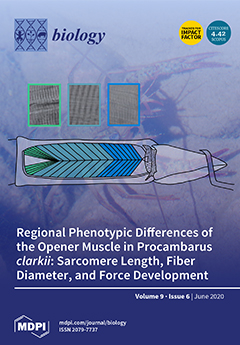
Cover Story: Invertebrates show more variation in muscle organization than vertebrates. The Procambarus clarkii opener muscle has three phenotypic regions (distal, central, proximal) yet is innervated by only one excitatory neuron. These regions have varied biochemistry and physiology. Central fibers generate the largest force with the longest sarcomeres; however, serotonin does not increase force generated by central fibers more than other regions. This finding was surprising since tension receptors sensing the shearing forces are located at the distal end of the apodeme (cuticle invagination). This study demonstrates the malleability of the motor unit. View this paper.
  • Issues are regarded as officially published after their release is announced to the table of contents alert mailing list .
  • You may sign up for email alerts to receive table of contents of newly released issues.
  • PDF is the official format for papers published in both, html and pdf forms. To view the papers in pdf format, click on the "PDF Full-text" link, and use the free Adobe Reader to open them.

Articles (30)

  • Review
  • Open Access
4 Citations
6,606 Views
21 Pages

Mass Spectrometry to Study Chromatin Compaction

  • Stephanie Stransky,
  • Jennifer Aguilan,
  • Jake Lachowicz,
  • Carlos Madrid-Aliste,
  • Edward Nieves and
  • Simone Sidoli

26 June 2020

Chromatin accessibility is a major regulator of gene expression. Histone writers/erasers have a critical role in chromatin compaction, as they “flag” chromatin regions by catalyzing/removing covalent post-translational modifications on hi...

  • Review
  • Open Access
15 Citations
7,544 Views
12 Pages

Lessons from SARS-CoV-2 Pandemic: Evolution, Disease Dynamics and Future

  • Saurabh Pandey,
  • Bharat Yadav,
  • Arvind Pandey,
  • Takshashila Tripathi,
  • Masuma Khawary,
  • Sashi Kant and
  • Deeksha Tripathi

26 June 2020

The COVID-19 pandemic is rising at an unprecedented rate. The surging number of deaths every day, global lockdown and travel restrictions have resulted in huge losses to society. The impact is massive and will leave a historical footprint. The Spanis...

  • Article
  • Open Access
30 Citations
5,362 Views
16 Pages

Kinematic Sub-Populations in Bull Spermatozoa: A Comparison of Classical and Bayesian Approaches

  • Luis Víquez,
  • Vinicio Barquero,
  • Carles Soler,
  • Eduardo R.S. Roldan and
  • Anthony Valverde

26 June 2020

The ejaculate is heterogenous and sperm sub-populations with different kinematic patterns can be identified in various species. Nevertheless, although these sub-populations are statistically well defined, the statistical differences are not always re...

  • Article
  • Open Access
22 Citations
7,087 Views
15 Pages

Spectral Distribution of Ultra-Weak Photon Emission as a Response to Wounding in Plants: An In Vivo Study

  • Ankush Prasad,
  • Prabhakar Gouripeddi,
  • Hanumanth Rao Naidu Devireddy,
  • Alina Ovsii,
  • Dattatreya Prabhu Rachakonda,
  • Roeland Van Wijk and
  • Pavel Pospíšil

26 June 2020

It is well established that every living organism spontaneously emits photons referred to as ultra-weak photon emission (synonym biophotons or low-level chemiluminescence) which inherently embodies information about the wellbeing of the source. In re...

  • Article
  • Open Access
10 Citations
3,501 Views
13 Pages

Termite Societies Promote the Taxonomic and Functional Diversity of Archaeal Communities in Mound Soils

  • Monde Wakung’oli,
  • Adenike Eunice Amoo,
  • Ben Jesuorsemwen Enagbonma and
  • Olubukola Oluranti Babalola

25 June 2020

Recent studies involving microbial communities in termite mounds have been more focused on bacteria and fungi with little attention given to archaea, which play significant roles in nutrient cycling. Thus, we aimed at characterizing the archaeal taxo...

  • Review
  • Open Access
98 Citations
6,304 Views
14 Pages

The Role of Mitochondria in Cardiovascular Diseases

  • Anastasia V. Poznyak,
  • Ekaterina A. Ivanova,
  • Igor A. Sobenin,
  • Shaw-Fang Yet and
  • Alexander N. Orekhov

25 June 2020

The role of mitochondria in cardiovascular diseases is receiving ever growing attention. As a central player in the regulation of cellular metabolism and a powerful controller of cellular fate, mitochondria appear to comprise an interesting potential...

  • Article
  • Open Access
21 Citations
4,857 Views
11 Pages

24 June 2020

This article describes a simple Susceptible Infected Recovered (SIR) model fitting with COVID-19 data for the month of March 2020 in New York (NY) state. The model is a classical SIR, but is non-autonomous; the rate of susceptible people becoming inf...

  • Article
  • Open Access
3 Citations
3,658 Views
10 Pages

Laboratory Diagnostics of Rickettsia Infections in Denmark 2008–2015

  • Susanne Schjørring,
  • Martin Tugwell Jepsen,
  • Camilla Adler Sørensen,
  • Palle Valentiner-Branth,
  • Bjørn Kantsø,
  • Randi Føns Petersen,
  • Ole Skovgaard and
  • Karen A. Krogfelt

19 June 2020

Rickettsiosis is a vector-borne disease caused by bacterial species in the genus Rickettsia. Ticks in Scandinavia are reported to be infected with Rickettsia, yet only a few Scandinavian human cases are described, and rickettsiosis is poorly understo...

  • Article
  • Open Access
18 Citations
4,937 Views
21 Pages

Unreported Cases for Age Dependent COVID-19 Outbreak in Japan

  • Quentin Griette,
  • Pierre Magal and
  • Ousmane Seydi

17 June 2020

We investigate the age structured data for the COVID-19 outbreak in Japan. We consider a mathematical model for the epidemic with unreported infectious patient with and without age structure. In particular, we build a new mathematical model and a new...

of 3

Get Alerted

Add your email address to receive forthcoming issues of this journal.

XFacebookLinkedIn
Biology - ISSN 2079-7737