

You are currently viewing a new version of our website. To view the old version click .

Antibiotics, Volume 14, Issue 7

July 2025 - 110 articles

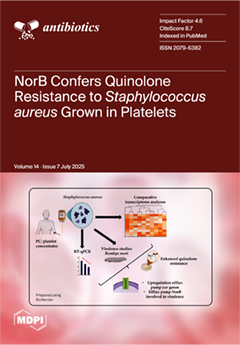
Cover Story: Platelet concentrates (PCs), used to treat patients with bleeding disorders, are stored at 20–24 °C to maintaining platelet functionality. These conditions also sustain the growth of bacteria such as Staphylococcus aureus, which poses an important safety risk to transfusion patients as it reaches clinically significant levels and produces virulence factors during PC storage. Previous studies have demonstrated that Staphylococcus spp. grown in PCs display upregulation of genes encoding for antimicrobial resistance and virulence. To expand the current knowledge, this study aimed to test whether the increase in the norB efflux pump expression observed in PCs translates into heightened quinolone resistance. Furthermore, the role of the NorB efflux pump on S. aureus virulence was investigated using a Bombyx mori (silkworm) animal model. View this paper
  • Issues are regarded as officially published after their release is announced to the table of contents alert mailing list .
  • You may sign up for email alerts to receive table of contents of newly released issues.
  • PDF is the official format for papers published in both, html and pdf forms. To view the papers in pdf format, click on the "PDF Full-text" link, and use the free Adobe Reader to open them.

Articles (110)

  • Article
  • Open Access
1 Citations
1,002 Views
12 Pages

Antimicrobial Resistance Patterns of Staphylococcus aureus Cultured from the Healthy Horses’ Nostrils Sampled in Distant Regions of Brazil

  • Mauro M. S. Saraiva,
  • Heitor Leocádio de Souza Rodrigues,
  • Valdinete Pereira Benevides,
  • Candice Maria Cardoso Gomes de Leon,
  • Silvana C. L. Santos,
  • Danilo T. Stipp,
  • Patricia E. N. Givisiez,
  • Rafael F. C. Vieira and
  • Celso J. B. Oliveira

Staphylococcus aureus (S. aureus) is a major cause of opportunistic infections in humans and animals, leading to severe systemic diseases. The rise of MDR strains associated with animal carriage poses significant health challenges, underscoring the n...

  • Review
  • Open Access
1 Citations
2,379 Views
25 Pages

Harnessing the Potential of Antibacterial and Antibiofilm Phytochemicals in the Combat Against Superbugs: A One Health Perspective

  • Suma Sarojini,
  • Saranya Jayaram,
  • Sandhya Kalathilparambil Santhosh,
  • Pragyan Priyadarshini,
  • Manikantan Pappuswamy and
  • Balamuralikrishnan Balasubramanian

The war between humans and bacteria started centuries ago. With the advent of antibiotics, there was a temporary ceasefire in this war, but the scenario soon started becoming worse with the emergence of drug-resistant strains within years of the depl...

  • Article
  • Open Access
878 Views
11 Pages

In Vitro and Ex Vivo Evaluation of Rifampicin Cytotoxicity in Human Skin Models

  • Marcel Nani Leite,
  • Natália Aparecida de Paula,
  • Leandra Náira Zambelli Ramalho and
  • Marco Andrey Cipriani Frade

Background/Objectives: Drugs for human use require several studies for the assessment of their efficacy and safety. An important property is cytotoxicity, which should be tested in different environments and models in closer proximity to the final us...

  • Correction
  • Open Access
531 Views
2 Pages

Correction: Alshawwa et al. In Situ Biosynthesis of Reduced Alpha Hematite (α-Fe2O3) Nanoparticles by Stevia Rebaudiana L. Leaf Extract: Insights into Antioxidant, Antimicrobial, and Anticancer Properties. Antibiotics 2022, 11, 1252

  • Samar Zuhair Alshawwa,
  • Eman J. Mohammed,
  • Nada Hashim,
  • Mohamed Sharaf,
  • Samy Selim,
  • Hayaa M. Alhuthali,
  • Hind A. Alzahrani,
  • Alsayed E. Mekky and
  • Mohamed G. Elharrif

In the original publication [...]

  • Article
  • Open Access
3 Citations
2,074 Views
23 Pages

Multidrug Resistance and Virulence Traits of Salmonella enterica Isolated from Cattle: Genotypic and Phenotypic Insights

  • Nada A. Fahmy,
  • Sumin Karna,
  • Angel Bhusal,
  • Ajran Kabir,
  • Erdal Erol and
  • Yosra A. Helmy

Background/Objective: Non-typhoidal Salmonella is a leading cause of foodborne illness worldwide and presents a significant One Health concern due to zoonotic transmission. Although antibiotic therapy remains a standard approach for treating salmonel...

  • Brief Report
  • Open Access
2,871 Views
6 Pages

Background: Metronidazole is the preferred anaerobic agent for empiric treatment of intra-abdominal infections (IAI). Although dosed every 8 h (q8hr), blood concentrations exceed the in vitro minimum inhibitory concentration (MIC) for anaerobic organ...

  • Article
  • Open Access
746 Views
11 Pages

Should Microhematuria Be Incorporated into the 2023 Duke-International Society for Cardiovascular Infectious Diseases Minor Immunological Criteria?

  • Jean Regina,
  • Louis Stavart,
  • Benoit Guery,
  • Georgios Tzimas,
  • Pierre Monney,
  • Lars Niclauss,
  • Matthias Kirsch,
  • Dela Golshayan and
  • Matthaios Papadimitriou-Olivgeris

Background/Objectives: Microhematuria is common in patients with infective endocarditis (IE). The present study aims to assess whether the addition of microhematuria in the 2023 Duke-International Society for Cardiovascular Infectious Diseases (ISCVI...

  • Article
  • Open Access
1,137 Views
15 Pages

Background/Objectives: Ceftiofur hydrochloride (CEF) is a third-generation cephalosporin widely used in cattle to treat various disease. The recommended dosage was 1.1 to 2.2 mg/kg BW for 3 to 5 consecutive days by intramuscular or subcutaneous injec...

  • Article
  • Open Access
2 Citations
3,212 Views
17 Pages

Background: Canine pyoderma and otitis externa are prevalent bacterial skin infections in veterinary practice, frequently complicated by the emergence of multidrug-resistant (MDR) pathogens. Objectives: To investigate the frequency, antimicrobial res...

  • Article
  • Open Access
2 Citations
2,400 Views
21 Pages

Mapping the AMR Infection Landscape in Bihar: Implications for Strengthening Policy and Clinical Practice

  • Vinay Modgil,
  • Sundeep Sahay,
  • Neelam Taneja,
  • Burhanuddin Qayyumi,
  • Ravikant Singh,
  • Arunima Mukherjee,
  • Bibekananda Bhoi and
  • Gitika Arora

Background: Antimicrobial resistance (AMR) poses a significant threat to public health, especially in low- and middle-income countries (LMICs), where surveillance infrastructure is underdeveloped. Bihar, India’s third most populous state and on...

of 11

Get Alerted

Add your email address to receive forthcoming issues of this journal.

XFacebookLinkedIn
Antibiotics - ISSN 2079-6382