You are currently on the new version of our website. Access the old version .

Microorganisms, Volume 12, Issue 12

December 2024 - 290 articles

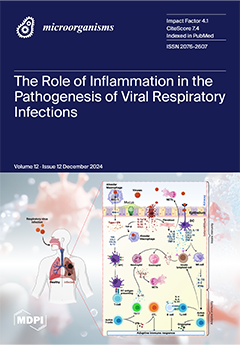
Cover Story: Viral respiratory infections (VRIs) are a leading cause of morbidity and mortality worldwide, making them a significant public health concern. During infection, respiratory viruses, including Influenza virus, SARS-CoV-2, and respiratory syncytial virus (RSV), trigger an antiviral immune response, specifically boosting the inflammatory response that plays a critical role in their pathogenesis. The inflammatory response induced by respiratory viruses can be a double-edged sword, since it can be initially induced to be antiviral and protective/reparative in terms of virus-induced injuries. Still, it can also be detrimental to host cells and tissues. However, the mechanisms that differentiate the complex crosstalk between favorable host inflammatory responses and harmful inflammatory responses are poorly understood. View this paper
  • Issues are regarded as officially published after their release is announced to the table of contents alert mailing list .
  • You may sign up for email alerts to receive table of contents of newly released issues.
  • PDF is the official format for papers published in both, html and pdf forms. To view the papers in pdf format, click on the "PDF Full-text" link, and use the free Adobe Reader to open them.

Articles (290)

  • Article
  • Open Access
3 Citations
4,411 Views
24 Pages

In Vitro Antioxidant and Antibacterial Activities of Ethyl Acetate Extracts of Ziziphus lotus Leaves and Five Associated Endophytic Fungi

  • Amel Ghazi-Yaker,
  • Bart Kraak,
  • Jos Houbraken,
  • El-hafid Nabti,
  • Cristina Cruz,
  • Noria Saadoun and
  • Karim Houali

The exploration of new pharmacological compounds from endophytic fungi offers infinite possibilities. The aim of this study was to evaluate the antibacterial and antioxidant activities of extracts from the leaves of Ziziphus lotus and five of its end...

  • Article
  • Open Access
2 Citations
2,266 Views
26 Pages

Gram Negative Biofilms: Structural and Functional Responses to Destruction by Antibiotic-Loaded Mixed Polymeric Micelles

  • Tsvetozara Damyanova,
  • Rumena Stancheva,
  • Milena N. Leseva,
  • Petya A. Dimitrova,
  • Tsvetelina Paunova-Krasteva,
  • Dayana Borisova,
  • Katya Kamenova,
  • Petar D. Petrov,
  • Ralitsa Veleva and
  • Stoyanka Stoitsova
  • + 2 authors

Biofilms are a well-known multifactorial virulence factor with a pivotal role in chronic bacterial infections. Their pathogenicity is determined by the combination of strain-specific mechanisms of virulence and the biofilm extracellular matrix (ECM)...

  • Review
  • Open Access
16 Citations
9,182 Views
26 Pages

Campylobacteriosis is a leading cause of infectious diarrhea and foodborne illness worldwide. Campylobacter infection is primarily transmitted through the consumption of contaminated food, especially uncooked meat, or untreated water; contact with in...

  • Article
  • Open Access
2 Citations
2,793 Views
22 Pages

The Effect of Oral Care Product Ingredients on Oral Pathogenic Bacteria Transcriptomics Through RNA-Seq

  • Ping Hu,
  • Sancai Xie,
  • Baochen Shi,
  • Cheryl S. Tansky,
  • Benjamin Circello,
  • Paul A. Sagel,
  • Eva Schneiderman and
  • Aaron R. Biesbrock

Various ingredients are utilized to inhibit the growth of harmful bacteria associated with cavities, gum disease, and bad breath. However, the precise mechanisms by which these ingredients affect the oral microbiome have not been fully understood at...

  • Article
  • Open Access
4 Citations
2,323 Views
13 Pages

Characteristics of the Stool, Blood and Skin Microbiome in Rosacea Patients

  • Marie Isolde Joura,
  • Antal Jobbágy,
  • Zsuzsanna A. Dunai,
  • Nóra Makra,
  • András Bánvölgyi,
  • Norbert Kiss,
  • Miklós Sárdy,
  • Sarolta Eszter Sándor,
  • Péter Holló and
  • Eszter Ostorházi

Several research groups have confirmed that in the pathogenesis of the chronic inflammatory skin disorder rosacea, the composition of the skin and fecal microbiome of affected patients differs from that of healthy individuals. We studied the stool, b...

  • Article
  • Open Access
1 Citations
2,113 Views
14 Pages

Haemophilus influenzae Invasive Infections in Children in Vaccine Era: Phenotypic and Genotypic Characterization Tunis, Tunisia

  • Yasmine Chelbi,
  • Khaoula Meftah,
  • Ala-Eddine Deghmane,
  • Samar Mhimdi,
  • Firas Aloui,
  • Aida Bouafsoun,
  • Eva Hong,
  • Khaled Menif,
  • Khadija Boussetta and
  • Hanen Smaoui
  • + 7 authors

The changing epidemiological profile of invasive Haemophilus influenzae infections (IIHi) is noted in the post-vaccination era. The aim of this study was to characterize phenotypically and genotypically invasive Haemophilus influenzae (Hi) isolates d...

  • Article
  • Open Access
1 Citations
2,162 Views
15 Pages

Transcriptome Analysis of the Harmful Dinoflagellate Heterocapsa bohaiensis Under Varied Nutrient Stress Conditions

  • Peng Peng,
  • Fangxin Han,
  • Xue Gong,
  • Xiangyuan Guo,
  • Ying Su,
  • Yiwen Zhang and
  • Jingjing Zhan

The increasing prevalence of harmful algal blooms (HABs) driven by eutrophication, particularly in China’s nearshore waters, is a growing concern. Dinoflagellate Heterocapsa bohaiensis blooms have caused significant ecological and economic dama...

  • Article
  • Open Access
6 Citations
4,616 Views
19 Pages

Terminalia bellirica (Gaertn) Roxb. and Terminalia chebula Retz. are significant botanicals in ancient Ayurvedic medicine. They are renowned for their therapeutic properties, notably in addressing gastrointestinal (GI) diseases. These plants have und...

  • Article
  • Open Access
2 Citations
1,605 Views
17 Pages

Development of a TaqMan qPCR for the Simultaneous Detection of the TuMV and BBWV2 Viruses Responsible for the Viral Disease in Pseudostellaria heterophylla

  • Li Gu,
  • Chensi Liu,
  • Shuting Yao,
  • Jiaxin Wu,
  • Lianghong Wang,
  • Jing Mu,
  • Yankun Wang,
  • Jianming Wang,
  • Zhongyi Zhang and
  • Mingjie Li

Pseudostellaria heterophylla (Miq.) Pax, a highly valued Chinese medicinal plant, is experiencing a notable decline in yield and quality due to viral diseases, particularly caused those by TuMV and BBWV2. Currently, the absence of a quantitative dete...

  • Article
  • Open Access
1 Citations
1,955 Views
18 Pages

Identification, Characterization, and Ultrastructure Analysis of the Phenol-Degrading Rhodococcus erythropolis 7Ba and Its Viable but Nonculturable Forms

  • Valentina N. Polivtseva,
  • Anton N. Zvonarev,
  • Olesya I. Sazonova,
  • Yanina A. Delegan,
  • Yulia N. Kocharovskaya,
  • Alexander G. Bogun and
  • Nataliya E. Suzina

Phenol and its chlorinated derivatives are introduced into the environment with wastewater effluents from various industries, becoming toxic pollutants. Phenol-degrading bacteria are important objects of research; among them, representatives of the g...

of 29

Get Alerted

Add your email address to receive forthcoming issues of this journal.

XFacebookLinkedIn
Microorganisms - ISSN 2076-2607