




Insects, Volume 16, Issue 12 (December 2025) – 103 articles
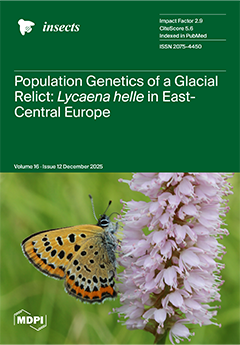
Cover Story (view full-size image):
The Violet Copper (Lycaena helle) is a butterfly of high latitudes and mountains of Eurasia. As a glacial relict, it is threatened by ongoing climate change. Earlier genetic studies from Western Europe revealed high population differentiation due to long-lasting isolation. We expand the population genetic knowledge into East-Central Europe (Czechia, Poland, Romania), where it inhabits mountain grasslands, lowland mires and sparse woodlands. We thus track the colonisation of North European lowlands, and Carpathian Mountains, after the recession of glaciers. We show that populations inhabiting sparse broadleaved forests in Carpathian valleys, plus populations in never glaciated southeastern Poland, represent survival of the glacial cycles in situ, and deserve the highest conservation priority. View this paper
- Issues are regarded as officially published after their release is announced to the table of contents alert mailing list.
- You may sign up for e-mail alerts to receive table of contents of newly released issues.
- PDF is the official format for papers published in both, html and pdf forms. To view the papers in pdf format, click on the "PDF Full-text" link, and use the free Adobe Reader to open them.
Previous Issue
Next Issue
