Article

Emerging Risk of Flea-Borne Bartonella in Tropical Cities: Evidence from Stray Cats in the Klang Valley, Malaysia


by
Justin Titti Alison
1,
Auni Atikah AbdulHalim
1,
Muhammad Rasul Abdullah Halim
2,
Hasmawati Yahaya
1,*,
Muhamad Afiq Aziz
3,
Sazaly AbuBakar
1 and
Zubaidah Ya’cob
1,*
1
Higher Institution Centre of Excellence (HICoE), Tropical Infectious Diseases Research & Education Centre (TIDREC), Universiti Malaya, Kuala Lumpur 50603, Malaysia
2
Department of Ecology and Biodiversity, Institute of Biological Sciences, Faculty of Science, Universiti Malaya, Kuala Lumpur 50603, Malaysia
3
Department of Microbiology, Institute of Biological Sciences, Faculty of Science, Universiti Malaya, Kuala Lumpur 50603, Malaysia
*
Authors to whom correspondence should be addressed.
Insects 2025, 16(12), 1282; https://doi.org/10.3390/insects16121282
Submission received: 28 October 2025 / Revised: 9 December 2025 / Accepted: 17 December 2025 / Published: 18 December 2025
(This article belongs to the Special Issue Surveillance and Control of Arthropod-Borne Diseases)

Simple Summary

Stray cats living in cities often carry fleas, which can spread pathogens that cause diseases to humans and animals. In this study, we examined fleas collected from stray cats in different sites within Klang Valley, Malaysia, to find out if they carried any harmful pathogen. We first confirmed that all the fleas collected were cat fleas (Ctenocephalides felis), the most common flea that parasitize cats. We then tested the fleas for the presence of Bartonella bacteria, which can cause “Cat Scratch Disease (CSD)” in humans. Our results showed a very high number of infected fleas. These findings show that there may be a hidden health risk to communities living in close contact with stray cats, especially in crowded city areas. This study highlights the importance of monitoring fleas and the bacteria they carry as part of public health efforts. By understanding these risks early, health authorities and communities can take steps to manage stray animals and prevent the spread of diseases to humans.

Abstract

Urban stray cats are often associated with ectoparasites and zoonotic pathogens due to their unsanitary living conditions and lack of veterinary care. Fleas, especially Ctenocephalides spp., are competent vectors of Bartonella spp., a genus of emerging bacterial pathogens with both public health and veterinary relevance. This study investigated the presence of Bartonella DNA in ectoparasitic fleas infesting stray cats in various urban habitats within the Klang Valley, Malaysia. A total of 204 fleas were collected from 89 stray cats. Fleas were identified morphologically using established taxonomic keys under a light microscope and further validated through PCR amplification of the mitochondrial cytochrome c oxidase subunit I (cox1) gene. Detection of Bartonella spp. was conducted by targeting the citrate synthase (gltA) gene. All fleas were confirmed as Ctenocephalides felis, with an infestation prevalence of 39.33% among the cats sampled. Of 118 C. felis specimens tested, 86.44% were positive for Bartonella DNA, one of the highest worldwide and significantly surpassing previous Malaysian reports. Sequencing of 12 positive samples showed identities with B. claridgeiae (58.3%), B. henselae (25.0%), an uncultured Bartonella species (8.3%) and a Bartonella isolate from a dog in Chile (8.3%). These results highlight the significant presence of Bartonella, causative agent of cat-scratch disease in stray cats, emphasizing their potential role as urban reservoirs and vectors. The findings underscore the need for ectoparasite surveillance and zoonotic pathogen control as integral components of stray animal management in Malaysia’s urban settings.

1. Introduction

Stray cats are ubiquitous in urban ecosystems, often living in close proximity to humans and other domestic animals [1]. Many of these cats originate from abandoned pets or unplanned litters, forming unregulated populations that thrive in densely populated areas [2]. Due to limited access to veterinary care and poor health management, stray cats are frequently infested with ectoparasites, which play a key role in maintaining and transmitting zoonotic pathogens of public health significance [3]. This human–animal interface, intensified by urbanisation, provides an ideal setting for the emergence and spillover of vector-borne infections under the One Health framework.
Among feline ectoparasites, fleas, particularly the cat flea Ctenocephalides felis, are the most common and globally widespread [4]. C. felis exhibits remarkable ecological adaptability, infesting a wide range of mammalian hosts across both temperate and tropical regions [5]. Beyond causing dermatological irritation and allergic reactions in animals, C. felis serves as a competent vector for several zoonotic agents, notably Bartonella species. Of these, B. henselae and B. clarridgeiae are of major medical relevance, being the primary etiological agents of cat scratch disease (CSD) in humans [6]. Human infection typically results from scratches or bites contaminated with flea faeces [7], and while CSD is usually self-limiting in immunocompetent individuals [8], severe systemic manifestations such as osteomyelitis, arthritis and involvement of the central nervous system have been documented, particularly in immunocompromised patients [9]. Human exposure to Bartonella is widespread, with seroprevalence reaching nearly 28% [10]. The global burden of this disease is considerable, with estimated incidence rates of 6.4 cases per 100,000 individuals among adults and 9.4 cases per 100,000 individuals in children aged 5–9 years [11].
Globally, urban stray cats are increasingly recognised as reservoirs for Bartonella spp. and their flea vectors [12]. Reported infection rates of Bartonella species in cat populations vary considerably by location, ranging from 0% to 62% globally [13,14] and reaching even higher levels in isolated cat populations [15]. In Malaysia, however, studies on flea infestations and Bartonella infections in stray cats remain limited, often constrained by small sample sizes or narrow geographic coverage.
Although animal-based data are limited, emerging evidence from Malaysian health facilities suggests that Bartonella exposure in humans may be under-recognized. A serological review of febrile patients from a major teaching hospital in the Klang Valley detected Bartonella IgG antibodies in 21.6% of individuals tested, including those initially suspected of rickettsial or dengue infections, highlighting that Bartonella exposure among humans in this region may be more common than previously recognised [16]. Additionally, a clinical review of Malaysian bartonellosis cases documented 19 patients diagnosed with ocular bartonellosis over a three-year period, representing one of the few documented series of human Bartonella infections in the country [17]. Notably, only 26.3% of these patients recalled cat scratches or bites, indicating that a substantial proportion of infections may arise from unrecognised or indirect exposures [17]. These findings underscore the public health relevance of flea-borne Bartonella in metropolitan Malaysian settings and reinforce the need for epidemiological data from both reservoirs and clinical populations.
The Klang Valley, encompassing Kuala Lumpur and its surrounding metropolitan districts, is one of the most densely populated and urbanised regions in the country, hosting a large and growing population of free-roaming cats. Despite the frequent human–cat interactions in this region, data on the prevalence of C. felis infestations and their role as vectors of Bartonella spp. are scarce [6,18,19]. This paucity of epidemiological evidence limits public health risk assessment and hinders the development of evidence-based vector control strategies.
The present study aims to address this knowledge gap by investigating the natural infection rates of C. felis and Bartonella spp. in urban stray cats within the Klang Valley, Peninsular Malaysia. By integrating morphological and molecular identification approaches, this research provides updated insights into flea-borne Bartonella circulation in urban environments. The findings are expected to contribute to the growing body of One Health evidence needed to inform zoonotic disease surveillance, risk mitigation, and integrated vector management strategies in tropical urban settings.

2. Materials and Methods

2.1. Study Area and Flea Collection

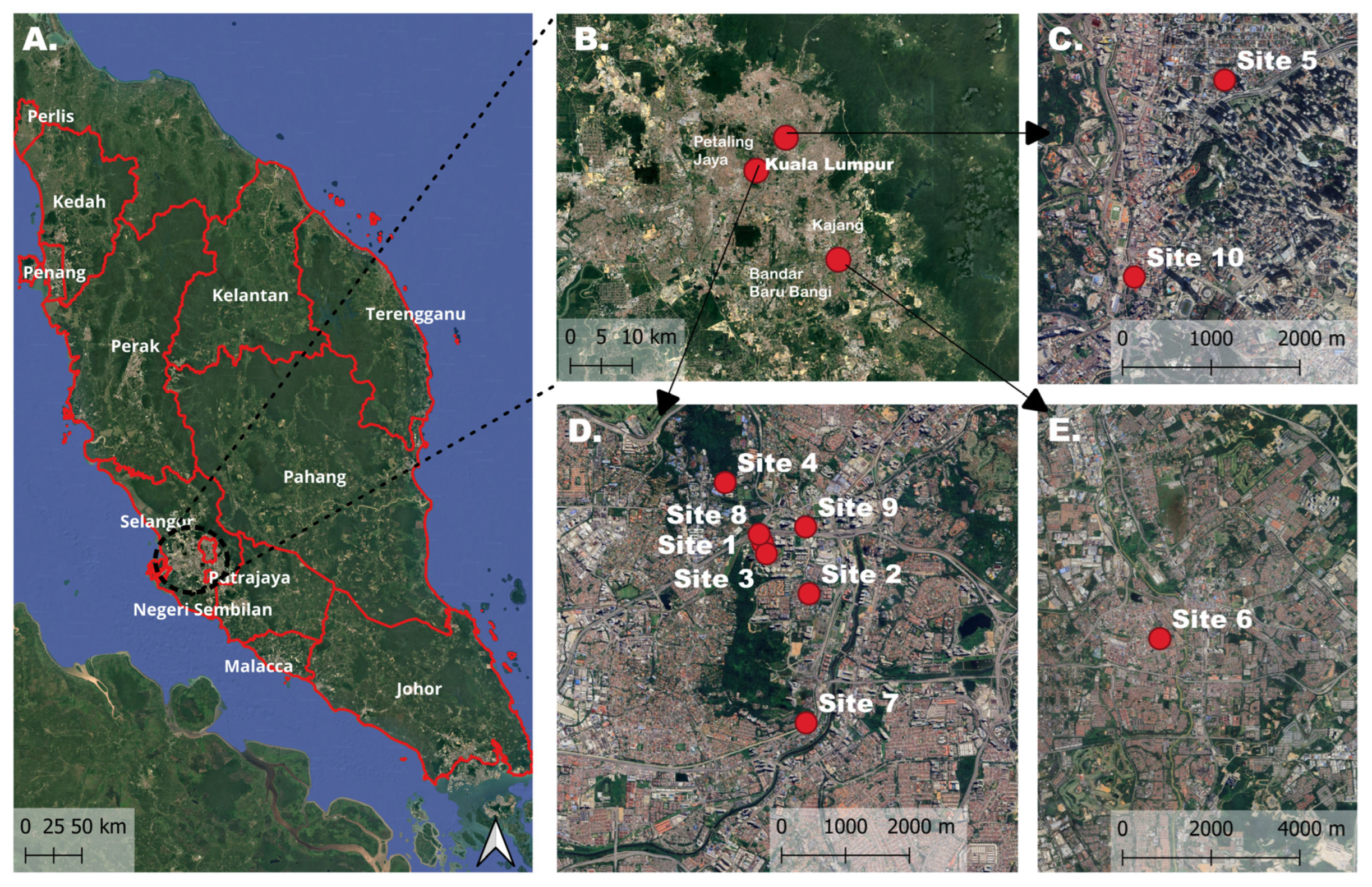
All procedures involving animal handling and sample collection were conducted in strict accordance with institutional and international ethical standards for the humane treatment of animals. Approval was obtained from the Institutional Animal Care and Use Committee (IACUC), Universiti Malaya (Ethics Reference No: T/22052023/13032023-02/R). Flea sampling was conducted daily from 8:00 am until 5.30 pm between October and December 2023 across ten urban sites within the Klang Valley, Peninsular Malaysia and are mapped using QGIS (version 3.28) (Figure 1, Table 1). This region represents one of the most densely populated and urbanised areas of the country, characterised by a large stray cat population living in close proximity to humans. Each site was visited only once to avoid resampling of individual cats. The number of sampling sites varied among location types to reflect differences in free-roaming cat availability and accessibility. Housing areas and public transportation hubs each had three feasible sites, while eatery areas had four sites due to higher cat activity and ease of access. Site selection also considered ethical and safety requirements, as well as permissions from local authorities, ensuring that only locations suitable for humane, low-stress sampling were included.
Free-roaming cats encountered at the selected urban and suburban locations within the Klang Valley were first visually assessed from a distance to ensure they exhibited no signs of illness, severe injury, or aggressive behaviour. Only cats that appeared alert, ambulatory, and behaviourally calm were considered eligible for sampling. To minimize stress, cats were approached slowly using small food pellets as bait to encourage them to remain stationary. Once the cat demonstrated relaxed feeding behaviour, a gentle manual restraint technique was applied, involving minimal physical contact and avoiding forceful handling. No sedation, chemical immobilisation, or capture cages were used at any stage. Ectoparasite collection was performed using a fine-toothed stainless-steel flea comb. Combing was conducted systematically for approximately 2–3 min per cat, focusing on anatomical regions known to harbour fleas, including the head, neck, dorsal torso, ventral abdomen, hindquarters, and tail base. Each combing pass was inspected visually. Immediately after each combing session, the comb containing dislodged fleas was inserted into a sterile zip-lock bag and sealed to prevent escape. The sealed bag was gently shaken to detach fleas from the comb’s teeth before transferring the fleas into labelled collection tubes containing 70% ethanol for preservation. Personal protective equipment (PPE), including nitrile gloves and long-sleeved laboratory coats, was worn throughout the procedure to minimise the risk of scratches, bites, and zoonotic exposure. All sampling equipment was disinfected with 70% ethanol between animals to avoid cross-contamination. Upon completion of flea collection, each cat was released at the exact location where it was initially encountered. No animal was restrained for more than a few minutes, and all individuals were released unharmed.
All fleas were transported to the laboratory and preserved at −80 °C until further processing and each flea was subjected to morphological identification performed under a NIKON stereomicroscope (SMZ800N, (Tokyo, Japan)) using standard morphological identification keys [20].

2.2. Flea Genomic DNA Extraction

For molecular analysis, a maximum of 10 fleas per infested cat were randomly selected to provide a representative subset while avoiding overrepresentation from heavily infested individuals, as commonly applied in ectoparasite pathogen studies [21,22]. DNA was extracted from each flea using standard genomic extraction protocols. All remaining fleas were preserved at −80 °C for potential future analyses. In brief, genomic DNA was extracted from 118 individual fleas using the DNeasy Blood and Tissue Kit (Qiagen, Hilden, Germany) following the manufacturer’s protocol, with minor modifications. Each flea was homogenized in 180 µL of ATL buffer using a sterile micropestle (Chongqing New World Trading Co., Ltd., Chongqing, China) followed by the addition of 20 µL of Proteinase K. The samples were incubated at 56 °C with intermittent vortexing until complete tissue digestion was achieved. Subsequently, 200 µL of AL buffer and 200 µL of absolute ethanol were added to each lysate, which was then transferred to a spin column and centrifuged at 6000× g for 1 min. The column was washed sequentially with 500 µL of AW1 and AW2 buffers. Finally, DNA was eluted in 50 µL of AE buffer and stored at −20 °C until polymerase chain reaction (PCR) analysis.

2.3. Molecular Identification of Fleas

Molecular confirmation of flea species was performed via PCR amplification of the mitochondrial cytochrome c oxidase subunit I (cox1) gene using the primer pair LCO and Cff-R [23] (Table 2), yielding an expected amplicon size of approximately 550 bp. Each 25 µL PCR reaction contained 12.5 µL of DreamTaq Green PCR Master Mix (Thermo Scientific, Vilnius, Lithuania), 1 µL of each primer (10 µM), 2 µL of genomic DNA, and 8.5 µL of nuclease-free water. Amplification was carried out under the following thermocycling conditions: initial denaturation at 95 °C for 1 min, followed by 35 cycles of denaturation at 95 °C for 15 s, annealing at 55 °C for 15 s, and extension at 72 °C for 10 s, with a final extension at 72 °C for 5 min (Table 3). Positive controls (known C. felis DNA) and negative controls (nuclease-free water) were included in each PCR run. Amplicons were visualized by electrophoresis on 1.0% agarose gels stained with GelRed and compared against a 100 bp GeneRuler DNA ladder (Thermo Fisher, Waltham, MA, USA). Positive PCR products were purified and sent for sequencing (Apical Scientific Sdn. Bhd., Seri Kembangan, Malaysia) for species confirmation.

2.4. Detection of Bartonella spp. By PCR

Screening for Bartonella DNA was performed by amplifying a fragment of the citrate synthase (gltA) gene using the primer pair BhCS.781p (5′-GGGGACCAGCTCATGGTGG-3′) and BhCS.1137n (5′-AATGCAAAAAGAACAGTAAACA-3′) as described by Norman et al. [24] (Table 2), generating a 379 bp amplicon. Each PCR reaction (25 µL) contained 12.5 µL of DreamTaq Green PCR Master Mix (Thermo Scientific, Vilnius, Lithuania), 1 µL of each primer (10 µM), 2 µL of flea genomic DNA, and 8.5 µL of nuclease-free water. Thermocycling conditions consisted of an initial denaturation at 94 °C for 10 min, followed by 35 cycles of denaturation at 94 °C for 30 s, annealing at 51 °C for 45 s, and extension at 72 °C for 30 s, with a final extension at 72 °C for 7 min (Table 3). Positive and negative controls were included in all PCR assays, using Bartonella henselae DNA as the positive control and sterile nuclease-free water as the negative control. PCR products were visualized via electrophoresis on 1.0% agarose gels stained with GelRed and compared to a 100 bp molecular size marker. Positive amplicons were purified and submitted for bidirectional sequencing at Apical Scientific Sdn. Bhd. (Seri Kembangan, Selangor, Malaysia).

2.5. Sequence Alignment and Phylogenetic Analysis

Raw chromatograms were examined using SeqScanner v2 (Applied Biosystems, Waltham, MA, USA) and manually edited for base-calling accuracy in BioEdit v7. Sequences were aligned using MEGA v11 [25] with default parameters, and consensus sequences were compared against the NCBI GenBank database using BLASTn via the online NCBI platform for species identification. Phylogenetic trees were constructed using the Maximum Likelihood (ML) method in MEGA v11. The Tamura 3-parameter (T92) model was applied for cox1 gene sequences of fleas, while the Kimura 2-parameter (K2) model was used for Bartonella gltA sequences. Node reliability was evaluated with 1000 bootstrap replicates. Pulex irritans [26] and Brucella melitensis [27] were designated as outgroups for flea and Bartonella phylogenies, respectively. Reference sequences retrieved from GenBank were included to confirm genetic clustering and species assignment.

2.6. Flea Infestation Parameters and Statistical Analysis

Flea infestation parameters were quantified following the definitions proposed by [28] to provide a comprehensive assessment of parasite–host interactions. The prevalence of infestation was calculated as the proportion of cats harbouring at least one flea, expressed as a percentage of the total number of cats examined. This parameter reflects the overall likelihood of flea presence within the sampled cat population. Host-related risk factors, including urban area type (housing, eatery, public transportation), cat sex, and age, were evaluated for their association with flea prevalence, following approaches commonly used in studies of flea-borne pathogens in cats [29,30,31].
Descriptive statistics were used to summarise flea infestation levels and Bartonella detection rates. Associations between categorical variables and flea infestation status were assessed using Fisher’s Exact Test. A p-value of <0.05 was considered statistically significant. All statistical analyses were performed using GraphPad Prism v9 (GraphPad Software, Boston, MA, USA).

3. Results

3.1. Flea Collection and Prevalence

A total of 204 fleas were recovered from 35 of the 89 stray cats sampled across various Klang Valley localities, resulting in an overall flea infestation prevalence of 39.33%. Fleas were detected at all surveyed locations except Kampung Baru. The highest flea burden originated from Pantai Dalam (n = 94; 45.19%), followed by Vista Angkasa Apartment (n = 53; 25.98%) and Kajang (n = 25; 12.25%) (Table 4 and Table S1).
Female cats comprised the majority of the sampled population (77.53%), and 27 of them (39%) were infested. Male cats represented a smaller portion of the sample (22.47%), but their infestation prevalence (40%) was almost identical to that of females (Table 5). This similarity suggests that flea exposure occurs uniformly across genders, likely driven by shared environmental conditions rather than sex-specific behaviour. Fisher’s Exact Test confirmed the absence of a statistically significant association between flea infestation and gender (p = 0.5711).
Adult cats showed an infestation prevalence of 39.0%, while juveniles showed a comparable prevalence of 40.0% (Table 5). No significant association was detected between infestation status and age class (p = 0.6571).
Environmental analysis revealed more pronounced differences. Flea infestation was recorded in all three major categories of sampling sites, namely housing, eatery, and public transportation areas. Public transportation areas exhibited the highest infestation prevalence (100%), indicating a consistently high exposure risk at these highly transient, human-associated locations. Housing areas showed a moderate prevalence of 40%, while eatery areas displayed the lowest prevalence at 33.9% (Table 5). Despite this lower prevalence, eatery zones contributed the largest number of fleas overall (n = 136), largely due to the high number of cats sampled.

3.2. Flea Identification

All 204 fleas were morphologically identified as Ctenocephalides felis (the cat flea) using established taxonomic keys [20]. Diagnostic characteristics included a long head with an angular frons, genal comb spines 1 and 2 of nearly equal length, and a distinct narrow dorsal incrassation [32]. No other flea species were detected among the examined specimens. For molecular confirmation, DNA from 118 individual fleas was successfully amplified targeting the mitochondrial cox1 gene (~550 bp). Ten representative sequences (479 bp) showed 97–100% similarity with C. felis isolate Malay01 (GenBank accession No.: MT027230.1) in BLAST via the online NCBI platform, confirming morphological identification and demonstrating high sequence consservation among local populations (Table 6).

3.3. Molecular Detection of Bartonella spp.

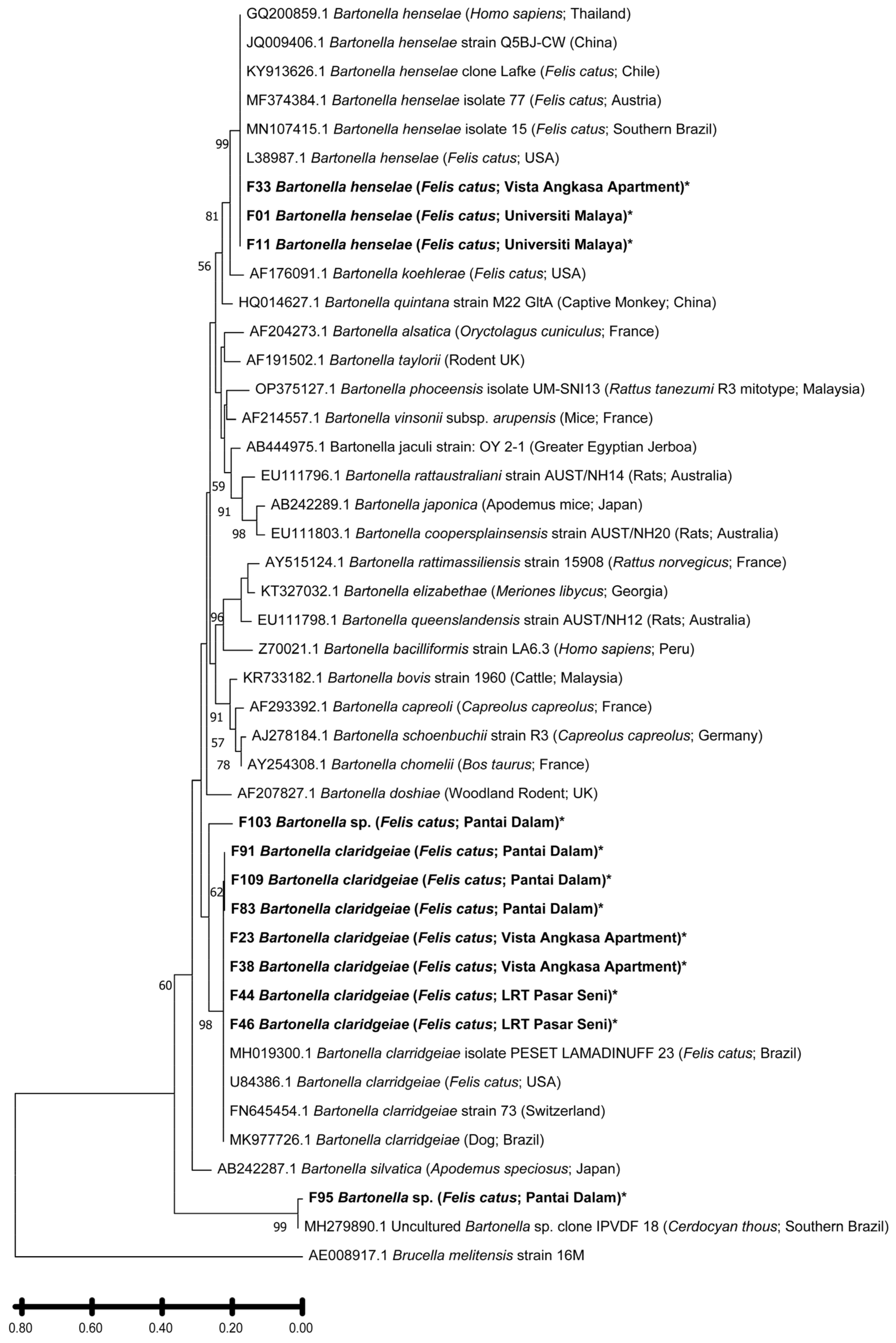
Of the 118 flea DNA samples, 102 (86.44%) tested positive for Bartonella spp. via PCR targeting the gltA gene, producing amplicons of the expected 379 bp size (Table 2). Twelve representative positive samples from different locations were sequenced for species identification. BLAST analysis of the 266 bp partial gltA sequences revealed the presence of two recognized species, B. henselae and B. claridgeiae, along with two uncharacterized Bartonella strains (Table 7). Ten sequences exhibited ≥98% similarity with known type strains, confirming species identity. One sample (F103) displayed 92.51% similarity to Bartonella sp. isolate Dog_9 (GenBank accession No.: MN233800.1), suggesting a potentially novel or divergent strain, though still above the 95.4% similarity threshold for genus-level classification [33]. Specifically, three sequences (F01, F11, F33) matched B. henselae isolates from domestic cats in Brazil (MN107415.1), while seven (F23, F38, F44, F46, F83, F91, F109) were closely related to B. claridgeiae isolates PESET LAMADINUFF 23/25 (MH019300.1–MH019301.1). Another sample (F95) showed 98.48% identity with an uncultured Bartonella sp. clone (MH279890.1) from a crab-eating fox (Cerdocyon thous) in southern Brazil.

3.4. Phylogenetic Analysis of Fleas and Associated Bartonella spp.

Phylogenetic reconstruction of the cox1 gene sequences confirmed that all flea samples obtained in this study belonged to Ctenocephalides felis (Figure 2). All sequences formed a strongly supported monophyletic cluster (bootstrap = 96%) together with C. felis isolate Malay01 (GenBank accession No.: MT027230.1), previously reported from cats in Southeast Asia. This cluster was clearly distinct from Ctenocephalides canis and Ctenocephalides orientis, which grouped into a separate, well-supported clade (bootstrap = 94%). The topology thus corroborates both the morphological and molecular identification of the fleas as C. felis. Phylogenetic analysis of the Bartonella gltA gene sequences revealed the presence of two well-defined clades, corresponding to B. henselae and B. claridgeiae (Figure 3). Sequences F01, F11, and F33 clustered tightly with B. henselae isolates previously reported from domestic cats in Brazil and the United States, supported by a bootstrap value of 99%. This B. henselae clade formed a sister relationship with B. koehlerae (GenBank accession No.: AF176091.1), indicating close evolutionary relatedness (bootstrap = 81%). The seven B. claridgeiae sequences (F23, F38, F44, F46, F83, F91, F109) formed a robust monophyletic clade (bootstrap = 98%) alongside reference strains from Brazil, the USA, and Switzerland. Notably, sequence F103, although related to this cluster, branched independently with relatively lower sequence similarity, suggesting possible intraspecific divergence or geographic variation. Sequence F95 was genetically distinct from both major clades but clustered closely with an uncultured Bartonella sp. clone (GenBank accession No.: MH279890.1) previously detected in a crab-eating fox (Cerdocyon thous) from Brazil (bootstrap = 99%). This unique positioning may reflect lineage diversification within Bartonella species infecting C. felis in Malaysia.

4. Discussion

This study provides updated insight into flea infestation patterns and Bartonella carriage among urban stray cats in the Klang Valley, a tropical city characterized by dense human–animal interactions and limited vector surveillance. The overall flea infestation rate of 39.3%, while lower than the national average of 71.8% reported by [30], remains epidemiologically significant and consistent with thresholds that warrant public health attention [34]. Comparable infestation levels have been reported in other urbanized tropical regions such as Mexico (53.0%) [35], though lower than observations from Thailand (95.8%) [36], Egypt (85.7%) [37], and Iran (92.3%) [38], likely reflecting differences in climate, host density, sampling approaches, and local veterinary practices.
Malaysia’s tropical climate, with high humidity and year-round warm temperatures, provides ideal conditions for continuous flea reproduction [39]. Stray cats in housing areas, eateries, and transportation hubs act as sentinels for urban flea persistence, highlighting the need for integrated ectoparasite surveillance within a One Health framework. Despite a limited sample size (n = 5) in transportation hubs, the observed 100% flea infestation prevalence is biologically plausible, consistent with reports of heavy ectoparasite burdens in unmanaged free-roaming cats in tropical urban environments [30]. High human mobility in these zones may further facilitate the dispersal of fleas or their developmental stages, enhancing the potential for silent vector transmission across the metropolitan area [27].
No significant associations were found between flea infestation and host sex or age, aligning with previous studies in Asia and the Middle East [36,37,38]. This suggests that exposure is driven more by environmental contact, grooming behaviors, and social interactions than by intrinsic host factors [40,41]. The predominance of female cats in the sampled population is likely a result of behavioral accessibility, as males often avoid humans due to territorial aggression, and should be considered in future sampling designs [30,42].
Morphological and molecular analyses confirmed Ctenocephalides felis as the sole flea species infesting stray cats in the Klang Valley, consistent with its global dominance among companion and stray animals [43,44,45]. COI barcoding enhanced taxonomic accuracy and confirmed close genetic similarity to the Southeast Asian isolate C. felis Malay01. The use of the mitochondrial COI marker is strongly supported by recent studies that demonstrate its reliability and resolution in distinguishing medically important flea species. For example, a 2025 study combining COI barcoding with scanning-electron microscopy (SEM) clearly differentiated C. felis from its close congener Ctenocephalides orientis, showing low intraspecific variation (0–0.24%) and sufficiently high interspecific divergence (4.6–21.3%) to support robust species delimitation [46]. Similarly, a large-scale survey characterizing the microbial communities of C. felis across the US and UK used cox1 (COI) gene sequences to define flea haplotypes, and successfully correlated haplotype diversity with pathogen carriage, underlining COI’s utility in vector–pathogen ecology [47].
Bartonella DNA was detected in 86.4% of fleas, one of the highest prevalences reported worldwide, surpassing previous Malaysian (28.0%) [48], French (26.2%) [49], U.S. (22.8%) [50], and Palestinian (50.4%) [51] studies. Sequencing of the gltA gene identified two zoonotic species, B. henselae and B. claridgeiae, with B. claridgeiae predominating (58.3%), reflecting emerging trends in Asia and Latin America [52,53]. The co-circulation of these species underscores the dual role of stray cats and their fleas as reservoirs and amplifiers of zoonotic Bartonella transmission.
Notably, this study use of the citrate-synthase gene (gltA) alone for initial detection of Bartonella in fleas is consistent with long-standing and widely accepted practice in molecular epidemiology of Bartonella. Reviews of Bartonella genotyping show that gltA remains the most frequently used and reliable marker worldwide [54], especially in studies involving ectoparasites such as fleas, ticks, lice and bat flies [55]. In a comprehensive survey of 293 studies, gltA-based PCR (alone or with one additional locus) was used in nearly half of cases where one or two loci were employed, underscoring its central role in baseline detection [55]. Several large-scale field studies have successfully used gltA-only PCR to detect zoonotic Bartonella spp. in fleas. For instance, a survey of fleas collected from domestic animals across multiple bioclimatic zones in Tunisia screened over two thousand fleas and detected Bartonella DNA using gltA primers [44]. Similarly, in a study in France, fleas from cats were tested for Bartonella with gltA PCR, yielding meaningful prevalence data and species identification [49]. These examples demonstrate that gltA provides sufficient sensitivity and specificity to support epidemiological inference, particularly in preliminary surveillance studies. In recognition of current methodological advances, we acknowledge that multilocus PCR or next-generation sequencing (NGS) approaches (e.g., targeting ssrA, rpoB, ITS, groEL) can enhance resolution, detect mixed infections, and improve phylogenetic depth [56]. Nevertheless, given resource constraints, the large number of flea specimens, and the primary aim of our study, to provide a baseline assessment of Bartonella presence in fleas from stray cats, using gltA as a first-line screening tool is justifiable and aligned with standard practice.
The detection of Bartonella DNA in fleas collected from free-roaming cats in urban Klang Valley raises significant public health concerns. The cat flea Ctenocephalides felis is a well-established vector for zoonotic Bartonella species (e.g., B. henselae, B. claridgeiae) and plays a central role in maintaining Bartonella transmission cycles among cats [57]. Molecular surveys from urban environments in East and Southeast Asia have documented the frequent presence of Bartonella in cat-infested fleas, highlighting their role as persistent reservoirs in anthropogenic settings [58]. In the Klang Valley, dense free-roaming cat populations in residential compounds, eateries, and public areas create frequent opportunities for human–cat interaction, including with vulnerable groups such as children and the elderly, facilitating accidental exposure to flea feces that can enter unnoticed abrasions or scratches. Bartonellosis is likely underdiagnosed in Malaysia due to limited clinical awareness and the absence of routine diagnostic testing such as PCR or serology in most hospitals [16,59,60]. While reported case numbers appear low, exposure risk is influenced more by the frequency of contact with infected vectors and animals than by formal notifications [61]. Although symptomatic disease is rare, zoonotic Bartonella infection can cause serious illness in immunocompromised or susceptible hosts [62]. Notably, the detection of divergent genotypes (Bartonella sp. clone IPVDF_18 and isolate Dog_9) suggests potential novel or regionally adapted lineages, possibly reflecting global dispersal via companion animals or vector migration [63,64]. Taken together, these findings underscore the emerging risk of flea-borne Bartonella transmission in tropical urban settings and highlight the need for targeted surveillance, public awareness, and vector-control strategies to protect human health.
The coexistence of high C. felis infestation and elevated Bartonella infection highlights the emerging risk of flea-borne zoonoses in tropical urban settings. Stray cats serve as both reservoirs and amplifiers of vector populations capable of transmitting cat scratch disease to humans. The absence of systematic vector control and animal health monitoring facilitates ongoing pathogen circulation. Integrating flea surveillance with urban public health strategies, particularly through collaboration with municipal authorities and animal welfare organizations, could help mitigate zoonotic risks, in alignment with global One Health recommendations from WHO and OIE/WOAH [65,66].

5. Study Limitations

This study provides important baseline data on flea infestation and Bartonella transmission in urban stray cats, but several limitations exist. Sampling was limited to select urban sites in the Klang Valley, and broader geographic coverage, including peri-urban and rural areas, would better capture ecological variation. Molecular analysis relied on a single gltA locus, which, while widely used, has limited resolution for closely related Bartonella strains; multilocus or genomic approaches could improve species discrimination and detect mixed infections. The study focused solely on cats, though dogs, rodents, and other synanthropic wildlife may also serve as reservoirs of flea-borne pathogens. Finally, only Bartonella spp. were assessed, despite C. felis harboring multiple zoonotic agents, highlighting the need for integrated multi-pathogen surveillance to fully evaluate public health risks.

6. Conclusions

This study presents updated molecular and phylogenetic evidence of Ctenocephalides felis–borne Bartonella species circulating among stray cats in urban areas of the Klang Valley, Malaysia. The high prevalence of C. felis infestations and the notable detection rate of Bartonella DNA highlight a potentially underestimated zoonotic risk within densely populated urban environments. Phylogenetic analyses based on cox1 and gltA genes confirmed that all flea specimens were C. felis and identified B. henselae and B. claridgeiae, with several genetically diverse lineages suggesting possible novel or geographically adapted strains. These findings emphasise the importance of ongoing molecular surveillance of flea-borne pathogens in stray and domestic animal populations, especially in tropical cities where close human–animal contact facilitates transmission. Integrated control strategies combining vector management, stray animal health programmes, and public awareness are crucial to reducing the risk of Bartonella and other flea-borne pathogens spilling over to humans. Future research employing multi-locus or whole-genome approaches will further clarify the evolutionary dynamics and public health implications of these emerging pathogens in Southeast Asia.

Supplementary Materials

The following supporting information can be downloaded at: https://www.mdpi.com/article/10.3390/insects16121282/s1, Table S1: The number of fleas collected by hosts within Klang Valley area.

Author Contributions

Conceptualization, Z.Y.; Methodology, J.T.A., Z.Y., M.A.A. and M.R.A.H.; Validation, M.R.A.H., A.A.A., H.Y., M.A.A. and Z.Y.; Formal Analysis, J.T.A., M.R.A.H., A.A.A. and H.Y.; Investigation, J.T.A., Z.Y., H.Y., M.A.A., A.A.A. and M.R.A.H.; Resources, Z.Y., M.A.A., M.R.A.H. and S.A.; Writing—Original Draft Preparation, J.T.A., Z.Y., M.A.A. and A.A.A.; Writing—Review and Editing, J.T.A., H.Y., Z.Y. and A.A.A.; Visualization, J.T.A., Z.Y. and M.A.A.; Supervision, Z.Y., M.A.A., M.R.A.H. and S.A.; Project Administration, Z.Y. and M.A.A.; Funding Acquisition, Z.Y., S.A., H.Y. and M.A.A. All authors have read and agreed to the published version of the manuscript.

Funding

This research was supported by the Universiti Malaya Research Grant (RU Grant) (Code: RU006-2025A).

Institutional Review Board Statement

All procedures involving animal handling and sample collection were conducted in strict accordance with institutional and international ethical standards for the humane treatment of animals. Approval was obtained from the Institutional Animal Care and Use Committee (IACUC), Universiti Malaya (Ethics Reference No: T/22052023/13032023-02/R). Approval date: 22 May 2023.

Informed Consent Statement

Not applicable. This study involved insect vectors only and did not include human participants.

Data Availability Statement

The original contributions presented in this study are included in the article/Supplementary Material. Further inquiries can be directed to the corresponding authors.

Acknowledgments

The authors would like to extend their gratitude for the assistance of TIDREC surveillance team during the field sampling. We are grateful for the laboratory accessibility from Department of Microbiology, Universiti Malaya and their staff for the kind assistance.

Conflicts of Interest

The authors declare no conflicts of interest.

References

  1. Crawford, H.M.; Calver, M.C.; Fleming, P.A. Subsidised by Junk Foods: Factors Influencing Body Condition in Stray Cats (Felis catus). J. Urban Ecol. 2020, 6, juaa004. [Google Scholar] [CrossRef]
  2. Jessup, D.A. The Welfare of Feral Cats and Wildlife. J. Am. Vet. Med. Assoc. 2004, 225, 1377–1383. [Google Scholar] [CrossRef] [PubMed]
  3. Centonze, L.A.; Levy, J.K. Characteristics of Free-Roaming Cats and Their Caretakers. J. Am. Vet. Med. Assoc. 2002, 220, 1627–1633. [Google Scholar] [CrossRef] [PubMed]
  4. Durden, L.A.; Hinkle, N.C. Chapter 10—Fleas (Siphonaptera); Elsevier: Amsterdam, The Netherlands, 2019; Available online: https://www.sciencedirect.com/science/article/abs/pii/B9780128140437000108 (accessed on 13 October 2025).
  5. Linardi, P.M.; Santos, J.L.C. Ctenocephalides felis felis vs. Ctenocephalides canis (Siphonaptera: Pulicidae): Some Issues in Correctly Identify These Species. Rev. Bras. Parasitol. Vet. 2012, 21, 345–354. [Google Scholar] [CrossRef]
  6. Low, V.L.; Prakash, B.K.; Tan, T.K.; Sofian-Azirun, M.; Anwar, F.H.K.; Vinnie-Siow, W.Y.; AbuBakar, S. Pathogens in Ectoparasites from Free-Ranging Animals: Infection with Rickettsia asembonensis in Ticks, and a Potentially New Species of Dipylidium in Fleas and Lice. Vet. Parasitol. 2017, 245, 102–105. [Google Scholar] [CrossRef]
  7. Goldstein, E.J.; Abrahamian, F.M. Diseases Transmitted by Cats; ASM Press Ebook; ASM Press: Washington, DC, USA, 2016; pp. 133–150. [Google Scholar] [CrossRef]
  8. Jurja, S.; Stroe, A.Z.; Pundiche, M.B.; Axelerad, S.D.; Mateescu, G.; Micu, A.O.; Popescu, R.; Oltean, A.; Axelerad, A.D. The Clinical Profile of Cat-Scratch Disease’s Neuro-Ophthalmological Effects. Brain Sci. 2022, 12, 217. [Google Scholar] [CrossRef]
  9. Maman, E.; Bickels, J.; Ephros, M.; Paran, D.; Comaneshter, D.; Metzkor-Cotter, E.; Avidor, B.; Varon-Graidy, M.; Wientroub, S.; Giladi, M. Musculoskeletal Manifestations of Cat Scratch Disease. Clin. Infect. Dis. 2007, 45, 1535–1540. [Google Scholar] [CrossRef]
  10. Ashtiani, Z.T.; Amiri, F.B.; Ahmadinezhad, M.; Mostafavi, E.; Esmaeili, S. Bartonellosis in World Health Organization Eastern Mediterranean Region, a Systematic Review and Meta-Analysis. Eur. J. Public Health 2025, 35, i48–i54. [Google Scholar] [CrossRef]
  11. Mada, P.K.; Zulfiqar, H.; Chandranesan, A.S.J. Bartonellosis. PubMed. Available online: https://www.ncbi.nlm.nih.gov/books/NBK430874/ (accessed on 13 October 2025).
  12. Dehio, C. Molecular and Cellular Basis of Bartonella Pathogenesis. Annu. Rev. Microbiol. 2004, 58, 365–390. [Google Scholar] [CrossRef]
  13. Bergh, K.; Bevanger, L.; Hanssen, I.; Loseth, K. Low Prevalence of Bartonella henselae Infections in Norwegian Domestic and Feral Cats. APMIS 2002, 110, 309–314. [Google Scholar] [CrossRef]
  14. La Scola, B.; Davoust, B.; Boni, M.; Raoult, D. Lack of Correlation between Bartonella DNA Detection within Fleas, Serological Results, and Results of Blood Culture in a Bartonella-Infected Stray Cat Population. Clin. Microbiol. Infect. 2002, 8, 345–351. [Google Scholar] [CrossRef] [PubMed]
  15. Gutiérrez, R.; Nachum-Biala, Y.; Harrus, S. Relationship between the Presence of Bartonella Species and Bacterial Loads in Cats and Cat Fleas (Ctenocephalides felis) under Natural Conditions. Appl. Environ. Microbiol. 2015, 81, 5613–5621. [Google Scholar] [CrossRef] [PubMed]
  16. Hou, S.L.; Idris, N.; Tay, S.T. Serological Review of Bartonella henselae and Bartonella quintana Infection among Malaysian Patients with Unknown Causes of Febrile Illnesses. Trop. Biomed. 2022, 39, 328–331. [Google Scholar] [CrossRef] [PubMed]
  17. Tan, C.L.; Lai, C.F.; Li, E.; Gani, A.; Muhammed, J.; Jaafar, T.; Sharmini, L.; Wan Hitam, W.-H. Clinical Profile and Visual Outcome of Ocular Bartonellosis in Malaysia. J. Trop. Med. 2017, 2017, 7946123. [Google Scholar] [CrossRef]
  18. Mokhtar, A.S.; Tay, S.T. Molecular Detection of Rickettsia felis, Bartonella henselae, and B. clarridgeiae in Fleas from Domestic Dogs and Cats in Malaysia. Am. J. Trop. Med. Hyg. 2011, 85, 931–933. [Google Scholar] [CrossRef]
  19. Tay, S.T.; Mokhtar, A.S.; Low, K.C.; Mohd Zain, S.N.; Jeffery, J.; Abdul Aziz, N.; Kho, K.L. Identification of Rickettsiae from Wild Rats and Cat Fleas in Malaysia. Med. Vet. Entomol. 2014, 28, 104–108. [Google Scholar] [CrossRef]
  20. Che Kamaruddin, N.; Adrus, M.; Wan Ismail, W.N. Prevalence of Ectoparasites on a Stray Cat Population from “Town of Knowledge” Kota Samarahan, Sarawak, Malaysian Borneo. Turk. J. Vet. Anim. Sci. 2020, 44, 1212–1221. [Google Scholar] [CrossRef]
  21. Nguyen, V.-L.; Colella, V.; Greco, G.; Fang, F.; Nurcahyo, W.; Hadi, U.K.; Venturina, V.; Tong, K.B.Y.; Tsai, Y.-L.; Taweethavonsawat, P.; et al. Molecular Detection of Pathogens in Ticks and Fleas Collected from Companion Dogs and Cats in East and Southeast Asia. Parasites Vectors 2020, 13, 420. [Google Scholar] [CrossRef]
  22. Pereira, A.; Cruz, A.; Novo, T.; FleaPT Group; Maia, C. Epidemiological and Molecular Characterisation of Flea Infestations in Dogs and Cats in Mainland Portugal. Parasites Vectors 2025, 18, 263. [Google Scholar] [CrossRef]
  23. Folmer, O.; Black, M.B.; Hoeh, W.R.; Lutz, R.A.; Vrijenhoek, R.C. DNA Primers for Amplification of Mitochondrial Cytochrome c Oxidase Subunit I from Diverse Metazoan Invertebrates. Mol. Mar. Biol. Biotechnol. 1994, 3, 294–299. [Google Scholar]
  24. Norman, A.; Regnery, R.L.; Jameson, P.H.; Greene, C.E.; Krause, D.C. Differentiation of Bartonella-like Isolates at the Species Level by PCR-Restriction Fragment Length Polymorphism in the Citrate Synthase Gene. J. Clin. Microbiol. 1995, 33, 1797–1803. [Google Scholar] [CrossRef] [PubMed]
  25. Tamura, K.; Stecher, G.; Kumar, S. MEGA11: Molecular Evolutionary Genetics Analysis Version 11. Mol. Biol. Evol. 2021, 38, 3022–3027. [Google Scholar] [CrossRef] [PubMed]
  26. Zhang, Y.; Nie, Y.; Li, L.-Y.; Chen, S.-Y.; Liu, G.-H.; Liu, W. Population Genetics and Genetic Variation of Ctenocephalides felis and Pulex irritans in China by Analysis of Nuclear and Mitochondrial Genes. Parasites Vectors 2022, 15, 266. [Google Scholar] [CrossRef] [PubMed]
  27. Frank, H.K.; Boyd, S.D.; Hadly, E.A. Global Fingerprint of Humans on the Distribution of Bartonella Bacteria in Mammals. PLoS Negl. Trop. Dis. 2018, 12, e0006865. [Google Scholar] [CrossRef]
  28. Krasnov, B.; Khokhlova, I.; Shenbrot, G. The Effect of Host Density on Ectoparasite Distributions: An Example of a Rodent Parasitized by Fleas. Ecology 2002, 83, 164–175. [Google Scholar] [CrossRef]
  29. Lefkaditis, M.A.; Sossidou, A.V.; Panorias, A.H.; Koukeri, S.E.; Paştiu, A.I.; Athanasiou, L.V. Urban Stray Cats Infested by Ectoparasites with Zoonotic Potential in Greece. Parasitol. Res. 2015, 114, 3931–3934. [Google Scholar] [CrossRef]
  30. Azrizal-Wahid, N.; Sofian-Azirun, M.; Low, V.L. Risk Factors Associated with Flea Infestation on Cats. Trop. Biomed. 2019, 36, 810–821. [Google Scholar]
  31. Latrofa, M.S.; Iatta, R.; Toniolo, F.; Furlanello, T.; Ravagnan, S.; Capelli, G.; Schunack, B.; Chomel, B.; Zatelli, A.; Mendoza-Roldan, J.; et al. A Molecular Survey of Vector-Borne Pathogens and Haemoplasmas in Owned Cats across Italy. Parasites Vectors 2020, 13, 116. [Google Scholar] [CrossRef]
  32. Hii, S.F.; Kopp, S.R.; Abdad, M.Y.; Thompson, M.F.; O’Leary, C.A.; Rees, R.L.; Traub, R.J. Molecular Evidence Supports the Role of Dogs as Potential Reservoirs for Rickettsia felis. Vector-Borne Zoonotic Dis. 2011, 11, 1007–1012. [Google Scholar] [CrossRef]
  33. La Scola, B.; Zeaiter, Z.; Khamis, A.; Raoult, D. Gene-Sequence-Based Criteria for Species Definition in Bacteriology: The Bartonella Paradigm. Trends Microbiol. 2003, 11, 318–321. [Google Scholar] [CrossRef]
  34. Abdullah, S.; Helps, C.; Tasker, S.; Newbury, H.; Wall, R. Pathogens in Fleas Collected from Cats and Dogs: Distribution and Prevalence in the UK. Parasites Vectors 2019, 12, 71. [Google Scholar] [CrossRef] [PubMed]
  35. Cantó, G.J.; Guerrero, R.I.; Olvera-Ramírez, A.M.; Milián, F.; Mosqueda, J.; Aguilar-Tipacamú, G. Prevalence of Fleas and Gastrointestinal Parasites in Free-Roaming Cats in Central Mexico. PLoS ONE 2013, 8, e60744. [Google Scholar] [CrossRef] [PubMed]
  36. Jittapalapong, S.; Sangvaranond, A.; Inpankaew, T.; Pinyopanuwat, N.; Chimnoi, W.; Kengradomkij, C.; Saengow, S.; Wongnakphet, S. Ectoparasites of Stray Cats in Bangkok Metropolitan Areas, Thailand. Agric. Nat. Res. 2008, 42, 463–470. [Google Scholar]
  37. El-Seify, M.A.; Aggour, M.G.; Sultan, K.; Marey, N.M. Ectoparasites in Stray Cats in Alexandria Province, Egypt: A Survey Study. Alex. J. Vet. Sci. 2016, 48, 115. [Google Scholar] [CrossRef]
  38. Hajipour, N.; Keighobadi, M.; Minas, A.; Abad, R.; Golabi, M.; Badali, A. Prevalence of Flea Infestation in Stray Cats in North West of Iran, Iran. Biol. Forum 2015, 7, 575–580. [Google Scholar]
  39. Kreppel, K.S.; Telfer, S.; Rajerison, M.; Morse, A.; Baylis, M. Effect of Temperature and Relative Humidity on the Development Times and Survival of Synopsyllus fonquerniei and Xenopsylla cheopis, the Flea Vectors of Plague in Madagascar. Parasites Vectors 2016, 9, 82. [Google Scholar] [CrossRef]
  40. Salant, H.; Mumcuoglu, K.Y.; Baneth, G. Ectoparasites in Urban Stray Cats in Jerusalem, Israel: Differences in Infestation Patterns of Fleas, Ticks and Permanent Ectoparasites. Med. Vet. Entomol. 2013, 28, 314–318. [Google Scholar] [CrossRef]
  41. Farrell, S.; McGarry, J.; Noble, P.M.; Pinchbeck, G.J.; Cantwell, S.; Radford, A.D.; Singleton, D.A. Seasonality and Other Risk Factors for Fleas Infestations in Domestic Dogs and Cats. Med. Vet. Entomol. 2023, 37, 359–370. [Google Scholar] [CrossRef]
  42. Mohd Zain, S.N.; Sahimin, N.; Pal, P.; Lewis, J.W. Macroparasite Communities in Stray Cat Populations from Urban Cities in Peninsular Malaysia. Vet. Parasitol. 2013, 196, 469–477. [Google Scholar] [CrossRef]
  43. Xhaxhiu, D.; Kusi, I.; Rapti, D.; Visser, M.; Knaus, M.; Lindner, T.; Rehbein, S. Ectoparasites of Dogs and Cats in Albania. Parasitol. Res. J. 2009, 105, 1577–1587. [Google Scholar] [CrossRef]
  44. Zouari, S.; Khrouf, F.; M’ghirbi, Y.; Bouattour, A. First Molecular Detection and Characterization of Zoonotic Bartonella Species in Fleas Infesting Domestic Animals in Tunisia. Parasites Vectors 2017, 10, 436. [Google Scholar] [CrossRef] [PubMed]
  45. Sabir, J.S.M.; Rabah, S.; Yacoub, H.; Hajrah, N.H.; Atef, A.; Al-Matary, M.; Edris, S.; Alharbi, M.G.; Ganash, M.; Mahyoub, J.; et al. Molecular Evolution of Cytochrome c Oxidase-I Protein of Insects Living in Saudi Arabia. PLoS ONE 2019, 14, e0224336. [Google Scholar] [CrossRef] [PubMed]
  46. Chotelersak, K.; Machida, R.; Thipaksorn, A.; Samung, Y.; Ruangsittichai, J. Mitochondrial COI Barcoding of Pulicidae Fleas and Ultrastructural Differentiation of the Cat Flea by Scanning Electron Microscopy. Infect. Genet. Evol. 2025, 133, 105793. [Google Scholar] [CrossRef] [PubMed]
  47. Manvell, C.; Berman, H.; Callahan, B.; Breitschwerdt, E.; Swain, W.; Ferris, K.; Maggi, R.; Lashnits, E. Identification of Microbial Taxa Present in Ctenocephalides felis (Cat Flea) Reveals Widespread Co-Infection and Associations with Vector Phylogeny. Parasites Vectors 2022, 15, 398. [Google Scholar] [CrossRef]
  48. Azrizal-Wahid, N.; Sofian-Azirun, M.; Low, V.L. Flea-Borne Pathogens in the Cat Flea Ctenocephalides felis and Their Association with MtDNA Diversity of the Flea Host. Comp. Immunol. Microbiol. Infect. Dis. 2021, 75, 101621. [Google Scholar] [CrossRef]
  49. Rolain, J.; Franc, M.; Davoust, B.; Raoult, D. Molecular Detection of Bartonella quintana, B. koehlerae, B. henselae, B. clarridgeiae, Rickettsia felis, and Wolbachia pipientis in Cat Fleas, France. Emerg. Infect. Dis. 2003, 9, 338–342. [Google Scholar] [CrossRef]
  50. Lappin, M.R.; Griffin, B.; Brunt, J.D.; Riley, A.; Burney, D.P.; Hawley, J.R.; Brewer, M.; Jensen, W. Prevalence of Bartonella Species, Haemoplasma Species, Ehrlichia Species, Anaplasma phagocytophilum, and Neorickettsia risticii DNA in the Blood of Cats and Their Fleas in the United States. J. Feline Med. Surg. 2006, 8, 85–90. [Google Scholar] [CrossRef]
  51. Nasereddin, A.; Risheq, A.; Harrus, S.; Azmi, K.; Ereqat, S.; Baneth, G.; Salant, H.; Mumcuoglu, K.Y.; Abdeen, Z. Bartonella Species in Fleas from Palestinian Territories: Prevalence and Genetic Diversity. J. Vector Ecol. 2014, 39, 261–270. [Google Scholar] [CrossRef]
  52. Persichetti, M.-F.; Solano-Gallego, L.; Serrano, L.; Altet, L.; Reale, S.; Masucci, M.; Pennisi, M.-G. Detection of Vector-Borne Pathogens in Cats and Their Ectoparasites in Southern Italy. Parasites Vectors 2016, 9, 247. [Google Scholar] [CrossRef]
  53. Saengsawang, P.; Kaewmongkol, G.; Phoosangwalthong, P.; Chimnoi, W.; Inpankaew, T. Detection of Zoonotic Bartonella Species in Ticks and Fleas Parasitizing Free-Ranging Cats and Dogs Residing in Temples of Bangkok, Thailand. Vet. Parasitol. Reg. Stud. Rep. 2021, 25, 100612. [Google Scholar] [CrossRef]
  54. AbdulHalim, A.A.; Husin, N.A.; Halim, M.R.A.; AbdulRahim, M.H.S.; Azman, S.N.A.; Loong, S.K.; Sahimin, N.; AbuBakar, S.; Chaisiri, K.; Morand, S.; et al. Preliminary Molecular Detection and Characterization of Bartonella in Small Mammals from Malaysian Oil Palm Ecosystems. One Health 2025, 21, 101234. [Google Scholar] [CrossRef] [PubMed]
  55. Kosoy, M.; McKee, C.D.; Albayrak, L.; Fofanov, Y. Genotyping of Bartonella Bacteria and Their Animal Hosts: Current Status and Perspectives. Parasitology 2017, 145, 543–562. [Google Scholar] [CrossRef]
  56. Bai, Y.; Osikowicz, L.M.; Hojgaard, A.; Eisen, R.J. Development of a Quadruplex PCR Amplicon next Generation Sequencing Assay for Detection and Differentiation of Bartonella Spp. Front. Microbiol. 2023, 14, 1243471. [Google Scholar] [CrossRef]
  57. Regier, Y.; O’Rourke, F.; Kempf, V.A.J. Bartonella Spp.—A Chance to Establish One Health Concepts in Veterinary and Human Medicine. Parasites Vectors 2016, 9, 261. [Google Scholar] [CrossRef] [PubMed]
  58. Zarea, A.A.K.; Bezerra-Santos, M.A.; Nguyen, V.-L.; Colella, V.; Dantas-Torres, F.; Halos, L.; Beugnet, F.; Tempesta, M.; Otranto, D.; Greco, G. Occurrence and Bacterial Loads of Bartonella and Haemotropic Mycoplasma Species in Privately Owned Cats and Dogs and Their Fleas from East and Southeast Asia. Zoonoses Public Health 2022, 69, 704–720. [Google Scholar] [CrossRef]
  59. Oteo, J.A.; Maggi, R.; Portillo, A.; Bradley, J.; García-Álvarez, L.; San-Martín, M.; Roura, X.; Breitschwerdt, E. Prevalence of Bartonella Spp. By Culture, PCR and Serology, in Veterinary Personnel from Spain. Parasites Vectors 2017, 10, 553. [Google Scholar] [CrossRef] [PubMed]
  60. Portillo, A.; Maggi, R.; Oteo, J.A.; Bradley, J.; García-Álvarez, L.; San-Martín, M.; Roura, X.; Breitschwerdt, E. Bartonella Spp. Prevalence (Serology, Culture, and PCR) in Sanitary Workers in La Rioja Spain. Pathogens 2020, 9, 189. [Google Scholar] [CrossRef]
  61. Ellwanger, J.H.; Chies, J.A.B. Zoonotic Spillover: Understanding Basic Aspects for Better Prevention. Genet. Mol. Biol. 2021, 44, e20200355. [Google Scholar] [CrossRef]
  62. Osikowicz, L.M.; Horiuchi, K.; Goodrich, I.; Breitschwerdt, E.B.; Chomel, B.; Biggerstaff, B.J.; Kosoy, M. Exposure of Domestic Cats to Three Zoonotic Bartonella Species in the United States. Pathogens 2021, 10, 354. [Google Scholar] [CrossRef]
  63. Schott, D.; Souza, U.A.; Dall’Agnol, B.; Webster, A.; Doyle, R.; Peters, F.; Favarini, M.; Mazim, F.; Rosa, A.O.; Jardim, A.; et al. Detection of Rickettsia spp. And Bartonella spp. in Ctenocephalides felis Fleas from Free-Ranging Crab-Eating Foxes (Cerdocyon thous). Med. Vet. Entomol. 2019, 33, 536–540. [Google Scholar] [CrossRef]
  64. Weinborn-Astudillo, R.M.; Pau, N.; Tobar, B.Z.; Jaffe, D.A.; Boulouis, H.-J.; Sepúlveda, P.; Müller, A.; Chomel, B.B. Bartonella Infection in Stray Dogs from Central and Southern Chile (Linares and Puerto Montt). Vector-Borne Zoonotic Dis. 2020, 20, 187–192. [Google Scholar] [CrossRef]
  65. WHO. WHO Results Report 2023 Shows Notable Health Achievements and Calls for Concerted Drive Toward Sustainable Development Goals. Available online: https://www.who.int/news/item/07-05-2024-who-results-report-2023-shows-notable-health-achievements-and-calls-for-concerted-drive-toward-sustainable-development-goals (accessed on 24 October 2025).
  66. WOAH. Vector-Borne Diseases Surveillance: A Global Health Imperative; WOAH—World Organisation for Animal Health: Paris, France, 2024; Available online: https://www.woah.org/en/article/vector-borne-diseases-surveillance-a-global-health-imperative/ (accessed on 24 October 2025).
Figure 1. Maps illustrating the distributions of the sampling sites for stray cat screening in Klang Valley, Peninsular Malaysia. (A) Peninsular Malaysia; (B) Sampling sites within Klang Valley; (C) Sites 5 and 10 in Kampung Baru and Pasar Seni, Kuala Lumpur; (D) Sites 1–4 and 7–9 around Pantai Dalam and Bangsar South, Kuala Lumpur and Petaling Jaya, Selangor; (E) Site 6 in Kajang, Selangor.
Insects 16 01282 g001
Figure 2. Phylogenetic tree based on 479 bp of cox1 gene of flea sample from Klang Valley and constructed by using Molecular Evolutionary Genetics Analysis version 11 (MEGA11) software. The tree was obtained by using the Maximum Likelihood method and Tamura 3-parameter model. Bootstrap support was calculated by using 1000 replicates and >60% bootstrap values are shown. Pulex irritans isolate CCCF-20 was used as an outgroup for this study. Bold and asterisk (*) indicate the samples in this study.
Insects 16 01282 g002
Figure 3. Phylogenetic tree based on 266 bp citrate synthase (gltA) gene of Bartonella sample from Klang Valley and constructed by using Molecular Evolutionary Genetics Analysis version 11 (MEGA11). The tree was obtained by using the Maximum Likelihood method and Kimura 2-parameter model. Bootstrap support was calculated by using 1000 replicates and >55% bootstrap values are shown. Brucella melitensis strain 16M was used as an outgroup for this study. Bold and asterisk (*) indicate the samples in this study.
Insects 16 01282 g003
Table 1. The sampling sites visited for flea sampling within Klang Valley, Peninsular Malaysia.
Location TypeLocation CodeLocation NameCoordinate
HousingSite 1Vista Angkasa Apartment3.113557556852751, 101.66219419555847
Site 2PPR Kerinchi3.10639539204193, 101.66874288244868
Site 3Pangsapuri 17 Tingkat Kerinchi3.112143440092739, 101.66271990854636
EaterySite 4Universiti Malaya3.1219803614182364, 101.65692982254491
Site 5Kampung Baru3.1622532764570286, 101.70469742056846
Site 6Kajang2.98559539628367, 101.78108597466827
Site 7Pantai Dalam3.088280610413649, 101.66833646527007
Public TransportationSite 8LRT Universiti Station3.1147193277270824, 101.66170419932773
Site 9LRT Kerinchi Station3.115756971841698, 101.668254108292
Site 10LRT Pasar Seni Station3.1423221347431975, 101.69552125239596
Table 2. Primers used for PCR assays in this study.
GenePrimer NameSequence (5′-3′)DirectionDetectionReference
cox1LCOGGT CAA CAA ATC ATA AAG ATA TTG GForwardFlea species[9]
Cff-RGAA GGG TCA AAG AAT GAT GTReverse
gltABhCS.781pGGG GAC CAG CTC ATG GTG GForwardBartonella[10]
BhCS.1137nAAT GCA AAA AGA ACA GTA AAC AReverse
Table 3. Cycling conditions used for PCR assays in this study.
GeneInitial DenaturationDenaturationAnnealingExtensionFinal ExtensionCycleAmplicon Size (bp)Reference
cox195 °C
1 min
95 °C
15 s
55 °C
15 s
72 °C
10 s
72 °C
5 min
35550[9]
gltA94 °C
10 min
94 °C
30 s
51 °C
45 s
72 °C
30 s
72 °C
7 min
35379[10]
Table 4. Flea infestation in free-roaming cats across different urban locations in the Klang Valley, Malaysia.
Location CodeNumber of Cats ExaminedNumber of Cats Infested with Fleas (Prevalence, %)Total Fleas Collected
Site 1147 (50.0)53
Site 271 (14.2)3
Site 342 (50.0)3
Site 4266 (23.1)17
Site 570 (0.0)0
Site 653 (60.0)25
Site 72111 (52.4)94
Site 822 (100.0)2
Site 911 (100.0)3
Site 1022 (100.0)4
Total8935204
Table 5. Prevalence of fleas (n = 204) on 89 sampled cats based on identified risk factors in the study areas.
Risk FactorVariableFlea-Infested CatTotal FleasPrevalence of Infestation (%)
AreaHousing area (n = 25)105940.0
Eatery area (n = 59)2013633.9
Public transportation area (n = 5)59100.0
GenderMale (n = 20)83540.0
Female (n = 69)2716939.0
AgeAdult (n = 84)3320039.0
Juvenile (n = 5)2440.0
Note: Prevalence of infestation was calculated as the proportion of cats harbouring at least one flea, expressed as a percentage of the total number of cats examined.
Table 6. BLASTn results for the obtained flea sequences based on the cox1 gene region.
Flea in This StudyLocationClosest GenBank MatchMaximum Identity (%)Query Cover (%)E-ValueOrigin
F02University MalayaC. felis isolate Malay01 (MT027230.1)99.83990.0East and Southeast Asia
F04University MalayaC. felis isolate Malay01 (MT027230.1)97.83980.0East and Southeast Asia
F21Vista Angkasa ApartmentC. felis isolate Malay01 (MT027230.1)100.00980.0East and Southeast Asia
F37Vista Angkasa ApartmentC. felis isolate Malay01 (MT027230.1)100.00980.0East and Southeast Asia
F50PPR KerinchiC. felis isolate Malay01 (MT027230.1)100.001000.0East and Southeast Asia
F60KajangC. felis isolate Malay01 (MT027230.1)100.001000.0East and Southeast Asia
F76KajangC. felis isolate Malay01 (MT027230.1)100.00980.0East and Southeast Asia
F90Pantai DalamC. felis isolate Malay01 (MT027230.1)100.001000.0East and Southeast Asia
F109Pantai DalamC. felis isolate Malay01 (MT027230.1)100.001000.0East and Southeast Asia
F118Pantai DalamC. felis isolate Malay01 (MT027230.1)99.83980.0East and Southeast Asia
Table 7. The BLASTn results for the obtained Bartonella sequences based on gltA gene region.
Sample IDLocationClosest GenBank MatchMaximum Identity (%)Query Cover (%)E-ValueOrigin
F01University MalayaB. henselae isolate 15 (MN107415.1)99.701005 × 10−172Brazil
F11University MalayaB. henselae isolate 15 (MN107415.1)99.701005 × 10−172Brazil
F23Vista Angkasa ApartmentB. claridgeiae isolate PESET LAMADINUFF 23 (MH019300.1)99.411002 × 10−170Brazil
F33Vista Angkasa ApartmentB. henselae isolate 15 (MN107415.1)98.531002 × 10−166Brazil
F38Vista Angkasa ApartmentB. claridgeiae isolate PESET LAMADINUFF 23 (MH019300.1)99.411002 × 10−170Brazil
F44LRT Pasar SeniB. claridgeiae isolate PESET LAMADINUFF 25 (MH019301.1)99.69966 × 10−166Brazil
F46LRT Pasar SeniB. claridgeiae isolate PESET LAMADINUFF 23 (MH019300.1)99.701002 × 10−171Brazil
F83Pantai DalamB. claridgeiae isolate PESET LAMADINUFF 25 (MH019301.1)99.111001 × 10−167Brazil
F91Pantai DalamB. claridgeiae isolate PESET LAMADINUFF 25 (MH019301.1)98.241001 × 10−163Brazil
F95Pantai DalamUncultured Bartonella sp. clone IPVDF_18 (MH279890.1)98.48982 × 10−160Brazil
F103Pantai DalamBartonella sp. isolate Dog_9 (MN233800.1)92.51994 × 10−128Chile
F109Pantai DalamB. claridgeiae isolate PESET LAMADINUFF 23 (MH019300.1)99.411008 × 10−170Brazil
Disclaimer/Publisher’s Note: The statements, opinions and data contained in all publications are solely those of the individual author(s) and contributor(s) and not of MDPI and/or the editor(s). MDPI and/or the editor(s) disclaim responsibility for any injury to people or property resulting from any ideas, methods, instructions or products referred to in the content.