The EU’s Habitats Directive Dragonfly Cordulegaster heros Theischinger, 1979 in Croatia—Distribution and Habitat Requirements


Simple Summary
Abstract
1. Introduction
2. Materials and Methods
2.1. Study Area
2.2. Sampling and Identification
2.3. Environmental Variables
2.4. Data Analysis
3. Results
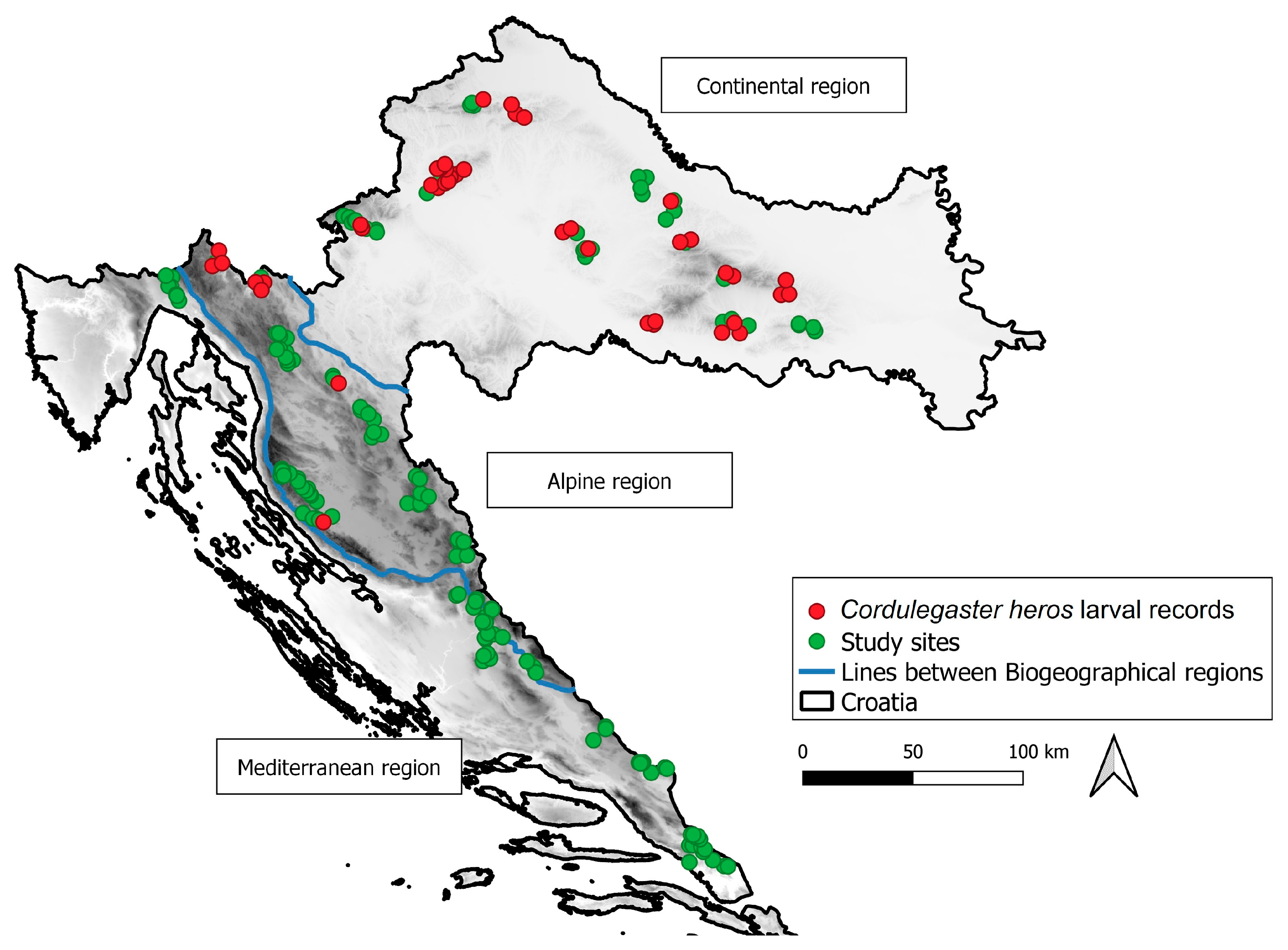
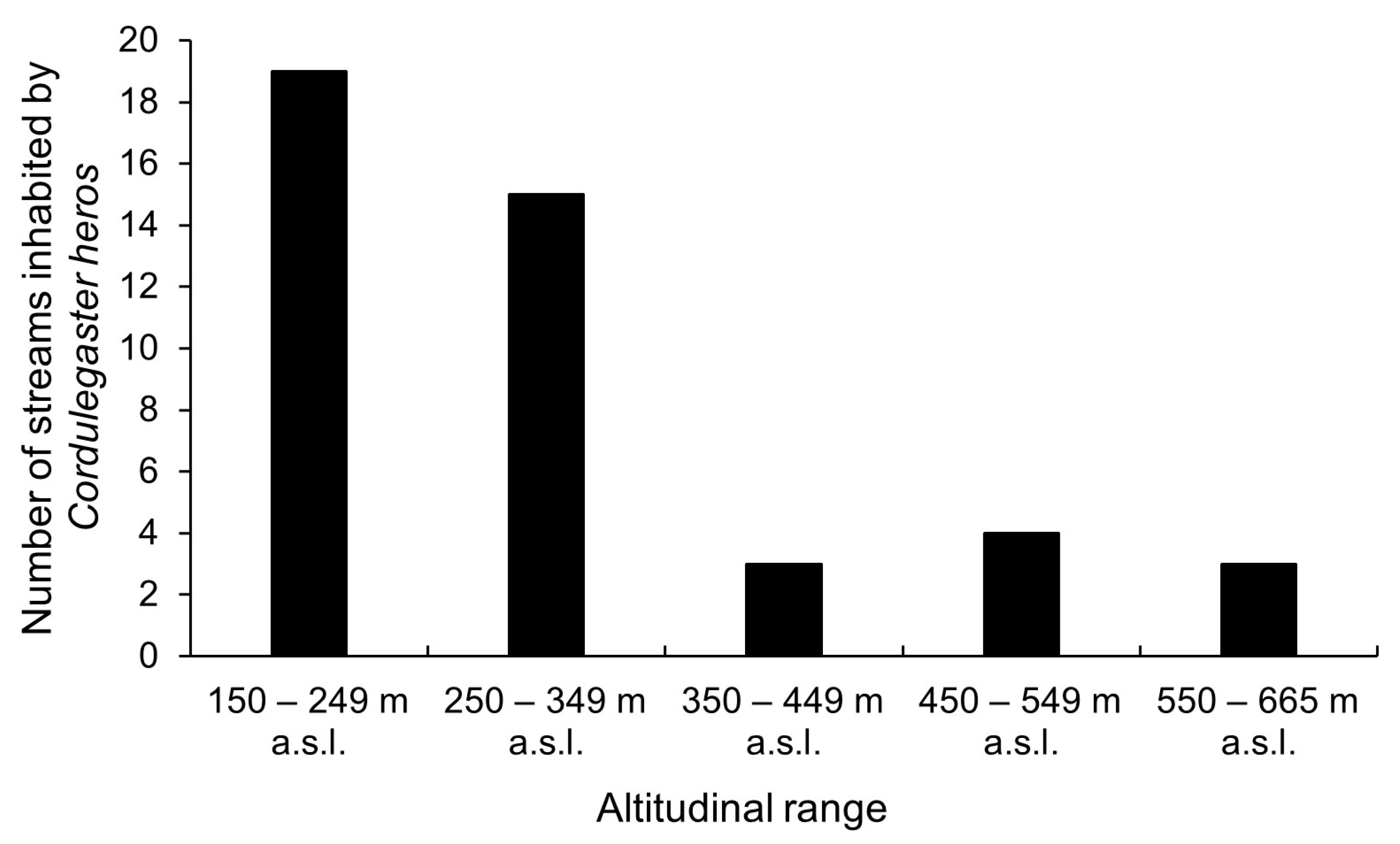
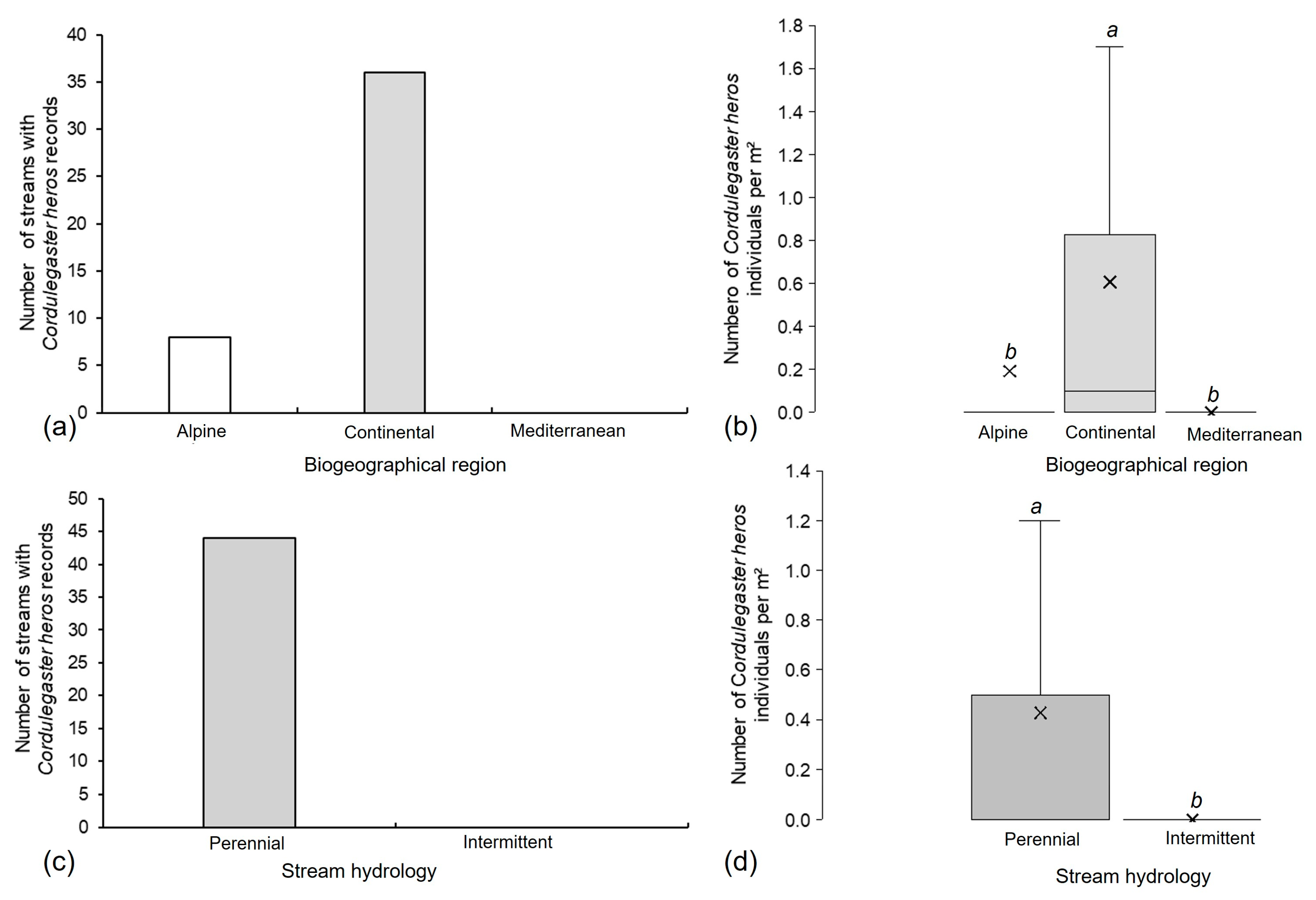
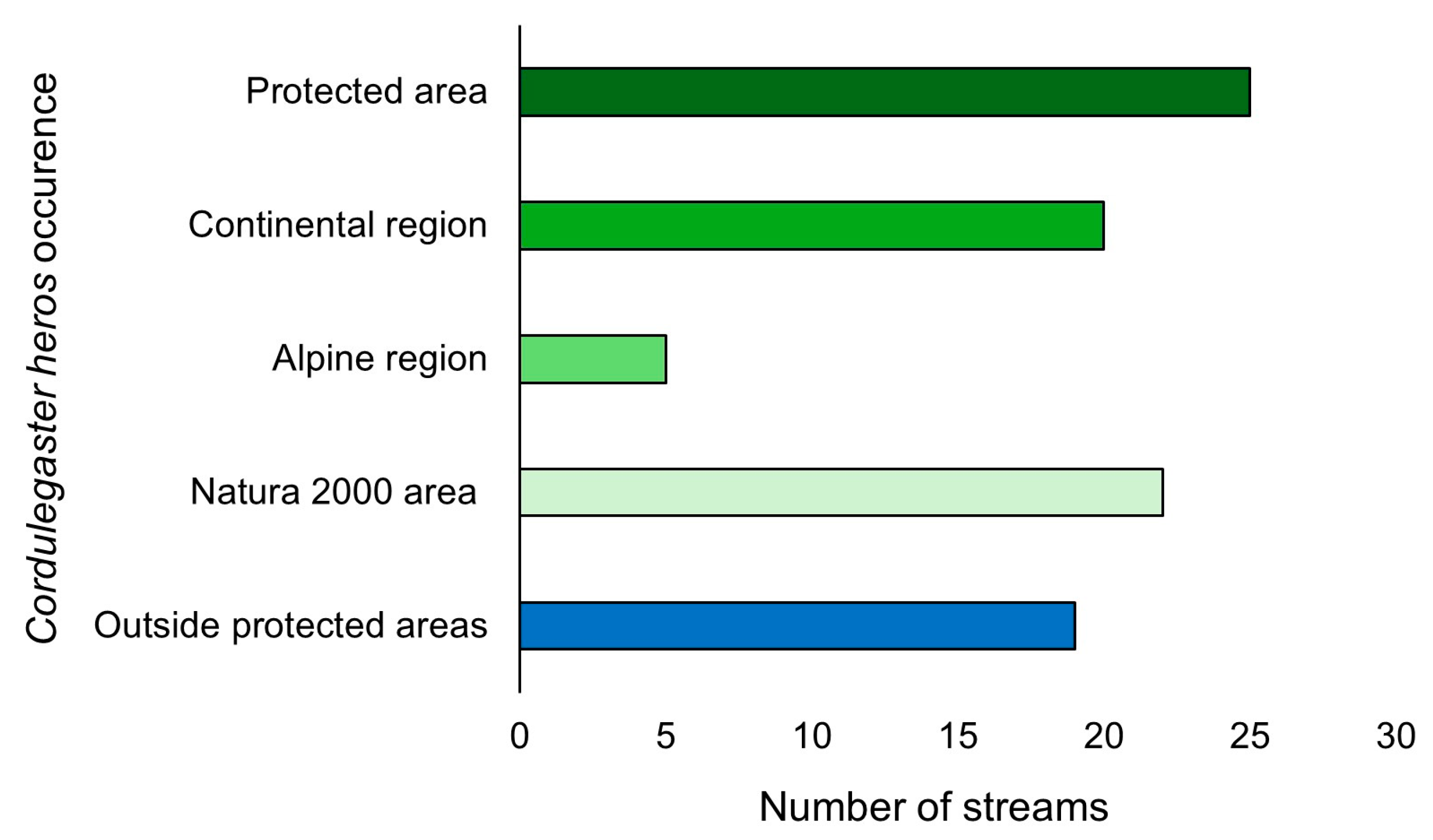
3.1. Cordulegaster heros Distribution and Relationship with Habitat Characteristics in Croatia
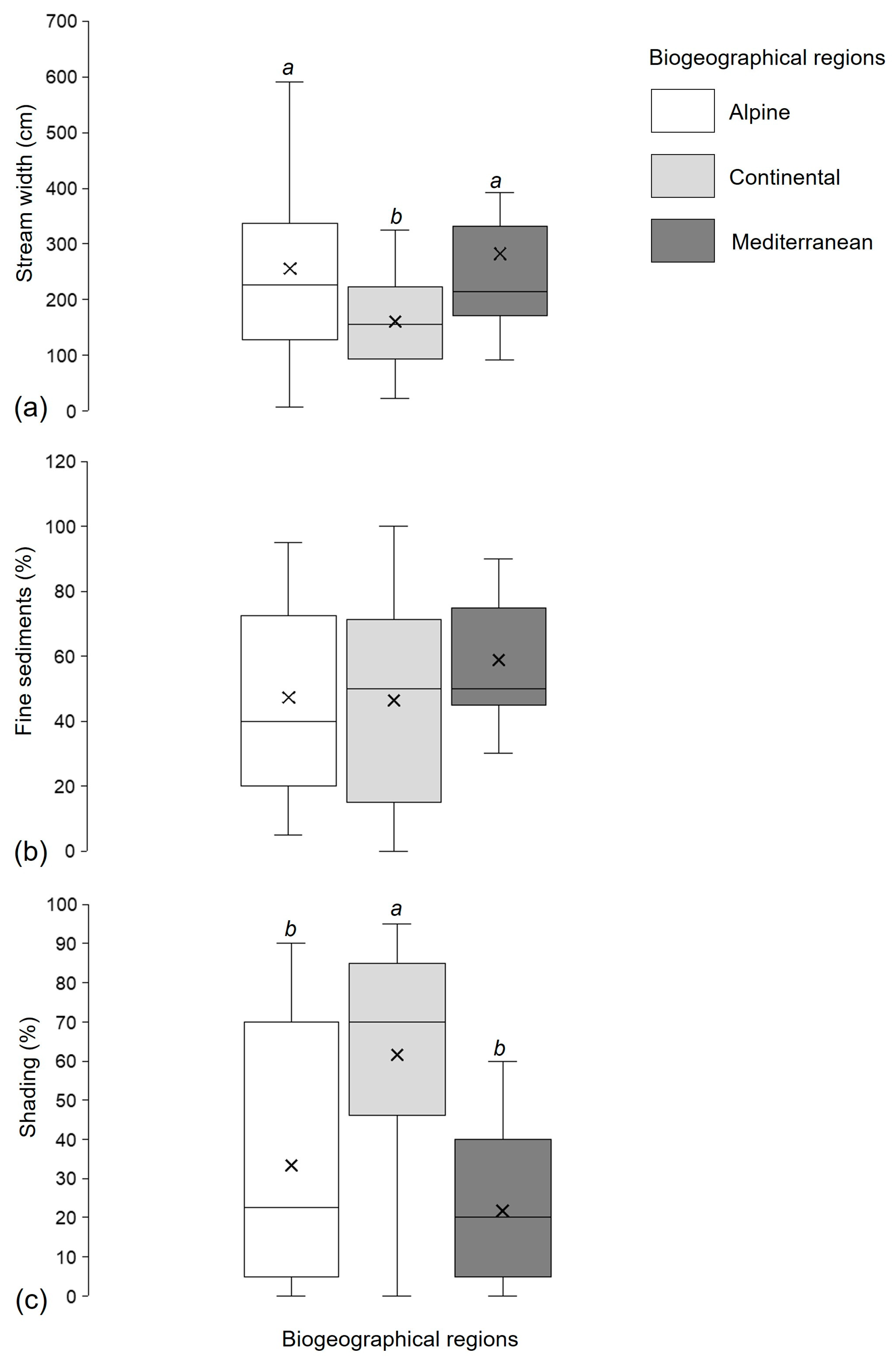
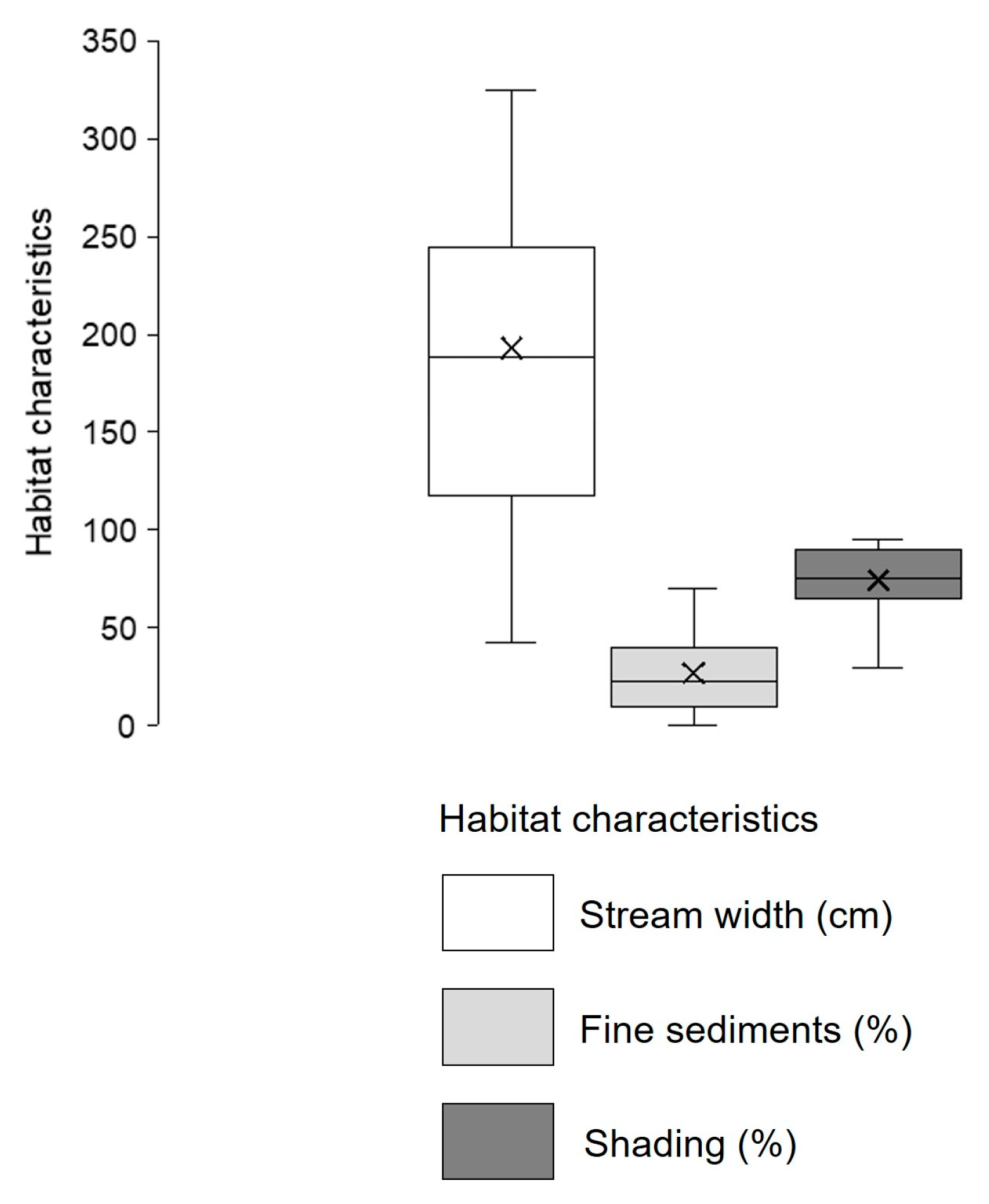
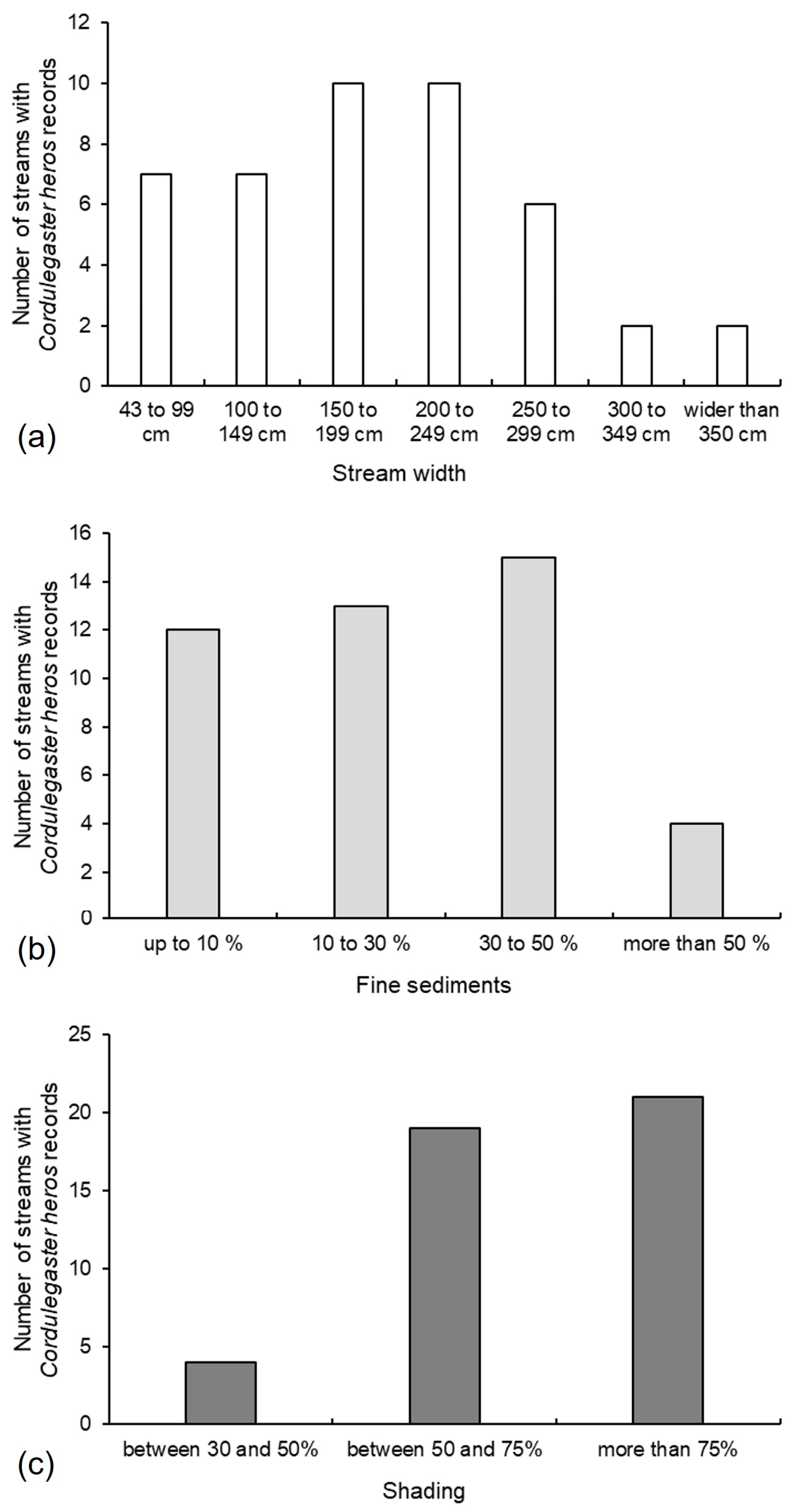
3.2. Cordulegaster heros Association with Habitat Characteristics in Croatian Streams
3.3. Cordulegaster heros Association with Habitat Characteristics and Physical and Chemical Water Parameters in the Medvednica Nature Park, Croatia
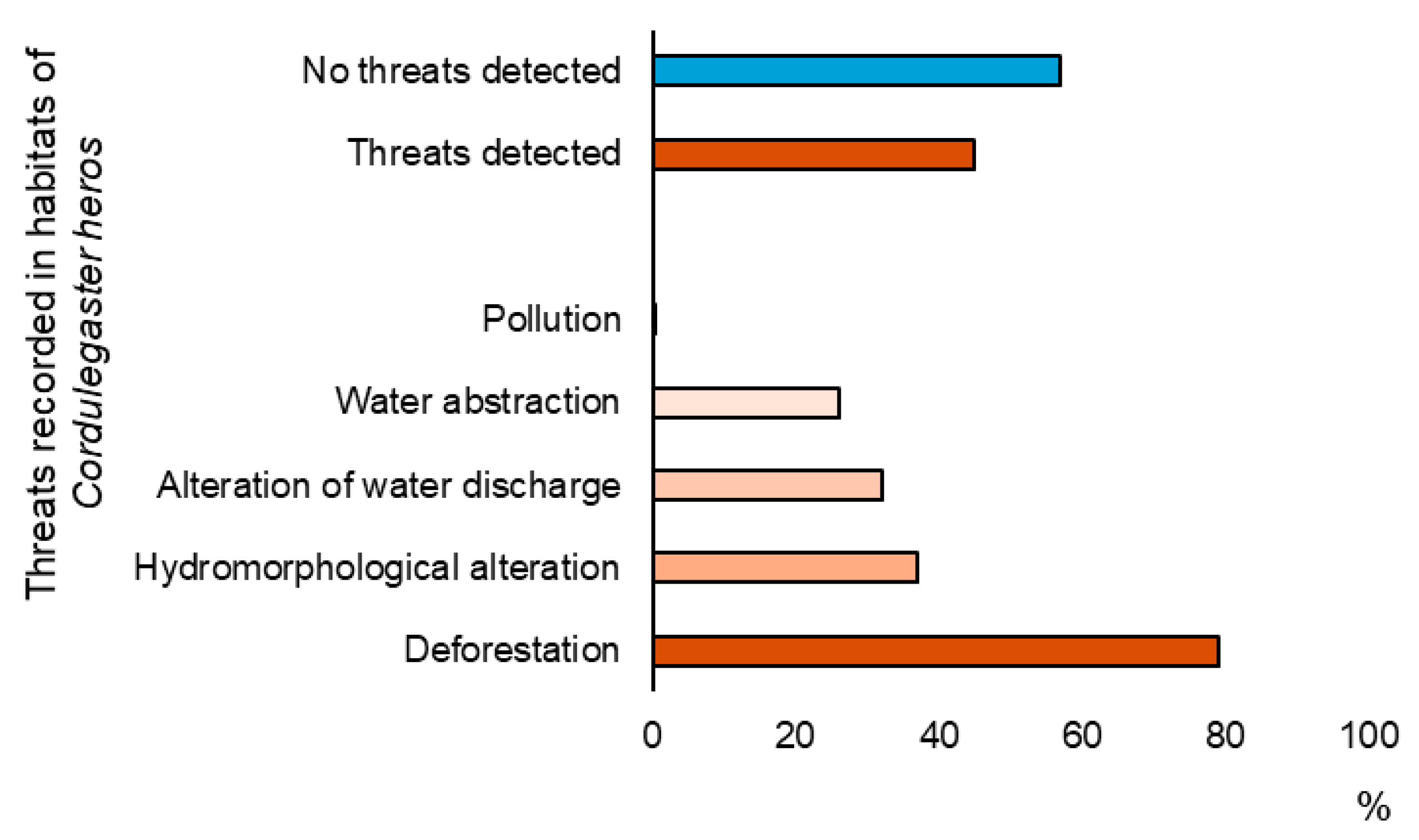
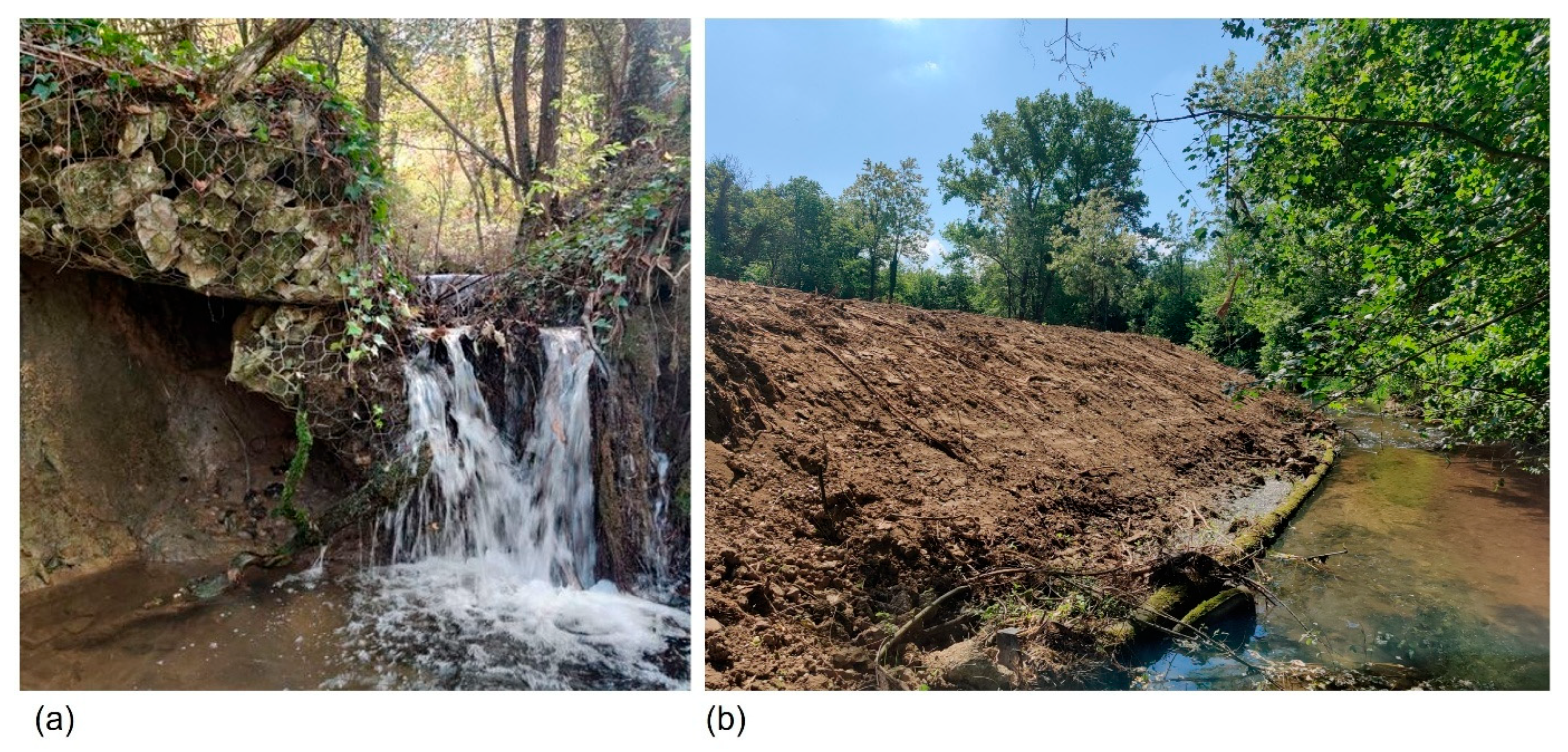
3.4. Threats to Habitats and Populations of Cordulegaster heros in Croatia
4. Discussion
4.1. Cordulegaster heros Prefers Perennial Streams in Submontane Areas of Continental Biogeographical Region in Croatia
4.2. Cordulegaster heros Prefers Clean Well-Oxygenated Forested Streams with High Habitat Shade
4.3. Threats to Cordulegaster heros’ Habitats and Implications for Its Conservation
5. Conclusions
Author Contributions
Funding
Data Availability Statement
Acknowledgments
Conflicts of Interest
References
- Reid, A.J.; Carlson, A.K.; Creed, I.F.; Eliason, E.J.; Gell, P.A.; Johnson, P.T.; Kidd, K.A.; MacCormack, T.J.; Olden, J.D.; Ormerod, S.J. Emerging threats and persistent conservation challenges for freshwater biodiversity. Biol. Rev. 2019, 94, 849–873. [Google Scholar] [CrossRef] [Scilit]
- Lynch, A.J.; Cooke, S.J.; Arthington, A.H.; Baigun, C.; Bossenbroek, L.; Dickens, C.; Harrison, I.; Kimirei, I.; Langhans, S.D.; Murchie, K.J.; et al. People need freshwater biodiversity. WIREs Water 2023, 10, e1633. [Google Scholar] [CrossRef] [Scilit]
- Dudgeon, D. Multiple threats imperil freshwater biodiversity in the Anthropocene. Curr. Biol. 2019, 29, R960–R967. [Google Scholar] [CrossRef] [Scilit]
- Finn, C.; Grattarola, F.; Pincheira-Donoso, D. More losers than winners: Investigating Anthropocene defaunation through the diversity of population trends. Biol. Rev. 2023, 98, 1732–1748. [Google Scholar] [CrossRef] [Scilit] [PubMed]
- Engelhardt, E.K.; Bowler, D.E.; Hof, C. European Habitats Directive has fostered monitoring but not prevented species declines. Conserv. Lett. 2023, 16, e12948. [Google Scholar] [CrossRef] [Scilit]
- European Commission. Council Directive 92/43/ECC. Off. J. Eur. Union 1992, 94, 40–52. [Google Scholar]
- European Commission. The Habitats Directive [WWW Document]. 2016. Available online: http://ec.europa.eu/environment/nature/legislation/habitatsdirective/index_en.htm (accessed on 25 September 2025).
- European Commission. EU’s Biodiversity Strategy for 2030. 2021. Available online: https://environment.ec.europa.eu/strategy/biodiversity-strategy-2030_en (accessed on 10 September 2025).
- Tang, D.H.Y.; Visconti, P. Biases of Odonata in Habitats Directive: Trends, trend drivers, and conservation status of European threatened Odonata. Insect Conserv. Divers. 2021, 14, 1–14. [Google Scholar] [CrossRef] [Scilit]
- Smith, B.D.; Villalobos-Jiménez, G.; Perron, M.A.C.; Sahlén, G.; Assandri, G.; Vilenica, M.; Calvão Batista, L.; Juen, L.; Cerini, F.; Bried, J.T. Odonata assemblages in human-modified landscapes. In Dragonflies and Damselflies: Model Organisms for Ecological and Evolutionary Research, 2nd ed.; Cordoba-Aguilar, A., Beatty, C., Bried, J., Eds.; Oxford Academic: Oxford, UK, 2023; pp. 247–260. [Google Scholar] [CrossRef] [Scilit]
- Samways, M.J. Conservation of Dragonflies: Sentinels for Freshwater Conservation; CABI/Royal Entomological Society: Wallingford, UK, 2024; p. 560. [Google Scholar] [CrossRef] [Scilit]
- Popova, O.N.; Haritonov, A.Y.; Sushchik, N.N.; Makhutova, O.N.; Kalachova, G.S.; Kolmakova, A.A.; Gladyshev, M.I. Export of aquatic productivity, including highly unsaturated fatty acids, to terrestrial ecosystems via Odonata. Sci. Total Environ. 2017, 581, 40–48. [Google Scholar] [CrossRef] [Scilit]
- Rivas-Torres, A.; Cordero-Rivera, A. A review of density, biomass and secondary production of odonates. Insects 2024, 15, 510. [Google Scholar] [CrossRef] [Scilit]
- May, M.L. Odonata: Who they are and what they have done for us lately: Classification and ecosystem services of dragonflies. Insects 2019, 10, 62. [Google Scholar] [CrossRef] [Scilit]
- Sayer, C.A.; Fernando, E.; Jimenez, R.R.; Macfarlane, N.B.; Rapacciuolo, G.; Böhm, M.; Brooks, T.M.; Contreras-MacBeath, T.; Cox, N.A.; Harrison, I.; et al. One-quarter of freshwater fauna threatened with extinction. Nature 2025, 638, 138–145. [Google Scholar] [CrossRef] [Scilit] [PubMed]
- Samways, M.J.; Córdoba-Aguilar, A.; Deacon, C.; Alves-Martins, F.; Baird, I.R.C.; Barmentlo, S.H.; Schlemmer Brasil, L.; Bried, J.T.; Clausnitzer, V.; Cordero-Rivera, A.; et al. Scientists’ warning on the need for greater inclusion of dragonflies in global conservation. Insect Conserv. Divers. 2025, 18, 447–687. [Google Scholar] [CrossRef] [Scilit]
- Council of Europe. Convention on the Conservation of European Wildlife and Natural Habitats; ETS No. 104; Council of Europe: Strasbourg, France, 1979. [Google Scholar]
- Anonymous. Pravilnik o izmjenama i dopunama Pravilnika o strogo zaštićenim vrstama [Ordinance on Amendments to the Ordinance on Strictly Protected Species]. Nar. Novine 2016, 73. Available online: https://narodne-novine.nn.hr/clanci/sluzbeni/dodatni/441255.pdf (accessed on 4 October 2025). (In Croatian)
- Dijkstra, K.-D.B.; Schröter, A.; Lewington, R. Field Guide to the Dragonflies of Britain and Europe: Including Western Turkey and North-Western Afrika; Bloomsbury Publishing: London, UK, 2020; p. 336. [Google Scholar]
- Fekete, J.; De Knijf, G.; Dinis, M.; Padisák, J.; Boda, P.; Mizsei, E.; Várbíró, G. Winners and losers: Cordulegaster species under the pressure of climate change. Insects 2023, 14, 348. [Google Scholar] [CrossRef] [Scilit] [PubMed]
- Vilenica, M.; Petrović, A.; Rimcheska, B.; Stojanović, K.; Tubić, B.; Vidinova, Y. How important are small lotic habitats of the Western Balkans for local mayflies? In Small Water Bodies of the Western Balkans; Pešić, V., Milošević, D., Miliša, M., Eds.; Springer: Cham, Switzerland, 2022; pp. 313–336. [Google Scholar] [CrossRef] [Scilit]
- Vinko, D.; Vilenica, M. BOOM 2013: Third Balkan odonatological meeting: Tretje mednarodno srečanje odonatologov Bal-kana Hrvaška, 1.-7. Avgust 2013: Rezultati. Erjavecia 2013, 28, 10–19. (In Slovenian) [Google Scholar]
- Vilenica, M.; Rebrina, F.; Ružanović, L.; Gulin, V.; Brigić, A. Odonata assemblages as a tool to assess the conservation value of intermittent rivers in the Mediterranean. Insects 2022, 13, 584. [Google Scholar] [CrossRef] [Scilit]
- Ergović, V.; Čerba, D.; Tubić, B.; Novaković, B.; Koh, M.; Mihaljević, Z. Seasonal dynamics and factors shaping aquatic insect assemblages in mountain streams of the Pannonian Lowland Ecoregion. Insects 2025, 16, 344. [Google Scholar] [CrossRef] [Scilit]
- Vilenica, M.; Dijkstra, K.-D.B. The dragonfly (Insecta, Odonata) fauna of the Banovina region, Croatia. Nat. Croat. 2014, 23, 45–66. [Google Scholar]
- Vilenica, M.; Katar, M.; Koren, T.; Štih Koren, A. Dragonfly fauna (Insecta: Odonata) of Papuk Nature Park, Croatia. Nat. Croat. 2022, 31, 351–364. [Google Scholar] [CrossRef] [Scilit]
- Šegota, T.; Filipčić, A. Köppenova podjela klima i hrvatsko nazivlje [Köppen’s climate classification and Croatian terminology]. Geoadria 2003, 8, 17–23. (In Croatian) [Google Scholar] [CrossRef] [Scilit]
- Harmel, M.; Skender, I.; Ćurić Ban, T.; Vugrek Petljak, K. Analiza pritisaka i prijetnji u Parku prirode Medvednica [Analysis of Pressures and Threats in Medvednica Nature Park]; Hrvatska Agencija za Okoliš i Prirodu: Zagreb, Croatia, 2015; p. 68. (In Croatian) [Google Scholar]
- Jelaska, S.; Nikolić, T. Geochemical control of the forest plant diversity on Mt. Medvednica, Croatia. Period. Biol. 2000, 102, 237–243. [Google Scholar]
- Tomljenović, B.; Csontos, L.; Márton, E.; Márton, P. Tectonic evolution of the northwestern Internal Dinarides as constrained by structures and rotation of Medvednica Mountains, North Croatia. Geol. Soc. Spec. Publ. 2008, 298, 145–167. [Google Scholar] [CrossRef] [Scilit]
- Šerić Jelaska, L.; Ješovnik, A.; Jelaska, S.D.; Pirnat, A.; Kučinić, M.; Durbešić, P. Variations of carabid beetle and ant assemblages, and their morpho-ecological traits within natural temperate forests in Medvednica Nature Park. Šumar. List 2010, 134, 475–486. [Google Scholar]
- Koren, T. The moth fauna (Lepidoptera: Heterocera) of Medvednica Nature Park, Croatia. Nat. Croat. 2020, 29, 37–54. [Google Scholar] [CrossRef] [Scilit]
- Farkaš-Topolnik, N. Plan upravljanja Parka prirode Medvednica [Medvednica Nature Park Management Plan]; Javna Ustanova Park Prirode Medvednica: Zagreb, Croatia, 2010; p. 78. (In Croatian) [Google Scholar]
- Gerken, B.; Sternberg, K. Die Exuvien europäischer Libellen. [The Exuviae of European Dragonflies]; Arnika & Eisvogel Höxter: Hökster/Jena, Germany, 1999; p. 354. [Google Scholar]
- Askew, R.R. The Dragonflies of Europe, 2nd ed.; Harley Books: Essex, UK, 2004; p. 308. [Google Scholar]
- TIBCO Software Inc. 2017: Statistica (Data Analysis Software System), version 13; TIBCO Software Inc.: Palo Alto, CA, USA, 2017. [Google Scholar]
- QGIS. QGIS Geographic Information System; QGIS Association: Grüt, Switzerland, 2025; Available online: http://www.qgis.org (accessed on 10 September 2025).
- Bioportal; Institute for Environment and Nature, Ministry of Environmental Protection and Green Transition. Bioportal—Biogeographical Regions, Croatian Borders. 2025. Available online: http://www.bioportal.hr/ (accessed on 20 October 2025).
- DGU. State Geodetic Directorate; Geoportal—Elevation Map, 2025. Available online: https://geoportal.dgu.hr/ (accessed on 20 October 2025).
- Pernecker, B.; Mauchart, P.; Csabai, Z. What to do if streams go dry? Behaviour of Balkan Goldenring (Cordulegaster heros, Odonata) larvae in a simulated drought experiment in SW Hungary. Ecol. Entomol. 2020, 45, 1457–1465. [Google Scholar] [CrossRef] [Scilit]
- Vinko, D.; Billqvist, M.; De Knijf, G.; van Grunsven, R.H.A.; Prunier, F. Cordulegaster heros. The IUCN Red List of Threatened Species; International Union for Conservation of Nature: Gland, Switzerland, 2023; p. e.T158700A208809715. [Google Scholar] [CrossRef] [Scilit]
- Bedjanič, M.; Šalamun, A. Large goldenringed dragonfly Cordulegaster heros Theischinger, 1979, new for the fauna of Italy (Odonata: Cordulegastridae). Nat. Slov. 2003, 5, 19–29. [Google Scholar] [CrossRef] [Scilit]
- Holuša, O.; Holušová, K. Population density and abundance of the northernmost population of Cordulegaster heros (Anisoptera: Cordulegastridae) in Europe (Czech Republic) with notes on its biogeographical range. Diversity 2022, 14, 854. [Google Scholar] [CrossRef] [Scilit]
- Šalamun, A. Ekologija in razširjenost velikega studenčarja (Cordulegaster heros) (Odonata: Cordulegastridae) v Sloveniji [Ecology and Distribution of the Balkan Goldenring (Cordulegaster heros) (Odonata: Cordulegastridae) in Slovenia]. Ph.D. Thesis, Univerza v Ljubljani, Biotehniška Fakulteta, Odelek za Biologijo, Ljubljana, Slovenia, 2016; p. 65. (In Slovenian) [Google Scholar]
- Kulijer, D. First survey of the dragonfly fauna (Insecta, Odonata) of northwestern Bosnia. Nat. Croat. 2017, 26, 65–80. [Google Scholar] [CrossRef] [Scilit]
- Vilenica, M.; Kulijer, D.; Gligorović, B.; Gligorović, A.; De Knijf, G. Distribution, habitat requirements, and vulnerability of Caliaeschna microstigma at the north-western edge of its range (Odonata: Aeshnidae). Odonatologica 2021, 50, 203–225. [Google Scholar] [CrossRef] [Scilit]
- Peñuelas, J.; Sardans, J.; Filella, I.; Estiarte, M.; Llusià, J.; Ogaya, R.; Carnicer, J.; Bartrons, M.; Rivas-Ubach, A.; Grau, O. Impacts of global change on Mediterranean forests and their services. Forests 2017, 8, 463. [Google Scholar] [CrossRef] [Scilit]
- Fekete, J.; Várbíró, G.; Szeles, J.; Bozóki, T.; Pernecker, B.; Csabai, Z.; Boda, P. Prolonged flow intermittency undermines the habitat potential of forested landscapes for a stream-dwelling dragonfly. Ecol. Entomol. 2025, 50, 953–1195. [Google Scholar] [CrossRef] [Scilit]
- Kulijer, D. Odonata fauna of karst streams and rivers of South Herzegovina (Bosnia and Herzegovina, West Balkan). Int. Dragonfly Fund 2014, 78, 55. [Google Scholar]
- Lang, C.; Müller, H.; Waringer, J.A. Larval habitats and longitudinal distribution patterns of Cordulegaster heros Theischinger and C. bidentata Sélys in an Austrian forest stream (Anisoptera: Cordulegastridae). Odonatologica 2001, 30, 395–409. [Google Scholar]
- Boda, R.; Bereczki, C.; Pernecker, B.; Mauchart, P.; Csabai, Z. Life history and multiscale habitat preferences of the red-listed Balkan Goldenring, Cordulegaster heros Theischinger, 1979 (Insecta, Odonata), in South-Hungarian headwaters: Does the species have mesohabitat-mediated microdistribution? Hydrobiologia 2015, 760, 121–132. [Google Scholar] [CrossRef] [Scilit]
- Kotarac, M.; Šalamun, A.; Govedič, M.; Podgorelec, M. Popis velikega studenčarja (Cordulegaster heros) s predlogom conacije Natura 2000 območja Goričko (SI3000221). Zasnova conacij izbranih Natura 2000 območij (7174201-01-01-0002) (Phare čezmejno sodelovanje Slovenija-Avstrija 2003); Center za Kartografijo Favne in Flore: Miklavž na Dravskem Polju, Slovenia, 2006; p. 31. (In Slovenian) [Google Scholar]
- Sternberg, K.; Buchwald, R.; Stephan, U. Cordulegaster boltonii (Donovan, 1807), Zweigestreifte Quelljungfer. Die Libellen Baden-Württembergs, Band 2; Ulmer Stuttgart: Stuttgart, Germany, 2000; pp. 191–208. [Google Scholar]
- De Knijf, G.; Billqvist, M.; van Grunsven, R.H.A.; Prunier, F.; Vinko, D.; Trottet, A.; Bellotto, V.; Clay, J.; Allen, D.J. Measuring the pulse of European biodiversity. In European Red List of Dragonflies & Damselflies (Odonata); European Commission: Brussels, Belgium, 2024; p. 46. [Google Scholar]
- Holuša, O.; Kúdela, M. New records of Cordulegaster heros (Odonata: Cordulegastridae) on its northern area border in Slovakia. Acta Mus. Beskid 2010, 2, 75–87. [Google Scholar] [CrossRef] [Scilit]
- David, S.; Šacha, D. Kmentovaný seznam vážek (Odonata) Slovenké republiky. Ochr. Prír. 2019, 33, 49–78. (In Slovak) [Google Scholar]
- Buczyński, P.; Michoński, G.; Zawal, A. New site of Cordulegaster heros Theischinger, 1979 in western Slovakia—The confirmation of its northern border of range of occurrence in Europe (Odonata: Cordulegastridae). Ecol. Monten. 2020, 28, 20–22. [Google Scholar] [CrossRef] [Scilit]
- Shanafield, M.; Bourke, S.A.; Zimmer, M.A.; Costigan, K.H. An overview of the hydrology of non-perennial rivers and streams. WIREs Water 2021, 8, e1504. [Google Scholar] [CrossRef] [Scilit]





| Streams | N (ind/m2) | Altitude (m a.s.l.) | Stream Width (cm) | Shading (%) | Fine Substrate (%) |
|---|---|---|---|---|---|
| Trnava | 3 (2–4) | 340 | 257 (241–263) | 90 | 10 |
| Markuševački potok | 2 (2–3) | 320 | 224 (197–226) | 90 | 35 |
| Rakova noga | 1. (1–2) | 517 | 188 (173–207) | 80 | 10 |
| Vidak | 3 (2–4) | 314 | 135 (121–148) | 85 | 20 |
| Pronjak | 1 (0–1) | 282 | 177 (176–191) | 70 | 5 |
| Bidrovec | 0 (0–0) | 351 | 190 (2170–210) | 90 | 15 |
| Vidovec | 1 (0−2) | 336 | 160 (150–170) | 80 | 5 |
| Veliki potok | 2 (0–2) | 310 | 66 (54–74) | 95 | 10 |
| Vrapčak | 1 (0–1) | 339 | 113 (98–122) | 75 | 10 |
| Bliznec | 4 (2–5) | 393 | 105 (90–120) | 95 | 5 |
| Bistra | 5 (4.0–6) | 280 | 160 (140–170) | 90 | 40 |
| Rijeka | 0 (0–1) | 260 | 201 (198–252) | 80 | 15 |
| Vukov potok | 0 (0–1) | 314 | 154 (121–178) | 90 | 20 |
| Dubravica | 0 (0–0) | 226 | 67 (56–71) | 90 | 10 |
| Kraljevac | 0 (0–0) | 567 | 216 (198–227) | 80 | 5 |
| Streams | Water Temperature (°C) | Oxygen Saturation (%) | Oxygen Concentration (mg/L) | pH | Conductivity (µS/cm) | Water Velocity (cm/s) | Water Depth (cm) |
|---|---|---|---|---|---|---|---|
| Trnava | 10.8 (10.8–11.2) | 102.8 (102.7–103.1) | 11.09 (11.01–11.15) | 8.38 (8.35–8.39) | 255 (253–257) | 18 (6–32) | 12 (9–17) |
| Markuševački potok | 10.6 (10.6–10.8) | 103.1 (103.0–103.1) | 11.11 (11.08–11.15) | 8.32 (8.30–8.46) | 266 (266–267) | 58 (8–88) | 8 (7–10) |
| Rakova noga | 10.5 (10.5–10.6) | 103.6 (103.4–103.6) | 11.01 (10.08–11.06) | 8.51 (8.49–8.53) | 337 (336–337) | 441 (11–69) | 12 (4–15) |
| Vidak | 12.3 (12.3–12.5) | 103.3 (103.3–103.4) | 10.79 (10.75–10.79) | 8.05 (8.04–8.11) | 205 (204–205) | 11 (5–41) | 13 (7–24) |
| Pronjak | 12.3 (12.3–12.4) | 100.7 (100.7–101.0) | 10.56 (10. 46–10.59) | 8.23 (8.03–8.26) | 247 (246–247) | 22 (5–44) | 10 (4–12) |
| Bidrovec | 13.9 (13.7–14.6) | 105.0 (104.5–105.4) | 10.50 (10.28–10.50) | 8.44 (8.36–8.45) | 267 (267–268) | 33 (8–61) | 18 (10–26) |
| Vidovec | 15.1 (15.0–15.5) | 106.0 (105.4–106.3) | 10.32 (10.16–10.37) | 8.42 (8.40–8.46) | 385 (382–386) | 38 (11–41) | 13 (6–18) |
| Veliki potok | 14.5 (14.3–14.7) | 106.3 (106.3–106.6) | 10.59 (10.53–10.65) | 8.36 (8.34–8.37) | 351 (349–352) | 38 (11–41) | 12 (6–16) |
| Vrapčak | 15.2 (15.1–15.4) | 105.9 (105.6–106.0) | 10.29 (0.10.29–10.34) | 8.47 (8.47–8.49) | 437 (434–437) | 11 (2–13) | 9 (6–13) |
| Bliznec | 17.1 (17.0–17.4) | 106.0 (106.0–106.1) | 9.80 (9.73–9.83) | 8.29 (8.28–8.31) | 405 (404–405) | 11 (2–24) | 8 (4–10) |
| Bistra | 14.7 (014.7–15.0) | 105.8 (105.4–105.8) | 10.42 (10.34–10.44) | 8.21 (8.10–8.24) | 225 (222–225) | 16 (5–27) | 9 (8–17) |
| Rijeka | 15.7 (15.5–15.9) | 104.3 (103.9–104.6) | 10.09 (9.99–10.16) | 8.17 (8.16–8.20) | 308 (307–308) | 16 (2–63) | 28 (7–36) |
| Vukov potok | 20.3 (20.1–21.8) | 98.7 (98.4–99.6) | 8.71 (8.44–8.85) | 8.35 (08.34–8.35) | 484 (482–484) | 16 (9–21) | 13 (6–26) |
| Dubravica | 12.4 (12.4–12.8) | 100.3 (100.0–100.7) | 10.55 (10.45–10.60) | 7.92 (7.90–7.93) | 480 (474–481) | 67 (21–83) | 13 (4–27) |
| Kraljevac | 16.9 (16.5–17.1) | 103.4 (103.4–103.8) | 9.43 (9.40–9.55) | 8.25 (8.24–8.26) | 393 (393–394) | 22 (2–72) | 15 (11–18) |
Disclaimer/Publisher’s Note: The statements, opinions and data contained in all publications are solely those of the individual author(s) and contributor(s) and not of MDPI and/or the editor(s). MDPI and/or the editor(s) disclaim responsibility for any injury to people or property resulting from any ideas, methods, instructions or products referred to in the content. |
© 2025 by the authors. Licensee MDPI, Basel, Switzerland. This article is an open access article distributed under the terms and conditions of the Creative Commons Attribution (CC BY) license (https://creativecommons.org/licenses/by/4.0/).
Share and Cite
Vilenica, M.; Schmidt, B.; Koren, T. The EU’s Habitats Directive Dragonfly Cordulegaster heros Theischinger, 1979 in Croatia—Distribution and Habitat Requirements. Insects 2025, 16, 1284. https://doi.org/10.3390/insects16121284
Vilenica M, Schmidt B, Koren T. The EU’s Habitats Directive Dragonfly Cordulegaster heros Theischinger, 1979 in Croatia—Distribution and Habitat Requirements. Insects. 2025; 16(12):1284. https://doi.org/10.3390/insects16121284
Chicago/Turabian StyleVilenica, Marina, Bruno Schmidt, and Toni Koren. 2025. "The EU’s Habitats Directive Dragonfly Cordulegaster heros Theischinger, 1979 in Croatia—Distribution and Habitat Requirements" Insects 16, no. 12: 1284. https://doi.org/10.3390/insects16121284
APA StyleVilenica, M., Schmidt, B., & Koren, T. (2025). The EU’s Habitats Directive Dragonfly Cordulegaster heros Theischinger, 1979 in Croatia—Distribution and Habitat Requirements. Insects, 16(12), 1284. https://doi.org/10.3390/insects16121284