Taxonomic Revision of the South American Genus Eudius and First Insights into the Phylogeny of the Tribe Eudiagogini (Curculionidae: Entiminae)

Simple Summary
Abstract
1. Introduction
2. Materials and Methods
2.1. Specimen Repositories
- MACN: Museo Argentino de Ciencias Naturales Bernardino Rivadavia, Buenos Aires, Argentina
- MZSP: Museu de Zoologia Universidade de São Paulo, Brazil
- MNHN: Muséum National d’Histoire Naturelle, Paris, France
- NHMUK: Natural History Museum, London, United Kingdom
- MFN: Museum für Naturkunde, Berlin, Germany
- MTD: Senckenberg Naturhistorische Sammlungen (Staatliches Museum für Tierkunde), Dresden, Germany
- NHRS: Naturhistoriska Riksmuseet, Stockholm, Sweden
2.2. Morphological Study
2.3. Distribution Map
2.4. Morphology-Based Phylogenetic Analysis
2.5. Molecular Phylogenetic Analysis
3. Results and Discussion
3.1. Taxonomy
- Eudius Schoenherr, 1834: 162 [26], 1840: 441 (classification, diagnosis) [27]; Castelnau, 1840: 312 (diagnosis) [28]; Blanchard, 1851: 323 (classification, description) [29]; Lacordaire, 1863: 385, 388 (key, description) [5]; Schenkling & Marshall, 1931: 3 (catalog) [4]; Voss, 1934: 71, 74 (key, classification) [30]; Blackwelder, 1947: 806 (catalog) [31]; Wibmer & O’Brien, 1986: 81 (catalog) [1]; Alonso-Zarazaga & Lyal, 1999: 157 (catalog) [3]; Morrone, 1999: 119 (catalog) [32].
- Type species. Eudius quadrisignatus Gyllenhal 1834, by original designation.
- Diagnosis. Eudius is easily distinguished from other genera of Eudiagogini by the striped patterns on pronotum and elytra, connate tarsal claws, and vagina and bursa copulatrix with distinct sclerites.
- Description.
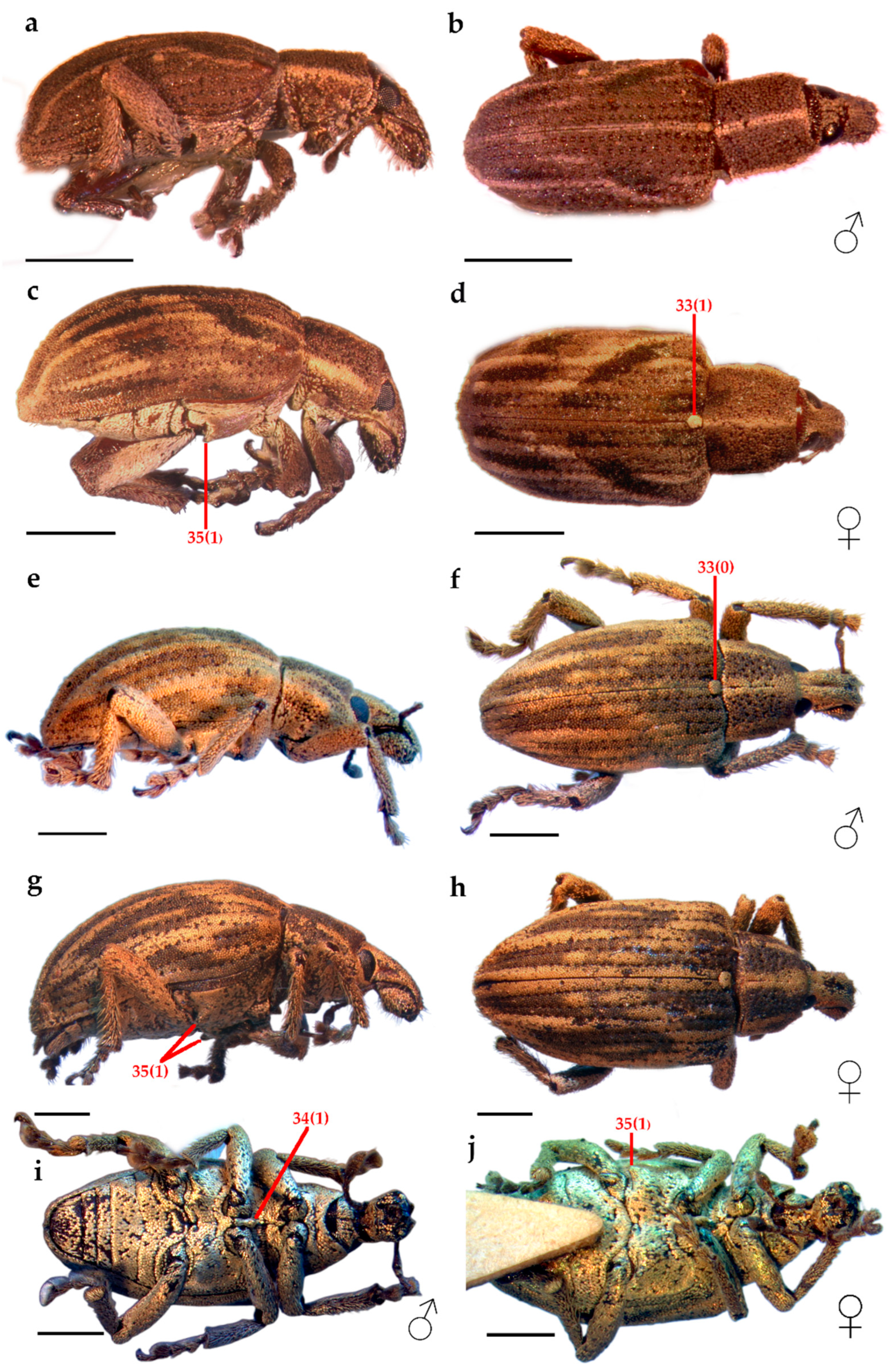
- Habitus (Figure 1). Medium-sized (3.5–6.0 mm). Body stout, broadly oval, maximum width about half TL, convex in lateral view. Integument reddish brown, covered with whitish to brownish or black scales, some iridescent, forming band patterns on pronotum and elytra; scales tessellate to imbricate, appressed, subcircular on dorsum and elongated on venter.
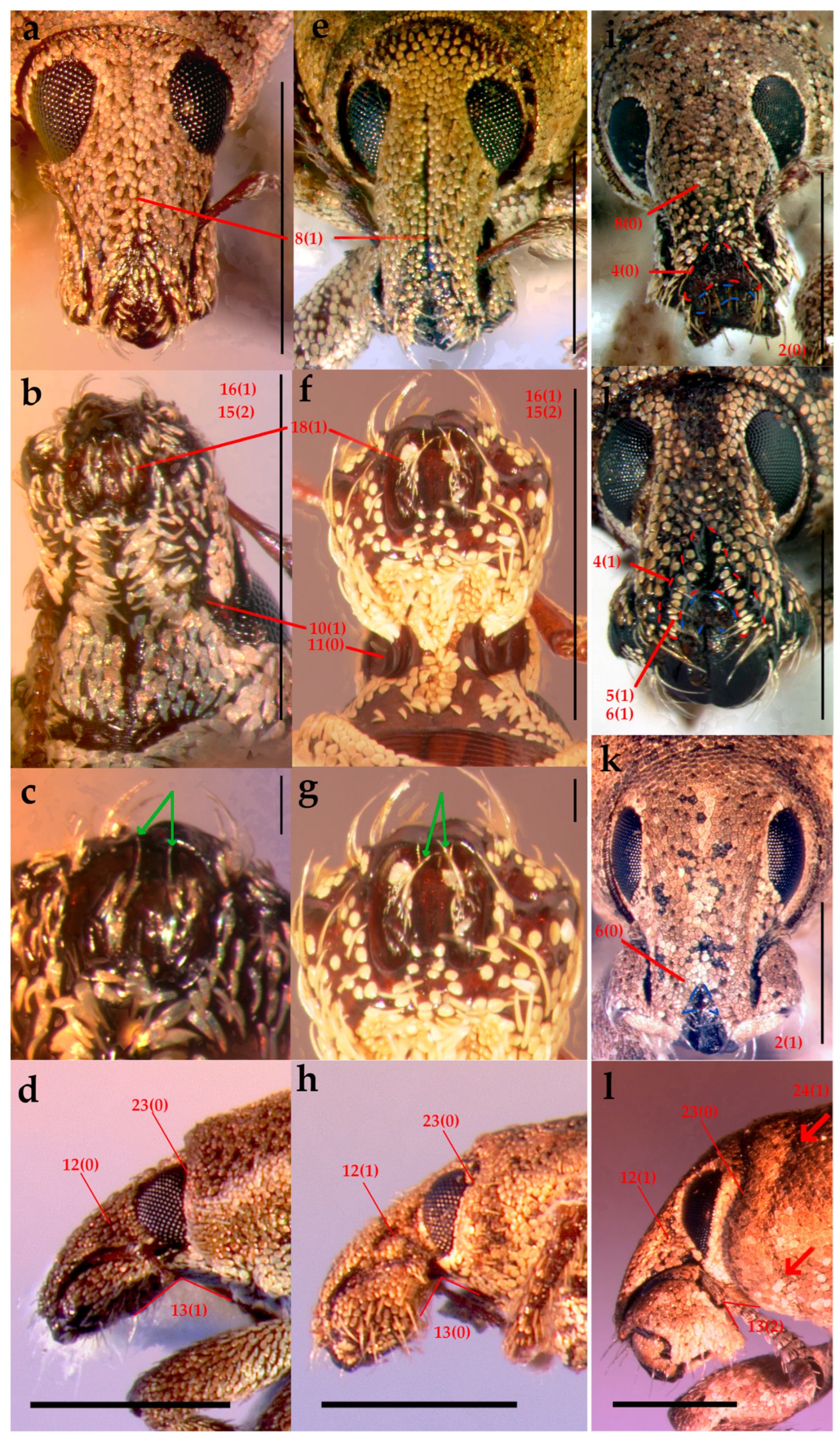
- Head (Figure 2a,h). Rostrum stout, short, downcurved; linear median groove. Epistome subtriangular and sunken, mostly glabrous, with a posterior V-shaped area of sparse scales (different from rostral ones), distal setae elongated, decumbent, directed antero-mesad. Antennae: scape straight, distally inflated; club elliptical. Mouthparts: mandibles with whitish scales, and rigid, translucent, decumbent setae; maxillae partially exposed at sides of prementum (imperfectly adelognathous condition), bearing small, elongated scales and each with one elongate, suberect seta; prementum glabrous.
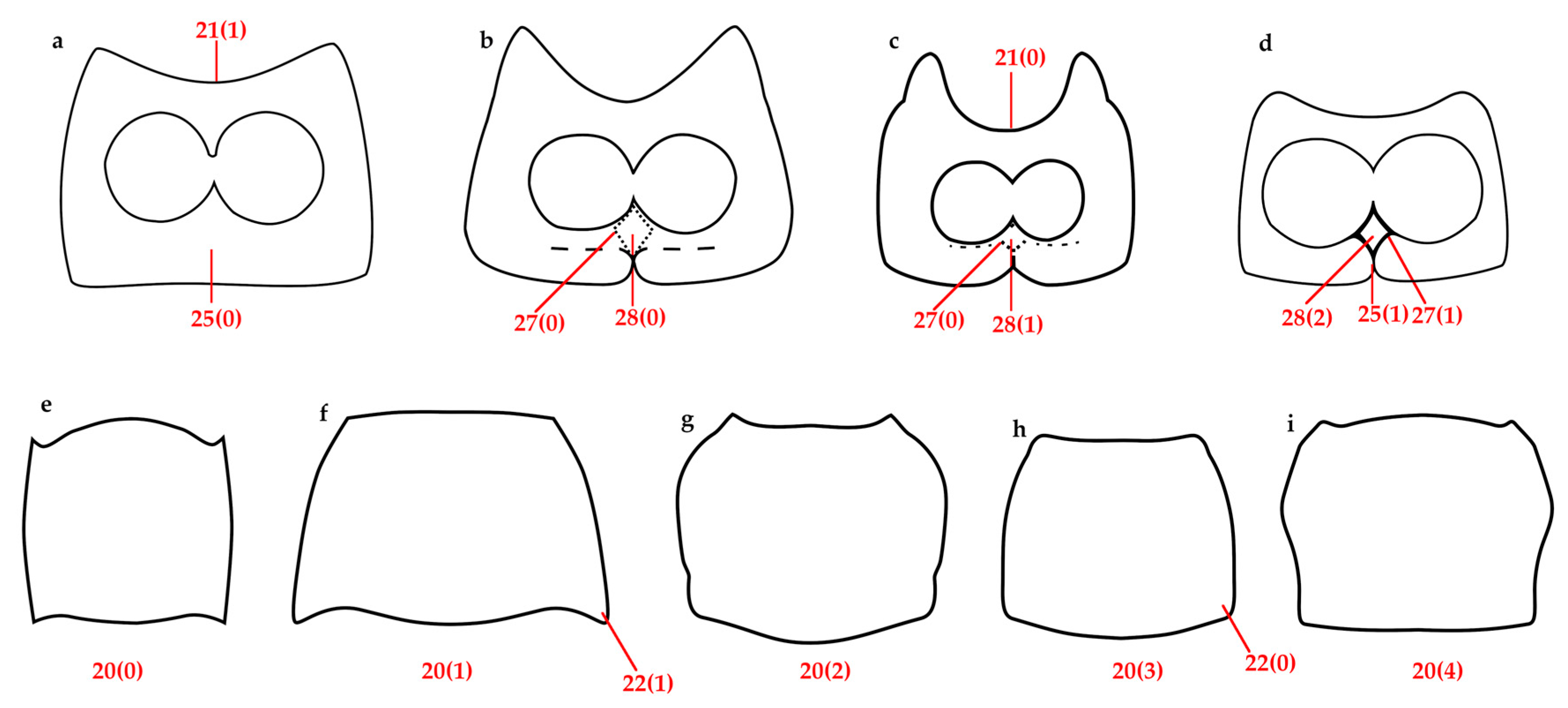
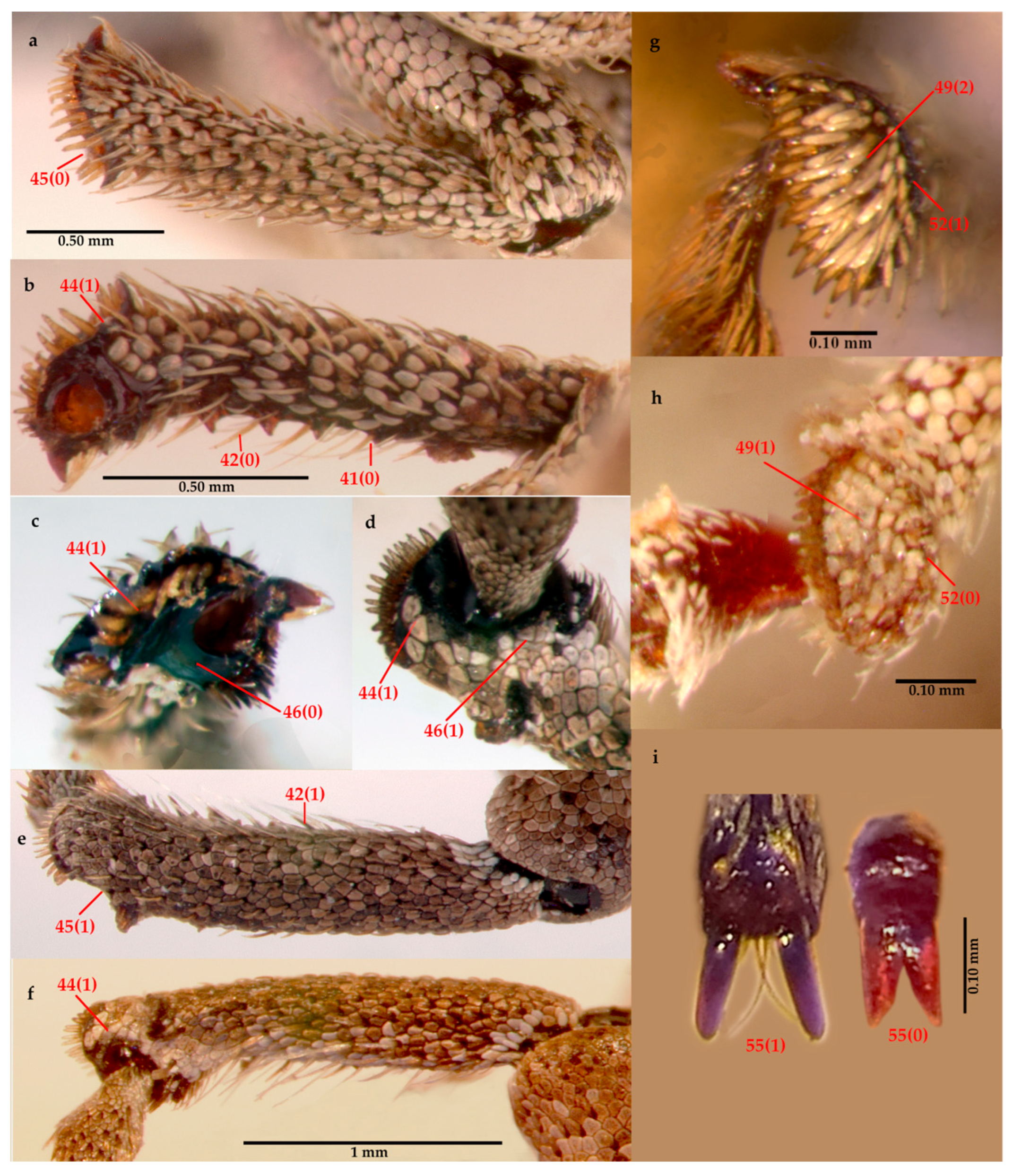
- Thorax (Figure 3c,h and Figure 4g,i [right]). Prothorax with flat flanks and ocular lobes. Pronotum with three light bands alternating with two (usually broader) dark bands; PL/PWa: 1.2, PWp/EW: 0.6, posterior margin bisinuate. Scutellar shield subpentagonal. Elytra elongate, about 3× longer than pronotum, EW/EL: 0.6, with a V-shaped color pattern, from humeri to about midlength, and with longitudinal discontinuous stripes on remaining areas; interstriae with white, sparse, recumbent, setiform scales; striae distinct, punctures bearing a minute elongated scale; humeri broadly rounded. Hindwings well developed. Mesoventrite with intermesocoxal process acute and anteriorly raised. Metaventrite swelling in front of metacoxae, acute and strongly produced; metacoxal distance approximately equal to length of first abdominal ventrite at middle. Legs: femora straight, with whitish setiform scales; metafemora medially inflated; tibiae slightly expanded distally, with setae increasing along inner margin, distal comb with short setae, corbel setose and scaly, tarsi with small (less than 0.25× the length of tarsomere 5) claws, connate at base.
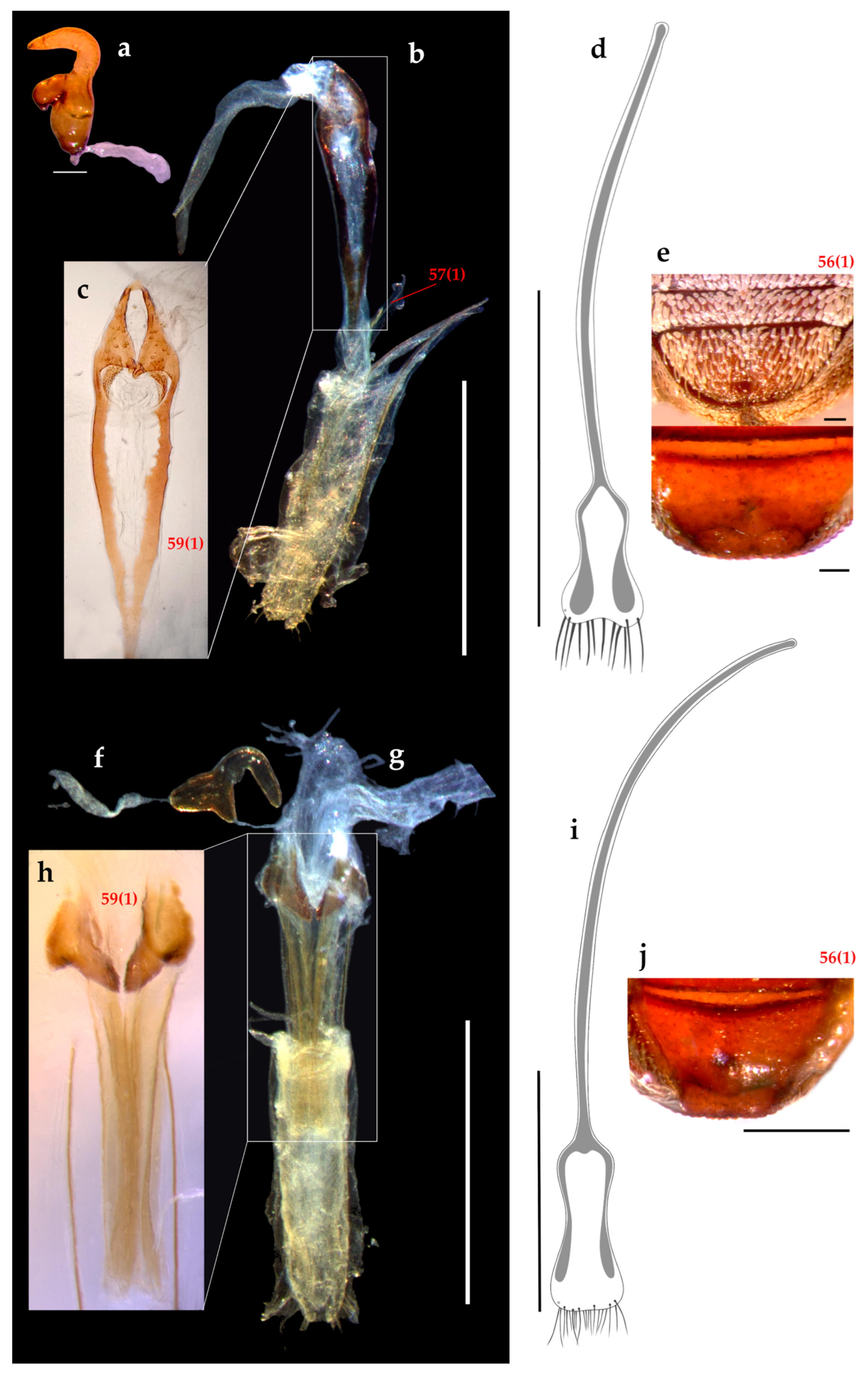
- Female terminalia (Figure 5). Sternite VIII as long as ventrites 1–5, plate with wide lateral sclerotized arms almost reaching apex of plate, apical margin with row of long setae. Ovipositor with subparallel ventral baculi, vagina and bursa copulatrix with sclerites, styli absent.Spermatheca: ramus globose, spermathecal duct membranose.
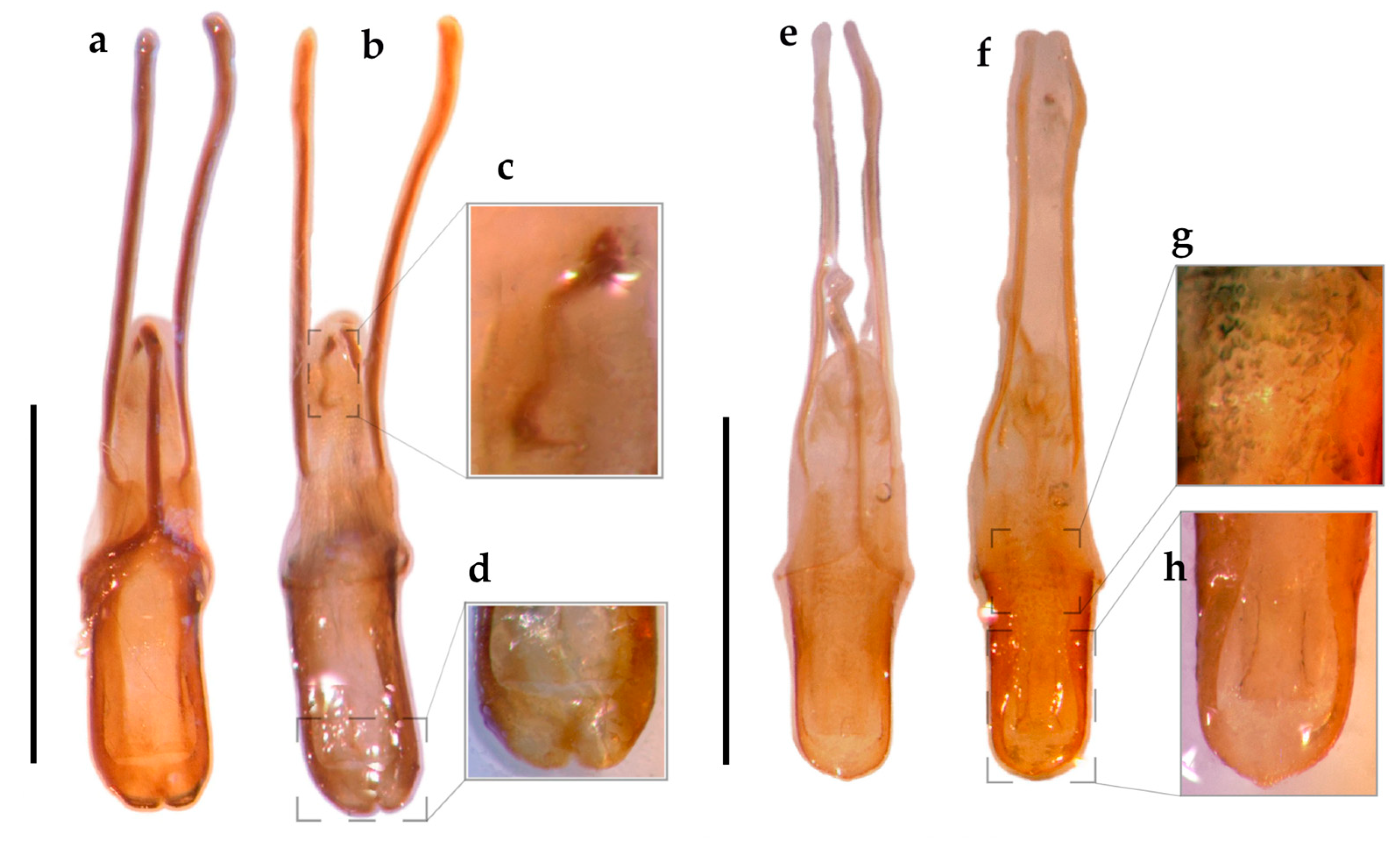
- Male genitalia (Figure 6). Penis as long as, or longer than, ventrites 1–5.
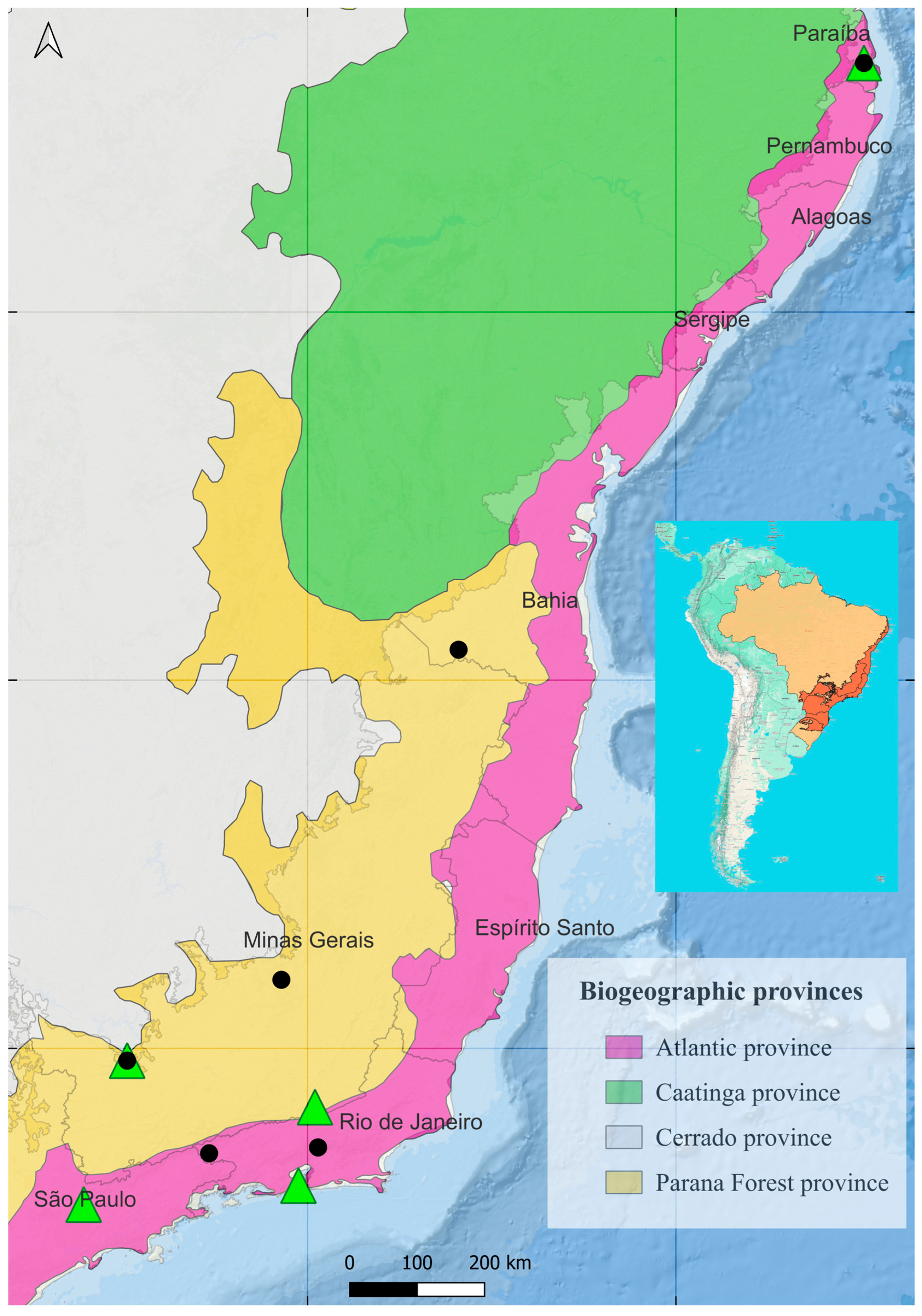
- Distribution (Figure 7). Brazil (Bahía, Espírito Santo, Minas Gerais, Paraíba, Rio de Janeiro, and São Paulo).
- Biology. Unknown.
- Included taxa. The genus only has two species: Eudius quadrisignatus and E. jocosus.
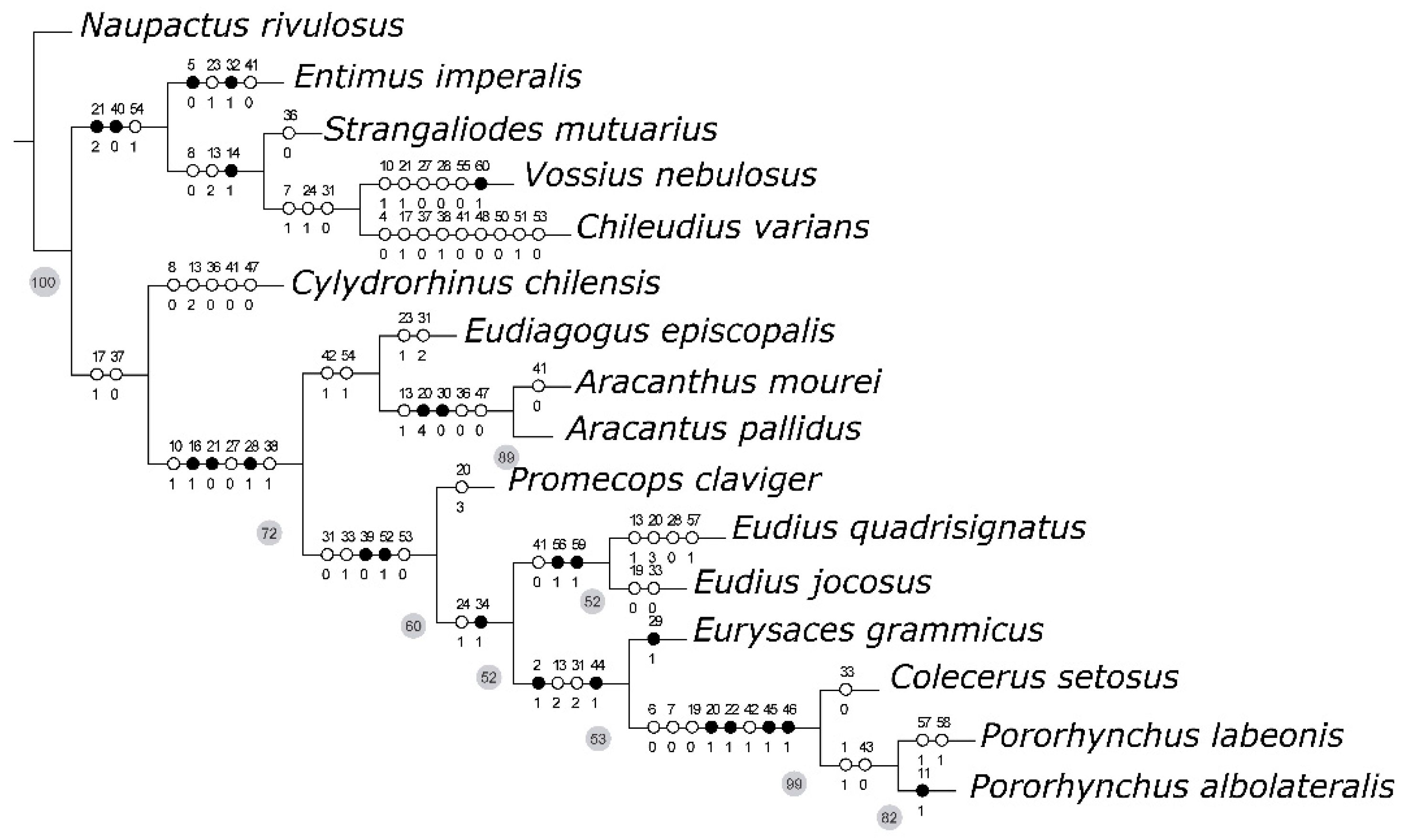
- Remarks. According to results of the cladistic analysis performed in this study (see Section 3.3.1 and Figure 8, Figures S1 and S2), the genus Eudius is a monophyletic group, supported by two exclusive synapomorphies: female ventrite 5 with a puncture located medially, internally forming a bilobate sclerite (Figure 5e,j), presence of sclerites in vagina and bursa of the female (Figure 5c,h), and also by some non-exclusive synapomorphies, like the absence of distinct crenulation with stout setae in internal margin of protibiae, maxillae partially covered with setae and scales, metatibial corbel with setose and scaly vestiture, and by tarsal claws connate at base. Within the clade Eudiagogini, Eudius is closely related (sister group) to a clade including Eurysaces, Coelecerus (probably also Eucoleocerus) and Pororhynchus.
- Eudius quadrisignatus Gyllenhal 1834 in Schoenherr, 1834: 163 [26]; Schoenherr, 1840: 441 (classification, diagnosis) [27]; Castelnau, 1840: 312 (diagnosis) [28]; Schenkling & Marshall, 1931: 3 (catalog) [4]; Blackwelder, 1947: 806 (catalog) [31]; Wibmer & O’Brien, 1986: 81 (catalog) [1]; Alonso-Zarazaga & Lyal, 1999: 157 (catalog) [3]; Morrone, 1999: 119 (catalog) [32].
- Type material examined. Lectotype, male, herein designated, from Brazil, in shared pin (upper position), labeled as follows: “Eudius 4-signatus, Brasilia, paratypes”, handwritten (NHRS, col. Chevrolat). Paralectotypes: female, same pin as lectotype, lower position (NHRS, col. Chevrolat); one male and one female, in the same pin, labeled as follows: “Eud:4-signatus Campus Gerais, Brasilia. Chevrol. Typus. Allotypus”, handwritten (NHRS, col. Schoenherr).Additional material examined. Brazil. Espírito Santo: Schmidt coll., (1♀, NHMUK). Minas Gerais: Mar de Espanha [S21.866944°, W43.01°], J. Bechyné coll., 27–28/II/1962, (1♂ MZSP 56828). Paraíba: Santa Rita? [S7.113889°, W34.977778°], Sahlberg coll., (1, MTD). Rio de Janeiro: Tijuca [S22.9255°, W43.2521°], (1, HMMUK); Fry coll., (6, NHMUK). São Paulo: Nazaré Paulista, Faz. Araucaria, Malayse [S23.180833°, W46.395°], B.H. Dietz coll., 23/IX/2004, (1 MZSP 60460), (1 MZSP 60459). No locality data: (1, NHMUK).
- Diagnosis. Eudius quadrisignatus differs from E. jocosus by the color pattern on pronotum and elytra; prothorax subcylindrical; rostrum with a superficial median groove, appearing as a faint linear impression; gular angle weak (>120°); antennal scape reaching anterior margin of eye; and ovipositor with ventral and dorsal baculi present.
- Redescription.
- Dimensions (mm): TL 3.4–4.5; RL 0.5–0.6, RW 0.5–0.6; PL 1.0–1.2, PWa 0.7–1.0, PWp 1.0–1.3; EL 2.7–3.6, EW 1.5–2.2.
- Vestiture. Body covered with imbricate scales, light brown to black on dorsum, and light brown on venter and legs (Figure 1a–d).
- Head (Figure 2a–d). Rostrum length subequal to RW, basal width equals to apical width of rostrum, gular angle weak (>120°), median groove shallow, gular suture raised. Scrobes apically spaced about half the width of rostral base. Epistome posteriorly ridged in ogival shape, with elongated setae at apex. Ventral rostrum with whitish, elongated scales, setiform scales and thin, short setae, all transverse from gular suture to sides. Eyes flat, subcircular, with posterior edge straight, subdorsal in position; interocular distance less than half the basal rostral width; anteocular depression faint. Antennae: scape reaching anterior eye margin; funicle segments 1–3 decreasing in length, 3–4 subequal, last three similar in length and progressively wider. Mouthparts: mandibles with dense, transversally oriented, elongated scales and thin, short setae; maxillae each with one translucent seta, setae diverge apically (Figure 2c).
- Thorax (Figure 3h and Figure 4i [right]). Prothorax subcylindrical, weak postocular lobes, ventrally separated by a shallow emargination. Pronotum with two dark wide bands and sometimes paired black basal marks medially; subquadrate, PWa 0.8× narrower than PWp, length subequal to PWp, anterior margin straight. Scutellar shield flat, slightly longer than wide, with whitish, oval scales. Elytra with oblique bands from stria 6 (basally) to 3 (before midlength), jointly forming black V-shaped figure, cream-outlined; interstriae 5, 8 cream; interstriae 2, 4, 6, 7 black, variable in length; interstriae 5 and 8 in the posterior half more elevated; elytra in lateral view with dorsal outline more abruptly curved posteriorly. Legs: tibiae with translucid, short, thin, sparse setae, plus few spinelike setae and elongated scales; mucro present on meso- and metatibiae, indistinct on protibiae, corbel elliptic.
- Abdomen. Ventrite 5 in males with a faint puncture situated at middle near distal margin, evident in KOH-cleared specimens.
- Female terminalia (Figure 5a–e). Sternite VIII: apical margin bilobated; apodeme 3× longer than plate. Ovipositor slightly shorter (0.7×) than ventrites 1–5; ventral and dorsal baculi present, dorsal slightly shorter than ventral ones. Pair of conspicuous hook-shaped sclerites with spinose inner margin, between vagina and bursa copulatrix. Spermatheca: collum subcylindrical; ramus oriented 45° with respect to collum. Other characters as in generic description.
- Distribution (Figure 7). Brazil (Espírito Santo, Minas Gerais, Paraíba, Rio de Janeiro, and São Paulo).
- Remarks. According to results of the cladistic analysis (see Section 3.3.1 and Figure 8, Figures S1 and S2), the species Eudius quadrisignatus has the following autapomorphies: gular angle weak, >120° (13.1), pronotal shape subquadrangular (20.3), prosternal process “Vossius” like (28.0), ovipositor with dorsal baculi present (57.1), rostral median groove like a linear superficial impression (9.0), and (under fast optimization) indistinct rostral anteocular impression (12.0).
- Eudius jocosus Fahraeus 1840: 441.
- Type material examined. Lectotype, herein designated, from Brazil, Minas Gerais, Campus Gerais, labeled as follows: “Eud: jocosus Chevrolat -unreadable word- Campos Gerais Chevrolat. Typus”, handwritten (NHRS, col. Schoenherr). In Chevrolat’s collection (at NHRS) we found three specimens labeled as types, which are probably not part of the type series. According with the original description, Campos Gerais was indicated in the labels, although this information is lacking for these specimens.
- Additional material examined. Brazil. Bahía: Encruzilhada, 960 m [S15.5308°, W40.9089°], M. Alvarenga coll., XI-1972, (5♂, CWOB). Espírito Santo: (1♂, MTD), (1♀, MTD), (1♀, MNHM), (1, MFN), (1, MFN), Dr. Standnge coll., (1, MFN), (3, NHMUK). Minas Gerais: Caraça [S20.127918°, W43.502316°], Gounelle coll., 1/II/1885, (1♂, MNHM). Paraíba: Santa Rita? [S7.113889°, W34.977778°], Sahlberg coll. [S. Ripa Sahlberg], (1♂, MTD). Rio de Janeiro: Teresópolis [S22.411944°, W42.96583°], B. Pohl coll., XII/1955, (1♂, MZSP 57012), (1♂, MZSP 57013), (1♂, MZSP 57011), (1♀, MZSP 57022); Itatiaia [S22.491389°, W44.559167°], Diringa coll., II/1969, (1♀, MZSP 60485); De Castelnau coll., (1♀, MNHM), Fry coll., (7, NHMUK), (1, NHMUK). No locality data: (2♀, 5♂, MTD); Sicard coll. (1♀, 1♂, MNHM, labeled: “Brésil. Museum Paris 1930 Coll. Sicard. Eudius jocosus”); Chevrolat coll. (1, MFN, labeled: “Eudius jocosus Chevrolat Brasil. QR code MFN URI http://coll.mfn-berlin.de/u/0a0d30”); (1, MFN, labeled: “Eudius jocosus Fhrs. Det. E. VoB. Hist. -Coll. (Coleoptera) Nr.44548 Eudius iocosus Schh. Brasil., Virmd. Zool. Mus. Berlín. QR code MFN URI http://coll.mfn-berlin.de/u/09f37b”); (10, NHMUK). No country data. (4♂, 2 ♀, MACN), (3, MACN_col. Burmeister, labeled “Nov. Erib.”)
- Diagnosis. Eudius jocosus differs from E. quadrisignatus by a more robust body; color patterns on pronotum and elytra more lustrous; prothorax subconical; rostrum with broad and deep median groove; gular angle strong (90–120°); and ovipositor only with ventral baculi.
- Redescription.
- Dimensions (mm): TL 4.2–6.0; RL 0.7–1.0, RW 0.5–0.7; PL 1.0–1.6, PWa 0.9–1.2, PWp 1.3–2.1; EL 3.0–5.2, EW 1.9–3.5.
- Vestiture. Body covered with tessellate scales, light brown with a golden bronze glaze (Figure 1e–j).
- Head (Figure 2e–h). RL about 1.4× RW, width slightly increases apically, gular angle strong (90–120°), median groove slightly deeper towards base, gular suture distinct but not raised. Scrobes apically spaced almost as wide as RW. Epistome posteriorly demarcated by subcircular scales and elongated setae arranged in a V-shaped pattern. Ventral rostrum with subcircular scales, anterior to scrobes globose scales and postero-anteriorly directed, thick, rigid, long setae, on postmentum similar setae but medio-laterally oriented. Eyes slightly convex, drop-shaped (with acute part towards venter), sublateral in position; interocular distance greater than half the basal rostral width; anteocular depression distinct. Antennae: scape not reaching anterior eye margin; funicle segments 1–5 decreasing in length, 5–6 subequal, 7 as long as 3, last three segments progressively wider. Mouthparts: mandibles with sparse, subcircular scales and thick, elongated setae; maxillae each with one whitish seta, setae converge apically (Figure 2g).
- Thorax (Figure 3c and Figure 4g). Prothorax subconical, strong postocular lobes, ventrally separated by a deep emargination. Pronotum with two dark brown wide bands and sometimes a narrower lateral band on each side; trapezoidal, PWa 0.6× narrower than PWp, length 0.8× PWp, anterior margin slightly curved. Scutellar shield elevated, slightly wider than long, with same subcircular scales than pronotum. Elytra with interrupted longitudinal darker stripes: typically on interstriae 2–4 basally, 5–7 medially and 2–3 apical, leaving a V-shaped pattern of light brown scales; interstriae 4 and 7 the posterior half more elevated; elytra in lateral view with dorsal outline uniformly curved. Legs: tibiae with cream, long, thick, dense setae, mucro present on all tibiae in males, indistinct on metatibia in females; corbels subcircular.
- Female terminalia (Figure 5f–j). Sternite VIII: with apical margin truncate; apodeme 3.3× longer than plate. Ovipositor as long as ventrites 1–5; only ventral baculi present. Vagina with 4 rods and pair of conspicuous conical sclerites at transitional zone between bursa copulatrix and vagina. Spermatheca: collum subconical, ramus oriented transversely to collum.
- Other characters as in generic description.
- Male genitalia (Figure 6e–h). Penis as long as ventrites 1–5; penis with apical margin rounded and slightly pointed apex; temones 1.6× longer than penis body; endophallus armed with papillae.
- Distribution (Figure 7). Brazil (Bahía, Espírito Santo, Minas Gerais, Paraíba and Rio de Janeiro).
- Remarks. According to results of the cladistic analysis (see Section 3.3.1 and Figure 8, Figures S1 and S2), the species Eudius jocosus has the following autapomorphies: antennal scape not reaching anterior margin of eyes (19.0), color of scutellar vestiture similar to that of elytra (33.0), and (under slow optimization): distinct rostral anteocular impression (12.1).


3.2. Distribution
- The occurrence map (Figure 7) suggests that the distribution of Eudius specimens is restricted to the Atlantic Forest biome. Records exist for both species in five Brazilian states: Bahia, Espírito Santo, Minas Gerais, Paraíba, Rio de Janeiro, and, for E. quadrisignatus, also São Paulo.

3.3. Phylogenetic Analyses
3.3.1. Morphological Evidence
- The search for the most parsimonious tree (MPT) under implied weights (K = 15) produced a single tree (Fit: 3.2; CI: 0.6; RI: 0.7), which topologically coincides with one of the three MPTs obtained under equal weights (L: 124) (Figure 8), which is the preferred phylogenetic hypothesis. The MP tree in Figure 8 shows unambiguous optimization of adult morphological characters, with unique changes (=exclusive synapomorphies) in black, and with homoplastic changes (=non-exclusive synapomorphies) in white. Figures S1 and S2 show character changes according to fast and slow optimization, respectively. The monophyly of tribe Eudiagogini, excluding the genus Chileudius, is firmly justified by: ventrally delimited antennal scrobes (10.1), cavernous sunken prementum (16.1), anterior margin of prosternum deeply emarginate or notched (21.0), poorly defined anterior and posterior margins of process formed by hypomeral lobes and sternellum (27.0), prosternal process of Eudiagogus type (28.1), presence of a scale at each puncture of elytral stria (38.1), additionally (under fast optimization) by: rostral length less than 1× its width (1.1), presence of a spine-like swelling anterior to each metacoxa on metaventrite (35.1), tibial apex with ascending comb well defined and oblique to apical comb (40.1), and also (under slow optimization) by precoxal and postcoxal areas of subequal lengths (29.2). This morphology-based phylogenetic analysis confirms the membership of Eudius in the tribe Eudiagogini and supports the monophyly of the genus, backed by the synapomorphies: presence in female ventrite 5 of a puncture located medially, internally forming a bilobate sclerite as in Figure 5e,j (56.1), presence of sclerites in vagina and bursa of the female, as in Figure 5c,h (59.1), absence of distinct crenulation with stout setae in internal margin of protibiae (41.0), also (under slow optimization) by maxillae partially covered with setae and scales (18.1), corbel of metatibia with setose and scaly vestiture (49.2) and tarsal claws connate at base (55.0). The sister group relationship of Eudius with a clade composed of the genera Eurysaces, Pororhynchus, and Colecerus, is suggested by the synapomorphies: presence of intercoxal process in mesoventrite (34.1) and prothoracic collar complete (24.1). Monophyly of Eudius’s sister group is supported by several synapomorphies, among them apically widened rostrum (2.1) and protibia with subapical or apical external surface modified into a flat lenticular surface, as in Figure 4d,f (44.1). The close relationship between the genera Pororhynchus and Colecerus is supported by several synapomorphies, among which they are worth to mention: subtrapezoidal shape of pronotum (20.1), projected posterolateral angles of pronotum (22.1), presence of subapical notch in protibia (45.1) and presence of scales on the denticular area of protibial apex (46.1).

3.3.2. Molecular Evidence
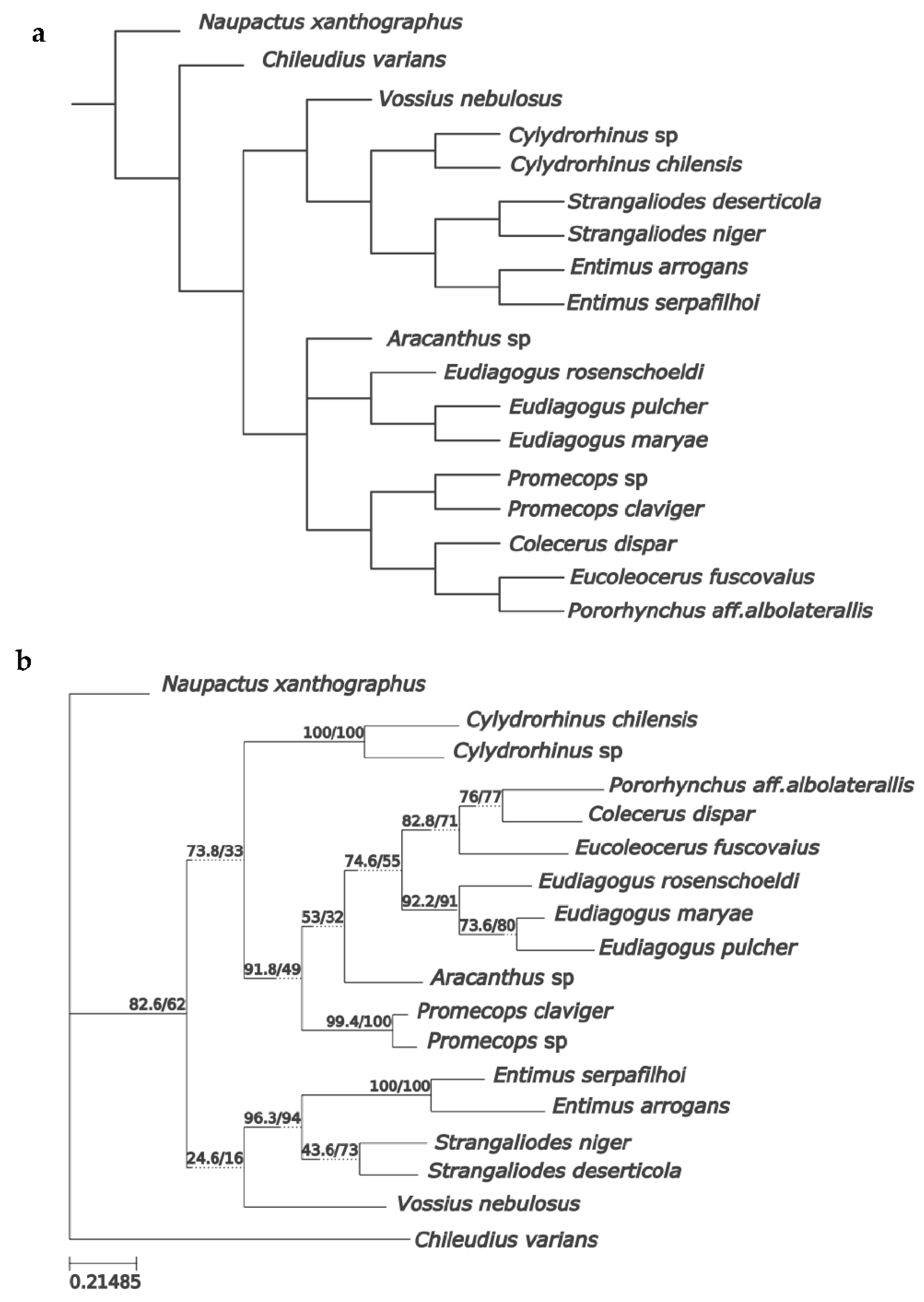
- Results of phylogenetic analyses of the molecular data set using different optimality criteria (maximum parsimony and maximum likelihood) are shown in Figure 9a,b. Although results of MP and ML are not identical in some intergeneric relationships (albeit without significant support), they agree in recovering monophyly of the genera represented by more than one species, in outgroup and ingroup. More importantly, they are congruent in recovering the monophyly of the tribe Eudiagogini with exclusion of the genus Chileudius, which is fully consistent with the results based on morphology. Statistical support values were expected to be low considering that for about 50% of the taxa (most ingroup terminals), the COI barcode was the only marker available.

4. Concluding Remarks
Supplementary Materials
Author Contributions
Funding
Data Availability Statement
Acknowledgments
Conflicts of Interest
References
- Wibmer, G.; O’Brien, C. Annotated Checklist of the Weevils (Curculionidae Sensu Lato) of South America (Coleoptera: Curculionoidea). Mem. Am. Entomol. Inst. 1986, 39, 1–563. [Google Scholar]
- O’Brien, C.; Wibmer, G. Annotated Checklist of the Weevils (Curculionidae Sensu Lato ) of North America, Central America, and the West Indies (Coleoptera: Curculionoidea). Mem. Am. Entomol. Inst. 1982, 34, 1–382. [Google Scholar]
- Alonso-Zarazaga, M.; Lyal, C. A World Catalogue of Families and Genera of Curculionoidea (Insecta: Coleoptera) (Excepting Scolytidae and Platypodidae); Entomopraxis, S.C.P.: Barcelona, Spain, 1999; ISBN 978-84-605-9994-4. [Google Scholar]
- Schenkling, S.; Marshall, G.A.K. Curculionidae: Leptopiinae. In Coleopterorum Catalogus; Pars 114; W. Junk: Berlin, Germany, 1931; Volume 28, pp. 1–83. [Google Scholar]
- Lacordaire, J. Histoire Naturelle des Insectes: Genera des Coléoptères ou Exposé Méthodique et Critique de Tous les Genres Proposés Jusquici Dans Cet Ordre d’insectes. Tome VI. Contenant la Famille des Curculionides; Librairie encyclopédique de Roret: Paris, France, 1863; Volume VI, pp. 1–637. [Google Scholar]
- Letsch, H.; Riedel, A. Classification and Biogeography of the Weevil Subfamily Entiminae (Coleoptera: Curculionidae) Based on a Comprehensive Dated Phylogeny. Zool. J. Linn. Soc. 2025, 205, zlaf132. [Google Scholar] [CrossRef]
- Pullen, K.; Jennings, D.; Oberprieler, R. Annotated Catalogue of Australian Weevils (Coleoptera: Curculionoidea). Zootaxa 2014, 3896, 1. [Google Scholar] [CrossRef] [PubMed]
- Marvaldi, A.; Lanteri, A.; del Río, M.; Oberprieler, R. Entiminae Schoenherr, 1823. In Handbook of Zoology. Arthropoda: Insecta: Coleoptera, Beetles. Morphology and Systematics; De Gruyter: Berlin, Germany, 2014; Volume 3, pp. 583–674. ISBN 978-3-11-027370-0. [Google Scholar]
- Marvaldi, A.; del Río, M.; Pereyra, V.; Rocamundi, N.; Lanteri, A. A Combined Molecular and Morphological Approach to Explore the Higher Phylogeny of Entimine Weevils (Coleoptera: Curculionidae), with Special Reference to South American Taxa. Diversity 2018, 10, 95. [Google Scholar] [CrossRef]
- Warner, R. The Genus Eudiagogus (Coleoptera: Curculionidae: Leptopiinae), with Two New Species on the Weed Sesbania (Leguminosae). Proc. Entomol. Soc. Wash. 1979, 81, 304–320. [Google Scholar]
- O’Brien, C.W.; Kovarik, P.W. A New Species of Eudiagogus Schoenherr from South America (Coleoptera: Curculionidae). Coleopt. Bull. 2000, 54, 313–317. [Google Scholar] [CrossRef]
- Kuschel, G. Nuevas Sinonimias, Revalidaciones y Combinaciones (9o Aporte a Col. Curculionidae). Agric. Técnica Chile 1950, 10, 10–21. [Google Scholar]
- Baird, H.P.; Shin, S.; Oberprieler, R.G.; Hullé, M.; Vernon, P.; Moon, K.L.; Adams, R.H.; McKenna, D.D.; Chown, S.L. Fifty Million Years of Beetle Evolution along the Antarctic Polar Front. Proc. Natl. Acad. Sci. USA 2021, 118, e2017384118. [Google Scholar] [CrossRef] [PubMed]
- Marques, M.; Grelle, C. The Atlantic Forest: History, Biodiversity, Threats and Opportunities of the Mega-Diverse Forest; Springer: Cham, Switzerland, 2021; ISBN 978-3-030-55321-0. [Google Scholar]
- Oberprieler, R.; Zimmerman, E.C. Australian Weevils (Coleoptera: Curculionoidea). Obituary: Elwood Curtin Zimmerman, Curculionidae: Entiminae Part I; CSIRO Australia: Clayton, South VIC, Australia, 2020; Volume VI, pp. xiv + 650. [Google Scholar]
- Lyal, C.H.C. (Ed.) Glossary of Weevil Characters. Available online: http://weevil.info/glossary-weevil-characters (accessed on 25 March 2025).
- Löwenberg-Neto, P. Neotropical Region: A Shapefile of Morrone’s (2014) Biogeographical Regionalisation. Zootaxa 2014, 3802, 300. [Google Scholar] [CrossRef] [PubMed]
- Goloboff, P.; Catalano, S. TNT Version 1.5, Including a Full Implementation of Phylogenetic Morphometrics. Cladistics 2016, 32, 221–238. [Google Scholar] [CrossRef] [PubMed]
- Nixon, K.C. WinClada, ver. 1.00.08; Nixon, K.C.: Ithaca, NY, USA, 2002. [Google Scholar]
- Talavera, G.; Lukhtanov, V.; Pierce, N.E.; Vila, R. DNA Barcodes Combined with Multilocus Data of Representative Taxa Can Generate Reliable Higher-Level Phylogenies. Syst. Biol. 2022, 71, 382–395. [Google Scholar] [CrossRef]
- Gillespie, J.; Johnston, J.; Cannone, J.; Gutell, R. Characteristics of the Nuclear (18S, 5.8S, 28S and 5S) and Mitochondrial (12S and 16S) rRNA Genes of Apismellifera (Insecta: Hymenoptera): Structure, Organization, and Retrotransposable Elements. Insect Mol. Biol. 2006, 15, 657–686. [Google Scholar] [CrossRef] [PubMed]
- Nguyen, L.-T.; Schmidt, H.A.; von Haeseler, A.; Minh, B.Q. IQ-TREE: A Fast and Effective Stochastic Algorithm for Estimating Maximum-Likelihood Phylogenies. Mol. Biol. Evol. 2015, 32, 268–274. [Google Scholar] [CrossRef] [PubMed]
- Kalyaanamoorthy, S.; Minh, B.Q.; Wong, T.K.F.; von Haeseler, A.; Jermiin, L.S. ModelFinder: Fast Model Selection for Accurate Phylogenetic Estimates. Nat. Methods 2017, 14, 587–589. [Google Scholar] [CrossRef] [PubMed]
- Hoang, D.T.; Chernomor, O.; von Haeseler, A.; Minh, B.Q.; Vinh, L.S. UFBoot2: Improving the Ultrafast Bootstrap Approximation. Mol. Biol. Evol. 2018, 35, 518–522. [Google Scholar] [CrossRef] [PubMed]
- Guindon, S.; Dufayard, J.-F.; Lefort, V.; Anisimova, M.; Hordijk, W.; Gascuel, O. New Algorithms and Methods to Estimate Maximum-Likelihood Phylogenies: Assessing the Performance of PhyML 3.0. Syst. Biol. 2010, 59, 307–321. [Google Scholar] [CrossRef]
- Schöenherr, C.J. Synonymia Insectorum. Genera et Species Curculionidum Cum Synonymia Hujus Familiae; Species Novae Aut Hactenus Minus Cognitae, Descriptionibus a Dom. L. Gyllenhal, C.H. Boheman, et Entomologis Aliis Illustratae; Roret: Paris, France, 1834; Volume 2, pp. 1–673. [Google Scholar]
- Schöenherr, C.J. Synonymia Insectorum. Genera et Species Curculionidum Cum Synonymia Hujus Familiae; Species Novae Aut Hactenus Minus Cognitae, Descriptionibus a Dom. L. Gyllenhal, C.H. Boheman, O.J. Fâhraeus et Entomologis Aliis Illustratae; Part 1; Roret: Paris, France; Fleischer: Leipzig, Germany, 1840; Volume 6, pp. 1–474. [Google Scholar]
- Castelnau, F., Compte de. Histoire Naturelle Des Insectes Coléoptères. In Histoire Naturelle des Animaux Articulés. Annelides, Crustacés, Arachnides, Myriapodes et Insectes; P. Duménil Éditeur: Paris, France, 1840; Volume 2, pp. 1–563. [Google Scholar]
- Gay, C. (Ed.) Blanchard Fauna Chilena. Insectos, Coleópteros. In Historia Física y Política de Chile; Imprimerie Maulde & Renou: París, France, 1851; Volume V, pp. 285–563. [Google Scholar]
- Voss, E. Einige Unbeschriebene Neotropische Curculioniden Nebst Einer Vorstudie Zur Tribus Promecopini (Col. Curc.). 48 Beitrag Zur Kenntnis Der Curculioniden (Neotrop. Curc. II). Sbornik entom odd Nar. Musea v Praze 1934, 12, 63–104. [Google Scholar]
- Blackwelder, R. Checklist of the Coleopterous Insects of Mexico, Central America, the West Indies, and South America. Part 5. Bull. United States Natl. Mus. 1947, 185, 765–925. [Google Scholar] [CrossRef]
- Morrone, J.J. The Species of Entiminae Ranged in America South of the United States. An. Inst. Biol. Univ. Nac. Auton. Mex. Ser. Zool. 1999, 70, 99–168. [Google Scholar]

| ID | Description |
|---|---|
| 1 | Rostrum, length relative to width taken at the anterior margin of eyes: equal to or greater than one times the width (0) (Figure 1); less than one times the width (1) |
| 2 | Rostrum, maximum width at apex compared to width at base: equal to or narrower than the base (0) (Figure 2i); expanded apically (1) (Figure 2k) |
| 3 | Rostrum, epistome, maximum width relative to distance between scrobes at apex: ≤1/3 (0); >1/3 (1) |
| 4 | Rostrum, posterior region of epistome, vestiture: absent (0) (Figure 2i); present (1) (Figure 2j) |
| 5 | Rostrum, posterior region of epistome, vestiture type: setae (0); scales (1) (Figure 2j) |
| 6 | Rostrum, posterior region of epistome, size, density and orientation of scales compared to those of the rest of the rostrum: homogeneous (0) (Figure 2k); heterogeneous (1) (Figure 2j) |
| 7 | Rostrum, posterior region of epistome, demarcated posteriorly by a change in the surface of the naked integument: absent (0); present (1) |
| 8 | Rostrum, median groove: absent or indistinct (0) (Figure 2i); present (1) (Figure 2a,e) |
| 9 | Rostrum, median groove, shape and depth: like a linear impression, superficial (0); like a broad groove (wider than 1/3 the distance between eyes); deep (1) |
| 10 | Rostrum, scrobes ventrally delimited: no (0); yes (1) (Figure 2b) |
| 11 | Rostrum, scrobes vestiture ventrally: absent (0) (Figure 2b); present (1) |
| 12 | Rostrum, lateral view, anteocular depression: indistinct (0) (Figure 2d); distinct (1) (Figure 2h,l) |
| 13 | Head, lateral view, gular angle: marked (90–120°) (0) (Figure 2h); weak (>120°) (1) (Figure 2d); acute (<90°) (2) (Figure 2l) |
| 14 | Head, vertex (posterior dorsal area of the head, anterior to the eyes), groove as a line: absent (0); present (1) |
| 15 | Mouthparts, condition according to the extent to which prementum covers the maxillae: adelognathous, maxillae completely concealed (0); imperfectly adelognathous, maxillae partially concealed (1); phanerognathous, maxillae exposed continuously at sides of prementum (2) (Figure 2b,f) |
| 16 | Mouthparts, labium, prementum, cavernous (sunken) appearance: absent (0); present (1) (Figure 2b,f) |
| 17 | Mouthparts, maxilla, vestiture of stipes and/or palpifer: absent (0); present (1) |
| 18 | Mouthparts, maxilla, vestiture of stipes and/or palpifer: setae (0); setae and scales (1) |
| 19 | Antennae, scape, relative length: not reaching the anterior margin of eyes (0); reaching the anterior margin of eyes (1) |
| 20 | Pronotum, shape: sub-circular (curved sides, maximum width near the middle) (0) (Figure 3e); sub-trapezoidal (1) (Figure 3f); sub-hexagonal (divergent sides towards the middle or first third and then sub-parallel) (2) (Figure 3g); sub-quadrangular (3) (Figure 3h); cup-shaped (4) (Figure 3i) |
| 21 | Prosternum, anterior margin, shape: deeply emarginated or notched (0) (Figure 3c); linear, almost straight (1) (Figure 3a); slightly emarginate (2) |
| 22 | Pronotum, postero-lateral angles: not projected (0) (Figure 3h); projected (1) (Figure 3f) |
| 23 | Prothorax, postocular lobes, shape: curved (0) (Figure 2d,l); angular (1) |
| 24 | Prothorax, collar, delimitation: incomplete, only laterally distinct (0); complete, dorsally and laterally bounded (1) (Figure 2l) |
| 25 | Prothorax, prosternum, suture or separation where hypomeral projections meet: absent (0) (Figure 3a); present (1) (Figure 3d) |
| 26 | Prothorax, prosternum, sternellum, elevation relative to surface of prosternum: flat (0); raised (1) |
| 27 | Prothorax, prosternum, hypomeral lobes and sternellum (as a process), outline of the posterior and anterior margins: poorly defined (0) (Figure 3b,c); well defined (1) (Figure 3d) |
| 28 | Prothorax, prosternum, hypomeral lobes and sternellum (as a process): Vossius type (0) (Figure 3b); Eudiagogus type (1) (Figure 3c); Cylydrorhinus type (2) (Figure 3d) |
| 29 | Prothorax, prosternum, ratio between lengths of its precoxal and postcoxal areas, measured by midline of coxae: precoxal area shorter than postcoxal (0); precoxal area longer than postcoxal (1); sub-equal (2) |
| 30 | Mesothorax, scutellum, visibility: indistinct or barely visible (0); clearly visible (1) |
| 31 | Mesothorax, scutellum, shape: sub-pentagonal, sub-square or round (0); sub-triangular (1); sub-rectangular, sub-trapezoidal (2) |
| 32 | Mesothorax, scutellum, vestiture: scaly (0); bristly (1) |
| 33 | Mesothorax, scutellum, color of vestiture relative to that of elytra: similar (0) (Figure 1f); different (1) (Figure 1d) |
| 34 | Mesothorax, mesoventrite, intercoxal process: absent (0): present (1) (Figure 1i) |
| 35 | Metathorax, metaventrite, spine-like swelling anterior to metacoxa: absent (0); present (1) (Figure 1c,g,j) |
| 36 | Elytra, humeri: rounded, not produced (0); clearly projected (1) |
| 37 | Elytra, interstria, ratio of its width relative to width of stria: at least 3 times wider than stria (0); equal to or less than width of stria (1) |
| 38 | Elytra, stria, a scale at each puncture: absent (0); present (1) |
| 39 | Legs, tibial apex, ascending comb: absent (0); present (1) |
| 40 | Legs, tibial apex, ascending comb: slightly differentiated from apical comb (0); well-defined, oblique to apical comb (1); well-defined, transverse to apical comb (2) |
| 41 | Legs, protibia, internal margin, crenulation with stout setae: absent or indistinct (0) (Figure 4b); present, evident (1) |
| 42 | Legs, protibia, color of stout setae in the internal margin: translucent or yellowish (0) (Figure 4b); black to dark brown (1) (Figure 4e) |
| 43 | Legs, protibia, distribution of stout setae in the internal margin: in the apical 2/3 (0); in the apical 3/4; in the apical 1/3 (2) |
| 44 | Legs, protibia, flat lenticular area apical or subapical on external side: absent (0); present (1) (Figure 4b–d,f) |
| 45 | Legs, protibia, subapical notch: absent (0) (Figure 4a); present (1) (Figure 4e) |
| 46 | Legs, protibia, apex, scales on the articular area: absent (0) (Figure 4c); present (1) (Figure 4d) |
| 47 | Legs, metatibia, apex, corbel: absent (0); present (1) |
| 48 | Legs, metatibia, corbel, vestiture: absent (0); present (1) |
| 49 | Legs, metatibia, corbel, vestiture type: setose (0); squamose (tessellate) (1) (Figure 4h); setose and squamose (2) (Figure 4g) |
| 50 | Legs, metatibia, corbel, width: narrow (0); wide (1) |
| 51 | Legs, metatibia, corbel, angle formed by the inner edge with respect to the outer edge: <45° (almost horizontal) (0); >45° (more vertical) (1) |
| 52 | Legs, metatibia, corbel, outer edge as a keel: absent (0) (Figure 4h); present (1) (Figure 4g) |
| 53 | Legs, metatibia, corbel, outer comb: absent (0); present (1) |
| 54 | Legs, metatibia, apical margin, shape: straight (0); angled or bent (1) |
| 55 | Legs, tarsal claws: connate at base (0) (Figure 4i); free (1) (Figure 4i) |
| 56 | Female abdomen, ventrite 5, median pit: absent (0); present (1) (Figure 5j) |
| 57 | Female genitalia, ovipositor, dorsal baculi: absent (0); present (1) (Figure 5b) |
| 58 | Female genitalia, ovipositor, styli: absent (0); present (1) |
| 59 | Female genitalia, bursa, sclerites: absent (0); present (1) (Figure 5c,h) |
| 60 | Male genitalia, endophallus, flagellum: absent (0); present (1) |
Disclaimer/Publisher’s Note: The statements, opinions and data contained in all publications are solely those of the individual author(s) and contributor(s) and not of MDPI and/or the editor(s). MDPI and/or the editor(s) disclaim responsibility for any injury to people or property resulting from any ideas, methods, instructions or products referred to in the content. |
© 2025 by the authors. Licensee MDPI, Basel, Switzerland. This article is an open access article distributed under the terms and conditions of the Creative Commons Attribution (CC BY) license (https://creativecommons.org/licenses/by/4.0/).
Share and Cite
Rincón, J.A.; del Río, M.G.; Marvaldi, A.E. Taxonomic Revision of the South American Genus Eudius and First Insights into the Phylogeny of the Tribe Eudiagogini (Curculionidae: Entiminae). Insects 2025, 16, 1278. https://doi.org/10.3390/insects16121278
Rincón JA, del Río MG, Marvaldi AE. Taxonomic Revision of the South American Genus Eudius and First Insights into the Phylogeny of the Tribe Eudiagogini (Curculionidae: Entiminae). Insects. 2025; 16(12):1278. https://doi.org/10.3390/insects16121278
Chicago/Turabian StyleRincón, Judy A., María Guadalupe del Río, and Adriana E. Marvaldi. 2025. "Taxonomic Revision of the South American Genus Eudius and First Insights into the Phylogeny of the Tribe Eudiagogini (Curculionidae: Entiminae)" Insects 16, no. 12: 1278. https://doi.org/10.3390/insects16121278
APA StyleRincón, J. A., del Río, M. G., & Marvaldi, A. E. (2025). Taxonomic Revision of the South American Genus Eudius and First Insights into the Phylogeny of the Tribe Eudiagogini (Curculionidae: Entiminae). Insects, 16(12), 1278. https://doi.org/10.3390/insects16121278