

You are currently viewing a new version of our website. To view the old version click .

Lubricants, Volume 12, Issue 4

April 2024 - 38 articles

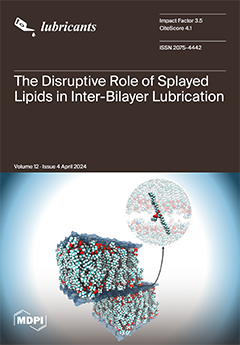
Cover Story: Lipid bilayers are natural biolubricants in synovial joints, reducing frictional dissipation through hydration lubrication acting at the hydration shells of the exposed lipid headgroups, which reduce frictional dissipation on bilayer–bilayer sliding. Splayed lipids stochastically emerge to link bilayers across the hydration layer and are disruptive to the shearing dynamics—bilayers are tethered by the splayed lipids as they slide, incurring inevitable tail–tail frictional dissipation. The frequency of the emergence of splayed lipids is lipid-specific. For example, it is correlated with the unsaturation of the lipid tails. Understanding the role of splayed lipids will thus shed light on tuning the lubrication properties of the liposomes of designated lipid species. View this paper
  • Issues are regarded as officially published after their release is announced to the table of contents alert mailing list .
  • You may sign up for email alerts to receive table of contents of newly released issues.
  • PDF is the official format for papers published in both, html and pdf forms. To view the papers in pdf format, click on the "PDF Full-text" link, and use the free Adobe Reader to open them.

Articles (38)

  • Article
  • Open Access
4 Citations
2,162 Views
21 Pages

High-power diesel engine turbochargers predominantly utilize floating ring bearings as their primary supporting components. To further enhance their load capacity, multi-lobe noncircular bearings have been progressively employed. This study focuses o...

  • Article
  • Open Access
1 Citations
1,722 Views
19 Pages

This study details the mechanical incorporation of graphite particles into the surface of aluminium (Al-1100) to fabricate surface composites using an electrical resistance heating-assisted pressing method. Initially, the aluminium surface is coated...

  • Review
  • Open Access
11 Citations
5,896 Views
28 Pages

Structural superlubricity refers to the lubrication state in which the friction between two crystalline surfaces in incommensurate contact is nearly zero; this has become an important branch in recent tribological research. Two-dimensional (2D) mater...

  • Article
  • Open Access
2 Citations
1,783 Views
14 Pages

Effect of Copper Nanoparticles Surface-Capped by Dialkyl Dithiophosphate on Different Base Oil Viscosity

  • Xufei Wang,
  • Shuguang Fan,
  • Ningning Song,
  • Laigui Yu,
  • Yujuan Zhang and
  • Shengmao Zhang

In order to more accurately characterize the effects of nanoparticles on lubricant viscosity, the effects of copper dialkyl dithiophosphate (HDDP)-modified (CuDDP) nanoparticles on the dynamic viscosity of mineral oils 150N, alkylated naphthalene (AN...

  • Article
  • Open Access
11 Citations
2,522 Views
11 Pages

The initial friction stage between the contacting materials would generate a maximum shear force and an unstable fluctuating time, which had a negative effect on the entire frictional system, especially at low temperature conditions. In order to decr...

  • Article
  • Open Access
6 Citations
1,850 Views
17 Pages

Cold rolling emulsion contains a variety of functional additives, which often exhibit complex interactions with each other. Sodium alkane sulfonate (SAS) is a common corrosion inhibitor used in cold rolling emulsions for temporary rust prevention. In...

  • Article
  • Open Access
5 Citations
6,368 Views
12 Pages

Pin-on-plate and pin-on-disk wear tests are typically used for assessing the wear behavior of a given material coupling and estimating its wear coefficient using the Archard wear law. This study investigates differences in the Archard law for pin-on-...

  • Article
  • Open Access
5 Citations
2,712 Views
16 Pages

A deep understanding of oil behavior inside roller bearings is important for the precise design of bearing configurations and oil systems in aircraft engines. The numerical method is employed to track oil distribution inside cylindrical roller bearin...

  • Article
  • Open Access
1 Citations
2,113 Views
18 Pages

Experimental Investigation of a Free-Form Honed Cylinder Liner for Heavy-Duty Engines

  • Frederik Stelljes,
  • Florian Pohlmann-Tasche and
  • Friedrich Dinkelacker

For future internal combustion engines, driven by regenerative fuels, efficiency is more important than ever. One approach to reduce the losses inside the piston cylinder unit (PCU) is to improve the alignment of the liner and the piston. Therefore,...

  • Article
  • Open Access
1 Citations
1,731 Views
18 Pages

The paper provides a discussion on the results of studies of the effect exerted by combined degradation factors typical of four types of wear: abrasion, impact–abrasion, tribocorrosion, and impact–abrasion–corrosion, conducted for c...

of 4

Get Alerted

Add your email address to receive forthcoming issues of this journal.

XFacebookLinkedIn
Lubricants - ISSN 2075-4442