



Next Issue
Volume 16, February
Previous Issue
Volume 15, December


Catalysts, Volume 16, Issue 1 (January 2026) – 111 articles
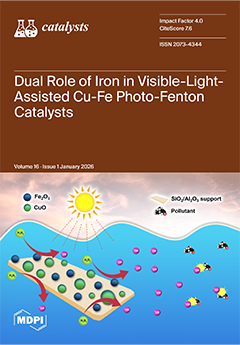
Cover Story (view full-size image): Visible-light-assisted photo-Fenton catalysis presents a promising and sustainable method for advanced water treatment, although its efficiency depends on surface chemistry and charge-carrier dynamics. This study shows how silica and γ-alumina supports distinctly affect the activity of Cu-Fe bimetallic catalysts under near-neutral conditions. Alumina enables superior metal dispersion and efficient hydroxyl radical generation, while iron plays a dual role: at low loading, it enhances Cu-mediated charge transfer and Fe3+/Fe2+ redox cycling; at higher loading, it increases electron–hole recombination and reduces photo-Fenton performance. By correlating spectroscopic data with hydroxyl radical formation, this work offers mechanistic insight and design guidelines for optimising visible-light-driven heterogeneous photo-Fenton catalysts. View this paper
  • Issues are regarded as officially published after their release is announced to the table of contents alert mailing list.
  • You may sign up for e-mail alerts to receive table of contents of newly released issues.
  • PDF is the official format for papers published in both, html and pdf forms. To view the papers in pdf format, click on the "PDF Full-text" link, and use the free Adobe Reader to open them.
Order results
Result details
Section
Select all
Export citation of selected articles as:
14 pages, 5865 KB  
Article
Microwave Synthesis of Transition Metal (Fe, Co, Ni)-Supported Catalysts for CO2 Hydrogenation
by Anna A. Strekalova, Anastasiya A. Shesterkina, Kirill A. Beresnev, Petr V. Pribytkov, Gennadiy I. Kapustin, Igor V. Mishin, Leonid M. Kustov and Alexander L. Kustov
Catalysts 2026, 16(1), 111; https://doi.org/10.3390/catal16010111 - 22 Jan 2026
Viewed by 299
Abstract
To improve the efficiency of CO2 hydrogenation, it is essential to develop new catalysts as well as new methods of producing them. In our work, we propose a new Fe-, Co-, Cu-containing catalyst preparation technique based on depositing the active component through [...] Read more.
To improve the efficiency of CO2 hydrogenation, it is essential to develop new catalysts as well as new methods of producing them. In our work, we propose a new Fe-, Co-, Cu-containing catalyst preparation technique based on depositing the active component through urea hydrolysis using microwave heating. We also compare catalysts produced with microwave synthesis to samples obtained through traditional synthesis methods, including impregnation and thermal deposition. The obtained catalysts were characterized by XRD, low-temperature N2 adsorption, SEM., and UV-VIS methods. The catalytic properties of the catalysts depend not only on the nature of the active component, but also on the preparation method. The best results for CO2 hydrogenation were achieved with Ni-containing catalysts produced by the impregnation method and microwave synthesis. Full article
Show Figures

Graphical abstract

22 pages, 5608 KB  
Article
ZSM-5 Nanocatalyst from Rice Husk: Synthesis, DFT Analysis, and Au/Pt Modification for Isopropanol Conversion
by Ebtsam K. Alenezy, Sahar A. El-Molla, Karam S. El-Nasser, Ylias Sabri and Ibraheem O. Ali
Catalysts 2026, 16(1), 110; https://doi.org/10.3390/catal16010110 - 22 Jan 2026
Viewed by 184
Abstract
Silica extracted from rice straw was utilized to synthesize nanoscale ZSM-5 zeolite, which was further modified with platinum (Pt) or gold (Au). The structural properties of the materials were examined using XRD, SEM, and BET analysis, while acidity distribution was determined by in [...] Read more.
Silica extracted from rice straw was utilized to synthesize nanoscale ZSM-5 zeolite, which was further modified with platinum (Pt) or gold (Au). The structural properties of the materials were examined using XRD, SEM, and BET analysis, while acidity distribution was determined by in situ FT-IR through pyridine adsorption. The zeolitic samples were evaluated as catalysts for isopropanol conversion in the temperature range of 150–275 °C. Modification of HZSM-5 with Au and Pt introduced additional active metal sites and enhanced the acidity of the catalyst, thereby lowering the activation energy for dehydration reactions and improving catalytic performance. Both acetone and propene were produced from isopropanol conversion across all catalysts, with oligomerization occurring at temperatures above 200 °C. Among the catalysts, HZSM-5 modified with 4% Pt or 4% Au exhibited superior conversion rates and selectivity to propene, achieving 92% selectivity at 200 °C. The enhanced propylene selectivity and stability of Au/HZSM-5 are associated with preserved medium-strength acid sites, as evidenced by in situ FT-IR pyridine adsorption, particularly the band at 1457 cm−1. Theoretical studies indicated that incorporating noble metals such as Au and Pt enhances the stability of the zeolite structure, which is consistent with the experimental results, suggesting new potential for advanced catalysis and material science applications. Full article
Show Figures

Graphical abstract

19 pages, 3198 KB  
Article
Interface-Engineered Zn@TiO2 and Ti@ZnO Nanocomposites for Advanced Photocatalytic Degradation of Levofloxacin
by Ishita Raval, Atindra Shukla, Vimal G. Gandhi, Khoa Dang Dang, Niraj G. Nair and Van-Huy Nguyen
Catalysts 2026, 16(1), 109; https://doi.org/10.3390/catal16010109 - 22 Jan 2026
Viewed by 194
Abstract
The extensive consumption of freshwater resources and the continuous discharge of pharmaceutical residues pose serious risks to aquatic ecosystems and public health. In this study, pristine ZnO, TiO2, Zn@TiO2, and Ti@ZnO nanocomposites were synthesized via a precipitation-assisted solid–liquid interference [...] Read more.
The extensive consumption of freshwater resources and the continuous discharge of pharmaceutical residues pose serious risks to aquatic ecosystems and public health. In this study, pristine ZnO, TiO2, Zn@TiO2, and Ti@ZnO nanocomposites were synthesized via a precipitation-assisted solid–liquid interference method and systematically evaluated for the photocatalytic degradation of the antibiotic levofloxacin under UV and visible light irradiation. The structural, optical, and surface properties of the synthesized materials were characterized using X-ray diffraction (XRD), Fourier transform infrared spectroscopy (FTIR), scanning electron microscopy (SEM), UV–visible diffuse reflectance spectroscopy (UV–DRS), and X-ray photoelectron spectroscopy (XPS). XRD analysis confirmed the crystalline nature of all samples, while SEM images revealed spherical and agglomerated morphologies. Photocatalytic experiments were conducted using a 50-ppm levofloxacin solution with a catalyst dosage of 1 g L−1. Pristine ZnO exhibited limited visible-light activity (33.81%) but high UV-driven degradation (92.98%), whereas TiO2 showed comparable degradation efficiencies under UV (78.6%) and visible light (78.9%). Notably, Zn@TiO2 nanocomposites demonstrated superior photocatalytic performance, achieving over 90% and near 70% degradation under both UV and visible light, respectively, while Ti@ZnO composites exhibited less than 60% degradation. The enhanced activity of Zn@TiO2 is attributed to improved interfacial charge transfer, suppressed electron–hole recombination, and extended light absorption. These findings highlight Zn@TiO2 nanocomposites as promising photocatalysts for efficient treatment of pharmaceutical wastewater under dual-light irradiation. Full article
Show Figures

Graphical abstract

18 pages, 9387 KB  
Article
Fluorine-Substituted Covalent Organic Framework/Anodized TiO2 Z-Scheme Heterojunction for Enhanced Photoelectrochemical Hydrogen Evolution
by Yuanyuan Niu, Feng Liu, Ping Li, Hongbin Qi and Bing Sun
Catalysts 2026, 16(1), 108; https://doi.org/10.3390/catal16010108 - 22 Jan 2026
Viewed by 193
Abstract
A well-defined heterojunction and tailored interface of the photocathode are desired to facilitate the efficient separation and transfer of photogenerated charge carriers for photoelectrochemical (PEC) hydrogen generation. Herein, optimized Z-scheme heterojunction (denoted as F-COF/TiO2) photoelectrodes were designed and fabricated by solvothermally [...] Read more.
A well-defined heterojunction and tailored interface of the photocathode are desired to facilitate the efficient separation and transfer of photogenerated charge carriers for photoelectrochemical (PEC) hydrogen generation. Herein, optimized Z-scheme heterojunction (denoted as F-COF/TiO2) photoelectrodes were designed and fabricated by solvothermally growing a F-substituted imine-linked covalent organic framework (F-COF) from 1,3,5-tris(3-fluoro-4-formylphenyl)benzene and 1,4-diaminobenzene on the surface of anodized TiO2 nanotubes for enhanced PEC hydrogen evolution. The F-COF/TiO2 heterojunction with photo-deposited Pt species as cocatalysts (Pt@F-COF/TiO2) revealed higher cathodic photocurrent density, decreased interfacial resistance, and improved onset potential due to the improved charge separation and transfer efficiency at the interface. Both the internal electric field between F-COF and TiO2, as well as the enhanced photophysical nature of F-COF films, contributed to the efficient interfacial charge separation and transfer. The photo-deposited Pt species and applied bias voltage also demonstrated a synergetic effect on facilitating charge separation and transfer for hydrogen production. The Pt@F-COF/TiO2 photoelectrode featured an improved PEC hydrogen evolution rate under AM 1.5G simulated sunlight irradiation and a durable PEC hydrogen evolution performance. This study provides valuable insights into the design of heterojunction-based photoelectrodes for efficient solar-driven hydrogen production for sustainable energy applications. Full article
(This article belongs to the Special Issue Multifunctional Metal–Organic Framework Materials as Catalysts)
Show Figures

Graphical abstract

8 pages, 1453 KB  
Communication
Double-Sided Illuminated Electrospun PAN TiO2-Cu2O Membranes for Enhanced CO2 Photoreduction to Methanol
by Mathieu Grandcolas
Catalysts 2026, 16(1), 107; https://doi.org/10.3390/catal16010107 - 22 Jan 2026
Viewed by 166
Abstract
Photocatalytic reduction of CO2 into value-added chemicals offers a sustainable route to mitigate greenhouse gas emissions while producing renewable fuels. However, conventional TiO2-based systems suffer from limited visible-light activity and inefficient reactor configurations. Here, we developed electrospun polyacrylonitrile (PAN) membranes [...] Read more.
Photocatalytic reduction of CO2 into value-added chemicals offers a sustainable route to mitigate greenhouse gas emissions while producing renewable fuels. However, conventional TiO2-based systems suffer from limited visible-light activity and inefficient reactor configurations. Here, we developed electrospun polyacrylonitrile (PAN) membranes embedded with TiO2-Cu2O heterojunction nanoparticles and integrated them into a custom crossflow photocatalytic membrane reactor. The reactor employed bifacial illumination using a solar simulator (front) and a xenon/mercury lamp (back), each calibrated to 1 Sun (100 mW·cm−2). Membrane morphology was characterized by SEM, and chemical composition was confirmed by XPS. Photocatalytic performance was evaluated in CO2-saturated 0.5 M potassium bicarbonate solution under continuous flow. The PAN/ TiO2-Cu2O membrane exhibited a methanol production rate of approximately 300 μmol·g−1·h−1 under dual-light illumination, outperforming single illumination, PAN-TiO2, and PAN controls. Enhanced activity is attributed to extended visible-light absorption, improved charge separation at the TiO2-Cu2O heterojunction, and optimized photon flux through bifacial illumination. The electrospun architecture provided high surface area and porosity, facilitating CO2 adsorption and catalyst dispersion. Combining heterojunction engineering with bifacial reactor design significantly improves solar-driven CO2 conversion. This approach offers a scalable pathway for integrating photocatalysis and membrane technology into sustainable fuel synthesis. Full article
(This article belongs to the Special Issue Advanced Semiconductor Photocatalysts)
Show Figures

Graphical abstract

17 pages, 2778 KB  
Article
Boosting Toluene Oxidation over Ru-Doped CoMn2O4 Spinel Catalysts by Constructing Ru–O–Mn/Co Chains
by Xue Wu, Shiyu Yu, Jian Mei, Bing Liu and Shijian Yang
Catalysts 2026, 16(1), 106; https://doi.org/10.3390/catal16010106 - 21 Jan 2026
Viewed by 199
Abstract
The development of efficient spinel oxide catalysts for low-temperature oxidation of volatile organic compounds (VOCs) remains an important research objective. In this work, Ru was doped into a CoMn2O4 spinel to enhance its catalytic activity toward toluene oxidation and the [...] Read more.
The development of efficient spinel oxide catalysts for low-temperature oxidation of volatile organic compounds (VOCs) remains an important research objective. In this work, Ru was doped into a CoMn2O4 spinel to enhance its catalytic activity toward toluene oxidation and the underlying promotion mechanism of Ru doping was systematically investigated. The resulting Ru-CoMn2O4 catalyst showed remarkable performance, with T90 reaching approximately 224 °C at a WHSV of 60,000 cm3 g−1 h−1 and nearly 100% CO2 selectivity above 200 °C. Mechanism studies revealed that the reaction followed both Mars–van Krevelen (MvK) and Eley–Rideal (E–R) pathways. The reaction rates were strongly influenced by the oxidizing capacity of the catalyst, the abundance of highly valent surface species (namely Co3+, Mn4+, and Ru4+), adsorbed toluene, lattice oxygen, gaseous toluene, and adsorbed oxygen. With Ru doping, new Ru–O–Mn and Ru–O–Co chains formed in the CoMn2O4 spinel structure, leading to a moderate enhancement in oxidizing ability and a moderate increase in the concentration of highly valent surface species, adsorbed toluene, and lattice oxygen. Although a slight reduction in adsorbed oxygen was observed, Ru doping significantly boosted the overall toluene oxidation activity of CoMn2O4. In summary, Ru-CoMn2O4 represented a promising catalyst for the efficient oxidation of VOCs. Full article
Show Figures

Graphical abstract

22 pages, 4146 KB  
Article
Machine Learning-Guided Inverse Analysis for Optimal Catalytic Pyrolysis Parameters in Hydrogen Production from Biomass
by Vishal V. Persaud, Abderrachid Hamrani, Medeba Uzzi and Norman D. H. Munroe
Catalysts 2026, 16(1), 105; https://doi.org/10.3390/catal16010105 - 21 Jan 2026
Viewed by 200
Abstract
Catalytic pyrolysis (CP) of biomass is a promising method for producing sustainable hydrogen because lignocellulosic biomass is widely available, renewable, and approximately carbon-neutral. CP of biomass is influenced by complex, interdependent process parameters, making optimization challenging and time-consuming using traditional methods. This study [...] Read more.
Catalytic pyrolysis (CP) of biomass is a promising method for producing sustainable hydrogen because lignocellulosic biomass is widely available, renewable, and approximately carbon-neutral. CP of biomass is influenced by complex, interdependent process parameters, making optimization challenging and time-consuming using traditional methods. This study investigated a two-stage machine learning (ML) framework fortified with Bayesian optimization to enhance hydrogen production from CP. The ML models were used to classify and predict hydrogen yield using a dataset of 306 points with 14 input features. The classification stage identified conditions favorable for good hydrogen yield, while the regression model (second stage) quantitatively predicted hydrogen yield. The random forest classifier and regressor demonstrated superior capabilities, achieving R2 scores of 1.0 and 0.8, respectively. The model demonstrated strong agreement with experimental data and effectively captured the key factors driving hydrogen production. Shapley Additive exPlanation (SHAP) identified temperature and catalyst properties (nickel loading) as the most influential parameters. The inverse analysis framework validated the model’s ability to determine optimal conditions for predicting targeted hydrogen yields by comparing it to experimental data reported in the literature. This AI-driven approach provides a scalable and data-efficient tool for optimizing processes in sustainable hydrogen production. Full article
Show Figures

Graphical abstract

22 pages, 2780 KB  
Article
A Cascade Process for CO2 to Methanol Driven by Non-Thermal Plasma: A Techno-Economic Assessment
by Shiwei Qin, Xiangbo Zou, Yunfei Ma, Yunfeng Ma, Zirong Shen, Angjian Wu and Xiaoqing Lin
Catalysts 2026, 16(1), 104; https://doi.org/10.3390/catal16010104 - 21 Jan 2026
Viewed by 211
Abstract
The non-thermal plasma-driven cascade process for CO2-to-methanol conversion shows significant potential in the field of green methanol synthesis. This process innovatively couples a plasma activation module with a catalytic synthesis module via a multi-stage pressurization device, establishing an efficient two-step pathway [...] Read more.
The non-thermal plasma-driven cascade process for CO2-to-methanol conversion shows significant potential in the field of green methanol synthesis. This process innovatively couples a plasma activation module with a catalytic synthesis module via a multi-stage pressurization device, establishing an efficient two-step pathway that converts CO2 into methanol via a CO intermediate. Such an arrangement establishes an energy conversion system characterized by both low carbon emissions and high efficiency. This work involved an initial technical evaluation employing a custom-built, lab-scale apparatus. The optimum parameters determined through this assessment were a plasma input voltage of 40 V combined with a subsequent reaction temperature of 240 °C. Operation at these specified parameters yielded a CO2 conversion of 48%, with the methanol selectivity and production rate reaching 40% and 502 gMeOH·kgcat1·h−1, respectively. Furthermore, industrial-scale process design and scale-up were performed, accompanied by process simulation using Aspen Plus and a subsequent techno-economic evaluation. The results indicate that, compared to the conventional direct CO2 hydrogenation process, the proposed cascade route can reduce the capital investment by approximately 17%. Full article
(This article belongs to the Special Issue Catalysts for CO2 Conversions)
Show Figures

Graphical abstract

13 pages, 4617 KB  
Article
Highly Uniform and Thermal Stable Paper-Structured Catalyst by Using Glass/Mullite Hybrid Fibers as a Matrix for Efficient Soot Combustion
by Hui Tang, Jiateng Hu, Qianqian Yang and Gang Yu
Catalysts 2026, 16(1), 103; https://doi.org/10.3390/catal16010103 - 21 Jan 2026
Viewed by 218
Abstract
In the present study, glass/ceramic hybrid fibers were chosen as a paper matrix, which effectively balance toughness and high-temperature resistance for soot combustion applications. In order to address the issue of unevenness in the performance of paper-type catalysts caused by the differences in [...] Read more.
In the present study, glass/ceramic hybrid fibers were chosen as a paper matrix, which effectively balance toughness and high-temperature resistance for soot combustion applications. In order to address the issue of unevenness in the performance of paper-type catalysts caused by the differences in the dispersion behavior of glass fibers and ceramic fibers in water, a facile foam-forming technology was proposed. The obtained glass fiber/mullite composite paper with various mass ratios (1:1, 2:1, 3:1, 4:1, and 5:1) exhibit high evenness, and better high-temperature resistance than the pure glass fibers. After impregnating K-Mn active ingredients, 15K5Mn-GFF-3G1C (GF/CF = 3:1) demonstrates high tensile strength, excellent catalytic activity (T50 = 388 °C), reusability (five cycles), and high-temperature stability (800 °C, 12 h). Full article
(This article belongs to the Section Catalytic Materials)
Show Figures

Graphical abstract

10 pages, 982 KB  
Article
Comparative Kinetic Study of Phenol Degradation Using Free and Alginate-Gel-Entrapped Extract Containing Tyrosinase from Agaricus bisporus
by Saida Leboukh and Hicham Gouzi
Catalysts 2026, 16(1), 102; https://doi.org/10.3390/catal16010102 - 20 Jan 2026
Viewed by 234
Abstract
The aim of this study was to investigate the biochemical properties of free and immobilized mushroom tyrosinase (EC 1.14.18.1) entrapped in calcium alginate beads for phenol oxidation in a batch system. Tyrosinase activity was determined spectrophotometrically at 400 nm under optimal conditions. The [...] Read more.
The aim of this study was to investigate the biochemical properties of free and immobilized mushroom tyrosinase (EC 1.14.18.1) entrapped in calcium alginate beads for phenol oxidation in a batch system. Tyrosinase activity was determined spectrophotometrically at 400 nm under optimal conditions. The effects of key operational parameters on phenol oxidation kinetics were evaluated for both enzyme systems. The Michaelis–Menten constant (KM) of the immobilized enzyme (0.94 ± 0.2 mM) was approximately twice that of the free enzyme (0.56 ± 0.04 mM), while its maximum reaction velocity (VMax = 101.4 ± 2.2 µmol L−1 min−1) decreased by nearly 30-fold (VMax(App) = 3.63 ± 0.3 µmol L−1 min−1). Immobilization also shifted the optimal pH of the enzyme to pH 6.0. The optimum temperature and activation energy for phenol oxidation were determined as 55 °C and 52.48 kJ/mol for immobilized tyrosinase, whereas they were 45 °C and 39.58 kJ/mol for the free enzyme. The highest level of activity was obtained with alginate beads of 2.6 mm diameter, and the immobilized preparation exhibited enhanced operational stability, completely retaining its initial activity after five reuse cycles. Overall, these findings suggest that mushroom tyrosinase immobilized in alginate beads is a promising system for phenol removal from wastewater. Full article
Show Figures

Figure 1

10 pages, 1511 KB  
Article
Improvements of Both Anode Catalyst Layer and Porous Transport Layer for the Efficient Proton-Exchange Membrane Water Electrolysis
by Zehao Tan, Ruofan Yu, Baoduo Jin, Chen Deng, Zhidong Huang and Liuxuan Luo
Catalysts 2026, 16(1), 101; https://doi.org/10.3390/catal16010101 - 20 Jan 2026
Viewed by 268
Abstract
In recent years, green hydrogen production via water electrolysis driven by renewable energy sources has garnered increasingly significant attention. Among the various water electrolysis technologies, proton-exchange membrane water electrolysis (PEMWE) distinguishes itself owing to the unique advantages, including the compact architecture, high efficiency, [...] Read more.
In recent years, green hydrogen production via water electrolysis driven by renewable energy sources has garnered increasingly significant attention. Among the various water electrolysis technologies, proton-exchange membrane water electrolysis (PEMWE) distinguishes itself owing to the unique advantages, including the compact architecture, high efficiency, rapid dynamic response, and high purity of the generated hydrogen. The membrane electrode assembly (MEA) serves as the core component of a PEM electrolyzer. And only a high-performance and stable MEA can provide a reliable platform for investigating the mass transport behavior within the porous transport layer (PTL). In this study, the MEA fabrication method was optimized by varying the ionomer-to-carbon (I/C) ratio, coating strategy, and anode Ir mass loading. As a result, the cell voltage was reduced from 1.679 V to 1.645 V at 1.0 A cm−2, with a small degradation of 1.3% over 70 h of operation. Based on the optimized MEA, the effects of the structure and porosity of PTL on the mass transport behavior were further analyzed. After the PTL parameter optimization, the cell voltage was further reduced to 1.630 V at 1.0 A cm−2, while a high-speed camera captured bubble dynamics in real time, showing the fast detachment of small oxygen bubbles. The integrated electrochemical and visualization results provide a useful guideline to designing both MEA and PTL for efficient PEMWE. Full article
(This article belongs to the Special Issue Advanced Catalysts for Water Electrolysis)
Show Figures

Graphical abstract

4 pages, 887 KB  
Editorial
Advances in Catalysis for Sustainable Energy and Environmental Remediation
by Habib Ullah, Muhammad Humayun and Sayyar Ali Shah
Catalysts 2026, 16(1), 100; https://doi.org/10.3390/catal16010100 - 19 Jan 2026
Viewed by 328
Abstract
Catalysis plays a key role in advancing sustainable technologies for energy conversion and environmental remediation [...] Full article
Show Figures

Scheme 1

15 pages, 2366 KB  
Article
Preparation of Copper/Graphene and Graphitic Carbon Nitride Composites and Study of Their Electrocatalytic Activity in the Synthesis of Organic Compounds
by Nina M. Ivanova, Zainulla M. Muldakhmetov, Yakha A. Vissurkhanova, Yelena A. Soboleva, Leonid A. Zinovyev and Saule O. Kenzhetaeva
Catalysts 2026, 16(1), 99; https://doi.org/10.3390/catal16010099 - 18 Jan 2026
Viewed by 221
Abstract
In this study, copper–carbon material composites, Cu/CM (where CM is reduced graphene oxide (rGO), graphitic carbon nitride (g-C3N4), their mixture, and N-doped reduced graphene oxide (N-rGO)), were prepared using a simple method of chemical reduction of copper cations in [...] Read more.
In this study, copper–carbon material composites, Cu/CM (where CM is reduced graphene oxide (rGO), graphitic carbon nitride (g-C3N4), their mixture, and N-doped reduced graphene oxide (N-rGO)), were prepared using a simple method of chemical reduction of copper cations in the presence of CM related to molecular-level mixing methods. Additionally, copper cations from its oxides present in the composites were reduced in an electrochemical cell by depositing them on the surface of a horizontally positioned cathode. The structure and morphology of the Cu/CM composites were studied using electron microscopy and X-ray diffraction analysis. The thermal stability and elemental analysis were determined for the carbon materials. The resulting Cu/CM composites were used as electrocatalysts in the electrohydrogenation of the aromatic ketone, acetophenone. Cu/rGO and Cu/N-rGO composites with a 1:1 ratio exhibited catalytic activity in this process, increasing the rate of APh hydrogenation and its degree of conversion with the selective formation of a single product, methyl phenyl carbinol (or 1-phenylethanol), compared to the electrochemical reduction of APh on a cathode without a catalyst. The Cu/N-rGO composite demonstrated the highest electrocatalytic activity. Full article
Show Figures

Graphical abstract

48 pages, 8652 KB  
Review
Advances in Alkaline Water Electrolysis—The Role of In Situ Ionic Activation in Green Hydrogen Production
by Vladimir M. Nikolić, Katarina M. Dimić-Mišić, Slađana Lj. Maslovara, Dejana P. Popović, Mihajlo N. Gigov, Sanja S. Krstić and Milica P. Marčeta Kaninski
Catalysts 2026, 16(1), 98; https://doi.org/10.3390/catal16010098 - 18 Jan 2026
Viewed by 374
Abstract
Alkaline water electrolysis remains one of the leading and most mature technologies for large-scale hydrogen production. Its advantages stem from the use of inexpensive, earth-abundant materials and well-established industrial deployment, yet the technology continues to face challenges, including sluggish hydrogen evolution reaction (HER) [...] Read more.
Alkaline water electrolysis remains one of the leading and most mature technologies for large-scale hydrogen production. Its advantages stem from the use of inexpensive, earth-abundant materials and well-established industrial deployment, yet the technology continues to face challenges, including sluggish hydrogen evolution reaction (HER) kinetics and energy-efficiency limitations compared with acidic electrolysis systems. This review provides a comprehensive overview of the fundamental principles governing alkaline electrolysis, encompassing electrolyte chemistry, electrode materials, electrochemical mechanisms, and the roles of overpotentials, cell resistances, and surface morphology in determining system performance. Key developments in catalytic materials are discussed, highlighting both noble-metal and non-noble-metal electrocatalysts, as well as advanced approaches to surface modification and nanostructuring designed to enhance catalytic activity and long-term stability. Particular emphasis is placed on the emerging strategy of in situ ionic activation, wherein transition-metal ions and oxyanions are introduced directly into the operating electrolyte. These species dynamically interact with electrode surfaces under polarization, inducing real-time surface reconstruction, improving water dissociation kinetics, tuning hydrogen adsorption energies, and extending electrode durability. Results derived from polarization measurements, electrochemical impedance spectroscopy, and surface morphology analyses consistently demonstrate that ionic activators, such as Ni–Co–Mo systems, significantly increase the HER performance through substantial increase in surface roughness and increased intrinsic electrocatalytic activity through synergy of d-metals. By integrating both historical context and recent research findings, this review underscores the potential of ionic activation as a scalable and cost-effective way toward improving the efficiency of alkaline water electrolysis and accelerating progress toward sustainable, large-scale green hydrogen production. Full article
(This article belongs to the Section Electrocatalysis)
Show Figures

Figure 1

11 pages, 1140 KB  
Article
Simple Synthesis of Ultrasmall Pt5La Nanoalloy for Highly Efficient Oxygen Reduction Reaction
by Run Cai, Wenjie Bi, Jiayi Liao, Shuwen Yang, Jiewei Yin, Jun Zhu, Xiangzhe Liu, Yang Liu and Zhong Ma
Catalysts 2026, 16(1), 97; https://doi.org/10.3390/catal16010097 - 18 Jan 2026
Viewed by 283
Abstract
Pt-rare earth metal (Pt-RE) alloys are considered to be one of the most promising electrocatalysts for producing oxygen reduction reactions (ORRs) due to their compressively strained Pt overlayer and their exceptional negative-alloy formation energies, which result in excellent activity and stability. However, there [...] Read more.
Pt-rare earth metal (Pt-RE) alloys are considered to be one of the most promising electrocatalysts for producing oxygen reduction reactions (ORRs) due to their compressively strained Pt overlayer and their exceptional negative-alloy formation energies, which result in excellent activity and stability. However, there are still great challenges in the chemical synthesis of Pt-RE nanoalloys. Herein, we report a simple method employing the nanopores of porous carbon as nanoreactors to synthesize a Pt5La nanoalloy. The Pt5La alloy nanoparticles are embedded in porous carbon (Pt5La@C) with a particle size of around 1–3 nm and also exhibit a very narrow size distribution because of the confined-space effect. The as-prepared Pt5La@C nanoalloy exhibits highly efficient ORR performance with a half-wave potential of 0.912 V in 0.1 M HClO4, which is 56 mV higher than that of a commercial Pt/C catalyst. Moreover, it achieves an improved intrinsic activity of 0.69 mA cm−2 and, a mass activity of 0.42 A mgPt−1 at 0.90 V. In addition, it also delivers a very stable lifespan performance, with negligible decay in half-wave potential after accelerated stress testing for 10,000 cycles. This work also provides a new method for the development of promising Pt-RE nanoalloys with ultrasmall nanoparticles with a very narrow size distribution for various efficient energy-conversion devices. Full article
(This article belongs to the Special Issue 15th Anniversary of Catalysts: Feature Papers in Electrocatalysis)
Show Figures

Figure 1

21 pages, 3893 KB  
Article
Microwave-Assisted Synthesis of 1,4-Dihydropyridines via the Hantzsch Reaction Using a Recyclable HPW/PEG-400 Catalytic System
by Wender Alves Silva, Sayuri Cristina Santos Takada, Claudia Cristina Gatto and Izabella Vitoria Maravalho
Catalysts 2026, 16(1), 96; https://doi.org/10.3390/catal16010096 - 17 Jan 2026
Viewed by 335
Abstract
1,4-Dihydropyridines (1,4-DHPs) are privileged heterocycles with broad relevance in medicinal chemistry and redox-related applications. However, conventional Hantzsch syntheses typically require prolonged thermal heating and often suffer from limited efficiency and regioselectivity. Herein, we report a sustainable and efficient microwave-assisted protocol for the synthesis [...] Read more.
1,4-Dihydropyridines (1,4-DHPs) are privileged heterocycles with broad relevance in medicinal chemistry and redox-related applications. However, conventional Hantzsch syntheses typically require prolonged thermal heating and often suffer from limited efficiency and regioselectivity. Herein, we report a sustainable and efficient microwave-assisted protocol for the synthesis of 1,4-DHPs, employing phosphotungstic acid (HPW) as a heteropolyacid catalyst in PEG-400 as a green reaction medium. The multicomponent cyclocondensation proceeds rapidly under microwave irradiation, affording the desired 1,4-DHP derivatives in good to excellent yields within short reaction times. Compared with classical acid-catalyzed conditions, the HPW/PEG-400 system markedly enhances regioselectivity toward the 1,4-DHP framework while simultaneously reducing energy input. Moreover, the catalytic system exhibits good recyclability, underscoring its potential as a practical and environmentally responsible platform for the synthesis of bioactive 1,4-dihydropyridine scaffolds. Full article
Show Figures

Graphical abstract

18 pages, 3642 KB  
Article
MoO3-Based Photocatalysts for the Depolymerization of Lignin Under UV-Vis Light
by Elena Teresa Palombella, Antonio Monopoli, Maria Chiara Sportelli, Federico Liuzzi, Isabella De Bari, Lucia D’Accolti and Cosimo Annese
Catalysts 2026, 16(1), 95; https://doi.org/10.3390/catal16010095 - 16 Jan 2026
Viewed by 299
Abstract
In this explorative work, molybdenum trioxide (MoO3) and representative doped MoO3 materials, i.e., Cu-doped MoO3 (2% Cu, “Cu-MoO3”) and H-doped MoO3 (H0.31MoO3, “H-MoO3”), have been tested for the first time [...] Read more.
In this explorative work, molybdenum trioxide (MoO3) and representative doped MoO3 materials, i.e., Cu-doped MoO3 (2% Cu, “Cu-MoO3”) and H-doped MoO3 (H0.31MoO3, “H-MoO3”), have been tested for the first time as photocatalysts in the UV-vis light-driven depolymerization of lignin. The catalysts have been characterized by XRD, TEM, ATR-FTIR, and UV-vis DRS. Under the adopted conditions (UV-vis irradiation, solvent 0.01 M aqueous NaOH, lignin 200 ppm, catalyst 1 g/L, rt, 5 h), photocatalytic depolymerization of wheat-straw lignin (WSL) produced increasing amounts of bio-oil on changing the catalyst from pristine MoO3 to Cu-MoO3 and H-MoO3 (23%, 28% and 30%, respectively). Also, quantification of vanillin and vanillic acid shows a similar increasing trend. These results appear in line with the estimated band gap energies, which decrease in the order: MoO3 (2.91 eV) > Cu-MoO3 (2.86 eV) > H-MoO3 (2.77 eV). H-MoO3 shows the best catalytic performance, which was then fruitfully explored in the photocatalytic depolymerization of benchmark commercial Kraft lignin (bio-oil yield 32%, vanillin and vanillic acid yields 1.28% and 0.78%, respectively). In view of the results obtained, this work is expected to provide new ideas for the design of heterogeneous photocatalytic system for lignin cleavage. Full article
(This article belongs to the Special Issue Catalysts from Lignocellulose to Biofuels and Bioproducts)
Show Figures

Graphical abstract

14 pages, 6601 KB  
Article
Innovative Copper-Based Heterogeneous Catalyst for Chan–Lam Cross-Coupling
by Jan Stehlík, Radka Pocklanová, David Profous, Barbora Lapčíková, Petr Cankař, Libor Kvítek and Ľubomír Lapčík
Catalysts 2026, 16(1), 94; https://doi.org/10.3390/catal16010094 - 16 Jan 2026
Viewed by 385
Abstract
The synthesis, in particular the industrial production, of pharmaceuticals requires a broad arsenal of synthetic reactions capable of selectively forming specific structural motifs and assembling smaller building blocks into complex molecules. The Chan–Evans–Lam cross-coupling reaction, which forms a bond between a N-nucleophile and [...] Read more.
The synthesis, in particular the industrial production, of pharmaceuticals requires a broad arsenal of synthetic reactions capable of selectively forming specific structural motifs and assembling smaller building blocks into complex molecules. The Chan–Evans–Lam cross-coupling reaction, which forms a bond between a N-nucleophile and an aryl group from a boronic acid, catalysed by copper salts, is a typical example of this synthetic route. Considering the toxicity of copper and the stringent regulatory limits for its residues in final pharmaceutical products, a heterogeneous catalytic approach offers a viable alternative for this transformation. In this work, we present a simply and reproducibly synthesized catalyst based on copper nanoparticles supported on reduced graphene oxide (Cu-rGO), with high efficiency in a model Chan–Lam reaction involving benzimidazole and aniline derivatives with substituted boronic acids. Full article
(This article belongs to the Collection Nanotechnology in Catalysis)
Show Figures

Graphical abstract

20 pages, 4761 KB  
Article
High-Performance CoxNiy@NC/SiO2 Catalysts Derived from ZIF-67 for Enhanced Hydrogenation of 1-Nitronaphthalene
by Xuedong Lan, Ming Zhong, Weidi Dai and Pingle Liu
Catalysts 2026, 16(1), 93; https://doi.org/10.3390/catal16010093 - 16 Jan 2026
Viewed by 336
Abstract
A series of silica-supported, nitrogen-doped carbon-encapsulated cobalt–nickel alloy catalysts (CoxNiy@NC/SiO2) was successfully synthesized and systematically evaluated for the liquid-phase hydrogenation of 1-nitronaphthalene to 1-naphthylamine. Physicochemical characterization confirmed that the incorporation of nickel promotes the formation of Co–Ni [...] Read more.
A series of silica-supported, nitrogen-doped carbon-encapsulated cobalt–nickel alloy catalysts (CoxNiy@NC/SiO2) was successfully synthesized and systematically evaluated for the liquid-phase hydrogenation of 1-nitronaphthalene to 1-naphthylamine. Physicochemical characterization confirmed that the incorporation of nickel promotes the formation of Co–Ni alloys and modulates the electronic structure of the catalysts. The catalytic performance was found to be highly sensitive to the Co/Ni ratio, with Co2Ni1@NC/SiO2 exhibiting the most outstanding activity. Under optimized reaction conditions (90 °C, 0.6 MPa H2, 5.5 h), both the conversion of 1-nitronaphthalene and the selectivity toward 1-naphthylamine reached approximately 99%. The catalyst also demonstrated excellent stability and recyclability, attributed to the protective nitrogen-doped carbon shell and the synergistic interaction between the Co–Ni alloy and M–Nx active sites. This work provides a new strategy for designing efficient and robust non-noble-metal catalysts for hydrogenation reactions. Full article
(This article belongs to the Special Issue Catalysis and Sustainable Green Chemistry)
Show Figures

Graphical abstract

36 pages, 7496 KB  
Review
Constructed Wetlands Beyond the Fenton Limit: A Systematic Review on the Circular Photo-Biochemical Catalysts Design for Sustainable Wastewater Treatment
by M. M. Nour, Maha A. Tony and Hossam A. Nabwey
Catalysts 2026, 16(1), 92; https://doi.org/10.3390/catal16010092 - 16 Jan 2026
Viewed by 345
Abstract
Constructed wetlands (CWs) are signified as green, self-sustaining systems for wastewater treatment. To date, their conventional designs struggle with slow kinetics and poor removal of refractory pollutants. This review redefines CWs as photo-reactive engineered systems, integrating near-neutral Fenton and photo-Fenton processes and in-situ [...] Read more.
Constructed wetlands (CWs) are signified as green, self-sustaining systems for wastewater treatment. To date, their conventional designs struggle with slow kinetics and poor removal of refractory pollutants. This review redefines CWs as photo-reactive engineered systems, integrating near-neutral Fenton and photo-Fenton processes and in-situ oxidant generation to overcome diffusion limits, acid dosing, and sludge formation. By coupling catalytic fillers, solar utilization, and plant–microbe–radical (ROS) synergies, the approach enables intensified pollutant degradation while preserving the low-energy nature of CWs. Bibliometric trends indicate a sharp rise in studies linking CWs with advanced oxidation and renewable energy integration, confirming the emergence of a circular treatment paradigm. A decision framework is proposed that aligns material selection, reactor hydrodynamics, and solar light management with sustainability indicators such as energy efficiency, Fe-leach budget, and ROS-to-photon yield. This synthesis bridges environmental biotechnology with solar-driven catalysis, paving the way for next-generation eco-engineered wetlands capable of operating efficiently beyond the classical Fenton constraints. This work introduces the concept of “Constructed Wetlands Beyond the Fenton Limit”, where CWs are reimagined as photo-reactive circular systems that unify catalytic, biological, and solar processes under near-neutral conditions. It provides the first integrated decision matrix and performance metrics connecting catalyst design, ROS efficiency, and circular sustainability that offers a scalable blueprint for real-world hybrid wetland applications. Full article
Show Figures

Figure 1

15 pages, 4358 KB  
Article
Catalytic Activity of Electroexplosive Cobalt Nanopowder in Hydrocarbon Synthesis by the Fischer–Tropsch Method
by Evgeniy Popok, Egor Grushetsky, Yana Morozova, Ilya Bogdanov, Maria Kirgina and Andrei Mostovshchikov
Catalysts 2026, 16(1), 91; https://doi.org/10.3390/catal16010091 - 13 Jan 2026
Viewed by 412
Abstract
The study aims to develop a method for obtaining a high-performance catalyst for the synthesis of liquid hydrocarbons using the Fischer–Tropsch method based on ultradisperse cobalt powders obtained by the electric explosion method. To determine the catalytic activity of the obtained catalyst samples, [...] Read more.
The study aims to develop a method for obtaining a high-performance catalyst for the synthesis of liquid hydrocarbons using the Fischer–Tropsch method based on ultradisperse cobalt powders obtained by the electric explosion method. To determine the catalytic activity of the obtained catalyst samples, the main process parameters, like temperature in the catalyst bed, the process pressure, the feedstock space velocity, and the ratio of reagents in the synthesis gas, were varied. It has been established that highly dispersed cobalt powder obtained by the electrical explosion method is a fairly active catalyst for the synthesis of liquid hydrocarbons via the Fischer–Tropsch process. It has been established that the overall CO conversion rate in the temperature range from 230 to 330 °C ranges from 25 to 90%. However, the formation of the main byproduct of the synthesis, carbon dioxide, is not observed below 270 °C. It was determined that for the developed catalyst sample, the optimal temperature range is from 230 to 260 °C, in which the yield of by-products of synthesis and gaseous hydrocarbons is quite low—the selectivity for methane does not exceed 20%, with the proportion of C5+ hydrocarbons in the liquid phase at the level of 80%. The CO conversion rate increases proportionally with growing pressure. It has been established that cobalt nanopowder exhibits high catalytic activity in reactions of liquid hydrocarbon formation with low hydrogen content in the initial synthesis gas. This fact allows us to conclude that it has potential for use in processing gases obtained during the pyrolysis of biomass or other non-traditional sources of synthesis gas, characterized by an H2:CO ratio of 1:1 to 1.25:1. Catalysts obtained from ultradisperse cobalt powders were shown to be resistant to rapid deactivation under synthesis conditions at operating temperatures for 30 h. During long-term testing, CO conversion remained at 23.5% at 230 °C for the entire duration of the experiment. Full article
Show Figures

Graphical abstract

18 pages, 4346 KB  
Article
Catalytic CO2 Utilization for Ethanol Reforming over Yttrium-Promoted Ni-Co/MCM-41 Catalyst: Optimizing Hydrogen Production Using Box–Behnken Experimental Design and Response Surface Methodology
by Bamidele Victor Ayodele, SK Safdar Hossain, Nur Diyan Mohd Ridzuan and Hayat Khan
Catalysts 2026, 16(1), 90; https://doi.org/10.3390/catal16010090 - 13 Jan 2026
Viewed by 355
Abstract
Catalytic dry reforming of ethanol offers a sustainable pathway for syngas and hydrogen production through CO2 utilization, though its efficiency depends heavily on the strategic synthesis of catalysts and the optimization of reaction parameters. This study employs Box–Behnken Design (BBD) and Response [...] Read more.
Catalytic dry reforming of ethanol offers a sustainable pathway for syngas and hydrogen production through CO2 utilization, though its efficiency depends heavily on the strategic synthesis of catalysts and the optimization of reaction parameters. This study employs Box–Behnken Design (BBD) and Response Surface Methodology (RSM) to optimize hydrogen yield from CO2 reforming of ethanol over a Yttrium-promoted Ni-Co/MCM-41 catalyst. The catalyst was synthesized using sequential wet impregnation method and characterized for its physicochemical properties. The catalyst was tested in fixed-bed reactor using experimental data obtained from BBD considering the effects of temperature (550–700 °C), ethanol flowrate (0.5–1 mL/min) and CO2 flowrate (15–30 mL/min) on the hydrogen yield. The experimental conditions were optimized using RSM quadratic model. The characterization revealed that the ordered mesoporous nature of the MCM-41 is maintained providing a high surface area of 597.75 m2/g for the catalyst. The addition of Yttrium as a promoter facilitates the formation of well crystallized nanoparticles. Maximum hydrogen yield of 85.09% was obtained at 700 °C, 20.393 mL/min and 0.877 mL/min for temperature, CO2 and ethanol flowrate, respectively. The predicted hydrogen yield obtained is strongly correlated with the actual values as indicated by R2 of 0.9570. Full article
Show Figures

Graphical abstract

18 pages, 999 KB  
Article
Direct Liquid Phase Hydroxylation of Benzene to Phenol over Iron-Containing Mordenite Catalysts: Combined DLS–EPR Study and Thermodynamic–Stability Analysis
by E. H. Ismailov, L. Kh. Qasimova, S. N. Osmanova, A. I. Rustamova, L. V. Huseynova, S. A. Mammadkhanova and Sh. F. Tagiyeva
Catalysts 2026, 16(1), 89; https://doi.org/10.3390/catal16010089 - 13 Jan 2026
Viewed by 430
Abstract
Direct hydroxylation of benzene to phenol using hydrogen peroxide is a cornerstone of sustainable green chemistry. This paper presents the results of a stability study of an iron-containing mordenite catalyst in the liquid-phase hydroxylation of benzene to phenol with a 30% aqueous hydrogen [...] Read more.
Direct hydroxylation of benzene to phenol using hydrogen peroxide is a cornerstone of sustainable green chemistry. This paper presents the results of a stability study of an iron-containing mordenite catalyst in the liquid-phase hydroxylation of benzene to phenol with a 30% aqueous hydrogen peroxide solution. The study utilizes a combination of catalytic activity measurements, dynamic light scattering (DLS), and electron paramagnetic resonance (EPR) spectra. The system is initially shown to exhibit high phenol selectivity; however, over time, DLS measurements indicate aggregation of the catalyst particles with an increase in the average particle diameter from 1.8 to 2.6 μm and the formation of byproducts–dihydroxybenzenes. Iron is present predominantly as magnetite nanoparticles (Fe3O4) ~10 nm in diameter, stabilized on the outer surface of mordenite, with minor leaching (<10%) due to the formation of iron ion complexes with ascorbic acid as a result of the latter’s interaction with magnetite particles. Using a thermodynamic approach based on the Ulich formalism (first and second approximations), it is shown that the reaction of benzene hydroxylation H2O2 in the liquid phase is thermodynamically quite favorable (ΔG° = −(289–292) kJ·mol−1 in the range of 293–343 K, K = 1044–1052). It is shown that ascorbic acid acts as a redox mediator (reducing Fe3+ to Fe2+) and a regulator of the catalytic medium activity. The stability of the catalytic system is examined in terms of the Lyapunov criterion: it is shown that the total Gibbs free energy (including the surface contribution) can be considered as a Lyapunov functional describing the evolution of the system toward a steady state. Ultrasonic (US) treatment of the catalytic system is shown to redisperse aggregated particles and restore its activity. It is established that the catalytic activity is due to nanosized Fe3O4 particles, which react with H2O2 to form hydroxyl radicals responsible for the selective hydroxylation of benzene to phenol. Full article
Show Figures

Graphical abstract

15 pages, 4650 KB  
Article
Engineering Phosphorus Doping Graphitic Carbon Nitride for Efficient Visible-Light Photocatalytic Hydrogen Production
by Thi Chung Le, Truong Thanh Dang, Tahereh Mahvelati-Shamsabadi and Jin Suk Chung
Catalysts 2026, 16(1), 88; https://doi.org/10.3390/catal16010088 - 13 Jan 2026
Viewed by 494
Abstract
Modulating the electronic structure and surface properties of graphitic carbon nitride (g-C3N4) by chemically phosphorus doping is an effective strategy for improving its photocatalytic performance. However, in order to benefit from practical applications, the cost-effectiveness, efficiency, and optimization of [...] Read more.
Modulating the electronic structure and surface properties of graphitic carbon nitride (g-C3N4) by chemically phosphorus doping is an effective strategy for improving its photocatalytic performance. However, in order to benefit from practical applications, the cost-effectiveness, efficiency, and optimization of the doping level need to be investigated further. Herein, we report a structural doping of P into g-C3N4 by in situ polymerization of the mixture of dicyandiamide (DCDA) and phosphorus pentoxide (P2O5). As an alternative to previous studies that used complex organic phosphorus precursors or post-treatment strategies, this work proposed a one-pot thermal polycondensation method that is low-cost, scalable, and enables controlled phosphorus substitutions at carbon sites of the g-C3N4 heptazine structure. Most of the structural features of g-C3N4 were well retained after doping, but the electronic structures and light harvesting capacity had been effectively altered, which provided not only a much better charge separation but also an improvement in photocatalytic activity toward H2 evolution under irradiation of a simulated sunlight. The optimized sample with P-doping content of 9.35 at.% (0.5PGCN) exhibited an excellent photocatalytic performance toward H2 evolution, which is over 5 times higher than that of bulk g-C3N4. This work demonstrates a facile one-step in situ route for producing high-yield photocatalysts using low-cost commercial precursors, offering practical starting materials for studies in solar cells, polymer batteries, and photocatalytic applications. Full article
Show Figures

Graphical abstract

13 pages, 3784 KB  
Article
Catalytic Performance of B-Site-Doped LaMnO3 Perovskite in Toluene Oxidation
by Xin Cui, Yizhan Wang, Xiaoliang Shi, Jia Lian, Yajie Pang, Zhenxiang Sun, Fengyu Zhou and Zhiyu Zhou
Catalysts 2026, 16(1), 87; https://doi.org/10.3390/catal16010087 - 13 Jan 2026
Viewed by 304
Abstract
The catalytic removal of toluene, a representative aromatic volatile organic compound (VOC), requires efficient and stable catalysts. This study systematically investigated the effect of B-site doping with transition metals (Fe, Cu, and Ni) on the catalytic performance of LaMnO3 perovskite for toluene [...] Read more.
The catalytic removal of toluene, a representative aromatic volatile organic compound (VOC), requires efficient and stable catalysts. This study systematically investigated the effect of B-site doping with transition metals (Fe, Cu, and Ni) on the catalytic performance of LaMnO3 perovskite for toluene oxidation. The LaMn0.5X0.5O3 catalysts were synthesized via a sol–gel method and evaluated. The LaMn0.5Ni0.5O3 catalysts exhibited the optimal catalytic performance, achieving toluene conversion temperatures of 243 °C at 50% conversion (T50) and 296 °C at 90% conversion (T90). Comprehensive characterization revealed that Ni doping effectively refined the catalyst’s microstructure (grain size decreased to 19.21 nm), increased the concentration of surface-active oxygen species (142.7%), elevated the Mn4+/Mn3+ ratio to 0.65, and enhanced lattice oxygen mobility. These modifications collectively contributed to its outstanding catalytic activity. The findings demonstrate that targeted B-site doping, particularly with Ni, is a promising strategy for engineering efficient perovskite catalysts for VOC abatement. Full article
(This article belongs to the Special Issue Catalytic Removal of Volatile Organic Compounds (VOCs))
Show Figures

Graphical abstract

16 pages, 1592 KB  
Article
NiCoP: A Highly Active Catalyst for Hydrogenation of Ethyl Levulinate to γ-Valerolactone in Liquid Phase
by Yonggang Ji, Siqi Wang, Xiaolu Yuan, Yan Bing, Li Chen, Xuefeng Lu, Tan Zhao, Linfei Xiao and Yazhou Wang
Catalysts 2026, 16(1), 86; https://doi.org/10.3390/catal16010086 - 12 Jan 2026
Viewed by 440
Abstract
The hydrogenation of the biomass platform compound, ethyl levulinate, for the synthesis of γ-valerolactone represents a highly promising pathway for biomass valorization. Transition metal phosphates are extensively utilized in biomass hydrogenation reactions due to their Brønsted and Lewis acid sites. In this study, [...] Read more.
The hydrogenation of the biomass platform compound, ethyl levulinate, for the synthesis of γ-valerolactone represents a highly promising pathway for biomass valorization. Transition metal phosphates are extensively utilized in biomass hydrogenation reactions due to their Brønsted and Lewis acid sites. In this study, we synthesized a series of transition metal (Ni, Co, and NiCo) phosphide catalysts using the liquid phase method. We investigated the effects of metal species and initial Co/Ni molar ratios on catalytic activity in hydrogenation of ethyl levulinate and optimized the reaction conditions. The NiCoP-1.00 sample, prepared with a Co/Ni molar ratio of 1, demonstrated high efficacy in the hydrogenation of ethyl levulinate to γ-valerolactone, achieving excellent selectivity (97.9%) under optimized conditions. Experimental findings indicate that the synergistic interaction between Ni and Co facilitates the hydrogenation of the intermediate ethyl 4-hydroxypentanoate to γ-valerolactone while inhibiting excessive hydrogenation. The catalytic performance of the NiCoP-1.00 catalyst remained stable over five recycling runs. Full article
(This article belongs to the Special Issue Catalytic Conversion of Biomass to Chemicals, 2nd Edition)
Show Figures

Graphical abstract

20 pages, 2214 KB  
Article
Fungal Pectinolytic Enzyme System for the Production of Long- and Short-Chain Pectin-Derived Oligosaccharides (POS) from Pomelo Albedo and Their Prebiotic Potential
by Katesuda Aiewviriyasakul, Worawat Surarit, Pawadee Methacanon, Hataikarn Lekakarn, Chonchanok Buathongjan, Chaiwut Gamonpilas, Wipawee Sritusnee, Thanaporn Laothanachareon, Duriya Chantasingh, Verawat Champreda and Benjarat Bunterngsook
Catalysts 2026, 16(1), 85; https://doi.org/10.3390/catal16010085 - 11 Jan 2026
Viewed by 700
Abstract
Pectin-derived oligosaccharides (POS) are emerging as promising functional prebiotics with growing industrial interest. This study reports a synergistic fungal pectinolytic biocatalytic system comprising endopolygalacturonase (EndoPG) and pectin methylesterase (PET11) from Aspergillus aculeatinus BCC 17849 for the controlled depolymerization of pomelo (Citrus maxima [...] Read more.
Pectin-derived oligosaccharides (POS) are emerging as promising functional prebiotics with growing industrial interest. This study reports a synergistic fungal pectinolytic biocatalytic system comprising endopolygalacturonase (EndoPG) and pectin methylesterase (PET11) from Aspergillus aculeatinus BCC 17849 for the controlled depolymerization of pomelo (Citrus maxima) albedo pectin. PET11-mediated demethylation increased substrate accessibility, thereby enhancing EndoPG-catalyzed hydrolysis and resulting in higher POS yields than those obtained with single-enzyme systems. The highest production of short-chain POS, comprising GalA, di-GalA, and tri-GalA (681 mg/g substrate), was achieved at an EndoPG:PET11 dosage ratio of 15:5. The resulting POS fraction significantly promoted the growth of five probiotic strains, including Lactobacilli and Bifidobacteria species, and enhanced probiotic adherence to intestinal epithelial cells. In particular, Lactobacillus acidophilus TBRC 5030 exhibited the highest adhesion level (35.24 ± 6.43%) in the presence of 2.0 mg/mL POS. Overall, this work demonstrated that enzyme-assisted demethylation coupled with targeted endo-hydrolysis enables effective tailoring of POS chain length, providing a promising biocatalytic strategy for pectin valorization into prebiotic ingredients. Full article
(This article belongs to the Section Biocatalysis)
Show Figures

Graphical abstract

18 pages, 3151 KB  
Article
Highly Efficient Hydrogenation of Lignin over Ni-Based Alloy Catalysts
by Xiaolong Chen, Hongli Wu, Peipei Zhang, Weina Zhang, Wei Jia, Pengfei Gao, Guo Tang, Fengyun Ma, Qinglong Xian and Noritatsu Tsubaki
Catalysts 2026, 16(1), 84; https://doi.org/10.3390/catal16010084 - 11 Jan 2026
Viewed by 454
Abstract
Ni-based catalysts have been extensively investigated for lignin hydrogenation; however, they often exhibit limited phenol selectivity and poor catalytic stability. To address these challenges, we introduced Cu as a promoter, resulting in the development of NiCu/ZSM-5 catalysts with significantly enhanced phenol selectivity and [...] Read more.
Ni-based catalysts have been extensively investigated for lignin hydrogenation; however, they often exhibit limited phenol selectivity and poor catalytic stability. To address these challenges, we introduced Cu as a promoter, resulting in the development of NiCu/ZSM-5 catalysts with significantly enhanced phenol selectivity and durability. Characterization studies revealed that Cu species form an alloy structure with Ni, which effectively suppresses the sintering of Ni nanoparticles during the catalytic process, thereby maintaining consistent performance over multiple reaction cycles. Furthermore, the Cu-Ni alloy demonstrated improved hydrogen activation capability while reducing overall H2 uptake, leading to a marked increase in phenol selectivity compared to the Cu-free Ni/ZSM-5 catalyst. As a result, the Ni1Cu1/ZSM-5 (Ni/Cu molar ratio = 1:1) catalyst achieved a lignin conversion of 69.8% and a phenol selectivity of 84.4%, with negligible performance degradation over 8 cycles. The strategy presented in this work may offer an effective approach for enhancing the performance of industrial catalysts in lignin upgrading processes. Full article
Show Figures

Graphical abstract

15 pages, 5279 KB  
Article
High-Density Aviation Fuel or Diesel-Range Naphthenes Are Synthesized from Biomass-Derived Isophorone and Furfural
by Mengze Sun, Xing Zhang, Jiamin Yan, Hui Zhang, Zhipeng Li, Li Huang, Song Jin, Wei Wang and Ning Li
Catalysts 2026, 16(1), 83; https://doi.org/10.3390/catal16010083 - 10 Jan 2026
Viewed by 369
Abstract
High-density aviation fuels and diesel-range cycloalkanes are in high demand for the transportation sector, but the development of sustainable and high-efficiency synthesis routes from biomass-derived platform chemicals remains a key challenge. High-density aviation fuel and diesel-grade cycloalkanes were successfully synthesized from biomass-derived isophorone [...] Read more.
High-density aviation fuels and diesel-range cycloalkanes are in high demand for the transportation sector, but the development of sustainable and high-efficiency synthesis routes from biomass-derived platform chemicals remains a key challenge. High-density aviation fuel and diesel-grade cycloalkanes were successfully synthesized from biomass-derived isophorone and furfural through a continuous process of selective hydrogenation, aldol condensation, and hydrodeoxygenation reaction. (E) 2-(Furan-2-methylene)-3,5,5-trimethylcyclohex-1-one (1A) was obtained by selective hydrogenation of isophorone to obtain 3,3,5-trimethylcyclohexanone (TMCH), which was then subjected to aldol condensation with furfural. The system studied key reaction parameters such as solvent type, temperature, catalyst type, catalyst loading, and reaction time that affect the aldol condensation of TMCH and furfural. The yield of 1A reached 98.69%, under optimized conditions using NaOH as the catalyst at a molar ratio of 3,3,5-trimethylcyclohexanone:furfural = 1:1, NaOH 0.15 g, anhydrous ethanol as the solvent, and a reaction temperature of 313 K for 1 h. A series of nickel-based catalysts supported on porous materials, including SiO2, CeO2, Al2O3, Hβ, and HZSM-5, were prepared and characterized by scanning electron microscopy (SEM) and X-ray diffraction (XRD). These catalysts were evaluated for the hydrodeoxygenation of 1A. Among them, the 10% Ni-SiO2 catalyst exhibited the highest catalytic activity, affording a C9–C14 cycloalkane yield of 88.32% and a total carbon yield of 99.6%. This work demonstrates a promising and sustainable strategy for producing branched cycloalkanes in the diesel and jet fuel range from lignocellulosic biomass-derived platform chemicals. Full article
(This article belongs to the Section Biomass Catalysis)
Show Figures

Graphical abstract

26 pages, 7676 KB  
Article
Effects of WO3 Amount and Treatment Temperature on TiO2-ZrO2-WO3 Photocatalysts Used in the Solar Photocatalytic Oxidation of Sildenafil
by Jhatziry Hernández Sierra, Jorge Cortez Elizalde, José Gilberto Torres Torres, Adib Abiu Silahua Pavón, Adrian Cervantes Uribe, Adrian Cordero García, Zenaida Guerra Que, Gerardo Enrique Córdova Pérez, Israel Rangel Vázquez and Juan Carlos Arevalo Perez
Catalysts 2026, 16(1), 82; https://doi.org/10.3390/catal16010082 - 10 Jan 2026
Viewed by 399
Abstract
TiO2 shows improved photocatalytic properties when combined with other oxides, such as ZrO2. Unfortunately, this material does not exhibit a spectral response in the visible range, but this can be improved by adding WO3. Here, the effect of [...] Read more.
TiO2 shows improved photocatalytic properties when combined with other oxides, such as ZrO2. Unfortunately, this material does not exhibit a spectral response in the visible range, but this can be improved by adding WO3. Here, the effect of the amount of WO3 and the treatment temperature on TiO2-ZrO2-WO3 materials applied in the solar photocatalytic oxidation of sildenafil was evaluated. The materials were synthesized using the sol–gel method and were characterized by N2, XRD, UV-Vis RDS, SEM, PL, and XPS. Photocatalytic activity was determined by the degradation and mineralization of sildenafil. The most active photocatalysts were selected for stability testing and to determine the oxidizing species that dominate the reaction mechanism. The optimal amount of WO3 that improves solar photocatalytic activity at both treatment temperatures was found to be 1% with a reaction mechanism based on OH· and h+. WO3 reduces electron–hole pair recombination. At 500 °C, the crystallinity of the anatase phase is improved, while at 800 °C, the transformation to rutile is suppressed at low WO3 concentrations. XPS observed the reduction in Ti4+ to Ti3+ and W6+ to W5+ in TiO2–ZrO2–WO3 materials, which were found to be photoactive under sunlight with potential for use in industrial-scale reaction systems. Full article
(This article belongs to the Special Issue Advances in Photocatalytic Degradation, 2nd Edition)
Show Figures

Figure 1

Previous Issue
Next Issue
Back to TopTop
