
Article

Preparation of Copper/Graphene and Graphitic Carbon Nitride Composites and Study of Their Electrocatalytic Activity in the Synthesis of Organic Compounds

by
Nina M. Ivanova
1,*,
Zainulla M. Muldakhmetov
1,
Yakha A. Vissurkhanova
1,2,
Yelena A. Soboleva
1,
Leonid A. Zinovyev
1 and
Saule O. Kenzhetaeva
2
1
Institute of Organic Synthesis and Chemistry of Coal of Kazakhstan Republic, Alikhanov Str., 1, Karaganda 100000, Kazakhstan
2
Chemistry Faculty, Karaganda National Research University Named After Academician Ye. A. Buketov, University Str., 28, Karaganda 100024, Kazakhstan
*
Author to whom correspondence should be addressed.
Catalysts 2026, 16(1), 99; https://doi.org/10.3390/catal16010099
Submission received: 22 December 2025 / Revised: 12 January 2026 / Accepted: 16 January 2026 / Published: 18 January 2026

Abstract

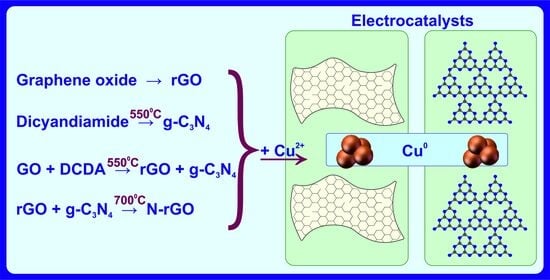
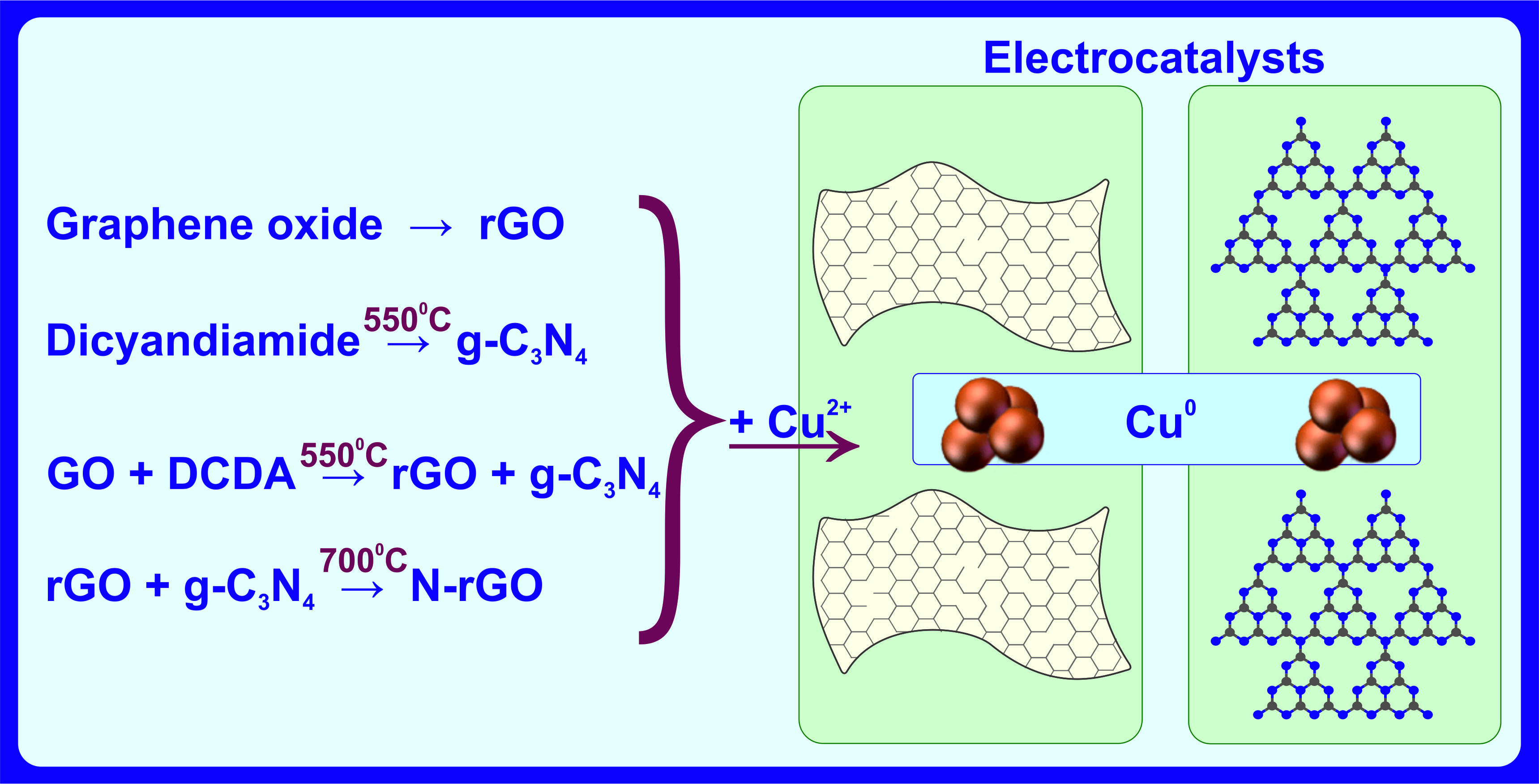
In this study, copper–carbon material composites, Cu/CM (where CM is reduced graphene oxide (rGO), graphitic carbon nitride (g-C3N4), their mixture, and N-doped reduced graphene oxide (N-rGO)), were prepared using a simple method of chemical reduction of copper cations in the presence of CM related to molecular-level mixing methods. Additionally, copper cations from its oxides present in the composites were reduced in an electrochemical cell by depositing them on the surface of a horizontally positioned cathode. The structure and morphology of the Cu/CM composites were studied using electron microscopy and X-ray diffraction analysis. The thermal stability and elemental analysis were determined for the carbon materials. The resulting Cu/CM composites were used as electrocatalysts in the electrohydrogenation of the aromatic ketone, acetophenone. Cu/rGO and Cu/N-rGO composites with a 1:1 ratio exhibited catalytic activity in this process, increasing the rate of APh hydrogenation and its degree of conversion with the selective formation of a single product, methyl phenyl carbinol (or 1-phenylethanol), compared to the electrochemical reduction of APh on a cathode without a catalyst. The Cu/N-rGO composite demonstrated the highest electrocatalytic activity.

Graphical Abstract

1. Introduction

It is known [1,2,3] that the deposition of metal nanoparticles on graphene layers allows for the production of new materials with interesting properties for applications in optics, catalysis, electronics, biotechnology, and other fields of science and technology. Graphene has a larger specific surface area than carbon nanotubes, well-developed porosity, outstanding electronic properties, and high mechanical and thermal stability. Therefore, the use of graphene and its modified derivatives as carbon carriers for metal nanoparticles holds great promise in the catalysis of organic reactions, photocatalysis, and electrocatalysis [4,5,6].
In the past 10–15 years, the creation of metal–graphene composites, including copper-containing composites, has received great attention, as confirmed by numerous publications on this topic in the scientific literature. For instance, a detailed review of studies devoted to Cu/graphene composites, various methods of their preparation, mechanical and electrical properties, and factors influencing these properties is published in [7]. Methods for producing copper–graphene composites and their influence on mechanical properties, and electrical and thermal conductivity are presented in recently published articles [8,9,10]. In discussing the progress in modern research on these properties of graphene-copper composites, the authors [10] note that the development of such composites should aim to successfully combine the excellent intrinsic characteristics of graphene (exceptional carrier mobility and ultrahigh thermal conductivity) with the high electrical and thermal conductivity and stability of copper to achieve a synergistic multifunctional effect.
The catalytic properties of copper–graphene composites are also studied in detail, but less frequently than similar composites involving noble metals. In traditional thermocatalytic processes, Cu/graphene catalysts (and their derivatives) are used in the synthesis of various organic compounds. For example, a Cu/rGO composite produced by the simultaneous chemical reduction of copper cations and graphene oxide (GO) using ascorbic acid was used for the thermocatalytic decomposition of ammonium perchlorate [11]. The catalytic activity of Cu/rGO composites was investigated in the processes of formamidation and amination of arylboronic acids [12] and phenol hydroxylation [13]. Composites of copper oxide supported on graphene oxide demonstrated high efficiency in reactions of catalytic hydrogenation of nitroaromatic compounds with the selective formation of amino derivatives at yields of 92–98% [14].
In electrochemical systems, copper–graphene composites have been shown to be highly sensitive sensors [15,16] and efficient electrocatalysts, especially with the participation of N-doped graphene, in such important reactions as oxygen reduction, carbon dioxide reduction, and hydrogen evolution [17,18,19,20]. A review [21] devoted to modern achievements in electrocatalytic hydrogenation on copper-containing catalysts also discusses the application of copper–graphene catalysts in electrohydrogenation reactions of organic compounds. Computer modeling of metal–graphene composites revealed different interactions between the two counterparts [3]. In particular, for Cu, Ag, and Au, the distance between the metal and graphene was determined to be 3 Å, indicating weak van der Waals interactions between them. To enhance the interaction of the metal with the graphene layers, it was modified by introducing various heteroatoms (as in the case of other carbon carrier materials), among which the most widespread are oxygen and nitrogen atoms [22,23,24].
Studies on the catalytic properties of composites of metal nanoparticles supported on graphitic carbon nitride, g-C3N4, are also common [25,26]. Carbon nitride is a product of thermal polycondensation of nitrogen-containing compounds, such as cyanamide, dicyandiamide, urea, melamine, and others, and consists of triazine and heptazine blocks linked together by tertiary nitrogen atoms. Like graphite, graphitic carbon nitride has a layered structure stabilized by van der Waals forces, and each layer is an aromatic heterocycle [27]. Due to simple synthesis methods, chemical and thermal stability, and a structure with a high nitrogen content, graphitic carbon nitride is an excellent material for the creation of various composite catalysts. Notably, unlike graphite, which has excellent conductive properties, g-C3N4 is characterized as a wide-band semiconductor [25] and is thus extensively used in photocatalysis [27,28,29,30]. The high nitrogen content is responsible for the attachment of metal nanoparticles, which improves the conductive properties of g-C3N4 when used as a support for heterogeneous catalysts. A review [25] focuses on such catalysts, in which their application in catalytic hydrogenation and oxidation processes is discussed. In this review, among the metal catalysts supported on g-C3N4 and used in catalytic hydrogenation reactions, mainly Pd, Pt, and Au nanoparticles are considered. At the same time, Cu/g-C3N4 composites are used quite frequently in photocatalytic processes and in electrocatalysis [31,32,33,34].
This paper describes the preparation of copper–carbon composites using carbon materials (CMs), such as reduced graphene oxide, graphitic carbon nitride, their mixture, and N-doped reduced graphene oxide. g-C3N4 was fabricated by heat treatment of dicyandiamide (DCDA) at 550 °C. Cu/CM composites were synthesized by chemical reduction using a procedure similar to that used to prepare copper–carbon composites with a carbon base from multiwalled carbon nanotubes, fullerene black, and soot obtained from aniline–formaldehyde polymer [35]. Some of these composites exhibited a high rate of nitrobenzene hydrogenation, maintained throughout almost the entire process, and the selective formation of one product, aniline. The novelty of this work lies in the development of a combined approach to prepare Cu/CM composites, involving chemical reduction of Cu2+ ions in the presence of various carbon matrices, followed by in situ electrochemical reduction of copper oxides. A systematic comparison of Cu/rGO, Cu/g-C3N4, Cu/(rGO + g-C3N4), and Cu/N-rGO composites was performed for the first time in the electrohydrogenation of an aromatic ketone, acetophenone (APh). It was demonstrated that N-doping of the carbon matrix leads to a pronounced enhancement in electrocatalytic activity, resulting in nearly a twofold increase in the hydrogenation rate compared to the catalyst-free electrochemical process.

2. Results and Discussion

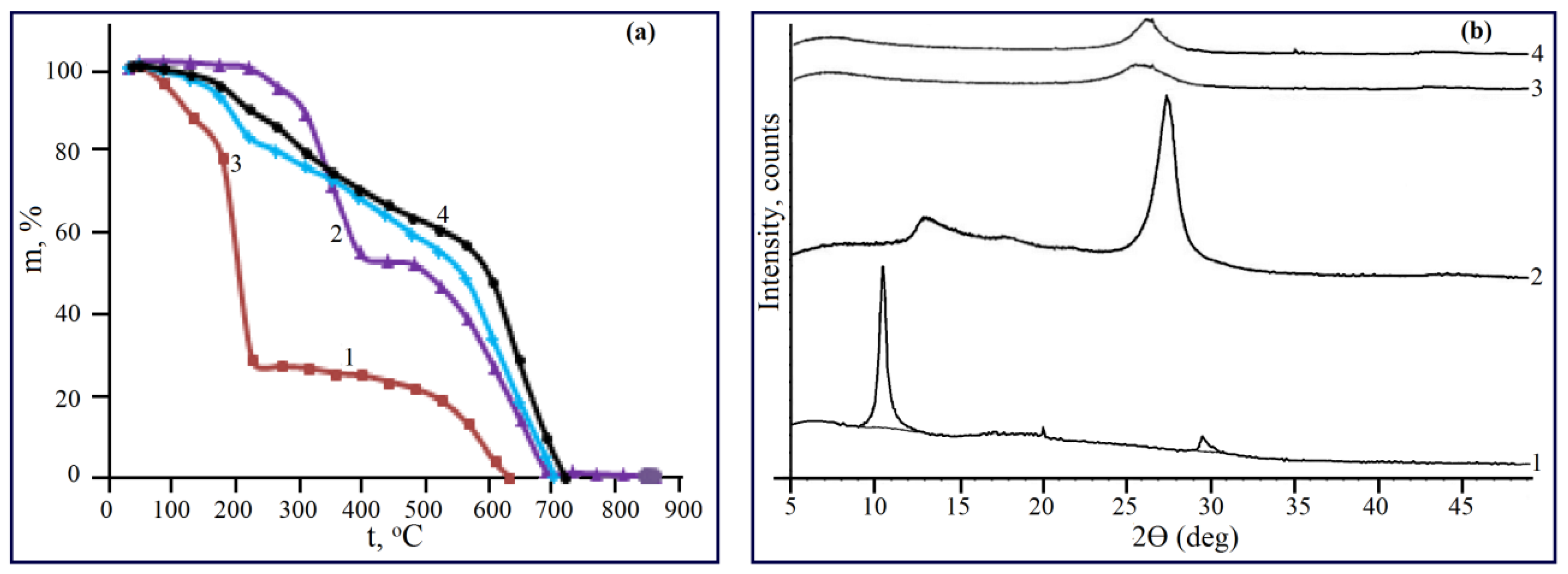
From our previous study [36], it follows that graphene oxide synthesized using a similar method has a total content of acidic groups equal to 5.02 mmol/g, determined by acid–base titration according to the Boehm method [37,38]. Among them are carboxyl groups (2.80 mmol/g), hydroxyl groups (1.54 mmol/g), and epoxy groups (0.68 mmol/g). As shown by TGA analyses in an air atmosphere (Figure 1a), heat treatment (HT) of the synthesized GO is accompanied by an active loss of acidic groups and a total decrease of 70% in sample weight in the 180–203 °C region. In the 205–495 °C temperature region, it is relatively stable with a mass loss of only 10%. The final combustion of carbon residues interacting with oxygen occurs in the ~500–630 °C region.
In the reduced graphene oxide prepared by chemical reduction using hydrazine hydrate, the hydroxyl and carboxyl groups are absent, and the epoxy groups remain in small amounts [36]. Previous studies have also established the presence of some oxygen-containing groups in the rGO samples after chemical and thermal reduction [39,40,41].
Dicyandiamide is thermally stable at up to ~270 °C with a mass loss of 5% (Figure 1a, curve 2). A further increase in temperature to 400 °C causes a significant mass loss (~40%) due to the release of gas products (such as NH3, HCN, N2, and nitrogen oxides according to [42]), the formation of triazine rings, their condensation, and the formation of intermediate products such as melam → melem → melon. In the temperature range of 400–530 °C, the final formation of the polymer product, g-C3N4, apparently occurs (the mass loss in this temperature range is only ~8%), and finally decomposes around 720 °C.
The TGA curves for GO + DCDA mixtures in 1:1 and 1:2 ratios (Figure 1a, curves 3 and 4) show nearly identical behavior with increasing temperature, and higher stability of these mixtures compared to the individual components in the temperature range of ~350–565 °C. Apparently, the gases released during DCDA decomposition protect GO from rapid decomposition in air and simultaneously have an N-doping effect on graphene. The authors of [43] made the same assumption when studying the thermal behavior of GO–melamine mixtures for obtaining N-doped graphene.
The X-ray diffraction (XRD) spectra of the synthesized GO and g-C3N4 samples are shown in Figure 1b. In the XRD pattern of graphene oxide, the peak for the (002) phase is shifted to the region of smaller angles (2θ = 11.3°) due to an increase in the interlayer distance during the oxidation of graphite (for example, in [44], the peak value is 11.8°). This confirms the presence of oxygen-containing functional groups in the GO structure. The crystalline phases of graphitic carbon nitride are located in the region of diffraction angles close to their literature values (27.46° and 12.93°) [45]. Based on the XRD pattern of the GO + DCDA (1:1) mixture after heating at 550 °C (Figure 1b, curve 3), one can conclude that its particles are in an amorphous state. The low-intensity peak combines two closely related phases: one for reduced graphene oxide with an angle of 2θ = 25.6°, and the other for g-C3N4 with an angle of 2θ = 26.7°. In the XRD pattern for the same mixture after additional heating at 700 °C (Figure 1b, curve 4), the peak’s intensity increases slightly, but it still combines the two aforementioned phases with diffraction angles of 26.1° and 26.7°, respectively. This indicates that carbon nitride does not completely decompose during heating at 700 °C, but partially remains in the mixture.
We performed analyses to determine the nitrogen content in these samples, and the results are presented in Table 1, which also includes the results of the DCDA analysis for comparison. The approximate nitrogen content of g-C3N4 for an ideal C:N ratio of 3:4 is 57.1% (by weight) according to the formula C3N4. However, as noted in the literature [46,47], the nitrogen content of g-C3N4 can vary significantly depending on the conditions of its synthesis. Carbon nitride (g-C3N4), synthesized from DCDA during heat treatment at 550 °C, contains almost 60% nitrogen (Table 1), which may indicate both incomplete polymerization during its formation and the presence of defects in its structure.
Heat treatment of the initial GO + DCDA (1:1) mixture at 550 °C resulted in the formation of a rGO + g-C3N4 composite with a nitrogen content of 25.8%. Subsequent heat treatment of this composite at 700 °C yielded N-doped reduced graphene oxide with a nitrogen content of ~12% (Table 1). The high nitrogen content in the prepared N-rGO sample was likely also due to the presence of a small amount of carbon nitride. Its presence may also be indicated by the hydrogen content (Table 1).
Copper-containing carbon composites were synthesized by chemical reduction of copper cations, Cu2+, in the presence of the carbon materials described above. It refers to molecular-level mixing methods, which ensure homogeneous distribution of both components, intensive adsorption of metal cations on carbon nanostructures, and the formation of Cu–O–C bonds between Cu2+ cations and oxygen-containing groups on the GO surface [10], as well as interaction of metal particles with nitrogen-containing groups in N-doped rGO.
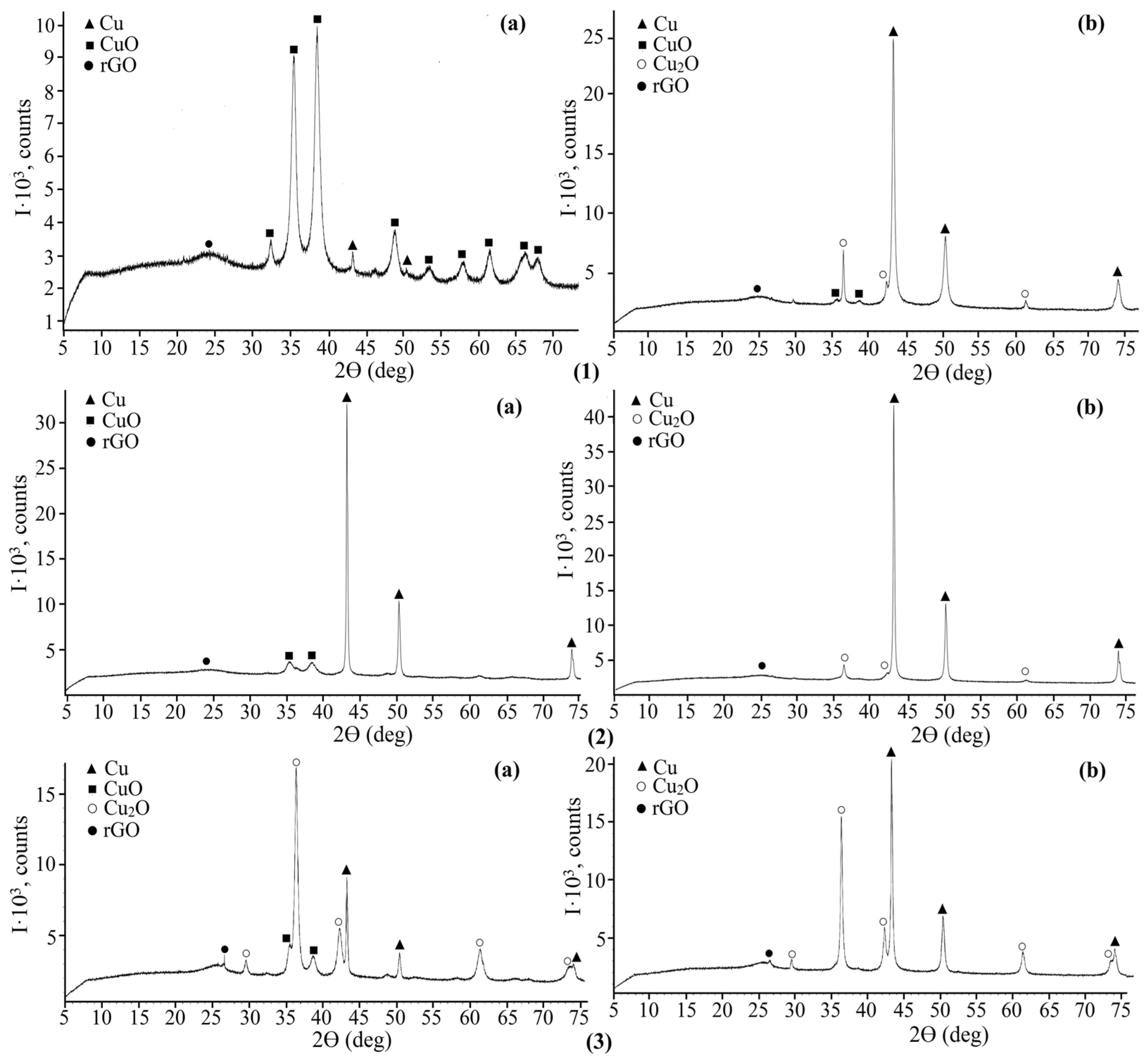
According to the XRD analysis (Figure 2), the chemical reduction of copper cations in a DW + EtOH environment in the presence of graphene oxide is incomplete, and the resulting Cu/rGO (1:1) composite mainly consists of copper(II) oxide and rGO (Figure 2(a1)). Crystalline copper phases additionally form in the composite during the electrochemical reduction of copper cations from CuO in the cell, and then this composite is used as an electrocatalyst in the electrohydrogenation of acetophenone (Figure 2(b1)). In the composite after electrochemical experiments, the copper particles have a size of 26 nm, as calculated using the diffractometer software.
The reduction of copper(II) cations in a DW + EG environment in the presence of ultrasonicated graphene oxide results in the formation of crystalline copper phases with high-intensity peaks in the XRD pattern and a small amount of its oxide, CuO (Figure 2(a2)). The size of the reduced copper particles was 38.8 nm (at a diffraction angle of 2θ = 43.3°), compared to 37.6 nm after experiments in the electrochemical cell. However, there is a partial loss of reduced graphene oxide during the reduction process when carried out in both aqueous–organic media. To remove any remaining ethylene glycol, the same Cu/rGO (1:1) composite was heated at 250 °C for 1 h in a muffle furnace in both air and argon environments. However, after this heat treatment, the copper content in both composites decreased, and its oxides appeared, with a significantly higher Cu2O content (Figure 2(a3)). This indicates that an oxidative process occurred due to the release of water and decomposition products of the remaining ethylene glycol. Upon subsequent electrochemical reduction of copper cations in the cell, the copper content increased again, but Cu2O remained, albeit in smaller quantities (Figure 2(b3)). Similar changes in the phase compositions were observed during the heat treatment of other Cu/carbon composites in both environments.
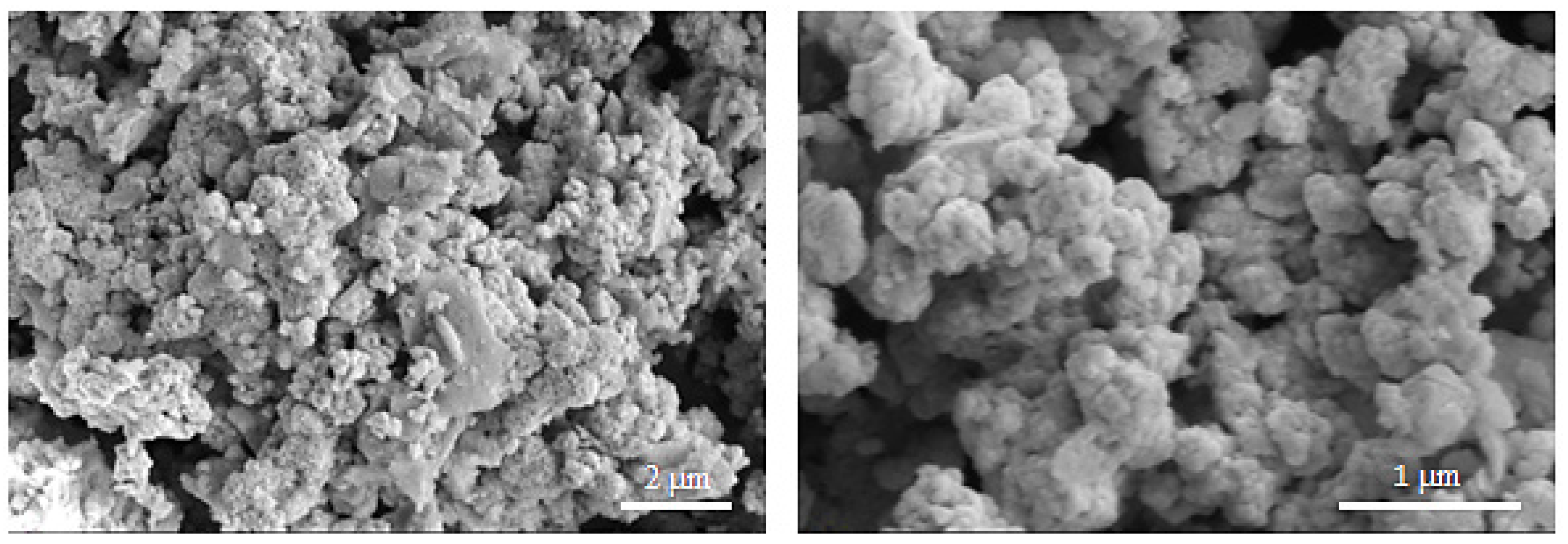
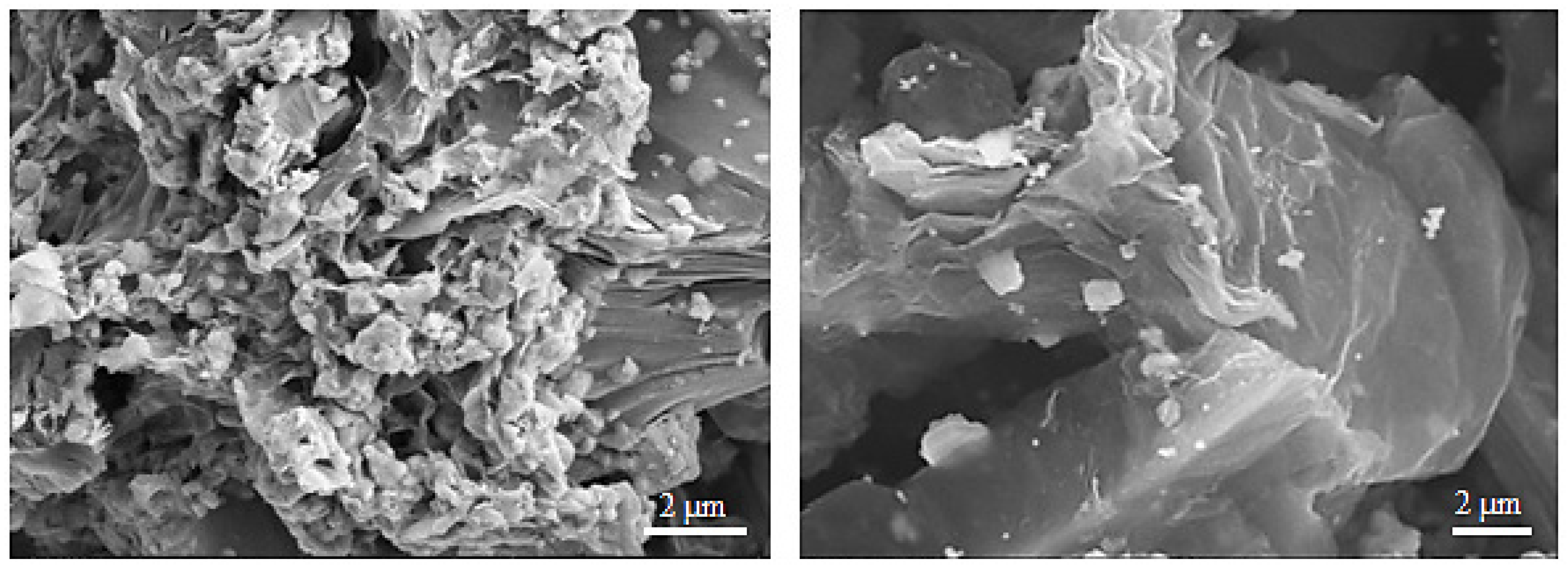
The SEM images of the Cu/rGO (1:1) (DW + EG) composite (Figure 3) show that copper and copper oxide particles are located both on the reduced graphene oxide sheets and in the spaces between them. The copper particles in the spaces between the graphene sheets form large aggregates of smaller particles. Exfoliated graphene sheets are also clearly visible in the SEM images. EDS analysis of rGO pieces revealed the presence of oxygen, which is apparently part of the functional groups remaining after the reduction of GO with hydrazine hydrate.
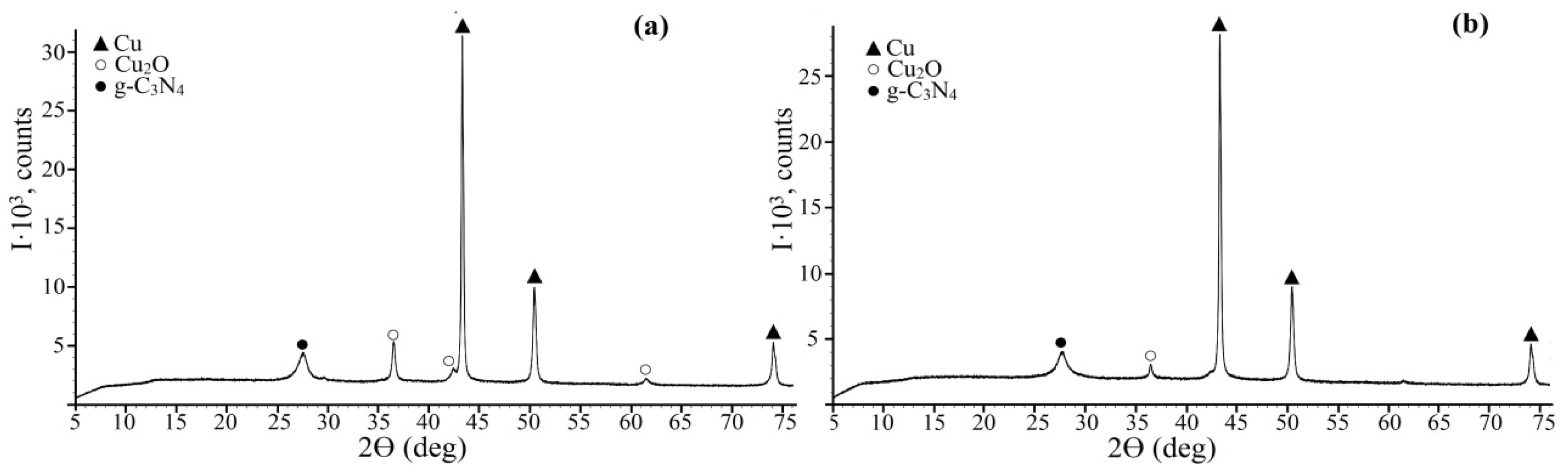
Graphitic carbon nitride, g-C3N4, and its mixture with rGO, which were prepared by heat treating DCDA and a dry mixture of GO + DCDA (1:1) in a muffle furnace at 550 °C in an air environment, were also used as carriers for copper nanoparticles. The reduction of copper cations in the presence of ultrasonicated g-C3N4 in a DW + EG environment is almost complete, with a small copper(I) oxide content, which decreases after electrohydrogenation of the APh (Figure 4). The particle size of the reduced copper at a diffraction angle of 2θ = 43.3° was 36.3 nm in the composite, and after electrochemical experiments, it remained almost the same (36.0 nm).
The SEM images of the Cu/g-C3N4 (1:1) (DW + EG) composite (Figure 5) show that it consists of carbon nitride particles of porous structure and different sizes, and on their surfaces and in between them are particles of copper and its oxides, collected in “clusters of grapes”. Moreover, the EDS analysis results show that the N and C are present in the composition of these “clusters”, indicating that carbon nitride also took part in their construction.
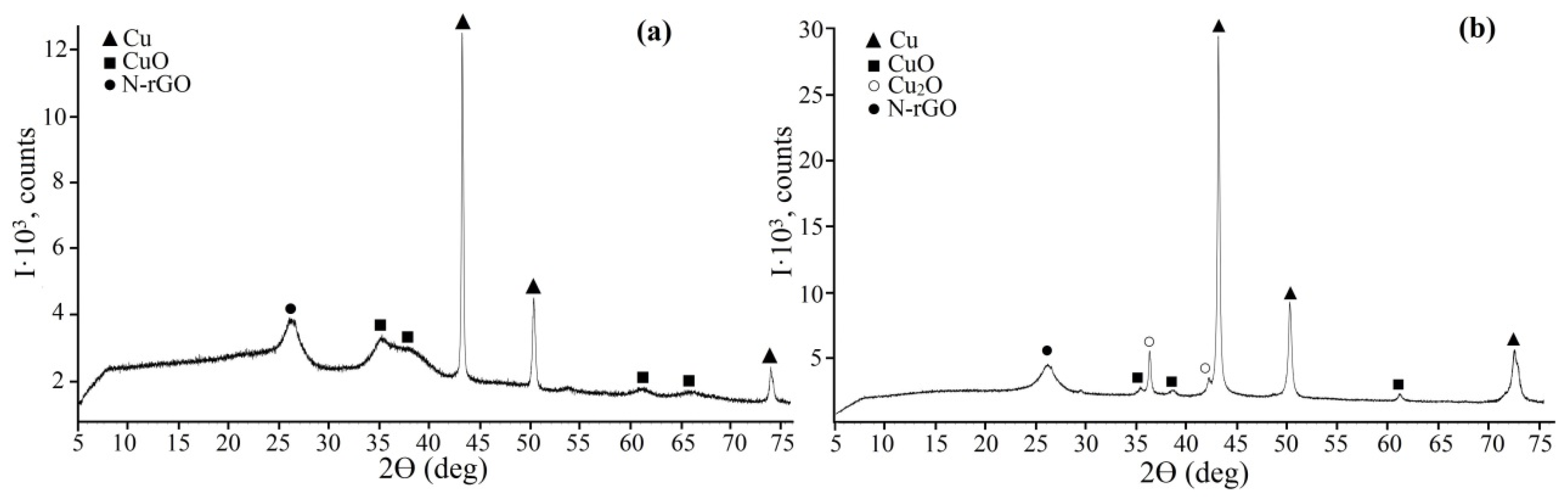
As noted above, the N-doped reduced graphene oxide was prepared by pyrolysis of the rGO + g-C3N4 mixture obtained through the heat treatment of oxide graphene and DCDA in a 1:1 ratio at 550 °C within 3 h. Pyrolysis was carried out at 700 °C for 1 h in a muffle furnace. The Cu/N-rGO composite was synthesized in a DW + EG environment. The X-ray diffraction patterns (Figure 6) show that after the synthesis and electrochemical experiments, its phase constitution includes small amounts of its oxides in addition to copper with high-intensity peaks and N-doped rGO. The particle size of the reduced copper at a diffraction angle of 2θ = 43.3° is 38.6 nm, compared to 32.6 nm after electrochemical experiments.
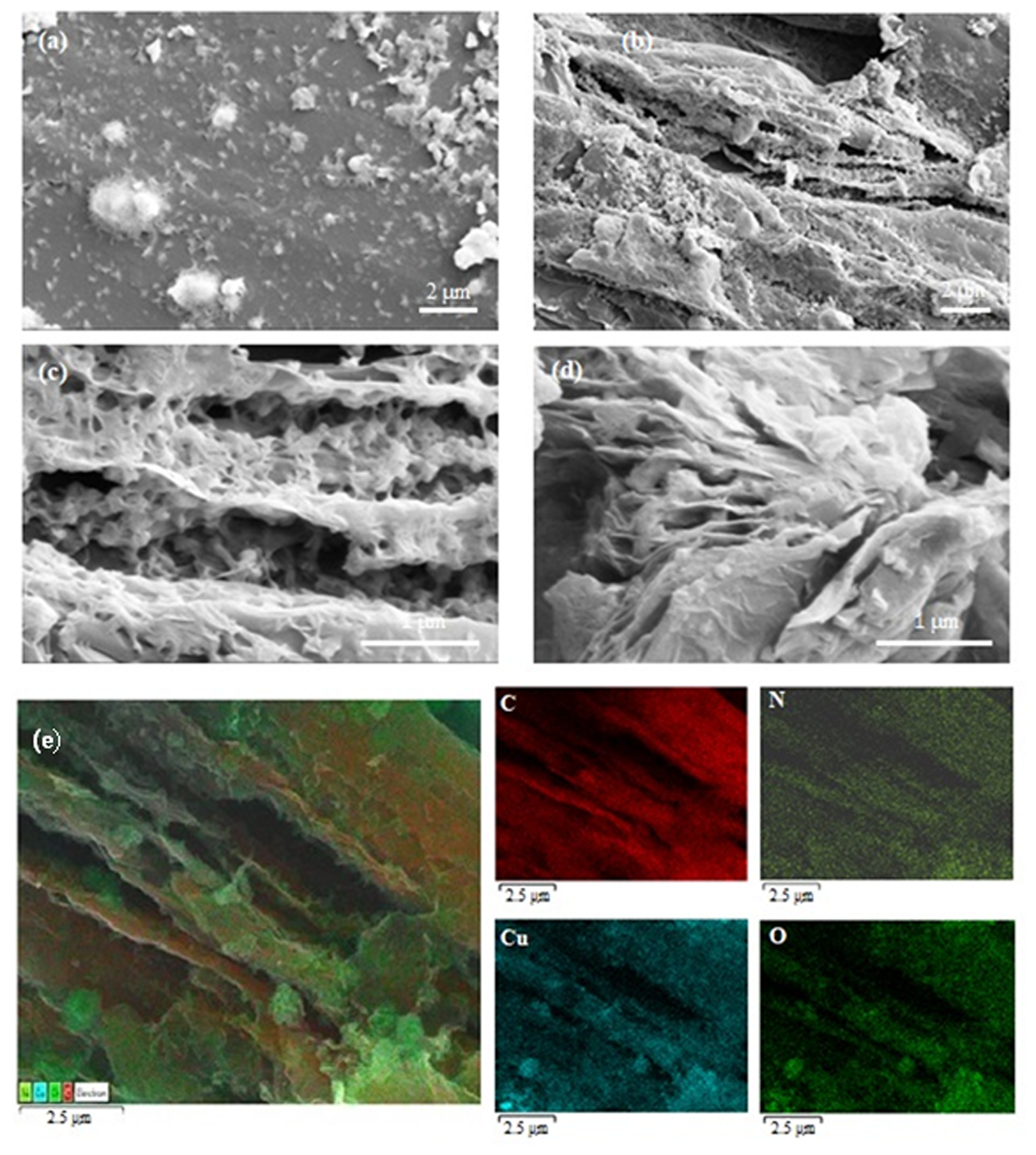
Electron microscopic studies (Figure 7) revealed that the Cu/N-rGO (1:1) (DW + EG) composite contains particles of varying nature and shape. There are bulk particles of the carbon base, on the surface of which rounded particles of copper and “feathers” of its oxide are distributed (Figure 7a). There are also layered formations with large pores (Figure 7b,c), apparently related to graphitic carbon nitride decomposing into layers, between which weak van der Waals forces act. In addition, there are particles similar in structure to exfoliated rGO (Figure 7d) [36]. EDS maps demonstrating the distribution of C, N, Cu, and O (Figure 7e) show that Cu and its oxide CuO particles are located not only in small cluster formations, but also over the entire surface of the layered C- and N-containing base.
Synthesized copper–carbon composites containing copper oxides after the chemical reduction procedure in their constitutions were further reduced in an electrochemical cell. To carry this out, a powder composite (weighing 1 g) was deposited on the surface of a copper cathode (without fixation) positioned horizontally at the bottom of the cathode chamber and serving as a conductive substrate. During the electrolysis of aqueous–alkaline solutions (electrolytes) at a current of 2.5 A, gases (H2 and O2) were released, and their volumes were recorded.
It is assumed that the electrochemical reduction (EChR) of copper oxides occurs directly at the solid composite–metallic cathode–electrolyte interface, i.e., it is heterogeneous in nature. The composite particles settled on the cathode surface under the influence of their own gravity. Copper oxides were reduced by direct electron transfer from the cathode and the participation of water molecules: CuO + 2e + H2O → Cu0 + 2OH; Cu2O + 2e + H2O → 2Cu0 + 2OH (cathode); 4OH → O2 + 2H2O + 4e (anode). XRD analyses effectively confirm the passage of electrochemical reduction of copper cations (Figure 2, Figure 4 and Figure 6). Table 2 shows the durations of the processes (τ) and the volumes of oxygen (VO2) additionally released to the volumes of the two gases in a ratio of 2VH2:VO2. It should be noted that the electrochemical reduction of copper cations from its oxides and the formation of hydrogen are two competing processes at the cathode under given conditions. According to the data presented in Table 2, it follows that the higher the degree of chemical reduction of copper cations in the resulting composites, the less additional electrochemical reduction is required, and the smaller the volumes of oxygen released in these processes.
After the electrochemical reduction of copper oxides within its composites, acetophenone (APh) dissolved in ethyl alcohol was added to the cell, and electrocatalytic hydrogenation was carried out under the same conditions. The results are listed in Table 2. For the electrocatalytic hydrogenation of acetophenone, which is the second stage, characteristics such as the average hydrogenation rate (W) over the period α = 0.25, the hydrogen utilization coefficient (η), the degree of APh conversion (α), and the results of chromatographic analyses of the extracts from the catholyte after the electrocatalytic hydrogenation of APh are also presented. The characteristics of the electrochemical reduction of acetophenone on a Cu cathode without the deposition of composites are also provided for comparison. Table 2 shows that the electrochemical reduction of acetophenone is not completed (α = 68.3%), and the main reduction product is the trans-isomer of pinacone (trans-2,3-diphenyl-2,3-butanediol), formed as a result of the cathodic hydrodimerization of APh.
Electrocatalytic hydrogenation of APh in the presence of copper-containing composites proceeds differently (Table 2). The Cu/rGO (1:1) composites synthesized in a distilled water + ethanol (DW + EtOH) environment exhibited electrocatalytic activity, slightly increasing the rate of APh electrohydrogenation. For the same composite prepared in a distilled water + ethylene glycol (DW + EG) solution, heat treatment is necessary to remove EG residues and improve its activity, especially in an argon environment. The electrocatalytic activity of Cu/rGO (1:1) composites was clearly demonstrated both in terms of the degree of APh conversion, which increased to 91–100%, and in the selective formation of the target product—methyl phenyl carbinol (MPhC), or 1-phenylethanol, which has fragrant properties and is widely used in the perfume industry. A high rate of APh hydrogenation was also observed in the presence of a composite with a high copper content, Cu/rGO (2:1) (DW + EtOH) (Table 2). On the contrary, increasing the carbon component in these composites lowers their activity. Composites with copper NPs deposited on graphitic carbon nitride and its mixture with reduced graphene oxide are practically inactive (Table 2). This may be explained by the relatively weak electrical conductivity of this polymer [45] or by the strong interaction of copper particles with nitrogen atoms in the g-C3N4 structure, which blocks the catalytically active surface of copper particles. In the presence of Cu/g-C3N4 composites, the main product is the trans-isomer, as in the electrochemical reduction of APh on a non-activated cathode (Table 2).
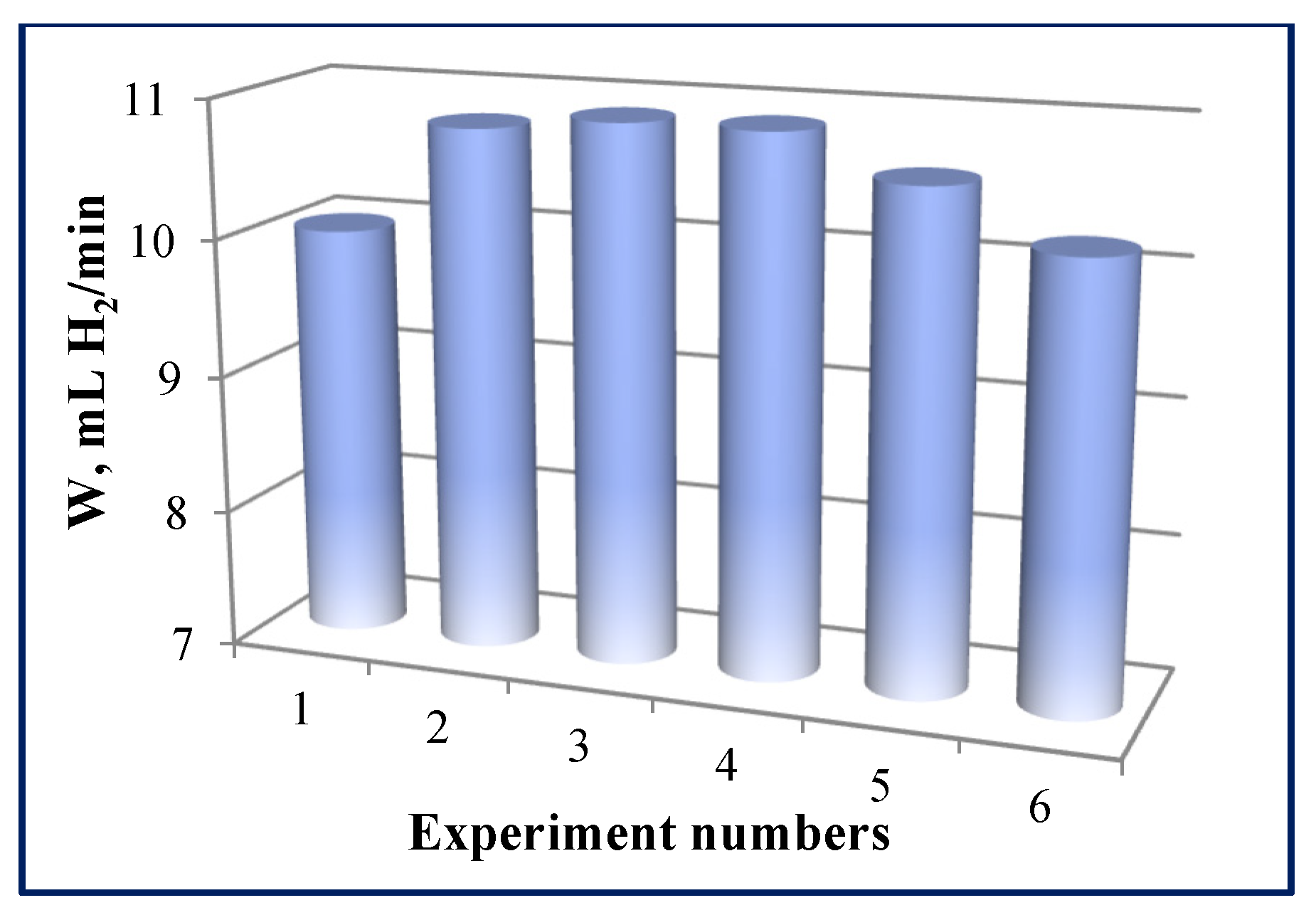
The highest activity in the studied process was demonstrated by a composite synthesized on the basis of copper NPs and N-doped reduced graphene oxide, Cu/N-rGO(700 °C) (DW + EG). The rate of APh hydrogenation increased by almost twice compared to its electrochemical reduction on a Cu cathode, and according to the chromatographic data, the yield of methyl phenyl carbinol was 99.7% (Table 2). The high electrocatalytic activity of N-doped graphene, both as a metal-free catalyst and as a support of metal nanoparticles, has been repeatedly noted in the literature on the oxygen reduction reaction [22,23,48,49]. This activity was assumed to be due to the presence of nitrogen functional groups in graphene, particularly in the pyrrolic and pyridinic forms, and due to its more rapid charge transfer than in pure graphene. It is obvious that these factors also act in the process of electrocatalytic hydrogenation of acetophenone in the presence of Cu/N-rGO(700 °C) composite. To determine how to maintain the electrocatalytic activity of this composite, we performed five additional experiments on the electrohydrogenation of acetophenone in its presence. The experiments were conducted under the same electrochemical system conditions as for all other composites, but with electrolyte replacement and the introduction of a new portion of the hydrogenated compound. Figure 8 shows that the average hydrogenation rate of APh over the conversion period α = 25% somewhat increased starting from the second experiment, and decreased slightly in experiment 6 (to 10.2 mL H2/min). The yield of methyl phenyl carbinol remained at 99.5%.

3. Materials and Methods

3.1. Materials

Copper nitrate (Cu(NO3)2·3H2O), hydrazine hydrate (N2H4·H2O, 64%), hydrogen peroxide, ethylene glycol, and ammonia solution (NH4OH) were purchased from “Ridder” LLP (Karaganda, Kazakhstan) and used without further purification. H2SO4, KMnO4, and HCl were purchased from “Karagandareaktivsbyt” LLP (Karaganda, Kazakhstan). Acetophenone and dicyandiamide were purchased from Sigma-Aldrich. Distilled water and medical ethyl alcohol (96%) were used to prepare aqueous–ethanol solutions.

3.2. Synthesis of GO, g-C3N4, N-rGO, and Their Cu-Containing Composites

Graphene oxide was synthesized using a modified version of Hummers’ method [44]. Commercial amorphous graphite powder (8.0 g) with a carbon content of ~99% and particle sizes of 0–50 μm was placed in a jacketed flask, and 200 mL of concentrated H2SO4 was added dropwise. The reaction mixture was stirred for 4 h at room temperature, and 24.0 g of KMnO4 was added portion-wise, keeping the temperature below 10 °C. Stirring was continued for 8 h at room temperature. A thick, dark–brown suspension was formed, and 400 mL of distilled water with 40 mL of a 30% H2O2 solution was slowly added dropwise. The mixture was stirred for 30 min at room temperature. For purification, the mixture was filtered and washed with 400 mL of a 5% HCl solution and 2000 mL of distilled water to pH 7, and dried at 50 °C. Thus, a black loose powder of graphene oxide was produced.
Graphitic carbon nitride, g-C3N4, was prepared through heat treatment of dicyandiamide powder in a muffle furnace at 550 °C for 3 h in closed crucibles under an air atmosphere.
The rGO + g-C3N4 carbon base was prepared through heat treatment of a thorough mixture of dry powders of GO and dicyandiamide in a 1:1 ratio at 550 °C for 3 h in air.
N-doped reduced graphene oxide, N-rGO, was produced by further heat treatment of the obtained rGO + g-C3N4 mixture at 700 °C for 1 h in air.
Synthesis of Cu/CM (1:1) composites (where CM = rGO, g-C3N4, rGO + g-C3N4, and N-rGO) was performed using the following procedure: carbon material (1.60 g) was added to a mixture of 100 mL of distilled water (DW) and 100 mL of ethyl alcohol (EtOH) or ethylene glycol (EG), thoroughly mixed, and ultrasonically treated for 1 h. Copper nitrate (6.08 g, 0.025 mol Cu(NO3)2·3H2O, containing 1.60 g of Cu), dissolved in 50 mL of DW and 50 mL of EtOH (or EG) was added dropwise to the resulting suspension, and the reaction mixture was stirred for 1 h. A 1 M NH4OH solution was added to increase the pH of the mixture to 12. This resulted in the formation of a dark blue suspension, to which hydrazine hydrate (N2H4·H2O) was added dropwise in a molar ratio of Cu(NO3)2:N2H4·H2O = 1:30 in the case of the DW + EtOH reaction environment and 1:50 in the DW + EG environment, and stirring was continued at 60 °C for another hour. A red-brown suspension was formed, and the resulting composite was separated by centrifugation at 2500 rpm for 10 min, thoroughly washed with distilled water and ethyl alcohol, heated to 30 °C, and dried at 60 °C in a vacuum.

3.3. Electrocatalytic Experiments

The procedure for electrocatalytic hydrogenation of organic compounds using metal-containing powder catalysts for cathode activation is described in detail in [35,50]. Experiments on the additional reduction of copper cations in the copper–carbon composites and their subsequent use to activate the Cu cathode in electrocatalytic hydrogenation processes were carried out in a diaphragm electrochemical cell in an aqueous–alkaline solution (the initial NaOH concentration was 2%) for the first stage and an alcohol–aqueous–alkaline solution for the second stage at a current of 2.5 A and a temperature of 30 °C. A 1 g amount of powder of the prepared Cu/CM composite was deposited on a horizontally located copper cathode (with an area of 0.09 dm2) tightly adjacent to the bottom of the electrolytic cell. A platinum grid served as the anode. The initial concentration of APh in the catholyte was 0.162 mol/L. At certain intervals of time, the volumes of released gases, hydrogen and oxygen, were recorded, on the basis of which some characteristics of the processes under study were calculated. The results are presented in Table 2, listing characteristics such as VO2—the volume of oxygen evolved during the electrochemical reduction of copper cations; W—the average rate of APh hydrogenation over a period equal to α = 0.25; and α—the APh conversion.

3.4. Physical–Chemical Investigations

The phase constitutions and morphological structure of the synthesized carbon materials and copper–carbon composites after heat treatment and electrochemical experiments were studied on a Rigaku SmartLab diffractometer (Rigaku Corporation, Tokyo, Japan) using CuKα radiation in the angle range (2θ) of 5–90° and an electron microscope FIB/SEM Helios-5CX (Thermo Fisher Scientific, Hillsboro, OR, USA). Energy-dispersive X-ray spectroscopic (EDS) analysis was performed using the XMax N 150 EDX detector (Oxford Instruments, High Wycombe, UK).
Thermal gravimetric analysis (TGA) tests were carried out with a LabSYS evo TGA/LTA/DSC analyzer (Setaram Instrumentation, Caluire-et-Cuire, France) at a heating rate of 10 °C/min in the temperature range of 30–900 °C in air.
Elemental microanalysis of the prepared carbon material samples for C, N, and H was performed using an EA3100 Elemental Analyzer (EuroVector, Pavia, Italy).
Chromatographic analyses of the extracts from catholytes (chloroform was an extractant) after the completion of electrocatalytic hydrogenation of APh were carried out on a Crystallux-4000 chromatograph (NPF Meta Chrom, Yoshkar-Ola, Russia).

4. Conclusions

Copper–carbon composites were synthesized by chemical reduction of metal cations in the presence of graphene derivatives (rGO and N-rGO), graphitic carbon nitride (g-C3N4), and a mixture of rGO + g-C3N4 (molecular-level mixture procedure). Graphitic carbon nitride was prepared through heat treatment of dicyandiamide at 550 °C. Heat treatment of the rGO + g-C3N4 mixture at 700 °C leads to the formation of N-doped reduced graphene oxide. The structure and morphological peculiarities of the copper–carbon composites were studied. It was shown that, despite the formation of copper particles with sizes of 32–38 nm, they are collected in agglomerates and are located mainly between the particles of the carbon base. Apparently, this is due to the high initial copper content in the composites, which is necessary for electrocatalytic studies. An exception is the Cu/N-rGO composite, in which reduced copper particles are not only located between the carbon base particles but also distributed across the entire surface of the porous exfoliated sheets of decomposing carbon nitride. This composite, in a 1:1 ratio, demonstrated the highest activity in the electrocatalytic hydrogenation of acetophenone as a model compound: the acetophenone hydrogenation rate increased by almost twofold compared to its electrochemical reduction at the cathode without the composite–catalyst. Furthermore, the formation of a single product, methyl phenyl carbinol (or 1-phenylethanol), was established in yields of ~99% when using Cu/N-rGO (1:1) and Cu/rGO (1:1) composites for cathode activation. These copper–carbon composites can be used as catalysts in catalytic and electrocatalytic syntheses of organic compounds capable of being reduced on copper catalysts.

Author Contributions

Conceptualization, N.M.I.; methodology, N.M.I. and Y.A.V.; investigation, Y.A.S., Y.A.V. and S.O.K.; writing—review and editing, N.M.I. and Y.A.V.; resources, Y.A.S. and Y.A.V.; supervision, Z.M.M.; funding acquisition, Z.M.M.; visualization: Y.A.S., Y.A.V. and L.A.Z.; instrumentation, L.A.Z. All authors have read and agreed to the published version of the manuscript.

Funding

This research is funded by the Science Committee of the Ministry of Science and Higher Education of the Republic of Kazakhstan (Program No. BR24992921).

Data Availability Statement

The data that support the findings of this study are available from the corresponding author upon reasonable request.

Conflicts of Interest

The authors declare that they have no conflicts of interest.

References

  1. Xu, C.; Wang, X.; Zhu, J. Graphene-metal particle nanocomposites. J. Phys. Chem. C 2008, 112, 19841–19845. [Google Scholar] [CrossRef]
  2. Julkapli, N.M.; Bagheri, S. Graphene supported heterogeneous catalysts: An overview. Int. J. Hydrog. Energy 2015, 40, 948–979. [Google Scholar] [CrossRef]
  3. Baimova, J.A.; Shcherbinin, S.A. Metal/graphene composites: A review on the simulation of fabrication and study of mechanical properties. Materials 2023, 16, 202. [Google Scholar] [CrossRef]
  4. Hu, M.; Yao, Z.; Wang, X. Graphene-Based Nanomaterials for Catalysis. Ind. Eng. Chem. Res. 2017, 56, 3477–3502. [Google Scholar] [CrossRef]
  5. Alam, M.W.; Allag, N.; Naveed-Ur-Rehman, M.; Bhat, S.I. Graphene-based catalysts: Emerging applications and potential impact. Chem. Rec. 2024, 24, e202400096. [Google Scholar] [CrossRef] [PubMed]
  6. Gao, K.; Sun, S.; Zhang, B. Recent advancements in the development of graphene-based materials for catalytic applications. ChemCatChem 2024, 16, e202400696. [Google Scholar] [CrossRef]
  7. Hidalgo-Manrique, P.; Lei, X.; Xu, R.; Zhou, M.; Kinloch, I.A.; Young, R.J. Copper/graphene composites: A review. J. Mater. Sci. 2019, 54, 12236–12289. [Google Scholar] [CrossRef]
  8. Liang, W. Review on the preparation process and properties of copper/graphene composites. Sci. Technol. Eng. Chem. Environ. Prot. 2024, 2, 1–4. [Google Scholar] [CrossRef]
  9. Li, J. Research on the properties of graphene/copper composites. Sci. Technol. Eng. Chem. Environ. Prot. 2024, 2, 1–5. [Google Scholar] [CrossRef]
  10. Liu, W.; Zhao, X.; Li, H.; Ding, Y. Research progress on the preparation and properties of graphene-copper composites. Metals 2025, 15, 1117. [Google Scholar] [CrossRef]
  11. Rios, P.L.; Povea, P.; Cerda-Cavieres, C.; Arroyo, J.L.; Morales-Verdejo, C.; Abarca, G.; Camarada, M.B. Novel in situ synthesis of copper nanoparticles supported on reduced graphene oxide and its application as a new catalyst for the decomposition of composite solid propellants. RCS Adv. 2019, 9, 8480–8489. [Google Scholar] [CrossRef] [PubMed]
  12. Fakhri, P.; Jaleh, B.; Nasrollahzadeh, M. Synthesis and characterization of copper nanoparticles supported on reduced graphene oxide as a highly active and recyclable catalyst for the synthesis of formamides and primary amines. J. Mol. Cat. A Chem. 2014, 383–384, 17–22. [Google Scholar] [CrossRef]
  13. Du, W.; Pang, J.; Ma, J.; Wang, W.; Zhang, L. Preparation of graphene supported copper composite materials and study on the catalytic activity of phenol hydroxylation. Mater. Today Sustain. 2024, 26, 100714. [Google Scholar] [CrossRef]
  14. Zhang, K.; Suh, J.M.; Lee, T.H.; Cha, J.H.; Choi, J.-W.; Jang, H.W.; Varma, R.S.; Shokouhimehr, M. Copper oxide-graphene oxide nanocomposite: Efficient catalyst for hydrogenation of nitroaromatics in water. Nano Converg. 2019, 6, 6. [Google Scholar] [CrossRef]
  15. Yao, Y. Facile synthesis of copper-coated-reduced graphene-oxide and its application as a highly sensitive electrochemical sensor for hydroquinone. J. Chem. 2022, 2022, 6894049. [Google Scholar] [CrossRef]
  16. Barreto, F.C.; Silva, M.K.L.; Cesarino, I. An electrochemical sensor based on reduced graphene oxide and copper nanoparticles for monitoring estriol levels in water samples after bioremediation. Chemosensors 2022, 10, 395. [Google Scholar] [CrossRef]
  17. Ania, C.O.; Seredych, M.; Rodriques-Castellon, E.; Bandosz, T.J. New copper/GO based material as an efficient oxygen reduction catalyst in an alkaline medium: The role of unique Cu/rGO architecture. Appl. Cat. B Environ. 2015, 163, 424–435. [Google Scholar] [CrossRef]
  18. Cao, C.; Wen, Z. Cu nanoparticles decorating rGO nanohybrids as electrocatalyst toward CO2 reduction. J. CO2 Util. 2017, 22, 231–237. [Google Scholar] [CrossRef]
  19. Aslan, E.; Patir, I.H. In situ copper nanoparticles on reduced graphene oxide (rGO/Cu) for biphasic hydrogen evolution. ChemElectroChem 2022, 9, e202200381. [Google Scholar]
  20. Liu, M.; Zang, C.; Ying, Y.; Zhao, Y.; Zhao, Z.; Jia, Y.; Chen, Y.; Shi, J.F.; Li, Y. Optimization strategies for enhancing the stability of Cu-based catalysts. Mater. Rep. Energy 2025, 5, 100355. [Google Scholar] [CrossRef]
  21. Zheng, M.; Zhang, J.; Wang, P.; Jin, H.; Zheng, Y.; Qiao, S.-Z. Recent advances in electrocatalytic hydrogenation reactions on copper-based catalysts. Adv. Mater. 2024, 36, 2307913. [Google Scholar] [CrossRef]
  22. Rangraz, Y.; Heravi, M.M.; Elhampour, A. Recent advances on heteroatom-doped porous carbon/metal materials: Fascinating heterogeneous catalysts for organic transformations. Chem. Rec. 2021, 21, 1985–2073. [Google Scholar] [CrossRef]
  23. He, L.; Weniger, F.; Neumann, H.; Beller, M. Synthesis, characterization, and application of metal nanoparticles supported on nitrogen-doped carbon: Catalysis beyond electrochemistry. Angew. Chem. Int. Ed. 2016, 55, 2–15. [Google Scholar] [CrossRef] [PubMed]
  24. Li, M.; Xu, F.; Li, H.; Wang, Y. Nitrogen-doped porous materials: Catalyst supports for heterogeneous hydrogenation and oxidation. Catal. Sci. Technol. 2016, 6, 3670–3693. [Google Scholar] [CrossRef]
  25. Gong, Y.; Li, M.; Li, H.; Wang, Y. Graphitic carbon nitride polymers: Promising catalysts or catalyst supports for heterogeneous oxidation and hydrogenation. Green. Chem. 2015, 17, 715–736. [Google Scholar] [CrossRef]
  26. Wang, L.; Wang, C.; Hu, X.; Xue, H.; Pang, H. Metal/graphitic carbon nitride composites: Synthesis, structures, and applications. Chem. Asian J. 2016, 11, 3305–3328. [Google Scholar] [CrossRef]
  27. Ahmed, M.A.; Mahmoud, S.A.; Mohamed, A.A. Unveiling the photocatalytic potential of graphitic carbon nitride (g-C3N4): A state-of-the-art review. RSC Adv. 2024, 14, 25629–25662. [Google Scholar] [CrossRef]
  28. Luo, Y.; Zhu, Y.; Han, Y.; Ye, H.; Liu, R.; Lan, Y.; Xue, M.; Xie, X.; Yu, S.; Zhang, L.; et al. g-C3N4-based photocatalysts for organic pollutant removal: A critical review. Carbon. Res. 2023, 2, 14. [Google Scholar] [CrossRef]
  29. Alaghmandfard, A.; Ghandi, K. A comprehensive review of graphitic carbon nitride (g-C3N4)–metal oxide-based nanocomposites: Potential for photocatalysis and sensing. Nanomaterials 2022, 12, 294. [Google Scholar] [CrossRef]
  30. Wang, Q.; Li, Y.; Huang, F.; Song, S.; Ai, G.; Xin, X.; Zhao, B.; Zheng, Y.; Zhang, Z. Recent advances in g-C3N4-based materials and their application in energy and environmental sustainability. Molecules 2023, 28, 432. [Google Scholar] [CrossRef]
  31. Le, S.; Jiang, T.; Zhao, Q.; Liu, X.; Li, Y.; Fang, B.; Gong, M. Cu-doped mesoporous graphitic carbon nitride for enhanced visible-light driven photocatalysis. RSC Adv. 2016, 6, 38811–38819. [Google Scholar] [CrossRef]
  32. Sakthivel, T.; Ramachandran, R.; Kirubakaran, K. Photocatalytic properties of copper-two dimensional graphitic carbon nitride hybrid film synthesized by pyrolysis method. J. Environ. Chem. Eng. 2018, 6, 2636–2642. [Google Scholar] [CrossRef]
  33. Xuan, T.N.; Thi, D.N.; Thuong, Q.T.; Ngoc, T.N.; Quoc, K.D.; Molnar, Z.; Mukhtar, S.; Szabo-Bardos, E.; Horvath, O. Effect of copper-modification of g-C3N4 on the visible-light-driven photocatalytic oxidation of nitrophenols. Molecules 2023, 28, 7810. [Google Scholar] [CrossRef]
  34. Zhang, H.; Ren, X.; Zhang, B.; Jia, A.; Wang, Y. Size effect of Cu nanoparticles in Cu/g-C3N4 composites on properties for highly efficient photocatalytic reduction of CO2 to methanol. ACS Appl. Mater. Interfaces 2023, 15, 53515–53525. [Google Scholar] [CrossRef]
  35. Ivanova, N.M.; Soboleva, Y.A.; Vissurkhanova, Y.A. Synthesis of copper-carbon nanocomposites and their application as electrocatalysts. Rus. J. Appl. Chem. 2025, 98, 10–19. [Google Scholar] [CrossRef]
  36. Ivanova, N.M.; Muldakhmetov, Z.M.; Vissurkhanova, Y.A.; Soboleva, Y.A.; Borsynbayev, A.S. N-containing graphene preparation using melamine as a nitrogen source. Eurasian J. Chem. 2025, 30, 74–84. [Google Scholar] [CrossRef]
  37. Schönherr, J.; Buchheim, J.; Scholz, P.; Adelhelm, P. Boehm titration revisited (Part I): Practical aspects for achieving a high precision in quantifying oxygen-containing surface groups on carbon materials. J. Carbon Res. 2018, 4, 21. [Google Scholar] [CrossRef]
  38. Schönherr, J.; Buchheim, J.; Scholz, P.; Adelhelm, P. Boehm titration revisited (Part II): A comparison of Boehm titration with other analytical techniques on the quantification of oxygen-containing surface groups for a variety of carbon materials. J. Carbon. Res. 2018, 4, 22. [Google Scholar] [CrossRef]
  39. Oliveira, A.E.F.; Braga, G.B.; Tarley, C.R.T.; Pereira, A.C. Thermally reduced graphene oxide: Synthesis, studies and characterization. J. Mater. Sci. 2018, 53, 12005–12015. [Google Scholar] [CrossRef]
  40. Nascimento, J.R.; D’Oliveira, M.R.; Veiga, A.G.; Chagas, C.A.; Schmal, M. Synthesis of reduced graphene oxide as a support for nano copper and palladium/copper catalysts for selective NO reduction by CO. ACS Omega 2020, 5, 25568–25581. [Google Scholar] [CrossRef] [PubMed]
  41. Banzal, K.; Singh, J.; Dhaliwal, A.S. Synthesis and characterization of graphene oxide and its reduction with different reducing agents. IOP Conf. Ser. Mater. Sci. Eng. 2022, 1225, 012050. [Google Scholar] [CrossRef]
  42. Yan, W.; Gan, X.; Yang, X. Exploration of pyrolysis behaviors and hazards of dicyandiamide under dynamic, isothermal, and adiabatic conditions. J. Therm. Anal. Calorim. 2025, 150, 7601–7612. [Google Scholar] [CrossRef]
  43. Du, D.; Li, P.; Ouyang, J. Nitrogen-doped reduced graphene oxide prepared by simultaneous thermal reduction and nitrogen-doping of graphene oxide in air and its application as electrocatalyst. ACS Appl. Mater. Interfaces 2015, 7, 26952–26958. [Google Scholar] [CrossRef] [PubMed]
  44. Rag, S.A.; Selvakumar, M.; Bhat, S.; Chidangil, S.; De, S. Synthesis and characterization of reduced graphene oxide for supercapacitor application with a biodegradable electrolyte. J. Electron. Mater. 2020, 49, 985–994. [Google Scholar]
  45. Praus, P.; Svoboda, L.; Ritz, M.; Troppova, I.; Sihor, M.; Koci, K. Graphitic carbon nitride: Synthesis, characterization and photocatalytic decomposition of nitrous oxide. Mater. Chem. Phys. 2017, 193, 438–446. [Google Scholar] [CrossRef]
  46. Deng, Y.; Liu, K.; Cao, H.; Luo, M.; Yan, H. Synthesis of graphene with both high nitrogen content and high surface area by annealing of graphene oxide and g-C3N4. J. Iran. Chem. Soc. 2015, 12, 807–814. [Google Scholar] [CrossRef]
  47. Kyriakos, P.; Hristoforou, E.; Belessiotis, G.V. Graphitic carbon nitride (g-C3N4) in photocatalytic hydrogen production: Critical overview and recent advances. Energies 2024, 17, 3159. [Google Scholar] [CrossRef]
  48. Zhang, Y.; Fugane, K.; Mori, T.; Niu, L.; Ye, J. Wet chemical synthesis of nitrogen-doped graphene towards oxygen reduction electrocatalysts without high-temperature pyrolysis. J. Mater. Chem. 2012, 22, 6575–6580. [Google Scholar] [CrossRef]
  49. Majeed, S.; Zhao, J.; Zhang, L.; Anjum, S.; Liu, Z.; Xu, G. Synthesis and electrochemical applications of nitrogen-doped carbon nanomaterials. Nanotechnol. Rev. 2013, 2, 615–635. [Google Scholar] [CrossRef]
  50. Ivanova, N.M.; Muldakhmetov, Z.M.; Soboleva, Y.A.; Vissurkhanova, Y.A.; Beisenbekova, M.E. Preparation and electrocatalytic activity of bimetallic Ni-Cu micro- and nanoparticles. Catalysts 2023, 13, 1166. [Google Scholar] [CrossRef]
Figure 1. (a) TGA curves for (1) GO, (2) DCDA, (3) GO + DCDA (1:1), and (4) GO + DCDA (1:2) (in the air); (b) XRD patterns for (1) GO, (2) g-C3N4, (3) rGO + g-C3N4 (550 °C), and (4) N-rGO (700 °C).
Catalysts 16 00099 g001
Figure 2. XRD patterns of the Cu/rGO (1:1) composite synthesized (1) in DW + EtOH, (2) in DW + EG solutions, and (3) formed after heat treatment in argon. (a) After synthesis and (b) after electrocatalytic hydrogenation of acetophenone.
Catalysts 16 00099 g002
Figure 3. SEM images of Cu/rGO (1:1) (DW + EG) composite after synthesis.
Catalysts 16 00099 g003
Figure 4. XRD patterns of the Cu/g-C3N4 (1:1) (DW + EG) composite (a) after synthesis and (b) after electrocatalytic hydrogenation of acetophenone.
Catalysts 16 00099 g004
Figure 5. SEM images of Cu/g-C3N4 (1:1) (DW + EG) composite after synthesis.
Catalysts 16 00099 g005
Figure 6. XRD patterns of the Cu/N-rGO (1:1) (DW + EG) composite (a) after synthesis and (b) after electrocatalytic hydrogenation of acetophenone.
Catalysts 16 00099 g006
Figure 7. (ad) SEM images of different structure particles of the Cu/N-rGO (1:1) (DW + EG) composite after synthesis; (e) EDS mapping of C, N, Cu, and O on one of the particles of this composite.
Catalysts 16 00099 g007
Figure 8. Recycling electrocatalytic activity of Cu/N-rGO(700 °C) (DW + EG) composites toward acetophenone electrohydrogenation.
Catalysts 16 00099 g008
Table 1. Elemental composition of DCDA samples and its mixtures with rGO after heat treatment.
Samples Heat Treatment
Temperature, °C
Contents of Elements, %
CNH
DCDA-28.3465.945.04
DCDA (g-C3N4)55034.2759.892.77
GO + DCDA (rGO + g-C3N4)55065.9625.802.29
N-rGO (700 °C)550, 70080.1012.090.60
Table 2. Electrochemical reduction of copper composites supported on rGO, g-C3N4, and their mixture, and electrocatalytic hydrogenation of acetophenone in their presence.
Samples of Copper-Containing CompositesEChR of Copper Cations in Composites Electrocatalytic
Hydrogenation of APh
Composition of Extracts, %
τ, minVO2,
mL
W, mL H2/min
(α = 0.25)
η, %α, %MPhCAPhtrans-
Isomer
cis-
Isomer
Cu cathode --5.129.068.36.016.046.313.6
Cu/rGO
Cu/rGO(1:1) (DW + EtOH)5077.76.338.8100.099.00.80.10.1
Cu/rGO(1:1) (DW + EG)3033.94.227.192.596.12.80.70.5
Cu/rGO(1:1) (DW + EG), Air 12030.77.140.691.394.24.11.00.7
Cu/rGO(1:1) (DW + EG), Ar 22045.28.045.8100.099.50.5--
Cu/rGO(2:1) (DW + EtOH)6081.18.150.0100.099.70.3--
Cu/rGO(1:2) (DW + EtOH)2035.12.715.372.055.217.315.78.1
Cu/g-C3N4
Cu/g-C3N4(1:1) (DW + EtOH)3038.23.721.862.91.816.249.819.7
Cu/g-C3N4(1:1) (DW + EG)209.64.324.456.81.510.049.824.3
Cu/g-C3N4(1:1) (DW + EG), Ar3034.54.023.353.95.510.549.721.7
Cu/(rGO + g-C3N4) (1:1)
Cu/(rGO + g-C3N4) (DW + EG), Air 3027.82.413.849.6----
Cu/rGO + g-C3N4 (DW + EG), Ar3036.63.218.847.1----
Cu/N-rGO (1:1)
Cu/N-rGO(700 °C) (DW + EG)2033.710.060.099.899.70.3--
1 The composite was kept for 1 h at 250 °C in air. 2 The composite was kept for 1 h at 250 °C in argon.
Disclaimer/Publisher’s Note: The statements, opinions and data contained in all publications are solely those of the individual author(s) and contributor(s) and not of MDPI and/or the editor(s). MDPI and/or the editor(s) disclaim responsibility for any injury to people or property resulting from any ideas, methods, instructions or products referred to in the content.