Article

Interface-Engineered Zn@TiO2 and Ti@ZnO Nanocomposites for Advanced Photocatalytic Degradation of Levofloxacin


1
Department of Chemical Engineering, Dharmsinh Desai University, Nadiad 387001, Gujarat, India
2
Lac Hong University, Bien Hoa 810000, Dong Nai, Vietnam
3
Centre for Herbal Pharmacology and Environmental Sustainability, Chettinad Hospital and Research Institute, Chettinad Academy of Research and Education, Kelambakkam 603103, Tamil Nadu, India
*
Authors to whom correspondence should be addressed.
Catalysts 2026, 16(1), 109; https://doi.org/10.3390/catal16010109 (registering DOI)
Submission received: 28 December 2025 / Revised: 14 January 2026 / Accepted: 15 January 2026 / Published: 22 January 2026

Abstract

The extensive consumption of freshwater resources and the continuous discharge of pharmaceutical residues pose serious risks to aquatic ecosystems and public health. In this study, pristine ZnO, TiO2, Zn@TiO2, and Ti@ZnO nanocomposites were synthesized via a precipitation-assisted solid–liquid interference method and systematically evaluated for the photocatalytic degradation of the antibiotic levofloxacin under UV and visible light irradiation. The structural, optical, and surface properties of the synthesized materials were characterized using X-ray diffraction (XRD), Fourier transform infrared spectroscopy (FTIR), scanning electron microscopy (SEM), UV–visible diffuse reflectance spectroscopy (UV–DRS), and X-ray photoelectron spectroscopy (XPS). XRD analysis confirmed the crystalline nature of all samples, while SEM images revealed spherical and agglomerated morphologies. Photocatalytic experiments were conducted using a 50-ppm levofloxacin solution with a catalyst dosage of 1 g L−1. Pristine ZnO exhibited limited visible-light activity (33.81%) but high UV-driven degradation (92.98%), whereas TiO2 showed comparable degradation efficiencies under UV (78.6%) and visible light (78.9%). Notably, Zn@TiO2 nanocomposites demonstrated superior photocatalytic performance, achieving over 90% and near 70% degradation under both UV and visible light, respectively, while Ti@ZnO composites exhibited less than 60% degradation. The enhanced activity of Zn@TiO2 is attributed to improved interfacial charge transfer, suppressed electron–hole recombination, and extended light absorption. These findings highlight Zn@TiO2 nanocomposites as promising photocatalysts for efficient treatment of pharmaceutical wastewater under dual-light irradiation.

Graphical Abstract

1. Introduction

The rapid expansion of industrial and pharmaceutical activities has resulted in the continuous discharge of complex organic contaminants into aquatic environments, posing significant threats to ecosystem integrity and public health. Industrial effluents account for a significant fraction of global freshwater pollution, with industries in India alone generating approximately 13,500 million litres of wastewater per day, of which a substantial portion remains untreated. According to the UN Water Report (2021), industrial activities consume nearly 12% of global freshwater resources, highlighting the urgent need for efficient and sustainable wastewater treatment technologies [1].
Conventional wastewater treatment methods, including activated sludge processes, coagulation–flocculation, adsorption, and membrane filtration, are primarily designed for the removal of biodegradable organic matter and suspended solids. However, these technologies are often ineffective for the complete mineralization of emerging contaminants such as pharmaceuticals and personal care products (PPCPs), which persist due to their complex molecular structures and biological stability [2,3]. The incomplete removal of pharmaceuticals from wastewater has raised significant public health concerns, as chronic exposure to trace concentrations of antibiotics has been linked to ecological toxicity, endocrine disruption, and the proliferation of antimicrobial resistance genes in aquatic environments [4,5].
Among emerging contaminants, pharmaceuticals and personal care products (PPCPs) have received increasing attention due to their persistence, bioactivity, and resistance to conventional wastewater treatment processes. Levofloxacin (LFX), a third-generation fluoroquinolone antibiotic widely prescribed for severe bacterial infections, is frequently detected in surface waters and wastewater effluents. The presence of LFX in aquatic environments has been linked to ecological toxicity, bioaccumulation, and the development of antimicrobial resistance, even at trace concentrations [6]. Conventional biological and physicochemical treatment methods are often ineffective in mineralizing such recalcitrant pharmaceutical compounds, necessitating the development of advanced treatment strategies [7].
Advanced oxidation processes (AOPs) have emerged as promising alternatives for degrading persistent organic pollutants due to their ability to generate highly reactive oxygen species (ROS). However, several AOPs rely on strong chemical oxidants, require strict operational control, and may lead to the formation of harmful by-products [8]. In contrast, semiconductor-based photocatalysis offers an environmentally benign and energy-efficient approach, utilizing light energy to generate electron–hole pairs that drive oxidative degradation reactions. Various semiconductors, including TiO2 and ZnO, have been extensively investigated owing to their chemical stability, non-toxicity, and strong oxidative potential [9,10,11,12,13].
ZnO and TiO2 are among the most widely studied photocatalysts; however, both materials suffer from intrinsic limitations such as rapid electron–hole recombination and limited visible-light activity due to their wide band gaps. ZnO exhibits high photocatalytic efficiency under UV irradiation, while TiO2 offers superior chemical stability and durability [14]. To overcome these limitations, heterojunction engineering through the formation of ZnO–TiO2 nanocomposites has been demonstrated as an effective strategy to enhance charge separation, extend light absorption, and improve photocatalytic performance.
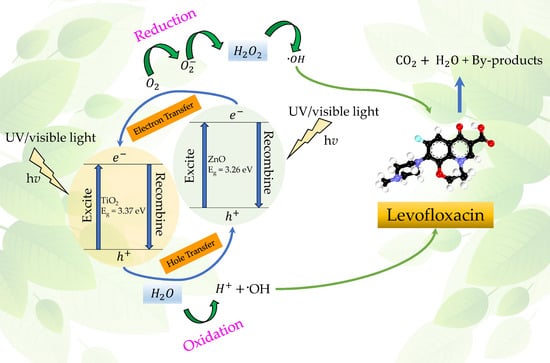
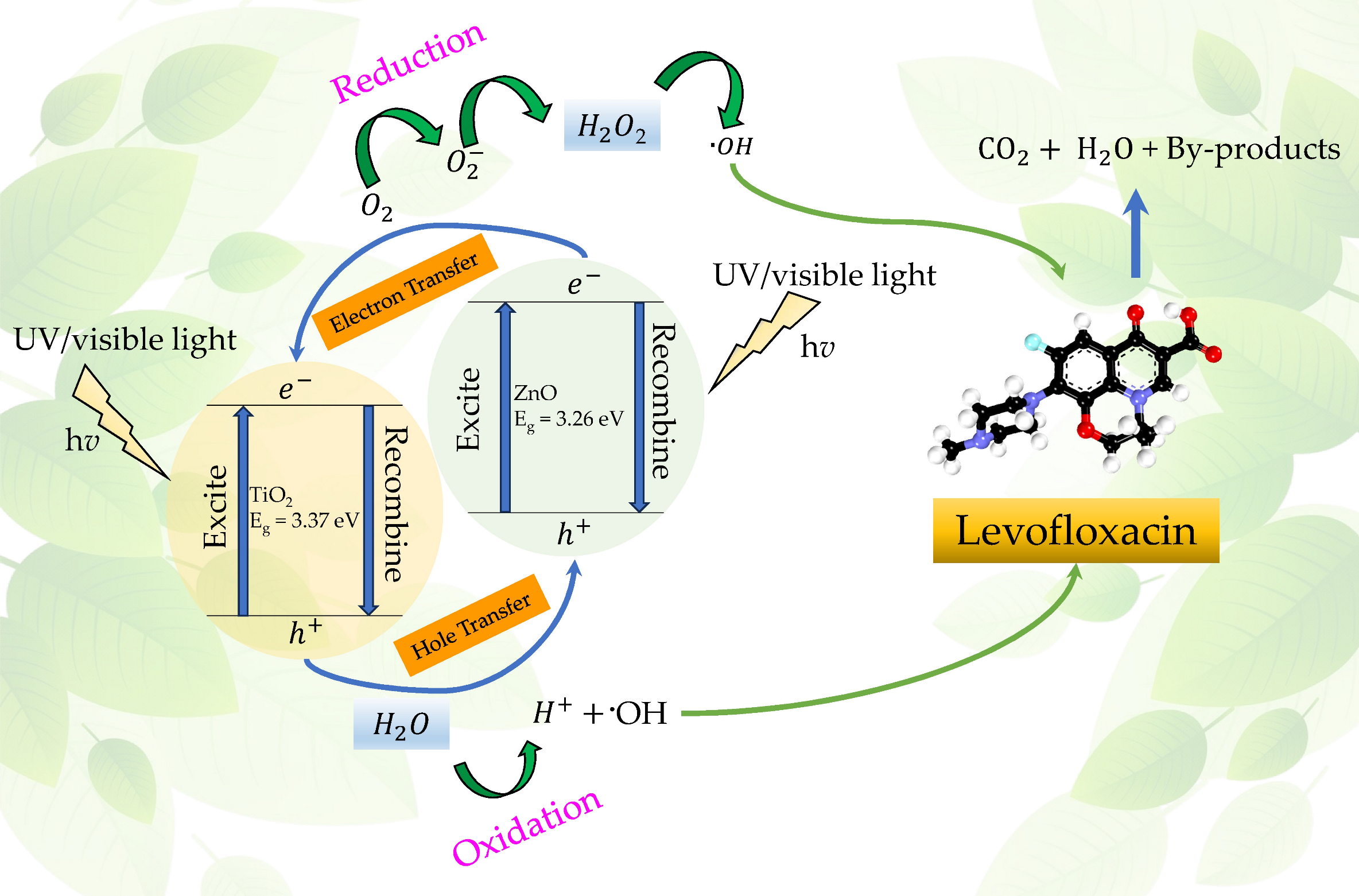
In ZnO–TiO2 heterostructures, as illustrated in Figure 1, the favourable Type-II band alignment promotes directional charge transfer under UV/visible light irradiation. Upon excitation, photogenerated electrons migrate from the conduction band of ZnO to that of TiO2, while holes transfer from the valence band of TiO2 to ZnO. This spatial separation of charge carriers effectively suppresses electron–hole recombination and prolongs carrier lifetime. The accumulated electrons on TiO2 react with dissolved oxygen to generate superoxide radicals (•O2) and subsequently H2O2, whereas holes localized on ZnO oxidize surface-adsorbed water or hydroxyl ions to produce highly reactive hydroxyl radicals (•OH). These reactive oxygen species play a dominant role in the oxidative degradation of levofloxacin, ultimately leading to its mineralization into CO2, H2O, and low-molecular-weight by-products. Numerous studies have explored ZnO–TiO2 composites synthesized via sol–gel, hydrothermal, and doping-based approaches, examples include nano-catalyst [15], noble metal and non-metal doping [16,17,18,19,20], ion doping [21,22], dye sensitization [23], metal dopant (Mg, Sr) [24,25], transition metals (Fe, Cu) [26,27,28], noble metals (Au, Ag, Pd) [29,30,31], nonmetals (S, C, N) [29,32,33], rare earth metals (Eu, Nd, Er) [34,35], co-doping (Zn2SnO4, ZnFeO4), and semiconductor coupling (Zn2SnO4-V2O5) [36]. It notes that limited attention has been given to the influence of directional composite architecture (Zn@TiO2 versus Ti@ZnO) and solid–liquid interference precipitation routes on photocatalytic efficiency under both UV and visible light irradiation.
In this work, Zn@TiO2 and Ti@ZnO nanocomposites were synthesized via a precipitation-assisted solid–liquid interference method and systematically compared for the photocatalytic degradation of levofloxacin under UV and visible light. A comprehensive characterization using XRD, FTIR, SEM–EDS, XPS, XRF, UV–DRS, DLS, and zeta potential analysis was conducted to correlate structural, optical, and surface properties with photocatalytic performance. The study aims to elucidate the role of composite configuration and interfacial interactions in enhancing photocatalytic activity, thereby providing insights for the rational design of efficient photocatalysts for the treatment of pharmaceutical wastewater.

2. Results

2.1. Thermal Analysis

The thermal stability of the synthesized materials was investigated using a Mettler Toledo STARe thermogravimetric analyzer. The measurement was performed under nitrogen flow (10 cm3/min) at temperatures ranging from 30 °C to 800 °C, with a starting sample weight of approximately 7.0 mg.
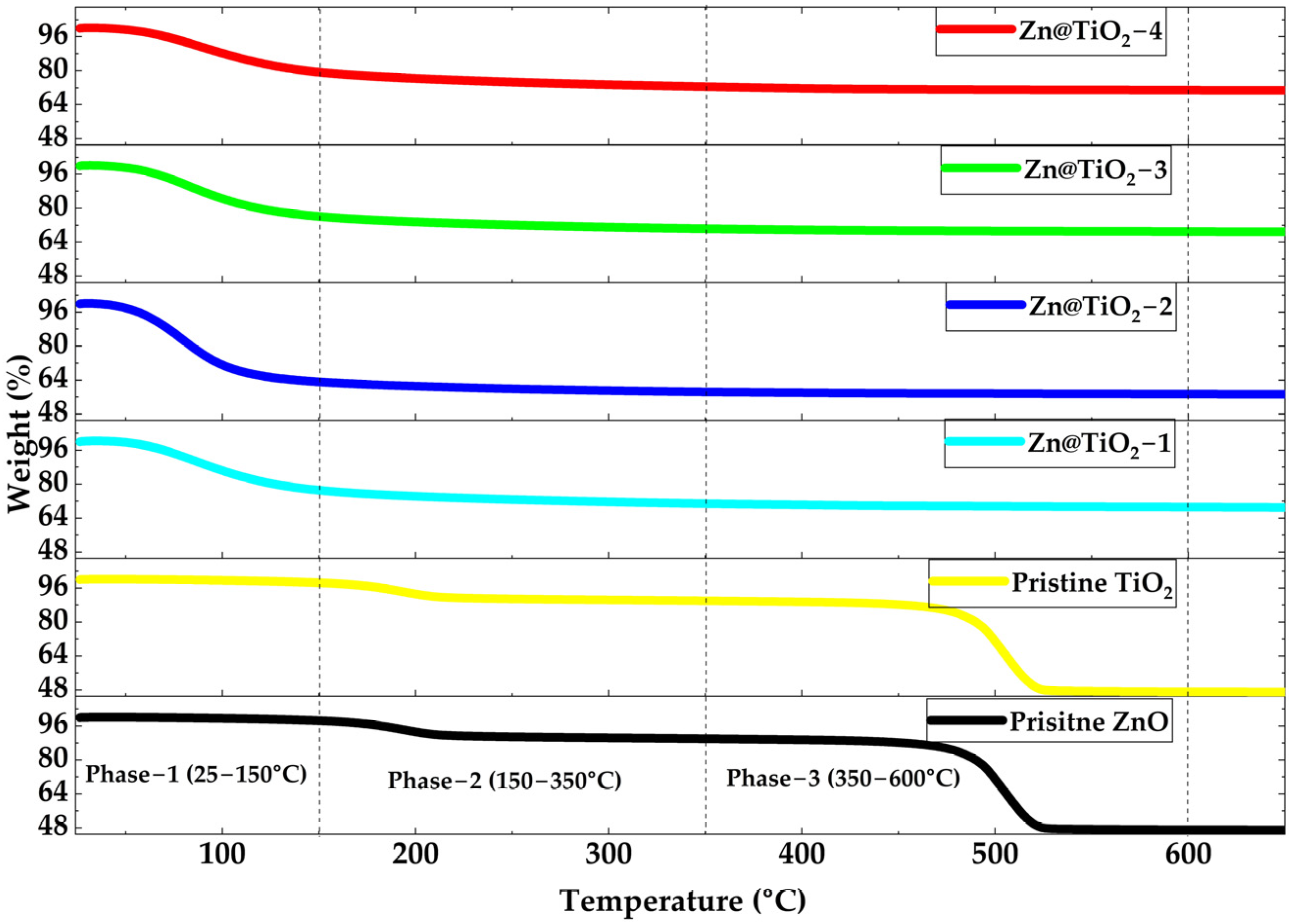
Figure 2 illustrates the thermal degradation of pristine ZnO, TiO2, Zn@TiO2 and Ti@ZnO nanocomposites. All samples exhibited a one-stage degradation process; the degradation phase, occurring at temperatures ranging from 30 °C to 400 °C, was associated with a substantial weight reduction of 40–50%.

2.2. X-Ray Diffractometry (XRD)

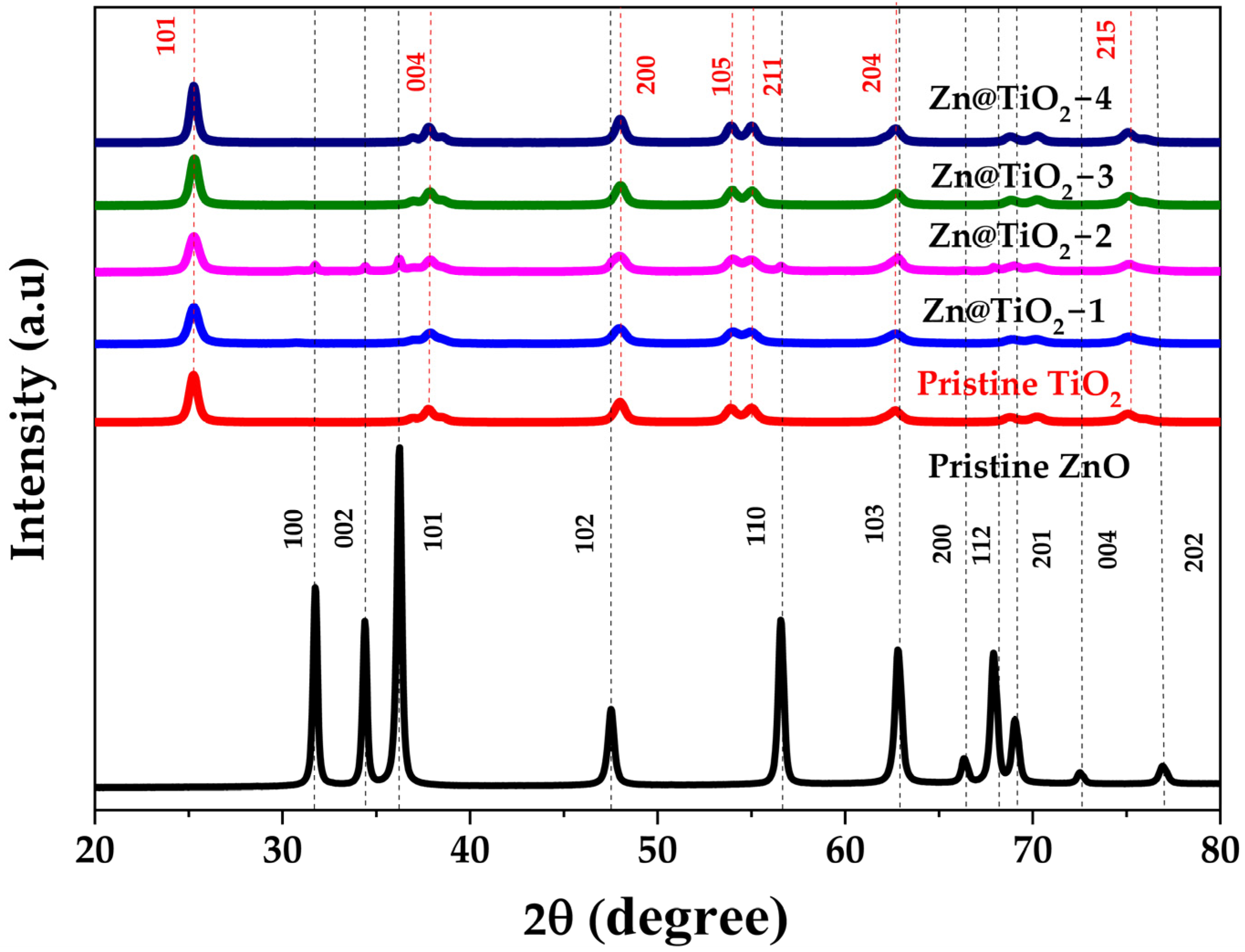
The X-ray diffraction data were obtained using Cu-Kα radiation (1.54060 A°). The XRD pattern of ZnO, TiO2, and their composites was found in varied profiles of peak and diffraction angle (2θ) (Figure 3). The powder’s XRD pattern was observed from 20° to 80°.
The average crystallite sizes of all samples, calculated using the Scherrer equation, are summarized in Table 1. The XRD results indicate that the reagent ratio has a significant influence on the crystallographic characteristics of the nanocomposites. A gradual decrease in the intensity of the anatase TiO2 (101) reflection at 2θ ≈ 25.28° was observed with decreasing TiO2 content, suggesting lattice distortion and reduced crystallite growth upon Zn2+ incorporation. The presence of Zn2+ ions is therefore inferred to suppress the growth of TiO2 crystallites rather than inhibit crystallinity entirely, leading to smaller crystallite sizes that are favourable for enhanced photocatalytic activity.
D = k λ β cos θ
In Equation (1), D is the crystallite size, k is the form factor (0.9), λ is the radiation wavelength, and β is the widening of the Bragg’s peaks ( β 2 = β s a m p l e 2 β i n s t r u m e n t a l 2 ). The average grain size of ZnO and TiO2 nanoparticles is 110.67 and 22.3825 nm, respectively. The average grain size of composite materials is provided in Table 1.

2.3. Fourier-Transform Infrared Spectroscopy

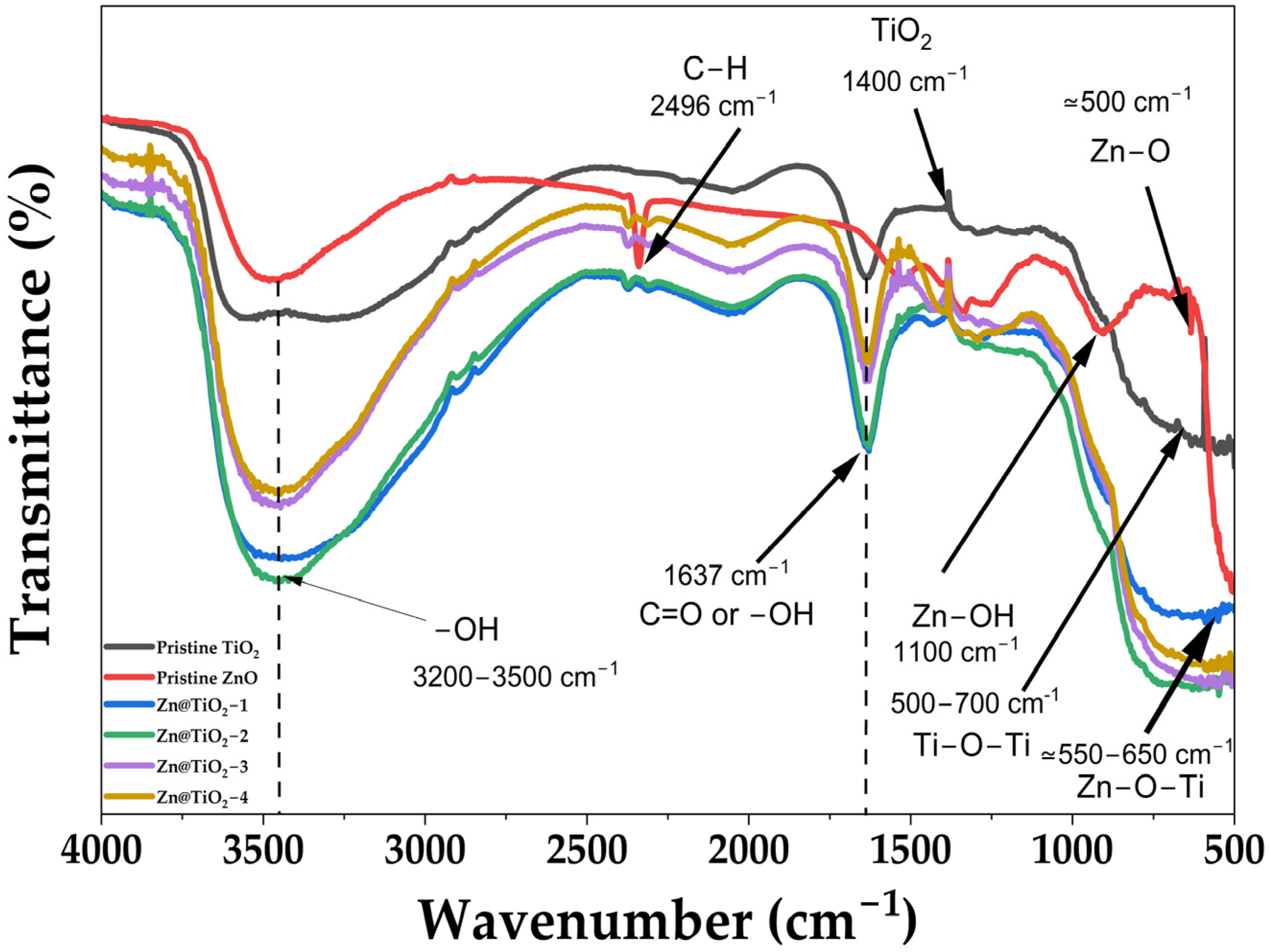
The chemical structures of pristine ZnO, TiO2, and their nanocomposites were analyzed using Fourier transform infrared (FTIR) spectroscopy (Shimadzu IRPrestige-21, Kyoto, Japan) in the range of 500–4000 cm−1 to identify surface functional groups (Figure 4). The characteristic vibrational bands corresponding to Zn–O, Ti–O–Ti, Ti–O–Zn, and surface hydroxyl groups are summarized in Table 2.

2.4. Dynamic Light Scattering and Zeta Sizer

The average particle size and zeta potential of pristine ZnO, TiO2, and their nanocomposites were measured using a dynamic light scattering (DLS) particle size analyzer (Malvern Zetasizer Nano ZS, UK). For zeta potential measurements, suspensions were prepared by dispersing 0.01 g of nanoparticles in 5 mL of distilled water at the optimized pH. Prior to analysis, all samples were ultrasonicated for 15 min to ensure uniform dispersion. Zeta potential measurements were employed to assess the colloidal stability and surface charge characteristics of the TiO2–ZnO nanocomposites, and the obtained values are summarized in Table 3.

2.5. UV-Vis Measurement

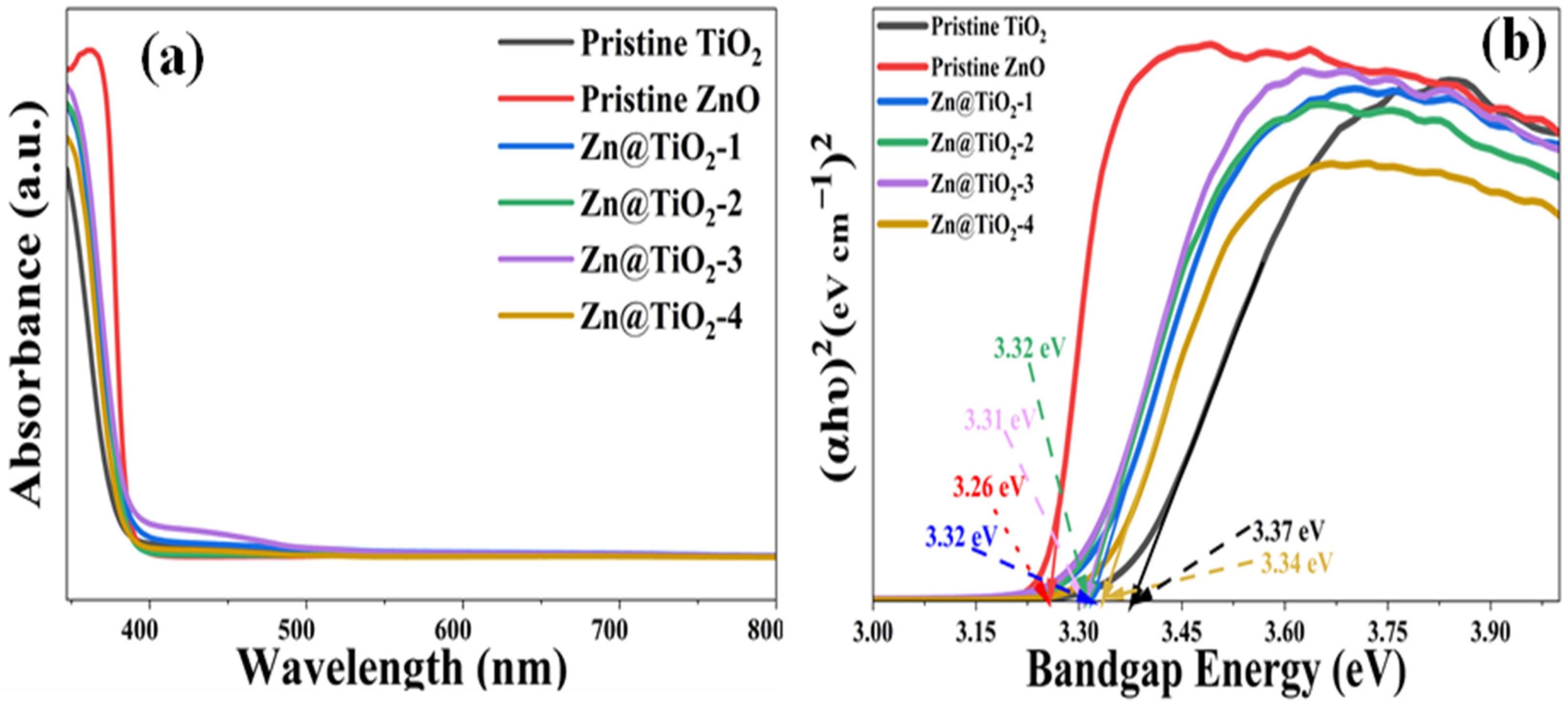
The light absorption behaviour and optical bandgap of the Zn@TiO2 nanocomposites were evaluated using UV–visible diffuse reflectance spectroscopy (UV–DRS) as shown in Figure 5. The optical bandgap values were estimated from the reflectance data using the Kubelka–Munk function.
F R = ( 1 R ) 2 2 R = A c s = k s
where R, k, A, c and s are the absolute reflectance, molar absorption coefficient, absorbance, concentration of the absorbing substance and scattering coefficient, respectively.
The absorption spectra of nanocomposites, pristine ZnO and TiO2 were used to estimate the band gaps (E) by,
E = h c λ   e V
where, h = Plank constant (6.626 × 10⁻³⁴ Js).
c = Velocity of light (3 × 10⁸ m/s).
λ = Absorbance Waveband with a sharp peak corresponding to the wavelength.

2.6. X-Ray Photoelectron Spectroscopy

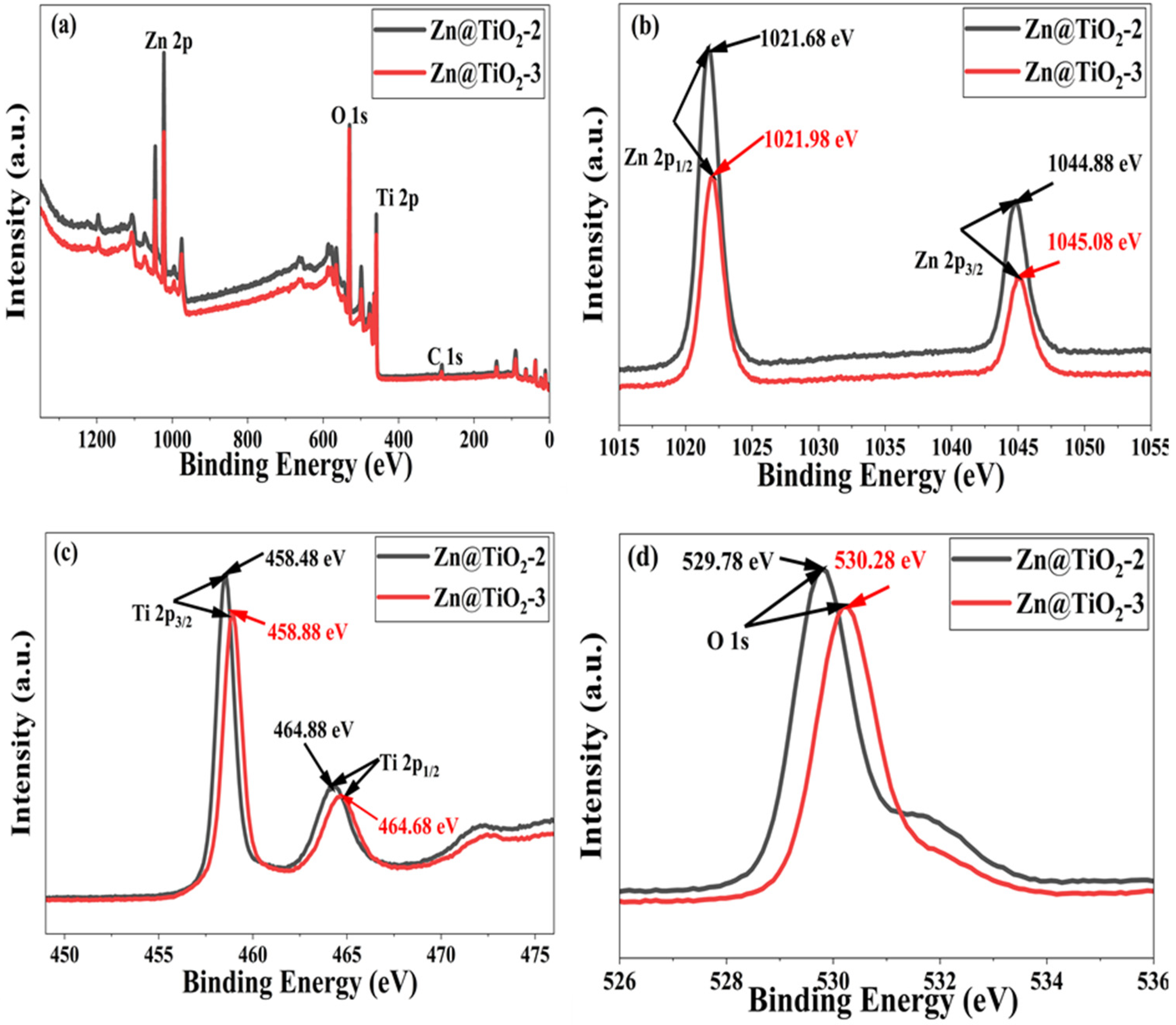
The surface chemical states and elemental composition of the TiO2–ZnO nanocomposites were analyzed using X-ray photoelectron spectroscopy (XPS) on a Thermo Scientific Nexsa (Thermo Fisher Scientific, Waltham, MA, USA), surface analysis system. The corresponding XPS spectra are presented in Figure 6a–d. The survey spectra of the Zn@TiO2 nanocomposites confirm the presence of Ti, Zn, and O, along with a minor C signal attributed to adventitious hydrocarbons from the XPS instrument environment [37]. A detailed analysis of the core-level spectra enabled the identification of the surface composition and oxidation states of the constituent elements in the nanocomposites [38].

2.7. Structural and Morphological Characterization of Nanoparticles

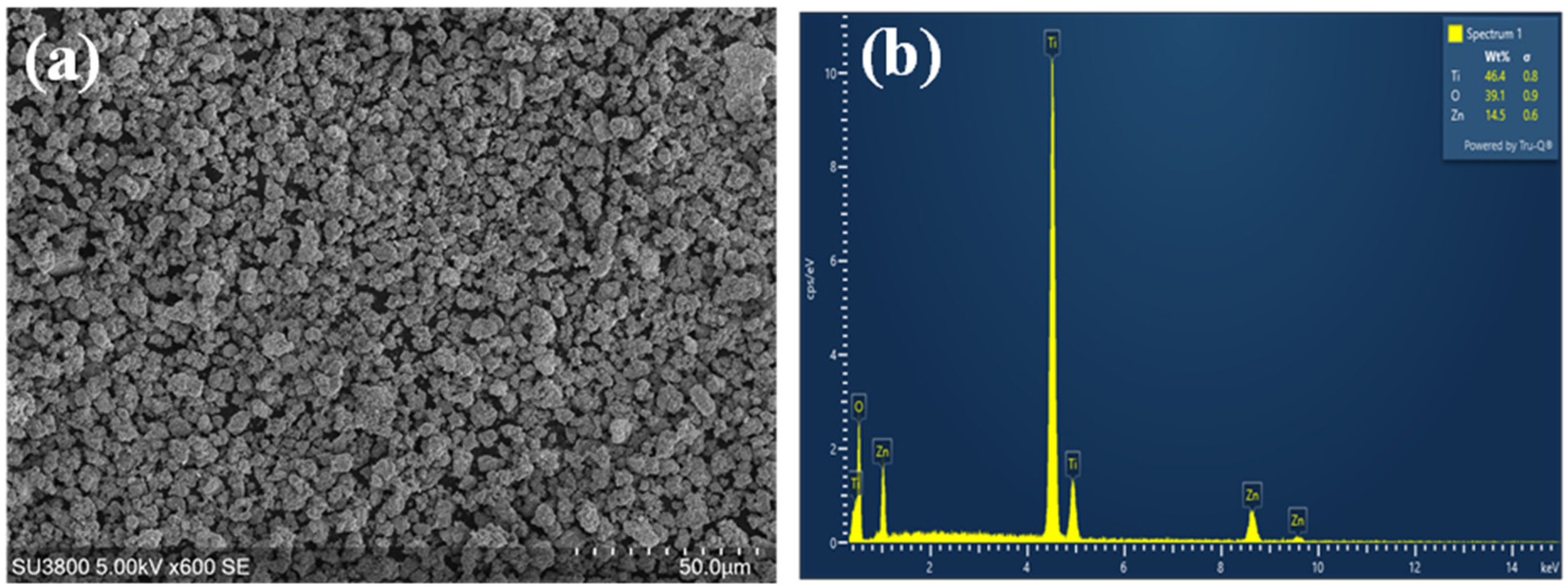
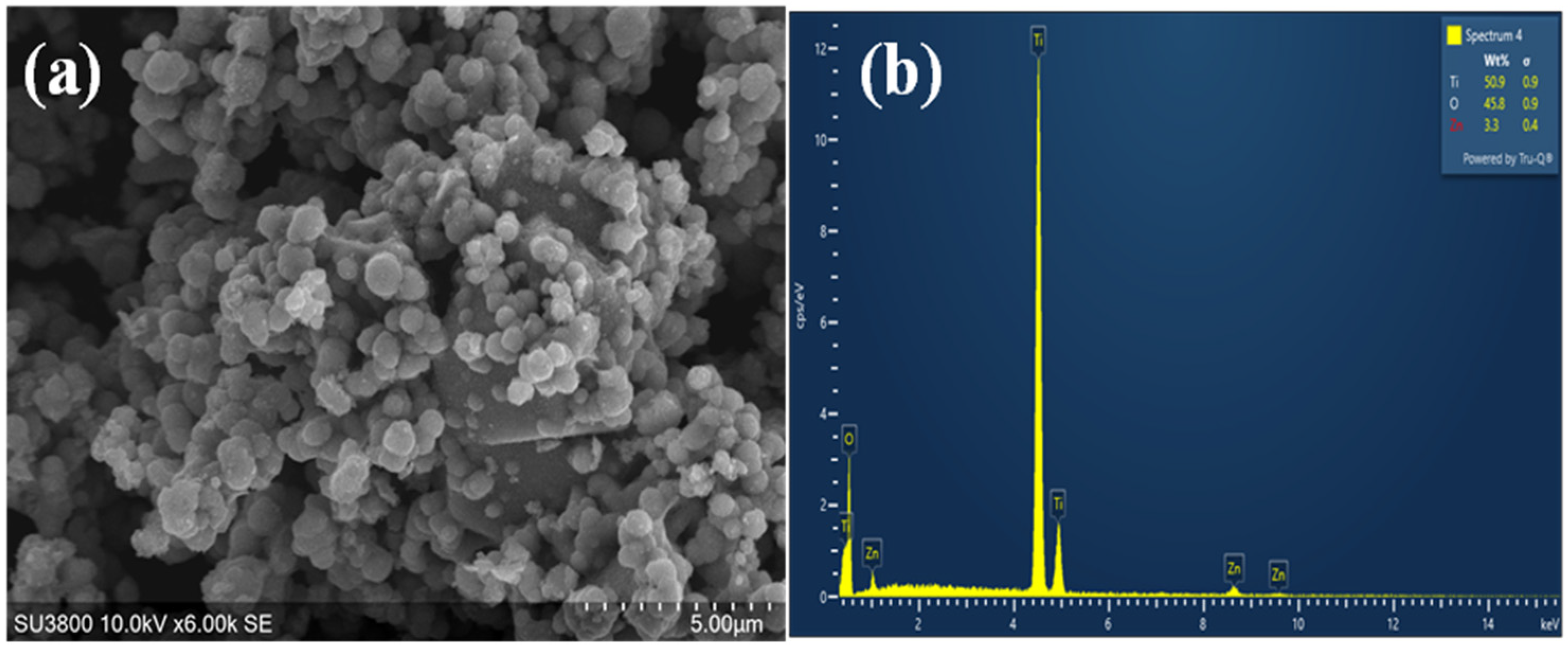
The surface morphology and particle size of the synthesized samples were examined using scanning electron microscopy (SEM; Hitachi SU3800, Tokyo, Japan) operated at an accelerating voltage of 15–25 kV with magnifications ranging from 10,000× to 15,000×. Secondary electron imaging was employed to analyze surface topography, particle shape, size distribution, and the extent of agglomeration. The SEM micrographs (Figure 7a,b and Figure 8a,b) reveal agglomerated nanoparticles with predominantly spherical morphology and particle sizes in the submicron range.

2.8. Photocatalytic Degradation

The photocatalytic activity of pristine ZnO, TiO2, and their nanocomposites was evaluated through the degradation of levofloxacin under UV and visible light irradiation. The degradation progress was monitored by recording UV–Vis absorption spectra at 15 min intervals using a Shimadzu UV-1700, Kyoto, Japan spectrophotometer. A continuous decrease in the characteristic absorption peak of levofloxacin at 288 nm was observed with increasing irradiation time, confirming effective photocatalytic degradation.
Photocatalytic experiments were conducted using a 50 ppm levofloxacin solution in the presence of pristine ZnO, pristine TiO2, Zn@TiO2, and Ti@ZnO nanocomposites. An increase in degradation efficiency was observed with irradiation time for all photocatalysts. The degradation performance followed the order: pristine ZnO < Ti@ZnO nanocomposites < pristine TiO2 < Zn@TiO2 nanocomposites. Among the investigated materials, Zn@TiO2 nanocomposites exhibited the highest photocatalytic activity, achieving more than 70% degradation efficiency under both UV and visible light irradiation. This enhanced performance is attributed to improved surface properties, efficient charge separation, and increased availability of active sites, which facilitate stronger interactions between the catalyst surface and levofloxacin molecules.
The photocatalytic degradation mechanism over Zn@TiO2 nanocomposites involves the generation of electron–hole pairs upon light irradiation, followed by the formation of reactive oxygen species that drive oxidative degradation of levofloxacin.
Z n @ T i O 2   ( o r   T i @ Z n O ) + h ϑ     e C B + h V B +
e C B + O 2 O 2
O 2 + H + H O 2
H O 2 + H O 2 H 2 O 2 + O 2
H 2 O 2 + e C B O H + O H
h V B + + O H O H  
h v b + + H 2 O   O H + H +
O H / O 2 + L e v o f l o x a c i n D e g r a d e d   intermediates C O 2 + H 2 O  
To present precise kinetic data, first-order kinetics apply to photocatalytic degradation,
C C 0 = k t  
where, k = rate constant,
t = reaction time,
C0 = initial levofloxacin concentration,
C = Final levofloxacin concentration.
From all the observations of degradation, Zn2+ doped TiO2 nanocomposites have much higher photocatalytic activity than pristine ZnO & TiO2.

3. Discussion

3.1. Thermal Analysis

Thermogravimetric analysis (TGA) was performed to evaluate the thermal stability of pristine ZnO, pristine TiO2, and Zn@TiO2 nanocomposites (Zn@TiO2-1 to Zn@TiO2-4). For precise comparison, as shown in Figure 2, all TGA curves were plotted using the same weight (%) scale. The thermal stability of all samples can be divided according to three characteristic temperature regions. In the low-temperature region (25–150 °C), the Zn@TiO2 nanocomposites exhibit noticeable weight loss, whereas pristine ZnO and TiO2 show nominal mass change. This early weight loss is attributed to the removal of physically adsorbed moisture and surface hydroxyl groups [39,40], which can be enhanced by increased surface area, interfacial defects, and the formation of Zn–O–Ti heterojunctions.
In the intermediate temperature range (150–350 °C), there is a progressive mass loss due to the elimination of strongly bound hydroxyl groups [39] and interfacial species associated with Zn–O–Ti linkages, with the extent of loss depending on TiO2 content. In contrast, pristine ZnO and TiO2 remain thermally stable in this region [41]. A significant weight loss is observed for pristine oxides in the high-temperature region (350–600 °C), particularly around 500–550 °C, which is attributed to lattice de-hydroxylation and structural rearrangements. The absence of pronounced mass loss in this region for Zn@TiO2 nanocomposites denotes enhanced thermal stability conveyed by strong interfacial bonding, which is advantageous for photocatalytic applications. The comparable thermal behaviour of Zn@TiO2 and Ti@ZnO nanocomposites suggests that the precipitation-assisted solid–liquid interference synthesis does not compromise structural integrity, which is essential for stable photocatalytic operation.

3.2. X-Ray Diffractometry (XRD)

The X-ray diffraction patterns of pristine ZnO, TiO2, and their nanocomposites are presented in Figure 3, and the corresponding characteristic peaks are summarized in Table 4. The diffraction pattern of pristine ZnO shows characteristic peaks at 2θ ≈ 31.75°, 34.39°, 36.23°, and 47.52°, corresponding to the (100), (002), (101), and (102) planes, respectively, which also confirms a hexagonal wurtzite crystal structure (ICDD PDF No. 00-036-1451) [42,43]. Pristine TiO2 shows noticeable diffraction peaks at 2θ ≈ 25.25°, 36.93°, 37.77°, and 38.43°, which are pointed to the (101), (004), (112), and (200) planes of the anatase phase, representing high crystallinity and phase purity (ICDD PDF No. 00-021-1272) [44].
The XRD patterns of Zn@TiO2-1 to Zn@TiO2-4 nanocomposites display diffraction peaks corresponding to both ZnO and TiO2 phases, confirming the successful formation of heterostructure composites without secondary impurity phases. In Zn@TiO2 nanocomposites, a gradual reduction in the intensity of anatase reflections was observed with increasing Zn content, indicating effective surface modification and lattice distortion induced by Zn incorporation. The dominant anatase TiO2 (101) reflection appears at 2θ ≈ 25.27–25.30°, while ZnO-related peaks at 2θ ≈ 31.74–31.75°, 34.40°, and 36.23°, corresponding to the (100), (002), and (101) planes, are retained with reduced intensity. Minor peak shifts and peak broadening observed in the nanocomposites suggest strong interfacial interaction and lattice distortion induced by the formation of Zn–O–Ti heterojunction [44,45]. The absence of additional diffraction peaks further indicates that Zn incorporation occurs via interfacial coupling rather than the formation of new crystalline phases [46].

3.3. Fourier-Transform Infrared Spectroscopy

FTIR spectra of pristine ZnO, TiO2, and their nanocomposites are shown in Figure 4, with characteristic vibrational assignments summarized in Table 4. All samples exhibit a broad absorption band in the range of 3200–3600 cm−1, which is attributed to the stretching vibration of surface hydroxyl groups (-OH) and adsorbed water molecules [41]. The intensity of this band increases progressively with increasing TiO2 content in the Zn@TiO2 nanocomposites, indicating a higher density of surface hydroxyl groups associated with TiO2-rich interfaces. Additionally, the band observed around 1620–1640 cm−1 corresponds to the bending vibration of molecularly adsorbed water, further supporting enhanced surface hydration in the nanocomposites [47].
In the low-wavenumber region (<1000 cm−1), distinct changes in band shape and intensity are observed with varying TiO2 proportions. The characteristic Zn–O stretching vibration appears below 500 cm−1, while Ti–O–Ti vibrations are observed in the range of 500–700 cm−1 [44]. With increasing TiO2 content, the Ti–O–Ti bands become more prominent, accompanied by peak broadening and slight shifts toward higher wavenumbers. Moreover, the emergence of a broadened absorption feature in the 550–650 cm−1 region is attributed to Zn–O–Ti interfacial vibrations, confirming the formation of heterojunction structures [47]. These spectral modifications indicate strong interfacial interaction and compositional tuning of metal–oxygen bonding [44], which is expected to influence charge transfer and photocatalytic activity.

3.4. Dynamic Light Scattering and Zeta Sizer

The hydrodynamic particle size and zeta potential values of pristine ZnO, TiO2, and their nanocomposites are summarized in Table 2. Dynamic light scattering (DLS) measurements revealed relatively large particle sizes for all samples compared to those observed by SEM, which can be attributed to agglomeration effects and solvent-mediated clustering in the liquid suspension. Such behavior is typical for oxide nanoparticles and does not contradict the primary particle sizes observed in solid-state imaging.
The results indicate that Zn@TiO2 nanocomposites exhibited larger hydrodynamic particle sizes when TiO2 was modified using zinc acetate dihydrate, whereas Ti@ZnO nanocomposites prepared using titanium isopropoxide (TTIP) showed comparatively smaller but more aggregated particle distributions. Notably, despite the larger hydrodynamic sizes, Zn@TiO2 nanocomposites demonstrated superior photocatalytic performance, indicating that photocatalytic efficiency is governed more by surface chemistry and charge-transfer dynamics than by particle size alone.
Zeta potential measurements were conducted to assess the surface charge characteristics and colloidal stability of the samples. The pristine oxide exhibits relatively lower absolute zeta potential values, indicating limited electrostatic stabilization. In contrast, the nanocomposites display higher absolute zeta potential values, reflecting improved surface charge development due to the formation of heterojunction interfaces. The enhanced surface charge is attributed to interfacial charge redistribution and surface hydroxylation induced by TiO2-ZnO coupling. Higher absolute zeta potential values imply stronger electrostatic repulsion among particles, which correlates with improved dispersion stability and is beneficial for photocatalytic applications, where effective catalyst–pollutant interaction in aqueous systems is essential. The corresponding DLS particle size distribution and zeta potential distribution graphs for pristine ZnO, pristine TiO2, Zn@TiO2 (1–4), and Ti@ZnO (1–4) are provided in the Supplementary Materials.

3.5. UV-Vis Measurement

The optical properties of pristine ZnO, TiO2, and their nanocomposites were examined using UV–Vis diffuse reflectance spectroscopy (Figure 5a,b). Pristine TiO2 and ZnO exhibited absorption edges near 380 nm, corresponding to bandgap energies of 3.20 eV and 3.34 eV, respectively, consistent with anatase TiO2 and wurtzite ZnO structures [48].
Zn@TiO2 nanocomposites showed a noticeable red shift in the absorption edge, extending up to approximately 393 nm (Figure 5a), indicating enhanced visible-light absorption due to heterojunction formation. Although the calculated bandgap values exhibit only minor variation (Figure 5b), the improved photocatalytic activity is primarily attributed to efficient charge separation and interfacial charge transfer rather than bandgap narrowing alone. The presence of defect-induced mid-gap states and synergistic interactions between ZnO and TiO2 further promote sub-bandgap light absorption and suppress electron–hole recombination, leading to enhanced photocatalytic performance under both UV and visible light irradiation.

3.6. X-Ray Photoelectron Spectroscopy

The XPS data report revealed the presence of Ti4+ for titanium, Zn2+ for zinc, and O2− for oxygen on the surface of the nanocomposite (Figure 6a–d). The spectrum of Ti 2P has two peaks: the first at 458.5 eV, which corresponds to the bonding energy of Ti 2P3/2, and the second at around 464 eV, which corresponds to the binding energy of Ti 2P1/2 [37]. These are in good match with the value relating to the chemical element state of Ti4+ given to the TiO2 (Figure 6c) lattice [38]. The XPS data of the Zn 2P spectra show two peaks roughly at 1021.1 eV and 1041.1 eV, which characterizes the peaks of Zn 2P3/2 and Zn 2P1/2, respectively. Figure 6d demonstrates the scan spectrum of the O 1S area. The curve gives the area in which the greater energy peak denotes the oxygen-deficient region, while the others may be defective oxide components.
The Zn 2p XPS spectra of the nanocomposites exhibit a noticeable shift toward lower binding energy compared to pristine ZnO, indicating a change in the electronic environment of Zn species. This shift can be attributed to interfacial electronic interaction between ZnO and TiO2 arising from their different work functions. TiO2 possesses a lower work function (~4.2–4.4 eV) than ZnO (~5.2–5.4 eV), resulting in electron transfer from TiO2 to ZnO upon heterojunction formation to achieve Fermi-level equilibrium. The accumulation of electron density around Zn sites leads to enhanced electronic shielding of the Zn core electrons, thereby reducing their binding energy.
Furthermore, the formation of Zn–O–Ti interfacial bonds facilitate charge redistribution and the establishment of an internal electric field at the heterojunction interface [49]. This built-in field promotes efficient charge separation by driving photogenerated electrons toward ZnO and holes toward TiO2, effectively suppressing recombination. The observed low binding energy shift of Zn peaks thus provides strong evidence of electron donation and interfacial charge transfer [49], which is directly responsible for the enhanced photocatalytic activity of the Zn@TiO2 and Ti@ZnO nanocomposites.

3.7. Structural and Morphological Characterization of Nanoparticles

SEM images of the Zn@TiO2 nanocomposites (Figure 7a,b and Figure 8a,b) reveal agglomerated nanoparticles with predominantly spherical morphology and particle sizes in the submicron range. The nanoparticles form densely packed aggregates with noticeable inter-agglomerate porosity, which is beneficial for providing accessible surface area during photocatalytic reactions. In several regions, smaller crystallites are observed decorating larger particles, suggesting heterogeneous growth during the precipitation process. Overall, the micrographs indicate a polydisperse nanoparticle system with moderate aggregation, consistent with oxide nanomaterials synthesized via wet-chemical routes.

3.8. Photocatalytic Degradation

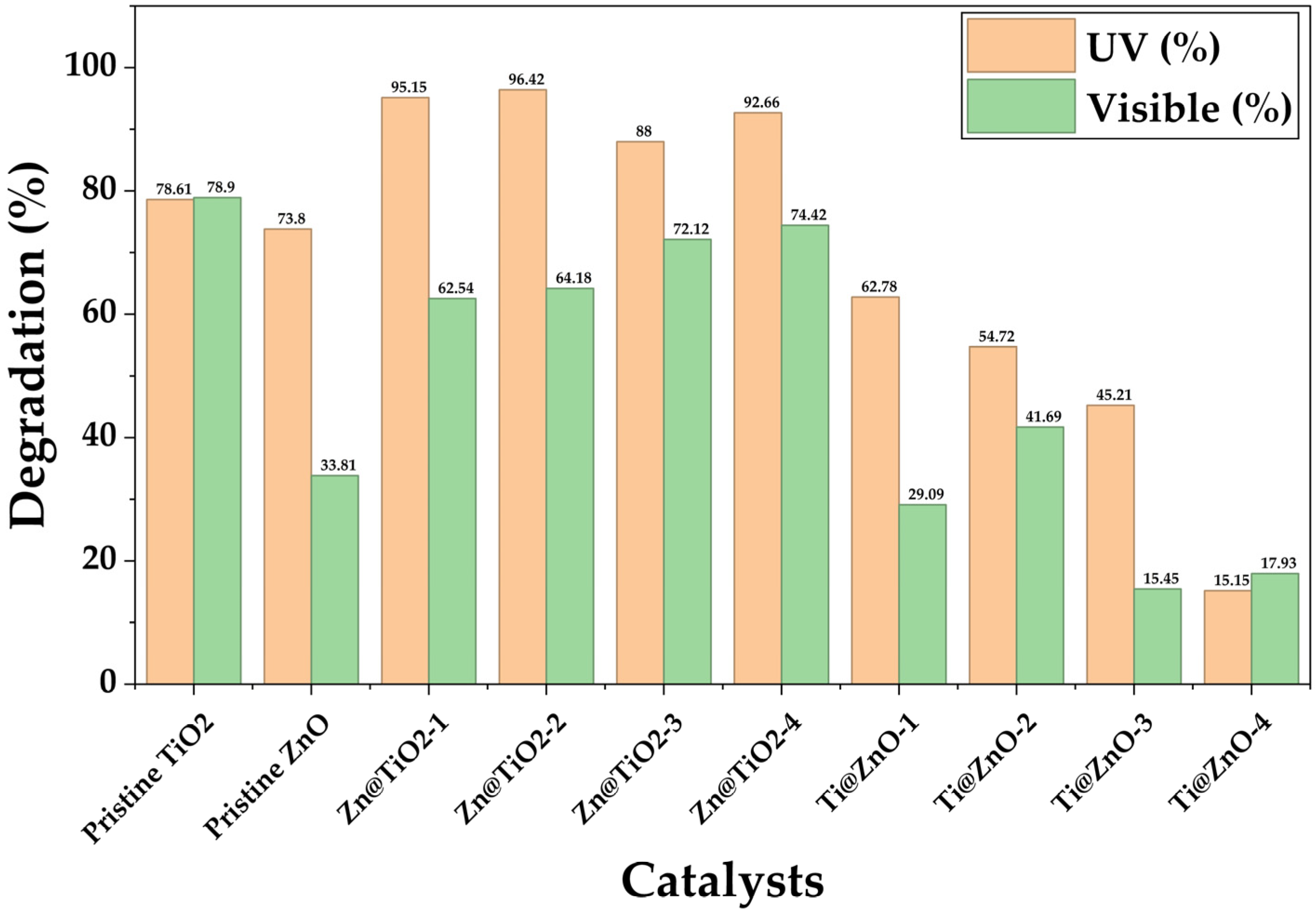
The photocatalytic performance of pristine ZnO, TiO2, and their composites has been investigated under UV and Visible light systems to examine the internal performance of light and time as shown in Figure 9. A significant improvement in photocatalytic activity was observed with the Zn@TiO2 nanocomposites. In which Zn@TiO2-2 gives the highest performance of 96.42%, followed closely by Zn@TiO2-1 at 95.15%. However, a slight decrease in efficiency was noted for Zn@TiO2-3 (88.00%) and Zn@TiO2-4 (92.66%), possibly due to excessive Zn2+ content leading to surface saturation, agglomeration, or light scattering, which may reduce the availability of active sites. If we discuss Ti4+ doped ZnO nanocomposites, a negative trend is observed, with a decline in performance as the ZnO content in the composites increases. Therefore, it has been proven that excess Zn2+ can hinder effective photolytic activity due to poor integration and reduce light absorption. Similar changes have also been observed for visible light, as pristine ZnO exhibits limited activity, with 33.81% degradation due to its wide bandgap. In visible light, again, Zn@TiO2 nanocomposites show a good result compared to Ti@ZnO nanocomposites. Pristine TiO2 recorded the highest degradation efficiency at 78.90%, followed by Zn@TiO2-4 (74.42%), Zn@TiO2-3 (72.12%), and Zn@TiO2-2 (64.18%). The enhancement under visible light can be attributed to the modification of TiO2 with Zn, which likely introduces intermediate energy levels, reduces the bandgap, and facilitates better charge separation.
The Ti@ZnO-2 composite also demonstrated lesser activity (41.69%), and further increase in ZnO content resulted in a decrease in performance. Ti@ZnO-1, Ti@ZnO-3, and Ti@ZnO-4 show 29.09%, 15.45%, and 17.93% degradation, respectively. These findings clearly suggest that Zn@TiO2 nanocomposites are more effective for photocatalytic degradation of levofloxacin under both UV and visible light, with Zn@TiO2-2 being the most efficient under UV light and Zn@TiO2-1 being the most efficient under visible light. The improved performance is primarily attributed to enhanced light absorption, better charge carrier dynamics, and the synergistic interaction between Zn and TiO2.

4. Materials and Methods

4.1. Materials

Titanium (IV) isopropoxide (TTIP, 99% purity) was purchased from Sigma-Aldrich. Zinc acetate dihydrate (99% purity) was obtained from Loba Chemie Pvt. Ltd. Mumbai India. Oxalic acid (99.0%) was procured from S D Fine-Chem Limited (SDFCL) Mumbai India, and methanol (99.0%) was supplied by Merck Life Science Pvt. Ltd., Mumbai, India. Ammonium hydroxide (NH4OH, 28–30% solution) was also purchased from Merck Life Science Pvt. Ltd. Levofloxacin was obtained from Rhombus Pharma Private Limited, Ahmedabad, Gujarat, India. All chemicals were used as received without further purification.

4.2. Method

4.2.1. Synthesis of TiO2 (Titanium Dioxide) Photocatalyst

Pristine TiO2 was synthesized via the precipitation method. Titanium (IV) isopropoxide (10 mL) was dissolved in 50 mL of methanol and stirred at 300 rpm at room temperature. The solution was hydrolyzed by the dropwise addition of ammonium hydroxide (NH4OH, 28–30%) until the pH reached 8, resulting in the formation of a precipitate. The suspension was allowed to settle for 24 h, after which the precipitate was washed repeatedly with methanol and distilled water, dried at 100 °C for 6 h, and calcined at 400 °C for 4 h. The calcination temperature was selected based on thermogravimetric analysis (TGA). The resulting TiO2 powder was used for further characterization and nanocomposite synthesis.

4.2.2. Synthesis of ZnO (Zinc Oxide) Photocatalyst

Pristine ZnO was synthesized using the precipitation method. Zinc acetate dihydrate (7 g) and oxalic acid (3 g) were dissolved in 50 mL of methanol, and the temperature was gradually increased from room temperature to 50 °C under continuous stirring. As oxalic acid is a better stabilizing agent, it supports achieving better morphological characteristics, such as size and agglomeration and also oxalic acid helps to achieve better precipitation [50,51,52]. The resulting solution was hydrolyzed by the dropwise addition of ammonium hydroxide (NH4OH, 28–30%) until the pH reached approximately 8, leading to the formation of a precipitate. The suspension was allowed to settle for 24 h, after which the precipitate was washed thoroughly with methanol and distilled water, dried at 100 °C for 6 h, and calcined at 400 °C for 4 h. The calcination temperature was selected based on thermogravimetric analysis (TGA). The obtained ZnO powder was used for further characterization and nanocomposite synthesis.

4.2.3. Synthesis of TiO2-ZnO Nanocomposites

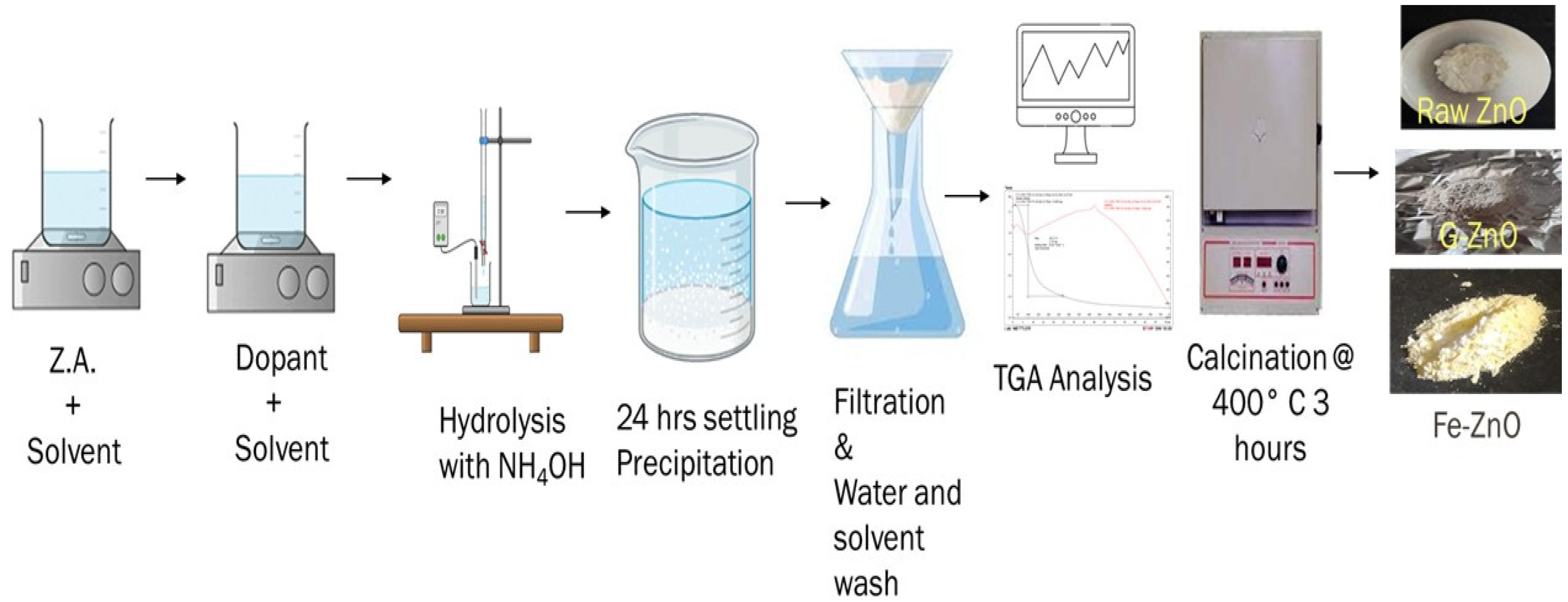
Multifunctional TiO2-ZnO nanocomposites were synthesized with varying precursor-to-photocatalyst ratios ranging from 1–4 gm with a total of 5 gm powder. Zn@TiO2 and Ti@ZnO are two forms of nanocomposites created with different ratios. Table 5 provides a clearer view of the precursor ratio for the Pristine Catalyst. Nanocomposites are formed because of liquid-solid interference. A graphical representation for more clarification is given in Figure 10. For the first step in the production of Zn@TiO2 nanocomposites, 1–4 g of TiO2 was combined with Zinc Acetate–Oxalic Acid (7:3 ratio) powder and dissolved in 50 mL of a methanol solution while stirring for 30 min. Then, carefully mix the previously made TiO2 photocatalyst (1–4 gm) with the zinc acetate and oxalic acid in a ratio of 70:30 (Zinc Acetate Dihydrate:Oxalic Acid) solution [50,51,52]. Vigorous stirring is supplied for about an hour. The resulting mixture is hydrolyzed with 28–30% NH4OH solution to obtain a pH of 8.
The resulting precipitates were allowed to settle for 24 h, washed thoroughly with methanol and distilled water, dried at 100 °C for 6 h, and subsequently calcined at 450 °C for 3 h. The obtained Zn@TiO2 nanocomposites were used for further characterization.
Ti@ZnO nanocomposites were synthesized following a similar precipitation approach. In this case, ZnO powder (1–4 g) was dispersed in 50 mL of methanol containing titanium (IV) isopropoxide (4, 3, 2, or 1 mL). The mixture was hydrolyzed by the dropwise addition of ammonium hydroxide (NH4OH, 28–30%) until the pH reached approximately 8, resulting in the formation of a precipitate. After settling for 24 h, the precipitate was filtered, washed with methanol and distilled water, dried at 100 °C for 6 h, and calcined at 450 °C for 3 h. The detailed compositions and reagent ratios used for nanocomposite synthesis are summarised in Table 1.
Based on the photocatalytic degradation results, Zn@TiO2-2 and Zn@TiO2-3 were selected for detailed characterization due to their superior performance under both UV and visible light irradiation. The structural and optical properties of pristine ZnO, pristine TiO2, and Zn@TiO2-1 to Zn@TiO2-4 were systematically investigated using X-ray diffraction (XRD), thermogravimetric analysis (TGA), Fourier transform infrared spectroscopy (FT-IR), dynamic light scattering (DLS), zeta potential analysis, and UV–visible diffuse reflectance spectroscopy (UV–Vis DRS). In addition, advanced surface and elemental analyses, including scanning electron microscopy coupled with energy-dispersive spectroscopy (SEM–EDS), X-ray fluorescence (XRF), and X-ray photoelectron spectroscopy (XPS), were performed to enable a detailed comparative evaluation of the Zn@TiO2-2 and Zn@TiO2-3 nanocomposites.

4.2.4. Levofloxacin Sample Preparation

A levofloxacin solution with a concentration of 50 ppm was prepared by dissolving 15 mg of levofloxacin in 300 mL of distilled water and stirring for 1 h to obtain a homogeneous solution. Aliquots of 3 mL were withdrawn at predetermined time intervals and analyzed by UV–Vis spectroscopy to determine the percentage degradation of levofloxacin in the presence of the photocatalyst under UV or visible light irradiation.

4.2.5. Photocatalytic Activity

A 50 ppm levofloxacin solution was prepared in 300 mL of distilled water and used as a model pollutant to evaluate the photocatalytic activity of pristine ZnO, pristine TiO2, Zn@TiO2, and Ti@ZnO nanocomposites. UV (8 W) and visible LED (45 W) lamps were employed as light sources for comparative photocatalytic studies. Prior to irradiation, the suspension was stirred in the dark for 1 h to establish adsorption–desorption equilibrium. The optimized catalyst dosage was maintained at 1 g L−1. During irradiation, 2.0 mL aliquots were withdrawn at 15 min intervals and analyzed using a Shimadzu UV-1700 spectrophotometer over the wavelength range of 200–800 nm. The total reaction time for each experiment was 240 min.

5. Conclusion and Future Perspectives

This study demonstrates the superior photocatalytic performance of Zn@TiO2 nanocomposites compared to pristine ZnO, TiO2, and Ti@ZnO systems for the degradation of the pharmaceutical pollutant levofloxacin. While pristine ZnO exhibited high activity under UV irradiation (92.98%) but limited visible-light response (33.81%), TiO2 showed more balanced degradation efficiencies under UV (78.6%) and visible light (78.9%). In contrast, Zn@TiO2 nanocomposites achieved consistently high degradation efficiencies, exceeding 90% under UV irradiation. Notably, a degradation of nearly 70% was observed under Visible Light irradiation, with Zn@TiO2-2 and Zn@TiO2-1 showing the best performance under UV Light, at 96.42% and 95.15%, respectively. The enhanced activity is attributed to efficient heterojunction formation, suppressed electron–hole recombination, improved charge transfer, and extended light utilization resulting from the Zn modification of TiO2. Conversely, Ti@ZnO nanocomposites exhibited a decline in photocatalytic efficiency with increasing ZnO content, likely due to surface saturation, charge recombination, and light-scattering effects. Overall, the results highlight the importance of rational heterostructure design in achieving efficient and stable photocatalytic performance under dual-light irradiation. Although the present study focuses on activity enhancement through rational composite design, future work should include catalyst reusability and long-term stability assessments, post-reaction structural characterization, and mechanistic investigations involving intermediate species identification using advanced analytical techniques such as LC–MS. Additionally, evaluation under real wastewater matrices will be essential to further assess the practical applicability of Zn@TiO2 nanocomposites for sustainable pharmaceutical wastewater treatment.

Supplementary Materials

The following supporting information can be downloaded at: https://www.mdpi.com/article/10.3390/catal16010109/s1, Figure S1: Dynamic Light Scattering Graph of pristine ZnO, pristine TiO2; Figure S2: Dynamic Light Scattering Graph of pristine Ti@ZnO-1, Ti@ZnO-2; Figure S3: Dynamic Light Scattering Graph of pristine Ti@ZnO-3, Ti@ZnO-4; Figure S4: Dynamic Light Scattering Graph of pristine Zn@TiO2-1, Zn@TiO2-2; Figure S5: Dynamic Light Scattering Graph of pristine Zn@TiO2-3, Zn@TiO2-4; Figure S6: Zeta Potential graph for pristine ZnO and pristine TiO2; Figure S7: Zeta Potential graph for Ti@ZnO-1 and Ti@ZnO-2; Figure S8: Zeta Potential graph for Ti@ZnO-3 and Ti@ZnO-4; Figure S9: Zeta Potential graph for Zn@TiO2 -1 and Zn@TiO2-2; Figure S10: Zeta Potential graph for Zn@TiO2-3 and Zn@TiO2-4.

Author Contributions

Conceptualization, I.R., A.S., V.G.G., K.D.D., N.G.N. and V.-H.N.; methodology, I.R., A.S., V.G.G., K.D.D., N.G.N. and V.-H.N.; validation, I.R.; formal analysis, I.R.; data curation, I.R.; writing—original draft preparation, I.R.; writing—review and editing, A.S., V.G.G., K.D.D., N.G.N. and V.-H.N.; supervision, A.S., V.G.G. and V.-H.N. All authors have read and agreed to the published version of the manuscript.

Funding

This research received no external funding.

Data Availability Statement

The data used is already included in the manuscript.

Acknowledgments

The author is grateful to Dharmsinh Desai University, Nadiad, for providing instrumentation support for the research facility and assistantship.

Conflicts of Interest

The authors declare that they have no conflicts of interest.

References

  1. Dutta, D.; Arya, S.; Kumar, S. Industrial Wastewater Treatment: Current Trends, Bottlenecks, and Best Practices. Chemosphere 2021, 285, 131245. [Google Scholar] [CrossRef]
  2. Su, R.; Liang, H.; Jiang, H.; Zhang, G.; Yang, C. Fe-Doped g-C3N4 for Enhanced Photocatalytic Degradation of Brilliant Blue Dye. Water 2025, 17, 3220. [Google Scholar] [CrossRef]
  3. Liu, J.; Ruan, H.; Duan, P.; Shao, P.; Zhou, Y.; Wang, Y.; Chen, Y.; Yan, Z.; Liu, Y. Photocatalytic Degradation of Antibiotics Using Nanomaterials: Mechanisms, Applications, and Future Perspectives. Nanomaterials 2025, 16, 49. [Google Scholar] [CrossRef]
  4. Luo, H.; Zeng, Y.; He, D.; Pan, X. Application of Iron-Based Materials in Heterogeneous Advanced Oxidation Processes for Wastewater Treatment: A Review. Chem. Eng. J. 2021, 407, 127191. [Google Scholar] [CrossRef]
  5. Čizmić, M.; Ljubas, D.; Rožman, M.; Ašperger, D.; Ćurković, L.; Babić, S. Photocatalytic Degradation of Azithromycin by Nanostructured TiO2 Film: Kinetics, Degradation Products, and Toxicity. Materials 2019, 12, 873. [Google Scholar] [CrossRef]
  6. Zhu, G.; Li, W.; Wang, P.; Cheng, G.; Chen, L.; Zhang, K.; Li, X. One-step Polymerization of Hydrophilic Ionic Liquid Imprinted Polymer in Water for Selective Separation and Detection of Levofloxacin from Environmental Matrices. J. Sep. Sci. 2020, 43, 639–647. [Google Scholar] [CrossRef]
  7. Kalantzi, I.; Rico, A.; Mylona, K.; Pergantis, S.A.; Tsapakis, M. Fish Farming, Metals and Antibiotics in the Eastern Mediterranean Sea: Is There a Threat to Sediment Wildlife? Sci. Total Environ. 2021, 764, 142843. [Google Scholar] [CrossRef]
  8. Muddemann, T.; Haupt, D.; Sievers, M.; Kunz, U. Elektrochemische Reaktoren Für Die Wasserbehandlung. Chem. Ing. Tech. 2019, 91, 769–785. [Google Scholar] [CrossRef]
  9. Ani, I.J.; Akpan, U.G.; Olutoye, M.A.; Hameed, B.H. Photocatalytic Degradation of Pollutants in Petroleum Refinery Wastewater by TiO2- and ZnO-Based Photocatalysts: Recent Development. J. Clean. Prod. 2018, 205, 930–954. [Google Scholar] [CrossRef]
  10. Ali, M.M.; Haque, M.J.; Kabir, M.H.; Kaiyum, M.A.; Rahman, M.S. Nano Synthesis of ZnO–TiO2 Composites by Sol-Gel Method and Evaluation of Their Antibacterial, Optical and Photocatalytic Activities. Results Mater. 2021, 11, 100199. [Google Scholar] [CrossRef]
  11. Upadhyay, G.K.; Rajput, J.K.; Pathak, T.K.; Kumar, V.; Purohit, L.P. Synthesis of ZnO:TiO2 Nanocomposites for Photocatalyst Application in Visible Light. Vacuum 2019, 160, 154–163. [Google Scholar] [CrossRef]
  12. Truong, H.T.; Truong, H.B.; Nguyen, T.C. ZnO/TiO2 Photocatalytic Nanocomposite for Dye and Bacteria Removal in Wastewater. Mater. Res. Express 2024, 11, 085003. [Google Scholar] [CrossRef]
  13. Sridevi, K.P.; Prasad, L.G.; Sangeetha, B.; Sivakumar, S. Structural and Optical Study of ZnO-TiO2 Nanocomposites. J. Ovonic Res. 2022, 18, 453–464. [Google Scholar] [CrossRef]
  14. Dharma, H.N.C.; Jaafar, J.; Widiastuti, N.; Matsuyama, H.; Rajabsadeh, S.; Othman, M.H.D.; Rahman, M.A.; Jafri, N.N.M.; Suhaimin, N.S.; Nasir, A.M.; et al. A Review of Titanium Dioxide (TiO2)-Based Photocatalyst for Oilfield-Produced Water Treatment. Membranes 2022, 12, 345. [Google Scholar] [CrossRef]
  15. Chen, Y.-J.; Lin, T.-S. Enhancement of Visible-Light Photocatalytic Efficiency of TiO2 Nanopowder by Anatase/Rutile Dual Phase Formation. Appl. Sci. 2020, 10, 6353. [Google Scholar] [CrossRef]
  16. Shu, Z.; Cai, Y.; Ji, J.; Tang, C.; Yu, S.; Zou, W.; Dong, L. Pt Deposites on TiO2 for Photocatalytic H2 Evolution: Pt Is Not Only the Cocatalyst, but Also the Defect Repair Agent. Catalysts 2020, 10, 1047. [Google Scholar] [CrossRef]
  17. Molinari, R.; Lavorato, C.; Argurio, P. Photocatalytic Reduction of Acetophenone in Membrane Reactors under UV and Visible Light Using TiO2 and Pd/TiO2 Catalysts. Chem. Eng. J. 2015, 274, 307–316. [Google Scholar] [CrossRef]
  18. Lavorato, C.; Argurio, P.; Mastropietro, T.F.; Pirri, G.; Poerio, T.; Molinari, R. Pd/TiO2 Doped Faujasite Photocatalysts for Acetophenone Transfer Hydrogenation in a Photocatalytic Membrane Reactor. J. Catal. 2017, 353, 152–161. [Google Scholar] [CrossRef]
  19. Perera, M.; Wijenayaka, L.A.; Siriwardana, K.; Dahanayake, D.; Nalin De Silva, K.M. Gold Nanoparticle Decorated Titania for Sustainable Environmental Remediation: Green Synthesis, Enhanced Surface Adsorption and Synergistic Photocatalysis. RSC Adv. 2020, 10, 29594–29602. [Google Scholar] [CrossRef]
  20. Fang, J.; Cao, S.W.; Wang, Z.; Shahjamali, M.M.; Loo, S.C.J.; Barber, J.; Xue, C. Mesoporous Plasmonic Au-TiO2 Nanocomposites for Efficient Visible-Light-Driven Photocatalytic Water Reduction. Int. J. Hydrogen Energy 2012, 37, 17853–17861. [Google Scholar] [CrossRef]
  21. Neelakanta Reddy, I.; Jayashree, N.; Manjunath, V.; Kim, D.; Shim, J. Photoelectrochemical Studies on Metal-Doped Graphitic Carbon Nitride Nanostructures under Visible-Light Illumination. Catalysts 2020, 10, 983. [Google Scholar] [CrossRef]
  22. Latorre-Sánchez, M.; Lavorato, C.; Puche, M.; Fornés, V.; Molinari, R.; Garcia, H. Visible-Light Photocatalytic Hydrogen Generation by Using Dye-Sensitized Graphene Oxide as a Photocatalyst. Chem. A Eur. J. 2012, 18, 16774–16783. [Google Scholar] [CrossRef] [PubMed]
  23. Regulska, E.; Breczko, J.; Basa, A.; Dubis, A.T. Rare-Earth Metals-Doped Nickel Aluminate Spinels for Photocatalytic Degradation of Organic Pollutants. Catalysts 2020, 10, 1003. [Google Scholar] [CrossRef]
  24. Yousefi, R.; Jamali-Sheini, F.; Cheraghizade, M.; Khosravi-Gandomani, S.; Sáaedi, A.; Huang, N.M.; Basirun, W.J.; Azarang, M. Enhanced Visible-Light Photocatalytic Activity of Strontium-Doped Zinc Oxide Nanoparticles. Mater Sci. Semicond. Process. 2015, 32, 152–159. [Google Scholar] [CrossRef]
  25. Chithira, P.R.; Theresa John, T. Correlation among Oxygen Vacancy and Doping Concentration in Controlling the Properties of Cobalt Doped ZnO Nanoparticles. J. Magn. Magn. Mater. 2020, 496, 165928. [Google Scholar] [CrossRef]
  26. Isai, K.A.; Shrivastava, V.S. Photocatalytic Degradation of Methylene Blue Using ZnO and 2%Fe–ZnO Semiconductor Nanomaterials Synthesized by Sol–Gel Method: A Comparative Study. SN Appl. Sci. 2019, 1, 1247. [Google Scholar] [CrossRef]
  27. Ayub, A.; Raza, Z.A. Arsenic Removal Approaches: A Focus on Chitosan Biosorption to Conserve the Water Sources. Int. J. Biol. Macromol. 2021, 192, 1196–1216. [Google Scholar] [CrossRef]
  28. Miao, J.; Jia, Z.; Lu, H.-B.; Habibi, D.; Zhang, L.-C. Heterogeneous Photocatalytic Degradation of Mordant Black 11 with ZnO Nanoparticles under UV–Vis Light. J. Taiwan Inst. Chem. Eng. 2014, 45, 1636–1641. [Google Scholar] [CrossRef]
  29. Güy, N.; Çakar, S.; Özacar, M. Comparison of Palladium/Zinc Oxide Photocatalysts Prepared by Different Palladium Doping Methods for Congo Red Degradation. J. Colloid. Interface Sci. 2016, 466, 128–137. [Google Scholar] [CrossRef] [PubMed]
  30. Ren, C.; Yang, B.; Wu, M.; Xu, J.; Fu, Z.; Lv, Y.; Guo, T.; Zhao, Y.; Zhu, C. Synthesis of Ag/ZnO Nanorods Array with Enhanced Photocatalytic Performance. J. Hazard. Mater. 2010, 182, 123–129. [Google Scholar] [CrossRef]
  31. Ahmed, M.A.; Abou-Gamra, Z.M.; ALshakhanbeh, M.A.; Medien, H. Control Synthesis of Metallic Gold Nanoparticles Homogeneously Distributed on Hexagonal ZnO Nanoparticles for Photocatalytic Degradation of Methylene Blue Dye. Environ. Nanotechnol. Monit. Manag. 2019, 12, 100217. [Google Scholar] [CrossRef]
  32. Patil, A.B.; Patil, K.R.; Pardeshi, S.K. Ecofriendly Synthesis and Solar Photocatalytic Activity of S-Doped ZnO. J. Hazard. Mater. 2010, 183, 315–323. [Google Scholar] [CrossRef]
  33. Byzynski, G.; Melo, C.; Volanti, D.P.; Ferrer, M.M.; Gouveia, A.F.; Ribeiro, C.; Andrés, J.; Longo, E. The Interplay between Morphology and Photocatalytic Activity in ZnO and N-Doped ZnO Crystals. Mater. Des. 2017, 120, 363–375. [Google Scholar] [CrossRef]
  34. Zong, Y.; Li, Z.; Wang, X.; Ma, J.; Men, Y. Synthesis and High Photocatalytic Activity of Eu-Doped ZnO Nanoparticles. Ceram. Int. 2014, 40, 10375–10382. [Google Scholar] [CrossRef]
  35. Raza, W.; Faisal, S.M.; Owais, M.; Bahnemann, D.; Muneer, M. Facile Fabrication of Highly Efficient Modified ZnO Photocatalyst with Enhanced Photocatalytic, Antibacterial and Anticancer Activity. RSC Adv. 2016, 6, 78335–78350. [Google Scholar] [CrossRef]
  36. Sanakousar, F.M.; Vidyasagar, C.C.; Jiménez-Pérez, V.M.; Prakash, K. Recent Progress on Visible-Light-Driven Metal and Non-Metal Doped ZnO Nanostructures for Photocatalytic Degradation of Organic Pollutants. Mater. Sci. Semicond. Process. 2022, 140, 106390. [Google Scholar] [CrossRef]
  37. Dontsova, T.A.; Yanushevska, O.I.; Nahirniak, S.V.; Kutuzova, A.S.; Krymets, G.V.; Smertenko, P.S. Characterization of Commercial TiO2P90 Modified with ZnO by the Impregnation Method. J. Chem. 2021, 2021, 9378490. [Google Scholar] [CrossRef]
  38. Liang, Z.; Zhang, X. Zn–ZnO@TiO2 Nanocomposite: A Direct Electrode for Nonenzymatic Biosensors. J. Mater. Sci. 2018, 53, 7138–7149. [Google Scholar] [CrossRef]
  39. Ghorbani, F.; Gorji, P.; Mobarakeh, M.S.; Mozaffari, H.R.; Masaeli, R.; Safaei, M. Optimized Synthesis of Xanthan Gum/ZnO/TiO2 Nanocomposite with High Antifungal Activity against Pathogenic Candida Albicans. J. Nanomater. 2022, 2022, 7255181. [Google Scholar] [CrossRef]
  40. Negi, A.; Ringwal, S.; Pandey, M.; Taha Yassin, M. Plant-Mediated Z-Scheme ZnO/TiO2-NCs for Antibacterial Potential and Dye Degradation: Experimental and DFT Study. Sci. Rep. 2024, 14, 7955. [Google Scholar] [CrossRef]
  41. Lee, P.; Saion, E.; Al-Hada, N.; Soltani, N. A Simple Up-Scalable Thermal Treatment Method for Synthesis of ZnO Nanoparticles. Metals 2015, 5, 2383–2392. [Google Scholar] [CrossRef]
  42. Mathumba, P.; Bilibana, M.P.; Olatunde, O.C.; Onwudiwe, D.C. X-Ray Diffraction Profile Analysis of Green Synthesized ZnO and TiO2 Nanoparticles. Mater. Res. Express 2024, 11, 075011. [Google Scholar] [CrossRef]
  43. Wang, L.; Fu, X.; Han, Y.; Chang, E.; Wu, H.; Wang, H.; Li, K.; Qi, X. Preparation, Characterization, and Photocatalytic Activity of TiO2/ZnO Nanocomposites. J. Nanomater. 2013, 2013, 321459. [Google Scholar] [CrossRef]
  44. Gunasekaran, A.; Rajamani, A.K.; Masilamani, C.; Chinnappan, I.; Ramamoorthy, U.; Kaviyarasu, K. Synthesis and Characterization of ZnO Doped TiO2 Nanocomposites for Their Potential Photocatalytic and Antimicrobial Applications. Catalysts 2023, 13, 215. [Google Scholar] [CrossRef]
  45. Yuste, M.; Escobar-Galindo, R.; Benito, N.; Palacio, C.; Martínez, O.; Albella, J.M.; Sánchez, O. Effect of the Incorporation of Titanium on the Optical Properties of ZnO Thin Films: From Doping to Mixed Oxide Formation. Coatings 2019, 9, 180. [Google Scholar] [CrossRef]
  46. Kurniawan, Y.S.; Yuliati, L. Activity Enhancement of P25 Titanium Dioxide by Zinc Oxide for Photocatalytic Phenol Degradation. Bull. Chem. React. Eng. Catal. 2021, 16, 310–319. [Google Scholar] [CrossRef]
  47. Santhanakrishnan, H.; Mani, N.; Jayaram, A.; Suruttaiyaudiyar, P.; Chellamuthu, M.; Shimomura, M. Engineering of Mono-Dispersed Mesoporous TiO2 over 1-D Nanorods for Water Purification under Visible Light Irradiation. Environ. Sci. Pollut. Res. 2021, 28, 18768–18777. [Google Scholar] [CrossRef] [PubMed]
  48. Abassi, K.; Ben Ali, A.; Ben Chaabane, T.; Younas, M.; Pecoraro, C.M.; Altalhi, T.; Mezni, A.; Bellardita, M. Investigating the Photocatalytic Activity of Hybrid ZnO@TiO2 Nanocomposites towards Dyes Degradation. Mater. Chem. Phys. 2025, 344, 131172. [Google Scholar] [CrossRef]
  49. Mintcheva, N.; Yamaguchi, S.; Kulinich, S.A. Hybrid TiO2-ZnO Nanomaterials Prepared Using Laser Ablation in Liquid. Materials 2020, 13, 719. [Google Scholar] [CrossRef]
  50. Ba-Abbad, M.M.; Kadhum, A.A.H.; Bakar Mohamad, A.; Takriff, M.S.; Sopian, K. The Effect of Process Parameters on the Size of ZnO Nanoparticles Synthesized via the Sol–Gel Technique. J. Alloys Compd. 2013, 550, 63–70. [Google Scholar] [CrossRef]
  51. Rajesh, D.; Vara Lakshmi, B.; Sunandana, C.S. Two-Step Synthesis and Characterization of ZnO Nanoparticles. Phys. B Condens. Matter 2012, 407, 4537–4539. [Google Scholar] [CrossRef]
  52. Stanković, A.; Veselinović, L.; Škapin, S.D.; Marković, S.; Uskoković, D. Controlled Mechanochemically Assisted Synthesis of ZnO Nanopowders in the Presence of Oxalic Acid. J. Mater. Sci. 2011, 46, 3716–3724. [Google Scholar] [CrossRef]
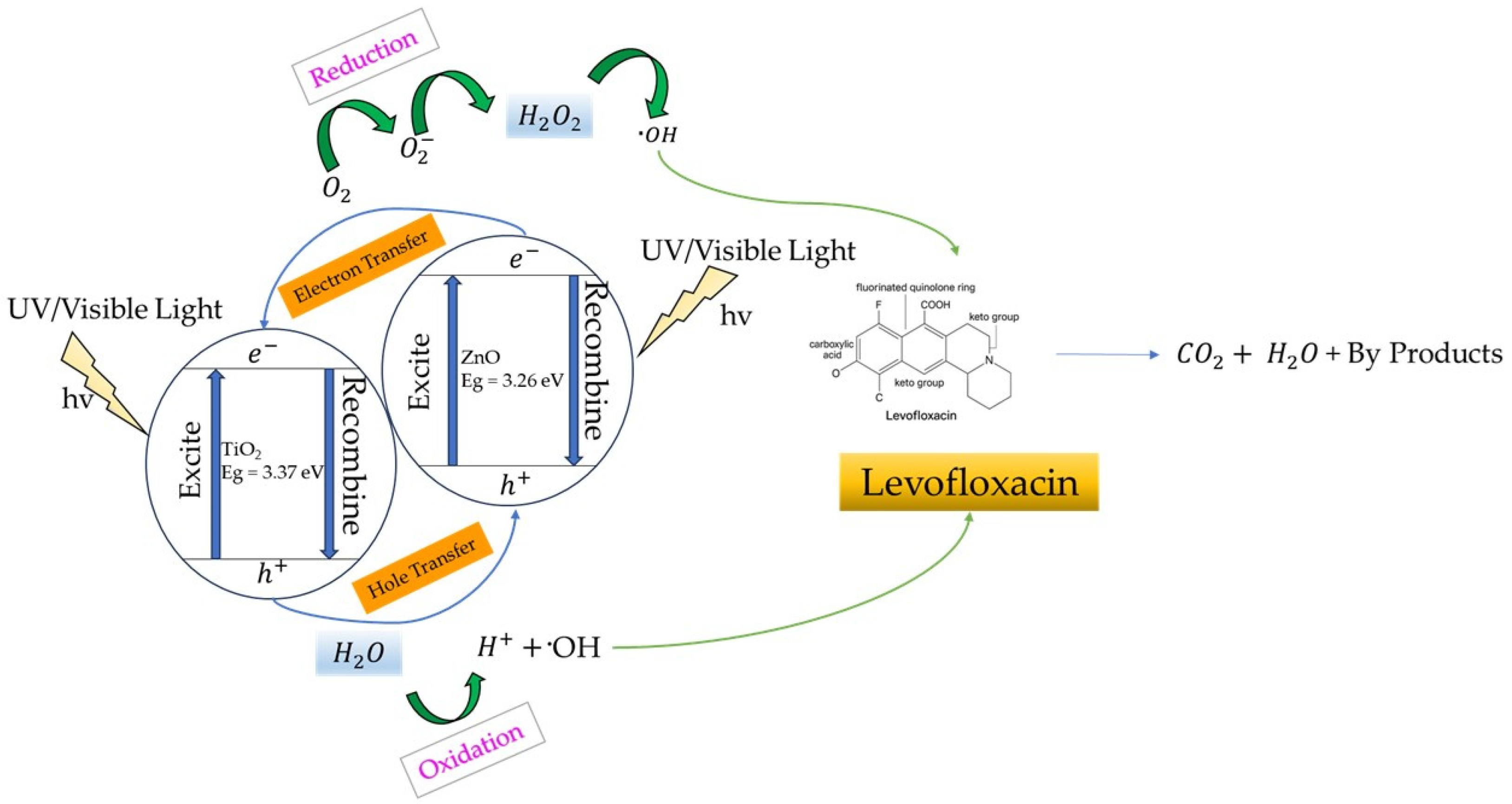
Figure 1. Mechanism of ZnO-TiO2 nanocomposite and its characterization.
Catalysts 16 00109 g001
Figure 2. Thermo Gravimetric Analysis of Pristine ZnO, TiO2 and Zn@TiO2 nanocomposites.
Catalysts 16 00109 g002
Figure 3. X-Ray Diffraction Pattern of Pristine ZnO, TiO2 and Zn@TiO2 Nanocomposites.
Catalysts 16 00109 g003
Figure 4. FT-IR Spectroscopy of ZnO-TiO2 Nanocomposites.
Catalysts 16 00109 g004
Figure 5. (a) UV-Vis absorbance spectra of Pristine ZnO, TiO2 and their composites. (b) Bandgap values of Pristine ZnO, TiO2 and their composites.
Catalysts 16 00109 g005
Figure 6. (ad) X-Ray Photoelectron Spectroscopy of TiO2-ZnO nanocomposites.
Catalysts 16 00109 g006
Figure 7. (a,b) SEM image of Zn@TiO2-2 nanocomposite and Energy Dispersive X-ray Spectroscopy (EDS) analysis of Zn@TiO2-2 nanocomposite.
Catalysts 16 00109 g007
Figure 8. (a,b) SEM image of Zn@TiO2-3 nanocomposite and Energy Dispersive X-Ray Spectroscopy (EDS) analysis of Zn@TiO2-3 nanocomposite, respectively.
Catalysts 16 00109 g008
Figure 9. Percentage Degradation of Levofloxacin with TiO2-ZnO Nanocomposites under the Influence of UV and Visible Light.
Catalysts 16 00109 g009
Figure 10. Schematic diagram for Ti@ZnO & Zn@TiO2 nanocomposite synthesis method.
Catalysts 16 00109 g010
Table 1. Average Grain Size of Zn@TiO2 nanocomposite.
Sr. No.Zn@TiO2 NPsAverage Grain Size (nm)
1Pristine ZnO63.52
2Pristine TiO229.10
3Zn@TiO2-128.01
4Zn@TiO2-237.29
5Zn@TiO2-323.51
6Zn@TiO2-411.41
Table 2. Characteristic peaks of Pristine ZnO, Pristine TiO2 and Zn@TiO2 nanocomposites.
Sr. NoCharacteristics BandMolecular VibrationWavenumber (cm−1)
1≡Ti-O-Ti≡Bending600–800
2TiO2Lattice Vibration1400
3≡Ti-O-Ti≡Stretching550
4Zn-OStretching500
5Zn-O-TiStretching650
6-OHBending1637
7-OHStretching3200
8C-HStretching2496
9C=OStretching1300–1600
Table 3. Particle Size and Zeta Potential of TiO2-ZnO Nanocomposites.
Sr. NoSample NameParticle Size (nm)Zeta Potential
1Pristine ZnO2605.0−5.47
2Pristine TiO2831.3−6.89
3Zn@TiO2-11301.0−10.90
4Zn@TiO2-21287.0−8.75
5Zn@TiO2-33070.0−13.10
6Zn@TiO2-41361.0−13.30
7Ti@ZnO-1311.70−9.56
8Ti@ZnO-2372.20−6.15
9Ti@ZnO-3319.80−6.20
10Ti@ZnO-41294.00−5.11
Table 4. Characteristic peaks of TiO2-ZnO Nanocomposites.
Sr. No.PeaksTiO2 (Anatase)TiO2 (Rutile)ZnO (Wurtzite)Cubic ZnTiO3
125.28
232.73
335.25
436.25
537.8
638.58
748.05
854.32
955.06
1056.6
1156.79
1262.86
1363.40
1467.96
1568.72
1669.07
1769.79
1870.91
1975.03
2078.82
Table 5. Composition for Synthesis of TiO2-ZnO Nanocomposites.
PhotocatalystsZinc Acetate
Dihydrate (gm)
Titanium Iso Propoxide (mL)Solvent (mL)Oxalic Acid (gm)ZnO NPsTiO2 NPs
Pristine ZnO1.75-503.25--
Zn@TiO2-11.40-502.60-1
Zn@TiO2-21.05-501.95-2
Zn@TiO2-30.70-501.30-3
Zn@TiO2-40.35-500.65-4
Pristine TiO2-550---
Ti@ZnO-1-450-1-
Ti@ZnO-2-350-2-
Ti@ZnO-3-250-3-
Ti@ZnO-4-150-4-
Disclaimer/Publisher’s Note: The statements, opinions and data contained in all publications are solely those of the individual author(s) and contributor(s) and not of MDPI and/or the editor(s). MDPI and/or the editor(s) disclaim responsibility for any injury to people or property resulting from any ideas, methods, instructions or products referred to in the content.