Article

Boosting Toluene Oxidation over Ru-Doped CoMn2O4 Spinel Catalysts by Constructing Ru–O–Mn/Co Chains


1
School of Environment & Ecology, Jiangnan University, Wuxi 214122, China
2
Key Laboratory of Ecosystem Carbon Source and Sink, China Meteorological Administration (ECSS-CMA), School of Atmospheric Science & Remote Sensing, Wuxi University, Wuxi 214105, China
3
International Joint Research Center for Photoresponsive Molecules and Materials, Key Laboratory of Synthetic and Biological Colloids, School of Chemical and Material Engineering, Jiangnan University, Wuxi 214122, China
*
Author to whom correspondence should be addressed.
Catalysts 2026, 16(1), 106; https://doi.org/10.3390/catal16010106
Submission received: 25 December 2025 / Revised: 14 January 2026 / Accepted: 15 January 2026 / Published: 21 January 2026

Abstract

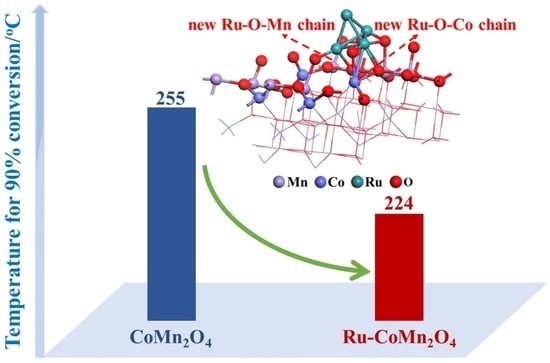
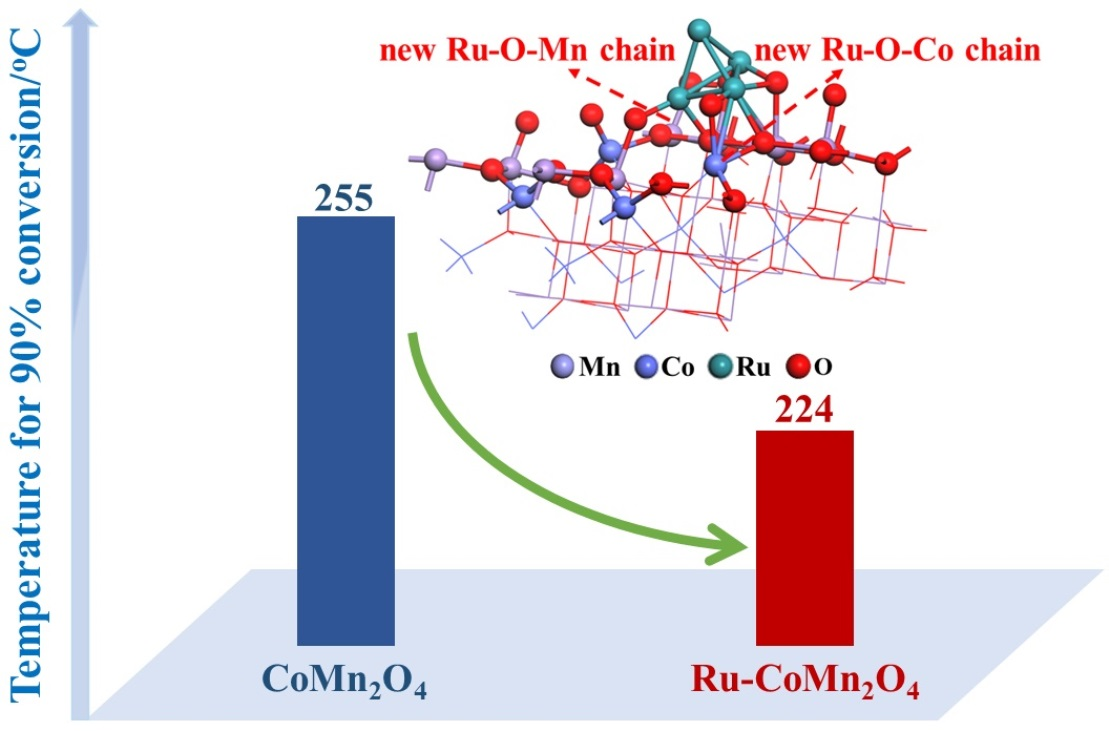
The development of efficient spinel oxide catalysts for low-temperature oxidation of volatile organic compounds (VOCs) remains an important research objective. In this work, Ru was doped into a CoMn2O4 spinel to enhance its catalytic activity toward toluene oxidation and the underlying promotion mechanism of Ru doping was systematically investigated. The resulting Ru-CoMn2O4 catalyst showed remarkable performance, with T90 reaching approximately 224 °C at a WHSV of 60,000 cm3 g−1 h−1 and nearly 100% CO2 selectivity above 200 °C. Mechanism studies revealed that the reaction followed both Mars–van Krevelen (MvK) and Eley–Rideal (E–R) pathways. The reaction rates were strongly influenced by the oxidizing capacity of the catalyst, the abundance of highly valent surface species (namely Co3+, Mn4+, and Ru4+), adsorbed toluene, lattice oxygen, gaseous toluene, and adsorbed oxygen. With Ru doping, new Ru–O–Mn and Ru–O–Co chains formed in the CoMn2O4 spinel structure, leading to a moderate enhancement in oxidizing ability and a moderate increase in the concentration of highly valent surface species, adsorbed toluene, and lattice oxygen. Although a slight reduction in adsorbed oxygen was observed, Ru doping significantly boosted the overall toluene oxidation activity of CoMn2O4. In summary, Ru-CoMn2O4 represented a promising catalyst for the efficient oxidation of VOCs.

Graphical Abstract

1. Introduction

Volatile organic compounds (VOCs), which originate from a wide range of industrial processes and human activities, play a critical role in the formation of secondary pollutants such as fine particulate matter and ozone [1,2]. These compounds exert considerable adverse impacts on human health and the environment [3]. Catalytic oxidation has emerged as one of the most promising technologies for VOCs removal owing to its high efficiency and operational reliability [4]. Nevertheless, the central challenge of this technology lies in developing highly active catalysts capable of completely mineralizing VOCs into harmless CO2 and H2O at relatively low temperatures [5].
Recently, spinel oxides, composed mainly of earth-abundant and low-cost transition metals, have been widely investigated as efficient and stable catalysts for the oxidation of VOCs [6]. Their attractiveness stems from a tunable elemental composition, flexible structure, and high thermal and chemical stability [7]. Among various spinel oxides, CoMn2O4 has emerged as a particularly prominent catalyst for VOCs oxidation, owing to its outstanding activity and robust stability [8,9]. However, the practical application of CoMn2O4 spinel is still constrained by the requirement for relatively high temperatures to achieve complete VOCs conversion and high CO2 selectivity [10]. Therefore, engineering novel reaction pathways within the spinel structure is critical to improving low-temperature catalytic performance.
In spinel-type oxides (AB2O4), the A and B metal sites, occupying tetrahedral and octahedral positions, respectively, can be modulated by incorporating different metal cations, which directly influences the catalytic performance [11]. For instance, Ren et al. found that La doping not only improved the mobility and reactivity of lattice oxygen species by weakening metal–oxygen bond, but also facilitated the activation and replenishment of gaseous oxygen [12]. Hence, La-doped CoMn2O4 exhibited enhanced toluene oxidation performance. Similarly, Dong et al. reported that Pt doping modified the local electronic environment of Co sites, promoting toluene adsorption and the low-temperature activation and transformation of lattice oxygen species in CoMn2O4, leading to a notable improvement in toluene oxidation [10]. Despite these advances in metal cation doping, these doped CoMn2O4 materials still exhibit inadequate performance in the catalytic oxidation of VOCs, alongside prohibitive material costs.
Owing to its strong redox capability, low light-off temperature, and superior tolerance to H2O, Ru has been extensively studied as a catalyst for the oxidation of VOCs [13], offering a cost-effective advantage over other precious metals like Pt, Au, and Pd [14]. Gao et al. deposited Ru nanoparticles of varying sizes on a CeO2 support and observed that smaller Ru nanoparticles exhibited a tendency to readily redisperse, exposing a higher proportion of active Run+ species and oxygen vacancies [15]. These smaller nanoparticles also demonstrated an enhanced ability to promote dehydrogenation and aromatic ring cleavage, ultimately leading to a significant improvement in toluene oxidation activity. Ding et al. employed a Ru/SnO2 catalyst for the oxidation of vinyl chloride [16]. Given that both RuO2 and SnO2 shared a rutile crystal structure, the Ru species formed highly dispersed RuO2 particles on SnO2. These dispersed particles efficiently adsorbed chlorine species during the reaction, thus preserving the oxygen vacancies from chlorination. This synergistic mechanism, where oxygen vacancies facilitated oxidation and RuO2 sites captured chlorine, resulted in significantly enhanced catalytic activity, stability, and byproduct selectivity.
In this work, Ru was doped into the CoMn2O4 spinel structure to further enhance its catalytic performance toward toluene oxidation, which served as a model VOCs, and the promotional effect of Ru doping on the reaction mechanism was systematically explored. The oxidation rates of toluene over CoMn2O4 and Ru-CoMn2O4 were found to be strongly influenced by the catalysts’ oxidizing capacity, the abundance of highly valent surface species (i.e., Co3+, Mn4+, and Ru4+), as well as the concentrations of surface adsorbed toluene, gaseous toluene, surface lattice oxygen, and surface adsorbed oxygen. The incorporation of Ru promoted the formation of Ru–O–Mn and Ru–O–Co linkages within the spinel framework, which moderately enhanced the oxidative capability and increased the concentration of highly valent surface species, surface adsorbed toluene, and surface lattice oxygen. Although a slight decrease in surface adsorbed oxygen was detected, Ru doping significantly improved the overall catalytic activity of CoMn2O4 toward toluene oxidation. These results demonstrate that Ru-CoMn2O4 may be a highly promising catalyst for efficient VOCs removal.

2. Results and Discussion

2.1. Performance for Toluene Oxidation

2.1.1. Activity

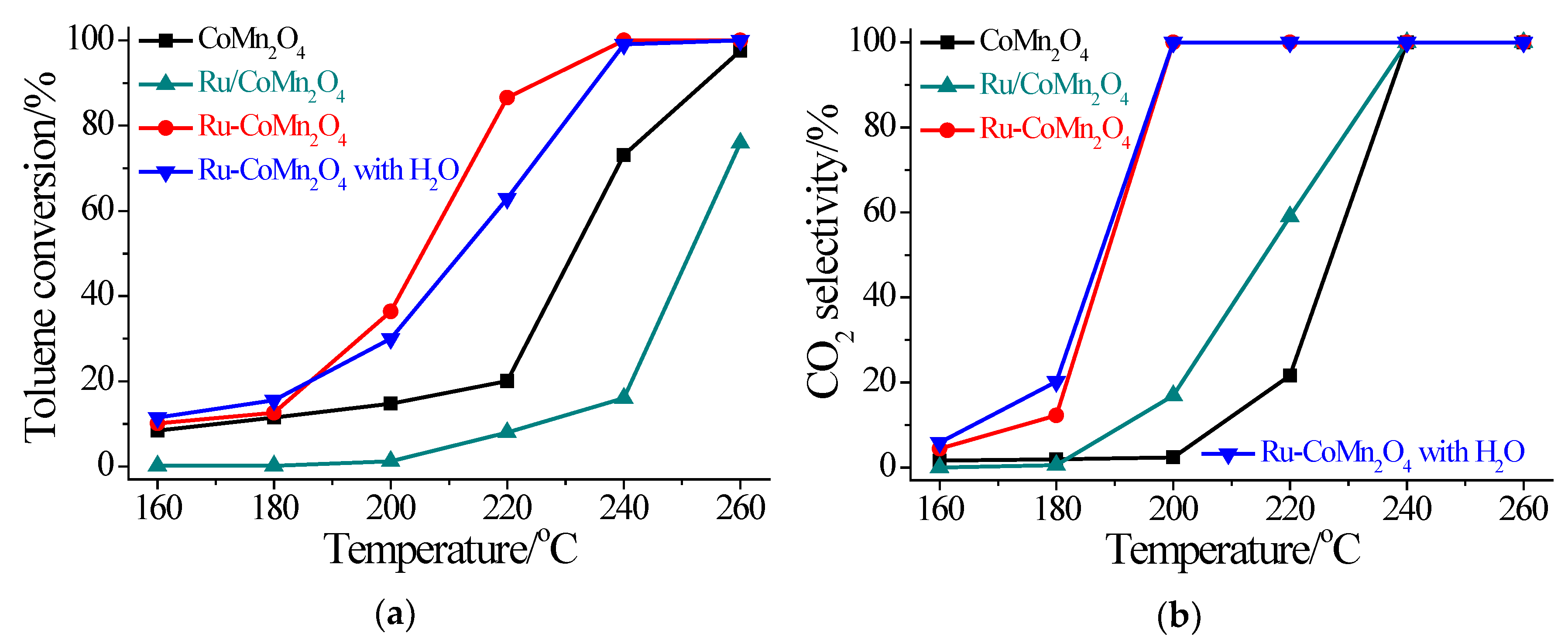
CoMn2O4 exhibited moderate activity in toluene oxidation, with a T90 value (the temperature required for 90% conversion) of approximately 255 °C (Figure 1a). However, its performance was slightly inferior to that of the CoMn2O4 (fresh) (see Figure S1a), suggesting that the chemical reagents used during the reduction process may have slightly suppressed its catalytic activity. After loading Ru via conventional impregnation, the catalytic activity of Ru/CoMn2O4 decreased significantly, showing a T90 value substantially above 260 °C (Figure 1a). In contrast, Ru-CoMn2O4 demonstrated excellent activity, achieving a T90 of only about 224 °C (Figure 1a), significantly lower than those of CoMn2O4, Ru/CoMn2O4, and CoMn2O4 (fresh). These results indicate that incorporating Ru via doping, rather than by conventional surface loading or exposure to chemical agents, markedly enhanced the activity of CoMn2O4 in oxidizing toluene. Additionally, Ru-CoMn2O4 demonstrated superior activity for toluene oxidation compared to other catalysts reported in the literature (see Table S1).
Since H2O is commonly present alongside VOCs in flue gas [17], its influence on toluene oxidation over Ru-CoMn2O4 was also evaluated. As shown in Figure 1a, the introduction of H2O led to a slight increase in the T90 value for Ru-CoMn2O4 to approximately 231 °C, indicating that the presence of H2O mildly inhibited the catalytic oxidation of toluene. Nevertheless, Ru-CoMn2O4 still maintained excellent performance in toluene oxidation even in the presence of H2O.

2.1.2. CO2 Selectivity

The ideal products of toluene oxidation are CO2 and H2O [18]; therefore, the CO2 selectivity of Ru-CoMn2O4 was investigated. As depicted in Figure 1b, CoMn2O4 showed low CO2 selectivity (below 25%) in the temperature range of 160–220 °C, likely due to the formation of intermediate products. When the temperature was raised to 240 °C, the CO2 selectivity of CoMn2O4 reached nearly 100%. Impregnation with Ru moderately improved the CO2 selectivity of CoMn2O4, and the CO2 selectivity of Ru/CoMn2O4 reached approximately 18% and 60% at 200 and 220 °C, respectively (Figure 1b). In comparison, Ru-CoMn2O4 exhibited excellent CO2 selectivity during toluene oxidation, achieving nearly 100% even at 200 °C (Figure 1b). These findings indicate that incorporating Ru via doping also significantly enhanced the CO2 selectivity of CoMn2O4. However, its CO2 selectivity was slightly inferior to that of the CoMn2O4 (fresh) (see Figure S1b), suggesting that the chemical reagents used during the reduction process may have slightly suppressed its CO2 selectivity. Additionally, the introduction of H2O had negligible impact on the CO2 selectivity of Ru-CoMn2O4 (Figure 1b).

2.1.3. Stability

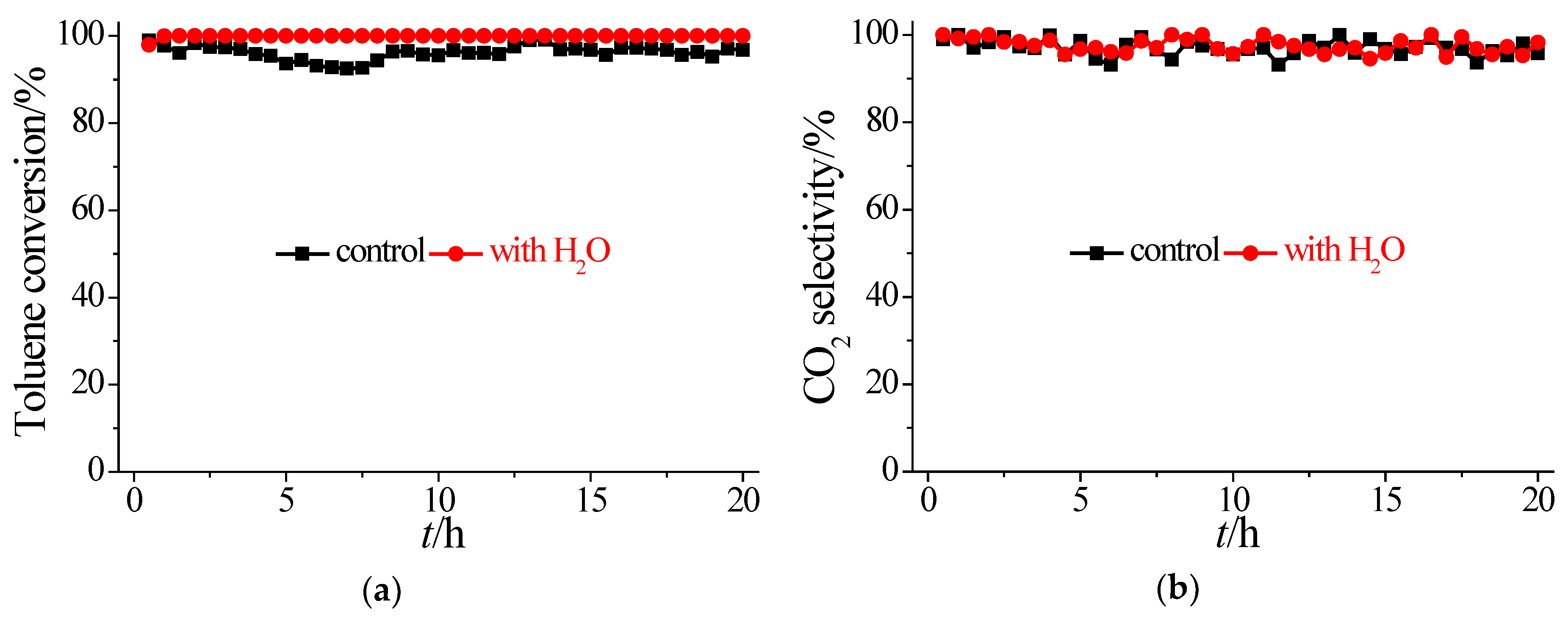
To evaluate the stability of Ru-CoMn2O4 in toluene oxidation, a long-term test was conducted at 240 °C. As shown in Figure 2a, Ru-CoMn2O4 exhibited excellent stability, maintaining a toluene conversion of approximately 99%. Meanwhile, the CO2 selectivity also remained stable at around 99% throughout the reaction (Figure 2b). Furthermore, the introduction of H2O did not compromise the catalytic performance. Both toluene conversion and CO2 selectivity were consistently maintained at approximately 99% under humid conditions (Figure 2), demonstrating the robust water-resistant stability of Ru-CoMn2O4.

2.2. Characterization

2.2.1. Crystal Structure

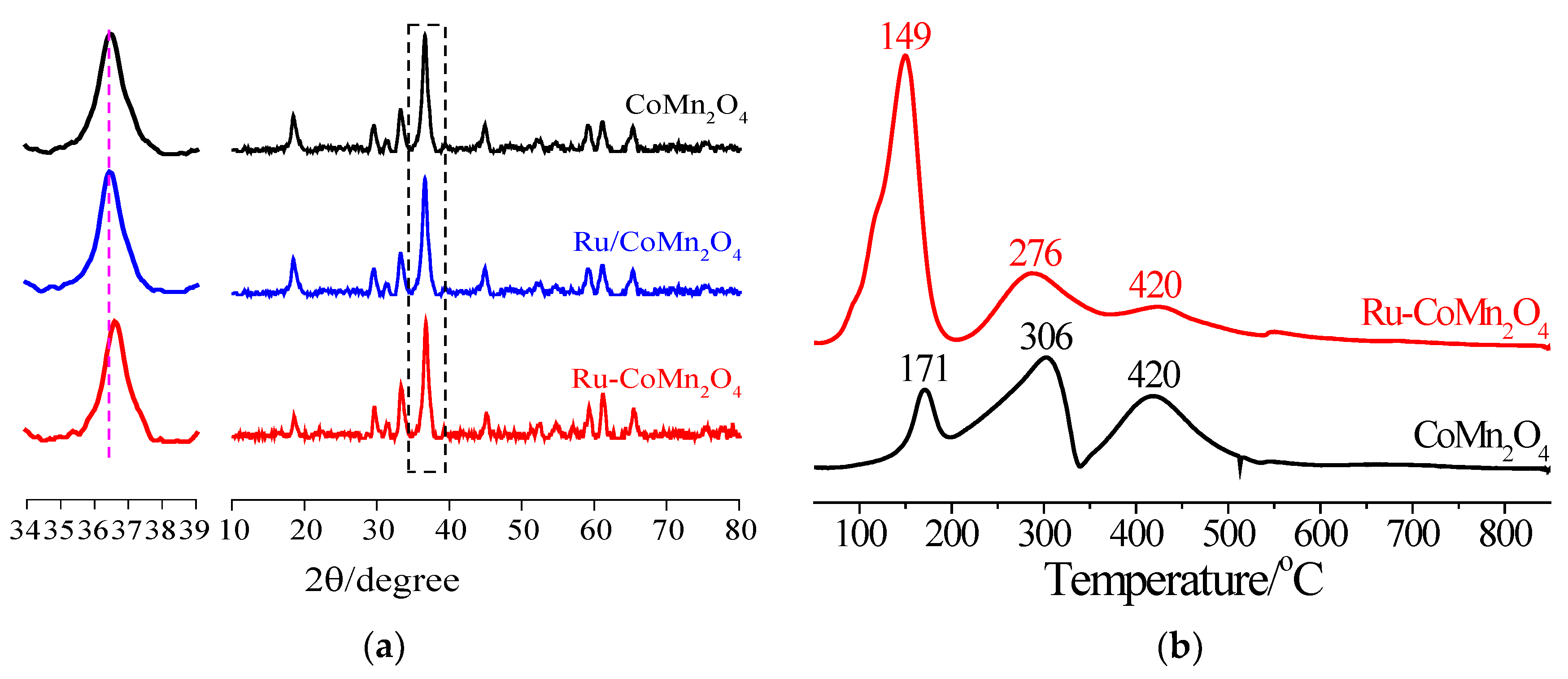
The crystal structures of CoMn2O4, Ru/CoMn2O4, and Ru-CoMn2O4 were analyzed by XRD. The XRD pattern of CoMn2O4 (Figure 3a) exhibited a perfect match with the reflection peaks of the pure tetragonal CoMn2O4 phase (JCPDS: 77-0471), and its space group was I41/amd [19]. Furthermore, no discernible differences were observed between the XRD patterns of CoMn2O4 and CoMn2O4 (fresh) (see Figure S2), indicating that the chemical reagents used in the reduction process had minimal influence on the crystal structure. After conventional impregnation with Ru, the XRD pattern still corresponded well to that of CoMn2O4, with no detectable peaks attributable to Ru species (Figure 3a). Although the XRD pattern of CoMn2O4 remained largely unchanged after Ru incorporation via doping, a slight shift toward higher angles was observed (Figure 3a). Concurrently, the lattice parameter of CoMn2O4 decreased from a = 5.72 Å and c = 9.24 Å to a = 5.67 Å and c = 9.15 Å. These results suggest that Ru was successfully incorporated into the surface crystal structure of CoMn2O4 spinel.

2.2.2. Surface Analysis

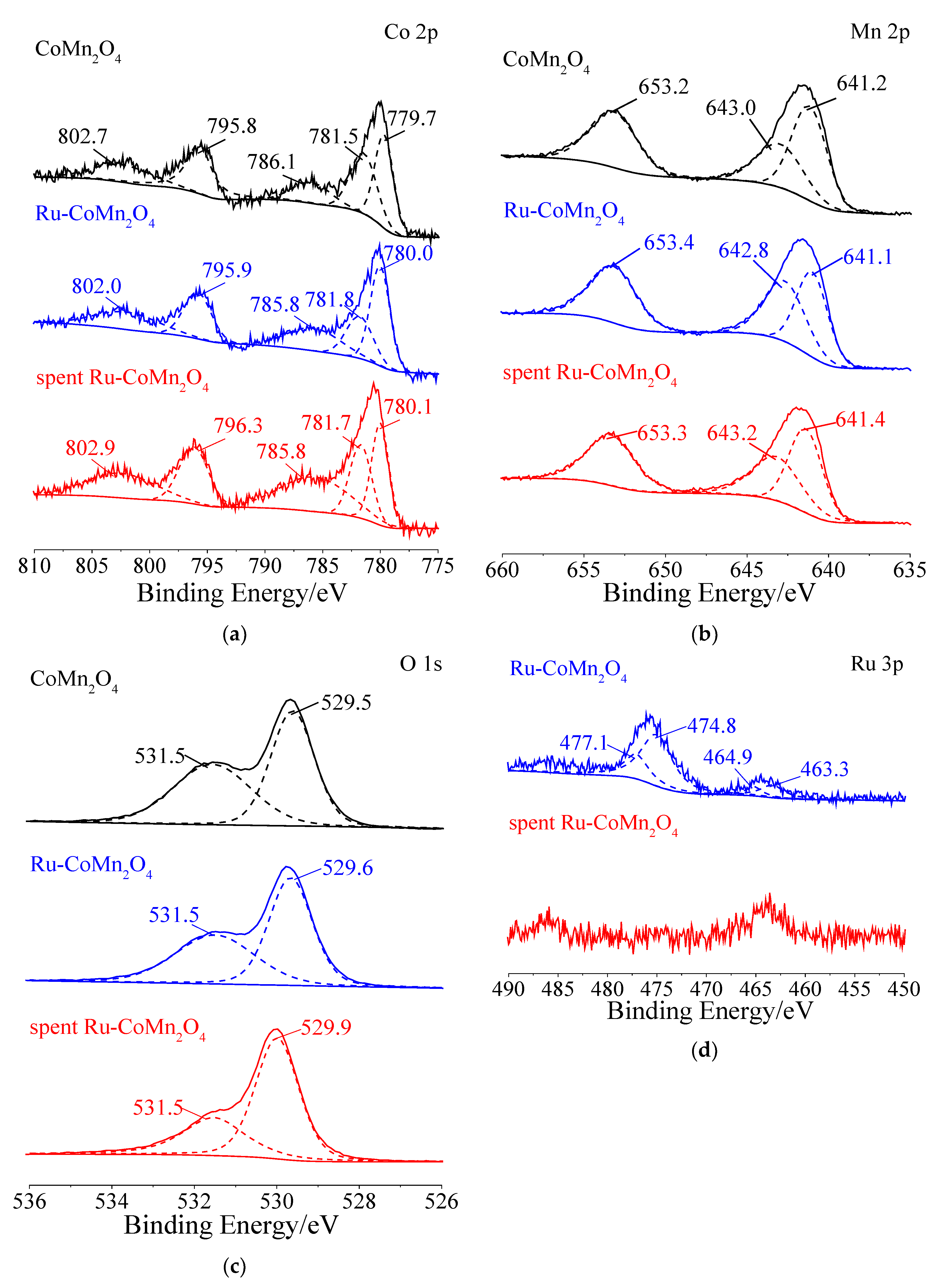
The surface elemental compositions and valence states of CoMn2O4 and Ru-CoMn2O4 were analyzed by XPS. The Co 2p3/2 binding energies for CoMn2O4 were observed at 779.7, 781.5, and 786.1 eV (Figure 4a), corresponding to Co3+, Co2+, and a satellite peak associated with Co2+, respectively [20,21]. The Mn 2p3/2 binding energies for CoMn2O4 were observed at 641.2 and 643.0 eV (Figure 4b), assigned to Mn3+ and Mn4+, respectively [22,23]. The O 1s binding energies for CoMn2O4 were observed at 529.5 and 531.5 eV (Figure 4c), attributed to surface lattice oxygen (Olatt) and surface adsorbed oxygen (Oad), respectively [24,25]. In the spinel structure, Mn3+ cations preferentially occupied octahedral sites. Partial oxidation of Mn3+ to Mn4+ at these sites, driven by the Jahn-Teller effect, induced significant local lattice distortion [26]. This distortion weakened the Mn–O bond strength and enhanced the mobility of lattice oxygen, facilitating its participation in the oxidation reaction [27]. In contrast, Co2+ cations predominantly resided in tetrahedral sites. Due to stronger orbital overlap between metal d-states and O 2p orbitals in octahedral coordination, the octahedral sites exhibited higher oxygen binding capacity compared to tetrahedral sites [26]. Therefore, Mn cations at octahedral sites were likely the primary active sites for toluene oxidation, while Co cations may serve as auxiliary active sites.
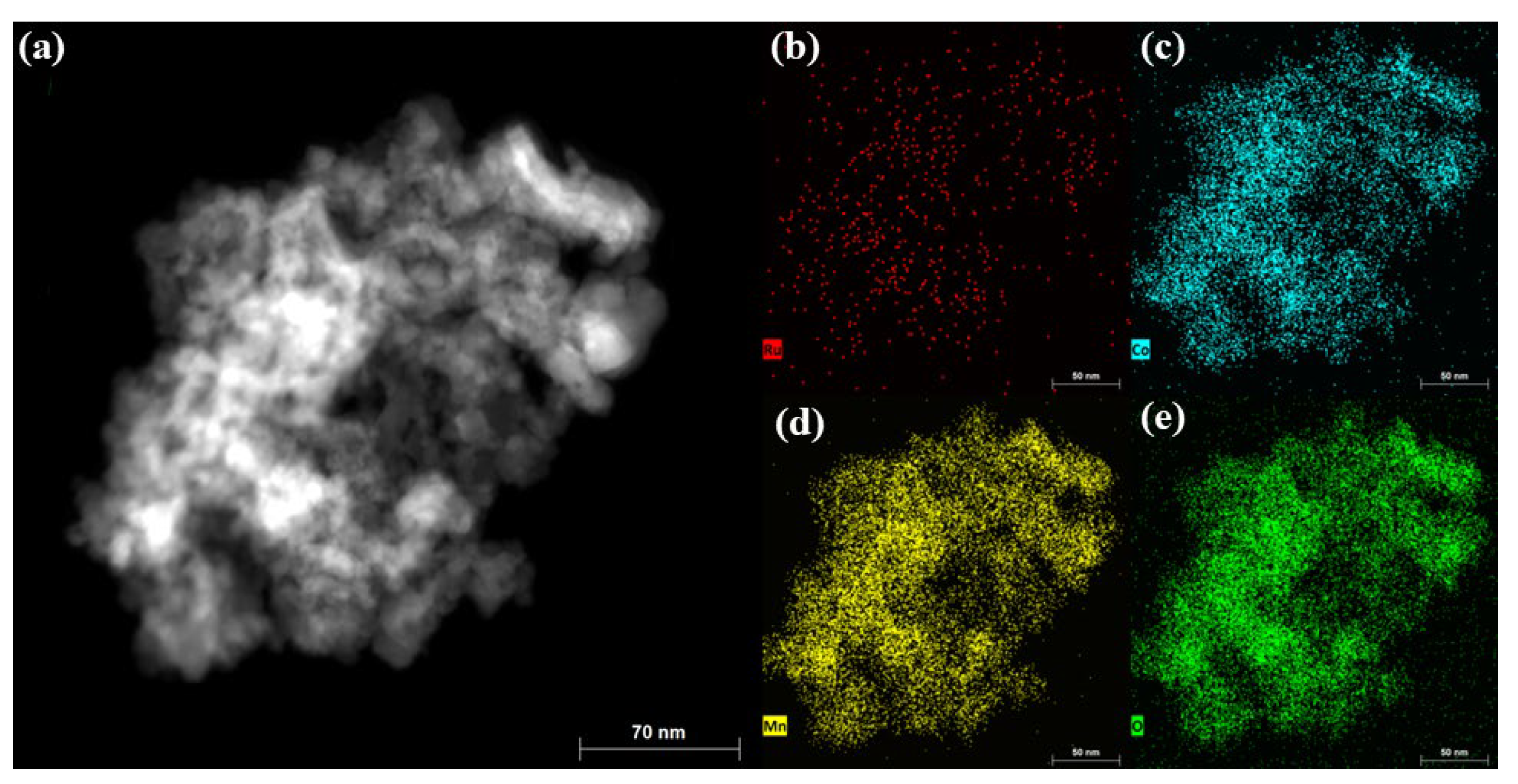
After the introduction of Ru via doping, no significant changes were observed in the XPS spectra of CoMn2O4 corresponding to the Co 2p3/2, Mn 2p3/2, and O 1s regions (Figure 4a–c). In contrast, the Ru 3p3/2 region of Ru-CoMn2O4 displayed weak peaks at 463.3 and 464.9 eV (Figure 4d), indicative of the presence of Ru0 and Ru4+ species [28,29]. Moreover, the HAADF-STEM image (Figure 5a) and EDX elemental mapping (Figure 5b–e) confirmed the homogeneous distribution of Ru, Co, Mn, and O across the surface of Ru-CoMn2O4. These findings suggest that Ru species were highly dispersed on the CoMn2O4 surface.
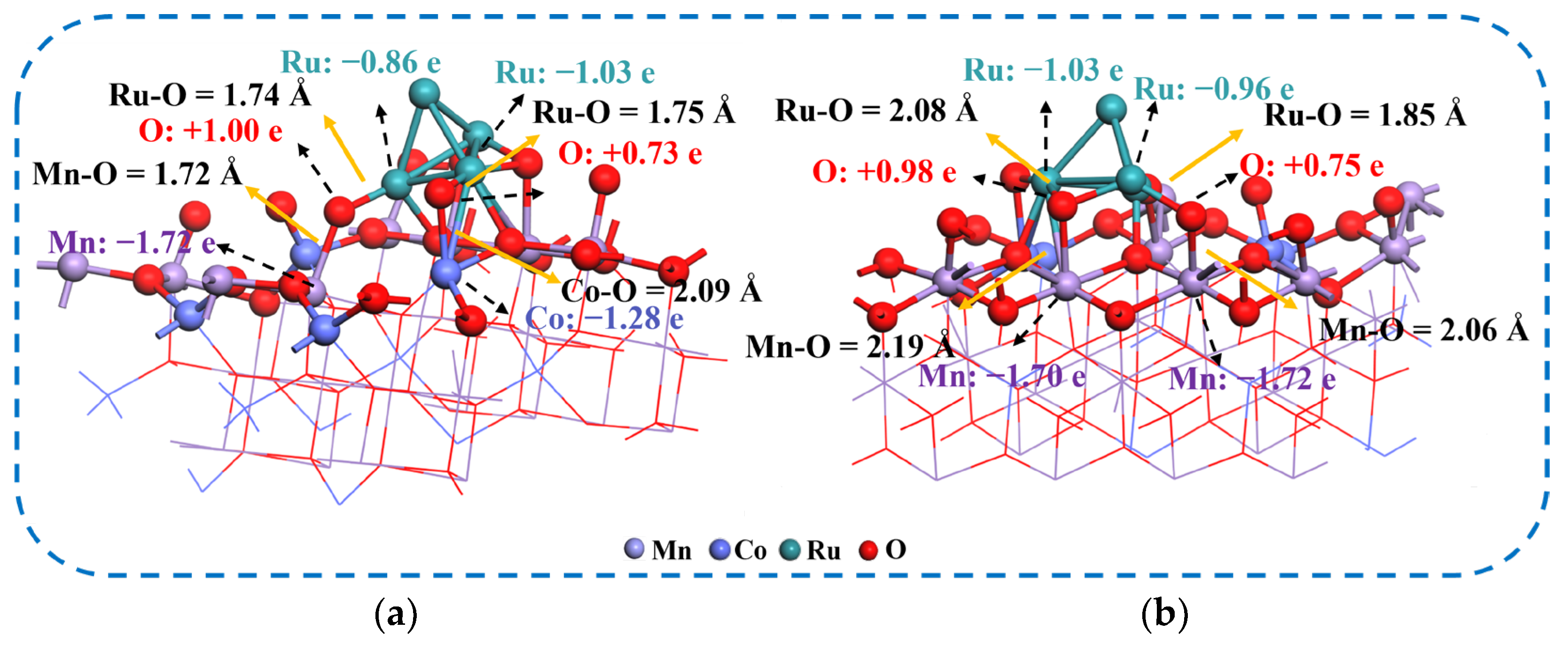
The surface element compositions of CoMn2O4 and Ru-CoMn2O4, as determined by XPS, were summarized in Table 1. Following Ru doping, the percentage of Co3+ in CoMn2O4 moderately increased from 4.12% to 4.82%, while that of Co2+ moderately decreased from 3.81% to 3.21% (Table 1). Concurrently, the binding energies of Co3+ and Co2+ in CoMn2O4 slightly increased from 779.7 eV and 781.5 eV to 780.0 eV and 781.8 eV, respectively (Figure 4a). These results indicate an interaction between Ru and Co, involving electron transfer from Co to Ru, which led to a decrease in electron density around Co sites. Similarly, the percentage of Mn4+ also showed a slight increase after Ru doping, accompanied by a corresponding decrease in Mn3+ (Table 1). This change was also associated with a slight shift of the Mn3+ and Mn4+ binding energies to 641.1 eV and 642.8 eV, respectively (Figure 4b), suggesting analogous electron transfer from Mn to Ru and a corresponding reduction in electron density around Mn. To further probe the influence of Ru on the local coordination environments of Co and Mn in CoMn2O4, structural models of both CoMn2O4 and Ru-CoMn2O4 were constructed and geometrically optimized. Previous studies have shown that super-exchange interactions between Mn and Co ions via bridging oxygen atoms facilitated electron delocalization in the CoMn2O4 lattice, thereby reducing overall electron localization—a feature inherent to the Co–O–Mn structural motifs in the spinel framework (Figure 6) [30]. Moreover, the Ru4 cluster was found to form chemical bonds at the CoMn2O4 interface (Figure 6). The Ru–O–Mn bridge exhibited a significantly higher formation energy (6.44 eV) than the Ru–O–Co bridge (4.66 eV), indicating stronger bonding interaction via the Mn–O bond in stabilizing the Ru4 cluster (Figure 6). The charge density difference analysis (see Figure S3) revealed that in pristine CoMn2O4, the Bader charges of Mn and Co were −1.76 e and −1.30 e, respectively (see Table S2). After Ru incorporation and the formation of Ru–O–Mn and Ru–O–Co bridges, these values increased to −1.72 e and −1.28 e, respectively (see Table S2), consistent with a reduction in their oxidation states. This confirmed that Ru promoted the oxidation of Mn3+ to Mn4+ and Co2+ to Co3+. Furthermore, more pronounced charge redistribution was observed along the Ru–O–Mn pathway. Bader charge analysis further indicated that upon Ru4 adsorption, Mn experienced greater electron depletion (Δρ = 1.70 e) than Co (Δρ = 1.28 e), suggesting stronger electronic coupling between Ru4 and Mn (Figure 6). This result aligned with the enhanced charge redistribution observed in the Δρ map along the Ru–O–Mn path, as well as the higher oxygen vacancy formation energy on the Mn bridge (Figure 6). Collectively, these findings demonstrated that the Ru–O–Mn bridge played a dominant role in the interfacial interaction, while the Ru–O–Co bring played a secondary role.
After toluene oxidation at 240 °C for 20 h, the percentages of Mn4+ and Co3+ in Ru-CoMn2O4 both decreased significantly (Table 1). However, no distinct Ru 3p signal was detected for Ru–CoMn2O4 after the reaction (Figure 4d), likely due to the low Ru content (approximately 0.75%). As a result, the valence state of Ru species could not be unambiguously determined, and their percentages were therefore not included in Table 1.

2.2.3. Redox Behavior

The reduction behaviors of CoMn2O4 and Ru-CoMn2O4 were characterized by H2-TPR. The H2-TPR profile of CoMn2O4 exhibited three distinct reduction peaks (Figure 3b). The peak at 171 °C was assigned to the reduction of Mn4+ to Mn3+, the one at 306 °C was attributed to the concurrent reductions of Co3+ to Co2+ and Mn3+ to Mn2+, and the peak at 420 °C was ascribed to the reduction of Co2+ to Co0 [31]. Upon incorporation of Ru, a new shoulder peak emerged at 120 °C (Figure 3b), corresponding to the reduction of Ru4+ to Ru0 [32]. Moreover, the reduction peaks associated with Mn4+ to Mn3+, Co3+ to Co2+, and Mn3+ to Mn2+ all shifted slightly to lower temperatures. These results indicate a synergistic interaction between Ru and CoMn2O4, which moderately enhanced the redox capability of CoMn2O4.

2.3. Mechanism of Toluene Oxidation

The mechanism of toluene oxidation over Ru-CoMn2O4 primarily followed two pathways: the Mars–van Krevelen (MvK) mechanism and Eley–Rideal (E–R) mechanism [33,34]. In the MvK mechanism, gaseous toluene was first adsorbed onto the catalyst surface and then oxidized by surface lattice oxygen, leading to the formation of final products. The surface lattice oxygen consumed was subsequently replenished by gaseous oxygen. In contrast, the E–R mechanism involved the direct reaction between gaseous toluene and adsorbed oxygen on the catalyst surface to yield the oxidation products.
Toluene oxidation over Ru-CoMn2O4 via the MvK mechanism can be approximated as:
C 7 H 8 ( g ) C 7 H 8 ( a d )
C 7 H 8 ( a d ) + 36 M n + + 18 O latt 2 7 CO 2 + 4 H 2 O + 36 M ( n 1 ) +
4 M ( n 1 ) + + O 2 ( g ) 4 M n + + 2 O latt 2
where Mn+ represents the highly valent surface species, namely Co3+, Mn4+, and Ru4+.
Toluene oxidation over Ru-CoMn2O4 via the E–R mechanism can be approximated as:
O 2 ( g ) 2 O ( ad )
C 7 H 8 ( g ) + 18 O ( ad ) 7 CO 2 + 4 H 2 O
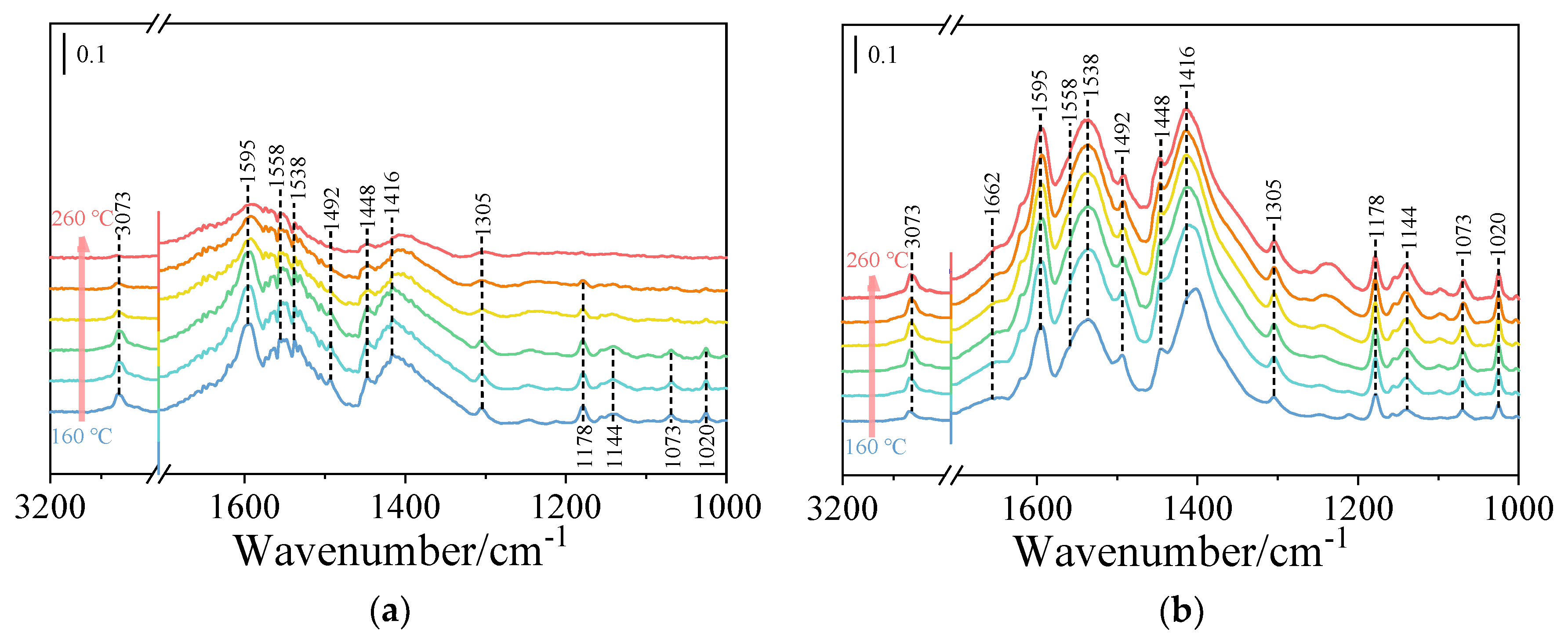
To explore the contribution of the MvK mechanism to the oxidation of toluene over Ru-CoMn2O4, in situ DRIFTS analysis was performed by introducing O2 over Ru-CoMn2O4 that was pre-adsorbed with toluene at temperatures ranging from 160 to 240 °C. When gaseous toluene was introduced at 160 °C, twelve distinct bands were observed on the Ru-CoMn2O4 surface at 1020, 1073, 1144, 1178, 1305, 1416, 1448, 1492, 1538, 1558, 1595, and 3073 cm−1 (Figure 7a). The bands at 1448, 1492, and 1595 cm−1 were assigned to the stretching vibrations of the skeletal C=C bonds in the aromatic ring of toluene [31], while the band at 3073 cm−1 was associated with the C–H stretching vibration of toluene [35], indicating toluene adsorption onto the Ru-CoMn2O4 surface. The bands at 1020, 1073, and 1144 cm−1 were attributed to C–O stretching vibrations in benzyl alcohol [36,37], suggesting the oxidation of toluene to benzyl alcohol by surface lattice oxygen. Furthermore, the band at 1178 cm−1 was ascribed to benzaldehyde species [38], suggesting the oxidation of benzyl alcohol to benzaldehyde. Additionally, the bands at 1416 and 1538 cm−1 corresponded to symmetric and asymmetric stretching vibrations of the C=O bond in benzoate species [39,40], indicating further oxidation of benzyl alcohol to benzoate. The band at 1305 cm−1 was assigned to the symmetric C=O stretching vibration in maleic anhydride [41], pointing to subsequent oxidation of benzoate. Moreover, the band at 1558 cm−1 was associated with the stretching vibration of COO groups from acetate species [25], suggesting further oxidation of maleic anhydride. As the temperature gradually increased to 260 °C, the intensities of these intermediate-related bands initially increased and then diminished (Figure 7a), indicating that the intermediates were further oxidized into final products (primarily CO2 and H2O). These results demonstrate that toluene adsorbed on Ru-CoMn2O4 can be oxidized by surface lattice oxygen, ultimately yielding end products. Therefore, the MvK mechanism played a crucial role in the oxidation of toluene over Ru-CoMn2O4.
According to Reaction 2, the toluene oxidation rate over Ru-CoMn2O4 via the MvK mechanism (denoted as δMvK) can be approximated as:
δ MvK = d [ C 7 H 8 ( g ) ] d t = k 1 [ C 7 H 8 ( ad ) ] [ M n + ] α [ O latt 2 ] β
where k1, [C7H8(ad)], [Mn+], [Olatt2−], α, and β represent the rate constant of Reaction 2, the number of surface adsorbed toluene molecules, Mn+ cations, surface lattice oxygen, and the reaction orders with respect to Mn+ cations and surface lattice oxygen, respectively.
Based on Reaction 5, the toluene oxidation rate over Ru-CoMn2O4 via the E–R mechanism (denoted as δE–R) can be approximated as:
δ E R = d [ C 7 H 8 ( g ) ] d t = k 2 [ C 7 H 8 ( g ) ] [ O ( ad ) ] γ
where k2, [C7H8 (g)], [O(ad)], and γ denote the rate constant of Reaction 5, the number of gaseous toluene molecules in the flue gas, surface adsorbed oxygen, and the reaction order with respect to surface adsorbed oxygen, respectively.
Therefore, the overall toluene oxidation rate over Ru-CoMn2O4 can be described as:
δ = δ MvK + δ E R = k 1 [ C 7 H 8 ( ad ) ] [ M n + ] α [ O latt 2 ] β + k 2 [ C 7 H 8 ( g ) ] [ O ( ad ) ] γ
The toluene concentration in the flue gas was typically high (~500 ppm), indicating that the adsorption of toluene on Ru-CoMn2O4 was nearly saturated. Thus, the number of surface adsorbed toluene molecules can be considered constant. Moreover, Mn+ and Olatt2− on Ru-CoMn2O4 can be speedily recovered through Reaction 3, and thus the amounts of Mn+ and Olatt2− on Ru-CoMn2O4 were rapidly replenished via Reaction 3, so their numbers were also regarded as constants. Furthermore, the O2 concentration in the flue gas was significantly higher (~5%) than that of toluene, meaning that the consumption of O(ad) due to toluene oxidation (Reaction 5) was negligible. Therefore, the number of O(ad) can be treated as constant. As indicated by Equation 8, the overall oxidation rate was postulated to vary linearly with the gaseous toluene concentration. The slope and intercept of this linear correlation were attributed to the kinetic constants of the E–R (kE–R) and MvK (kMvK) mechanisms, respectively.
Thus, Equation (8) can be rewritten as:
δ = δ MvK + δ E R = k MvK + k E R [ C 7 H 8 ( g ) ]
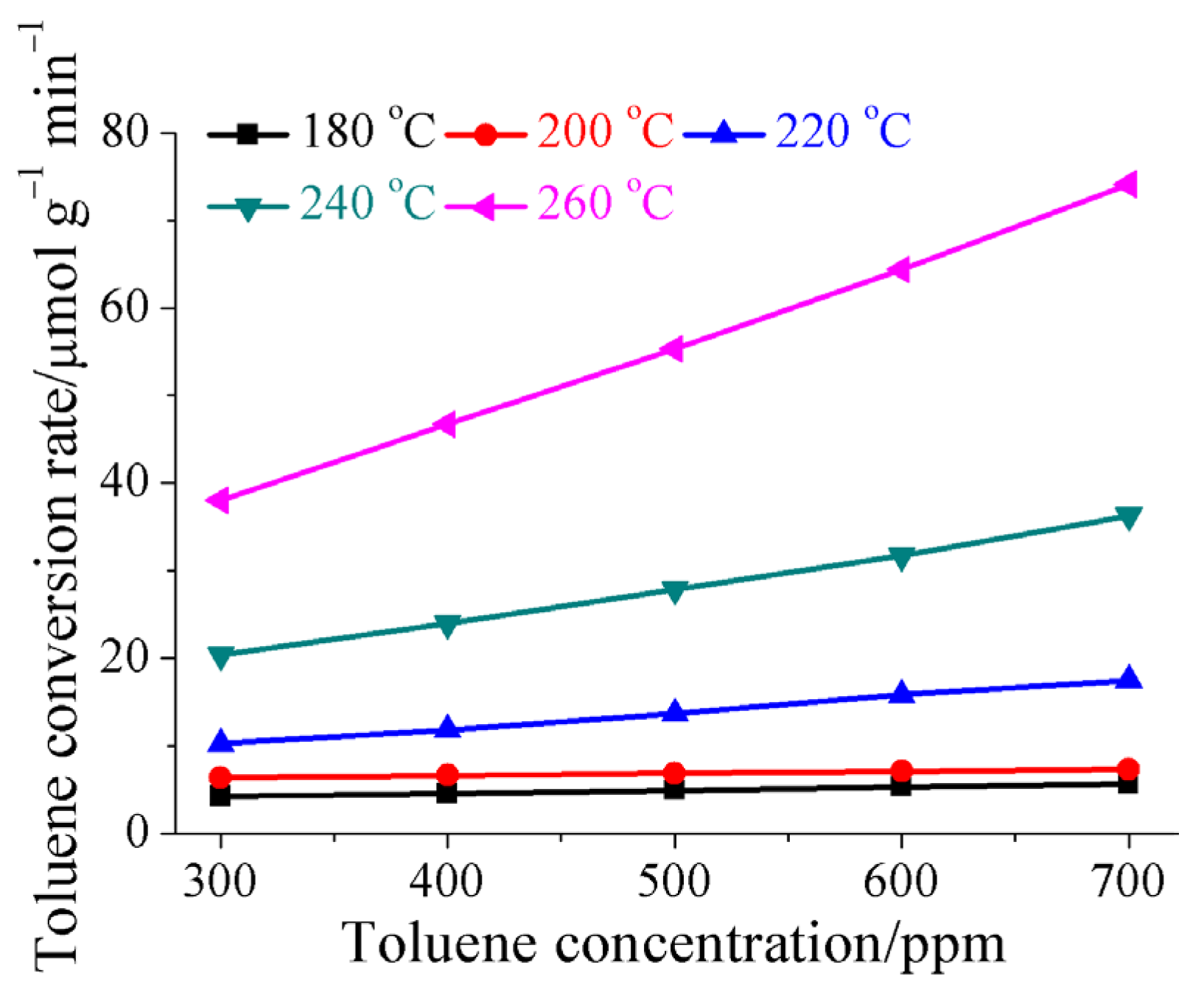
To determine the kinetic parameters for toluene oxidation via the E–R and MvK mechanisms, a kinetic study of toluene oxidation over Ru-CoMn2O4 was performed in the temperature range of 180–260 °C, with toluene conversion kept below 15% (Figure 8). A linear regression analysis based on Equation (9) was applied, and the resulting intercept, slope, and regression coefficient were summarized in Table 2.
As shown in Table 2, the intercept values, corresponding to the MvK rate constant (kMvK) were approximately 4.02, 5.94, 7.85, 12.2, and 19.5 µmol g−1 min−1 at 180, 200, 220, 240, and 260 °C, respectively. Moreover, the slope values, representing the E–R rate constant (kE–R) were about 0.0044, 0.0095, 0.064, 0.158, and 0.364 µmol g−1 min−1 at the corresponding temperatures (Table 2). These results indicate that toluene oxidation over Ru-CoMn2O4 proceeded through both the MvK and E–R mechanisms. According to Equation (7), the oxidation rate via the E–R mechanism showed a linear dependence on toluene concentration. At toluene concentrations of approximately 914, 625, 123, 77, and 54 ppm at 180, 200, 220, 240, and 260 °C, respectively, the oxidation rates via the E–R and MvK mechanisms were roughly equal, suggesting comparable contributions from both pathways under these conditions. When the toluene concentration fell below these threshold values at each temperature, the oxidation rate via the MvK mechanism exceeded that via the E–R mechanism, indicating a more dominant role of the MvK pathway at lower concentrations. Conversely, at concentrations above these levels, the E–R mechanism became the predominant pathway. Given that typical toluene concentrations in flue gas were around 500 ppm, the MvK mechanism contributed more significantly at 200 °C, whereas the E–R mechanism dominated from 220 to 260 °C. Therefore, the oxidation of toluene over Ru-CoMn2O4 was influenced by both temperature and reactant concentration: the MvK mechanism dominated under lower temperatures and concentrations, while the E–R mechanism gained prominence at higher elevated temperatures and concentrations.
To further elucidate the reaction pathway of toluene oxidation over Ru-CoMn2O4 via the E–R mechanism, in situ DRIFTS measurements were performed during exposure of the catalyst to a mixture of toluene and O2 at 160–260 °C. In addition to characteristic bands of adsorbed toluene (1448, 1492, 1595, and 3073 cm−1), benzyl alcohol (1020, 1073, and 1144 cm−1), benzaldehyde (1178 cm−1), benzoate species (1416 and 1538 cm−1), maleic anhydride (1305 cm−1), and acetate species (1558 cm−1), one band emerged at 1662 cm−1 on Ru-CoMn2O4 (Figure 7b), corresponding to the C=O stretching vibration of benzaldehyde [42]. This observation suggests that the intermediate products formed during toluene oxidation over Ru-CoMn2O4 via the E–R mechanism included mainly benzyl alcohol, benzaldehyde, benzoate, maleic anhydride, and acetate species. Therefore, the reaction pathway of toluene oxidation via the E–R mechanism was probably similar or less intricate than that involving the MvK mechanism.
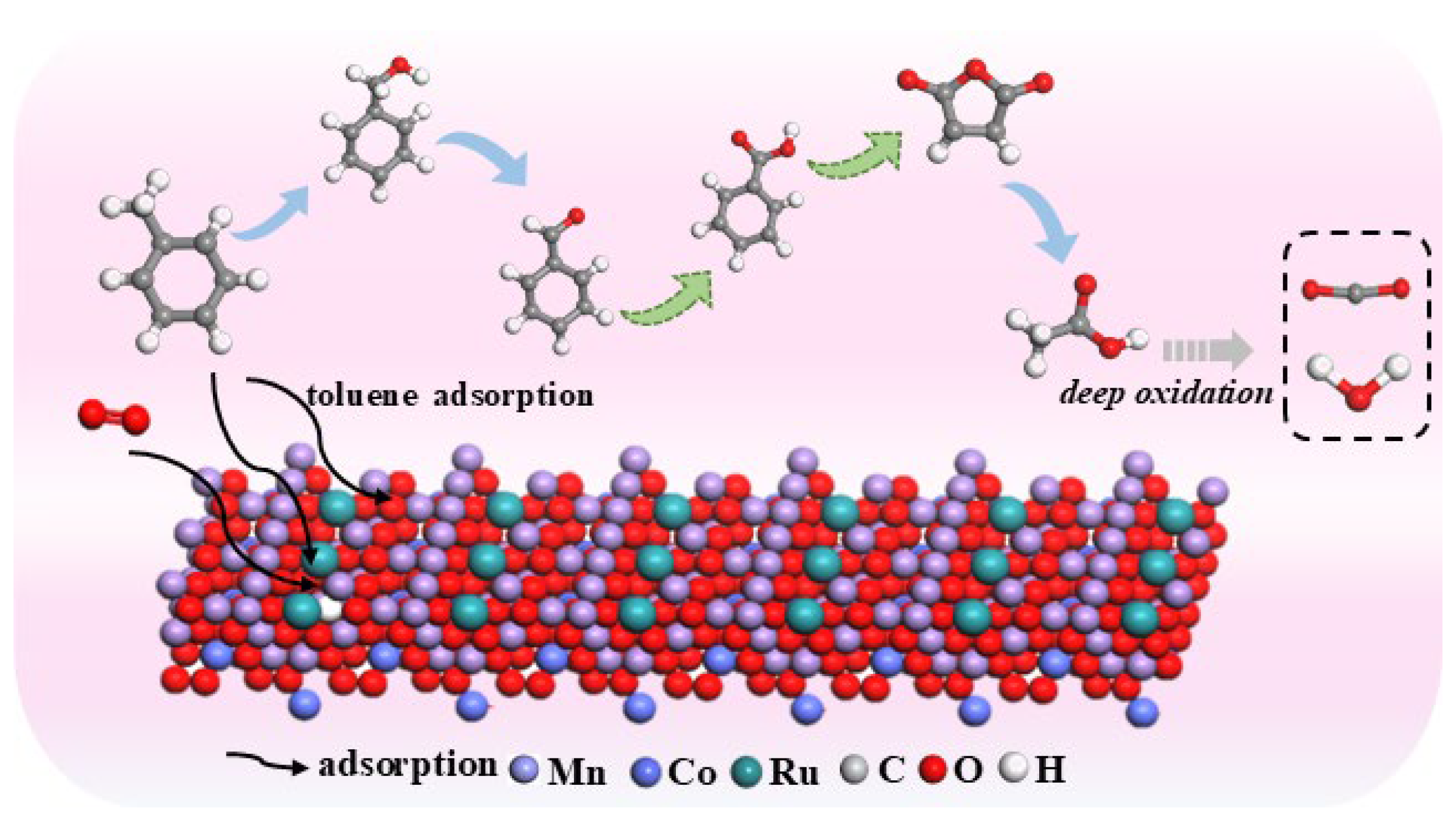
On basic of combined in situ DRIFTS and kinetic analyses, it was determined that a dual-mechanism coupling, involving both MvK and E–R routes, governs toluene oxidation over Ru-CoMn2O4. The corresponding pathway, depicted in Figure 9, comprised the following elementary steps: (1) Adsorption of gaseous toluene onto the Ru-CoMn2O4 surface. (2) Oxidation of both surface adsorbed and gaseous toluene to benzyl alcohol, activated by surface lattice oxygen and surface adsorbed oxygen, respectively. (3) Replenishment of surface consumed oxygen by gaseous oxygen from the feed. (4) Subsequent oxidation of benzyl alcohol to intermediates including benzaldehyde, benzoate, maleic anhydride, and acetate species. (5) Final oxidation of these intermediates, releasing CO2 and H2O as the end products.

2.4. Promotion Mechanism of Ru Doping on Toluene Oxidation over CoMn2O4

As indicated by Equation 8, the oxidation rate of toluene over Ru-CoMn2O4 exhibited a strong dependence on several parameters: the rate constants k1 (for Reaction 2) and k2 (for Reaction 5), as well as the concentrations of Mn+ (i.e., Co3+, Mn4+, and Ru4+) cations, surface adsorbed toluene, surface lattice oxygen, gaseous toluene, and surface adsorbed oxygen. Since the concentration of gaseous toluene was unaffected by Ru doping, the enhancement in toluene oxidation activity on CoMn2O4 due to Ru doping was primarily attributed to an increase in the values of k1 and k2, enhanced toluene adsorption, and higher concentrations of Mn+ cations, surface lattice oxygen, or surface adsorbed oxygen.
The rate constants k1 and k2 were closely associated with the oxidizing capabilities of CoMn2O4 and Ru-CoMn2O4. H2-TPR analysis revealed a moderate improvement in the oxidizing ability of CoMn2O4 after Ru doping (Figure 3b), implying that both k1 and k2 for CoMn2O4 increased moderately following Ru modification. Furthermore, XPS analysis showed that the percentages of Co3+, Mn4+, and Ru4+ were all marginally higher on Ru-CoMn2O4 than those on CoMn2O4 (Table 1), indicating a moderate increase in the number of Mn+ cations after Ru doping. Additionally, the percentage of Olatt was slightly greater for Ru-CoMn2O4 compared to CoMn2O4 (Table 1), suggesting a minor increase in surface lattice oxygen and a corresponding slight decrease in surface adsorbed oxygen after Ru doping.
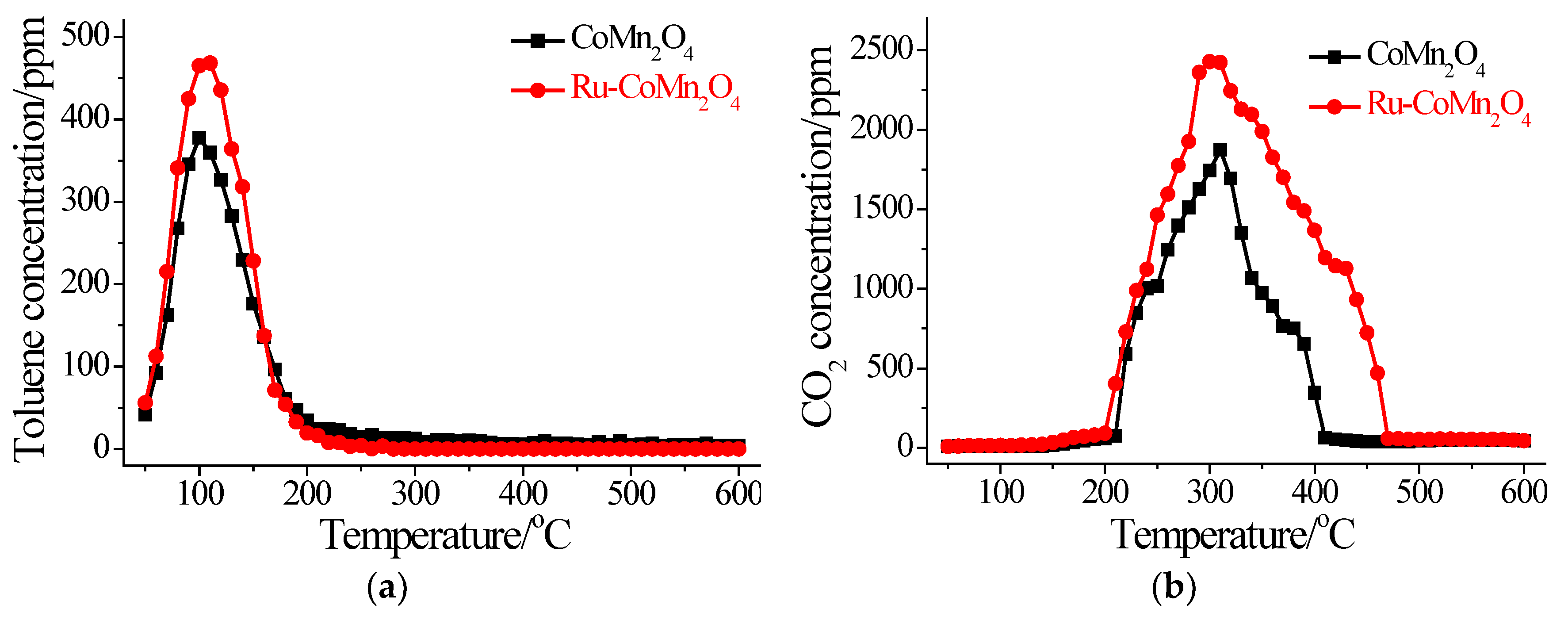
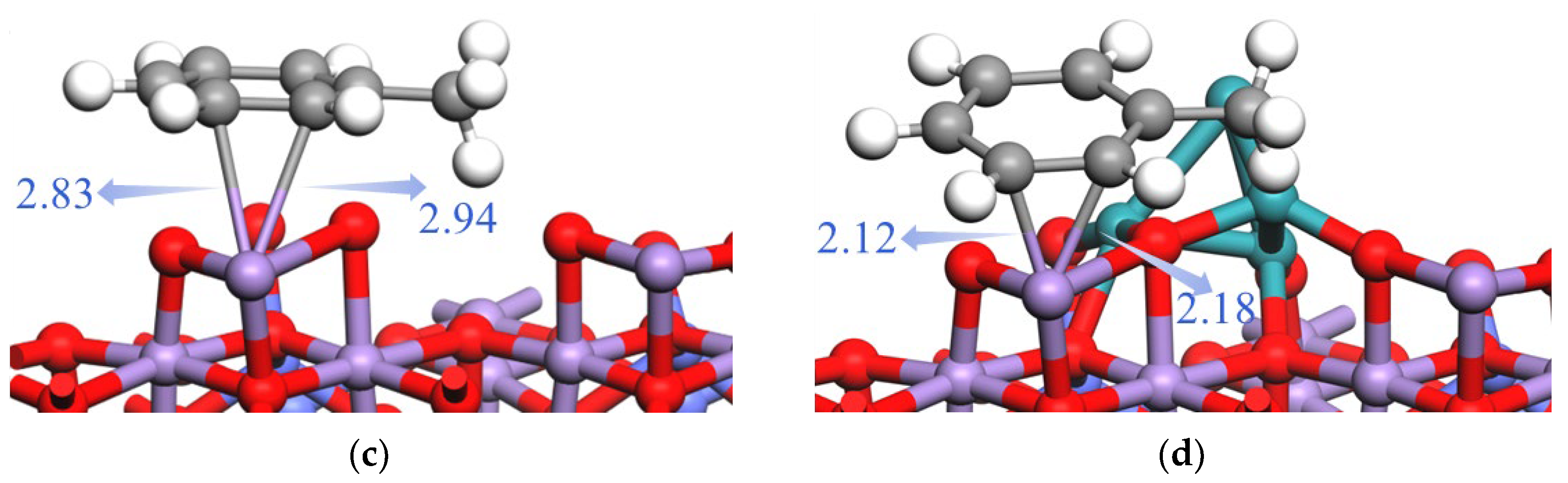
To evaluate the effect of Ru doping on toluene adsorption, toluene-TPD profiles of CoMn2O4 and Ru-CoMn2O4 were compared. As shown in Figure 10, the amount of toluene adsorbed (calculated from the total desorbed toluene in Figure 10a and formed CO2 in Figure 10b) on CoMn2O4 was approximately 66.5 μmol g−1, whereas it increased to about 78.2 μmol g−1 for Ru-CoMn2O4, representing a 1.2-fold enhancement. Hence, toluene adsorption onto CoMn2O4 was moderately promoted by Ru doping. To gain further insight into the interaction between toluene and CoMn2O4 under the influence of Ru doping, the toluene adsorption properties of both CoMn2O4 and Ru-CoMn2O4 were investigated via DFT calculations. On basic of the tetragonal CoMn2O4 phase identified by XRD (Figure 3a), the (211) crystal surface was identified as the dominant facet of the spinel structure. The adsorption energy (Eads) of toluene molecules on this surface was evaluated with different exposed atoms. The most stable configurations were those in which carbon atoms of the aromatic ring (Ca) interacted with Mn sites, forming Mn–Ca bonds with lengths of 2.83 Å and 2.94 Å, yielding an Eads of −1.47 eV for CoMn2O4. In contrast, for Ru-CoMn2O4, the Eads value was −1.64 eV, and the corresponding Mn–Ca bond lengths shortened to 2.12 Å and 2.18 Å, indicating a strengthened interaction between toluene and the Mn sites adjacent to Ru.
In summary, the introduction of Ru into CoMn2O4 led to the formation of new Ru–O–Mn and Ru–O–Co structures. These structural modifications resulted in a moderate enhancement in oxidizing ability, a marginal increase of surface-adsorbed toluene and lattice oxygen content, and a higher proportion of highly valent surface species (namely Co3+, Mn4+, and Ru4+). Consequently, despite a slight reduction in surface adsorbed oxygen, Ru doping significantly enhanced the toluene oxidation activity of CoMn2O4.

3. Materials and Methods

3.1. Catalyst Preparation

CoMn2O4 spinel was synthesized via a sol–gel method. Stoichiometric amounts of cobalt nitrate and manganous nitrate (provided by Sinopharm Group Chemical Reagent Co., Ltd., Shanghai, China, analytical reagent) were dissolved in ultrapure water and then added into a citric acid solution under stirring for 0.5 h. The pH of the mixture was adjusted to 9.0 using ammonia solution, followed by stirring at 80 °C for 10 h. The resulting product was dried at 105 °C for 10 h and subsequently calcined at 400 °C for 3 h to obtain CoMn2O4, which was designated as CoMn2O4 (fresh).
Ru-CoMn2O4 was prepared by a reduction method. Specifically, 0.5 g of CoMn2O4 (fresh) was dispersed in 25 mL of ultrapure water, after which 0.0039 g of ruthenium chloride (corresponding to 0.38 wt% Ru loading, provided by Sinopharm Group Chemical Reagent Co., Ltd., analytical reagent) was added to the suspension and stirred for 1 h. Then, NaBH4 and NaOH (with molar ratios of NaBH4/Ru = 2/1 and NaBH4/NaOH = 1/5, provided by Sinopharm Group Chemical Reagent Co., Ltd., analytical reagent) were introduced into the suspension under stirring for another hour. Finally, the product was washed once with ultrapure water and once with ethanol, and dried at 105 °C for 12 h to obtain Ru-CoMn2O4. For comparison, Ru/CoMn2O4 was also synthesized via a conventional impregnation method using ruthenium chloride as the precursor and CoMn2O4 (fresh) as the support, with the same Ru loading of 0.38 wt%. Additionally, to rule out potential interference from chemical reagents, a control sample of CoMn2O4 (fresh) was treated following the same procedure used for Ru-CoMn2O4 synthesis but without the addition of ruthenium chloride. This sample was denoted as CoMn2O4 for subsequent experiments and analyses.

3.2. Performance Assessment

The performance for toluene oxidation was evaluated in a packed-bed reactor operated between 160–260 °C. A catalyst weight of 200 mg and a total gas flow rate of 200 mL min−1 were used, resulting in a weight hourly space velocity (WHSV) of 60,000 cm3 g−1 h−1. The simulated flue gas consisted of 500 ppm toluene, 5% O2, 5% H2O (when introduced), balanced with N2. The outlet concentrations of toluene and CO2 were continuously measured via an infrared gas analyzer (Thermo Scientific IGS Analyzer, Waltham, MA, USA). Catalytic activity was evaluated based on two indicators: toluene conversion and CO2 selectivity, which were calculated using the following equations:
toluene   conversion   = [ toluene ] in [ toluene ] out [ toluene ] in × 100 %
CO 2   selectivity = [ CO 2 ] out 7 ( [ toluene ] in [ toluene ] out ) × 100 %
where [toluene]in denotes the toluene concentration at the reactor inlet, and [toluene]out and [CO2]out represent the concentrations of toluene and CO2 at the reactor outlet, respectively.

3.3. Characterization

X-ray diffraction (XRD) pattern, X-ray photoelectron spectroscopy (XPS), temperature-programmed reduction of H2 (H2-TPR), and high-angle annular dark-field scanning transmission electron microscopy (HAADF-STEM) and energy-dispersive X-ray (EDX) spectroscopy were measured using a Bruker-AXS D8 ADVANCE diffractometer, a Thermo Scientific K-Alpha spectrometer, a Micromeritics AutoChem II 2920 chemical adsorption analyzer, and a Bruker Quantax XFlash 7 X-ray energy spectrometer, respectively.
Temperature-programmed desorption of toluene (toluene-TPD) was also carried out in a packed-bed reactor. The procedure involved the following steps: First, the CoMn2O4 or Ru-CoMn2O4 samples were purged by a 5% O2/N2 mixture at 300 °C for 1 h and then cooled to 50 °C. Afterwards, the samples were exposed to 500 ppm toluene for 0.5 h. Lastly, the temperature was increased at a rate of 10 °C min−1 in N2.
In situ diffuse reflectance infrared Fourier transform spectroscopy (DRIFTS) was conducted on a Thermo Scientific Nicolet iS50 (Thermo Fisher Scientific, Waltham, MA, USA) Fourier transform infrared spectrometer equipped with a mercury cadmium telluride (MCT) detector.

3.4. Density Functional Theory (DFT) Calculation

First-principles calculations were performed using the Vienna Ab initio Simulation Package (VASP 5.4.4). The most stable CoMn2O4 (211) surface and a typical Ru4 cluster were employed to construct the slab models of CoMn2O4 and Ru-CoMn2O4, respectively. Further computational details and specific structural information were provided in the Supporting Information.

4. Conclusions

This study demonstrated that Ru doping effectively enhanced the toluene oxidation performance of CoMn2O4. The optimized Ru-CoMn2O4 catalyst achieved 90% toluene conversion at 224 °C with high CO2 selectivity under a high WHSV of 60,000 cm3 g−1 h−1. A combination of mechanistic analyses revealed that the reaction proceeded primarily via Mars–van Krevelen (MvK) and Eley–Rideal (E–R) mechanisms, in which the abundance of highly valent metal species (Co3+, Mn4+, and Ru4+), surface lattice oxygen activity, and presence of surface adsorbed oxygen and toluene molecules collectively dictated the catalytic behavior. The doping of Ru into the CoMn2O4 spinel structure generated new Ru–O–Mn and Ru–O–Co linkages. This structural modification resulted in a moderately enhanced oxidizing capability and simultaneously increased the concentrations of highly valent surface species, surface adsorbed toluene, and surface lattice oxygen. Despite a minor decrease in surface adsorbed oxygen, Ru doping significantly improved the overall catalytic activity of CoMn2O4 for toluene oxidation. These findings not only clarified the promotional role of Ru in spinel-structured catalysts but also validated CoMn2O4-based materials as efficient systems for the catalytic oxidation of VOCs.

Supplementary Materials

The following supporting information can be downloaded at: https://www.mdpi.com/article/10.3390/catal16010106/s1, Figure S1: Catalytic performance of toluene oxidation over CoMn2O4 (fresh): (a) toluene conversion and (b) CO2 selectivity; Figure S2: XRD patterns of CoMn2O4 and CoMn2O4 (fresh); Figure S3: Charge density difference of Ru-CoMn2O4; Figure S4: Atomic sites (Co, Mn, O, and Ru) identified in the optimized Ru-CoMn2O4 model; Figure S5: Dependence of the toluene conversion rate over CoMn2O4 on toluene concentration; Table S1: Comparison of Ru-CoMn2O4 for toluene oxidation with other reported catalysts; Table S2: Electronic distributions of Co, Mn, O, and Ru in the models of CoMn2O4 and Ru-CoMn2O4; Table S3: Reaction kinetic parameters for toluene oxidation over CoMn2O4.

Author Contributions

Investigation, X.W.; data curation, X.W. and S.Y. (Shiyu Yu); writing—original draft preparation, J.M.; funding acquisition, J.M.; software, B.L.; writing—review and editing, S.Y. (Shijian Yang). All authors have read and agreed to the published version of the manuscript.

Funding

This research was funded by the Wuxi University Research Start-up Fund for High-level Talents (Grant 2025r060), and the Young Science and Technology Talent Sponsorship Program of Jiangsu Province (Grant JSTJ-2025-763).

Data Availability Statement

All the data were reported in the paper.

Acknowledgments

In the process of preparing this manuscript, we employed the AI tool DeepSeek (web version, available at https://chat.deepseek.com/) specifically for polishing and refining the language of certain sentences. The primary reason for this use is that we are non-native English speakers, and we sought to improve the readability and precision of our academic expression.

Conflicts of Interest

The authors declare no conflicts of interest.

References

  1. Batty, C.A.; Pearson, V.K.; Olsson-Francis, K.; Morgan, G. Volatile organic compounds (VOCs) in terrestrial extreme environments: Implications for life detection beyond Earth. Nat. Prod. Rep. 2025, 42, 93–112. [Google Scholar] [CrossRef]
  2. Caron, F.; Guichard, R.; Robert, L.; Verriele, M.; Thevenet, F. Experimental assessment of modelling VOC emissions from particleboard into a ventilated chamber. Atmos. Environ. 2024, 320, 120341. [Google Scholar] [CrossRef]
  3. Schoofs, K.; Van Gastel, A.; Demuynck, M.; Baetens, D.; Vaes, K.; Denys, S. Closing the loop: A kinetic study on photocatalytic in situ regeneration of activated carbon filters for continuous indoor VOC removal. Chem. Eng. J. 2025, 518, 164590. [Google Scholar] [CrossRef]
  4. Soukup, K.; Balabanova, J.; Fernandez, E.; Kupcík, J.; Topka, P. Pt catalysts supported on polybenzimidazole nanofibrous mats: Tailored electrospinning leading to different morphology and platinum dispersion. Application to VOC oxidation. Catal. Today 2026, 461, 115524. [Google Scholar] [CrossRef]
  5. García, A.; Toca, L.; Fernández-Domene, R.M.; Ivars-Barceló, F.; Montejano-Nares, E.; Amorós, P.; Sánchez-Tovar, R.; Solsona, B. Defective outermost layers of ceria catalysts determined by electrochemical methods as direct responsible for catalytic activity in total oxidation of a representative VOC. Appl. Surf. Sci. 2024, 653, 159354. [Google Scholar] [CrossRef]
  6. Shan, C.; Wang, Y.; Li, J.; Zhao, Q.; Han, R.; Liu, C.; Liu, Q. Recent advances of VOCs catalytic oxidation over spinel oxides: Catalyst design and reaction mechanism. Environ. Sci. Technol. 2023, 57, 9495–9514. [Google Scholar] [CrossRef]
  7. Dai, Y.; Kumar, V.P.; Zhu, C.; Wang, H.; Smith, K.J.; Wolf, M.O.; MacLachlan, M.J. Bowtie-shaped NiCo2O4 catalysts for low-temperature methane combustion. Adv. Funct. Mater. 2019, 29, 1807519. [Google Scholar] [CrossRef]
  8. Ren, Y.; Song, C.; Wang, H.; Qu, Z. Accelerated dual activation of lattice oxygen and molecule oxygen over CoMn2O4 catalysts for VOC oxidation: Promoting the role of oxygen vacancies. ACS Catal. 2024, 14, 4340–4351. [Google Scholar] [CrossRef]
  9. Li, H.; Li, X.; Li, Y.; Guo, M. Novel CoMn2O4 as a highly efficient catalyst for the oxidation of o-, m-, p-xylene: Preparation and kinetic study. Mol. Catal. 2022, 528, 112482. [Google Scholar] [CrossRef]
  10. Dong, C.; Yang, C.; Ren, Y.; Sun, H.; Wang, H.; Xiao, J.; Qu, Z. Local electron environment regulation of spinel CoMn2O4 induced effective reactant adsorption and transformation of lattice oxygen for toluene oxidation. Environ. Sci. Technol. 2023, 57, 21888–21897. [Google Scholar] [CrossRef]
  11. Nithya, R.; Patil, S.S.; Dasari, H.P.; Dasari, H.; Nethaji, S. Potential of CoMn2O4 spinel as soot oxidation catalyst and its kinetics thereof. Sci. Rep. 2025, 15, 1174. [Google Scholar] [CrossRef]
  12. Zhang, P.; Li, H.; Wang, Z.; Wang, X.; Nuobu, G.; Zhao, Z.; Chang, L.; Guo, J.; Xu, M.; Chen, F. Atomic-scale regulation of La doping in spinel Co3O4 lattice for highly efficient VOCs oxidation. Appl. Catal. B Environ. Energy 2026, 381, 125899. [Google Scholar] [CrossRef]
  13. Zhao, J.; Xi, W.; Tu, C.; Dai, Q.; Wang, X. Catalytic oxidation of chlorinated VOCs over Ru/TixSn1-x catalysts. Appl. Catal. B Environ. Energy 2020, 263, 118237. [Google Scholar] [CrossRef]
  14. Zhang, B.; Yang, J.; Mu, Y.; Ji, X.; Cai, Y.; Jiang, N.; Xie, S.; Qian, Q.; Liu, F.; Tan, W. Fabrication of highly dispersed Ru catalysts on CeO2 for efficient C3H6 oxidation. Environ. Sci. Technol. 2024, 58, 19533–19544. [Google Scholar] [CrossRef] [PubMed]
  15. Gao, G.; Liao, Y.; Li, W.; Li, Z.; Xu, H.; Huang, W.; Yan, N.; Fan, L.; Qu, Z. Active surface RuOx species originating from size-driving self-dispersion process for toluene catalytic combustion. Chem. Eng. J. 2022, 441, 136127. [Google Scholar] [CrossRef]
  16. Ding, M.; Zhang, Y.; Guo, Y.; Hua, W.; Yang, J.; Wang, L.; Guo, Y.; Dai, Q.; Wang, A.; Zhan, W. Selective adsorption of chlorine species on RuO2 sites for efficient elimination of vinyl chloride on the Ru/SnO2 Catalyst. Environ. Sci. Technol. 2025, 59, 956–967. [Google Scholar] [CrossRef]
  17. Li, Y.; Ren, Y.; He, J.; Xiao, H.; Li, J. Recent advances of the effect of H2O on VOC oxidation over catalysts: Influencing factors, inhibition/promotion mechanisms, and water resistance strategies. Environ. Sci. Technol. 2025, 59, 1034–1059. [Google Scholar] [CrossRef]
  18. Paris, C.; Dib, H.; Bounoukta, C.E.; Genty, E.; Poupin, C.; Siffert, S.; Cousin, R. Benefit of LDH-derived mixed oxides for the Co-oxidation of toluene and CO exhausted from biomass combustion. Catalysts 2024, 14, 455. [Google Scholar] [CrossRef]
  19. Kalaiselvi, C.; Pandian, M.S.; Chandar, N.K. MXene-based ternary nanocomposites as photocatalysts for the Simultaneous photocatalytic degradation of single and mixed dyes. Chem. Eng. Sci. 2026, 320, 122512. [Google Scholar] [CrossRef]
  20. Mei, J.; Ke, Y.; Yu, Z.; Hu, X.; Qu, Z.; Yan, N. Morphology-dependent properties of Co3O4/CeO2 catalysts for low temperature dibromomethane (CH2Br2) oxidation. Chem. Eng. J. 2017, 320, 124–134. [Google Scholar] [CrossRef]
  21. Mei, J.; Huang, W.; Qu, Z.; Hu, X.; Yan, N. Catalytic oxidation of dibromomethane over Ti-modified Co3O4 catalysts: Structure, activity and mechanism. J. Colloid Interf. Sci. 2017, 505, 870–883. [Google Scholar] [CrossRef] [PubMed]
  22. Mei, J.; Zhao, S.; Huang, W.; Qu, Z.; Yan, N. Mn-promoted Co3O4/TiO2 as an efficient catalyst for catalytic oxidation of dibromomethane (CH2Br2). J. Hazard. Mater. 2016, 318, 1–8. [Google Scholar] [CrossRef] [PubMed]
  23. Tada, S.; Mori, Y.; Shigeta, T.; Nishijima, M.; Hiramatsu, H.; Kikuchi, R. Effect of Mn addition to Cu/ZnO/ZrO2 catalysts for CO2-to-methanol hydrogenation. Appl. Catal. A Gen. 2025, 708, 120589. [Google Scholar] [CrossRef]
  24. Gamba, O.A.; Badawi, M.; Said, H.; Barres, O.; Lainé, J.; Mesquita, J.; Foucaud, Y. pH-dependent behavior of quartz surfaces: Insights from XPS, DRIFT, and potentiometric titrations. J. Phys. Chem. B. 2025, 129, 9517–9528. [Google Scholar] [CrossRef]
  25. Shen, Q.; Zhou, J.; Wu, X.; Liu, B.; Mei, J.; Yang, S. Exceptional performance of chlorobenzene oxidation on antimony-loaded commercial selective catalytic reduction catalyst as a co-benefit of nitrogen oxides reduction: Notable enhancement of chlorobenzene oxidation due to antimony loading. J. Colloid. Interf. Sci. 2025, 680, 274–285. [Google Scholar] [CrossRef]
  26. Cui, Y.; Zeng, Z.; Hou, Y.; Ma, S.; Shen, W.; Huang, Z. A low-noble-metal Ru@CoMn2O4 spinel catalyst for the efficient oxidation of propane. Molecules 2024, 29, 2255. [Google Scholar] [CrossRef]
  27. Hu, H.; He, H.; Xie, R.; Cheng, C.; Yan, T.; Chen, C.; Sun, D.; Chan, T.; Wu, J.; Zhang, L. Achieving reversible Mn2+/Mn4+ double redox couple through anionic substitution in a P2-type layered oxide cathode. Nano Energy 2022, 99, 107390. [Google Scholar] [CrossRef]
  28. Tian, Y.; Han, Z.; Zeng, Q.; Zhao, H.; Li, Y.; Ma, D. Synthesis of Ru-W/CeZrOx catalyst with superior NH3-SCO performance: Synergy between Ru and W species. J. Hazard. Mater. 2025, 486, 137108. [Google Scholar] [CrossRef]
  29. Li, Z.; Zhang, M.; Su, X.; Lu, Y.; Li, J.; Zhang, Q.; Li, W.; Qian, K.; Lu, X.; Dai, B. Machine learning-assisted Ru-N bond regulation for ammonia synthesis. Nat. Commun. 2025, 16, 7818. [Google Scholar] [CrossRef]
  30. Li, M.; Zhang, X.; Liu, X.; Lian, Y.; Niu, X.; Zhu, Y. Excellent low-temperature activity for oxidation of benzene serials VOCs over hollow Pt/CoMn2O4 sub-nanosphere: Synergistic effect between Pt and CoMn2O4 on improving oxygen activation. Chem. Eng. J. 2023, 473, 145478. [Google Scholar] [CrossRef]
  31. Dong, C.; Qu, Z.; Qin, Y.; Fu, Q.; Sun, H.; Duan, X. Revealing the highly catalytic performance of spinel CoMn2O4 for toluene oxidation: Involvement and replenishment of oxygen species using in situ designed-TP techniques. ACS Catal. 2019, 9, 6698–6710. [Google Scholar] [CrossRef]
  32. Gao, G.; Hou, J.; Fan, Y.; Liu, Z.; Qi, H.; Xu, H.; Huang, W.; Chen, W.; Yan, N.; Qu, Z. Stabilizing Ru-based catalysts against bromine poisoning through Ru–O covalency regulation for durable brominated volatile organic compound oxidation. Environ. Sci. Technol. 2025, 59, 15504–15514. [Google Scholar] [CrossRef] [PubMed]
  33. Shin, H.; Vikrant, K.; Kim, K.H.; Heynderickx, P.M.; Boukhvalov, D.W. Thermocatalytic oxidation of a binary mixture of formaldehyde and toluene at ambient levels by a titanium dioxide supported platinum catalyst. Sci. Total Environ. 2024, 915, 169612. [Google Scholar] [CrossRef] [PubMed]
  34. Dong, L.; Jiang, K.; Shen, Q.; Xie, L.; Mei, J.; Yang, S. Catalytic oxidation of chlorobenzene over HSiW/CeO2 as a co-benefit of NOx reduction: Remarkable inhibition of chlorobenzene oxidation by NH3. Materials 2024, 17, 828. [Google Scholar] [CrossRef]
  35. Su, Z.; Li, X.; Si, W.; Artiglia, L.; Peng, Y.; Chen, J.; Wang, H.; Chen, D.; Li, J. Probing the actual role and activity of oxygen vacancies in toluene catalytic oxidation: Evidence from in situ XPS/NEXAFS and DFT+U calculation. ACS Catal. 2023, 13, 3444–3455. [Google Scholar] [CrossRef]
  36. Xiao, M.; Yu, X.; Guo, Y.; Ge, M. Boosting toluene combustion by tuning electronic metal-support interactions in in situ grown Pt@Co3O4 catalysts. Environ. Sci. Technol. 2021, 56, 1376–1385. [Google Scholar] [CrossRef]
  37. Su, Z.; Si, W.; Liu, H.; Xiong, S.; Chu, X.; Yang, W.; Peng, Y.; Chen, J.; Cao, X.; Li, J. Boosting the catalytic performance of CeO2 in toluene combustion via the Ce-Ce homogeneous interface. Environ. Sci. Technol. 2021, 55, 12630–12639. [Google Scholar] [CrossRef]
  38. Yang, X.; Ma, X.; Yu, X.; Ge, M. Exploration of strong metal-support interaction in zirconia supported catalysts for toluene oxidation. Appl. Catal. B Environ. Energy 2020, 263, 118355. [Google Scholar] [CrossRef]
  39. Mo, S.; Zhang, Q.; Li, J.; Sun, Y.; Ren, Q.; Zou, S.; Zhang, Q.; Lu, J.; Fu, M.; Mo, D. Highly efficient mesoporous MnO2 catalysts for the total toluene oxidation: Oxygen-Vacancy defect engineering and involved intermediates using in situ DRIFTS. Appl. Catal. B Environ. Energy 2020, 264, 118464. [Google Scholar] [CrossRef]
  40. Li, Y.; Chen, T.; Zhao, S.; Wu, P.; Chong, Y.; Li, A.; Zhao, Y.; Chen, G.; Jin, X.; Qiu, Y. Engineering cobalt oxide with coexisting cobalt defects and oxygen vacancies for enhanced catalytic oxidation of toluene. ACS Catal. 2022, 12, 4906–4917. [Google Scholar] [CrossRef]
  41. Liu, Y.; Wu, W.; Guan, Y.; Ying, P.; Li, C. FT-IR spectroscopic study of the oxidation of chlorobenzene over Mn-based catalyst. Langmuir 2002, 18, 6229–6232. [Google Scholar] [CrossRef]
  42. Liu, J.; Li, Y.; Ke, J.; Wang, S.; Wang, L.; Xiao, H. Black NiO-TiO2 nanorods for solar photocatalysis: Recognition of electronic structure and reaction mechanism. Appl. Catal. B Environ. Energy 2018, 224, 705–714. [Google Scholar] [CrossRef]
Figure 1. Catalytic performance of toluene oxidation over CoMn2O4, Ru/CoMn2O4, Ru-CoMn2O4, and Ru-CoMn2O4 in the presence of H2O: (a) toluene conversion and (b) CO2 selectivity. Reaction conditions: [toluene] = 500 ppm, [O2] = 5%, [H2O] = 5% (when introduced), catalyst weight = 200 mg, total gas flow rate = 200 mL min−1, and WHSV = 60,000 cm3 g−1 h−1.
Catalysts 16 00106 g001
Figure 2. Long-term catalytic stability of Ru-CoMn2O4 for toluene oxidation at 240 °C over 20 h: (a) toluene conversion and (b) CO2 selectivity. Reaction conditions: [toluene] = 500 ppm, [O2] = 5%, [H2O] = 5% (when introduced), catalyst weight = 200 mg, total gas flow rate = 200 mL min−1, and WHSV = 60,000 cm3 g−1 h−1.
Catalysts 16 00106 g002
Figure 3. (a) XRD patterns of CoMn2O4, Ru/CoMn2O4, and Ru-CoMn2O4. (b) H2-TPR profiles of CoMn2O4 and Ru-CoMn2O4.
Catalysts 16 00106 g003
Figure 4. XPS spectra of CoMn2O4, Ru-CoMn2O4, and spent Ru-CoMn2O4 in the regions of (a) Co 2p, (b) Mn 2p, (c) O 1s, and (d) Ru 3d.
Catalysts 16 00106 g004
Figure 5. (a) HAADF-STEM image and (be) corresponding EDX elemental mapping of Ru-CoMn2O4.
Catalysts 16 00106 g005
Figure 6. Optimized model structures and corresponding Bader charge analysis for (a) CoMn2O4 and (b) Ru-CoMn2O4.
Catalysts 16 00106 g006
Figure 7. (a) In situ DRIFTS spectra recorded during exposure of O2 to Ru-CoMn2O4 pre-adsorbed with toluene. (b) In situ DRIFTS spectra collected during exposure of Ru-CoMn2O4 to a mixture of toluene and O2.
Catalysts 16 00106 g007
Figure 8. Dependence of the toluene conversion rate over Ru-CoMn2O4 on toluene concentration. Reaction conditions: [toluene] = 300–700 ppm, [O2] = 5%, catalyst weight = 10–110 mg, total gas flow rate = 200 mL min−1, and WHSV = 109,091–1,200,000 cm3 g−1 h−1.
Catalysts 16 00106 g008
Figure 9. Proposed reaction pathway for toluene oxidation over Ru-CoMn2O4.
Catalysts 16 00106 g009
Figure 10. Toluene-TPD profiles of CoMn2O4 and Ru-CoMn2O4: (a) toluene desorption and (b) CO2 formation. DFT-calculated adsorption configurations of toluene on (c) CoMn2O4 and (d) Ru-CoMn2O4.
Catalysts 16 00106 g010aCatalysts 16 00106 g010b
Table 1. Percentages of Co, Mn, Ru, and O species on CoMn2O4, Ru-CoMn2O4, and spent Ru-CoMn2O4/%.
Co3+Co2+Mn4+Mn3+Ru4+Ru0OlattOad
CoMn2O44.123.818.9710.9--37.534.7
Ru-CoMn2O44.823.2110.110.50.950.5238.531.4
spent
Ru-CoMn2O4
4.603.929.5810.8--46.424.7
Table 2. Reaction kinetic parameters for toluene oxidation over Ru-CoMn2O4.
Temperature/°C/μmol g−1 min−1
δE–RδMvKR2
Ru-CoMn2O41800.00444.020.998
2000.00955.940.998
2200.0647.850.998
2400.15812.20.998
2600.36419.50.998
Disclaimer/Publisher’s Note: The statements, opinions and data contained in all publications are solely those of the individual author(s) and contributor(s) and not of MDPI and/or the editor(s). MDPI and/or the editor(s) disclaim responsibility for any injury to people or property resulting from any ideas, methods, instructions or products referred to in the content.