Article

Fluorine-Substituted Covalent Organic Framework/Anodized TiO2 Z-Scheme Heterojunction for Enhanced Photoelectrochemical Hydrogen Evolution

1
School of Science, China University of Geosciences (Beijing), Beijing 100083, China
2
Department of Hydrogenation Catalyst, Sinopec Research Institute of Petroleum Processing, Beijing 100083, China
*
Author to whom correspondence should be addressed.
Catalysts 2026, 16(1), 108; https://doi.org/10.3390/catal16010108 (registering DOI)
Submission received: 12 December 2025 / Revised: 2 January 2026 / Accepted: 8 January 2026 / Published: 22 January 2026
(This article belongs to the Special Issue Multifunctional Metal–Organic Framework Materials as Catalysts)

Abstract

A well-defined heterojunction and tailored interface of the photocathode are desired to facilitate the efficient separation and transfer of photogenerated charge carriers for photoelectrochemical (PEC) hydrogen generation. Herein, optimized Z-scheme heterojunction (denoted as F-COF/TiO2) photoelectrodes were designed and fabricated by solvothermally growing a F-substituted imine-linked covalent organic framework (F-COF) from 1,3,5-tris(3-fluoro-4-formylphenyl)benzene and 1,4-diaminobenzene on the surface of anodized TiO2 nanotubes for enhanced PEC hydrogen evolution. The F-COF/TiO2 heterojunction with photo-deposited Pt species as cocatalysts (Pt@F-COF/TiO2) revealed higher cathodic photocurrent density, decreased interfacial resistance, and improved onset potential due to the improved charge separation and transfer efficiency at the interface. Both the internal electric field between F-COF and TiO2, as well as the enhanced photophysical nature of F-COF films, contributed to the efficient interfacial charge separation and transfer. The photo-deposited Pt species and applied bias voltage also demonstrated a synergetic effect on facilitating charge separation and transfer for hydrogen production. The Pt@F-COF/TiO2 photoelectrode featured an improved PEC hydrogen evolution rate under AM 1.5G simulated sunlight irradiation and a durable PEC hydrogen evolution performance. This study provides valuable insights into the design of heterojunction-based photoelectrodes for efficient solar-driven hydrogen production for sustainable energy applications.

Graphical Abstract

1. Introduction

Production of hydrogen fuels by leveraging inexhaustible solar energy to drive the splitting of abundant water into hydrogen and oxygen offers a promising pathway for carbon neutrality, addressing the global energy challenges [1,2,3]. Photoelectrochemical (PEC) hydrogen generation has emerged as a highly sparkling, economical, and sustainable technology for converting solar energy into renewable and low-cost hydrogen fuel [4,5]. The photoelectrodes integrated in the PEC system are essential units for harvesting solar energy and further converting it into hydrogen fuels by interfacial catalysis. Numerous semiconductor-based photoelectrodes with cocatalytic materials have been developed to harness solar energy for achieving more efficient PEC production of green hydrogen [6,7]. An applied electric bias can further positively shift the onset potential, combined with the photovoltage operation for promoting PEC hydrogen evolution with less electrical power consumption [8,9,10]. Moreover, less consumption of high-value sacrificial agents during the PEC hydrogen evolution process offers economic viability, reduced chemical pollution, scalability, and improved efficiency of this technique [11,12]. Despite its significant potential, the application of PEC hydrogen evolution is still hindered by the fast recombination of charge carriers, low solar-to-hydrogen conversion efficiency, poor stability of photoelectrodes, and high overpotentials for the hydrogen evolution [13,14]. To overcome these limitations, the development of advanced photoelectrodes with enhanced light absorption, efficient charge separation and transfer, and excellent catalytic activity is of paramount importance.
Two-dimensional covalent organic frameworks (2D COFs) have drawn increasing attention as novel candidates for photocatalytic and PEC applications [15,16]. The well-defined structures of 2D COFs provide an ideal platform to deeply understand the structure–activity relationship for their PEC performance due to their highly ordered structures, tunable pore sizes, high surface area, adjustable chemical compositions, pre-designed π-conjugation, predictable band gap engineering, good stability, and abundant accessible catalytic sites [17,18,19]. To overcome the intrinsic poor conductivity, high exciton binding energies, and low charge separation of 2D COFs, various strategies, including electronic structure regulation, linkage protonation, molecular junction, hybrid heterostructure, etc., have been explored to improve their photogenerated charge carrier separation efficiency for 2D COF-based photocatalysis [20,21,22,23]. Fluorination is validated as a facile and versatile strategy for engineering advanced organic photocatalysts due to the pronounced electronegativity of fluorine polarizes the π-framework to promote polarity-driven charge separation and enhance photocatalytic activity [24,25]. F-substituted 2D COFs have also been verified with improved light absorption and enhanced charge separation and transfer in various photocatalytic systems [26,27,28]. Furthermore, a COF-based Z-scheme or S-scheme heterojunctions combining with other semiconductors (e.g., TiO2, g-C3N4) also benefit the separation and mobility of photoelectrons with a higher reducing capacity for hydrogen production [29,30,31,32]. Finally, the decorated cocatalysts (such as Pt nanoparticles, single-atom Pt species) are expected to extract photogenerated electrons from the semiconductor heterojunction, thereby suppressing charge recombination, lowering the charge transfer barrier, improving PEC efficiency, and reaction kinetics for hydrogen evolution [33].
While these strategies have significantly advanced 2D COF-based photocatalysis, their translation into efficient PEC systems remains rarely developed. Bridging this gap necessitates the rational design of 2D COF-based photoelectrodes that not only incorporate beneficial design principles from photocatalysis but also address PEC-specific challenges. These challenges include establishing intimate electrical contact with conductive substrates and creating directed charge transfer pathways within an integrated electrode architecture. Pioneering works have demonstrated that in situ interfacial growth or solution-processable techniques are effective for integrating 2D COF films onto selected substrates to fabricate functional photoelectrodes for PEC hydrogen evolution [34,35,36,37]. These studies further suggest that constructing well-defined 2D COF-based photoelectrodes with efficient charge separation/transfer, abundant reactive sites, and improved interfacial conductivity holds great promise for enhancing PEC performance. To this end, employing novel molecular design strategies to promote charge separation and constructing tailored heterojunctions are desired for fabricating high-performance, rationally designed 2D COF-based photoelectrodes for PEC hydrogen evolution.
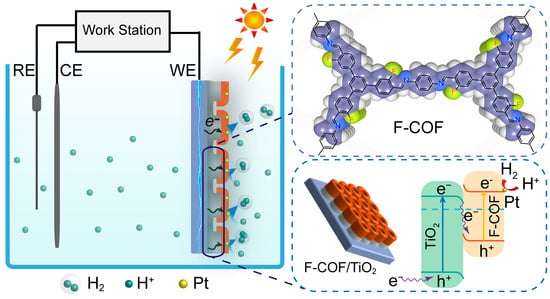
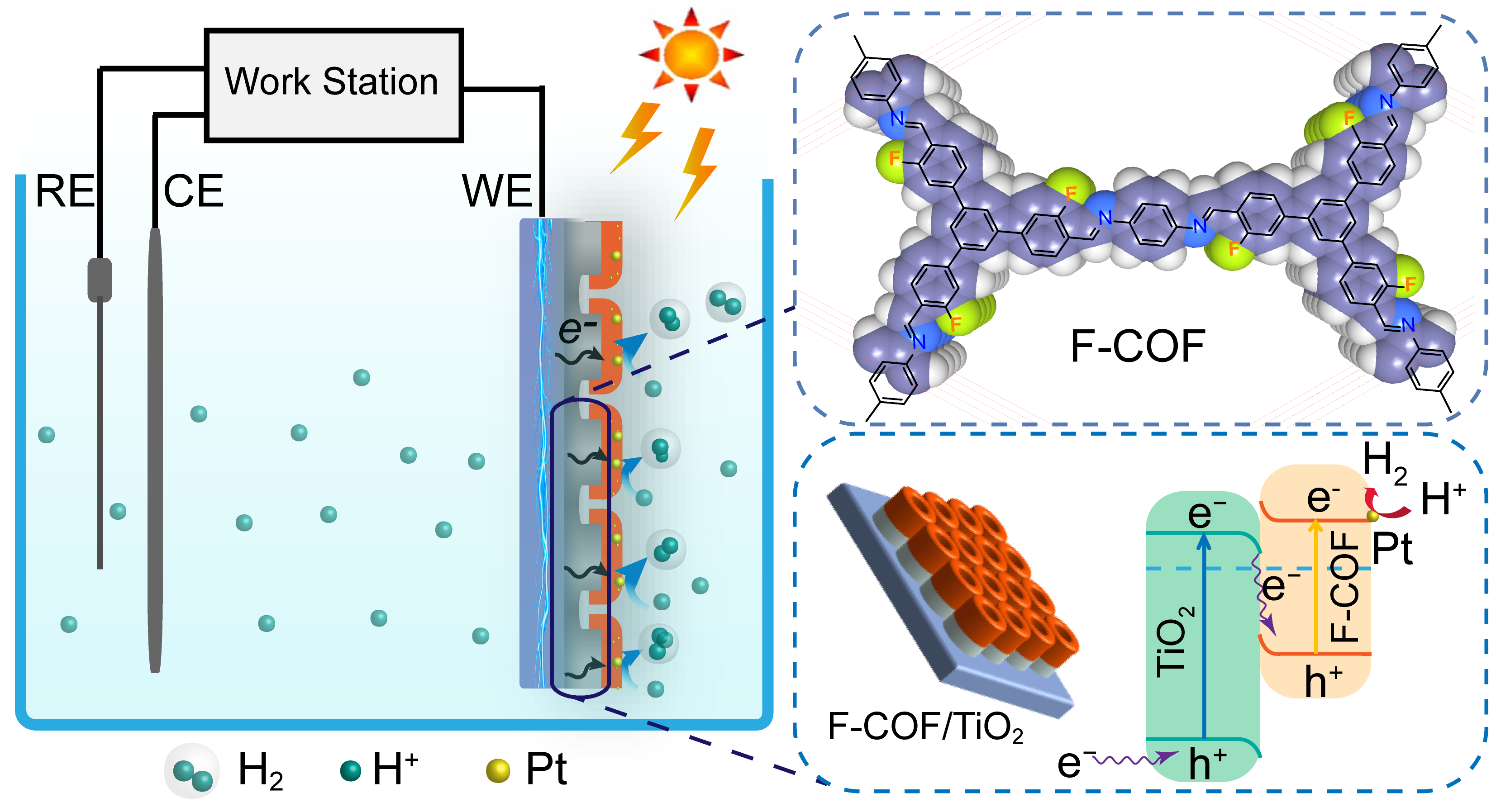
Inspired by the above-designed concept, an efficient and stable Z-scheme heterojunction photoelectrode for PEC hydrogen evolution was fabricated by solvothermal polycondensation of F-substituted 2D imine COF (F-COF) films from 1,3,5-tris(3-fluoro-4-formylphenyl) benzene (TFPB) and 1,4-phenylenediamine (PPDA) on the surface of anodized titanium dioxide (TiO2) nanotubes (Figure 1). Anodized TiO2 nanostructures serve as an exemplary substrate for photoelectrode design due to their facile fabrication, tunable morphology, photoconductive properties, environmental friendliness, robust chemical stability in aqueous electrolytes, and suitable band edge positions for interfacing with other semiconductors [38]. When integrated with 2D F-COF films, TiO2 can form intimate heterojunctions (e.g., Z-scheme) that significantly enhance the spatial separation of photogenerated charge carriers. The Z-scheme F-COF/TiO2 photoelectrode demonstrated extended absorption performance and efficient pathways for interfacial charge separation and transfer. The fluorination in the F-COF films further promotes the separation and transfer of photogenerated charges. To further optimize the hydrogen evolution reaction kinetics at the photoelectrode–electrolyte interface, the decoration with Pt species as a cocatalyst is a common and effective strategy functioning not only as highly active sites for proton reduction but also as efficient electron sinks. With the photo-deposited Pt species as co-catalysis, the Pt@F-COF/TiO2 photoelectrode revealed enhanced PEC efficiency and significantly improved hydrogen evolution rate with good cycling stability. This work not only explores the potential of F-substituted 2D COFs in enhancing PEC performance but also provides valuable insights into the design of advanced heterojunction photoelectrodes for sustainable hydrogen production.

2. Results and Discussion

2.1. Synthesis and Characterization

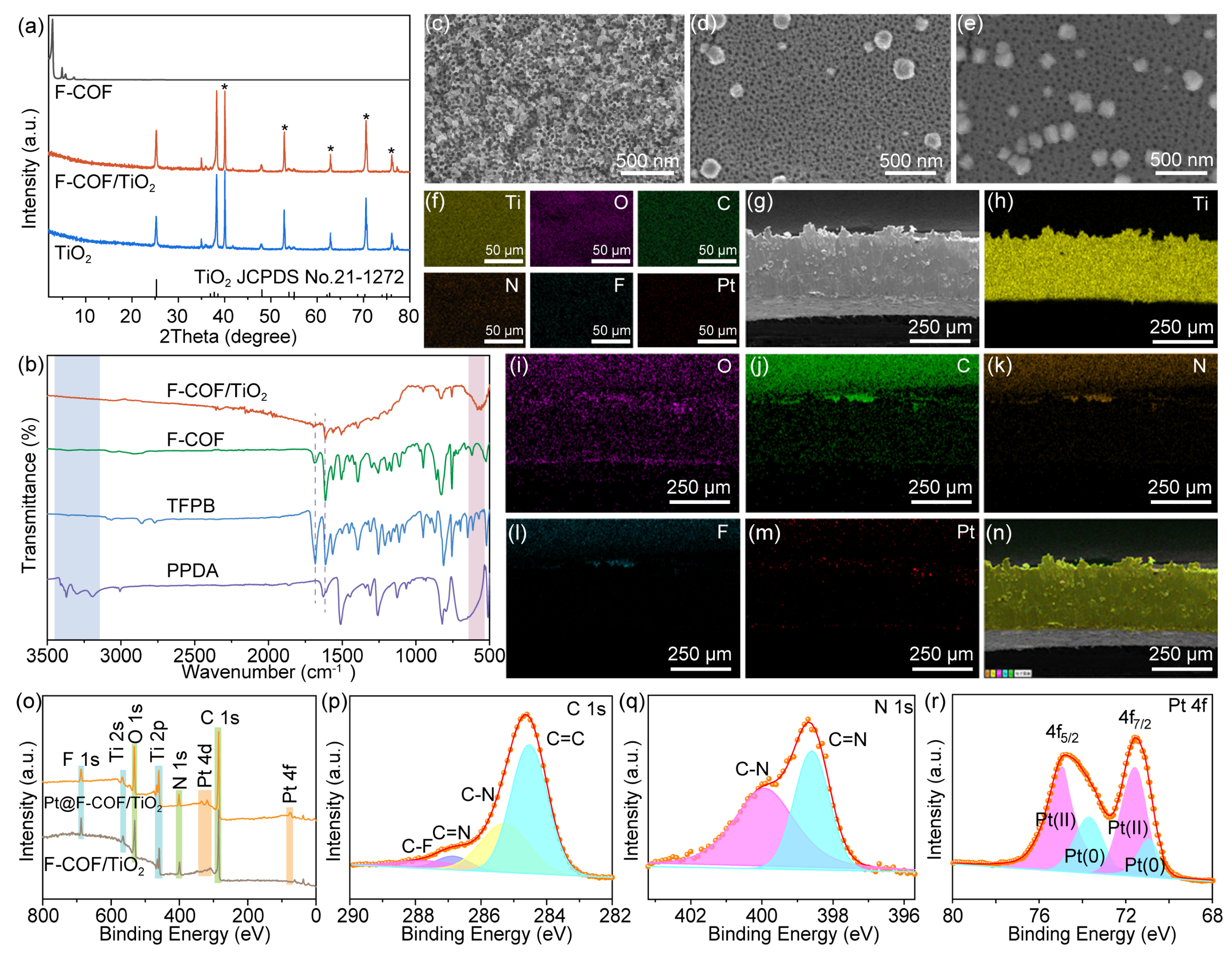
F-COF films grown on anodized TiO2 nanotubes and F-COF powders were synthesized from TFPB and PPDA via the solvothermal method in a sealed autoclave or cylinder glass tube, respectively. A mixed solvent of 1,2-dichlorobenzene (o-DCB) and 1-butanol (n-BuOH), with a volume ratio of 1:1, was used for F-COF synthesis. Pt species as co-catalysts were in situ photo-deposited onto the F-COF-based electrode. The F-COF powders demonstrate high crystallinity, confirmed by powder X-ray diffraction (PXRD) patterns (Figure 2a and Figure S1). The significant diffraction peaks are well consistent with the calculated pattern. While no specific peaks of F-COF are detected in the XRD patterns of F-COF/TiO2 electrode (Figure 2a) due to the less-coated F-COF films, only the XRD peaks of the anatase phase of TiO2 are recorded, combined with the diffraction peaks of Ti substrate (marked with * in Figure 2a).
The chemical structure of F-COF films on the TiO2 surface was further characterized by using Fourier transform infrared (FTIR) spectra in the attenuated total reflection mode (Figure 2b). Most of the amine groups in PPDA are consumed, indicated by the vanished N-H stretching modes from 3200 to 3500 cm−1. The FTIR peak related to C=O stretching vibration at 1684 cm−1 in TFPB objectively shrinks, indicating the consumption of aldehyde monomers during the polycondensation for F-COF formation. The FTIR peak at 1615 cm−1, which is coupled with the aromatic ring vibration of the benzene ring, reveals the stretching vibration mode of the formed imine bond, indicating the successful preparation of F-COF. Additionally, the broad peak around 600 cm−1 in the spectrum of F-COF/TiO2 indicates the Ti-O-Ti vibration modes of TiO2. As a control experiment, COFTAPB-PPDA films without F substitution were also constructed on the anodized TiO2 surface. A shoulder peak ascribed to imine bonds emerges at 1621 cm−1 with the total consumption of amino and aldehyde groups of monomers (Figure S2).
The microstructures of the formed F-COF films on TiO2 substrate were investigated by using a scanning electron microscope (SEM) with energy dispersive spectroscopy (EDS). The anodized TiO2 exhibits a typical nanotubular microstructure with a diameter of approximately 42 nm (Figure 2c). Numerous anodized fragments are also observed on the rough TiO2 surface. The growth of the F-COF film renders the TiO2 surface smooth while preserving the pore structure of the nanotubes. Some nanoparticles are formed with diameters ranging from 100 to 300 nm on the surface (Figure 2d). The in situ photo-reduced deposition of Pt species as proton catalysts does not alter the surface microstructure of the F-COF/TiO2 (Figure 2e). Similar microstructures are also observed for the COFTAPB-PPDA/TiO2 surface, but demonstrating the less-exposed pore structure of the nanotubes due to the growth of the COFTAPB-PPDA film (Figure S3). Top-view SEM mapping reveals that the elements constituting the F-COF/TiO2 are uniformly distributed on the surface (Figure 2f). Side-view mapping indicates that the distribution of Ti and O is essentially consistent with the elemental composition of the Ti foil substrate (Figure 2g–i). The elements C, N, F, and Pt are predominantly concentrated in the surface region (Figure 2j–n), which agrees with the morphology, showing the growth of the F-COF film on the TiO2 surface.
The formation of F-COF/TiO2 and Pt@F-COF/TiO2 electrodes was also verified by using X-ray photoelectron spectroscopy (XPS). These two electrodes demonstrate typical Ti, O, C, N, and F peaks in the survey spectra, while the featured Pt 4f and 4d peaks are detected for Pt@F-COF/TiO2 (Figure 2o). The assigned C=C, C-N, C=N, and C-F peaks in the C 1s spectra (Figure 2p) reveal the chemical structure of F-COF on TiO2 substrate, combined with the O 1s, Ti 2p, and F 1s spectra (Figure S4). C-O-Ti bond is also assigned in O 1s spectra, which is attributed to the covalent bonding between the F-COF film and TiO2 nanotubes. The C=N peak at 398.5 eV and C-N peak at 400 eV further confirm the formation of the imine linkage of F-COF as assigned in N 1s spectra (Figure 2q). Two spin-split peaks of Pt are recorded in the Pt 4f spectra, which are attributed to 4f7/2 and 4f5/2 orbitals with an energy gap of 3.2 eV (Figure 2r). The binding energies of lower valence states of Pt(II) are assigned at 71.5 eV and 74.8 eV, respectively. Few Pt(0) is also detected as located at 70.9 eV and 73.7 eV, respectively. No initial Pt(IV) in H2PtCl6 is detected, indicating the full reduction in Pt species during the photo-induced deposition. All these characterizations confirmed the successful preparation of F-COF-based heterostructure electrodes.

2.2. General Photoelectrochemical Performance

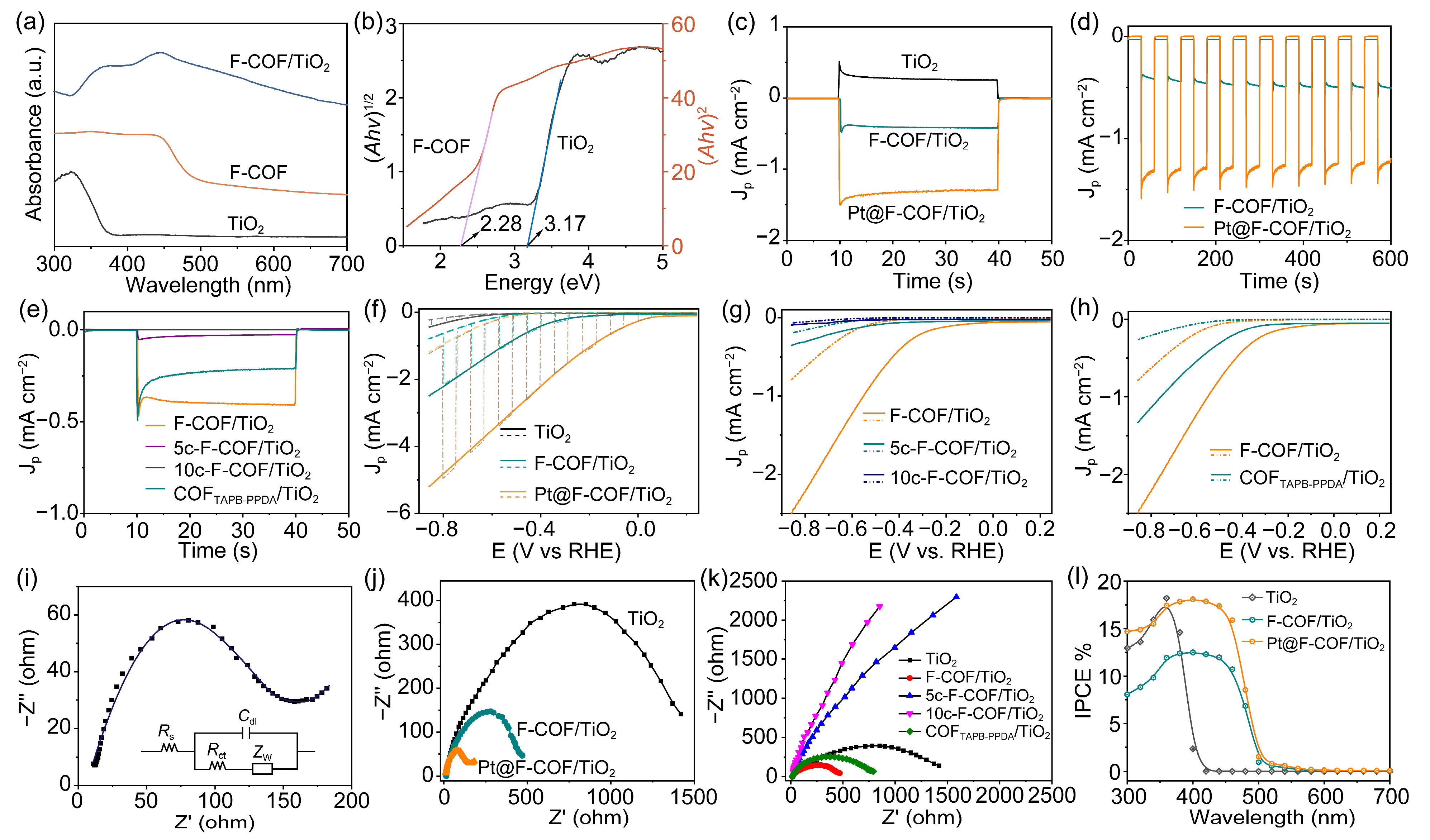
The ultraviolet-visible (UV-vis) light absorption spectra were recorded to evaluate the photophysical properties of the F-COF/TiO2 photoelectrode compared to individual F-COF and TiO2. Anodized TiO2 shows the typical absorption to UV light with the absorbance edge of 370 nm, while F-COF demonstrates a light absorption range from the UV region to the visible-light edge of ca. 490 nm (Figure 3a). F-COF/TiO2 reveals a broader UV-vis absorption region with increased absorbance, indicating its enhanced light absorption capability. The optical band gaps for F-COF and anodized TiO2 are evaluated as 2.28 eV and 3.17 eV, respectively, according to the Tauc’s plots deriving from their absorption spectra (Figure 3b).
The PEC performance of the F-COF-based photoelectrodes was evaluated by using the transient photocurrent response. As shown in Figure 3c, the anodized TiO2 electrode demonstrates an anodic photocurrent density of 0.59 mA cm−2 in a phosphorus buffer solution (PBS, pH = 7) under the light irradiation of a 300 W Xe lamp which simulated AM 1.5G sunlight (100 mW cm−2). Both the F-COF modified Ti foil electrode and F-COF/TiO2 photoelectrode reveal the cathodic photocurrent response at 0.155 VRHE (Figure 3c and Figure S5). A steady, neat photocurrent density of −0.42 mA cm−2 is recorded for the F-COF/TiO2 photoelectrode in PBS, which is about two times that of F-COF (−0.19 mA cm−2). This result indicates that the combination of F-COF onto the TiO2 nanotube array surface can dominantly transform both the UV irradiation and visible light into cathodic current [39]. The presence of TiO2 electrode significantly enhances the photocurrent response by facilitating the separation and transport efficiency of photo-induced charge carriers in the formed F-COF/TiO2 heterostructures. The photo-deposition of Pt species can further increase the photocurrent density to −1.34 mA cm−2 for Pt@F-COF/TiO2 photoelectrode, implying that the Pt species may also contribute to reducing the recombination of photogenerated charge carriers and facilitating the effective separation and transfer of photogenerated electrons. Both the Pt@F-COF/TiO2 and F-COF/TiO2 photoelectrodes demonstrate stable photocurrent response over ten cycles (Figure 3d).
Fluorine substitution demonstrates a great impact on the PEC performance of COF/TiO2 photoelectrodes. Without F substitution, the COFTAPB-PPDA/TiO2 photoelectrode exhibits a strong photocurrent response immediately upon illumination but experiences rapid decay, likely due to the fast recombination of photogenerated carriers lacking an effective heterojunction or optimized structure (Figure 3e). A photocurrent density of −0.22 mA cm−2 is recorded after 30 s, which is almost half lower than that of the F-COF/TiO2 photoelectrode. These results suggest that the F substitution may enhance the efficiency of photogenerated charge separation and transfer. The high electronegativity of F atoms may modify the electronic structure of the F-COF and induce charge polarization within the F-COF structure, facilitating the polarity-induced separation of photogenerated electrons and holes and further optimizing the charge transport pathways and catalytic performance [27,40]. On the other hand, the monomer concentrations for fabricating F-COF films also significantly impact the transient photocurrent density of F-COF/TiO2 photoelectrodes. The 5c-F-COF/TiO2 or 10c-F-COF/TiO2 photoelectrode exhibits a dramatically decreased photocurrent response as the monomer concentration is increased for fabricating thicker F-COF films on the TiO2 surface (Figure 3e). A thicker F-COF film may impede the transport of photogenerated carriers due to either the lower conductivity of COF films or the increased diffusion path length, suppressing the charge separation and transport between F-COF and TiO2. Therefore, the incorporation of fluorine and the optimization of monomer concentration for F-COF film fabrication are essential ways to enhance the PEC performance of F-COF-based photoelectrodes.
The PEC response is further investigated by using linear sweep voltammetry (LSV) measurements under illumination. Compared to the lower current density of the TiO2 electrode either in the dark or under light irradiation, the photocurrent densities of the F-COF/TiO2 and Pt@F-COF/TiO2 photoelectrodes increase progressively with the applied negative potential under illumination, exhibiting a much steeper trend compared to that in the dark (Figure 3f), which indicates their good PEC activity over a broad potential range. Furthermore, the onset potentials for the three photoelectrodes (TiO2, F-COF/TiO2, and Pt@F-COF/TiO2) are evaluated as −0.544 VRHE, −0.226 VRHE, and 0.064 VRHE based on the LSV curves under light irradiation. The net photocurrent density for Pt@F-COF/TiO2 photocurrent is calculated as −303.6 μA cm−2 at 0 VRHE and −2.86 mA cm−2 at −0.5 VRHE, which are higher than that of F-COF/TiO2 electrodes (−57.9 μA cm−2 at 0 VRHE and −773.4 μA cm−2 at −0.5 VRHE, Figure S6 and Table S1). The onset potential and photocurrent density of the Pt@F-COF/TiO2 photoelectrode are comparable to the previously reported TiO2-based photocathodes, while slightly superior to the currently COF-based photoelectrodes in photocurrent density and the Pt-decorated SnSe electrode for PEC hydrogen evolution, as summarized in Table S2 [34,35,36,37,41,42,43,44,45,46,47]. The comparison indicates that the Pt@F-COF/TiO2 photoelectrode exhibits acceptable and moderate PEC performance.
As control experiments, very low photocurrent densities are recorded with applied potentials for 5c-F-COF/TiO2 and 10c-F-COF/TiO2 electrodes (Figure 3g) and the COFTAPB-PPDA/TiO2 electrode reveals a lower photocurrent density and higher onset potential value compared to F-COF/TiO2 (Figure 3h), which are consistent with the PEC properties above. These results indicate that the optimized F-COF/TiO2 heterojunction can significantly enhance the charge separation and transfer efficiency at the photoelectrode surface. The photo-deposited Pt species can further facilitate charge separation and interfacial transfer. The applied bias accelerates further charge transfer and suppresses the recombination of photogenerated carriers, thereby improving the overall PEC performance by channeling photo-induced electrons into reduction reactions and satisfying the thermodynamic requirements for hydrogen evolution [48,49].
The chargetransfer resistance at the photoelectrode interfaces was further investigated using Nyquist plots of electrochemical impedance spectra (EIS) under full-spectrum light irradiation with fitted curves by using the NOVA software (version 2.1). The Nyquist plot fitting demonstrated excellent agreement with the proposed equivalent circuit model as represented in Figure 3i for Pt@F-COF/TiO2 photoelectrode. In the simulated equivalent circuit, Rs represents the solution resistance. Rct corresponds to the charge transfer resistance at the F-COF-based photoelectrode/electrolyte interface, which is one of the most critical parameters in the photoelectrochemical process. It reflects the ease or difficulty of charge transfer and the reaction kinetics at the photoelectrode interface. Cdl represents the double-layer capacitance formed at the electrode/electrolyte interface. The parallel combination of Rct and Cdl constitutes a semicircular arc, reflecting the interfacial charge transfer kinetics. As shown in Figure 3j, F-COF/TiO2 photoelectrode exhibits an Rct of 490 Ω, which is markedly lower than that of the pristine anodized TiO2 photoelectrode (>1800 Ω) and also lower than the non-fluorinated COFTAPB-PPDA/TiO2 photoelectrode (765 Ω). Most notably, the Rct of the Pt@F-COF/TiO2 photoelectrode further decreases to 157 Ω. This significant reduction in Rct can be attributed to the enhanced photoconductance and improved photo-induced charge separation efficiency in these composite photoelectrodes. Particularly, Fsubstitution in F-COF films also facilitates the charge transfer at the optimized interface of the F-COF/TiO2 heterostructure compared to its non-fluorinated counterpart. However, the 5c-F-COF/TiO2 and 10c-F-COF/TiO2 photoelectrodes reveal higher interfacial resistance than the TiO2 electrode (Figure 3k), ascribed to the inherent poor conductivity of thicker F-COF films. Furthermore, the influence of the Warburg Impedance (W) was negligible across all samples, indicating that the interfacial charge transfer process, rather than mass transport, is the rate-limiting step in these measurements. The EIS results support the photocurrent response behaviors of F-COF-based photoelectrodes as discussed above.
The incident-photon-to-current conversion efficiency (IPCE) is employed to evaluate the PEC performance of the F-COF-based photoelectrodes. Compared to the typical ultraviolet-light response of the TiO2 electrode with a top IPCE of 17.5% at 360 nm, the F-COF/TiO2 electrode demonstrates extended visible-light photo-response with an IPCE value of 12.4% at 360-480 nm (Figure 3l). By depositing Pt species onto F-COF/TiO2, Pt@ F-COF/TiO2 photoelectrode exhibits enhanced IPCE in a similar visible-light spectrum range from 300 to 500 nm, where the summit IPCE is recorded as 17.7%. It indicates the enhanced charge separation and transfer in the Pt@F-COF/TiO2 heterostructures. Integration of the IPCE spectra yields photocurrent densities roughly double the transient values recorded in Figure 3c, and both datasets follow an analogous ascending trend. The excellent PEC performance of the optimized Pt@F-COF/TiO2 photocathode promises its potential in PEC hydrogen evolution applications.

2.3. Photoelectrochemical Hydrogen Evolution

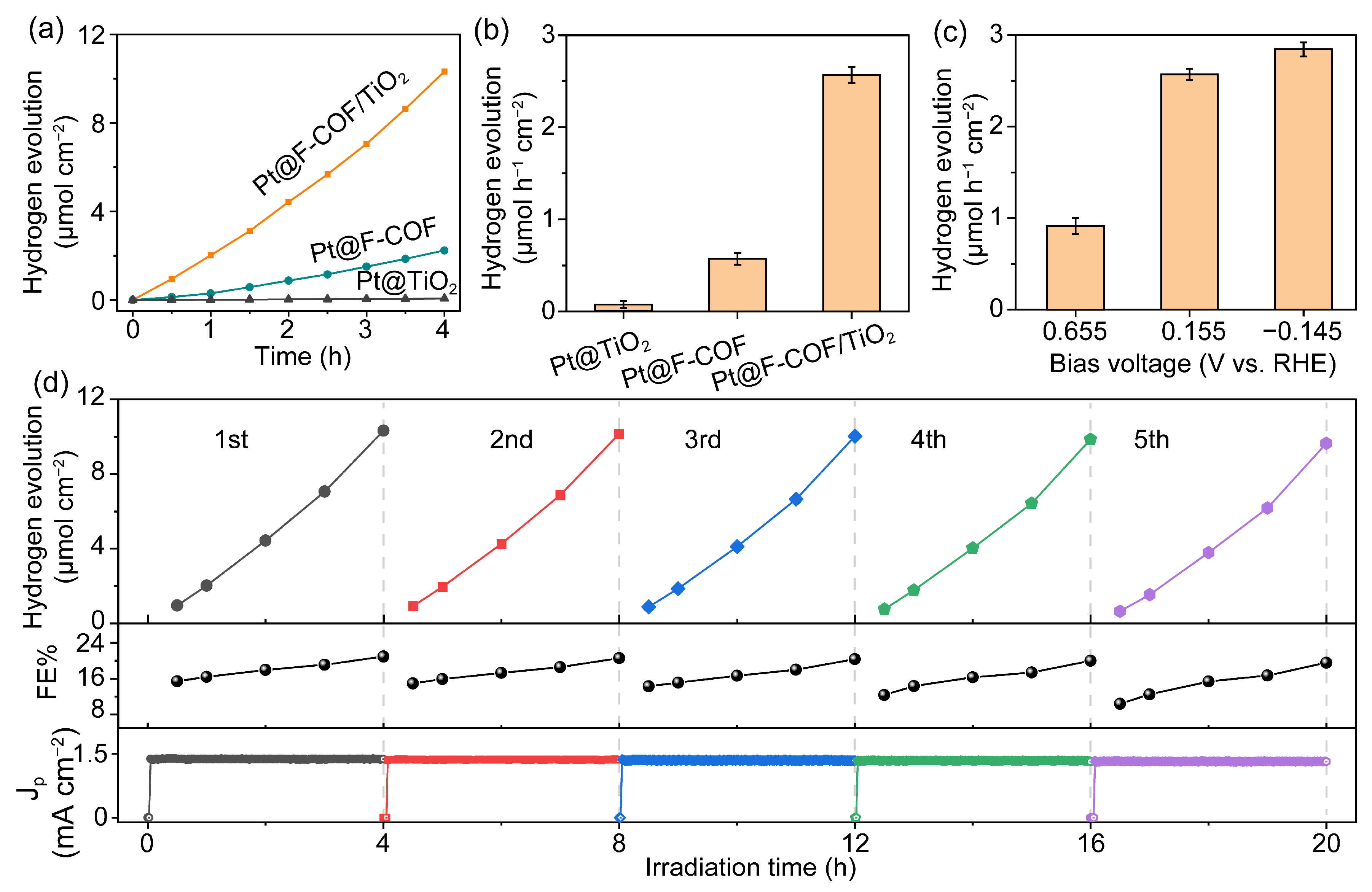
The PEC hydrogen evolution performance of Pt@F-COF/TiO2 photoelectrode is quantitatively investigated in a PEC cell with a 0.5 M PBS solution (pH = 7) under the AM 1.5G simulated sunlight irradiation. Under optimized conditions, the Pt@F-COF/TiO2 photocathode shows progressively increased hydrogen production from aqueous solutions over time under light irradiation, whose PEC hydrogen generation capability is remarkably stronger than Pt@F-COF and Pt@TiO2 in 4 hours (Figure 4a). The PEC hydrogen evolution rate of Pt@F-COF/TiO2 photoelectrode is evaluated as 2.57 μmol h−1 cm−2, about 4.5 times that of the Pt@F-COF and 33.6 times that of Pt@TiO2 (Figure 4b). TiO2 and F-COF/TiO2 photoelectrode without Pt species modification hardly revealed PEC activity for hydrogen evaluation, indicating the contribution of cocatalyst loading to accelerated surface reaction kinetics and the overall performance enhancement. The bias voltages demonstrate a consistent effect on the PEC hydrogen evolution rate corresponding to the PEC performance of Pt@F-COF/TiO2 photoelectrode (Figure 4c). A hydrogen evolution rate of 0.82 μmol h−1 cm−2 is recorded at the bias of 0.655 VRHE for the Pt@F-COF/TiO2 photoelectrode. The enhanced negative bias can improve the PEC hydrogen evolution rate to 2.74 μmol h−1 cm−2 at 0.155 VRHE and slightly further to 2.91 μmol h−1 cm−2 at −0.145 VRHE. It indicates that an appropriate bias can help enhance the PEC hydrogen evolution efficiency. The 0.155 VRHE is used for further PEC hydrogen evolution.
It is noteworthy that the performance enhancement trend observed for the composite photoelectrodes remains consistent across the different electrolytes. Specifically, the activity ranking of Pt@F-COF/TiO2 > F-COF/TiO2 > pristine TiO2 is unambiguously demonstrated in the photocurrent density and onset potential in LSV (0.5 M H2SO4). The Pt@F-COF/TiO2 photoelectrode demonstrates the most efficient and stable hydrogen production (in 0.5 M PBS) and the lowest Rct in EIS (in 0.5 M Na2SO4) with the same order compared to F-COF/TiO2 and pristine TiO2. This coherence across varying pH and ionic environments strongly confirms that the superior performance of the fluorination-enhanced charge separation in the heterojunction and the catalytic function of Pt species, rather than an artifact of the measurement condition.
After the first PEC hydrogen evolution cycle, the Pt@F-COF/TiO2 photocathode can be conveniently and effectively removed from the reaction solutions compared to the complex collection of photocatalysts. Additionally, the photoelectrodes can be readily reused by just being activated in tetrahydrofuran for 2 h. The Pt@F-COF/TiO2 photoelectrode can continuously generate hydrogen from refreshed aqueous solutions for another four cycles without a significantly decreased hydrogen evolution rate (Figure 4d). A total of 93.4% of the PEC hydrogen evolution capability of the Pt@F-COF/TiO2 photoelectrode is reserved for 4 h after the fifth cycle. No significant microstructural changes are observed on the surface of the Pt@F-COF/TiO2 photoelectrode after five consecutive cycles, as evidenced by the SEM images (Figure S7). This indicates the robust cycling stability of the photoelectrode in the neutral PBS electrolyte. The Faradaic efficiency (FE%) was employed to evaluate the PEC hydrogen production performance of the Pt@F-COF/TiO2 photoelectrode during the cycling tests. The calculated FE% along with the PEC hydrogen evolution procedure demonstrates an increased value from 15.4% to 20.9% for the first 4-h cycle. A slight decrease in FE% in 4 h is recorded to 19.6% with a loss of 6.2% after the fifth cycling test. An average Faradic efficiency of 20.3% is calculated for every 4 h. These results imply the durability and stability of the Pt@F-COF/TiO2 photoelectrode for PEC hydrogen evolution.

2.4. Photoelectrochemical Hydrogen Evolution Mechanism

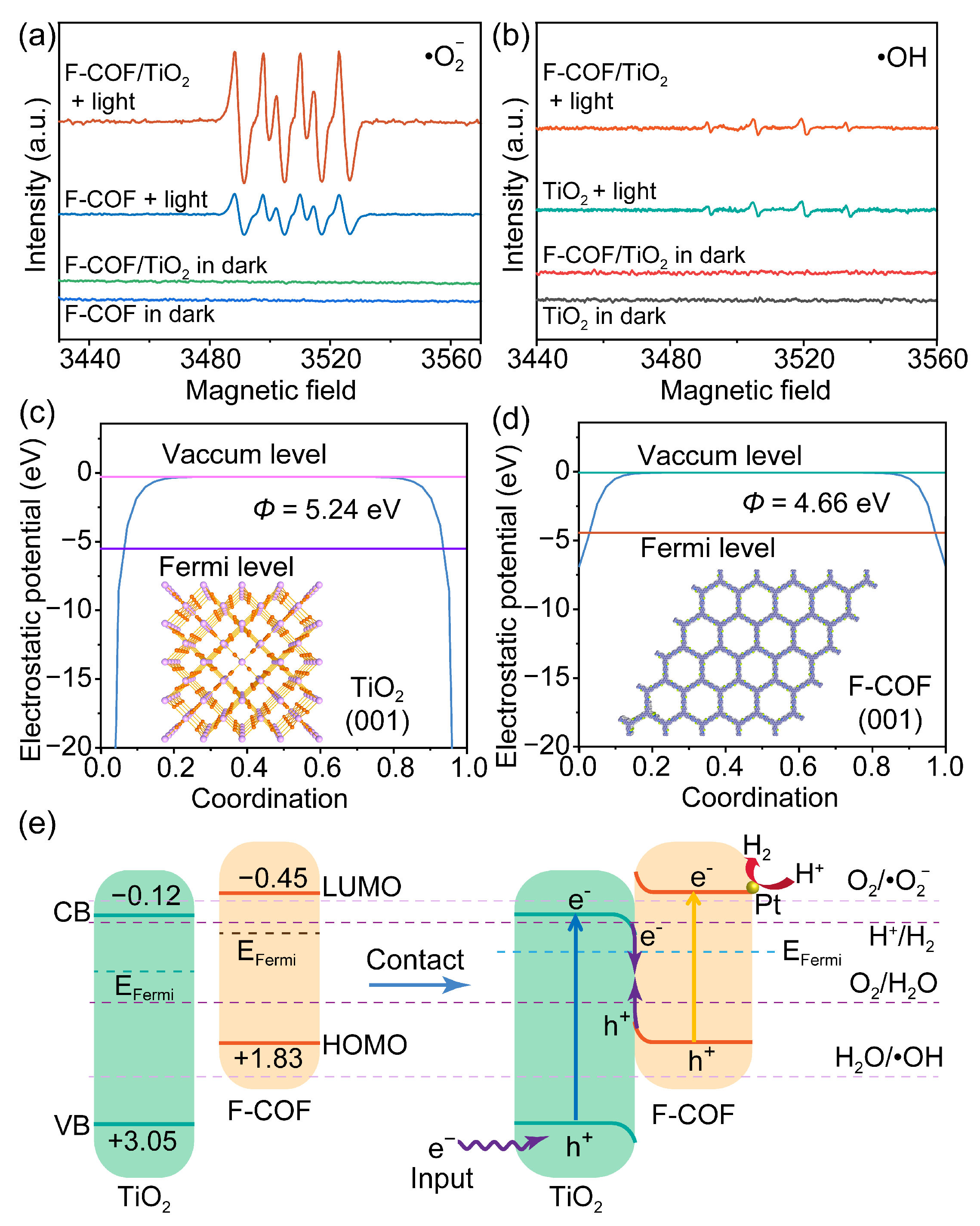
The band diagrams of F-COF/TiO2 are first evaluated to illustrate the PEC hydrogen evolution process. The flat-band potentials of F-COF and TiO2 were estimated as −0.69 V and −0.36 V (vs. SCE), respectively, via Mott–Schottky plots (Figure S8), which are approximately equivalent to the conduction band (CB) or lowest unoccupied molecular orbital (LUMO) positions of the two materials. In conjunction with their optical band gaps, the band diagrams of F-COF and TiO2 are summarized in Figure 5. The conduction band levels of both F-COF and TiO2 are higher than the reversible potential of H+/H2, indicating their potential to utilize photogenerated electrons for hydrogen production from aqueous solutions.
The schematic diagrams of the charge transfer at the Pt@F-COF/TiO2 heterojunction interfaces are investigated to illustrate the mechanism for the PEC hydrogen evolution process by using experimental confirmation and density functional theory (DFT) computations. Electron paramagnetic resonance (EPR) spectra were conducted with 5,5′-dimethyl-1-pyrroline-N-oxide (DMPO) as the signal-detecting agent for photo-induced radicals in different solutions to reveal the charge transfer process. The generated superoxide radicals (•O2) signals are recorded for F-COF and F-COF/TiO2 as their exposure to light for 10 min (Figure 5a). This can be attributed to the higher energy level of LUMO for F-COF (−0.45 V vs. RHE) than the reversible potential of O2/•O2 (−0.33 V vs. RHE at pH 7) [29], thereby thermodynamically reducing O2 to •O2. Moreover, the DMPO-•O2 signals of F-COF/TiO2 are stronger than those of individual F-COF, ascribed to more efficient charge separation and higher photoelectron density in the F-COF/TiO2 heterojunctions. No DMPO-•O2 signals are detected for anodized TiO2 under the same conditions due to its lower energy level (−0.12 V vs. RHE) for reducing O2 to generate •O2. The enhanced DMPO-•O2 signals for F-COF/TiO2 imply that the photo-induced electrons accumulate on the LUMO of F-COF rather than migrate to the conduction band of TiO2, which conflicts with the characteristics of a typical type-II heterojunction. Additionally, weak DMPO-•OH signals are detected under light irradiation for TiO2 and F-COF/TiO2 with similar intensities due to the oxidation of H2O by a few photo-induced holes on the valence band (VB) of TiO2 (Figure 5b). No •OH signals are recorded for F-COF because the energy level of the highest occupied molecular orbital (HOMO) in F-COF cannot meet the oxidation potential of H2O/•OH (2.34 V vs. RHE, at pH 7) [50]. The produced •OH signals for F-COF/TiO2 heterojunctions also indicate that photogenerated holes are confined to the conduction band of TiO2 and cannot be transferred to the HOMO of F-COF, which further confirms that the F-COF/TiO2 heterostructure is not a type-II heterojunction.
From the DFT calculation results, F-COF shows a lower work function (Φ = 4.66 eV) and a higher Fermi level (EFermi = 0.16 V vs. RHE) compared to TiO2 (Φ = 5.24 eV and EFermi = 0.74 V vs. RHE, Figure 5c,d). The difference in Φ between F-COF and TiO2 could drive free electrons to transfer across the interface from F-COF films to anodized TiO2 as they intimately contact in the dark. The spontaneous electron migration results in the accumulation of free electrons in TiO2 and diminished electron density in F-COF. The bands at the contact interface between F-COF and TiO2 gradually bend along with the interfacial charge transfer process until an equilibrium Fermi level is established (Figure 5e). An internal electric field (IEF) would consequently be formed at the typical direct Z-scheme F-COF/TiO2 heterojunction interface with an orientation from partially positive F-COF to free-electron-accumulated TiO2 [29,31]. Under light irradiation, photoelectrons are excited from the valence band to the conduction band in anodized TiO2 and from HOMO to LUMO in F-COF films, respectively. Subsequently, the photoelectrons in the conduction band of TiO2 tend to integrate with the holes in the HOMO of F-COF films due to the synergistic effects of band bending, Coulomb attraction, and IEF, as well as the polarity-induced charge separation and transfer because of F substitution [26,28]. The active photoelectrons are preserved in the LUMO of F-COF with strong reduction capability and are further rapidly transferred to Pt species for enhanced hydron generation from aqueous solution. The holes retained in the valence band of TiO2 and partially in the HOMO of F-COF are captured by electrons supplied from an external electric field, thereby reducing the recombination of photo-induced charge carriers in the F-COF/TiO2 heterojunction. An appropriate positive bias of the external electric field can further enhance the integration of photoelectrons in the conduction band of TiO2 with holes in the HOMO of F-COF, driven by the IEF. It also facilitates the transfer of photoelectrons from the LUMO of F-COF to the Pt species, thereby promoting the PEC hydrogen production efficiency.

3. Materials and Methods

3.1. Synthesis of F-COF Powders

All reagents were purchased from Acros Organics (Beijing, China) unless otherwise specified and used directly without further purification. The F-COF powders were synthesized from the polycondensation of 1,3,5-tris(3-fluoro-4-formylphenyl) benzene (TFPB) and 1,4-phenylenediamine (PPDA) in the presence of acetic acid via the solvothermal method in a sealed tube. Typically, TFPB (44.4 mg, 0.1 mmol), PPDA (16.22 mg, 0.15 mmol), and a mixed solvent (1 mL, v/v = 1:1) of 1,2-dichlorobenzene (o-DCB), 1-butanol (n-BuOH) were charged in a cylinder glass tube. The mixture was sonically treated to obtain a homogeneous suspension. Then, acetic acid aqueous (400 μL, 6 mol L−1) was added to the cylinder tube. After degassing by the typical three freeze–pump–thaw cycles, the cylinder glass tube with reacting precursors was sealed and heated to 120 °C for 72 h. After cooling down to room temperature, the F-COF powders were collected and activated with THF in a Soxhlet extraction system for 24 h.

3.2. Synthesis of F-COF Films on Anodized TiO2 Substrates

The anodized TiO2 on Ti foil (Alfa Aesar, Shanghai, China, 99.8%, metal basis) with a thickness of 1 mm was carried out at 60 V for 15 min in an ethylene glycol solution containing 0.1 wt% of NH4F (Sinopharm Chemical Reagent Co. Ltd., Shanghai, China, >96%) and 1 wt% H2O, which was further annealed at 450 °C for 2 h [35].
The synthesis of F-COF films on anodized TiO2 substrates was performed via a solvothermal reaction. Typically, TFPB (0.03 mmol L−1) and PPDA (0.03 mmol L−1) were homogeneously dissolved in the mixed o-DCB and n-BuOH (10 mL, v/v = 1:1). Then, acetic acid aqueous (50 μL, 6 mol L−1) was added to the precursor mixture and sonically treated for 10 min. The homogeneous solution was transferred into a linear polytetrafluoroethylene (PTFE) autoclave (25 mL in total capacity). TiO2/Ti substrates were loaded into a homemade Π-shaped PTFE holder. The PTFE holder with TiO2/Ti slices was carefully submerged in the precursor solution of the PTFE autoclave. Then, the PTFE autoclave was sealed in a stainless-steel container and heated to 120 °C for 72 h. After cooling down to room temperature, the Ti foils coated with F-COF films were rinsed and activated with THF overnight, and dried under vacuum at 70 °C.
Higher monomer concentrations (5 times, 0.15 mmol L−1 for TFPB; 10 times, 0.3 mmol L−1 for TFPB) were also used for F-COF film growth, denoted as 5c-F-COF/TiO2 and 5c-F-COF/TiO2, respectively. As a control experiment, COFTAPB-PPDA films were also synthesized on anodized TiO2 substrates by replacing TFPB monomer with 1,3,5-tris(4-aminophenyl) benzene (TAPB).

3.3. Fabrication of Pt@F-COF/TiO2 Electrodes

Pt@F-COF/TiO2 electrodes were fabricated by loading Pt species onto F-COF/TiO2 according to the previously reported in situ photo-deposition method [35,51]. Typically, F-COF/TiO2 and TiO2 electrodes, as well as F-COF/Ti electrode, were dipped into an H2PtCl6 (Sigma-Aldrich, Beijing, China, ≥99.9%) aqueous solution (1 mg mL−1, 1 mL) for 30 min under the irradiation of a 300 W Xe lamp (PLS-SXE 300+/UV, Beijing PerfectLight Technology Co., Ltd., Beijing, China, AM 1.5G simulated sunlight, 100 mW cm−2). The Pt-loaded electrodes were washed with deionized water and dried at 70 °C for further characterization and measurements.

3.4. General Methods

Fourier transform infrared (FTIR) spectra were recorded in the range of 400~4000 cm−1 with an interval of 4 cm−1 on a PerkinElmer Frontier™ FTIR spectrophotometer (Waltham, MA, USA) in the attenuated total reflection (ATR) mode with an additional variable angle reflectance accessory under ambient conditions. The X-ray diffraction (XRD) patterns of F-COF powders were recorded on a PANalytical Empyrean Diffractometer (Almelo, the Netherlands) operated at 40 kV and 40 mA with Cu Kα radiation (λ = 1.5416 Å), ranging from 1.5 to 40° with a speed of 2°/min at ambient temperature. The XRD patterns of TiO2 and F-COF/TiO2 electrode were collected in the range of 1.5 to 80° with a speed of 5°/min. The microstructures and element distribution of samples were observed on a JEOL JSM-7900F scanning electron microscope (SEM, Tokyo, Japan). The cross-sectional observation of the Pt@F-COF/TiO2/Ti electrode was performed by SEM after being cut frozen by liquid nitrogen. XPS spectra were performed on a Thermo Fisher Scientific ESCALAB 250Xi spectroscope (Waltham, MA, USA) with 200 W monochromated Al Kα radiation (photon energy 1253.6 eV) as the exciting source at a working voltage of 12.5 kV. The 500 μm X-ray spots were used for XPS analysis. The base pressure in the analysis chamber was about 3 × 10⁻¹⁰ mbar. Typically, the hydrocarbon C1s line at 284.8 eV from adventitious carbon is used for energy referencing. The background of all spectra was subtracted using a Shirley-type background to remove most of the extrinsic loss structure. The absorption spectra of the TiO2 electrode and F-COF were recorded on a PerkinElmer Lambda 750 UV–vis scanning spectrophotometer (Waltham, MA, USA) in diffuse reflection mode with an integrating sphere accessory in the range of 300 to 800 nm. A Bruker ESP 500 spectrometer (Karlsruhe, Germany) was used to observe the active free radical electron paramagnetic resonance (EPR) signal when exposed to UV-vis light. The materials were combined in a 50 mM 5,5-dimethyl-1-pyrroline N-oxide (DMPO) solution (methanol dispersion for DMPO-•O2 and aqueous dispersion for DMPO-•OH).

3.5. Modeling Methods

The crystal models for F-COF were modeled by using the Materials Studio 5.0 software package (Accelrys Software Inc., 2009, now BIOVIA, Materials Studio 5.0: Modeling Simulation for Chemical and Material, San Diego, CA, USA). The lattice parameters and atomic positions were optimized under the universal force field. The exchange-correlation energy was calculated for the theoretical computation of the work function by using the generalized gradient approximation (GGA) with Perdew–Burke–Ernzerhof (PBE) parametrization. The k-point was determined to be 1 × 1 × 1, and the energy threshold was set at 381 eV. The vacuum spaces were set at 30 Å for (001) facets of anatase-phase TiO2 and F-COF. The work function is represented by the formula Φ = Evacuum−EFermi, where EFermi and Evacuum stand for the electrostatic potentials of the Fermi level and the vacuum, respectively.

3.6. Photoelectrochemical Performance and Hydrogen Evolution

The photoelectrochemical (PEC) measurements were carried out on a CHI-760E electrochemical station (CH Instruments, Shanghai, China) with or without light irradiation from the 300 W Xe lamp, simulated AM 1.5G sunlight (100 mW cm−2). A standard three-electrode system was used for measurement by employing the Pt@F-COF/TiO2 photoelectrode with a surface area of 1 cm2 as the working electrode, a saturated calomel electrode (SCE) as the reference electrode, and Pt foil (length of 10 mm, diameter of 1 mm) as the auxiliary electrode. The potentials (ESCE vs. SCE) were uniformly converted with respect to the reversible hydrogen electrode (RHE, ERHE) by using the equation:
E RHE = E SCE + 0.241 V + 0.059 × pH
For probing the intrinsic charge separation of the heterojunction, the transient photocurrent response of photoelectrodes was performed in a phosphorus buffer solution (PBS, pH = 7, 0.5 M).
Linear sweep voltammetry (LSV) measurements were performed from 0.5 V to −1.2 V (vs. SCE), with a scan rate of 5 mV s−1 in a 0.5 M H2SO4 solution for benchmarking the hydrogen evolution activity under high proton flux. This acidic condition ensures rapid proton supply, thereby highlighting differences in the intrinsic catalytic activity of the photoelectrodes. Chopped-light LSV measurements were also performed with an on–off light controller under the same conditions.
For determining the flat-band potential and interfacial charge transfer resistance, a 0.5 M Na2SO4 aqueous solution (pH ~7) was employed for Mott–Schottky measurements in a voltage range of ±1.5 V under the frequency of 1 kHz. This inert, non-buffering electrolyte is a standard choice for such analyses, as it avoids specific ion adsorption that could interfere with accurate capacitance determination. Electrochemical impedance spectra (EIS) were carried out in a frequency range from 0.01 Hz to 100 kHz, with an amplitude of 5 mV in a 0.5 M Na2SO4 aqueous solution. Incident photon-to-electron conversion efficiency (IPCE) of the photocathodes was measured on a PL-PES PEC measurement system (Beijing Perfectlight Technology Co. Ltd., Beijing, China) with the typical three-electrode system in 0.5 M PBS solution (pH = 7). The IPCE was calculated according to the following formula:
I P C E =   | J p h o t o J d a r k | × 1240 λ × P i n × 100 %
where the Jphoto and Jdark represent the photocurrent density (mA cm−2) of the photoelectrode under the irradiation with a specific wavelength (λ, nm) and incident light intensity (Pin, mW cm−2).
The PEC hydrogen production was performed in a sealed PEC reacting cell made of stainless steel with a quartz window equipped with the standard three-electrode system and a circulating water system. PBS solution (50 mL, pH = 7, 0.5 M) was employed for evaluating the hydrogen evolution capability of the heterojunction photoelectrode. The area of the working electrode (Pt@F-COF/TiO2) was fixed at 1 cm2. The electrolyte solution was degassed for 30 min with high-purity nitrogen floating under dark conditions. Hydrogen was generated when the reacting cell was irradiated under the AM 1.5G-simulated sunlight. The hydrogen-producing rate measurement was carried out half-hourly by injecting 1 mL of reacting gas into a Techcomp GC7900 gas chromatograph (Shanghai, China) with a 15 Å molecular sieve packing column and a thermal conductivity detector. The circulating water system was applied to maintain the reacting cell at room temperature, avoiding the heat damage of the continuous light irradiation. A quantitative evaluation cycle lasted for 4 h. A fresh PBS solution was used for a new cycle. The Faradic efficiency (FE%) was calculated based on the PEC hydrogen-producing rate and chronoamperometric measurements (single strip level and the potential of 0.155 VRHE) according to the previous work [52].

4. Conclusions

In summary, a Z-scheme heterojunction photoelectrode composed of the imine-linked F-COF films and TiO2 was fabricated for enhanced PEC hydrogen evolution with the assistance of low-valent Pt cocatalysts. The Pt@F-COF/TiO2 heterostructures were constructed by the solvothermal growth of F-COF on the surface of anodized anatase-phase TiO2 nanotubes from TFPB and PPDA, followed by the in situ photo-deposition of Pt(II) and Pt(0) species and thoroughly analyzed through a comprehensive set of characterization techniques. The optimized Pt@F-COF/TiO2 heterojunction exhibited superior PEC performance, such as the broader absorption range, higher transient photocurrent density, lower interfacial resistance, improved onset potential compared to the individual components, and finally revealed enhanced overall PEC hydrogen production performance (2.57 μmol h−1 cm−2) under the optimized conditions. The Z-scheme heterojunction of F-COF/TiO2 photoelectrode with a well-defined band diagram was also verified by radical trapping experiments and DFT calculation. The improved PEC performance was attributed to the effective separation and transfer of photogenerated charge pairs at the F-COF/TiO2 heterojunction interface, facilitated by the IEF generated due to the difference in work functions between F-COF and TiO2. The fluorine substitution in F-COF films, photo-deposited Pt species, and applied bias voltage demonstrated a synergetic effect on the enhancement of the charge separation and transfer efficiency for hydrogen production. Furthermore, the Pt@F-COF/TiO2 heterojunction maintained a stable photocurrent response over extended periods and featured good stability and durability as assessed through cyclic long-term tests, demonstrating its robustness for PEC hydrogen evolution. The findings provide valuable insights into the design and optimization of the heterojunction-based PEC system for efficient solar-driven hydrogen generation by tuning molecular structure and fabricating a well-defined heterojunction.

Supplementary Materials

The following supporting information can be downloaded at: https://www.mdpi.com/article/10.3390/catal16010108/s1, Figure S1: Experimental and calculated PXRD patterns of F-COF; Figure S2: Chemical structure and FTIR spectra of COFTAPB-PPDA/TiO2, COFTAPB-PPDA, and corresponding monomers; Figure S3: SEM images of COFTAPB-PPDA/TiO2 and Pt@COFTAPB-PPDA/TiO2; Figure S4: Supplementary O 1s, Ti 2p and F 1s spectra for Pt@F-COF/TiO2; Figure S5: Transient photocurrent density for F-COF modified on Ti foil electrode at a bias of 0.155 VRHE; Figure S6: Potential-dependent net photocurrent for F-COF/TiO2, and Pt@F-COF/TiO2 electrodes deriving from their LSV curves under irradiation and in the dark; Figure S7: SEM images of Pt@F-COF/TiO2 photoelectrode subjected to five consecutive PEC hydrogen evolution cycles in neutral PBS electrolyte; Figure S8: Mott–Schottky plots of TiO2 and F-COF for obtaining the flat-band energy to evaluate the valence band positions; Table S1: Comparison of PEC performance of F-COF-based photoelectrodes; Table S2: Comparison with the performance of state-of-the-art photocathodes for HER.

Author Contributions

Conceptualization, B.S. and H.Q.; methodology, Y.N., F.L. and P.L.; validation, P.L.; investigation, Y.N. and P.L.; resources, F.L.; data curation, Y.N. and P.L.; writing—original draft preparation, Y.N.; writing—review and editing, B.S., H.Q., F.L. and P.L.; visualization, Y.N. and P.L.; supervision, B.S.; funding acquisition, B.S. and F.L. All authors have read and agreed to the published version of the manuscript.

Funding

This work is supported by the State Key Laboratory of Petroleum Molecular & Process Engineering (36800000-24-ZC0613-0029).

Data Availability Statement

The original contributions presented in this study are included in the article. Further inquiries can be directed to the corresponding author.

Acknowledgments

We thank the instruments and equipment sharing platform of China University of Geosciences (Beijing). The authors also thank all colleagues who contributed technical assistance during the project.

Conflicts of Interest

Author Feng Liu was employed by the company Sinopec Research Institute of Petroleum Processing. The remaining authors declare that the research was conducted in the absence of any commercial or financial relationships that could be construed as a potential conflict of interest.

References

  1. Zhou, P.; Navid, I.A.; Ma, Y.; Xiao, Y.; Wang, P.; Ye, Z.; Zhou, B.; Sun, K.; Mi, Z. Solar-to-hydrogen efficiency of more than 9% in photocatalytic water splitting. Nature 2023, 613, 66–70. [Google Scholar] [CrossRef]
  2. Hisatomi, T.; Domen, K. Reaction systems for solar hydrogen production via water splitting with particulate semiconductor photocatalysts. Nat. Catal. 2019, 2, 387–399. [Google Scholar] [CrossRef]
  3. Song, Y.; Zhang, X.; Xiao, Z.; Wang, Y.; Yi, P.; Huang, M.; Zhang, L. Coupled amorphous NiFeP/cystalline Ni3S2 nanosheets enables accelerated reaction kinetics for high current density seawater electrolysis. Appl. Catal. B Environ. Energy 2024, 352, 124028. [Google Scholar] [CrossRef]
  4. Zhao, Y.; Niu, Z.; Zhao, J.; Xue, L.; Fu, X.; Long, J. Recent advancements in photoelectrochemical water splitting for hydrogen production. Electrochem. Energy Rev. 2023, 6, 14. [Google Scholar] [CrossRef]
  5. Lin, J.; Yu, Y.; Zhang, Z.; Gao, F.; Liu, S.; Wang, W.; Li, G. A novel approach for achieving high-efficiency photoelectrochemical water oxidation in InGaN nanorods grown on Si system: MXene nanosheets as multifunctional interfacial modifier. Adv. Funct. Mater. 2020, 30, 1910479. [Google Scholar] [CrossRef]
  6. Kumar, M.; Meena, B.; Subramanyam, P.; Suryakala, D.; Subrahmanyam, C. Recent trends in photoelectrochemical water splitting: The role of cocatalysts. NPG Asia Mater. 2022, 14, 88. [Google Scholar] [CrossRef]
  7. Jin, L.; Zhao, H.; Wang, Z.M.; Rosei, F. Quantum dots-based photoelectrochemical hydrogen evolution from water splitting. Adv. Energy Mater. 2021, 11, 2003233. [Google Scholar] [CrossRef]
  8. Dong, W.J.; Ye, Z.; Tang, S.; Navid, I.A.; Xiao, Y.; Zhang, B.; Pan, Y.; Mi, Z. Concentrated solar light photoelectrochemical water splitting for stable and high-yield hydrogen production. Adv. Sci. 2024, 11, 2309548. [Google Scholar] [CrossRef]
  9. Dong, W.J.; Xiao, Y.; Yang, K.R.; Ye, Z.; Zhou, P.; Navid, I.A.; Batista, V.S.; Mi, Z. Pt nanoclusters on GaN nanowires for solar-assisted seawater hydrogen evolution. Nat. Commun. 2023, 14, 179. [Google Scholar] [CrossRef]
  10. Li, H.; Du, Z.; He, F.; Chen, S.; Yang, H.; Tang, K. Cobalt carbonate hydroxide assisted formation of self-supported CoNi-based metal–organic framework nanostrips as efficient electrocatalysts for oxygen evolution reaction. Int. J. Hydrogen Energy 2023, 48, 15566–15573. [Google Scholar] [CrossRef]
  11. El ouardi, M.; El Idrissi, A.; Arab, M.; Zbair, M.; Haspel, H.; Saadi, M.; Ait Ahsaine, H. Review of photoelectrochemical water splitting: From quantitative approaches to effect of sacrificial agents, oxygen vacancies, thermal and magnetic field on (photo)electrolysis. Int. J. Hydrogen Energy 2024, 51, 1044–1067. [Google Scholar] [CrossRef]
  12. Ma, N.; Fei, C.; Wang, J.; Wang, Y. Fabrication of NiFe-MOF/cobalt carbonate hydroxide hydrate heterostructure for a high-performance electrocatalyst of oxygen evolution reaction. J. Alloys Compd. 2022, 917, 165511. [Google Scholar] [CrossRef]
  13. Li, X.; Xie, S.; Hou, D.; Wang, W.; Li, G. Functionalized UiO-66 induces shallow electron traps in heterojunctions with InN for enhanced photocathodic water splitting. J. Colloid Interface Sci. 2025, 685, 573–583. [Google Scholar] [CrossRef] [PubMed]
  14. Xie, S.; Liang, J.; Liu, Q.; Liu, P.; Wang, J.; Li, J.; Wu, H.; Wang, W.; Li, G. Core–shell InN/PM6 Z-scheme heterojunction photoanodes for efficient and stable photoelectrochemical water splitting. J. Mater. Chem. A 2023, 11, 25671–25682. [Google Scholar] [CrossRef]
  15. Li, H.; Liu, J.; Wang, Y.; Guo, C.; Pi, Y.; Fang, Q.; Liu, J. Hollow covalent organic framework (COF) nanoreactors for sustainable photo/electrochemical catalysis. Coord. Chem. Rev. 2025, 523, 216240. [Google Scholar] [CrossRef]
  16. Chen, Y.; Jiang, D. Photocatalysis with covalent organic frameworks. Acc. Chem. Res. 2024, 57, 3182–3193. [Google Scholar] [CrossRef]
  17. Wang, Y.; Zhao, Y.; Li, Z. 2D covalent organic frameworks as photocatalysts for solar energy utilization. Macromol. Rapid Commun. 2022, 43, 2200108. [Google Scholar] [CrossRef]
  18. Niu, Q.; Deng, W.; Chen, Y.; Lin, Q.; Li, L.; Liu, Z.; Bi, J.; Yu, Y. Exciton dipole orientation and dynamic reactivity synergistically enable overall water splitting in covalent organic frameworks. ACS Energy Lett. 2024, 9, 5830–5835. [Google Scholar] [CrossRef]
  19. Wang, X.; Zhang, C.; Bi, R.; Peng, Z.; Song, A.; Zhang, R.; He, H.; Qi, J.; Gong, J.; Niu, C.; et al. Reducing the exciton binding energy of covalent organic framework through π-bridges to enhance photocatalysis. Adv. Funct. Mater. 2025, 35, 2421623. [Google Scholar] [CrossRef]
  20. Khalil, I.E.; Das, P.; Thomas, A. Two-dimensional covalent organic frameworks: Structural insights across different length scales and their impact on photocatalytic efficiency. Acc. Chem. Res. 2024, 57, 3138–3150. [Google Scholar] [CrossRef]
  21. Li, Z.; Liu, C.; Deng, Q.; Deng, W. Rational design of covalent organic frameworks as photocatalysts for water splitting. Adv. Funct. Mater. 2024, 34, 2402676. [Google Scholar] [CrossRef]
  22. Shen, R.; Huang, C.; Hao, L.; Liang, G.; Zhang, P.; Yue, Q.; Li, X. Ground-state charge transfer in single-molecule junctions covalent organic frameworks for boosting photocatalytic hydrogen evolution. Nat. Commun. 2025, 16, 2457. [Google Scholar] [CrossRef] [PubMed]
  23. Liu, N.; Xie, S.; Huang, Y.; Lu, J.; Shi, H.; Xu, S.; Zhang, G.; Chen, X. Dual–acceptor engineering in pyrene-based covalent organic frameworks for boosting photocatalytic hydrogen evolution. Adv. Energy Mater. 2024, 14, 2402395. [Google Scholar] [CrossRef]
  24. Yamamoto, K.; Kato, S.; Zajaczkowska, H.; Marszalek, T.; Blom, P.W.M.; Ie, Y. Effects of fluorine substitution in quinoidal oligothiophenes for use as organic semiconductors. J. Mater. Chem. C 2020, 8, 3580–3588. [Google Scholar] [CrossRef]
  25. Tao, X.; Zhao, Y.; Wang, S.; Li, C.; Li, R. Recent advances and perspectives for solar-driven water splitting using particulate photocatalysts. Chem. Soc. Rev. 2022, 51, 3561–3608. [Google Scholar] [CrossRef]
  26. Liu, Y.; Li, L.; Tan, H.; Ye, N.; Gu, Y.; Zhao, S.; Zhang, S.; Luo, M.; Guo, S. Fluorination of covalent organic framework reinforcing the confinement of Pd nanoclusters enhances hydrogen peroxide photosynthesis. J. Am. Chem. Soc. 2023, 145, 19877–19884. [Google Scholar] [CrossRef]
  27. Wang, M.; Wang, Z.; Shan, M.; Wang, J.; Qiu, Z.; Song, J.; Li, Z. Fluorine-substituted donor-acceptor covalent organic frameworks for efficient photocatalyst hydrogen evolution. Chem. Mater. 2023, 35, 5368–5377. [Google Scholar] [CrossRef]
  28. Liu, C.; Xiao, Y.; Yang, Q.; Wang, Y.; Lu, R.; Chen, Y.; Wang, C.; Yan, H. A highly fluorine-functionalized 2D covalent organic framework for promoting photocatalytic hydrogen evolution. Appl. Surf. Sci. 2021, 537, 148082. [Google Scholar] [CrossRef]
  29. Zhou, Y.; Dong, P.; Liu, J.; Zhang, B.; Zhang, B.; Xi, X.; Zhang, J. Functional groups-dependent Tp-based COF/MgIn2S4 S-scheme heterojunction for photocatalytic hydrogen evolution. Adv. Funct. Mater. 2025, 35, 2500733. [Google Scholar] [CrossRef]
  30. Gao, R.; Shen, R.; Huang, C.; Huang, K.; Liang, G.; Zhang, P.; Li, X. 2D/2D hydrogen-bonded organic frameworks/covalent organic frameworks S-scheme heterojunctions for photocatalytic hydrogen evolution. Angew. Chem. Int. Ed. 2025, 64, e202414229. [Google Scholar] [CrossRef]
  31. Shen, R.; Liang, G.; Hao, L.; Zhang, P.; Li, X. In situ synthesis of chemically bonded 2D/2D covalent organic frameworks/O-Vacancy WO3 Z-scheme heterostructure for photocatalytic overall water splitting. Adv. Mater. 2023, 35, 2303649. [Google Scholar] [CrossRef]
  32. Zhang, Y.-P.; Tang, H.-L.; Dong, H.; Gao, M.-Y.; Li, C.-C.; Sun, X.-J.; Wei, J.-Z.; Qu, Y.; Li, Z.-J.; Zhang, F.-M. Covalent-organic framework based Z-scheme heterostructured noble-metal-free photocatalysts for visible-light-driven hydrogen evolution. J. Mater. Chem. A 2020, 8, 4334–4340. [Google Scholar] [CrossRef]
  33. Zang, Y.; Wang, R.; Shao, P.-P.; Feng, X.; Wang, S.; Zang, S.-Q.; Mak, T.C.W. Prefabricated covalent organic framework nanosheets with double vacancies: Anchoring cu for highly efficient photocatalytic H2 evolution. J. Mater. Chem. A 2020, 8, 25094–25100. [Google Scholar] [CrossRef]
  34. Lu, Y.; Li, W.; Sun, C.; Tang, Y.; Cheng, L.; Sun, H. Copper-surface-mediated synthesis of sp2 carbon-conjugated covalent organic framework photocathodes for photoelectrochemical hydrogen evolution. Chem. Eur. J. 2024, 30, e202402930. [Google Scholar] [CrossRef] [PubMed]
  35. Zhang, Y.; Li, Y.; Yu, J.; Sun, B.; Shang, H. A heterostructure photoelectrode based on two-dimensional covalent organic framework film decorated TiO2 nanotube arrays for enhanced photoelectrochemical hydrogen generation. Molecules 2023, 28, 822. [Google Scholar] [CrossRef]
  36. Dai, C.; He, T.; Zhong, L.; Liu, X.; Zhen, W.; Xue, C.; Li, S.; Jiang, D.; Liu, B. 2,4,6-Triphenyl-1,3,5-triazine based covalent organic frameworks for photoelectrochemical H2 evolution. Adv. Mater. Interfaces 2021, 8, 2002191. [Google Scholar] [CrossRef]
  37. Yao, L.; Rodriguez-Camargo, A.; Xia, M.; Mucke, D.; Guntermann, R.; Liu, Y.; Grunenberg, L.; Jimenez-Solano, A.; Emmerling, S.T.; Duppel, V.; et al. Covalent organic framework nanoplates enable solution-processed crystalline nanofilms for photoelectrochemical hydrogen evolution. J. Am. Chem. Soc. 2022, 144, 10291–10300. [Google Scholar] [CrossRef]
  38. Xue, R.; Liu, Y.; Wu, X.; Lv, Y.; Guo, J.; Yang, G.-Y. Covalent organic frameworks meet titanium oxide. ACS Nano 2024, 18, 19443–19469. [Google Scholar] [CrossRef]
  39. Lawrence, R.T.; Croxall, M.P.; Lu, C.; Goh, M.C. TiO2–NGQD composite photocatalysts with switchable photocurrent response. Nanoscale 2023, 15, 2788–2797. [Google Scholar] [CrossRef]
  40. Wu, G.; Yu, F.; Liu, Y.; Wang, B.; Liu, Y.; Qiu, J. Boosting exciton dissociation and charge transfer in fluorine-substituted covalent organic frameworks with biomimetic electron pumps for remarkable photocatalytic extraction of uranium. ACS Appl. Mater. Interfaces 2025, 17, 3503–3513. [Google Scholar] [CrossRef]
  41. Jun, S.E.; Hong, S.-P.; Choi, S.; Kim, C.; Ji, S.G.; Park, I.J.; Lee, S.A.; Yang, J.W.; Lee, T.H.; Sohn, W.; et al. Boosting unassisted alkaline solar water splitting using silicon photocathode with TiO2 nanorods decorated by edge-rich MOS2 nanoplates. Small 2021, 17, 2103457. [Google Scholar] [CrossRef] [PubMed]
  42. Xavier, T.P.; Piraviperumal, M.; Kuo, C.-Y.; Govindasamy, M. TiO2 hole transport layer incorporated in a thermally evaporated Sb2Se3 photoelectrode exhibiting low onset potential for photoelectrochemical applications. Energy Fuels 2024, 38, 16936–16948. [Google Scholar] [CrossRef]
  43. Nie, C.; Liu, C.; Gong, L.; Wang, M. Boosting the performance of a silicon photocathode for photoelectrochemical hydrogen production by immobilization of a cobalt tetraazamacrocyclic catalyst. J. Mater. Chem. A 2021, 9, 234–238. [Google Scholar] [CrossRef]
  44. Wang, K.; Li, Y.; Li, L.; Wang, C.; Fang, Y.; Zhao, W.; Cai, H.; Sun, F.; Jiang, F. Efficient carrier transfer route via the bridge of C60 particle to TiO2 nanoball based coverage layer enables stable and efficient cadmium free gese photocathode for solar hydrogen evolution. Appl. Catal. B Environ. Energy 2021, 297, 120437. [Google Scholar] [CrossRef]
  45. Li, X.; Zhao, H.; Huang, J.; Li, Y.; Miao, H.; Shi, G.; Wong, P.K. A high-performance TiO2 protective layer derived from non-high vacuum technology for a Si-based photocathode to enhance photoelectrochemical water splitting. J. Mater. Chem. A 2024, 12, 16605–16616. [Google Scholar] [CrossRef]
  46. Mary, A.S.; Murugan, C.; Pandikumar, A. Uplifting the charge carrier separation and migration in Co-doped CuBi2O4/TiO2 p-n heterojunction photocathode for enhanced photoelectrocatalytic water splitting. J. Colloid Interface Sci. 2022, 608, 2482–2492. [Google Scholar] [CrossRef]
  47. Ba, Q.; Tóth, P.S.; Vass, Á.; Rajeshwar, K.; Janáky, C. Photoelectrochemical hydrogen evolution on macroscopic electrodes of exfoliated snse flakes. Appl. Catal. A 2023, 661, 119233. [Google Scholar] [CrossRef]
  48. Dang, K.; Liu, S.; Wu, L.; Tang, D.; Xue, J.; Wang, J.; Ji, H.; Chen, C.; Zhang, Y.; Zhao, J. Bias distribution and regulation in photoelectrochemical overall water-splitting cells. Natl. Sci. Rev. 2024, 11, nwae053. [Google Scholar] [CrossRef]
  49. Wu, H.; Zhang, L.; Du, A.; Irani, R.; Van De Krol, R.; Abdi, F.F.; Ng, Y.H. Low-bias photoelectrochemical water splitting via mediating trap states and small polaron hopping. Nat. Commun. 2022, 13, 6231. [Google Scholar] [CrossRef]
  50. Moon, H.S.; Hsiao, K.-C.; Wu, M.-C.; Yun, Y.; Hsu, Y.-J.; Yong, K. Spatial separation of cocatalysts on z-scheme organic/inorganic heterostructure hollow spheres for enhanced photocatalytic H2 evolution and in-depth analysis of the charge-transfer mechanism. Adv. Mater. 2023, 35, 2200172. [Google Scholar] [CrossRef]
  51. Li, Y.; Yang, L.; He, H.; Sun, L.; Wang, H.; Fang, X.; Zhao, Y.; Zheng, D.; Qi, Y.; Li, Z.; et al. In situ photodeposition of platinum clusters on a covalent organic framework for photocatalytic hydrogen production. Nat. Commun. 2022, 13, 1355. [Google Scholar] [CrossRef]
  52. Jiang, C.; Moniz, S.J.A.; Wang, A.; Zhang, T.; Tang, J. Photoelectrochemical devices for solar water splitting – materials and challenges. Chem. Soc. Rev. 2017, 46, 4645–4660. [Google Scholar] [CrossRef]
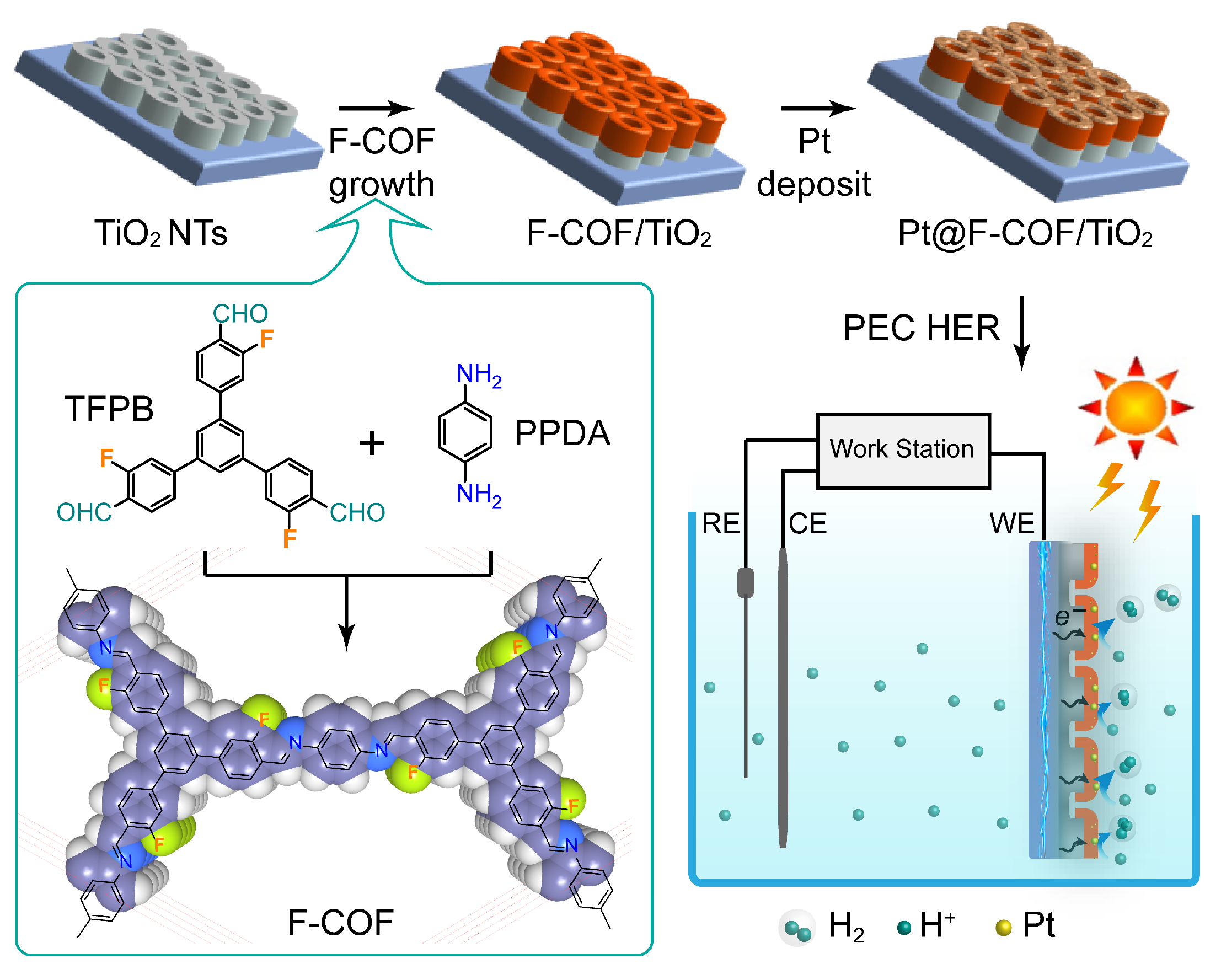
Figure 1. Schematic diagram of the fabrication of Pt@F-COF/TiO2 photoelectrode for hydrogen evolution in a PEC cell and the chemical structure of F-COF. RE, CE, and WE represent reference electrode, counter electrode, and working electrode, respectively.
Catalysts 16 00108 g001
Figure 2. (a) PXRD patterns of F-COF/TiO2 and TiO2. * referring to the diffraction peaks from the Ti substrate. (b) FTIR spectra of F-COF/TiO2, F-COF, and corresponding monomers. SEM images of (c) TiO2, (d) F-COF/TiO2, and (e) Pt@ F-COF/TiO2. (f) EDS mapping images of Ti, O, C, N, F, and Pt for the selected Pt@ F-COF/TiO2 SEM area. (g) Side-view SEM image of Pt@ F-COF/TiO2 and its (hm) EDS mapping as well as (n) overlapped element mapping images. (o) XPS survey spectra of F-COF/TiO2 and Pt@F-COF/TiO2. (p) C 1s, (q) N 1s, and (r) Pt 4f spectra for Pt@ F-COF/TiO2.
Catalysts 16 00108 g002
Figure 3. (a) UV-vis adsorption spectra of TiO2, F-COF, and F-COF/TiO2 and (b) Tauc’s plots for TiO2 and F-COF. (c) Transient photocurrent density (Jp) and (d) stability measurement at the bias of 0.155 VRHE for F-COF/TiO2 and Pt@F-COF/TiO2, and at 0 V vs. SCE for TiO2. (e) Transient photocurrent density of F-COF/TiO2 with different monomer concentrations and COFTAPB-PPDA/TiO2 electrodes at a bias of 0.155 VRHE. (f) LSV curves in the dark (dashed lines) and under light irradiation (solid lines), as well as chopped-light LSV curves (dot lines) of TiO2, F-COF/TiO2, and Pt@F-COF/TiO2 photoelectrodes under full-range light irradiation. LSV curves of (g) F-COF/TiO2 and COFTAPB-PPDA/TiO2 electrodes and (h) F-COF/TiO2 electrodes fabricated at various monomer concentrations under light irradiation (solid lines) and in the dark (dashed lines). (i) EIS Nyquist plot of Pt@F-COF/TiO2 photoelectrodes and the equivalent circuit model. EIS Nyquist plots of (j) TiO2, F-COF/TiO2, and Pt@F-COF/TiO2 photoelectrodes and (k) TiO2, F-COF/TiO2 photoelectrodes with different monomer concentrations and COFTAPB-PPDA/TiO2 electrodes under full-range light irradiation. (l) Wavelength-dependent IPCE curves for different photocathodes at the bias of 0.155 VRHE for F-COF/TiO2 and Pt@F-COF/TiO2 and without applied bias for TiO2.
Catalysts 16 00108 g003
Figure 4. (a,b) PEC hydrogen evolution performance of the Pt@F-COF/TiO2 photoelectrode compared to Pt@TiO2 and Pt@F-COF electrodes. (c) Effect of applied bias voltages on PEC hydrogen evolution performance of the Pt@F-COF/TiO2 photoelectrode. (d) Cycling PEC hydrogen evolution tests and Faraday efficiency (FE%) calculated based on the chronoamperometric measurement. PEC hydrogen evolution was performed in the PBS (pH = 7) under the AM 1.5G simulated sunlight irradiation at 0.155 VRHE.
Catalysts 16 00108 g004
Figure 5. EPR spectra of (a) DMPO-•O2 in methanol for F-COF and F-COF/TiO2, and (b) DMPO-•OH in aqueous solution for TiO2 and F-COF/TiO2 in the dark and under irradiation for 10 min. Fermi-level diagrams calculated for (c) TiO2 (001) facet and (d) F-COF (001) facet. (e) Schematic illustration of the Z-scheme heterostructure between TiO2 and F-COF and the charge transfer and PEC hydrogen evolution process.
Catalysts 16 00108 g005
Disclaimer/Publisher’s Note: The statements, opinions and data contained in all publications are solely those of the individual author(s) and contributor(s) and not of MDPI and/or the editor(s). MDPI and/or the editor(s) disclaim responsibility for any injury to people or property resulting from any ideas, methods, instructions or products referred to in the content.