Innovative Copper-Based Heterogeneous Catalyst for Chan–Lam Cross-Coupling

 , , , and
Abstract
1. Introduction
2. Results and Discussion
2.1. Catalyst Synthesis
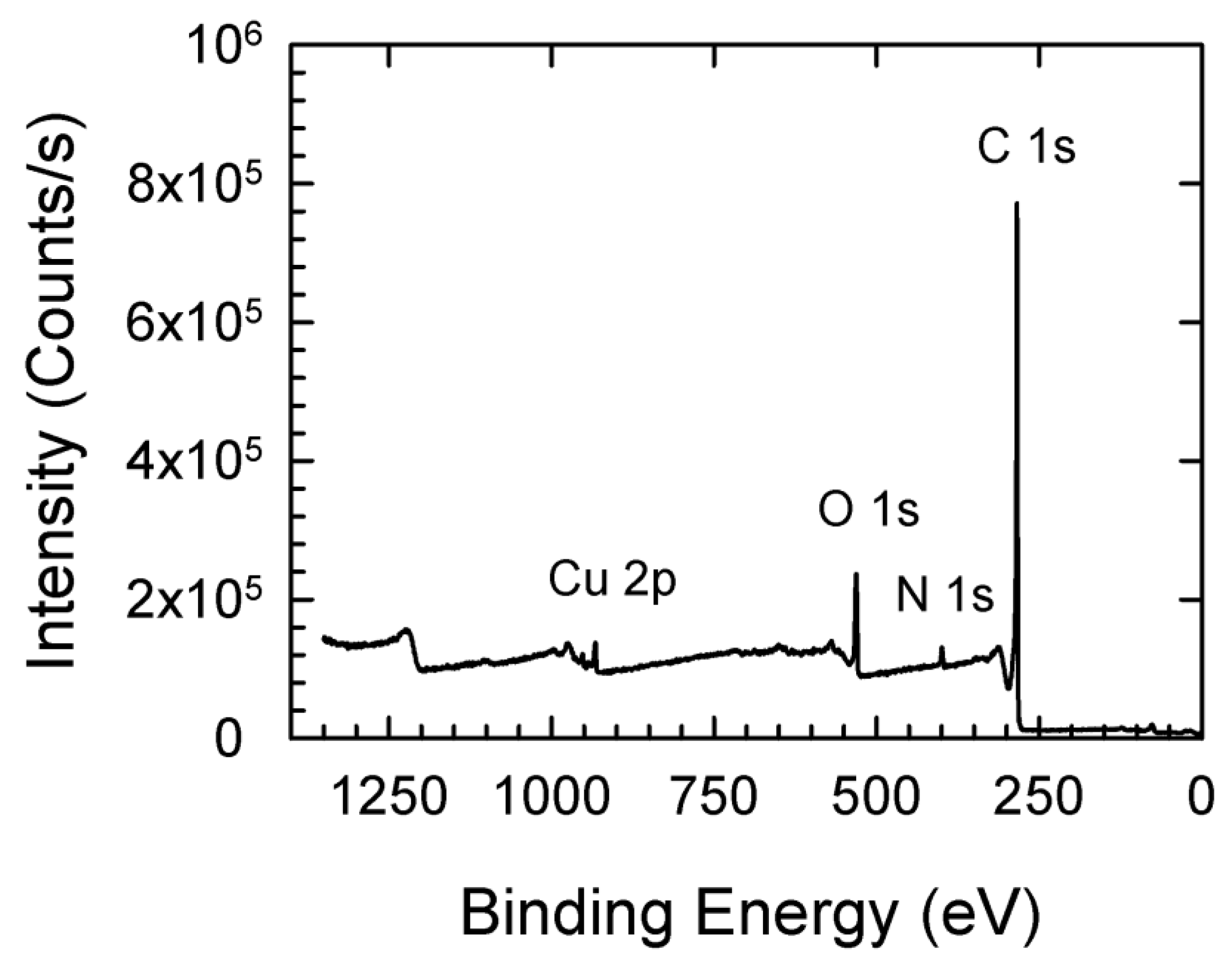
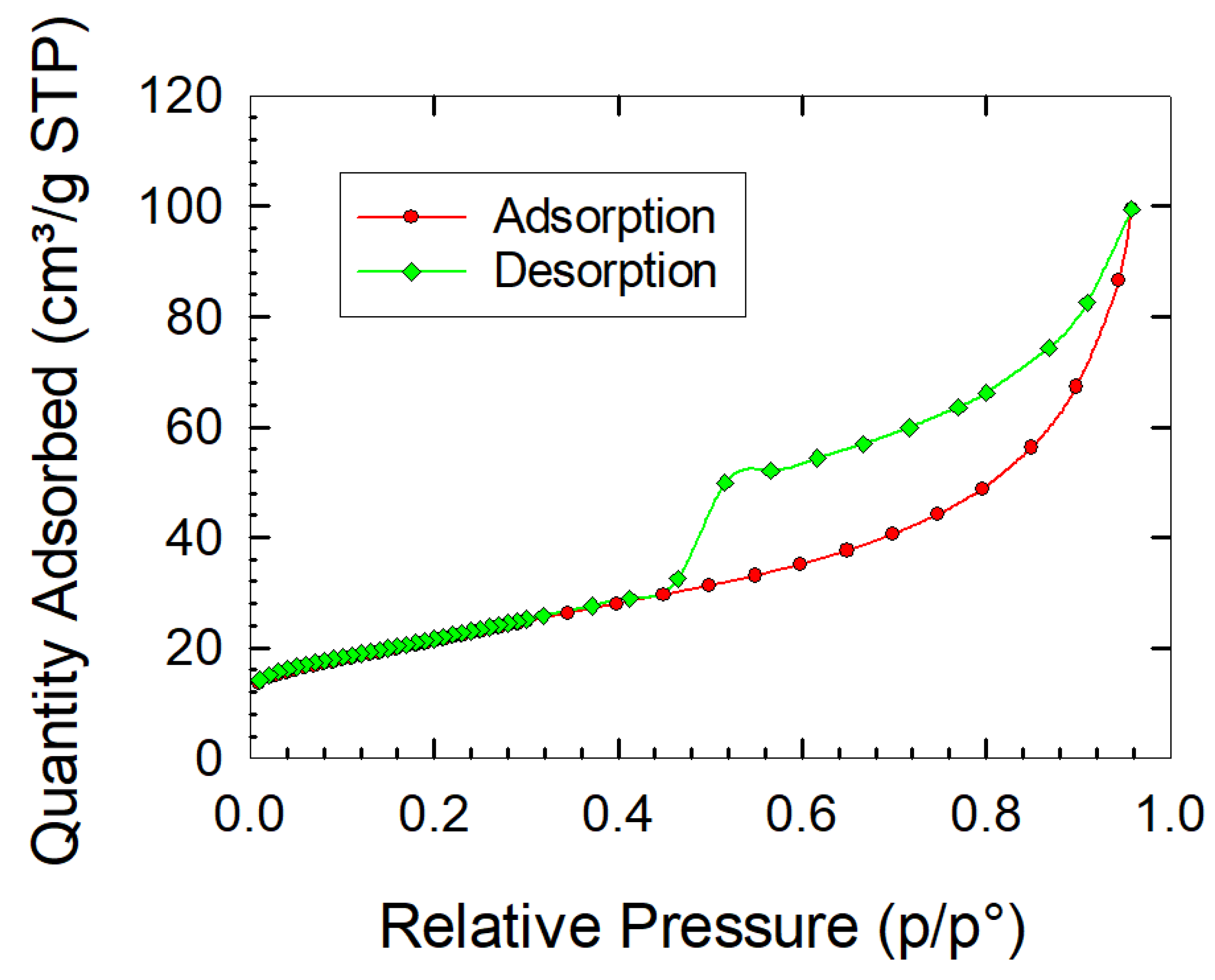
2.2. Catalyst Characterization
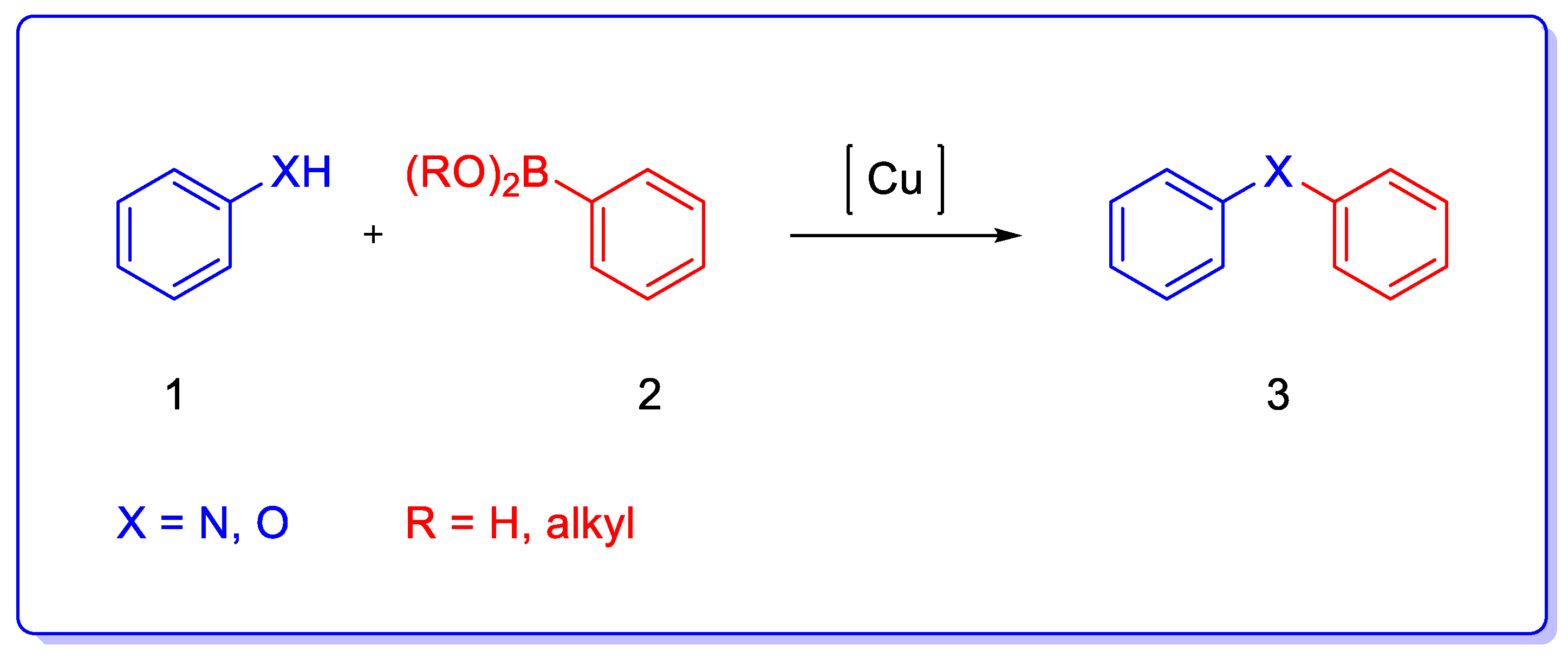
2.3. Chan–Lam Cross-Coupling
General Procedure and Monitoring
2.4. Results of Catalytic Experiments
3. Conclusions
Supplementary Materials
Author Contributions
Funding
Data Availability Statement
Acknowledgments
Conflicts of Interest
References
- Chupas, P.J.; Chapman, K.W.; Jennings, G.; Lee, P.L.; Grey, C.P. Watching Nanoparticles Grow: The Mechanism and Kinetics for the Formation of TiO2-Supported Platinum Nanoparticles. J. Am. Chem. Soc. 2007, 129, 13822–13824. [Google Scholar] [CrossRef] [Scilit]
- Huang, Z.; Sun, S.; Ma, M.; Liu, Y.; Zhong, X.; Chen, J.; Gao, F.; Hai, G.; Huang, X. Facile Synthesis of TiO2 Supported Pd Nanoparticles for Efficient Photocatalytic CO2 Reduction to CH4 with H2O. Sustain. Mater. Technol. 2025, 43, e01247. [Google Scholar] [CrossRef] [Scilit]
- Serra-Pérez, E.; Dražić, G.; Takashima, M.; Ohtani, B.; Kovačič, S.; Žerjav, G.; Tušar, N.N. Influence of the Surface Structure of the TiO2 Support on the Properties of the Au/TiO2 Photocatalyst for Water Treatment under Visible Light. Catal. Today 2024, 437, 114764. [Google Scholar] [CrossRef] [Scilit]
- Ulusal, F. The Synthesis and Cytotoxicity Analysis of Gold Nanoparticles Coated with Mesoporous SiO2 from Gold Treatment Wastewater for Medical Applications. Inorg. Chem. Commun. 2024, 159, 111867. [Google Scholar] [CrossRef] [Scilit]
- Kim, T.S.; O’Connor, C.R.; Reece, C. Interrogating Site Dependent Kinetics over SiO2-Supported Pt Nanoparticles. Nat. Commun. 2024, 15, 2074. [Google Scholar] [CrossRef] [Scilit] [PubMed]
- Hoque, A.; Nawarathne, C.P.; Alvarez, N.T. Vertically Aligned Carbon Nanotubes from Premade Binary Metal Oxide Nanoparticles on Bare SiO2. Carbon 2025, 235, 120086. [Google Scholar] [CrossRef] [Scilit]
- Wang, F.; Tian, X.; Shi, Y.; Fan, W.; Liu, Q. Photocatalytic CO2 Methanation over the Ni/SiO2 Catalysts for Performance Enhancement. Int. J. Hydrogen Energy 2024, 68, 1382–1392. [Google Scholar] [CrossRef] [Scilit]
- Deng, J.; Li, F.; Qi, Z.; Huang, W.; Wan, Z.; Zhang, L.; Zheng, D.; Li, G.; Zhang, F. A Novel Redox Synergistic Mechanism of Peroxymonosulfate Activation Using Pd-Fe3O4 for Ultra-Fast Chlorinated Hydrocarbon Degradation. Appl. Catal. B Environ. Energy 2024, 359, 124499. [Google Scholar] [CrossRef] [Scilit]
- Payamifar, S.; Foroozandeh, A.; Abdouss, M.; Marjani, A.P. Magnetic Nickel Nanoparticle Catalyst on β-Cyclodextrin-Modified Fe3O4 for Nitroarene Hydrogenation. Sci. Rep. 2024, 14, 28493. [Google Scholar] [CrossRef] [Scilit]
- Novoselov, K.S.; Geim, A.K.; Morozov, S.V.; Jiang, D.; Zhang, Y.; Dubonos, S.V.; Grigorieva, I.V.; Firsov, A.A. Electric Field Effect in Atomically Thin Carbon Films Supplementary. Science 2004, 306, 666–669. [Google Scholar] [CrossRef] [Scilit]
- Derakhshi, M.; Daemi, S.; Shahini, P.; Habibzadeh, A.; Mostafavi, E.; Ashkarran, A.A. Two-Dimensional Nanomaterials beyond Graphene for Biomedical Applications. J. Funct. Biomater. 2022, 13, 27. [Google Scholar] [CrossRef] [Scilit]
- Kumar, R.; Singh, D.P.; Muñoz, R.; Amami, M.; Singh, R.K.; Singh, S.; Kumar, V. Graphene-Based Materials for Biotechnological and Biomedical Applications: Drug Delivery, Bioimaging and Biosensing. Mater. Today Chem. 2023, 33, 101750. [Google Scholar] [CrossRef] [Scilit]
- Kaur, H.; Garg, R.; Singh, S.; Jana, A.; Bathula, C.; Kim, H.S.; Kumbar, S.G.; Mittal, M. Progress and Challenges of Graphene and Its Congeners for Biomedical Applications. J. Mol. Liq. 2022, 368, 120703. [Google Scholar] [CrossRef] [Scilit] [PubMed]
- Zare, P.; Aleemardani, M.; Seifalian, A.; Bagher, Z.; Seifalian, A.M. Graphene Oxide: Opportunities and Challenges in Biomedicine. Nanomaterials 2021, 11, 1083. [Google Scholar] [CrossRef] [Scilit] [PubMed]
- He, W.; Zhai, L.; Yam, C.Y.; Xu, Z. Current Transients in Graphene Electronics under Single-Particle Irradiation. Small Sci. 2023, 3, 2300011. [Google Scholar] [CrossRef] [Scilit] [PubMed]
- Xiang, Z.; Wang, H.; Zhao, P.; Fa, X.; Wan, J.; Wang, Y.; Xu, C.; Yao, S.; Zhao, W.; Zhang, H.; et al. Hard Magnetic Graphene Nanocomposite for Multimodal, Reconfigurable Soft Electronics. Adv. Mater. 2024, 36, e2308575. [Google Scholar] [CrossRef] [Scilit]
- Banerjee, R.; Chowdhury, A.H.; Kumar, P.S.; Wang, C.; Goel, S.; Raj, P.M. Laser-Induced Graphene Supercapacitors on Flex Substrates for Package-Integrated Power Supply. In Proceedings of the 2023 4th International Symposium on 3D Power Electronics Integration and Manufacturing, 3D-PEIM, Miami, FL, USA, 1–3 February 2023. [Google Scholar]
- Pan, Y.; Shi, Z.; Li, J.; Zhang, Z.; Li, X.; Zhuang, Z.; Mo, Y.; Liang, J.; Wang, Z.; An, M.; et al. Graphene Oxide Laminates Intercalated with Prussian Blue Nanocube as a Photo-Fenton Self-Cleaning Membrane for Enhanced Water Purification. J. Memb. Sci. 2023, 672, 121465. [Google Scholar] [CrossRef] [Scilit]
- Sheikholeslami, M.; Khalili, Z.; Mousavi, S.J. Influence of Self-Cleaning Coating on Performance of Photovoltaic Solar System Utilizing Mixture of Phase Change Material and Graphene Nanoparticle. J. Build. Eng. 2023, 77, 107540. [Google Scholar] [CrossRef] [Scilit]
- Yan, Y.; Shin, W.I.; Chen, H.; Lee, S.M.; Manickam, S.; Hanson, S.; Zhao, H.; Lester, E.; Wu, T.; Pang, C.H. A Recent Trend: Application of Graphene in Catalysis. Carbon Lett. 2021, 31, 177–199. [Google Scholar] [CrossRef] [Scilit]
- Fan, F.R.; Wang, R.; Zhang, H.; Wu, W. Emerging Beyond-Graphene Elemental 2D Materials for Energy and Catalysis Applications. Chem. Soc. Rev. 2021, 50, 10983–11031. [Google Scholar] [CrossRef] [Scilit]
- Huang, L.; Cheng, L.; Ma, T.; Zhang, J.J.; Wu, H.; Su, J.; Song, Y.; Zhu, H.; Liu, Q.; Zhu, M.; et al. Direct Synthesis of Ammonia from Nitrate on Amorphous Graphene with Near 100% Efficiency. Adv. Mater. 2023, 35, e2211856. [Google Scholar] [CrossRef] [Scilit]
- Huang, L.W.; Jeng, H.T.; Su, W.B.; Chang, C.S. Indirect Interactions of Metal Nanoparticles through Graphene. Carbon 2021, 174, 132–137. [Google Scholar] [CrossRef] [Scilit]
- Choudhary, P.; Ramalingam, B.; Das, S.K. Rational Design of Antimicrobial Peptide Conjugated Graphene-Silver Nanoparticle Loaded Chitosan Wound Dressing. Int. J. Biol. Macromol. 2023, 246, 125347. [Google Scholar] [CrossRef] [Scilit]
- Zhou, S.; Zeng, X.; Yan, X.; Xie, F.; Fahlman, B.D.; Wang, C.; Li, W. High Aspect Ratio Copper Nanowires and Copper Nanoparticles Decorated by Reduced Graphene Oxide for Flexible Transparent Conductive Electrodes. Appl. Surf. Sci. 2022, 604, 154597. [Google Scholar] [CrossRef] [Scilit]
- Mehmandoust, M.; Erk, N.; Karaman, O.; Karimi, F.; Bijad, M.; Karaman, C. Three-Dimensional Porous Reduced Graphene Oxide Decorated with Carbon Quantum Dots and Platinum Nanoparticles for Highly Selective Determination of Azo Dye Compound Tartrazine. Food Chem. Toxicol. 2021, 158, 112698. [Google Scholar] [CrossRef] [Scilit]
- Kostoglou, N.; Liao, C.W.; Wang, C.Y.; Kondo, J.N.; Tampaxis, C.; Steriotis, T.; Giannakopoulos, K.; Kontos, A.G.; Hinder, S.; Baker, M.; et al. Effect of Pt Nanoparticle Decoration on the H2 Storage Performance of Plasma-Derived Nanoporous Graphene. Carbon 2021, 171, 294–305. [Google Scholar] [CrossRef] [Scilit]
- Purabgola, A.; Mayilswamy, N.; Kandasubramanian, B. Graphene-Based TiO2 Composites for Photocatalysis & Environmental Remediation: Synthesis and Progress. Environ. Sci. Pollut. Res. 2022, 29, 32305–32325. [Google Scholar]
- Park, S.; Choi, S.H.; Kim, J.M.; Ji, S.; Kang, S.; Yim, S.; Myung, S.; Kim, S.K.; Lee, S.S.; An, K.S. Nanoarchitectonics of MXene Derived TiO2/Graphene with Vertical Alignment for Achieving the Enhanced Supercapacitor Performance. Small 2024, 20, e2305311. [Google Scholar] [CrossRef] [Scilit]
- Gonçalves, D.A.; Alencar, L.M.; Anjos, J.P.B.; Orth, E.S.; Souza, V.H.R. Ultrasensitive Electrochemical Detection of Glyphosate Using Crumpled Graphene/Copper Oxide Nanocomposite. Mater. Today Commun. 2023, 36, 106746. [Google Scholar] [CrossRef] [Scilit]
- Tu, X.; Xie, Y.; Gao, F.; Ma, X.; Lin, X.; Huang, X.; Qu, F.; Ping, L.; Yu, Y.; Lu, L. Self-Template Synthesis of Flower-like Hierarchical Graphene/Copper Oxide@copper(II) Metal-Organic Framework Composite for the Voltammetric Determination of Caffeic Acid. Microchim. Acta 2020, 187, 258. [Google Scholar] [CrossRef] [Scilit]
- Marcano, D.C.; Kosynkin, D.V.; Berlin, J.M.; Sinitskii, A.; Sun, Z.; Slesarev, A.; Alemany, L.B.; Lu, W.; Tour, J.M. Improved Synthesis of Graphene Oxide. ACS Nano 2010, 4, 4806–4814. [Google Scholar] [CrossRef] [Scilit]
- Mondal, P.; Sinha, A.; Salam, N.; Roy, A.S.; Jana, N.R.; Islam, S.M. Enhanced Catalytic Performance by Copper Nanoparticle-Graphene Based Composite. RSC Adv. 2013, 3, 5615–5623. [Google Scholar] [CrossRef] [Scilit]
- Hummers, W.S.; Offeman, R.E. Preparation of Graphitic Oxide. J. Am. Chem. Soc. 1958, 80, 1339. [Google Scholar] [CrossRef] [Scilit]
- Smith, A.T.; LaChance, A.M.; Zeng, S.; Liu, B.; Sun, L. Synthesis, Properties, and Applications of Graphene Oxide/Reduced Graphene Oxide and Their Nanocomposites. Nano Mater. Sci. 2019, 1, 31–47. [Google Scholar] [CrossRef] [Scilit]
- Tarcan, R.; Todor-Boer, O.; Petrovai, I.; Leordean, C.; Astilean, S.; Botiz, I. Reduced Graphene Oxide Today. J. Mater. Chem. C 2020, 8, 1198–1224. [Google Scholar] [CrossRef] [Scilit]
- Kiranakumar, H.V.; Thejas, R.; Naveen, C.S.; Khan, M.I.; Prasanna, G.D.; Reddy, S.; Oreijah, M.; Guedri, K.; Bafakeeh, O.T.; Jameel, M. A Review on Electrical and Gas-Sensing Properties of Reduced Graphene Oxide-Metal Oxide Nanocomposites. Biomass Convers. Biorefin. 2024, 14, 12625–12635. [Google Scholar] [CrossRef] [Scilit]
- Shabil Sha, M.; Anwar, H.; Musthafa, F.N.; Al-Lohedan, H.; Alfarwati, S.; Rajabathar, J.R.; Khalid Alahmad, J.; Cabibihan, J.J.; Karnan, M.; Kumar Sadasivuni, K. Photocatalytic Degradation of Organic Dyes Using Reduced Graphene Oxide (RGO). Sci. Rep. 2024, 14, 3608. [Google Scholar] [CrossRef] [Scilit] [PubMed]
- Evans, D.A.; Katz, J.L.; West, T.R. ChemInform Abstract: Synthesis of Diaryl Ethers Through the Copper-Promoted Arylation of Phenols with Arylboronic Acids. An Expedient Synthesis of Thyroxine. ChemInform 1998, 29. [Google Scholar] [CrossRef] [Scilit]
- Chan, D.M.T.; Monaco, K.L.; Wang, R.P.; Winters, M.P. New N- and O-Arylations with Phenylboronic Acids and Cupric Acetate. Tetrahedron Lett. 1998, 39, 2933–2936. [Google Scholar] [CrossRef] [Scilit]
- Lam, P.Y.S.; Clark, C.G.; Saubern, S.; Adams, J.; Winters, M.P.; Chan, D.M.T.; Combs, A. New Aryl/Heteroaryl C-N Bond Cross-Coupling Reactions via Arylboronic Acid/Cupric Acetate Arylation. Tetrahedron Lett. 1998, 39, 2941–2944. [Google Scholar] [CrossRef] [Scilit]
- West, M.J.; Fyfe, J.W.B.; Vantourout, J.C.; Watson, A.J.B. Mechanistic Development and Recent Applications of the Chan-Lam Amination. Chem. Rev. 2019, 119, 12491–12523. [Google Scholar] [CrossRef] [Scilit]
- Robinson, H.; Oatley, S.A.; Rowedder, J.E.; Slade, P.; Macdonald, S.J.F.; Argent, S.P.; Hirst, J.D.; McInally, T.; Moody, C.J. Late-Stage Functionalization by Chan–Lam Amination: Rapid Access to Potent and Selective Integrin Inhibitors. Chem.—A Eur. J. 2020, 26, 7678–7684. [Google Scholar] [CrossRef] [Scilit]
- Kuliukhina, D.S.; Malysheva, A.S.; Averin, A.D.; Savelyev, E.N.; Orlinson, B.S.; Novakov, I.A.; Beletskaya, I.P. Chan–Lam N-Arylation of Adamantane-Containing Amines. Russ. J. Org. Chem. 2023, 59, 2107–2116. [Google Scholar] [CrossRef] [Scilit]
- Han, Y.; Zhang, M.; Zhang, Y.Q.; Zhang, Z.H. Copper Immobilized at a Covalent Organic Framework: An Efficient and Recyclable Heterogeneous Catalyst for the Chan-Lam Coupling Reaction of Aryl Boronic Acids and Amines. Green Chem. 2018, 20, 4891–4900. [Google Scholar] [CrossRef] [Scilit]
- Janíková, K.; Jedinák, L.; Volná, T.; Cankař, P. Chan-Lam Cross-Coupling Reaction Based on the Cu2S/TMEDA System. Tetrahedron 2018, 74, 606–617. [Google Scholar] [CrossRef] [Scilit]
- Halford-McGuff, J.M.; Israel, E.M.; West, M.J.; Vantourout, J.C.; Watson, A.J.B. Direct Chan–Lam Amination and Etherification of Aryl BMIDA Reagents. Eur. J. Org. Chem. 2022, 2022, e202200993. [Google Scholar] [CrossRef] [Scilit]
- Wu, M. Chan-Lam Oxygen-Cyclopropylation of Aliphatic Alcohols; Smith College: Northampton, MA, USA, 2022. [Google Scholar]
- Derosa, J.; O’Duill, M.L.; Holcomb, M.; Boulous, M.N.; Patman, R.L.; Wang, F.; Tran-Dubé, M.; McAlpine, I.; Engle, K.M. Copper-Catalyzed Chan-Lam Cyclopropylation of Phenols and Azaheterocycles. J. Org. Chem. 2018, 83, 3417–3425. [Google Scholar] [CrossRef] [Scilit] [PubMed]
- Naya, L.; Larrosa, M.; Rodríguez, R.; Cruces, J. Selective Copper-Promoted Cross-Coupling Reaction of Anilines and Alkylboranes. Tetrahedron Lett. 2012, 53, 769–772. [Google Scholar] [CrossRef] [Scilit]
- Vantourout, J.C.; Miras, H.N.; Isidro-Llobet, A.; Sproules, S.; Watson, A.J.B. Spectroscopic Studies of the Chan-Lam Amination: A Mechanism-Inspired Solution to Boronic Ester Reactivity. J. Am. Chem. Soc. 2017, 139, 4769–4779. [Google Scholar] [CrossRef] [Scilit]
- Grayson, J.D.; Dennis, F.M.; Robertson, C.C.; Partridge, B.M. Chan-Lam Amination of Secondary and Tertiary Benzylic Boronic Esters. J. Org. Chem. 2021, 86, 9883–9897. [Google Scholar] [CrossRef] [Scilit] [PubMed]
- Bhowmik, A.; Yadav, M.; Fernandes, R.A. Room Temperature Nickel-Catalyzed Cross-Coupling of Aryl-Boronic Acids with Thiophenols: Synthesis of Diarylsulfides. Org. Biomol. Chem. 2020, 18, 2447–2458. [Google Scholar] [CrossRef] [Scilit]
- Lam, L.Y.; Ma, C. Chan-Lam-Type C-S Coupling Reaction by Sodium Aryl Sulfinates and Organoboron Compounds. Org. Lett. 2021, 23, 6164–6168. [Google Scholar] [CrossRef] [Scilit]
- Greenwood, N.S.; Ellman, J.A. Sulfur-Arylation of Sulfenamides via Chan-Lam Coupling with Boronic Acids: Access to High Oxidation State Sulfur Pharmacophores. Org. Lett. 2023, 25, 2830–2834. [Google Scholar] [CrossRef] [Scilit]
- Yu, J.T.; Guo, H.; Yi, Y.; Fei, H.; Jiang, Y. The Chan-Lam Reaction of Chalcogen Elements Leading to Aryl Chalcogenides. Adv. Synth. Catal. 2014, 356, 749–752. [Google Scholar] [CrossRef] [Scilit]
- Sun, N.; Zheng, K.; Zhang, M.; Zheng, G.; Jin, L.; Hu, B.; Shen, Z.; Hu, X. Cu-Catalysed Chan-Lam Synthesis of Unsymmetrical Aryl Chalcogenides under Aqueous Micellar Conditions. Green Chem. 2023, 25, 2782–2789. [Google Scholar] [CrossRef] [Scilit]
- Fernandes, R.A.; Bhowmik, A.; Yadav, S.S. Advances in Cu and Ni-Catalyzed Chan–Lam-Type Coupling: Synthesis of Diarylchalcogenides, Ar2–X (X = S, Se, Te). Org. Biomol. Chem. 2020, 18, 9583–9600. [Google Scholar] [CrossRef] [Scilit]
- Chen, H.; Wei, C.; Pang, G.L.; Liang, C.; Mo, D.L.; Ma, X.P. Synthesis of N-Vinyl Cinnamaldehyde Nitrones through Atropisomeric Quinoxaline-Derived N, N, O-Ligand-Promoted Chan-Lam Reaction. Org. Lett. 2022, 24, 6013–6017. [Google Scholar] [CrossRef] [Scilit]
- Dangroo, N.A.; Ara, T.; Dar, B.A.; Khuroo, M.A. Copper Catalyzed Tandem Chan–Lam Type C—N and Staudinger-Phosphite N—P Coupling for the Synthesis of N-Arylphosphoramidates. Catal. Commun. 2019, 118, 76–80. [Google Scholar] [CrossRef] [Scilit]
- Sánchez-Velasco, O.A.; Saavedra-Olavarría, J.; Araya-Santelices, D.A.A.; Hermosilla-Ibáñez, P.; Cassels, B.K.; Pérez, E.G. Synthesis OfN-Arylcytisine Derivatives Using the Copper-Catalyzed Chan-Lam Coupling. J. Nat. Prod. 2021, 84, 1985–1992. [Google Scholar] [CrossRef] [Scilit]
- Saikia, R.; Das, S.; Almin, A.; Mahanta, A.; Sarma, B.; Thakur, A.J.; Bora, U. N,N′-Dimethylurea as an Efficient Ligand for the Synthesis of Pharma-Relevant Motifs through Chan-Lam Cross-Coupling Strategy. Org. Biomol. Chem. 2023, 21, 3143–3155. [Google Scholar] [CrossRef] [Scilit]
- Sharif, M.; Mahmood, A.; Kanwal, A.; Ahmad, M.; Rasool, N.; Usman, M.Q.; Al Mughram, M.H.; Al-Harerhi, A.A.M.; Shah, T.A.; Skaikh, I.I. Facile Synthesis of Aminobiphenyl Sulfonamides via Chan–Lam Coupling and Their Biological Evaluation as Potent Carbonic Anhydrase Inhibitors. Sci. Rep. 2025, 15, 25661. [Google Scholar] [CrossRef] [Scilit]
- Vu, J.; Haug, G.C.; Schubert, T.J.; Head, J.F.; Patton, R.S.; Dong, Y. Enantioconvergent Chan–Lam Coupling: Synthesis of Chiral Benzylic Amides via Cu-Catalyzed Deborylative Amidation. J. Am. Chem. Soc. 2025, 147, 25527–25535. [Google Scholar] [CrossRef] [Scilit] [PubMed]
- Anuradha; Kumari, S.; Pathak, D.D. Synthesis and Development of Chitosan Anchored Copper(II) Schiff Base Complexes as Heterogeneous Catalysts for N-Arylation of Amines. Tetrahedron Lett. 2015, 56, 4135–4142. [Google Scholar] [CrossRef] [Scilit]
- Wang, B.; Yang, P.; Ge, Z.W.; Li, C.P. A Porous Metal–Organic Framework as Active Catalyst for Multiple C–N/C–C Bond Formation Reactions. Inorg. Chem. Commun. 2015, 61, 13–15. [Google Scholar] [CrossRef] [Scilit]
- Bao, J.; Tranmer, G.K. The Solid Copper-Mediated C–N Cross-Coupling of Phenylboronic Acids under Continuous Flow Conditions. Tetrahedron Lett. 2016, 57, 654–657. [Google Scholar] [CrossRef] [Scilit]
- Khatioda, R.; Pathak, D.; Sarma, B. Cu(II) Complex onto a Pyridine-Based Porous Organic Polymer as a Heterogeneous Catalyst for Nitroarene Reduction. ChemistrySelect 2018, 3, 6309–6320. [Google Scholar] [CrossRef] [Scilit]
- Khosravi, A.; Mokhtari, J.; Naimi-Jamal, M.R.; Tahmasebi, S.; Panahi, L. Cu2(BDC)2(BPY)-MOF: An Efficient and Reusable Heterogeneous Catalyst for the Aerobic Chan-Lam Coupling Prepared via Ball-Milling Strategy. RSC Adv. 2017, 7, 46022–46027. [Google Scholar] [CrossRef] [Scilit]
- Garnier, T.; Sakly, R.; Danel, M.; Chassaing, S.; Pale, P. Chan-Lam-Type C-N Cross-Coupling Reactions under Base- and Ligand-Free CuI-Zeolite Catalysis. Synthesis 2017, 49, 1223–1230. [Google Scholar] [CrossRef] [Scilit]
- Sharma, H.; Mahajan, H.; Jamwal, B.; Paul, S. Cu@Fe3O4-TiO2-L-Dopa: A Novel and Magnetic Catalyst for the Chan-Lam Cross-Coupling Reaction in Ligand Free Conditions. Catal. Commun. 2018, 107, 68–73. [Google Scholar] [CrossRef] [Scilit]
- Dutta, M.M.; Phukan, P. Cu-Doped CoFe2O4 Nanoparticles as Magnetically Recoverable Catalyst for CN Cross-Coupling Reaction. Catal. Commun. 2018, 109, 38–42. [Google Scholar] [CrossRef] [Scilit]
- Sharma, N.; Choudhary, A.; Kaur, M.; Sharma, C.; Paul, S.; Gupta, M. Modified Graphene Supported Ag-Cu NPs with Enhanced Bimetallic Synergistic Effect in Oxidation and Chan-Lam Coupling Reactions. RSC Adv. 2020, 10, 30048–30061. [Google Scholar] [CrossRef] [Scilit] [PubMed]
- Seyedi, N.; Shahabi Nejad, M.; Saidi, K.; Sheibani, H. Fabrication of Nitrogen-Enriched Graphene Oxide/Cu NPs as a Highly Efficient and Recyclable Heterogeneous Nanocatalyst for the Chan–Lam Cross-Coupling Reaction. Appl. Organomet. Chem. 2020, 34, e5307. [Google Scholar] [CrossRef] [Scilit]
- Sarmah, M.; Sarmah, D.; Dewan, A.; Bora, P.; Boruah, P.K.; Das, M.R.; Bharali, P.; Bora, U. Dual Responsive Sustainable Cu2O/Cu Nanocatalyst for Sonogashira and Chan-Lam Cross-Coupling Reactions. Catal. Lett. 2023, 153, 1423–1437. [Google Scholar] [CrossRef] [Scilit]
- Banda, P.G.; Kurup, G.B.; Mucherla, R. Magnetically Recoverable CuFe2O4 Nanocatalyst: Dual Catalytic Action in Sonogashira and Chan-Lam Coupling Reactions. J. Organomet. Chem. 2024, 1016, 123259. [Google Scholar] [CrossRef] [Scilit]
- Di, J.Q.; Zhang, M.; Chen, Y.X.; Wang, J.X.; Geng, S.S.; Tang, J.Q.; Zhang, Z.H. Copper Anchored on Phosphorus G-C3N4as a Highly Efficient Photocatalyst for the Synthesis OfN-Arylpyridin-2-Amines. Green Chem. 2021, 23, 1041–1049. [Google Scholar] [CrossRef] [Scilit]
- Yusuf, M.; Hira, S.A.; Lim, H.; Song, S.; Park, S.; Park, K.H. Core-Shell Cu2S:NiS2@C Hybrid Nanostructure Derived from a Metal-Organic Framework with Graphene Oxide for Photocatalytic Synthesis of N-Substituted Derivatives. J. Mater. Chem. A 2021, 9, 9018–9027. [Google Scholar] [CrossRef] [Scilit]
- Mirza-Aghayan, M.; Saeedi, M.; Boukherroub, R. Carbon–Nitrogen Bond Formation Using Modified Graphene Oxide Derivatives Decorated with Copper Complexes and Nanoparticles. Appl. Organomet. Chem. 2021, 35, e6327. [Google Scholar] [CrossRef] [Scilit]
- Mittal, A.; Kumari, S.; Parmanand; Yadav, D.; Sharma, S.K. A New Copper Complex on Graphene Oxide: A Heterogeneous Catalyst for N-Arylation and C-H Activation. Appl. Organomet. Chem. 2020, 34, e5362. [Google Scholar] [CrossRef] [Scilit]
- Kumar, A.; Layek, S.; Agrahari, B.; Kujur, S.; Pathak, D.D. Graphene Oxide Immobilized Copper(II) Schiff Base Complex [GO@AF-SB-Cu]: A Versatile Catalyst for Chan-Lam Coupling Reaction. ChemistrySelect 2019, 4, 1337–1345. [Google Scholar] [CrossRef] [Scilit]
- Wang, Y.; Yan, Q.; Shi, Y.; Long, M. Copper Toxicity in Animals: A Review. Biol. Trace Elem. Res. 2024, 203, 2675–2686. [Google Scholar] [CrossRef] [Scilit] [PubMed]
- Gaetke, L.M.; Chow, C.K. Copper Toxicity, Oxidative Stress, and Antioxidant Nutrients. Toxicology 2003, 189, 147–163. [Google Scholar] [CrossRef] [Scilit]
- Charkiewicz, A.E. Is Copper Still Safe for Us? What Do We Know and What Arethe Latest Literature Statements? Curr. Issues Mol. Biol. 2024, 46, 8441–8463. [Google Scholar] [CrossRef] [Scilit]
- Royer, A.; Sharman, T. Copper Toxicity; StatPearls Publishing: Treasure Island, FL, USA, 2025. [Google Scholar]
- Chen, X.; Qu, Z.; Liu, Z.; Ren, G. Mechanism of Oxidization of Graphite to Graphene Oxide by the Hummers Method. ACS Omega 2022, 7, 23503–23510. [Google Scholar] [CrossRef] [Scilit] [PubMed]
- Brusko, V.; Khannanov, A.; Rakhmatullin, A.; Dimiev, A.M. Unraveling the Infrared Spectrum of Graphene Oxide. Carbon 2024, 229, 119507. [Google Scholar] [CrossRef] [Scilit]
- Ossonon, B.D.; Bélanger, D. Synthesis and Characterization of Sulfophenyl-Functionalized Reduced Graphene Oxide Sheets. RSC Adv. 2017, 7, 27224–27234. [Google Scholar] [CrossRef] [Scilit]
- Nasrollahzadeh, M.; Babaei, F.; Fakhri, P.; Jaleh, B. Synthesis, Characterization, Structural, Optical Properties and Catalytic Activity of Reduced Graphene Oxide/Copper Nanocomposites. RSC Adv. 2015, 5, 10782–10789. [Google Scholar] [CrossRef] [Scilit]
- Elzey, S.; Baltrusaitis, J.; Bian, S.; Grassian, V.H. Formation of Paratacamite Nanomaterials via the Conversion of Aged and Oxidized Copper Nanoparticles in Hydrochloric Acidic Media. J. Mater. Chem. 2011, 21, 3162–3169. [Google Scholar] [CrossRef] [Scilit]
- Györke, G.; Dancsó, A.; Volk, B.; Milen, M. Chan−Lam Arylation of Benzimidazole and Its Derivatives in the Presence of Copper-Containing Minerals. ChemistrySelect 2021, 6, 802–807. [Google Scholar] [CrossRef] [Scilit]
- Anupama, T.S.A.; Monica, V.; Małecki, J.G.; Keri, R.S.; Azam, M.; Al-Resayes, S.I.; Budagumpi, S. Chan−Evans−Lam Coupling for the Synthesis of N–Aryl Derivatives Catalyzed by Copper(I) Chloride and Sterically Varied Imidazolium Salts at Mild Reaction Conditions. J. Mol. Struct. 2024, 1301, 137362. [Google Scholar] [CrossRef] [Scilit]
- Zhou, X.; Yang, J.; Hao, Z.; Han, Z.; Lin, J.; Lu, G.L. Copper Complexes with N,N,N-Tridentate Quinolinyl Anilido-Imine Ligands: Synthesis and Their Catalytic Application in Chan−Lam Reactions. Molecules 2023, 28, 7406. [Google Scholar] [CrossRef] [Scilit]
- Ishida, M.; Adachi, R.; Kobayashi, K.; Yamamoto, Y.; Kawahara, C.; Yamada, T.; Aoyama, H.; Kanomata, K.; Akai, S.; Lam, P.Y.S.; et al. First Atroposelective Chan-Lam Coupling for the Synthesis of C-N Linked Biaryls. Chem. Commun. 2023, 60, 678–681. [Google Scholar] [CrossRef] [Scilit] [PubMed]
- Lan, J.B.; Chen, L.; Yu, X.Q.; You, J.S.; Xie, R.G. A Simple Copper Salt Catalysed the Coupling of Imidazole with Arylboronic Acids in Protic Solvent. Chem. Commun. 2004, 4, 188–189. [Google Scholar] [CrossRef] [Scilit] [PubMed]
- Clerc, A.; Bénéteau, V.; Pale, P.; Chassaing, S. Chan-Lam-Type Azidation and One-Pot CuAAC under CuI-Zeolite Catalysis. ChemCatChem 2020, 12, 2060–2065. [Google Scholar] [CrossRef] [Scilit]
- Pharande, P.S.; Mhaldar, P.M.; Lohar, T.R.; Ghotekar, S.K.; Chhowala, T.N.; Rashinkar, G.S.; Pore, D.M. A Selective Heterogeneous Cellulose Supported Schiff Base Cu(II) Catalyst for Chan–Evans–Lam Coupling. Res. Chem. Intermed. 2023, 49, 4541–4560. [Google Scholar] [CrossRef] [Scilit]
- Roy, T.; Mondal, K.; Halder, P.; Sengupta, A.; Das, P. CuF2/DTBP-Catalyzed Chan-Lam Coupling of Oxazolidinones with Arylboronic Acid Pinacol Ester: Scope and Application. J. Org. Chem. 2025, 90, 6219–6232. [Google Scholar] [CrossRef] [Scilit]
- Valencia, J.; Sánchez-Velasco, O.A.; Saavedra-Olavarría, J.; Hermosilla-Ibáñez, P.; Pérez, E.G.; Insuasty, D. N-Arylation of 3-Formylquinolin-2(1H)-Ones Using Copper(II)-Catalyzed Chan–Lam Coupling. Molecules 2022, 27, 8345. [Google Scholar] [CrossRef] [Scilit] [PubMed]
- Tomanová, M.; Jedinák, L.; Košař, J.; Kvapil, L.; Hradil, P.; Cankař, P. Synthesis of 4-Substituted Pyrazole-3,5-Diamines: Via Suzuki-Miyaura Coupling and Iron-Catalyzed Reduction. Org. Biomol. Chem. 2017, 15, 10200–10211. [Google Scholar] [CrossRef] [Scilit]



 | ||
 | Isolated Yield (%) | |
 | 2a | 51 |
 | 2b | 24 |
 | 2c | 83 |
 | 2d | 8 |
 | ||||
| Aniline Derivative |  |  |  |  |
 | 7 | 46 | 19 | 25 |
 | 17 | 5 | 26 | − |
 | 12 | 5 | 26 | − |
 | 70 | 15 | 7 | − |
 | − | − | 12 | 6 |
 | 13 | 32 | 53 | 21 |
 | − | − | − | − |
Disclaimer/Publisher’s Note: The statements, opinions and data contained in all publications are solely those of the individual author(s) and contributor(s) and not of MDPI and/or the editor(s). MDPI and/or the editor(s) disclaim responsibility for any injury to people or property resulting from any ideas, methods, instructions or products referred to in the content. |
© 2026 by the authors. Licensee MDPI, Basel, Switzerland. This article is an open access article distributed under the terms and conditions of the Creative Commons Attribution (CC BY) license.
Share and Cite
Stehlík, J.; Pocklanová, R.; Profous, D.; Lapčíková, B.; Cankař, P.; Kvítek, L.; Lapčík, Ľ. Innovative Copper-Based Heterogeneous Catalyst for Chan–Lam Cross-Coupling. Catalysts 2026, 16, 94. https://doi.org/10.3390/catal16010094
Stehlík J, Pocklanová R, Profous D, Lapčíková B, Cankař P, Kvítek L, Lapčík Ľ. Innovative Copper-Based Heterogeneous Catalyst for Chan–Lam Cross-Coupling. Catalysts. 2026; 16(1):94. https://doi.org/10.3390/catal16010094
Chicago/Turabian StyleStehlík, Jan, Radka Pocklanová, David Profous, Barbora Lapčíková, Petr Cankař, Libor Kvítek, and Ľubomír Lapčík. 2026. "Innovative Copper-Based Heterogeneous Catalyst for Chan–Lam Cross-Coupling" Catalysts 16, no. 1: 94. https://doi.org/10.3390/catal16010094
APA StyleStehlík, J., Pocklanová, R., Profous, D., Lapčíková, B., Cankař, P., Kvítek, L., & Lapčík, Ľ. (2026). Innovative Copper-Based Heterogeneous Catalyst for Chan–Lam Cross-Coupling. Catalysts, 16(1), 94. https://doi.org/10.3390/catal16010094