Article

Simple Synthesis of Ultrasmall Pt5La Nanoalloy for Highly Efficient Oxygen Reduction Reaction

1
School of Materials and Chemistry, University of Shanghai for Science and Technology, Shanghai 200093, China
2
Institute of Fuel Cells, School of Mechanical Engineering, Shanghai Jiao Tong University, Shanghai 200240, China
*
Author to whom correspondence should be addressed.
Catalysts 2026, 16(1), 97; https://doi.org/10.3390/catal16010097
Submission received: 6 January 2026 / Revised: 14 January 2026 / Accepted: 16 January 2026 / Published: 18 January 2026
(This article belongs to the Special Issue 15th Anniversary of Catalysts: Feature Papers in Electrocatalysis)

Abstract

Pt-rare earth metal (Pt-RE) alloys are considered to be one of the most promising electrocatalysts for producing oxygen reduction reactions (ORRs) due to their compressively strained Pt overlayer and their exceptional negative-alloy formation energies, which result in excellent activity and stability. However, there are still great challenges in the chemical synthesis of Pt-RE nanoalloys. Herein, we report a simple method employing the nanopores of porous carbon as nanoreactors to synthesize a Pt5La nanoalloy. The Pt5La alloy nanoparticles are embedded in porous carbon (Pt5La@C) with a particle size of around 1–3 nm and also exhibit a very narrow size distribution because of the confined-space effect. The as-prepared Pt5La@C nanoalloy exhibits highly efficient ORR performance with a half-wave potential of 0.912 V in 0.1 M HClO4, which is 56 mV higher than that of a commercial Pt/C catalyst. Moreover, it achieves an improved intrinsic activity of 0.69 mA cm−2 and, a mass activity of 0.42 A mgPt−1 at 0.90 V. In addition, it also delivers a very stable lifespan performance, with negligible decay in half-wave potential after accelerated stress testing for 10,000 cycles. This work also provides a new method for the development of promising Pt-RE nanoalloys with ultrasmall nanoparticles with a very narrow size distribution for various efficient energy-conversion devices.

1. Introduction

Proton-exchange membrane fuel cells (PEMFCs) are considered to be a promising technology for clean and efficient power generation [1,2]. In these cells, the oxygen reduction reaction (ORR) at the cathode is kinetically sluggish, and its reaction rate directly governs the overall cell performance [3,4]. Catalysts with high activity towards ORR are generally required to accelerate this process, and currently, Pt-based catalysts represent the most widely used type of ORR catalyst due to their excellent electrocatalytic activity [5,6,7]. Considering the scarcity and relatively high cost of Pt, the cost of Pt-based catalysts usually accounts for more than 50% of the total cost of components in PEMFCs, greatly restricting their widespread application [8]. Although the current demand for Pt in fuel cells in vehicles has decreased to 20–30 g per vehicle, this is still a significant gap from the sustainable development goal of less than 10 g per vehicle, similar to what is in an internal combustion engine today [9]. Therefore, in order to achieve the large-scale commercialization of PEMFCs, it is still necessary to further enhance the electrocatalytic activity of Pt-based catalysts towards ORR, which would result in reducing the demand for Pt metal [10].
Pt–rare earth metal alloys (Pt-RE alloys) are a class of alloys of platinum and rare earth metals, and they have been proposed as promising electrocatalysts for ORR in fuel cells [11,12,13,14]. Theoretical and experimental studies have revealed that their enhanced ORR activity originates from the formation of a compressively strained Pt overlayer, which can tune the binding energy of the reaction intermediates, thereby enhancing their catalytic activity [15,16]. Moreover, the high stability of Pt-RE alloys in fuel cells is also anticipated, owing to their dense Pt shell, which acts as a protective barrier against the leaching of rare earth elements, and to the exceptional negative-alloy formation energy that suppresses the migration of rare earth atoms from the core to the surface [17,18]. For instance, Gunji et al. [19] reported that atomically ordered intermetallic Pt5La nanoparticles (NPs) exhibited a specific activity of 1.39 mA cm−2 and mass activity of 0.657 A mg−1 towards ORR, which are about 3.7 and 5.1 times higher than those of a commercial Pt/C catalyst, respectively.
The synthesis of Pt-RE alloys remains a significant challenge [20,21,22]. Owing to their extremely low standard reduction potential [23] and high oxygen affinity [24], rare earth metals are difficult to reduce. Furthermore, even when reduced, they are particularly prone to forming oxides rather than metallic species [25]. Currently, the preparation methods for Pt-RE alloys generally involve the use of gas deposition techniques or strong reducing agents in environments with strictly controlled water and oxygen contents [18,26]. For example, Chorkendorff et al. [27] deposited a Pt3Y alloy catalyst on the surface of a glassy carbon electrode through sputtering in a high vacuum environment. Simultaneously, the same research group prepared a PtxY alloy catalyst by heating metallic platinum particles and YCl3 in an atmosphere of extremely high-purity hydrogen [28]. Alivisatos et al. [29] utilized alkali metal triethylborohydride (MEt3BH, M = Na, K) as a reducing agent to prepare a Pt3Y alloy catalyst in a vacuum environment. Recently, some preparation methods under mild conditions have also been developed. For instance, Li et al. [30,31] reported a method for preparing Pt-RE nanoalloys (including Pt3Y, Pt5La, Pt5Ce, Pt2Sm, Pt2Gd, and Pt3Tb) by utilizing an in situ-formed g-C3N4 network structure to stabilize platinum atoms and rare earth metal atoms, followed by calcination in a mild reducing atmosphere (such as a 3.3% H2/Ar mixture). However, the aforementioned methods for preparing Pt-RE alloys exhibit several distinct drawbacks. These primarily include the excessively broad size distribution of the synthesized Pt-RE alloys [28,30,32,33], typically ranging from 5 to 20 nm, significantly reducing the utilization of Pt atoms and producing a relatively low utilization of rare earth metals in forming the alloy, resulting in the need to invest far more rare earth metals than the theoretical requirement [33,34].
In this work, we report a simple method of employing the nanopores of porous carbon (Ketjenblack EC-600JD, KB) as nanoreactors to synthesize ultrasmall Pt5La nanoalloys (Pt5La@C). The Pt5La alloys nanoparticles are embedded in nanopores of KB, which can restrict the overgrowth of the Pt5La alloys, and thus the Pt5La@C catalyst creates a particle size distribution in a very narrow range, with particle sizes ranging from 2 to 3 nm. Furthermore, the as-prepared Pt5La@C catalyst exhibits a half-wave potential of 0.912 V, an intrinsic activity of 0.69 mA cm−2, and a mass activity of 0.42 A mgPt−1 at 0.90 V towards ORR in a three-electrode system. In addition, it also delivers a very stable performance with negligible decay after accelerated stress testing (AST) for 10,000 cycles. Overall, this work provides a simple method for the synthesis of promising Pt-RE nanoalloys.

2. Results and Discussion

2.1. Synthesis and Characterization of Pt5La@C Catalyst

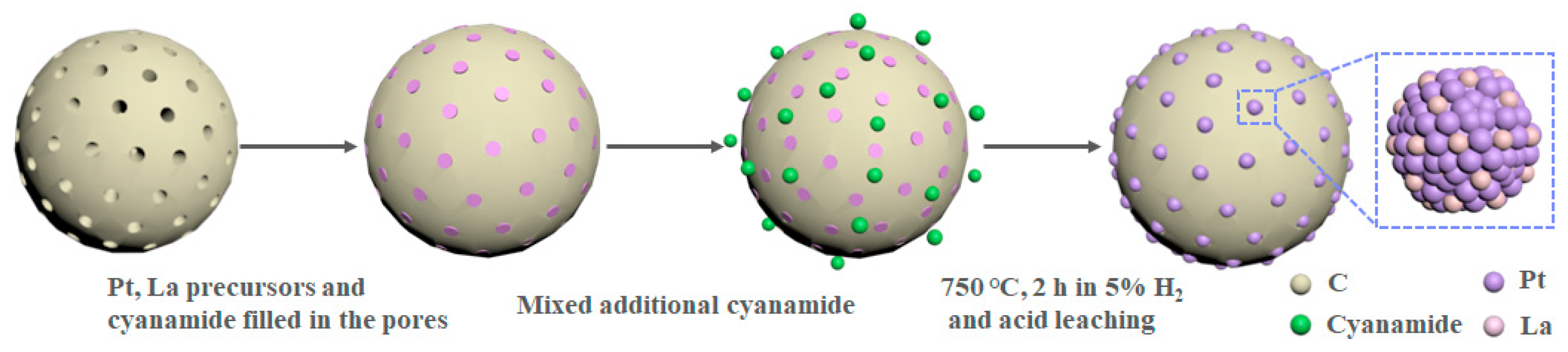
Ultrasmall Pt5La nanoalloys embedded in porous carbon (Pt5La@C) were prepared by a method combining incipient wetness impregnation and the thermal annealing process [5,30]. A commercial carbon (Ketjenblack EC-600JD, KB) that is abundant in 3–5 nm surface pores was selected here as the nanoreactor used to confine the Pt5La alloy nanoparticles and restrict their overgrowth and aggregation under high temperatures [35]. As shown in Figure 1, an anhydrous ethanol solution containing the precursors was impregnated into KB, and the dried mixture was then mixed with additional cyanamide and annealed. In order to remove the non-alloyed rare earth metal (metal oxide), the product PtLa@C (5:5) was acid leached to obtain the Pt5La@C catalyst [30]. In order to understand the effect of the molar ratios of Pt/La, three ratios of Pt/La =5:5, 5:3, and 5:1 were studied (The as-prepared samples were noted as PtLa@C (5:5), PtLa@C (5:3), and PtLa@C (5:1), respectively.). PtLa@C (5:5) was finally leached in 0.5 M H2SO4 to obtain the Pt5La@C catalyst.
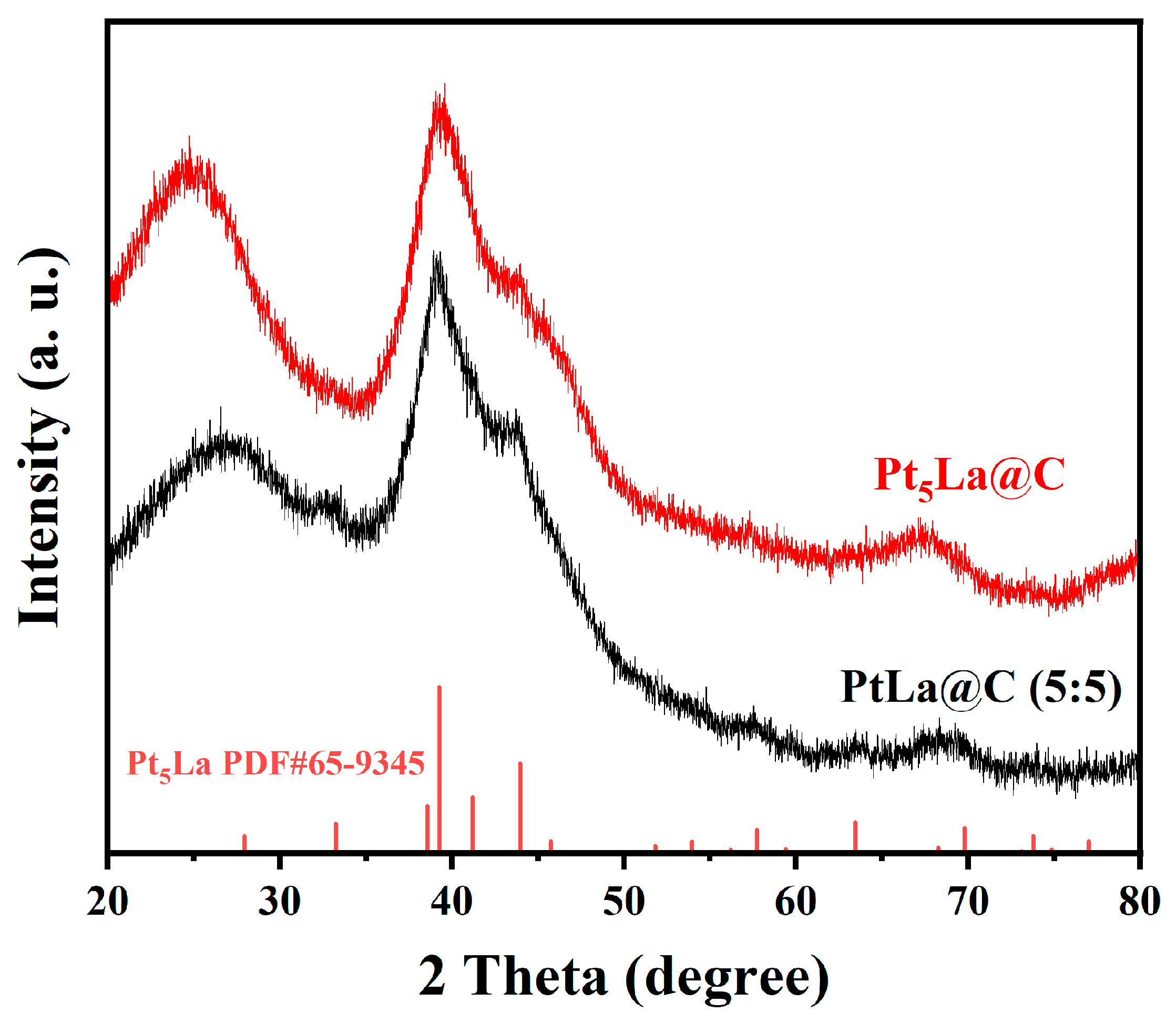
Figure 2 shows the powder X-ray diffraction (XRD) of the Pt5La@C sample prepared with a molar ratio of Pt/La = 5:5 before acid leaching (PtLa@C (5:5)). The weak, broad peak at around 26.5° should correspond to the amorphous carbon related to KB after annealing at a high temperature [36]. The rest of the diffraction peaks, located at 27.93°, 33.24°, 39.24°, 43.95°, 53.93°, 57.71°, 63.44°, 69.79°, 73.79°, and 77.02°, can be assigned to Pt5La (JCPDS card no. 65-9345) belonging to its (101), (110), (111), (201), (112), (202), (301), (220), (113), and (203) crystal planes, respectively, identifying the presence of a hexagonal crystalline phase in Pt5La in the PtLa@C (5:5) sample [34]. In addition, the absence of any peaks associated with lanthanum oxide may be attributed to its features of very low content or high dispersion in the KB support. After acid leaching, the main diffraction peaks, located at 39.24° and 43.95°, can still be clearly observed in the XRD pattern (Figure 2), suggesting the remains of Pt5La in the Pt5La@C sample. The Pt and La weight percent for the Pt5La@C sample were 10.37 wt.% and 0.85 wt.%, respectively, determined by inductively coupled plasma-optical emission spectroscopy (ICP-OES) (Table S1). A slightly lower value of La content after acid leaching compared to the theoretical value in Pt5La alloys may be attributed to the dissolution of surface La atoms, forming a Pt shell [37]. In order to understand the effect of Pt:La atomic ratios in the formation of Pt5La alloy, PtLa@C samples with Pt and La ratios of 5:3 and 5:1 were also synthesized. As shown in Figure S1, the XRD pattern of the PtLa@C (5:3) sample shows diffraction peaks around 27.93°, 33.24°, and 43.95°, which should be assigned to Pt5La alloys; however, the rest of the peaks originate from the metallic Pt. Furthermore, for the PtLa@C (5:1) sample, only diffraction peaks associated with Pt were observed (Figure S2). These results suggest an insufficient amount of La in the samples with Pt/La ratios of 5:3 and 5:1, and that 5:5 might be the proper ratio for the synthesis of Pt5La alloys.
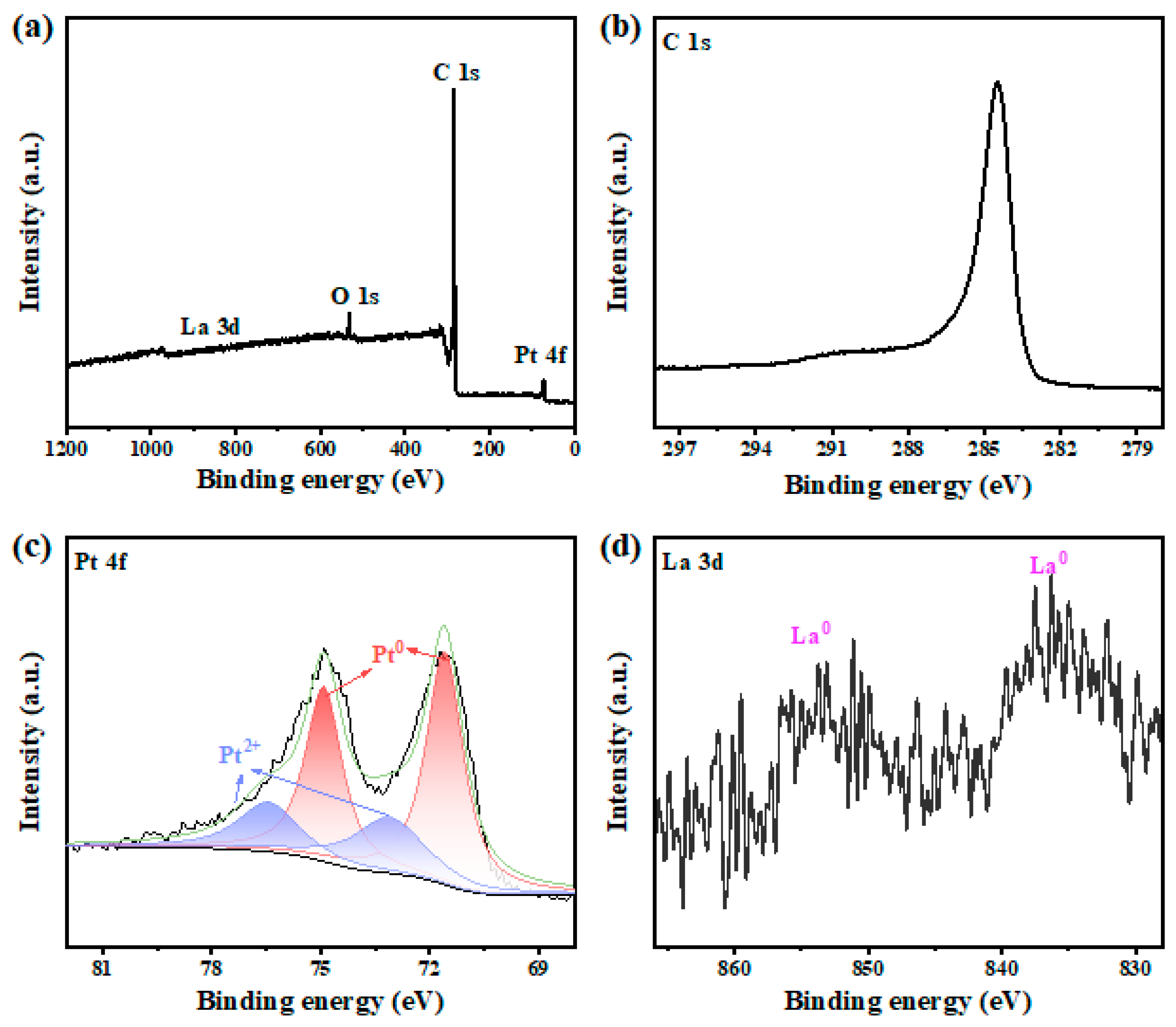
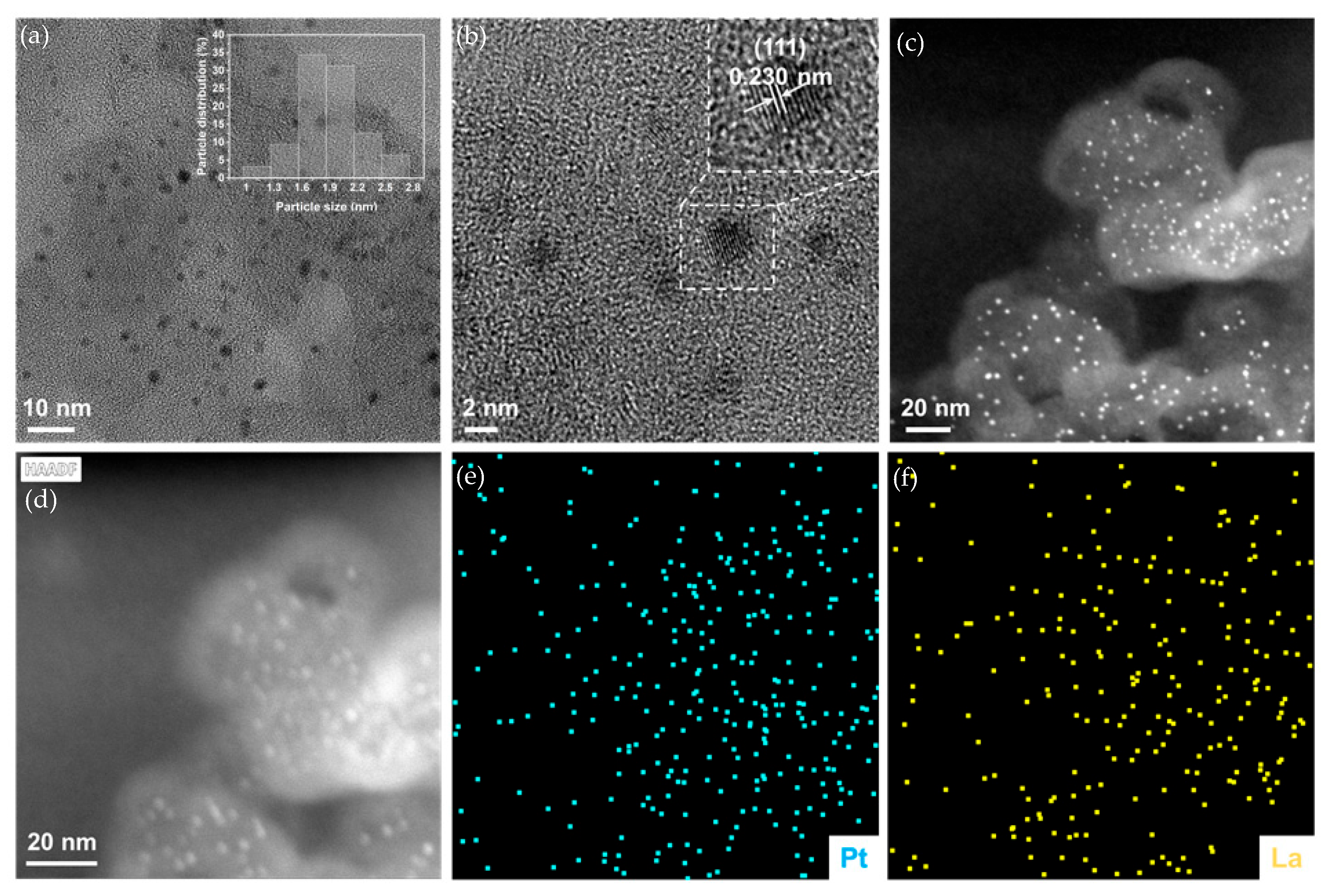
X-ray photoelectron spectroscopy (XPS) was then performed to investigate the surface compositions and chemical states of the elements present in the as-prepared Pt5La@C sample. As shown in Figure 3a, the surveyed spectrum of the Pt5La@C sample displayed the characteristic peaks of Pt, La, O, and C (Figure 3b and Figure S3) with a Pt and La atomic ratio of about 5:1, which is consistent with the ICP results (Table S2). Figure 3c,d show the Pt 4f and La 3d XPS peaks of the Pt5La@C sample, and the details of the fitting parameters are presented in Table S3. The peaks associated with Pt(0) located at 71.6 eV and 74.9 eV are the main species, accounting for 68.5%, while the portion of Pt(II) is only 31.5% [34]. Similarly, peaks belonging to La(0), located at 835.8 eV and 853.0 eV, were also observed, indicating the existence of metallic La in the Pt5La@C sample. The morphology of the Pt5La@C sample was further analyzed using TEM and high-angle annular dark field scanning electron microscopy (HAADF-STEM) techniques. As shown in Figure 4a and Figure S4, the TEM image of the Pt5La@C sample showed that Pt5La alloy nanoparticles were uniformly dispersed in a very narrow particle size range (from 1.00 to 2.80 nm), with an average size of 1.95 nm. The particle size distribution is presented in the insert in Figure 4a. Moreover, a clear lattice with a spacing of 0.230 nm was observed in the HRTEM image (Figure 3b), corresponding to the (111) crystal plane of the Pt5La alloy [19], which is in agreement with the XRD result and confirms the formation of the Pt5La alloy. The HAADF-STEM image also showed highly dispersed Pt5La alloy nanoparticles with an ultrasmall particle size and in a very narrow size range (Figure 3c). The uniform dispersion of the Pt5La nanoparticles may be attributed to the restriction of the surface pores of KB [5]. In addition, the elemental mapping images (Figure 4d–f and Figure S5) show the uniform distribution of Pt and La, providing further strong evidence of the formation of the Pt5La alloy.

2.2. ORR Performance of Pt5La@C Sample

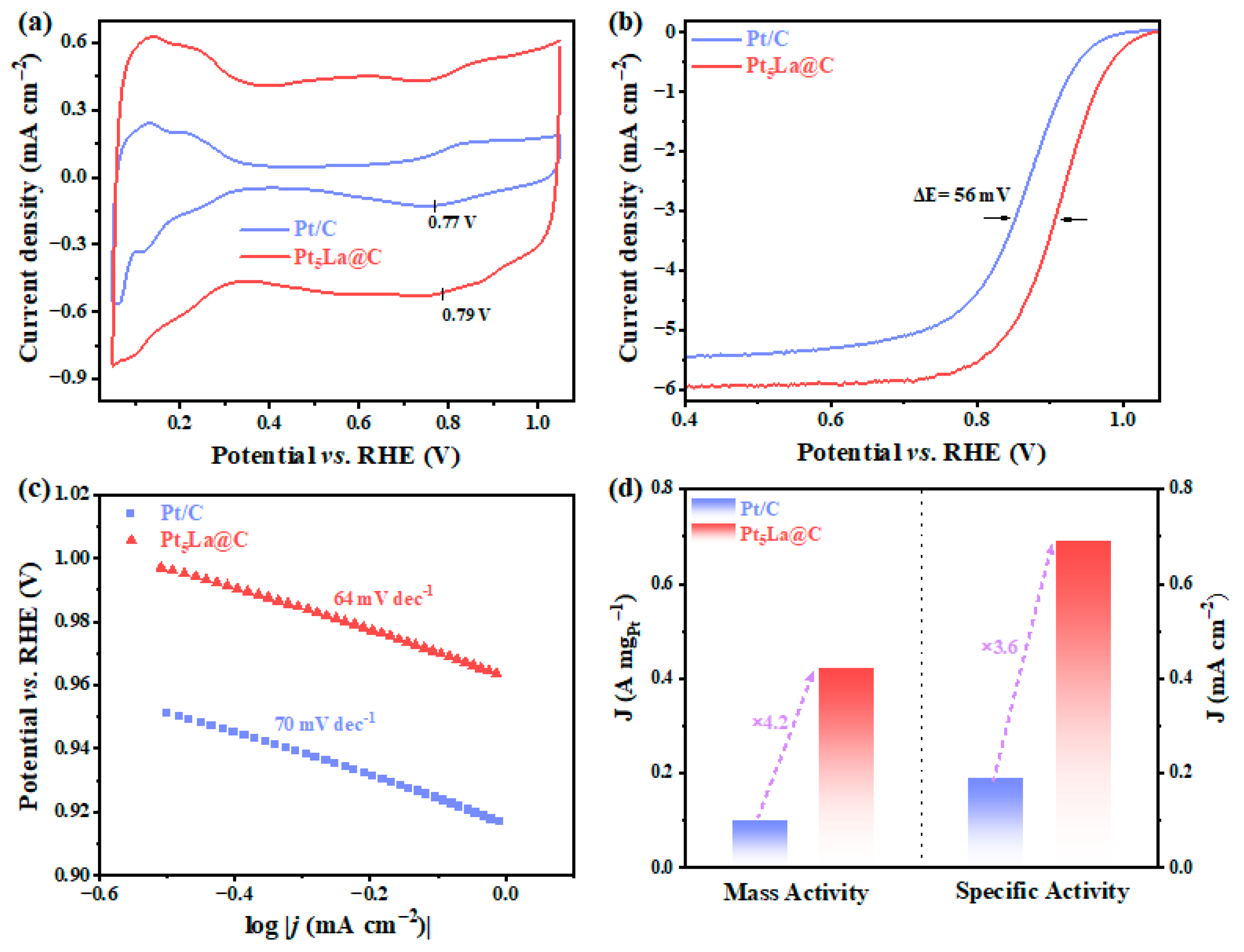
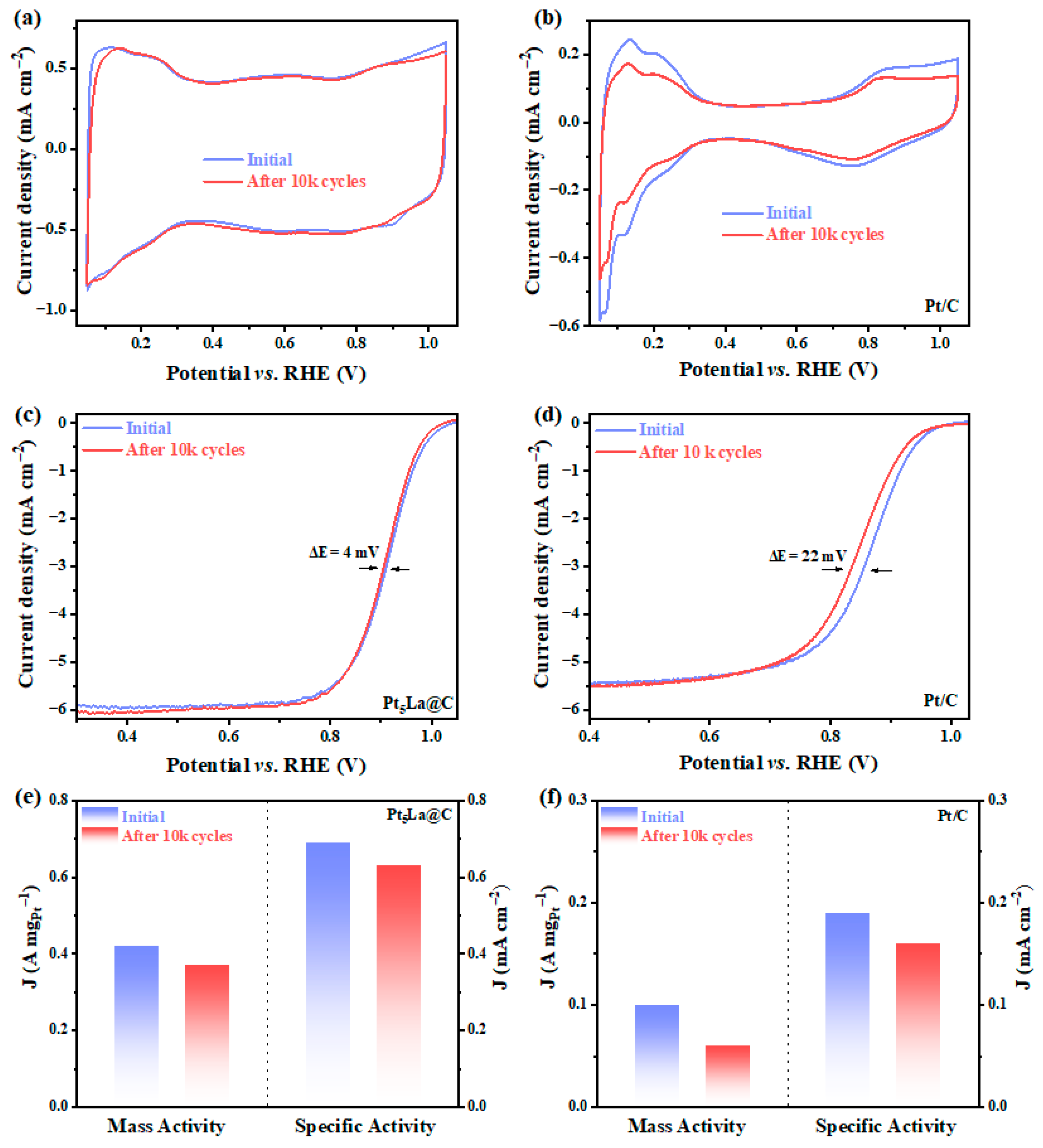
The ORR performance of the Pt5La@C catalyst was then evaluated in a 0.1 M HClO4 solution with a commercial Pt/C catalyst as a reference. Figure 5a shows the cyclic voltammogram (CV) curves of Pt5La@C and commercial Pt/C catalysts recorded in an Ar-saturated 0.1 M HClO4 solution with a scan rate of 20 mV s−1. It is clear that the peak potentials associated with the surface oxidation and oxide reduction shift positively for Pt5La@C (0.79 V) relative to the commercial Pt/C (0.77 V), demonstrating the weakened Pt-OHads interaction, which may reveal a higher ORR rate on the Pt5La@C surface [5]. In addition, the electrochemical surface area (ECSA) can be determined by calculating the hydrogen desorption peak area in the CV curves, and Pt5La@C showed an ECSA of 61.3 m2 gPt−1, which is significantly higher than that of Pt/C (52.2 m2 gPt−1). The ORR performance of the Pt5La@C catalyst was further measured in a three-electrode system with an O2-saturated 0.1 M HClO4 solution at 1600 rpm at a scan rate of 10 mV s−1. As shown in Figure 4b, the ORR polarization curve of Pt5La@C exhibited a much more positive shift compared to that of the commercial Pt/C catalyst. Moreover, the half-wave potential (E1/2) in the mixed kinetic/diffusion region is one of the metrics that indicates ORR activity [4], and Pt5La@C showed a half-wave potential of 0.912 V, which is higher than that of the commercial Pt/C (0.856 V), further indicating the unique ORR activity of Pt5La@C. Figure 4c shows the Tafel slope of the Pt5La@C catalyst compared to that of the commercial Pt/C catalyst. Tafel slopes of 64 mV dec−1 were fitted for the Pt5La@C catalyst, which are in close agreement with those of the commercial Pt/C catalyst (70 mV dec−1), indicating a similar ORR pathway with a pure Pt surface. Furthermore, the lower Tafel slopes than those of the Pt/C catalyst also indicate considerably improved kinetics for ORR. The kinetic mass activity and specific activity of Pt5La@C were also calculated by the Koutecky–Levich equation at 0.90 V vs. RHE. As shown in Figure 4d, the mass activity of the Pt5La@C catalyst was 0.42 A mgPt−1, which is 4.2 times that of Pt/C (0.1 A mgPt−1). Moreover, the specific activities of Pt5La@C were 0.69 mA cm−2, also surpassing those of commercial Pt/C (0.19 mA cm−2). In addition, the Pt5La@C sample showed a slightly better ORR performance than the Pt5La@C sample before acid leaching (Figure S6). The Pt5La@C catalyst in this work showed comparable ORR activity to previous works (Table S4). The durability of the Pt5La@C and commercial Pt/C catalysts was further evaluated by conducting an accelerated stability test (AST) in an air-saturated 0.1 M HClO4 solution via potential cycling between 0.6 and 1.0 V with a scan rate of 50 mV s−1. Figure 6a,b show the CV curves of Pt5La@C and commercial Pt/C catalysts, respectively, before and after 10,000 potential cycles. The loss of ECSA is only 4.4% after 10,000 potential cycles, while the ECSA retention of Pt/C was only 30.3% for Pt/C, indicating the maximum retention of Pt active sites in Pt5La@C [38]. As shown in Figure 6c, in ORR polarization curves, the half-wave potential of Pt5La@C catalysts showed only 4 mV decay after 10,000 potential cycles, while commercial Pt/C experienced 22 mV degradation (Figure 6d). The better durability of Pt5La@C was further confirmed by the changes in its mass activity and specific activity. As shown in Figure 6e, after the 10,000-cycle test, Pt5La@C only displayed a decrease of 12% in mass activity and 8.7% in specific activity, which are significantly smaller than those of Pt/C (40% for mass activity and 15.8% for specific activity) (Figure 6f).

3. Experimental Section

3.1. Chemicals

Cyanamide and chloroplatinic acid hexahydrate (H2PtCl6·6H2O, 37.5% Pt basis), 2-Propanol ((CH3)2CHOH, ≥99.5%), and perchloric acid (HClO4, 70%) were bought from Sigma-Aldrich (Saint Louis, MO, USA). Lanthanum (III) nitrate hexahydrate (La(NO3)3·6H2O, 99.9%) and anhydrous ethanol were purchased from Shanghai Titan Technology Co., Ltd. (Shanghai, China). Ketjenblack EC-600JD was obtained from Akzo Nobel (Amsterdam, The Netherlands). Nafion solution (5% wt.) was purchased from Ion Power (New Castle, DE, USA). The commercial Pt/C catalyst (40 wt.% Pt loading) was obtained from Johnson Matthey (London, UK). All chemicals were used as received without further purification.

3.2. Synthesis of Pt5La@C Catalyst

In a typical way, 50 mg dried carbon (Ketjenblack EC-600JD) was immersed in anhydrous ethanol containing 30 umol H2PtCl6·6H2O, 30 umol La(NO3)3·6H2O, and 100 mg cyanamide. This mixture was sonicated for 2 h. After drying in a vacuum oven at 70 °C overnight, the powder was further mixed and ground with 200 mg cyanamide using an agate mortar and then transferred into a tube furnace and annealed under a 5% H2/95% Ar atmosphere at 750 °C for 2 h (ramp rate: 10 °C/min), followed by cooling naturally to room temperature. The product PtLa@C (5:5) was finally leached in 50 mL of 0.5 M H2SO4 at 70 °C for 1 h under continuous stirring to obtain the Pt5La@C catalyst.

3.3. Physical Characterizations

The crystal structure of the catalysts was verified by X-ray diffraction conducted on an X-ray diffractometer (Rigaku, Tokyo, Japan, SmartLab-9kW) under Cu Kα radiation (λ = 0.15406 nm) with a scan rate of 5° min−1. Transmission electron microscopy was performed on a Thermo Fisher Talos F200X G2 transmission electron microscope (TEM, Waltham, MA, USA). X-ray photoelectron spectroscopy (XPS) was collected using a K-Alpha+ photoelectron spectrometer (Thermo Fisher Scientific). Pt and La contents in the catalyst were determined by inductively coupled plasma atomic emission spectroscopy (710-ES, Varian (Palo Alto, CA, USA), ICP-OES).

3.4. Electrochemical Measurements

All of the electrochemical measurements were performed in a three-electrode cell by a CHI 760E electrochemical workstation (Shanghai CH Instruments, Shanghai, China). The electrolyte was a 0.1 M HClO4 solution, while a Pt foil and Ag/AgCl (3 M KCl) were used as the counter electrode and reference electrode, respectively. For the preparation of the catalyst ink, a certain amount of catalyst was mixed in iso-propanol/ultrapure water (v/v = 1:3) with 5wt.% Nafion as the binder, and sonicated for 30 min. Working electrodes were obtained by dropping 15 μL of catalyst ink onto a glassy carbon electrode (GCE) (d = 5 mm) with a geometric electrode area of 0.196 cm2 and drying in air, yielding a catalyst loading of 20 μgPt cm−2. The cyclic voltammetry measurement in the potential range of 0.05 to 1.05 V was first conducted in an Ar-saturated 0.1 M HClO4 solution at a scan rate of 50 mV s−1 to obtain a stable CV curve. Subsequently, the CV curve was recorded from 0.05 V to 1.05 V at a scan rate of 20 mV s−1, and the electrochemical surface area (ECSA) was determined by integrating a charge for hydrogen desorption between 0.05 and 0.40 V, assuming a 210 μC cm−2. The ORR polarization curve was then measured in an O2-saturated 0.1 M HClO4 solution at a scan rate of 10 mV s−1 between 0 and 1.10 V with electrode rotation rate at 1600 rpm. Catalyst stability was evaluated by accelerated stress testing (AST) with potential cycles between 0.6 and 1.0 V at 50 mV s−1 for 10,000 cycles in an air-saturated 0.1 M HClO4 solution. For comparison, commercial Pt/C was used as the baseline catalyst.

4. Conclusions

In summary, ultrasmall Pt5La nanoalloys were synthesized to be embedded into porous carbon with a particle size of less than 3 nm and also with a very narrow size distribution. The as-prepared Pt5La@C catalyst achieved an impressive ORR performance, with a half-wave potential of 0.912 V, which is 56 mV higher than that of the commercial Pt/C catalyst. A high intrinsic activity of 0.69 mA cm−2 and mass activity of 0.42 A mgPt−1 at 0.90 V were also observed. Furthermore, it also displayed excellent stability with negligible decay after an AST of 10,000 cycles. In addition, this work provides a simple method for the synthesis of Pt-RE nanoalloys with ultrasmall nanoparticles in a very narrow distribution.

Supplementary Materials

The following supporting information can be downloaded at: https://www.mdpi.com/article/10.3390/catal16010097/s1, Figure S1: XRD pattern of PtLa@C sample synthesized with Pt and La atomic ratio of 5:3 (PtLa@C (5:3)) before leaching; Figure S2: XRD pattern of PtLa@C sample synthesized with Pt and La atomic ratio of 5:1 (PtLa@C (5:1)); Figure S3: O 1s XPS spectra of Pt5La@C sample after acid leaching; Figure S4: (a) TEM and (b) HAADF-STEM images of Pt5La@C sample; Figure S5: TEM-EDS spectrum of Pt5La@C sample; Figure S6: (a) Cyclic voltammetry curve, (b) ORR polarization curve of Pt5La@C sample before acid leaching (PtLa@C (5:5)); Table S1: Chemical composition of Pt5La@C sample after acid leaching; Table S2: Atomic ratios of Pt, La, C and O species in Pt5La@C sample after leaching detected by XPS; Table S3: Binding energies and atomic ratios of Pt specie in Pt5La@C sample after acid leaching. Table S4: Comparison of ORR performance for various Pt-RE alloy catalysts under acidic conditions. References [13,14,19,24,32,33,34,39,40,41,42,43] are cited in the Supplementary Materials.

Author Contributions

Investigation, data curation, writing—original draft, R.C.; investigation, data curation, W.B.; investigation, data curation, J.L.; data curation, S.Y.; data curation, J.Y.; data curation, J.Z.; data curation, X.L.; data curation, Y.L.; methodology, project administration, funding acquisition, supervision, writing—review and editing, Z.M. All authors have read and agreed to the published version of the manuscript.

Funding

This research was funded by the National Natural Science Foundation of China (22208214).

Data Availability Statement

Data are contained within the article and Supplementary Materials.

Conflicts of Interest

The authors declare no conflicts of interest.

References

  1. Wang, X.X.; Swihart, M.T.; Wu, G. Achievements, challenges and perspectives on cathode catalysts in proton exchange membrane fuel cells for transportation. Nat. Catal. 2019, 2, 578–589. [Google Scholar] [CrossRef] [Scilit]
  2. Zhang, F.; Zu, B.; Wang, B.; Qin, Z.; Yao, J.; Wang, Z.; Fan, L.; Jiao, K. Developing long-durability proton-exchange membrane fuel cells. Joule 2025, 9, 101853. [Google Scholar] [CrossRef] [Scilit]
  3. Huang, L.; Zaman, S.; Tian, X.; Wang, Z.; Fang, W.; Xia, B.Y. Advanced platinum-based oxygen reduction electrocatalysts for fuel cells. Acc. Chem. Res. 2021, 54, 311–322. [Google Scholar] [CrossRef] [Scilit]
  4. Zhang, L.; Deng, Y.; Zhang, J.; Tan, W.; Wang, L.; Du, L.; Song, H.; Liao, S.; Dang, D.; Sun, S.; et al. Optimized surface strain in L10-type Pt0.8Ga0.2Co intermetallic catalyst for enhanced oxygen reduction in fuel cells. Chem. Mater. 2024, 36, 11404–11411. [Google Scholar] [CrossRef] [Scilit]
  5. Ma, Z.; Li, S.; Wu, L.; Song, L.; Jiang, G.; Liang, Z.; Su, D.; Zhu, Y.; Adzic, R.R.; Wang, J.X.; et al. NbOx nano-nail with a Pt head embedded in carbon as a highly active and durable oxygen reduction catalyst. Nano Energy 2020, 69, 104455. [Google Scholar] [CrossRef] [Scilit]
  6. Ren, X.; Lv, Q.; Liu, L.; Liu, B.; Wang, Y.; Liu, A.; Wu, G. Current progress of Pt and Pt-based electrocatalysts used for fuel cells. Sustain. Energy Fuels 2020, 4, 15–30. [Google Scholar] [CrossRef] [Scilit]
  7. Leng, X.; Huang, L.; Sun, Y.; Jin, X.; Chen, F.; Duan, H.; Cao, B. PtM (M = Fe, Co, Ni) alloys as highly efficient catalysts to the oxygen reduction reaction. Fuel 2026, 408, 137516. [Google Scholar] [CrossRef] [Scilit]
  8. Wei, Z.; Chen, X.; Diao, P.; Liao, J.; Chong, Z.; Yao, C.; Ma, Z.; Li, G. Highly dispersed Pt on TiOx embedded in porous carbon as electrocatalyst for hydrogen evolution reaction. Catalysts 2025, 15, 487. [Google Scholar] [CrossRef] [Scilit]
  9. Pollet, B.G.; Kocha, S.S.; Staffell, I. Current status of automotive fuel cells for sustainable transport. Curr. Opin. Electrochem. 2019, 16, 90–95. [Google Scholar] [CrossRef] [Scilit]
  10. Ma, Z.; Cano, Z.P.; Yu, A.; Chen, Z.; Jiang, G.; Fu, X.; Yang, L.; Wu, T.; Bai, Z.; Lu, J. Enhancing oxygen reduction activity of Pt-based electrocatalysts: From theoretical mechanisms to practical methods. Angew. Chem. Int. Ed. 2020, 59, 18334–18348. [Google Scholar] [CrossRef] [Scilit]
  11. Jiang, H.; Liu, Q.; Song, W.; Gong, P.; Yu, Z.; Liang, Z. Synthesis of nitrogen-doped platinum-neodymium nanoalloy catalyst by liquid-phase reduction for oxygen reduction reaction. Adv. Sustain. Syst. 2025, 9, 2400944. [Google Scholar] [CrossRef] [Scilit]
  12. Li, C.; Wang, H.; Qian, F.; Li, Y.; Sang, Q.; Chen, Q.; Liao, J.; Zhu, Y.; Liu, Y.; Zhang, S. Gram-scale synthesis of unsupported Pt-rare earth nanosponge for enhanced stability in proton exchange membrane fuel cells. Chem. Eng. J. 2025, 515, 163572. [Google Scholar] [CrossRef] [Scilit]
  13. Zhang, Y.-F.; Zhao, Y.-Y.; Ye, K.; Zhao, Y.; Zhou, S.; Yin, F. Chemical synthesis of Pt/rare-earth nanoalloys with exclusive ligand effect boosting oxygen electrocatalysis. Rare Met. 2024, 44, 1777–1788. [Google Scholar] [CrossRef] [Scilit]
  14. Xu, S.-L.; Zhao, S.; Zeng, W.-J.; Li, S.; Zuo, M.; Lin, Y.; Chu, S.; Chen, P.; Liu, J.; Liang, H.-W. Synthesis of a hexagonal-phase platinum-lanthanide alloy as a durable fuel-cell-cathode catalyst. Chem. Mater. 2022, 34, 10789–10797. [Google Scholar] [CrossRef] [Scilit]
  15. Yoo, S.J.; Hwang, S.J.; Lee, J.-G.; Lee, S.-C.; Lim, T.-H.; Sung, Y.-E.; Wieckowski, A.; Kim, S.-K. Promoting effects of La for improved oxygen reduction activity and high stability of Pt on Pt-La alloy electrodes. Energy Environ. Sci. 2012, 5, 7521–7525. [Google Scholar] [CrossRef] [Scilit]
  16. Gao, Q.; Wang, H.; Liu, C.; Luo, L.; Li, X.; Jiang, Q.; Ji, Y.; Zheng, T.; Xia, C. Regulatory mechanisms and applications of rare earth elements-based electrocatalysts. Chin. J. Chem. 2025, 43, 205–218. [Google Scholar] [CrossRef] [Scilit]
  17. Malacrida, P.; Escudero-Escribano, M.; Verdaguer-Casadevall, A.; Stephens, I.E.L.; Chorkendorff, I. Enhanced activity and stability of Pt-La and Pt-Ce alloys for oxygen electroreduction: The elucidation of the active surface phase. J. Mater. Chem. A 2014, 2, 4234–4243. [Google Scholar] [CrossRef] [Scilit]
  18. Escudero-Escribano, M.; Malacrida, P.; Hansen, M.H.; Vej-Hansen, U.G.; Velázquez-Palenzuela, A.; Tripkovic, V.; Schiøtz, J.; Rossmeisl, J.; Stephens, I.E.L.; Chorkendorff, I. Tuning the activity of Pt alloy electrocatalysts by means of the lanthanide contraction. Science 2016, 352, 73–76. [Google Scholar] [CrossRef] [Scilit]
  19. Gunji, T.; Tanaka, S.; Inagawa, T.; Otsuka, K.; Matsumoto, F. Atomically ordered Pt5La nanoparticles as electrocatalysts for the oxygen reduction reaction. ACS Appl. Nano Mater. 2022, 5, 4958–4965. [Google Scholar] [CrossRef] [Scilit]
  20. Tang, N.; Wang, H.; Zhang, T. Synthesis of Pt-rare earth metal alloys and their applications. Chem. Eur. J. 2024, 30, e202402750. [Google Scholar] [CrossRef] [Scilit]
  21. Hu, M.; Cai, Z.; Liang, X.; Li, G.; Tan, H.; Yang, S.; Ren, H.; Wang, Z.; Sun, G.; Liu, S.; et al. Surface-confined synthesis of ultrafine Pt-rare earth nanoalloys on N-functionalized supports. Adv. Funct. Mater. 2022, 32, 2202675. [Google Scholar] [CrossRef] [Scilit]
  22. Feng, Y.; Zhang, S.; Chen, M.; Zhu, L.; Pei, A.; Wu, F.; Liao, X.; Gao, Q.; Wang, W.; Yang, Z.; et al. Revealing the mechanism of bifunctional PtLa electrocatalyst for highly efficient methanol oxidation, hydrogen evolution, and coupling reaction. J. Colloid Interface Sci. 2025, 679, 918–928. [Google Scholar] [CrossRef] [Scilit]
  23. Guan, C.; Chen, H.; Feng, H. Room-temperature synthesis of sub-2 nm ultrasmall platinum-rare-earth metal nanoalloys for hydrogen evolution reaction. Inorg. Chem. 2022, 61, 13379–13385. [Google Scholar] [CrossRef] [Scilit]
  24. Moriyama, T.; Muratsugu, S.; Sato, M.; Higuchi, K.; Takagi, Y.; Tada, M. Pt2Gd alloy nanoparticles from organometallic Pt and Gd complexes and hollow mesoporous carbon spheres: Enhanced oxygen reduction reaction activity and durability. J. Am. Chem. Soc. 2025, 147, 1262–1270. [Google Scholar] [CrossRef] [Scilit]
  25. Jiang, Y.; Fu, T.; Liu, J.; Zhao, J.; Li, B.; Chen, Z. Molten salt synthesis of carbon-supported Pt-rare earth metal nanoalloy catalysts for oxygen reduction reaction. RSC Adv. 2022, 12, 4805–4812. [Google Scholar] [CrossRef] [Scilit]
  26. Brandiele, R.; Guadagnini, A.; Parnigotto, M.; Pini, F.; Coviello, V.; Badocco, D.; Pastore, P.; Rizzi, G.A.; Vittadini, A.; Forrer, D.; et al. Laser-optimized Pt-Y alloy nanoparticles embedded in Pt-Y oxide matrix for high stability and ORR electrocatalytic activity. J. Energy Chem. 2024, 92, 508–520. [Google Scholar] [CrossRef] [Scilit]
  27. Hernandez-Fernandez, P.; Masini, F.; McCarthy, D.N.; Strebel, C.E.; Friebel, D.; Deiana, D.; Malacrida, P.; Nierhoff, A.; Bodin, A.; Wise, A.M.; et al. Mass-selected nanoparticles of PtxY as model catalysts for oxygen electroreduction. Nat. Chem. 2014, 6, 732. [Google Scholar] [CrossRef] [Scilit]
  28. Roy, C.; Knudsen, B.P.; Pedersen, C.M.; Velázquez-Palenzuela, A.; Christensen, L.H.; Damsgaard, C.D.; Stephens, I.E.L.; Chorkendorff, I. Scalable synthesis of carbon-supported platinum-lanthanide and -rare-earth alloys for oxygen reduction. ACS Catal. 2018, 8, 2071–2080. [Google Scholar] [CrossRef] [Scilit]
  29. Kanady, J.S.; Leidinger, P.; Haas, A.; Titlbach, S.; Schunk, S.; Schierle-Arndt, K.; Crumlin, E.J.; Wu, C.H.; Alivisatos, A.P. Synthesis of Pt3Y and other early-late intermetallic nanoparticles by way of a molten reducing agent. J. Am. Chem. Soc. 2017, 139, 5672–5675. [Google Scholar] [CrossRef] [Scilit] [PubMed]
  30. Hu, Y.; Jensen, J.O.; Cleemann, L.N.; Brandes, B.A.; Li, Q. Synthesis of Pt-rare earth metal nanoalloys. J. Am. Chem. Soc. 2020, 142, 953–961. [Google Scholar] [CrossRef] [Scilit] [PubMed]
  31. Hu, Y.; Jensen, J.O.; Norby, P.; Cleemann, L.N.; Yang, F.; Li, Q. Mechanistic insights into the synthesis of platinum-rare earth metal nanoalloys by a solid-state chemical route. Chem. Mater. 2021, 33, 535–546. [Google Scholar] [CrossRef] [Scilit]
  32. Qin, J.; Li, Z.; Ye, K.; Zhang, Y.; Liu, Q.; Yin, F. Rare earth gadolinium-modified platinum-based bimetallic nanomaterial as a cathodic catalyst for the oxygen reduction reaction. Energy Fuels 2021, 35, 14868–14875. [Google Scholar] [CrossRef] [Scilit]
  33. Campos-Roldán, C.A.; Parnière, A.; Donzel, N.; Pailloux, F.; Blanchard, P.-Y.; Jones, D.J.; Rozière, J.; Cavaliere, S. Influence of the carbon support on the properties of platinum-yttrium nanoalloys for the oxygen reduction reaction. ACS Appl. Energy Mater. 2022, 5, 3319–3328. [Google Scholar] [CrossRef] [Scilit]
  34. Fan, C.; Wen, P.; Li, G.; Li, G.; Gu, J.; Li, Q.; Li, B. Facile synthesis of Pt5La nanoalloys as the enhanced electrocatalysts for oxygen reduction reaction and methanol oxidation reaction. J. Alloys Compd. 2022, 894, 161892. [Google Scholar] [CrossRef] [Scilit]
  35. Cai, R.; Jiang, J.; Diao, P.; Wei, Z.; Yao, C.; Zhou, B.; Zhang, H.; Liu, W.; Ma, Z. Highly dispersed ZIF-67-derived co-NC confined in carbon pores enables efficient oxygen reduction in alkaline media. J. Electroanal. Chem. 2025, 989, 119212. [Google Scholar] [CrossRef] [Scilit]
  36. Chong, Z.; Cai, R.; Yao, C.; Wei, Z.; Diao, P.; Liao, J.; Yang, S.; Chen, X.; Zhang, H.; Ma, Z. Ultrasmall Mo2C nanoparticles anchored on porous carbon as electrocatalyst for the hydrogen evolution reaction. ACS Appl. Nano Mater. 2025, 8, 9760–9769. [Google Scholar] [CrossRef] [Scilit]
  37. Jiang, N.; Huang, B.; Wang, M.; Chen, Y.; Yu, Q.; Guan, L. Universal and energy-efficient approach to synthesize Pt-rare earth metal alloys for proton exchange membrane fuel cell. Adv. Sci. 2024, 11, 2305110. [Google Scholar] [CrossRef] [Scilit] [PubMed]
  38. Yang, L.; Bai, J.; Zhang, N.; Jiang, Z.; Wang, Y.; Xiao, M.; Liu, C.; Zhu, S.; Xu, Z.J.; Ge, J.; et al. Rare earth evoked subsurface oxygen species in platinum alloy catalysts enable durable fuel cells. Angew. Chem. Int. Ed. 2024, 63, e202315119. [Google Scholar] [CrossRef] [Scilit]
  39. Zhu, S.; Yang, L.; Bai, J.; Chu, Y.; Liu, J.; Jin, Z.; Liu, C.; Ge, J.; Xing, W. Ultra-stable Pt5La intermetallic compound towards highly efficient oxygen reduction reaction. Nano Res. 2023, 16, 2035–2040. [Google Scholar] [CrossRef] [Scilit]
  40. Wan, Z.; Wan, X.; Ye, J.; Su, H.; Cheng, G.; Gao, J.; Gao, W.; Wen, D. Tuning d-band center of Pt via Pt-Pt5La heterostructure interface as efficient and stable electrocatalyst for oxygen reduction and methanol oxidation reactions in DMFCs. Chem. Eng. J. 2024, 498, 155564. [Google Scholar] [CrossRef] [Scilit]
  41. Fan, C.; Li, G.; Gu, J.; Wang, Q.; Li, S.; Li, B. Molten-salt electrochemical deoxidation synthesis of platinum-neodymium nanoalloy catalysts for oxygen reduction reaction. Small 2023, 19, 2300110. [Google Scholar] [CrossRef] [Scilit] [PubMed]
  42. Liu, Q.; Qin, J.; Huang, F.; Zhang, D.; Chen, L.; Yin, F. Dysprosium regulated platinum particles as a bimetallic alloy catalyst for oxygen reduction reaction. J. Rare Earths 2023, 41, 1189–1194. [Google Scholar] [CrossRef] [Scilit]
  43. Zhu, S.; Sun, M.; Mei, B.; Yang, L.; Chu, Y.; Shi, Z.; Bai, J.; Wang, X.; Jiang, Z.; Liu, C.; et al. Intrinsic spin shielding effect in platinum-rare-earth alloy boosts oxygen reduction activity. Natl. Sci. Rev. 2023, 10, nwad162. [Google Scholar] [CrossRef] [Scilit] [PubMed]
Figure 1. Schematic illustration of the synthesis procedure of the Pt5La@C sample.
Catalysts 16 00097 g001
Figure 2. XRD patterns of PtLa@C (5:5) and Pt5La@C samples.
Catalysts 16 00097 g002
Figure 3. (a) XPS survey, (b) C 1s, (c) Pt 4f, and (d) La 3d XPS spectra of Pt5La@C sample after acid leaching.
Catalysts 16 00097 g003
Figure 4. (a) TEM, (b) HRTEM, (c,d) HAADF-STEM images, and (e,f) elemental mapping images of (e) Pt, (f) La for the Pt5La@C sample after acid leaching (The insertion in (a) is the particle size distribution of Pt5La nanoparticles).
Catalysts 16 00097 g004
Figure 5. (a) Cyclic voltammetry curves, (b) ORR polarization curves, (c) mass-transport corrected Tafel plots based on specific current density obtained from ORR polarization curves, and (d) Specific and mass activities at 0.9 V vs. RHE of Pt5La@C and commercial Pt/C catalysts for ORR.
Catalysts 16 00097 g005
Figure 6. Cyclic voltammetry curves of (a) Pt5La@C and (b) commercial Pt/C catalysts before and after 10,000 potential cycles, ORR polarization curves before and after 10,000 potential cycles of (c) Pt5La@C and (d) commercial Pt/C catalysts. Mass and specific activities change before and after 10,000 potential cycles for (e) Pt5La@C and (f) commercial Pt/C catalysts.
Catalysts 16 00097 g006
Disclaimer/Publisher’s Note: The statements, opinions and data contained in all publications are solely those of the individual author(s) and contributor(s) and not of MDPI and/or the editor(s). MDPI and/or the editor(s) disclaim responsibility for any injury to people or property resulting from any ideas, methods, instructions or products referred to in the content.