Article

Microwave Synthesis of Transition Metal (Fe, Co, Ni)-Supported Catalysts for CO2 Hydrogenation

by
Anna A. Strekalova
1,
Anastasiya A. Shesterkina
2,*,
Kirill A. Beresnev
2,
Petr V. Pribytkov
2,
Gennadiy I. Kapustin
1,
Igor V. Mishin
1,
Leonid M. Kustov
1,2 and
Alexander L. Kustov
2,*
1
Zelinsky Institute of Organic Chemistry, Russian Academy of Sciences, Leninsky Prospekt 47, Moscow 119991, Russia
2
Chemistry Department, Lomonosov Moscow State University, Leninskie Gory 1/3, Moscow 119991, Russia
*
Authors to whom correspondence should be addressed.
Catalysts 2026, 16(1), 111; https://doi.org/10.3390/catal16010111 (registering DOI)
Submission received: 15 December 2025 / Revised: 12 January 2026 / Accepted: 21 January 2026 / Published: 22 January 2026

Abstract

To improve the efficiency of CO2 hydrogenation, it is essential to develop new catalysts as well as new methods of producing them. In our work, we propose a new Fe-, Co-, Cu-containing catalyst preparation technique based on depositing the active component through urea hydrolysis using microwave heating. We also compare catalysts produced with microwave synthesis to samples obtained through traditional synthesis methods, including impregnation and thermal deposition. The obtained catalysts were characterized by XRD, low-temperature N2 adsorption, SEM., and UV-VIS methods. The catalytic properties of the catalysts depend not only on the nature of the active component, but also on the preparation method. The best results for CO2 hydrogenation were achieved with Ni-containing catalysts produced by the impregnation method and microwave synthesis.

1. Introduction

The increased use of fossil fuels has led to rapidly rising levels of carbon dioxide (CO2) in the atmosphere, causing climate and environmental problems (e.g., the greenhouse effect and rising sea levels) as well as energy crises [1,2]. To reduce the carbon footprint, the conversion of CO2 into value-added products is of fundamental interest [3]. As such, the use of CO2 as a C1 feedstock to synthesize carbon monoxide (CO), methane (CH4), and light hydrocarbons represent a more sustainable pathway than the current petrochemical approach. Methane, which is the main component of natural gas used in household appliances, is a highly efficient energy-carrying molecule [4]. Light olefins are important chemical raw materials that are widely used in the production of various polymeric materials and fine chemical products [5]. Due to thermodynamic stability and chemical inactivity of the CO2 molecule, the reaction temperature above 240 °C is required for methane formation. However, at a high temperature (500 °C), CO and H2O are formed by the reverse water–gas shift reaction, which leads to additional hydrogen consumption, and the resulting water has an inhibitory effect on the active metal during the reaction, which leads to deactivation of the catalyst [6]. Thus, efficient transformation of CO2 into methane and light olefins requires the development of new improved catalytic systems.
In recent years, homogeneous [7] and heterogeneous [8] catalysts for the hydrogenation of CO2 into methane and light olefins have been widely investigated. Most often, catalysts based on noble metals such as Ru [9], Rh [10], Pd [11], and Pt have been chosen for the hydrogenation of carbon dioxide into methane due to their high activity in H2 dissociation, as well as catalysts based on base metals such as Co [12,13] and Ni [14]. For the production of light olefins, Fe-based catalysts [13,15] are preferred, mainly because of their wide availability and low cost. Recently, most studies have focused on nickel-containing catalysts in the CO2 hydrogenation reaction [16,17,18]. These catalysts are the most widely studied materials because of their low cost and good catalytic activity in CO2 methanation [19,20]. The activity of base metal catalytic systems in the CO2 hydrogenation reaction depends on various factors such as the method of catalyst synthesis, the nature of the carrier, and the concentration of the active component, reaction conditions, etc.
Traditionally, approaches to the synthesis of monometallic nanomaterials for the CO2 hydrogenation reaction are represented most often by impregnation, precipitation, ultrasonic methods [21,22,23]. The synthesis of catalysts using conventional methods, such as co-precipitation and sol–gel methods, do not allow for the control of the stages of nucleation and growth, which results in a wide range of particle sizes. However, using the impregnation method, fine metal particles can be prepared without achieving a narrow particle size distribution. In addition, using this method has disadvantages such as the structure and size of the metal particles depending on the morphology of the carrier; it is also difficult to control the composition of the bimetallic catalyst particles [24]. The benefits of using the microwave irradiation synthesis method are the uniform heating achieved, with less energy required compared to the traditional methods, and the possible usage of environment friendly solvents, thus omitting the purification of the product [25]. It is also easier to control the size of the particles with the use of the microwave method of synthesis [26]. Zhu et al. [27] fabricated a nickel phyllosilicate-based catalyst by the microwave irradiation method using surfactants and obtained a CO2 conversion of 81.7% at 400 °C, 60 L g−1 h−1, and 0.1 MPa. At low process temperatures, nickel-containing catalysts undergo deactivation due to the formation of nickel carbonyl, which is formed by the interaction of CO with metal particles [28]. In this regard, the development of highly active catalytic systems capable of efficiently converting CO2 to methane at suitable temperatures and low CO formation is an actual task.
In this work—a comparison of methods for the synthesis of monometallic Fe-, Ni-, and Co-containing catalysts, including the microwave heating and traditional methods, which relies on the thermal hydrolysis of urea and the incipient wetness impregnation of the support in carbon dioxide hydrogenation reaction, was employed.

2. Results and Discussion

2.1. Physicochemical Properties of the Catalysts

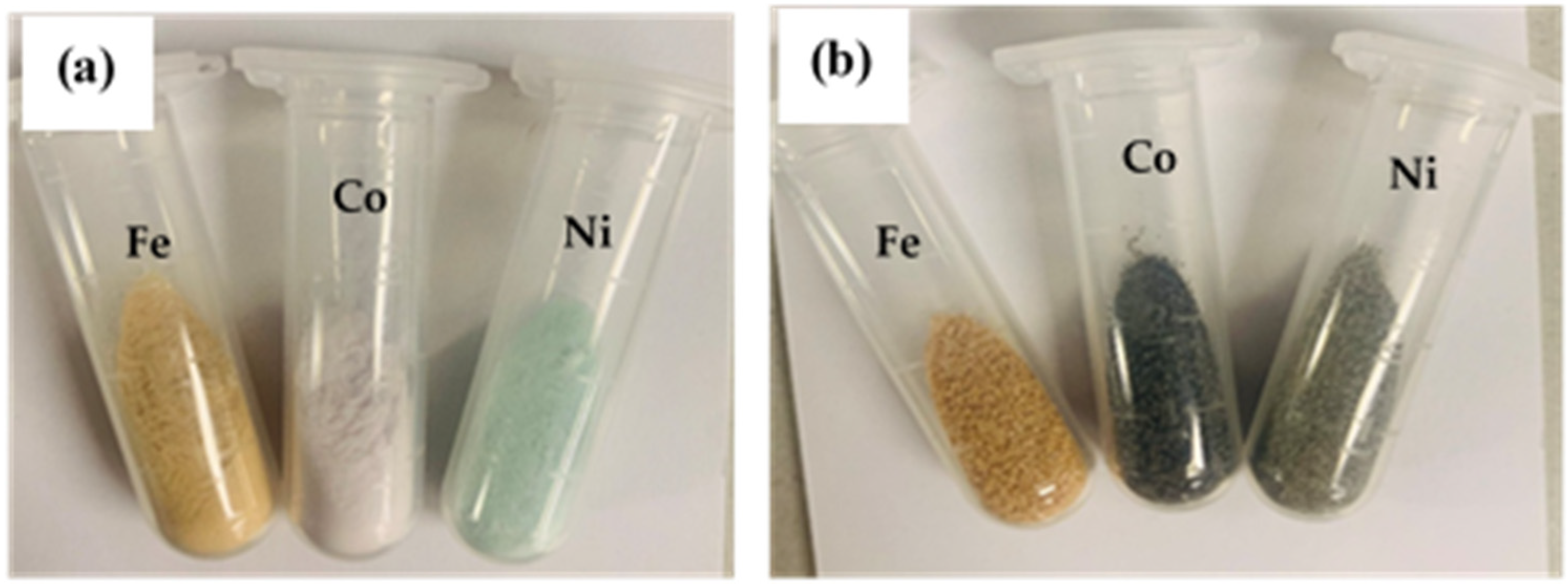
The supported Fe-, Co-, and Ni-containing catalysts were prepared by three different synthesis methods: DP, MW, and IP. The catalysts synthesized by the DP and MW methods retained the same color after thermal treatment and after drying in a rotary evaporator—namely light orange, soft pink, and light green (Figure 1a)—while the catalysts prepared by the IP method turned dark after calcination (Figure 1b), which indicates the formation of different phases, and is especially evident in Co- and Ni-containing samples. The resulting effect was described in our previously published paper [29].
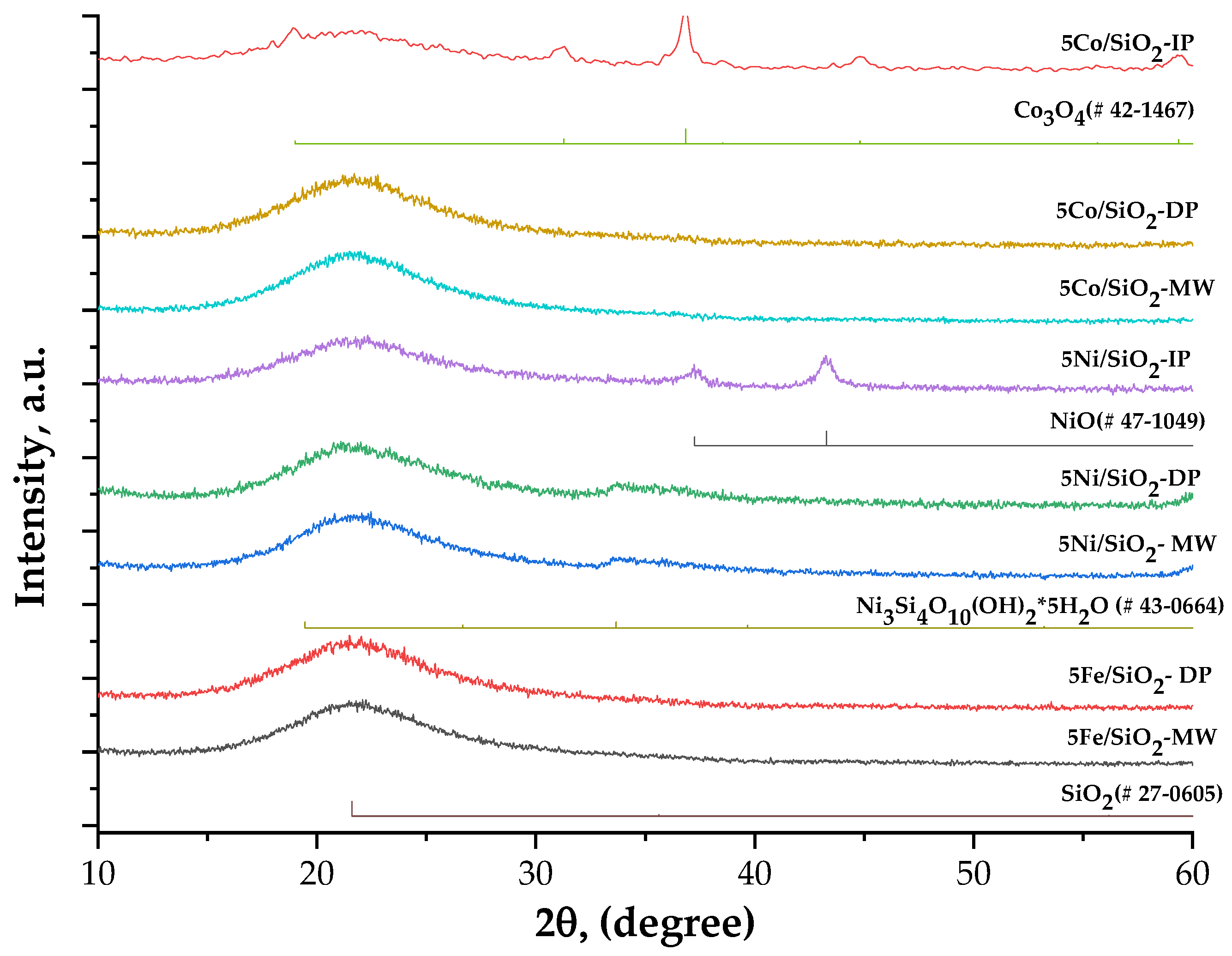
The phase composition of all monometallic samples was investigated by XRD (Figure 2). The XRD patterns of all samples show a halo at 22°, which corresponds to the amorphous structure of the original SiO2 carrier (JCPDS #27-0605). The X-ray diffraction pattern of the calcined sample 5Ni/SiO2-MW obtained by the microwave method exhibits characteristic weak peaks at 26.7°, 33.7°, 39.7°, 53.2°, and 60.9°, which correspond to the formation of the phyllosilicate phase of nickel (Ni3Si4O10(OH)2·*5H2O), which has a structure similar to that of the mineral pimelite. Similar reflexes were observed for the sample 5Ni/SiO2-DP obtained by thermal heating (JCPDS #43-0664) [30] and for 10% Cu/SiO2 [31]. According to the XRD study of the 5Co/SiO2 and 5Fe/SiO2 samples obtained by both the microwave (MW) and thermal deposition (DP) methods, no crystalline phases were detected in the X-ray diffraction patterns. The Co and Ni samples synthesized by impregnation followed by calcination exhibited the formation of the oxide phases Co3O4 and NiO, respectively [29].
The N2 adsorption–desorption method was applied to investigate the textural characteristics of the synthesized catalysts obtained by different methods, and the results are presented in Table 1. BET-specific surface area analysis of the Ni-containing samples has shown a decrease in the SBET value for the 5Ni/SiO2-IP catalyst, along with a decrease in the mesopores volume relative to the initial SiO2 support. This is probably caused by the filling of pores with a metal precursor solution and therefore the deposition of the nickel oxide phase inside the SiO2 pores [32]. Conversely, the increase in the SBET value of the 5Ni/SiO2-DP and 5Ni/SiO2-MW samples was observed along with the increase in the micropore volume (Table 1). This phenomenon has been noted by a number of researchers [33,34] and is probably caused by the creation of additional defects in the SiO2 structure due to the formation of the phyllosilicate phase. Also, a slight decrease in the specific surface area of the other two Fe- and Co-containing samples obtained by the impregnation method was observed. However, for these samples obtained by the DP and MW methods, the SBET did not differ significantly from the SiO2 carrier.
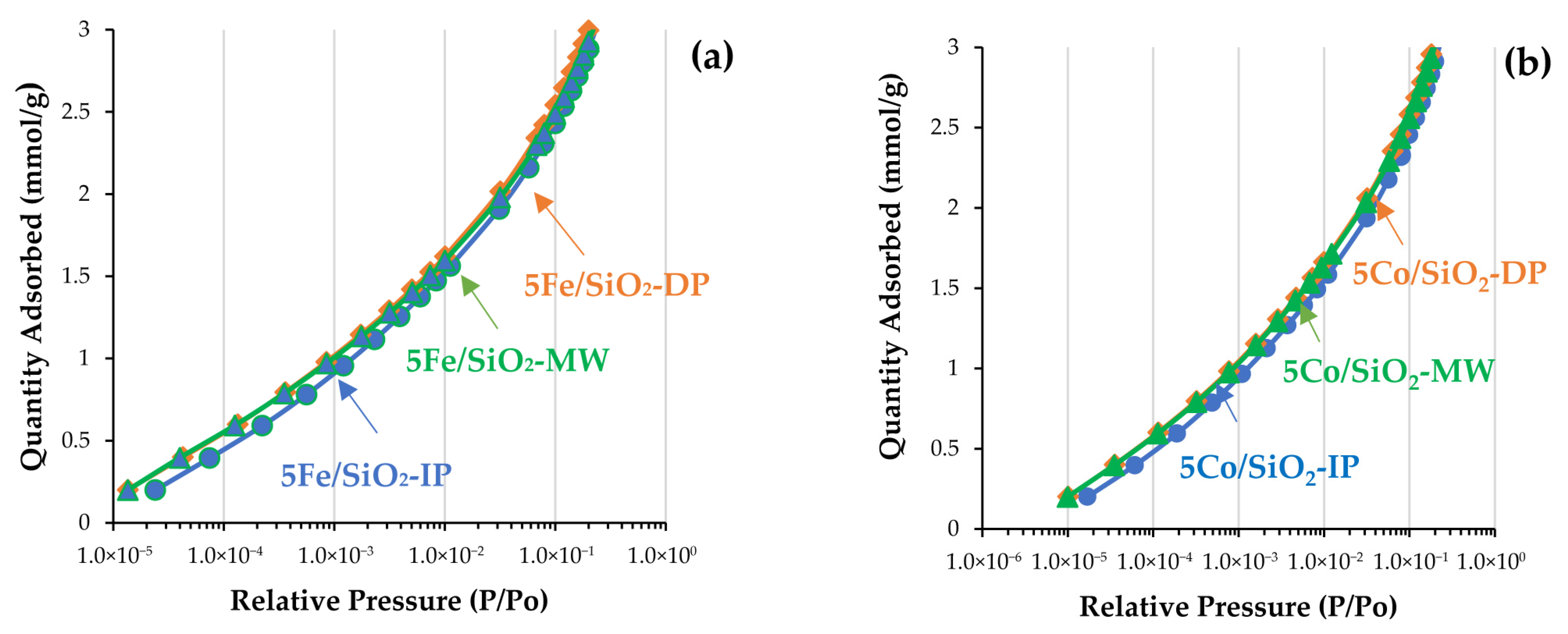
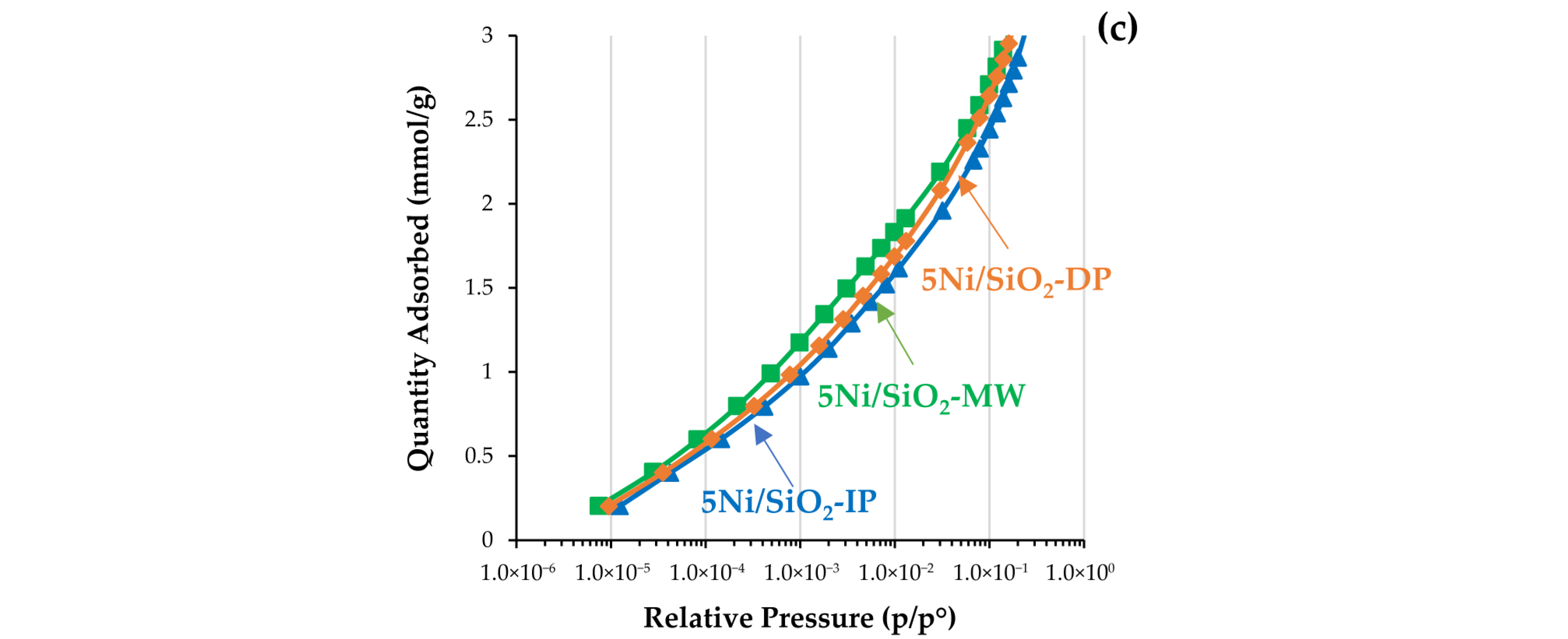
The isotherms of all samples differ from each other within the limits of the method error (Figure 3). However, the isotherms of the samples obtained by the DP method and the MW method are slightly shifted to higher adsorption values than the isotherms of the samples obtained by the IP method in the region of low relative pressures.
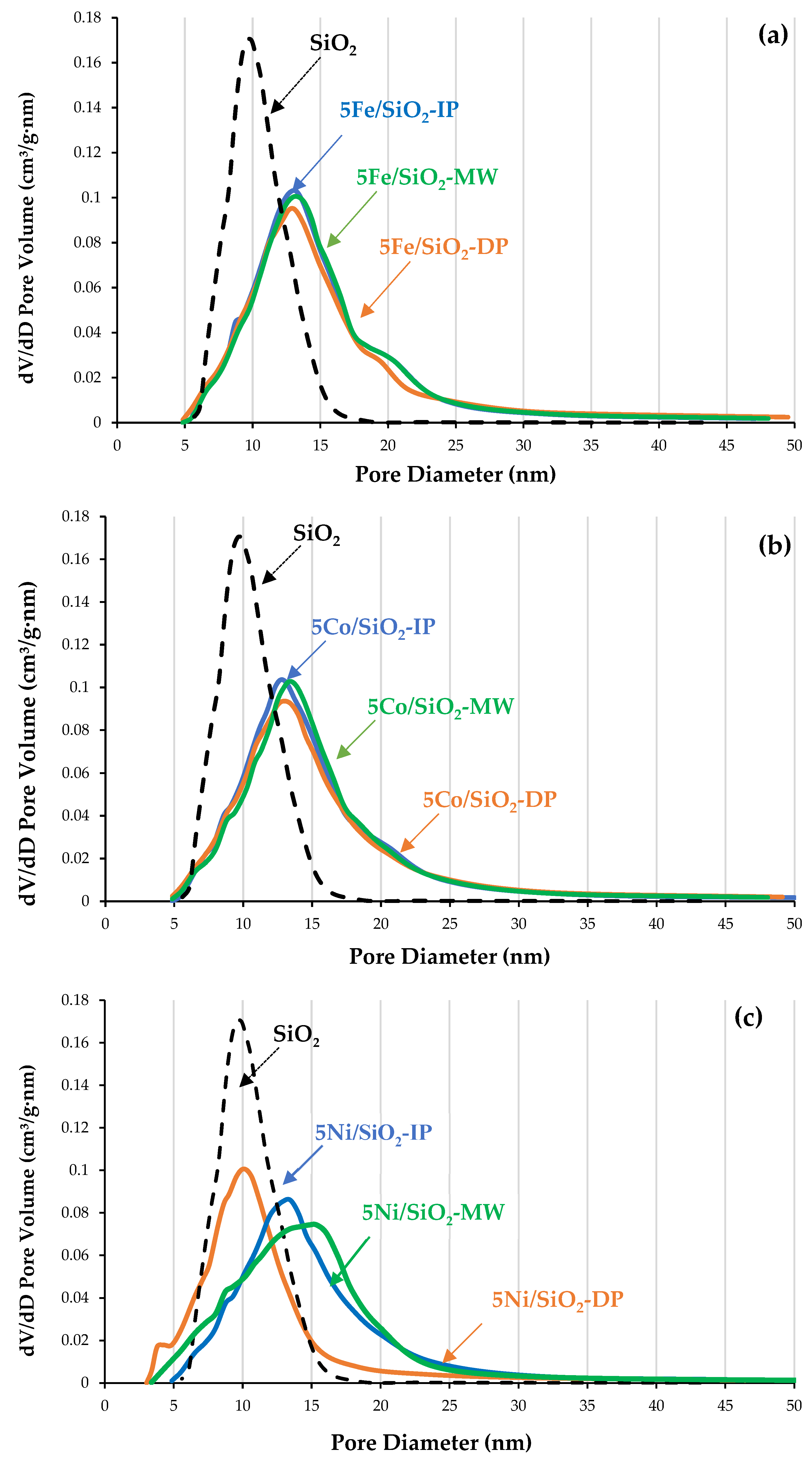
The characteristics of the pore size distribution for the Fe and Co samples vary insignificantly (Figure 4a,b) and are practically independent of the production method. However, in comparison with the initial SiO2 carrier, there is a shift in the curve towards wider pores. At the same time, the specific surface area of these samples varies slightly compared to that of the initial SiO2, and the total pore volume increases. It should also be noted that the DP method for nickel catalysts leads to a decrease in the volume of the mesopores of the initial silica gel, but the IP and MW methods favor a wider distribution of mesopores and result in shifts in the apex of the distribution curve toward the region of wider pores. The formation of new pores with d = 2–5 nm leads to a significant increase in the specific surface area of the samples obtained by the MW and DP methods compared to the original silica gel. So, the studies of N2 adsorption–desorption of the 5Ni/SiO2-DP and 5Ni/SiO2-MW samples revealed (i) the formation of a new phase with a high specific surface area, which increases the specific surface area of the initial SiO2 carrier from 244 to 281 m2/g (Table 1); (ii) a wide bimodal distribution of mesopores of the newly formed phase in line with two definite maxima at 4 nm and 10 nm instead of a narrow monomodal distribution with a maximum at 10 nm for the carrier (Figure 4c); and (iii) the presence of micropores 2–5 nm in size in the structures of the samples.
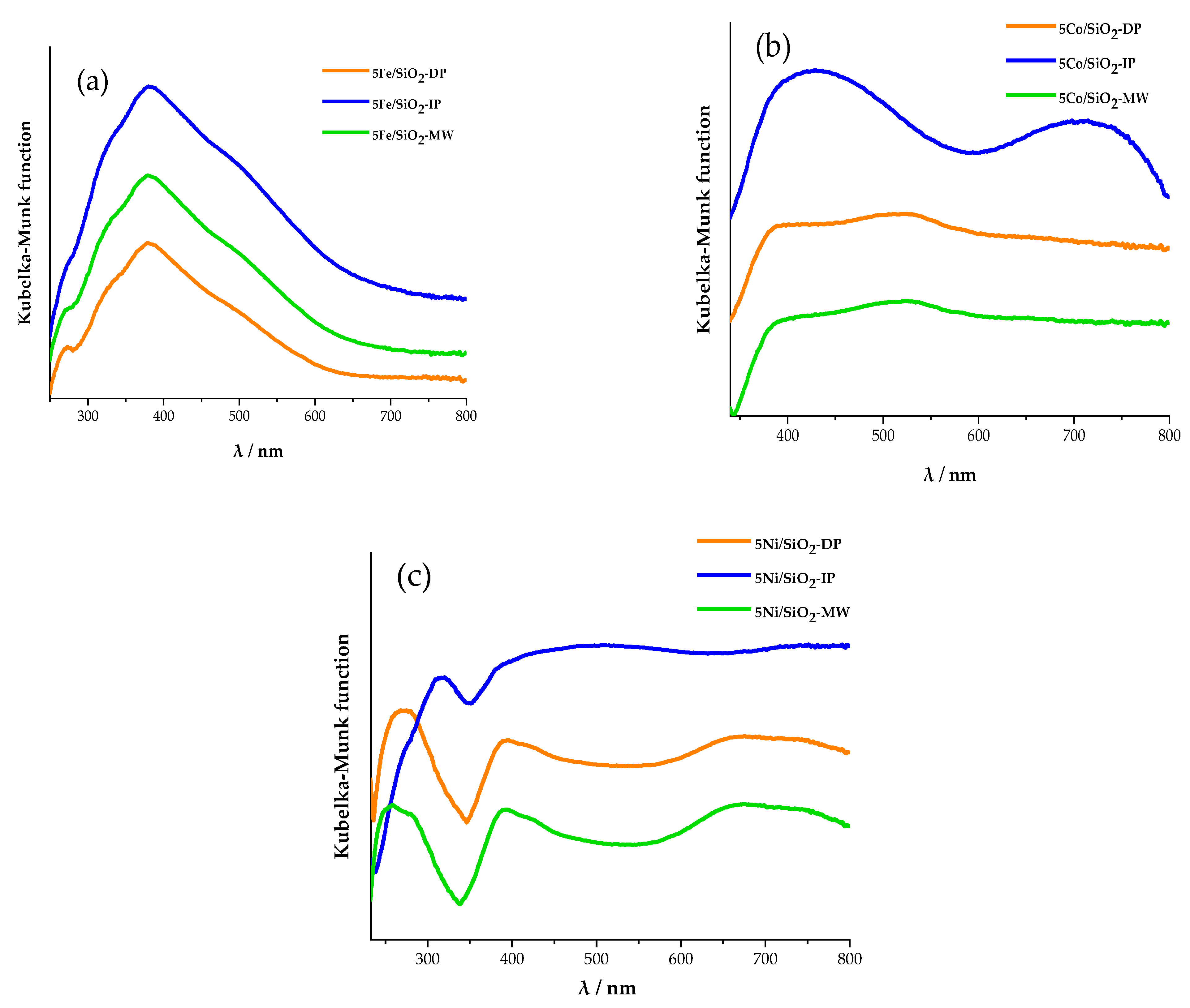
The crystal structure of all prepared Fe, Co, Ni catalyst samples was investigated by UV-VIS diffuse reflectance spectroscopy (Figure 5).
The spectra of the 5Fe/SiO2 samples (Figure 5a) show a shoulder at about 250 nm, which is more intense for 5Fe/SiO2-DP and weakest for 5Fe/SiO2-IP, indicating a lower energy dπ-pπ charge transfer from the ligand to the Fe(III) ion in the (FeO4) tetrahedral coordination. An intense absorption band at 380 nm is also observed, which is due to the absorption of Fe in the FexOy oligomeric cluster. Figure 5b shows the spectra of the 5Co/SiO2 samples. The 5Co/SiO2-IP sample exhibits two pronounced broad bands at about 450 and 713 nm, which indicate the presence of Co3O4 clusters. In the 5Co/SiO2-DP and 5Co/SiO2-MW samples, the band at 450 nm is weakly pronounced, indicating the presence of a small number of Co3O4 clusters. The spectra of the 5Ni/SiO2 samples are shown in Figure 5c. The 5Ni/SiO2-DP and 5Ni/SiO2-MW samples exhibit a broad UV band in the 235–340 nm region, which corresponds to the O2− → Ni2+ charge transfer in the octahedral coordination of NiO. The band at 390–420 nm indicates the formation of nickel silicate and/or chemical bonding between nickel ions and the silica gel. The appearance of the band in this region depends on the coordination, Ni2+ aggregation, and degree of dispersion, indirectly indicating a stronger metal–carrier interaction between smaller Ni and silica gel particles.
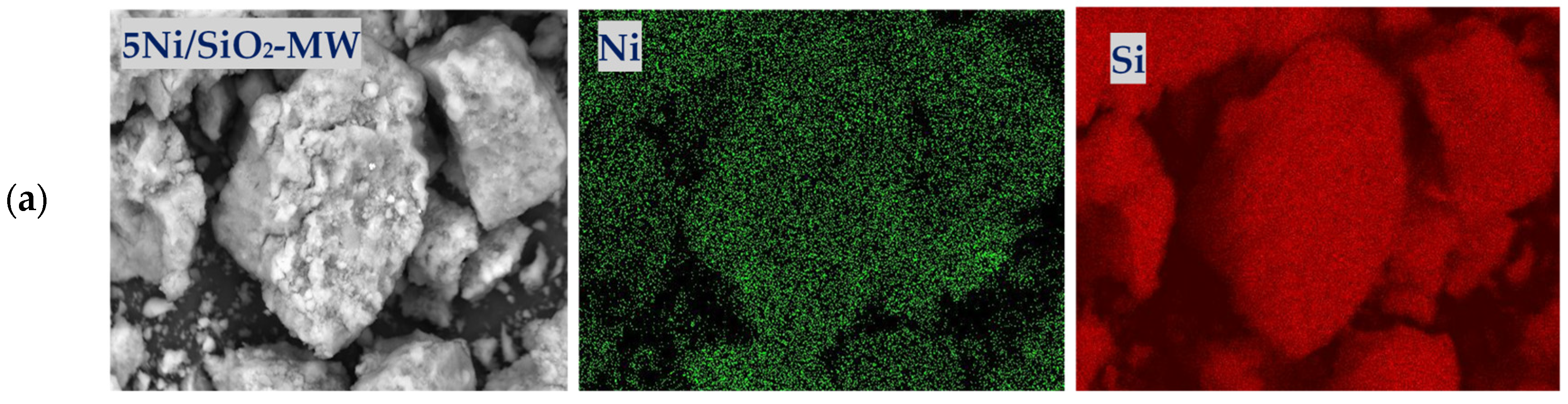
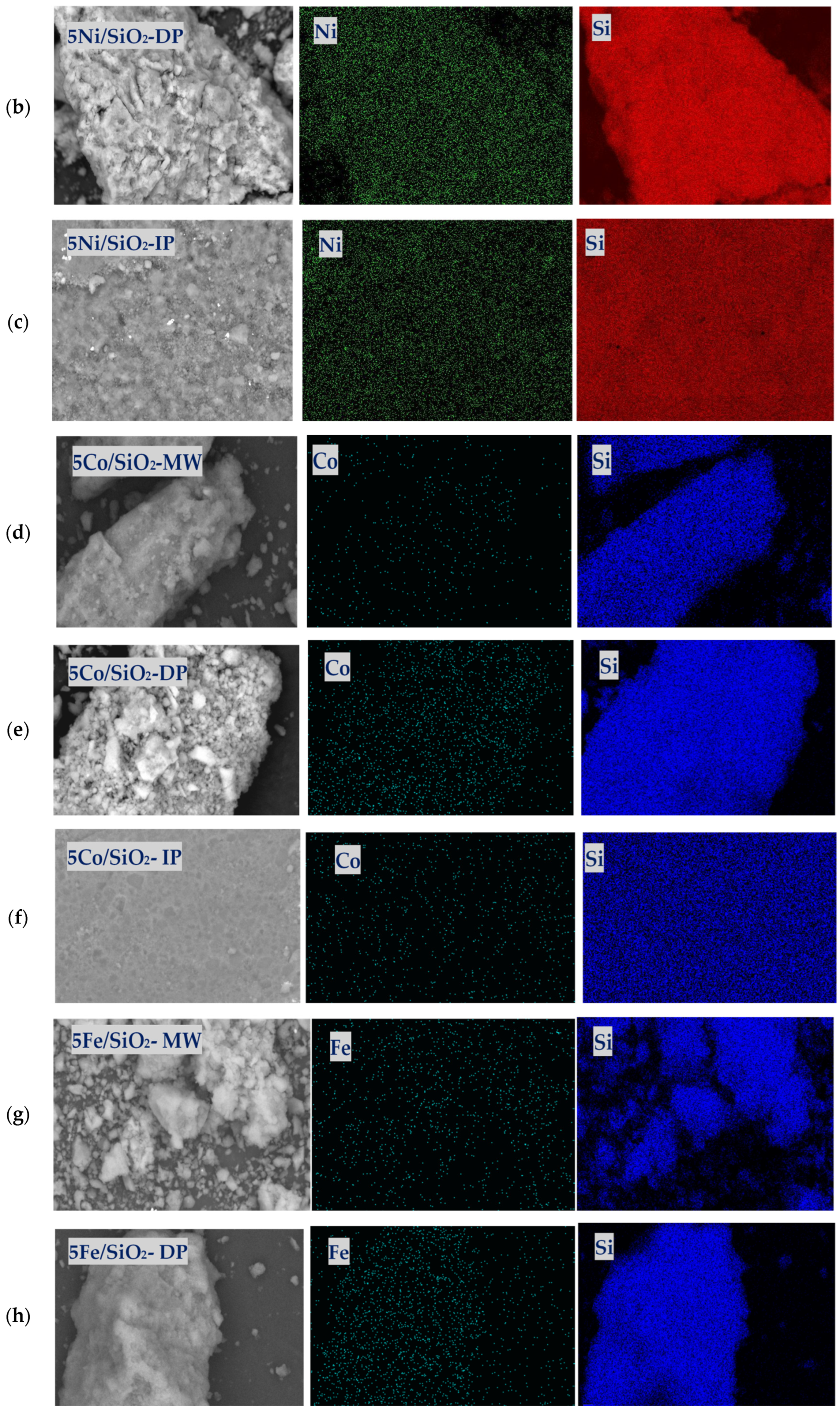
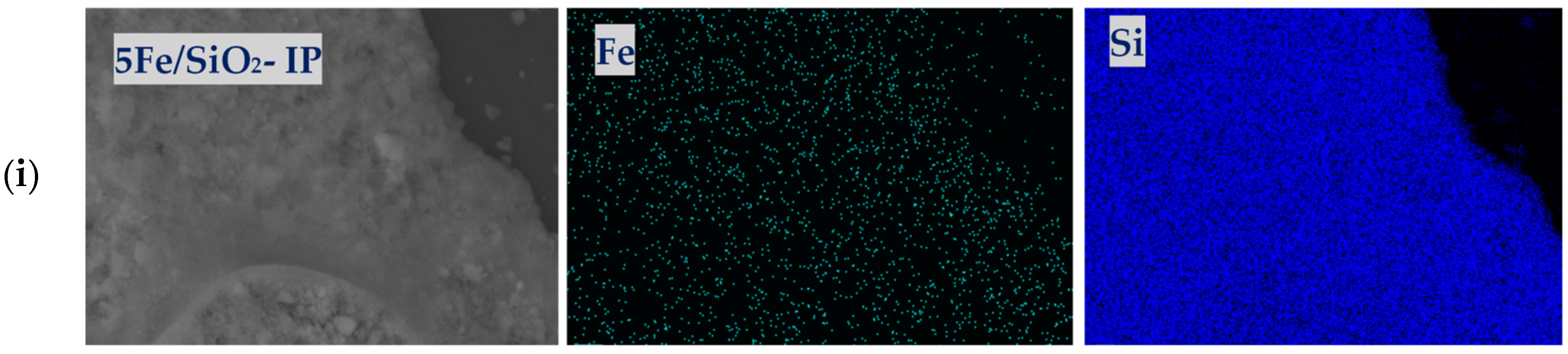
The results of the investigation of the morphology of the synthesized Ni-, Co-, and Fe-containing catalysts by the SEM method are presented in Figure 6, with the mapping of the constituent elements in the samples, as well as the EDS spectra. A uniform distribution of Ni, Co, Fe on the carrier surface can be observed in the micrographs of the all samples synthesized by different methods—MW, DP, and IP (Figure 6).

2.2. Catalytic Activity

The effect of the synthesis method of the monometallic catalysts was studied in the carbon dioxide hydrogenation reaction. For iron-based catalysts, CO was the main reaction product, and methane was prevalent among the resulting hydrocarbons. Methane was also almost the only hydrocarbon formed on the nickel-based samples, with C2 hydrocarbons occurring as traces. Ni-based catalysts surpass Co-based samples in methane formation and hydrocarbon selectivity, though Co catalysts demonstrate a higher variety of C2+ products.
An investigation of the influence of the active component on the catalytic properties in CO2 hydrogenation showed that Ni- and Co-based samples exhibit catalytic properties, but the distribution of the resulting products in these samples is very different (Table S1). Thus, in the case of the nickel catalyst, the hydrogenation reaction predominantly proceeds with the formation of light hydrocarbons. In turn, in cobalt-containing samples, CO and hydrocarbons, mainly C2+, are formed almost equally. The poor overall performance of iron-containing samples was to be expected since iron cannot adsorb hydrogen the way nickel and cobalt can.
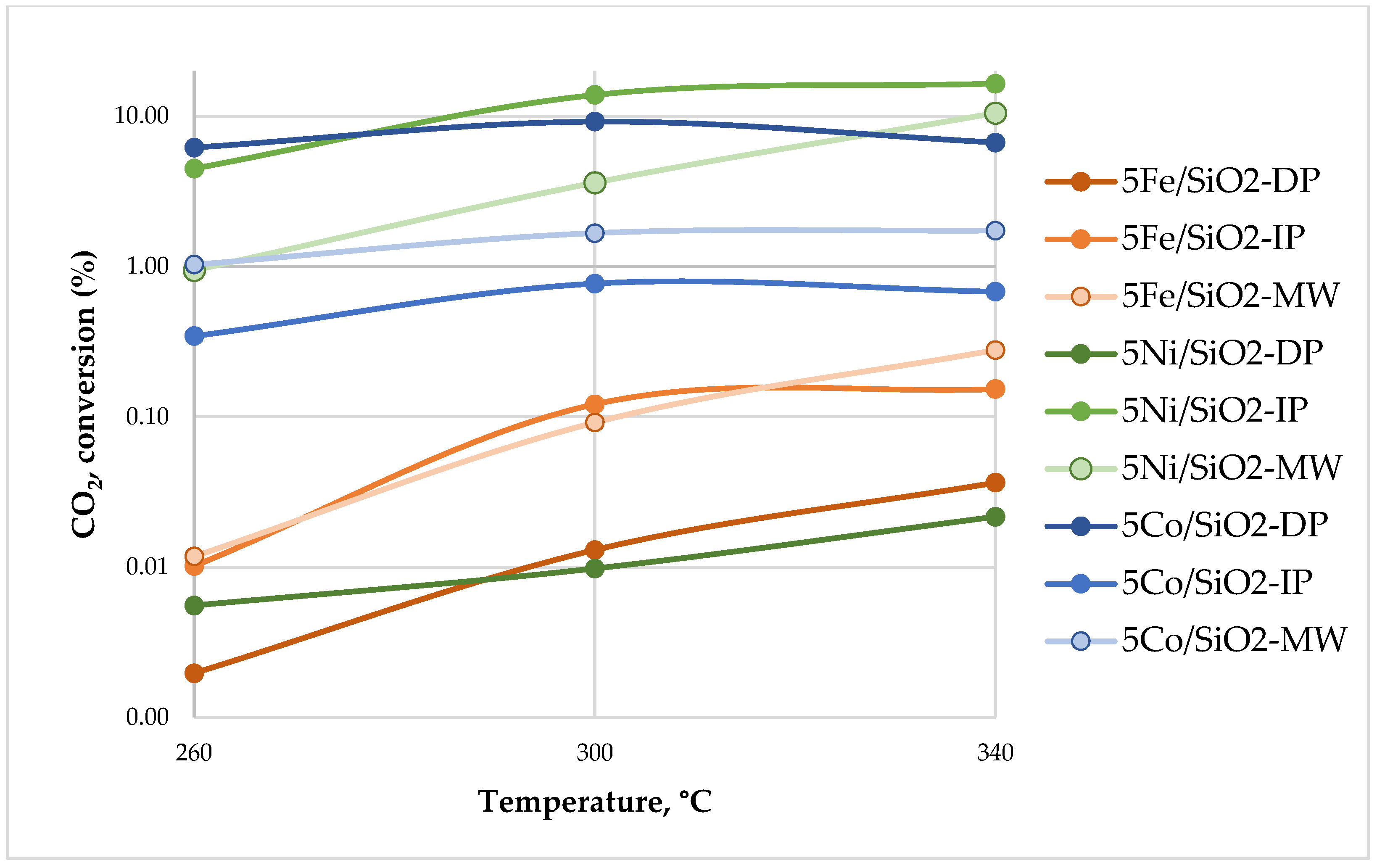
The study of the effect of the reaction temperature, ranging from 260 °C to 340 °C for the samples synthesized by the MW method, showed that an increase in the reaction temperature leads to a sharp increase in the CO2 conversion rate, but at the same time reduces the selectivity of hydrocarbon formation (Figure 7).
A comparison of the methods of synthesis showed that the Ni-containing catalysts obtained under the microwave heating and impregnation method are the most efficient in CO2 hydrogenation, in contrast to the samples obtained under thermal conditions. Also, high values in terms of the process productivity were obtained for these catalysts (Table 2). As be seen from Figure 7, the correlation between the temperature and the CO2 conversion is more linear for MW samples over the studied temperature range. While most of the samples reach a maximal conversion (or at least approach it) around 300 °C, the MW samples demonstrate a further increase in the CO2 conversion rate. A performance comparison of Ni-based catalysts studied in this work and in other papers is shown in Table 2. Among the Co-containing catalysts, a high efficiency was obtained at a temperature of 340 °C on a sample synthesized by thermal heating.

3. Materials and Methods

3.1. Catalyst Preparation

A series of monometallic samples of Fe, Co, and Ni, supported on a commercial SiO2 carrier (Ssp = 250 m2g−1, Vpore = 1 cm3g−1, Saint-Gobain, France), was prepared by several different methods: (i) precipitation by the thermal hydrolysis of urea (deposition precipitation, DP); (ii) microwave heating in a Multiwave Pro reactor (MW); and, as a comparison method, (iii) the incipient wetness impregnation (impregnation preparation, IP) of the carrier. Aqueous solutions of the corresponding nitrates were used as the active metal precursors, including Fe(NO3)3·9H2O (99+%), Co(NO3)2·6H2O (99+%), and Ni(NO3)2·6H2O (99+%) were supplied by Acros Organics (Geel, Belgium)). The content of the active component in the all catalysts was 5 wt%.
The methods for the synthesis of the catalysts were as follows:
(i)
DPU method: The reactor for sample synthesis was a 250 mL round-bottomed flask placed in a water bath with a thermocouple between the walls of the bath and the reactor. A magnetic stirrer was placed into the reactor for the uniform stirring of the suspension, and simultaneously an aqueous solution of metal nitrate precursor at the required concentration (1 M) and the required volume of distilled water were introduced. Then we introduced a calcined SiO2 carrier and stirred the suspension for 15 min. After that, a weight of urea was added to the obtained suspension, and the suspension was heated to 92 °C, then thermostated under constant stirring for 9 h. Then the suspension was cooled, the precipitate was separated from the mother liquor by centrifugation, and the sample was dried under a vacuum on a rotary evaporator at 40 °C for 2 h. The dry sample was additionally calcined in an air atmosphere at 300 °C for 3 h. The catalysts were denoted as 5Fe/SiO2-DP, 5Co/SiO2-DP, and 5Ni/SiO2-DP, respectively [29,31].
(ii)
MW method: For microwave synthesis, the Multiwave Pro (Anton Paar GmbH, Graz, Austria) microwave oven equipped with four autoclave-type beakers was used in the preparation of catalysts. A magnetic stirrer was placed in each beaker, then the SiO2 carrier was added, and an equal amount of the prepared solution was introduced, as in the DPU method (i). Next, the beakers were sealed and placed in a microwave reactor. The process of hydrothermal synthesis was carried out under the following conditions: temperature—92 °C (measured in each beaker by an IR sensor), pressure—9 bar, time of synthesis—5 h, and microwave radiation power—100 W. Upon completion of the process, the resulting suspension was washed three times with distilled water, centrifuged and dried under a vacuum for 3 h. Dry samples were additionally calcined in an air atmosphere at a temperature of 300 °C for 3 h. The catalysts were denoted as 5Fe/SiO2-MW, 5Co/SiO2-MW, and 5Ni/SiO2-MW, respectively [31].
(iii)
IP method: For comparison, samples were synthesized by the carrier impregnation method. The pre-vacuumed SiO2 carrier (2 g) was impregnated for 2 h with aqueous solutions of nitrates of the corresponding salts (Fe(NO3)3, Co(NO3)2, and Ni(NO3)2), with periodic shaking for uniform distribution, then the samples were dried in an oven at 110 °C and calcined at 300 °C in air for 3 h. The calcined catalysts obtained by the IP method were designated 5Fe/SiO2-IP, 5Co/SiO2-IP, and 5Ni/SiO2-IP, respectively.

3.2. Catalyst Characterization

The textural properties of the samples obtained by the DP, MW, and IP methods were determined from N2 adsorption isotherms using an ASAP 2020 Plus Micromeritics unit (Micromeritics, Norcross, GA, USA) at 77 K. The specific surface area of the samples was calculated by the BET method; the pore size distribution was determined from the desorption branch of the isotherm by the method of Barrett, Joyner, and Halenda (BJH). The total pore volume (V) was calculated at p/po = 0.99. The phase composition of the catalysts was investigated by X-ray diffraction analysis (XRD). X-ray diffractograms were recorded using an ARL X’TRA diffractometer (Thermo Fisher Scientific, Waltham, MA, USA) at a scanning speed of 1.2° per minute over a scanning range of 10 < 2θ < 60°. ICCD data were used to identify the signals. The microstructure and morphological characteristics of the samples were analyzed using the scanning electron microscopy (SEM) on a LEO EVO 50 XVP electron microscope (Carl Zeiss, Oberkochen, Germany) equipped with an INCA Energy 350 energy dispersive spectrometer (Oxford Instruments, Oxon, UK). The valence states of Fe, Co, and Ni on the carrier surface were investigated by UV-VIS diffuse reflectance spectroscopy with a Shimadzu UV-3600 Plus spectrophotometer (Shimadzu, Kyoto, Japan) supplied with an ISR-603 integrating sphere. BaSO4 was used as a reference sample and sample diluent. The spectra were recorded in the wavelength range of 200–800 nm at room temperature (25 °C). The UVProbe software (version 2.3) was used to process the spectra.

3.3. Catalyst Activity Test

The activity of the catalyst samples was investigated in a flow-through catalytic unit equipped with a 6 mm internal diameter stainless-steel reactor with a fixed catalyst bed at a pressure of 2 MPa at the temperature range from 260 °C to 340 °C. A catalyst fraction of 0.25 to 0.5 mm was used in the experiment. The loading of catalysts was 150 mg. The catalyst was mixed with quartz of the same fraction as the catalyst, bringing it to a volume of 1.4 mL. The H2:CO2 flow ratio was 2:1. The total volume flow rate of the initial gases (H2 + CO2) was 18 mL/min. Each sample was preliminarily reduced in situ in the flow of hydrogen, the process temperature was kept at 500 °C for 4 h, and the hydrogen flow rate was 50 mL/min. The reaction products were analyzed in the online sampling mode using a Chromatec-Crystal 5000 gas chromatograph (Nizhny Novgorod, Russia).

4. Conclusions

The Ni-, Co-, Fe-containing catalysts supported on a commercial SiO2 gel were prepared by different methods (MW, DP, and IP). The samples were characterized using physicochemical analysis methods such as XRD, N2 adsorption, and SEM-EDX. Nickel-containing catalysts showed the highest catalytic activity among all the obtained catalysts under the same conditions for the CO2 hydrogenation reaction. It has been shown that it is not only the nature of the active component that affects the conversion of CO2, but also the method of preparation. The nickel phyllosilicate phase obtained by the hydrolysis of urea using microwave heating is catalytically active in this reaction. The fast microwave synthesis method is an excellent alternative to traditional methods for the synthesis of phyllosilicate-phase systems, which require a very long synthesis time, ranging from 9 h to several days.

Supplementary Materials

The following supporting information can be downloaded at: https://www.mdpi.com/article/10.3390/catal16010111/s1, Table S1: Catalytic characteristics of the samples in CO2 hydrogenation.

Author Contributions

Conceptualization, A.A.S. (Anna A. Strekalova) and A.A.S. (Anastasiya A. Shesterkina); methodology, A.A.S. (Anna A. Strekalova) and K.A.B.; software, A.L.K. and L.M.K.; validation, A.A.S. (Anastasiya A. Shesterkina); formal analysis, A.L.K.; investigation, A.A.S. (Anna A. Strekalova) and P.V.P., I.V.M., and G.I.K.; resources, A.L.K. and L.M.K.; data curation, A.A.S. (Anastasiya A. Shesterkina); writing—original draft preparation, A.A.S. (Anastasiya A. Shesterkina); writing—review and editing, A.A.S. (Anastasiya A. Shesterkina) and A.L.K.; visualization, A.A.S. (Anna A. Strekalova); supervision, A.L.K. and L.M.K.; project administration, A.A.S. (Anna A. Strekalova) and A.A.S. (Anastasiya A. Shesterkina); funding acquisition, A.L.K. and L.M.K. All authors have read and agreed to the published version of the manuscript.

Funding

The research was supported by Russian Science Foundation (grant no. 23-73-30007).

Data Availability Statement

The original contributions presented in the study are included in the article, and further inquiries can be directed to the corresponding authors.

Acknowledgments

The authors acknowledge the support from Lomonosov Moscow State University Program of Development for providing access to the facilities of the scanning electron microscopy practicum.

Conflicts of Interest

The authors declare no conflicts of interest.

References

  1. Wang, H.; Fan, S.; Wang, S.; Dong, M.; Qin, Z.F.; Bin Fan, W.; Wang, J.G. Research progresses in the hydrogenation of carbon dioxide to certain hydrocarbon products. J. Fuel Chem. Technol. 2021, 49, 1609–1619. [Google Scholar] [CrossRef]
  2. De, S.; Dokania, A.; Ramirez, A.; Gascon, J. Advances in the Design of Heterogeneous Catalysts and Thermocatalytic Processes for CO2 Utilization. ACS Catal. 2020, 10, 14147–14185. [Google Scholar] [CrossRef]
  3. Álvarez, A.; Bansode, A.; Urakawa, A.; Bavykina, A.V.; Wezendonk, T.A.; Makkee, M.; Gascon, J.; Kapteijn, F. Challenges in the Greener Production of Formates/Formic Acid, Methanol, and DME by Heterogeneously Catalyzed CO2 Hydrogenation Processe. Chem. Rev. 2017, 117, 9804–9838. [Google Scholar] [CrossRef] [PubMed]
  4. Song, Y.J.; Cui, X.J.; Deng, T.S.; Qin, Z.F.; Bin Fan, W. Solvent effect on the activity of Ru-Co3O4 catalyst for liquid-phase hydrogenation of CO2 into methane. J. Fuel Chem. Technol. 2021, 49, 178–185. [Google Scholar] [CrossRef]
  5. Guo, S.; Feng, L.; Yu, Z.; Xu, D.; Liu, K.; Song, X.; Cheng, Y.; Cao, Q.; Wang, G.; Ding, M. Effects of preparation methods on the performance of InZr/SAPO-34 composite catalysts for CO2 hydrogenation to light olefins. J. Fuel Chem. Technol. 2024, 52, 790–799. [Google Scholar] [CrossRef]
  6. Vogt, C.; Monai, M.; Kramer, G.J.; Weckhuysen, B.M. The renaissance of the Sabatier reaction and its applications on Earth and in space. Nat. Catal. 2019, 2, 188–197. [Google Scholar] [CrossRef]
  7. Song, Q.W.; Zhou, Z.H.; He, L.N. Efficient, selective and sustainable catalysis of carbon dioxide. Green Chem. 2017, 19, 3707–3728. [Google Scholar] [CrossRef]
  8. Saeidi, S.; Najari, S.; Fazlollahi, F.; Nikoo, M.K.; Sefidkon, F.; Klemeš, J.J.; Baxter, L.L. Mechanisms and kinetics of CO2 hydrogenation to value-added products: A detailed review on current status and future trends. Renew. Sust. Energy Rev. 2017, 80, 1292–1311. [Google Scholar] [CrossRef]
  9. Guo, Y.; Mei, S.; Yuan, K.; Wang, D.J.; Liu, H.C.; Yan, C.H.; Zhang, Y.W. Low-Temperature CO2 Methanation over CeO2-Supported Ru Single Atoms, Nanoclusters, and Nanoparticles Competitively Tuned by Strong Metal-Support Interactions and H-Spillover Effect. ACS Catal. 2018, 8, 6203–6215. [Google Scholar] [CrossRef]
  10. Karelovic, A.; Ruiz, P. Mechanistic study of low temperature CO2 methanation over Rh/TiO2 catalysts. J. Catal. 2013, 301, 141–153. [Google Scholar] [CrossRef]
  11. Kwak, J.H.; Kovarik, L.; Szanyi, J. Heterogeneous catalysis on atomically dispersed supported metals: CO2 reduction on multifunctional Pd catalysts. ACS Catal. 2013, 3, 2094–2100. [Google Scholar] [CrossRef]
  12. Parastaev, A.; Muravev, V.; Huertas Osta, E.; van Hoof, A.J.F.; Kimpel, T.F.; Kosinov, N.; Hensen, E.J.M. Boosting CO2 hydrogenation via size-dependent metal–support interactions in cobalt/ceria-based catalysts. Nat. Catal. 2020, 3, 526–533. [Google Scholar] [CrossRef]
  13. Bogdan, V.I.; Koklin, A.E.; Kustov, A.L.; Pokusaeva, Y.A.; Bogdan, T.V.; Kustov, L.M. Carbon Dioxide Reduction with Hydrogen on Fe, Co Supported Alumina and Carbon Catalysts under Supercritical Conditions. Molecules 2021, 26, 2883. [Google Scholar] [CrossRef] [PubMed]
  14. Vogt, C.; Monai, M.; Sterk, E.B.; Palle, J.; Melcherts, A.E.M.; Zijlstra, B.; Groeneveld, E.; Berben, P.H.; Boereboom, J.M.; Hensen, E.J.M.; et al. Understanding carbon dioxide activation and carbon–carbon coupling over nickel. Nat. Commun. 2019, 10, 5330. [Google Scholar] [CrossRef] [PubMed]
  15. De Smit, E.; Weckhuysen, B.M. The renaissance of iron-based Fischer–Tropsch synthesis: On the multifaceted catalyst deactivation behavior. Chem. Soc. Rev. 2008, 37, 2758–2781. [Google Scholar] [CrossRef] [PubMed]
  16. Kustov, A.L.; Aymaletdinov, T.R.; Shesterkina, A.A.; Kalmykov, K.B.; Pribytkov, P.V.; Mishin, I.V.; Dunaev, S.F.; Kustov, L.M. Methane dry reforming: Influence of the SiO2 and Al2O3 supports on the catalytic properties of Ni catalysts. Mendeleev Commun. 2024, 34, 221–223. [Google Scholar] [CrossRef]
  17. Abdullah, B.; Abd Ghani, N.A.; Vo, D.V.N. Recent advances in dry reforming of methane over Ni-based catalysts. J. Clean Prod. 2017, 162, 170–185. [Google Scholar] [CrossRef]
  18. Wu, X.; Xu, L.; Chen, M.; Lv, C.; Wen, X.; Cui, Y.; Wu, C.E.; Yang, B.; Miao, Z.; Hu, X. Recent Progresses in the Design and Fabrication of Highly Efficient Ni-Based Catalysts with Advanced Catalytic Activity and Enhanced Anti-coke Performance Toward CO2 Reforming of Methane. Front. Chem. 2020, 8, 581923. [Google Scholar] [CrossRef]
  19. Mebrahtu, C.; Abate, S.; Perathoner, S.; Chen, S.; Centi, G. CO2 methanation over Ni catalysts based on ternary and quaternary mixed oxide: A comparison and analysis of the structure-activity relationships. Catal. Today 2018, 304, 181–189. [Google Scholar] [CrossRef]
  20. Evdokimenko, N.; Yermekova, Z.; Roslyakov, S.; Tkachenko, O.; Kapustin, G.; Bindiug, D.; Kustov, A.; Mukasyan, A.S. Sponge-like CoNi Catalysts Synthesized by Combustion of Reactive Solutions: Stability and Performance for CO2 Hydrogenation. Mater. 2022, 15, 5129. [Google Scholar] [CrossRef]
  21. Bacariza, M.C.; Graça, I.; Bebiano, S.S.; Lopes, J.M.; Henriques, C. Micro- and mesoporous supports for CO2 methanation catalysts: A comparison between SBA-15, MCM-41 and USY zeolite. Chem. Eng. Sci. 2018, 175, 72–83. [Google Scholar] [CrossRef]
  22. Salavati-Niasari, M.; Shakouri-Arani, M.; Davar, F. Flexible ligand synthesis, characterization and catalytic oxidation of cyclohexane with host (nanocavity of zeolite-Y)/guest (Mn(II), Co(II), Ni(II) and Cu(II) complexes of tetrahydro-salophen) nanocomposite materials. Micropor. Mesopor. Mater. 2008, 116, 77–85. [Google Scholar] [CrossRef]
  23. Namvar, F.; Salavati-Niasari, M.; Mahdi, M.A.; Meshkani, F. Multidisciplinary green approaches (ultrasonic, co-precipitation, hydrothermal, and microwave) for fabrication and characterization of Erbium-promoted Ni-Al2O3 catalyst for CO2 methanation. Arab. J. Chem. 2023, 16, 104494. [Google Scholar] [CrossRef]
  24. Dekkar, S.; Tezkratt, S.; Sellam, D.; Ikkour, K.; Parkhomenko, K.; Martinez-Martin, A.; Roger, A.C. Dry Reforming of Methane over Ni–Al2O3 and Ni–SiO2 Catalysts: Role of Preparation Methods. Catal. Lett. 2020, 150, 2180–2199. [Google Scholar] [CrossRef]
  25. Strekalova, A.A.; Shesterkina, A.A.; Kustov, A.L.; Kustov, L.M. Recent Studies on the Application of Microwave-Assisted Method for the Preparation of Heterogeneous Catalysts and Catalytic Hydrogenation Processes. Int. J. Mol. Sci. 2023, 24, 8272. [Google Scholar] [CrossRef]
  26. Kustov, L.M.; Kostyukhin, E.M.; Korneeva, E.Y.; Kustov, A.L. Microwave synthesis of nanosized iron-containing oxide particles and their physicochemical properties. Russ. Chem. Bull. 2023, 72, 583–601. [Google Scholar] [CrossRef]
  27. Zhu, R.; Liu, Q.; He, Y.; Liang, P. Rapid construction of nickel phyllosilicate with ultrathin layers and high performance for CO2 methanation. J. Colloid Interface Sci. 2024, 668, 352–365. [Google Scholar] [CrossRef]
  28. Zhan, Y.; Wang, Y.; Gu, D.; Chen, C.; Jiang, L.; Takehira, K. Ni/Al2O3-ZrO2 catalyst for CO2 methanation: The role of γ-(Al, Zr)2O3 formation. Appl. Surf. Sci. 2018, 459, 74–79. [Google Scholar] [CrossRef]
  29. Shesterkina, A.A.; Vikanova, K.V.; Zhuravleva, V.S.; Kustov, A.L.; Davshan, N.A.; Mishin, I.V.; Strekalova, A.A.; Kustov, L.M. A novel catalyst based on nickel phyllosilicate for the selective hydrogenation of unsaturated compounds. Mol. Catal. 2023, 547, 113341. [Google Scholar] [CrossRef]
  30. Bian, Z.; Kawi, S. Preparation, characterization and catalytic application of phyllosilicate: A review. Catal. Today 2020, 339, 3–23. [Google Scholar] [CrossRef]
  31. Shesterkina, A.; Vikanova, K.; Kostyukhin, E.; Strekalova, A.; Shuvalova, E.; Kapustin, G.; Salmi, T. Microwave Synthesis of Copper Phyllosilicates as Effective Catalysts for Hydrogenation of C≡C Bonds. Molecules 2022, 27, 988. [Google Scholar] [CrossRef] [PubMed]
  32. Li, G.; Hu, L.; Hill, J.M. Comparison of reducibility and stability of alumina-supported Ni catalysts prepared by impregnation and co-precipitation. Appl. Catal. A Gen. 2006, 301, 16. [Google Scholar] [CrossRef]
  33. Tan, J.; Xia, X.; Cui, J.; Yan, W.; Jiang, Z.; Zhao, Y. Efficient tuning of surface nickel species of the Ni-phyllosilicate catalyst for the hydrogenation of maleic anhydride. J. Phys. Chem. C 2019, 123, 9779–9787. [Google Scholar] [CrossRef]
  34. Liu, H.; Wang, H.; Shen, J.; Sun, Y.; Liu, Z. Preparation, characterization and activities of the nano-sized Ni/SBA-15 catalyst for producing COx-free hydrogen from ammonia. Appl. Catal. A Gen. 2008, 337, 138–147. [Google Scholar] [CrossRef]
  35. Sorbino, G.; Tammaro, O.; Padua, A.; Basco, A.; Scognamiglio, S.; Sisti, M.; Arletti, R.; Marocco, A.; Pansini, M.; Landi, G.; et al. Unveiling the role of Ni nanometric particles in ultra-stable hierarchically porous Y zeolite to drive methane steam reforming and CO2 hydrogenation. Int. J. Hydrogen Energy 2025, 103, 887–900. [Google Scholar] [CrossRef]
  36. Chitturi, H.S.; Ramesh, A.; Sreedhar, I.; Da Cost, P.; Singh, S.A. Impact of oxygen vacancies on the catalytic activity of Ni/Co3O4 for CO2 methanation. Int. J. Hydrogen Energy 2025, 136, 1152–1170. [Google Scholar] [CrossRef]
Figure 1. Images of Fe-, Co-, Ni-containing catalysts obtained by DP and MW (which appear identical to each other) (a) and IP (b) after calcination at 300 °C.
Catalysts 16 00111 g001
Figure 2. XRD patterns of monometallic Ni, Co, and Fe catalysts prepared by MW, IP, and DP methods.
Catalysts 16 00111 g002
Figure 3. Adsorption isotherms of N2 at 77 K for the samples: (a) 5Fe/SiO2, (b) 5Co/SiO2, and (c) 5Ni/SiO2.
Catalysts 16 00111 g003aCatalysts 16 00111 g003b
Figure 4. Size distribution of the mesopore volume for the samples: (a) 5Fe/SiO2, (b) 5Co/SiO2, and (c) 5Ni/SiO2.
Catalysts 16 00111 g004
Figure 5. UV-VIS spectra of samples: (a) 5Fe/SiO2, (b) 5Co/SiO2, and (c) 5Ni/SiO2.
Catalysts 16 00111 g005
Figure 6. SEM micrographs of the samples: (a) 5Ni/SiO2-MW, (b) 5Ni/SiO2-DP, (c) 5Ni/SiO2-IP, (d) 5Co/SiO2-MW, (e) 5Co/SiO2-DP, (f) 5Co/SiO2-IP, (g) 5Fe/SiO2-MW, (h) 5Fe/SiO2-DP, and (i) 5Fe/SiO2-IP.
Catalysts 16 00111 g006aCatalysts 16 00111 g006bCatalysts 16 00111 g006c
Figure 7. Dependence of the CO2 conversion rate on the reaction temperature for the catalysts.
Catalysts 16 00111 g007
Table 1. Textural characteristics of the synthesized catalysts and initial SiO2 support.
SampleXRDSBET,
m2/g
Vtot,
cm3/g
Vmeso,
cm3/g
Dpor, Micro/Meso, nm
5Ni/SiO2-IPNiO2180.800.721–2/5–35
5Ni/SiO2-DPNi3Si4O10(OH)22810.720.651–2/3–30
5Ni/SiO2-MWNi3Si4O10(OH)22560.850.851–2/3–30
5Fe/SiO2-IPFe2O32340.930.921–2/5–35
5Fe/SiO2-DP-2430.940.931–2/5–40
5Fe/SiO2-MW-2370.930.921–2/5–40
5Co/SiO2-IPCo3O42370.930.921–2/5–40
5Co/SiO2-DP-2460.930.921–2/5–40
5Co/SiO2-MW-2440.930.921–2/5–40
SiO2-2440.780.771–2/6–18
Table 2. Catalytic performance comparison.
SampleGHSV, L*gcat−1*h−1T, °CP, MPaH2:CO2X (CO2), %P, molCO2*kgcat−1*h−1Ref.
5% Ni/SiO2 MW7.234022:110.4811.22[This work]
5% Ni/USY404500.112:3:85 N2105.4[35]
5% Ni/Co3O4303500.14:1:45 N2359.4[36]
Disclaimer/Publisher’s Note: The statements, opinions and data contained in all publications are solely those of the individual author(s) and contributor(s) and not of MDPI and/or the editor(s). MDPI and/or the editor(s) disclaim responsibility for any injury to people or property resulting from any ideas, methods, instructions or products referred to in the content.