Article

Engineering Phosphorus Doping Graphitic Carbon Nitride for Efficient Visible-Light Photocatalytic Hydrogen Production


by
Thi Chung Le
,
Truong Thanh Dang
,
Tahereh Mahvelati-Shamsabadi
and
Jin Suk Chung
*
School of Chemical Engineering, University of Ulsan, Ulsan 44610, Republic of Korea
*
Author to whom correspondence should be addressed.
Catalysts 2026, 16(1), 88; https://doi.org/10.3390/catal16010088
Submission received: 9 December 2025 / Revised: 29 December 2025 / Accepted: 7 January 2026 / Published: 13 January 2026

Abstract

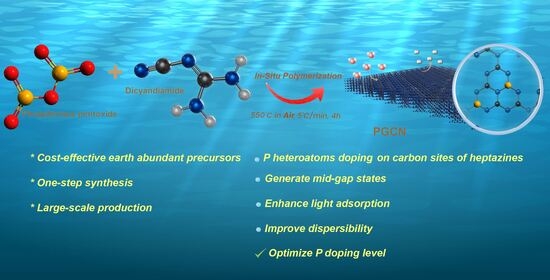
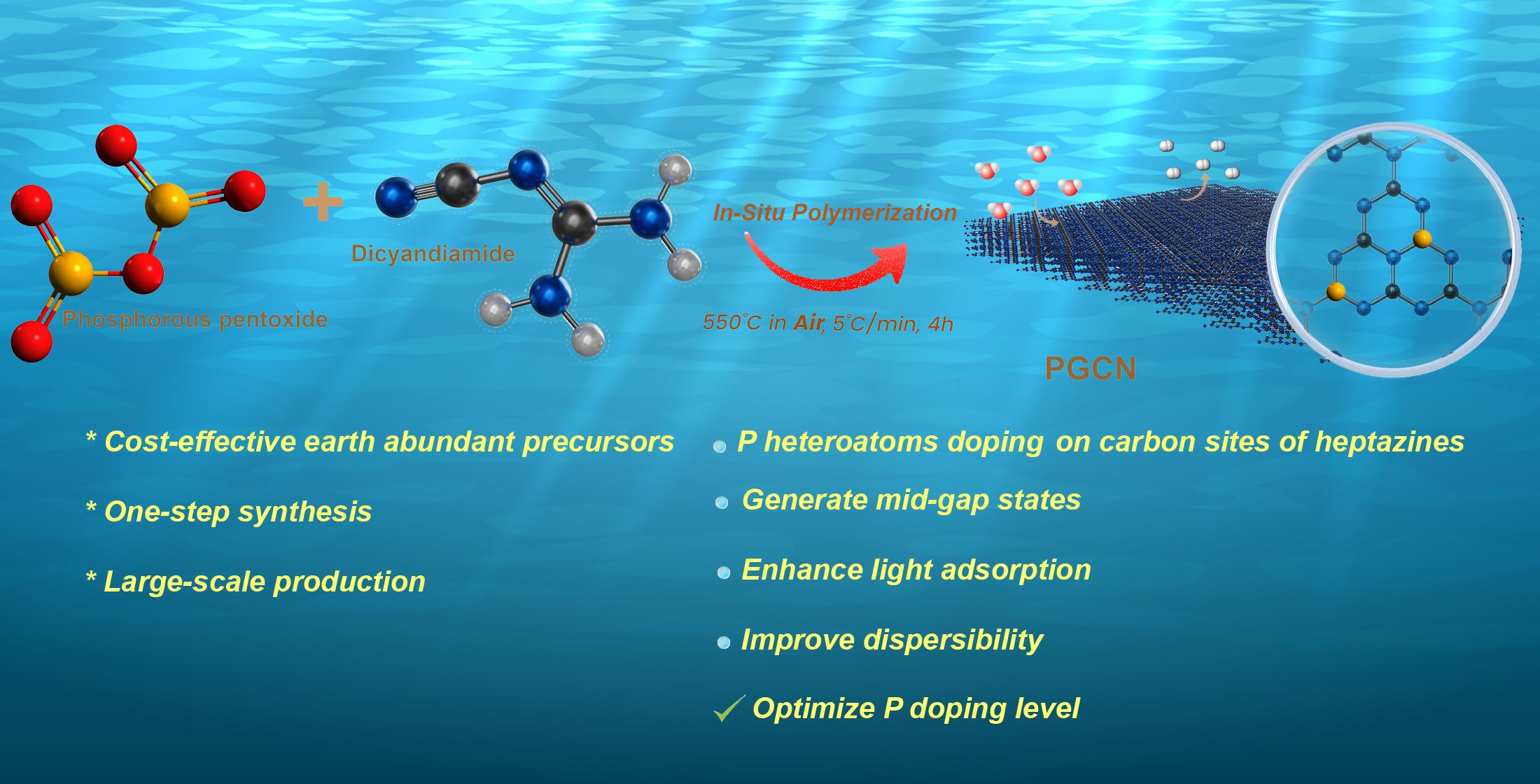
Modulating the electronic structure and surface properties of graphitic carbon nitride (g-C3N4) by chemically phosphorus doping is an effective strategy for improving its photocatalytic performance. However, in order to benefit from practical applications, the cost-effectiveness, efficiency, and optimization of the doping level need to be investigated further. Herein, we report a structural doping of P into g-C3N4 by in situ polymerization of the mixture of dicyandiamide (DCDA) and phosphorus pentoxide (P2O5). As an alternative to previous studies that used complex organic phosphorus precursors or post-treatment strategies, this work proposed a one-pot thermal polycondensation method that is low-cost, scalable, and enables controlled phosphorus substitutions at carbon sites of the g-C3N4 heptazine structure. Most of the structural features of g-C3N4 were well retained after doping, but the electronic structures and light harvesting capacity had been effectively altered, which provided not only a much better charge separation but also an improvement in photocatalytic activity toward H2 evolution under irradiation of a simulated sunlight. The optimized sample with P-doping content of 9.35 at.% (0.5PGCN) exhibited an excellent photocatalytic performance toward H2 evolution, which is over 5 times higher than that of bulk g-C3N4. This work demonstrates a facile one-step in situ route for producing high-yield photocatalysts using low-cost commercial precursors, offering practical starting materials for studies in solar cells, polymer batteries, and photocatalytic applications.

Graphical Abstract

1. Introduction

Energy from the sun represents a renewable and sustainable source of power, which provides eternal energy for human existence. Graphene-like carbon nitride, a 2D material containing heptazine motifs, has attracted considerable interest in fields such as catalysis, photocatalysis, and optoelectronic applications owing to its remarkable thermal and chemical stability as well as its favorable photocatalytic activity [1]. A catalytic activation of benzene using g-C3N4 was reported by Goettmann et al. in 2006 [2]. Three years later, Wang and co-workers discovered that g-C3N4 is capable of photocatalytic hydrogen production upon visible light irradiation [3], marking a significant milestone in metal-free photocatalysts. Typically, bulk g-C3N4 is easily fabricated through thermal polycondensation of common N-rich starting materials such as melamine [4,5], cyanamide [6], dicyandiamide (DCDA) [7,8], urea [9,10,11,12,13], thiourea [14,15,16], 3-amino-1,2,4-triazole [17], and ammonium thiocyanate [18]. This approach, however, produces bulk g-C3N4 that has low dispersibility in reaction media and high recombination rates of photoinduced charge carriers, which are the bottlenecks of particle-based H2 evolution. Nevertheless, thermal polycondensation remains the most widely adopted and scalable method for g-C3N4 synthesis, so it is important to overcome its inherent limitations by making rational modifications to the structure and electronic properties.
Among the various modification strategies, heteroatom doping onto g-C3N4 has proven particularly effective in improving charge separation and photocatalytic performance. Chemical doping is widely recognized as an efficient approach to tailor the electronic band structure and surface characteristics of photocatalysts, thereby promoting the separation efficiency of photoinduced electron/hole pairs. In particular, phosphorus doping in g-C3N4 tailors its electronic structure, charge transport, and surface reactivity simultaneously. With this multifaceted modulation, photocatalytic H2 evolution rates are dramatically improved while chemical stability and scalability are maintained [19,20,21,22]. Zhou et al. reported P-doped g-C3N4 with enhanced charge separation, evidenced by PL quenching and photocurrent enhancement, resulting in photocatalytic H2 evolution rate improvement. The P dopant introduced electron-rich and electron-deficient sites, which resulted in internal dipoles that might promote charge carrier separation. The P incorporation not only altered the g-C3N4 surface from positively to negatively charged, which enhanced the proton adsorption and H2 evolution step, but also generated P+ centers that act as Lewis acid sites synergistic with -NH2 groups Lewis base sites of g-C3N4, which enhanced photocatalytic kinetics reaction [20]. Fang et al. claimed an alternation of the electronic band structure caused by the P atoms substituting for C and N atoms in the heptazine framework, which creates P-N and P-C bonds, creating sub-bandgap states and extending light adsorption up to near-infrared regions. Moreover, the P-doped g-C3N4 promoted the nanostructures’ porosity and layers exfoliation compared to bulk g-C3N4, which supported increasing the accessible active sites density and charge diffusion efficiency [21,22].
As summarized in the comprehensive Table S3, recent P-doped g-C3N4 photocatalysts typically exhibit H2 evolution rates ranging from several hundred to thousands of μmol g−1 h−1 under visible-light irradiation, depending strongly on the dopant source, phosphorus loading level, synthesis route, and light irradiation conditions. However, most reported studies employ a single phosphorus content or rely on phosphorus doping of bulk g-C3N4 using relatively complex phosphorus precursors. Although phosphorus doping has been widely demonstrated to enhance the photocatalytic activity of g-C3N4, the composition-dependent photocatalytic behavior and systematic optimization of the phosphorus doping level as a function of hydrogen evolution performance remain largely unexplored [23,24]. Herein, through a facile and mass-production technique of in situ polymerization of precursor mixtures, we controlled the phosphorus level to optimize the phosphorus doping on g-C3N4 for maximum photocatalytic activity toward the evolution of H2. Photocatalytic H2 evolution was evaluated under a simulated sunlight irradiation (Asashi MAX-350 Xenon light source), using triethanolamine (TEOA) as a sacrificial agent (10 vol%), Eosin Y as a photosensitizer, and platinum nanoparticles as a cocatalyst. The amount of produced H2 was determined using an automated injection setup coupled to online gas chromatography operating with a thermal conductive detector (TCD) and a Carboxen 1000 column.

2. Results and Discussion

2.1. Crystal Structure and Chemical Composition

The as-prepared photocatalysts were synthesized via a facile in situ polymerization of a mixture of the g-C3N4 and P precursors, which enables mass production. The mixture was thoroughly ground in a conventional oven to prevent water adsorption. The melting points of DCDA and P2O5 were, respectively, 209.5 °C and 340 °C, which ensured a complete mixing during the polymerization reaction at 550 °C. The elemental composition of as-prepared samples was determined by EA, ICP-OES, and XPS. The EA and ICP-OES were used to analyze CHN-O and P content, respectively (Table 1). While the samples’ surface compositions were investigated by XPS (Table S1). As shown in Table 1, the 0.25PGCN sample exhibited a clear compositional change after P doping. The atomic percentage of nitrogen remained almost unchanged, while the carbon content gradually decreased with the increase of phosphorus content. This result suggests that the incorporated phosphorus atoms substituted for carbon atoms within the heptazine framework. The amount of phosphorus introduced into the 0.25PGCN sample was approximately equal to the reduction of carbon compared with pristine GCN, showing a consistent substitution behavior. A similar trend was also observed in the surface elemental compositions obtained from XPS analysis (Table S1). As the P doping level increased in the PGCN samples, the atomic percentage of nitrogen slightly decreased, which could be attributed to the reduced polymerization efficiency during the condensation process. The carbon content also decreased with increasing phosphorus doping, while the combined concentration of carbon and phosphorus in the PGCN samples remained approximately equal to the carbon percentage in pristine GCN (average total of C and P = 31.30 at.% compared with 31.21 at.% of C in GCN). These results provide clear evidence that the introduced phosphorus heteroatoms substituted for carbon atoms in the g-C3N4 framework during the P-doping reaction.
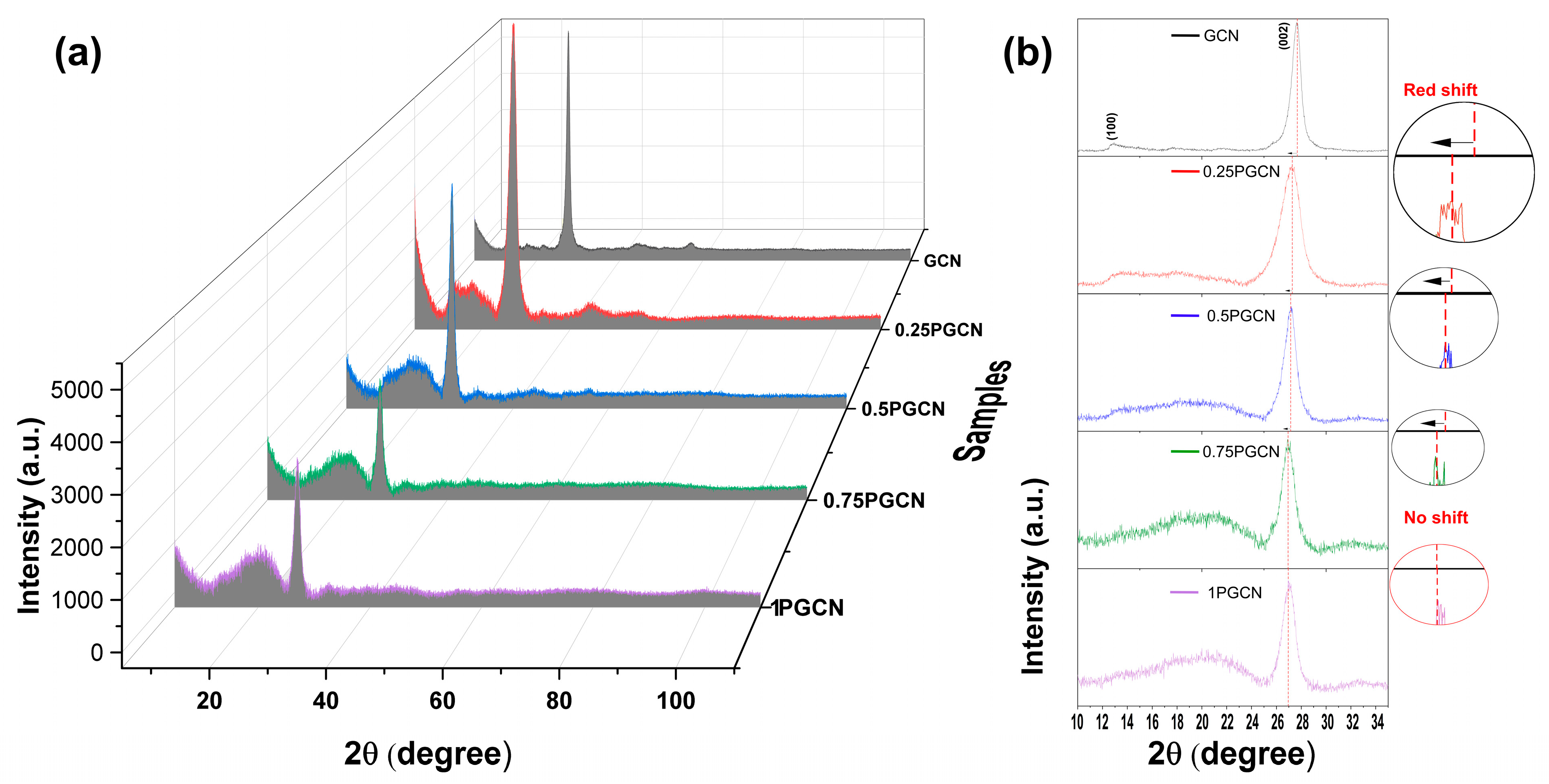
HRP-XRD analysis was carried out to examine the crystallographic features of the synthesized GCN and PGCN samples (Figure 1). The diffraction peaks observed at ca. 13.3° and ca. 27.4° correspond to the (100) and (002) planes of g-C3N4, respectively. Based on JCPDS 87-1526, these reflections are attributed to the in-plane arrangement of repeating heptazine units and the interlayer stacking of the conjugated aromatic layers [1]. With increasing P doping, the (100) peak becomes weaker and broader, which is caused by P doping disrupting the tri-s-triazine order in the heptazine motifs of g-C3N4. Moreover, compared to GCN, the PGCN sample exhibited a red shift in the plane (002) due to lattice expansion from the larger P atoms (atomic radius ca. 110 pm vs. C ca. 70 pm, N ca. 65 pm), which was assigned to the expansion of the interlayer spacing caused by P-doping on the crystal planes. The (002) peak exhibits a significant red-shift from pristine g-C3N4 to 0.25PGCN, with the red-shift decreasing up to the 0.75PGCN sample, and no further shift observed from 0.75PGCN to 1PGCN, indicating phosphorus doping that over 30 wt.% reached saturation for interlayer spacing expansion (Table 1). This change in the crystal structure of the graphitic carbon nitride system contributed to an imbalance in the Van de Waals force in the π-π aromatic system between layers, which resulted in an enhancement of the dispersibility of PGCN in the reaction media. A reduction in the (002) peak intensity was inversely proportional to the increasing mass ratio of P2O5 to DCDA, from 0.25:1 to 1:1 (Figure 1a), with minimal change observed from the 0.75PGCN to 1PGCN samples.
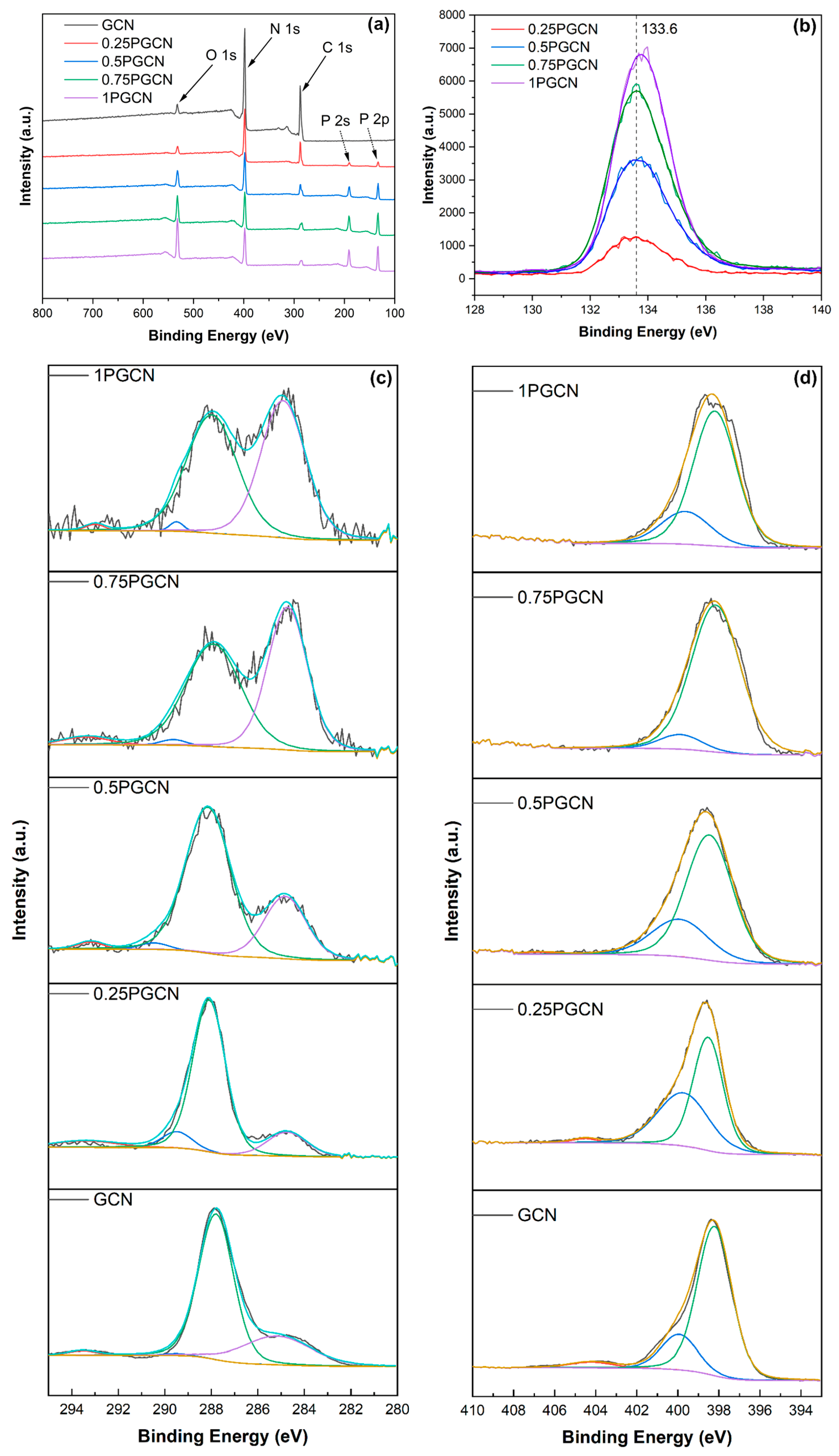
The elemental composition and chemical bonding states at the sample surfaces were analyzed using X-ray photoelectron spectroscopy (XPS). Figure 2a presents the XPS survey spectra of the as-prepared samples, which reveal their surface chemical states and electronic structures. As the phosphorus content increased, the C 1s peak intensity decreased, while the P 2s and P 2p peak intensities increased. This trend suggests that phosphorus atoms likely substitute carbon within the heptazine units to form P-N coordination structures, as indicated by the P 2s and P 2p peaks at 190.8 eV and 133.6 eV, respectively [25]. Figure 2b–d shows the XPS core-level spectra for P 2p, C 1s, and N 1s. For all PGCN samples (Figure 2b), a peak appears at approximately 133.6 eV, corresponding to P-N bonds, whereas P-C bonding would be expected at ca. 2 eV lower binding energy [26,27]. The intensity of the P 2p peak shows an enhancement by increasing the P amount. Moreover, deconvolution P 2p XPS spectra displayed two peaks with binding energies of ca. 133.2 and 134.1 eV, which were assigned to the typical P-N and P=N species (Figure S1) [19]. The introduction of P-N and P=N bonds in the g-C3N4 framework indicated heteroatom doping, as the P atoms replaced the corner C atoms and the bay C atoms, respectively. This result is consistent with the FTIR results presented hereafter. As shown in the deconvoluted C 1s XPS spectra (Figure 2c), characteristic carbon peaks appear at 284.80, 288.14, and 289.63 eV, assigned to graphitic C-C bonds, sp2-hybridized N2-C=N structures, and oxygen-containing C-O functionalities, respectively [4,5]. It is clearly evident that, with an increase in P content in the structure, the (Csp2/graphitic C) ratio decreases. This confirms that P substitutes at the carbon position in the heptazine units, in agreement with the P-N coordination observed in the P core-level spectra [26,27,28]. Whilst when the P content increases in the 0.75PGCN sample, this ratio shows a sharp decrease in Csp2 and a clear increase in graphitic C. This may be a sign of partial destruction of the heptazine units, which could negatively affect the photocatalytic properties. Furthermore, we calculated the peak area percentage of the N2-C=N bond in the heptazine units of the as-prepared photocatalysts (Table S2) [29], which decreased gradually with increasing P-doping levels and reached a saturation level at the 0.75PGCN sample. These results verified the loss of C atoms in the C–N framework of the g-C3N4 by P atom substitutions during the thermal polymerization reaction, which is consistent with the EA results. The peak positioned near 289.63 eV reflects the incorporation of C-OH and C-NH2 groups generated during thermal polymerization under atmospheric conditions. The nitrogen distribution in the samples was evaluated using N 1s core-level XPS spectra (Figure 2d). The energy contribution at 398.5 eV corresponds to nitrogen coordinated to two carbons in heptazine units. The peak centered at 399.9 eV reflects overlapping signals from tertiary bridging nitrogen (-N<) and amino groups (-NHx), which is characteristic of tri-s-triazine units in g-C3N4. Additionally, a faint signal at ca. 293 eV in C 1s and 404.1 eV in N 1s is attributed to π-electron delocalization within the heterocyclic framework.
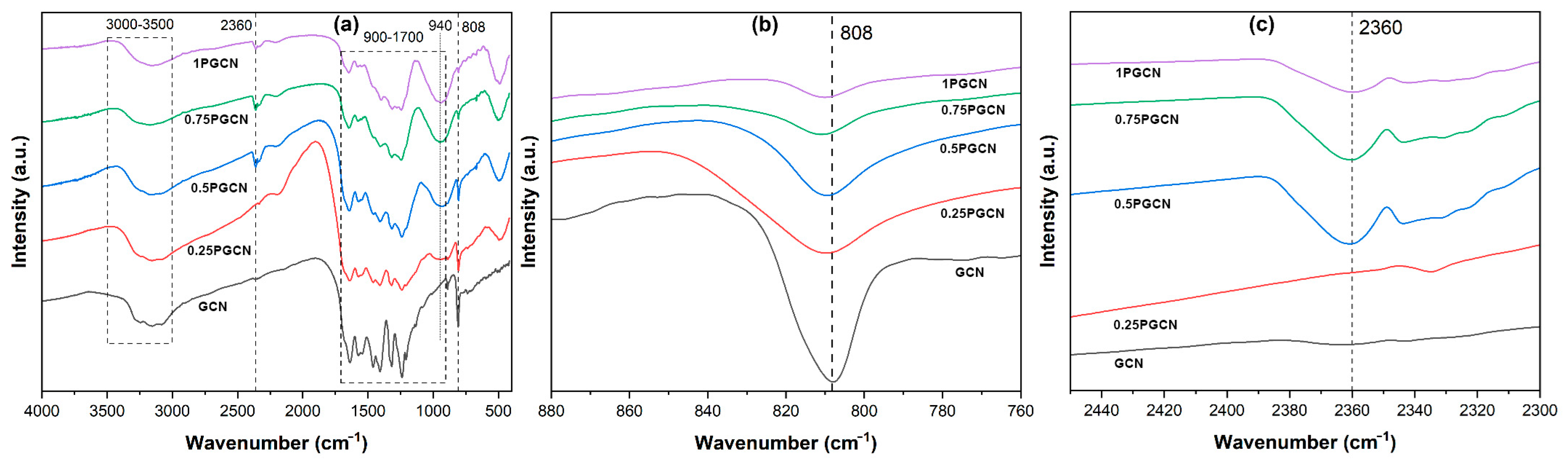
FT-IR was carried out to further examine the structural characteristics of the synthesized samples and to identify the chemical functionalities present in the photocatalysts. Figure 3 shows the typical FT-IR patterns of as-prepared samples. A band ca. 808 cm−1 was linked to the vibration of the heptazine motif, while the broad feature between 900 and 1700 cm−1 (typical peaks at ca. 1238 cm−1, 1318 cm−1, 1409 cm−1, and 1573 cm−1) was assigned to the stretching modes of C-N rings and aromatic C-C bonds. The wide bands at 3000–3500 cm−1 were attributed to N-H and the stretching mode of epoxide and hydroxyl groups [1]. Although the preserved characteristic peaks in the FT-IR spectra suggest that P incorporation does not alter the overall structural framework of g-C3N4, the band at 808 cm−1 shifts to higher wavenumbers as the P content increases (Figure 3b). This blue shift reflects stronger vibrational modes, likely caused by changes in the electron cloud distribution of the C-N and C=N bonds induced by P doping. Furthermore, two new P-related absorption peaks appear at approximately 940 cm−1 and 2360 cm−1 in the PGCN samples, which were assigned to the P-N bond motion [30]. This feature confirms the successful incorporation of phosphorus into the g-C3N4 framework, and those results were consistent with the above XRD results.
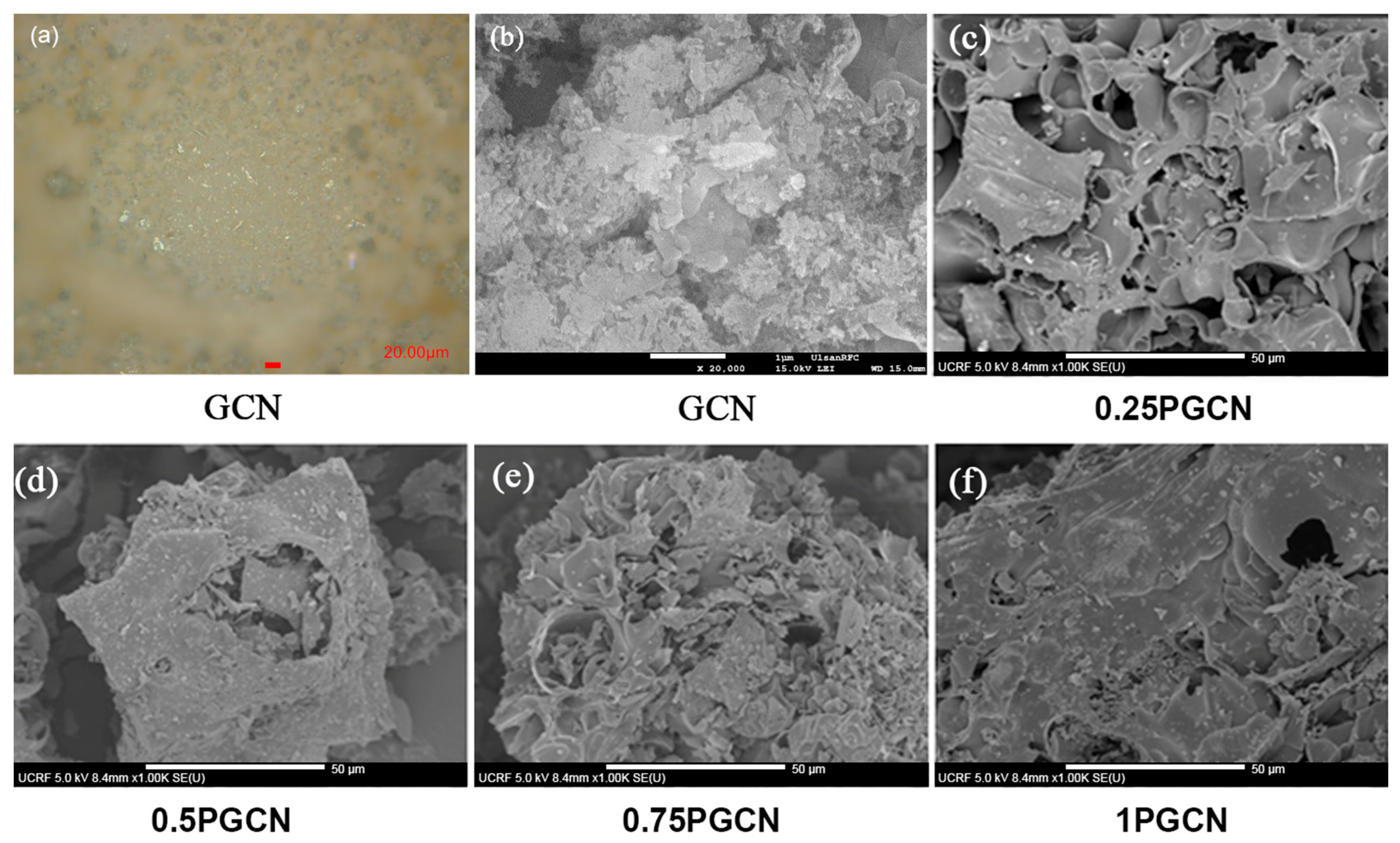
The surface features of the synthesized samples were examined using LSCM and FE-SEM. As shown in Figure 4a, the LSCM image (20× magnification) reveals the inherent surface texture of GCN. FE-SEM provided further insight into the dried sample morphology. The GCN displays a layered, plate-like structure with a relatively smooth surface, indicating multilayer stacking formed during the thermal polymerization step (Figure 4b). This graphite-like arrangement offers limited accessible active sites because of its low surface area and hydrophobic nature, making it less favorable for water adsorption during the reaction. The surface morphology of PGCN samples exhibits increased roughness, accompanied by disrupted layer-by-layer stacking (Figure 4c–f). The reduction in lateral layer dimensions primarily results from P2O5 interfering with the polymerization of DCDA during synthesis, hindering the formation of extended tri-s-triazine networks.

2.2. Optical Bandgap and Charge Carrier Separation and Transfer

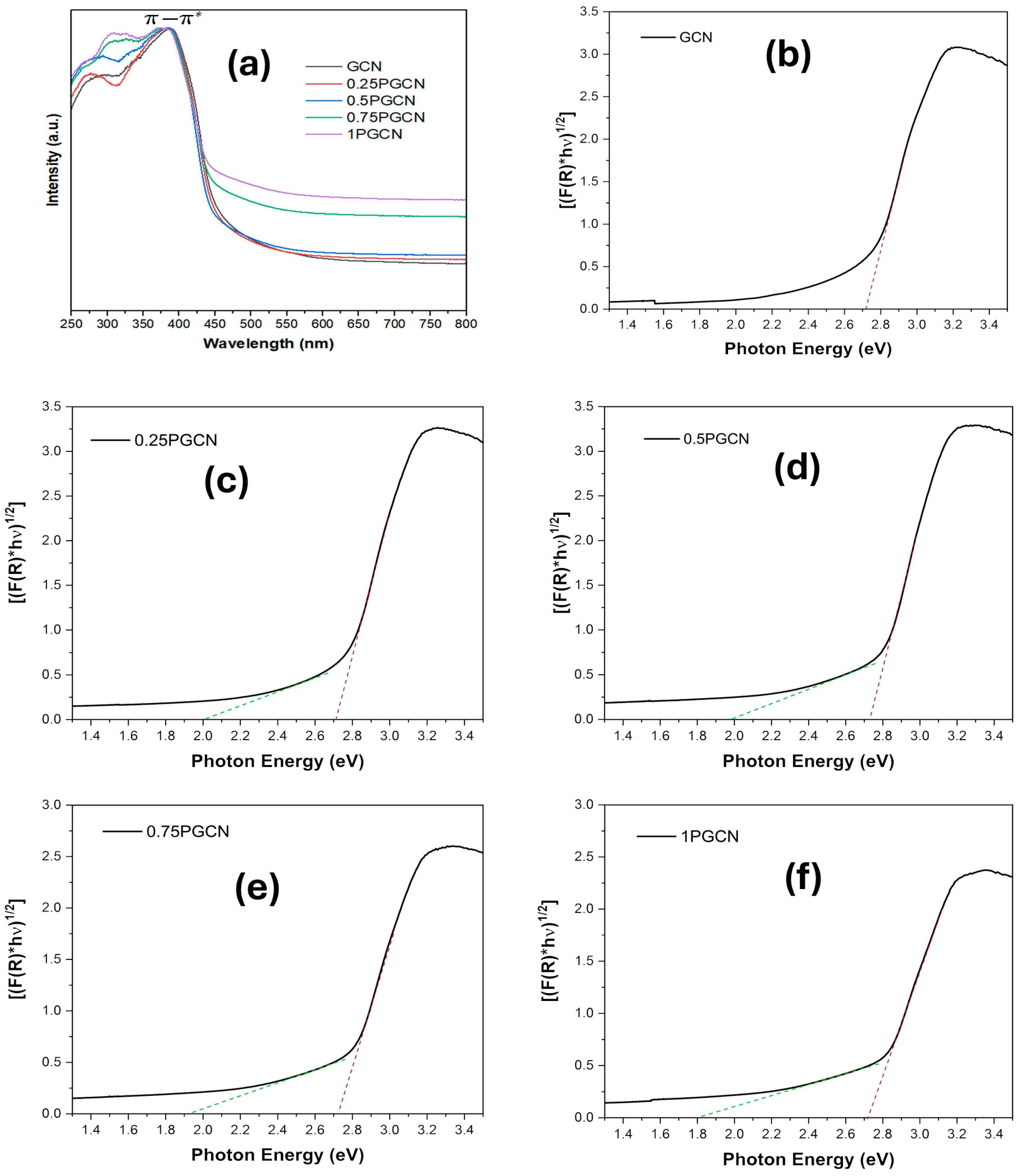
The optical properties of the as-prepared samples were studied using Ultraviolet-Visible Diffuse Reflectance Spectroscopy (UV-DRS). As shown in Figure 5a, the data were converted to absorption, and the two absorption peaks, approximately at 250–350 nm and 350–450 nm, are attributed to electronic transitions within the conjugated networks [27,28,31]. This confirms that the π-conjugated system of GCN is maintained after P-doping. P-doping in the bulk structure of GCN did not shift the intrinsic band-edge positions but increased absorption in the visible range (Figure 5a). This was also confirmed by the bandgap calculation, which showed an energy gap of around 2.7 eV for GCN and all P-doped samples (Figure 5b–f) [32]. In addition to estimating the bandgap energies, the plots also suggested the appearance of extra electronic transitions within the bandgap of the doped samples at around 1.8 eV, commonly referred to as mid-gap states (Figure 5b–f). These trap states allowed excitation by lower-energy photons, extending the light absorption range into the visible region [26], which was also observed in the UV-Vis results of the samples dispersed in reaction media (Figure S2).
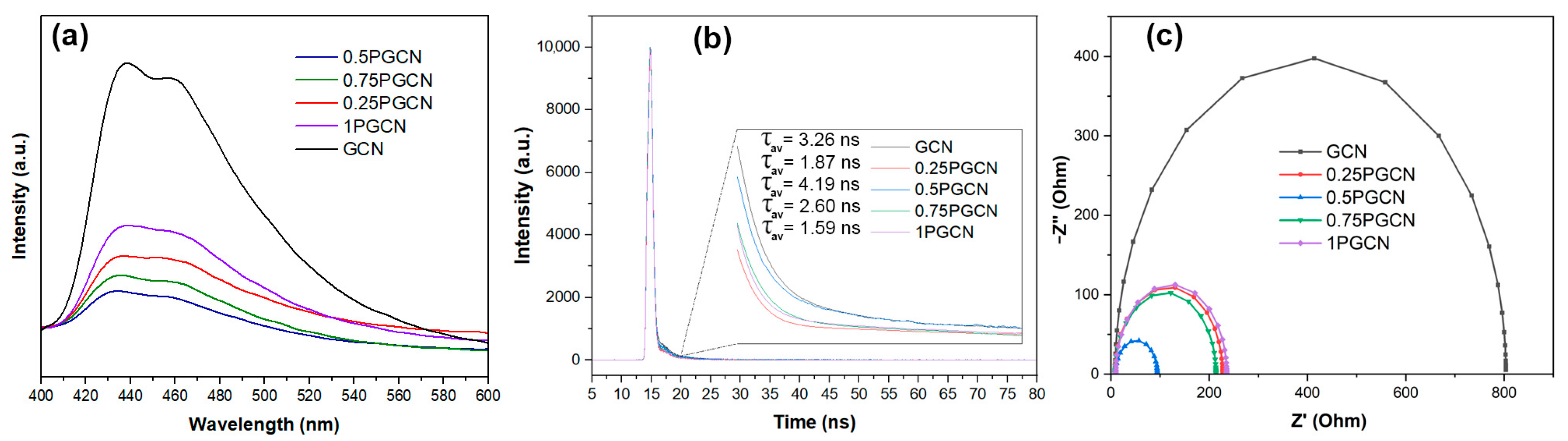
P in the GCN structure substitutes for carbon in the heptazine units. P will take part in the conduction band (C formed conduction band) and create new energy states under the conduction band. Some of these new energy states act as recombination centers, while others increase the density of electrons in the band gap. The photoluminescence (PL) emission spectroscopy was utilized to illustrate the net effect of the energy states on the electronic structure of P-doped samples (Figure 6a) [33]. All PGCN samples displayed quenched PL signals compared with pristine GCN, reflecting improved charge carrier separation and a reduction in charge recombination. These findings demonstrate that the P-induced mid-gap states facilitate more effective charge separation and transfer. In the heptazine framework, phosphorus bonds with three neighboring nitrogen atoms and contributes its lone pair to the π-system, which enhances overall π-electron delocalization [26].
Therefore, it can cause higher charge density and more electron transfer within the tris-s-triazine units. Moreover, there is an optimum amount for P-doping. At first, increasing phosphorus decreases the recombination rate, as shown for samples 0.25PGCN and 0.5PGCN, but further increases in samples 0.75PGCN and 1PGCN, the recombination rate starts to increase. Therefore, the 0.5PGCN sample exhibits optimal charge-carrier separation and transfer among the doped samples. Additionally, time-resolved PL spectroscopy was used to study the kinetics of photoexcited charge carriers in GCN and doped samples. The decay spectra of GCN and PGCN samples are shown in Figure 6b. The prolonged average lifetime of 4.19 ns in the 0.5PGCN sample relative to that of 3.26 ns in the GCN sample clearly demonstrates the suppressed recombination rate of generated charge carriers and facilitated charge carriers’ dynamics. Moreover, the transport of charge carriers within the samples plays a decisive role in directing them toward the active sites where the reactions occur. To assess this charge-transport behavior, EIS measurements were performed. The Nyquist plots show that 0.5PGCN displays the smallest semicircle (Figure 6c), indicating its superior ability to reduce the charge-transfer resistance between the catalyst surface and the reactant species.

2.3. Photocatalytic Performance and Mechanism

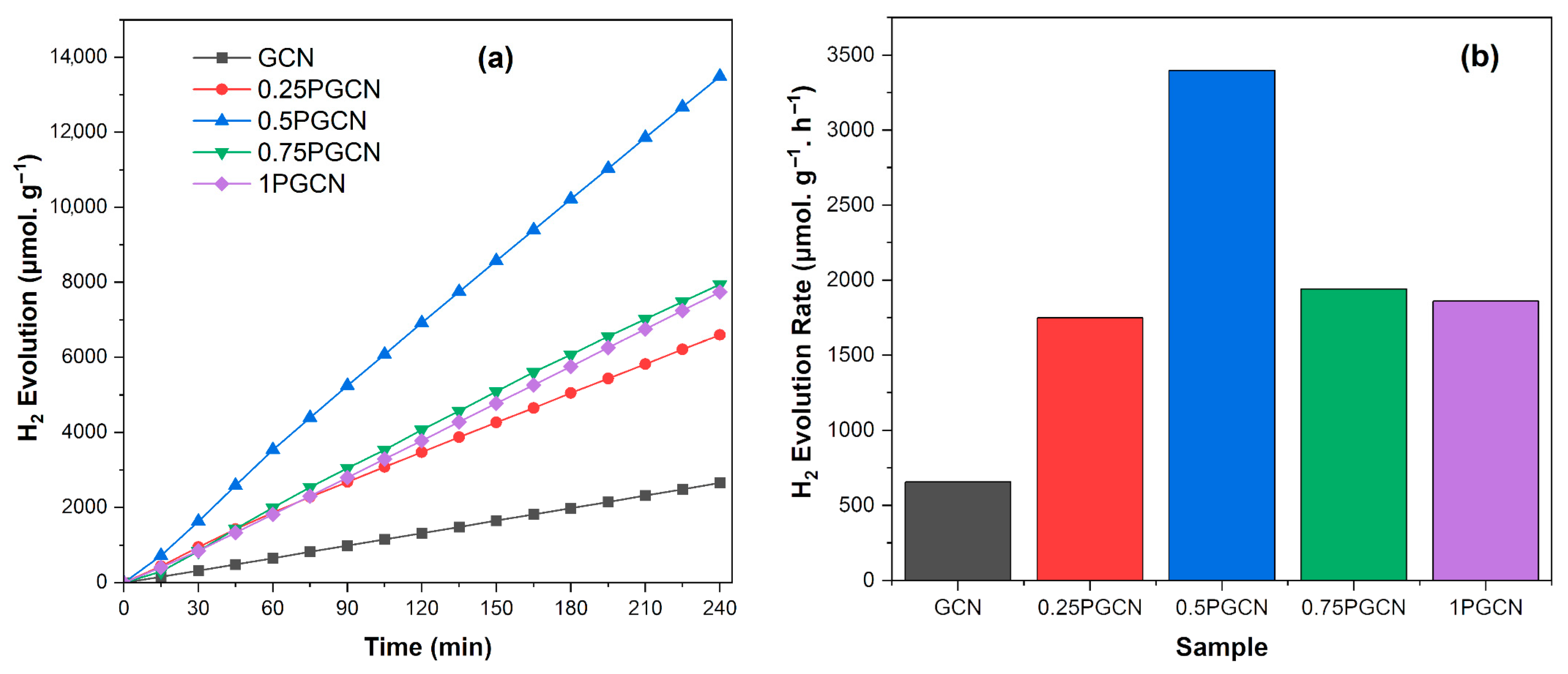
Photocatalytic hydrogen production was evaluated under simulated sunlight, employing 3 wt.% Pt-loaded photocatalysts, 10 vol% TEOA as the sacrificial agent, and Eosin Y as the photosensitizer (mass ratio 1:1 to catalyst). As shown in Figure 7, the average H2 evolution rate was 656.35, 1748.81, 3396.59, 1940.67, and 1861.27 µmol h−1 g−1 for GCN, 0.25PGCN, 0.5PGCN, 0.75PGCN, and 1PGCN, respectively (Figure 7b). Figure 7a shows the enhanced hydrogen evolution over time of the as-prepared photocatalysts. Particularly, the 0.5PGCN sample performed the highest H2 evolution yield among all the PGCN samples, which is over 5 times higher than that of the GCN sample. Moreover, as shown in Table S3, the optimized PGCN sample in this work exhibited a photocatalytic H2 evolution rate comparable to previously reported P-doped g-C3N4 photocatalysts under visible-light irradiation. This performance is achieved via a simple in situ polymerization approach using inexpensive precursors and controlled phosphorus content, highlighting the advantage of composition-dependent optimization while maintaining synthetic simplicity and scalability. The synergistic effects of phosphorus doping and heterostructure formation, which result in enhanced charge separation and transfer, improved light-harvesting capability, and increased dispersibility in the reaction medium, account for the significant improvement in photocatalytic performance.
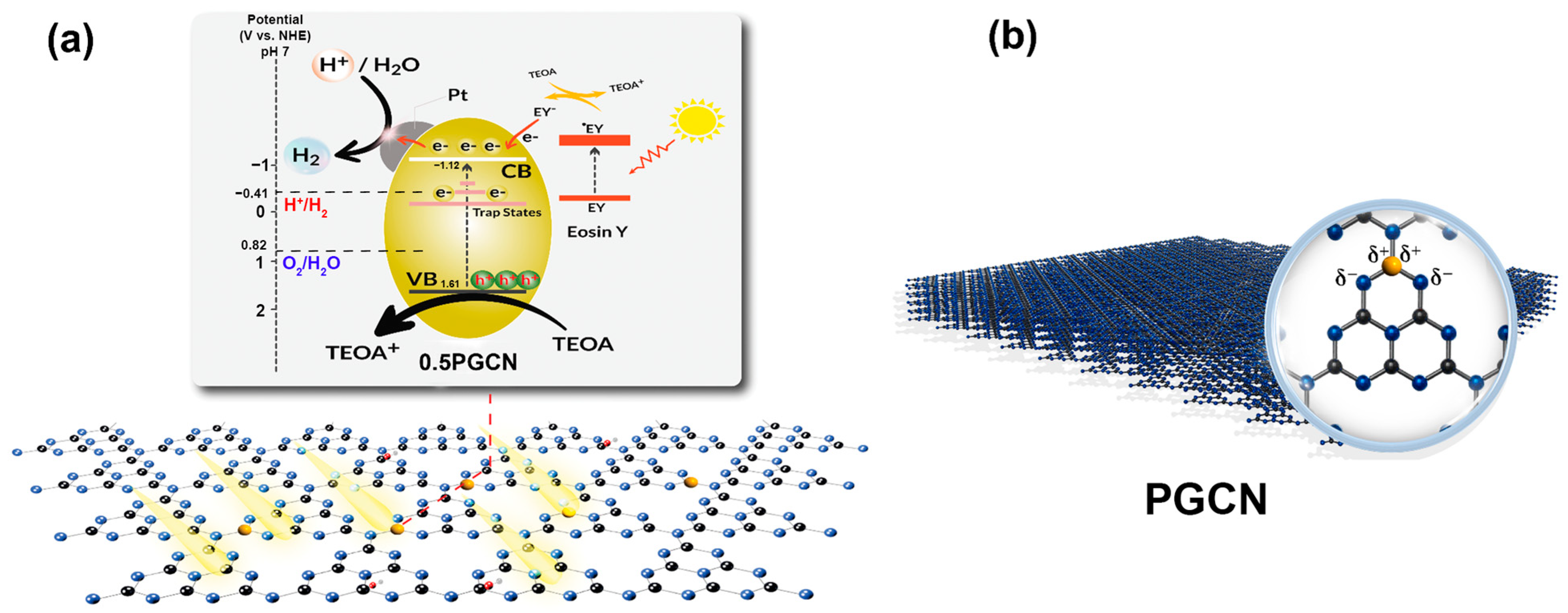
Figure 8 presents a proposed mechanism for the photocatalytic generation of H2. Under illumination from a solar simulator operating at 0.43 Sun, PGCN absorbs photons with energies meeting or exceeding its intrinsic bandgap, thereby promoting electron excitation from the valence band to the conduction band and generating holes. Concurrently, EY interacts with TEOA upon photoexcitation to yield EY, which shuttles electrons into the conduction band of g-C3N4. These electrons are then delivered to Pt cocatalyst particles, where the reduction of H+/H2O takes place, forming H2. At the same time, the corresponding holes are quenched by oxidation of TEOA (Figure 8a) [1,34,35]. Because phosphorus possesses more valence electrons than carbon, substituting a C atom with a P atom within the g-C3N4 framework (Figure 8b) introduces additional electrons that can delocalize over the π-conjugated triazine units, forming positively charged P+ centers (Figure 8b). These P+ sites facilitate more efficient separation of photoexcited charge carriers. In addition, incorporating P into the basal plane of g-C3N4 generates mid-gap electronic states (Figure 8a), enabling PGCN to be activated by lower-energy photons and enhancing visible-light absorption, consistent with the UV-DRS results.

3. Materials and Methods

3.1. Materials

Dicyandiamide (DCDA) and phosphorus pentoxide (P2O5) were used as a graphitic carbon nitride precursor and phosphorus source, respectively. DCDA, P2O5, chloroplatinic acid solution (H2PtCl6, 8 wt.% in H2O), and triethanolamine (TEOA) were purchased from Sigma-Aldrich (Burlington, MA, USA). Eosin Y and ethyl alcohol were purchased from Samchun Chemicals (Seoul, Republic of Korea). High-grade argon (99.999%) was obtained from MS Gas Corporation (Busan, Republic of Korea). All chemical reagents were of analytical grade and were used as received without any further purification.

3.2. Synthesis Method of P-Doped g-C3N4 and Bulk g-C3N4

Typically, 60 g of P2O5 and 60 g of DCDA (mass ratio of 1:1) were well ground, placed in a U-form crucible and covered by aluminum foil, and then annealed at 550 °C for 5 h in a muffle furnace at a rate of 5 °C min−1, followed by cooling naturally. The as-prepared sample was washed with DI water and ethyl alcohol by centrifugation at 10,000 rpm for 30 min, and the separated catalyst was vacuum dried at 70 °C for 24 h for further characterization. The sample was denoted as 1PGCN. Different mass ratio P2O5:DCDA of 0.25:1, 0.5:1, 0.75:1 were also synthesized and named as 0.25PGCN, 0.5PGCN, 0.75PGCN, respectively. PGCN was the designation given to the P-doped g-C3N4 samples. The bulk graphitic carbon nitride, called GCN, was synthesized in a similar manner without using the phosphorus precursor. Briefly, 60 g of DCDA was placed in a U-shaped crucible, covered with aluminum foil, and calcined at 550 °C for 5 h at a heating rate of 5 °C min−1, followed by natural cooling. The obtained product was washed with deionized water and ethanol and then dried at 70 °C for 24 h.

3.3. Photocatalytic Activity Toward Hydrogen Evolution

The photocatalytic H2 production under simulated sunlight irradiation was measured to gauge the photocatalytic performance, employing TEOA as the sacrificial agent (10 vol%), Eosin Y as a photosensitizer (mass ratio 1:1 relative to the photocatalyst), and platinum as a cocatalyst. A calculated amount of platinum (3 wt.%) was decorated on the surface of the photocatalysts by photoreduction in aqueous solution with chloroplatinic acid as the Pt precursor. Here, the suspension was vigorously stirred by a magnetic bar in the quartz reactor, and argon gas was used for purging the reactor at a flow rate of 25 sccm for 2 h, followed by applied simulated sunlight irradiation for 2 h. The products were washed with DI water by centrifugation at 10,000 rpm for 15 min, and the separated catalysts were dried at 70 °C for 24 h for further characterization.
The photocatalytic performance toward H2 evolution was evaluated in a quartz reactor (300 mL) under simulated sunlight irradiation (the MAX-350’s mirror solar module), which is able to shape the xenon spectrum similar to the sun spectrum in the wavelength range from 350 nm to 1100 nm. The incident light intensity directed onto the reaction solution was measured as 43.2 mW cm−2. The produced H2 was evaluated via an automated injection system coupled to online gas chromatography equipped with a TCD and a Carboxen 1000 column (Sigma-Aldrich, Burlington, MA, USA).

3.4. Characterizations

Analyzing the elemental compositions of samples was performed with a Flash 2000 elemental analyzer (Thermo Scientific, Waltham, MA, USA), and the concentration of P atoms was directly measured by ICP–OES (Agilent Technologies, Agilent 5110, Santa Clara, CA, USA). Fourier-transform infrared spectroscopy (FT-IR; Nicolet 380, Thermo Scientific, Waltham, MA, USA) was employed to identify the functional groups present in the synthesized photocatalysts. Field-emission scanning electron microscopy (FE-SEM; JSM-600F, JEOL, Tokyo, Japan) was used to examine the microstructure and morphology of the dried samples. The optical images of the resulting catalysts were captured using an Olympus laser scanning confocal microscope (LSCM, Olympus Corporation, Tokyo, Japan). The crystal structures of the prepared samples were examined using high-resolution powder X-ray diffraction (HRP-XRD; Rigaku D/MAZX 2500 V/PC, Tokyo, Japan) equipped with a Cu Kα radiation source (λ = 1.5415 Å) and operated at a scanning speed of 2° (2θ) per minute. X-ray photoelectron spectroscopy (XPS, Thermo Scientific K-Alpha, Waltham, MA, USA) was employed to analyze the elemental composition, chemical states, and electronic states of the samples. UV-vis absorption spectra (Specord 210 Plus, Analytik Jena, Jena, Germany) together with UV-vis diffuse reflectance spectroscopy measurements (UV-Vis-NIR (%R), Cary 5000, Agilent, Santa Clara, CA) were recorded to study the optical properties of the photocatalysts. Photoluminescence measurements were performed at room temperature using a 473 nm diode laser on a Cary Eclipse fluorescence spectrophotometer (Agilent Technologies, Santa Clara, CA, USA). Time-resolved PL spectra were obtained with a FS5 spectrofluorometer (Edinburgh Instruments Ltd., Livingston, UK) under 400 nm laser excitation.

3.5. Electrochemical Measurement

Electrochemical impedance spectroscopy (EIS) was conducted using a VSP electrochemical workstation (BioLogic Science Instruments, Seyssinet-Pariset, France) in a standard three-electrode configuration under simulated sunlight at room temperature. The EIS tests were performed at open-circuit conditions after a 10 min stabilization period, using a frequency range of 100 kHz to 0.1 Hz and an amplitude of 10 mV at a DC potential of +0.8 VSCE. A spray-coating method was used to prepare the working electrode. Following typical preparation steps, 0.5 mg of the catalyst powder was ultrasonically dispersed in ethanol for 30 min, after which the suspension was spray-coated onto an FTO substrate (1 cm2 spray area, other area was covered by black tape) placed on a 90 °C hotplate. A 1 M KOH solution (10 mL) served as the electrolyte. The reference electrode was a RE-61AP (Hg/HgO) electrode, and a platinum wire was used as the counter electrode. The SVC-3 voltammetry cell and electrodes were supplied by ALS Co., Ltd. (Tokyo, Japan).

4. Conclusions

Engineering phosphorus doping into the g-C3N4 framework was achieved through a facile in situ polymerization of commercially available, low-cost P2O5 and DCDA as the phosphorus and bulk g-C3N4 precursors, respectively, carried out at 550 °C in air. The P doping level was optimized at 9.35 at.%, which preserved the structural features of g-C3N4, as confirmed by HRP-XRD, FT-IR, and XPS. At this doping level, significant electronic modifications were introduced, leading to improved photoinduced charge separation and transfer, along with enhanced visible-light absorption, as demonstrated by UV-DRS, PL, TR-PL, and EIS results. Based on a systematic optimization of phosphorus content, it was possible to establish a clear relationship between structure, electronic properties, and performance for P-doped g-C3N4, which provides composition-dependent performance for photocatalytic H2 evolution. In the PGCN lattice, phosphorus atoms replace the carbon sites of the heptazine units, forming P-N coordination bonds. Furthermore, the identification of distinct P-doping sites in the corner and bay carbon positions of the heptazine motifs by the transparent FT-IR vibrational features and P 2p core-level deconvoluted peaks provides new spectroscopic criteria for tracking P-doping configurations in g-C3N4. Although incorporating P into the framework reduced the conduction band minimum and the valence band maximum pairs of g-C3N4 photocatalyst, the doping simultaneously improves photocatalytic behavior, creating a seesaw-type relationship. Thus, optimizing the P content to the point where these effects balance yielded the highest photocatalytic performance. The 0.5PGCN sample achieved a hydrogen evolution rate as high as 3396.59 µmol h−1 g−1, demonstrating its strong potential as a bulk material for future photocatalysis research.

Supplementary Materials

The following Supporting Information is available at https://www.mdpi.com/article/10.3390/catal16010088/s1; Table S1. Elemental compositions of the surface samples analyzed by XPS; Table S2. Peak area percentage of N2-C=N bond in the heptazine units of the as-prepared samples; Figure S1. Deconvoluted P 2p XPS spectra of PGCN samples; Figure S2. (a) UV-DRS spectra of as-prepared dried samples, (b) corresponding Tauc plot for band gap determination. (c,d) UV-Vis spectra of the photo-catalysts in the reaction media and enlarged spectra of 0.5PGCN, 0.75PGCN, 1PGCN samples; Figure S3. Ultraviolet photoelectron spectroscopy (UPS) spectrum of 0.5PGCN sample; Table S3. Comparison of photocatalytic H2 evolution performance of reported g-C3N4-based heteroatom-doped composites. Refs. [36,37,38,39,40,41,42,43,44,45,46,47,48,49] are cited in Supplementary Materials.

Author Contributions

Conceptualization, T.C.L., T.T.D. and J.S.C.; Methodology, T.C.L. and T.T.D.; Validation, T.C.L. and T.T.D.; Formal analysis, T.C.L., T.T.D. and T.M.-S.; Investigation, T.C.L., T.T.D. and T.M.-S.; Resources, J.S.C.; Data curation, T.T.D. and T.M.-S.; Writing—original draft, T.C.L., T.T.D. and T.M.-S.; Writing—review & editing, J.S.C.; Visualization, T.T.D. and T.M.-S.; Supervision, J.S.C.; Project administration, J.S.C.; Funding acquisition, J.S.C. All authors have read and agreed to the published version of the manuscript.

Funding

This research was funded by the 2025 Research Fund of the University of Ulsan.

Data Availability Statement

The original contributions presented in this study are included in the article/Supplementary Materials. Further inquiries can be directed to the corresponding author(s).

Conflicts of Interest

The authors declare no conflicts of interest.

References

  1. Dang, T.T.; Nguyen, T.K.A.; Bhamu, K.C.; Mahvelati-Shamsabadi, T.; Van, V.K.H.; Shin, E.W.; Chung, K.-H.; Hur, S.H.; Choi, W.M.; Kang, S.G.; et al. Engineering Holey Defects on 2D Graphitic Carbon Nitride Nanosheets by Solvolysis in Organic Solvents. ACS Catal. 2022, 12, 13763–13780. [Google Scholar] [CrossRef]
  2. Goettmann, F.; Fischer, A.; Antonietti, M.; Thomas, A. Metal-free catalysis of sustainable Friedel–Crafts reactions: Direct activation of benzene by carbon nitrides to avoid the use of metal chlorides and halogenated compounds. Chem. Commun. 2006, 43, 4530–4532. [Google Scholar] [CrossRef]
  3. Wang, X.; Maeda, K.; Thomas, A.; Takanabe, K.; Xin, G.; Carlsson, J.M.; Domen, K.; Antonietti, M. A metal-free polymeric photocatalyst for hydrogen production from water under visible light. Nat. Mater. 2009, 8, 76–80. [Google Scholar] [CrossRef]
  4. Gu, Z.; Cui, Z.; Wang, Z.; Qin, K.S.; Asakura, Y.; Hasegawa, T.; Tsukuda, S.; Hongo, K.; Maezono, R.; Yin, S. Carbon vacancies and hydroxyls in graphitic carbon nitride: Promoted photocatalytic NO removal activity and mechanism. Appl. Catal. B Environ. 2020, 279, 119376. [Google Scholar] [CrossRef]
  5. Krivtsov, I.; Mitoraj, D.; Adler, C.; Ilkaeva, M.; Sardo, M.; Mafra, L.; Neumann, C.; Turchanin, A.; Li, C.; Dietzek, B.; et al. Water-Soluble Polymeric Carbon Nitride Colloidal Nanoparticles for Highly Selective Quasi-Homogeneous Photocatalysis. Angew. Chem. Int. Ed. 2020, 59, 487–495. [Google Scholar] [CrossRef]
  6. Goettmann, F.; Fischer, A.; Antonietti, M.; Thomas, A. Chemical Synthesis of Mesoporous Carbon Nitrides Using Hard Templates and Their Use as a Metal-Free Catalyst for Friedel–Crafts Reaction of Benzene. Angew. Chem. Int. Ed. 2006, 45, 4467–4471. [Google Scholar] [CrossRef]
  7. Liang, Q.; Li, Z.; Huang, Z.-H.; Kang, F.; Yang, Q.-H. Holey Graphitic Carbon Nitride Nanosheets with Carbon Vacancies for Highly Improved Photocatalytic Hydrogen Production. Adv. Funct. Mater. 2015, 25, 6885–6892. [Google Scholar] [CrossRef]
  8. Liu, G.; Wang, T.; Zhang, H.; Meng, X.; Hao, D.; Chang, K.; Li, P.; Kako, T.; Ye, J. Nature-Inspired Environmental “Phosphorylation” Boosts Photocatalytic H2 Production over Carbon Nitride Nanosheets under Visible-Light Irradiation. Angew. Chem. Int. Ed. 2015, 54, 13561–13565. [Google Scholar] [CrossRef]
  9. Liu, J.; Li, W.; Duan, L.; Li, X.; Ji, L.; Geng, Z.; Huang, K.; Lu, L.; Zhou, L.; Liu, Z.; et al. A Graphene-like Oxygenated Carbon Nitride Material for Improved Cycle-Life Lithium/Sulfur Batteries. Nano Lett. 2015, 15, 5137–5142. [Google Scholar] [CrossRef] [PubMed]
  10. Song, X.; Hu, Y.; Zheng, M.; Wei, C. Solvent-free in situ synthesis of g-C3N4/{001}TiO2 composite with enhanced UV- and visible-light photocatalytic activity for NO oxidation. Appl. Catal. B Environ. 2016, 182, 587–597. [Google Scholar] [CrossRef]
  11. Zhang, Z.; Jiang, D.; Li, D.; He, M.; Chen, M. Construction of SnNb2O6 nanosheet/g-C3N4 nanosheet two-dimensional heterostructures with improved photocatalytic activity: Synergistic effect and mechanism insight. Appl. Catal. B Environ. 2016, 183, 113–123. [Google Scholar] [CrossRef]
  12. Wang, D.H.; Pan, J.N.; Li, H.H.; Liu, J.J.; Wang, Y.B.; Kang, L.T.; Yao, J.N. A pure organic heterostructure of μ-oxo dimeric iron(iii) porphyrin and graphitic-C3N4 for solar H2 roduction from water. J. Mater. Chem. A 2016, 4, 290–296. [Google Scholar] [CrossRef]
  13. Nguyen, T.K.A.; Pham, T.-T.; Nguyen-Phu, H.; Shin, E.W. The effect of graphitic carbon nitride precursors on the photocatalytic dye degradation of water-dispersible graphitic carbon nitride photocatalysts. Appl. Surf. Sci. 2021, 537, 148027. [Google Scholar] [CrossRef]
  14. Nguyen, P.A.; Dao, Q.D.; Dang, T.T.; Hoang, T.V.A.; Chung, J.S.; Shin, E.W. Highly dispersed PtO over g-C3N4 by specific metal-support interactions and optimally distributed Pt species to enhance hydrogen evolution rate of Pt/g-C3N4 photocatalysts. Chem. Eng. J. 2023, 464, 142765. [Google Scholar] [CrossRef]
  15. Wang, K.; Li, Q.; Liu, B.; Cheng, B.; Ho, W.; Yu, J. Sulfur-doped g-C3N4 with enhanced photocatalytic CO2-reduction performance. Appl. Catal. B Environ. 2015, 176–177, 44–52. [Google Scholar] [CrossRef]
  16. Zhang, G.; Zhang, J.; Zhang, M.; Wang, X. Polycondensation of thiourea into carbon nitride semiconductors as visible light photocatalysts. J. Mater. Chem. 2012, 22, 8083–8091. [Google Scholar] [CrossRef]
  17. Mane, G.P.; Talapaneni, S.N.; Lakhi, K.S.; Ilbeygi, H.; Ravon, U.; Al-Bahily, K.; Mori, T.; Park, D.-H.; Vinu, A. Highly Ordered Nitrogen-Rich Mesoporous Carbon Nitrides and Their Superior Performance for Sensing and Photocatalytic Hydrogen Generation. Angew. Chem. Int. Ed. 2017, 56, 8481–8485. [Google Scholar] [CrossRef] [PubMed]
  18. Cui, Y.; Zhang, G.; Lin, Z.; Wang, X. Condensed and low-defected graphitic carbon nitride with enhanced photocatalytic hydrogen evolution under visible light irradiation. Appl. Catal. B Environ. 2016, 181, 413–419. [Google Scholar] [CrossRef]
  19. Feng, J.; Zhang, D.; Zhou, H.; Pi, M.; Wang, X.; Chen, S. Coupling P Nanostructures with P-Doped g-C3N4 As Efficient Visible Light Photocatalysts for H2 Evolution and RhB Degradation. ACS Sustain. Chem. Eng. 2018, 6, 6342–6349. [Google Scholar] [CrossRef]
  20. Zhou, Y.; Zhang, L.; Liu, J.; Fan, X.; Wang, B.; Wang, M.; Ren, W.; Wang, J.; Li, M.; Shi, J. Brand new P-doped g-C3N4: Enhanced photocatalytic activity for H2 evolution and Rhodamine B degradation under visible light. J. Mater. Chem. A 2015, 3, 3862–3867. [Google Scholar] [CrossRef]
  21. Fang, H.-B.; Zhang, X.-H.; Wu, J.; Li, N.; Zheng, Y.-Z.; Tao, X. Fragmented phosphorus-doped graphitic carbon nitride nanoflakes with broad sub-bandgap absorption for highly efficient visible-light photocatalytic hydrogen evolution. Appl. Catal. B Environ. 2018, 225, 397–405. [Google Scholar] [CrossRef]
  22. Zhu, Y.-P.; Ren, T.-Z.; Yuan, Z.-Y. Mesoporous Phosphorus-Doped g-C3N4 Nanostructured Flowers with Superior Photocatalytic Hydrogen Evolution Performance. ACS Appl. Mater. Interfaces 2015, 7, 16850–16856. [Google Scholar] [CrossRef]
  23. Bao, T.; Li, X.; Li, S.; Rao, H.; Men, X.; She, P.; Qin, J. Recent advances of graphitic carbon nitride (g-C3N4) based materials for photocatalytic applications: A review. Nano Mater. Sci. 2025, 7, 145–168. [Google Scholar] [CrossRef]
  24. Jiang, C.; Jiao, Y.; Li, F.; Fang, C.; Ding, J.; Wan, H.; Zhang, P.; Guan, G. One-Dimensional Tubular Carbon Nitride Embedded in Ni2P for Enhanced Photocatalytic Activity of H2 Evolution. Catalysts 2024, 14, 243. [Google Scholar] [CrossRef]
  25. Wang, G.; Chen, Z.; Wang, T.; Wang, D.; Mao, J. P and Cu Dual Sites on Graphitic Carbon Nitride for Photocatalytic CO2 Reduction to Hydrocarbon Fuels with High C2H6 Evolution. Angew. Chem. Int. Ed. 2022, 61, e202210789. [Google Scholar] [CrossRef]
  26. Zhang, Y.; Mori, T.; Ye, J.; Antonietti, M. Phosphorus-Doped Carbon Nitride Solid: Enhanced Electrical Conductivity and Photocurrent Generation. J. Am. Chem. Soc. 2010, 132, 6294–6295. [Google Scholar] [CrossRef]
  27. Ran, J.; Ma, T.Y.; Gao, G.; Du, X.-W.; Qiao, S.Z. Porous P-doped graphitic carbon nitride nanosheets for synergistically enhanced visible-light photocatalytic H2 production. Energy Environ. Sci. 2015, 8, 3708–3717. [Google Scholar] [CrossRef]
  28. Niu, P.; Zhang, L.; Liu, G.; Cheng, H.-M. Graphene-Like Carbon Nitride Nanosheets for Improved Photocatalytic Activities. Adv. Funct. Mater. 2012, 22, 4763–4770. [Google Scholar] [CrossRef]
  29. Ding, J.; Xu, W.; Wan, H.; Yuan, D.; Chen, C.; Wang, L.; Guan, G.; Dai, W.-L. Nitrogen vacancy engineered graphitic C3N4-based polymers for photocatalytic oxidation of aromatic alcohols to aldehydes. Appl. Catal. B Environ. 2018, 221, 626–634. [Google Scholar] [CrossRef]
  30. Yu, G.; Gong, K.; Xing, C.; Hu, L.; Huang, H.; Gao, L.; Wang, D.; Li, X. Dual P-doped-site modified porous g-C3N4 achieves high dissociation and mobility efficiency for photocatalytic H2O2 production. Chem. Eng. J. 2023, 461, 142140. [Google Scholar] [CrossRef]
  31. Dang, T.T.; Vuong, H.-T.; Kang, S.G.; Chung, J.S. Photocatalytic Degradation and Adsorptive Removal of Tetracycline on Amine-Functionalized Graphene Oxide/ZnO Nanocomposites. Korean J. Chem. Eng. 2023, 61, 635–644. [Google Scholar]
  32. Fattahimoghaddam, H.; Mahvelati-Shamsabadi, T.; Jeong, C.-S.; Lee, B.-K. Coral-like potassium and phosphorous doped graphitic carbon nitride structures with enhanced charge and mass transfer dynamics toward photocatalytic hydrogen peroxide production and microbial disinfection. J. Colloid Interface Sci. 2022, 617, 326–340. [Google Scholar] [CrossRef]
  33. Min, S.; Lu, G. Enhanced Electron Transfer from the Excited Eosin Y to mpg-C3N4 for Highly Efficient Hydrogen Evolution under 550 nm Irradiation. J. Phys. Chem. C 2012, 116, 19644–19652. [Google Scholar] [CrossRef]
  34. Kudo, A.; Miseki, Y. Heterogeneous photocatalyst materials for water splitting. Chem. Soc. Rev. 2009, 38, 253–278. [Google Scholar] [CrossRef]
  35. Yang, H.; Zhou, Y.; Wang, Y.; Hu, S.; Wang, B.; Liao, Q.; Li, H.; Bao, J.; Ge, G.; Jia, S. Three-dimensional flower-like phosphorus-doped g-C3N4 with a high surface area for visible-light photocatalytic hydrogen evolution. J. Mater. Chem. A 2018, 6, 16485–16494. [Google Scholar] [CrossRef]
  36. Zhang, H.; Xu, H.; Li, R.; Quan, L.; Zhan, C.; Zhang, Z.; Han, P.; Liu, Y.; Tong, Y. GO coupled with P doped g-C3N4 for regulating the local chemical environment in photocatalytic hydrogen evolution. Colloids Surfaces A Physicochem. Eng. Aspects 2025, 727, 138226. [Google Scholar] [CrossRef]
  37. Lv, S.; Ng, Y.H.; Zhu, R.; Li, S.; Wu, C.; Liu, Y.; Zhang, Y.; Jing, L.; Deng, J.; Dai, H. Phosphorus vapor assisted preparation of P-doped ultrathin hollow g-C3N4 sphere for efficient solar-to-hydrogen conversion. Appl. Catal. B Environ. 2021, 297, 120438. [Google Scholar] [CrossRef]
  38. Fang, X.-X.; Ma, L.-B.; Liang, K.; Zhao, S.-J.; Jiang, Y.-F.; Ling, C.; Zhao, T.; Cheang, T.-Y.; Xu, A.-W. The doping of phosphorus atoms into graphitic carbon nitride for highly enhanced photocatalytic hydrogen evolution. J. Mater. Chem. A 2019, 7, 11506–11512. [Google Scholar] [CrossRef]
  39. Yang, Y.; Xing, S.; Ma, Y.; Zhang, Y.; Yan, J.; Ran, J.; Li, X. P-doped g-C3N4 with triple calcinations for enhancing photocatalytic performance. J. Mater. Sci. Mater. Electron. 2024, 35, 431. [Google Scholar] [CrossRef]
  40. Wu, M.; Zhang, J.; He, B.-b.; Wang, H.-w.; Wang, R.; Gong, Y.-s. In-situ construction of coral-like porous P-doped g-C3N4 tubes with hybrid 1D/2D architecture and high efficient photocatalytic hydrogen evolution. Appl. Catal. B Environ. 2019, 241, 159–166. [Google Scholar] [CrossRef]
  41. Guo, S.; Deng, Z.; Li, M.; Jiang, B.; Tian, C.; Pan, Q.; Fu, H. Phosphorus-Doped Carbon Nitride Tubes with a Layered Micro-nanostructure for Enhanced Visible-Light Photocatalytic Hydrogen Evolution. Angew. Chem. Int. Ed. Engl. 2016, 55, 1830–1834. [Google Scholar] [CrossRef]
  42. Guo, S.; Tang, Y.; Xie, Y.; Tian, C.; Feng, Q.; Zhou, W.; Jiang, B. P-doped tubular g-C3N4 with surface carbon defects: Universal synthesis and enhanced visible-light photocatalytic hydrogen production. Appl. Catal. B Environ. 2017, 218, 664–671. [Google Scholar] [CrossRef]
  43. Lin, Q.; Li, Z.; Lin, T.; Li, B.; Liao, X.; Yu, H.; Yu, C. Controlled preparation of P-doped g-C3N4 nanosheets for efficient photocatalytic hydrogen production. Chin. J. Chem. Eng. 2020, 28, 2677–2688. [Google Scholar] [CrossRef]
  44. Liu, B.; Ye, L.; Wang, R.; Yang, J.; Zhang, Y.; Guan, R.; Tian, L.; Chen, X. Phosphorus-Doped Graphitic Carbon Nitride Nanotubes with Amino-rich Surface for Efficient CO2 Capture, Enhanced Photocatalytic Activity, and Product Selectivity. Acs Appl. Mater. Interfaces 2018, 10, 4001–4009. [Google Scholar] [CrossRef]
  45. Zhou, P.; Meng, X.; Li, L.; Sun, T. P, S Co-doped g-C3N4 isotype heterojunction composites for high-efficiency photocatalytic H2 evolution. J. Alloys Compd. 2020, 827, 154259. [Google Scholar] [CrossRef]
  46. Ullah, I.; Lu, X.-J.; Chen, S.; Li, J.-H.; Habib, S.; Murtaza, G.; Tofaz, T.; Xu, A.-W. Electron-Deficient Boron-Doped g-C3N4 as an Efficient and Robust Photocatalyst for Visible-Light Driven Hydrogen Evolution from Water Splitting. Adv. Sustain. Systems 2024, 8, 2400103. [Google Scholar] [CrossRef]
  47. Feng, C.; Tang, L.; Deng, Y.; Wang, J.; Liu, Y.; Ouyang, X.; Yang, H.; Yu, J.; Wang, J. A novel sulfur-assisted annealing method of g-C3N4 nanosheet compensates for the loss of light absorption with further promoted charge transfer for photocatalytic production of H2 and H2O2. Appl. Catal. B Environ. 2021, 281, 119539. [Google Scholar] [CrossRef]
  48. Fang, K.; Chen, Z.; Wei, Y.; Fang, S.; Dong, Z.; Zhang, Y.; Li, W.; Wang, L. Single site Co-S anchored on carbon nitride as a highly active cocatalyst for photocatalytic hydrogen evolution. J. Alloys Compd. 2022, 925, 166257. [Google Scholar] [CrossRef]
  49. Hong, I.; Chen, Y.-A.; Shih, J.-A.; Jung, H.; Yun, Y.; Pu, Y.-C.; Hsu, Y.-J.; Moon, H.S.; Yong, K. Boosting photocatalytic H2 evolution in B-doped g-C3N4/O-doped g-C3N4 through synergistic band structure engineering and homojunction formation. Appl. Surf. Sci. 2025, 679, 161250. [Google Scholar] [CrossRef]
Figure 1. (a) XRD spectra of GCN and PGCN samples. (b) Highlight XRD spectra of the samples, which show red-shifts from GCN to 0.75PGCN and no further shifting from 0.75PGCN to 1PGCN sample.
Catalysts 16 00088 g001
Figure 2. XPS spectra of as-prepared samples. (a) Survey spectra, and deconvolution of (b) P 2p spectra, (c) C 1s spectra, and (d) N 1s spectra.
Catalysts 16 00088 g002
Figure 3. (a) FT-IR spectra of as-prepared photocatalysts. (b) The enlarged spectra at 808 cm−1. (c) The enlarged spectra at 2360 cm−1.
Catalysts 16 00088 g003
Figure 4. (a) LSCM image of GCN, and FE-SEM images of (b) GCN, (c) 0.25PGCN, (d) 0.5PGCN, (e) 0.75PGCN, and (f) 1PGCN samples.
Catalysts 16 00088 g004
Figure 5. (a) UV–Vis Diffuse Reflectance spectra. Corresponding Tauc plot for band gap determination of (b) GCN, (c) 0.25PGCN, (d) 0.5PGCN, (e) 0.75PGCN, (f) 1PGCN.
Catalysts 16 00088 g005
Figure 6. (a) PL emission spectra, (b) Time-resolved PL decay spectra, and (c) EIS Nyquist plots of GCN and PGCN samples.
Catalysts 16 00088 g006
Figure 7. (a) Amount of H2 produced vs. reaction time of GCN and PGCN samples. (b) Averaged H2 evolution rate of the corresponding photocatalysts.
Catalysts 16 00088 g007
Figure 8. (a) Schematic illustration of the photocatalytic mechanism for 0.5PGCN sample under simulated sunlight irradiation, and (b) illustrated PGCN’s structure.
Catalysts 16 00088 g008
Table 1. Elemental compositions of the photocatalysts analyzed by elemental analysis (C, H, N, O analyzer) and ICP-OES (for P).
SampleN (at. %)C (at. %)H (at. %)O (at. %)P (at. %)
GCN50.2631.2115.493.040
0.25PGCN49.8625.2615.294.035.55
0.5PGCN49.2221.0414.226.189.35
0.75PGCN46.1216.2714.377.7615.48
1PGCN44.4610.5416.167.1321.72
Disclaimer/Publisher’s Note: The statements, opinions and data contained in all publications are solely those of the individual author(s) and contributor(s) and not of MDPI and/or the editor(s). MDPI and/or the editor(s) disclaim responsibility for any injury to people or property resulting from any ideas, methods, instructions or products referred to in the content.