

High-Performance CoxNiy@NC/SiO2 Catalysts Derived from ZIF-67 for Enhanced Hydrogenation of 1-Nitronaphthalene


Abstract
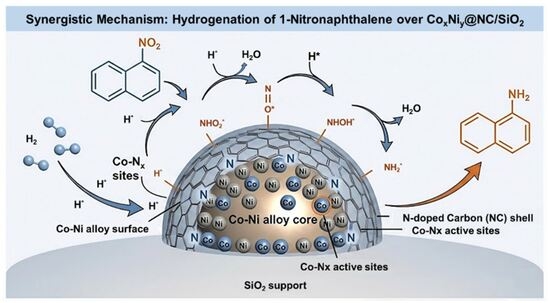
1. Introduction
2. Results and Discussion
2.1. Characterization of Catalysts
2.2. Activity of CoxNiy@NC/SiO2 Catalysts for the Hydrogenation of 1-Nitronaphthalene
2.3. Stability and Recyclability of Co2Ni1@NC/SiO2
2.4. Applicability of CoxNiy@NC/SiO2 Catalysts
3. Experimental
3.1. Synthesis Method of Catalysts
3.2. Catalyst Characterization
3.3. Hydrogenation of Nitronaphthalene
3.4. Stability Testing of Catalysts
3.5. Product Analysis Methods and Calculation Methods
4. Conclusions
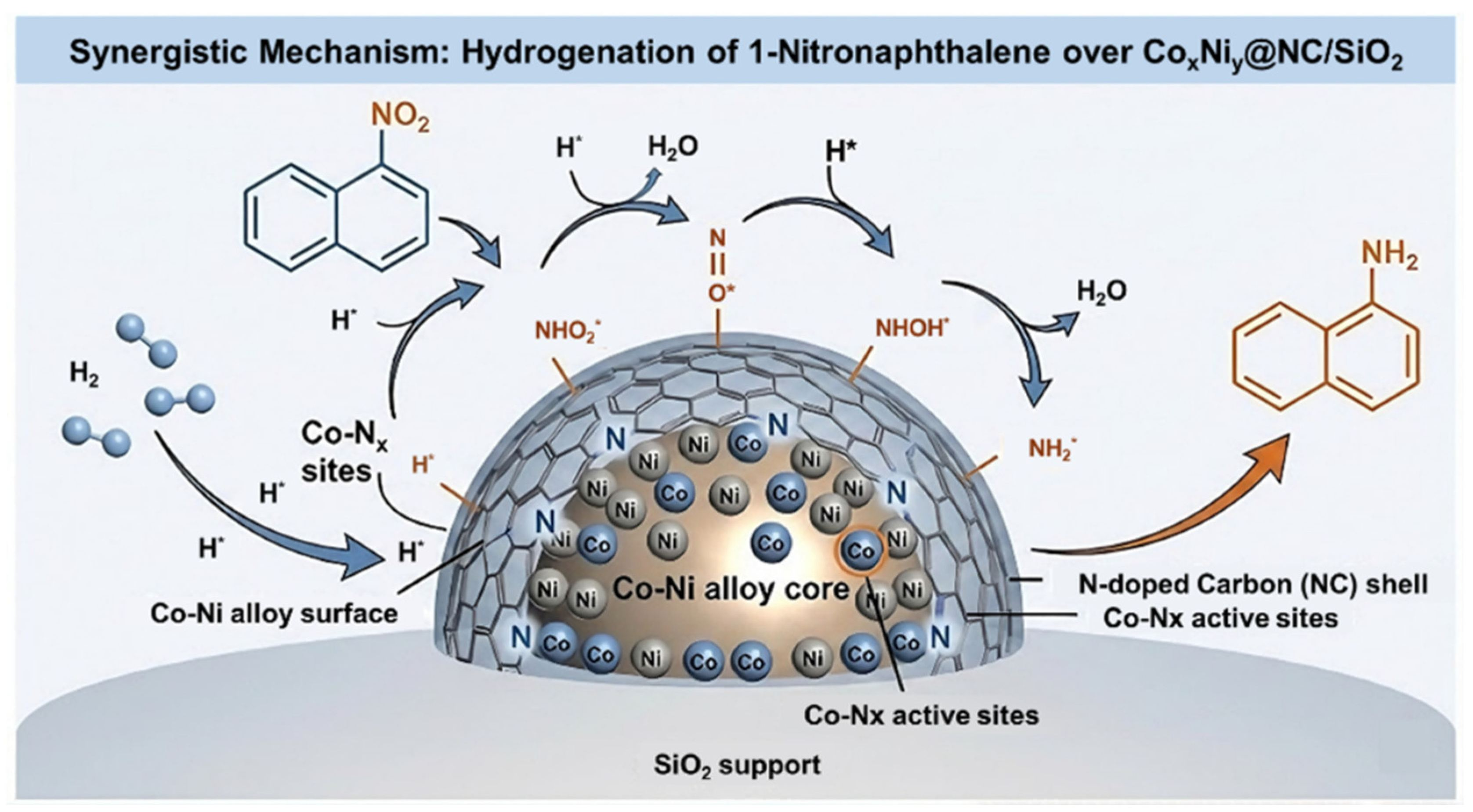
- Characterization and correlation analyses indicate that the pronounced enhancement in catalytic activity is primarily attributable to a synergistic interaction between Ni and Co. This bimetallic synergy optimizes the electronic structure of the active centers, thereby facilitating H2 activation and accelerating the hydrogenation pathway.
- Spectroscopic and structural data suggest that nitrogen derived from the 2-methylimidazole ligand coordinates with cobalt to form Co–Nx active sites and Ni-Nx sites formed during high-temperature calcination reduction process. These M–Nx sites promote electron transfer to the catalyst surface, generating electron-rich active sites. Given the strongly electron-withdrawing nature of the nitro group, such electron-rich surfaces enhance substrate–catalyst interactions and thereby improve nitro-group hydrogenation efficiency.
- The in situ formed carbon-nitrogen matrix produced during thermal treatment stabilizes and disperses the metal active sites, to improve the hydrogenation activity of the catalyst, while also significantly improving the catalyst’s thermal stability and oxidation resistance, contributing to the observed durability and regenerability of the CoxNiy@NC/SiO2 catalysts.
- The superior performance of CoxNiy@NC/SiO2 catalysts is underpinned by dynamic evolution mechanisms that generally require independent and systematic investigation to elucidate, such as the structural evolution of the carbon-nitrogen layers during cycling, the dynamic changes in metal valence states, and the continuous evolution of metal particle size within the catalyst, highlighting future directions for in-depth exploration.
Author Contributions
Funding
Data Availability Statement
Conflicts of Interest
References
- Hartwig, J.F. Transition metal catalyzed synthesis of arylamines and aryl ethers from aryl halides and triflates: Scope and mechanism. Angew. Chem. Int. Ed. 1998, 37, 2046–2067. [Google Scholar] [CrossRef]
- Kawatsura, M.; Hartwig, J.F. Palladium-catalyzed intermolecular hydroamination of vinylarenes using arylamines. J. Am. Chem. Soc. 2000, 122, 9546–9547. [Google Scholar] [CrossRef]
- Liang, M.; Chen, J. Arylamine organic dyes for dye-sensitized solar cells. Chem. Soc. Rev. 2013, 42, 3453–3488. [Google Scholar] [CrossRef]
- Levy, G.N.; Weber, W.W. Arylamine acetyltransferases. In Enzyme Systems that Metabolise Drugs and Other Xenobiotics; John Wiley & Sons: Hoboken, NJ, USA, 2001; pp. 441–457. [Google Scholar]
- Butcher, N.; Boukouvala, S.; Sim, E.; Minchin, R. Pharmacogenetics of the arylamine n-acetyltransferases. Pharmacogenom. J. 2002, 2, 30–42. [Google Scholar] [CrossRef]
- Xu, X.; Mathieu, C.; Berthelet, J.; Duval, R.; Bui, L.C.; Busi, F.; Dupret, J.-M.; Rodrigues-Lima, F. Human arylamine n-acetyltransferase 1 is inhibited by the dithiocarbamate pesticide thiram. Mol. Pharmacol. 2017, 92, 358–365. [Google Scholar] [CrossRef]
- Peters, A.; Sener, M. Disperse dyes derived from 4-phenylazo-1-naphthylamine and 4-phenylazo-5-hydroxy-1-naphthylamine. Dye. Pigment. 1987, 8, 99–118. [Google Scholar] [CrossRef]
- Ameen, S.; Akhtar, M.S.; Kim, Y.S.; Yang, O.-B.; Shin, H.-S. Synthesis and characterization of novel poly (1-naphthylamine)/zinc oxide nanocomposites: Application in catalytic degradation of methylene blue dye. Colloid Polym. Sci. 2010, 288, 1633–1638. [Google Scholar] [CrossRef]
- Ojani, R.; Raoof, J.-B.; Salmany-Afagh, P. Electrocatalytic oxidation of some carbohydrates by poly (1-naphthylamine)/nickel modified carbon paste electrode. J. Electroanal. Chem. 2004, 571, 1–8. [Google Scholar] [CrossRef]
- Zinin, N. Ueber das azobenzid und die nitrobenzinsäure. J. Prakt. Chem. 1845, 36, 93–107. [Google Scholar] [CrossRef]
- Chee, S.W.; Arce-Ramos, J.M.; Li, W.; Genest, A.; Mirsaidov, U. Structural changes in noble metal nanoparticles during co oxidation and their impact on catalyst activity. Nat. Commun. 2020, 11, 2133. [Google Scholar] [CrossRef]
- Asoh, H.; Arai, F.; Ono, S. Effect of noble metal catalyst species on the morphology of macroporous silicon formed by metal-assisted chemical etching. Electrochim. Acta 2009, 54, 5142–5148. [Google Scholar] [CrossRef]
- Papa, V.; Cao, Y.; Spannenberg, A.; Junge, K.; Beller, M. Development of a practical non-noble metal catalyst for hydrogenation of n-heteroarenes. Nat. Catal. 2020, 3, 135–142. [Google Scholar] [CrossRef]
- Zhang, B.; Lin, Z.; Huang, J.; Cao, L.; Wu, X.; Yu, X.; Zhan, Y.; Xie, F.; Zhang, W.; Chen, J. Highly active and stable non noble metal catalyst for oxygen reduction reaction. Int. J. Hydrogen Energy 2017, 42, 10423–10434. [Google Scholar] [CrossRef]
- Chua, C.K.; Pumera, M. Carbocatalysis: The state of “metal-free” catalysis. Chem. Eur. J. 2015, 21, 12550–12562. [Google Scholar] [CrossRef]
- Li, J.; Xi, Z.; Pan, Y.-T.; Spendelow, J.S.; Duchesne, P.N.; Su, D.; Li, Q.; Yu, C.; Yin, Z.; Shen, B. Fe stabilization by intermetallic l10-fept and pt catalysis enhancement in l10-fept/pt nanoparticles for efficient oxygen reduction reaction in fuel cells. J. Am. Chem. Soc. 2018, 140, 2926–2932. [Google Scholar] [CrossRef] [PubMed]
- Barluenga, J.; Valdés, C.; Beltrán, G.; Escribano, M.; Aznar, F. Developments in pd catalysis: Synthesis of 1h-1, 2, 3-triazoles from sodium azide and alkenyl bromides. Angew. Chem. Int. Ed. 2006, 45, 6893–6896. [Google Scholar]
- Gu, Z.; Herrmann, A.T.; Zakarian, A. Dual ti–ru catalysis in the direct radical haloalkylation of n-acyl oxazolidinones. Angew. Chem. Int. Ed. Engl. 2011, 50, 7136. [Google Scholar] [CrossRef]
- Tasker, S.Z.; Standley, E.A.; Jamison, T.F. Recent advances in homogeneous nickel catalysis. Nature 2014, 509, 299–309. [Google Scholar] [CrossRef]
- Osadchii, D.Y.; Olivos-Suarez, A.I.; Szécsényi, Á.; Li, G.; Nasalevich, M.A.; Dugulan, I.A.; Crespo, P.S.; Hensen, E.J.; Veber, S.L.; Fedin, M.V. Isolated fe sites in metal organic frameworks catalyze the direct conversion of methane to methanol. ACS Catal. 2018, 8, 5542–5548. [Google Scholar] [CrossRef]
- Fu, H.; Ruan, L.; Liao, J.; Pei, A.; Liu, J.; Zeng, L.; Yang, K.; Zhu, L.; Chen, B.H. Ptni/c bimetallic nanocatalyst with high catalytic performance and stability for 1-nitronaphthalene hydorgenation to 1-naphthylamine. Mol. Catal. 2020, 494, 111151. [Google Scholar]
- RAJ, K.J.A.; Prakash, M.; Mahalakshmy, R.; Elangovan, T.; Viswanathan, B. Liquid phase hydrogenation of nitrobenzene over nickel supported on titania. Chin. J. Catal. 2012, 33, 1299–1305. [Google Scholar] [CrossRef]
- Huang, L.; Lv, Y.; Wu, S.; Liu, P.; Xiong, W.; Hao, F.; Luo, H. Activated carbon supported bimetallic catalysts with combined catalytic effects for aromatic nitro compounds hydrogenation under mild conditions. Appl. Catal. A Gen. 2019, 577, 76–85. [Google Scholar] [CrossRef]
- Pan, H.; Peng, Y.; Lu, X.; He, J.; He, L.; Wang, C.; Yue, F.; Zhang, H.; Zhou, D.; Xia, Q. Well-constructed ni@ cn material derived from di-ligands ni-mof to catalyze mild hydrogenation of nitroarenes. Mol. Catal. 2020, 485, 110838. [Google Scholar] [CrossRef]
- Liu, Y.; Cheng, H.; Cheng, M.; Liu, Z.; Huang, D.; Zhang, G.; Shao, B.; Liang, Q.; Luo, S.; Wu, T. The application of zeolitic imidazolate frameworks (zifs) and their derivatives based materials for photocatalytic hydrogen evolution and pollutants treatment. Chem. Eng. J. 2021, 417, 127914. [Google Scholar] [CrossRef]
- Arafat, Y.; Azhar, M.R.; Zhong, Y.; Abid, H.R.; Tadé, M.O.; Shao, Z. Advances in zeolite imidazolate frameworks (zifs) derived bifunctional oxygen electrocatalysts and their application in zinc–air batteries. Adv. Energy Mater. 2021, 11, 2100514. [Google Scholar] [CrossRef]
- Qiang, R.; Du, Y.; Chen, D.; Ma, W.; Wang, Y.; Xu, P.; Ma, J.; Zhao, H.; Han, X. Electromagnetic functionalized co/c composites by in situ pyrolysis of metal-organic frameworks (zif-67). J. Alloys Compd. 2016, 681, 384–393. [Google Scholar] [CrossRef]
- Jin, D.; Yang, X.; Ou, Y.; Rao, M.; Zhong, Y.; Zhou, G.; Ye, D.; Qiu, Y.; Wu, Y.; Li, W. Thermal pyrolysis of si@ zif-67 into si@ n-doped cnts towards highly stable lithium storage. Sci. Bull. 2020, 65, 452–459. [Google Scholar] [CrossRef]
- Lai, Q.; Zhao, Y.; Liang, Y.; He, J.; Chen, J. In situ confinement pyrolysis transformation of zif-8 to nitrogen-enriched meso-microporous carbon frameworks for oxygen reduction. Adv. Funct. Mater. 2016, 26, 8334–8344. [Google Scholar] [CrossRef]
- Pan, Y.; Sun, K.; Liu, S.; Cao, X.; Wu, K.; Cheong, W.-C.; Chen, Z.; Wang, Y.; Li, Y.; Liu, Y. Core–shell zif-8@ zif-67-derived cop nanoparticle-embedded n-doped carbon nanotube hollow polyhedron for efficient overall water splitting. J. Am. Chem. Soc. 2018, 140, 2610–2618. [Google Scholar] [CrossRef]
- Biswas, R.K.; Khan, P.; Mukherjee, S.; Mukhopadhyay, A.K.; Ghosh, J.; Muraleedharan, K. Study of short range structure of amorphous silica from pdf using ag radiation in laboratory xrd system, raman and nexafs. J. Non-Cryst. Solids 2018, 488, 1–9. [Google Scholar] [CrossRef]
- Deshmukh, P.; Bhatt, J.; Peshwe, D.; Pathak, S. Determination of silica activity index and xrd, sem and eds studies of amorphous sio2 extracted from rice husk ash. Trans. Indian Inst. Met. 2012, 65, 63–70. [Google Scholar] [CrossRef]
- Zhong, W.; Liu, H.; Bai, C.; Liao, S.; Li, Y. Base-free oxidation of alcohols to esters at room temperature and atmospheric conditions using nanoscale co-based catalysts. Acs Catal. 2015, 5, 1850–1856. [Google Scholar] [CrossRef]
- Bensebaa, N.; Loudjani, N.; Alleg, S.; Dekhil, L.; Suñol, J.; Al Sae, M.; Bououdina, M. Xrd analysis and magnetic properties of nanocrystalline Ni20co80 alloys. J. Magn. Magn. Mater. 2014, 349, 51–56. [Google Scholar] [CrossRef]
- Mei, G.; Sun, Z.; Fang, Z.; Dan, Y.; Lu, X.; Tang, J.; Guo, W.; Zhai, Y.; Zhu, Z. Coni alloy nanoparticles encapsulated within n-doped carbon nanotubes for efficiently ph-universal co2 electroreduction. Small 2025, 21, 2504086. [Google Scholar] [CrossRef]
- Wierzbicki, D.; Baran, R.; Dębek, R.; Motak, M.; Grzybek, T.; Gálvez, M.E.; Da Costa, P. The influence of nickel content on the performance of hydrotalcite-derived catalysts in co2 methanation reaction. Int. J. Hydrogen Energy 2017, 42, 23548–23555. [Google Scholar] [CrossRef]
- Song, D.; Li, J. Effect of catalyst pore size on the catalytic performance of silica supported cobalt fischer–tropsch catalysts. J. Mol. Catal. A Chem. 2006, 247, 206–212. [Google Scholar] [CrossRef]
- Diop, N.F.; Otun, K.O.; Thior, S.; Maphiri, V.M.; Kitenge, V.N.; Sarr, S.; Sylla, N.F.; Wenqiang, X.; Chaker, M.; Ngom, B.D. Facile room-temperature solution-phase synthesis of a zif-67: Ni hybrid-mof battery type material for supercapacitor applications. RSC Adv. 2025, 15, 34976–34990. [Google Scholar] [CrossRef]
- Malobela, L.J.; Heveling, J.; Augustyn, W.G.; Cele, L.M. Nickel–cobalt on carbonaceous supports for the selective catalytic hydrogenation of cinnamaldehyde. Ind. Eng. Chem. Res. 2014, 53, 13910–13919. [Google Scholar] [CrossRef]
- Wang, B.; Li, P.-Y.; Dong, Q.; Chen, L.-Q.; Wang, H.-Q.; Han, P.-L.; Fang, T. Bimetallic nico/ac catalysts with a strong coupling effect for high-efficiency hydrogenation of n-ethylcarbazole. ACS Appl. Energy Mater. 2023, 6, 1741–1752. [Google Scholar] [CrossRef]
- Zhu, L.; Zheng, T.; Zheng, J.; Yu, C.; Zhang, N.; Liao, Q.; Shu, Q.; Chen, B.H. Synthesis of ru/coni crystals with different morphologies for catalytic hydrogenation. CrystEngComm 2017, 19, 3430–3438. [Google Scholar] [CrossRef]
- Chen, Y.-Z.; Wang, C.; Wu, Z.-Y.; Xiong, Y.; Xu, Q.; Yu, S.-H.; Jiang, H.-L. From bimetallic metal-organic framework to porous carbon: High surface area and multicomponent active dopants for excellent electrocatalysis. Adv. Mater. 2015, 27, 5010–5016. [Google Scholar] [PubMed]
- Niu, Q.; Guo, J.; Chen, B.; Nie, J.; Guo, X.; Ma, G. Bimetal-organic frameworks/polymer core-shell nanofibers derived heteroatom-doped carbon materials as electrocatalysts for oxygen reduction reaction. Carbon 2017, 114, 250–260. [Google Scholar]
- Ma, W.; Wang, N.; Tong, T.; Zhang, L.; Lin, K.-Y.A.; Han, X.; Du, Y. Nitrogen, phosphorus, and sulfur tri-doped hollow carbon shells derived from zif-67@ poly (cyclotriphosphazene-co-4, 4′-sulfonyldiphenol) as a robust catalyst of peroxymonosulfate activation for degradation of bisphenol a. Carbon 2018, 137, 291–303. [Google Scholar]
- Zheng, Y.; Zhang, L.; Huang, H.; Wang, F.; Yin, L.; Jiang, H.; Wang, D.; Yang, J.; Zuo, G. Zif-67-derived co, ni and s co-doped n-enriched porous carbon polyhedron as an efficient electrocatalyst for oxygen evolution reaction (oer). Int. J. Hydrogen Energy 2019, 44, 27465–27471. [Google Scholar]
- Liu, X.; Zang, W.; Guan, C.; Zhang, L.; Qian, Y.; Elshahawy, A.M.; Zhao, D.; Pennycook, S.J.; Wang, J. Ni-doped cobalt–cobalt nitride heterostructure arrays for high-power supercapacitors. ACS Energy Lett. 2018, 3, 2462–2469. [Google Scholar]
- Wang, B.; Guo, L.; Zhang, J.; Qiao, Y.; He, M.; Jiang, Q.; Zhao, Y.; Shi, X.; Zhang, F. Synthesis of nickel nitride-based 1d/0d heterostructure via a morphology-inherited nitridation strategy for efficient electrocatalytic hydrogen evolution. Small 2022, 18, 2201927. [Google Scholar]
- Chen, W.; Xu, H.; Ma, X.; Qi, L.; Zhou, Z. Synergistic trimetallic ni–cu–sn catalysts for efficient selective hydrogenation of phenylacetylene. Chem. Eng. J. 2023, 455, 140565. [Google Scholar]
- Huang, Z.-Y.; Guo, X.-S.; Tang, Y.; Ye, J.-S.; Liu, H.-Y.; Xiao, X.-Y. Metalloporphyrin doped macroporous zif-8 metal-organic framework derived m-nx carbon material for oxygen reduction reactions. J. Alloys Compd. 2023, 947, 169441. [Google Scholar]
- Han, B.; Yu, B.; Wang, J.; Liu, M.; Gao, G.; Xia, K.; Gao, Q.; Zhou, C. Understanding the electronic metal-support interactions of the supported ni cluster for the catalytic hydrogenation of ethylene. Mol. Catal. 2021, 511, 111731. [Google Scholar] [CrossRef]
- Wang, X.; Zhao, J.; Zhang, J.; Zhao, Y.; Zhao, P.; Ni, L.; Xie, Q.; Meng, J. Ball-milled silicon with amorphous al2o3/c hybrid coating embedded in graphene/graphite nanosheets with a boosted lithium storage capability. Langmuir 2022, 38, 8555–8563. [Google Scholar]
- Fang, R.; Yao, C.; Wang, Q.; Feng, F.; Lu, C.; Zhang, Q.; Li, X. Carbon-coated catalysts: Synthesis, optimization and applications. Catal. Rev. 2025, 1–62. [Google Scholar] [CrossRef]
- Yao, F.; Liu, S.; Cui, H.; Lv, Y.; Zhang, Y.; Liu, P.; Hao, F.; Xiong, W.; Luo, H.a. Activated carbon supported non-noble bimetallic ni-based catalysts for nitrocyclohexane hydrogenation to cyclohexanone oxime under mild conditions. ACS Sustain. Chem. Eng. 2021, 9, 3300–3315. [Google Scholar] [CrossRef]
- Li, Y.; Jia, B.; Fan, Y.; Zhu, K.; Li, G.; Su, C.Y. Bimetallic zeolitic imidazolite framework derived carbon nanotubes embedded with co nanoparticles for efficient bifunctional oxygen electrocatalyst. Adv. Energy Mater. 2018, 8, 1702048. [Google Scholar] [CrossRef]
- Shu, Y.; Song, X.; Lan, F.; Zhao, C.; Guan, Q.; Li, W. N-doped carbon interior-modified mesoporous silica-confined nickel nanoclusters for stereoselective hydrogenation. ACS Catal. 2022, 12, 15386–15399. [Google Scholar] [CrossRef]
- Haber, F. Über stufenweise reduktion des nitrobenzols mit begrenztem kathodenpotential. Z. Elektrochem. 1898, 4, 506–514. [Google Scholar]
- Dubois, V.; Jannes, G.; Verhasselt, P. Kinetic study of a nitroaliphatic compound hydrogenation. In Studies in Surface Science and Catalysis; Elsevier: Amsterdam, The Netherlands, 1997; Volume 108, pp. 263–271. [Google Scholar]
- Blaser, H.-U.; Indolese, A.; Schnyder, A.; Steiner, H.; Studer, M. Supported palladium catalysts for fine chemicals synthesis. J. Mol. Catal. A Chem. 2001, 173, 3–18. [Google Scholar] [CrossRef]
- Gong, X.; Li, N.; Li, Y.; Hu, R. The catalytic hydrogenation of furfural to 2-methylfuran over the mg-al oxides supported co-ni bimetallic catalysts. Mol. Catal. 2022, 531, 112651. [Google Scholar] [CrossRef]
- Gutiérrez-Tarriño, S.; Rojas-Buzo, S.; Lopes, C.W.; Agostini, G.; Calvino, J.J.; Corma, A.; Oña-Burgos, P. Cobalt nanoclusters coated with n-doped carbon for chemoselective nitroarene hydrogenation and tandem reactions in water. Green Chem. 2021, 23, 4490–4501. [Google Scholar] [CrossRef]
- Ma, Y.; Xiong, S.; Cai, L.; Meng, L.; Chen, G.; Dong, C.; Guan, H. High-performance electromagnetic absorbing ni/c composites derived from ni-mof materials: Effects of organic ligands and pyrolysis temperatures. Carbon 2025, 233, 119882. [Google Scholar]
- Shao, C.; Luo, M.; Song, H.; Zhang, S.; Wang, F.; Liu, X.; Huang, Z. Highly active porous carbon-supported coni bimetallic catalysts for four-electron reduction of oxygen. Energy Fuels 2023, 37, 4026–4037. [Google Scholar]
- Zhang, X.; Wang, T.; Xiao, L.; Xiang, G.; Xu, W.; Huang, Q. Synthesis of nano-tube coni/n–c complex and its catalytic properties for highly efficient oxygen reduction. Int. J. Hydrogen Energy 2023, 48, 26979–26989. [Google Scholar] [CrossRef]
- Huang, Y.; Chen, Y.; Xu, M.; Asset, T.; Tieu, P.; Gili, A.; Kulkarni, D.; De Andrade, V.; De Carlo, F.; Barnard, H.S. Catalysts by pyrolysis: Direct observation of chemical and morphological transformations leading to transition metal-nitrogen-carbon materials. Mater. Today 2021, 47, 53–68. [Google Scholar] [CrossRef]
- Wang, F.; Guo, C.; Di, S.; Chen, Q.; Zhu, H. Effect of nitrogen-containing carbon shell-coated carbon support on the catalytic performance of platinum–cobalt alloy catalyst for oxygen reduction. Energy Fuels 2023, 37, 3980–3990. [Google Scholar] [CrossRef]
- Yao, Y.; Yin, C.; He, W.; Zhou, Y.; Ma, C.; Liu, Y.; Li, X.; Lu, C. Strengthened delocalized electronic effect in nano-nickel@ carbon with high pyrrolic nitrogen for selective hydrogenation of substituted nitrobenzene hydrogenation. ACS Catal. 2024, 14, 14912–14927. [Google Scholar] [CrossRef]
- Huang, L.; Lv, Y.; Liu, S.; Cui, H.; Zhao, Z.; Zhao, H.; Liu, P.; Xiong, W.; Hao, F.; Luo, H.A. Non-noble metal Ni nanoparticles supported on highly dispersed tio2-modified activated carbon as an efficient and recyclable catalyst for the hydrogenation of halogenated aromatic nitro compounds under mild conditions. Ind. Eng. Chem. Res. 2020, 59, 1422–1435. [Google Scholar] [CrossRef]



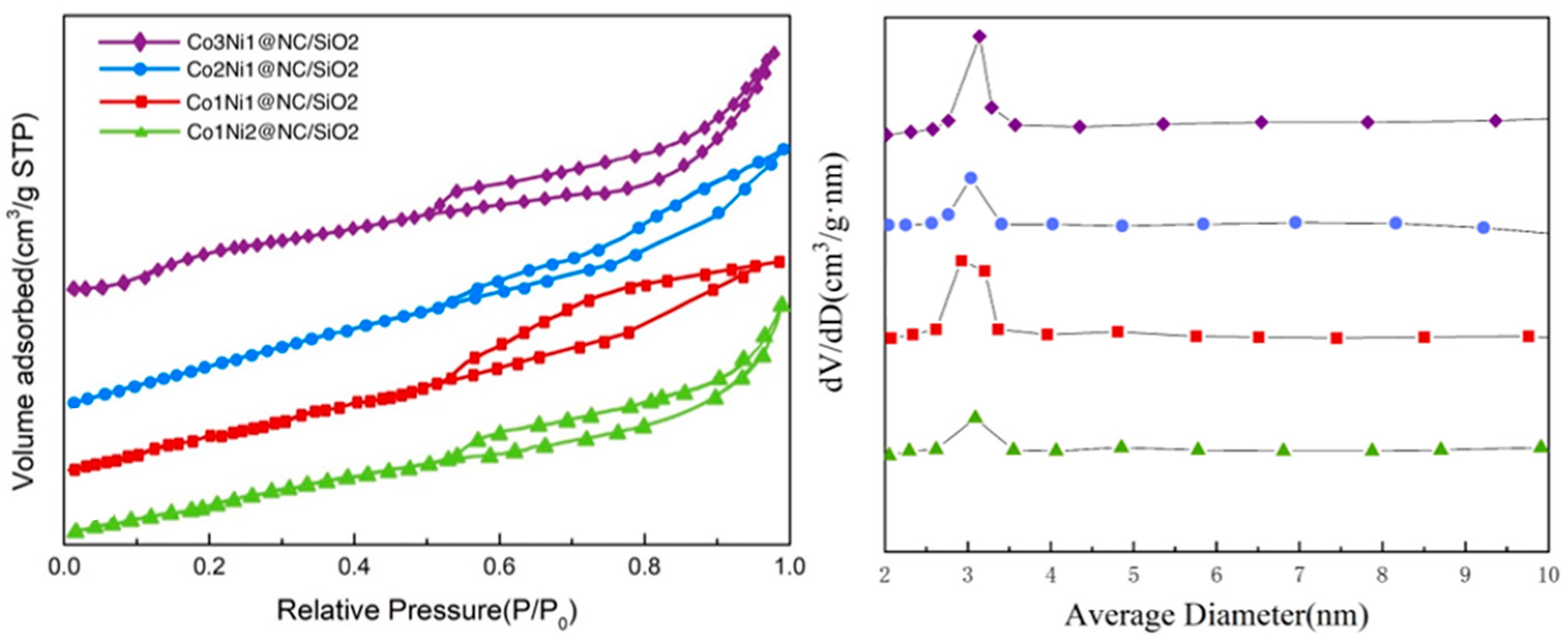
| Catalysts | BET Surface Area (m2/g) | Total Pore Volume (cm3/g) | Pore Size (nm) |
|---|---|---|---|
| Co3Ni1@NC/SiO2 | 355.9 | 0.26 | 3.25 |
| Co2Ni1@NC/SiO2 | 324.6 | 0.24 | 3.12 |
| Co1Ni1@NC/SiO2 | 298.3 | 0.21 | 3.02 |
| Co1Ni2@NC/SiO2 | 276.4 | 0.20 | 2.98 |
| Catalysts | Reducing Condition | Conversion | Selectivity | Yield | |
|---|---|---|---|---|---|
| 1-Naphthylamine | Others | ||||
| Co2Ni1@NC/SiO2 | H2-400 °C for 2 h | 82.5% | 87.3% | 12.7% | 72.1% |
| Co2Ni1@NC/SiO2 | H2-450 °C for 2 h | 94.6% | 94.4% | 5.6% | 89.2% |
| Co2Ni1@NC/SiO2 | H2-500 °C for 2 h | 99.9% | 95.3% | 4.7% | 95.3% |
| Co2Ni1@NC/SiO2 | H2-550 °C for 2 h | 91.5% | 96.6% | 3.4% | 88.4% |
| Co2Ni1@NC/SiO2 | H2-600 °C for 2 h | 79.2% | 81.4% | 18.6% | 64.5% |
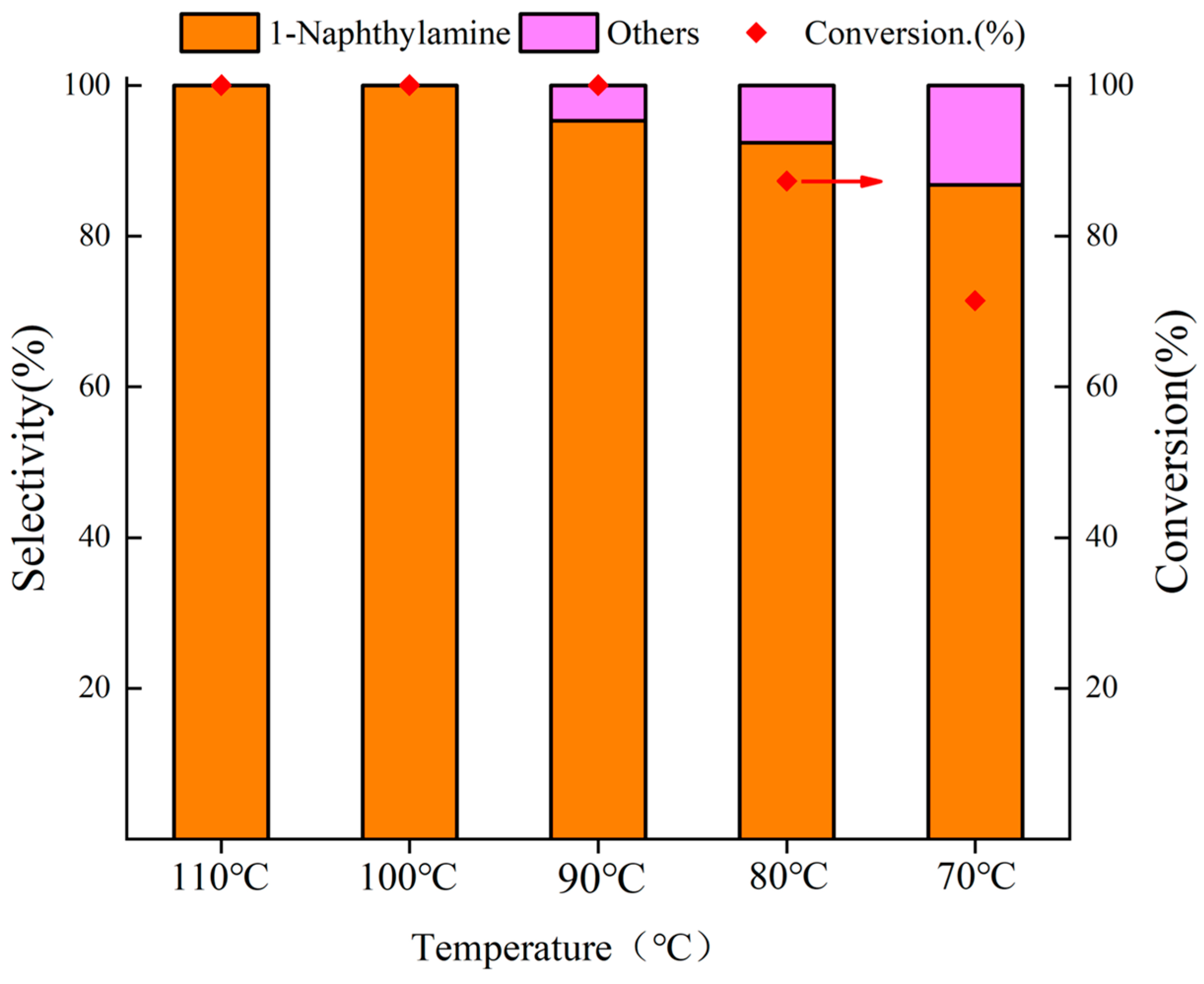
| Catalysts | Reaction Temperature | Reaction Time | Conversion | Selectivity | |
|---|---|---|---|---|---|
| 1-Naphthylamine | Others | ||||
| Co2Ni1@NC/SiO2H2500 | 90 °C | 5.5 h | >99.9% | >99.9% | / |
| Co2Ni1@NC/SiO2H2500 | 80 °C | 6.5 h | >99.9% | >99.9% | / |
| Co2Ni1@NC/SiO2H2500 | 70 °C | 9 h | >99.9% | >99.9% | / |
| Entry | Substrates | Products | Reaction Temperature (°C) | Reaction Time (h) | Con. (%)/Sel. (%) |
|---|---|---|---|---|---|
| 1 |  |  | 95 | 7 | >99%/>99% |
| 2 |  |  | 95 | 8.5 | >99%/>99% |
| 3 |  |  | 70 | 5 | >99%/>98.5% |
| 4 |  |  | 70 | 7.5 | >99%/>96.8% |
| 5 |  |  | 70 | 5 | >99%/>98.1% |
| 6 |  |  | 70 | 5.5 | >99%/>97.8% |
Disclaimer/Publisher’s Note: The statements, opinions and data contained in all publications are solely those of the individual author(s) and contributor(s) and not of MDPI and/or the editor(s). MDPI and/or the editor(s) disclaim responsibility for any injury to people or property resulting from any ideas, methods, instructions or products referred to in the content. |
© 2026 by the authors. Licensee MDPI, Basel, Switzerland. This article is an open access article distributed under the terms and conditions of the Creative Commons Attribution (CC BY) license.
Share and Cite
Lan, X.; Zhong, M.; Dai, W.; Liu, P. High-Performance CoxNiy@NC/SiO2 Catalysts Derived from ZIF-67 for Enhanced Hydrogenation of 1-Nitronaphthalene. Catalysts 2026, 16, 93. https://doi.org/10.3390/catal16010093
Lan X, Zhong M, Dai W, Liu P. High-Performance CoxNiy@NC/SiO2 Catalysts Derived from ZIF-67 for Enhanced Hydrogenation of 1-Nitronaphthalene. Catalysts. 2026; 16(1):93. https://doi.org/10.3390/catal16010093
Chicago/Turabian StyleLan, Xuedong, Ming Zhong, Weidi Dai, and Pingle Liu. 2026. "High-Performance CoxNiy@NC/SiO2 Catalysts Derived from ZIF-67 for Enhanced Hydrogenation of 1-Nitronaphthalene" Catalysts 16, no. 1: 93. https://doi.org/10.3390/catal16010093
APA StyleLan, X., Zhong, M., Dai, W., & Liu, P. (2026). High-Performance CoxNiy@NC/SiO2 Catalysts Derived from ZIF-67 for Enhanced Hydrogenation of 1-Nitronaphthalene. Catalysts, 16(1), 93. https://doi.org/10.3390/catal16010093