
Article

ZSM-5 Nanocatalyst from Rice Husk: Synthesis, DFT Analysis, and Au/Pt Modification for Isopropanol Conversion


1
Department of Chemistry, College of Science, Jouf University, Sakaka 72341, Aljouf, Saudi Arabia
2
Chemistry Department, Faculty of Education, Ain Shams University, Cairo 11341, Roxy, Egypt
3
Centre for Advanced Materials and Industrial Chemistry (CAMIC), School of Engineering, RMIT University, Melbourne, VIC 3001, Australia
*
Authors to whom correspondence should be addressed.
Catalysts 2026, 16(1), 110; https://doi.org/10.3390/catal16010110 (registering DOI)
Submission received: 24 December 2025 / Revised: 15 January 2026 / Accepted: 16 January 2026 / Published: 22 January 2026

Abstract

Silica extracted from rice straw was utilized to synthesize nanoscale ZSM-5 zeolite, which was further modified with platinum (Pt) or gold (Au). The structural properties of the materials were examined using XRD, SEM, and BET analysis, while acidity distribution was determined by in situ FT-IR through pyridine adsorption. The zeolitic samples were evaluated as catalysts for isopropanol conversion in the temperature range of 150–275 °C. Modification of HZSM-5 with Au and Pt introduced additional active metal sites and enhanced the acidity of the catalyst, thereby lowering the activation energy for dehydration reactions and improving catalytic performance. Both acetone and propene were produced from isopropanol conversion across all catalysts, with oligomerization occurring at temperatures above 200 °C. Among the catalysts, HZSM-5 modified with 4% Pt or 4% Au exhibited superior conversion rates and selectivity to propene, achieving 92% selectivity at 200 °C. The enhanced propylene selectivity and stability of Au/HZSM-5 are associated with preserved medium-strength acid sites, as evidenced by in situ FT-IR pyridine adsorption, particularly the band at 1457 cm−1. Theoretical studies indicated that incorporating noble metals such as Au and Pt enhances the stability of the zeolite structure, which is consistent with the experimental results, suggesting new potential for advanced catalysis and material science applications.

1. Introduction

In the chemical industry, propylene serves as a crucial feedstock for the production of numerous compounds, such as acrylonitrile, acrylic acid, propylene oxide, and propylene glycol, as well as its primary application in manufacturing polypropylene [1,2,3]. Propylene also plays a key role in the cumene process, where it reacts with benzene to form cumene (isopropylbenzene). Subsequent oxidation of cumene yields phenol and acetone as co-products. However, because the markets for phenol and acetone differ significantly, imbalances in demand can constrain production flexibility. To address this, some plants convert excess acetone back into propylene by hydrogenating it to isopropanol (isopropyl alcohol), followed by dehydration to regenerate propylene, thus partially closing the loop and decoupling phenol production from fluctuations in the acetone market [4].
Zeolites are essential catalysts in petroleum refining [5], owing to their hierarchical framework of interconnected channels that integrate micro- and mesopores, together with acid–base properties that can be tailored during synthesis or post-synthesis modifications [6,7,8]. Zeolites are used as adsorbents because of their ionic exchange capacity, which also plays a significant role in catalysis when applied to the dispersion and support properties of metal nanoparticles. Recent studies have demonstrated that two-dimensional ZSM-5 with ~2 nm single-layer thickness exhibits remarkable pore-diffusion characteristics, attributed to abundant interlayer mesopores and ultra-short diffusion pathways. These features make it an excellent platform for designing novel, highly active metal–zeolite catalysts [9]. Superior catalytic performance was reported in the hydroisomerization of n-heptane, showing higher selectivity toward i-heptane isomers compared to conventional ZSM-5 [10]. Moreover, direct Pt loading onto ZSM-5, either via ion exchange or alternative methods, significantly enhanced the hydrogenation conversion of naphthalene to tetralin in the presence of Ni [11,12]. Numerous studies and publications over the past few decades have examined most of the factors influencing the performance of bifunctional catalysts [13]. Zeolites are therefore highly attractive for the development of bifunctional catalysts, with gold serving as active redox centers. One study investigated several alcohols likely adsorbed on the H-ZSM-5 catalyst [14]. The effects of 2-propanol and 2-propen-1-ol adsorption on H-ZSM-5 were investigated through thermogravimetric analysis (TGA), temperature-programmed desorption (TPD), and transmission infrared spectroscopy [15,16]. To better understand alcohol conversion mechanisms, researchers studied the gas–solid interface conversion of isopropanol using various metal-promoted catalysts. It is widely accepted that three simultaneous processes can limit the maximum achievable isopropanol conversion, as reported in several studies [17,18]. First, aldehyde and ketone products of alcohol dehydrogenation are more readily formed on basic catalysts. Second, ethers and olefins, as well as dehydrogenation products, are favored in the presence of acidic sites. The third, less common pathway involves the intermolecular dehydration of two alcohol molecules to form isopropyl ether.
Here, we present the modification of HZSM-5 using gold and platinum precursors (AuCl3 and dichlorotetraammine platinum), followed by comprehensive physicochemical characterization to evaluate the effect of noble-metal incorporation on the catalyst properties. The structural and surface properties of the developed catalysts were thoroughly analyzed using a range of techniques, including X-ray diffraction (XRD), pyridine adsorption monitored by in situ FT-IR spectroscopy, scanning electron microscopy (SEM), and BET surface area analysis. The catalytic performance in isopropanol conversion was assessed over a temperature range of 150–275 °C, enabling a correlation between the catalysts’ physicochemical properties and their catalytic activity.

2. Results and Discussion

2.1. XRD Investigation

The XRD pattern of the parent HZSM-5, Au/HZSM-5, and Pt/HZSM-5 catalysts is displayed in Figure 1. The XRD pattern confirms the formation of highly crystalline HZSM-5. In contrast, the broad feature observed at low angles (~8–18° 2θ) arises from overlapping reflections characteristic of the MFI framework, particularly in nanosized or hierarchical ZSM-5, and therefore does not indicate the presence of an amorphous phase [19]. Distinct diffraction peaks observed at 2θ values of 7.8°, 8.7°, 22.9°, 23.6°, and 24.3° correspond to the (101), (020), (303), (151), and (313) planes, respectively. The obtained diffraction reflections are in excellent agreement with the standard JCPDS card No. 44–0003, which is characteristic of the orthorhombic MFI framework. This correspondence confirms the successful crystallization and formation of a well-defined ZSM-5 zeolite phase [20,21,22]. In contrast, the Au/HZSM-5 sample exhibits additional diffraction peaks at 2θ = 38.20° and 44.41°, which are attributed to the metallic Au phase (JCPDS/PDF No. 00-004-0784). These reflections correspond to the Au (111) and Au (200) crystallographic planes, respectively, confirming the presence of metallic gold species on the HZSM-5 framework [23]. This result indicated that during migration and contact with H2O molecules in zeolite channels, AuCl3 was reduced to lower oxidation states. This reduction phenomenon first surfaced in the evolution of HCl during the reduction of AuIII/NaY to Au0 [24]. However, new diffraction peaks appeared in the Pt/HZSM-5 sample at 2θ = 39.82° and 46.24°, which are attributed to metallic platinum with a face-centered cubic (fcc) structure (JCPDS/PDF No. 04-0802). Au/HZSM-5 and Pt/HZSM-5 showed the strongest and most intense diffraction peaks characteristic of metallic gold and platinum species, suggesting that the largest numbers of gold and platinum nanoparticles were wet-impregnated onto HZSM-5. However, after being modified by Au or Pt, there is a reduction in the peak’s relative intensities. By calculating the peak area ratio between the range 22° and 25°, which corresponds to the sum of the five diffraction peaks of 2θ at 23.06, 23.29, 23.70, 23.93, and 24.40 degrees, the relative HZSM-5 crystallinity of the samples was determined [25].
Table 1 illustrates that the HZSM-5 framework structure is somewhat decreased by the insertion of Pt or Au into HZSM-5 zeolite, with a drop in crystallinity of approximately 19% after modification by 4 wt.% Pt and 33% after modification by 4 wt.% Au. The decrease in crystallinity of Au/HZSM-5 and Pt/HZSM-5 compared with the parent HZSM-5 is mainly attributed to partial framework distortion and defect formation during the metal loading process. Specifically, the deposition of noble metal nanoparticles via ion exchange and subsequent calcination can cause dealumination and partial amorphization of the zeolite framework, leading to a lower degree of long-range order observed in the XRD patterns. In addition, the interaction between metal species and the zeolite surface, particularly at exchange or defect sites, may disrupt the periodicity of the Si–O–Al network. Therefore, the observed 33% and 19% reductions in crystallinity for Au/HZSM-5 and Pt/HZSM-5, respectively, reflect both mild framework disorder and partial pore blockage caused by metal incorporation rather than complete structural collapse.

2.2. Surface Texture

The investigation of nitrogen physisorption and the resulting numerical processing of the adsorption data were used to study the microstructure and properties of the parent HZSM-5, Pt/HZSM-5, and Au/HZSM-5, namely pore size and surface area. An analysis of Table 1 indicates the following: (i) For the different materials under investigation, the values of statistical surface area (St), computed using the t-plot technique, and specific surface area (SBET), obtained from the complete BET equation, showed similar values, confirming the suitability of the standard t-curves applied in the pore study. The absence of ultramicropores has been shown by the absence of such large differences. (ii) When HZSM-5 was treated with Pt or Au, the external surface area (Sext) decreased together with the surface area of wide pores (Swid) to approximately 27 and 22%, respectively. The different trends observed for the external surface area (Sext) and the surface area of wide pores (Swid) after Pt or Au modification of HZSM-5 are attributed to metal-dependent dispersion and localization effects. In Au/HZSM-5, the simultaneous decrease in Sext and Swid is associated with partial micropore blockage accompanied by changes in external surface morphology, whereas Pt/HZSM-5 exhibits a more pronounced reduction in Sext while maintaining a moderate Swid, indicating preferential blockage of pore mouths and external surface sites. These differences reflect variations in metal–zeolite interactions rather than a uniform textural modification of the zeolite framework [26,27]. Additionally, the observed decreases in pore volume (Vp; 12% and 9%), BET surface area (SBET; 7% and 6%), and the availability of channels and/or active sites after Au and Pt modification can be attributed to partial pore blockage caused by the deposited metal species [28].
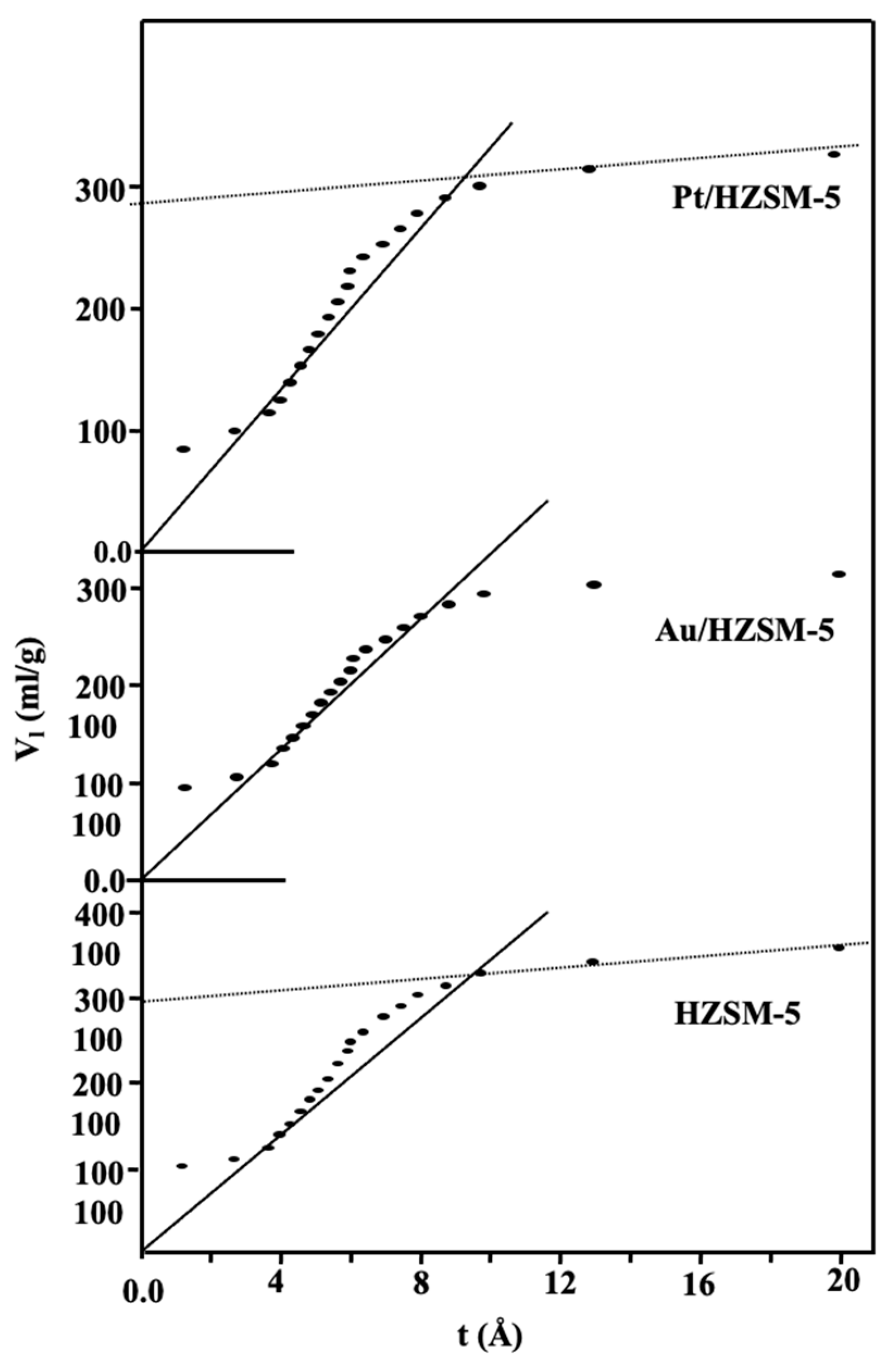
Figure 2 displays the V1–t plots of the parent HZSM-5 and its modification by Au and Pt. HZSM-5 displayed an upward “t” deviation from 4.4 to 10.1 Å. The modification by Au and Pt shows the upward deviations, which begin at 4.9 and 4.8 Å and go up to 7.51 and 8.6 Å for the Au and Pt samples, respectively. The early onset of “t” differences following Au or Pt modifications indicates pore blockage and zeolite pore narrowing. These observations have been confirmed by the values of V p w i d , which were estimated at 0.067 cm3 g−1 for the parent zeolite and decreased in V p w i d (0.052 cm3 g−1) for Au/HZSM-5 compared to that for the respective parent zeolite (0.067), suggesting partial blockage of the channels of HZSM-5.

2.3. In Situ FT-IR Spectra of Pyridine Adsorption

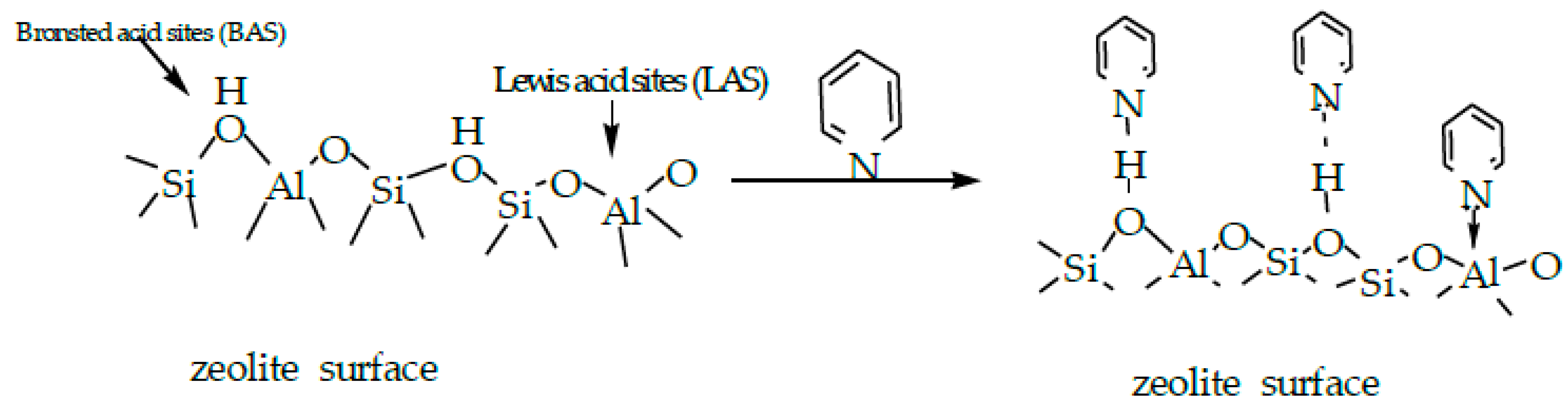
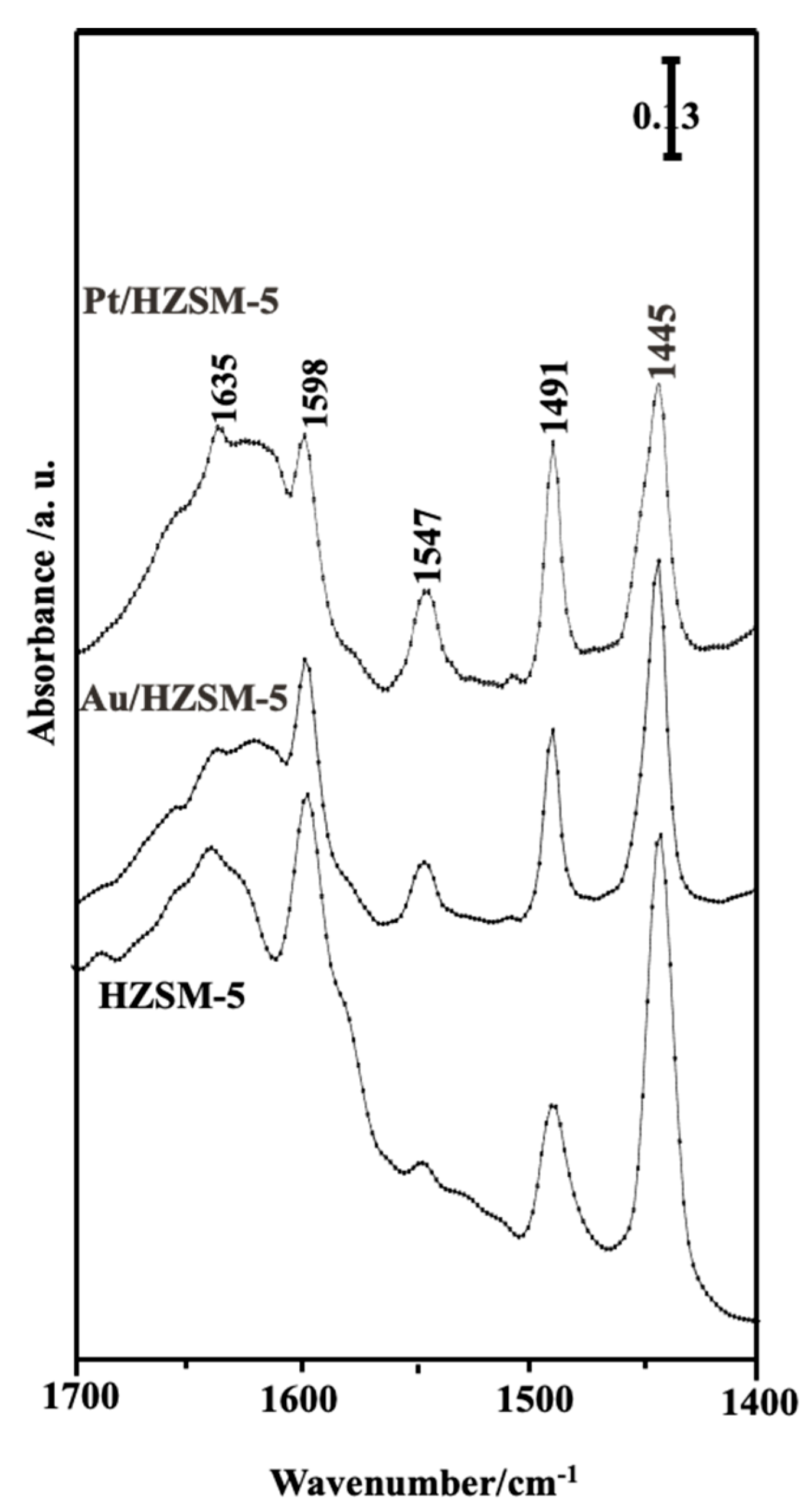
To evaluate the concentration of acid sites in HZSM-5 and modification by Au or Pt, in situ FT-IR spectra of pyridine adsorption at 100 °C, followed by evacuation at the same temperature, were obtained and are presented in Figure 3. The FT-IR spectrum of pyridine-adsorbed parent HZSM-5 (Scheme 1) exhibits characteristic absorption bands at 1598 cm−1, attributed to the ring stretching vibration of the C=N bond of pyridine coordinated to Lewis acid sites (Py–L), arising from interaction with coordinatively unsaturated cationic Al–O species in the zeolite framework. In contrast, the bands observed at 1635 and 1547 cm−1 are assigned to protonated pyridine (PyH+), corresponding to ring stretching vibrations involving the C=N and C–C bonds of the pyridinium ion formed upon interaction with Brønsted acid sites (surface hydroxyl groups), confirming the formation of Py–B complexes. Additionally, the absorption band at 1491 cm−1 is attributed to combined C–H and ring stretching vibrations of pyridine coordinated to both Lewis and Brønsted acid sites, reflecting overlapping vibrational contributions from Py–L and PyH+ species [29,30,31].
In situ FT-IR spectra of pyridine adsorbed on HZSM-5, Au/HZSM-5, and Pt/HZSM-5 at 100 °C reveal characteristic bands of Lewis-bound pyridine (Lpy) at 1445 and 1598 cm−1 and Brønsted-bound pyridine (Bpy) at 1547 and 1635 cm−1. Compared with the parent zeolite, noble-metal modification leads to a clear enhancement of the Brønsted acid band at 1547 cm−1 following the order Pt/HZSM-5 > Au/HZSM-5 > HZSM-5, accompanied by a progressive decrease in the Lewis acid band at 1445 cm−1. This trend indicates a redistribution of surface acidity induced by Au and Pt incorporation, where Brønsted acid sites are strengthened at the expense of Lewis acid sites. In HZSM-5, Brønsted acidity originates primarily from framework Si–OH–Al groups, while Lewis acidity and weak acid sites are associated with extra-framework aluminum species or silanol nests formed during partial dealumination [32,33,34]. The observed increase in Brønsted acidity upon metal incorporation is attributed to metal-induced restructuring of the acid environment, in which noble-metal species promote redistribution and stabilization of aluminum species near framework hydroxyl groups, leading to the formation of more strongly protonated or pseudo-bridging Brønsted sites and a concurrent reduction in coordinatively unsaturated Lewis sites. The more pronounced effect observed for Pt/HZSM-5 suggests stronger metal–support interactions compared with Au/HZSM-5, consistent with previous reports linking noble-metal deposition to aluminum redistribution and acid site transformation [35,36].
Quantitative determination of Brønsted and Lewis acid site concentrations, derived from the integrated intensities of the bands at 1547 and 1445 cm−1 using established molar extinction coefficients [37,38], demonstrates that Au/HZSM-5 and Pt/HZSM-5 possess higher Brønsted acid site densities and Brønsted-to-Lewis (B/L) ratios than the parent HZSM-5, which is in agreement with previously reported studies summarized in Table 2 [39,40,41,42]. The parent zeolite exhibits moderate intrinsic acidity, with partial restriction of pyridine accessibility within its microporous channels [43]. In contrast, noble-metal incorporation primarily enhances acid strength and site accessibility rather than increasing the overall number of acid sites. The resulting predominance of medium-strength Brønsted acid sites is particularly beneficial for selective isopropanol dehydration and hydroisomerization reactions, as excessively strong acid sites tend to promote undesirable side reactions, including hydride transfer, cyclization, and coke formation, thereby reducing catalytic selectivity and stability [40,44].

2.4. Scanning Electron Microscopy (SEM)

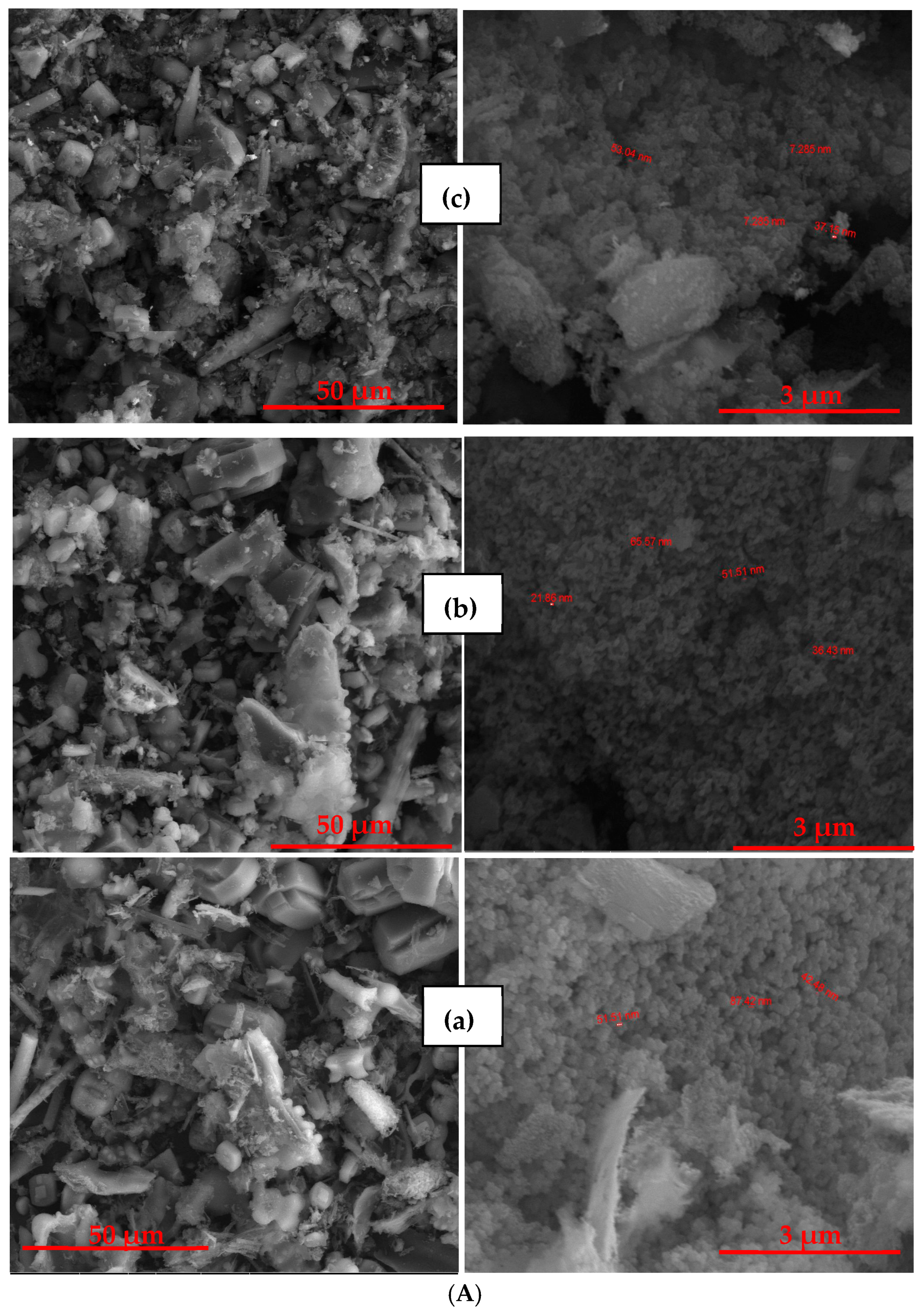
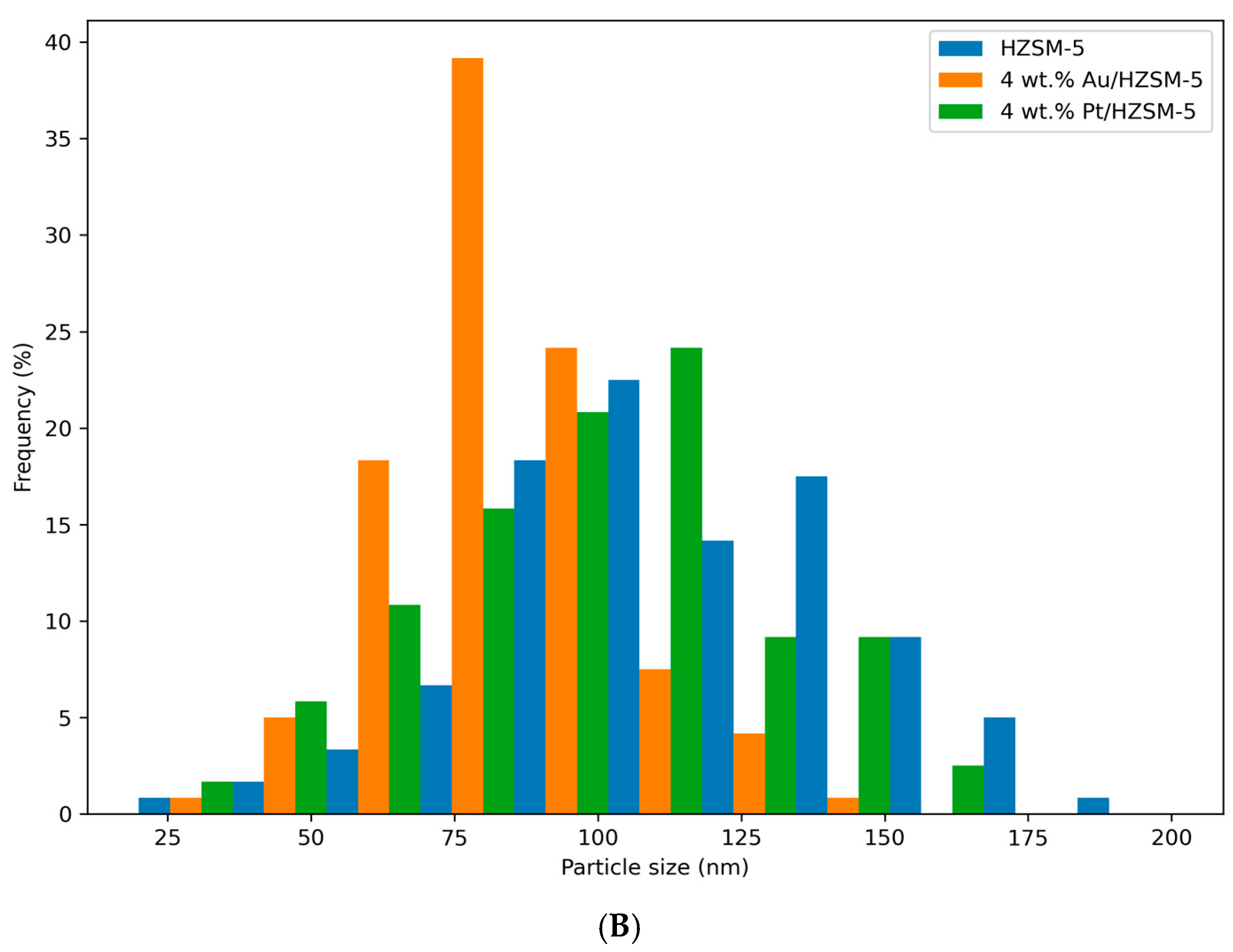
The SEM images of the parent HZSM-5 and the noble-metal-modified catalysts (Au/HZSM-5 and Pt/HZSM-5) are presented in Figure 4A. The Au/HZSM-5 catalyst exhibits finely dispersed Au nanoparticles with an average particle size of approximately 26 nm, indicating effective metal dispersion on the zeolite surface. In contrast, the Pt/HZSM-5 sample shows comparatively larger Pt particles with an average size of about 44 nm, accompanied by a more rectangular particle morphology. The parent HZSM-5 sample displays an average particle size of approximately 47 nm. The observed differences in particle size and morphology suggest that partial ion exchange occurred between the noble-metal precursors and the Brønsted protons of the parent HZSM-5 framework, which is consistent with previously reported studies [45].
To further support the SEM observations, particle size distribution (PSD) analysis derived from SEM images is shown in Figure 4B. The parent HZSM-5 exhibits a relatively broad particle size distribution, indicating a wide size range and a higher tendency toward particle aggregation. In contrast, Au/HZSM-5 displays a narrower distribution centered at smaller particle sizes, reflecting enhanced dispersion of gold species on the HZSM-5 support. The Pt/HZSM-5 sample presents an intermediate particle size distribution, suggesting moderate aggregation compared with the Au-modified catalyst. Moreover, it has been reported that supports with moderate acidity can promote improved Pt and Au dispersion by strengthening metal–support interactions. Accordingly, the relatively small average particle sizes observed for the Pt- and Au-modified HZSM-5 catalysts can be correlated with the altered acidity of the support, characterized by an increased contribution of Brønsted acid sites and a reduced proportion of Lewis acid sites [46,47]. These observations are in good agreement with the results obtained from N2 adsorption–desorption measurements, pyridine-FTIR analysis, and XRD characterization, confirming the strong correlation between acidity modification, metal dispersion, and the structural properties of the catalysts.

2.5. Catalytic Properties of Isopropanol

2.5.1. Catalytic Conversion

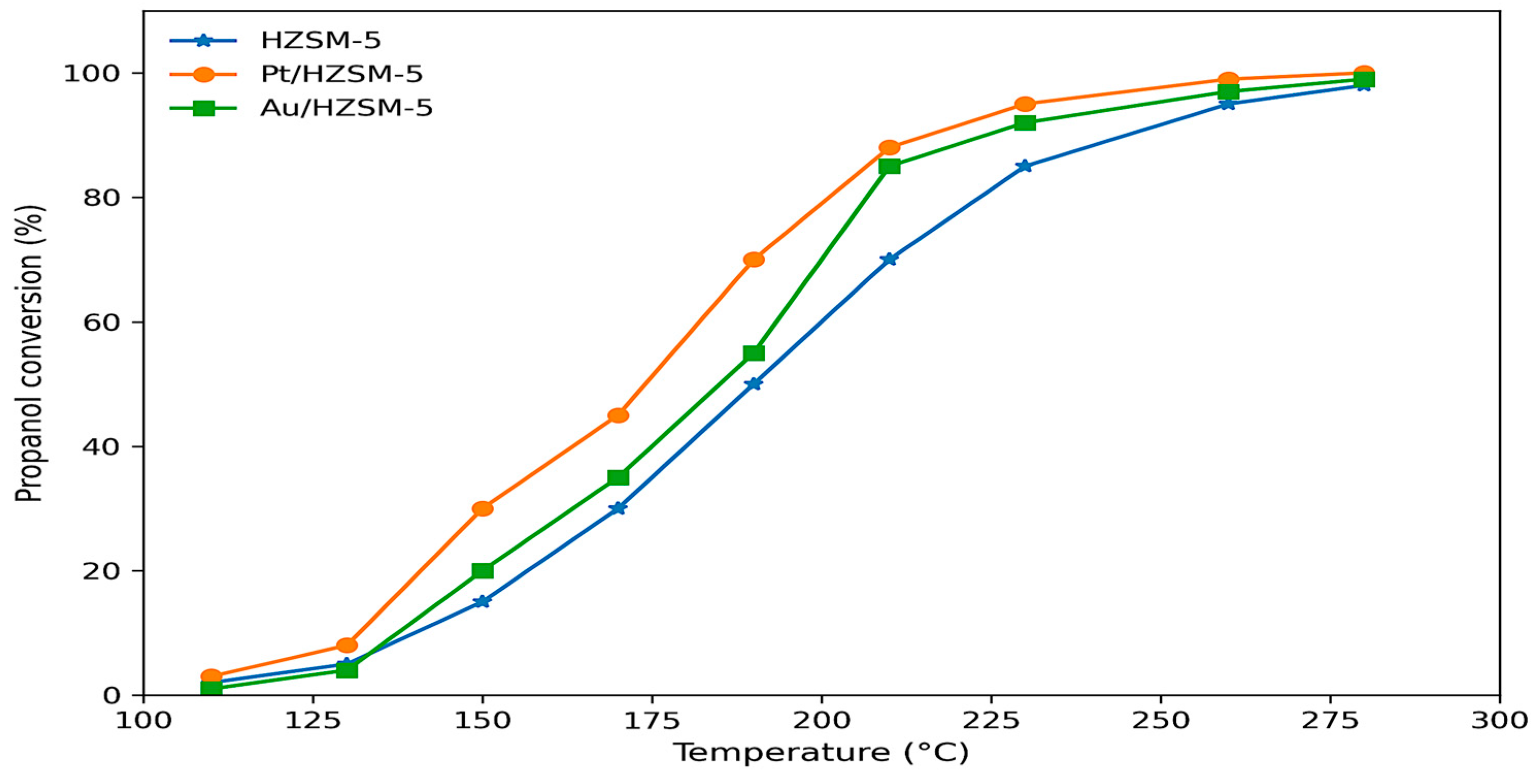
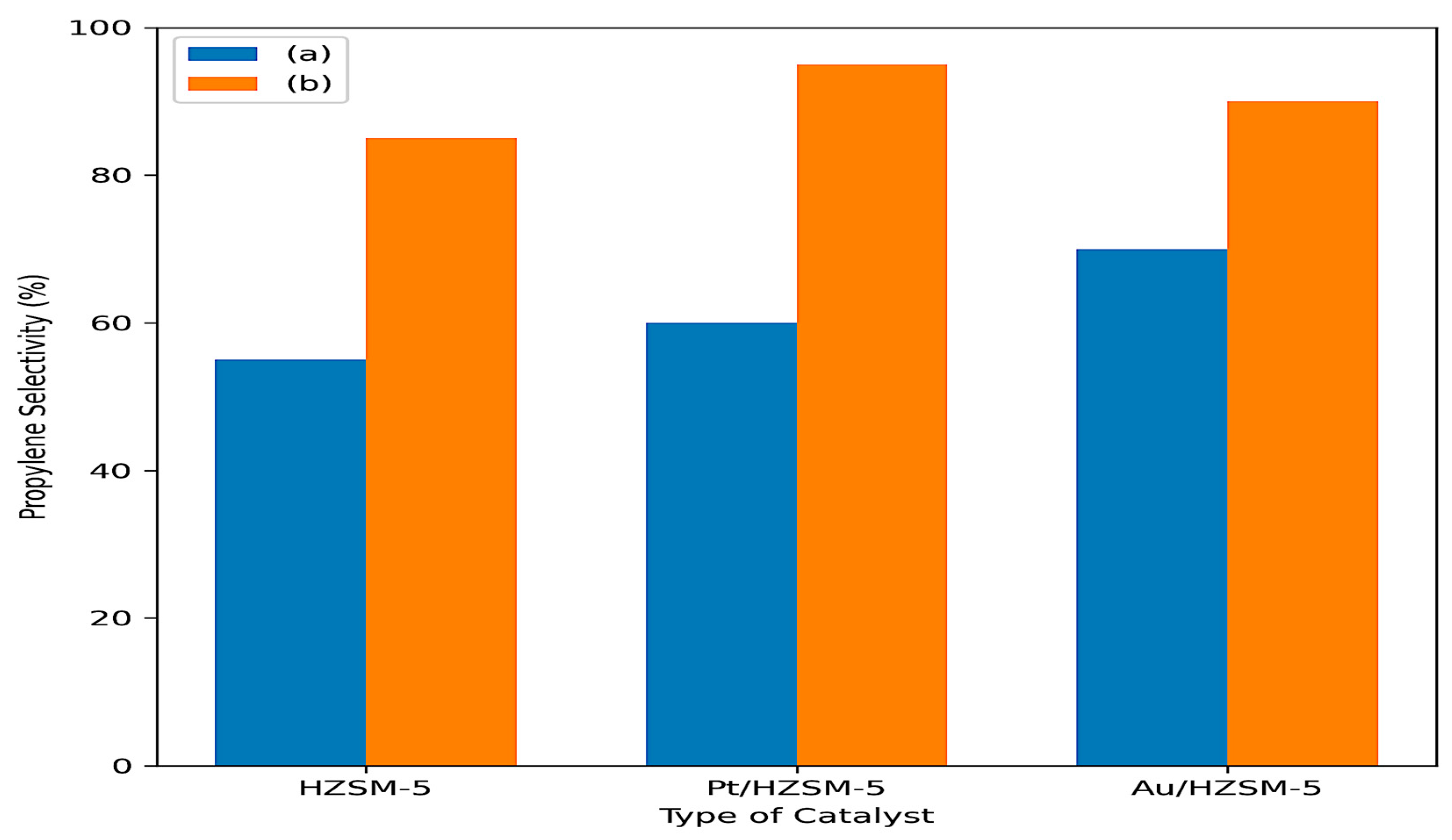
Iso-propanol (IPA) showed catalytic decomposition (dehydration and dehydrogenation) over HZSM-5 after a 4 wt.% Pt or 4 wt.% Au loading. The main by-products of the conversion of 2-propanol for all catalysts were propylene, acetone, and a negligible quantity of di-isopropyl ether (DIPE). Figure 5 illustrates the total isopropanol conversion as a function of reaction temperature, demonstrating that higher reaction temperatures result in increased conversion. At a lower temperature (110 °C), Table 3 shows that the Au/HZSM-5 sample exhibits the highest propene selectivity (82.5%), compared to Pt/HZSM-5 (65%) and the parent HZSM-5 (58%). At 175 °C, both Au/HZSM-5 and Pt/HZSM-5 exhibit identical propene selectivity (98%), which is significantly higher than that of the parent HZSM-5 zeolite (89%).
Conversely, HZSM-5 requires somewhat higher temperatures (200 °C) in order to achieve a comparable conversion to the other catalysts (Figure 6). In the Pt/HZSM-5 catalyst, the stronger band at 1547 cm−1 reflects a higher population of strong Brønsted acid sites, which can favor secondary reactions such as oligomerization and coke formation, leading to reduced propene selectivity (Table 3). By contrast, Au/HZSM-5 exhibits a predominance of medium-strength Brønsted acid sites with better accessibility within a well-connected pore network, which promotes selective isopropanol dehydration to propene while suppressing side reactions. Accordingly, propene selectivity is governed primarily by the strength and effectiveness of Brønsted acid sites rather than by their absolute concentration measured by pyridine adsorption. This interpretation is consistent with the pyridine-FTIR results (Figure 3) and aligns with previous studies reporting a direct relationship between propene selectivity and the density of medium-strength acid sites in ZSM-5 catalysts [48].
Table 3 shows which products the examined catalysts were selective for: propylene (Sp), acetone (Sa), and oligomerization products (So) at different reaction temperatures (100–275 °C). This table illustrates how each catalyst under investigation behaved as a dehydration catalyst to produce propylene. At lower temperatures, Au/HZSM-5 shows higher selectivity for propene production compared to Pt/HZSM-5, indicating that an increase in Brønsted acid sites and active sites promotes the dehydration of isopropanol to propylene. A maximum value of 98% occurred when the reaction temperature was increased to 175 °C, exhibiting an increase in selectivity towards propene over Au/HZSM-5. The selectivity for propylene over Au/HZSM-5 increased significantly, which can be attributed to water elimination at elevated temperatures (up to 175 °C), freeing active Lewis acid sites on the surface. Above this temperature, surface oligomerization products formed on the acid sites tend to favor the production of alkanes with varying chain lengths rather than propylene. Olefin oligomerization on Au/HZSM-5 might speed up unfavorable side reactions, like coke production and cracking, which will dramatically decrease its lifetime. Following each reaction, Au/HZSM-5 turns black, which gives support to the claim that coke formation is expected.
At 100 °C, the acetone selectivity of HZSM-5 (45%) decreased to 44.8% with Pt/HZSM-5 and further to 31% with Au/HZSM-5. This reduction suggests that raising the reaction temperature and incorporating noble metals lowers the selective formation of acetone, likely due to the extensive dispersion of Au and Pt nanoparticles on Lewis acid sites, which limits 2-propanol conversion to acetone.

2.5.2. Activation Energy

The catalytic conversion of isopropyl alcohol to propene over pure and Pt- or Au-modified HZSM-5 systems was investigated to determine the apparent activation energy (ΔE). This has provided insight into potential modifications to the catalyzed reaction’s mechanism. The Arrhenius equation may be directly applied to determine the ΔE by utilizing the reaction rate constant (k), which was determined using the variously treated materials at varied reaction temperatures ranging from 100 to 140 °C. Table 4 lists the values of ΔE and ln A (frequency factor) for each catalyst. When changing from pure HZSM-5 to Pt/HZSM-5, the activation energy for the dehydration of 2-propanol is reduced by 14%. These results are consistent with the observed enhancement in catalytic reactivity. The substantial decrease in activation energy for isopropanol dehydration to propene is attributed to modifications in the nature of the active sites induced by noble metal incorporation. The higher propylene formation achieved over Au/HZSM-5 compared with Pt/HZSM-5 is associated with the effective preservation and utilization of medium-strength acid sites, with catalytic performance following the order Au/HZSM-5 > Pt/HZSM-5 > HZSM-5. This trend indicates that the introduction of Au or Pt nanoparticles alters the acid site environment and/or generates new active centers, thereby facilitating the dehydration pathway and reducing the corresponding activation energy.

2.6. Reaction Mechanism

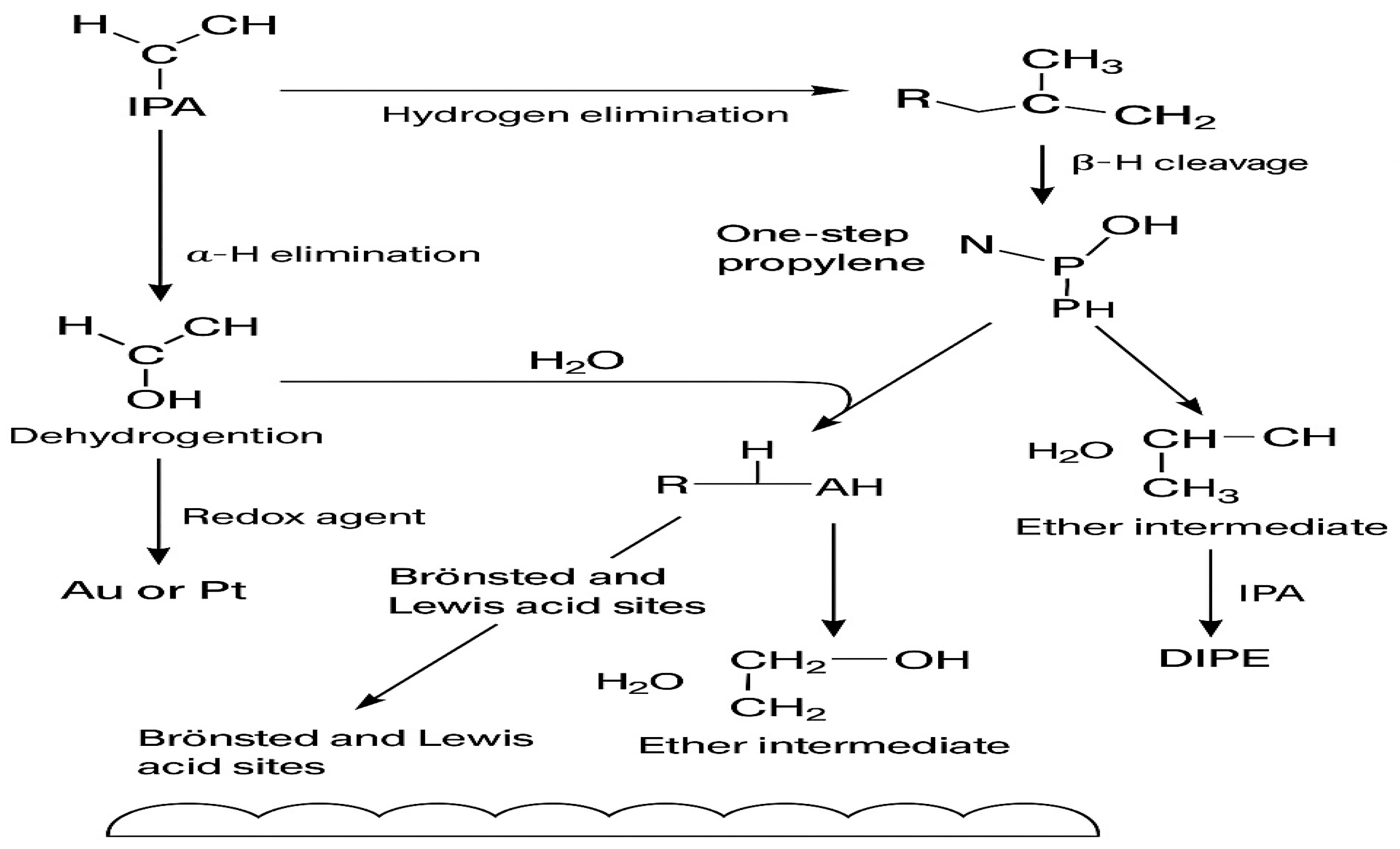
The redox and acidic properties of the catalysts influence the decomposition pathways of isopropanol on HZSM-5, which proceed via both dehydration and dehydrogenation routes. Scheme 2 illustrates how these pathways are affected by modification with Au or Pt. Propylene is produced by dehydrating IPA using the following methods: (i) on Brønsted acid sites for hydrogen elimination (carbanion creation): an intermediate known as isopropyl carbanion is produced after β-hydrogen elimination occurs first, and then the C-OH bond is cleaved to yield propylene [49,50,51]. (ii) The one-step process for propylene formation involves the simultaneous cleavage of the C–OH and β-H bonds in the IPA molecule, facilitated by both Lewis and Brønsted acid sites, leading to coordinated water elimination [49,50,51].
Acetone, a byproduct of IPA dehydrogenation, is produced by the following: (i) isopropoxide species produced over Brønsted acid references following α-hydrogen abstraction, producing a carbanion intermediate that ultimately forms acetone [51,52]. (ii) The Mars–van Krevelen method can also be used to produce acetone using metallic catalysts for dehydrogenation with redox sites, especially if an environment that oxidizes occurs [52,53].
The following methods allow IPA to dehydrate into diisopropylether (DIPE) compounds by intermolecular dehydration: (i) Through the SN1 process, a hydroxyl group of one IPA molecule is replaced by an isopropoxide carbanion (nucleophile) produced by β-hydrogen abstraction within the Brønsted acid sites, leading to DIPE [54,55,56]. (ii) Through a partial hydroxyl group binding process, the Lewis acid sites can typically aid in the replacement of the hydroxyl group. It is an SN2 mechanism if the previous process showed nucleophilic attack and hydroxyl group removal take place together to produce an ether. Therefore, the formation of DIPE typically involves both the Brønsted and Lewis acid sites in the catalysts. Another possibility is that, at greater conversion rates, IPA and propylene undergo etherification to produce DIPE [57]. The color change in the solid catalysts from gray to black after the catalytic study supports the possibility of coke formation. It is evident that the pore structure, rather than acidity, primarily governs isomerization selectivity. According to these studies, the catalysts’ pore structure or geometry plays an essential role in the isomer formation process.

2.7. Estimation of the Reaction Rate Constants and Turnover Frequencies (TOFs)

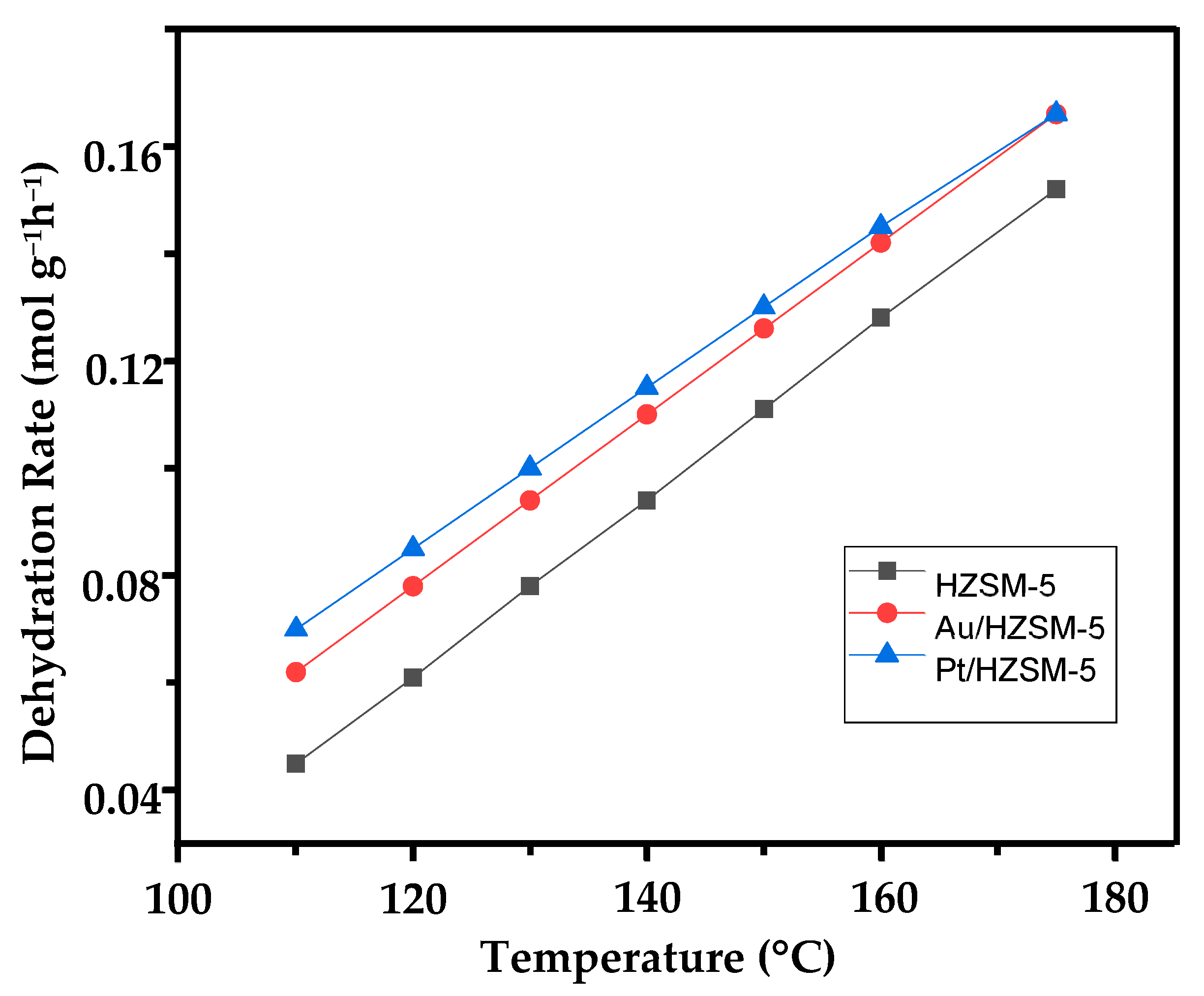
The catalytic transformation of isopropanol over HZSM-5-based materials is primarily controlled by surface acidity, which governs the competition between dehydration, dehydrogenation, and secondary condensation reactions. In line with the mechanistic pathways proposed in Scheme 3, propene formation represents the dominant reaction route and reflects the activity of Brønsted acidic centers within the zeolite framework [58]. The kinetic parameters associated with these surface reactions are summarized in Table 4, while their temperature dependence is illustrated in Figure 7. For the purpose of kinetic evaluation, all reactions were treated as irreversible and described using a pseudo-first-order approximation, which is suitable for alcohol conversion under excess carrier gas and near steady-state operation. Apparent rate constants corresponding to the individual reaction channels were extracted from product selectivity data by assuming that these pathways proceed independently on distinct types of active sites [58]. Turnover frequencies were calculated only for the dehydration route, as this pathway is directly linked to the concentration of Brønsted acid sites determined by Py-FTIR, whereas dehydrogenation and oligomerization are associated with metal centers and strongly acidic site ensembles, respectively [40,59].
The temperature dependence of the dehydration rate constants follows Arrhenius-type behavior, confirming that the observed activity trends are governed by intrinsic kinetics rather than transport limitations [56]. Although Pt/HZSM-5 exhibits a higher density of Brønsted acid sites compared to Au/HZSM-5, it displays a lower turnover frequency for propene formation, indicating that the effectiveness of individual acid sites plays a more critical role than their total abundance [60]. This observation suggests that strong metal–acid interactions or excessive acidity may alter the surface environment in a manner that reduces the efficiency of dehydration-active sites and promotes competing pathways. Such behavior is consistent with the mechanistic understanding that secondary reactions, including oligomerization, become more favorable when acid strength or site density exceeds the optimum required for selective dehydration [61].

2.8. Computational Study

2.8.1. Energetical Studies

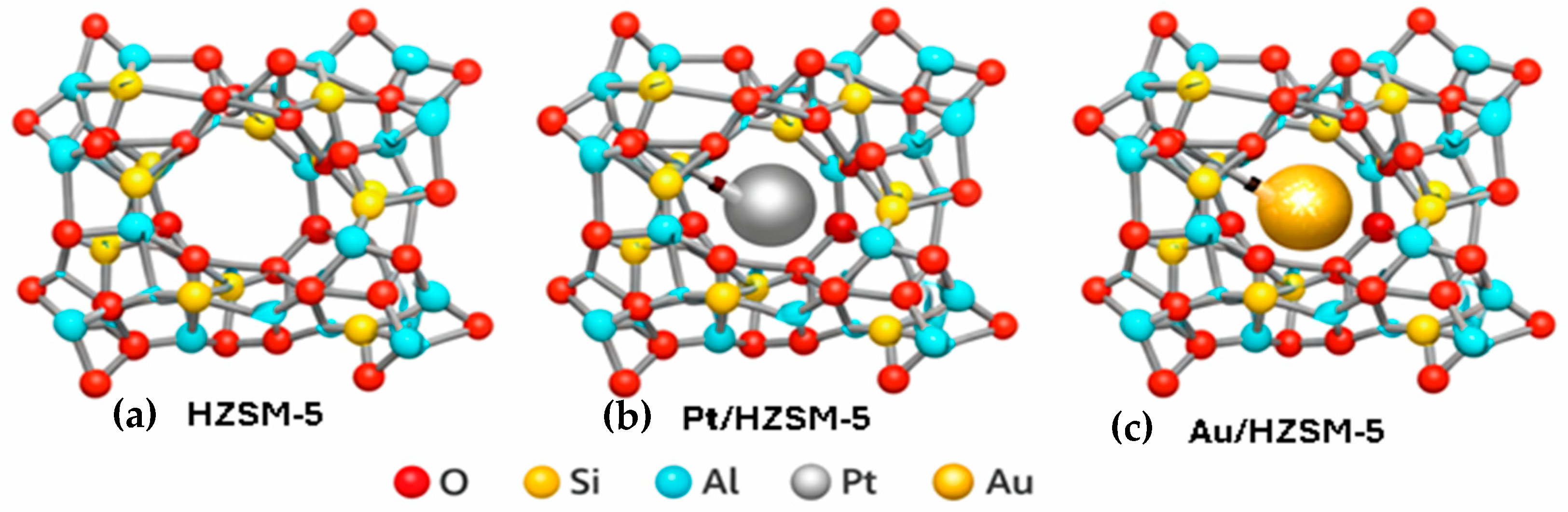
Density Functional Theory (DFT) calculations [62] were performed to evaluate the energetic stability and preferred geometries of HZSM-5, Pt/HZSM-5, and Au/HZSM-5 cluster models. Geometry optimizations were carried out using the Spartan package (Spartan’18, Wavefunction Inc., Irvine, CA, USA) with the B3LYP functional (https://www.wavefun.com, accessed on 15 January 2026). As shown in Figure 8, semi-planar configurations aligned along the straight channels are energetically preferred over angular arrangements for all models, due to reduced steric constraints and improved electrostatic compatibility with the channel walls. The calculated total and electronic energies indicate that metal incorporation enhances framework stability. Both Au/HZSM-5 and Pt/HZSM-5 exhibit lower total energies (−38.63 and −40.46 kcal·mol−1) and electronic energies (−118.39 and −119.38 kcal·mol−1) compared with the parent HZSM-5 model. These values reflect greater structural stabilization of the optimized systems, rather than reaction exothermicity. Among the modified structures, Pt/HZSM-5 is the most stable, consistent with stronger metal–framework interactions relative to Au/HZSM-5.

2.8.2. Template Interactions

Interaction energy components, including binding, electrostatic, nonbonding, van der Waals, torsional, and repulsive terms, were evaluated using DFT at the B3LYP/6-311G* level (Table 5). The presence of Pt or Au significantly lowers the overall interaction energies relative to pristine HZSM-5, indicating stronger and more favorable interactions between the metal species and the zeolite framework. Stabilization is dominated by electrostatic interactions between partially positive framework species and electronegative oxygen atoms. The Pt-modified framework exhibits the most favorable electrostatic interaction energy (Eele = −418.974 kcal·mol−1), followed by Au/HZSM-5 (−326.846 kcal·mol−1), both of which are significantly more stabilized than the parent HZSM-5 framework (−222.946 kcal·mol−1). This enhanced electrostatic stabilization is attributed to charge redistribution arising from the lower electronegativity of Pt and Au relative to the framework silicon, which strengthens cation–anion interactions within the zeolite channels.
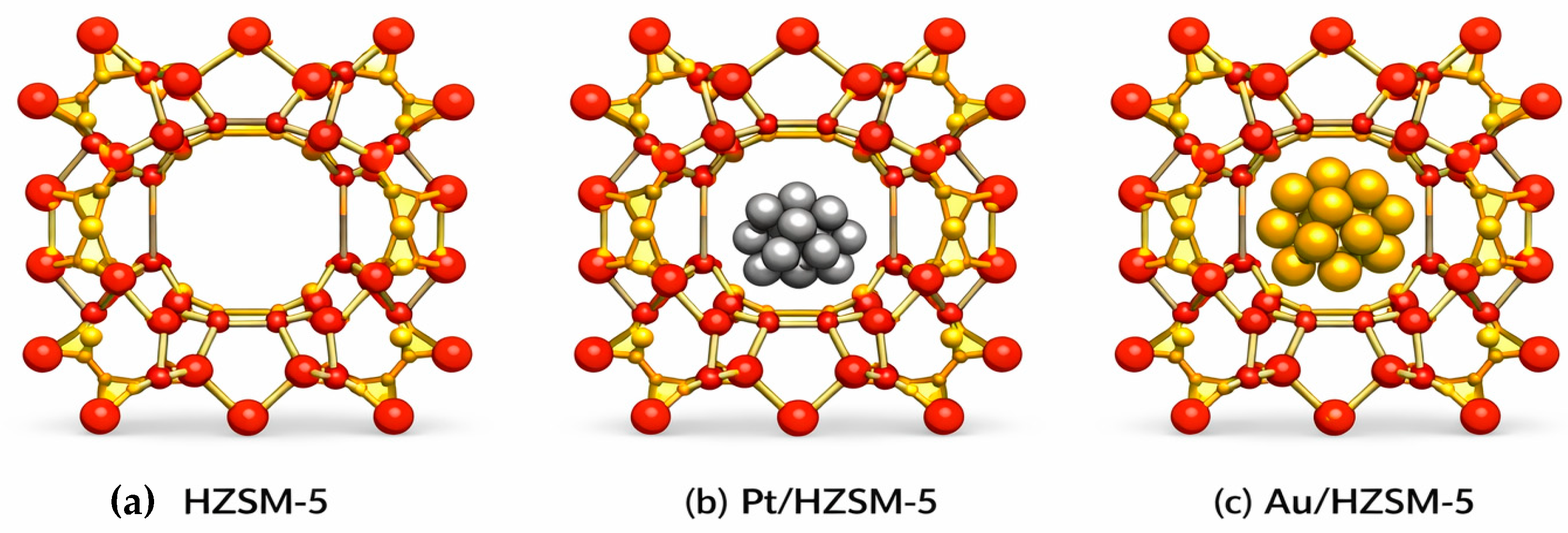
Analysis of the channel geometry indicates that straight channels exhibit shorter and more favorable cation–anion distances than angular channels, resulting in stronger attractive interactions (Figure 8). Among the investigated systems, Pt/HZSM-5 shows the shortest effective channel length, suggesting enhanced ionic packing and stronger confinement within the channel voids (Figure 9). This behavior is further supported by specific anion–cation interaction analysis. In pristine HZSM-5, the optimal OH···Si+ distance is approximately 4.3 Å, corresponding to an electrostatic interaction energy of −222.94 kcal·mol−1. Upon metal incorporation, these distances decrease to 3.6 Å for OH···Pt+ and 3.2 Å for OH···Au+, reflecting stronger electrostatic attraction and partial coordination to the metal centers. This contraction is accompanied by increased stabilization, with the electrostatic interaction energy reaching −418.974 kcal·mol−1 for Pt species located within the zeolite channel voids. Repulsive energy analysis shows that the lowest repulsion energy (3.484 kcal·mol−1) is obtained for the Pt-modified system, indicating the most stabilized configuration. The stabilization trend inferred from repulsion energies follows MFI > Au–MFI > Pt–MFI (Table 5).
Finally, Brønsted acidity was evaluated using proton affinity (PA) calculations. The PA value decreases from 545.36 kcal·mol−1 for the unmodified HZSM-5 framework to 460.123 kcal·mol−1 for the Pt-modified system, indicating a pronounced enhancement in Brønsted acid strength. An intermediate PA value is observed for Au/HZSM-5 (498.430 kcal·mol−1), demonstrating that both the nature of the incorporated metal and its spatial arrangement within the zeolite framework strongly influence acidity. The higher acidity of Pt/HZSM-5 favors secondary cracking reactions, leading to over-cracking into light hydrocarbons and promoting acetone formation via dehydrogenation and oligomerization pathways. In contrast, Au/HZSM-5 exhibits higher propylene selectivity, which can be attributed to the preservation of medium-strength Brønsted acid sites combined with a well-interconnected pore network and a balanced total acidity.

3. Experimental Section

3.1. Materials

The materials utilized in this work included rice straw collected from (Sharqia City, Egypt), pretreated with 3% HCl (RS). NaOH pellets (AR grade, 98%) were purchased from Sigma-Aldrich, St. Louis, MO, USA. n-Propylamine (n-PA) was obtained from Merck, Darmstadt, Germany. AuCl3 was supplied by Aldrich, St. Louis, MO, USA, while dichlorotetraammine platinum(II) (NH3)4PtCl2 was purchased from Sigma, St. Louis, MO, USA. Tetrapropylammonium bromide (TPABr) was obtained from Fluka, Buchs, Switzerland. H2SO4 was purchased from a commercial chemical supplier, Cairo, Egypt.

3.1.1. Silica Extraction from Rice Straw

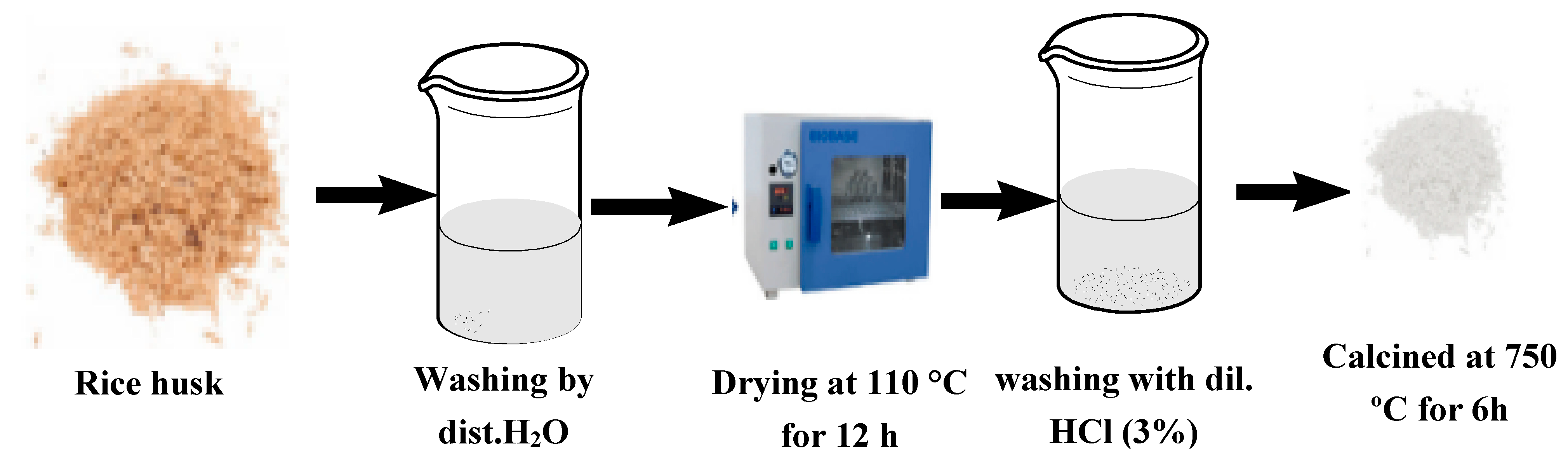
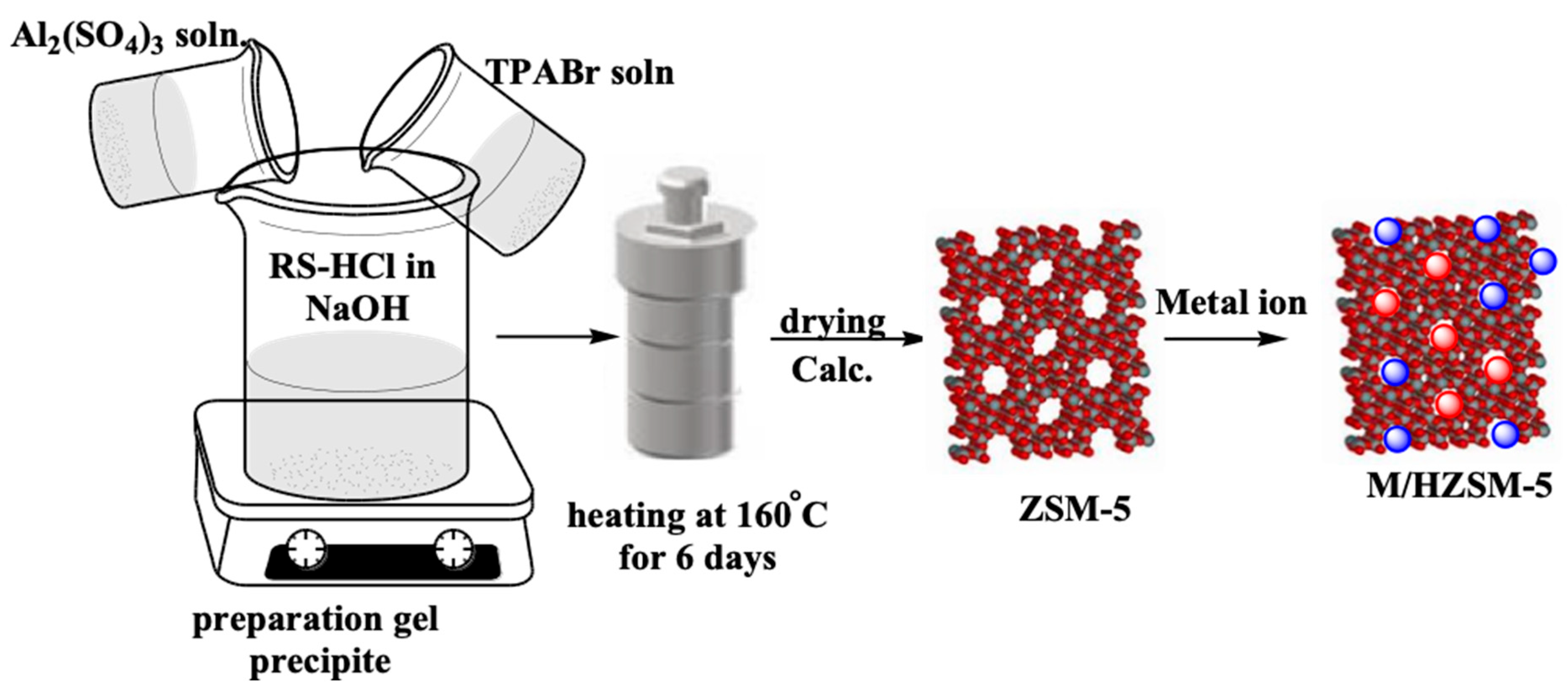
According to [63], dry rice straw collected from a rice field was first sieved to remove contaminants, including leftover rice grains and clay. The cleaning procedure consisted of multiple washings with distilled H2O, filtration, and subsequent air drying at ambient temperature. After the rice straw was pulverized and put through a 5 mm mesh filter, it was heated for one hour under reflux in 3% HCl. The slurry was filtered and washed repeatedly with distilled water until chloride ions were eliminated, as confirmed by the absence of AgCl precipitation upon AgNO3 testing. The resulting material was then dried at 110 °C in air and calcined for 6 h at 750 °C to obtain white ash, providing the raw material for RS-HCl. The synthesis process of silica from dry raw rice straw is illustrated schematically in Scheme 3. XRF analysis showed that the sample ash’s silica production was 42%.

3.1.2. Hydrothermal Preparation of ZSM-5

The ZSM-5 zeolite was synthesized via a hydrothermal method using silica extracted from rice straw treated with HCl (RS-HCl) as the silica source, following the procedure reported in our previous studies [14,63], as illustrated in Scheme 4.
A calculated amount of NaOH (1.1 g) was dissolved in 10 mL of distilled H2O and added to 4.02 g of silica (RS-HCl) dispersed in 100 mL of distilled H2O under stirring. The mixture was initially stirred at room temperature (RT), with stirring maintained as the temperature was gradually increased to 80 °C, yielding a transparent sodium silicate solution (solution A). In parallel, solution B was produced by dissolving 2.2 g of TPABr (as template) in 10 mL of distilled water while stirring for 20 min. Thereon, both solutions (adding B to A) were mixed for 15 min before 2.0 mL of n-propyl amine was added as a mobilizing agent. Separately, 0.5 g of Al2(SO4)3.16H2O was dissolved in 10 mL of distilled H2O along with 0.05 mL of concentrated H2SO4 to adjust the pH. The mixture was stirred continuously until a transparent solution was formed.
Solution B was combined with Solution A and stirred for 30 min before being added to the previously prepared mixture. The resulting mixture was hydrothermally treated at 160 °C for 6 days in an oil bath utilizing stainless steel autoclaves. Upon removal from the oil bath, the autoclaves were rapidly quenched with cold water. The solid product was separated by filtration and washed with distilled water until the filtrate exhibited a pH of 8. The obtained sample was labeled as ZSM-5. All samples were dried at 110 °C for 3 h and calcined at 550 °C for 6 h in an oven.

3.1.3. The HZSM-5 Preparation

One gram of NaZSM-5, which was synthesized in this study, was treated three times with NH4NO3 solution(Cairo, Egypt) (0.1M in 100 mL) for 1 h at RT to gain HZSM-5. The material was filtered and dried at 120 °C for 4 h after each stage. After calcining the NH4-ZSM-5 powder for 3 h at 550 °C, the final product, H-ZSM-5, was produced.

3.1.4. The Au/HZSM-5 and Pt/HZSM-5 Preparation Method

HZSM-5 samples were impregnated with an aqueous solution of AuCl3 (Aldrich, St. Louis, MO, USA) or (NH3)4PtCl2 (Sigma, St. Louis, MO, USA) to obtain solids containing 4 wt.% of Au or Pt, respectively. The solution volume was adjusted to ensure uniform impregnation of the zeolite samples. A REX-P 90 temperature controller (REX-C Instrument Co., Ltd., Shanghai, China) was employed to maintain the reaction temperature at 60 °C for 4 h. Following impregnation, water was slowly evaporated at 110 °C until dryness, followed by further drying for 6 h at the same temperature, and then calcined in air at 300 °C for 6 h; as illustrated in Scheme 4. The synthesized samples, designated as Au/HZSM-5 and Pt/HZSM-5, exhibited black and white colors, respectively.

3.2. Characterization Techniques

The phases, relative crystallinity, and crystal size of the synthesized samples were evaluated by X-ray diffraction (XRD, Bruker axs D8, Karlsruhe, Germany) using Cu-Kα radiation (λ = 1.5406 Å) with a secondary monochromator over the 2θ range of 4° to 60°. The crystallite size was automatically determined from the XRD data using the Scherrer equation.
Nitrogen adsorption isotherms measurements were carried out at −196 °C. Prior to analysis, calcined samples (100 mg) were evacuated at 200 °C under a pressure of 10−5 Torr for 3 h to eliminate moisture and any adsorbed species. The BET method was employed to determine the specific surface area, while the t-method was applied to evaluate the external surface area and micropore volume. Additionally, an estimate of the micropore volume was obtained using the method proposed by de Boer et al. [64].
The acidity characteristics of the prepared solid samples were evaluated by in situ FT-IR spectroscopy following pyridine adsorption. Spectra were obtained using a Bruker Vector 22 spectrometer (Bruker Optics GmbH, Ettlingen, Germany) with a resolution of 2 cm−1. Each sample was compressed into a self-supporting wafer (~30 mg/cm2) and then placed inside a quartz infrared cell with CaF2 windows, positioned in an electric furnace. Prior to measurement, samples were heated for 2 h at 200 °C under 10−5 Torr using a closed Pyrex vacuum system (300 cm3 dead volume). Temperature control was achieved with a Ni–Cr thermocouple connected to a regulator. Pyridine (5 Torr) was introduced into the cell and allowed to equilibrate for 30 min; excess pyridine was then removed at 100 °C. Spectra were recorded at RT in the 1700–1400 cm−1 range, and background subtraction was applied.
SEM analysis was performed using a JEOL JSM-T 330A microscope (Tokyo, Japan) operated at an accelerating voltage of 30 kV. These micrographs were used to evaluate the particle size and morphology of the 4.0 wt.% M/HZSM-5 (M = Au or Pt) crystals.
Catalytic testing for isopropyl alcohol conversion was conducted in a fixed-bed Pyrex reactor (Cairo, Egypt) (20 cm length, 1 cm i.d.) packed with quartz particles (2–3 mm) supporting 50 mg of catalyst. The reactor was operated under atmospheric pressure, with the catalyst bed temperature controlled within ±1 °C and varied between 150 and 275 °C. Isopropyl alcohol vapor was introduced via an evaporator/saturator maintained at 35 °C, with nitrogen as the diluent. Prior to each run, the catalyst was pretreated at 350 °C in a nitrogen flow for 1 h, followed by cooling to the reaction temperature. The gaseous reaction products were analyzed utilizing a Perkin-Elmer Auto System XL gas chromatograph (PerkinElmer Inc., Waltham, MA, USA) equipped with a flame ionization detector (FID). Nitrogen carrier gas flow was fixed at 40 mL/min, and separations were carried out on a fused silica capillary column (PE-CW type, 15 m × 1.0 μm; Perkin-Elmer).

3.3. Models and Computational Methods

The study of MFI silicates, derived from the IZA structure databases [65], is a significant stride in the field of material science. The use of a Si36O46-H52 cluster model is a sophisticated approach to simulate the zeolite framework, providing a deeper understanding of the structural attributes of these materials. The application of Density Functional Theory (DFT) for geometry optimization, complemented by the addition of hydrogen atoms to complete silicon coordination, is a meticulous process that ensures the integrity of the zeolite cluster model. The employment of the 6-311G* basis set along with the Becke3LYP method reflects a commitment to precision in computational chemistry [66,67,68,69]. These calculations, as facilitated by the Spartan software package [70], are crucial for understanding the interaction energies within the zeolite–SDA crystal system, which include total energy, electronic energy, stabilization energy, binding energy, and various interaction energies. Such detailed computational analysis is indispensable for predicting the behavior of these materials under different conditions and can lead to breakthroughs in the design of new catalysts and adsorbents.
The interactions between the zeolite and template were calculated as the energy difference between the isolated and interacting (Z....T) systems in the following method:
ΔE(Z/T) = E(Z/T) − E(Z°) − E(T°)
where E(Z/T): the total energy for the zeolite–template system,
E(Z°): total energies for the isolated zeolite,
E(T°): total energies for template systems.
The energy of the reaction was determined to be the proton affinity (PA) of a zeolite HZSM-5:
HZSM-5 → ZSM-5 + H+
Using DFT calculations, the proton affinity (PA) was determined by the difference between the acid’s total energy (EHZ) and that of its conjugate base (EZ−).
PA = (EZ−) − (EHZ)

4. Conclusions

The catalytic conversion of isopropyl alcohol proved to be an effective probe reaction for evaluating both the strength and nature of active sites in HZSM-5-based catalysts. ZSM-5 zeolite was successfully synthesized from rice husk ash and subsequently modified with noble metals (4 wt.% Au or 4 wt.% Pt) via a simple and controllable wet impregnation method. Characterization results demonstrated that metal incorporation induces significant modifications in the surface properties of HZSM-5, particularly in terms of acidity and redox behavior. While the parent HZSM-5 catalyst primarily exhibits acidic functionality, the introduction of Au or Pt generates bifunctional catalysts with combined acidic and redox active sites, without compromising the structural integrity of the zeolite framework. Catalytic evaluation revealed that Au/HZSM-5 exhibits higher propylene selectivity, which is attributed to the preservation of medium-strength Brønsted acid sites, a balanced total acidity, and a well-interconnected pore network. In contrast, Pt/HZSM-5 favors secondary cracking reactions due to its stronger Brønsted acidity, leading to increased formation of light hydrocarbons and by-products.
Computational studies further supported the experimental findings, showing that the incorporation of Au and Pt enhances the thermodynamic stability of the zeolite framework, as evidenced by lower calculated total and electronic energies. Geometrical optimization revealed that semi-planar configurations within straight channels are more stable than angular configurations, owing to shorter and more favorable cation–anion distances. Analysis of electrostatic, van der Waals, and repulsive interactions confirmed that Pt-MFI exhibits the highest overall stability, followed by Au-MFI and then the parent MFI structure. These insights provide a molecular-level understanding of how metal incorporation influences acidity, stability, and catalytic behavior, offering valuable guidance for the rational design of highly active and selective zeolite-based catalysts for future applications.

Author Contributions

All authors have made significant and collaborative contributions to the conception, execution, and development of this research. E.K.A. contributed to conceptualization, methodology, data curation, and writing—original draft preparation. S.A.E.-M. contributed to the experimental work, synthesis, and characterization. K.S.E.-N. performed the DFT analysis and formal analysis. Y.S. contributed to writing—review and editing. I.O.A. contributed to supervision, validation, and critical revision of the manuscript. All authors have read and agreed to the published version of the manuscript.

Funding

This work was funded by the Deanship of Graduate Studies and Scientific Research at Jouf University under grant No. (DGSSR-2025-02-01393).

Data Availability Statement

The original contributions presented in this study are included in the article. Further inquiries can be directed to the corresponding authors.

Acknowledgments

The authors extend their appreciation to the Deanship of Graduate Studies and Scientific Research at Jouf University for funding this work through research grant No. (DGSSR-2025-02-01393).

Conflicts of Interest

The authors declare no conflicts of interest.

References

  1. Phung, T.K.; Pham, T.L.M.; Vu, K.B.; Busca, G. (Bio)Propylene production processes: A critical review. J. Environ. Chem. Eng. 2021, 9, 105673. [Google Scholar] [CrossRef]
  2. Murat, M.; Tišler, Z.; Šimek, J.; Hidalgo-Herrador, J.M. Highly active catalysts for the dehydration of isopropanol. Catalysts 2020, 10, 719. [Google Scholar] [CrossRef]
  3. Rode, L.; Bosman, C.E.; Louw, J.; Petersen, A.; Ghods, N.N.; Görgens, J.F. Biobased propylene and acrylonitrile production in a sugarcane biorefinery: Identification of preferred production routes via techno-economic and environmental assessments. Biomass Bioenergy 2024, 190, 107399. [Google Scholar] [CrossRef]
  4. Dubois, J.-L.; Postole, G.; Silvester, L.; Auroux, A. Catalytic Dehydration of Isopropanol to Propylene. Catalysts 2022, 12, 1097. [Google Scholar] [CrossRef]
  5. Wang, W.; Li, M.; Zhang, Y.; Qin, K.; Zhuang, L.; Yang, P.; Nie, H. Structure-performance relationship between zeolites properties and hydrocracking performance of tetralin over NiMo/Al2O3-Y catalysts: A machine-learning-assisted study. Fuel 2025, 390, 134652. [Google Scholar] [CrossRef]
  6. Mallette, A.J.; Seo, S.; Rimer, J.D. Synthesis strategies and design principles for nanosized and hierarchical zeolites. Nat. Synth. 2022, 1, 521–534. [Google Scholar] [CrossRef]
  7. Chen, L.-H.; Sun, M.-H.; Wang, Z.; Yang, W.; Xie, Z.; Su, B.-L. Hierarchically structured zeolites: From design to application. Chem. Rev. 2020, 120, 11194–11294. [Google Scholar] [CrossRef]
  8. Zheng, Y.; Ning, W.; Wang, Q.; Wei, X.; Li, X.; Pan, M. Hierarchical ZSM-5 zeolite using amino acid as template: Avoiding phase separation and fabricating an ultra-small mesoporous structure. Microporous Mesoporous Mater. 2023, 355, 112578. [Google Scholar] [CrossRef]
  9. Deng, H.; Pan, T.; Zhang, Y.; Wang, L.; Wu, Q.; Ma, J.; Shan, W.; He, H. Adsorptive removal of toluene and dichloromethane from humid exhaust on MFI, BEA and FAU zeolites: An experimental and theoretical study. Chem. Eng. J. 2020, 394, 124986–124996. [Google Scholar] [CrossRef]
  10. Ghaderi, Z.; Peyrovi, M.H.; Parsafard, N. n-Heptane isomerization activities of Pt catalyst supported on micro/mesoporous composites. BMC Chem. 2021, 15, 3083. [Google Scholar] [CrossRef]
  11. Liu, J.; Zhang, H.; Lu, N.; Yan, X.; Fan, B.; Li, R. Influence of Acidity of Mesoporous ZSM-5-Supported Pt on Naphthalene Hydrogenation. Ind. Eng. Chem. Res. 2020, 59, 1056–1064. [Google Scholar] [CrossRef]
  12. Niu, X.; Zhao, R.; Han, Y.; Zhang, X.; Wang, Q. Highly dispersed platinum clusters anchored on hollow ZSM-5 zeolite for deep hydrogenation of polycyclic aromatic hydrocarbons. Fuel 2022, 326, 125021. [Google Scholar] [CrossRef]
  13. Batalha, N.; Comparot, J.-D.; Le Valant, A.; Pinard, L. In situ FTIR spectroscopy to unravel the bifunctional nature of aromatics hydrogenation synergy on zeolite/metal catalysts. Catal. Sci. Technol. 2022, 12, 1117–1129. [Google Scholar] [CrossRef]
  14. El-Bahy, Z.M.; Mohamed, M.M.; Zidan, F.I.; Thabet, M.S. Photo-degradation of acid green dye over Co–ZSM-5 catalysts prepared by incipient wetness impregnation technique. J. Hazard. Mater. 2008, 153, 364–371. [Google Scholar] [CrossRef]
  15. Pereira, C.; Kokotailo, G.T.; Gorte, R.J.; Farneth, W.E. Adsorption and reaction of 2-propen-1-ol in H-ZSM-5. J. Phys. Chem. 1990, 94, 2063–2067. [Google Scholar] [CrossRef]
  16. Grady, M.C.; Gorte, R.J. Adsorption of 2-propanol and propene on H-ZSM-5: Evidence for stable carbenium ion formation. J. Phys. Chem. 1985, 89, 1305–1308. [Google Scholar] [CrossRef]
  17. Molina, C.; Abdrassilova, A.; Ávila, M.; Alonso-Doncel, M.; Cueto, J.; Gómez-Pozuelo, G.; Briones, L.; Botas, J.; Serrano, D.; Peral, A.; et al. Tailoring the preparation of USY zeolite with uniform mesoporosity for improved catalytic activity in phenol/isopropanol alkylation. Microporous Mesoporous Mater. 2025, 392, 113629. [Google Scholar] [CrossRef]
  18. Teng, H.; Zhu, M.; Shao, Y.; Shao, S.; Wu, Q.; Li, Z.; Chen, X.; Kita, H. Preparation and catalytic performance of the supported TS-1 zeolites for IPA oxidation. J. Solid State Chem. 2025, 349, 125449. [Google Scholar] [CrossRef]
  19. Airi, A.; Signorile, M.; Bonino, F.; Quagliotto, P.; Bordiga, S.; Martens, J.A.; Crocellà, V. Insights on a Hierarchical MFI Zeolite: A Combined Spectroscopic and Catalytic Approach for Exploring the Multilevel Porous System Down to the Active Sites. ACS Appl. Mater. Interfaces 2021, 13, 49114–49127. [Google Scholar] [CrossRef]
  20. Zhou, X.; Ma, M.; Zhang, R.; Song, X.; Li, W.; Jiang, J.; Xie, J.; Li, X.; Cai, L.; Sun, X.; et al. Spatial isolation effect improves the acidity and redox capacity of ZSM-5 encapsulating Pt catalyst to achieve efficient toluene oxidation. Colloids Surf. A Physicochem. Eng. Asp. 2024, 694, 134173. [Google Scholar] [CrossRef]
  21. Wang, J.; Hou, C.; Wang, X.; Xing, Y.; Xie, Y.; Wang, L.; Zhang, M. Low-content Pt loading on a post-treatment-free zeolite for efficient catalytic combustion of toluene. Microporous Mesoporous Mater. 2024, 363, 112832. [Google Scholar] [CrossRef]
  22. Gao, J.; Lin, Q.; Yang, T.; Bao, Y.C.; Liu, J. Preparation and characterization of ZSM-5 molecular sieve using coal gangue as a raw material via solvent-free method: Adsorption performance tests for heavy metal ions and methylene blue. Chemosphere 2023, 341, 139741. [Google Scholar] [CrossRef]
  23. Alshoaibi, A.; Islam, S. Heating influence on atomic site structural changes of Mesoporous Au supported Anatase nanocomposite for photocatalytic progression. J. Sol-Gel Sci. Technol. 2022, 104, 225–238. [Google Scholar] [CrossRef]
  24. Mohammadnejad, S.; Provis, J.L.; van Deventer, J.S. Reduction of gold(III) chloride to gold(0) on silicate surfaces. J. Colloid Interface Sci. 2013, 389, 252–259. [Google Scholar] [CrossRef] [PubMed]
  25. Dinga, J.; Chena, J.; Ruic, Z.; Liua, Y.; Lva, P.; Liua, X.; Lib, H.; Ji, H. Synchronous pore structure and surface hydroxyl groups amelioration as an efficient route for promoting HCHO oxidation over Pt/ZSM-5. Catal. Today 2018, 316, 107–113. [Google Scholar] [CrossRef]
  26. Groen, J.C.; Peffer, L.A.A.; Pérez-Ramírez, J. Pore size determination in modified micro- and mesoporous materials. Microporous Mesoporous Mater. 2003, 60, 1–17. [Google Scholar] [CrossRef]
  27. Thommes, M.; Kaneko, K.; Neimark, A.V.; Olivier, J.P.; Rodriguez-Reinoso, F.; Rouquerol, J.; Sing, K.S.W. Physisorption of gases, with special reference to the evaluation of surface area and pore size dis-tribution (IUPAC Technical Report). Pure Appl. Chem. 2015, 87, 1051–1069. [Google Scholar] [CrossRef]
  28. Duan, H.; Tian, Y.; Gong, S.; Zhang, B.; Lu, Z.; Xia, Y.; Shi, Y.; Qiao, C. Effects of Crystallite Sizes of Pt/HZSM-5 Zeolite Catalysts on the Hydrodeoxygenation of Guaiacol. Nanomaterials 2020, 10, 2246. [Google Scholar] [CrossRef]
  29. Zholobenko, V.; Freitas, C.; Jendrlin, M.; Bazin, P.; Travert, A.; Thibault-Starzyk, F. Probing the acid sites of zeolites with pyridine: Quantitative AGIR measurements of the molar absorption coefficients. J. Catal. 2020, 385, 52–60. [Google Scholar] [CrossRef]
  30. Yi, F.; Zhang, J.; Chen, H.; Yan, M.; Zhao, G.; Yang, Y.; Xu, D.; Cao, J.-P. Synergy between Lewis acidic metal sites and silanols in Sn- and Ti-Beta for conversion of butenes by DRIFTS. J. Organomet. Chem. 2024, 1009, 123067. [Google Scholar] [CrossRef]
  31. Zhou, W.; Zhang, W.; Ma, X.; Lai, H.; Zhang, X. Understanding contributions of zeolite surface hydroxyl groups over Au/USY in selective oxidation of aromatic alcohols. Chem. Eng. J. 2024, 488, 151036. [Google Scholar] [CrossRef]
  32. Vo, N.X.P.; Ngo, T.P.; Tran, V.T.; Luong, N.T.; Le, P.N.; Cao, V.C. Enhanced Hydrothermal Stability and Propylene Selectivity of Electron Beam Irradiation-Induced Hierarchical Fluid Catalytic Cracking Additives. Catalysts 2025, 15, 620. [Google Scholar] [CrossRef]
  33. Holzinger, J.; Beato, P.; Lundegaard, L.F.; Skibsted, J. Distribution of Aluminum over the Tetrahedral Sites in ZSM-5 Zeolites and Their Evolution after Steam Treatment. J. Phys. Chem. C 2018, 122, 15595–15613. [Google Scholar] [CrossRef]
  34. Mehla, S.; Kukade, S.; Kumar, P.; Rao, P.; Sriganesh, G.; Ravishankar, R. Fine tuning H-transfer and β-scission reactions in VGO FCC using metal promoted dual functional ZSM-5. Fuel 2019, 242, 487–495. [Google Scholar] [CrossRef]
  35. Behravesh, E.; Kumar, N.; Balme, Q.; Roine, J.; Salonen, J.; Schukarev, A.; Mikkola, J.-P.; Peurla, M.; Aho, A.; Eränen, K.; et al. Synthesis and characterization of Au nano particles supported catalysts for partial oxidation of ethanol: Influence of solution pH, Au nanoparticle size, support structure and acidity. J. Catal. 2017, 353, 223–238. [Google Scholar] [CrossRef]
  36. Walkowiak, A.; Wolski, L.; Ziolek, M. Lights and Shadows of Gold Introduction into Beta Zeolite. Molecules 2020, 25, 5781. [Google Scholar] [CrossRef] [PubMed]
  37. Liu, R.; Bian, Y.; Dai, W. Qualitative and quantitative analysis of Brønsted and Lewis acid sites in zeolites: A combined probe-assisted 1H MAS NMR and NH3-TPD investigation. Chin. J. Struct. Chem. 2024, 43, 100250. [Google Scholar] [CrossRef]
  38. Tututi-Ríos, E.; González, H.; Gutiérrez-Alejandre, A.; Rico, J.L. Conversion of fructose over mesoporous Sn-KIT-6-PrSO3H catalysts: Impact of the Brønsted/Lewis acid sites molar ratio on the main reaction pathways. Microporous Mesoporous Mater. 2024, 370, 113051. [Google Scholar] [CrossRef]
  39. Ning, Q.; Liu, S.-Y.; Zhang, H.-K.; Chen, Z.-Q.; Ren, J. Effect of metal precursor solvent on n-dodecane isomerization of Pt/ZSM-22. J. Fuel Chem. Technol. 2018, 46, 1454–1461. [Google Scholar] [CrossRef]
  40. Parmar, S.; Pant, K.K.; John, M.; Kumar, K.; Pai, S.M.; Newalkar, B.L. Hydroisomerization of n-hexadecane over Pt/ZSM-22 framework: Effect of divalent cation exchange. J. Mol. Catal. A Chem. 2015, 404–405, 47–56. [Google Scholar] [CrossRef]
  41. Meng, J.; Bai, D.; Zeyaodong, P.; Li, C.; Chen, X.; Liang, C. Hydroisomerization of n-hexadecane over Pt/ZSM-48 catalysts: Effects of metal-acid balance and crystal morphology. Microporous Mesoporous Mater. 2022, 330, 111637. [Google Scholar] [CrossRef]
  42. Batova, T.I.; Stashenko, A.N.; Obukhova, T.K.; Snatenkova, Y.M.; Khramov, E.V.; Sadovnikov, A.A.; Golubev, K.B.; Kolesnichenko, N.V. Oxidative carbonylation of methane into acetic acid: Effect of metal (Zn, Cu, La, and Mg) doping on Rh/ZSM-5 activity. Microporous Mesoporous Mater. 2024, 366, 112953. [Google Scholar] [CrossRef]
  43. Dong, W.; Shen, Z.; Peng, B.; Gu, M.; Zhou, X.; Xiang, B.; Zhang, Y. Selective chemical conversion of sugars in aqueous solutions without alkali to lactic acid over a Zn-Sn-beta lewis acid-base catalyst. Sci. Rep. 2016, 6, 26713. [Google Scholar] [CrossRef] [PubMed]
  44. Wu, Y.; Long, J.; Wei, S.; Gao, Y.; Yang, D.; Dai, Y.; Yang, Y. Non-oxidative propane dehydrogenation over Co/Ti-ZSM-5 catalysts: Ti species-tuned Co state and surface acidity. Microporous Mesoporous Mater. 2022, 341, 112115. [Google Scholar] [CrossRef]
  45. Saleh, H.M.; Hassan, A.I. Synthesis and Characterization of Nanomaterials for Application in Cost-Effective Electrochemical Devices. Sustainability 2023, 15, 10891. [Google Scholar] [CrossRef]
  46. Oliveira, A.S.; Cueto, J.; Alonso-Doncel, M.d.M.; Kubů, M.; Čejka, J.; Serrano, D.P.; García-Muñoz, R.A. Propane dehydrogenation over Pt and Ga-containing MFI zeolites with modified acidity and textural properties. Catal. Today 2024, 427, 114437. [Google Scholar] [CrossRef]
  47. Dehmani, Y.; Bouzekri, O.; Lamhasni, T.; Aadnan, I.; Abouarnadasse, S.; Lima, E.C. Catalytic oxidation of isopropanol: A critical review. J. Mol. Liq. 2025, 426, 127331. [Google Scholar] [CrossRef]
  48. Auepattana-Aumrung, C.; Márquez, V.; Wannakao, S.; Jongsomjit, B.; Panpranot, J.; Praserthdam, P. Role of Al in Na-ZSM-5 zeolite structure on catalyst stability in butene cracking reaction. Sci. Rep. 2020, 10, 13643. [Google Scholar] [CrossRef]
  49. Díez, V.K.; Apesteguía, C.R.; Di Cosimo, J.I. Acid–base properties and active site requirements for elimination reactions on alkali-promoted MgO catalysts. Catal. Today 2000, 63, 53–62. [Google Scholar] [CrossRef]
  50. Doheim, M.M.; Hanafy, S.A.; El-Shobaky, G.A. Catalytic conversion of ethanol and isopropanol over the Mn2O3/Al2O3 system doped with Na2O. Mater. Lett. 2002, 55, 304–311. [Google Scholar] [CrossRef]
  51. El-Molla, S.A.; Hammed, M.N.; El-Shobaky, G.A. Catalytic conversion of isopropanol over NiO/MgO system doped with Li2O. Mater. Lett. 2004, 58, 1003–1011. [Google Scholar] [CrossRef]
  52. Said, A.E.-A.A.; El-Wahab, M.M.A.; Goda, M.N. Selective synthesis of acetone from isopropyl alcohol over active and stable CuO–NiO nanocomposites at relatively low-temperature. Egypt. J. Basic Appl. Sci. 2016, 3, 357–365. [Google Scholar] [CrossRef]
  53. Kulkarni, D.; Wachs, I.E. Isopropanol oxidation by pure metal oxide catalysts: Number of active surface sites and turnover frequencies. Appl. Catal. A Gen. 2002, 237, 121–137. [Google Scholar] [CrossRef]
  54. Larmier, K.; Chizallet, C.; Cadran, N.; Maury, S.; Abboud, J.; Lamic-Humblot, A.-F.; Marceau, E.; Lauron-Pernot, H. Mechanistic investigation of isopropanol conversion on alumina catalysts: Location of active sites for alkene/ether production. ACS Catal. 2015, 5, 4423–4437. [Google Scholar] [CrossRef]
  55. Heese, F.P.; Dry, M.E.; Möller, K.P. Single stage synthesis of diisopropyl ether—An alternative octane enhancer for lead-free petrol. Catal. Today 1999, 49, 327–335. [Google Scholar] [CrossRef]
  56. Larmier, K.; Chizallet, C.; Maury, S.; Cadran, N.; Abboud, J.; Lamic-Humblot, A.; Marceau, E.; Lauron-Pernot, H. Isopropanol Dehydration on Amorphous Silica–Alumina: Synergy of Brønsted and Lewis Acidities at Pseudo-Bridging Silanols. Angew. Chem. Int. Ed. Engl. 2017, 56, 230–234. [Google Scholar] [CrossRef]
  57. Valdez, R.; Pawelec, B.; Quintana, J.; Olivas, A. Effect of the acidity of alumina over Pt, Pd, and Pt–Pd (1:1) based catalysts for 2-propanol dehydration reactions. Fuel 2013, 105, 688–694. [Google Scholar] [CrossRef]
  58. Corma, A. Inorganic solid acids and their use in acid-catalyzed hydrocarbon reactions. Chem. Rev. 1995, 95, 559–614. [Google Scholar] [CrossRef]
  59. Weckhuysen, B.M.; Yu, J. Recent advances in zeolite chemistry and catalysis. Chem. Soc. Rev. 2015, 44, 7022–7024. [Google Scholar] [CrossRef]
  60. Hattori, H. Heterogeneous Basic Catalysis. Chem. Rev. 1995, 95, 537–558. [Google Scholar] [CrossRef]
  61. Ayala, V.; Corma, A.; Iglesias, M.; Rincón, J.; Sánchez, F. Hybrid organic—Inorganic catalysts: A cooperative effect between support, and palladium and nickel salen complexes on catalytic hydrogenation of imines. J. Catal. 2004, 224, 170–177. [Google Scholar] [CrossRef]
  62. Guisnet, M.; Magnoux, P. Organic chemistry of coke formation. Appl. Catal. A Gen. 2001, 212, 83–96. [Google Scholar] [CrossRef]
  63. Ali, I.O.; Thabet, M.S.; El-Nasser, K.S.; Hassan, A.M.; Salama, T.M. Synthesis of nanosized ZSM-5 zeolite from rice straw using lignin as a template: Surface-modified zeolite with quaternary ammonium cation for removal of chromium from aqueous solution. Microporous Mesoporous Mater. 2012, 160, 97–105. [Google Scholar] [CrossRef]
  64. de Boer, J.; Linsen, B.G.; Osinga, T.J. Studies on pore systems in catalysts VI. The universal t curve. J. Catal. 1965, 4, 643–648. [Google Scholar] [CrossRef]
  65. Baerlocher, C.; McCusker, L. Database of Zeolite Structures. Framework Type MEL (Material: ZSM-11, ZSM-5). Available online: https://www.iza-structure.org/databases/ (accessed on 13 April 2013).
  66. Johnson, A.G.; Gill, P.M.W.; Pople, J.A. The performance of a family of density functional methods. Chem. Phys. 1993, 98, 5612. [Google Scholar] [CrossRef]
  67. Gordon, M.S.; Stephen Binkley, J.S.; Pople, J.A.; Pietro, W.J.; Hehre, W.J. Self-consistent molecular-orbital methods. 22. Small split-valence basis sets for second-row elements. J. Am. Chem. Soc. 1982, 104(10), 2797–2803. [Google Scholar] [CrossRef]
  68. WPietro, W.J.; Francl, M.M.; Hehre, W.J.; DeFrees, D.J.; Pople, J.A.; Binkley, J.S. Self-consistent molecular orbital methods. 24. Supplemented small split-valence basis sets for second-row elements. J. Am. Chem. Soc. 1982, 104, 5039. [Google Scholar] [CrossRef]
  69. Francl, M.M.; Pietro, W.J.; Hehre, W.J.; Binkley, J.S.; Gordon, M.S.; DeFrees, D.J.; Pople, J.A. Self-consistent molecular orbital methods. XXIII. A polarization-type basis set for second-row elements. J. Chem. Phys. 1982, 77, 3654. [Google Scholar] [CrossRef]
  70. Shao, Y.; Molnar, L.F.; Jung, Y.; Kussmann, J.; Ochsenfeld, C.; Brown, S.T.; Gilbert, A.T.B.; Slipchenko, L.V.; Levchenko, S.V.; O’Neill, D.P.; et al. Advances in methods and algorithms in a modern quantum chemistry program package. Phys. Chem. Chem. Phys. 2006, 8, 317–352. [Google Scholar] [CrossRef] [PubMed]
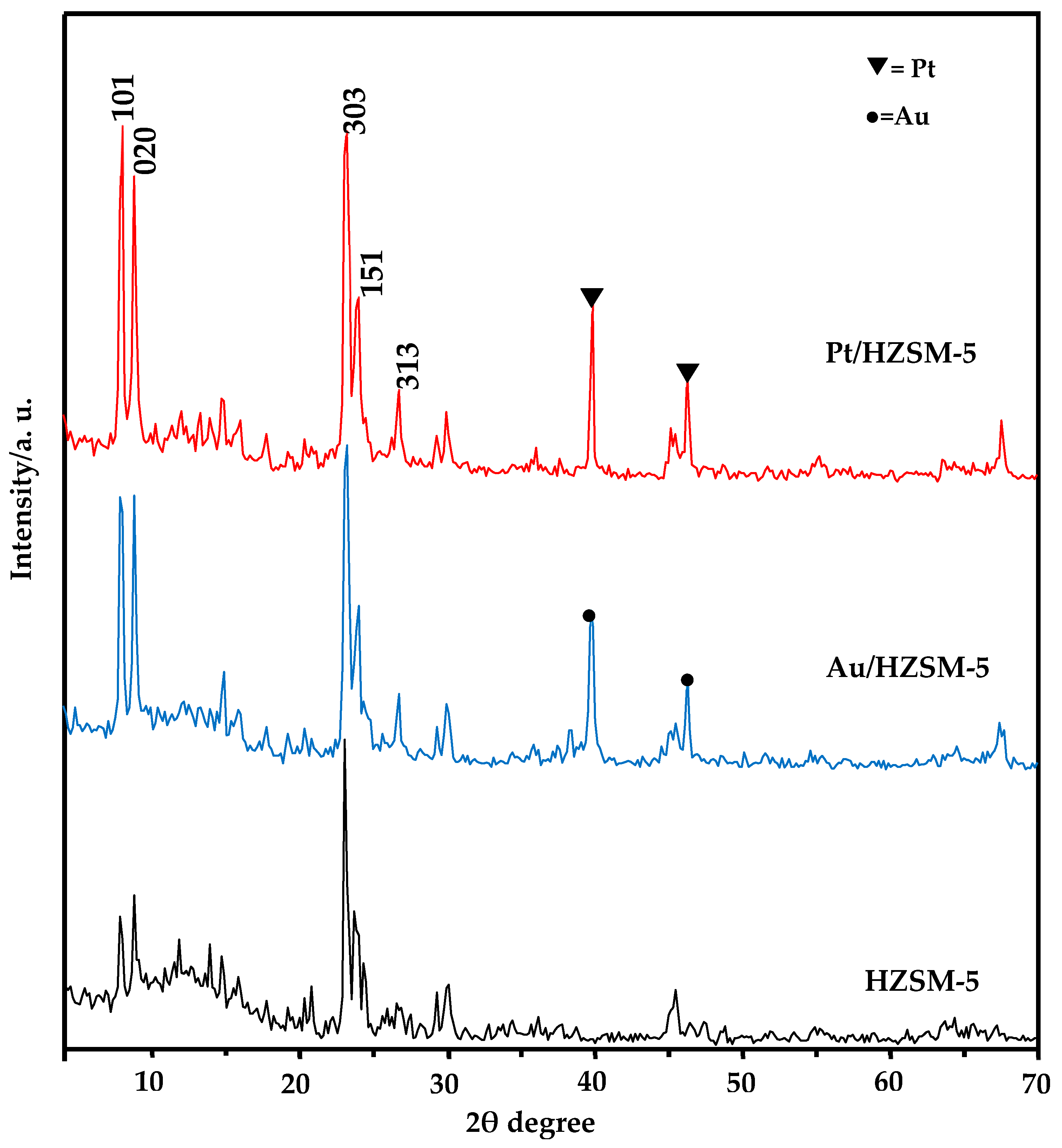
Figure 1. X-ray diffraction patterns of pure HZSM-5; Au/HZSM-5 and Pt/HZSM-5 catalysts (4 wt.%).
Catalysts 16 00110 g001
Figure 2. Nitrogen adsorption–desorption isotherms of pure HZSM-5; Au/HZSM-5 and Pt/HZSM-5 catalysts (4 wt.%).
Catalysts 16 00110 g002
Scheme 1. Ascribed to the associated LPy and BPy on parent HZSM-5.
Catalysts 16 00110 sch001
Figure 3. In situ FTIR spectra of pyridine adsorption on HZSM-5, Au/HZSM-5, and Pt/HZSM-5 catalysts. Pyridine was introduced at room temperature, and the spectra were recorded after evacuation at 100 °C for 15 min.
Catalysts 16 00110 g003
Figure 4. (A) Low- and high-magnification SEM images of (a) pure HZSM-5, (b) 4 wt.% Au/HZSM-5, and (c) 4 wt.% Pt/HZSM-5. (B) Particle Size Distribution (Frequency %) Derived from SEM Analysis of HZSM-5, Au/HZSM-5, and Pt/HZSM-5.
Catalysts 16 00110 g004aCatalysts 16 00110 g004b
Figure 5. Total conversion 2-propanol to propene formation using pure and variously treated HZSM-5 as a function of reaction temperature.
Catalysts 16 00110 g005
Figure 6. Selectivity toward propene formation over pure HZSM-5, 4 wt.% Au/HZSM-5, and 4 wt.% Pt/HZSM-5 catalysts at reaction temperatures of (a) 110 °C and (b) 175 °C.
Catalysts 16 00110 g006
Scheme 2. Proposed reaction pathways of isopropanol (IPA) over the zeolite surface.
Catalysts 16 00110 sch002
Figure 7. Temperature dependence of the isopropanol dehydration rate over HZSM-5 and Au- or Pt-modified HZSM-5 catalysts.
Catalysts 16 00110 g007
Scheme 3. Synthesizing silica from raw, dry rice straw.
Catalysts 16 00110 sch003
Figure 8. Ball-and-stick models of (a) HZSM-5, (b) Pt/HZSM-5, and (c) Au/HZSM-5, illustrating Pt and Au species located as extra-framework entities within the zeolite channel voids.
Catalysts 16 00110 g008
Figure 9. Active-site models of HZSM-5 zeolite used to study template interactions within the straight channel: (a) HZSM-5, (b) Pt/HZSM-5, and (c) Au/HZSM-5. The structures are represented in ball-and-stick mode, where oxygen atoms are shown in red, silicon atoms in yellow, platinum atoms in gray, and gold atoms in blue. Hydrogen atoms are omitted for clarity.
Catalysts 16 00110 g009
Scheme 4. Synthesis for ZSM-5 and M/ZSM-5 zeolites.
Catalysts 16 00110 sch004
Table 1. Surface characteristics and crystallinity of HZSM-5 and noble-metal-modified (Au, Pt) HZSM-5 catalysts.
SampleSBET
(m2/g)
St
(m2/g)
Vp Total
(cm3/g)
r
(Å)
Sμ
(m2/g)
Sext
(m2/g)
Swid
(m2/g)
Vpμ
(cm3/g)
V p wid
(cm3/g)
Average Crystal Size (nm)Intensity
%
HZSM-55675420.22723.2649552720.2610.06756100
Au/HZSM-55285260.26722.1148162470.2150.0525077
Pt/HZSM-55345160.28622.7448135530.2180.0635081
Note: (SBET) BET-surface area; (St) surface area derived from V1–t plots; (Sext) external surface area; (Sμ) surface area of micropores; (Swid) surface area of wide pores; (Vp total) total pore volume (VPμ) pore volume of micropores; (r) mean pore radius.
Table 2. Pyridine-FTIR (Py-FTIR) analysis of Brønsted and Lewis acid sites in HZSM-5, Au/HZSM-5, and Pt/HZSM-5 compared with literature data.
CatalystBrønsted Acid Sites (μmol·g−1)Lewis Acid Sites (μmol·g−1)BAS/LASRef.
HZSM-543780.55In this work
Au/HZSM-551540.94
Pt/HZSM-563501.26
Pt/ZSM-2283741.1239
Pt/ZSM-2246143.2940
Pt/ZSM-48127255.0841
Zn/Rh/ZSM-51653480.542
Table 3. Effect of treatment HZSM-5 with Au or Pt species on the products selectivity.
Temperature
(°C)
Solid Catalyst
HZSM-54% Au/HZSM-54% Pt/HZSM-5
SpSaSoSpSaSoSpSaSo
1005545.80.268.431.40.25544.80.2
1105842.80.282.017.60.46534.50.5
1206633.70.388.510.90.68316.30.7
1307326.70.392.07.20.88910.01.0
1407524.40.694.05.10.9944.81.2
17589101.098.30.41.3980.91.5
200980.51.597.60.42.096.50.13.4
225960.53.593.40.46.287.10.112.8
275700.529.565.20.434.468.00.131.9
Note: Sp: selectivity towards propene formation (dehydration), Sa: selectivity towards acetone formation (dehydrogenation) and So: selectivity towards oligomerization.
Table 4. Kinetic parameters (rate constant, TOF, activation energy, and frequency factor) for isopropanol dehydration over HZSM-5-based catalysts.
Catalyst SamplesDehydration Rate (mol g−1 h−1)Rate Constants
(h−1)
TOF (h−1)
× 103
∆E
kJ/mol
ln A
Dehydration RateDehydrogenation Rate (Acetone)Oligomerization Rate
HZSM-50.1520.0170.00170.893.5140.1235.82
Au/HZSM-50.1660.00870.00150.983.3137.4536.24
Pt/HZSM-50.1660.00820.00200.982.6120.730.87
Table 5. Calculated energetic in (kcal/mol), QSPR parameters for different types of MFI using DFT with a B3LYP\6-311G* Basics sets.
CODEEEeleEstbEintEelsEtorEnbEsolEstrEvdwPAVSA
HZSM-5−21.269−98.47−0.275−3.906−222.9468.302−222.94668.81312.0624.530545.360472.281
Au/HZSM-5−38.633−118.39−0.086−10.862−326.8465.231−326.846−15.59922.37254.550498.430447.535
Pt/HZSM-5−40.4675−119.375−4.939−49.765−418.9743.484−388.974−53.10389.120.4006460.123523.885
Note: E: The total energy. Eele: electronic energy, Estb: stabilization energy, Eint: binding energy, Eels: electrostatic interaction energy, Etor: repulsion interaction energy, Enb: nonbonding interaction energy, Evdw: van der waals energy, PA: proton affinity, VSA: molecular volume surfaceA3.
Disclaimer/Publisher’s Note: The statements, opinions and data contained in all publications are solely those of the individual author(s) and contributor(s) and not of MDPI and/or the editor(s). MDPI and/or the editor(s) disclaim responsibility for any injury to people or property resulting from any ideas, methods, instructions or products referred to in the content.