Article

Highly Efficient Hydrogenation of Lignin over Ni-Based Alloy Catalysts

1
Xinjiang Key Laboratory of Agricultural Chemistry and Biomaterials, College of Chemistry and Chemical Engineering, Xinjiang Agricultural University, Urumqi 830052, China
2
China National Offshore Oil Corporation (CNOOC), Institute of Chemical & Advanced Materials, Beijing 102209, China
3
Xinjiang Key Laboratory of Advanced Functional Materials, Autonomous Region, College of Chemistry, Xinjiang University, Urumqi 830046, China
4
Department of Applied Chemistry, School of Engineering, University of Toyama, Gofuku 3190, Toyama 930-8555, Japan
*
Authors to whom correspondence should be addressed.
Catalysts 2026, 16(1), 84; https://doi.org/10.3390/catal16010084
Submission received: 7 December 2025 / Revised: 5 January 2026 / Accepted: 9 January 2026 / Published: 11 January 2026

Abstract

Ni-based catalysts have been extensively investigated for lignin hydrogenation; however, they often exhibit limited phenol selectivity and poor catalytic stability. To address these challenges, we introduced Cu as a promoter, resulting in the development of NiCu/ZSM-5 catalysts with significantly enhanced phenol selectivity and durability. Characterization studies revealed that Cu species form an alloy structure with Ni, which effectively suppresses the sintering of Ni nanoparticles during the catalytic process, thereby maintaining consistent performance over multiple reaction cycles. Furthermore, the Cu-Ni alloy demonstrated improved hydrogen activation capability while reducing overall H2 uptake, leading to a marked increase in phenol selectivity compared to the Cu-free Ni/ZSM-5 catalyst. As a result, the Ni1Cu1/ZSM-5 (Ni/Cu molar ratio = 1:1) catalyst achieved a lignin conversion of 69.8% and a phenol selectivity of 84.4%, with negligible performance degradation over 8 cycles. The strategy presented in this work may offer an effective approach for enhancing the performance of industrial catalysts in lignin upgrading processes.

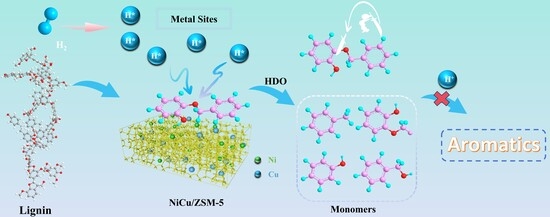
Graphical Abstract

1. Introduction

The catalytic hydrogenation of lignin into monomeric phenolics is a process of major significance for sustainable chemistry [1], addressing the essential need for renewable aromatic compounds in chemical manufacturing. Lignin, a primary component of biomass, is the most abundant natural reservoir of aromatic motifs but is largely underused, frequently treated as a waste product. Hydrogenative conversion capitalizes on this inherent aromaticity, providing a strategic renewable substitute for petroleum-derived methods [2,3]. This reaction is principally valuable for its phenolic outputs—including propylguaiacol, dihydroeugenol, and alkylphenols—which function as high-value platform chemicals and key precursors for synthesizing phenol-formaldehyde resins, epoxy polymers, adhesives, and diverse fine chemicals [4,5]. Creating a renewable source for these vital monomers through lignin hydrogenation helps lessen the environmental footprint of traditional petrochemical production. Furthermore, the process improves the economic viability and atom efficiency of integrated biorefineries by valorizing a low-value lignocellulosic stream [6]. Consequently, progress in this technology is crucial for advancing a circular bioeconomy, diminishing dependence on finite fossil resources, and establishing sustainable supply chains for essential aromatic intermediates.
Ni catalysts are extensively employed in lignin hydrogenation owing to their favorable activity and lower cost relative to noble metals [7,8,9]. Nonetheless, these catalysts frequently achieve inadequate conversion and, more critically, low selectivity for target phenolics. These limitations largely originate from Ni’s electronic structure and the severe reaction conditions necessary. Metallic Ni possesses a moderate capacity for hydrogen dissociation; its d-band center usually imposes a higher activation barrier for H2 compared to platinum or palladium [10,11], resulting in insufficient reactive hydrogen for breaking critical lignin C-O bonds (e.g., β-O-4 linkages). This can lead to repolymerization of intermediates, reducing conversion. To compensate, high temperatures and pressures are used. Under these aggressive conditions, hydrogen species on Ni surfaces can become excessively reactive, driving non-selective over-hydrogenation. This causes undesirable saturation of the aromatic rings in phenolic products, converting compounds like guaiacol into fully hydrogenated cyclohexanol derivatives and significantly lowering phenolic selectivity [12,13,14].
To address these drawbacks, strategic modifications of Ni catalysts have been explored. A prominent strategy is the addition of a second metal (e.g., Cu, Mo, or Zr) to create bimetallic systems [15,16,17], or the use of designed solid acid supports like Nb2O5 or acidic zeolites [18,19,20]. For example, the introduction of zirconium promotes the dispersion of Ni particles and increases the electron density of Ni0. By weakening the interaction between Ni and the carrier, it reduces Ni’s adsorption strength on benzene rings, preventing excessive hydrogenation of the benzene rings. This preserves the aromatic structure and enhances the selectivity for phenols [21,22]. Acidic supports can similarly assist initial ether cleavage through hydrolysis or carbocation stabilization, potentially lowering overall hydrogen requirements. While such modifications have enhanced phenolic yields and selectivity in model reactions, substantial difficulties persist with real, complex lignin feeds. Promoted catalysts often face stability problems, such as sintering under harsh liquid-phase conditions, leaching of the promoter metal, or coke formation from lignin fragments on acid sites. Additionally, maintaining a consistent balance between hydrogenolysis activity (for depolymerization) and hydrogenation activity (for stabilization without over-saturation) remains a nuanced, system-dependent challenge. Therefore, creating durable, selective, and broadly applicable Ni-based catalysts for lignin valorization is a central and ongoing research objective [23,24,25].
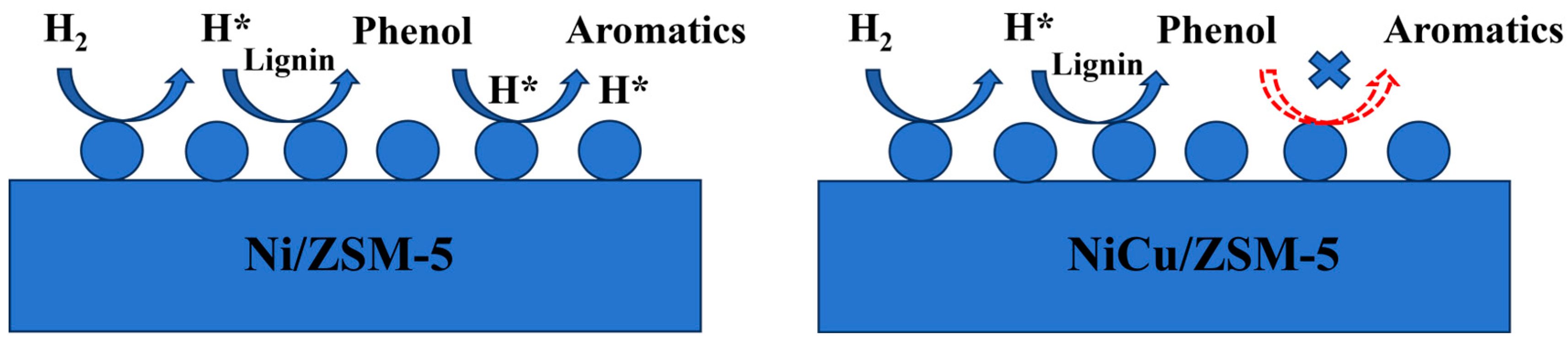
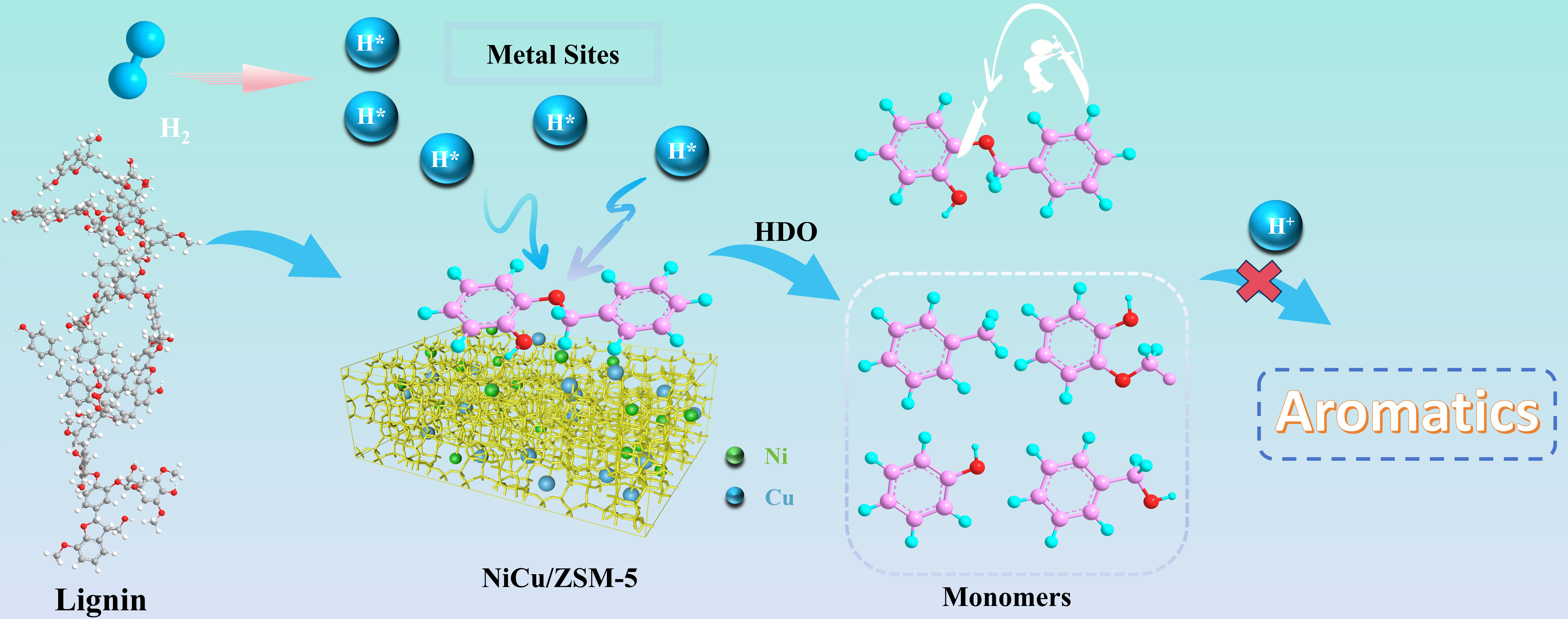
To tackle these issues, our research aimed to modulate Ni properties via Cu promotion, forming a well-defined NiCu alloy structure. Detailed characterization using hydrogen temperature-programmed reduction (H2-TPR) and hydrogen temperature-programmed desorption (H2-TPD) confirmed that this electronic adjustment improved the catalyst’s ability to activate and dissociate hydrogen compared to pure Ni. while simultaneously reducing total H2 adsorption, signaling a lower tendency for over-hydrogenation [26,27,28]. Critically, probe reactions with phenol hydrogenation confirmed that the NiCu alloy effectively inhibited deep hydrogenation of the aromatic ring (Figure 1). As a result, the catalyst showed enhanced performance in lignin hydrogenation, attaining 69.8% conversion and 84.4% selectivity, with consistent stability across 8 cycles. This design strategy, which separates efficient hydrogen activation for C-O cleavage from excessive hydrogenation activity for ring saturation, offers a clear framework for developing effective and selective non-precious metal catalysts to convert lignin into phenolic compounds.

2. Results and Discussion

2.1. Structural Characterization

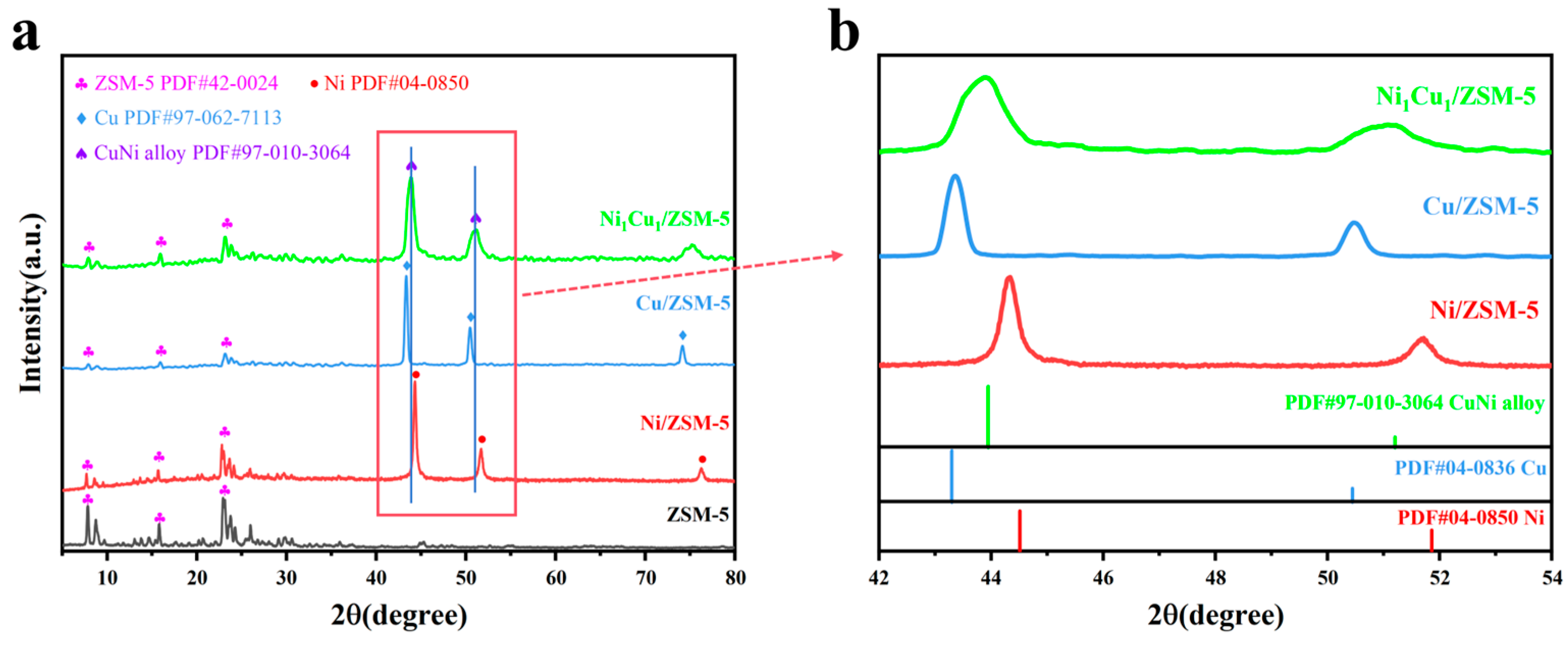
Figure 2 displays the X-ray diffraction (XRD) patterns of the prepared Ni/ZSM-5, Cu/ZSM-5, and Ni1Cu1/ZSM-5 catalysts. All samples show characteristic diffraction peaks at 2θ ≈ 7–10° and 22.5–25° [29,30], which are assigned to the crystalline framework of the ZSM-5 zeolite support. The actual metal loadings, quantified by inductively coupled plasma-optical emission spectrometry (ICP-OES), are approximately 5.15 at% for Ni/ZSM-5, 4.84 at% for Cu/ZSM-5, and 2.38 at% Ni with ~2.46 at% Cu for Ni1Cu1/ZSM-5 (Table S1), providing a compositional foundation for the subsequent phase analysis. For the monometallic Ni/ZSM-5 catalyst, distinct peaks appear at 2θ = 44.5°, 51.8°, and 76.4°, corresponding to the (111), (200), and (220) planes of the face-centered cubic (fcc) metallic Ni0 phase. Similarly, the Cu/ZSM-5 catalyst exhibits peaks at 2θ = 43.3°, 50.4°, and 74.1°, indexed to the (111), (200), and (220) planes of fcc Cu0.
Notably, the diffraction pattern of the bimetallic Ni1Cu1/ZSM-5 catalyst reveals a clear structural evolution. The metallic reflections are observed at intermediate 2θ positions of 43.9°, 51.1°, and 75.3°. These peaks neither coincide with those of pure Ni0 or Cu0 nor represent a simple overlap of the two monometallic patterns. Instead, they are precisely indexed to the (111), (200), and (220) planes of a homogeneous NiCu alloy phase (PDF#97-010-3064). The consistent shift in diffraction angles, together with the absence of separate Ni or Cu phase signatures, provides definitive evidence that Cu forms a strong metallic bond with Ni, resulting in an alloy structure. This confirms that Cu is incorporated into the Ni lattice, rather than acting as a weakly interacting promoter, thereby fundamentally altering the electronic and geometric properties of the catalyst [31,32]. Additionally, XRD measurements were performed on catalysts with varying Ni/Cu ratios (as shown in Figure S1). The results indicate that the Ni1Cu1/ZSM-5, Ni1Cu2/ZSM-5, and Ni2Cu1/ZSM-5 all exhibit characteristic diffraction peaks consistent with the CuNi alloy at 2θ = 43.9°, 51.1° and 75.3°. The alloy peak positions are essentially identical, indicating that variations in metal ratio do not significantly affect the crystalline phase structure of the CuNi alloy. In terms of peak intensity, Ni1Cu1/ZSM-5 displays the strongest alloy peaks, suggesting relatively higher alloy crystallinity in this sample. In contrast, Ni2Cu1/ZSM-5 exhibits the weakest CuNi alloy peaks, and additional diffraction peaks corresponding to NiO (near 2θ = 37.2° and 62.9°) are observed in its XRD pattern—indicating that a portion of Ni in this catalyst does not participate in alloy formation and instead exists as NiO.
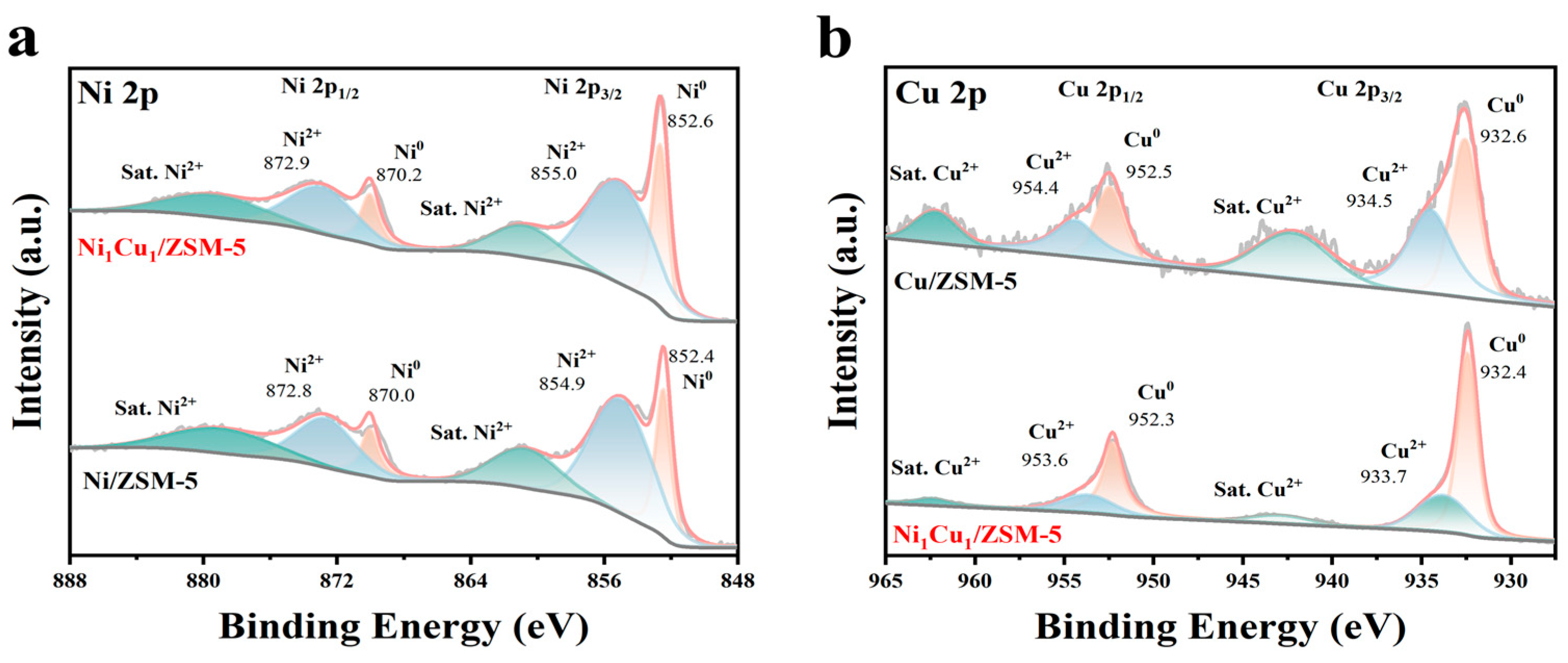
Figure 3 illustrates the in situ X-ray photoelectron spectroscopy (XPS) spectra acquired from the Ni/ZSM-5 and Ni1Cu1/ZSM-5 catalysts. Both samples were subjected to in situ H2 reduction within the XPS chamber to prevent surface oxidation, with the corresponding binding energy (BE) values detailed in Table S2.Prominent satellite features near 861.5 eV and 879.5 eV in the Ni 2p spectra of both catalysts are indicative of Ni2+ species within a NiAl2O4-type spinel structure. This phase is presumed to originate from the interaction between Ni and framework alumina in the ZSM-5 support during calcination and reduction [33,34].
For the monometallic Ni/ZSM-5 catalyst, deconvolution of the Ni 2p3/2 peak reveals two spin–orbit components: one at ~852.4 eV assigned to metallic Ni0 and a broader feature at ~854.9 eV corresponding to Ni2+. Conversely, the Ni 2p spectrum for the bimetallic Ni1Cu1/ZSM-5 catalyst shows a positive shift of the metallic Ni0 peak to approximately 852.6 eV. This increase in binding energy offers direct spectroscopic evidence of electronic modification via alloying [35,36], signifying a change in the core-level electronic environment of the Ni atoms.
Examination of the Cu 2p region indicates that for the Cu/ZSM-5 catalyst, the Cu 2p3/2 peak is positioned near 932.6 eV, attributable to either Cu0 or Cu+ species; the absence of pronounced satellite features precludes the presence of significant Cu2+ after reduction. In the Ni1Cu1/ZSM-5 catalyst, this Cu 2p3/2 peak shifts to a lower binding energy of approximately 932.4 eV. The observed positive shift for Ni coupled with a negative shift for Cu provides definitive evidence of a strong electronic interaction between the metals [37], consistent with a transfer of electron density from Ni to Cu. The C 1s XPS spectra in Figure S2 show significant differences among the samples: Ni/ZSM-5 is dominated by C-O/C=O species, Cu/ZSM-5 is dominated by C-C species, while the intensity of the C-C signal for Ni1Cu1/ZSM-5 falls between the two. These differences in the distribution of surface carbon species indirectly reflect the variation in the chemical environment of the catalyst’s outermost surface. Pristine Ni and Cu surfaces exhibit distinct intrinsic adsorption properties. The unique intermediate-state C 1s spectrum of Ni1Cu1/ZSM-5 indicates that its surface is not a simple mixture of the two metals, but rather a new, homogeneous phase. This observation correlates well with the binding energy shifts in the Ni 2p and Cu 2p spectra (direct evidence). These results collectively confirm the formation of an integrated Ni-Cu alloy phase, rather than a simple physical mixture of discrete metallic nanoparticles.
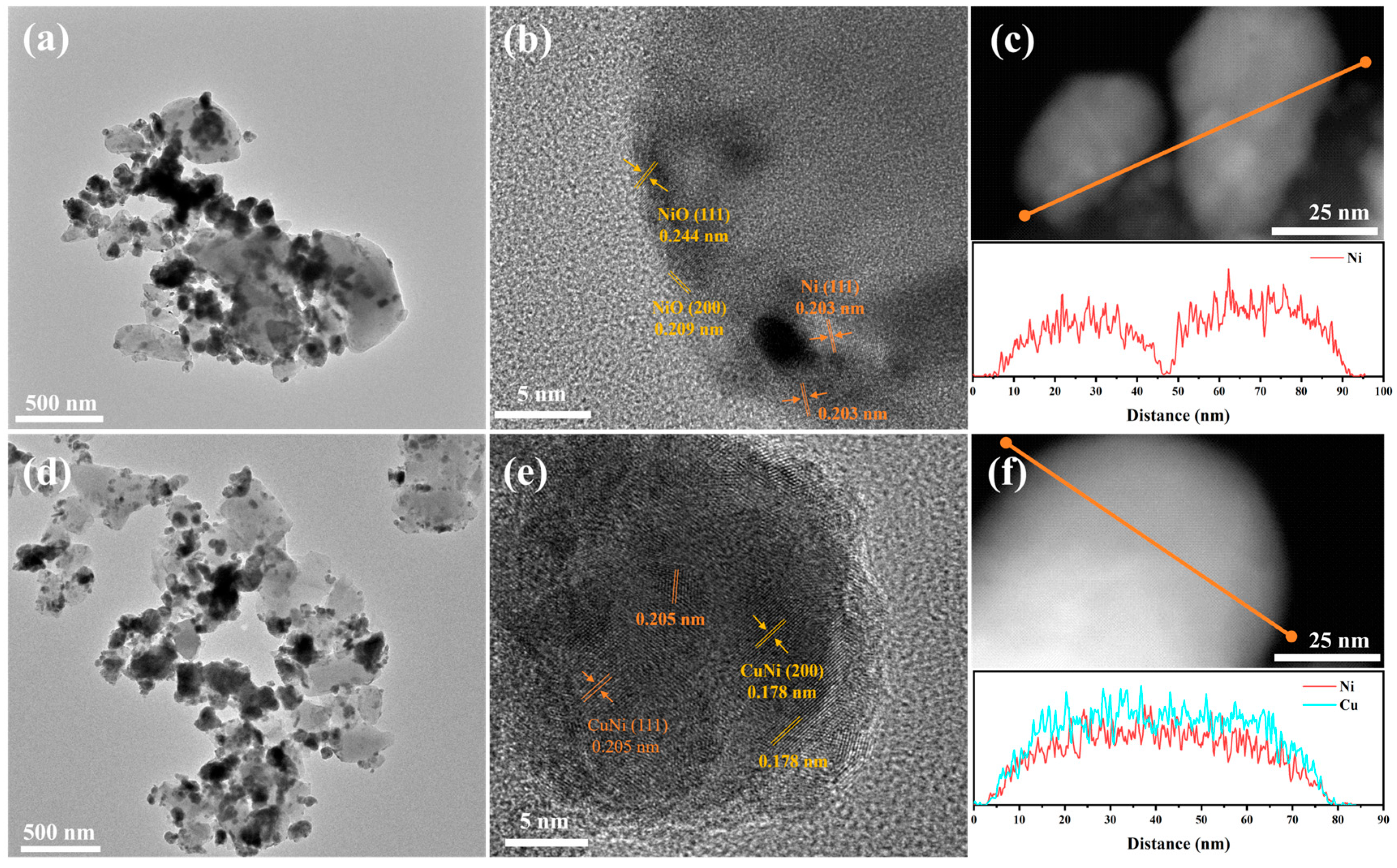
The morphology and microstructure of the reduced catalysts were analyzed using transmission electron microscopy (TEM), as shown in Figure 4. Metal nanoparticles were observed to be uniformly dispersed across the ZSM-5 support in both the Ni/ZSM-5 and Ni1Cu1/ZSM-5 samples. Statistical analysis of particle sizes yielded average diameters of roughly 65 nm for Ni/ZSM-5 and 60 nm for Ni1Cu1/ZSM-5, suggesting that the inclusion of Cu contributed to a slight refinement in particle size distribution. In addition, the selected area electron diffraction (SAED) pattern of Ni1Cu1/ZSM-5 (Figure S3) shows concentric rings composed of multiple diffraction spots. The corresponding d-spacing value (d = 0.205 nm) is consistent with the lattice spacing of the (111) crystal plane of the CuNi alloy identified by XRD, confirming the formation of the CuNi alloy and in agreement with the results from high-resolution transmission electron microscopy (HR-TEM).
Energy-dispersive X-ray spectroscopy (EDS) line-scan profiles performed across individual nanoparticles elucidated their elemental composition. A profile across a representative nanoparticle in the Ni/ZSM-5 sample detected only a Ni signal, confirming its monometallic structure. Conversely, a line-scan across a typical particle in the Ni1Cu1/ZSM-5 catalyst revealed synchronized Ni and Cu signals, with the intensities of both elements rising and falling concurrently along the particle’s diameter. This spatially coincident distribution provides direct microscopic evidence that Ni and Cu atoms cohabit within the same nanoparticle, robustly indicating the formation of a homogeneous Ni-Cu alloy phase [38]. This finding aligns with the conclusions drawn from the earlier XRD and XPS analyses.
The general morphology of the catalysts was evaluated using scanning electron microscopy (SEM). Unmodified ZSM-5 displayed a characteristic cubic morphology (Figure S4), which is advantageous for offering structured pore channels and active sites. The Ni precursor was observed as aggregated nanoparticles possessing a fine and relatively uniform size distribution, a feature anticipated to enhance specific surface area and the availability of active sites. While TEM analysis (Figure 4) confirms the formation of similarly sized metal nanoparticles, SEM imaging (Figure S5) reveals distinct differences in the macro-scale morphology of the catalyst particles. The NiCu/ZSM-5 catalyst exhibits a more rugged surface texture and a notably lower degree of secondary agglomeration compared to Ni/ZSM-5, where primary particles are frequently sintered into larger, dense aggregates. This suggests that the introduction of Cu promotes the formation of NiCu alloy particles with stronger adhesion to the ZSM-5 support, thereby inhibiting their coalescence during thermal treatment. This improved morphological stability, coupled with a narrower nanoparticle size distribution, is consistent with the enhanced catalytic performance observed for the bimetallic catalyst. EDS elemental mapping (Figure S5e) further verified the homogeneous co-distribution of Ni and Cu throughout the Ni1Cu1/ZSM-5 catalyst, providing strong evidence for the formation of a bimetallic alloy or, at minimum, very close intermetallic contact. Uniform signals for silicon and aluminum confirmed the structural integrity of the ZSM-5 framework following metal incorporation.
The pore structure was investigated using nitrogen adsorption–desorption isotherms (Figure S5f). Both ZSM-5 and Ni1Cu1/ZSM-5 displayed Type I isotherms, which are typical of microporous materials. ZSM-5 showed a sharp uptake at very low relative pressures (P/P0), indicative of its developed microporosity. The isotherm for Ni/ZSM-5 exhibited a combination of Type I and Type IV characteristics, with subsequent analysis (Table S3) confirming the introduction of mesoporosity. The adsorption profile for Ni1Cu1/ZSM-5 at moderate-to-high relative pressures fell between those of ZSM-5 and Ni/ZSM-5, denoting a structure containing both micro- and mesopores. All three materials exhibited H4-type hysteresis loops. Notably, the hysteresis loop for Ni1Cu1/ZSM-5 was less pronounced than that for Ni/ZSM-5, suggesting either a reduced mesopore volume or a more uniform mesopore size/shape distribution, thereby lowering desorption resistance. The pore-size distribution for Ni1Cu1/ZSM-5 (Figure S5g) further verified the coexistence of micro- and mesopores, with a narrower mesopore distribution relative to Ni/ZSM-5 [39,40].
For a more direct and quantitative analysis of how bimetallic loading influences catalyst texture, the textural properties are summarized in Table S3. The pristine ZSM-5 exhibits a Brunauer–Emmett–Teller (BET) surface area of 268.50 m2/g, indicative of its well-developed microporous framework and abundant accessible surface sites. In contrast, Ni/ZSM-5, Cu/ZSM-5 and Ni1Cu1/ZSM-5 all show substantially lower BET surface areas. ZSM-5 is a typical microporous zeolite with a pore size of less than 1 nm, while the loaded metal particles are approximately 60 nm in size—too large to enter the internal micropores and thus predominantly dispersed on the zeolite external surface. As evidenced by the consistent shape of the N2 adsorption–desorption isotherms before and after metal loading, the co-loading of Ni and Cu does not alter the inherent framework structure of ZSM-5. The observed decreases in specific surface area and pore volume are instead attributed to two main factors: partial blockage of the zeolite micropore entrances by the externally distributed metal species, and the mass dilution effect caused by the introduction of non-porous metal components. Compared with ZSM-5, Ni/ZSM-5 displays a relatively large pore volume (0.20 cm3/g) and average pore size (4.79 nm), characteristic of a mesopore-dominated structure. This phenomenon suggests that the metal loading process likely induced partial collapse of the ZSM-5 micropore framework, forming small mesopores. These newly generated mesopores compensate for the blocked micropore volume and contribute to a larger average pore size. For Cu/ZSM-5, it also shows a pore volume of 0.20 cm3/g (consistent with Ni/ZSM-5) but an even larger average pore diameter (5.23 nm), further confirming the formation of mesoporous structures after metal loading. Compared with the parent ZSM-5 (average pore diameter: 2.87 nm, typical of microporous–mesoporous hybrid), the increased average pore size of Cu/ZSM-5 suggests that Cu introduction similarly induces the expansion of pore channels—even more significantly than Ni loading—leading to a more prominent mesoporous feature. Conversely, Ni1Cu1/ZSM-5 has a pore volume of 0.12 cm3/g and a BET surface area of 178.51 m2/g, denoting a hybrid meso-microporous structure with a moderate pore size distribution. The inclusion of Cu appears to improve Ni dispersion and regulate Ni particle size, thereby minimizing metal agglomeration and curbing excessive pore expansion. However, the higher total metal loading leads to partial pore channel occupation, resulting in a further decrease in both pore volume and BET surface area.

2.2. Catalytic Performance for Hydrogenation of Lignin

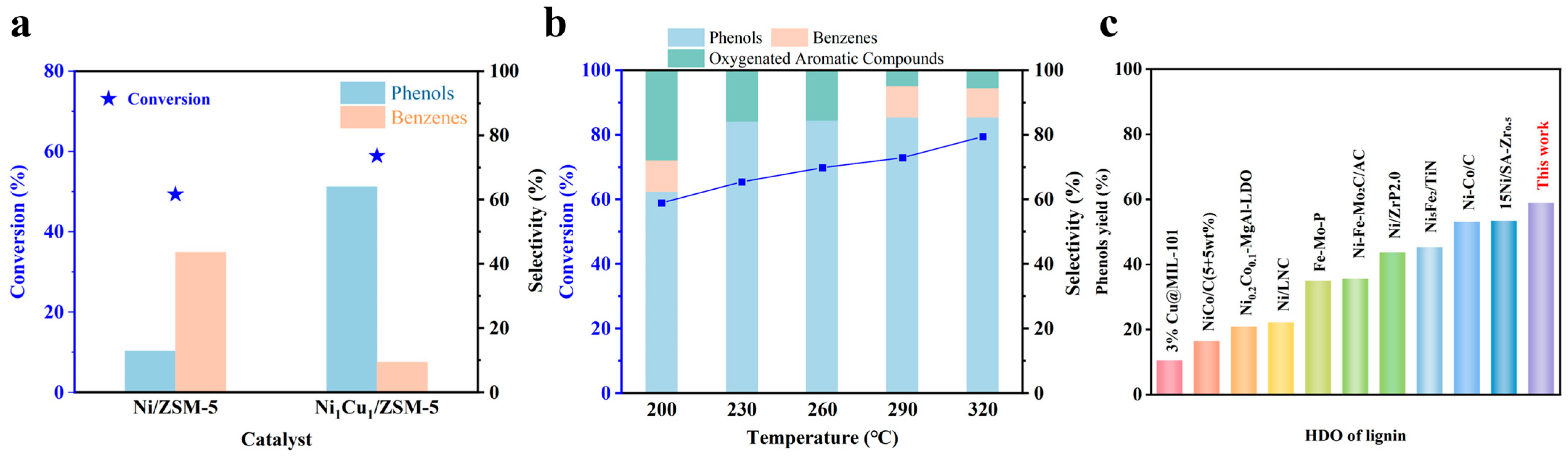
Catalytic hydrodeoxygenation (HDO) performance was evaluated using lignin isolated from cotton stalks. As shown in Figure 5, the Ni/ZSM-5 catalyst achieved a lignin conversion of 49.3%, with selectivities for phenolic compounds and benzenes of 12.8% and 43.5%, respectively. In contrast, the Ni1Cu1/ZSM-5 catalyst demonstrated a substantially improved phenolic selectivity of 64.0% and a suppressed benzene selectivity of 9.3%, alongside a moderately higher lignin conversion of 58.9%.
For comparison, the activity of ZSM-5 support, pure Ni, and pure Cu was also assessed (Table S4), with all showing unsatisfactory performance. For instance, the selectivity of pure Ni catalysts for phenolic and aromatic compounds was only 8.4% and 21.0%, respectively, with a conversion rate of 47.1%; The pure Cu catalyst exhibits selectivities of 30.7% for phenolic compounds and 59.2% for aromatic compounds, with an overall conversion rate of 46.5%; The ZSM-5 support itself gave corresponding selectivities of 10.0% and 21.9%, with a low overall conversion of 32.8%.
Furthermore, NiCu/ZSM-5 catalysts with varying Ni/Cu molar ratios were tested (Table S5). The Ni1Cu2/ZSM-5 catalyst showed selectivities of 50.7% for phenolics and 34.4% for aromatics, while the Ni2Cu1/ZSM-5 catalyst gave 10.4% and 44.8%, respectively; both catalysts showed worse catalytic performance than those over Ni1Cu1/ZSM-5 catalyst, whose lignin conversion and phenolic compounds selectivity were 58.9% and 64.0%, respectively. Consequently, the 1:1 Ni/Cu molar ratio was identified as optimal, leading to the selection of the Ni1Cu1/ZSM-5 catalyst for subsequent study.
The influence of reaction temperature (200–320 °C) on the Ni1Cu1/ZSM-5 catalyst was also investigated (Figure 5b). At 200 °C, phenolic selectivity was 64.0%. Increasing the temperature gradually raised the lignin conversion from 58.9% (200 °C) to 79.4% (320 °C), with intermediate values of 65.4% at 230 °C, 69.8% at 260 °C, and 72.9% at 290 °C., with phenolic selectivity also increasing progressively (from 59.5% at 200 °C to 85.4% at 320 °C; intermediate values: 84.0% at 230 °C, 84.4% at 260 °C, 85.4% at 290 °C). Notably, aromatic formation was absent between 230 °C and 260 °C but re-emerged above 290 °C. When the reaction temperature was 290 and 320 °C, the benzenes selectivities were 9.6% and 9.0%, respectively. Though high temperature such as 290 and 320 °C would have higher phenolic compounds yield, considering the cost for the product separation, we finally select 260 °C as the optimal temperature.
A summary of phenolic selectivity versus lignin conversion from various catalysts [17,21,41,42,43,44,45,46,47,48], including literature data, is presented in Figure 5c and Table S6. Most reported catalysts exhibit phenolic selectivities below 80.0% at conversions exceeding 60.0%; for example, a 15Ni/SA-Zr0.5 catalyst achieved 80.1% phenolic selectivity at 66.7% lignin conversion under the same conditions (260 °C, 4 h) [21]. Strikingly, the Ni1Cu1/ZSM-5 catalyst simultaneously achieved high phenolic selectivity (84.4%) and substantial lignin conversion (69.8%) with phenols yield at 58.9%, underscoring its superior performance for the targeted conversion of lignin to phenolic compounds.
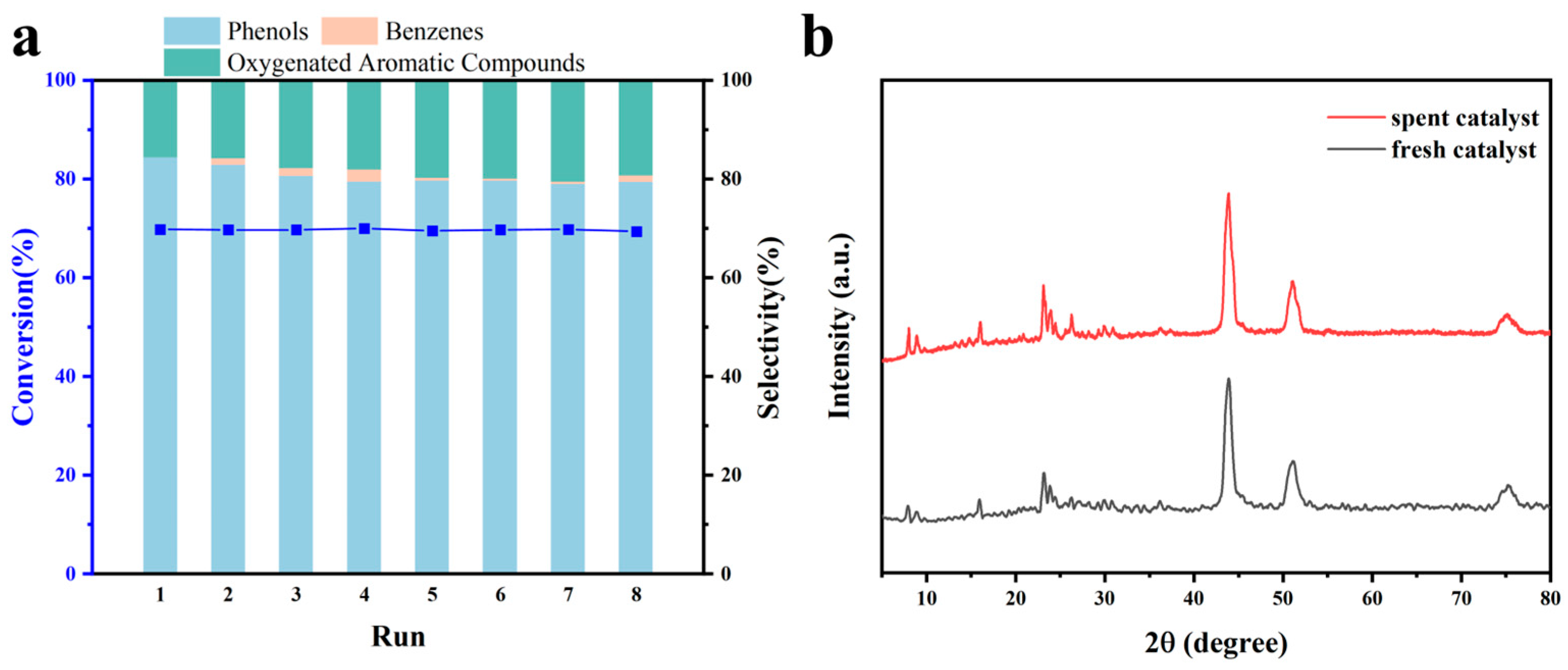
Catalyst durability, a crucial parameter for industrial viability [42,49], was assessed by evaluating the cycling stability of Ni1Cu1/ZSM-5 in the lignin HDO reaction. The catalyst was subjected to eight consecutive runs under consistent conditions (260 °C, 4 h), with phenolic selectivity monitored as the primary metric. Following each cycle, the catalyst was retrieved via centrifugation, washed with ethyl acetate, vacuum-dried at 60 °C, and subsequently regenerated through calcination in a muffle furnace at 400 °C for 4 h in air atmosphere and reduction in a tube furnace at 450 °C for 4 h under H2 atmosphere prior to reuse. As depicted in Figure 6a and Figure S6, gas chromatography–mass spectrometry (GC-MS) analysis indicated that the phenolic selectivity of Ni1Cu1/ZSM-5 declined only marginally from 84.4% to 79.0% after the eighth cycle. This performance demonstrates markedly enhanced stability relative to the Ni/ZSM-5 catalyst (Figure S7), affirming its robustness under repeated redox regeneration. XRD patterns of the spent catalyst (Figure 6b) revealed no significant shifts in peak positions or alterations in crystallite size compared to the fresh material, providing evidence of its structural integrity throughout the stability assessment. In the post-reaction particle size characterization, significant particle agglomeration is observed for the spent Ni/ZSM-5 (Figure S8a), with the average particle size increasing to ~75 nm, while the particle size of the spent Ni1Cu1/ZSM-5 (Figure S8b) remains stable at ~62 nm. This post-reaction evidence clearly demonstrates that compared to monometallic Ni/ZSM-5 (which undergoes sintering after reaction), the Ni1Cu1/ZSM-5 catalyst maintains a relatively stable particle size, thus verifying its anti-sintering property.
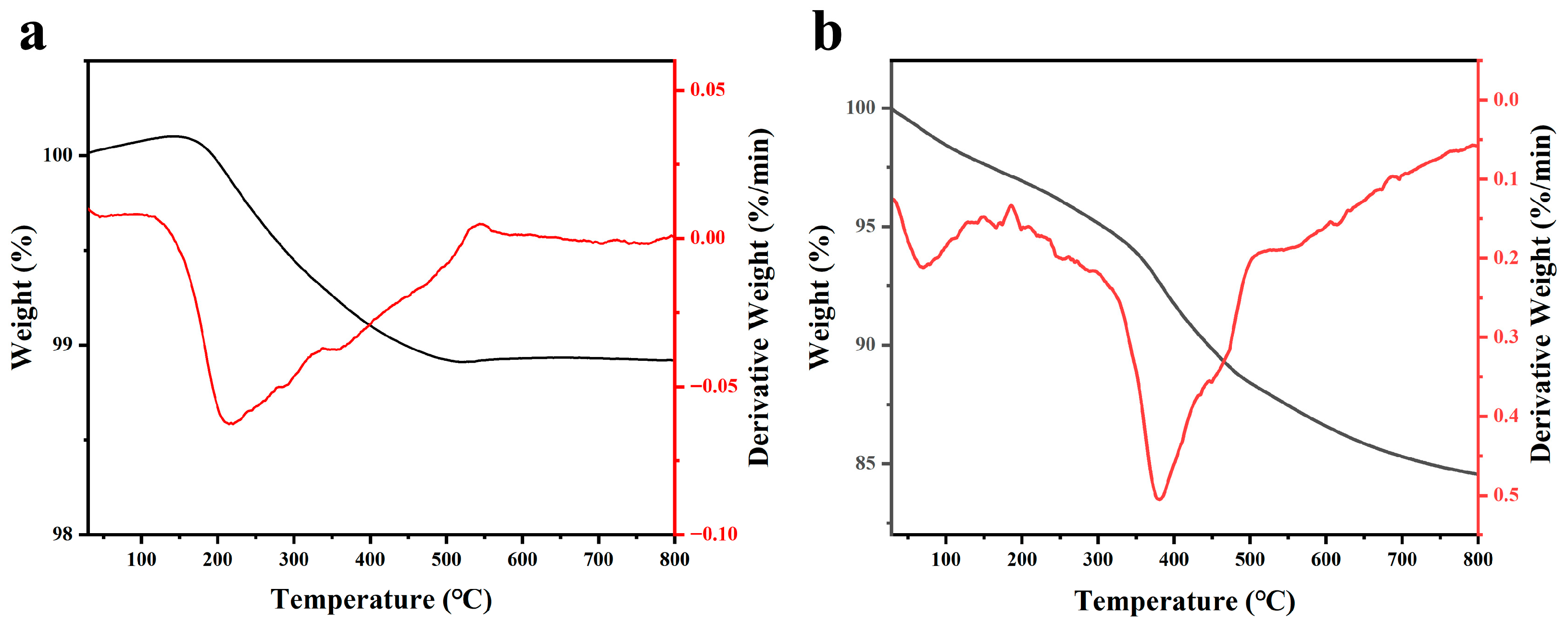
Considering the significance of catalyst longevity for practical deployment, the coking behavior during lignin HDO was investigated through thermogravimetric analysis (TG) of both fresh and spent catalysts (Figure 7). For the fresh catalyst (Figure 7a), it exhibited minimal mass loss (only ~1.0% in total) throughout the heating process. A slight mass decrease (≈0.5%) near 75 °C corresponds to the desorption of physisorbed moisture, consistent with the spent sample. No obvious mass loss was observed in the 200–400 °C range or beyond, indicating the absence of carbonaceous deposits (coke) and the structural stability of the fresh catalyst. For the spent catalyst (Figure 7b), it displayed a cumulative mass loss of approximately 16.0%. A broad, gradual mass-loss event was observed near 75 °C, associated with the desorption of physiosorbed moisture (consistent with the fresh sample). A more substantial decrease in mass occurred within the 200–400 °C range, attributed to the combustion of relatively labile, hydrogen-rich carbonaceous deposits (often termed “soft” coke). Beyond 400 °C, the mass loss diminished progressively, with residual losses likely resulting from the decomposition of more stable, refractory carbonaceous species [50,51]. These findings suggest the accumulation of medium-temperature carbon deposits on the catalyst surface, which likely originate from secondary reactions of reactants or intermediates, forming polymer-like, hydrogen-rich species commonly classified as soft coke.
The stark contrast between the fresh (negligible mass loss) and spent (16.0% mass loss) catalysts directly confirms that the significant mass loss of the spent sample originates from coke deposition during the lignin HDO reaction, rather than inherent structural changes of the catalyst itself.
In addition, to obtain more comprehensive information on the thermal effects of the catalyst samples, we have supplemented differential scanning calorimetry (DSC) measurements for both fresh and spent Ni1Cu1/ZSM-5 catalysts (Figure S9). As shown in the figure below, overall, the endothermic and exothermic effects of the two catalysts are not significant. It can be seen from the figure that the heat flow of the fresh catalyst changes gently without obvious strong exothermic peaks, indicating that the fresh catalyst itself has no additional exothermic reactions during the heating process. In contrast, as the temperature rises (especially after 500 °C), the heat flow of the spent catalyst drops sharply—this is the characteristic exothermic behavior of coke combustion.

2.3. Reaction Mechanism

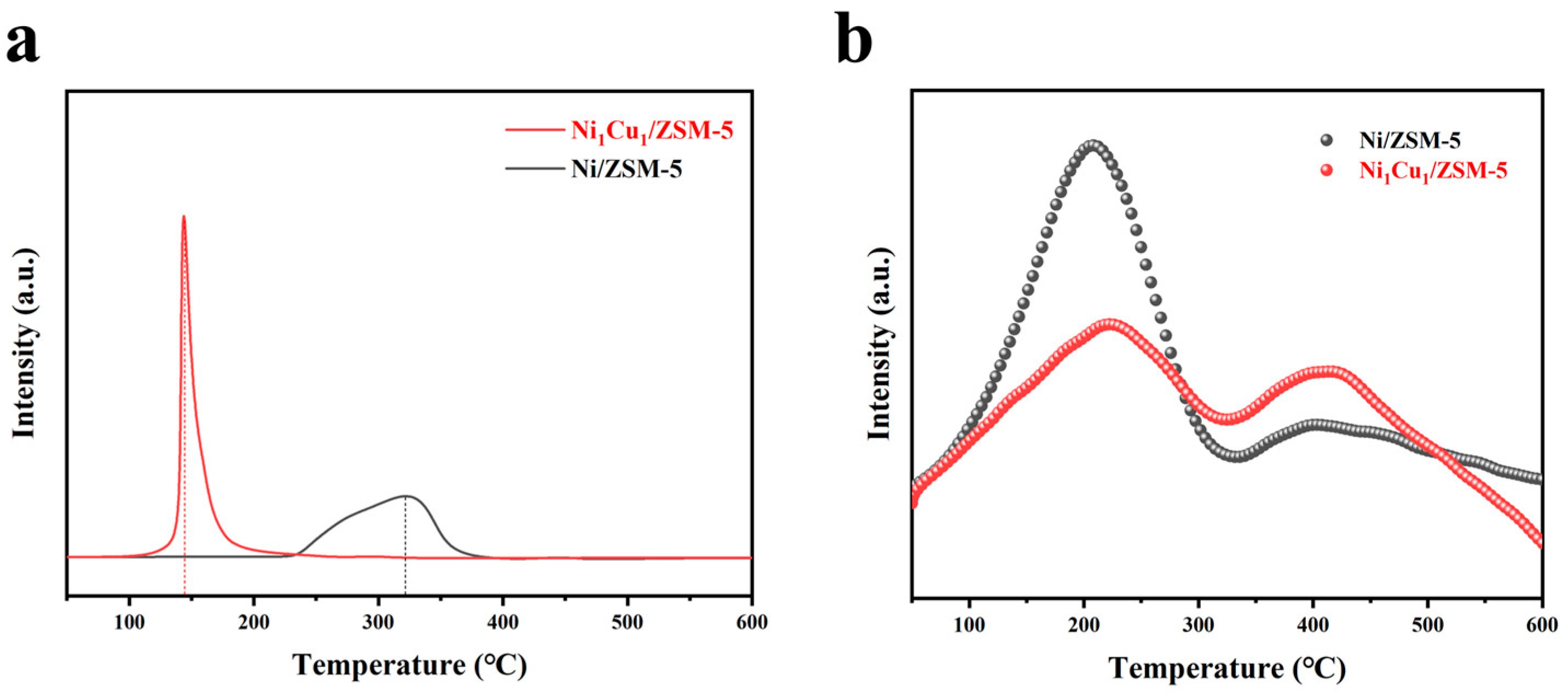
The enhanced efficacy of the bimetallic Ni1Cu1/ZSM-5 catalyst over the monometallic Ni/ZSM-5 system, evidenced by improved lignin conversion and phenolic selectivity, is fundamentally attributed to alloy-induced modifications in hydrogen activation and adsorption behavior. A comparative investigation using H2 temperature-programmed reduction (H2-TPR) and desorption (H2-TPD) was undertaken to examine these pivotal surface processes.
H2-TPR profiles offer insights into reducibility and hydrogen activation capacity. As depicted in Figure 8a, the Ni/ZSM-5 catalyst shows a primary reduction peak at approximately 325 °C, assigned to the reduction of NiO species interacting strongly with the support. Conversely, the main reduction peak for Ni1Cu1/ZSM-5 is significantly shifted to a lower temperature near 150 °C. This pronounced shift demonstrates a substantially lowered barrier for hydrogen activation. Alloy formation alters the electronic structure of Ni, plausibly weakening Ni-O bonds in the precursor oxide and/or facilitating the mobility of surface oxygen [52,53]. Consequently, hydrogen dissociates more efficiently on the bimetallic surface under milder conditions. This enhanced generation of active hydrogen species (H*) promotes the hydrogenolysis of lignin’s recalcitrant C-O ether bonds, contributing to higher conversion. When comparing alloy catalysts with different molar ratios, all the catalysts (Ni2Cu1/ZSM-5, Ni1Cu2/ZSM-5 and Ni1Cu1/ZSM-5) exhibit a single reduction peak at an intermediate temperature (Figure S10). This feature confirms intimate interaction and cooperative reduction behavior between Ni and Cu species, rather than the presence of isolated monometallic phases. Among the entire catalyst series, the Ni1Cu1/ZSM-5 catalyst exhibits the lowest reduction peak temperature, indicating the strongest Ni-Cu synergistic interaction and the most facile reduction kinetics at the equimolar Ni/Cu ratio. The ability to readily generate reduced metallic Ni active sites under milder conditions through this optimized reduction behavior directly correlates with the superior catalytic activity of Ni1Cu1/ZSM-5 in lignin hydrogenation.
While efficient hydrogen activation is necessary for conversion, regulating the surface concentration and reactivity of adsorbed hydrogen is paramount for selectivity, as probed by H2-TPD. Experiments conducted with a constant catalyst mass (100 mg) enable direct comparison. Figure 8b shows that while both catalysts display hydrogen desorption peaks in the 210 °C and 400 °C regions—corresponding to metal sites with different hydrogen binding energies—quantitative analysis reveals a distinct trend. Ni/ZSM-5 possesses a significantly larger total H2 desorption area, indicating a greater capacity for hydrogen adsorption and retention. The Ni1Cu1/ZSM-5 catalyst, in contrast, desorbs a markedly lower quantity of hydrogen.
This distinction is central to explaining the selectivity enhancement. The high surface hydrogen concentration on Ni/ZSM-5 fosters consecutive hydrogenation reactions. Although beneficial for initial cleavage, the abundant H* species readily saturate the aromatic rings of phenolic intermediates, leading to over-hydrogenation into cyclohexanol derivatives and, ultimately, alkylbenzenes via secondary reactions. This non-selective pathway consumes target phenolics, resulting in lower selectivity. In contrast, the Ni-Cu alloy surface exhibits a vital synergy: it activates H2 efficiently (as shown by H2-TPR) but maintains a lower overall hydrogen storage capacity. This moderated adsorption profile, likely a result of electronic and geometric effects that dilute contiguous Ni sites [21,54,55], creates a tuned surface hydrogen chemical potential. This environment remains effective for the selective hydrogenolysis of C-O bonds to release phenolic monomers while inhibiting subsequent aromatic ring saturation. Thus, the combined H2-TPR and H2-TPD data provide a coherent mechanistic explanation for the concurrent gains in activity and selectivity, rooted in facilitated hydrogen activation paired with moderated hydrogen adsorption on the Ni1Cu1/ZSM-5 alloy catalyst.
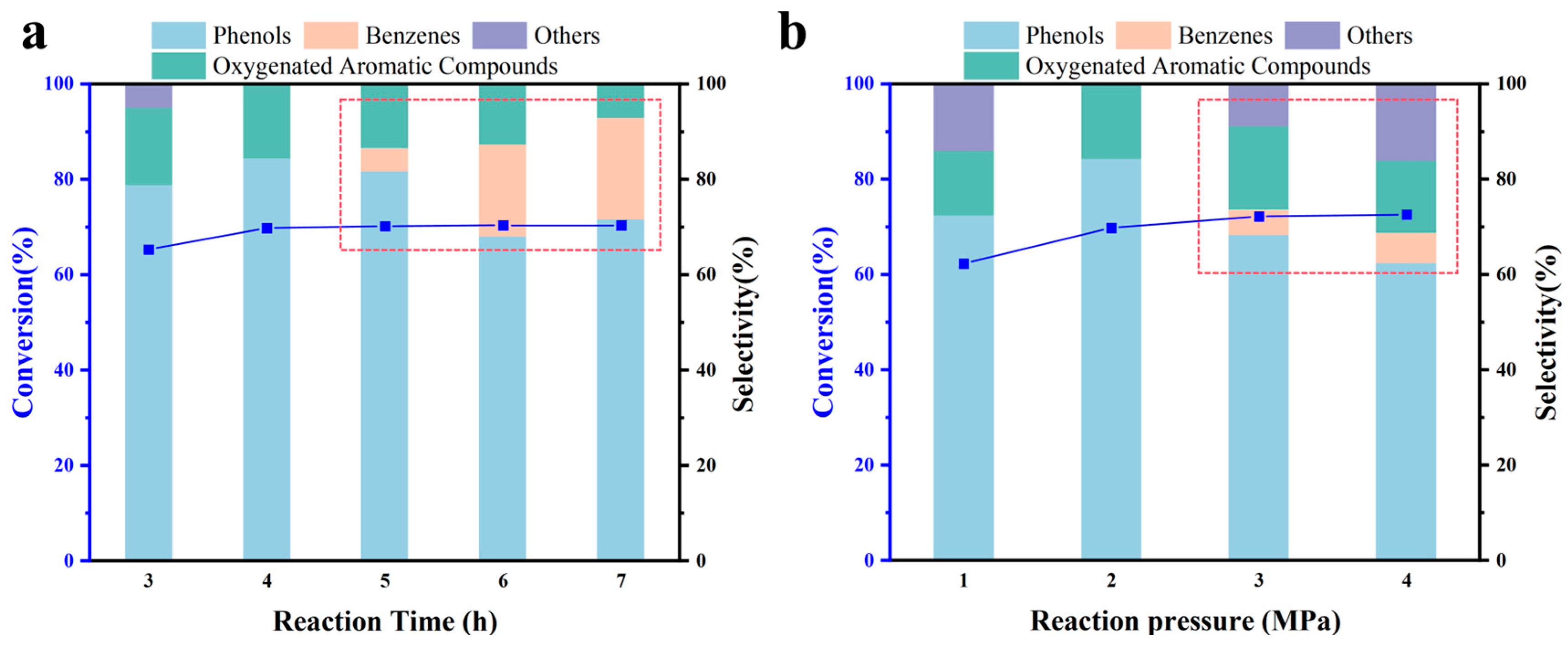
To corroborate the suggested reaction mechanism, time-resolved and pressure-dependent studies of lignin hydrodeoxygenation were performed using the Ni1Cu1/ZSM-5 catalyst. As illustrated in Figure 9a, a lignin conversion of 65.0% was attained after 3 h. The product mixture was primarily composed of phenolic monomers and oxygenated aromatic compounds, with no measurable formation of fully deoxygenated aromatic hydrocarbons (alkylbenzenes). When the reaction time was extended to 4 h, conversion rose to 70.0% while the product distribution remained consistent, still dominated by phenolics and oxygenated aromatics without substantial hydrocarbon generation. This suggests that, within this optimal timeframe, the catalyst selectively cleaves C-O bonds to liberate phenolic intermediates while inhibiting their further deoxygenation.
A notable change in selectivity occurred when the reaction was prolonged to 5–7 h. Although the overall conversion stabilized near 70.0%, aromatic hydrocarbons began to form, with their selectivity increasing progressively from 5.0% to 20.0%. This progression demonstrates that the phenolic and oxygenated aromatic intermediates generated initially undergo successive hydrodeoxygenation steps into alkylbenzenes given sufficient residence time. The time-dependent emergence of hydrocarbons confirms that aromatic hydrocarbon production is not a primary parallel reaction but a sequential, kinetically slower transformation of oxygenated intermediates. These results emphasize that while the Ni-Cu alloy structure successfully separates C–O bond cleavage from aromatic ring saturation initially, extended reaction times ultimately facilitate the complete deoxygenation of phenolics.
Under different hydrogen pressure conditions (as shown in Figure 9b), lignin conversion reaches 62.3% at 1 MPa. At this pressure, the product mixture is predominantly composed of phenolic monomers and oxygenated aromatic compounds. When the pressure is increased to 2 MPa, conversion rises to 69.8%, with a selectivity of 84.4% toward phenolic compounds. This indicates that under low-to-moderate pressures, the Ni1Cu1/ZSM-5 catalyst preferentially cleaves C-O bonds to generate phenolic intermediates while suppressing their further deoxygenation. As the reaction pressure increases to 3–4 MPa, the selectivity toward phenolic compounds decreases (68.4% at 3 MPa and 62.5% at 4 MPa), and aromatic hydrocarbons along with by-products appear in the product distribution. This behavior arises because higher H2 pressure enhances hydrogen coverage on the catalyst surface; sufficient surface hydrogen creates favorable conditions for the hydrodeoxygenation of phenolic intermediates, promoting their progressive conversion into aromatic hydrocarbons (i.e., “over-hydrogenation” occurs).
The pressure-dependent experiments demonstrate that H2 pressure (corresponding to surface H2 coverage) is a key factor governing product selectivity: low H2 coverage inhibits over-hydrogenation (preserving oxygenated products), whereas high H2 coverage promotes it (yielding alkylbenzenes). These observations are consistent with the conclusion from TPD/TPR studies that “H2 coverage on the NiCu surface is reduced”.
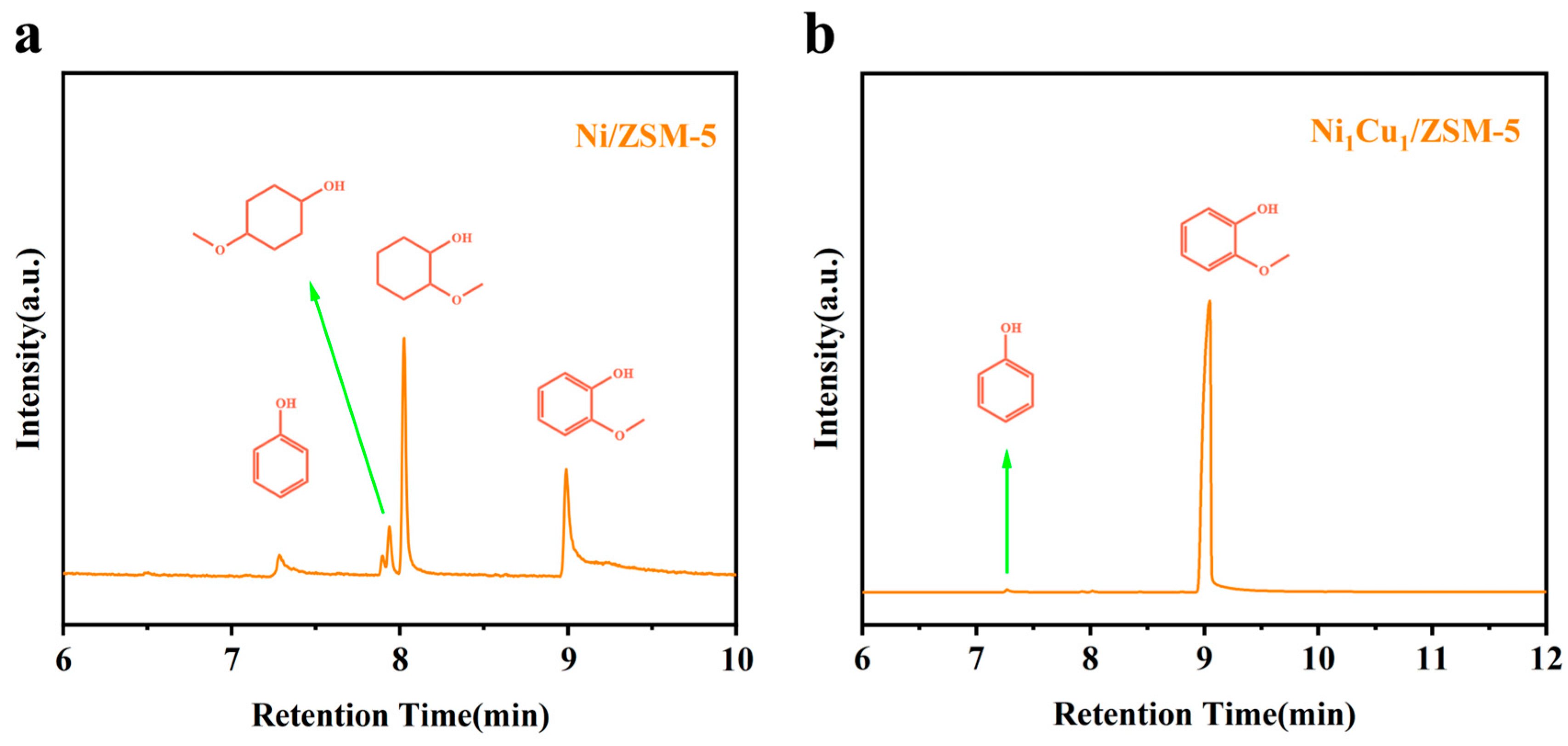
To directly evaluate and contrast the inherent hydrogenation and deoxygenation behaviors of the two catalysts, guaiacol was utilized as a representative model compound under controlled conditions (Figure 10). This probe reaction specifically measures a catalyst’s relative tendency to saturate the aromatic ring versus to break the methoxy C-O bond. The outcomes correlate directly with the findings from actual lignin processing. Using the monometallic Ni/ZSM-5 catalyst, guaiacol conversion was 60.3%, with the product spectrum heavily favoring saturated cyclohexane derivatives. This indicates the dominant, non-selective hydrogenation character of Ni, which preferentially saturates the aromatic ring and promotes full deoxygenation.
Conversely, the Ni1Cu1/ZSM-5 catalyst demonstrated distinctly different performance, yielding a significantly lower guaiacol conversion of 6.2% under the same parameters. This minimal conversion, coupled with the lack of hydrocarbon formation, offers strong and direct evidence for its inherently restrained hydrogenation capacity. The Ni-Cu alloy sites, although capable of initial substrate activation, present a substantially higher kinetic barrier for hydrogenating the stable aromatic ring in phenolic compounds compared to pure Ni sites.
Together, the temporal study and model compound experiments construct a consistent mechanistic understanding. The enhanced phenolic selectivity of Ni1Cu1/ZSM-5 in lignin valorization originates from its discriminatory catalytic function. It provides adequate hydrogenolysis activity to fragment lignin into phenolic monomers but introduces a considerable kinetic constraint on subsequent steps that would otherwise hydrogenate the aromatic ring or promote extensive hydrodeoxygenation to arenes. The monometallic Ni/ZSM-5 catalyst lacks this discernment; its pronounced and abundant hydrogen adsorption leads to rapid over-hydrogenation and consumption of the target phenolic products, explaining its inferior selectivity.

3. Materials and Methods

3.1. Material and Lignin Extraction

All chemicals were used as received without further purification, unless otherwise stated. Nickel nitrate hexahydrate (Ni(NO3)2·6H2O, purity: ≥98.5%), copper nitrate hexahydrate (Cu(NO3)2·6H2O, purity: ≥98.5%), aluminum sulfate octadecahydrate (Al2(SO4)3·18H2O, purity: ≥99.5%), tetrapropylammonium hydroxide (TPAOH, purity: 40 wt% in water), silicon dioxide (SiO2, purity: ≥99.5%) and sodium silicate (purity: Na2O ≥ 18.0%, SiO2 ≥ 60.0%) were purchased from Macklin Chemical Reagent Co., Ltd. Shanghai, China. Anhydrous sodium carbonate (Na2CO3, purity: ≥99.5%), sodium hydroxide (NaOH, purity: ≥98.0%), anhydrous ethanol (C2H5OH, purity: ≥99.5%), and ethyl acetate (CH3COOCH2CH3, purity: ≥99.5%) were sourced from Aladdin Industrial Corporation, Shanghai, China.

3.2. Catalyst Preparation

The ZSM-5 molecular sieve was synthesized using a solvent-free method. Briefly, 1.5 g of sodium silicate, 0.65 g of aluminum sulfate octadecahydrate (Al2(SO4)3·18H2O), 1.35 g of silicon dioxide (SiO2), and 15 mL of tetrapropylammonium hydroxide (TPAOH) were accurately weighed and added into an agate mortar. The mixture was thoroughly ground for 60 min to ensure complete homogenization. Subsequently, the homogenized solid was transferred into a stainless-steel autoclave lined with polytetrafluoroethylene (PTFE) and crystallized at 180 °C for 13 h under autogenous pressure. After crystallization, the resulting solid was repeatedly washed with deionized water until the filtrate reached neutral pH (pH = 7), followed by vacuum filtration. The filtered solid was dried in a vacuum oven at 60 °C for 12 h to obtain a white powder. Finally, the powder was calcined in a muffle furnace at 500 °C for 5 h in air atmosphere to remove the template agent, yielding the target ZSM-5 molecular sieve.
Preparation of NiCu/ZSM-5 catalysts. NiCu catalysts with varying (Ni:Cu) molar ratios (1:0, 1:1, 1:2, 2:1 and 0:1) were synthesized via a co-precipitation method with a total metal molar amount of 30 mmol. Typically, a calculated amount of nickel nitrate hexahydrate (Ni(NO3)2·6H2O) and copper nitrate trihydrate (Cu(NO3)2·3H2O) was weighed and dissolved in distilled water, followed by stirring until complete dissolution to obtain a mixed metal salt solution. This solution was added dropwise to 100 mL of an aqueous ZSM-5 suspension. The pH of the mixture was adjusted to 10 using a mixed solution of NaOH and Na2CO3. The resulting mixture was stirred in a water bath at 70 °C for 3 h to ensure complete precipitation of metal ions, followed by aging for 5 h. The precipitate was collected by suction filtration and washed with distilled water until the washings reached pH 7. The filtered cake was then transferred to an evaporating dish and dried under vacuum at 60 °C for 12 h. Finally, the precursors were calcined in a muffle furnace (KSL-1100X-S, Hefei Kejing Materials Technology Co., Ltd., Hefei, China) at 400 °C for 4 h and subsequently reduced in a tube furnace (OTF-1200X-S, Hefei Kejing Materials Technology Co., Ltd., Hefei, China) at 450 °C for 4 h under a hydrogen atmosphere to obtain the NiCu/ZSM-5 catalysts.
The preparation of NiCu catalysts with different molar ratios was carried out as previously described, but without the addition of ZSM-5 support. The metal content was mixed according to the desired molar ratio.

3.3. Catalyst Characterizations

Scanning electron microscopy (SEM) was performed using an S-4800 SEM instrument (Hitachi High-Technologies Corporation, Tokyo, Japan). High resolution transmission electron microscopy (HRTEM) images were obtained on JEOL JEM-2011 (HR) microscope (JEOL Ltd., Tokyo, Japan) operating at 200 kV to examine the size and morphology of the nanoparticles. X-ray diffraction (XRD) patterns of the catalyst were collected at a Rigaku D/max 2500 X-ray diffractometer (Rigaku Corporation, Tokyo, Japan) employing Cu Kα (λ = 1.5406 Å) radiation (40 kV, 40 mA). X-ray photoelectron spectroscopy (XPS) measurements were performed on an ESCA Lab 250 (Thermo) spectrometer (Thermo Fisher Scientific, Waltham, MA, USA; Shanghai, China) with a monochromatic Al Kα (1486.6 eV) as the excitation source. The surface area, total pore volume, and pore size distribution of the catalyst were measured at −196 °C via nitrogen adsorption using a V-Sorb 2800P volumetric adsorption apparatus (Gold APP Instruments Corporation, Nanjing, China). High-quality N2 (>99.99%) was used for the adsorption test, and the catalysts were degassed at 150 °C for 12 h prior to analysis. The specific surface area was calculated using the Brunauer–Emmett–Teller (BET) method, while the pore size distributions were measured using Barrett–Joyner–Halenda (BJH) analysis based on the desorption branch of the isotherms.
Hydrogen temperature-programmed reduction (H2-TPR) and hydrogen temperature-programmed desorption (H2-TPD) analysis was performed using a Micromeritics Autochem II 2920 instrument (Micromeritics Instrument Corporation, Norcross, GA, USA). The specific pretreatment procedure was as follows: 50 mg of the sample was accurately weighed and loaded into the quartz reaction tube. The sample was first dried by heating from room temperature to 200 °C at a ramp rate of 10 °C/min, under a flow of high-purity helium (He) at a flow rate of 30–50 mL/min for 1 h to remove physisorbed moisture and impurities. After cooling to 50 °C, a 10% H2/Ar (v/v) mixture was introduced at a flow rate of 30–50 mL/min for 1 h to achieve complete hydrogen saturation of the catalyst surface. Subsequently, the gas stream was switched to pure argon (Ar) at 30–50 mL/min and purged for an additional hour h to remove weakly adsorbed hydrogen species. Finally, the temperature was increased to 800 °C at a heating rate of 10 °C/min under an argon atmosphere for desorption measurement, with the evolved gases monitored in real time by a thermal conductivity detector (TCD).
Thermogravimetric and differential scanning calorimetry analyses was conducted on a SDT Q600 instrument manufactured by Thermal Analysis Instruments, Inc. (New Castle, DE, USA). The test was performed under a nitrogen atmosphere with the following conditions: sample weight of 10 mg, nitrogen flow rate of 60 mL/min, and a temperature ramp from 30 °C to 800 °C at a heating rate of 10 °C/min. The actual loading of the various metals in the different catalysts was tested by Inductively Coupled Plasma-Optical Emission Spectrometer (ICP-OES, Agilent 5100, Santa Clara, CA, USA).

3.4. Catalyst Evaluation

The lignin hydrogenation experiments were carried out in a 100 mL stainless steel high-pressure reactor equipped with a magnetic stirrer (Dalian Sanling Power Electronic Equipment Factory, Dalian, China). The standard procedure was as follows: 200 mg of organosolv lignin, 100 mg of catalyst, and 30 mL of H2O were added to the reactor. The reactor was then sequentially purged with N2 and H2 for five cycles each to ensure the complete removal of air. Subsequently, the hydrogen pressure was adjusted to 2 MPa, and the reaction was carried out at 200 °C under continuous stirring at 400 rpm for 4 h. Upon completion of the reaction, the reactor was removed and rapidly cooled to room temperature via water cooling.
The hydrogenation products were classified into three phases: solid, liquid, and gas. Due to the negligible yield of gaseous products, the gas phase was not subjected to further analysis or discussion. After the completion of the reaction, the solid–liquid mixture was separated by centrifugation. The separated solid residue was then washed with ethyl acetate, extracted, dried, and weighed. This dried solid was calcined in a muffle furnace at 400 °C for 4 h and subsequently reduced in a tube furnace at 450 °C for 4 h under a hydrogen atmosphere prior to storage for subsequent catalytic cycle tests. The liquid product was extracted using ethyl acetate, and the resulting extract was filtered through a 0.22 μm organic syringe filter prior to analysis by gas chromatography–mass spectrometry (GC-MS).
Lignin conversion and product selectivity were calculated by the following equations:
Conversion = ( 1 mass   of   substrate   after   reaction mass   of   substrate   before   reaction )   ×   100 %
Selectivity = content   of   target   product content   of   total   product   ×   100 %
The phenol simulation experiment employed guaiacol as the model compound, using a water-ethanol mixture (1:1) as the solvent, with all other reaction conditions matching those for actual lignin. After reaction completion, the solid–liquid mixture was separated by centrifugation. The liquid-phase product underwent distillation and ethyl acetate extraction. The resulting extract was filtered through a 0.22 μm organic syringe filter before undergoing gas chromatography–mass spectrometry (GC-MS) analysis.

4. Conclusions

In summary, bimetallic NiCu/ZSM-5 catalysts were successfully prepared using a co-precipitation method on a ZSM-5 support. The influence of the Ni/Cu molar ratio, reaction temperature, and reaction duration on the hydrodeoxygenation of lignin was systematically examined, with a focus on catalytic synergy and recyclability. The Ni1Cu1/ZSM-5 catalyst demonstrated optimal performance, attaining 69.8% lignin conversion and 84.4% selectivity toward phenolic compounds under conditions of 260 °C, 2 MPa H2, and a 4 h reaction time. Furthermore, the catalyst exhibited high stability over eight consecutive cycles, with phenolic selectivity declining only marginally from 84.4% to 79.0%. In this system, the ZSM-5 support contributed acidic sites that promoted C-O bond cleavage and stabilized metal dispersion, while Cu moderated aromatic ring hydrogenation and Ni maintained hydrogenation activity, resulting in a synergistic optimization of the reaction pathway. This study provides a theoretical foundation for the valorization of biomass resources and proposes a direction for designing effective lignin hydrogenation catalysts.

Supplementary Materials

The following supporting information can be downloaded at: https://www.mdpi.com/article/10.3390/catal16010084/s1, Figure S1. XRD patterns of Ni1Cu1/ZSM-5, Ni1Cu2/ZSM-5 and Ni2Cu1/ZSM-5 catalysts. Figure S2. XPS C 1s spectra of Ni/ZSM-5, Ni1Cu1/ZSM-5, Cu/ZSM-5 catalysts. Figure S3. SEAD pattern of Ni1Cu1/ZSM-5 catalysts. Figure S4. SEM images of ZSM-5 and Ni. Figure S5. SEM images of (a), (b) Ni/ZSM-5 and (c), (d) Ni1Cu1/ZSM-5; (e) Elemental distribution SE images of Ni1Cu1/ZSM-5 catalyst; (f) N2 adsorption–desorption isotherms and (g) pore size distributions of ZSM-5, Ni/ZSM-5, and Ni1Cu1/ZSM-5. Figure S6. Cyclic GC-MS of Ni1Cu1/ZSM-5 catalyst during lignin hydrodeoxygenation reaction. Figure S7. Analysis of the cyclic performance of Ni/ZSM-5 catalyst in lignin hydrodeoxygenation reaction. Figure S8. (a) Ni/ZSM-5 and (b) Ni1Cu1/ZSM-5 after the reaction (TEM images). Figure S9. DSC curves of the fresh and spent Ni1Cu1/ZSM-5 catalysts. Figure S10. H2-TPR profiles of Ni, Ni/ZSM-5, Cu/ZSM-5, Ni1Cu1/ZSM-5, Ni1Cu2/ZSM-5 and Ni2Cu1/ZSM-5 catalysts. Table S1. ICP-OES results of Ni/ZSM-5, Ni1Cu1/ZSM-5, Cu/ZSM-5 catalysts. Table S2. Binding energy of different catalyst (Ni and Cu). Table S3. Textural analysis of ZSM-5, Ni/ZSM-5, Cu/ZSM-5 and Ni1Cu1/ZSM-5. Table S4. Lignin hydrogenation performance with different catalysts. Table S5. Effect of Ni/Cu molar ratios on the hydrogenation performance of NiCu/ZSM-5 catalysts. Table S6. Hydrodeoxygenation of Lignin to Phenolic Compounds over Various Metallic Catalysts. Table S7. Precursor weights of NiCu catalysts with different Ni/Cu molar ratios.

Author Contributions

Conceptualization, X.C.; performed the investigation and wrote the original draft, X.C., P.G. and W.Z.; performed the investigation and data curation, W.J. and Q.X.; performed data curation, F.M. and G.T.; performed the investigation, N.T.; supervision, performed the conceptualization and wrote, reviewed, and edited the final manuscript, H.W. and P.Z.; All authors have read and agreed to the published version of the manuscript.

Funding

This work is funded by Natural Science Foundation of Xinjiang (2022D01A173), National Natural Science Foundation of China (U23B6003), Xinjiang Uygur Autonomous Region Tianchi Talent Introduction Plan (TianChi Excellent Award for Young Doctoral Talents, 2223RSTTCYC), and High-Level Talent Cultivation Program of Xinjiang Agricultural University (2522GCCRC).

Data Availability Statement

All data will be made available as published and as requested through the corresponding author’s contacts.

Conflicts of Interest

The authors declare that they have no known competing financial interests or personal relationships that could have appeared to influence the work reported in this paper.

References

  1. Sulis, D.B.; Lavoine, N.; Sederoff, H.; Jiang, X.; Marques, B.M.; Lan, K.; Cofre-Vega, C.; Barrangou, R.; Wang, J.P. Advances in lignocellulosic feedstocks for bioenergy and bioproducts. Nat. Commun. 2025, 16, 1244. [Google Scholar] [CrossRef] [PubMed]
  2. Subbotina, E.; Rukkijakan, T.; Marquez-Medina, M.D.; Yu, X.; Johnsson, M.; Samec, J.S.M. Oxidative cleavage of C-C bonds in lignin. Nat. Chem. 2021, 13, 1118–1125. [Google Scholar] [CrossRef] [PubMed]
  3. Abdelaziz, O.Y.; Hulteberg, C.P. Lignin depolymerization under continuous-flow conditions: Highlights of recent developments. Chemsuschem 2020, 13, 4382–4384. [Google Scholar] [CrossRef] [PubMed]
  4. Wang, S.; Li, X.; Ma, R.; Song, G. Catalytic hydrogenolysis of lignin into serviceable products. Acc. Chem. Res. 2025, 58, 529–542. [Google Scholar] [CrossRef]
  5. Cheng, L.; Wang, S.; Lu, H.; Ye, J.; Xu, J.; Wang, K.; Jiang, J. Selective activation of C-C bonds in lignin model compounds and lignin for production of value-added chemicals. J. Bioresour. Bioprod. 2024, 9, 433–464. [Google Scholar] [CrossRef]
  6. Guan, J.; Khan, A.; Zhang, Y.; Zhou, Y.; Li, M.J.; Patria, R.D.; Leu, S. Strategic design principles for greener biorefineries: A substrate-process matrix emphasizing complete lignocellulose utilization from various biomass feedstocks. Green Chem. 2025, 27, 11581–11606. [Google Scholar] [CrossRef]
  7. Ambursa, M.M.; Juan, J.C.; Yahaya, Y.; Taufiq-Yap, Y.H.; Lin, Y.-C.; Lee, H.V. A review on catalytic hydrodeoxygenation of lignin to transportation fuels by using nickel-based catalysts. Renew. Sustain. Energy Rev. 2021, 138, 110667. [Google Scholar] [CrossRef]
  8. Ji, N.; Ri, P.; Diao, X.; Rong, Y.; Kim, C. Supported transition metal (Mo, W) carbide and nitride catalysts for lignin hydrodeoxygenation: Interplay of supports, structure, and catalysis. Catal. Sci. Technol. 2023, 13, 2618–2637. [Google Scholar] [CrossRef]
  9. Feng, Y.; Shen, L.; Zhang, W.; Yuan, X.; Zhu, M.; Xu, J. Elucidating the structure-activity relationship of the bimetallic Ni-Cu catalysts for CO2 hydrogenation. J. CO2 Util. 2024, 80, 102683. [Google Scholar] [CrossRef]
  10. Zhang, J.; Wang, T.; Shi, C.; Pan, L.; Zhang, X.; Peng, C.; Zou, J. Achieving super dispersed metallic nickel nanoparticles over MCM-41 for highly active and stable hydrogenation of olefins and aromatics. Chem. Eng. J. 2023, 470, 144197. [Google Scholar] [CrossRef]
  11. Yao, Z.; Zhao, Y.; Wang, X.; Ma, Z.; Ji, X.; Han, Y. High-value conversion of biomass-derived chemicals by in situ construction of Ni(OH)2/CeVO4@NF catalysts enriched with oxygen vacancies. Small 2025, 21, e07751. [Google Scholar] [CrossRef] [PubMed]
  12. Shi, Y.; Xing, E.; Zhang, J.; Xie, Y.; Zhao, H.; Sheng, Y.; Cao, H. Temperature-dependent selectivity of hydrogenation/hydrogenolysis during phenol conversion over Ni catalysts. Acs Sustain. Chem. Eng. 2019, 7, 9464–9473. [Google Scholar] [CrossRef]
  13. Zhang, B.; Liu, J.; Xia, L.; Wang, J.; Zhao, P.; Lu, Y.; Huang, X.; Wei, Y. Unraveling the metal-acid site cooperation in organic acid-modified NiPd/Al(PO3)3 for the selective cleavage of C-O bridged bonds in lignin to produce aromatic monomers. Acs Sustain. Chem. Eng. 2025, 13, 11202–11215. [Google Scholar] [CrossRef]
  14. Wang, B.; Huang, J.; Wu, H.; Yan, X.; Liao, Y.; Li, H. Synergy of heterogeneous Co/Ni dual atoms enabling selective C-O bond scission of lignin coupling with in-situ N-functionalization. J. Energy Chem. 2024, 92, 16–25. [Google Scholar] [CrossRef]
  15. Yin, P.; Meng, H.; Wang, L.; Lai, Y.; Jie, Y.; Yu, J.; Liu, W.; Zhao, X.; Shen, T.; Zhang, X.; et al. Theoretical and experimental exploration of NiM(111) (M = Fe, Co, Cu, Zn) bimetallic catalysts for the water-gas shift reaction. J. Mater. Chem. A 2022, 10, 16610–16619. [Google Scholar] [CrossRef]
  16. Liu, S.; Chen, Y.; Chen, C.; Wu, Y.; Du, J.; Feng, X.; Wu, Q.; Qi, P.; Wang, H.; Ren, N.; et al. From single-atom catalysis to dual-atom catalysis: A comprehensive review of their application in advanced oxidation processes. Sep. Purif. Technol. 2024, 351, 127989. [Google Scholar] [CrossRef]
  17. Zhou, L.; Zhu, Z.; Luo, B.; He, Y.; Shu, R.; Tian, Z.; Wang, C. Bimetallic NiCo catalyzed enzymatic hydrolysis lignin hydrogenolysis to produce aromatic monomers. Fuel 2023, 333, 126357. [Google Scholar] [CrossRef]
  18. Kong, L.; Zhang, L.; Gu, J.; Gou, L.; Xie, L.; Wang, Y.; Dai, L. Catalytic hydrotreatment of kraft lignin into aromatic alcohols over nickel-rhenium supported on niobium oxide catalyst. Bioresour. Technol. 2020, 299, 122582. [Google Scholar] [CrossRef]
  19. Verma, D.; Insyani, R.; Cahyadi, H.S.; Park, J.; Kim, S.M.; Cho, J.M.; Bae, J.W.; Kim, J. Ga-doped Cu/H-nanozeolite-y catalyst for selective hydrogenation and hydrodeoxygenation of lignin-derived chemicals. Green Chem. 2018, 20, 3253–3270. [Google Scholar] [CrossRef]
  20. Zhao, C.; Lercher, J.A. Upgrading pyrolysis oil over Ni/HZSM-5 by cascade reactions. Angew. Chem. Int. Edit 2012, 51, 5935–5940. [Google Scholar] [CrossRef]
  21. Guo, D.; Wang, S.; Dong, S.; Feng, J.; Pan, H. ZrO2 promoted the depolymerization of lignin into phenolic monomers over 15Ni/SiO2-Al2O3-ZrO2 catalyst. Acs Sustain. Chem. Eng. 2024, 12, 14153–14163. [Google Scholar] [CrossRef]
  22. Lu, X.; Wang, D.; Guo, H.; Xiu, P.; Chen, J.; Qin, Y.; Robin, H.M.; Xu, C.; Zhang, X.; Gu, X. Insights into depolymerization pathways and mechanism of alkali lignin over a Ni1.2-ZrO2/WO3/γ-Al2O3 catalyst. Chin. J. Chem. Eng. 2022, 48, 191–201. [Google Scholar] [CrossRef]
  23. Wang, H.; Pu, Y.; Ragauskas, A.; Yang, B. From lignin to valuable products-strategies, challenges, and prospects. Bioresour. Technol. 2019, 271, 449–461. [Google Scholar] [CrossRef] [PubMed]
  24. Hu, L.; Wu, J.; Wei, X.-Y.; Yu, C.; Li, L.; Li, L. Reaction synergy of RuFe bimetallic catalysts on mordenite in lignin hydrogenolysis for aromatic compounds production. Sep. Purif. Technol. 2025, 359, 130643. [Google Scholar] [CrossRef]
  25. Liu, Z.-H.; Li, B.-Z.; Yuan, J.S.; Yuan, Y. Creative biological lignin conversion routes toward lignin valorization. Trends Biotechnol. 2022, 40, 1550–1566. [Google Scholar] [CrossRef]
  26. Wang, F.; Yang, S.; Fan, R.; Yan, H.; Zhao, H.; Liu, Y.; Chen, X.; Yang, C. Atomic pt in Ni cluster promoted hydrogen spillover for enhanced α,β-unsaturated aldehydes hydrogenation. Mol. Catal. 2025, 576, 114925. [Google Scholar] [CrossRef]
  27. Tian, J.; Wu, J.; Lin, F.; Ma, Y.; Sun, Y. Defect engineering-regulated electron transfer of NiAl-MMO for catalyzing directed conversion of lignin into cyclohexanol-based chemicals. Acs Sustain. Chem. Eng. 2025, 13, 16884–16896. [Google Scholar] [CrossRef]
  28. Zeng, A.; Xu, B.; Lu, C.; Liu, Y.-Y.; Sun, Z.; Wang, A.; Wang, Y. Preparation of Ni-Cu-C composite catalysts prepared from mixed nickel and copper hydroxides for selective hydrogenation of 4-nitrophenol. Chem. Eng. J. 2024, 500, 156935. [Google Scholar] [CrossRef]
  29. Song, K.; Lu, M.; Xu, S.; Chen, C.; Zhan, Y.; Li, D.; Au, C.; Jiang, L.; Tomishige, K. Effect of alloy composition on catalytic performance and coke-resistance property of Ni-Cu/Mg(Al)O catalysts for dry reforming of methane. Appl. Catal. B-Environ. 2018, 239, 324–333. [Google Scholar] [CrossRef]
  30. Rutkowska, M.; Macina, D.; Mirocha-Kubień, N.; Piwowarska, Z.; Chmielarz, L. Hierarchically structured ZSM-5 obtained by desilication as new catalyst for DME synthesis from methanol. Appl. Catal. B-Environ. 2015, 174–175, 336–343. [Google Scholar] [CrossRef]
  31. Yang, Z.; Liu, Y.; Liu, D.; Meng, X.; Liu, C. Hydroisomerization of N-octane over bimetallic Ni-Cu/SAPO-11 catalysts. Appl. Catal. A-Gen. 2017, 543, 274–282. [Google Scholar] [CrossRef]
  32. Lin, Z.; Li, J.; Li, L.; Yu, L.; Li, W.; Yang, G. Manipulating the hydrogen evolution pathway on composition-tunable CuNi nanoalloys. J. Mater. Chem. A 2017, 5, 773–781. [Google Scholar] [CrossRef]
  33. Yu, L.; Song, M.; Williams, P.T.; Wei, Y. Alumina-supported spinel NiAl2O4 as a catalyst for re-forming pyrolysis gas. Ind. Eng. Chem. Res. 2019, 58, 11770–11778. [Google Scholar] [CrossRef]
  34. Rao, T.U.; Suchada, S.; Choi, C.; Machida, H.; Huo, Z.; Norinaga, K. Selective hydrogenation of furfural to tetrahydrofurfuryl alcohol in 2-butanol over an equimolar Ni-Cu-Al catalyst prepared by the co-precipitation method. Energy Convers. Manag. 2022, 265, 115736. [Google Scholar] [CrossRef]
  35. Chen, G.; She, P.; Han, J.; Li, J.; Tian, G.; Sun, Y.; Gao, Y.; Yang, G.; Diao, Z.; Guan, B.; et al. Structurally engineering multi-shell hollow zeolite single crystals via defect-directed oriented-kinetics transformation and their heterostructures for hydrodeoxygenation reaction. Angew. Chem. Int. Edit 2025, 64, e202424690. [Google Scholar] [CrossRef]
  36. Zeng, J.; Yao, Y.; Wang, F.; Gao, J.; Zhang, L.; Xu, G.; Zhong, Z.; Su, F. Enhanced CO2 methanation through electronic modification of Ru to Ni in Ni-Al hydrotalcite-derived catalysts. Green Energy Environ. 2025, 10, 1280–1294. [Google Scholar] [CrossRef]
  37. Chen, Y.; Fan, S.; Chen, J.; Deng, L.; Xiao, Z. Catalytic membrane nanoreactor with Cu-Agx bimetallic nanoparticles immobilized in membrane pores for enhanced catalytic performance. Acs Appl. Mater. Interfaces 2022, 14, 9106–9115. [Google Scholar] [CrossRef]
  38. Yao, F.; Liu, S.; Cui, H.; Lv, Y.; Zhang, Y.; Liu, P.; Hao, F.; Xiong, W.; Luo, H. Activated carbon supported non-noble bimetallic Ni-based catalysts for nitrocyclohexane hydrogenation to cyclohexanone oxime under mild conditions. Acs Sustain. Chem. Eng. 2021, 9, 3300–3315. [Google Scholar] [CrossRef]
  39. Faris, A.H.; Rahim, A.A.; Mohamad Ibrahim, M.N.; Hussin, M.H.; Alkurdi, A.M.; Salehabadi, A. Investigation of oil palm based kraft and auto-catalyzed organosolv lignin susceptibility as a green wood adhesives. Int. J. Adhes. Adhes. 2017, 74, 115–122. [Google Scholar] [CrossRef]
  40. Li, T.; Su, J.; Wang, H.; Wang, C.; Xie, W.; Wang, K. Catalytic hydropyrolysis of lignin using NiMo-doped catalysts: Catalyst evaluation and mechanism analysis. Appl. Energy 2022, 316, 119115. [Google Scholar] [CrossRef]
  41. Tran, M.H.; Phan, D.-P.; Nguyen, T.H.; Kim, H.B.; Kim, J.; Park, E.D.; Lee, E.Y. Catalytic hydrogenolysis of alkali lignin in supercritical ethanol over copper monometallic catalyst supported on a chromium-based metal-organic framework for the efficient production of aromatic monomers. Bioresour. Technol. 2021, 342, 125941. [Google Scholar] [CrossRef]
  42. Xue, Z.; Liu, Q.; Wang, G.; Sui, W.; Parvez, A.M.; Si, C. Mild catalytic transfer hydrogenolysis of lignin for efficient monophenol production over lignin-coordinated N-doped ultrafine Ni nanocluster catalyst. Fuel Process. Technol. 2023, 248, 107835. [Google Scholar] [CrossRef]
  43. Li, C.; Wang, Y.; Tang, Z.; Zhou, Z.; Qin, B.; Chen, M. The bifunctional active sites on carbon supported Fe-Mo bimetallic catalyst to improve kraft lignin liquefaction. Renew. Energy 2023, 219, 119503. [Google Scholar] [CrossRef]
  44. Yan, B.; Lin, X.; Chen, Z.; Cai, Q.; Zhang, S. Selective production of phenolic monomers via high efficient lignin depolymerization with a carbon based nickel-iron-molybdenum carbide catalyst under mild conditions. Bioresour. Technol. 2021, 321, 124503. [Google Scholar] [CrossRef] [PubMed]
  45. Ma, H.; Li, H.; Zhao, W.; Li, L.; Liu, S.; Long, J.; Li, X. Selective depolymerization of lignin catalyzed by nickel supported on zirconium phosphate. Green Chem. 2019, 21, 658–668. [Google Scholar] [CrossRef]
  46. Nguyen, T.S.; Le, M.T.; Nguyen, V.H. Mild hydrogenolysis of lignin model compound and organosolv lignin over non-noble bimetallic Ni-Fe/TiN catalyst. Biomass Bioenergy 2023, 174, 106821. [Google Scholar] [CrossRef]
  47. Ewuzie, R.N.; Genza, J.R.; Abdullah, A.Z. Activity and product distribution in Ni-Co and Ni-Cu catalyst-mediated lignin depolymerization into phenolic substances with isopropanol H-donating solvent. Environ. Sci. Pollut. Res. 2024, 31, 49727–49743. [Google Scholar] [CrossRef]
  48. Zeng, Z.; Xie, J.; Guo, Y.; Rao, R.; Chen, B.; Cheng, L.; Xie, Y.; Ouyang, X. Hydrogenolysis of lignin to produce aromatic monomers over FePd bimetallic catalyst supported on HZSM-5. Fuel Process. Technol. 2021, 213, 106713. [Google Scholar] [CrossRef]
  49. Gayubo, A.G.; Aguayo, A.T.; Atutxa, A.; Aguado, R.; Olazar, M.; Bilbao, J. Transformation of oxygenate components of biomass I confirm pyrolysis oil on a HZSM-5 zeolite. II. aldehydes, ketones, and acids. Ind. Eng. Chem. Res. 2004, 43, 2619–2626. [Google Scholar] [CrossRef]
  50. Vincent Sahayaraj, D.; Lusi, A.; Kohler, A.J.; Bateni, H.; Radhakrishnan, H.; Saraeian, A.; Shanks, B.H.; Bai, X.; Tessonnier, J. An effective strategy to produce highly amenable cellulose and enhance lignin upgrading to aromatic and olefinic hydrocarbons. Energy Environ. Sci. 2023, 16, 97–112. [Google Scholar] [CrossRef]
  51. Luo, B.; Tian, Z.; Shu, R.; Wang, C.; Chen, Y.; Liu, J.; Liao, Y. Highly stable biochar-encapsulated CoTi@BC nanocatalysts for lignin hydrogenolysis. J. Catal. 2025, 442, 115914. [Google Scholar] [CrossRef]
  52. Yang, F.; Libretto, N.J.; Komarneni, M.R.; Zhou, W.; Miller, J.T.; Zhu, X.; Resasco, D.E. Enhancement of M-cresol hydrodeoxygenation selectivity on Ni catalysts by surface decoration of MoOx species. Acs Catal. 2019, 9, 7791–7800. [Google Scholar] [CrossRef]
  53. Liu, J.; Li, C.; Yang, Y.; Chen, Y.; Chen, H.; Wang, X.; Yang, H. Hydrodeoxygenation of lignin-derived oxygenated aromatic compounds catalyzed by nano-floral hydrotalcite for the preparation of liquid-phase organic hydrogen carriers. Appl. Catal. B-Environ. 2025, 371, 125285. [Google Scholar] [CrossRef]
  54. Wu, J.; Liu, C.; Zhu, Y.; Song, X.; Wen, C.; Zhang, X.; Wang, C.; Ma, L. Understanding the geometric and electronic factors of PtNi bimetallic surfaces for efficient and selective catalytic hydrogenation of biomass-derived oxygenates. J. Energy Chem. 2021, 60, 16–24. [Google Scholar] [CrossRef]
  55. Liu, Z.; Yu, Y.; Liu, Y.; Ying, A.; Zhang, X.; Wang, Y. Unlocking birch lignin hydrocracking through tandem catalysis: Unraveling the role of moderate hydrogen spillover. Acs Catal. 2024, 14, 2115–2126. [Google Scholar] [CrossRef]
Figure 1. Schematic illustration of lignin HDO over Ni/ZSM-5 and NiCu/ZSM-5.
Catalysts 16 00084 g001
Figure 2. XRD patterns: (a) Full patterns of ZSM-5, Ni/ZSM-5, Cu/ZSM-5, and Ni1Cu1/ZSM-5; (b) Magnified patterns (2θ = 42–54°).
Catalysts 16 00084 g002
Figure 3. XPS spectra of different catalysts: (a) Ni 2p, and (b) Cu 2p.
Catalysts 16 00084 g003
Figure 4. TEM images and high-resolution TEM images and STEM-EDS linear-scan: (ac), Ni/ZSM-5 and (df), Ni1Cu1/ZSM-5.
Catalysts 16 00084 g004
Figure 5. (a) Catalytic hydrogenation performance of Ni/ZSM-5 and Ni1Cu1/ZSM-5; (b) Effect of reaction temperature on lignin hydrogenation over the Ni1Cu1/ZSM-5 catalyst; (c) Comparison of lignin hydrogenation performance between Ni1Cu1/ZSM-5 and other reported excellent catalysts at 260 °C. Reaction conditions: 100 mg catalyst, 200 mg lignin, 30 mL H2O, 2 MPa H2, 400 rpm, 4 h.
Catalysts 16 00084 g005
Figure 6. (a) Recyclability of Ni1Cu1/ZSM-5 catalyst for the hydrodeoxygenation of lignin and (b) XRD patterns of the fresh and used catalyst. Reaction conditions: 100 mg catalyst, 200 mg lignin, 30 mL H2O, 2 MPa H2, 400 rpm, 260 °C, 4 h.
Catalysts 16 00084 g006
Figure 7. TG analysis of (a) fresh Ni1Cu1/ZSM-5 catalyst and (b) spent Ni1Cu1/ZSM-5 catalyst after hydrogenation reaction.
Catalysts 16 00084 g007
Figure 8. (a) H2-TPR profiles and (b) H2-TPD profiles of Ni/ZSM-5 and Ni1Cu1/ZSM-5.
Catalysts 16 00084 g008
Figure 9. Optimization of reaction parameters in lignin HDO reaction including (a) Reaction time and (b) hydrogen pressure. Reaction conditions: 100 mg catalyst, 200 mg lignin, 30 mL H2O, 400 rpm, 260 °C.
Catalysts 16 00084 g009
Figure 10. Catalytic Hydrodeoxygenation Performance of different catalysts for guaiacol hydrogenation: (a) Ni/ZSM-5; (b) Ni1Cu1/ZSM-5. Reaction conditions: 50 mg catalyst, 100 mg guaiacol, 30 mL H2O, 2 MPa H2, 400 rpm, 260 °C, 4 h.
Catalysts 16 00084 g010
Disclaimer/Publisher’s Note: The statements, opinions and data contained in all publications are solely those of the individual author(s) and contributor(s) and not of MDPI and/or the editor(s). MDPI and/or the editor(s) disclaim responsibility for any injury to people or property resulting from any ideas, methods, instructions or products referred to in the content.