Skip Content
You are currently on the new version of our website. Access the old version .

Toxins, Volume 13, Issue 4

2021 April - 61 articles

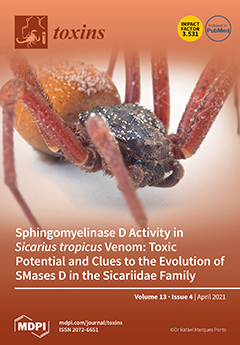
Cover Story: The spider family Sicariidae includes Hexophthalma, Sicarius and Loxosceles genera. Their venoms share a common feature: the presence of Sphingomyelinases D. SMases D are also found in bacteria, ticks and fungi. The bacterial and spider SMases D are functionally similar and considered to have originated from a common ancestor. There are different hypotheses about the evolutionary history of SMases D enzymes, but few studies take into account the similarity or differences in the induction mechanism of effects provoked by SMases D. In this study, Sicarius tropicus and L. laeta venoms were compared regarding the presence and activity of SMases D. Results showed that S. tropicus venom has active SMases D capable of causing cell death and hemolysis dependent on complement system, which, in its induction mechanism, is similar to the one present in bacteria. View this paper
  • Issues are regarded as officially published after their release is announced to the table of contents alert mailing list .
  • You may sign up for email alerts to receive table of contents of newly released issues.
  • PDF is the official format for papers published in both, html and pdf forms. To view the papers in pdf format, click on the "PDF Full-text" link, and use the free Adobe Reader to open them.

Articles (61)

  • Article
  • Open Access
10 Citations
4,533 Views
15 Pages

20 April 2021

Snake venom phospholipases A2 (PLA2s) have sequences and structures very similar to those of mammalian group I and II secretory PLA2s, but they possess many toxic properties, ranging from the inhibition of coagulation to the blockage of nerve transmi...

  • Article
  • Open Access
8 Citations
3,570 Views
12 Pages

Vasoactive Effects of Acute Ergot Exposure in Sheep

  • Rossalin Yonpiam,
  • Jair Gobbet,
  • Ashok Jadhav,
  • Kaushik Desai,
  • Barry Blakley and
  • Ahmad Al-Dissi

20 April 2021

Ergotism is a common and increasing problem in Saskatchewan’s livestock. Chronic exposure to low concentrations of ergot alkaloids is known to cause severe arterial vasoconstriction and gangrene through the activation of adrenergic and serotonergic r...

  • Review
  • Open Access
70 Citations
8,889 Views
21 Pages

20 April 2021

Climate change (CC) is predicted to increase the risk of aflatoxin (AF) contamination in maize, as highlighted by a project supported by EFSA in 2009. We performed a comprehensive literature search using the Scopus search engine to extract peer-revie...

  • Article
  • Open Access
37 Citations
5,861 Views
16 Pages

Effects of Polystyrene Microplastics on Growth and Toxin Production of Alexandrium pacificum

  • Chao Liu,
  • Jiangbing Qiu,
  • Zhixuan Tang,
  • Hong Hu,
  • Fanping Meng and
  • Aifeng Li

20 April 2021

Microplastics (MP) widely distributed in aquatic environments have adverse effects on aquatic organisms. Currently, the impact of MP on toxigenic red tide microalgae is poorly understood. In this study, the strain of Alexandrium pacificum ATHK, typic...

  • Article
  • Open Access
39 Citations
4,196 Views
16 Pages

In Vitro Mechanism Assessment of Zearalenone Removal by Plant-Derived Lactobacillus plantarum BCC 47723

  • Saowalak Adunphatcharaphon,
  • Awanwee Petchkongkaew and
  • Wonnop Visessanguan

19 April 2021

Zearalenone (ZEA) is a harmful secondary fungal metabolite, produced primarily by plant pathogenic fungi mostly belonging to the genus Fusarium. It is involved in reproductive disorders in animals since its structure is similar to the estrogen hormon...

  • Article
  • Open Access
11 Citations
3,964 Views
14 Pages

19 April 2021

Binary toxin (Bin toxin), BinA and BinB, produced by Lysinibacillus sphaericus has been used as a mosquito-control agent due to its high toxicity against the mosquito larvae. The crystal structures of Bin toxin and non-insecticidal but cytotoxic para...

  • Concept Paper
  • Open Access
20 Citations
7,165 Views
13 Pages

Protection of Residual Renal Function and Nutritional Treatment: First Step Strategy for Reduction of Uremic Toxins in End-Stage Kidney Disease Patients

  • Adamasco Cupisti,
  • Piergiorgio Bolasco,
  • Claudia D’Alessandro,
  • Domenico Giannese,
  • Alice Sabatino and
  • Enrico Fiaccadori

19 April 2021

The retention of uremic toxins and their pathological effects occurs in the advanced phases of chronic kidney disease (CKD), mainly in stage 5, when the implementation of conventional thrice-weekly hemodialysis is the prevalent and life-saving treatm...

  • Article
  • Open Access
18 Citations
7,172 Views
27 Pages

Differentiation, Quantification and Identification of Abrin and Abrus precatorius Agglutinin

  • Sylvia Worbs,
  • Bettina Kampa,
  • Martin Skiba,
  • Eva-Maria Hansbauer,
  • Daniel Stern,
  • Hervé Volland,
  • François Becher,
  • Stéphanie Simon,
  • Martin B. Dorner and
  • Brigitte G. Dorner

18 April 2021

Abrin, the toxic lectin from the rosary pea plant Abrus precatorius, has gained considerable interest in the recent past due to its potential malevolent use. However, reliable and easy-to-use assays for the detection and discrimination of abrin from...

  • Article
  • Open Access
4 Citations
3,143 Views
15 Pages

Activity of Some Plant and Fungal Metabolites towards Aedes albopictus (Diptera, Culicidae)

  • Sonia Ganassi,
  • Marco Masi,
  • Pasqualina Grazioso,
  • Antonio Evidente and
  • Antonio De Cristofaro

18 April 2021

Aedes albopictus (Skuse) is a widespread mosquito, a vector of important human arboviruses, including Chikungunya, Dengue and Zika. It is an extremely difficult species to control even for the onset of resistances to chemicals insecticides, therefore...

  • Review
  • Open Access
77 Citations
11,888 Views
23 Pages

17 April 2021

Aflatoxins are poisonous carcinogens produced by fungi, mainly Aspergillus flavus and Aspergillus parasiticus. Aflatoxins can contaminate a variety of livestock feeds and cause enormous economic losses, estimated at between US$52.1 and US$1.68 billio...

  • Review
  • Open Access
107 Citations
28,318 Views
20 Pages

Muscle Tone Physiology and Abnormalities

  • Jacky Ganguly,
  • Dinkar Kulshreshtha,
  • Mohammed Almotiri and
  • Mandar Jog

16 April 2021

The simple definition of tone as the resistance to passive stretch is physiologically a complex interlaced network encompassing neural circuits in the brain, spinal cord, and muscle spindle. Disorders of muscle tone can arise from dysfunction in thes...

  • Article
  • Open Access
52 Citations
6,314 Views
21 Pages

15 April 2021

Rice bran, a by-product of the rice milling process, has emerged as a functional food and being used in formulation of healthy food and drinks. However, rice bran is often contaminated with numerous mycotoxins. In this study, a method to simultaneous...

  • Article
  • Open Access
7 Citations
6,722 Views
11 Pages

Effectiveness of Training and Use of Novasil Binder in Mitigating Aflatoxins in Cow Milk Produced in Smallholder Farms in Urban and Periurban Areas of Kenya

  • Gladys Anyango,
  • Irene Kagera,
  • Florence Mutua,
  • Peter Kahenya,
  • Florence Kyallo,
  • Pauline Andang’o,
  • Delia Grace and
  • Johanna F. Lindahl

15 April 2021

Aflatoxins, which commonly contaminate animal feeds and human food, present a major public health challenge in sub-Saharan Africa. After ingestion by cows, aflatoxin B1 is metabolized to aflatoxin M1 (AFM1), some of which is excreted in milk. This st...

  • Article
  • Open Access
13 Citations
4,217 Views
8 Pages

Changes in Muscle Mass after Botulinum Toxin Injection in Children with Spastic Hemiplegic Cerebral Palsy

  • Dongwoo Lee,
  • Jaewon Kim,
  • Ja-Young Oh,
  • Mi-Hyang Han,
  • Da-Ye Kim,
  • Ji-Hye Kang and
  • Dae-Hyun Jang

14 April 2021

We aimed to evaluate muscle mass changes after injection of botulinum toxin (BoNT) in children with spastic hemiplegic cerebral palsy (CP). Children aged between 2 and 12 years who were diagnosed with hemiplegic CP with spastic equinus foot were pros...

  • Article
  • Open Access
10 Citations
4,200 Views
15 Pages

Intravenous Vipera berus Venom-Specific Fab Fragments and Intramuscular Vipera ammodytes Venom-Specific F(ab’)2 Fragments in Vipera ammodytes-Envenomed Patients

  • Tihana Kurtović,
  • Svjetlana Karabuva,
  • Damjan Grenc,
  • Mojca Dobaja Borak,
  • Igor Križaj,
  • Boris Lukšić,
  • Beata Halassy and
  • Miran Brvar

14 April 2021

Vipera ammodytes (V. ammodytes) is the most venomous European viper. The aim of this study was to compare the clinical efficacy and pharmacokinetic values of intravenous Vipera berus venom-specific (paraspecific) Fab fragments (ViperaTAb) and intramu...

  • Article
  • Open Access
19 Citations
3,594 Views
17 Pages

Effects of a Low Dose of T-2 Toxin on the Percentage of T and B Lymphocytes and Cytokine Secretion in the Porcine Ileal Wall

  • Paweł Wojtacha,
  • Wojciech Trybowski,
  • Piotr Podlasz,
  • Magdalena Żmigrodzka,
  • Józef Tyburski,
  • Magdalena Polak-Śliwińska,
  • Ewa Jakimiuk,
  • Tadeusz Bakuła,
  • Mirosław Baranowski and
  • Kazimierz Obremski
  • + 2 authors

13 April 2021

Plant materials used in the production of pig feed are frequently contaminated with mycotoxins. T-2 toxin is a secondary metabolite of selected Fusarium species, and it can exert a harmful influence on living organisms. Most mycotoxins enter the body...

  • Review
  • Open Access
59 Citations
6,575 Views
10 Pages

12 April 2021

Our climate is projected to change gradually over time. Mycotoxin occurrence in cereal grains is both directly and indirectly related to local weather and to climate changes. Direct routes are via the effects of precipitation, relative humidity, and...

  • Article
  • Open Access
29 Citations
4,482 Views
15 Pages

Bergamottin and 5-Geranyloxy-7-methoxycoumarin Cooperate in the Cytotoxic Effect of Citrus bergamia (Bergamot) Essential Oil in Human Neuroblastoma SH-SY5Y Cell Line

  • Alessandro Maugeri,
  • Giovanni Enrico Lombardo,
  • Laura Musumeci,
  • Caterina Russo,
  • Sebastiano Gangemi,
  • Gioacchino Calapai,
  • Santa Cirmi and
  • Michele Navarra

10 April 2021

The plant kingdom has always been a treasure trove for valuable bioactive compounds, and Citrus fruits stand out among the others. Bergamottin (BRG) and 5-geranyloxy-7-methoxycoumarin (5-G-7-MOC) are two coumarins found in different Citrus species wi...

  • Review
  • Open Access
33 Citations
6,431 Views
17 Pages

Contribution of Gut Microbiota-Derived Uremic Toxins to the Cardiovascular System Mineralization

  • Iwona Filipska,
  • Agata Winiarska,
  • Monika Knysak and
  • Tomasz Stompór

10 April 2021

Chronic kidney disease (CKD) affects more than 10% of the world population and leads to excess morbidity and mortality (with cardiovascular disease as a leading cause of death). Vascular calcification (VC) is a phenomenon of disseminated deposition o...

  • Article
  • Open Access
8 Citations
4,032 Views
12 Pages

Characterization of the Exo-Metabolome of the Emergent Phytopathogen Fusarium kuroshium sp. nov., a Causal Agent of Fusarium Dieback

  • Angélica Gutiérrez-Sánchez,
  • Javier Plasencia,
  • Juan L. Monribot-Villanueva,
  • José B. Rodríguez-Haas,
  • Jose Abel López-Buenfil,
  • Clemente J. García-Ávila,
  • Eliel Ruiz-May,
  • Diana Sánchez-Rangel and
  • José A. Guerrero-Analco

9 April 2021

Fusarium kuroshium is the fungal symbiont associated with the ambrosia beetle Euwallacea kuroshio, a plague complex that attacks avocado, among other hosts, causing a disease named Fusarium dieback (FD). However, the contribution of F. kuroshium to t...

  • Article
  • Open Access
21 Citations
3,151 Views
8 Pages

9 April 2021

Breast reconstruction after mastectomy is commonly performed using transverse rectus abdominis myocutaneous (TRAM) flap. Previous studies have demonstrated that botulinum neurotoxin injections in TRAM flap surgeries lower the risk of necrosis and all...

  • Article
  • Open Access
6 Citations
6,713 Views
16 Pages

Morphological Analysis Reveals a Compartmentalized Duct in the Venom Apparatus of the Wasp Spider (Argiope bruennichi)

  • Henrike Schmidtberg,
  • Björn M. von Reumont,
  • Sarah Lemke,
  • Andreas Vilcinskas and
  • Tim Lüddecke

9 April 2021

Spiders are one of the most successful groups of venomous animals, but surprisingly few species have been examined in sufficient detail to determine the structure of their venom systems. To learn more about the venom system of the family Araneidae (o...

  • Article
  • Open Access
42 Citations
5,078 Views
12 Pages

9 April 2021

Ochratoxin A (OTA) is a mycotoxin frequently found in raw and processed foods. While it is considered a possible human carcinogen, the mechanism of action remains unclear. OTA has been shown to be hepatotoxic in both in vitro and in vivo models and o...

  • Article
  • Open Access
6 Citations
3,346 Views
8 Pages

Internalization of Clostridium botulinum C2 Toxin Is Regulated by Cathepsin B Released from Lysosomes

  • Masahiro Nagahama,
  • Keiko Kobayashi,
  • Sadayuki Ochi and
  • Masaya Takehara

9 April 2021

Clostridium botulinum C2 toxin is a clostridial binary toxin consisting of actin ADP-ribosyltransferase (C2I) and C2II binding components. Activated C2II (C2IIa) binds to cellular receptors and forms oligomer in membrane rafts. C2IIa oligomer assembl...

  • Article
  • Open Access
9 Citations
2,889 Views
10 Pages

8 April 2021

Botulinum toxin type A (BoNT-A) injection patterns customized to each patient’s unique tremor characteristics produce better efficacy and lower adverse effects compared to the fixed-muscle-fixed-dose approach for Essential Tremor (ET) and Parkinson’s...

  • Article
  • Open Access
19 Citations
6,330 Views
19 Pages

Degradation of Multiple Peptides by Microcystin-Degrader Paucibacter toxinivorans (2C20)

  • Allan A. Santos,
  • Sylvia Soldatou,
  • Valeria Freitas de Magalhães,
  • Sandra M. F. O. Azevedo,
  • Dolores Camacho-Muñoz,
  • Linda A. Lawton and
  • Christine Edwards

8 April 2021

Since conventional drinking water treatments applied in different countries are inefficient at eliminating potentially toxic cyanobacterial peptides, a number of bacteria have been studied as an alternative to biological filters for the removal of mi...

  • Article
  • Open Access
12 Citations
4,445 Views
24 Pages

Innovative and Highly Sensitive Detection of Clostridium perfringens Enterotoxin Based on Receptor Interaction and Monoclonal Antibodies

  • Thea Neumann,
  • Maren Krüger,
  • Jasmin Weisemann,
  • Stefan Mahrhold,
  • Daniel Stern,
  • Martin B. Dorner,
  • Cécile Feraudet-Tarisse,
  • Christopher Pöhlmann,
  • Katharina Schulz and
  • Brigitte G. Dorner
  • + 6 authors

8 April 2021

Clostridium perfringens enterotoxin (CPE) regularly causes food poisoning and antibiotic-associated diarrhea; therefore, reliable toxin detection is crucial. To this aim, we explored stationary and mobile strategies to detect CPE either exclusively b...

  • Article
  • Open Access
8 Citations
3,422 Views
10 Pages

Analysis of Multiple Mycotoxins in the Qatari Population and Their Relation to Markers of Oxidative Stress

  • Belqes Al-Jaal,
  • Aishah Latiff,
  • Sofia Salama,
  • Huda Mohamed Hussain,
  • Noora Abdulaziz Al-Thani,
  • Noor Al-Naimi,
  • Noof Al-Qasmi,
  • Peter Horvatovich and
  • Morana Jaganjac

8 April 2021

Mycotoxins are naturally occurring food toxins worldwide that can cause serious health effects. The measurement of mycotoxin biomarkers in biological fluids is needed to assess individuals’ exposure. The aim of this study was to investigate the incid...

  • Communication
  • Open Access
13 Citations
3,267 Views
6 Pages

7 April 2021

The CRISPR-Cas13 system based on a bacterial enzyme has been explored as a powerful new method for RNA manipulation. Due to the high efficiency and specificity of RNA editing/interference achieved by this system, it is currently being developed as a...

  • Review
  • Open Access
34 Citations
5,466 Views
17 Pages

Ageritin from Pioppino Mushroom: The Prototype of Ribotoxin-Like Proteins, a Novel Family of Specific Ribonucleases in Edible Mushrooms

  • Sara Ragucci,
  • Nicola Landi,
  • Rosita Russo,
  • Mariangela Valletta,
  • Paolo Vincenzo Pedone,
  • Angela Chambery and
  • Antimo Di Maro

7 April 2021

Ageritin is a specific ribonuclease, extracted from the edible mushroom Cyclocybe aegerita (synonym Agrocybe aegerita), which cleaves a single phosphodiester bond located within the universally conserved alpha-sarcin loop (SRL) of 23–28S rRNAs. This...

  • Article
  • Open Access
6 Citations
3,488 Views
14 Pages

6 April 2021

Beauvericin (BEA) and deoxynivalenol are toxins produced by Fusarium species that can contaminate food and feed. The aim of this study was to assess the effects of these mycotoxins on the maturation of oocytes from gilts and sows. Furthermore, the an...

  • Review
  • Open Access
109 Citations
14,897 Views
65 Pages

Phytotoxic Secondary Metabolites from Fungi

  • Dan Xu,
  • Mengyao Xue,
  • Zhen Shen,
  • Xiaowei Jia,
  • Xuwen Hou,
  • Daowan Lai and
  • Ligang Zhou

6 April 2021

Fungal phytotoxic secondary metabolites are poisonous substances to plants produced by fungi through naturally occurring biochemical reactions. These metabolites exhibit a high level of diversity in their properties, such as structures, phytotoxic ac...

  • Article
  • Open Access
2 Citations
3,843 Views
14 Pages

Composition and Acute Inflammatory Response from Tetraponera rufonigra Venom on RAW 264.7 Macrophage Cells

  • Suwatjanee Naephrai,
  • Supakit Khacha-ananda,
  • Pornsiri Pitchakarn and
  • Churdsak Jaikang

3 April 2021

Tetraponera rufonigra (Arboreal Bicoloured Ant) venom induces pain, inflammation, and anaphylaxis in people and has an increased incident in Southeast Asia regions. The bioactive components and mechanism of action of the ant venom are still limited....

  • Article
  • Open Access
15 Citations
4,843 Views
13 Pages

Cyanotoxin Screening in BACA Culture Collection: Identification of New Cylindrospermopsin Producing Cyanobacteria

  • Rita Cordeiro,
  • Joana Azevedo,
  • Rúben Luz,
  • Vitor Vasconcelos,
  • Vítor Gonçalves and
  • Amélia Fonseca

3 April 2021

Microcystins (MCs), Saxitoxins (STXs), and Cylindrospermopsins (CYNs) are some of the more well-known cyanotoxins. Taking into consideration the impacts of cyanotoxins, many studies have focused on the identification of unknown cyanotoxin(s)-producin...

  • Article
  • Open Access
22 Citations
5,351 Views
23 Pages

Pharmaceutical Assessment Suggests Locomotion Hyperactivity in Zebrafish Triggered by Arecoline Might Be Associated with Multiple Muscarinic Acetylcholine Receptors Activation

  • Petrus Siregar,
  • Gilbert Audira,
  • Ling-Yi Feng,
  • Jia-Hau Lee,
  • Fiorency Santoso,
  • Wen-Hao Yu,
  • Yu-Heng Lai,
  • Jih-Heng Li,
  • Ying-Ting Lin and
  • Chung-Der Hsiao
  • + 1 author

3 April 2021

Arecoline is one of the nicotinic acid-based alkaloids, which is found in the betel nut. In addition to its function as a muscarinic agonist, arecoline exhibits several adverse effects, such as inducing growth retardation and causing developmental de...

  • Article
  • Open Access
6 Citations
5,646 Views
16 Pages

Sphingomyelinase D Activity in Sicarius tropicus Venom: Toxic Potential and Clues to the Evolution of SMases D in the Sicariidae Family

  • Priscila Hess Lopes,
  • Caroline Sayuri Fukushima,
  • Rosana Shoji,
  • Rogério Bertani and
  • Denise V. Tambourgi

1 April 2021

The spider family Sicariidae includes three genera, Hexophthalma, Sicarius and Loxosceles. The three genera share a common characteristic in their venoms: the presence of Sphingomyelinases D (SMase D). SMases D are considered the toxins that cause th...

  • Review
  • Open Access
104 Citations
8,478 Views
20 Pages

Zearalenone and the Immune Response

  • Cristina Valeria Bulgaru,
  • Daniela Eliza Marin,
  • Gina Cecilia Pistol and
  • Ionelia Taranu

31 March 2021

Zearalenone (ZEA) is an estrogenic fusariotoxin, being classified as a phytoestrogen, or as a mycoestrogen. ZEA and its metabolites are able to bind to estrogen receptors, 17β-estradiol specific receptors, leading to reproductive disorders which incl...

  • Opinion
  • Open Access
20 Citations
9,440 Views
17 Pages

Ergonomic Recommendations in Ultrasound-Guided Botulinum Neurotoxin Chemodenervation for Spasticity: An International Expert Group Opinion

  • Philippe Lagnau,
  • Alto Lo,
  • Ryan Sandarage,
  • Katharine Alter,
  • Alessandro Picelli,
  • Jorg Wissel,
  • Monica Verduzco-Gutierrez,
  • Areerat Suputtitada,
  • Michael C. Munin and
  • Rajiv Reebye
  • + 3 authors

31 March 2021

Ultrasound (US)-guided botulinum neurotoxin (BoNT) injections are becoming a mainstay in the treatment of muscle spasticity in upper motor neuron syndromes. As a result, there has been a commensurate increase in US-guided BoNT injection for spasticit...

  • Article
  • Open Access
25 Citations
3,884 Views
11 Pages

High Levels of Tetrodotoxin (TTX) in Trumpet Shell Charonia lampas from the Portuguese Coast

  • Pedro Reis Costa,
  • Jorge Giráldez,
  • Susana Margarida Rodrigues,
  • José Manuel Leão,
  • Estefanía Pinto,
  • Lucía Soliño and
  • Ana Gago-Martínez

31 March 2021

Tetrodotoxin (TTX) is a potent neurotoxin, considered an emerging toxin in Europe where recently a safety limit of 44 µg TTX kg−1 was recommended by authorities. In this study, three specimens of the large gastropod trumpet shell Charonia lampas boug...

  • Article
  • Open Access
33 Citations
5,353 Views
11 Pages

Effects of Light on the Ochratoxigenic Fungi Aspergillus ochraceus and A. carbonarius

  • Haiyong Zhang,
  • Gang Wang,
  • Qingli Yang,
  • Xu Yang,
  • Yongquan Zheng,
  • Yang Liu and
  • Fuguo Xing

31 March 2021

Ochratoxin A (OTA) usually contaminates agricultural products such as grapes, oatmeal, coffee and spices. Light was reported as an effective strategy to control spoilage fungi and mycotoxins. This research investigated the effects of light with diffe...

  • Review
  • Open Access
229 Citations
22,225 Views
23 Pages

The Impact of CKD on Uremic Toxins and Gut Microbiota

  • Jacek Rysz,
  • Beata Franczyk,
  • Janusz Ławiński,
  • Robert Olszewski,
  • Aleksanda Ciałkowska-Rysz and
  • Anna Gluba-Brzózka

31 March 2021

Numerous studies have indicated that the progression of chronic kidney disease (CKD) to end-stage renal disease (ESRD) is strictly associated with the accumulation of toxic metabolites in blood and other metabolic compartments. This accumulation was...

  • Article
  • Open Access
8 Citations
3,710 Views
19 Pages

Examination of the Efficacy and Cross-Reactivity of a Novel Polyclonal Antibody Targeting the Disintegrin Domain in SVMPs to Neutralize Snake Venom

  • Shelby S. Szteiter,
  • Ilse N. Diego,
  • Jonathan Ortegon,
  • Eliana M. Salinas,
  • Abcde Cirilo,
  • Armando Reyes,
  • Oscar Sanchez,
  • Montamas Suntravat,
  • Emelyn Salazar and
  • Jacob A. Galan
  • + 1 author

31 March 2021

Snake envenomation can result in hemorrhage, local necrosis, swelling, and if not treated properly can lead to adverse systemic effects such as coagulopathy, nephrotoxicity, neurotoxicity, and cardiotoxicity, which can result in death. As such, snake...

  • Article
  • Open Access
10 Citations
5,438 Views
13 Pages

The Crystal Structure of Bacillus cereus HblL1

  • Harley L. Worthy,
  • Lainey J. Williamson,
  • Husam Sabah Auhim,
  • Stephen H. Leppla,
  • Inka Sastalla,
  • D. Dafydd Jones,
  • Pierre J. Rizkallah and
  • Colin Berry

31 March 2021

The Hbl toxin is a three-component haemolytic complex produced by Bacillus cereus sensu lato strains and implicated as a cause of diarrhoea in B. cereus food poisoning. While the structure of the HblB component of this toxin is known, the structures...

  • Article
  • Open Access
9 Citations
3,629 Views
15 Pages

Optical Method and Biochemical Source for the Assessment of the Middle-Molecule Uremic Toxin β2-Microglobulin in Spent Dialysate

  • Joosep Paats,
  • Annika Adoberg,
  • Jürgen Arund,
  • Ivo Fridolin,
  • Kai Lauri,
  • Liisi Leis,
  • Merike Luman and
  • Risto Tanner

31 March 2021

Optical monitoring of spent dialysate has been used to estimate the removal of water-soluble low molecular weight as well as protein-bound uremic toxins from the blood of end stage kidney disease (ESKD) patients. The aim of this work was to develop a...

  • Article
  • Open Access
10 Citations
4,123 Views
14 Pages

Citrinin Determination in Food and Food Supplements by LC-MS/MS: Development and Use of Reference Materials in an International Collaborative Study

  • Emmanuel K. Tangni,
  • François Van Hove,
  • Bart Huybrechts,
  • Julien Masquelier,
  • Karine Vandermeiren and
  • Els Van Hoeck

30 March 2021

The development of incurred reference materials containing citrinin (CIT) and their successful application in a method validation study (MVS) in order to harmonize CIT determination in food and food supplements are demonstrated. CIT-contaminated mate...

  • Review
  • Open Access
56 Citations
5,948 Views
10 Pages

30 March 2021

Accumulation of uremic toxins represents one of the major contributors to the rapid progression of chronic kidney disease (CKD), especially in patients with end-stage renal disease that are undergoing dialysis treatment. In particular, protein-bound...

  • Article
  • Open Access
3 Citations
2,975 Views
13 Pages

30 March 2021

The suitability of a newly developed cell-based functional assay was tested for the detection of the activity of a range of neurotoxins and neuroactive pharmaceuticals which act by stimulation or inhibition of calcium-dependent neurotransmitter relea...

  • Communication
  • Open Access
10 Citations
3,091 Views
10 Pages

29 March 2021

Recent cell-based and animal experiments have demonstrated an effective reduction in botulinum neurotoxin A (BoNT/A) by copper. Aim: We aimed to analyze whether the successful symptomatic BoNT/A treatment of patients with Wilson’s disease (WD) corres...

of 2

Get Alerted

Add your email address to receive forthcoming issues of this journal.

XFacebookLinkedIn
Toxins - ISSN 2072-6651